


Peptide research · 8 min · 1,847 words
What a placebo arm is for
A placebo arm gets the same visits without the drug. In SURMOUNT-1 that group lost 3.1 percent at 72 weeks; tirzepatide 15 mg lost 20.9 percent. n is how many people the mean is standing on.
What this essay tells you
- A placebo arm gets the same visits and lifestyle advice without the drug. SURMOUNT-1 placebo lost 3.1 percent at 72 weeks. Tirzepatide 15 mg lost 20.9 percent.
- n is the headcount. SURMOUNT-1 randomised 2,539 people. STEP-1 randomised 1,961. The retatrutide 12 mg mean, −24.2 percent, stood on 62 people, so the interval is wider.
- The treatment-regimen number includes people who stopped. The efficacy number imagines they stayed, and it is larger. A before-and-after is neither. A research vial was not in the draw.
What this means
A placebo arm is the group who get the appointments and the lifestyle advice, but not the drug. In the tirzepatide obesity trial, that group lost about 3 percent in 72 weeks, and the 15 mg group lost about 21 percent. n is the number of people in the comparison: 2,539 in that trial, 1,961 in the semaglutide trial, and only 62 on the top dose of the earlier retatrutide study. A bigger n makes the range around the average tighter. One person's before-and-after is not a placebo arm.
A placebo arm is the control group in a randomised trial. Those people get the ritual of treatment — the visits, the pen or the injection, the weighing, often the same diet and activity counselling — and they do not get the drug. The point is subtraction. Whatever happens in both groups is the trial itself. Whatever happens only in the drug group is the thing the drug added. In the big obesity trials that number is not zero on the placebo side. In SURMOUNT-1 the placebo mean at 72 weeks was −3.1 percent. In STEP-1, at 68 weeks, it was −2.4 percent. The drug means sit next to those figures, or they are not means of a trial.
In short. The placebo group does everything except take the drug. They still lose some weight. The drug's number only means something next to that.
Why the placebo group loses weight
Nobody in these trials is sent home to do nothing. SURMOUNT-1, Jastreboff, Aronne, Ahmad and colleagues, New England Journal of Medicine, 2022, assigned 2,539 adults with obesity, and without diabetes, in a 1:1:1:1 ratio to tirzepatide 5, 10 or 15 mg, or placebo, for 72 weeks. STEP-1, Wilding and colleagues, New England Journal of Medicine, 2021, assigned 1,961 adults to semaglutide 2.4 mg or placebo for 68 weeks. Both programmes included a lifestyle intervention for every arm. People know they are in a study. They are weighed on a schedule. They talk to staff. Some of them would have lost weight that year anyway, and some who were unusually heavy on the morning of the baseline visit drift back toward their own average. That last one is regression to the mean, and it does not require a molecule.
In short. Both groups get the diet advice and the visits. Some of the loss would have happened anyway. The placebo number is that shared background.
Read the placebo percent as the background, then read the drug percent as background plus drug. In SURMOUNT-1 the treatment-regimen estimand — the average for everyone who was randomised, whether or not they stayed on the injections — was −15.0 percent at 5 mg (95 percent confidence interval −15.9 to −14.2), −19.5 percent at 10 mg (−20.4 to −18.5), and −20.9 percent at 15 mg (−21.8 to −19.9), against −3.1 percent on placebo (−4.3 to −1.9). About a third of the placebo group, 34.5 percent, still lost at least 5 percent of their body weight. A person can truthfully say the injections changed nothing and they lost weight. That person is already inside the placebo bar.
In short. On placebo, the average loss was about 3 percent, and about one in three people lost 5 percent or more. A success story can come from the group that did not get the drug.
Two questions, two percents
The same trial prints a second, larger set of means if you ask a different question. The treatment-regimen, or treatment-policy, estimand asks what happened to everyone you randomised, including people who stopped. The efficacy estimand asks what the difference would have been if everyone had stayed on the assigned treatment. In the SURMOUNT-1 figure the efficacy means at week 72 are about −16.0, −21.4 and −22.5 percent at 5, 10 and 15 mg, with the placebo line near −2.4 percent, beside the regimen numbers of −15.0, −19.5, −20.9 and −3.1. Neither set is a lie. They are answers to two questions. A screenshot that picks the larger one and never says which question it answered has changed the experiment.
In short. One number includes people who stopped the drug. The other imagines that everyone stayed on it. The second looks bigger. Say which one you are quoting.
STEP-1's treatment-policy mean at week 68 was −14.9 percent with semaglutide 2.4 mg and −2.4 percent with placebo, a difference of −12.4 percentage points (95 percent confidence interval −13.4 to −11.5). That is not a head-to-head against tirzepatide. Different years, different people, a different drug, a different clock. Putting −14.9 beside −20.9 and calling it a contest is how two good papers become one bad sentence. The GIP page walks the chemistry. This page is only the comparison that makes the percent mean something.
In short. Semaglutide's trial and tirzepatide's trial were not the same experiment. You can put the papers next to each other. You cannot pretend they were one race.
What n is
n is the count of people behind the sentence. SURMOUNT-1's n is 2,539 randomised, split four ways, so each arm is on the order of six hundred. STEP-1 started with 1,306 assigned to semaglutide and 655 to placebo. The retatrutide Phase 2, Jastreboff and colleagues, New England Journal of Medicine, 2023, randomised 338 adults. The 12 mg mean at 48 weeks was −24.2 percent, and the interval around it ran from −26.6 to −21.8, with 62 people on that dose and the placebo mean at −2.1 percent. Look at the width. The Phase 3 interval around −20.9 percent is about two points from end to end. The Phase 2 interval around −24.2 percent is about eight. A mean can be dramatic and still be standing on a small platform. n is the platform.
In short. n is how many people were counted. Hundreds of people make a narrow band around the average. Sixty people make a wide one. The average can be large either way.
A p-value is not that platform, and it is not the weight change. P less than 0.001 means the difference was unlikely if the drug had done nothing, under the model the statisticians wrote down. It does not mean the effect was large. A tiny difference becomes 'significant' if you recruit enough people, and a large difference in forty people can fail a test because the bar is wide. Quote the percent, the interval, the n, and the placebo. If the sentence still needs a p-value after that, it is a footnote, not the result.
In short. Significant does not mean large. The size is the percent, next to placebo, with the range and the headcount.
- The background
- −3.1%
- The drug, everyone randomised
- −20.9%
- The other question
- −22.5%
- The small platform
- n = 62
SURMOUNT-1 placebo at 72 weeks. Same visits, no drug. Interval −4.3 to −1.9.
Tirzepatide 15 mg, treatment-regimen. Includes people who stopped. Interval −21.8 to −19.9.
Efficacy estimand if treatment had continued as planned. A different question, not a correction.
Retatrutide 12 mg in the Phase 2. Mean −24.2%, interval about eight points wide.
Blinding, and when the body gives it away
Double-blind means the participant and the study staff are not told the assignment. It does not mean nobody can guess. Nausea, a slower stomach, and a belt that needs a new hole are information. In these trials a lot of people work out which arm they are in, and some of the staff can guess too. That is functional unblinding. It is a real crack in the design, and it is why symptoms that depend on belief — energy, mood, how hard the diet felt — are softer than the number on the scale. The scale is still the better object, because a kilogram is a kilogram. The placebo arm does not repair the crack. It keeps the visits and the counselling matched, so the crack is not the whole story.
In short. People often guess which injection they got, because they feel sick or they lose more weight. The placebo group still matters, because they had the same appointments.
One person's photograph is not an arm
A before-and-after is n of one, with no coin toss, no concealed assignment, and no pre-written rule for which photograph gets posted. The weeks when nothing happened are missing. The placebo rate you just read says that roughly one in three people in a careful trial lose 5 percent without the drug, and then go back to their life without a paper. A trial mean is a centre of a spread. The SURMOUNT-1 interval around −20.9 percent runs from −21.8 to −19.9, which is the uncertainty of the average, not the range of the people. Individuals land all over the place. Someone will lose less than the placebo average while taking the drug. Someone on placebo will lose more than a friend on the top dose. Neither anecdote moves the mean.
In short. One story is one person. The average is the centre of a crowd, and the crowd includes people who did well with no drug at all.
The comparison belongs to the product that was randomised: a formulated injection, on a protocol, with inclusion rules and a sponsor. A lyophilised research vial of a published sequence is a chemical with a chromatogram. It was not the arm in SURMOUNT-1, STEP-1, or the retatrutide Phase 2. Reading those papers is the right use of them. Treating the vial as if it had inherited the placebo-controlled result is a different claim, and it is not the one on the label. Laboratory research only. Not for human consumption.
In short. The placebo comparison belongs to the medicine in that trial. A research vial of the published chain was not in the draw. The paper is public. The vial is a reagent.
Questions this essay answers
- What is a placebo arm in a clinical trial?
- It is the group randomised to the same visits, injections and lifestyle advice without the drug. The drug's result is the difference between the groups, not the drug group's change from the first weigh-in.
- Why does the placebo group lose weight in obesity trials?
- They are not doing nothing. SURMOUNT-1 and STEP-1 gave every arm a lifestyle intervention, regular weighing and contact with staff. The placebo means were −3.1 percent at 72 weeks and −2.4 percent at 68 weeks. About 34.5 percent of the SURMOUNT-1 placebo group lost at least 5 percent.
- What does n mean in a study?
- n is the number of people behind the result. SURMOUNT-1 randomised 2,539 adults. STEP-1 randomised 1,961. The retatrutide Phase 2 randomised 338, with 62 on 12 mg. A larger n makes the confidence interval around the mean narrower.
- What is a treatment-regimen estimand?
- It is the average result for everyone who was randomised, including people who stopped the drug. SURMOUNT-1's treatment-regimen means at 72 weeks were −15.0, −19.5 and −20.9 percent at 5, 10 and 15 mg, against −3.1 percent on placebo. The efficacy estimand, which imagines everyone stayed on treatment, is larger: about −16.0, −21.4 and −22.5 percent.
- Is a before-and-after the same as a trial result?
- No. A photograph is one person, chosen after the fact, with no randomised placebo. Trial means are centres of a spread. Individuals land above and below them, including on placebo.
- Does a research vial inherit the placebo-controlled result?
- No. The comparison belongs to the formulated product that was randomised under that protocol. A lyophilised research vial of the published sequence is a laboratory reagent, not that arm. Not for human consumption.
Hypothetical research reconstitution
How these vials are typically mixed
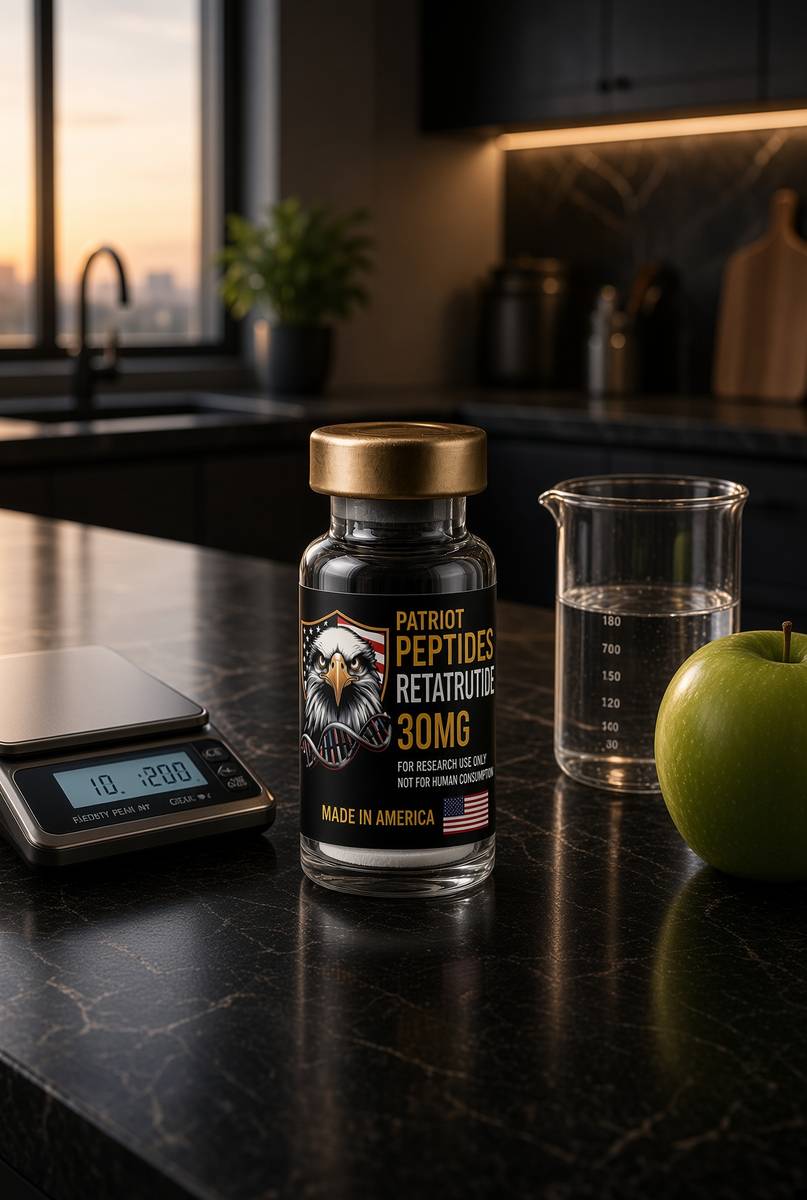
Hypothetical research reconstitution for the named catalogue vial. Not a protocol, not medical advice, not a use instruction. These amounts sit in published and commonly cited laboratory ranges. The vial is labelled for research use only — not for human or veterinary administration.
Retatrutide
30mg
Mix with 3 ml bacteriostatic water → 10 mg/ml
- Hypothetical aliquot
- 1–2 mg to start; published trial arms ran higher by week
- 0.10–0.20 ml · 10–20 units on a U-100 syringe (at 1–2 mg)
- How often
- Once weekly
- The Jastreboff NEJM 2023 arms ran 48 weeks. That is a trial, not a shop protocol.
Bench steps
- Let the vial sit until it is no longer cold to the touch.
- Wipe the stopper with 70% isopropyl alcohol. Let it dry.
- Draw 3 ml bacteriostatic water (0.9% benzyl alcohol).
- Run the water slowly down the inside glass — do not blast the cake.
- Roll between finger and thumb until the cake is gone. Do not shake.
- Label the date. Store the solution at 2–8 °C. Do not freeze. Use within 30 days unless the note below says otherwise.
LY3437943 architecture. Weekly, not daily. Those milligram figures are what the papers used on the investigational medicine — they are not a use instruction for this reagent.
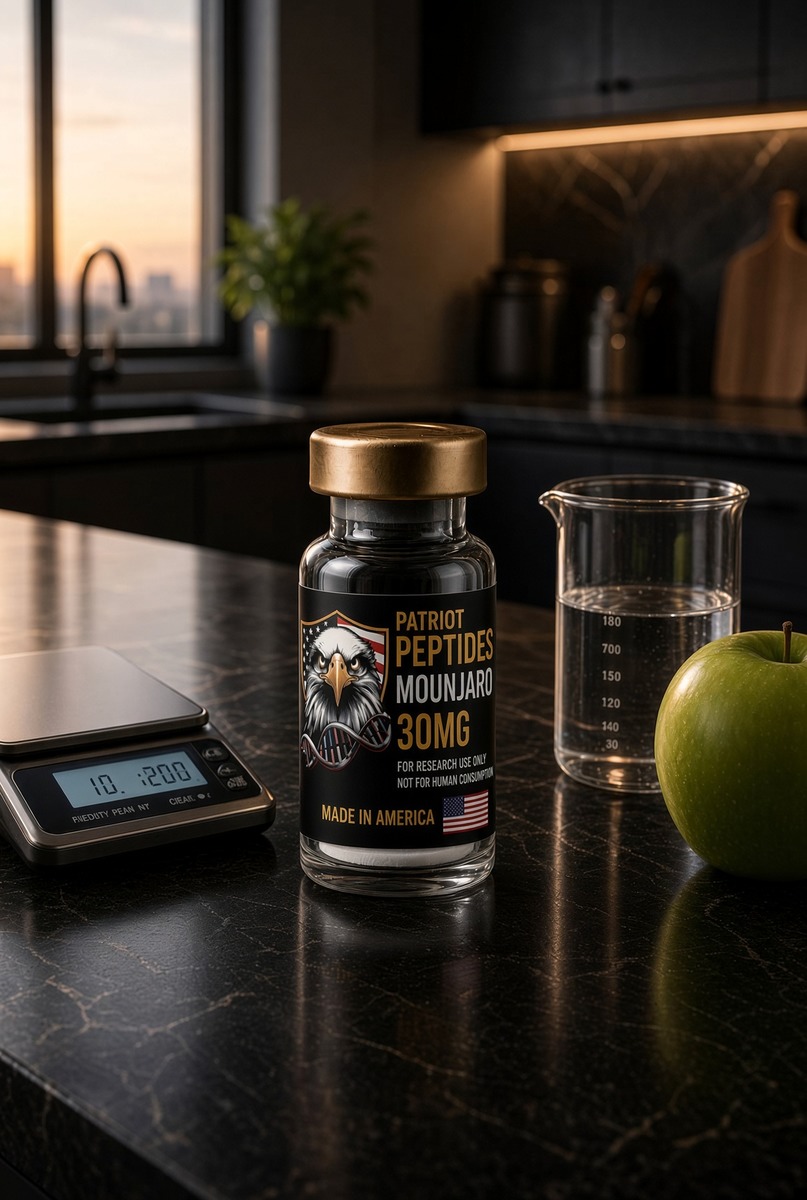
Mounjaro
30mg
Mix with 3 ml bacteriostatic water → 10 mg/ml
- Hypothetical aliquot
- The SURMOUNT arms used 5, 10 and 15 mg
- At 10 mg/ml those amounts are 0.50, 1.00 and 1.50 ml
- How often
- Once weekly in the published trials
- SURMOUNT-1 ran 72 weeks.
Bench steps
- Let the vial sit until it is no longer cold to the touch.
- Wipe the stopper with 70% isopropyl alcohol. Let it dry.
- Draw 3 ml bacteriostatic water (0.9% benzyl alcohol).
- Run the water slowly down the inside glass — do not blast the cake.
- Roll between finger and thumb until the cake is gone. Do not shake.
- Label the date. Store the solution at 2–8 °C. Do not freeze. Use within 30 days unless the note below says otherwise.
Mounjaro 30mg. Tirzepatide, LY3298176. The milligram figures are what the papers used. They are not a use instruction for this vial.
Bacteriostatic water and sterile syringes ship with peptide orders over £75. Kit details · 10 ml bacteriostatic water
The vials this essay sits on
Named sequences the essay maps — Retatrutide, Mounjaro. Hypothetical research neighbourhood, not a protocol, not a medicine. One press puts every in-stock vial in the bag.
 Made in USA
Incretin
Retatrutide
One chain that copies three hormones you release after a meal: fullness, insulin, and how the liver spends fuel.
4.6(609)
4 browsing this now · 3 purchased in the last 24 hours
30mg · In stock
£120.00
 Research only
Research use only. Not a combined-use instruction.
Read next

43 min · long read · Peptide research
How to read a Phase 2 paper without lying to yourself
Jastreboff et al., NEJM 2023, is a public Phase 2 trial of retatrutide: 338 adults, placebo, 48 weeks, 24.2% mean weight loss at 12 mg. n, randomisation, adverse events, and why a research vial of the published structure is not the investigational medicine.
7 min · Peptide research
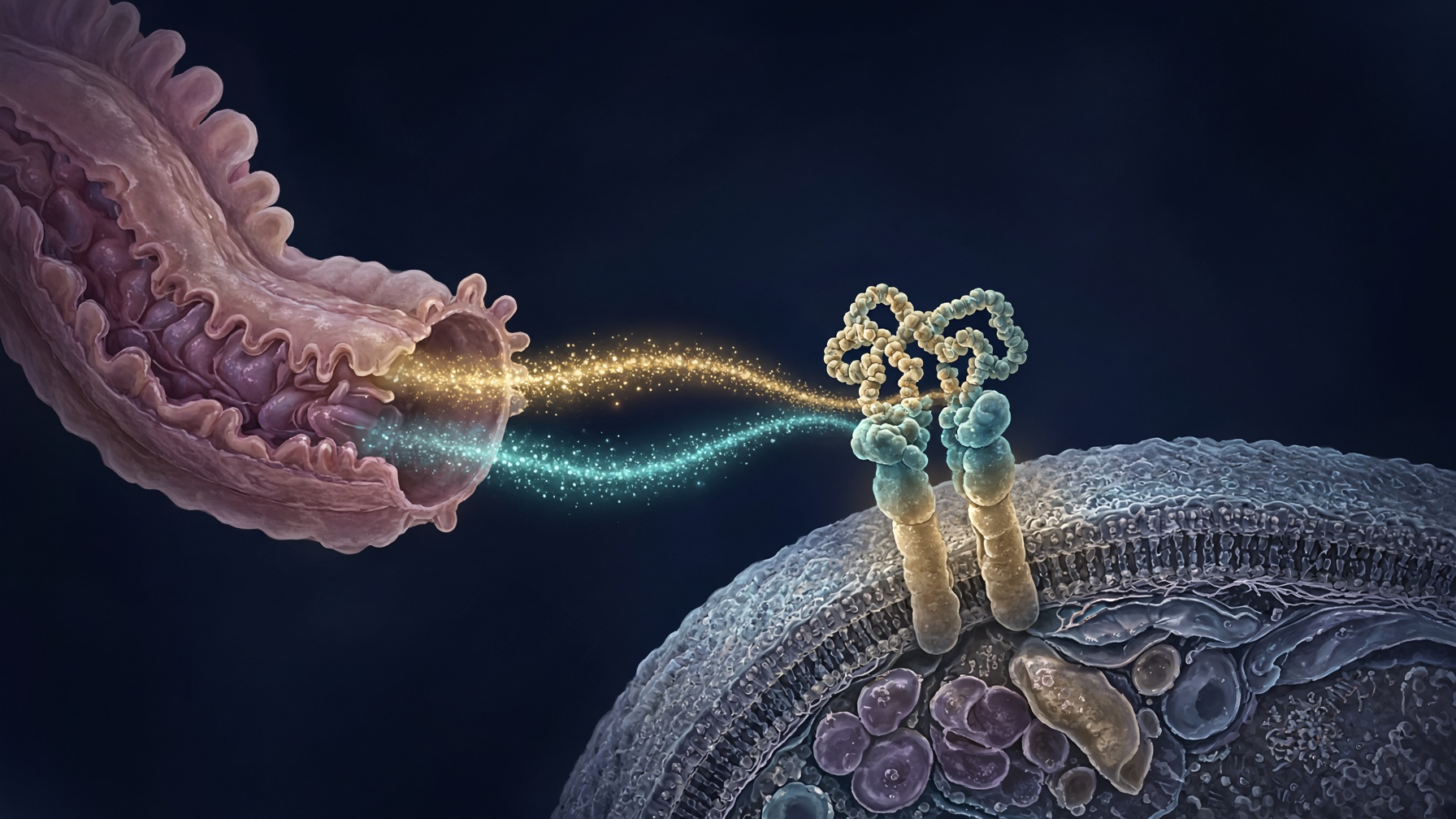
GIP: the incretin people forgot, then remembered
GIP is the gut hormone that tells the pancreas to release insulin when sugar is high. GLP-1 does that and also slows the stomach and quiets appetite. Mounjaro is tirzepatide: one chain on both. Semaglutide is only the second. The 72-week trial mean at 15 mg was about 21 percent.
5 min · Peptide research
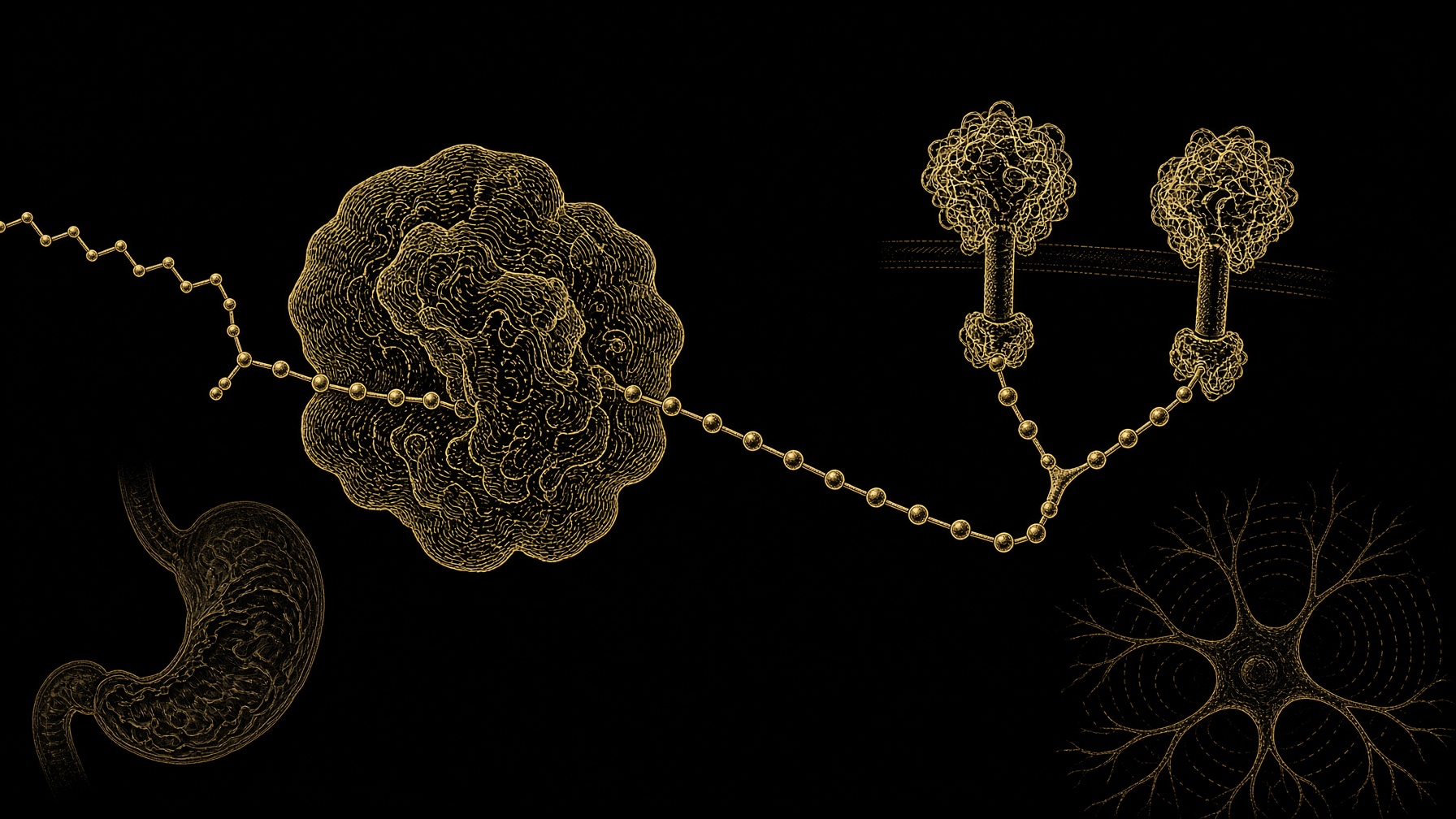
Semaglutide and tirzepatide: one receptor, then two
Semaglutide is GLP-1. Tirzepatide is GLP-1 plus GIP. The obesity trials printed about 15 percent and about 21 percent mean weight loss. Retatrutide adds glucagon. Stopping the drug hands appetite back.
44 min · long read · Peptide research
Retatrutide (LY3437943): the published triple-agonist structure
A fatty-acylated unimolecular agonist at GIPR, GLP-1R and GCGR.
More in this section
53 min · long read · Peptide research
How research peptides are made — and why HPLC actually matters
Solid-phase peptide synthesis builds a chain one residue at a time. HPLC then asks whether the main peak is what you think it is. ≥98% refers to the main peak's share of the chromatogram.

52 min · long read · Peptide research
Recovery, GH pulses and the CJC / ipamorelin pair
Somatotrophs have two 'go' receptors. CJC without DAC is a slightly longer GHRH pulse. Ipamorelin is a selective ghrelin-receptor key that does not yank ACTH. Together they are the pair Bowers already showed is more than additive
51 min · long read · Peptide research
Fatigue, cellular energy and the NAD+ / MOTS-c neighbourhood
NAD+ is the rechargeable chip every cell spends on fuel and DNA repair — and the pool shrinks with age. MOTS-c is a mitochondrial 16-mer sent out under metabolic stress.
51 min · long read · Peptide research
Melanocortin circuits: pigment, appetite and PT-141
Melanotan II lights MC1, MC3, MC4 and MC5 — pigment plus the rest of the sheet. PT-141 is the free-acid cousin pointed at MC3 and MC4, the circuitry papers use for desire and energy, not skin colour. Both come from the same Arizona research programme.
The page is the mechanism: the protein, what it does in the cell, and the drug or peptide that talks to it.