

Peptide research · 48 min · 10,457 words
Somatropin: the 191-residue ligand
Recombinant human growth hormone is one of the most studied proteins in endocrinology. Pulsatility, GHR–JAK2–STAT5b, lipolysis, IGF-1 generation — the map is public.
What this essay actually tells you
- Human growth hormone is 191 amino acids, two disulphide bonds, a class-I cytokine-receptor ligand at GHR → JAK2–STAT5b. Count the residues. Name the receptor. That's somatropin.
- Recombinant somatropin replaced cadaveric pituitary GH after Creutzfeldt–Jakob risk ended the old supply in the 1980s. That's why the recombinant exists, and why the cadaveric doesn't.
- The liver answers with IGF-1. Occupying GHR is a different experiment from occupying GHRHR or GHSR upstream. Downstream ligand. Different question from a secretagogue.
What this actually means
Human growth hormone is a 191-amino-acid protein released in pulses by the pituitary, mostly at night. It docks a receptor on liver and other cells, which then make IGF-1 and also burn some fat directly. Medicine has used recombinant somatropin for decades in children who do not make enough, and in some adults with true deficiency. The biology is not a secret. The vial we stock is that 191-residue protein, freeze-dried and HPLC-characterised, labelled for research.
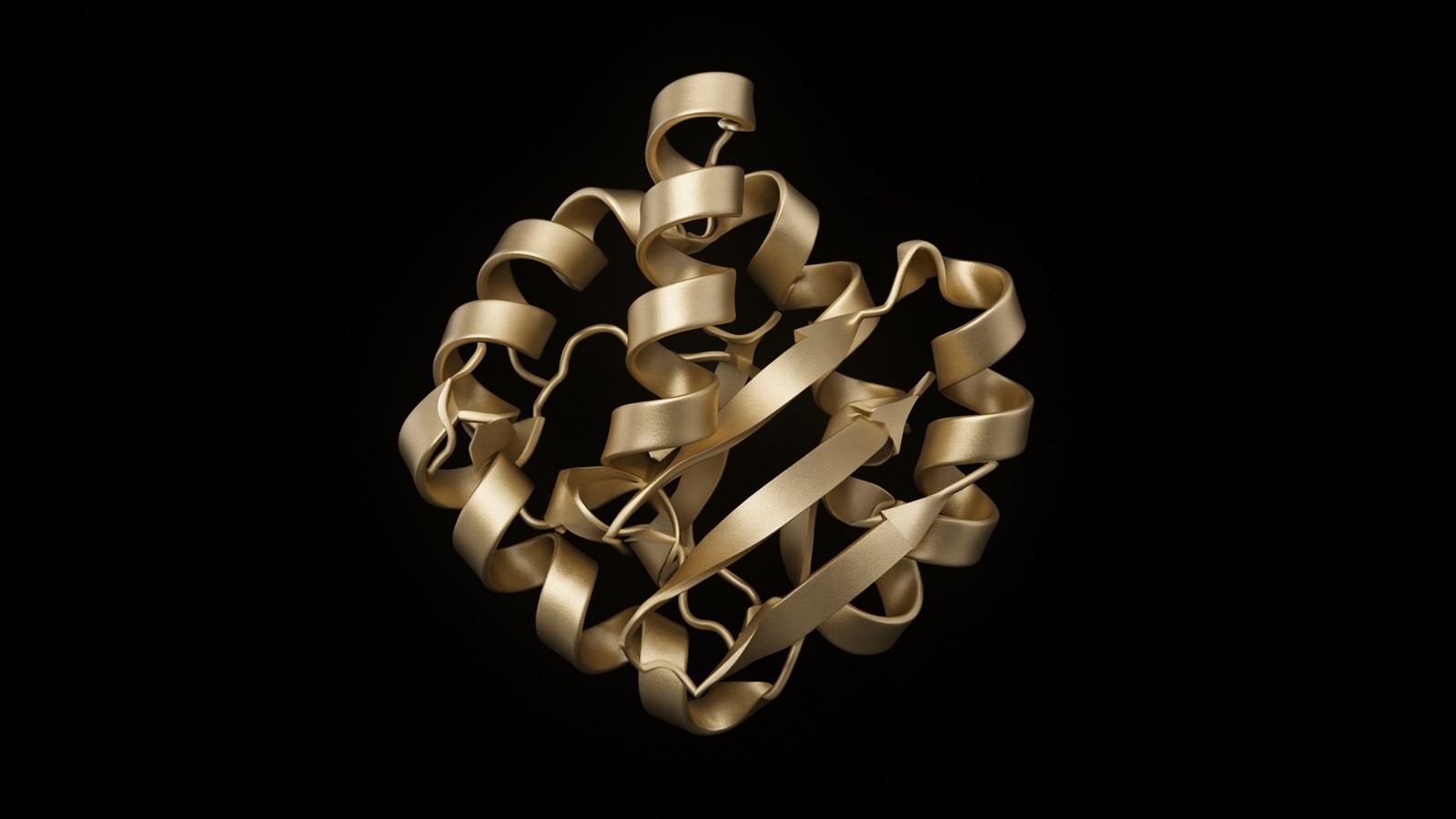
Somatropin is recombinant human growth hormone: a 191-residue, 22-kilodalton four-helix bundle, two disulphide bonds, the ligand the growth-hormone receptor evolved to bind. The International Nonproprietary Name is somatropin. The gene is GH1. The older three-letter name is HGH, which doesn't tell you which splice, which gene, or which factory. Mature hormone is stored in dense-core granules in anterior-pituitary somatotrophs and released in pulses, mostly at night, under a hypothalamic ratio of growth-hormone-releasing hormone to somatostatin, with ghrelin turning the volume up. Downstream, GHR is a class-I cytokine receptor. Ligand-induced rotation of a preformed dimer recruits JAK2, which phosphorylates STAT5b, the principal transcriptional driver of hepatic IGF1, ALS and IGFBP3, with MAPK and PI3K arms leaving the same receptor. Johannes Veldhuis spent a career showing that those events are timed. Continuous exposure down-regulates GHR and writes a different hepatic programme. Licensed medicines exist in diagnosed deficiency. The 24 IU vial in this catalogue is a research aliquot of that 191-residue backbone, lyophilised, HPLC-characterised, CAS 12629-01-5. The map is public, and it's a rather lovely one once you sit with it.
In short. Somatropin is the 191-amino-acid growth-hormone protein. It docks a cytokine receptor, the liver writes IGF-1, and the timing of the pulse is part of the message.
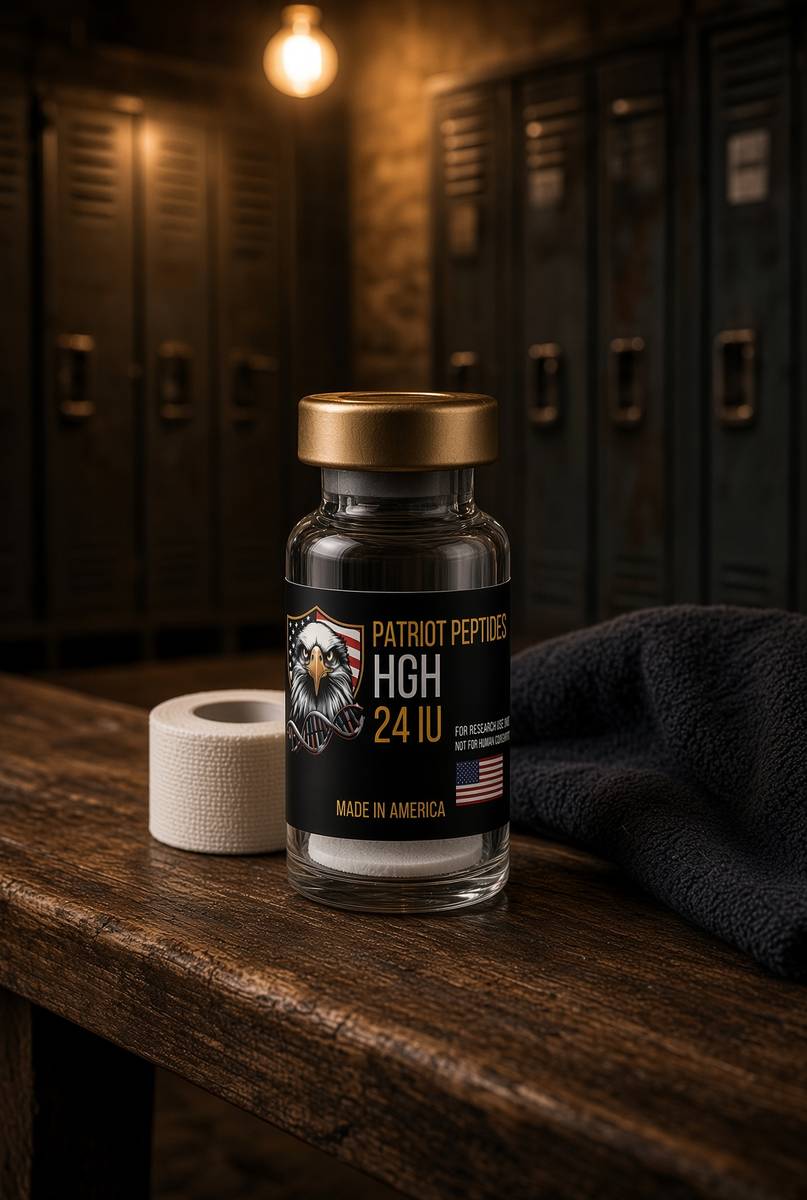
We stock that sequence because the endocrine papers name it. The 24 IU listing is lyophilised recombinant 191-residue somatropin, the same amino-acid backbone licensed medicine uses on an endocrine ward. Purity is a chromatogram, typically ≥98 percent by HPLC. Molecular weight is about 22.1 kilodaltons. Form is a white to off-white cake. The reconstitution kit in the order is bacteriostatic water and syringes so the first step is documented rather than guessed. Gentle rolling, not beating: this protein denatures if you treat it as a small peptide that likes a vortex. None of those sentences is a dose, a route, or a schedule for a person. Licensed somatropin pens exist, in named paediatric and adult-deficiency indications, under specialist care. This vial is a laboratory reagent labelled for research. Sequence identity with a medicine is a chemical fact. It isn't a marketing authorisation, and it isn't a clinic appointment written as physiology. You're looking at the same chain the papers used, freeze-dried, so you can weigh it into an assay you can actually name.
In short. The vial is freeze-dried 191-residue somatropin for the bench, the same chain licensed medicine uses. A shared sequence is not a prescription.
Four laboratory analogues sit on four different floors of the growth-hormone axis, and confusing them is how an experiment dies. Modified GRF(1–29) without DAC occupies GHRHR, a class-B GPCR on the somatotroph, and still has to live with somatostatin, sleep and the readily-releasable granule pool. Ipamorelin occupies GHS-R1a, a class-A GPCR, and inherits ghrelin's geography as well as its synergy on the same granule. Recombinant somatropin occupies GHR itself and skips the pituitary's opinion; you're now the pulse, or the drip, depending on how you dose. IGF-1 LR3 occupies IGF1R, a receptor tyrosine kinase, with IGF-binding-protein affinity collapsed, so a cultured myotube actually sees the ligand. This page is the third microphone: the 191-residue cytokine, the receptor geometry, the STAT5b programme, the pulse as information, the 20-kilodalton splice, the historical met-GH that came first, and why a research aliquot and a licensed pen are two legal objects. The neighbouring axis essay is the wiring they share. Stay here if you wanted the 191 itself explained at the length it actually needs.
In short. Four lab analogues ask four receptors. This page is the growth-hormone protein itself, not the brain peptide or the downstream IGF-1 copy.
People still talk about growth hormone as if it were a stronger testosterone. It isn't even in the same kingdom, and that's a useful surprise. Androgen receptor is a nuclear steroid receptor; the ligand is a small hydrophobic molecule; the transcription factor is the receptor itself. GHR is a cytokine receptor on the cell surface; the ligand is a 191-residue protein that never needs to enter; the transcription factor is STAT5b, recruited after JAK2 has phosphorylated the tail. The circulating messenger of much of the growing is IGF-1, a 70-residue insulin-family peptide written largely in the liver. Direct metabolic actions — hormone-sensitive lipase in adipocytes, insulin antagonism in muscle and fat — run beside that endocrine IGF-1, not instead of it. Confusing those two kingdoms is how the biochemistry gets scrambled, and it gets scrambled often. A catalogue that sells the 191-mer owes you the receptor class, the kinase, the transcription factor, and the pulse, before anyone talks about composition. That's the job of the next headings. The athlete in the opening figure is a late readout. The receptor is early, and it's where we'll start.
In short. Growth hormone is not a steroid. It is a protein that twists a surface receptor, a kinase fires, and STAT5b writes IGF-1 in the liver.
GH is a digital signal: night-time bursts, suppression by hyperglycaemia, amplification by fasting and ghrelin. Flatten the pulse and the liver writes a different programme.— The Veldhuis programme, in the language this desk uses. See Veldhuis JD, Bowers CY. Endocr Rev, and the JCEM deconvolution series.
A 191-residue four-helix bundle
Mature human growth hormone is 191 amino acids, about 22 kilodaltons, a four-helix bundle in the long-chain class-I cytokine family. The fold is the up-up-down-down helical bundle that prolactin, erythropoietin, leptin and several interleukins also use, which is why their receptors look related even when the physiology does not. Two disulphide bonds hold the bundle: Cys53–Cys165 tethers helix 1 to helix 4, and Cys182–Cys189 closes a small C-terminal loop. Count the residues. Name the disulphides. That's somatropin, and those are the facts you'd want before talking about IGF-1. The protein is synthesised as a precursor with a signal peptide, cleaved in the endoplasmic reticulum, folded with the help of the disulphide geometry the receptor later reads, and packed into dense-core secretory granules. Somatotrophs are half or more of the anterior pituitary by cell number in a young adult. The 24 IU cake is that mature 191-residue chain, recombinant, characterised. It isn't a fragment, and it isn't a secretagogue. It's the ligand the receptor evolved to hold, freeze-dried so you can put a known number of molecules into a well.
In short. The protein is 191 amino acids, two disulphide bonds, four helices. Count the residues and name the fold before talking about IGF-1.
GH1 sits on the long arm of chromosome 17, in a cluster with GH2 and the chorionic somatomammotropins, a family that arose by duplication and then specialised. The somatotroph transcribes GH1, splices it, exports the mRNA, and translates it into the endoplasmic reticulum. The 22-kilodalton isoform is the main product. A 20-kilodalton splice isoform exists, of which more in the next paragraph. The protein doesn't wander the cytosol looking for work. It's a secreted ligand. The receptor lives on the outside of hepatocytes, adipocytes, chondrocytes, myocytes and a longer tissue list; the 191-mer occupies an extracellular face and the flood on the inside is chemistry. If you need the hormone in the cytosol, you haven't named the lock. Recombinant manufacture hijacks a ribosomal pipeline in a tank, usually Escherichia coli or a mammalian line depending on the manufacturer, and skips the 17q dramas of the locus. Solid-phase peptide synthesis is the wrong factory at this length. A hundred and ninety-one cycles of Fmoc chemistry is a defeat. The amide bond is the same. The factory is not, and that's a useful distinction to keep in your pocket when two cakes sit on the same shelf.
In short. The growth-hormone gene is transcribed in pituitary cells and the protein is secreted, not used inside those cells. A 191-residue chain is made in a recombinant tank, not on a resin bead.
The 20-kilodalton splice isn't a contaminant. Alternative splicing of GH1 skips 45 bases in exon 3 and deletes residues 32–46; the variant is a fraction of pituitary output, typically something like five to ten percent of circulating GH depending on the assay and the physiological state. It binds GHR with a different affinity profile, particularly at the second binding site, and it's missed by some monoclonal immunoassays whose epitope sits on the deleted loop. If you report GH in nanograms per millilitre, say which epitope the antibody sees. Recombinant somatropin, as licensed and as stocked, is the 22-kilodalton, 191-residue species, the majority ligand, the one the adult-GHD trials used. Isoform literacy is how you stop arguing with an assay. It's also why HGH as a three-letter name is a worse name than somatropin: the short name doesn't tell you which chain. The research vial is the 191. If a blot or an ELISA is about to disagree with a mass spectrometer, ask which splice the antibody was raised against before asking which laboratory made a mistake. That's a kinder first question, and it's usually the right one.
In short. A shorter 20-kilodalton splice lacks residues 32 to 46 and some assays miss it. The recombinant vial is the full 191-residue, 22-kilodalton form.
Placental growth hormone, from GH2, is a different gene, a different pregnancy physiology, and not this vial. It rises across gestation, partly replacing pituitary GH in the maternal circulation, and it's a reminder that the cluster on 17q is a family rather than a single name. Pegvisomant, a GHR antagonist used in acromegaly, is the inverse probe on the same receptor: occupy GHR so that STAT5b doesn't write, IGF-1 falls, and the clinical conversation becomes one about occupancy rather than about cutting the pituitary. A licensed antagonist and a licensed agonist on the same receptor are further proof that GHR is a variable, not a mood called growth. Growth-hormone-binding protein, the shed extracellular domain of GHR, circulates and buffers some of the ligand; assays and pharmacokinetics live with that buffer whether a protocol names it or not. The 191-residue recombinant protein doesn't become pegvisomant by being concentrated, and it doesn't become placental GH by being given in the third trimester of an argument. Name the gene. Name the splice. Name the receptor state. That's the whole of the identity question, and it's a rather satisfying one once you've asked it.
In short. Placental GH is a different gene. Pegvisomant blocks the same receptor from the other direction. Name the chain and the receptor state.
Recombinant manufacture is why this protein exists as a catalogue object at all. Genentech's 1978 insulin in Escherichia coli, approved in 1982 as Humulin, was the template: a coding sequence in a tank, a folded chain, a chromatogram. A 191-residue somatropin followed, first as a methionine-extended version and then as the authentic 191, of which the next heading is the history. The industrial fact that matters on a bench is simpler than the corporate one. A 15-mer such as BPC-157 is a solid-phase object. A 191-mer is a recombinant protein. When a catalogue mixes them on adjacent pages it's mixing two factories. HPLC still asks whether the main peak dominates. Mass spectrometry still asks whether that peak has the right mass. Folding and disulphide pairing are the extra questions a cytokine-sized protein brings that a pentapeptide does not. The certificate on the 24 IU listing is how those questions are answered for this aliquot. It isn't a package insert. It's the minimum a research reagent owes a blot that will have to write the catalogue number next to a concentration. Same amide bond. Different factory. Still a chromatogram on the bench.
In short. Short peptides are made on resin. This 191-residue hormone is made in a recombinant tank. Same amide bond, different factory, still a chromatogram on the bench.
- Mature GH (somatropin)
- 191 aa, ~22.1 kDa
- 20 kDa splice
- Δ32–46
- Somatrem (historical)
- 192 aa, Met-GH
- GHR
- class-I cytokine receptor
- Hepatic STAT5b programme
- IGF1 / ALS / IGFBP3
- Direct metabolic arms
- HSL + insulin antagonism
- Catalogue aliquot
- 24 IU
- IU convention
- ~3 IU/mg
Four-helix bundle, two disulphides. CAS 12629-01-5. The recombinant ligand.
GH1 exon-3 skip. Minority of circulating GH. Some monoclonal assays miss it.
Bacterial initiation methionine. Protropin era. Not this vial.
Preformed dimer, ligand-induced rotation. JAK2, then STAT5b.
Ternary complex in plasma. Integral of recent occupancy.
Adipocyte lipolysis; muscle and liver glucose handling. IGF-1-independent in the acute window.
Lyophilised 191-mer, ≥98% HPLC. Reagent. Not a pen.
Recombinant GH bioassay. 24 IU is an eight-milligram-scale cake on that convention. Write molar in the methods.
Somatrem, cadavers, and the authentic 191
Before the recombinant, the supply was cadaveric. Pituitary glands collected at autopsy were extracted, purified as far as the methods of the 1950s to 1970s allowed, and given to children with severe growth-hormone deficiency. Linear growth followed, which is why the programme existed. Creutzfeldt–Jakob disease followed in a subset of recipients, which is why the programme ended. Iatrogenic CJD from contaminated cadaveric GH became apparent in the mid-1980s; national programmes withdrew the extract. Prion protein had ridden along with the hormone. That isn't a rumour and it isn't a footnote. It's the reason recombinant somatropin exists as a public object rather than as a nicer chromatogram of the same old extract. The recombinant doesn't carry a human prion. That's why it replaced the cadaveric, and why the cadaveric does not. Skip the CJD sentence and you've written a product story. The sentence belongs here because the factory is a safety fact, not only a convenience, and because the children who grew on that extract are part of why we take this ligand seriously.
In short. Old growth hormone came from human pituitaries and some batches carried prion disease. Recombinant somatropin exists because that supply had to stop.
Somatrem is the historical recombinant, and it isn't somatropin. Genentech's first licensed growth-hormone medicine, somatrem, was methionyl-human GH: 192 residues, an extra N-terminal methionine left by bacterial initiation, Protropin in the United States from 1985. The extra methionine is a translational leftover, not a design for the receptor. Most patients did well. A minority raised antibodies against the met-extended chain, which is the immunogenicity conversation any bacterial protein with a non-native N-terminus has to expect. Subsequent authentic-sequence products — somatropin, 191 residues, the INN this page uses — removed that methionine. Humatrope, Genotropin, Norditropin, Saizen and their cousins are that 191-residue species, made in bacteria or in mammalian cells depending on the manufacturer, folded, filled into pens. Somatrem is why writing 'recombinant GH' without a residue count is still underspecified. The research vial is somatropin, 191, not somatrem, 192. Count the residues. The history is how you know why the count moved, and once you've counted it the rest of the story sits still.
In short. The first recombinant version had an extra methionine and 192 amino acids. Somatropin is the authentic 191-residue chain that replaced it.
Licensed somatropin is one of the cleaner endocrine success stories of the late twentieth century. In children with GH deficiency, and in certain short-stature syndromes that sit on the label in named jurisdictions, recombinant somatropin increases linear growth. In adult GH deficiency, replacement improves body composition — less fat, more lean mass — with a less dramatic effect on strength and a real conversation about glucose tolerance. Jørgensen, Christiansen, Bengtsson and the classic replacement literature are the citations; those were labelled-medicine trials in diagnosed deficiency, under specialist care, with IGF-1 as a monitoring analyte and glucose as a watched variable. Acromegaly remains the experiment of nature for chronic excess: soft-tissue overgrowth, insulin resistance, a cardiomyopathy conversation, a tumour, or a GHR antagonist, on the other side of the same receptor. Those medicines aren't this listing. The 191-residue sequence is shared. The legal class is not. A research house that stocks the backbone has a duty to keep the pen and the cake labelled as two objects, because the chain is the same and the file around it is not.
In short. Licensed somatropin grows children who lack the hormone and changes body composition in deficient adults. Chronic excess is acromegaly. Those are medicines, not this vial.
The research aliquot is the same carbon skeleton and the same amide chain as those pens, characterised for a different job. HPLC, mass, a certificate of analysis, a reconstitution kit, a label that says laboratory use. Indication, device, pharmacovigilance and a marketing authorisation sit on the other side of that sentence. Adults can want both a paper and an appointment. Bundling them is how a research reagent becomes a medical claim it isn't allowed to be, and how a clinic becomes a webshop it is not. Patriot Peptides sells the characterised 191-mer. Where a licensed somatropin pen exists, it exists because a regulator and a manufacturer ran a file this catalogue did not. Sequence identity is the honest link between the vial and the literature. It isn't a licence to write the vial as a prescription. The rest of this page is the biochemistry you'd want before designing the assay you actually have the controls for. The physiology doesn't depend on the unmix. The label does. Keep both sentences in the room and the 191-mer stays a ligand rather than a rumour.
In short. Same amino-acid chain as the licensed pens, different legal class. The cake is a characterised laboratory ligand, not a prescription.
Diagram
Hypothalamus
GHRH · somatostatin
Go and stop. Class-B GPCRs on the somatotroph.
Stomach / arcuate
ghrelin → GHS-R1a
Volume knob. Synergises with GHRH. Ipamorelin sits here.
Pituitary
GH pulses
191 residues. Night-time bursts. Veldhuis spent a career on the pattern.
Liver
IGF-1 + IGFBP3 + ALS
JAK2–STAT5b at the GH receptor. Much of the growing is this hormone.
Tissue
IGF1R
RTK. IRS–PI3K–Akt–mTOR. IGF-1 LR3 asks this microphone with IGFBPs taken out.
CJC without DAC is DPP-IV-resistant GRF(1–29) that still pulses. Ipamorelin is selective GHS-R1a. Somatropin is the 191-residue ligand. IGF-1 LR3 bypasses the pituitary. Confuse the four and the methods section is already wrong.
GHR is a class-I cytokine receptor
GHR is a class-I cytokine receptor, a single-pass transmembrane protein that sits as a preformed dimer. The older cartoon, from the 1992 de Vos, Ultsch and Kossiakoff crystal structure of the hGH–hGHR complex, was sequential dimerisation: one ligand binds a first receptor chain at a high-affinity site, then a second chain at a lower-affinity site, assembling the dimer from monomers. Waters, Brooks and colleagues spent subsequent years pinning down a revision that the field now treats as the working picture: the receptor is already a dimer, and ligand rotates the two chains into a geometry JAK2 can use. One somatropin occupies a site on the first chain and a different site on the second — an asymmetric handshake, one ligand, two chains. Rotation brings the intracellular Box 1 motifs together. JAK2, already loosely associated with those boxes, trans-phosphorylates. The crystal wasn't wrong about the interfaces. It was incomplete about the resting state. Write 'GH dimerises GHR from monomers' and you're a generation behind the receptor paper you think you're citing. The handshake is still the chemistry. The resting pair is the bit we added later, and it's a rather elegant bit.
In short. The GH receptor is already a pair of chains. One hormone molecule twists that pair so the associated kinase can fire.
JAK2 is the kinase GHR doesn't have of its own. Cytokine receptors rent Janus kinases; GHR rents JAK2. Once the dimer has been rotated, the two JAK2 molecules phosphorylate each other and then phosphorylate tyrosines on the receptor tail. Those phosphotyrosines become docking sites. STAT5b SH2 domains bind, STAT5b is itself phosphorylated, dimerises, and goes to the nucleus. STAT3 and, to a lesser extent, STAT1 can be recruited in some cells; STAT5b is the principal transcriptional driver of the hepatic IGF1, ALS and IGFBP3 programme and the one a GH-axis paper is expected to name. JAK2 inhibitors exist as medicines in myeloproliferative disease; they aren't GH drugs, but they're the pharmacological proof that this kinase is a real enzyme with a real ATP-binding site, not a nickname. If you're about to claim a GHR phenotype in a dish, a phospho-STAT5b blot, timed after ligand, with a JAK2-inhibitor control, is how a sceptical reader will believe you. A homogenate IGF-1 kit on its own is a downstream integral, not a receptor paper. Show the blot. The kinase will thank you for it.
In short. GHR has no kinase of its own. It borrows JAK2, which phosphorylates STAT5b, and STAT5b goes to the nucleus. Show that blot if you claim the receptor.
Diagram
Outside
Peptide ligand
Named sequence in the nM–µM pocket. Shape complementarity, not vibes. A 15-mer and a 4-mer do not fit the same hole.
Membrane
7-TM receptor
Helices rearrange. The cytoplasmic face becomes a GEF for a heterotrimeric G protein (Gs, Gi, Gq, G12/13).
Inside
Second messengers
cAMP, IP₃, Ca²⁺, β-arrestin. One occupied receptor can spawn thousands of messenger molecules. That is amplification.
~800 GPCRs in the human genome. Seven transmembrane helices, an extracellular ligand pocket, an intracellular G-protein handshake. Catalogue neighbours: ipamorelin at GHSR, PT-141/MT2 at melanocortin receptors, retatrutide at GLP-1R/GIPR/GCGR.
STAT5b writes the hepatic programme that circulating IGF-1 actually travels in. Occupancy at GHR, JAK2, phospho-STAT5b, then IGF1 transcription, ALS transcription, IGFBP3 transcription. The three products assemble in plasma as a ternary complex that carries the large majority of circulating IGF-1, extending its half-life from minutes when free to hours when bound. Acid-labile subunit is liver-specific in a way IGF-1 is not; extra-hepatic IGF-1, especially the mechanically gated splice in loaded muscle, is a different conversation and isn't a vial. Yakar, LeRoith and colleagues, with the liver-specific IGF-1 knockout, showed that circulating IGF-1 can fall hard while local IGF-1 keeps a surprising amount of postnatal growth going. That paper is why 'GH makes you grow via IGF-1' is true and incomplete, and it's a paper worth sitting with. Endocrine IGF-1 is the serum assay and the liver's job. Autocrine and paracrine IGF-1 are the tissue's job. Recombinant somatropin asks the liver to write the endocrine ligand. It doesn't write the mechano-growth splice a loaded fibre already knows how to write.
In short. STAT5b tells the liver to make IGF-1 and two partners that carry it in blood. Tissues also make local IGF-1. The vial asks the liver, not the fibre.
MAPK and PI3K arms leave the same receptor and account for some of the non-transcriptional and some of the extra-hepatic actions. SHC recruitment opens Ras, Raf, MEK and ERK, a proliferative and gene-expression lamp GH shares with a dozen other cytokines. IRS proteins can open PI3K, PIP3 and Akt, the metabolic neighbourhood GH shares, awkwardly, with insulin and with IGF-1: awkward because GH is insulin-antagonistic at the whole-body level even as its receptor can light a PI3K lamp. Tissue and timing sort that apparent contradiction. Acute GH is lipolytic and insulin-antagonistic. IGF-1, downstream, is insulin-like at IGF1R and at hybrid receptors. The net of a physiological pulse is therefore a lipolytic first hour and an IGF-1-mediated later window. Flatten the pulse and you stretch the first hour across the day, which is one reading of why continuous GH looks more insulin-antagonistic than pulsatile GH for the same IGF-1 increment. The papers aren't unanimous in every protocol, which is honest. The direction of the argument is stable enough to make dosing pattern a scientific decision rather than a convenience.
In short. The same receptor also lights MAPK and PI3K. A pulse separates a fat-burning first hour from a later IGF-1 window. A drip blurs those two jobs.
Diagram
× 1
Ligand
One peptide in one pocket. nM–µM. Shape, not a mood.
× 10–10²
G proteins
The occupied GPCR is a GEF. Each Gα is a catalyst.
× 10³–10⁴
cAMP / IP₃ / Ca²⁺
Adenylyl cyclase and PLC do not make one molecule. They make a cloud.
× 10⁴–10⁶
PKA / PKC / CaMK
Kinases phosphorylate many substrates per messenger.
× tissue
Secretion, transcription, motility
The organism-level readout. Still not a protocol.
This is the only magic, and it is not magic. A nanomolar ligand can move a micromolar messenger because enzymes sit between them. Desensitisation (GRK, β-arrestin, endocytosis) is how the cell refuses to let ‘more ligand’ mean ‘more signal’ forever.
SOCS2 is the off-switch the axis deserves a named sentence for. STAT5b transcribes it. SOCS2 binds the phosphorylated GHR tail, recruits ubiquitin-ligase machinery, and dampens JAK2. Animals lacking SOCS2 are large, which is the genetic proof that this brake isn't decorative. Continuous GHR occupancy writes more SOCS2 and the receptor quiets; troughs in a physiological pulse let the receptor recover. Receptor internalisation and reduced surface census travel with that transcriptional brake. That's ordinary cytokine-receptor hygiene, the same logic interferon and erythropoietin use, applied to a hormone whose information is a burst. It's why a daily subcutaneous bolus of recombinant GH that never quite returns to baseline, and a nocturnal Veldhuis burst, won't occupy GHR in the same temporal pattern even if mean IGF-1 looks similar on a sparse blood draw. Mean IGF-1 is an integral. The receptor's day is a series of STAT5b phosphorylations. Integrals hide series. Continuous exposure down-regulates GHR. Anyone designing an assay with somatropin is designing a time course, whether they admit it or not, and the time course is half the ligand.
In short. STAT5b also writes SOCS2, which shuts the GH receptor down. Pulses let the receptor recover. Continuous exposure keeps the brake planted and the receptor quieter.
GHR isn't only hepatic. Adipocytes carry it, and hormone-sensitive lipase is a client of the direct metabolic programme: free fatty acids rise after a GH pulse, independently of IGF-1. Skeletal muscle carries it; insulin antagonism of glucose uptake is a GHR sentence as well as an IGF-1 sentence, which is why glucose belongs in a protocol that occupies this receptor at high tone. Epiphyseal chondrocytes carry it in the growing skeleton, which is why childhood GH deficiency is a stature diagnosis and why the labelled paediatric indications exist. Osteoblasts and a periosteal conversation sit in the adult skeleton, which is why acromegaly changes acral bone and why adult-GHD trials report composition more cleanly than they report strength. Endothelium, kidney, and immune cells express GHR at various levels; the extra-hepatic transcriptome is real and isn't a licence to treat every tissue as a liver. The hepatocyte remains the endocrine IGF-1 factory. Direct actions remain direct. Measure only serum IGF-1 and you've measured the liver's opinion. You haven't measured lipolysis, insulin sensitivity, or a chondrocyte. Name the tissue, and the receptor stops being a rumour about IGF-1.
In short. Liver, fat, muscle and growing bone all carry the GH receptor. Serum IGF-1 is the liver's opinion, not the whole of what the receptor does.
Veldhuis: the pulse is the message
Native GH in a healthy adult is a series of pulses, larger in deep sleep, suppressed by hyperglycaemia, amplified by fasting and by ghrelin, with an interpulse baseline that is low in men and higher in women. Veldhuis and colleagues deconvolved those series from intensive sampling, and the deconvolution papers in JCEM and Endocrine Reviews are why this page won't let 'GH level' pass as a write-up line. A single morning clinic IGF-1 is an integral of recent hepatic STAT5b work. A single GH draw is a random sample from a pulsatile process and is often uninformative. Night-time burst mass, pulse frequency, and basal secretion are three numbers, not one. Slow-wave sleep is the largest physiological window. Glucose is a gate: a somatotroph in a hyperglycaemic animal releases less. Fasting and ghrelin raise burst mass. Sex steroids shape amplitude and frequency. Thyroid hormone is permissive for GH synthesis; a hypothyroid somatotroph writes fewer granules. Recombinant somatropin arriving from a subcutaneous depot doesn't inherit that hypothalamic computation. It's a plasma curve with a broad peak and a long tail. The liver notices, and it writes accordingly.
In short. Natural growth hormone comes in night-time bursts, gated by sleep, sugar and fasting. A single blood test often misses that pattern. Daily recombinant GH is a broad peak, not a burst.
Sexual dimorphism of the pulse isn't a footnote. Male rodents fire large, regular nocturnal GH bursts against a near-silent baseline. Female rodents run a more nearly continuous, lower-amplitude tone. The liver reads those two patterns as two programmes. A classic molecular signature: male-pattern GH, in the rat, induces some cytochrome P450 genes, notably CYP2C11, and suppresses others such as CYP2C12; female-pattern GH does the reverse. STAT5b pulsing versus STAT5b occupancy that never quite returns to baseline is a large part of the mechanism. Knock out STAT5b and the male-specific liver programme collapses towards female. Waxman, Norstedt, Mode and others built that literature; it's why a pharmacologist can't treat GH exposure as area-under-the-curve and be done. Humans are less cartoonishly dimorphic than rats, which is a species sentence we'll keep making, but the principle survives. Women have more frequent, smaller pulses and a higher interpulse baseline; men have larger, less frequent bursts. Oral oestrogen antagonises hepatic GHR signalling and lowers IGF-1 even as it may raise GH secretion — a first-pass effect that transdermal oestrogen doesn't copy.
In short. Males and females fire growth hormone in different patterns, and the liver reads those patterns as different gene programmes. Area-under-the-curve is not the whole story.
Continuous exposure down-regulates GHR. That sentence is the design constraint for every dosing pattern, and it's why a GHRH analogue without a Drug Affinity Complex and a daily somatropin bolus aren't interchangeable tools. Hepatocytes reading a pulsatile STAT5b phosphorylation write IGF1, ALS and IGFBP3, the ternary-complex programme that circulating IGF-1 actually travels in. Hepatocytes reading a flattened GH tone write a different programme: more insulin antagonism, a different lipid-gene set, less of the IGF pattern many protocols thought they wanted. Receptor down-regulation contributes. SOCS2, already named, feeds back and shuts the receptor when occupancy is unrelieved. Surface GHR falls. The next pulse, if there is no trough, meets a quieter receptor. Jørgensen, the older rodent infusion studies, and the clinical experience with continuous subcutaneous GH pumps all point the same way. In the rat, a three-hour GH infusion and a pair of pulses matched for area-under-the-curve don't write the same cytochrome P450 genes. Pattern is information. Flatten it and you've changed the ligand even if the amino-acid sequence is identical. That's the sentence to take home.
In short. A continuous GH signal tells the liver a different story from a pulse, and the receptor itself becomes quieter. Same protein, different message.
A daily subcutaneous bolus of recombinant GH doesn't reproduce nocturnal pulsatility. It produces a broad plasma peak and a long tail, a pattern closer to a drip than to a Veldhuis burst, because the depot, the GH-binding protein buffer, and the absence of a hypothalamic off-switch all stretch the curve. Children with GH deficiency still grow on that regimen, because a growing epiphysis will accept a flattened IGF-1 rise, which is why the labelled paediatric programmes work. Adults with true deficiency shift composition on it. Healthy adults given the same flattened signal are a different population, with a different GHR census, a different IGFBP profile, and a different glucose conversation. Dosing the research 191-mer as if it were a nocturnal pulse is a claim the pharmacokinetics won't support. If the question needs a pulse generated by the somatotroph, with somatostatin still in the background, the pulse-length GHRH analogue is the microphone, not a larger IU count of somatropin. Both questions are lawful. They aren't the same question. They won't give the same hepatic transcriptome, and that's the whole of the comparison.
In short. Daily injected somatropin is a wide peak, not a night burst. Deficient children still grow on it. A pulse-length GHRH analogue is the tool if the question needs a true pulse.
Sampling is therefore part of the ligand. Frequent GH draws, twenty minutes apart through a night, are how Veldhuis built a pulse series; a morning IGF-1 is how a clinic monitors a replacement pen. Decide which question you're asking before you thaw the cake. If the question is whether GHR occupancy can drive a STAT5b programme in a hepatocyte line, a timed phospho-STAT5b blot after a defined nanomolar addition is the assay, and pulsatility is a later, organism-level variable. If the question is whether a flattened recombinant-GH curve writes a different hepatic gene set from a GHRH-driven pulse in an animal, you need both ligands, a sampling interval that can see bursts, and a liver readout that isn't only IGF-1 — ALS, IGFBP3, a P450, a lipogenic transcript, a phospho-STAT5b time course. Species is a variable: rodent sexual dimorphism of GH pattern is sharper than human. Concentration is a variable: nanomolar in a well isn't a free fraction after GHBP, first-pass and proteases have had their turn. Write the clock. The 191-mer doesn't carry a clock of its own, and that's why you have to bring one.
In short. Choose the clock before the vial. A cell-dish STAT5b blot and a night-long pulse series in an animal are two different experiments with the same protein.
Veldhuis spent a career on this: GH is a digital signal. Flatten the pulse and the liver writes a different programme. People keep flattening it anyway.— The Veldhuis programme, in one line. Deconvolution of burst mass, frequency and basal secretion is the methods demand behind it.
What the liver writes, and what GHR does besides
Hepatic IGF-1 is the endocrine product most protocols think they're buying, and it's a real product. GHR occupancy in hepatocytes writes IGF1, and writes the two partners, ALS and IGFBP3, that sequester more than ninety percent of circulating IGF-1 in a ternary complex. Free IGF-1 is short-lived and insulin-like; bound IGF-1 is a reservoir with a half-life of hours. IGFBP-1 is insulin-suppressed and rises in fasting, which is one of the ways the axis knows the metabolic state. Proteases clip IGFBPs in tissues and release ligand locally. The experimental nuisance, in a dish, is that serum-containing media present a binding-protein sink: native IGF-1 added to such a medium is rapidly bound and the receptor on a myoblast sees a fraction of what you pipetted. That nuisance is why Long Arg3 IGF-1 exists, and it's a design decision about the buffer, not a potency contest against somatropin. Somatropin asks GHR. LR3 asks IGF1R with the buffer collapsed. Two receptors. Two questions. Serum IGF-1 after somatropin is a hepatic integral, useful, and incomplete. Keep that incompleteness in the room and the number starts to mean something.
In short. The liver packages IGF-1 with two partners so it lasts hours in blood. Somatropin asks for that package. A lab IGF-1 analogue that ignores the partners is a different receptor entirely.
Direct lipolysis is the metabolic sentence a summary that only says IGF-1 will skip. GH activates hormone-sensitive lipase in adipocytes; triglycerides are hydrolysed; free fatty acids and glycerol rise in plasma on a timescale of tens of minutes after a pulse, before hepatic IGF-1 has had time to climb. That's a GHR programme, JAK2-adjacent, IGF-1-independent in the acute window. It's part of why GH is a fasting hormone as well as a growth hormone: spare glucose, burn fat, shift respiratory quotient. Overnight, when the large pulses land, that lipolytic window is physiology. Flattened recombinant-GH tone stretches it, which is one reason adult replacement and adult excess both talk about insulin sensitivity. Measuring non-esterified fatty acids, glycerol, and a respiratory quotient in the same experiment as IGF-1 is how a metabolic paper earns the word metabolic. Measuring only IGF-1 and writing 'fat loss' is how a metabolome becomes a mood. The 191-mer will light both programmes if GHR is present. Attribution is the job, and it's a kinder job than it sounds: name the arm, and the rest of the sentence writes itself.
In short. Growth hormone also turns on fat burning in fat cells, quickly, before IGF-1 has risen. That direct effect is part of why the hormone is not only a growth signal.
Insulin antagonism in muscle and in liver is the other direct metabolic arm, and it's why glucose belongs in the protocol. GH reduces insulin-stimulated glucose uptake in muscle, increases hepatic glucose output, and shifts fuel towards lipid oxidation. The whole-body result, after a pulse, is a transient reduction in insulin sensitivity that a later IGF-1 rise partly offsets, because IGF-1 is insulin-like at IGF1R and at hybrid receptors. Continuous or high-tone GH stretches the antagonistic window. Adult-GHD replacement trials had to watch glucose for that reason; acromegaly is the disease-scale version of the same sentence. Laron syndrome — GHR loss of function, high GH, very low IGF-1 — is insulin-sensitive, which is genetic proof that the antagonism is a GHR programme and not a mysterious property of having too little IGF-1. A GHRH analogue can't rescue Laron. A GH analogue can't rescue a missing STAT5b. Mecasermin, recombinant native IGF-1, is the licensed ligand when the cascade is broken below GHR, in a named paediatric indication. Catalogue somatropin isn't a rescue for a receptor it can't rotate.
In short. GH makes muscle and liver less eager to take up sugar. That is why glucose has to be watched, and why a broken GH receptor cannot be fixed by giving more of the hormone.
In the growing skeleton, GH and IGF-1 both talk to epiphyseal chondrocytes. Childhood GH deficiency is a stature diagnosis because those chondrocytes didn't see enough of either ligand at the right time. Recombinant somatropin, in labelled paediatric indications, restores linear growth in GH deficiency and in a short list of other short-stature syndromes that regulators have accepted; the epiphysis will accept a flattened IGF-1 rise, which is why a daily pen works in a child whose own pulses never arrived. Close the epiphyses and the linear-growth programme ends, which is why adult acromegaly grows acral soft tissue and periosteal bone rather than stature. Adult-GHD replacement, in the Jørgensen and Bengtsson literature, shifts body composition — less fat, more lean mass — with a more modest effect on isometric strength and a real discussion of glucose tolerance and of quality-of-life instruments that aren't dynamometers. Those are labelled-medicine trials in diagnosed deficiency. They're the clinical existence proof that GHR occupancy does something to composition. They aren't a licence to treat a research 191-mer as a training protocol, and they never were.
In short. In children who lack the hormone, somatropin restores height because growing cartilage still listens. In deficient adults it changes fat and lean mass more than it changes strength.
Acromegaly is the experiment of nature for what chronic GHR occupancy does when the pulse generator won't shut up. A somatotroph adenoma, usually, writes GH as a flattened high tone; IGF-1 is high; soft tissue overgrows; insulin resistance is common; cardiomyopathy, sleep apnoea and colonic neoplasia sit on the complication list. Pegvisomant occupies GHR and lowers IGF-1 without lowering GH, which is the receptor-level proof that the clinical picture is occupancy, not a mysterious pituitary vapour. Surgical resection and somatostatin analogues occupy other floors. The research conversation this page needs is simpler and blunter. Chronic excess is a disease. Healthy adults given flattened recombinant GH aren't acromegalic after a week, and they aren't a paediatric-GHD population either. Extrapolating a labelled replacement trial into an unlabelled adult with a normal axis is how a serious ligand becomes a cartoon. The 191-mer is the ligand those programmes used. The indication isn't transferable by residue count. Pulsatility and dose are the scientific conversation, and the map is in the textbooks. Sit with it before you copy a trial into a different population.
In short. Acromegaly is what years of excess growth hormone do to soft tissue, sugar handling and the heart. Chronic excess is a disease, not a goal copied from a replacement trial.
Adult GH-deficiency replacement is the other clinical file a research page has to cite without becoming it. Diagnosed adult GHD — a structural pituitary problem, a failed stimulation test, a low IGF-1 in the right context — is a medicine indication in many jurisdictions. Replacement with daily subcutaneous somatropin, titrated to IGF-1, shifts fat mass down and lean mass up. Strength and VO2 follow less reliably. Glucose tolerance is a watched variable, not a surprise. Quality-of-life scores move in some cohorts and not in others, which is what you'd expect of an instrument that isn't a DEXA. Jørgensen's Aarhus papers and Bengtsson's Gothenburg papers are the classic citations; later meta-analyses haven't repealed the composition finding. Those trials used the 191-residue ligand. They used it in people whose own GHR census, IGFBP profile and insulin sensitivity were the census of deficiency, not the census of a healthy adult flattening an already-running axis. The research 24 IU cake is that backbone for assays and for models. It doesn't inherit a titration protocol from a labelled pen, and it shouldn't be asked to.
In short. In adults with proven deficiency, replacement somatropin changes body composition in published trials. That file is medicine in a diagnosed population, not a protocol for a research cake.
Four probes, four questions
A GHRH analogue occupies GHRHR on the somatotroph and still has to live with somatostatin, sleep, glucose and the readily-releasable granule pool. Catalogue modified GRF(1–29) without DAC is tetrasubstituted at D-Ala2, Gln8, Ala15 and Leu27 so DPP-IV doesn't chew it in minutes, and is deliberately without the maleimide that would glue it to albumin for days. Tens of minutes is still a pulse on a pituitary clock. Tesamorelin, a trans-3-hexenoyl GRF(1–44), is the licensed neighbour in HIV-associated lipodystrophy, a different backbone, a different legal class. Recombinant somatropin skips that entire floor. It doesn't ask the somatotroph to fuse granules. It doesn't care, in the moment of occupancy, whether somatostatin is high. It arrives as the 191-mer and occupies GHR. The flattening problem then becomes the investigator's, because the depot and the plasma curve are now the pulse generator. If the question needs a pulse generated by the somatotroph, the pulse-length GHRH analogue is the microphone. If the question needs GHR occupancy itself, including in a dish that has no somatotroph, somatropin is the ligand. Two experiments. Name which one you're running.
In short. A GHRH analogue asks the pituitary to release what it has stored. Somatropin skips the pituitary and talks to the GH receptor directly. Those are two experiments.
Ipamorelin occupies GHS-R1a, the ghrelin receptor, a class-A GPCR coupled to Gq and Gi. Raun, Hansen, Nielsen and colleagues, European Journal of Endocrinology 1998, showed that the pentapeptide Aib-His-D-2-Nal-D-Phe-Lys-NH2 releases GH in vitro and in vivo with no meaningful ACTH, cortisol or prolactin rise at GH-effective doses, unlike GHRP-6 and hexarelin in the same protocols. Selectivity versus older growth-hormone secretagogues is the design brief. Hunger comes with the territory because GHS-R1a also sits on arcuate NPY/AgRP neurons; ACTH doesn't have to. Synergy with a GHRH analogue is a G-protein fact: two paths, one granule, more GH than either ligand alone. Somatropin doesn't sit on that receptor. It won't release pituitary GH. It won't turn a hunger circuit on as a ghrelin mimetic. It will occupy GHR wherever GHR is expressed, including in a hepatocyte that has never seen a somatotroph. Co-applying a secretagogue and the 191-mer is two questions in one tube unless both concentrations and both receptors are named. Name them. Attribution is the job, and it's how you keep a clean table from becoming a muddle.
In short. Ipamorelin is a five-residue ghrelin-receptor agonist that asks the pituitary for GH. Somatropin is the GH. Mixing them without naming both receptors hides which lock turned.
IGF-1 LR3 is an 83-residue analogue of IGF-1, Arg3 plus a thirteen-residue N-terminal extension, built so that affinity for IGF-binding proteins collapses by roughly two orders of magnitude. Francis, McDougall, Bagley, Ballard and colleagues made it for culture, where serum presents a binding-protein sink and native IGF-1 is a poor tool. IGF1R agonism remains. In a myoblast or a hepatocyte the analogue is the ligand the tyrosine kinase actually sees. Cross-talk with the insulin receptor isn't a footnote; glucose belongs in any protocol that occupies IGF1R at high tone. Somatropin occupies GHR and asks the liver to transcribe native IGF-1, which then sits in IGFBP complexes. LR3 occupies IGF1R and skips the liver's opinion, and skips the buffer. Different lock, different floor, different assay, different risks in any literature that takes mitogenic signalling seriously. The research vial of the 191-mer isn't LR3. Mecasermin, licensed native IGF-1, isn't LR3 either. Three objects. Treat them as strengths of one growth reagent and you've already failed the receptor heading. Name the kinase, or name the cytokine receptor, and the rest of the sentence writes itself.
In short. IGF-1 LR3 occupies the IGF-1 receptor and ignores the binding proteins. Somatropin occupies the GH receptor and asks the liver to make native IGF-1. Different lock.
Four ligands, four receptors, four questions. Confuse them and you're assembling a stack. A stack is a purchasing habit. It isn't an experiment. The papers that combined GHRH and a secretagogue in pituitary slices named both concentrations and both receptors. That's the standard. CJC without DAC asks what a slightly prolonged GHRH pulse does to somatotrophs, to GH burst mass, and to the hepatic STAT5b programme when troughs are still allowed. Ipamorelin asks what selective GHS-R1a agonism does to the same granule, and to arcuate and gastric addresses, without dragging ACTH and prolactin into the table. Recombinant somatropin asks GHR itself, and the answer will depend on whether you dose it as a pulse or as a drip. IGF-1 LR3 bypasses the pituitary and the liver and asks the tyrosine kinase, with IGFBPs taken out of the fight. Sequence identity is the honest link between a catalogue vial and a paper. HPLC and mass spectrometry are how we know which of those four chains is in the cake. A certificate that can't show a main peak and a mass isn't yet a microphone; it's a rumour about a white powder. Confirm the mass. Then ask the lock.
In short. Each analogue asks one receptor one question. Treating the four as a mix is a shopping list, not an experiment. Name the chain on the chromatogram.
Diagram
| Node | Catalogue | Conversation |
|---|---|---|
| GPCR | Ipamorelin, MT2, PT-141, retatrutide, CJC | Second messengers, secretion, appetite, pigment |
| RTK / IGF1R | IGF-1 LR3 | IRS–PI3K–Akt–mTOR and Shc–ERK |
| Cytokine receptor | Somatropin (HGH) | GHR–JAK2–STAT5b, hepatic IGF-1 |
| Cofactor | NAD+ | Sirtuins, PARPs, CD38, redox |
| Actin buffer | TB-500 / Tβ4 motif | G-actin sequestration, motility |
| Growth-factor-like | BPC-157 | VEGFR2 / FAK / eNOS neighbourhood |
| Copper ligand | GHK-Cu | Transcriptome shift in fibroblasts |
| MC fragment | KPV | NF-κB, PepT1, no pigment |
| Nuclear / pineal | Epithalon (AEDG) | TERT and melatonin literatures |
| mtORF peptide | MOTS-c | AMPK, folate–methionine cycle |
Each row is a different kind of molecular conversation. The catalogue peptides bind at these nodes; they are not interchangeable, and stacking them because a forum did mixes unrelated literatures.
How to design an honest assay
Decide what you're measuring before you thaw the cake. Phospho-STAT5b, timed, with a JAK2-inhibitor bracket, is occupancy at GHR as a signalling event. IGF-1, ALS and IGFBP3 in plasma or in hepatocyte medium are the hepatic transcriptional programme as an integral. Free fatty acids and glycerol are the acute lipolytic arm. A clamp, or at least a glucose and insulin pair, is the antagonism arm. A DEXA or a carcass composition in an animal is a late, organism-level readout that won't tell you which arm moved. Epitope-defined GH assays are how you stop arguing with the 20-kilodalton splice. Mass spectrometry on the reconstituted cake is how you know the 191-mer you think you added is the 191-mer you added. None of that is glamorous. All of it is how you stop a cytokine-receptor page becoming a mood. The 24 IU listing is for the assays that need the standard: a STAT5b tube, a hepatocyte, an isolated adipocyte whose glycerol you actually record. Treat 24 IU as a human serving and you haven't read the label, and the label is the legal class of the object.
In short. Say whether you are measuring the receptor's kinase, the liver's IGF-1, fat breakdown, or sugar handling. Those are different readouts of the same ligand.
Pharmacological controls are how you name the floor. A JAK2 inhibitor closes the kinase GHR rents; if your phospho-STAT5b and your IGF-1 both die with it, you were looking at this receptor class. Pegvisomant, where a laboratory can obtain it as a research ligand, occupies GHR as an antagonist and is the cleanest GHR-specific close. A GHRH-receptor antagonist won't close a somatropin phenotype, and that negative is information: it proves you'd skipped the somatotroph, which was the point. An IGF1R inhibitor — several exist in the oncology literature — will close the downstream tyrosine-kinase arm without closing acute lipolysis, which is how you unpick endocrine IGF-1 from direct GHR actions. Somatostatin analogues close the pituitary pulse generator; they're the wrong tool if the ligand in the well is already the 191-mer. If a phenotype survives pegvisomant but dies with an IGF1R inhibitor, you were never looking at GHR. You were looking at IGF-1. That's a better paper than a stack of four catalogue vials and a waist measurement, and it's a paper you can actually enjoy writing.
In short. Use a JAK2 block, a GH-receptor blocker, or an IGF-1-receptor blocker so you can tell which floor of the axis actually moved.
Cell-type choice is a control, not a convenience. A hepatocyte, primary or a well-behaved line that still expresses GHR and STAT5b, will tell you about the endocrine IGF-1 programme. An adipocyte will tell you about hormone-sensitive lipase. A chondrocyte or an ATDC5-style model will tell you about matrix genes the epiphysis cares about. A myotube will tell you about insulin antagonism and about a GHR transcriptome that isn't the liver's. HEK293 will tell you whether a transfected construct still binds; it won't tell you what a hepatocyte writes. Species is a variable: rodent GHR and human GHR are close but not identical, and rodent GH pattern is more sexually dimorphic than human. Aged tissue isn't a late-passage dish. A late-passage dish isn't ageing. If the claim is hepatic, the cell has to be hepatic, and the blot has to show GHR and phospho-STAT5b, not only a commercial IGF-1 ELISA on a mixed supernatant. That last sentence is Waters restated as a practical demand, and it's a demand a hepatocyte can actually meet if you pick one.
In short. Pick the cell that has the job you are claiming. A kidney-cell line is not a liver cell, and a mixed soup measurement cannot tell a receptor story on its own.
Time course and downregulation are the unglamorous half of an honest somatropin assay, and they ruin more figures than the wrong analogue. Phospho-STAT5b is minutes. SOCS2 transcription is hours. Surface GHR census after continuous exposure is hours to a day. IGF-1 protein in medium or in plasma lags transcription. Lipolysis is tens of minutes. A twenty-four-hour harvest after a single addition has mixed those clocks into a soup. A repeated daily addition in an animal has mixed them on purpose, which is lawful if you write that you meant to flatten. Snap the phospho-STAT5b at the minute it lives. Write the exposure pattern: pulse, bolus, infusion, or a GHRH analogue still living with somatostatin. Internal standards for IGF-1 assays, especially in mouse versus human kits, are a graveyard of cross-reactivity. The cake in the vial is only as informative as the minute you chose to stop the chemistry, and as the receptor census you actually had at that minute. Continuous exposure down-regulates GHR. Measuring a late IGF-1 without a GHR blot is measuring a survivor. Write the minute. The kinase already did.
In short. STAT5b phosphorylation is minutes; the off-switch and the fall in receptor numbers are hours. Write the time point, or the late IGF-1 number is a blur.
A dish isn't a somatotroph in a sleeping human, and a somatotroph in a sleeping human isn't a hepatocyte, and a hepatocyte isn't an adipocyte. Pathophysiology, in the genome-to-function essay next door, is receptor then cell then tissue then organism. Apply somatropin and measure phospho-STAT5b, then IGF-1, then a body-composition endpoint, and you've walked the floors. Apply four analogues at once and measure a waist, and you haven't. Concentration in a well isn't a plasma free-fraction after GH-binding protein, first-pass and proteases have had their turn. IU are a bioassay unit with a history: recombinant GH is commonly three international units per milligram, so a 24 IU cake is an eight-milligram-scale aliquot on that convention, and a write-up that can't convert to molar isn't yet a receptor paper. Molar is how GHR occupancy is discussed in the Waters literature. IU are how the listing is labelled, because the field still speaks two languages. Write both, or write the conversion. The receptor will not wait for the unit you preferred, and it shouldn't have to.
In short. Walk receptor to cell to tissue to organism, in that order. Convert international units to a molar concentration if you are claiming occupancy at GHR.
- Name the chain: 191-residue somatropin, not somatrem, not the 20 kDa splice, not placental GH2.
- Name the receptor: GHR, class-I cytokine, JAK2, STAT5b. A GHRH analogue is a different lock.
- Name the pattern: pulse, daily bolus, or infusion. Continuous exposure down-regulates GHR.
- Name the arm: phospho-STAT5b, IGF1/ALS/IGFBP3, FFA/glycerol, glucose, or composition. Integrals hide series.
- Name the control: JAK2 inhibitor, pegvisomant, IGF1R inhibitor. Floor-specific closes.
- Write IU and molar, the epitope, the time point, and the cell type. GHR will not wait.
Close: conserved ligand, public papers, laboratory reagent
The catalogue listing is lyophilised recombinant 191-residue somatropin, 24 IU, ≥98 percent by HPLC, molecular weight about 22.1 kilodaltons, CAS 12629-01-5, a white to off-white cake in a vial, a certificate of analysis, a reconstitution kit. It's the same amino-acid sequence every adult-GHD and paediatric-GHD paper names. It's a laboratory reagent. The form is the form you weigh, in IU and then in moles, into a STAT5b assay, a hepatocyte, an adipocyte, a standard curve. Purity is a chromatogram, not a feeling. Water, agitation and freeze–thaw are the enemies of a four-helix cytokine in solution; the lyophilised solid is how you store it, and a gentle roll is how you reconstitute it. None of those sentences is a dose. None of them is a route. None of them is a schedule. A write-up that can't say how many nanomoles went into a well hasn't yet started. Sequence identity with Humatrope, Genotropin, Norditropin and the rest is a chemical fact to be written in the methods. It isn't a package insert copied onto a shop page. Weigh the cake. Name the moles. Then ask the receptor.
In short. The vial is freeze-dried 191-residue somatropin, 24 international units, purity on a chromatogram, for weighing into experiments. That is a laboratory chemical, not a schedule for a person.
Pharmacokinetics of a subcutaneous 191-mer are the reason the cake and the pen can't be collapsed even when the chain is identical. A licensed pen is a formulated, device-metered medicine with a file for absorption, GHBP binding, IGF-1 titration, glucose monitoring and pharmacovigilance. A lyophilised research cake is a standard. Plasma half-life of an unformulated bolus is a broad peak and a long tail, not a Veldhuis burst; what you measure downstream is IGF-1, FFA, insulin, a cloud of delayed hepatic and adipose readouts, not a tidy copy of nocturnal physiology. Oral GH isn't a thing: a 22-kilodalton protein doesn't survive the gut as a ligand, and a tablet story doesn't survive contact with pepsin. The research solid was freeze-dried to be a standard. If you want a pulse generated by a somatotroph, the pulse-length GHRH analogue is the literature, and it isn't this listing. If you want an enzyme-adjacent receptor assay, this listing is the ligand. Precursor identity is a mechanism. Here the identity is the mature hormone, and that's the whole of the pharmacokinetic sentence.
In short. A 22-kilodalton protein is a poor pill and a broad injection peak, not a night burst. The freeze-dried standard does not inherit a pen's pharmacokinetics.
Two, three, four reagents on the same GH-axis shelf, two, three, four certificates, four questions. The 24 IU somatropin cake is the 191-mer for GHR, JAK2 and STAT5b work. Modified GRF(1–29) without DAC is a 29-mer for GHRHR, pulse-length by design. Ipamorelin is a pentapeptide for GHS-R1a. IGF-1 LR3 is an 83-mer for IGF1R with IGFBPs taken out of the fight. Retatrutide, if it is on your bench, is occupancy at GLP-1R, GIPR and GCGR, and organism-level fuel demand then changes; IGF-1 will follow because fuel follows intake, not because a triple agonist is a GHR ligand. Four floors on the GH axis, a fifth invoice on the incretin sheet. A stack that treats them as interchangeable growth juice hasn't named a receptor. We'll sell you the named objects. We won't design the blot, and we won't write a protocol that pretends a 191-mer is a 29-mer or a weekly incretin. Neighbourhood, on this page, is a courtesy on a reading list. It isn't a combination claim. Match the ligand to the lock, and the rest of the sentence is already written.
In short. Somatropin, a GHRH analogue, a ghrelin-receptor pentapeptide and an IGF-1 analogue occupy four different receptors. Do not run them as if they were one juice.
The node is conserved enough to take seriously and species-specific enough not to copy a rat P450 paper onto a human protocol. Four-helix cytokines and class-I receptors are old. JAK2 and STAT5b are old. Pulsatile secretion of GH, sexually dimorphic in rodents in a way that taught the field about digital STAT5b, is old. Human replacement medicine is forty years old this decade if you date it from somatrem, younger if you date it from authentic-sequence somatropin. You can run the receptor argument in a mouse, a rat, a sheep, a human hepatocyte, and the asymmetric handshake at GHR will still be the chemistry. Conservation isn't a licence to treat a labelled paediatric pen as a research protocol, or a research cake as a pen. It's a licence to take the biochemistry seriously enough to measure it, in the organism you have, with the controls the receptor requires. The popular story got loud because composition moves in deficiency. The work got hard because pattern is information and because healthy adults aren't a GHD cohort. The 191-mer doesn't resolve that. It is the ligand the argument is about, and that's enough.
In short. From rodents to humans, this receptor and this pulse language are real. A mouse liver gene and a human replacement trial are still not the same experiment.
The public papers are the reading list, and they're short enough to actually read. de Vos, Ultsch, Kossiakoff, Science 1992, the hGH–hGHR complex, the interfaces. Waters and Brooks, the preformed-dimer rotation that revised how those interfaces are used. Veldhuis, the JCEM deconvolution series and the Endocrine Reviews syntheses, GH as a digital signal. Waxman, the rat-liver P450 sexual dimorphism that made pattern a transcriptional variable. Yakar and LeRoith, the liver-specific IGF-1 knockout, endocrine versus autocrine. Jørgensen and Bengtsson, adult-GHD composition. Raun 1998, so the secretagogue stays selective and stays a different microphone. Teichman 2006, so the albumin-conjugated GHRH analogue stays a different clock. Mayo 1992, GHRHR, so the floor above stays named. That's a fortnight of evenings, not a guru. The replacement headlines will still be there when you come back, and they'll look smaller. Count the residues. Name the receptor. Read the pulse papers before any composition headline. The 191-mer will still be 191 when you've finished, and you'll know why that number is the whole product.
In short. A short stack of named papers covers the receptor crystal, the pulse, the liver genes, the deficiency trials and the other microphones. Read those before any headline.
What you should leave with is a topology, not a shopping list. Somatropin is a 191-residue, 22-kilodalton four-helix cytokine. GHR is a class-I cytokine receptor; ligand rotates a preformed dimer; JAK2 phosphorylates STAT5b; the liver writes IGF1, ALS and IGFBP3; MAPK and PI3K leave the same receptor. A 20-kilodalton splice lacks residues 32–46. Somatrem was the 192-residue methionyl historical recombinant; cadaveric GH ended after CJD. Veldhuis: pulsatility is sexually dimorphic and is information at the liver. Continuous exposure down-regulates GHR. Direct actions include hormone-sensitive lipase and insulin antagonism; the growing epiphysis is why paediatric replacement works; adult-GHD trials shift composition; acromegaly is chronic excess as a disease. Licensed medicines exist. The 24 IU cake is a research aliquot of the 191-residue backbone. Modified GRF(1–29), ipamorelin and IGF-1 LR3 are different microphones. If your experiment needs the ligand, weigh it, time it, and name the floor. If it needs a pulse generated by a somatotroph, the pulse-length GHRH analogue is cited above. If it needs a medicine, this catalogue doesn't sell one.
In short. Leave with the map: 191 residues, a cytokine receptor, a pulse the liver reads as information, licensed pens elsewhere. The cake is for the assay that map requires.
Research-use-only. Not for human consumption / not a medicine. The lyophilised 191-residue somatropin on this listing is a laboratory reagent, HPLC-characterised, labelled for in-vitro work: a STAT5b tube, a hepatocyte, an adipocyte whose glycerol you actually record, a standard curve whose epitope you can name. The physiology in the paragraphs above is public, cited, and older than the vial. Use it to design the experiment you have the controls for, with the receptor named, the pattern named, and the time point written down. Read Waters, read Veldhuis, read Jørgensen, then weigh the cake. We'll sell you the ligand. We won't tell you it is a nocturnal pulse you can deposit under the skin and draw as stature, or as youth. Growth hormone is a set of rates, a receptor geometry, and a hepatic programme that can be flattened. This rate you can measure, in a tube, with a chromatogram on the bench beside it. The axis will still pulse tonight, whether or not anyone opened a vial, because the hypothalamus and the somatotroph weren't waiting for a certificate of analysis.
In short. The vial is a research chemical for experiments, not a medicine and not food. The biology is public. Weigh it, time the pulse or the drip, and keep the claim the size of the chromatogram.
- 191 residues, ~22 kDa, two disulphides, four-helix cytokine fold. CAS 12629-01-5.
- 20 kDa splice Δ32–46; somatrem was 192-residue Met-GH; cadaveric GH ended after CJD.
- GHR: class-I cytokine receptor, preformed dimer, rotation, JAK2, STAT5b, IGF1/ALS/IGFBP3, plus MAPK/PI3K.
- SOCS2 is the off-switch. Continuous exposure down-regulates GHR. Pattern is information.
- Veldhuis: night-time bursts, sexually dimorphic. Daily subcutaneous GH is a broad peak, not a burst.
- Direct arms: hormone-sensitive lipase, insulin antagonism. Growing epiphysis. Adult-GHD composition. Acromegaly as caution.
- Four microphones: GHRHR, GHS-R1a, GHR, IGF1R. This vial is the third.
- Licensed pens exist in diagnosed deficiency. The 24 IU cake is a characterised research aliquot.
Questions the essay actually answers
- Is research HGH the same as prescription somatropin?
- Yes. Recombinant 191-residue somatropin is the same amino-acid sequence. We sell HPLC-characterised material labelled for research use, the same backbone the endocrine literature is built on. Sequence identity is a chemical fact. It is not a marketing authorisation.
- Why does pulsatility matter?
- Native GH is released in bursts. Continuous or badly timed exposure down-regulates GHR and shifts the hepatic programme towards insulin antagonism rather than the IGF pattern people think they want. Veldhuis is still the person to read on this. Sexual dimorphism of pulse shape is part of the same story.
- What is the 20 kDa splice variant?
- Alternative splicing of GH1 skips 45 bases in exon 3 and deletes residues 32–46. The variant is a minority of circulating GH, binds GHR with a different affinity profile, and is missed by some monoclonal assays. Recombinant somatropin is the 22 kDa, 191-residue species. Name the epitope.
- What was somatrem, and how does it differ from somatropin?
- Somatrem is methionyl-human GH: 192 residues, an extra N-terminal methionine from bacterial initiation, the first licensed recombinant (Protropin, 1985). Somatropin is the authentic 191-residue chain that replaced it. This vial is somatropin. Count the residues.
- How does GHR signalling work?
- GHR is a class-I cytokine receptor sitting as a preformed dimer. One somatropin rotates the two chains; JAK2 trans-phosphorylates; STAT5b is the principal transcriptional driver of hepatic IGF1, ALS and IGFBP3; MAPK and PI3K arms leave the same receptor. SOCS2 feeds back. It is not a steroid-receptor logic.
- How is somatropin different from CJC without DAC or ipamorelin?
- A GHRH analogue occupies GHRHR on the somatotroph and still has to live with somatostatin, sleep and the granule pool. Ipamorelin occupies GHS-R1a. Recombinant somatropin occupies GHR directly and skips that gate. Daily subcutaneous GH also flattens the native pulse. Four questions, sitting on four locks.
- What did adult GHD trials actually show?
- In diagnosed adult GH deficiency, daily recombinant somatropin shifts body composition: less fat, more lean mass, with a more modest effect on strength and a real conversation about glucose tolerance (Jørgensen, Bengtsson, and the replacement literature). Those are labelled-medicine trials in deficiency. They aren't a protocol for a healthy adult or for a research cake.
- Why did recombinant replace cadaveric GH?
- Pituitary extracts given to deficient children transmitted Creutzfeldt–Jakob disease in a subset of recipients. National programmes withdrew the cadaveric supply in the mid-1980s. Recombinant somatropin does not carry a human prion. That is why the recombinant exists, and why the cadaveric does not.
- How is IGF-1 LR3 different from occupying GHR?
- Somatropin occupies GHR and asks the liver to transcribe native IGF-1, which then sits in IGFBP complexes. LR3 is an 83-residue analogue (Arg3 plus a 13-aa extension) that collapses IGFBP affinity so a cultured cell sees the tyrosine kinase occupied. Different floor, different question. Watch glucose.
- Is this a medicine?
- Licensed somatropin is a medicine in diagnosed GH deficiency and in named paediatric indications. Tesamorelin is a licensed GHRH analogue in its indication. The 24 IU listing is a HPLC-characterised research reagent: same 191-residue backbone the papers name, a reconstitution kit, and a certificate of analysis rather than a marketing authorisation.
Hypothetical research reconstitution
How these vials are typically mixed
Hypothetical research reconstitution for the named catalogue vial. Not a protocol, not medical advice, not a use instruction. These amounts sit in published and commonly cited laboratory ranges. The vial is labelled for research use only — not for human or veterinary administration.
HGH
24 IU
Mix with 2 ml bacteriostatic water → 12 IU/ml
- Hypothetical aliquot
- 1–2 IU
- 0.08–0.17 ml · 8–17 units on a U-100 syringe
- How often
- Once daily, usually an evening aliquot in the somatropin notes
- 8–12 weeks, then a pause
Bench steps
- Let the vial sit until it is no longer cold to the touch.
- Wipe the stopper with 70% isopropyl alcohol. Let it dry.
- Draw 2 ml bacteriostatic water (0.9% benzyl alcohol).
- Run the water slowly down the inside glass — do not blast the cake.
- Roll between finger and thumb until the cake is gone. Do not shake.
- Label the date. Store the solution at 2–8 °C. Do not freeze. Use within 30 days unless the note below says otherwise.
24 IU in 2 ml. Two IU is about 17 units on the syringe. Gentle roll only — somatropin denatures if you beat it.
CJC-1295 (no DAC)
10mg
Mix with 2 ml bacteriostatic water → 5 mg/ml · 5,000 mcg/ml
- Hypothetical aliquot
- 100–300 mcg
- 0.02–0.06 ml · 2–6 units on a U-100 syringe
- How often
- Once daily, often with ipamorelin in the same window
- 8–12 weeks
Bench steps
- Let the vial sit until it is no longer cold to the touch.
- Wipe the stopper with 70% isopropyl alcohol. Let it dry.
- Draw 2 ml bacteriostatic water (0.9% benzyl alcohol).
- Run the water slowly down the inside glass — do not blast the cake.
- Roll between finger and thumb until the cake is gone. Do not shake.
- Label the date. Store the solution at 2–8 °C. Do not freeze. Use within 30 days unless the note below says otherwise.
No DAC — the pulse, not the drip. This is not CJC with DAC. Fridge. Often paired with the ipamorelin listing or the 10/10 blend.
Ipamorelin
10mg
Mix with 2 ml bacteriostatic water → 5 mg/ml · 5,000 mcg/ml
- Hypothetical aliquot
- 200–300 mcg
- 0.04–0.06 ml · 4–6 units on a U-100 syringe
- How often
- Once or twice daily (morning and/or evening)
- 8–12 weeks
Bench steps
- Let the vial sit until it is no longer cold to the touch.
- Wipe the stopper with 70% isopropyl alcohol. Let it dry.
- Draw 2 ml bacteriostatic water (0.9% benzyl alcohol).
- Run the water slowly down the inside glass — do not blast the cake.
- Roll between finger and thumb until the cake is gone. Do not shake.
- Label the date. Store the solution at 2–8 °C. Do not freeze. Use within 30 days unless the note below says otherwise.
GHS-R1a hexapeptide. The 200 mcg mark is the usual starting aliquot. Stacks with CJC-1295 no DAC in the papers that run both.
IGF-1 LR3
1000mcg
Mix with 1 ml bacteriostatic water → 1,000 mcg/ml
- Hypothetical aliquot
- 20–50 mcg
- 0.02–0.05 ml · 2–5 units on a U-100 syringe
- How often
- Once daily
- 4–6 weeks, then a pause
Bench steps
- Let the vial sit until it is no longer cold to the touch.
- Wipe the stopper with 70% isopropyl alcohol. Let it dry.
- Draw 1 ml bacteriostatic water (0.9% benzyl alcohol).
- Run the water slowly down the inside glass — do not blast the cake.
- Roll between finger and thumb until the cake is gone. Do not shake.
- Label the date. Store the solution at 2–8 °C. Do not freeze. Use within 30 days unless the note below says otherwise.
A thousand micrograms, not milligrams. 50 mcg is 5 units. Over-mixing the cake with a large water volume makes the marks unreadable — 1 ml is the point.
Bacteriostatic water and sterile syringes ship with peptide orders over £75. Kit details · 10 ml bacteriostatic water
The vials this essay sits on
Named sequences the essay maps — HGH, CJC without DAC, Ipamorelin, IGF-1 LR3. Hypothetical research neighbourhood, not a protocol, not a medicine. One press puts every in-stock vial in the bag.
 Research only
 Research only
Growth axis
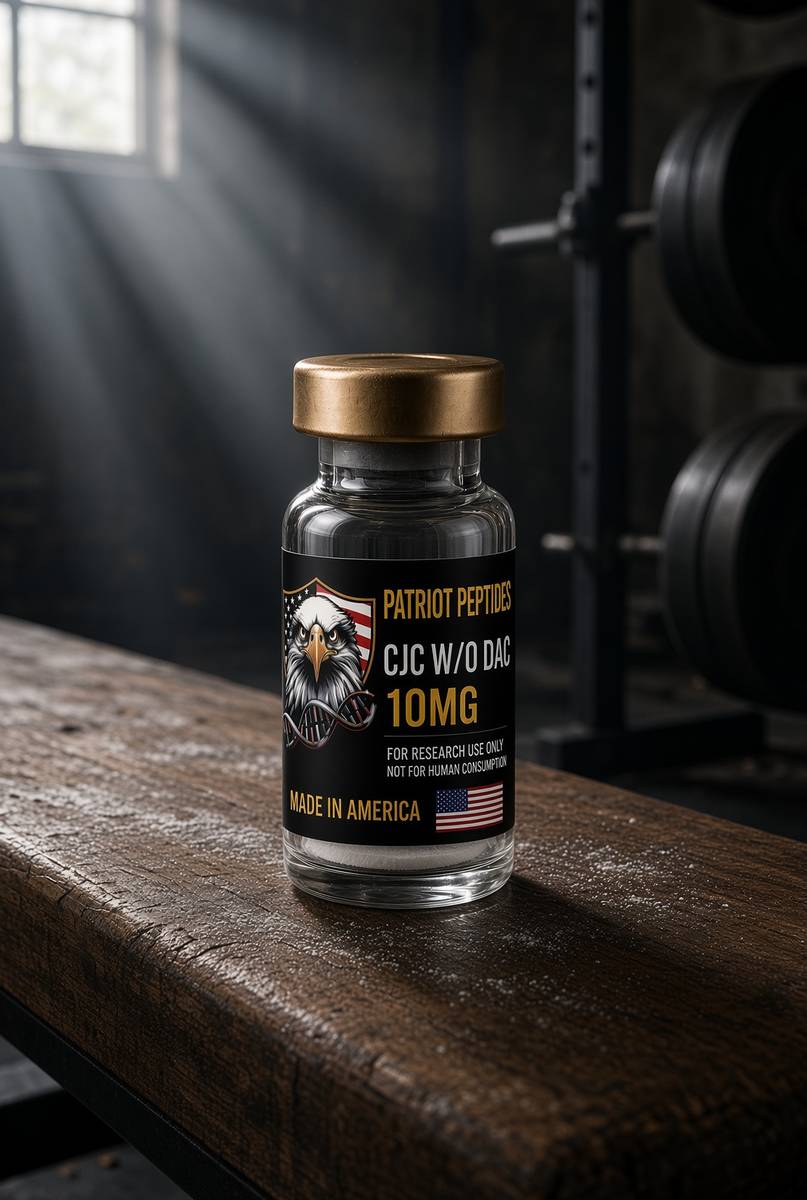
CJC without DAC
10 mg CJC without DAC — a GHRH pulse, not a weekly drip.
4.6(620)
53 browsing this now · 4 purchased in the last 24 hours
10mg · In stock
£30.00
 Research only
Growth axis
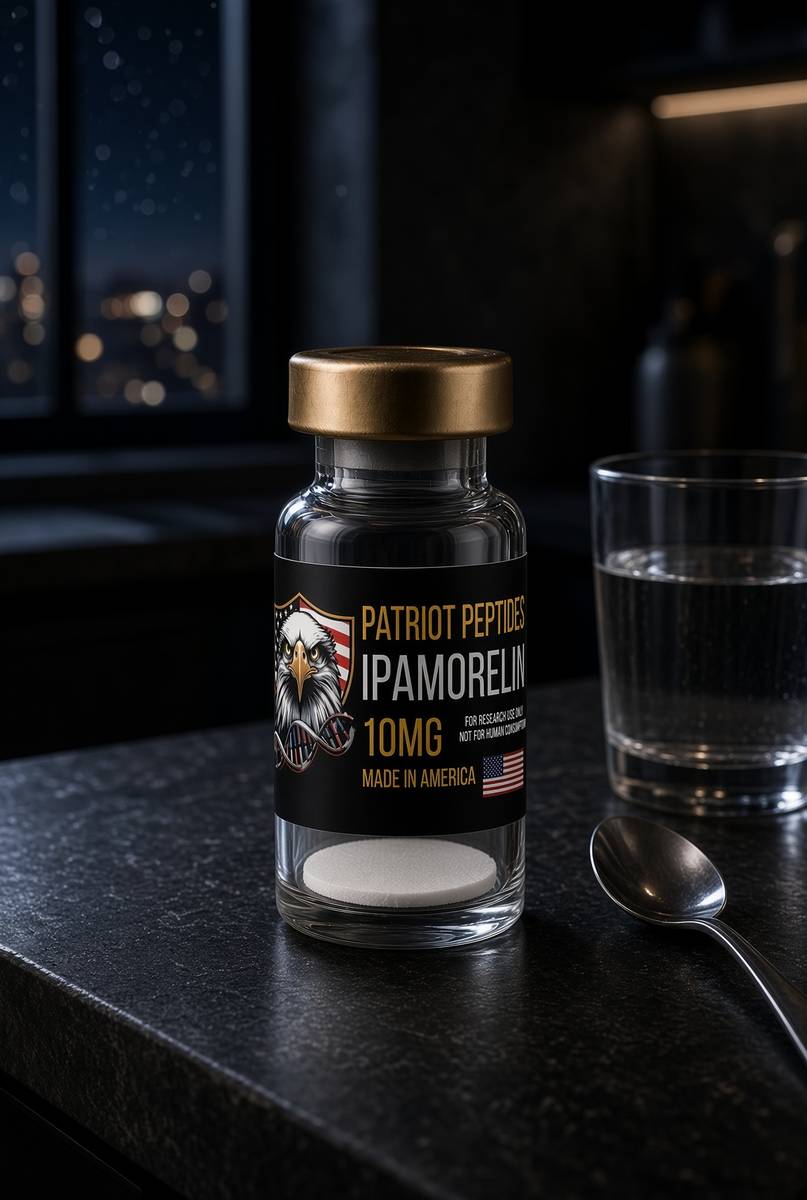
Ipamorelin
10 mg ipamorelin. The clean ghrelin-receptor pentapeptide.
4.7(457)
33 browsing this now · 4 purchased in the last 24 hours
10mg · In stock
£30.00
 Research only
Research use only. Not a combined-use instruction.
Read next
44 min · long read · Peptide research
The growth-hormone axis, properly explained
GHRH, ghrelin, somatotropin and IGF-1 are one conversation. CJC without DAC, ipamorelin, HGH and IGF-1 LR3 are four different microphones.
48 min · long read · Peptide research
IGF-1 LR3: taking the binding proteins out of the fight
Insulin-like growth factor-1 is the tyrosine-kinase half of the GH conversation. LR3 is an analogue designed to ignore IGFBPs — so the receptor on a cultured cell actually sees it.
41 min · long read · Peptide research
CJC-1295 without DAC: a GHRH analogue that still pulses
Modified GRF(1–29) with four substitutions that dodge DPP-IV, and deliberately without the Drug Affinity Complex that would glue it to albumin for a week. The design constraint is physiology.
More in this desk

53 min · long read · Peptide research
Recovery, GH pulses and the CJC / ipamorelin pair
Somatotrophs have two 'go' receptors. CJC without DAC is a slightly longer GHRH pulse. Ipamorelin is a selective ghrelin-receptor key that does not yank ACTH. Together they are the pair Bowers already showed is more than additive — not a gym protocol.
53 min · long read · Peptide research
How research peptides are made — and why HPLC actually matters
Solid-phase peptide synthesis builds a chain one residue at a time. HPLC then asks whether the main peak is what you think it is. ≥98% is not a slogan. It is a chromatogram.
52 min · long read · Peptide research
Fatigue, cellular energy and the NAD+ / MOTS-c neighbourhood
NAD+ is the rechargeable chip every cell spends on fuel and DNA repair — and the pool shrinks with age. MOTS-c is a mitochondrial 16-mer sent out under metabolic stress. Two answers to 'I have no energy' that are not coffee.
51 min · long read · Peptide research
Melanocortin circuits: pigment, appetite and PT-141
Melanotan II lights MC1, MC3, MC4 and MC5 — pigment plus the rest of the sheet. PT-141 is the free-acid cousin pointed at MC3 and MC4, the circuitry papers use for desire and energy, not skin colour. Same Arizona family. Different question.
Essays describe published research. They are not medical advice and they do not authorise human use of any catalogue item.