

Peptide research · 51 min · 11,312 words
Melanocortin circuits: pigment, appetite and PT-141
Melanotan II lights MC1, MC3, MC4 and MC5 — pigment plus the rest of the sheet. PT-141 is the free-acid cousin pointed at MC3 and MC4, the circuitry papers use for desire and energy, not skin colour. Same Arizona family. Different question.
What this essay actually tells you
- Melanotan II is a pan-agonist at MC1, MC3, MC4 and MC5. Pigment plus the rest of the sheet. Arizona chemistry.
- PT-141 is the free-acid cousin, MC3/MC4-preferring. Bremelanotide is the licensed neighbour in its indication, not this vial.
- KPV is the other melanocortin fragment in the catalogue — inflammatory tail, not these rings. File it under a different essay.
What this actually means
If you've typed tan or libido into this shop, you've landed on the melanocortin family, and those two searches aren't the same ligand. Melanotan II is a cyclic analogue of α-MSH built in Arizona as a sunless-tanning probe. It occupies MC1 (pigment), MC3 and MC4 (appetite, energy, arousal circuitry) and MC5. That's why the 1990s clinic noticed more than a tan. PT-141, later named bremelanotide, is the free-acid metabolite of that ring: less MC1, more MC3/MC4. Palatin took that idea to a licensed medicine for hypoactive sexual desire. The catalogue stocks both as named research sequences. Neither vial is a tanning product or Vyleesi. KPV is the other melanocortin fragment in the catalogue — the anti-inflammatory tail, not these rings — and lives on a different essay.
The melanocortin family is one ancestral hormone, five receptors, and a lot of crossed wires. Melanotan II is a cyclic analogue of α-melanocyte-stimulating hormone, built at the University of Arizona as a sunless-tanning probe. It occupies four of the five melanocortin G-protein-coupled receptors: MC1, the pigment receptor on melanocytes; MC3 and MC4, the central receptors the energy-balance and arousal papers actually use; and MC5, the sebum receptor on exocrine glands. That's why a 1990s clinic room noticed more than a tan. PT-141 is the free-acid cousin of that same ring: the C-terminus left as a carboxylic acid rather than an amide, a small edit that shifts the literature toward MC3 and MC4 and away from MC1. Palatin later took that idea to a licensed medicine, bremelanotide, for a defined hypoactive-sexual-desire indication. The catalogue stocks both named research sequences. The licensed injection is a different object, in a different legal class, with a different regulator. Unbundling those three nouns — the pan-agonist, the free-acid research ring, and Vyleesi — is the job. A chromatogram isn't a sunbed.
In short. Tan and libido land on the same hormone family, but not on the same peptide. We'll split the Arizona pan-agonist from its free-acid cousin.
Melanotan II is Ac-Nle-cyclo[Asp-His-D-Phe-Arg-Trp-Lys]-NH2. Seven residues, a lactam between aspartic acid and lysine, an acetyl at the amino terminus, an amide at the carboxyl terminus, norleucine in place of methionine, D-phenylalanine in place of the natural L-phenylalanine of α-MSH. Victor Hruby and Mac Hadley made that ring in Tucson in a photoprotection programme: occupy the pigment receptor, write eumelanin, spare the ultraviolet. The ring didn't stay on one receptor. It's a super-agonist at MC1R, MC3R, MC4R and MC5R, the four melanocortin receptors that share the His-Phe-Arg-Trp pocket, and it is a poor ligand at MC2R, the ACTH receptor on the adrenal. All four of the receptors it does occupy couple primarily to Gs, so occupancy raises cyclic AMP — the same small messenger, now writing pigment, appetite or oil depending on the cell. What the cell writes with that rise depends on which receptor you occupied and where it lives. Pigment is the first invoice. Appetite, flushing, stretching, yawning and arousal were the rest of the sheet, written down in a small human study rather than edited out. A pan-agonist does pan-agonist things. That's the chemistry this listing actually holds.
In short. Melanotan II is a small cyclic peptide from Arizona that turns on four related receptors at once, not only the one that darkens pigment.
PT-141 is the same lactam with the C-terminus left as a carboxylic acid: Ac-Nle-cyclo[Asp-His-D-Phe-Arg-Trp-Lys]-OH, about 1025 daltons, one oxygen and one charge different from the amidated parent at physiological pH. Receptor pockets notice charge. MC1R notices it enough that pigment recedes as the dominant question. MC3R and MC4R still bind the ring. That's why the circuitry papers use this analogue for desire and energy, not for skin colour. Palatin named the structure bremelanotide. The FDA licensed Vyleesi in 2019 as an on-demand subcutaneous injection for acquired, generalised hypoactive sexual desire disorder in premenopausal women. Nausea is common on that label, which is on-family pharmacology, not a contaminant. The medicine is a device, a pharmacovigilance file, and a named indication. The research vial is a characterised heptapeptide with a mass and a chromatogram. Patriot Peptides isn't Palatin. Treating the laboratory solid as Vyleesi in a different bottle is how a thread gets written. We'll keep the two objects in different drawers.
In short. PT-141 is the same ring with the end left as an acid. It prefers brain receptors over pigment. Bremelanotide is the licensed medicine, not this vial.
KPV is the other melanocortin fragment in the catalogue, and it doesn't belong on this page except as a filing instruction. Lys-Pro-Val is the C-terminal tripeptide of α-MSH, the inflammatory tail kept after the His-Phe-Arg-Trp core was thrown away. Luger's keratinocyte work, Getting's macrophage work, and Dalmasso's PepT1 and DSS-colitis paper sit on NF-κB, IκB preservation, and a nutrient transporter the inflamed intestine already over-expresses. That's subtraction. These two rings are addition and cyclisation: pin the core, resist proteases, occupy almost the whole sheet, then, in the free-acid cousin, shift which locks the ring prefers. Pigment and desire are GPCR questions. Inflammatory transcription in a barrier tissue is a different question, a different mass, and a different essay. A bench that opens Melanotan II and hopes for a clean IκB readout hasn't matched the ligand to the question. File the tripeptide under its own map. Stay here for the Arizona pair.
In short. KPV is the anti-inflammatory tail of the same hormone, a different experiment. This page is the two cyclic rings, not that tripeptide.
Hadley and Hruby made a tanning probe and the autonomic nervous system filed a minority report. That is the whole Melanotan II story in one sentence. The free-acid cousin is how the minority report became a programme.— Reading of the Arizona melanocortin notebooks against Palatin's later MC3/MC4 literature.
One precursor, five locks, two rings
The endogenous parent is α-melanocyte-stimulating hormone, thirteen residues, acetylated and amidated, sequence Ac-SYSMEHFRWGKPV-NH2. It's cut from pro-opiomelanocortin, POMC, a polyprotein written in corticotrophs of the anterior pituitary, in melanotrophs of the intermediate lobe, and in a thin population of hypothalamic neurons. Convertases decide which hormone you get. In a corticotroph the principal product is ACTH, thirty-nine residues, the ligand that tells the adrenal cortex to make cortisol. In a melanotroph, and in those hypothalamic cells, the same precursor is cut further to α-MSH. The core pharmacophore is His-Phe-Arg-Trp, residues six to nine, the tetrapeptide the five melanocortin receptors actually want in the pocket. The last three letters are lysine-proline-valine. Medicinal chemistry on this family has two directions, and this essay is only one of them. Melanotan II and PT-141 are addition, cyclisation, and a C-terminal choice. KPV is subtraction. One precursor. Five receptors. Two research rings on this listing. The phenotype is the lock's address, not a mystic property of a seven-residue cycle.
In short. The natural hormone is thirteen amino acids cut from a larger precursor. The middle four fit the receptors. These rings keep that middle and pin it shut.
The POMC gene sits on the short arm of chromosome 2, at 2p23.3. The primary translation product is a few hundred amino acids with paired basic residues marking the cut sites. Prohormone convertase 1/3, PC1, is the first pair of scissors in a corticotroph: it releases ACTH and β-lipotropin. Prohormone convertase 2, PC2, is the second pair, abundant in melanotrophs and in hypothalamic POMC neurons. PC2 takes ACTH and cuts it to a shorter N-terminal piece that peptidylglycine α-amidating monooxygenase, PAM, amidates, and that an N-acetyltransferase acetylates. The product of those two modifications is α-MSH. γ-MSH comes from the N-terminal fragment. β-endorphin comes from β-lipotropin. One gene, a handful of convertases, a tissue-specific peptide cocktail. A corticotroph isn't a melanotroph wearing a different hat. The enzymes are different, the products are different, and the receptors those products occupy are different. If we write POMC peptides as if they were interchangeable, we haven't yet chosen an experiment. Amidation is also why the C-terminus of Melanotan II is an amide by design, and why leaving it as an acid in PT-141 is a real medicinal-chemistry sentence rather than a typo on a certificate.
In short. One gene is cut differently in different cells. Pituitary cells make ACTH. Other POMC cells make α-MSH. The end of the chain is amidated on purpose.
Hypothalamic POMC neurons sit in the arcuate nucleus, next door to AgRP/NPY neurons that do the opposite job. Leptin, from adipose tissue, excites the POMC cells and silences the AgRP cells. Insulin does some of the same. The POMC cells release α-MSH onto MC4R in the paraventricular nucleus and in the brainstem; the AgRP cells release agouti-related peptide, an inverse agonist at MC3R and MC4R, plus GABA. Appetite, in this neighbourhood, is a melanocortin tone, not a mood. Break POMC, or break the convertase PCSK1, or break the leptin receptor upstream, or break MC4R downstream, and the brake fails. That's why a pigment-hormone family became an obesity-genetics family, and why a cyclic peptide that occupies MC4R could become a licensed medicine for people whose genes already failed on that path. The arcuate anatomy is also the reason a tanning analogue made volunteers less hungry. It was never a side-effect in the sense of an accident. It was a receptor the ligand couldn't help occupying. Desire circuitry shares some of those central addresses, which is why the free-acid cousin could be taken toward a sexual-function label without becoming a different protein family.
In short. Brain cells that make α-MSH sit next to cells that block the same receptors. Leptin leans on that seesaw. That's how a tanning family became an appetite and desire story.
Arizona pinned the core in a lactam
Mac Hadley and Victor Hruby, University of Arizona, spent the 1980s and 1990s making melanocortin analogues that would raise eumelanin without ultraviolet. Fair MC1R-variant skin tans poorly and burns well; a peptide that occupied MC1R and wrote eumelanin was, on paper, photoprotection you could dose. Hadley was a comparative physiologist. Stretching, yawning and grooming were already in the α-MSH literature he knew how to measure. Hruby was the chemist who could pin a tetrapeptide in a turn a receptor pocket likes. The collaboration still looks good on the page: a named sequence, a named cyclisation, a named receptor sheet, a named set of rodent pigment and behaviour assays. The programme is sometimes written as if the extras were discovered by accident in a sunbed. They were discovered in a physiology laboratory that was already measuring behaviour as well as pigment. A cyclic super-agonist made those readouts louder. The tanning story is the public story. The notebooks already had the rest of the family in them. A research essay about two rings owes both halves, and owes the names on the Arizona door.
In short. Arizona wanted a peptide that would darken pigment without sun. The same laboratory already knew how to measure appetite, yawning and arousal.
The linear analogue that came first is [Nle4, D-Phe7]α-MSH. Methionine at position four of α-MSH oxidises; norleucine does not, and the side chain is close enough that the receptor still accepts it. Phenylalanine at position seven, in the HFRW core, was flipped to the D-amino acid so proteases would hesitate and potency would rise. That molecule is Melanotan I, later afamelanotide, later Scenesse. It stayed closer to the thirteen-residue parent. Melanotan II is the next move: cut to a heptapeptide, keep norleucine and D-phenylalanine, and close a lactam bridge between aspartic acid and lysine so the HFRW tetrapeptide is held in a turn the pocket likes. Super-agonist is the word the Arizona papers used, and they meant potency at four receptors that made the linear parent look polite. Enzymatic resistance is the other point of the D-amino acid and the cycle. A linear α-MSH in plasma is a short conversation. The cyclic lactam is a longer one. Photoprotection was the brief. The receptor sheet was larger than the brief. That isn't a scandal. It's what happens when you occupy a family of GPCRs that share a pocket and don't share a tissue.
In short. Chemists first made a linear cousin, then a shorter ring. The ring is Melanotan II: stronger at four receptors and slower for enzymes to cut.
A lactam is an amide that closes a ring rather than extending a chain. Aspartic acid contributes the carboxyl; lysine contributes the side-chain amine; the bond between them pins residues two to seven of the analogue into a cycle. The His-D-Phe-Arg-Trp core sits on that cycle in a conformation the melanocortin receptors bind with high affinity. Linear peptides of this length have many rotatable bonds; the cycle throws most of those degrees of freedom away, which is why cyclisation is a classic potency trick and not a cosmetic. The same trick is a protease trick. Exopeptidases that nibble from the ends still meet an acetyl and, on Melanotan II, an amide. Endopeptidases that want an extended strand meet a turn they cut poorly. Molecular weight is about 1024 daltons for the amidated ring, about 1025 for the free acid. CAS 121062-08-6 names the parent. Identity is that sequence plus the lactam plus the D-phenylalanine plus the C-terminus you actually wrote. A linear deletion peptide won't copy the mass or the pharmacology. A missed coupling in solid-phase synthesis makes an N-minus-one contaminant that looks almost right on a cheap ultraviolet scan. Sequence, mass and purity are the invoice.
In short. The ring is a chemical bridge between two amino acids. It holds the shape the receptors like and slows the enzymes that would otherwise cut the chain.
Pan, in this family, has a precise meaning. Binding and functional assays in the 1990s and after put Melanotan II at MC1R, MC3R, MC4R and MC5R with nanomolar or sub-nanomolar potency, Gs-coupled cyclic AMP as the default readout, and negligible activity at MC2R. MC2R wants ACTH and needs the accessory protein MRAP to traffic and to signal; the cyclic heptapeptide is a poor ligand there, which is why a tanning probe doesn't routinely present as an ACTH analogue. That selectivity is luck as much as design, and it is worth keeping on the page so nobody files melanocortin agonist under steroidogenesis. The four receptors it does occupy share the HFRW pocket and don't share tissue. MC1R lives on melanocytes, and also on macrophages and keratinocytes. MC3R and MC4R live in hypothalamus and elsewhere in the brain. MC5R lives on exocrine glands, sebaceous epithelium in particular. One ancestral key. Four locks. The phenotype is the lock's address. A pan-agonist occupies the locks it can reach. The extras in a volunteer study are those locks doing their jobs. PT-141 is the same family refusing, a little, to occupy all four with equal enthusiasm. That refusal is the C-terminus.
In short. Melanotan II is strong at four of the five related receptors and weak at the adrenal one. Effects depend on which tissues those four receptors sit in.
- Melanotan II
- Ac-Nle-cyclo[Asp-His-D-Phe-Arg-Trp-Lys]-NH2
- PT-141
- Ac-Nle-cyclo[Asp-His-D-Phe-Arg-Trp-Lys]-OH
- α-MSH parent
- 13 residues
- Receptors
- MC1R, MC3R, MC4R, MC5R
- Afamelanotide
- Scenesse, EPP
- Bremelanotide
- Vyleesi, FDA 2019
- Setmelanotide
- Imcivree, FDA 2020
- Dorr 1996
- pilot phase I
Hruby and Hadley, Arizona. Lactam between Asp and Lys. ~1024 Da. CAS 121062-08-6. Pan-agonist MC1/3/4/5.
Free-acid cousin. ~1025 Da. MC3/MC4-preferring. Research heptapeptide, not Vyleesi.
Ac-SYSMEHFRWGKPV-NH2. HFRW is the core. KPV is the tail, a different essay.
Gs–cAMP. Negligible at MC2R, the ACTH receptor.
Melanotan I. Linear [Nle4, D-Phe7]α-MSH. Licensed implant, not these rings.
Licensed neighbour in HSDD. Palatin. Not the research vial.
MC4R agonist for POMC / PCSK1 / LEPR deficiency.
Pigment, nausea, stretching, yawning, erection. The extras were data.
Five class-A GPCRs, primarily Gs, and tissue writes the rest
The melanocortin receptors are class-A, rhodopsin-like G-protein-coupled receptors: seven transmembrane helices, an extracellular face that binds peptide, an intracellular face that acts as a guanine-nucleotide exchange factor for a heterotrimeric G protein. There are five of them in mammals, numbered MC1R to MC5R in the order they were cloned, which isn't the order of their physiological importance and is a standing irritation to anyone who teaches the family. Roger Cone, Kathleen Mountjoy and colleagues cloned MC1R from melanoma RNA in 1992 and then the rest of the family in short order. MC1R was the MSH receptor everyone already believed in. MC2R was the ACTH receptor the adrenal had been using since the 1950s. MC3R, MC4R and MC5R were the surprises: three more GPCRs with the same HFRW pocket, sitting in brain and in exocrine glands, waiting for someone to knock them out. The knockout mice did the teaching. Mc4r-null mice eat, grow and become obese. Mc1r-null mice are yellow because pheomelanin wins. Mc5r-null mice have a sebum defect. Mc3r-null mice have a subtler energy-balance phenotype. A family you can clone, knock out and occupy is a family a catalogue can name without inventing a job.
In short. Five related receptors were cloned in the 1990s. Knockout mice then showed pigment, appetite and oil as separate jobs of the same family.
Gs is the default G protein. Occupancy rearranges the helices. The cytoplasmic face catalyses GDP-to-GTP exchange on Gαs. Gαs-GTP finds adenylyl cyclase. Cyclase makes cyclic AMP from ATP. Protein kinase A reads the cyclic AMP, phosphorylates CREB and a list of other substrates, and the cell writes whatever programme that receptor, in that tissue, is for. In a melanocyte the programme is MITF, then tyrosinase, then eumelanin. In a paraventricular neuron the programme is a change in excitability and in peptide release that the organism experiences as satiety. In a brainstem neuron that same occupancy can read as aversive or emetic tone. In a spinal and hypothalamic neighbourhood that later desire papers mapped, the programme includes stretching, yawning and genital autonomic outflow. In a sebocyte the programme is lipid synthesis for sebum. The second messenger is the same nucleotide. The invoice isn't. Some of these receptors also recruit β-arrestin, and some couple in part to other G proteins in particular assays. For a working map, Gs–cyclic AMP is the sentence you write first. Lefkowitz and Kobilka's chemistry Nobel in 2012 was for this architecture in general. The architecture is why a nanomolar peptide can move a micromolar messenger.
In short. These receptors mostly raise cyclic AMP inside the cell. The same messenger means pigment in skin, fullness or desire in brain, or oil in a gland, depending on the receptor.
Diagram
Outside
Peptide ligand
Named sequence in the nM–µM pocket. Shape complementarity, not vibes. A 15-mer and a 4-mer do not fit the same hole.
Membrane
7-TM receptor
Helices rearrange. The cytoplasmic face becomes a GEF for a heterotrimeric G protein (Gs, Gi, Gq, G12/13).
Inside
Second messengers
cAMP, IP₃, Ca²⁺, β-arrestin. One occupied receptor can spawn thousands of messenger molecules. That is amplification.
~800 GPCRs in the human genome. Seven transmembrane helices, an extracellular ligand pocket, an intracellular G-protein handshake. Catalogue neighbours: ipamorelin at GHSR, PT-141/MT2 at melanocortin receptors, retatrutide at GLP-1R/GIPR/GCGR.
Amplification is arithmetic, not a metaphor. One occupied receptor can load tens to hundreds of G proteins because the receptor is a catalyst, not a stoichiometric sponge. Each Gαs-GTP can occupy adenylyl cyclase long enough to make many cyclic AMP molecules. Each cyclic-AMP-activated protein kinase A can phosphorylate many substrates. A nanomolar occupancy in the pocket can therefore raise a micromolar messenger in the cytosol, which is the only magic in this family and isn't magic. Local nanodomains — AKAPs, phosphodiesterases sitting next to the cyclase — mean a cyclic AMP rise next to a channel isn't a cyclic AMP rise next to the nucleus. That's why two ligands at the same receptor can write different intracellular sentences if they prefer different nanodomains or different arrestin versus G-protein balances. Melanotan II and bremelanotide share a ring and don't write identical sentences. Desensitisation is the other half: G-protein-coupled receptor kinases phosphorylate the occupied receptor, β-arrestin binds, the receptor is pulled inward. More ligand isn't more signal forever. A first-hour flush in a melanocortin study is often that machinery, not a reason to double the concentration in a dish you haven't timed.
In short. One receptor can make a cloud of cyclic AMP because enzymes sit in between. The cell then turns the receptor off, so more ligand isn't more signal forever.
Diagram
× 1
Ligand
One peptide in one pocket. nM–µM. Shape, not a mood.
× 10–10²
G proteins
The occupied GPCR is a GEF. Each Gα is a catalyst.
× 10³–10⁴
cAMP / IP₃ / Ca²⁺
Adenylyl cyclase and PLC do not make one molecule. They make a cloud.
× 10⁴–10⁶
PKA / PKC / CaMK
Kinases phosphorylate many substrates per messenger.
× tissue
Secretion, transcription, motility
The organism-level readout. Still not a protocol.
This is the only magic, and it is not magic. A nanomolar ligand can move a micromolar messenger because enzymes sit between them. Desensitisation (GRK, β-arrestin, endocytosis) is how the cell refuses to let ‘more ligand’ mean ‘more signal’ forever.
- Ligand in the extracellular pocket. Shape complementarity. HFRW for the full agonists; KPV is a different, smaller question, on a different page.
- Seven helices rearrange. The cytoplasmic face becomes a GEF for Gs.
- Gαs-GTP activates adenylyl cyclase. Cyclic AMP rises. PKA and EPAC read it.
- The tissue writes the phenotype: MITF and tyrosinase, satiety, desire-adjacent outflow, sebum — or, for the fragment, IκB preservation.
- GRK and β-arrestin desensitise. Endocytosis. The signal is a pulse unless the ligand is built not to leave.
The peptide doesn't need to enter the cell. That sentence is the whole point of a plasma-membrane GPCR, and it is the sentence that still gets lost. Occupancy outside rearranges helices. Information crosses the bilayer as conformation. Cyclic AMP is made on the inner face. The heptapeptide, in the boring and correct case, is still outside, or is on its way to a lysosome after the receptor was internalised. KPV is the exception that proves the rule: a tripeptide that can also be cargo on PepT1, with intracellular NF-κB consequences that don't all require the tanning receptor. Neither of these rings is that exception. They're too large for PepT1, they're GPCR ligands, and treating them as cell-penetrating peptides is a category error. The lactam is a protease trick, not a bilayer ticket. The free acid is a receptor-preference trick, not a passport. If your experiment can't say whether the ligand sat on a receptor or crossed as cargo, you haven't yet named the experiment. For both rings on this listing the lock is extracellular. Name the subtype. Then measure the nucleotide.
In short. Both rings work from outside the cell by changing the receptor's shape. They don't need to go inside. The much smaller fragment KPV can travel a different route.
MC1R writes eumelanin, or fails to
MC1R on a melanocyte is the pigment receptor you already think you know. Occupancy, α-MSH or a synthetic agonist, raises cyclic AMP. Protein kinase A phosphorylates CREB. CREB, with other inputs, writes MITF, microphthalmia-associated transcription factor, the master transcription factor of the melanocyte. MITF writes TYR, tyrosinase, and TYRP1 and DCT (TYRP2), the enzymes that take tyrosine through DOPA and dopaquinone into the melanin polymers. When the cyclic AMP signal is strong, the polymer is eumelanin: brown-black, a broad ultraviolet absorber, photoprotective in the ordinary sense that a physical chemist would accept. When the cyclic AMP signal is weak, dopaquinone is diverted toward cysteine conjugates and the polymer is pheomelanin: red-yellow, a poorer absorber, and in some assays a source of reactive oxygen rather than a shield. The switch isn't a lifestyle. It's a receptor, a cyclic nucleotide, a transcription factor and a pair of polymer chemistries. Saying melanin as if there were one pigment skips the melanosome. Melanotan II occupies this receptor with enthusiasm. That was the design. PT-141 occupies it less enthusiastically. That was the C-terminus. The other receptors weren't a surprise to the chemists.
In short. MC1R tells pigment cells to make dark eumelanin. If the receptor is weak, they make red-yellow pheomelanin instead, which protects less well against ultraviolet light.
The red-hair-colour alleles are the cleanest genotype-to-phenotype story in human pigmentation. R151C, R160W and D294H are the common European hypomorphs: missense changes that leave a receptor on the surface but blunt the cyclic AMP response to α-MSH. Heterozygotes tan poorly. Compound heterozygotes and homozygotes are the classic red-hair, fair-skin, freckled, burns-rather-than-tans phenotype. Valverde, Rees, Sturm, Duffy, Palmer — the association papers of the 1990s and 2000s — mapped that colouring onto those alleles with a clarity most complex traits never get. The receptor is still a receptor. A hypomorph isn't a deletion. Residual signalling, ligand-independent constitutive activity, and the rest of the pigment genome still move the phenotype. But if you want a single-gene sentence about why some skin never browns, MC1R is that sentence. Arizona's photoprotection idea was aimed at that skin: raise eumelanin without ultraviolet, especially where the endogenous hormone is shouting at a deaf receptor. Whether a super-agonist can shout loudly enough at a hypomorph is an empirical question, allele by allele, and not a reason to write the research ring as a cosmetic. Agouti signalling protein, ASIP, is the endogenous inverse agonist at MC1R; the yellow mouse is ASIP overexpressed.
In short. Common red-hair versions of MC1R answer poorly to the natural hormone. Fair skin, freckles and burning follow. That's one of the cleanest gene-to-colour stories we have.
Melanoma statistics travel with that colouring, and the travel isn't only these people burn, therefore they get more ultraviolet, therefore they get more melanoma. They do burn. Cumulative ultraviolet is a first-class cause. There's also a pheomelanin-intrinsic story: Mitra, Fisher and colleagues, in a mouse with a red-hair Mc1r allele, showed oxidative DNA damage and melanoma risk that didn't require ultraviolet, which is a disturbing paper if you had hoped pigment chemistry was only a filter. Human epidemiology is messier than a genetically red mouse. MC1R variants raise melanoma risk in fair-skinned cohorts after you adjust, imperfectly, for sun exposure and for naevus count. The practical sentence for this pair of rings is simpler than the oncology: a hypomorphic MC1R tilts the polymer toward pheomelanin, tilts the skin toward burning, and travels with melanoma risk. Afamelanotide was built, in part, as a photoprotective agonist for skin that tans poorly. Erythropoietic protoporphyria, the licensed indication, is a different phototoxicity — ferrochelatase deficiency, protoporphyrin in the skin, pain in visible light — but the receptor is the same MC1R, and eumelanin is still the pigment you're trying to write. That implant is Melanotan I, not either cyclic ring.
In short. Red-hair MC1R variants travel with higher melanoma risk. Some of that is burning. Some of it may be the red pigment itself making oxidative damage.
MC2R is the adrenal, and both rings mostly leave it alone
MC2R is the ACTH receptor. It lives on zona fasciculata cells of the adrenal cortex. Occupancy raises cyclic AMP, protein kinase A phosphorylates the machinery that moves cholesterol to CYP11A1, and cortisol is written. The receptor is fussy. It wants ACTH, not α-MSH, and it needs melanocortin-2 receptor accessory protein, MRAP, to traffic and to signal. Familial glucocorticoid deficiency type 1 is MC2R loss-of-function; type 2 is MRAP. Melanotan II, for all its promiscuity at MC1, MC3, MC4 and MC5, is a poor MC2R agonist, which is why a pan-melanocortin probe doesn't routinely present as an ACTH analogue. PT-141 isn't an ACTH analogue either. That sentence belongs early, because melanocortin is easy to over-read as the whole family including the adrenal. ACTH is a melanocortin. It isn't the melanocortin these rings are holding. The corticotroph, the adrenal, the circadian cortisol curve — those are a different essay, a different axis, a different ligand. Name MC2R so you can leave it. Then return to the four receptors the lactam actually occupies, which are already enough to fill a first-in-human room with pigment, nausea, appetite change and arousal without borrowing the adrenal.
In short. MC2R is the adrenal ACTH receptor and needs a helper protein. Neither ring on this page touches it much, so a tanning or desire probe isn't a cortisol drug.
MC3R and MC4R: energy, appetite and the desire circuit
MC3R is the quieter of the two central receptors and isn't a footnote. It sits on POMC neurons themselves, among other sites, and functions in part as an inhibitory autocrine brake: α-MSH released from the neuron can occupy MC3R on the same population and temper the output. Knockout mice have a metabolic phenotype that isn't identical to MC4R knockout — more of a shift in body composition and feed efficiency than the frank hyperphagia of MC4R loss. Human MC3R variants exist and are argued over; they haven't given us a licensed agonist of their own. Melanotan II occupies MC3R because Melanotan II occupies almost everything in the family. That's a feature of a pan-agonist and a nuisance if you wanted to know which receptor moved feeding or which receptor moved arousal. PT-141 leans toward MC3 and MC4, which is why the sexual-function literature sits on those two and not on the melanocyte. Energy balance is a circuit. Desire, in the papers that followed Arizona, is a circuit that shares anatomy with that energy map and then leaves it for spinal and autonomic outflow. MC3R is one node. MC4R is the node the clinic actually met.
In short. MC3R helps the brain's energy circuit and partly brakes the cells that make α-MSH. It's real. MC4R is the one obesity genetics and desire papers made famous.
MC4R is the hypothalamic receptor that made this family a metabolic subject, and then a desire subject, without ever stopping being a pigment-hormone receptor in a different tissue. It's expressed on paraventricular neurons, on brainstem neurons that run autonomic outflow, and in a list of other nuclei a neuroanatomist can recite. Occupancy by α-MSH is an appetite brake and a push on energy expenditure. Occupancy by AgRP is the opposite: AgRP is an inverse agonist, not merely a blocker, because MC4R has constitutive activity and AgRP turns that down. Yeo, Farooqi, O'Rahilly and colleagues at Cambridge showed, in the late 1990s and then in a New England Journal paper in 2003, that heterozygous loss-of-function mutations in MC4R are the most common single-gene cause of severe obesity in the cohorts that bother to sequence it. A few percent of severe early-onset obesity. Dominant with incomplete penetrance. Hyperphagia from childhood, increased lean mass, accelerated linear growth — a phenotype that isn't they eat too much as a moral sentence. The neuron is an appetite brake. Break the receptor and the brake fails. That's a first-class melanocortin output. A tanning essay that leaves it out hasn't described the family.
In short. MC4R in the hypothalamus is an appetite brake. Inherited damage to one copy is the most common single-gene cause of severe obesity. Desire papers use this receptor too.
The 2003 paper is the document, not a tweet. Farooqi, Keogh, Yeo, Lank, Cheetham, O'Rahilly: Clinical spectrum of obesity and mutations in the melanocortin 4 receptor gene, New England Journal of Medicine, 348: 1085–1095. They sequenced MC4R in people with severe obesity, found a spectrum of heterozygous mutations, showed that the mutations that wrecked receptor function in a dish tracked with the clinical severity, and put a tanning-hormone receptor in the endocrine clinic. Subsequent work filled in the signalling: Gs, cyclic AMP, but also a β-arrestin and MAPK conversation that some obesity mutations hit more than others, which is why not every missense is the same disease. Rare homozygous or compound-heterozygous complete loss is more severe. The common heterozygous loss-of-function is already enough to be the leading monogenic obesity. Polygenic obesity is still most of obesity. MC4R isn't the obesity gene. It's the most common of the rare, severe, early ones, and it is a melanocortin receptor, which is the only reason it belongs in an essay about two Arizona rings. When Hadley's volunteers ate less, they were occupying this receptor, among others. That was never an accident of formulation.
In short. Farooqi and O'Rahilly sequenced MC4R in severe obesity and showed the broken receptors matched the broken appetite. That paper moved this family into the clinic.
POMC deficiency is the rarer, cleaner experiment of nature. If you can't make the ligand, MC4R never sees α-MSH, MC1R never sees it either, and ACTH is missing so the adrenal never sees that. The child is ACTH-deficient, obese, and often red-haired, because the pigment receptor and the appetite receptor lost the same peptide. PCSK1 deficiency wrecks the convertase that cuts POMC and proinsulin and a list of other prohormones; obesity is part of a broader endocrine mess. Leptin-receptor deficiency wrecks the upstream signal that tells POMC neurons to fire. Three genetic lesions, one pathway, one licensed peptide that was built to occupy MC4R anyway. Setmelanotide, RM-493, Imcivree, Rhythm Pharmaceuticals: a cyclic octapeptide MC4R agonist. Kühnen, Krude and colleagues treated POMC-deficient patients and published the weight loss in the New England Journal in 2016. The FDA licensed it in 2020 for chronic weight management in people six and older with POMC, PCSK1 or LEPR deficiency, later adding Bardet-Biedl syndrome. When a tanning-hormone family has an FDA-approved obesity drug, the family left the booth. Setmelanotide is that drug. Melanotan II isn't. PT-141 isn't. Confusing either research ring with a licensed MC4R medicine is how a thread gets written.
In short. If the body can't make α-MSH, you get obesity, cortisol failure and often red hair together. Setmelanotide is the licensed MC4R agonist for those rare pathway diseases.
Leptin is the upstream signal that made the arcuate melanocortin circuit a textbook. Friedman cloned leptin from the ob mouse; the receptor lives on POMC neurons and on AgRP neurons. Leptin rising, as the warehouse fills, excites POMC cells so they release α-MSH onto MC4R, and silences AgRP cells so the inverse agonist withdraws. Starvation is the opposite: POMC quiet, AgRP loud, appetite up. That's why leptin-receptor deficiency looks like POMC deficiency looks like MC4R deficiency, one floor down each time, and why setmelanotide can bypass a broken leptin receptor or a missing ligand and still occupy the last receptor. MRAP2, a relative of the adrenal accessory protein, helps MC4R traffic and signal; some rare obesity mutations hit MRAP2 instead of the receptor itself. The circuit is allowed to have more than one named protein. A pan-agonist dumped into a volunteer still occupies MC4R on this circuit, which is why appetite moved in Arizona. It also occupies MC1R, MC3R and MC5R, which is why appetite was never the only thing that moved. The free-acid cousin occupies the central pair more than the pigment receptor, which is why desire literature could leave the melanocyte in the background.
In short. Leptin talks to brain cells that release α-MSH onto the appetite receptor. Break leptin, the hormone, or MC4R, and the same brake fails. These rings occupy that last step among others.
Desire, in this family, isn't a mood word and not a caption. Central melanocortin tone — MC4R heavily implicated, MC3R in the supporting cast — sits on hypothalamic and brainstem neurons that run stretching, yawning and genital autonomic outflow, with a spinal half the sexual-function papers spent two decades mapping. Dorr's 1996 volunteers noticed spontaneous erection because a pan-agonist reaches those addresses as well as melanocytes. Industry followed that signal. Early Palatin development chased male erectile function, then moved, for regulatory and clinical reasons, to acquired, generalised hypoactive sexual desire disorder in premenopausal women. That's a defined indication with a defined device, not a synonym for libido as a search term. Sildenafil is a phosphodiesterase-5 inhibitor acting on vascular smooth muscle in a nitric-oxide cascade; it is a different protein family, a different organ, a different legal object. Melanocortin desire papers are central. PDE5 papers are local and vascular. Stapling them because both sentences contain erection is how a reading list becomes a rumour. PT-141 is the research ring those central papers named. Bremelanotide is the licensed neighbour in its indication. Neither is a PDE5 inhibitor, and neither is a personality.
In short. Desire papers in this family are about brain and spinal melanocortin receptors, not about the blood-vessel enzyme that sildenafil occupies. Different lock, different literature.
Diagram
MC1R
melanocyte
Eumelanin vs pheomelanin. Red-hair alleles. Afamelanotide’s receptor.
MC3R
hypothalamus
Energy balance. Occupied by MT2 because MT2 occupies almost everything.
MC4R
hypothalamus
Appetite brake. Loss-of-function obesity. Setmelanotide (FDA 2020).
MC5R
sebaceous
Sebum. A first-class output people still treat as a footnote.
KPV
tail of α-MSH
NF-κB off-switch. PepT1 uptake. Designed not to tan.
MT2
pan-agonist
Ac-Nle-cyclo[Asp-His-D-Phe-Arg-Trp-Lys]-NH2. Pigment, appetite, flushing, arousal.
α-MSH is Ac-SYSMEHFRWGKPV-NH2. The last three letters are KPV. Melanotan II is what a pan-agonist looks like. KPV is the design move in the other direction. Match the ligand to the question.
MC5R writes sebum, and inverse agonists prove the receptors were on
MC5R is the sebum receptor. It's expressed on sebaceous glands and on other exocrine epithelia. Knockout mice have a defect in water repulsion and thermoregulation that traces to altered sebum, which makes sense once you remember that fur is a hydrophobic coat a gland has to oil. Human sebocytes express MC5R; α-MSH can change their lipid programme in culture. This is a first-class melanocortin output that people still treat as a footnote because it doesn't photograph as a tan and doesn't hospitalise as obesity. A pan-agonist will occupy MC5R because that is what pan means. Whether a given flushing or a given change in skin oil in an old Arizona volunteer study was MC5R, MC1R, autonomic, or all three isn't a question a caption gets to answer. Five receptors were cloned because five receptors exist. Constitutive activity is the other fact this family teaches well. MC4R signals somewhat without ligand; AgRP is an inverse agonist that turns that basal signal down. ASIP does the equivalent at MC1R. Melanotan II is a heavy on. PT-141 is an on aimed more at the central pair. Inverse agonism is why blocker is a sloppy word.
In short. MC5R sits on oil glands. The family does sebum as well as pigment and appetite. A pan-agonist will touch that receptor too. Some of these receptors are partly on even without hormone.
The 1996 extras were data
Dorr, Lines, Levine and colleagues, Life Sciences 1996, is the human document you'd actually cite. Evaluation of melanotan-II, a superpotent cyclic melanotropic peptide in a pilot phase-I clinical study. Small numbers, as pilots are. Pigment rose, which was the intended MC1R readout. Nausea happened, which is brainstem melanocortin tone, MC4R neighbourhoods that run aversive and emetic circuitry, area postrema and related nuclei. Stretching and yawning happened, old in the α-MSH literature, easy to joke about, still a real central readout. Spontaneous erection happened in men. Appetite moved. Faces flushed. A pan-agonist in a volunteer is a pan-agonist. The group wrote the extras down instead of editing them out, which is why a later sexual-function programme could point at a paper rather than at a rumour. Industry followed the arousal signal into the free-acid analogue. Palatin named the structure bremelanotide. The parent ring wasn't that programme's finished medicine. It was the existence proof that central melanocortin tone is ligand-gated in humans, at doses that also tan. Existence proofs are how fields start. They aren't how medicines finish. Hadley's notebooks already knew the extras were data. Dorr put them in print.
In short. The 1996 human study is small and honest: pigment plus nausea, yawning, arousal and appetite change. Later drug programmes followed some of those signals and left the rest.
Those extras map onto receptors if you let them. Pigment is MC1R on melanocytes. Appetite is MC3R and MC4R in hypothalamus. Flushing is vascular and autonomic, a mixture a first-hour study isn't designed to dissect. Arousal — stretching, yawning, spontaneous erection in men — is central melanocortin tone, MC4R heavily implicated, with a spinal and autonomic half. None of that was off-target in the sense of hitting a different protein family. It was on-family, on-purpose promiscuity. A pan-agonist is a tool for asking whether a phenotype is melanocortin-gated at all. It's a poor tool for asking which subtype did the work. If you want subtype, you change the molecule, or you use a knockout, or you use an antagonist, or you pick the licensed cousin that was taken through to a label on one job. Melanotan II remains the research pan-agonist because that is the question it answers. PT-141 is the design move that kept the ring and changed the terminus so the question could shift toward MC3 and MC4. Subtle is a different vial. KPV is the design move in the other direction, and it isn't on this listing as a third ring.
In short. The extra effects were the other melanocortin receptors doing their jobs. A pan-agonist asks whether the family is involved. The free acid asks a narrower central question.
Nausea is the melanocortin extra a first-hour study should expect and an experiment should name. MC4R sits in the brainstem as well as in the paraventricular hypothalamus, including neighbourhoods that run aversive and emetic tone. Area postrema and related nuclei are how a peptide that never needed to be a gut hormone can still make a volunteer reach for a basin. Afamelanotide, bremelanotide and setmelanotide all carry gastrointestinal events on their labels; Melanotan II did in Arizona. That's on-family pharmacology, not a contaminant in the cake. Stretching and yawning are the other brainstem signature. A feeding study that doesn't watch for malaise will count nausea as satiety and publish a cleaner curve than the animal lived. A human study that doesn't list nausea has probably not given a melanocortin agonist, or hasn't asked. The extras are data. Write them down, as Dorr did, and then decide whether your question can survive them. A pigment assay in a dish doesn't have a brainstem. A rodent feeding assay does. A desire study in a volunteer does. Choose the assay that matches the claim. PT-141 didn't escape this invoice by becoming a free acid.
In short. Melanocortin agonists often cause nausea because appetite receptors also sit in brainstem areas that trigger queasiness. That's the family, not a dirty sample.
A superpotent cyclic melanotropic peptide in a pilot phase-I study did what a pan-agonist does: pigment, nausea, stretching, yawning, erection. The extras were data, not a scandal to be edited out.— Dorr RT, Lines R, Levine N, et al. Evaluation of melanotan-II, a superpotent cyclic melanotropic peptide in a pilot phase-I clinical study. Life Sci. 1996; 58: 1777–1784.
The free acid: PT-141 is not Melanotan II, and is not Vyleesi
Amide versus acid is a medicinal-chemistry sentence worth slowing down for, because the rest of the ring is identical and the phenotype isn't. A C-terminal amide is the native finish of α-MSH and of Melanotan II; amidation is a PAM enzyme's job in the secretory pathway, and chemists put it on the resin as an amide resin or as a post-cleavage conversion. A free carboxylic acid is one oxygen different and a charge different at physiological pH. Receptor pockets notice charge. MC1R notices it enough that pigment recedes as the dominant question. MC3R and MC4R still bind the ring. That's ligand-dependent receptor choice, the adult version of it doesn't tan as much. It isn't a Kenakin bias table anyone should fabricate for a catalogue page, and it isn't identity. Treating Melanotan II and PT-141 as interchangeable because they share a lactam is how the two rings collapse into one. Same family, different terminus, different preferred locks, different literature, different legal object when Palatin's medicine is in the room. Write the C-terminus on the experimental line. Then write which receptor you actually meant.
In short. Changing the last chemical group from an amide to an acid shifts the ring away from pigment receptors and toward the brain ones. That small edit is why PT-141 isn't Melanotan II.
Write the two sequences next to each other and the edit is almost rude in its smallness. Melanotan II: Ac-Nle-cyclo[Asp-His-D-Phe-Arg-Trp-Lys]-NH2. PT-141: Ac-Nle-cyclo[Asp-His-D-Phe-Arg-Trp-Lys]-OH. Same norleucine. Same D-phenylalanine. Same Asp-Lys lactam. Same His-D-Phe-Arg-Trp core sitting in the turn. The amide is gone. The carboxylic acid is in. Mass moves by about a dalton. Pharmacology moves by a family portrait. Binding and functional panels in the Palatin-era literature put the free acid forward at MC3 and MC4 relative to MC1, which is the only reason a desire programme could leave the tanning booth without leaving Tucson. Early papers sometimes call PT-141 a metabolite of Melanotan II, which is a pharmacokinetic sentence about deamidation, not a licence to treat the two solids as one peak. On a reverse-phase column they're neighbours. On a receptor they aren't interchangeable. A missed amidation during manufacture will give you a free-acid contaminant in an amidated cake, or the reverse, and a cheap ultraviolet scan won't always confess. Mass spectrometry is how you know which C-terminus you weighed. Nicknames change every season. The terminus doesn't care.
In short. The two rings share almost every atom. The last group is an amide on Melanotan II and an acid on PT-141. That's enough to change which receptors lead.
Palatin's development path is the documentary record of that C-terminal choice, and it is worth reading as industrial history rather than as a protocol. The ring was interesting because Dorr's extras had already shown central melanocortin tone in humans. Male erectile function was the first clinical bet, because spontaneous erection was the extra that photographed. The bet then moved. Regulatory and clinical reasons, a female indication with a defined diagnostic construct, an on-demand subcutaneous injection rather than a daily metabolic agonist: those are how a melanocortin analogue becomes a medicine rather than a rumour. The FDA licensed Vyleesi in 2019 for acquired, generalised hypoactive sexual desire disorder in premenopausal women. Nausea is common. Flushing happens. The label is the label. This catalogue doesn't sell that injection, doesn't write that indication onto a research cake, and doesn't pretend a lyophilised heptapeptide is a Palatin device. Bremelanotide is the licensed neighbour in its indication. PT-141 on a research listing is the named sequence those papers used before, during and beside that programme. Adults can want both a paper and an appointment. Bundling them is how a research reagent becomes a medical claim it isn't allowed to be.
In short. Palatin took the free-acid ring toward a licensed desire injection. That medicine has a label and a device. The research peptide is the named chain, not that product.
Hypoactive sexual desire disorder, as a regulatory object, is a diagnostic construct with inclusion criteria, exclusion criteria and a pair of trial endpoints you can actually name. Acquired means the complaint wasn't lifelong. Generalised means it isn't partner-specific. Premenopausal was the population on the 2019 label. Satisfying sexual events and a desire score are the numbers those trials moved, with nausea as the event the label has to carry. That's clinic language. It isn't libido as a search term, and it isn't a reason to caption a research vial with a bedroom. Flibanserin is a different, serotonergic, daily oral neighbour with its own alcohol warning and its own argument; it isn't a melanocortin. Sildenafil, again, is vascular and local. The melanocortin bet was central occupancy at MC3 and MC4. Whether a given volunteer in Arizona, or a given rodent in a subsequent paper, was showing desire, nausea, stretching, or all three is a measurement problem, not a branding problem. A research heptapeptide doesn't inherit an FDA indication by structural kinship. Kinship is why the paper trail exists. Indication is earned in a different building.
In short. The licensed indication is a defined diagnosis in a defined population, with nausea on the label. A research cake doesn't inherit that indication by looking similar.
Three licensed cousins, two research rings
Afamelanotide is the linear analogue that finished as a medicine, and it belongs on this page so the cyclic pair can't be mistaken for it. [Nle4, D-Phe7]α-MSH, Melanotan I, then Scenesse, Clinuvel. An implant, not a cyclic heptapeptide in a vial. The EMA licensed it for erythropoietic protoporphyria in 2014; the FDA followed in 2019. EPP is ferrochelatase deficiency, protoporphyrin IX in erythrocytes and skin, burning pain in visible light rather than a delayed ultraviolet burn. Eumelanin in the epidermis is a filter for that light. The implant is a licensed photoprotective melanocortin agonist in a defined disease, MC1R-forward, with a pharmacovigilance file and a regulated device. It's Melanotan I, not Melanotan II, and it isn't PT-141. Different molecule, different label, different legal class. Photoprotection as a research idea is allowed on this page because that is why Arizona built the family. Photoprotection as a product claim for either cyclic ring isn't allowed, because no regulator has given those rings that job, and because a pan-agonist is a poor photoprotection tool once you have a linear analogue that stays closer to pigment. The free acid is a poorer photoprotection tool still.
In short. The linear cousin, afamelanotide, became a licensed implant for a rare light-pain disease. Neither cyclic ring on this page is that implant.
Setmelanotide is the third licensed cousin and the one a metabolic bench has to name even when the search term was tan or libido. A cyclic octapeptide, MC4R-forward, Rhythm Pharmaceuticals, Imcivree, FDA 2020, later Bardet-Biedl as well as POMC, PCSK1 and leptin-receptor deficiency. Kühnen and Krude's New England Journal paper in 2016 is the POMC-deficiency treatment document. The drug occupies the receptor the missing ligand never reached. It isn't Melanotan II with a better press officer, and it isn't PT-141 with a metabolic marketing department. Selectivity, indication, device, pharmacovigilance, a named genetic population: those are how a melanocortin agonist becomes a medicine rather than a probe. The pan-agonist remains useful on a bench that wants to know whether a phenotype is melanocortin-gated at all, before anyone spends a year on a subtype-selective analogue. The free acid remains useful on a bench that wants MC3 and MC4 without quite so much MC1. Pigment in melanocytes, cyclic AMP in MC4R-expressing neurons, feeding suppression in rodents, central autonomic readouts: those are fair assays. They're why both rings stay in a research catalogue. They aren't Imcivree, and they aren't a diet.
In short. Setmelanotide is a licensed MC4R medicine for rare genetic obesity. The two research rings occupy that receptor among others, as probes, not as that drug.
The licensed cousins, taken together, are the proof of the family. Afamelanotide occupies MC1R for photoprotection in EPP. Bremelanotide occupies MC3R and MC4R for a defined desire indication. Setmelanotide occupies MC4R for rare genetic obesity on the POMC pathway. Three peptides, three jobs, three labels, three companies, three decades of chemistry that started as a tanning analogue on a Tucson bench. That's success as a pharmacologist means it: the ancestral ligand was real, the receptors were clonable, the analogues were makeable, and at least three of the phenotypes were large enough and clean enough to survive a regulator. Melanotan II is none of those three medicines. PT-141 as a research solid isn't Vyleesi. They're the unselective parent and the free-acid cousin those programmes learned from, still the right probes when a bench wants to know whether a melanocortin phenotype is ligand-gated at all, or whether the central pair can be asked without quite so much pigment. The success of the family isn't a licence to treat the parent as a sunbed, the cousin as a desire injection, or either cake as a weight medicine. Match the ligand to the question.
In short. Three licensed drugs came out of this family: a light-pain implant, a desire injection, a rare-obesity agonist. The two rings here are research parents, not those medicines.
KPV is the design move in the other direction, and this is the last paragraph we'll spend on it, because the fragment has its own page. Subtract α-MSH until three residues remain: lysine-proline-valine, the C-terminal tail. The HFRW core is gone. Most of the MC1R tanning potency is gone. Most of the MC4R appetite agonism is gone. What remains, in the papers that measured it, is an anti-inflammatory fragment. Luger's group, in keratinocytes, showed that α-MSH and C-terminal fragments still calm inflammatory transcription. Getting's group, in macrophages, showed melanocortin peptides reducing leukocyte recruitment and cytokine output. Dalmasso, Gastroenterology 2008, showed PepT1-mediated tripeptide uptake reducing intestinal inflammation in a DSS model. The master switch those assays keep reading is NF-κB. Residual activity when MC1R is blocked is the intellectual reason to use the tripeptide instead of either of these rings when you don't want a pan-agonist circus or a central-desire confound. These two rings are the Arizona melanocortin story. The tail isn't. File it under the KPV essay and under the family portrait. Don't file it under tan, and don't file it under libido.
In short. KPV keeps the last three amino acids of the natural hormone for inflammatory-gene quieting. It isn't these rings. Its essay is next door.
What a bench that claims a melanocortin result still has to pick
A bench that claims a melanocortin result still has to pick an assay. Cyclic AMP, in a cell line that actually expresses the subtype you named, is occupancy as a nucleotide: ELISA, HTRF, a GloSensor, the old radioimmunoassay. Pigment, in melanocytes or in a melanoma line, is MITF and tyrosinase and a melanin pellet you can see. Feeding, in a rodent, is grams over hours after a central or peripheral dose, with the usual caveat that nausea looks like satiety if you aren't watching. Central autonomic and sexual-function readouts, for the free-acid cousin, are a different room again: stretching, yawning, genital blood flow, a rodent copulatory assay you have to specify rather than hint at. NF-κB, for the fragment you aren't using today, is a reporter, a p65 immunofluorescence, an IκB blot. Those readouts aren't interchangeable. A cyclic AMP rise in an MC1R line isn't a desire score. A feeding suppression isn't a tan. Writing melanocortin activity without naming the assay hasn't yet done the experiment. Concentration matters: nanomolar at a GPCR, and a forum dose isn't a Kd. Spare receptors mean EC50 can sit below Kd.
In short. Cyclic AMP, pigment, feeding and central autonomic readouts are different measurements. A melanocortin paper has to name which one it ran, and at which receptor.
Cell-type choice is a control, not a convenience. A HEK293 well transfected with MC1R will tell you whether the amidated ring raises cyclic AMP at that subtype. It won't tell you what a melanocyte does with MITF, and it won't tell you what a paraventricular neuron does with firing rate. Transfect MC4R and you have the appetite-and-desire nucleotide, still not the organism. Primary melanocytes, a decent melanoma line with endogenous MC1R, hypothalamic explants or a feeding assay, a spinal or autonomic preparation if you're in the desire neighbourhood, sebocytes if you're in the MC5R neighbourhood: those are the tissues the family actually uses. Knockouts and antagonists are how you assign the subtype after a pan-agonist has told you the family is involved. An MC4R antagonist that spares the pigment readout is information. An Mc1r-null melanocyte that still sees a cyclic AMP bump is a contamination or a second receptor. Species is a variable twice: the receptor sequence, and the downstream transcription. A yellow mouse is an Mc1r genetics lesson, not a human red-hair protocol. A cyclic heptapeptide with four Gs-coupled addresses is a lot of work.
In short. Pick the cell that has the job you're claiming. A kidney-cell line with one receptor added isn't a pigment cell, and it isn't a hunger or desire neuron.
Identity is a chromatogram and a mass, not a nickname. Melanotan II is a cyclic heptapeptide, about 1024 daltons, a lactam that a linear deletion peptide won't copy, an amidated C-terminus. PT-141 is the free-acid cousin at about 1025. KPV, which you aren't weighing today, is 342 daltons and a different peak. HPLC area-percent without mass spectrometry can still be a clean peak of the wrong chain. A missed coupling in solid-phase synthesis makes an N-minus-one contaminant that looks almost right on a cheap ultraviolet scan. Asp-Lys lactamisation can fail and leave a linear peptide with the same residues and a different pharmacology. D-phenylalanine can be the L-amino acid if the building block was mislabelled, and potency will collapse. Amidation can fail and give you the free acid in the amidated vial, or residual amide in the acid vial. That's why the interesting number isn't did we make a peptide but what else is in the peak, and why a certificate that names sequence, mass, C-terminus and purity is the invoice a research ligand owes you. Nicknames change every season. The sequence doesn't care.
In short. Each ring is a named chain with a named mass and a named ending. A clean HPLC peak still needs a mass to prove it is the right peptide.
Pharmacological controls are how you name the lock. An MC4R antagonist in a feeding or desire-adjacent study, an MC1R antagonist or an Mc1r-null melanocyte in a pigment study, a cyclic AMP assay in a line that expresses one subtype: those are the tools. AgRP as an inverse agonist at MC4R is a different tool again, because it turns basal activity down rather than merely keeping α-MSH off. ASIP at MC1R is the pigment equivalent. A pan-agonist plus no antagonist is a family-level result, which is allowed if the claim is family-level. A free-acid analogue plus no antagonist is still a two-receptor-level result until you split MC3 from MC4. A pan-agonist plus a waist measurement and a tan photograph is two family-level results stapled together, which is a poster, not a paper. Desensitisation is a time-course variable: GRKs and β-arrestin will pull the receptor in, and a twenty-four-hour treatment isn't a five-minute cyclic AMP bump. Washout, restimulation, an arrestin recruitment assay if you're going to mention bias: those are the moves. Melanotan II and bremelanotide share a ring and don't write identical intracellular sentences. If you claim they do, show the nucleotide, the arrestin, and the tissue.
In short. Use blockers or receptor-missing cells so you can tell which lock did the work. A pan-agonist without those controls only tells you the family was involved.
We won't write a reconstitution schedule, a stacking plan, a sunbed protocol, or a desire protocol. Those are experimental recipes, indications, or wishes, and they aren't the job. The papers that already ran melanocyte cyclic AMP assays, knockout feeding studies, first-in-human Arizona rooms and Palatin-era desire trials are in PubMed, with concentrations and exclusion criteria. Go there if you're running an experiment. Stay here if you wanted the two rings explained: sequences, lactam, four receptors then a C-terminal shift, three licensed cousins, a tripeptide pointing the other way, and a pair of research sequences with masses. Dosing, stacking the amidated parent with the free acid, and filing a lyophilised cake under photoprotection or hypoactive sexual desire are category errors this desk won't make. A Phase 1 Arizona paper from 1996 is a paper. A 2019 FDA label is a label. A lyophilised cake with a sequence on the certificate is a cake. Reading them on the same afternoon is encouraged. Stapling them into a protocol isn't. The physiology doesn't change because someone wanted a shorter path between a receptor and a person.
In short. This is the biology of the two rings, not instructions for using them. The papers already contain the methods. The medicines already have labels. The cakes are named laboratory sequences.
Diagram
| Node | Catalogue | Conversation |
|---|---|---|
| GPCR | Ipamorelin, MT2, PT-141, retatrutide, CJC | Second messengers, secretion, appetite, pigment |
| RTK / IGF1R | IGF-1 LR3 | IRS–PI3K–Akt–mTOR and Shc–ERK |
| Cytokine receptor | Somatropin (HGH) | GHR–JAK2–STAT5b, hepatic IGF-1 |
| Cofactor | NAD+ | Sirtuins, PARPs, CD38, redox |
| Actin buffer | TB-500 / Tβ4 motif | G-actin sequestration, motility |
| Growth-factor-like | BPC-157 | VEGFR2 / FAK / eNOS neighbourhood |
| Copper ligand | GHK-Cu | Transcriptome shift in fibroblasts |
| MC fragment | KPV | NF-κB, PepT1, no pigment |
| Nuclear / pineal | Epithalon (AEDG) | TERT and melatonin literatures |
| mtORF peptide | MOTS-c | AMPK, folate–methionine cycle |
Each row is a different kind of molecular conversation. The catalogue peptides bind at these nodes; they are not interchangeable, and stacking them because a forum did mixes unrelated literatures.
The two cakes on the listing
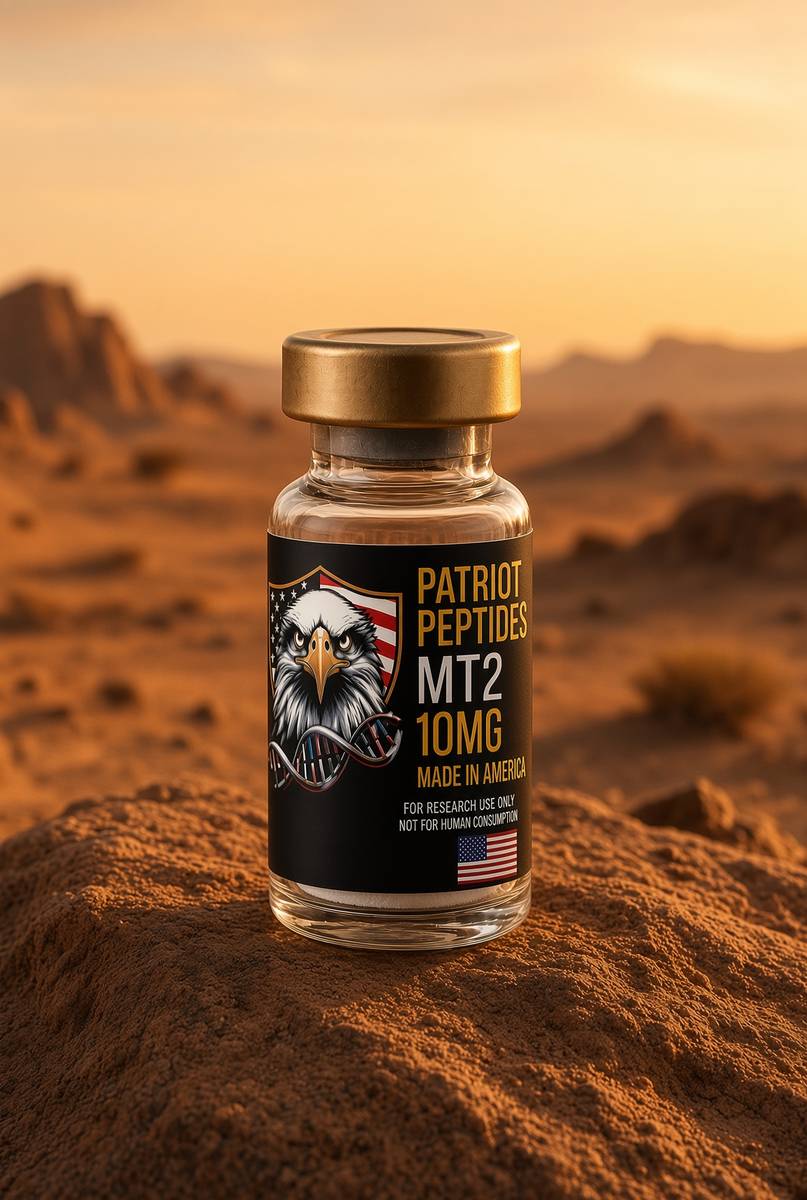
The first listing is lyophilised Melanotan II, ten milligrams, ≥98 percent by HPLC, sequence Ac-Nle-cyclo[Asp-His-D-Phe-Arg-Trp-Lys]-NH2, molecular weight about 1024, CAS 121062-08-6. A white to off-white cake in a vial, a certificate of analysis, a reconstitution kit. It's the same carbon skeleton the Arizona papers named. It's a laboratory reagent. The form is the form you weigh into a cyclic AMP assay, a melanocyte pigment assay, a transfected-subtype screen, a rodent feeding study whose malaise you actually watch. Purity is a chromatogram, not a feeling. Water, light and freeze–thaw are the enemies of a peptide in solution; the lyophilised solid is how you store it. None of those sentences is a dose. None of them is a route. None of them is a schedule. An experiment that can't say how many nanomoles went into a well hasn't yet started. A social post that treats ten milligrams as a human serving hasn't read the label, and the label is the legal class of the object. The ring is a probe of four Gs-coupled addresses. It isn't a tanning medicine. Afamelanotide already has that job, in its indication, as a different molecule.
In short. The first vial is freeze-dried Melanotan II, ten milligrams, purity on a chromatogram, for weighing into experiments. That's a laboratory chemical, not a dose for a person.
The second listing is lyophilised PT-141, the named free-acid heptapeptide, HPLC-characterised, sequence Ac-Nle-cyclo[Asp-His-D-Phe-Arg-Trp-Lys]-OH, about 1025 daltons. It's the laboratory ligand the MC3/MC4-forward papers used. It isn't Vyleesi. It isn't an on-demand injection, not a Palatin device, not a hypoactive-sexual-desire appointment, and not a reason to skip the C-terminus on the certificate. Where a desire-circuitry assay needs the analogue that prefers the central pair over pigment, this is the sequence. Where a pigment assay needs the pan-agonist, it is the wrong cake. Neighbourhood, in this journal, is a courtesy on a reading list. It isn't a combination claim. We'll sell you the named objects. We won't design the blot, and we won't write a protocol that pretends a cyclic pan-agonist is a free-acid cousin or a weekly desire injection. Patriot Peptides synthesises named structures and puts the papers next to the vials. We aren't Palatin, not Clinuvel, not Rhythm, and not a tanning shop. A first-in-human Arizona paper is a paper. An FDA label is a label. A lyophilised cake is a cake. This paragraph is the unmix. The physiology above doesn't depend on it. The label does.
In short. The second vial is freeze-dried PT-141, the free-acid ring, for the central-receptor experiments. It's the named laboratory sequence, not the licensed desire medicine.
What a melanocyte, a paraventricular neuron, a brainstem emetic neuron, a spinal autonomic circuit, a sebocyte and a macrophage share is a GPCR architecture and an ancestral ligand. What they don't share is a phenotype. Cyclic AMP is the common coin. MITF, satiety, nausea, desire-adjacent outflow, sebum and IκB are the jobs. The HFRW core spends that coin at four receptors with enthusiasm when the C-terminus is an amide. The free acid spends it more at the central pair. The KPV tail spends almost none of it on pigment and still shows up in the inflammatory transcription assays, on a different page. Farooqi and O'Rahilly spent the coin at MC4R and found childhood obesity. Hadley and Hruby spent it across the sheet and found pigment plus the extras a pan-agonist owes you. Palatin spent a close analogue at MC3 and MC4 and found a desire label. Rhythm spent a different cyclic peptide at MC4R and found a rare-obesity label. Clinuvel spent the linear analogue at MC1R and found a light-pain implant. The family is large enough for all of those papers. It isn't large enough to excuse using the wrong ligand.
In short. Same messenger, different jobs in different cells. Use the pan-agonist for the whole family, the free acid for the central pair, and the licensed drugs only as the papers and labels describe them.
Close: two rings, one family, laboratory reagents
The neighbouring essays are the rest of the map. Melanotan II, the pan-agonist: the amidated ring at the length that sequence deserves, Arizona, Dorr, the four receptors, the three licensed cousins as proof. Melanocortins, from tanning receptors to inflammatory off-switches: the family portrait, POMC, five receptors, the pan-agonist and the tail on one page. KPV, the anti-inflammatory tripeptide: Luger, Getting, Dalmasso, PepT1, IκB, the fragment this pair isn't. How peptides talk to cells: occupancy, amplification, arrestin, the class-A physics this family sits on. Pathophysiology as a stack: receptor, cell, tissue, organism, so a tanning analogue that also cuts appetite is no longer a surprise. Read those if you're holding a different vial, or if you wanted the family rather than this pair. Stay here if you wanted to know why two rings that share a lactam are two questions, why amide versus acid is an experimental line, and why bremelanotide on a label isn't PT-141 in a catalogue. The figure is HPLC identity for two research peptides. The readout is late. The pocket is early. The C-terminus was the point.
In short. Other essays cover the amidated pan-agonist alone, the whole family, and the anti-inflammatory tail. This one is the two rings, and the small edit that splits pigment from desire.
Research-use-only. Not for human consumption / not a medicine. The lyophilised Melanotan II and PT-141 on these listings are laboratory reagents, HPLC-characterised, labelled for in-vitro and preclinical work: a cyclic AMP assay, a melanocyte pigment readout, a transfected-subtype screen, a rodent feeding study whose malaise you actually record, a central-circuit assay that names MC3 or MC4 rather than hoping. The physiology in the paragraphs above is public, cited, and older than either vial. Use it to design the experiment you have the controls for, with the subtype named, the assay named, and the C-terminus written down so nobody confuses the amide with the acid. Read Hadley, read Dorr, read Farooqi, read the Vyleesi, Scenesse and Imcivree labels as labels, then weigh the cake that matches the question. We'll sell you the two cyclic heptapeptides. We won't tell you either is a tanning medicine, a desire injection, or a weight drug. Those jobs, where they exist, belong to other molecules with other regulators. This rate you can measure, in a tube, with a chromatogram on the bench beside it. The receptors will still be Gs-coupled in the morning.
In short. The vials are research chemicals for experiments, not medicines and not a sunbed. The biology is public. Weigh the ring that matches the receptor, and keep the claim the size of the chromatogram.
α-MSH is Ac-SYSMEHFRWGKPV-NH2. Melanotan II is what a pan-agonist looks like. PT-141 is the free-acid cousin pointed at MC3 and MC4. The fragment KPV is the design move in the other direction. Pigment, desire and NF-κB are different experiments.
- Melanotan II: Ac-Nle-cyclo[Asp-His-D-Phe-Arg-Trp-Lys]-NH2. Hruby and Hadley, Arizona. Lactam, norleucine, D-Phe7, C-terminal amide. ~1024 Da. CAS 121062-08-6.
- PT-141: the same ring with the C-terminus left as an acid. ~1025 Da. MC3/MC4-preferring. Research heptapeptide, not Palatin's Vyleesi.
- Four class-A GPCRs, MC1R, MC3R, MC4R, MC5R, primarily Gs–cAMP. Negligible at MC2R. Tissue writes the phenotype.
- MC1R: MITF, tyrosinase, eumelanin versus pheomelanin. RHC alleles R151C, R160W, D294H. Afamelanotide (Scenesse) is the linear licensed cousin for EPP.
- MC4R: hypothalamic appetite brake and a desire-circuit node. Farooqi and O'Rahilly: heterozygous loss-of-function is the commonest monogenic severe obesity. Setmelanotide (Imcivree, FDA 2020) for POMC / PCSK1 / LEPR deficiency.
- Dorr 1996: pigment, nausea, stretching, yawning, erection. The extras were on-family pharmacology, not a contaminant.
- Bremelanotide (Vyleesi, FDA 2019) is the licensed neighbour in HSDD. Catalogue PT-141 is the named laboratory sequence.
- KPV is the opposite design: the C-terminal tripeptide, NF-κB, PepT1. File it under a different essay. These two rings are the Arizona pair.
Questions the essay actually answers
- Is PT-141 just Melanotan II?
- No. Same family, different C-terminus, different receptor preference. Melanotan II is the amidated pan-agonist at MC1, MC3, MC4 and MC5. PT-141 is the free-acid analogue and prefers MC3/MC4. Write the terminus on the experimental line.
- Do you sell a tanning product?
- No. Melanotan II is listed as a characterised research pan-agonist of melanocortin receptors. Afamelanotide (Melanotan I, Scenesse) is the licensed photoprotective implant for erythropoietic protoporphyria. Different molecule, different legal class. Not a cosmetic. Not for human use.
- Is catalogue PT-141 the same as Vyleesi?
- No. Bremelanotide (Vyleesi, FDA 2019) is Palatin's licensed on-demand injection for acquired, generalised hypoactive sexual desire disorder in premenopausal women. Catalogue PT-141 is the named heptapeptide as a laboratory ligand. Same backbone idea. Different legal class. Patriot Peptides is not Palatin.
- Why does MC4R belong in a tanning-analogue essay?
- Because α-MSH occupies it, and so does Melanotan II. It is the hypothalamic appetite brake, and a node the desire papers use. Heterozygous loss-of-function is the most common monogenic cause of severe obesity (Farooqi and O'Rahilly, NEJM 2003). Appetite and central autonomic tone are first-class melanocortin outputs, which is why Arizona volunteers ate less and why Palatin followed the extras.
- How is setmelanotide different from these two rings?
- Setmelanotide (Imcivree) is an MC4R-forward cyclic peptide licensed in 2020 for obesity caused by POMC, PCSK1 or LEPR deficiency, later Bardet-Biedl. Melanotan II is a pan-agonist. PT-141 prefers MC3/MC4 as a research sequence. Same ancestral family. Different selectivity, different legal class, different job.
- Does occupying a melanocortin receptor require the peptide to enter the cell?
- For MC1R through MC5R, no. They are GPCRs: occupancy outside rearranges helices, Gs runs, cyclic AMP rises inside. The lactam is a protease trick, not a bilayer ticket. KPV is the exception that proves the rule — a tripeptide that can also be cargo on PepT1. Neither ring on this page is that exception.
- What did the 1996 Arizona study actually show?
- Dorr, Lines, Levine and colleagues, Life Sciences 1996: a pilot phase-I study of a superpotent cyclic melanotropic peptide. Pigment rose. Nausea, stretching, yawning and spontaneous erection were written down, as was an appetite change. The extras were data. They mapped onto central melanocortin receptors the later desire programme followed.
- Where does KPV fit?
- It does not, on this page, except as a filing instruction. KPV is Lys-Pro-Val, the C-terminal tripeptide of α-MSH, kept for NF-κB suppression, including via PepT1 in gut models. Inflammatory tail, not these rings. Read the KPV essay and the family portrait. Stay here for the Arizona pair.
- How is Melanotan I different from Melanotan II?
- Melanotan I is the linear analogue [Nle4, D-Phe7]α-MSH, later afamelanotide (Scenesse), licensed for erythropoietic protoporphyria. Melanotan II is the cyclic heptapeptide pan-agonist, more potent at four receptors, a research sequence. Different molecule, different label, different legal class. Photoprotection as a licensed job belongs to the linear implant.
- What should an experiment declare?
- Sequence and C-terminus (amide versus acid), mass, which subtype the cell actually expresses, cyclic AMP versus pigment versus feeding versus a central autonomic readout, and an antagonist or knockout if the claim is subtype rather than family. Species. Time point, because desensitisation is real. A nickname is not an experimental line.
Hypothetical research reconstitution
How these vials are typically mixed
Hypothetical research reconstitution for the named catalogue vial. Not a protocol, not medical advice, not a use instruction. These amounts sit in published and commonly cited laboratory ranges. The vial is labelled for research use only — not for human or veterinary administration.
MT-2
10mg
Mix with 2 ml bacteriostatic water → 5 mg/ml · 5,000 mcg/ml
- Hypothetical aliquot
- 100–250 mcg
- 0.02–0.05 ml · 2–5 units on a U-100 syringe
- How often
- Every other day, or 3× weekly
- Until the pigment question in the assay is answered; then a hold
Bench steps
- Let the vial sit until it is no longer cold to the touch.
- Wipe the stopper with 70% isopropyl alcohol. Let it dry.
- Draw 2 ml bacteriostatic water (0.9% benzyl alcohol).
- Run the water slowly down the inside glass — do not blast the cake.
- Roll between finger and thumb until the cake is gone. Do not shake.
- Label the date. Store the solution at 2–8 °C. Do not freeze. Use within 30 days unless the note below says otherwise.
Start at 100 mcg in the notes that bother to titrate. Nausea is the classic first-hour finding in the melanocortin literature. Protect from light.
PT-141
10mg
Mix with 2 ml bacteriostatic water → 5 mg/ml
- Hypothetical aliquot
- 0.5–1.0 mg
- 0.10–0.20 ml · 10–20 units on a U-100 syringe
- How often
- As required in the bremelanotide literature; not a daily molecule
- Per experiment, not a calendar cycle
Bench steps
- Let the vial sit until it is no longer cold to the touch.
- Wipe the stopper with 70% isopropyl alcohol. Let it dry.
- Draw 2 ml bacteriostatic water (0.9% benzyl alcohol).
- Run the water slowly down the inside glass — do not blast the cake.
- Roll between finger and thumb until the cake is gone. Do not shake.
- Label the date. Store the solution at 2–8 °C. Do not freeze. Use within 30 days unless the note below says otherwise.
Free-acid analogue of MT-II. Palatin’s research dose around 1.75 mg is a licensed-medicine figure, not a shop instruction. 0.5 mg is where most bench notes start.
Bacteriostatic water and sterile syringes ship with peptide orders over £75. Kit details · 10 ml bacteriostatic water
The vials this essay sits on
Named sequences the essay maps — MT2, PT-141. Hypothetical research neighbourhood, not a protocol, not a medicine. One press puts every in-stock vial in the bag.
 Research onlyOut of stock
Melanocortin
MT2
10 mg Melanotan II. Cyclic pan-melanocortin super-agonist.
4.6(720)
52 browsing this now · 3 purchased in the last 24 hours
10mg
£20.00
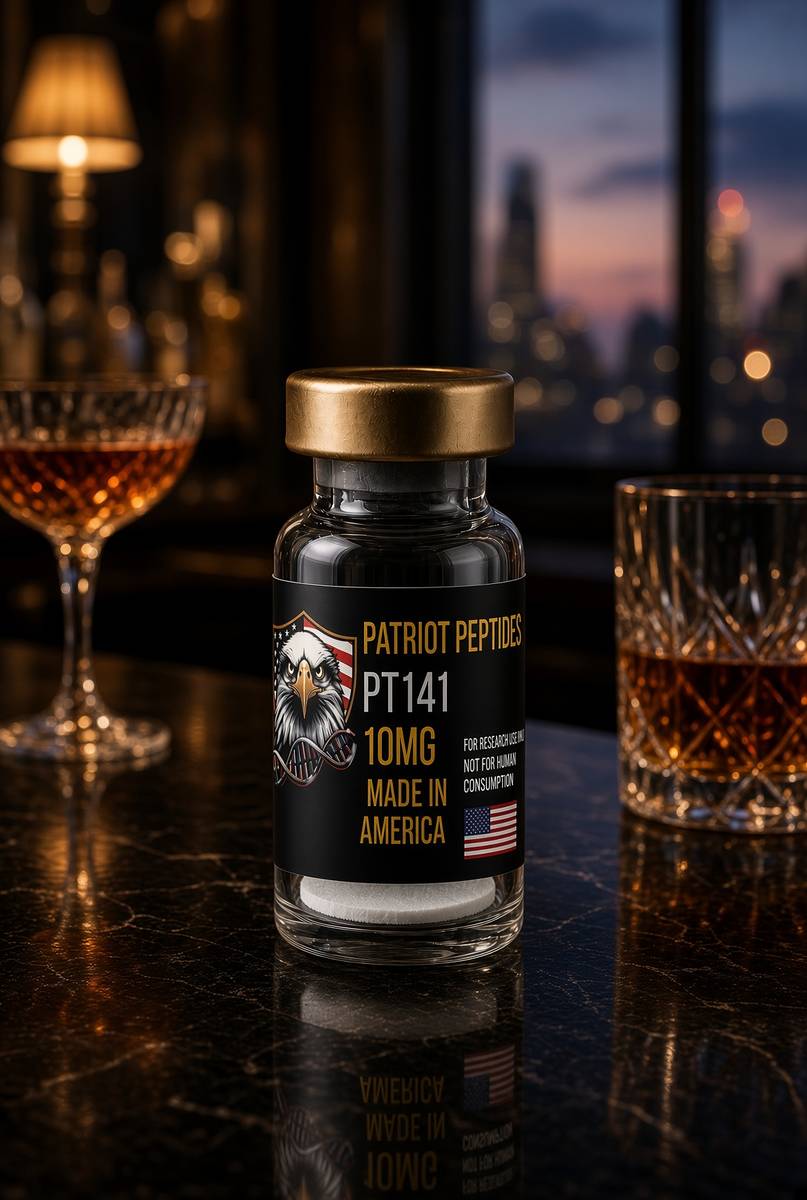 Made in USA
Research use only. Not a combined-use instruction.
Read next
More in this desk

53 min · long read · Peptide research
Recovery, GH pulses and the CJC / ipamorelin pair
Somatotrophs have two 'go' receptors. CJC without DAC is a slightly longer GHRH pulse. Ipamorelin is a selective ghrelin-receptor key that does not yank ACTH. Together they are the pair Bowers already showed is more than additive — not a gym protocol.
53 min · long read · Peptide research
How research peptides are made — and why HPLC actually matters
Solid-phase peptide synthesis builds a chain one residue at a time. HPLC then asks whether the main peak is what you think it is. ≥98% is not a slogan. It is a chromatogram.
52 min · long read · Peptide research
Fatigue, cellular energy and the NAD+ / MOTS-c neighbourhood
NAD+ is the rechargeable chip every cell spends on fuel and DNA repair — and the pool shrinks with age. MOTS-c is a mitochondrial 16-mer sent out under metabolic stress. Two answers to 'I have no energy' that are not coffee.
51 min · long read · Peptide research
GHRH and ghrelin mimetics: two keys on the same pituitary lock
Somatotrophs have two ‘go’ receptors — GHRHR (Gs–cAMP) and GHSR (Gq). Bowers showed that occupying both releases more GH than the sum of either. That is synergy as a receptor fact, not a smoothie.
Essays describe published research. They are not medical advice and they do not authorise human use of any catalogue item.