

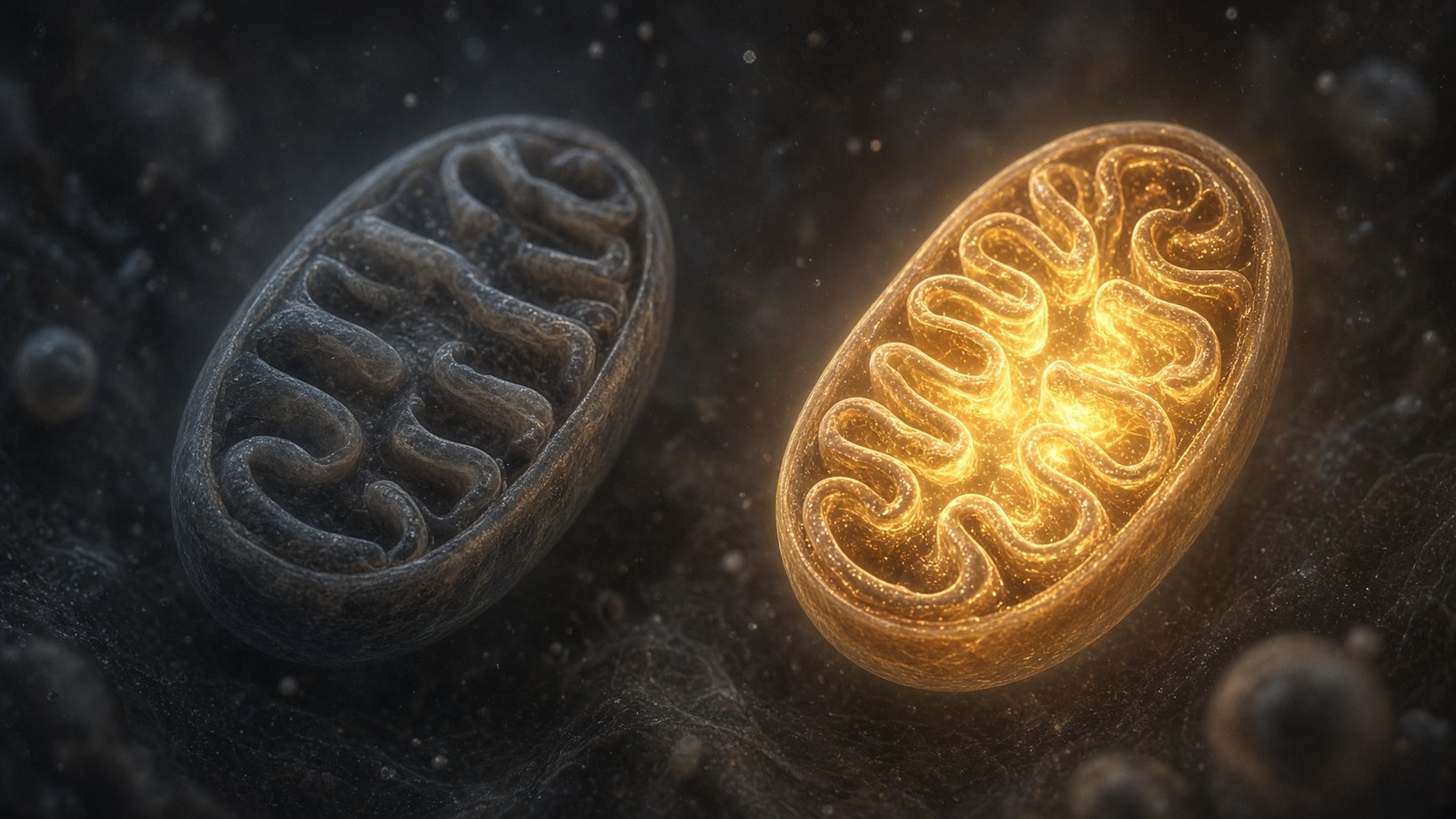
Peptide research · 52 min · 11,409 words
Fatigue, cellular energy and the NAD+ / MOTS-c neighbourhood
NAD+ is the rechargeable chip every cell spends on fuel and DNA repair — and the pool shrinks with age. MOTS-c is a mitochondrial 16-mer sent out under metabolic stress. Two answers to 'I have no energy' that are not coffee.
What this essay actually tells you
- NAD+ is the hydride carrier sirtuins and PARPs spend. The pool falls as CD38 rises. That is the budget, not a stimulant slogan.
- This 1000mg cake is lyophilised research β-NAD+. eLIVEate's intramuscular NAD+ is a different object, different till, no commission.
- MOTS-c is mtDNA writing a peptide the cytosol reads under metabolic stress. AMPK. Adjacent energy door. Different ligand.
What this actually means
Tired is a human sentence. The cell version is a budget. NAD+ carries electrons so food becomes ATP, and it is consumed when sirtuins deacylate proteins or PARPs patch DNA. The pool falls as CD38 rises with age. We stock the cofactor at 1000mg because that is a serious aliquot for those assays — not because it is an infusion, and not because it is the clinic appointment at eLIVEate Me. MOTS-c is the other energy door: mitochondrial DNA writing a peptide the cytosol reads when fuel is short, AMPK lighting up. If you typed exhausted or no energy, those are the two listings the search bar should surface. Coffee, iron, thyroid and a night's sleep still explain more everyday fatigue than either vial, and a clinic letter still sorts the differential. Two mechanisms. One organelle campus in the papers. Neither cake is a medicine, a dose, or a plan for a tired person.
Tired is a human sentence. The cell version is a budget, and the two are allowed to share a search bar without becoming the same object. Fatigue, in a clinic, is a complaint: energy that will not come, a week that will not start, a body that feels as if the night did not happen. The complaint has a differential. Anaemia, hypothyroidism, depression, obstructive sleep apnoea, a medicine list, a post-viral state, and myalgic encephalomyelitis / chronic fatigue syndrome all live in that drawer, and they have blood tests, sleep studies, and letters. None of them is a missing dinucleotide on a certificate, and none of them is a sixteen-residue open reading frame in mitochondrial 12S rRNA. People type exhausted, no energy, or fatigue into a peptide catalogue because internet culture bundled a feeling with two named reagents whose papers sit on fuel. Our job is to keep the feeling and the chemistry in the same picture without pretending they're the same object. The reagents are real chemistry. The complaint is a real clinic object. They don't become one object because a search bar put them on the same afternoon.
In short. Fatigue is a clinic complaint with a differential. Two research reagents sit near cellular fuel. This page unbundles the feeling from the chemistry.
The two listings that keep turning up next to that search are a dinucleotide and a mitochondrial peptide, and they're both worth knowing properly. NAD+ is nicotinamide adenine dinucleotide, C21H27N7O14P2, 663.43 grams per mole, CAS 53-84-9, the biologically relevant anomer β-NAD+. Carbon 4 of the nicotinamide ring accepts a hydride and the molecule becomes NADH; give the hydride back and you have NAD+ again. That's the coin Complex I wants oxidised, and it is the stoichiometric substrate sirtuins and PARPs spend. MOTS-c is MRWQEMGYIFYPRKLR, sixteen residues, about 2175 daltons, CAS 1627580-64-6, translated from an open reading frame in mitochondrial 12S rRNA — Lee, Kim, Cohen, Cell Metabolism, 2015. AMPK is the fuel-gauge kinase those papers sit on. Adjacent energy door. Different ligand. A catalogue that stocks both does so because a bench that reads cellular-energy papers will meet both names, not because biochemistry wrote them as a pair. This is physiology and a paper trail. It is not a stimulant, and it is not a stack for a person. Same organelle campus. Two jobs. Once you can hold both, the search bar gets less confusing and the chemistry gets more fun.
In short. NAD+ is the hydride-carrying cofactor cells spend on fuel and repair. MOTS-c is a 16-mer from mitochondrial DNA that talks to AMPK. Same campus, two different jobs.
Coffee still exists, and we should say so before anyone hangs a caption on a cofactor. Adenosine receptors, a night's slow-wave sleep, iron, thyroid hormone, and a breakfast that did not happen at four in the morning still explain more everyday fatigue than either listing. Spiegel, Leproult and Van Cauter wrecked next-day glucose tolerance in healthy young men by taking the night apart; that paper is in the sleep essay on this desk, and it is still the ruder account of why a person feels spent. Caffeine is an adenosine-receptor antagonist. Levothyroxine occupies a nuclear receptor after a TSH has been read. Continuous positive airway pressure stents a collapsing pharynx. Those are named tools for named lesions, and they're good at their jobs. A hydride carrier and a mitochondrial 16-mer are named reagents for named assays. Mapping the search to the neighbourhood is a courtesy. Treating the neighbourhood as a diagnosis is how a journal becomes a brochure. Hold the complaint, the budget, and the two paper trails at once, and you're doing the grown-up version of the same afternoon. The brochure is shorter. The biochemistry is better, and it's still allowed to be exciting.
In short. Sleep, iron, thyroid and coffee still explain more everyday tiredness than either molecule. Mapping a search to a neighbourhood is not a diagnosis.
NAD+ is the hydride carrier sirtuins and PARPs spend. The pool falls as CD38 rises. That is a budget, not a pick-me-up. MOTS-c is a different door on the same campus.— Reading of the NAD+ salvage-and-drain map against the MOTS-c AMPK papers. Adjacent energy literature. Different ligand.
Tired is a clinic word with a differential
A clinic that takes fatigue seriously does not start with a cofactor. It starts with a history: onset, duration, sleep, mood, medicines, alcohol, a post-infective chapter, weight change, breathlessness, the difference between sleepiness and an inability to generate force. FBC, ferritin, TSH, HbA1c, a biochemical profile, and, where the history points, coeliac serology, CK, and a sleep study. NICE-adjacent practice for suspected ME/CFS asks for a persistent, disabling fatigue that is not explained by another condition, with post-exertional malaise as a distinctive feature, not a personality. Obstructive sleep apnoea is scored as an apnoea-hypopnoea index, not as a mood of tiredness. Depression has its own instruments. None of those sentences names NAD+ or MOTS-c, and that's as it should be. A peptide paper that starts from fatigue and never says which of those sentences it means has started from a word rather than from a clinic object. The word is allowed to be generous. The experiment is not. You're allowed to care about both the letter and the well. You just have to know which room you're in. The clinic sorts the complaint. The bench sorts the budget. We'll stay in the second room once the first has been named.
In short. A clinic work-up for fatigue is blood, sleep, mood and medicines. ME/CFS, apnoea and depression are named drawers. None of them is a cofactor deficiency on a label.
Myalgic encephalomyelitis / chronic fatigue syndrome is the drawer the internet most likes to file next to mitochondria, and the filing is not empty. Oxidative phosphorylation, pyruvate dehydrogenase, and a metabolomic signature of impaired ATP generation have all been reported in subsets of that literature, with the usual fights about cohort, control, and whether a bicycle test is an assay or an insult. Those fights are real, and they're how a field stays honest. They are also not a licence to caption a 1000 milligram cake as a treatment, or a 16-mer as a mitochondrial support product. Primary mitochondrial disease — POLG, MELAS, Leigh syndrome, a heteroplasmy threshold — is a different drawer again, with genetics, a named complex, and tissues that cannot keep a membrane potential. Common tiredness after a short night is a third. Post-viral fatigue is a fourth. Four drawers, one search bar. We'll keep naming the clinic objects so the research solids cannot be mistaken for them. Licensed medicines for hypothyroidism, iron deficiency, narcolepsy and depression live in a formulary. These vials do not. That's not a disappointment. That's a legal class, and it leaves the biochemistry free to be biochemistry.
In short. ME/CFS papers sometimes sit near mitochondria, and primary mitochondrial disease is another drawer again. Neither is a caption for these research solids.
Why a peptide shop sees the search at all is not a mystery, and it is not a scandal. NAD+ restoration papers in mice report mitochondrial oxygen consumption, insulin sensitivity, and a set of vessel and stem-cell assays that a tired person can misread as energy. MOTS-c papers report AMPK, a folate–methionine-cycle interaction, resistance to diet-induced obesity in the original Lee experiments, and a rise in human plasma after exercise. Both literatures use the word metabolic. Forums use the word energy. Search engines collapse the two, because that's what search engines do. The useful job is to keep the assays named: a Seahorse well, a clamp, a phospho-AMPK blot, a CD38 Western, a hypnogram if the complaint is actually sleep. A feeling on a Tuesday is not a well. Adjacent papers are a lawful reason to put two reagents on the same reading list. Adjacent papers are not a reason to caption a vial with a syndrome. Unbundling starts here and does not stop until the close, and it's a kindness rather than a telling-off. Named assays are how you get to keep the excitement without borrowing a diagnosis. That's the deal, and it's a good one.
In short. Mouse NAD+ papers and MOTS-c AMPK papers both say metabolic. Forums say energy. Named assays are the only honest translation.
A body-weight of phosphate, recycled
Peter Rich, Biochemical Society Transactions, 2003, is the citation this journal keeps using because it is the right size for a fatigue sentence, and because the number still makes people sit up. A human adult turns over on the order of forty to sixty kilograms of ATP per day. The standing pool is about fifty grams, a coffee-cup, not a warehouse. Recycled, not stored. That implies something like 10²¹ hydrolyses a second. Almost all of that phosphate is minted on the inner mitochondrial membrane, downstream of NADH oxidation at Complex I or of FADH2 and QH2 entry at Complex II and the Q-cycle. NAD+ is not the ATP. It is the hydride coin the chain wants oxidised so that the chain can pump the protons the turbine spends. A 1000 milligram cake of β-NAD+ is about 1.5 millimoles, about 9 × 10²⁰ molecules, coincidentally near a second of that flux as a count, and not a second of that flux as a physiology, because the cake is not in the matrix and the molecule does not become ATP. Without the scale, a gram of cofactor starts to look like a body-weight of phosphate. It is not.
In short. You recycle roughly a body-weight of ATP every day from a fifty-gram pool. NAD+ is the electron-carrying coin mitochondria need to mint it. A gram of cofactor is not a day's energy.
Where that phosphate is minted is the organelle a fatigue caption always wants and rarely measures, so let's measure it with a sentence. Glycolysis nets two ATP per glucose and, more importantly, two NADH if the triose phosphate dehydrogenase step runs, which it cannot without NAD+. The TCA cycle mints more NADH on isocitrate dehydrogenase 3, α-ketoglutarate dehydrogenase and malate dehydrogenase, plus GTP or ATP at succinyl-CoA synthetase, plus QH2 at succinate dehydrogenase. β-oxidation spirals NADH and QH2 on every turn. Complex V, F1Fo ATP synthase, is the rotary mint: protons back in, ADP plus phosphate out as ATP. Tissues that live on that mint — heart, brain, skeletal muscle, kidney cortex, brown fat when it is on — notice first when the hydride coin or the chain or the oxygen is short. A hepatocyte has more glycolytic latitude. A red cell has no mitochondrion at all and lives on glycolysis. Fatigue as a whole-body sentence is therefore several cell types talking at once, which is why a homogenate NAD+ kit on a late-passage dish is not a person who cannot climb the stairs.
In short. Most ATP is made on the inner mitochondrial membrane. Heart, brain and muscle feel a shortage first. A blended dish measurement is not a tired person.
Supply and demand at this scale is the only fatigue physiology worth the word, and it's a rather elegant arithmetic once you see it. Demand is myosin ATPase, ion pumps, gluconeogenesis, protein synthesis, a brain that is two percent of body mass and twenty percent of the oxygen. Supply is substrate, oxygen, a chain that is assembled, a membrane potential of about 150 millivolts, and a NAD+ pool that is both large enough and oxidised enough for the dehydrogenases to run. Sleep restriction raises demand relative to recovery and wrecks the next day's insulin handling. Iron deficiency wrecks Complex IV and aconitase because those enzymes want iron-sulphur and haem. Thyroid hormone sets the basal leak and the inventory of respiratory subunits. Anaemia wrecks oxygen delivery. None of those is a sirtuin caption. A NAD+ restoration paper that reports oxygen consumption without saying which of those jobs it held constant has not yet earned the word energy. MOTS-c sitting on AMPK is a demand-side and a biogenesis-side conversation: the kinase that notices a rising AMP/ATP ratio. Different invoice from the hydride coin. Same organelle campus. Keep the jobs named when a caption says fatigue.
In short. Tiredness at this scale is supply versus demand: fuel, oxygen, the chain, and the NAD+ pool. Sleep, iron and thyroid already sit on that arithmetic.
NAD+ is the hydride carrier, not a stimulant
NAD+ is nicotinamide adenine dinucleotide. Two nucleotides joined by their phosphates: an adenine, a nicotinamide, a pair of riboses. Adenine is the same base DNA uses; nicotinamide is the ring vitamin B3 leaves behind. The chemically interesting atom is carbon 4 of that nicotinamide ring. That carbon accepts a hydride — a proton and two electrons, written H− — and the molecule becomes NADH. Give the hydride back, and you have NAD+ again. Otto Warburg and Arthur Harden were arguing about this chemistry before anyone had a word for sirtuin, which is one of those facts that still makes a teaching afternoon better. The oxidised form is the hydride acceptor. The reduced form is the hydride donor. Almost every dehydrogenase you were taught in first-year biochemistry is a commentary on that single carbon. Molecular weight 663.43. Formula C21H27N7O14P2. CAS 53-84-9. The biologically relevant anomer is β-NAD+. Those are the facts you need before anyone is allowed to talk about fatigue, ageing, or a 1000 milligram cake. The helix in the photograph is a visual stand-in. The molecule is a dinucleotide. One carbon does the whole job. That's the trick, and it's still astonishing once you look at it properly.
In short. NAD+ is a small helper molecule. It picks up a pair of electrons at one carbon of a vitamin-B3 ring, then hands them on. That carbon is the whole trick.
The day job is still redox, and a fatigue page that skips the named enzymes is already a caption. Glyceraldehyde-3-phosphate dehydrogenase in glycolysis takes NAD+ and a phosphate and a three-carbon aldehyde and hands back NADH and a high-energy acyl phosphate. If the cytosol is reduced — high NADH, low NAD+ — GAPDH slows, glycolysis backs up, and the cell dumps pyruvate to lactate via lactate dehydrogenase in order to regenerate NAD+ in the cytosol. That's the Warburg observation as a nucleotide problem, not as a caption about cancer, and it is why a person who cannot reoxidise NADH feels a glycolytic tax. Malate dehydrogenase in the TCA cycle does the same exchange on a four-carbon acid. The acyl-CoA dehydrogenases of β-oxidation, the pyruvate dehydrogenase complex, isocitrate dehydrogenase 3, α-ketoglutarate dehydrogenase: hydride out, NADH in the pool. Name them, because captions skip them. A tired muscle that is reduced will stall fat oxidation and start making lactate. That can be a training session. It can also be a pool problem. The blot has to say which. Named enzymes are how you keep the excitement attached to a mechanism.
In short. Named enzymes in sugar and fat burning all need the oxidised form of NAD+. If the pool is stuck reduced, those pathways stall and lactate rises.
Complex I of the inner mitochondrial membrane is where most of that NADH is cashed, and it's a machine worth a slow look. NADH:ubiquinone oxidoreductase, forty-five or so subunits in mammals, flavin and iron-sulphur clusters, a proton pump. The flavin oxidises NADH, the electrons walk a chain of iron-sulphur clusters, ubiquinone is reduced, four protons are pumped. The chain runs through Complex III and cytochrome c to Complex IV, where oxygen is the terminal acceptor. Peter Mitchell's gradient is the product. ATP synthase is the turbine. If NAD+ is scarce, dehydrogenases cannot mint NADH, and Complex I has nothing to oxidise. If NADH is plentiful and the chain is blocked, the matrix sits reduced, superoxide leak at I and III rises, and the TCA cycle backs up at the NAD+-dependent steps. Either failure is an energy failure in the tissues that already run the organelle hardest. That sentence is why a redox cofactor sits in a fatigue neighbourhood. It is still not a reason to write the cofactor as a stimulant. Stimulants occupy receptors. This molecule occupies a carbon.
In short. Complex I spends the loaded form of NAD+ and pumps protons so ATP synthase can run. A shortage or a jam at that step is an energy failure in hard-working tissues.
A stimulant caption is the thing this page exists to refuse, gently and in public. Caffeine occupies adenosine A1 and A2A receptors and takes the brake off arousal; the architecture of the subsequent night pays. Amphetamines occupy monoamine transporters. Modafinil is a different wakefulness file. NAD+ is a hydride carrier sirtuins and PARPs spend. The pool falls as CD38 rises. That's a budget, not a pick-me-up. Restoration in a dish or a mouse can move oxygen consumption, a sirtuin client, a PAR polymer, a metabolome. It does not occupy an adenosine receptor, and it does not inherit a wakefulness indication because a forum used the word energy. The 1000 milligram listing is lyophilised β-NAD+ for the assays that budget demands. MOTS-c is the other door: a peptide the mitochondrion writes when fuel is short. Adjacent. Different. If you write either vial as a substitute for sleep, iron, or a clinic letter, you've skipped the pharmacokinetics, the clinic differential, and the Rich number, and those three are more interesting than the skip. The rest of this piece is the biochemistry you'd want before designing the assay you actually have the controls for.
In short. Caffeine occupies adenosine receptors. NAD+ is a spent cofactor whose pool sags as a chopping enzyme rises with age. That is a budget, not a pick-me-up.
Three drains: sirtuins, PARP1, CD38
What changed, and the reason this cofactor escaped the textbook and landed in ageing institutes, is that three enzyme families consume NAD+ as a substrate rather than recycle it as a coenzyme. Sirtuins deacylate lysines and spend one NAD+ per lysine, releasing nicotinamide and O-acyl-ADP-ribose. PARP1 polymerises ADP-ribose onto DNA-damage foci and can empty a millimolar pool in minutes. CD38 is a NADase whose expression climbs with age and with inflammation; Verdin's group made that the sentence the ageing-NAD+ papers have to walk through. Salvage through NAMPT tries to refill what those three spend. Leonard Guarente's laboratory, working in yeast, found that SIR2 was an NAD+-dependent deacetylase. Imai, sitting in that lab, then in his own, showed that the mammalian orthologue SIRT1 used NAD+ the same way. The 2000 Nature paper on SIR2 and NAD is still the document. Caloric restriction, in the organisms where it extends life, raises NAD+/NADH and often raises NAMPT. Sirtuins then have something to spend. That's a measured physiology. It is not the only chapter of restriction, and it is not a fatigue medicine. Three drains. One refill. The textbook job didn't stop.
In short. Some enzymes use NAD+ up instead of recycling it. Gene-silencing enzymes, DNA-repair enzymes, and an age-linked hydrolase all punch holes in the pool. Refill is a separate problem.
Seven mammalian sirtuins, SIRT1 through SIRT7, three compartments, and the census is the point. SIRT1 and SIRT6 and SIRT7 are nuclear; SIRT2 is largely cytosolic and can visit the nucleus in G2/M; SIRT3, SIRT4 and SIRT5 are mitochondrial. All of them are NAD+-dependent lysine deacylases, with some of the family moonlighting as ADP-ribosyltransferases. The acyl can be acetyl, succinyl, malonyl, long-chain fatty acyl, depending on the isoform and the paper. Nicotinamide is a product inhibitor, which is why a NAMPT block raises nicotinamide and quiets sirtuins from both sides of the reaction. SIRT1 deacetylates histones, p53, FOXO transcription factors, PGC-1α; PGC-1α deacetylation is the mitochondrial-biogenesis sentence a fatigue caption always wants. SIRT3 deacetylates Complex I subunits, SOD2, long-chain acyl-CoA dehydrogenase, IDH2, a matrix neighbourhood of fuel and of superoxide. Knock it out and you get a hyperacetylated mitochondrial proteome and a mouse that mishandles fuel under stress. Compartment is the variable. NAD+ supply in that compartment is the other variable. A homogenate NAD+ number does not tell you whether SIRT3 had substrate this morning, and it does not tell you why a person is tired. Seven enzymes. Three rooms. One coin. That's a family, not a brand.
In short. Humans have seven NAD+-spending deacetylases in the nucleus, cytosol and mitochondria. The mitochondrial one tunes fuel burning. A blended NAD+ number does not tell you which room was empty.
PARP1 is the other nuclear spend, and it is faster. Poly(ADP-ribose) polymerase 1 binds DNA breaks, nicks NAD+, and polymerises ADP-ribose onto itself and onto nearby proteins — histones, repair factors, a focus you can see with an antibody. The polymer is a flag. Repair machinery reads it. Then a glycohydrolase (PARG) takes it off. The NAD+ does not come back from that cycle as NAD+; it comes back, at best, as nicotinamide plus ADP-ribose, which salvage has to rebuild. A genotoxic hit can drop cellular NAD+ by millimolar amounts in minutes. Dawson, Berger, Kraus: the PARP literature is not subtle about this. In an ischaemic neuron the same burst is how PARP1 kills: NAD+ collapse, glycolytic stall at GAPDH, energy failure on top of the break. That last sentence is a fatigue mechanism with a name, and it is an acute lesion, not an ageing caption. PARP inhibitors exist as oncology drugs because BRCA-deficient tumours need PARP1 to limp through replication. Those drugs also spare NAD+. If you're about to claim a NAD+ restoration phenotype in a dish, you need to know whether you have a PARP1 problem, a salvage problem, or both.
In short. When DNA breaks, PARP1 spends NAD+ very fast to flag the damage. A bad enough hit can empty the pool in minutes and stall energy generation.
CD38 is the age-associated NADase, and it's the drain that turned a textbook cofactor into an ageing story. Camacho-Pereira, Chini, Verdin, Cell Metabolism 2016, is the paper to put on the bench: CD38 expression rises with age in mice, the rise tracks the fall in tissue NAD+, and CD38-knockout animals keep more of the pool. The enzyme is a type II and type III membrane protein, ecto-facing in many of its incarnations, and it hydrolyses NAD+ to nicotinamide and ADP-ribose, or cyclises it to cyclic ADP-ribose, a calcium messenger. Immune cells carry a lot of it. Inflamed tissue carries more. CD157/BST1 is a related NADase. The drain is chronic rather than a minutes-scale burst, which is a different experimental object from PARP1. A NAMPT activator or an NR supplement is trying to refill a bucket that CD38 is still holing. Some of the restoration literature reads more cleanly once you put a CD38 antibody on the blot. Massudi's human skin measurements, a roughly fifty percent drop between young adult and elderly, sit in the same neighbourhood as a number, not as a dosing instruction.
In short. CD38 is an enzyme that chops NAD+ up, and it becomes more common with age and inflammation. Refilling the pool while this enzyme is rising is pouring into a bucket with a hole.
Competing drains matter as much as salvage because the phenotype of low NAD+ is not one phenotype, and it is not a synonym for fatigue. A PARP1 burst is acute, nuclear-first, glycolytic-stall-adjacent. A CD38-high immune infiltrate is chronic, partly extracellular, and will eat precursor as well as the dinucleotide. A sirtuin programme running hard is a spend you might actually want — restriction, exercise, a genuine fast — and the refill through NAMPT is part of the adaptation. Measuring a lower NAD+ in aged tissue and writing give more is the move of a brochure. Measuring which drain is open, in which compartment, in which cell type, is the move of a paper, and it's a more interesting move. FK866 inhibits NAMPT and will collapse the pool from the refill side; olaparib and its cousins close the PARP1 hole; CD38 antibodies and inhibitors exist in the literature and in the clinic for other reasons. Those are tools. Use them as tools. The diagram that follows is the bucket with three holes and a named bottleneck on the inlet. A feeling of tiredness is not yet a named hole.
In short. Low NAD+ is not one disease and not a synonym for tiredness. A sudden DNA-repair spend, a slow age-linked leak, and a healthy spend during fasting are three different stories.
Diagram
Sirtuins
SIRT1–7
Deacylate lysines. One NAD+ per lysine. Nicotinamide + OAADPr out.
PARP1
DNA-damage
Poly-ADP-ribose on a break. Can empty millimolar NAD+ in minutes.
CD38
NADase
Age- and inflammation-associated. A hole in the bucket, not a repair job.
NAMPT is the kinetic bottleneck of mammalian salvage (Revollo, Brenner). NR and NMN feed the same pool from different rungs. Restoration papers move the node. They do not own every phenotype downstream of it.
- NAD+ formula
- C21H27N7O14P2
- Whole-body ATP turnover
- 40–60 kg/day
- Standing ATP pool
- ~50 g
- PARP1 drain
- millimolar in minutes
- NAMPT
- kinetic bottleneck
- Sirtuins
- SIRT1–7
- Catalogue cake
- 1000 mg β-NAD+
- MOTS-c neighbour
- 16-mer from 12S rRNA
663.43 g·mol⁻¹. Hydride lands at nicotinamide C4. CAS 53-84-9.
Rich, Biochem Soc Trans, 2003. Recycled, not stored. The redox pool sits on this flux.
A coffee-cup, not a warehouse. ~10²¹ hydrolyses a second in a living adult.
A genotoxic hit. Nuclear-first. Glycolysis notices because GAPDH wants NAD+.
Nicotinamide → NMN. Revollo, Imai; Brenner. FK866 shuts it.
One NAD+ per lysine deacylated. Nicotinamide + O-acyl-ADP-ribose out.
~1.5 mmol, ≥98% HPLC. Reagent. Not an infusion.
Lee, Cell Metab 2015. MRWQEMGYIFYPRKLR. AMPK. Same organelle, different invoice.
NAMPT salvage is the bottleneck
Mammalian cells build NAD+ three ways, and they do not use them equally. De novo synthesis starts from tryptophan, climbs the kynurenine path, and arrives at quinolinic acid, which QPRT turns into nicotinic acid mononucleotide. The Preiss-Handler path starts from nicotinic acid — the niacin of a flush — and meets the same nicotinic acid mononucleotide, then NAAD, then NAD+ via NAD synthetase. Salvage starts from nicotinamide, the product every consuming enzyme releases, and it is the workhorse in most tissues. NAMPT, nicotinamide phosphoribosyltransferase, transfers a phosphoribosyl group from PRPP onto nicotinamide and makes NMN. NMNAT isoforms adenylate NMN to NAD+. That's the loop the drains feed, and the loop that has to keep up. A liver has more de novo capacity than a neuron. A neuron lives on salvage. If you only remember one enzyme from this heading, remember NAMPT. The kinetic bottleneck of mammalian NAD+ salvage is not a caption. It is a Km, a protein abundance, and a reason FK866 is lethal to the pool. Revollo, Imai, Journal of Biological Chemistry 2004, put the enzyme where it belongs.
In short. Cells can make NAD+ from tryptophan, from niacin, or by recycling leftover nicotinamide. Most tissues live on the recycle path. The first enzyme on that path is the bottleneck.
NAMPT was cloned as a cytokine, pre-B-cell colony-enhancing factor, visfatin, a confusing decade of names, before Revollo, Imai and colleagues put it on the salvage map. Intracellular NAMPT is the one that matters for the pool in most cells. There is an extracellular form that has been argued over as a secreted enzyme and as a ligand; that argument is not settled enough to build a protocol on, and we won't pretend otherwise. What is settled is that NAMPT abundance and activity set how fast nicotinamide becomes NMN, that the enzyme is feedback-sensitive, and that a pharmacological block collapses NAD+ on a timescale of hours in a dish. AMPK phosphorylates and can stabilise NAMPT, which is one of the few honest bridges to the MOTS-c heading: a fuel-gauge kinase talking to the salvage bottleneck. Circadian clocks write the gene in some tissues — Ramsey, Bass, CLOCK/BMAL1 and NAD+. Restriction and exercise raise it in the tissues those papers actually measured. Age, in several depots, lowers it. Supply side. Demand side is CD38 and PARP. Both sides, always, if the claim is a pool.
In short. NAMPT is the enzyme that turns leftover nicotinamide back into the next precursor. Block it and the pool falls in hours. Fasting, clocks and exercise can raise it. Age often lowers it.
NMNAT is the second step, and it is where compartmentation stops being a footnote. NMNAT1 is nuclear. NMNAT2 is cytosolic and Golgi-associated, and it is the isoform axons cannot do without — its loss is how NMN accumulates and SARM1 fires, collapsing axonal NAD+ and killing the distal segment. NMNAT3 is mitochondrial, or at least that is the textbook assignment; the extent to which mitochondria make their own NAD+ from imported NMN versus importing NAD+ itself is a live experimental argument. Three genes, three addresses, one chemical reaction: NMN plus ATP to NAD+ plus pyrophosphate. A nuclear PARP1 burst is, among other things, a local NAMPT-NMNAT1 problem. A mitochondrial SIRT3 programme is a local NMNAT3-and-import problem. Adding NMN to a medium is not the same experiment as adding NAD+, and neither is the same as overexpressing NAMPT. If your blot cannot say which NMNAT you have, you are not yet doing compartmental salvage. You are doing a soup. A soup is allowed as a scout. It is not allowed as the only figure in a fatigue-and-mitochondria title. Three postcodes. One reaction. Which postcode you fill decides which job gets paid, and that's the whole of the compartment sentence.
In short. The second recycling enzyme comes in three postcodes: nucleus, cytosol, mitochondrion. Which postcode you fill decides which job gets paid.
Nicotinamide riboside is the Brenner contribution, and it is the cleanest precursor story in the last twenty years. Charles Brenner identified NR as a vitamin, mapped the nicotinamide riboside kinases NRK1 and NRK2, and showed that NR is phosphorylated to NMN and then adenylated to NAD+. Trammell, Brenner, Nature Communications 2016: oral NR raises the human NAD+ metabolome, with nicotinic acid adenine dinucleotide as a distinctive marker. NR is uncharged relative to NAD+, it uses nucleoside transporters, and it bypasses NAMPT, which is the point if NAMPT is the bottleneck you are trying to walk around. NRK2 is enriched in muscle. NMN is one rung down, the Sinclair-adjacent molecule, which means you have to read more carefully. Yoshino, Mills, Imai, Cell Metabolism 2011: NMN treated diet- and age-induced diabetes in mice. Grozio, Imai, Nature Metabolism 2019: Slc12a8 as a NMN transporter, a claim that has been disputed as well as cited. Extracellular NMN can be dephosphorylated by CD73 to NR, then imported as NR. Intact NAD+ as a precursor is the awkward object in the catalogue: charged, about 663 daltons, a poor passenger across a plasma membrane. Precursor identity is a mechanism, not a brand.
In short. Nicotinamide riboside and NMN join the recycle path on different rungs. Whole NAD+ is charged and does not easily cross a cell membrane. Three rungs. Three experiments.
Mitochondria notice first
Mitochondria notice first because they are a NAD+ customer twice: once as Complex I, once as SIRT3. Two jobs, one pool, or at least one pool that is not freely mixed with the cytosol. The inner membrane does not let the dinucleotide cross as such. How the matrix is topped up is still being mapped: NMN import, a dedicated NAD+ transporter in some species — SLC25A51 / MCART1 is the mammalian candidate, Kory, Mootha, Nature 2020, and independent papers the same year — NMNAT3 on the inside. The malate-aspartate shuttle moves reducing power without moving NAD+. So does the glycerol-phosphate shuttle, dumping electrons on Q and skipping Complex I. A cytosolic PARP1 burst can starve the nucleus and the cytosol without immediately emptying the matrix; a CD38-high extracellular drain can starve the precursors before any compartment sees them. Compartmentation is why a whole-cell NAD+ kit is a starting measurement and not a mitochondrial paper, and why a fatigue caption that says mitochondria without a compartment has not yet started. Digitinin fractionation, isolated mitochondria, matrix-targeted biosensors: those are the tools.
In short. Mitochondria keep their own NAD+ stash behind a membrane the molecule cannot freely cross. A whole-cell average can look fine while the organelle is hungry, or the reverse.
A drained mitochondrial pool has a look, and the look is not mystical, and it is not a personality. Oxygen consumption falls because Complex I is underfed. Membrane potential sags. TCA intermediates rearrange; citrate and α-ketoglutarate are often the ones people quote. Fatty-acid oxidation stalls and acylcarnitines accumulate. Superoxide rises, not always, but often enough that SOD2 acetylation — a SIRT3 substrate — shows up on a blot. PGC-1α stays acetylated if the nuclear pool is thin too, so biogenesis does not answer the failure. mtDNA, sitting next to a leakier chain with a thinner repair budget, picks up damage faster than the nucleus does; that is the neighbouring mitochondria essay, and it is why a NAD+ problem and a second-genome problem are allowed to travel together without being the same problem. None of this is a licence to write NAD+ restores youthful mitochondria as a product sentence. It is a licence to measure OCR, membrane potential, acylcarnitines, SIRT3 clients and a NAD+ number in the same experiment. If you only have the last, you have a metabolome, not a mitochondrion, and you do not yet have a fatigue mechanism.
In short. When mitochondrial NAD+ runs low, fuel burning slows, the voltage sags, fat oxidation stalls and the superoxide mop can lag. Measure those things together.
The 1000 milligram cake is about 1.5 millimoles of the oxidised cofactor. Whole-body ATP turnover is forty to sixty kilograms a day. Those two numbers are allowed to sit in the same paragraph so that nobody confuses a reagent with a physiology. Patriot's listing is lyophilised β-NAD+, ≥98 percent by HPLC, a white to off-white cake, a certificate of analysis, a reconstitution kit. Water, light and freeze–thaw are the enemies of a nicotinamide nucleotide in solution; the lyophilised solid is how you store it. Isolated mitochondria, permeabilised cells, and in-vitro enzyme assays are the settings where the intact cofactor is the ligand you think it is. Adding β-NAD+ to a medium is, in many dishes, an experiment about ectonucleotidases and salvage, not about NAD+ going in. Connexin 43 hemichannels have been proposed as a route in some cells. CD38 and CD73 on the cell surface will eat extracellular NAD+ and leave nicotinamide, ADP-ribose, NMN, NR — a cloud of smaller pieces some of which can then enter. Write the experiment you are actually doing. The cake is a standard for those experiments. It is not 40 kilograms of ATP, and it is not a night's sleep in a bottle.
In short. The gram of freeze-dried cofactor is a standard for enzyme and organelle assays. Surfaces often chop intact NAD+ first. It is not a body-weight of phosphate.
Diagram
- I. Pumps H⁺. ~45 subunits. The NADH coin is spent here.
- II. TCA entry. No proton pump. FADH₂ neighbourhood.
- Q. Lipid-soluble shuttle in the inner membrane.
- III. Q-cycle. Pumps H⁺. Superoxide leak site.
- c. Intermembrane space. The shuttle everyone has heard of.
- IV. O₂ → H₂O. The reason you breathe.
- V. F₁Fₒ rotary. Protons in, ATP out. ~10²¹ times a second in you.
Mitchell’s chemiosmotic theory (Nobel 1978): the inner membrane is a battery of ~150 mV. NAD+ is the hydride carrier that feeds Complex I. MOTS-c is a 16-mer the mitochondrion translated from 12S rRNA — a different object on the same campus.
Diagram
Matrix
- TCA cycle · β-oxidation · mtDNA nucleoids
- NADH produced here. Complex I spends it.
- MOTS-c (MRWQEMGYIFYPRKLR) from 12S rRNA.
Inner membrane
- I → II → III → IV → V (ATP synthase)
- ~150 mV proton-motive force
- ~40–60 kg of ATP turned over per human day
mtDNA is 16,569 bp, 37 genes, 13 proteins of the respiratory chain. Nuclear DNA encodes the other ~1,200 mitochondrial proteins. NAD+ is the hydride carrier between dehydrogenases and Complex I. MOTS-c is a 16-mer translated from 12S rRNA — a peptide the mitochondrion wrote itself.
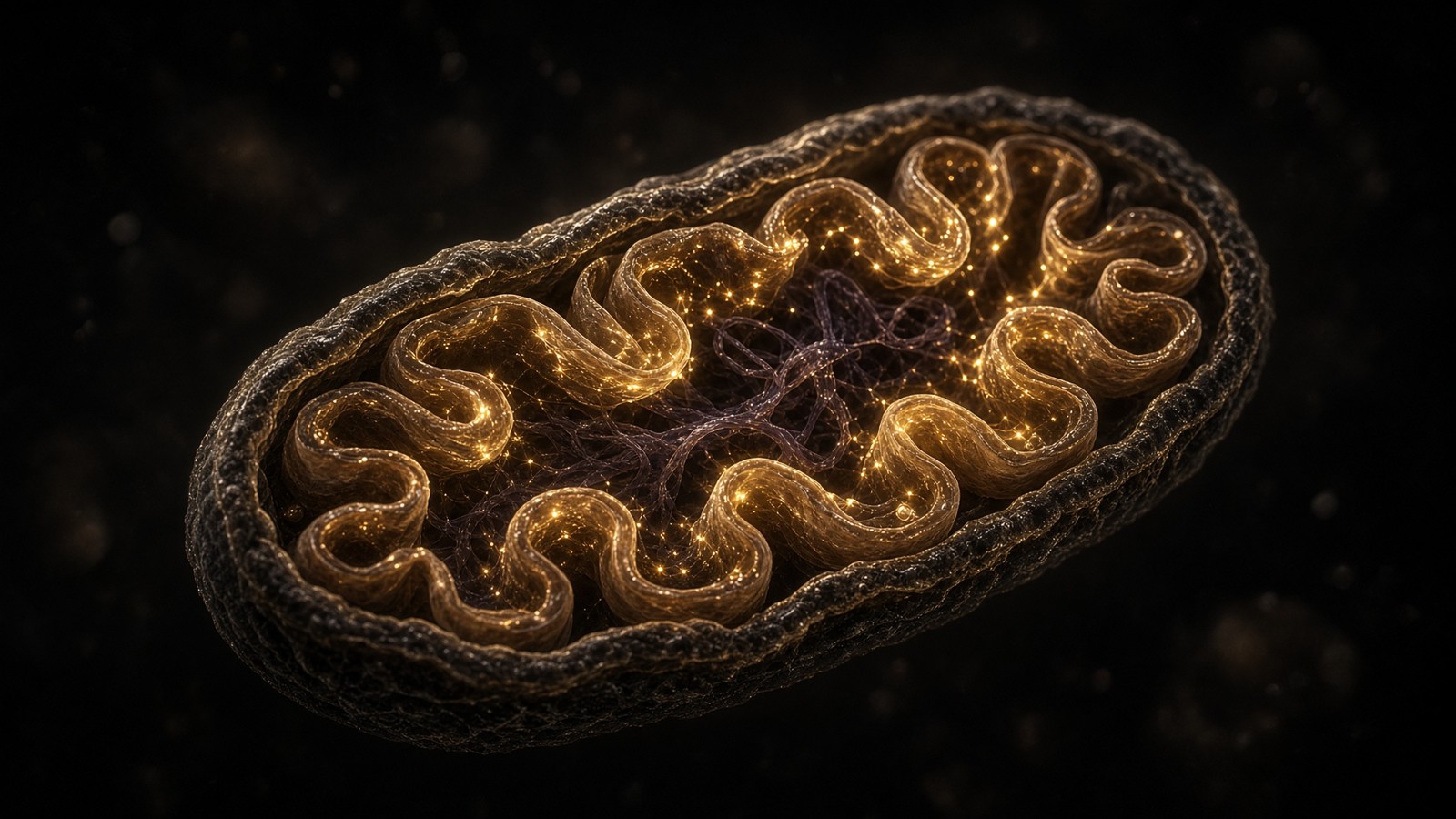
MOTS-c: mtDNA writing a peptide the cytosol reads
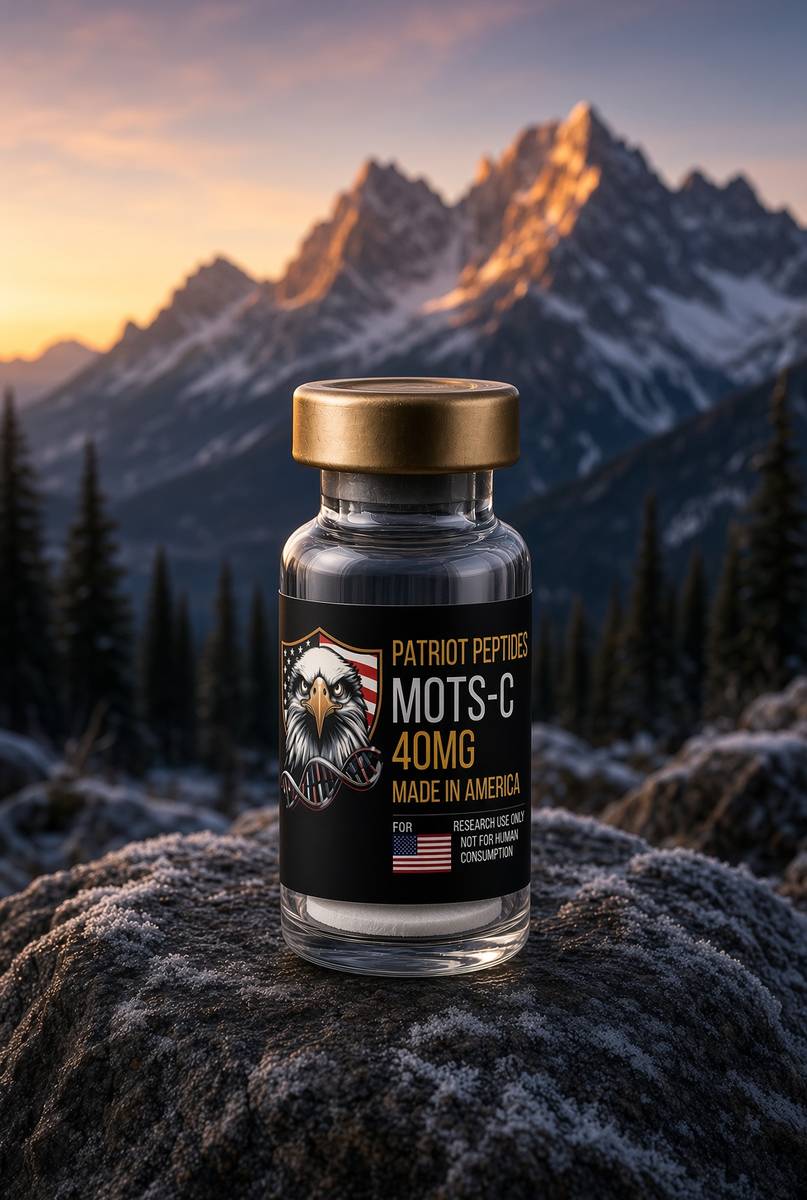
MOTS-c is the other catalogue object in this neighbourhood, and the neighbourhood has to stay a neighbourhood. Mitochondrial ORF of the 12S rRNA type-c: sixteen amino acids, MRWQEMGYIFYPRKLR, written in an RNA that was supposed to be a ribosome, not a message. Lee, Kim, Cohen, Cell Metabolism 2015: metabolic homoeostasis in mice, AMPK, the folate–methionine cycle, resistance to diet-induced obesity in those experiments. Read the sequence again. Met-Arg-Trp-Gln-Glu-Met-Gly-Tyr-Ile-Phe-Tyr-Pro-Arg-Lys-Leu-Arg. Sixteen residues from a reading frame in MT-RNR1, the 12S rRNA gene. Translation appears to happen on a cytosolic ribosome after the rRNA, or a fragment of it, has left the organelle — the 2015 paper and the later work are still arguing about the exact routing — and the peptide can then act in the cytosol or, under metabolic stress, go to the nucleus. An organelle writing a peptide the cytosol reads under metabolic stress. That sentence should not exist. The data did not ask permission, which is why it's one of the more delightful sentences in the last decade of mitochondrial biology. We stock 40 milligrams of that named 16-mer, HPLC-characterised. Neighbourhood is not identity. A dinucleotide and a mitochondrial peptide share an organelle and do not share a mechanism.
In short. MOTS-c is a short peptide the mitochondrion writes from its own ribosomal RNA. The cytosol reads it when fuel is short. That is next door to NAD+, not the same molecule.
AMPK is the fuel gauge MOTS-c talks to, and it's a kinase worth knowing even if you never touch the 16-mer. AMP-activated protein kinase is a heterotrimeric serine/threonine kinase: a catalytic α subunit, a scaffolding β, a γ that binds adenine nucleotides. Rising AMP and ADP at the γ subunit, falling ATP, a rising AMP/ATP ratio: the kinase turns on, helped by LKB1 and by CAMKK2 in a calcium neighbourhood. Phosphorylated AMPK then phosphorylates acetyl-CoA carboxylase, which slows malonyl-CoA production and lets fatty acids into mitochondria; TSC2 and Raptor, which lean on mTORC1; ULK1, which is an autophagy door; PGC-1α partners, which are a biogenesis door. AICAR is the AMP-mimetic a bench already knows. Metformin is a dirty, useful, licensed neighbour that among other jobs can raise the AMP/ATP ratio. MOTS-c sitting on this kinase is sitting on a fuel-decision node, not on Complex I, and not on NAMPT except where AMPK feeds NAMPT as already named. That's the adjacent energy door. Different ligand from the hydride carrier. Same organelle campus. A blot of phospho-AMPK T172 is the honesty test on this side of the page.
In short. AMPK is the kinase that notices a rising AMP to ATP ratio and then spends fuel more carefully. MOTS-c papers sit on that gauge. NAD+ papers sit on a different invoice.
The folate–methionine cycle is the other MOTS-c neighbourhood in the 2015 paper, and it is the one a fatigue caption never names because one-carbon metabolism does not sound like energy. MOTS-c was reported to interact with an enzyme in that cycle, to change AICAR levels, and through that change to speak to AMPK. 5-methyl-tetrahydrofolate, methionine synthase, SAM as the methyl donor, the methionine salvage that a methyl-hungry cell lives on: those are the named objects. A 16-mer that leans on one-carbon flux is leaning on nucleotide synthesis, on methylation, and on a metabolite that can mimic AMP. That's interesting. It is also a long way from a randomised trial of injected MOTS-c as a medicine in people who typed tired into a search bar. Independent replication of the original metabolic claims is the live scientific question; the sequence is not. If you're citing a large Phase 3 MOTS-c weight-loss trial, or a MOTS-c fatigue trial, you're citing a paper that does not exist, and that's a useful gap to know about. The catalogue holds the named 16-mer because the sequence is published and the assays are nameable. It does not hold a settled clinical endpoint.
In short. MOTS-c papers also sit on one-carbon metabolism, the folate and methionine cycle. That is a named biochemical neighbourhood, not a human fatigue trial.
Kim, Son, Benayoun and Lee, Cell Metabolism 2018, is the follow-up you actually have to cite if the claim is that the organelle wrote a memo. MOTS-c translocates to the nucleus in response to metabolic stress and regulates nuclear gene expression. Metabolic stress, in those experiments, was serum deprivation, oxidative stress, glucose restriction — the sorts of insult a cell already answers with AMPK, with ATF4, with a mitochondrial unfolded-protein response. Nuclear entry of a mitochondrial-encoded peptide is the reverse of the usual TOM/TIM import story. The direction of the memo is what makes the sentence surprising, and surprise is allowed in a journal. Whether that is an evolved signalling system or a translation accident that became useful is a question the 2015–2018 papers opened and did not close. What they did close is the sequence, the stress-gated nuclear localisation, and a transcriptional response that a microarray can name. A fatigue page is allowed to put that memo next to a hydride-carrier budget because both are how a cell talks about fuel. It is not allowed to write them as one juice, and it is not allowed to write nuclear translocation as a clinic appointment.
In short. Under metabolic stress MOTS-c can enter the nucleus and change gene activity. That is an organelle writing a memo, not a second form of NAD+.
Reynolds, Nature Communications 2021, is the exercise paper the search bar will throw at you, and it should be read as written. MOTS-c as an exercise-induced mitochondrial-encoded regulator of age-dependent physical decline and muscle homoeostasis, with human plasma MOTS-c rising after exercise, plus mouse genetics. That last combination is a human observation plus an animal perturbation. It is not a randomised trial of injected MOTS-c as a medicine in patients, and we won't invent one. Exercise still wins because PGC-1α, calcium, AMPK and the actual fusion/fission cycle respond to work. A peptide does not do a VO₂ session. MOTS-c and NAD+ are how you study the node. Training is how the node was built. Age-dependent physical decline is a real physiology; it is also several jobs, including sleep, sarcopenia, VO₂ max, and a CD38-positive immune system. Filing a 16-mer under I have no energy because plasma MOTS-c rises after a bout is a string match with the word exercise. It is not a flux assay of a Tuesday afternoon. Hold the observation. Hold the gap. The gap is information.
In short. Human plasma MOTS-c rises after exercise in a named paper. That is not a trial of injected MOTS-c as a treatment for tiredness, and training is still how the organelle census was built.
MOTS-c is not the first mitochondrial peptide. Humanin, 24 residues, was reported in 2001 by Hashimoto, Niikura, Nishimoto and colleagues as a rescue factor from a cDNA screen against familial Alzheimer's gene insults — and it maps to 16S rRNA, MT-RNR2, another structural RNA with a secret ORF. SHLPs, small humanin-like peptides, were later picked out of the same 16S region by the Cohen laboratory. The naming is inelegant. The observation is the same kind of observation as MOTS-c: the mitochondrial transcriptome is not only rRNA, tRNA and thirteen mRNAs. It is also a handful of short ORFs that a ribosome can, under some conditions, translate. Whether these are evolved signals or translational noise that a field has dressed as a family is not a question a catalogue will settle. We're not going to inflate them into a mitochondrial peptidome therapy. Humanin has a serious in-vitro and rodent literature and no authorised medicinal product. MOTS-c is the one in the catalogue, because it is a named 16-mer with a published sequence, a Cell Metabolism paper, a follow-up, and a clean synthesis. Catalogue honesty is a primary structure plus a chromatogram plus a paper.
In short. Humanin and related short ORFs sit in the same mitochondrial-RNA neighbourhood. MOTS-c is the named 16-mer with a published sequence and a chromatogram. A family is not a therapy.
Adjacent energy door. Different ligand.
cAMP is amplified from a receptor occupancy: one occupied GPCR, many cyclase turnovers, a cloud of kinase. NAD+ is spent, one molecule per lysine or per ADP-ribose. That's the opposite of amplification, and it's the bit a fatigue caption likes to borrow from the wrong floor. Salvage has to keep up. The second-messenger diagram belongs in this essay so that a fatigue caption cannot borrow cloud-and-kinase language for a cofactor that works by subtraction. MOTS-c, sitting on AMPK, is closer to a kinase cascade than NAD+ is, and even AMPK is a fuel-gauge kinase, not a Gs-coupled receptor. Three floors. A stack that treats a dinucleotide, a 16-mer and a triple gut-hormone agonist as interchangeable energy juice has not named a cofactor, a reading frame or a receptor. Retatrutide, if it is on your bench, occupies GLP-1R, GIPR and GCGR, and organism-level fuel demand then changes; mitochondrial flux will follow because flux follows fuel, not because a triple agonist is a Complex I ligand. The appetite essay on this desk already owns that occupancy. This page owns the budget and the mitochondrial memo. Keep the floors. A reading list can sit them together. An experiment cannot.
In short. A hormone signal is amplified. NAD+ is spent one molecule at a time. MOTS-c talks to a fuel-gauge kinase. Those are three different kinds of energy conversation.
Diagram
× 1
Ligand
One peptide in one pocket. nM–µM. Shape, not a mood.
× 10–10²
G proteins
The occupied GPCR is a GEF. Each Gα is a catalyst.
× 10³–10⁴
cAMP / IP₃ / Ca²⁺
Adenylyl cyclase and PLC do not make one molecule. They make a cloud.
× 10⁴–10⁶
PKA / PKC / CaMK
Kinases phosphorylate many substrates per messenger.
× tissue
Secretion, transcription, motility
The organism-level readout. Still not a protocol.
This is the only magic, and it is not magic. A nanomolar ligand can move a micromolar messenger because enzymes sit between them. Desensitisation (GRK, β-arrestin, endocytosis) is how the cell refuses to let ‘more ligand’ mean ‘more signal’ forever.
What restoration experiments actually show
The mouse NAD+ restoration literature is large enough to be a field, and it is not a cartoon. Yoshino, Mills, Imai, Cell Metabolism 2011: NMN, diet- and age-induced diabetes, insulin sensitivity, a mitochondrial set of readouts. Gomes and the Sinclair laboratory's 2013 Cell paper on NMN and mitochondrial communication in ageing muscle — the paper that put the restoration sentence into the popular press, with a PGC-1α/SIRT1/HIF-1α story that other labs have both used and argued with. Mills, Yoshino, Imai, Cell Metabolism 2016: twelve months of NMN in mice, body weight, energy expenditure, insulin sensitivity, plasma lipids, eye function, a panel rather than a single heroic endpoint. Das, Sinclair, Cell 2018: NMN and capillary density, SIRT1 in endothelium. Fang, Bohr: PARP1, NAD+, and DNA-repair neighbourhoods in Cockayne and xeroderma models, where the drain is the point. Canto, Auwerx: NR in mice, mitochondrial unfolded-protein response. You can dislike a press release and still have to cite the figures. Fatigue, as a primary endpoint, is almost never what those figures measured. Oxygen consumption, a clamp, a vessel density: those are the assays. A tired mouse is not a scored complaint.
In short. In mice, NMN and nicotinamide riboside have improved insulin handling, blood-vessel density and some mitochondrial readouts in named papers. Those assays are not a human fatigue score.
Human NR and NMN trials are smaller and more mixed, which is what you should expect when you perturb a node this central in an animal that also has a diet, a sleep schedule and a CD38-positive immune system. Trammell, Brenner, Nature Communications 2016: oral NR is bioavailable, the NAD+ metabolome moves, NAAD is a marker. Martens, Seals, Nature Communications 2018: NR in healthy middle-aged and older adults, blood pressure and aortic stiffness as the endpoints that moved in that cohort. Elhassan, Philp, Cell Reports 2019: NR in aged men, skeletal-muscle NAD+ metabolome up, a set of circulating inflammatory cytokines down, mitochondrial function in muscle not dramatically remodelled. Yoshino, Klein, Science 2021: NMN for ten weeks in postmenopausal prediabetic women, hyperinsulinaemic–euglycaemic clamps, skeletal-muscle insulin sensitivity improved, liver and adipose in that study did not. The effect was modest, the cohort was specific, and the paper did not claim to have reversed ageing or cured tiredness. Other trials have moved the metabolome and left VO₂ max, insulin sensitivity, strength and self-reported energy where they were. That pattern is information. You can fill a pool and not own the phenotype the pool sits under.
In short. In people, nicotinamide riboside and NMN often change NAD+ metabolites. Fitness, insulin numbers and how tired someone feels often have not followed.
Pellagra is the historical control, and it belongs in a fatigue heading so that niacin does not get forgotten. Goldberger, the American South, a diet of maize, four Ds: dermatitis, diarrhoea, dementia, death. Nicotinic acid and nicotinamide cure pellagra because they refill a NAD+ pool that was empty from the dietary side. That's a deficiency disease, a vitamin, a public-health victory, and a person with pellagra is tired in the way a person with no coin is broke. Ageing is not pellagra. Aged tissue is not a population with no niacin. The pool falls, in specific tissues, for reasons of drain and of NAMPT, against a dietary background that would have kept Goldberger's patients well. Treating ageing-NAD+ as a vitamin deficiency is how a serious salvage map becomes a supplement aisle. Treating supplements as irrelevant is how you forget that NR and NMN do move human metabolomes. ME/CFS is not pellagra either, and neither is a short night. The clinical gap is the gap between a deficiency disease and a clamp in a prediabetic woman, and between both of those and a search bar that says exhausted. Hold all three ends.
In short. Niacin cures pellagra because that is a true vitamin deficiency. Ageing is not pellagra, and ordinary tiredness is not either. Topping up a sagging pool is not the same victory.
A cake and an appointment are two legal objects
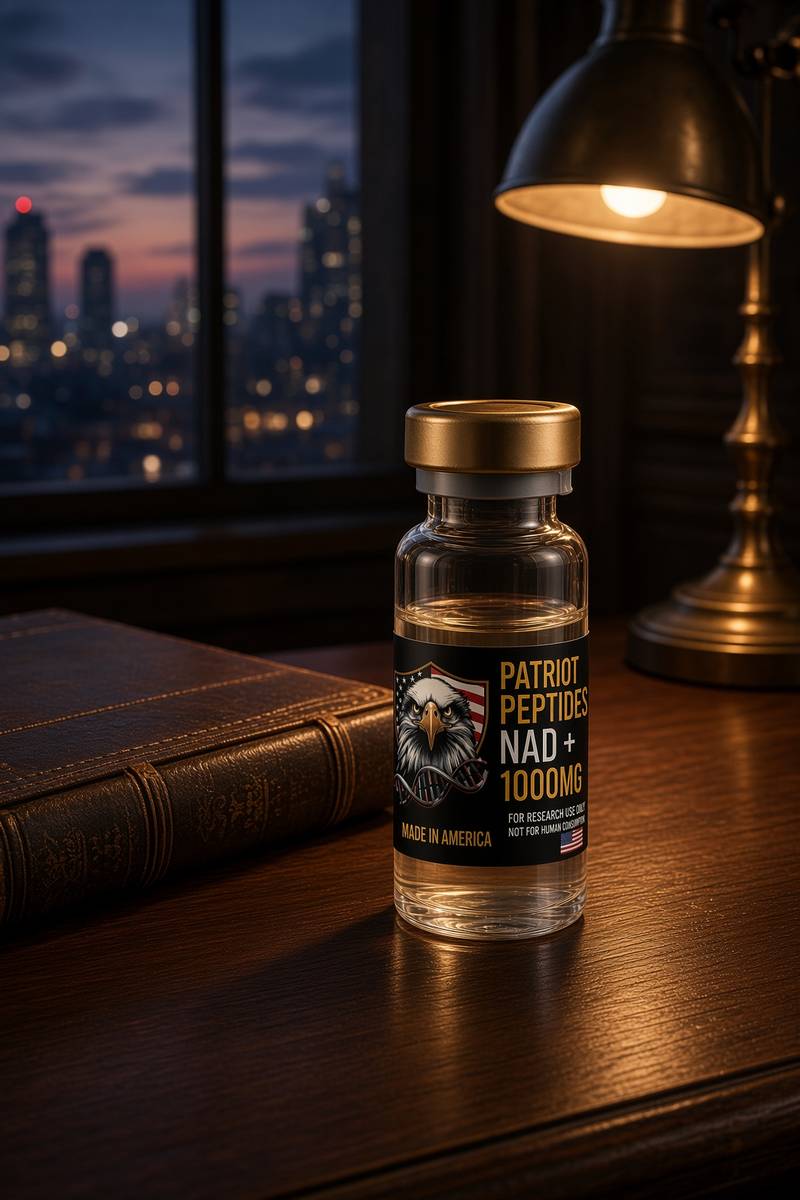
The catalogue listing is lyophilised β-NAD+, 1000 milligrams, ≥98 percent by HPLC, molecular weight 663.43, formula C21H27N7O14P2, CAS 53-84-9. A white to off-white cake in a vial, a certificate of analysis, a reconstitution kit. It is the same carbon skeleton every dehydrogenase, sirtuin and PARP paper names. It is a laboratory reagent. The form is the form you weigh into a sirtuin assay, a PARP assay, a cycling assay, a set of isolated mitochondria, a standard curve for LC-MS. Purity is a chromatogram, not a feeling. None of those sentences is a dose. None of them is a route. None of them is a schedule. If you cannot say how many nanomoles went into a well, you have not yet started. A social post that treats 1000 milligrams as a human serving has not read the label, and the label is the legal class of the object. MOTS-c 40 milligrams is about 20 micromoles of MRWQEMGYIFYPRKLR, HPLC-characterised, a 16-mer for AMPK and one-carbon neighbourhoods. Two certificates. Two questions. We will sell you the named objects. We will not design the blot.
In short. The freeze-dried cofactor is a gram of NAD+, purity on a chromatogram, for weighing into experiments. MOTS-c is a separate 16-mer. Neither is a dose or a schedule.
Pharmacokinetics of intact NAD+ are the reason a freeze-dried cake and an intramuscular appointment cannot be collapsed. The 1000 milligram cake is lyophilised research β-NAD+. eLIVEate intramuscular NAD+ is a different object, a different till, no commission. Two legal objects. Charged, 663 daltons, poor passive permeability. Ectonucleotidases on endothelium and on immune cells. CD38 facing out. CD73. Connexins as a disputed door. Plasma half-life of an intravenous bolus is short; what you measure downstream is often nicotinamide, NR, NMN, ADP-ribose, a cloud, not a tidy rise in mitochondrial NAD+ in the tissue you cared about. Intramuscular administration is a different curve again, a depot, a local ecto-enzyme landscape, a set of unknowns a clinic has to own as a clinic. eLIVEate is a separate company. Where that appointment exists on the diary in Great Missenden, it is a supervised administration of a clinic-compounded or licensed preparation, with a consent form and a clinician. Patriot Peptides does not write the appointment as a reconstitution of the catalogue cake. Same carbon skeleton on a whiteboard. Different product, different company, different regulator's attention. The physiology above does not depend on this sentence. The label does.
In short. A clinic injection of NAD+, where it exists, is a different product at a different company. The freeze-dried solid is the laboratory reagent. Same molecule on paper. Different law in the room.
Two mitochondrial reagents on the same shelf, two certificates, two questions, and a clinic object that is not either of them. The 1000 milligram NAD+ cake is a dinucleotide for redox, sirtuin and PARP work. The MOTS-c listing is MRWQEMGYIFYPRKLR, a 16-mer for AMPK and one-carbon neighbourhoods. The appointment, where it exists, is a supervised intramuscular administration under another company's governance. Three objects. A stack that treats them as interchangeable energy juice has not named a cofactor, a reading frame or a consent form. Adults can want a paper and an appointment on the same afternoon. Bundling them is how a research reagent becomes a medical claim it is not allowed to be, and how a clinic becomes a webshop it is not. Neighbourhood, in this journal, is a courtesy on a reading list. It is not a combination claim. Retatrutide remains a fourth floor if your metabolic reading list has already walked that far: three class-B GPCRs, organism-level fuel demand, flux following fuel. The button that puts NAD+ and MOTS-c in the same bag is logistics for a bench that wants both named sequences. It is not a protocol for a person who typed exhausted.
In short. NAD+, a mitochondrial 16-mer, and a clinic injection are three different objects. A reading list can sit the first two together. That is not a combined plan for a person.
Diagram
| Node | Catalogue | Conversation |
|---|---|---|
| GPCR | Ipamorelin, MT2, PT-141, retatrutide, CJC | Second messengers, secretion, appetite, pigment |
| RTK / IGF1R | IGF-1 LR3 | IRS–PI3K–Akt–mTOR and Shc–ERK |
| Cytokine receptor | Somatropin (HGH) | GHR–JAK2–STAT5b, hepatic IGF-1 |
| Cofactor | NAD+ | Sirtuins, PARPs, CD38, redox |
| Actin buffer | TB-500 / Tβ4 motif | G-actin sequestration, motility |
| Growth-factor-like | BPC-157 | VEGFR2 / FAK / eNOS neighbourhood |
| Copper ligand | GHK-Cu | Transcriptome shift in fibroblasts |
| MC fragment | KPV | NF-κB, PepT1, no pigment |
| Nuclear / pineal | Epithalon (AEDG) | TERT and melatonin literatures |
| mtORF peptide | MOTS-c | AMPK, folate–methionine cycle |
Each row is a different kind of molecular conversation. The catalogue peptides bind at these nodes; they are not interchangeable, and stacking them because a forum did mixes unrelated literatures.
How to design an honest energy assay
Decide what you are measuring before you thaw the cake. Total NAD(H) is a pool size. The NADH/NAD+ ratio is a redox state. They can move in opposite directions. A cycling assay reports a number from a homogenate and is only as good as the extraction; acid extraction destroys NADH and keeps NAD+, alkali the reverse, and people have been getting that wrong since the 1960s. LC-MS, with 13C internal standards, is how a metabolome paper earns the word metabolome: NAD+, NADH, NADP+, NADPH, NMN, NR, nicotinamide, NAAD, ADP-ribose, a family. NADPH is not NADH. The extra phosphate on the adenosine ribose is a different pool, anabolic, pentose-phosphate, glutathione reductase, and confusing the two is a way to ruin a figure. Biosensors — SoNar, Peredox, LigA-based probes, matrix-targeted variants — give you ratio in a living compartment. A Seahorse XF or an Oroboros O2k is oxygen consumption, the Complex I invoice. TMRM for membrane potential, with FCCP and oligomycin as the brackets. Westerns for SIRT1, SIRT3, NAMPT, CD38, PAR, PGC-1α, acetyl-SOD2. Pick one, and write which one. A kit on a homogenate is a scout. It is not a fatigue paper.
In short. Say whether you are measuring how much NAD+ there is, or how much of it is loaded with electrons. Name the machine. A blended kit is a starting measurement, not the whole story.
MOTS-c assays are a different honesty test, and they're worth running as themselves rather than as a smaller NAD+. Phospho-AMPK T172, phospho-ACC S79, a vehicle, a time course, AICAR as a positive control if you are claiming the gauge. OCR and ECAR on the same plate if the claim is fuel choice. A MOTS-c ELISA on plasma is an observation of the sort Reynolds made; it is not the same experiment as adding the synthetic 16-mer to a myotube. Nuclear fractionation, or a tagged construct, if the claim is the 2018 translocation. Folate and methionine-cycle intermediates if the claim is one-carbon. Sequence on the certificate, HPLC, mass. Cell-type choice is a control: a HEK293 well will tell you whether a construct moves a metabolome; it will not tell you what a myotube does with AMPK, and it will not tell you what a CD38-high macrophage does to a neighbour's NAD+ pool. Aged mouse tissue is not a late-passage dish. If the claim is ageing, the animal has to be old, the tissue has to be named, and the cell sort has to be done.
In short. For MOTS-c, show the fuel-gauge kinase, a time course and a control. A plasma reading is not the same experiment as adding the synthetic peptide to a muscle cell.
Pharmacological controls are how you name the hole on the NAD+ side, and they're more fun than they sound. FK866 inhibits NAMPT; the pool falls from the refill side, typically over hours, and a rescue with NR, which bypasses NAMPT, is the specificity check. A PARP inhibitor — olaparib is the one a hospital already knows — closes the PARP1 drain; if your NAD+ collapse was a genotoxic burst, this drug will spare the pool and change the interpretation. CD38 inhibitors and blocking antibodies exist in the literature; 78c is a named small molecule from the Chini neighbourhood. Nicotinamide at high millimolar is a product inhibitor of sirtuins and a precursor at the same time, which is why it is a terrible single-handed tool. Sirtuin inhibitors, EX-527 for SIRT1, 3-TYP for SIRT3, close a spend without refilling the pool. If a phenotype survives FK866 but dies with a sirtuin inhibitor, you were never looking at pool size. You were looking at an enzyme. Extraction timing and redox-quench ruin more figures than the wrong precursor. NADH oxidises on a warm bench. Snap-freeze, cold methanol, internal standards added at the moment of quench. Freeze fast. NADH will not wait.
In short. Use drugs that block refill, DNA-repair spending, or the age-linked chopping enzyme, so you can tell which hole you are studying. Freeze fast. NADH will not wait.
Cell-type choice is a control, not a convenience, and it is the control a fatigue caption most likes to skip. A HEK293 well is a construct-and-precursor metabolome. It is not a CD38-high macrophage eating a neighbour's pool, and it is not a myotube with NRK2. Primary hepatocytes still have NAMPT and a de novo path; neurons mostly do not. Endothelial cells are a SIRT1-and-nitric-oxide neighbourhood; they are not a SIRT3-and-β-oxidation neighbourhood. A whole-liver NAD+ number is a hepatocyte diluted by immune cells that may be the actual CD38. That last sentence is Verdin's point, restated as a design demand. If the claim is skeletal-muscle energy, the fibre type has to be named, because type I fibres live on mitochondria and type II fibres have more glycolytic latitude. If the claim is brain fog, you do not have a NAD+ paper until you have a compartment and a cell sort, and even then you do not have a clinic object. Late-passage dishes are a Hayflick neighbourhood with their own NAD+ story. Ageing work needs old tissue, named. A kidney-cell line is not a muscle fibre, and a mixed old liver is partly immune cells chopping NAD+.
In short. Pick the cell that has the job you are claiming. A kidney-cell line is not a muscle fibre, and a mixed old liver is partly immune cells chopping NAD+.
- Name the pool: total NAD(H), NADH/NAD+ ratio, or a named precursor. NADP(H) is a different nucleotide.
- Name the compartment: cytosol, nucleus, matrix. A homogenate is a scout.
- Name the drain: sirtuin client, PAR polymer, CD38 protein or activity. FK866, a PARP inhibitor, a CD38 tool.
- Name the refill: NAMPT, NRK, NMNAT isoform. Rescue with NR if you blocked NAMPT.
- Name the mitochondrial invoice if you claim one: OCR, membrane potential, acylcarnitines, SIRT3 clients. Not a kit alone.
- If the ligand is MOTS-c, show phospho-AMPK, a time course, and a vehicle. A plasma ELISA is a different experiment.
- Write the quench, the time point, and the internal standard. NADH will not wait.
Close: conserved node, public papers, laboratory reagents
The node is conserved, which is the only reason a yeast silencing gene, a worm lifespan paper, a mouse clamp and a human metabolome can sit in one essay without being a collage. SIR2 spent NAD+ in Saccharomyces. The seven mammalian sirtuins still do. PARP1 is a eukaryotic elaboration on a break. CD38 is a vertebrate NADase that ageing and inflammation both write. NAMPT is the bottleneck a mammal actually lives on. NRKs let a nucleoside walk around it. Complex I has wanted oxidised NAD+ since there was a proton-motive force to build. MOTS-c is a mammalian mitochondrial ORF; AMPK is older than that ORF and runs in yeast as SNF1. You can run the hydride argument in a bacterium, with different names, and carbon 4 will still be the chemistry. Conservation is not a licence to treat a mouse figure as a human protocol, and it is not a licence to treat a 16-mer as a cofactor. It is a licence to take the biochemistry seriously enough to measure it, in the organism you have, with the controls the drains require. The popular story got loud because the node is central. The work got hard for the same reason.
In short. From yeast to humans, cells spend this cofactor to silence genes, flag broken DNA, and run mitochondria. A mouse result is not automatically a human plan, and MOTS-c is a later, separate sentence.
The public papers are the reading list, and they are short enough to actually read. Imai and Guarente, Nature 2000, SIR2 as an NAD+-dependent deacetylase. Revollo, Imai, JBC 2004, NAMPT as the mammalian bottleneck. Bieganowski and Brenner, Cell 2004, NR as a vitamin. Camacho-Pereira, Chini, Verdin, Cell Metabolism 2016, CD38 as the age-NADase. Yoshino, Imai, Cell Metabolism 2011, NMN in diabetic mice. Trammell, Brenner, Nature Communications 2016, NR in humans. Yoshino, Klein, Science 2021, NMN and a clamp in prediabetic women. Kory, Mootha, Nature 2020, SLC25A51 as the mitochondrial NAD+ transporter. Lee, Cohen, Cell Metabolism 2015, MOTS-c, so the neighbourhood stays named. Kim, Lee, Cell Metabolism 2018, nuclear translocation under metabolic stress. Reynolds, Nature Communications 2021, exercise-induced MOTS-c. Rich, 2003, so the ATP scale stays honest. Kraus and Berger on PARP, so the minutes-scale drain stays in the picture. Spiegel, Van Cauter, Lancet 1999, so a short night still explains more breakfast misery than either vial. That's a fortnight of evenings, not a guru. The energy headlines will still be there when you come back, and they will look smaller.
In short. A short stack of named papers covers the enzyme, the bottleneck, the age-linked leak, the mouse work, the human clamps, the mitochondrial 16-mer and the ATP scale. Read those before any headline.
What you should leave with is a topology, not a shopping list. NAD+ is a hydride carrier at nicotinamide C4, and that is still most of the pool's day. Sirtuins, PARP1 and CD38 spend it, one molecule at a time. NAMPT salvages. NR and NMN feed. Mitochondria notice first because Complex I and SIRT3 both sit on the pool, and because the matrix is not in free exchange with the rest of the cell. MOTS-c is mtDNA writing a peptide the cytosol reads under metabolic stress, AMPK, an adjacent energy door, a different ligand. Mice, given NMN or NR, show metabolic and vascular phenotypes that are in print. Humans, given NR or NMN, show metabolome shifts that are in print and clinical endpoints, including how tired they feel, that are mixed. The 1000 milligram cake is lyophilised β-NAD+ for the assays that topology demands. The 40 milligram MOTS-c cake is the named 16-mer. The appointment at another company is a different legal object. If your experiment needs the cofactor, weigh it, quench it, and name the drain. If it needs the 16-mer, show AMPK. If it needs a medicine, this catalogue does not sell one.
In short. Leave with the map: electron carrier, three spends, one bottleneck, a mitochondrial 16-mer on AMPK, mixed human outcomes. The reagents are for the assays that map requires.
Ageing, on the NAD+ node, is a budget that started to leak faster than it was refilled. CD38 up, NAMPT down in some tissues, PARP1 busier in a genome that has had more years to be nicked, sirtuins still trying to deacylate a proteome that is more acetylated than it was. MOTS-c, on its node, is an organelle writing a 16-mer when the neighbourhood is rude, a fuel-gauge conversation that exercise already speaks fluently. Those sentences are research programmes. They are not diagnoses, and they are not a letter for a person who cannot get out of bed. The programmes run on HPLC-characterised reagents, on mice whose age you state, on clamps rather than well-being scores, and on a willingness to publish the trial that did not move the endpoint. We will keep the cofactor on the shelf at a serious aliquot, and the 16-mer next to it, because those programmes are real and because the molecules they spend and write are not mysteries. We will not write your discussion section. Cellular time is a set of rates. This rate you can weigh. Tired remains a clinic word until a named assay has earned a better one.
In short. Ageing on this topic looks like a budget leaking faster than it is refilled, and MOTS-c looks like an organelle memo under stress. Those are research programmes, not a diagnosis of tiredness.
Research-use-only. Not for human consumption, not a medicine. The lyophilised β-NAD+ on this listing is a laboratory reagent, HPLC-characterised at ≥98 percent, labelled for in-vitro work: a standard curve, a sirtuin tube, a PARP assay, a set of isolated mitochondria whose oxygen consumption you actually record. MOTS-c is the named 16-mer, HPLC-characterised, labelled the same way, for AMPK and one-carbon neighbourhoods a blot can name. The physiology in the paragraphs above is public, cited, and older than either vial. Use it to design the experiment you have the controls for, with the drain named, the compartment named, the kinase named, and the time point written down. Read Imai, read Verdin, read Brenner, read Lee, then weigh the cake that matches the question. We will sell you the cofactor and the 16-mer. We will not tell you either is a currency you can deposit in a vein and draw as youth, or as a Tuesday with enough energy in it. Cellular time is a set of rates. Fatigue is a complaint a clinic still has to sort. These rates you can measure, in a tube, with a chromatogram on the bench beside them.
In short. The solids are research chemicals for experiments, not medicines and not food. The biology is public. Weigh the one that matches the assay, and keep the claim the size of the chromatogram.
Questions the essay actually answers
- Does this mean NAD+ or MOTS-c treats fatigue?
- No. Fatigue is a clinic complaint with a differential: anaemia, thyroid, sleep apnoea, depression, ME/CFS, a short night. The papers sit on a hydride-carrying cofactor and on a mitochondrial 16-mer. Patriot sells characterised research reagents, labelled for laboratory use — not a medicine and not a protocol.
- Is the 1000 mg NAD+ the same as the clinic injection?
- No. eLIVEate's NAD+ is an in-person intramuscular plan at a separate company. Patriot's vial is lyophilised research β-NAD+. Related skeleton, different legal frame, no commission on the booking.
- Why MOTS-c with NAD+?
- Both sit on cellular energy literature. One is a cofactor Complex I and sirtuins spend. One is a mitochondrial-encoded peptide that talks to AMPK. Search should surface both when someone types fatigue. Neighbourhood is not identity.
- Why does the NAD+ pool fall with age?
- Consumption outruns salvage in specific tissues. PARP1 can drain the pool after DNA damage; CD38 is an age- and inflammation-associated NADase (Camacho-Pereira, Verdin, Cell Metab 2016); NAMPT, the kinetic bottleneck of salvage, often falls. Supply and demand, not a vitamin caption.
- What is NAMPT, and why does it matter?
- Nicotinamide phosphoribosyltransferase, the rate-limiting enzyme of mammalian NAD+ salvage: nicotinamide to NMN. Revollo and Imai, JBC 2004. FK866 inhibits it and collapses the pool. NR bypasses it via NRK1/2. NAMPT is the first step of the recycle path — name it if the claim is salvage.
- How do nicotinamide riboside, NMN and NAD+ differ?
- NR is a nucleoside precursor (Brenner): NRKs phosphorylate it to NMN. NMN is the NAMPT product and the NMNAT substrate; how it enters cells is still argued. Intact NAD+ is the dinucleotide, charged, 663 Da, a poor membrane passenger, the reagent in the 1000 mg cake. Three rungs. Three experiments.
- Do sirtuins consume NAD+?
- Yes. SIRT1–7 are NAD+-dependent lysine deacylases. One NAD+ is spent per lysine; nicotinamide and O-acyl-ADP-ribose are released. That is Imai and Guarente, Nature 2000, still the sentence. They do not redox-cycle the cofactor. They spend it.
- What did human NR and NMN trials actually show?
- The metabolome often moves (Trammell, Brenner, 2016 for NR). Clinical endpoints are mixed: a vascular signal in one NR cohort (Martens, 2018); muscle insulin sensitivity, modest, in prediabetic women on NMN with a clamp (Yoshino, Science 2021). Self-reported energy and fitness often do not follow. A central node can shift without owning the phenotype.
- What is MOTS-c, chemically?
- MRWQEMGYIFYPRKLR, sixteen residues from an open reading frame in mitochondrial 12S rRNA (Lee, Cohen, Cell Metab 2015). AMPK and the folate–methionine cycle in those papers; nuclear translocation under metabolic stress (Kim, 2018); plasma rise after exercise (Reynolds, 2021). A named 16-mer, not a smaller NAD+.
- How should NAD+ be measured honestly?
- Say whether you mean pool size or NADH/NAD+ ratio, and which compartment. Cycling assays on homogenates are scouts. LC-MS with internal standards is a metabolome. Biosensors give living ratios. Show the drain (PAR, CD38, a sirtuin client) and the refill (NAMPT, NRK, NMNAT) if the claim is restoration. Quench fast. NADH will not wait.
Hypothetical research reconstitution
How these vials are typically mixed
Hypothetical research reconstitution for the named catalogue vial. Not a protocol, not medical advice, not a use instruction. These amounts sit in published and commonly cited laboratory ranges. The vial is labelled for research use only — not for human or veterinary administration.
NAD+
1000mg
Mix with 10 ml bacteriostatic water → 100 mg/ml
- Hypothetical aliquot
- 50–100 mg
- 0.50–1.00 ml · 50–100 units on a U-100 syringe
- How often
- Two or three times per week in published infusion and assay notes
- 4–8 weeks, then a pause
Bench steps
- Let the vial sit until it is no longer cold to the touch.
- Wipe the stopper with 70% isopropyl alcohol. Let it dry.
- Draw 10 ml bacteriostatic water (0.9% benzyl alcohol).
- Run the water slowly down the inside glass — do not blast the cake.
- Roll between finger and thumb until the cake is gone. Do not shake.
- Label the date. Store the solution at 2–8 °C. Do not freeze. Use within 30 days unless the note below says otherwise.
A 1000mg cake wants 10 ml. Protect from light. Solution yellows as it oxidises — that is the cofactor dying, not a flavour. Use promptly.
MOTS-c
40mg
Mix with 2 ml bacteriostatic water → 20 mg/ml
- Hypothetical aliquot
- 5–10 mg
- 0.25–0.50 ml · 25–50 units on a U-100 syringe
- How often
- Two or three times per week
- 4–8 weeks
Bench steps
- Let the vial sit until it is no longer cold to the touch.
- Wipe the stopper with 70% isopropyl alcohol. Let it dry.
- Draw 2 ml bacteriostatic water (0.9% benzyl alcohol).
- Run the water slowly down the inside glass — do not blast the cake.
- Roll between finger and thumb until the cake is gone. Do not shake.
- Label the date. Store the solution at 2–8 °C. Do not freeze. Use within 30 days unless the note below says otherwise.
Mitochondrial 16-mer. Fridge. Do not freeze. The 5 mg mark is where most bench notes start.
Bacteriostatic water and sterile syringes ship with peptide orders over £75. Kit details · 10 ml bacteriostatic water
The vials this essay sits on
Named sequences the essay maps — NAD+, MOTS-C. Hypothetical research neighbourhood, not a protocol, not a medicine. One press puts every in-stock vial in the bag.
Research use only. Not a combined-use instruction.
Read next
49 min · long read · Peptide research
NAD+: the currency of cellular time
NAD+ is nicotinamide adenine dinucleotide, the hydride coin Complex I wants oxidised and the stoichiometric substrate sirtuins, PARP1 and CD38 spend. Salvage through NAMPT is the kinetic bottleneck; the pool falls with age. Restoration in mice moves muscle, endothelium and stem-cell assays; human NR and NMN trials more often move the metabolome than a hard clinical endpoint. This essay is that topology, the named papers, and why a 1000 mg cake of lyophilised β-NAD+ is a laboratory reagent rather than an infusion.

50 min · long read · Peptide research
Sirtuins, caloric restriction and the NAD+ budget
Yeast SIR2, worm daf-16, mouse SIRT1 — a conserved story about spending NAD+ to deacylate the proteins that decide whether a cell is in famine or feast. The cofactor is the budget. We stock it at 1000mg.

49 min · long read · Clinic
In-clinic NAD+ and the lyophilised research vial are not the same product
In-clinic NAD+ at eLIVEate Me (£200/month IM) is not Patriot’s 1000 mg lyophilised research vial. Same molecule class, different product, different till.
More in this desk

53 min · long read · Peptide research
Recovery, GH pulses and the CJC / ipamorelin pair
Somatotrophs have two 'go' receptors. CJC without DAC is a slightly longer GHRH pulse. Ipamorelin is a selective ghrelin-receptor key that does not yank ACTH. Together they are the pair Bowers already showed is more than additive — not a gym protocol.
53 min · long read · Peptide research
How research peptides are made — and why HPLC actually matters
Solid-phase peptide synthesis builds a chain one residue at a time. HPLC then asks whether the main peak is what you think it is. ≥98% is not a slogan. It is a chromatogram.
51 min · long read · Peptide research
Melanocortin circuits: pigment, appetite and PT-141
Melanotan II lights MC1, MC3, MC4 and MC5 — pigment plus the rest of the sheet. PT-141 is the free-acid cousin pointed at MC3 and MC4, the circuitry papers use for desire and energy, not skin colour. Same Arizona family. Different question.
51 min · long read · Peptide research
GHRH and ghrelin mimetics: two keys on the same pituitary lock
Somatotrophs have two ‘go’ receptors — GHRHR (Gs–cAMP) and GHSR (Gq). Bowers showed that occupying both releases more GH than the sum of either. That is synergy as a receptor fact, not a smoothie.
Essays describe published research. They are not medical advice and they do not authorise human use of any catalogue item.