


The living cell
How a cell actually works
Nine long essays, in the order you should read them: the city, DNA and coding, protein formation, energy, listening, the decision to divide, then what fails. Correct terms, then a plain-English line after every paragraph.
3.6 × 10¹³
Human cells
Sender, Fuchs, Milo. Most of them are red blood cells with no nucleus.
10²¹ / s
ATP hydrolyses
A body-weight of ATP recycled every day. The standing pool is a coffee cup.
2 metres
DNA per nucleus
Folded into 6–10 µm. Gene regulation is the search problem that packing creates.
Read in this order
Nine essays. One syllabus.
Start at the city. Walk the membrane, the nucleus, then gene to protein so DNA, the genetic code and protein formation have a home. Then quality control, mitochondria, how a cell listens, the decision to divide, and what fails. Previous and next follow this order on every page.
01 · Start here · Part 01 The city
What a cell is, how many you are, and the numbers that keep size honest.
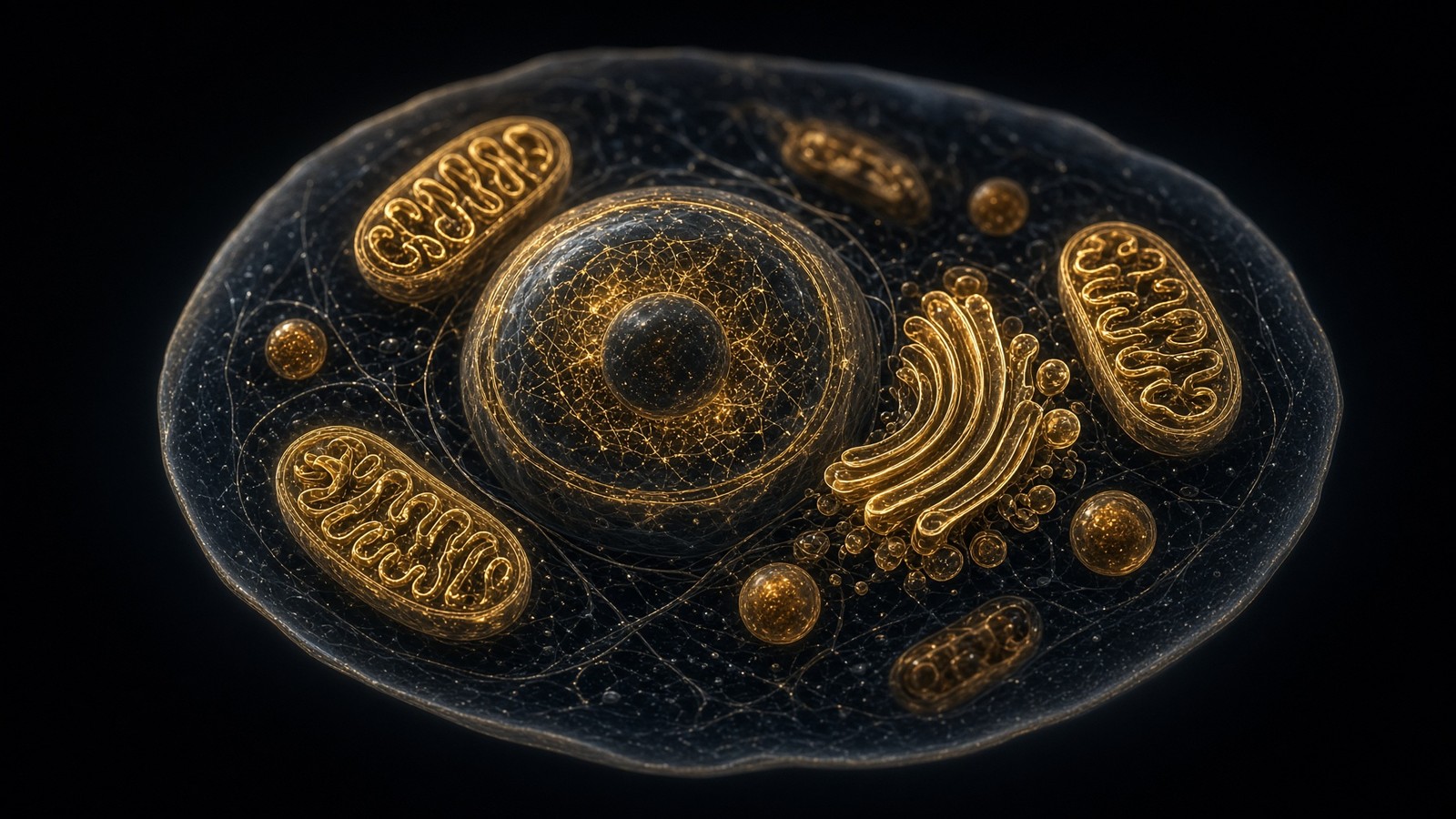
65 min · long read · The living cell
The living cell is a city, and you are 36 trillion of them
A 70 kg adult is on the order of 36 trillion cells, most of them red blood cells with no nucleus. A typical nucleated cell holds about ten billion proteins and two metres of DNA. The body recycles 40–60 kg of ATP a day. Those figures are published; this essay is what they mean.
02 · The edge · Part 01 The city
The five-nanometre wall that makes an inside, and how a ligand can occupy it without entering.
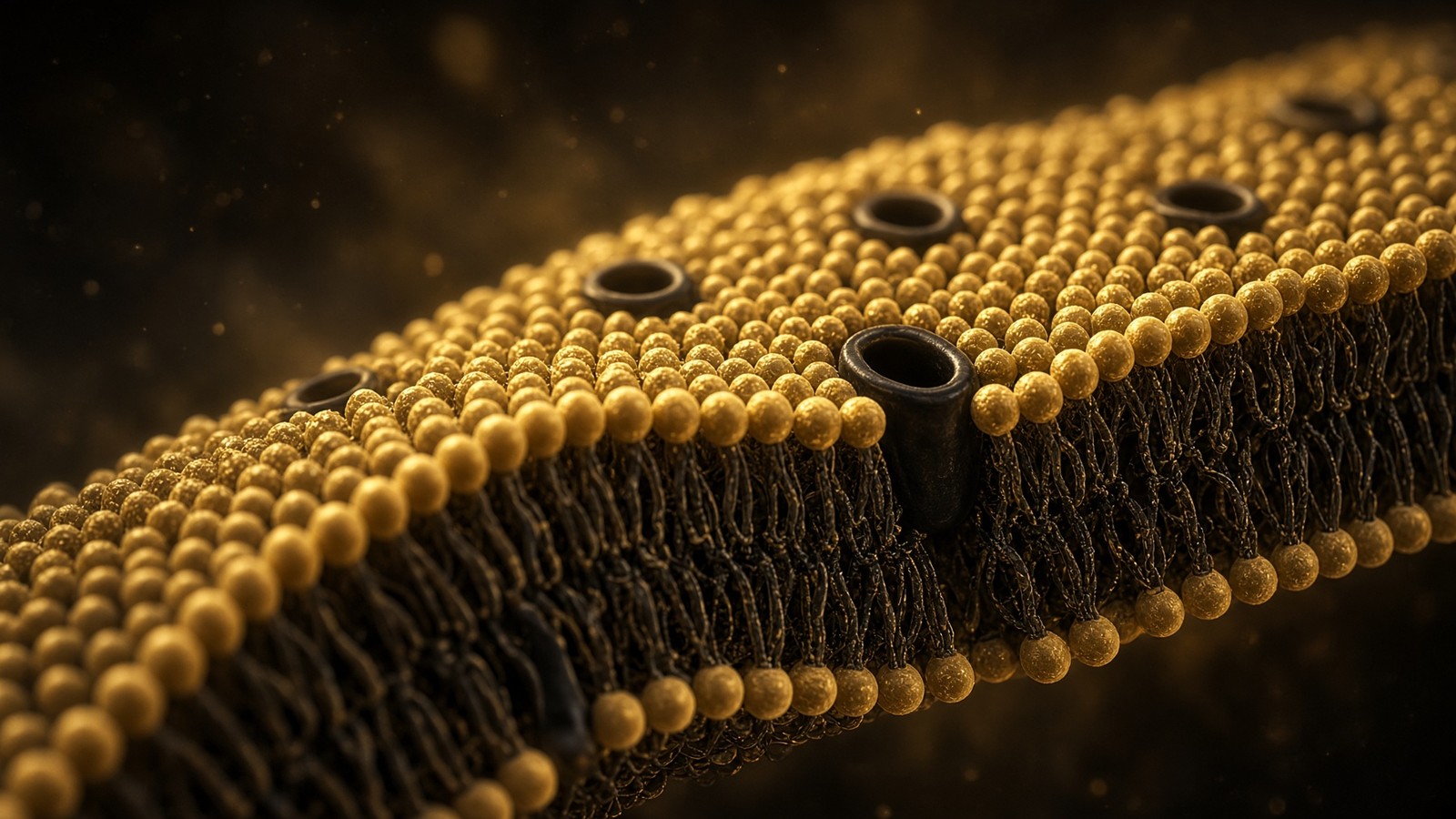
51 min · long read · The living cell
Membranes: a five-nanometre wall
Every cell, every organelle, every synapse sits on a lipid bilayer about five nanometres thick. Singer and Nicolson, Hodgkin and Huxley, a billion lipids, and why a peptide ligand at a GPCR does not need to enter the cell.
03 · The library · Part 02 DNA and the message
Two metres of DNA in a few micrometres. Chromatin, telomeres, the packing that is also regulation.
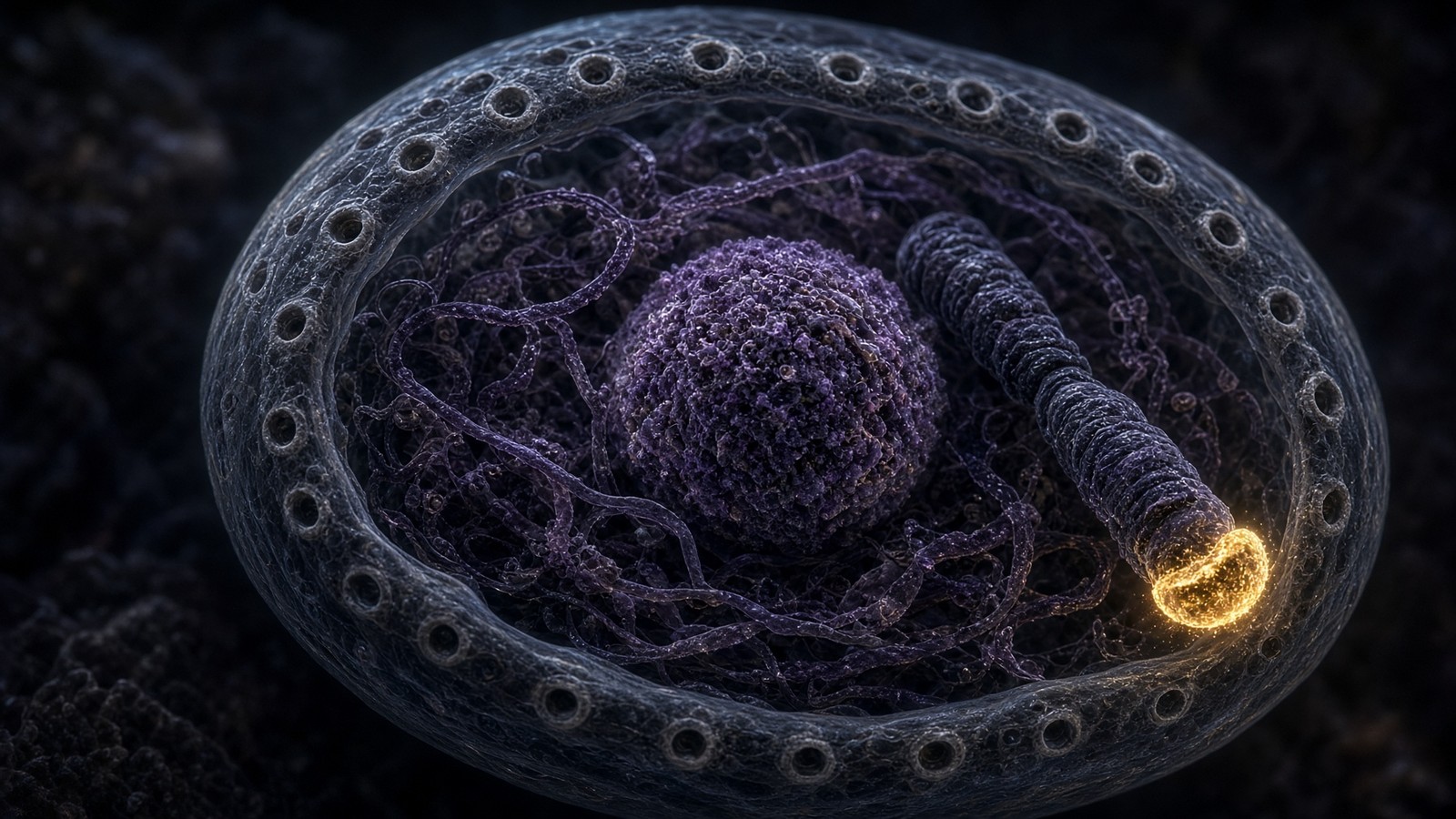
54 min · long read · The living cell
The nucleus, telomeres, and the four residues of Epithalon
Two metres of DNA folded into a nucleus a few micrometres across. TERT is off in most somatic cells on purpose. Epithalon is four residues, Ala-Glu-Asp-Gly, with a TERT and pineal literature. The machines are real. A large Western trial of telomere length in adults is not.
04 · DNA, coding, protein · Part 02 DNA and the message
Transcription, splicing, the ribosome, the genetic code. How a cell actually reads itself.
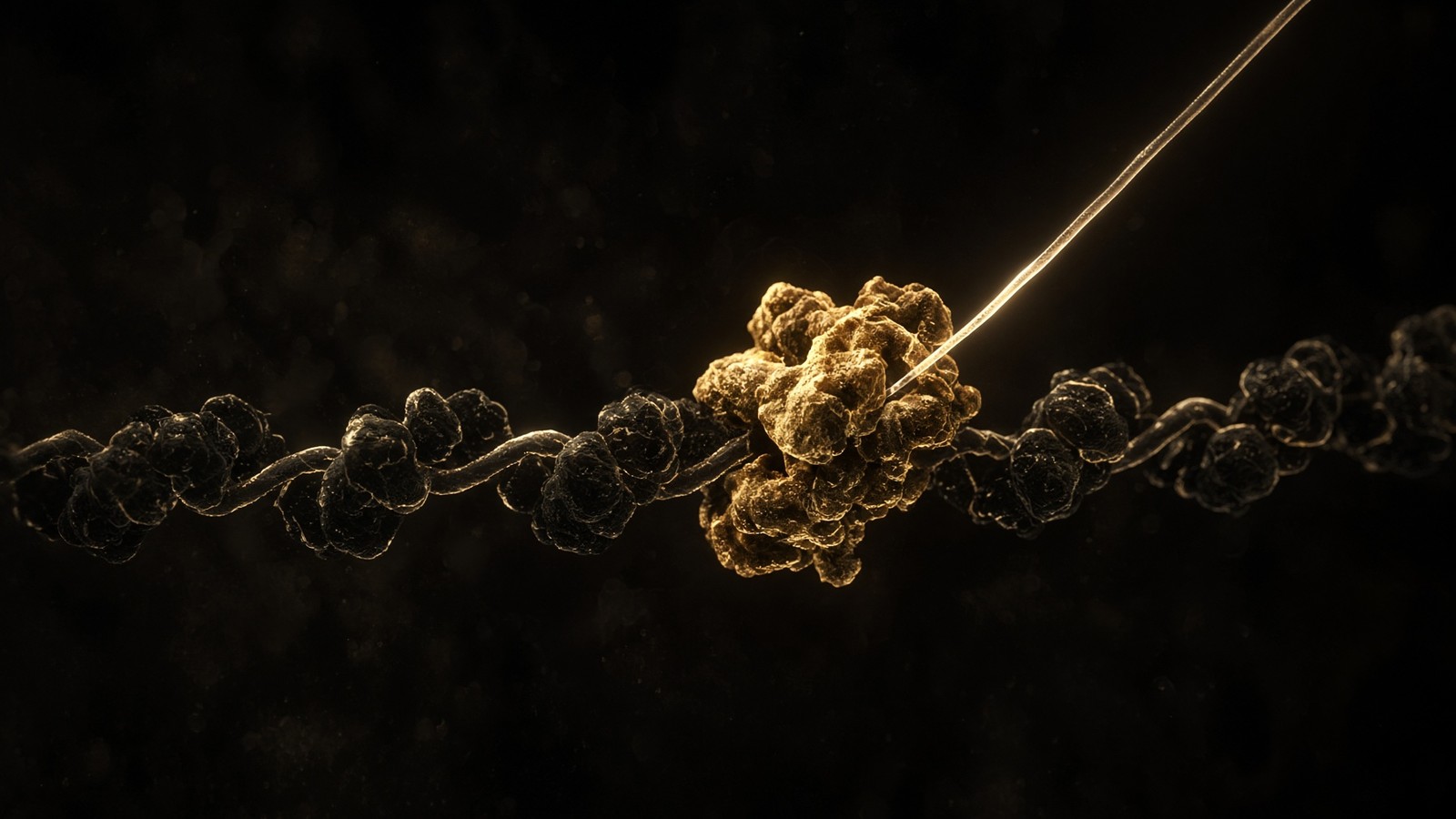
64 min · long read · The living cell
From gene to protein: how a cell actually reads itself
DNA is transcribed, spliced, exported, translated and folded. A research peptide is the ligand at the end of that pipeline, already made. This essay is every machine in between — polymerases, spliceosome, ribosome — with the actual rates attached.
05 · Quality control · Part 03 Protein formation
A chain is not yet a machine. Chaperones, ubiquitin, the proteasome, autophagy.
57 min · long read · The living cell
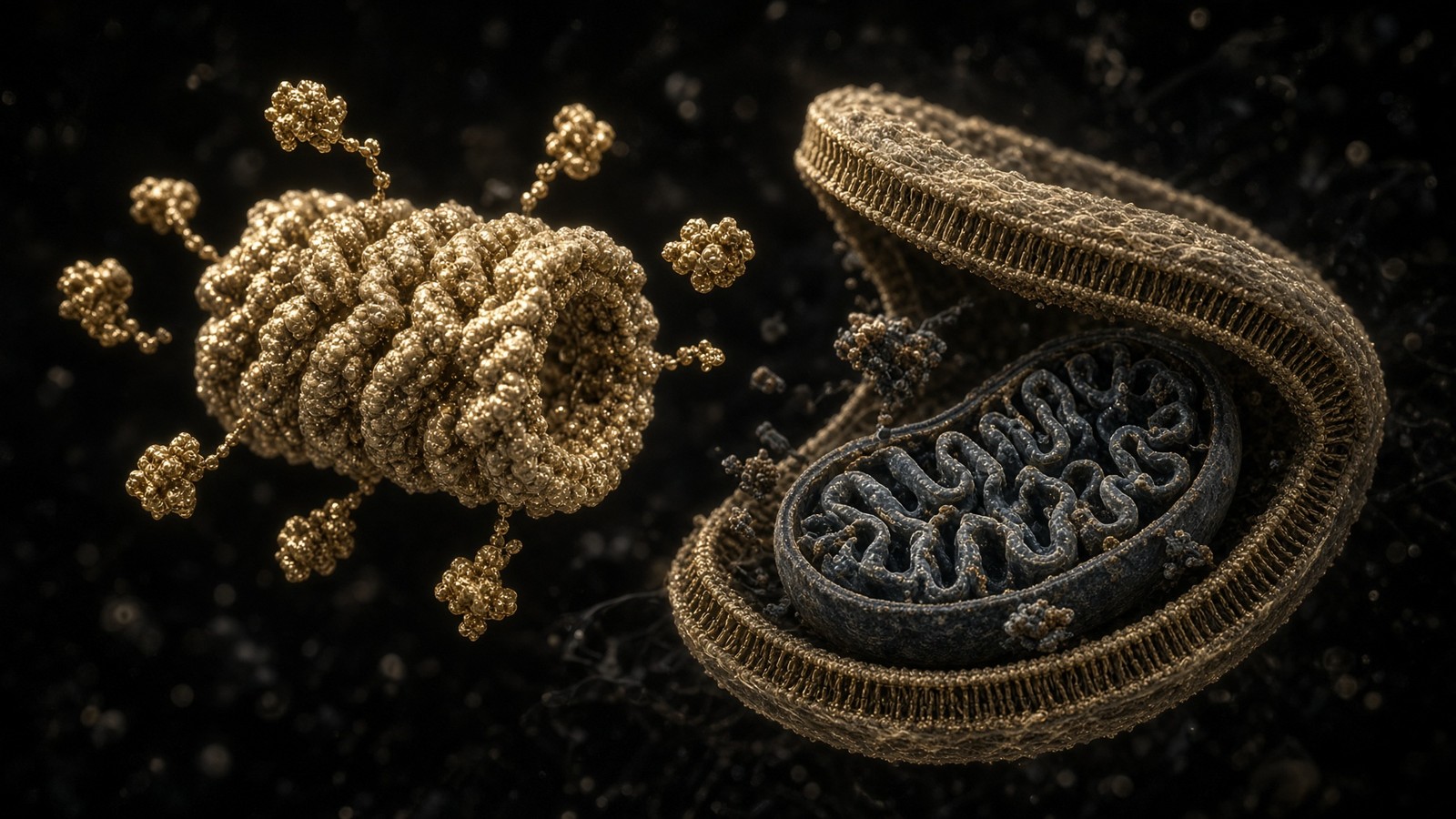
Proteostasis: the cell that eats its own mistakes
Ten billion proteins, a 76-residue tag, a 2.5-megadalton proteasome, and autophagy for whole organelles. Hershko, Ciechanover and Rose, 2004. Ohsumi, 2016. DSIP is a sleep-isolation nonapeptide, not an autophagy ligand.
06 · How energy is made · Part 04 Energy
The bacterium you kept, the genome it kept, ATP synthase, NAD+ as the hydride carrier.
64 min · long read · The living cell
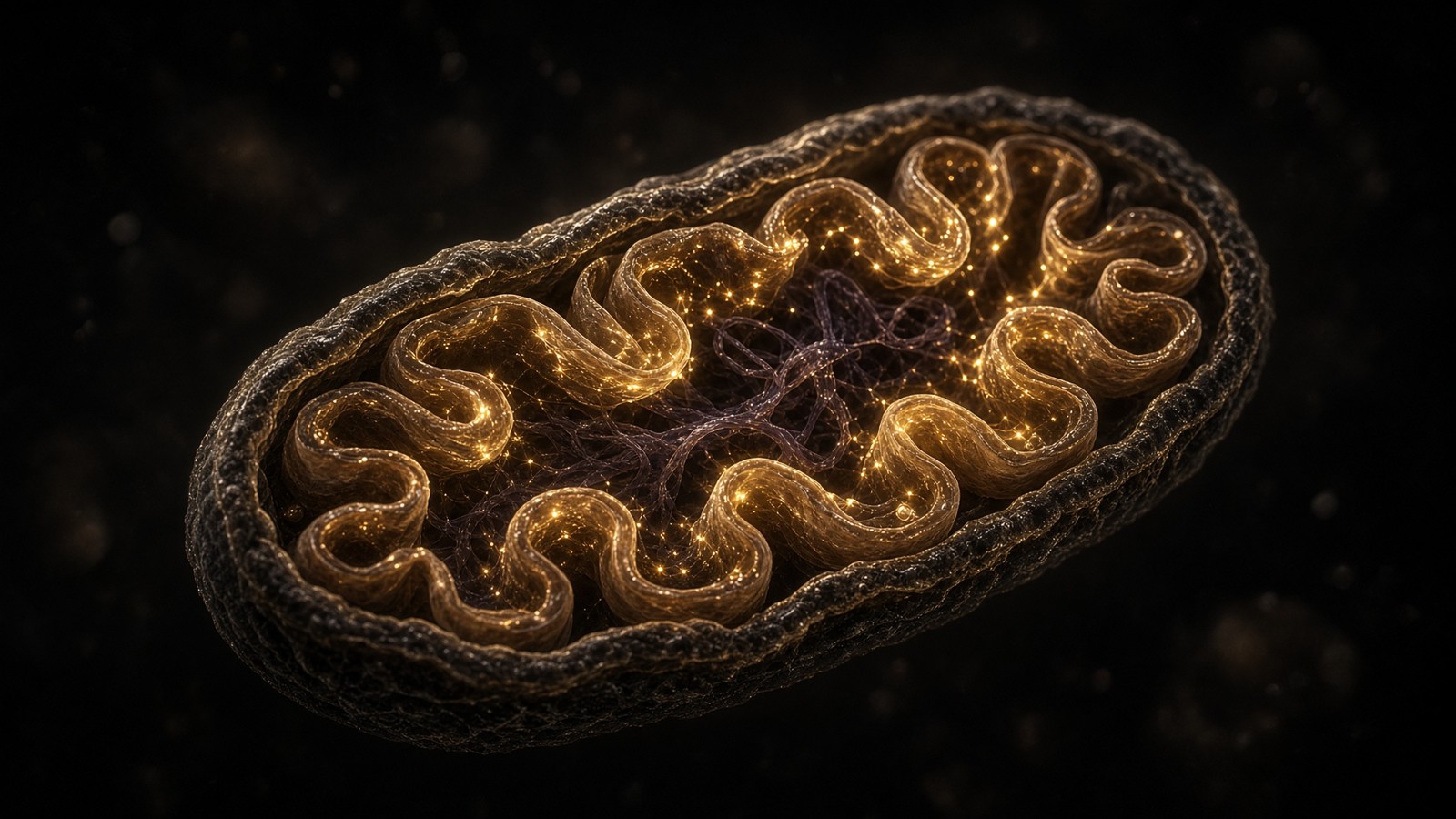
Mitochondria: the bacterium you kept, the genome it kept, the peptides it writes
You turn over 40–60 kg of ATP a day using a 16,569-base genome that still uses a bacterial genetic code. NAD+ is the hydride carrier Complex I spends. MOTS-c is a 16-mer translated from mitochondrial 12S rRNA — Lee, Kim, Cohen, 2015. That last sentence is real, and it is surprising.
07 · How a cell listens · Part 05 Listening
Occupancy, GPCRs, second messengers, amplification and the off switch.
70 min · long read · The living cell
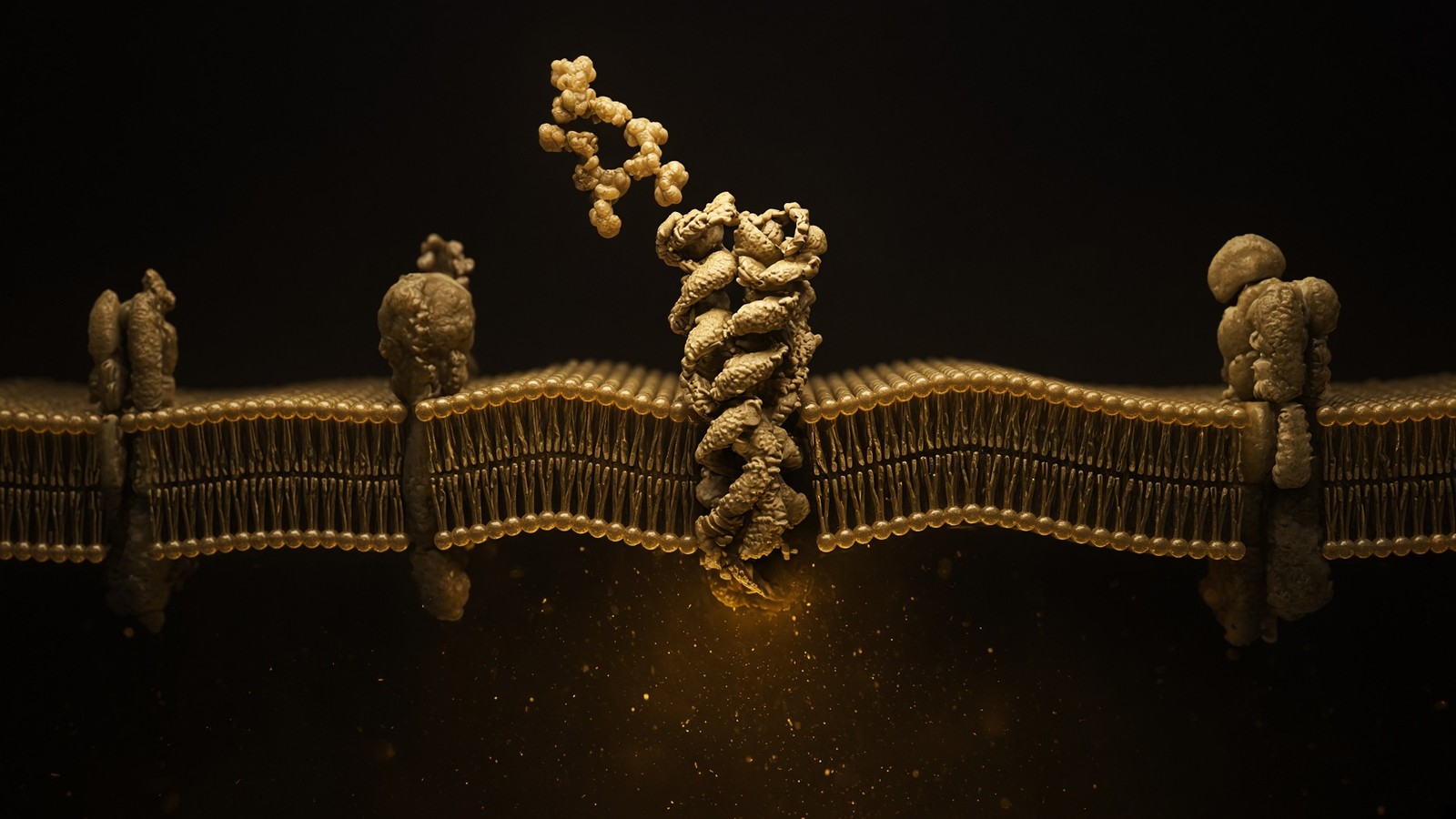
How peptides talk to cells: occupancy, amplification, arrestin
A peptide is a ligand. Most of the catalogue binds a GPCR on the cell surface: one occupancy, then enzymes make thousands of second messengers. That amplification is real, and it is not magic. Desensitisation is why more ligand is not more signal forever.
08 · The decision to divide · Part 06 Becoming two
G1, S, G2, M. Cyclins, checkpoints, p53, three fates: cycle, senesce, die.
47 min · long read · The living cell
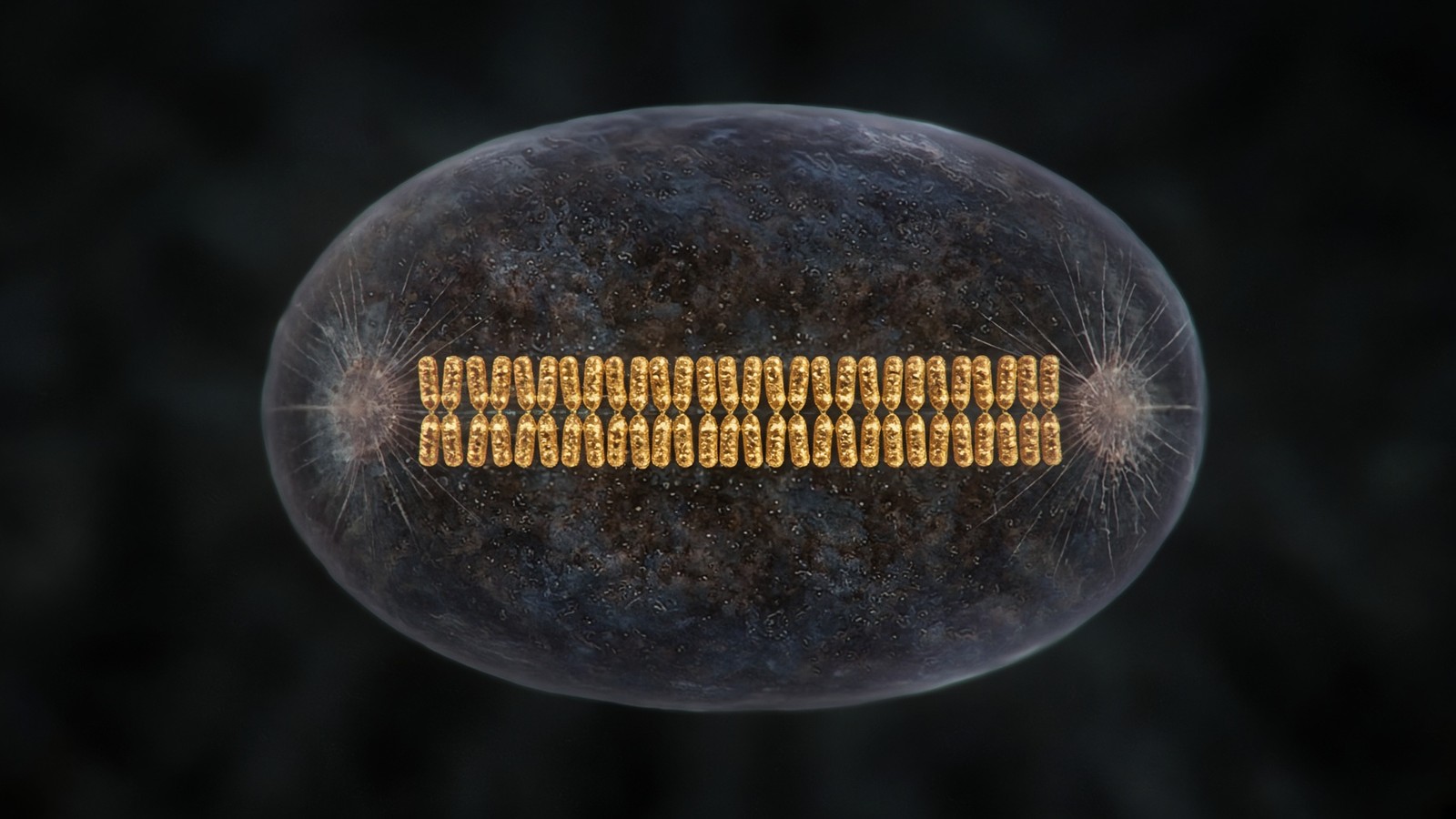
The cell cycle, p53, and the decision to divide
G1, S, G2, M. Cyclins license kinases. Checkpoints can say no. p53 reads damage and writes p21, or apoptosis, or a senescence that will not reverse. Hayflick counted the doublings. A repair-peptide paper that cannot name which of those fates moved is still only a description.
09 · When a floor fails · Part 07 What goes wrong
Disease as a stack from genome to a person who notices. Read this last so the floors have names.
82 min · long read · The living cell
Pathophysiology from the genome to a person who notices
Disease is a stack: genome, transcriptome, proteome, metabolome, organelle, cell fate, tissue, organism. A peptide binds one node. The rest of the stack keeps running. CFTR, type 2 diabetes and a tendon as worked examples.
Next on the desk
Three Cell essays a week
Each piece is written the way a working scientist would explain the field to a colleague from another lab: the real names of the machines, the papers that established them, the arithmetic that makes the scale honest, and a plain-English restatement after every paragraph. Three more essays a week from the rest of the journal, same standard.
01 · queued
Innate immunity: NF-κB, inflammasomes, and a tripeptide
TLRs, the inflammasome, IL-1β, and KPV’s NF-κB literature as a floor-3 occupancy with a floor-2 readout.
02 · queued
The extracellular matrix: collagen as job and as mistake
Types I/III/IV, MMPs, TIMPs, fibroblasts, fibrosis versus tendon, and Pickart’s copper tripeptide microarray.
03 · queued
Excitability: ions, synapses, and two Russian heptapeptides
10¹⁴ synapses, Hodgkin–Huxley, BDNF literature, Semax and Selank as ACTH and tuftsin analogues — not a nootropic product.
04 · queued
Endocrinology is just cells talking at a distance
Axes, set-points, pulsatility, incretins, and why GH, thyroid, HPA and GLP-1 are the same physics at different glands.
05 · queued
473 genes: the smallest genome that still counts as alive
JCVI-syn3.0, the essentialome, and why a peptide catalogue is a luxury an organism with 473 genes does not have. Companion to the syn3 essay.
06 · queued
DNA repair: the genome is sacred and still needs a workshop
BER, NER, mismatch repair, homologous recombination, NHEJ. Error rates 10⁻⁹ only because of this. PARPs spend NAD+ here — the cofactor vial sits on a repair budget.
07 · queued
The lysosome is not a bin. It is the appetite switch.
mTORC1 at the lysosomal surface, Rag GTPases, amino-acid sensing, AMPK, ULK1. Fasting essays sit next door. DSIP does not.
08 · queued
Calcium: 100 nanomolar, then a flood, then it is gone
Resting 100 nM, spike 1–10 µM, pumps, buffers, mitochondria as a sink. Every peptide that moves Gq is actually moving this ion.
8 more titles in the queue. Three Cell essays a week, same length and voice.
Questions the desk actually answers
- How many cells are in a human body?
- On the order of 36 trillion (3.6 × 10¹³) human cells in a 70 kg adult. About 84% by number are red blood cells, which have no nucleus. Sender, Fuchs and Milo, Cell 2016, with later updates — the figure to cite, rather than the round 37 trillion that still circulates as folklore.
- How does gene transcription actually work?
- Chromatin opens, a promoter is found among 3.1 billion base pairs, RNA polymerase II elongates at about 20–40 nucleotides per second, the spliceosome edits the RNA while it is still being written, and a ribosome translates at 5–6 amino acids per second. The full pipeline is the From gene to protein essay.
- Do research peptides work at the DNA level?
- Almost none of the catalogue is a transcription factor. The peptides bind receptors, cofactor pockets, actin, copper sites. Epithalon’s papers claim effects on TERT and the pineal — a gene-level literature, still not a gene editor. CRISPR is the gene editor.
- Where should I start?
- At the living-cell-at-scale essay, then read down the numbered list on this page. That order is DNA, coding, protein formation, energy, listening, division, and what fails. Previous and next on each essay follow it.
New Cell desk essays land three times a week, plus three more from the rest of the journal. The catalogue is still HPLC research peptides, next-day UK, research use only.
Shop peptides