

The living cell · 54 min · 11,878 words
The nucleus, telomeres, and the four residues of Epithalon
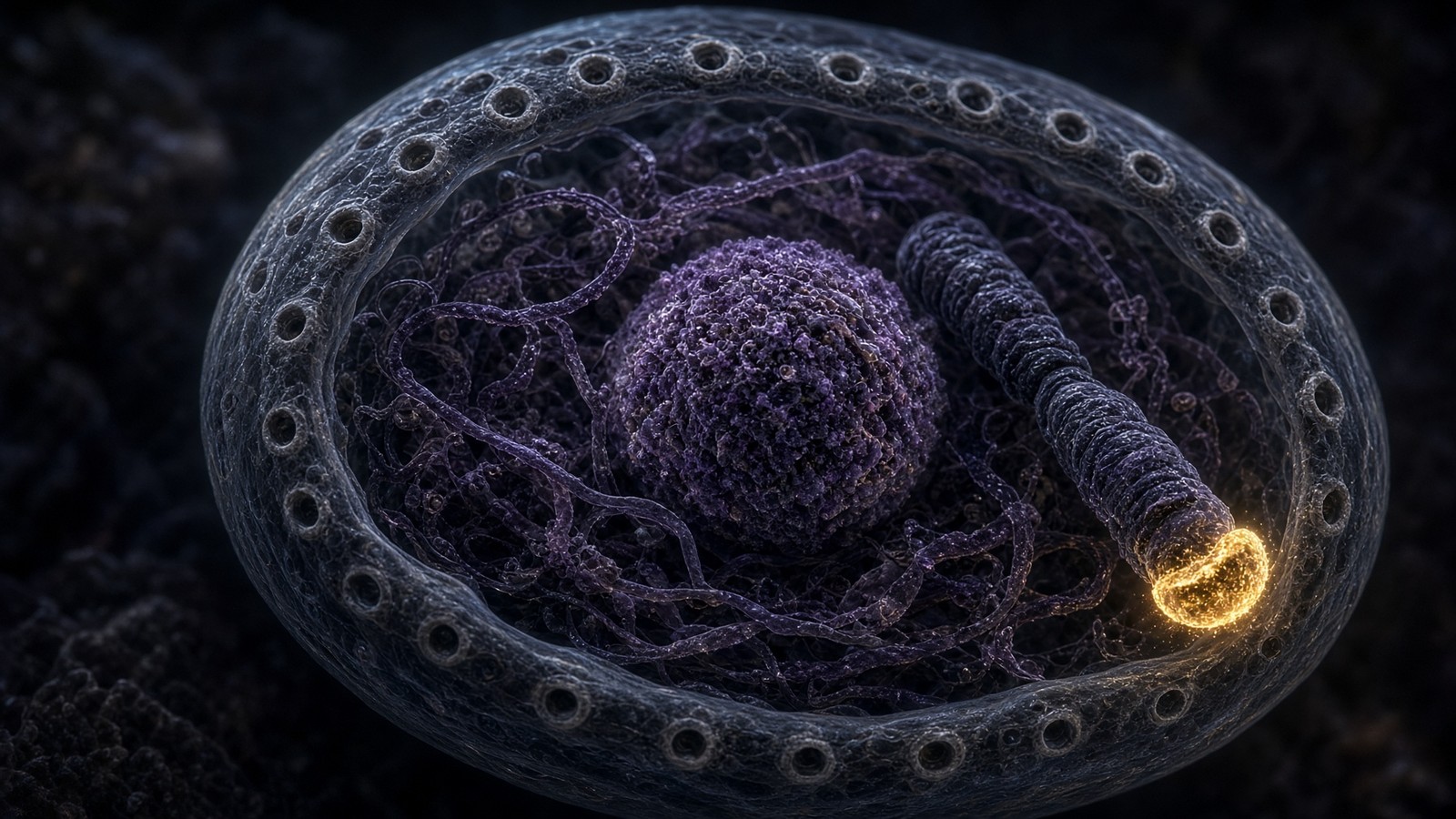
Two metres of DNA folded into a nucleus a few micrometres across. TERT is off in most somatic cells on purpose. Epithalon is four residues, Ala-Glu-Asp-Gly, with a TERT and pineal literature. The machines are real. A large Western trial of telomere length in adults is not.
What this essay actually tells you
- Two metres of diploid DNA fold into a 6–10 µm nucleus. Finding a promoter among 3.1 billion base pairs is the first problem of gene regulation. Telomeres (TTAGGG, shelterin) hide the chromosome end from the damage response.
- TERT is off in most somatic cells on purpose — tumour suppression. Blackburn, Greider, Szostak, Nobel 2009. Stem cells keep it. Most cancers hijack it. Any TERT-reactivation claim has to argue karyotypes, not just a TRAP assay.
- Epithalon is Ala-Glu-Asp-Gly (390 Da). Khavinson/Anisimov literature on TERT and nocturnal melatonin exists. A large Western RCT of telomere length in adults does not. We stock a characterised tetrapeptide, not a telomere therapy.
What this actually means
The nucleus is not a library. It is a packed, moving, transcribed object with pores, a lamina, a nucleolus, and chromosome ends that shorten unless TERT is on. TERT is off in most somatic cells on purpose — tumour suppression. A four-residue peptide (Ala-Glu-Asp-Gly) from the Khavinson school is reported, in cell and animal papers, to move TERT and nocturnal melatonin. That is a gene-regulation claim about a tetrapeptide. We stock the tetrapeptide as a characterised research ligand. We do not stock a telomere therapy. This essay is the nucleus as it actually is, then the papers, then the gap.
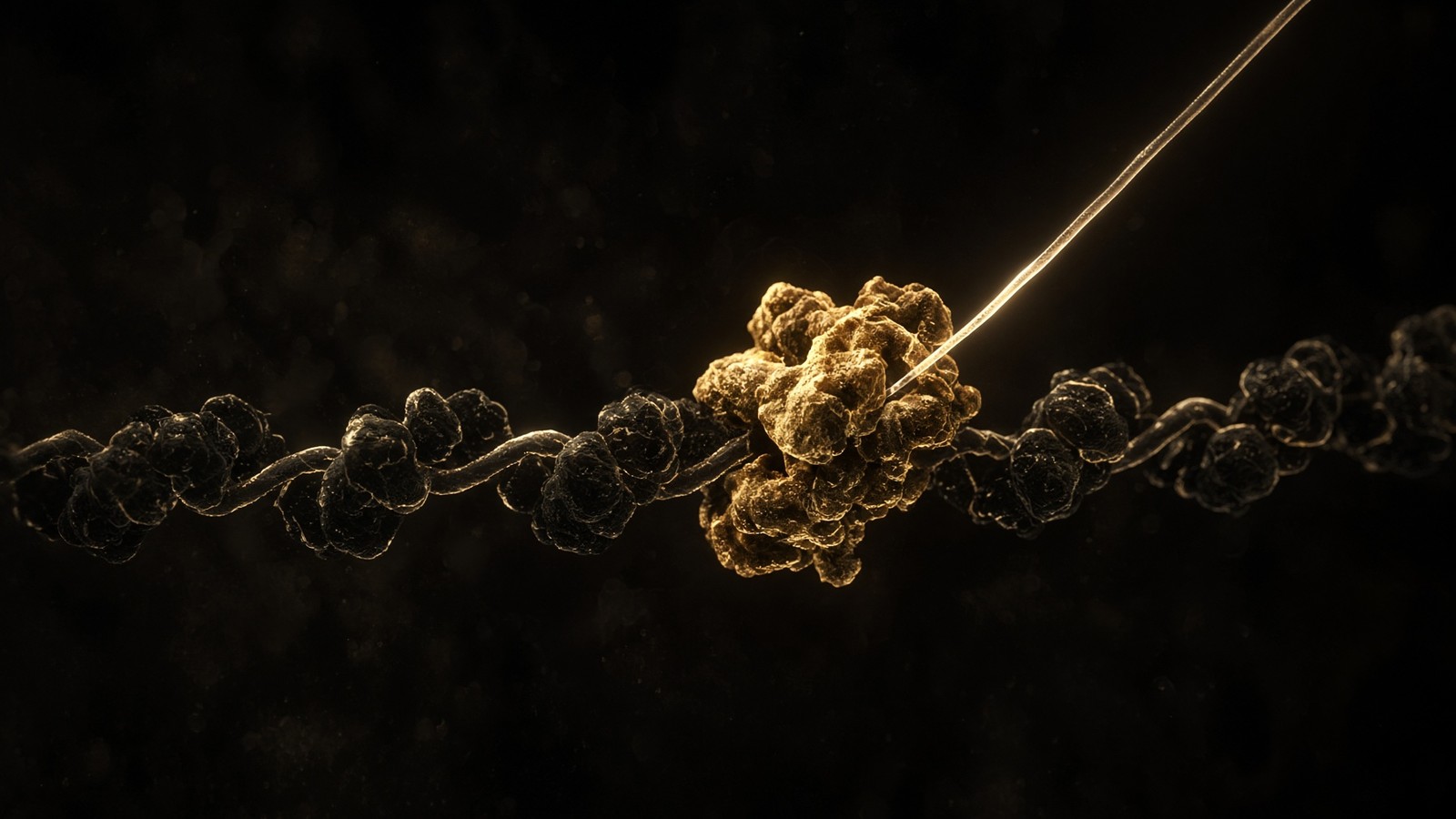
Open a textbook illustration of a nucleus and you get a circle. Open a living nucleus and you get a viscous, phase-separated, transcribed gel with chromosome territories that don't mix, a nucleolus that is a liquid condensate of rRNA synthesis, nuclear speckles of splicing factors, and lamina-associated heterochromatin plastered to the edge. Particle tracking shows that even a transcription factor spends most of its time scanning, not bound. Finding a promoter in that is a search problem with a 3.1-billion-letter haystack and a clock measured in minutes. Most of the genome, most of the time, looks nothing like a gene being read. The search is performed by proteins a few nanometres across, in a packed room, on a clock measured in minutes. I find that quietly thrilling. A circle on a textbook page never told you any of that, and it should have.
In short. A living nucleus isn't a quiet circle on a textbook page. It's a packed, moving gel where finding a promoter is a search through three billion letters.
We're looking at two rooms that people keep trying to make into one. The first room is the nucleus as it actually is: a double membrane, a few thousand pores, a lamina that can go wrong as a named disease, two metres of DNA, a histone code, a polymerase that has to be assembled and then released from a pause, and chromosome ends that are disposable so the essential sequence is not. The second room is a four-residue peptide, Ala-Glu-Asp-Gly, 390 daltons, from a St Petersburg programme that reported effects on TERT and on nocturnal melatonin. The first room is textbook. The second is a literature. We stock the tetrapeptide. We don't stock a completed mechanism, a telomere therapy, or a sleep tablet. The point of writing the first room at this length is so that when the second room makes a gene-regulation claim, you can see the machine it would have to touch.
In short. The nucleus is textbook machinery; Epithalon is four residues with a TERT and melatonin literature. We stock the tetrapeptide, not a completed telomere therapy.
Diagram
Closed chromatin (H3K27me3, DNA methylation) hides the promoter. Pioneer factors and histone acetyltransferases open it.
PIC: TFIID, TFIIH, Mediator, Pol II. Ser5 phosphorylation of the CTD lets the polymerase leave the promoter.
Elongation ~20–40 nt/s. Capping, splicing, cleavage and polyadenylation happen on the still-growing RNA.
Human genes are islands in 3.1 billion base pairs of mostly noncoding sequence. Promoter, enhancers, chromatin state and the Mediator complex decide whether Pol II is allowed to fire. Epithalon’s literature sits on TERT and pineal clocks — two of the rare promoters anyone bothers to name in a peptide essay.
The neighbouring essay, from gene to protein, is the full pipeline: transcription, capping, splicing, export, translation, fold. Stay here for the earlier problem. Before a message can be made, the gene has to be found in a packed nucleus, the chromatin has to be in a state that permits a polymerase, and a pre-initiation complex has to be built on a promoter that is one stretch of a few hundred base pairs among three billion. Telomeres sit at the other end of that same molecule of DNA, counting divisions. The pineal sits in a different organ and writes a different chemical. Epithalon’s papers claim both. Holding those claims honestly requires the furniture of the nucleus first, then the papers, then the gap. Starting with the vial is how the gap gets mistaken for furniture. The pineal sits in a different organ and writes a different chemical. Epithalon's papers claim both TERT and nocturnal melatonin. Holding those claims honestly requires the furniture of the nucleus first, then the papers, then the gap. Starting with the vial is how the gap gets mistaken for furniture.
In short. Before a gene can be read it must be found in packed chromatin, and telomeres count divisions on the same DNA. Epithalon's papers claim both TERT and the pineal.
A nucleus is not a library with a quiet librarian. It is a warehouse in which the books are also the shelves, the shelves are moving, and most of the floor is taken up by a factory that makes ribosomes.
The room is a double envelope, not a circle
The nuclear envelope is two lipid bilayers. The outer nuclear membrane is continuous with the rough endoplasmic reticulum; ribosomes sit on it and print into a lumen that is, topologically, the same space as the perinuclear cisterna. The inner nuclear membrane faces the chromatin and is a different protein neighbourhood: SUN-domain proteins, emerin, lamin B receptor, the long list of inner-membrane residents that hitch the cytoskeleton to the genome through LINC complexes. Between the two membranes is the perinuclear space, twenty to fifty nanometres of ER-continuous lumen, calcium included. A nucleus is therefore not a bag floating in cytoplasm. It's a specialised cisterna of the endomembrane system with a genome stuffed into one side of it. That's why envelope proteins can be ER proteins with extra jobs, and why a laminopathy can look like a nuclear-shape disease and an ER-stress disease at the same time.
In short. The nuclear envelope is two membranes continuous with the ER, not a bag floating in cytoplasm. Inner-membrane proteins hitch the genome to the cytoskeleton.
Traffic goes through nuclear pore complexes. A typical somatic nucleus carries on the order of three thousand of them, each a cylindrical assembly of about thirty nucleoporins, massing something like 110 megadaltons — one of the largest machines in the cell, visible in electron micrographs as an eight-fold symmetric hole with a basket on the nuclear face. Ions, metabolites and small proteins wander through the central channel; everything above about forty kilodaltons needs a transport receptor. Importins carry cargo in, exportins carry cargo out, and the Ran-GTP gradient, maintained by RCC1 on chromatin and RanGAP in the cytoplasm, makes the direction a thermodynamic fact rather than a suggestion. An mRNA that has been spliced is too big to wander. It's escorted. A peptide of 390 daltons, if it ever reached this door, wouldn't be stopped by the pore on size. That isn't the same sentence as ‘it reaches the promoter’. Size is the easy filter. Specificity is the rest of biology.
In short. About three thousand nuclear pores gate traffic: small molecules wander, larger cargo is escorted. A tetrapeptide is small enough to pass, which isn't the same as reaching a promoter.
Diagram
Out → in
Proteins, TF, histones
Importins + Ran-GTP cycle. A transcription factor that cannot clear the pore is not a transcription factor. It is a cytosolic rumour.
The mesh
NPC · FG nups
Passive cutoff a few nanometres. A ribosomal subunit is assembled in the nucleolus and exported as cargo, not as a wanderer.
In → out
mRNA, assembled ribosomes
TREX, NXF1/NXT1. Unspliced RNA is retained on purpose. Export is a licence, not a leak.
~3,000 pores per nucleus. ~30 nucleoporins. FG-repeat mesh that lets small molecules through and makes macromolecules show a passport (NLS, NES, NXF1 for mRNA). The nucleus is not a bag. It is a gated compartment.
The lamina is the wrapper, and the wrapper can be a disease
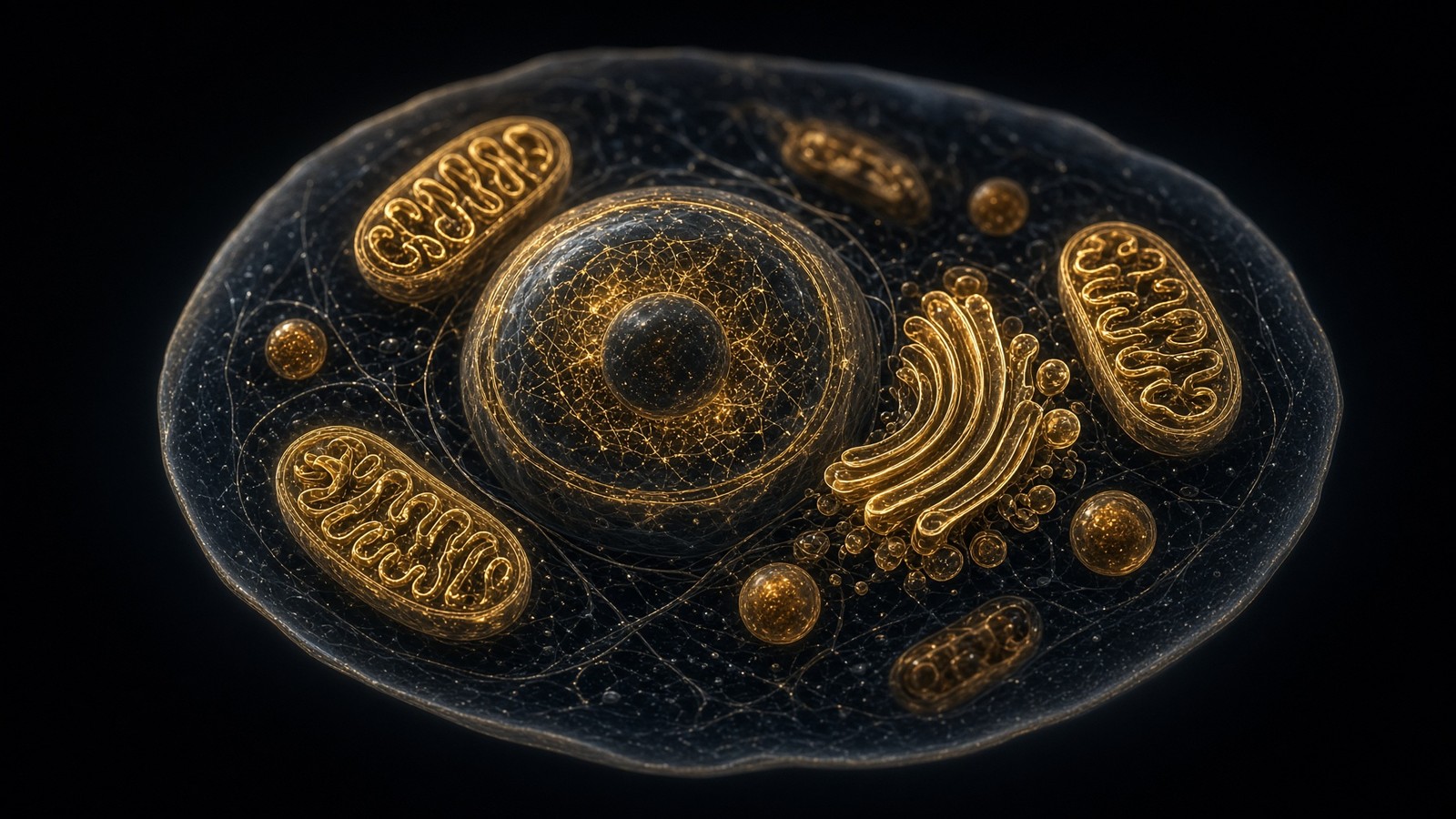
Under the inner membrane sits the nuclear lamina, a meshwork of type V intermediate filaments. Mammals run two families. A-type lamins, lamin A and lamin C, are splice isoforms of one gene, LMNA. B-type lamins, B1 and B2, are separate genes, LMNB1 and LMNB2, and they stay farnesylated, membrane-associated, present even in cells that haven't yet decided to be anything in particular. A-type lamins arrive later in differentiation and do more of the mechanical work of a tissue that has to be pushed and pulled. The mesh isn't wallpaper. It's a binding surface for heterochromatin (lamina-associated domains, LADs), a mechanical couple to the cytoskeleton, and a scaffold that, when you break it, doesn't merely wrinkle a cartoon nucleus. It changes which chromatin sits where, which genes are available, and how the nucleus survives a squeeze through a capillary or a tissue.
In short. The nuclear lamina is a mesh of lamins under the inner membrane. It holds heterochromatin, couples the nucleus to the cytoskeleton, and isn't wallpaper.
Laminopathies are the named proof that the wrapper isn't cosmetic. Hutchinson–Gilford progeria syndrome is the one the public has heard of, and for once the public has heard of a real mutation: a silent-looking change in LMNA (classically c.1824C>T, p.G608G) that activates a cryptic splice site, deletes fifty amino acids from lamin A, and leaves a truncated protein, progerin, that remains permanently farnesylated. Nuclei bleb. Heterochromatin is disorganised. Children show a failure of growth, loss of subcutaneous fat, atherosclerosis that can kill in the second decade. It's a disease of the nuclear envelope that reads, at the organism, as accelerated ageing — which isn't the same as saying that ageing is progeria, and we won't say that. Other LMNA alleles give Emery–Dreifuss muscular dystrophy, dilated cardiomyopathy, lipodystrophy. The point for this page is narrower. The genome lives in a mechanical object. If you want to talk about chromatin, telomeres, and a peptide that claims to talk to a promoter, you start by admitting that the room has a wall, and that the wall has a genetics.
In short. Hutchinson–Gilford progeria is a real lamin A splice disease, not a metaphor for ageing. The genome lives in a mechanical wall with its own genetics.
The nucleolus is where most transcription, by mass, actually happens
The nucleolus isn't an organelle with a membrane. It's a multilayered condensate that assembles around ribosomal DNA. The classical electron-microscopic zones still earn their keep: fibrillar centres (FC) where the rDNA and RNA polymerase I sit; dense fibrillar component (DFC) where the 45S precursor is born and early processing factors such as fibrillarin work; granular component (GC) where later assembly happens and nucleophosmin lives. Liquid–liquid phase separation is the modern vocabulary for the same object. Human rDNA exists as several hundred tandem copies — on the order of four hundred, clustered as nucleolar organiser regions on the short arms of the acrocentric chromosomes 13, 14, 15, 21 and 22. Not all of them are on in any given cell. The ones that are on occupy the nucleolus and make the 45S pre-rRNA that will be cut into 18S, 5.8S and 28S. 5S rRNA is a Pol III product from elsewhere and is imported into the same factory. Ribosomal proteins arrive from the cytoplasm. The assembled subunits leave through the pores.
In short. The nucleolus is a condensate around ribosomal DNA, not a membrane-bound organelle. Polymerase I transcribes rRNA there from hundreds of tandem copies.
Here's the sentence textbooks bury. In a growing cell, most of the RNA by mass is rRNA, not mRNA. Polymerase I, not polymerase II, does most of the transcribing. The political argument of the genome is the twenty thousand protein-coding genes and the enhancers that turn them on in a liver rather than a neuron. The industrial argument is ribosomes. A hepatocyte that needs a million of them can't wait for Pol II to moonlight as a ribosome factory. That's why nucleolar size tracks growth, why mTOR signalling and nucleolar function keep ending up in the same reviews, and why a sentence that starts ‘transcription’ and then talks only about mRNA has already selected the minority product. When we get to TERT we'll be talking about a Pol II gene, a rare transcript, a reverse transcriptase that is supposed to be off. Hold the nucleolus in mind so that ‘transcription’ doesn't mean a single machine with a single substrate. The nucleus runs three polymerases with three jobs, and the loudest one by mass is making rRNA in a droplet.
In short. Most RNA by mass is ribosomal, made by polymerase I, not messenger RNA from polymerase II. TERT is a rare Pol II gene that most somatic cells keep off.
- Envelope: two membranes, perinuclear space continuous with ER lumen, LINC complexes to the cytoskeleton.
- Pores: ~3,000 NPCs per typical somatic nucleus, ~110 MDa each, Ran-GTP directionality.
- Lamina: lamins A/C (LMNA), B1, B2. Hutchinson–Gilford progeria is a real named disease of this mesh.
- Nucleolus: FC / DFC / GC, Pol I, ~400 rDNA copies, most RNA mass is rRNA.
- Other bodies: Cajal (snRNP maturation), speckles (splicing factors), PML (sumo neighbourhoods). Phase-separated, not membrane-bound.
Two metres in a six-to-ten-micrometre sphere
A haploid human genome is about 3.1 billion base pairs. Diploid, in G1, that is roughly 6.2 billion. Each base pair contributes 0.34 nanometres along B-DNA, so the stretched length is about two metres. The nucleus of a typical somatic cell is six to ten micrometres across. The packing ratio is therefore on the order of ten thousand if you compare mitotic chromosomes to naked DNA, and still several hundred if you stop at interphase chromatin. This isn't a metaphor and it isn't a storage problem that evolution solved once and forgot. It's the entire problem of gene regulation. Somewhere in those two metres is a promoter a few hundred base pairs long. The cell has to find it without unzipping the rest, and it has to do so on a clock measured in minutes, not in the hours a naïve search of three billion letters would suggest.
In short. Two metres of DNA sit in a six-to-ten-micrometre nucleus. Finding a promoter a few hundred base pairs long is the whole problem of gene regulation.
- Stretched diploid DNA
- ~2 metres
- Nuclear diameter
- 6–10 µm
- Nucleosome
- 147 bp / ~11 nm
- Nuclear pores
- ~3,000
- rDNA copies
- ~400
- Typical human telomere
- 5–15 kb
- Epithalon
- 4 residues, 390 Da
6.2 billion base pairs at 0.34 nm each. One cell. G1.
A sphere you could hide under a grain of salt. The packing is the regulation.
Histone octamer, H2A, H2B, H3, H4. Beads on a string, not a 30-nm myth we still owe you.
Per typical somatic nucleus. More in a large, transcriptionally busy one.
Tandem, acrocentric short arms. Pol I’s substrate. Most RNA mass.
TTAGGG repeats. Newborns longer, a wide scatter, not a clock you can read off a slogan.
Ala-Glu-Asp-Gly. The claim is that this talks to TERT and the pineal. The mass is not in dispute.
The first packing step is the nucleosome. One hundred and forty-seven base pairs of DNA wrap 1.65 turns around a histone octamer: two copies each of H2A, H2B, H3 and H4. Histone H1 sits at the entry and exit and helps the fibre decide how to fold. Under the electron microscope of the 1970s this was ‘beads on a string’, the 10-nanometre fibre, and it is still the unit you can defend in a living nucleus. The 30-nanometre fibre, a solenoid or a zigzag depending on which textbook you were unlucky enough to grow up with, has had a harder decade. Cryo-electron tomography of native nuclei keeps failing to find a regular 30-nm lattice. In vivo chromatin looks more like an irregular, dynamically folded 10-nm fibre that bunches, loops, and sometimes crowds into a density we used to draw as a solenoid because solenoids are easier to lecture. We won't pretend the argument is closed. We'll pretend, correctly, that the nucleosome is not.
In short. DNA wraps 147 base pairs around a histone octamer to make a nucleosome. The living fibre looks irregular, not a tidy thirty-nanometre solenoid from old textbooks.
Diagram
- 2 nmB-DNA0.34 nm/bp. Diploid G1 is ~2 metres of this.
- 11 nmNucleosome147 bp around a histone octamer. ~30 million per nucleus.
- loopsCTCF / cohesinEnhancers meet promoters by folding, not by sliding.
- µmA/B compartmentsHi-C: open A, closed B, territories at the lamina.
- 6–10 µmNucleusThe room. The search problem is the entire point of gene regulation.
Packing is not storage. It is the first regulatory decision: a promoter buried in H3K27me3 is not a promoter, it is furniture. Transcription starts when this origami opens the right 1,000 base pairs among 3.1 billion.
Above the nucleosome the genome is a hierarchy of loops, not a hierarchy of coils. Cohesin extrudes DNA until it hits CTCF bound in the right orientation; the resulting loops are the physical basis of topologically associating domains, TADs, the squares you see on a Hi-C map. Genes inside a TAD talk to enhancers inside the same TAD more readily than to the next TAD over. Disrupt a TAD boundary and you can put a limb-enhancer onto the wrong gene and get a developmental disaster; that isn't a hypothetical, it is a class of structural variants. At a larger scale the nucleus sorts into A and B compartments: A is euchromatic, interior, early-replicating, transcriptionally busy; B is heterochromatic, later-replicating, and enriched at the nuclear lamina as LADs. Chromosomes occupy territories that don't mix on the timescale of a cell cycle — the Cremer observation, now a tomography fact. Homologous chromosomes aren't required to sit together. The genome isn't a set of encyclopaedia volumes on a shelf. It's a set of neighbourhoods, and the neighbourhoods have postcodes that are themselves regulated.
In short. Cohesin and CTCF loop DNA into TADs, and A and B compartments sort active from quiet chromatin. Chromosomes occupy territories, so finding a gene is geography, not a shelf.
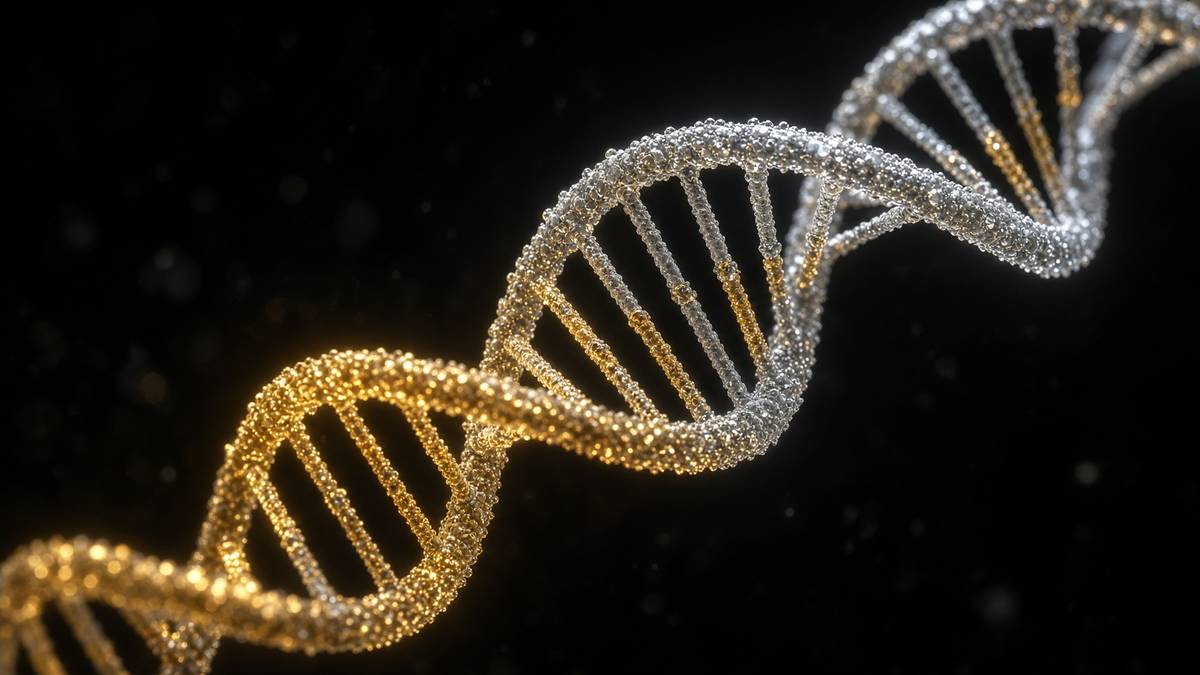
Heterochromatin at the lamina is the quiet majority. Constitutive heterochromatin — centromeres, some telomeres, repeats — is H3K9me3-rich and HP1-coated and tends to the periphery or to the nucleolar rim. Facultative heterochromatin is the Polycomb kind, H3K27me3, the genes a cell has decided not to be. Euchromatin is the interior, the A compartment, the genes currently in the argument. None of this is a binary switch you flip with a peptide. It's a statistical geography that a transcription factor has to navigate, and that a mitotic programme has to rebuild every time the envelope breaks down and reforms. Telomeres, which we'll reach, often sit at the periphery in mammalian interphase, which is one more reason a TERT claim is a claim about a neighbourhood as well as about an enzyme. The search problem isn't ‘find a sequence’. It's ‘find a sequence in a particular packing state in a particular territory in a particular phase of the cell cycle, without setting off the DNA-damage alarms that live on the same polymer’.
In short. Quiet chromatin sits at the lamina; busy genes sit inside. A transcription factor must find sequence in a packing state, a territory, and a cell-cycle phase.
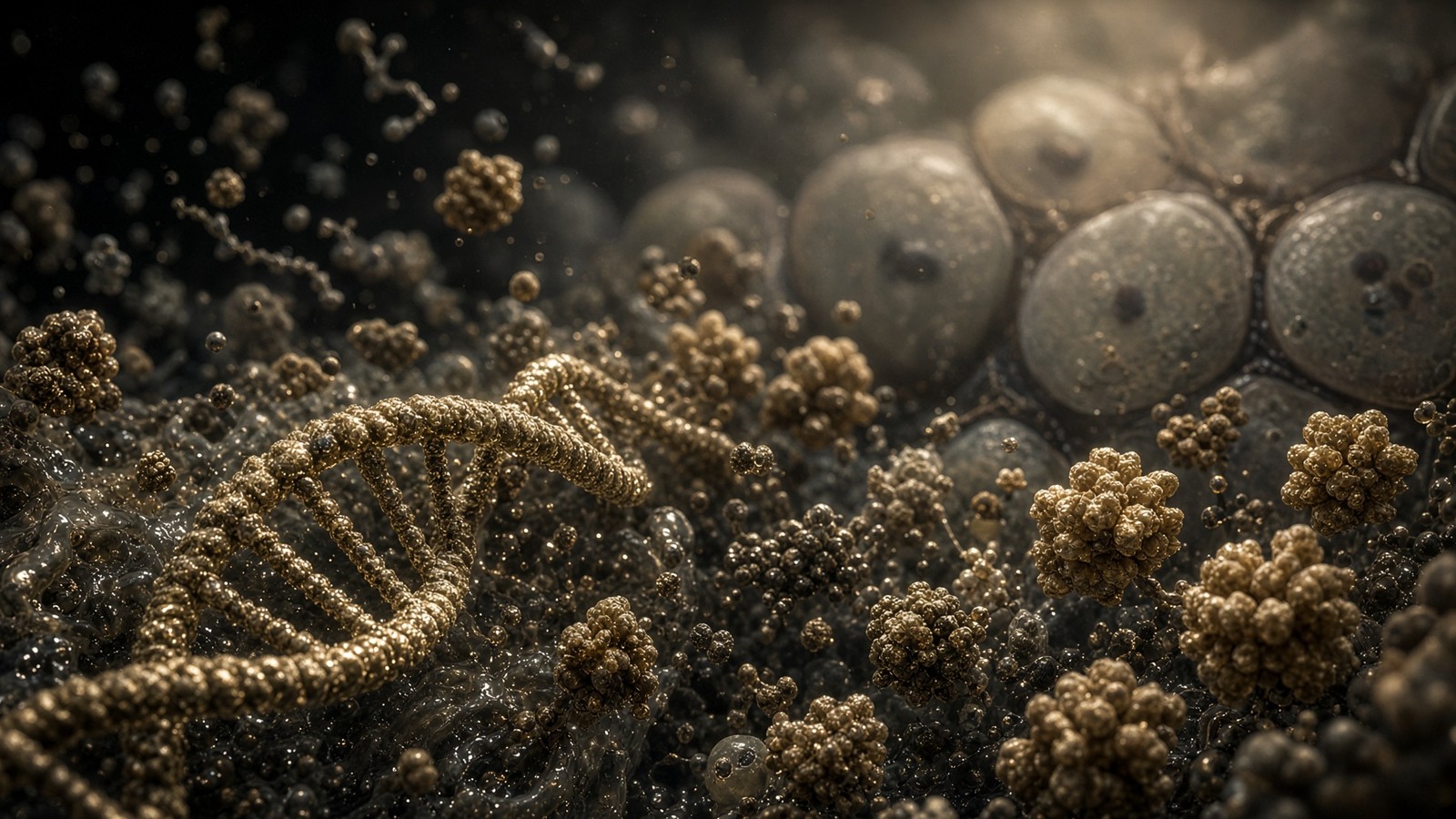
The histone code is chemistry on a tail, not a moral
Nucleosomes have tails. The N-termini of H3 and H4 in particular stick out of the disc and collect covalent marks: methylation, acetylation, phosphorylation, ubiquitination, and a long tail of rarer modifications that keep chromatin labs employed. The ‘histone code’ hypothesis, Allis and colleagues, was that combinations of these marks are read as instructions. That has survived better as a vocabulary than as a strict cipher. Marks correlate with states; they also cause states; they're written, erased and read by enzymes that have other substrates; and the same lysine can mean different things in different neighbourhoods. Still, a working lexicon exists, and it isn't optional if you want to talk about a promoter being on. H3K4me3 at active starts, H3K27ac at talking enhancers, H3K27me3 and H3K9me3 as two kinds of silence: that's the vocabulary we'll actually use. A promoter is a chromatin state as well as a sequence.
In short. Histone tails collect methyl, acetyl and other marks that correlate with, and sometimes cause, chromatin states. A promoter being on is chemistry on those tails.
H3K4me3 sits at active promoters, laid down by SET1/MLL methyltransferases, read by PHD fingers and by TFIID itself, a mark that says this start site is in use. H3K27ac, written by p300/CBP, marks active enhancers and the promoters that are actually talking; it is the acetylation people mean when they say ‘open’. H3K27me3 is the Polycomb repressive complex 2 mark, EZH2 as the catalytic subunit, the long-term no of facultative heterochromatin — the developmental genes a neuron has decided a liver shouldn't run. H3K9me3 is constitutive heterochromatin, SUV39H family, HP1, the repeats and the locked-down neighbourhoods. There are others (H3K36me3 in gene bodies, H3K4me1 at poised enhancers, H2A.Z at nucleosome-depleted regions) and we won't pretend this paragraph is a review. The point is that a promoter is a chromatin state as well as a sequence, and that state is a set of enzymes looking at tails.
In short. H3K4me3 marks active promoters; H3K27ac marks talking enhancers; H3K27me3 and H3K9me3 mark two kinds of silence. A promoter is a chromatin state as well as a sequence.
Writers, erasers, readers, and a cofactor that is not a promoter
Every mark has a writer, an eraser and a reader. Histone acetyltransferases (p300/CBP, GCN5/PCAF) write acetyl; HDACs and sirtuins take it off. Lysine methyltransferases write methyl; LSD1 and the JmjC-domain demethylases take it off. Bromodomains read acetyl; chromodomains, PHD fingers and Tudor domains read methyl, with a stereochemistry that cares whether the lysine is mono, di or tri. Inhibitors of these enzymes are licensed oncology drugs, which is the sentence that should stop anyone treating ‘epigenetics’ as a spa category. DNA methylation is a parallel system, not a histone mark: cytosine in CpG, written de novo by DNMT3A and DNMT3B, maintained through replication by DNMT1 with UHRF1, oxidised toward removal by TET1, TET2 and TET3 via 5-hydroxymethylcytosine. CpG islands at promoters, when methylated, are a long-term mute. Imprinting and X-inactivation are the famous users. Ageing clocks that read CpG methylation are a real measurement and a marketing disaster; we'll leave them in the neighbouring pathophysiology essay and not hang a peptide on them.
In short. Writers, erasers and readers set histone marks; DNA methylation at CpG is a parallel mute. Inhibitors of these enzymes are licensed oncology drugs, not spa products.
Sirtuins deacetylate histones and transcription factors using NAD+ as co-substrate. That sentence is why a redox cofactor is a chromatin cofactor. SIRT1 is nuclear and cytoplasmic and has too many reported substrates; SIRT6 is a chromatin sirtuin with DNA-repair and ageing phenotypes in mouse genetics that are actually interesting; SIRT7 lives in the nucleolus and talks to Pol I. PARP1, which isn't a sirtuin, polymerises ADP-ribose onto DNA-damage foci and can drain millimolar nuclear NAD+ in minutes after a break; the nicotinamide that results is a sirtuin inhibitor until NAMPT salvages it. The nuclear NAD+ pool is therefore a budget shared by repair and by regulation. CD38 on the membrane of inflammatory cells is a chronic leak. This is the non-Epithalon way the ageing nucleus notices metabolism — and the reason a 1000 mg NAD+ vial and a 50 mg Epithalon vial can sit in the same journal section without being the same idea. The 1000 mg vial is that cofactor, lyophilised, HPLC-characterised, research use only. It isn't a histone deacetylase, it isn't a TERT promoter, and it isn't a physiology. It's the coin those enzymes spend.
In short. Sirtuins spend NAD+ to deacetylate chromatin; PARP1 can drain the same pool after DNA damage. A NAD+ vial is that cofactor, not a TERT promoter.
SIRT1 deacetylates histones and transcription factors using NAD+. SIRT6 is a nuclear chromatin sirtuin with DNA-repair and ageing phenotypes in mouse genetics. PARP1 can drain nuclear NAD+ in minutes after a DNA break, and the resulting Nam is a sirtuin inhibitor until NAMPT salvages it. The nuclear NAD+ pool is therefore a budget shared by repair and by regulation. CD38 on the membrane of inflammatory cells is a chronic leak. This is the non-Epithalon way the ageing nucleus notices metabolism — and the reason a 1000 mg NAD+ vial and a 50 mg Epithalon vial can sit in the same journal section without being the same idea. One is a cofactor chromatin enzymes spend. The other is a tetrapeptide with a transcriptional literature. Neither is a promoter. Neither is a protocol. Hold the two objects apart and the nuclear NAD+ budget stays a budget.
In short. SIRT1 and SIRT6 spend nuclear NAD+; PARP1 and CD38 leak it. That's how the ageing nucleus notices metabolism, without any tetrapeptide in the sentence.
How transcription actually starts
A gene that is packed, marked and sitting in the right compartment is still not transcribed. Transcription, for a protein-coding gene, is a Pol II problem, and Pol II doesn't find promoters by itself in a way you would want to bet a literature on. Enhancers — sometimes a kilobase away, sometimes a megabase, often cell-type-specific, often several of them per gene — loop onto a promoter via cohesin, CTCF, and a mass of contacts that Hi-C and Micro-C keep redrawing. Pioneer transcription factors (FOXA, GATA, PU.1 and a short list of others) can bind DNA that is still nucleosomal, which ordinary factors cannot, and so they're the ones that open a closed neighbourhood enough for the rest of the committee to sit down. Lineage is, in large part, which pioneers arrived. A liver isn't a neuron because the sequence is different. A liver isn't a neuron because the pioneers that opened the sequence were different, and the Polycomb that kept the other sequence shut was not.
In short. Packed, marked chromatin is still silent until polymerase II is assembled. Pioneer factors open neighbourhoods; lineage is which pioneers arrived, not a different genome.
Diagram
A lyophilised research peptide skips every step after “protein”. It is the ligand already. That is the entire point of the catalogue, and the reason it is not a gene therapy.
Crick’s flow is still right. The numbers are the part textbooks skip: a mammalian polymerase is slow, splicing is a machine the size of a ribosome, and translation errors run about one in 10⁴ amino acids.
The pre-initiation complex is a machine you rebuild every time
TFIID — TBP plus a set of TBP-associated factors — finds the promoter, TATA or not; most mammalian promoters are TATA-less and TFIID still manages. TFIIA and TFIIB stabilise. TFIIF arrives with Pol II. TFIIE and TFIIH complete the pre-initiation complex. TFIIH is the interesting one for anyone who likes diseases: its XPB helicase unwinds the start site, its CDK7 kinase phosphorylates serine 5 of the Pol II C-terminal domain, and mutations in TFIIH subunits give xeroderma pigmentosum, Cockayne syndrome, trichothiodystrophy — transcription and repair sharing a machine, because of course they do. Mediator, about twenty-six subunits and 1.4 megadaltons, sits between enhancers and Pol II and isn't optional; it is the physical argument that a loop is a conversation rather than a coincidence. The CTD of mammalian Pol II is fifty-two heptapeptide repeats, YSPTSPS, a landing pad whose phosphorylation pattern is a clock: Ser5 at initiation and 5′-capping, Ser2 at productive elongation and 3′-processing. The polymerase is a kinase substrate as much as it is a polymerase.
In short. TFIID finds the promoter, TFIIH unwinds DNA and phosphorylates the polymerase tail, and Mediator joins the enhancer conversation. Transcription is a machine you rebuild every time.
Then the polymerase doesn't leave. Promoter-proximal pausing is the rule, not the exception. DSIF (SPT4/SPT5) and NELF hold Pol II twenty to sixty nucleotides downstream of the start site until P-TEFb — CDK9 plus cyclin T — phosphorylates Ser2 of the CTD, phosphorylates NELF, phosphorylates DSIF into a positive elongation factor, and the polymerase is actually allowed to work. A great deal of what people call transcriptional regulation is the decision to release the pause, not the decision to bind the promoter. Heat-shock genes taught us that in Drosophila decades ago; everything else borrowed it. Super-elongation complexes, BRD4 recruiting P-TEFb, the 7SK snRNP sequestering P-TEFb when it isn't wanted: this is a literature of its own. We need only the shape. Finding the gene, opening the chromatin, assembling the PIC, phosphorylating Ser5, pausing, releasing the pause. Then twenty to forty nucleotides per second, with splicing on the still-growing RNA, which is the next essay’s problem.
In short. Most polymerases pause just after starting until P-TEFb releases them. A great deal of transcriptional control is that pause-release decision, not promoter binding.
- Enhancer and promoter in the same loop; pioneers if the nucleosome has not already been asked.
- TFIID finds the start. TFIIH unwinds and phosphorylates CTD Ser5. Mediator is the conversation with the enhancer.
- Pol II transcribes 20–60 nt and pauses under DSIF/NELF.
- P-TEFb (CDK9/cyclin T) phosphorylates CTD Ser2 and the pause factors. Elongation is now allowed.
- Twenty to forty nucleotides per second, with long pauses, capping already done, splicing already boarding.
A 20 kb gene at 30 nucleotides a second is about eleven minutes of pure elongation, which no gene actually enjoys without pauses. Dystrophin, 2.3 megabases, is many hours, which is why muscle nuclei stagger the work. TERT isn't dystrophin. TERT is a modest-sized gene with a promoter that most somatic cells have decided to keep quiet, and a product — a reverse transcriptase — that those cells have decided they don't want. If a literature claims that a tetrapeptide moves TERT, the claim is that something in the list above moved: chromatin at the promoter, a transcription factor occupancy, a pause-release decision, a stability of the message, a translation of the protein, or an assay artefact that looked like one of those. The neighbouring pipeline essay is how the message becomes a protein. Here we stay on finding the gene, because that is the floor on which a TERT claim has to stand.
In short. If a tetrapeptide moves TERT, something in this list moved: chromatin, occupancy, pause-release, message stability, or an assay artefact. Name which, on a blot.
Telomeres are the disposable ends so the essential DNA is not
Eukaryotic linear chromosomes have an end-replication problem: DNA polymerase needs a primer, the lagging strand would shrink, ends look like double-strand breaks. The solution is telomeres — TTAGGG repeats in humans, thousands of them — and shelterin, a six-protein complex that hides the end from the DNA-damage response. TRF2 is particularly serious; lose it and you get end-fusions and genomic chaos. The t-loop tucks the 3′ overhang back into the duplex so the end is a lariat, not a break. The sequence is almost childishly repetitive, and the chemistry is not. Shelterin lies to ATM and ATR so a chromosome end isn't treated as an emergency. When the repeats get too short to hold the argument, the emergency is declared, p53 fires, and the cell senesces or dies. That's the counting, and Hayflick counted it before anyone had named the counter.
In short. Linear chromosomes shrink at the ends and those ends look like breaks. Telomeres are disposable TTAGGG repeats; shelterin hides them so the damage response doesn't fire.
The sequence is almost childishly repetitive. TTAGGG, TTAGGG, TTAGGG, for five to fifteen kilobases in a typical human somatic cell, with a G-rich 3′ overhang of a few tens to a couple of hundred nucleotides. Newborns run longer; centenarians run shorter; the scatter between individuals at the same chronological age is large enough that anyone selling a single number as a biological age should be asked which assay, which tissue, which extraction, and whether they have met a laboratory. Sperm and some stem-cell compartments keep a longer reserve. The length is a distribution, not a ruler. What isn't in dispute is the chemistry of the repeat, the existence of the overhang, and the fact that a blunt or exposed end of linear DNA is, to the cell, indistinguishable from a double-strand break until something hides it. Length is a distribution, not a ruler you can read off a birthday.
In short. Human telomeres run about five to fifteen kilobases of TTAGGG, with a wide scatter. Length is a distribution, not a clock you can read off a caption.
Diagram
5′— (TTAGGG)n ··· TRF1 · TRF2 · TIN2 · TPP1 · POT1 · Rap1 —3′ overhang
TRF1/TRF2 bind double-strand TTAGGG. POT1 binds the single-strand overhang. TIN2 and TPP1 hold the complex.
t-loop: the overhang invades upstream repeats so the end is not an end. Rap1 and TRF2 keep NHEJ off the chromosome.
TERT + TERC extend the repeats when the complex allows. In most of your cells the reverse transcriptase is transcriptionally off.
TTAGGG repeats, a 3′ overhang, a t-loop. Shelterin makes a chromosome end look like a loop rather than a double-strand break. Lose the disguise and ATM/ATR treat the end as damage — fusions, crisis, or senescence.
Six proteins, a t-loop, and a DNA-damage response that must not fire
Shelterin, named and dissected by Titia de Lange’s laboratory, is six proteins. TRF1 and TRF2 bind double-stranded TTAGGG via Myb-like domains; TRF1 is more of a length regulator, TRF2 more of an end-protection factor. POT1 binds the single-stranded overhang with oligonucleotide/oligosaccharide-binding folds and is the protein that, when you take it off, lets ATR treat the overhang as replication protein A sitting on a resection. TPP1 (which isn't TPP1 the lysosomal protease; nomenclature is a prank) binds POT1 and recruits telomerase when telomerase is allowed. TIN2 ties TRF1, TRF2 and TPP1 together. Rap1 binds TRF2 and, in mammals, is less of a transcriptional regulator than its yeast namesake and more of a quiet partner. The complex as a whole does two jobs that look like one: it hides the end, and it regulates how much telomerase, if any, is allowed to see the end.
In short. Shelterin is six proteins that cap the telomere: TRF1, TRF2, POT1, TPP1, TIN2 and Rap1. The complex hides the end and decides whether telomerase may see it.
The t-loop, seen first by Griffith, Rosenfield, de Lange and colleagues, is the architectural joke that makes the hiding work. The 3′ overhang invades the duplex repeats upstream and forms a displacement loop. The end is now a lariat, not a terminus. TRF2 is required to keep this structure honest. Remove TRF2 and you get telomere fusions, anaphase bridges, breakage-fusion-bridge cycles, the genomic chaos that a tumour-suppression system is supposed to prevent by senescing the cell before it gets that far. ATM and ATR, the apical kinases of the DNA-damage response, are the things shelterin is hiding the end from. A telomere is therefore not a decorative cap. It's a folded, protein-coated argument that this particular DNA end isn't an emergency. When the repeats get too short to hold the argument, the emergency is declared, p53 and p21 fire, and the cell senesces or dies. That's the counting.
In short. The t-loop tucks the overhang back into the duplex so the end is a lariat, not a break. Lose TRF2 and you get fusions, chaos, and a declared emergency.
The end-replication problem was staring at the structure of DNA from the moment the structure was known. Conventional DNA polymerases synthesise 5′ to 3′ and need a primer. The leading strand can, in principle, run to the end; the lagging strand cannot, because the last RNA primer leaves a gap when it is removed. Watson wrote the problem down in 1972. Olovnikov, independently and with a theorist’s nerve, proposed marginotomy: a shortening at each division as a counting mechanism for ageing. Hayflick, a decade earlier, had already counted the divisions in a dish and found they were finite. None of them yet had the enzyme. The enzyme is the next heading. The problem is this one: linear chromosomes shrink, ends look like breaks, and evolution’s answer in vertebrates was a repetitive disposable sequence plus a protein complex that lies to the damage response, plus — in cells that are allowed it — a reverse transcriptase that restocks the repeats.
In short. DNA polymerase can't finish a linear lagging strand, so ends shrink each division. Olovnikov and Watson named the problem; telomerase is the enzyme that restocks the repeats.
Telomerase is a reverse transcriptase that most of you keep off
Telomerase is TERT (the reverse transcriptase) plus TERC (the RNA template). It's on in the germline, in stem cells at a trickle, in most cancers as a hijack, and off in most somatic cells. The Hayflick limit is what you get when it is off: 40–60 divisions, then senescence or crisis. ALT (alternative lengthening of telomeres) is recombination-based and shows up in a subset of tumours that didn't take the TERT route. Elizabeth Blackburn, Carol Greider and Jack Szostak got the 2009 Nobel for this system. The molecule isn't a mystery. The pharmacology of turning it back on in a soma is a mystery we should stay humble about. The molecule isn't a mystery. The pharmacology of turning it back on in a soma is a mystery we should stay humble about. Too little telomerase is a marrow and lung disease. Too much in the wrong cell is often cancer. The bargain is the point of the gene being off.
In short. Telomerase is TERT plus the RNA template TERC. It's on in germline and stem cells, hijacked in most cancers, and off in most somatic cells on purpose.
TERC, also called hTR, is a noncoding RNA that carries the template for TTAGGG. TERT reverse-transcribes that template onto the 3′ overhang, processively in a decent assay, adding repeats. Biogenesis of the RNP involves dyskerin (and the other H/ACA proteins), TCAB1, and a Cajal-body itinerary; mutations in that pathway give dyskeratosis congenita and related telomeropathies, which are the human genetic proof that too little telomerase is a disease of marrow, lung and skin. Too much, or too much in the wrong cell, is a different disease, and it is called cancer often enough that the sentence has to be written slowly. The catalytic cycle is a reverse transcriptase cycle. Nucleoside analogue inhibitors that were built for HIV have been pointed at TERT with mixed enthusiasm. None of that is this catalogue. This catalogue holds a tetrapeptide whose literature claims to move TERT expression, which is a transcriptional claim, not a nucleotide-analogue claim. Different floor. Same gene.
In short. TERC carries the TTAGGG template; TERT reverse-transcribes it onto the overhang. Too little telomerase is a marrow and lung disease; too much in the wrong cell is often cancer.
Most somatic cells silence TERT transcriptionally, on purpose. The promoter is there. The gene is there. The product isn't wanted, because a cell that can rebuild its telomeres without limit is a cell that has taken one of the brakes off neoplastic progression. Stem cells keep a trickle; the germline keeps more; lymphocytes can pulse it when a clone has to expand. The rest of the soma uses the Hayflick limit as a tumour-suppression mechanism and accepts the cost, which is that tissues that must divide (epithelia, marrow, endothelium) will eventually run the cap down, senesce, and ask their neighbours to live with a SASP. That's the bargain. If you talk about boosting telomerase as if it were a vitamin, you haven't looked hard at the bargain. If you talk about the bargain as if it made TERT untouchable, you haven't looked hard at dyskeratosis or the stem-cell papers. The interesting pharmacology would be cell-type-specific, reversible, and accompanied by karyotypes. That pharmacology, as a licensed medicine, doesn't sit in the catalogue.
In short. Most somatic cells silence TERT as tumour suppression and accept tissue ageing as the cost. Boosting telomerase isn't a vitamin; any real pharmacology would need karyotypes.
ALT is the other way to keep an end, and tumours know it
A minority of cancers, often mesenchymal, don't turn TERT on. They lengthen telomeres by recombination: ALT, alternative lengthening of telomeres, associated with loss of ATRX or DAXX, with PML-body-like ALT-associated promyelocytic leukaemia bodies, and with extra-chromosomal C-circles that a diagnostician can assay. ALT is a reminder that the cell has more than one way to solve an end, and that solving the end isn't the same as being healthy. A TERT-on cancer and an ALT cancer have both escaped the counting. They haven't become young. They have become a problem. When a peptide literature reports telomerase activity in a culture, the adult question isn't only ‘did TRAP light up?’ It's ‘which cells, which karyotype, which p53 status, and did you look for ALT because your assay isn't a moral?’ We'll ask that again when we get to Khavinson. It belongs here first, as a property of the enzyme, not as a swipe at a paper.
In short. Some tumours lengthen telomeres by recombination, not TERT. A TRAP signal in culture still needs karyotype, p53 status, and an honest look for ALT.
TERT promoter mutations are among the most common noncoding drivers in cancer: C228T and C250T, generating ETS-binding sites, reported across melanoma, glioblastoma, bladder, a long list. Horn, Huang, and the 2013 papers that made the promoter itself a oncogene. The soma keeps TERT off with a promoter that is one C-to-T from being on. That's how thin the bargain is, and how little a caption word like ‘activation’ should be allowed to hide. If you want TERT on in a fibroblast, you're asking for a state that evolution spent a promoter’s worth of sequence trying to prevent in that fibroblast. Maybe a tetrapeptide can ask. Maybe a culture condition can ask. Maybe an artefact can look like asking. The karyotype is still the adult measurement. Maybe a tetrapeptide can ask. Maybe a culture condition can ask. Maybe an artefact can look like asking. The karyotype is still the adult measurement. Asking TERT on in a fibroblast is asking for a state evolution spent a promoter's worth of sequence trying to prevent in that fibroblast.
In short. TERT promoter mutations are common cancer drivers: one C-to-T from on. Asking TERT on in a fibroblast is asking for a state evolution tried to prevent.
The Nobel, the dish, and the bargain
Leonard Hayflick and Paul Moorhead, Experimental Cell Research, 1961: human diploid fibroblasts aren't immortal in culture. They divide, the population doubles some forty to sixty times depending on the strain and the era of the medium, and then they stop. Hayflick’s WI-38 cells became a vaccine substrate and a gerontology object at once. He didn't know the counter. He knew the count. The field spent the next three decades arguing whether the stop was a medium artefact, a differentiation, or a clock. Olovnikov’s marginotomy and Watson’s end-replication problem were the theoretical clock. Greider and Blackburn, Tetrahymena, 1985, found an activity that added telomeric repeats onto a primer — telomerase. Szostak’s yeast genetics showed that telomeres are essential for chromosome stability. The 2009 Nobel Prize in Physiology or Medicine went to Blackburn, Greider and Szostak. Fifty years from a culture dish to a reverse transcriptase. Selling ‘telomere support’ as a vitamin is skipping the part where TERT is off on purpose.
In short. Hayflick counted finite divisions in 1961; Greider and Blackburn found telomerase; the 2009 Nobel explained the counter. Selling telomere support as a vitamin is skipping the bargain.
Diagram
- Hayflick limit~40–60 doublingsHuman fibroblasts in 1961. They were not immortal. He counted.
- End-replication5–15 kb TTAGGGDNA polymerase needs a primer. The lagging strand shortens. Olovnikov named the problem.
- Shelterin6 proteinsTRF1, TRF2, POT1, TIN2, TPP1, Rap1. The end is hidden from the damage response.
- TERT offmost somatic cellsTumour suppression. Stem cells and germline keep it on. So do most cancers.
- SenescenceSASPp16, p21, the secretome Campisi named. A cell that refuses to die and talks too much.
Blackburn, Greider and Szostak, Nobel 2009. Epithalon’s literature sits on TERT and pineal melatonin — a tetrapeptide claiming two of the rare promoters anyone names in a peptide essay. The machines are real. A large Western RCT of telomere length in adults is not on the shelf next to the vial.
What happens at the stop isn't a single fate. Replicative senescence is one: the cell is metabolically active, doesn't divide, and begins to secrete a cocktail of cytokines, proteases and growth factors that Campisi named the senescence-associated secretory phenotype, SASP. The neighbouring essay on senescence is the place for the full inflammatory argument. Here we need only the nuclear half. Short telomeres that can no longer hold shelterin trigger a persistent DNA-damage response at the ends, p53, p21, often p16, a G1 arrest that is supposed to be permanent. If checkpoints are lost — p53 mutant, p16 gone — the cell can continue into crisis, a chaos of fusions and breakage from which a rare clone emerges with TERT on or ALT running. That clone isn't young. It's selected. Hayflick’s dish, with checkpoints intact, senesces. A tumour’s biography is Hayflick’s dish with the checkpoints shot.
In short. Short telomeres trigger senescence and a secretory phenotype, or, if checkpoints fail, crisis and a rare TERT-on or ALT clone. That clone is selected, not young.
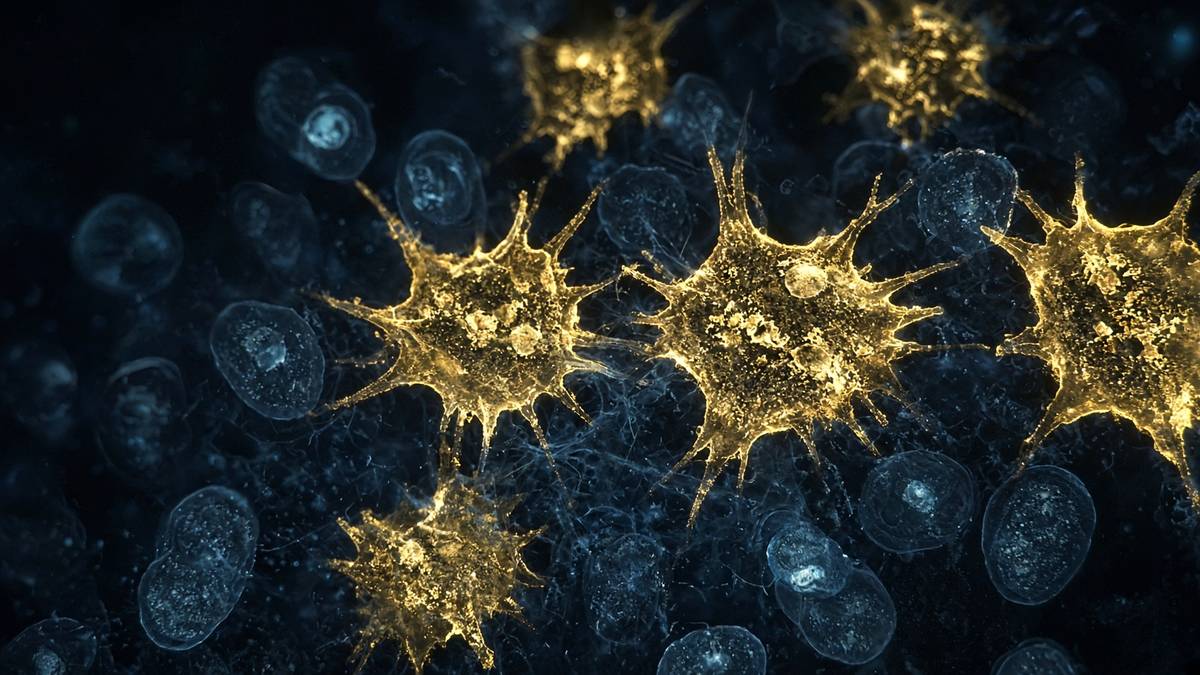
A TERT-on cell isn't automatically young. Karyotypes matter. Mutation burden matters. Mitochondrial genotype matters. The lamina we started with matters — progerin is a nuclear-shape disease, not a telomere disease, and the children aren't old in the sense a centenarian is old. Telomere length in leukocytes is a noisy correlate of all-cause mortality in epidemiology and a terrible individual clock. Fibroblasts in a dish aren't a person. Induced pluripotent stem cells reset telomeres and don't reset everything. The bargain is still the sentence: TERT off in the soma as tumour suppression; TERT on in the stem-cell and germline compartments that have to outlast a body; TERT hijacked in most cancers. Any molecule that claims to move that lever is interesting because of the bargain, not in spite of it. Interesting isn't the same as licensed, replicated, or safe. Interesting is the word we can afford.
In short. A TERT-on cell isn't automatically young: karyotype, mutation burden and the lamina still matter. Leukocyte telomere length is a noisy correlate, not an individual clock.
Most somatic cells silence TERT on purpose. That is the tumour-suppression bargain. A tetrapeptide that claims to flip it back on is interesting because of that bargain, not in spite of it.
The pineal is a clock, not a sleep story
Light hits intrinsically photosensitive retinal ganglion cells (melanopsin), the SCN keeps a 24-hour transcription-translation loop (CLOCK, BMAL1, PER, CRY), and at night the superior cervical ganglion releases norepinephrine onto pinealocytes. AANAT (arylalkylamine N-acetyltransferase) is the rate-limiting enzyme from serotonin toward melatonin. Light at night collapses AANAT. Ageing flattens the nocturnal melatonin peak even in the dark. Melatonin then is a darkness certificate to the pituitary and to peripheral clocks — MT1/MT2 GPCRs, antioxidant chemistry at high concentrations that may not be the physiological ones. A peptide studied as pineal-adjacent is therefore sitting on two oscillators you can measure in a 24-hour window: the melatonin curve and the telomere. That's the interesting geometry. It's also how a four-residue claim got so large. A peptide studied as pineal-adjacent is therefore sitting on two oscillators you can measure in a 24-hour window: the melatonin curve and the telomere. That's the interesting geometry. It is also how a four-residue claim got so large. Two clocks. One four-mer. Hold the anatomy before you hold the claim.
In short. The SCN keeps time, and at night the pineal writes melatonin via AANAT, a peak ageing flattens. A pineal-adjacent peptide sits on two measurable oscillators: melatonin and the telomere.
The suprachiasmatic nucleus is a paired cluster of about twenty thousand neurons sitting above the optic chiasm, small enough to miss in a careless dissection and important enough that lesioning it in a mammal abolishes overt circadian rhythmicity. Reppert and Weaver spent a career on how those neurons keep time. The loop is a transcription-translation negative feedback: CLOCK and BMAL1 (ARNTL) drive Period and Cryptochrome; PER and CRY proteins accumulate, repress CLOCK/BMAL1, degrade, and the cycle restarts, with a delay that is the clock. Kinase phosphorylation (CK1) and F-box proteolysis set the period. VIP and GABA couple the neurons so the cluster doesn't drift apart. Light, via melanopsin ipRGCs and the retinohypothalamic tract, resets the phase by inducing Per. That's the central clock. Peripheral clocks in liver, adrenal, cardiomyocyte use the same proteins and take cues from the SCN, from feeding, from temperature. The pineal isn't the master clock in mammals. The SCN is. The pineal is an output.
In short. The SCN is the mammalian master clock, a transcription-translation loop of CLOCK, BMAL1, PER and CRY. The pineal is an output of that clock, not the clock itself.
AANAT is how darkness becomes a chemical
The anatomical joke of mammalian pineal melatonin is that the light doesn't hit the pineal. It hits the retina, the SCN computes night, and a multi-synapse path through the paraventricular hypothalamus and the intermediolateral column of the spinal cord ends at the superior cervical ganglion, which then releases norepinephrine onto pinealocytes. Norepinephrine, via β1 and α1 adrenergic receptors, raises cAMP and calcium, and AANAT protein is both transcribed and stabilised. David Klein’s biochemistry is the reference: arylalkylamine N-acetyltransferase acetylates serotonin to N-acetylserotonin; acetylserotonin O-methyltransferase (ASMT, also called HIOMT) then methylates that to melatonin, N-acetyl-5-methoxytryptamine. AANAT is the night-gated, rate-limiting step. Protein can rise tens-fold after dark and collapse in minutes if you turn a light on, because proteasomal degradation of AANAT is the off-switch and cAMP is what holds it back. Darkness is therefore a chemical, but only after a nervous system has certified it. A pineal in a dish, disconnected, isn't a clock in the mammalian sense. A peptide that claims to restore nocturnal melatonin amplitude in an old rodent is claiming to move this axis — SCN, SCG, AANAT, or the pinealocyte’s competence to listen. That's a 24-hour assay with a dark control, not a mood.
In short. Light hits the retina, not the pineal; the SCN certifies night, and AANAT then makes melatonin. A peptide claiming to restore that amplitude is claiming to move this axis.

Melatonin then leaves the pineal into blood and CSF, occupies MT1 and MT2 (both GPCRs), and tells the pituitary, the SCN itself, and a list of peripheral tissues that the organism is in the dark phase. At pharmacological concentrations it is also a radical scavenger, which has launched a thousand supplement labels and a smaller number of careful papers. Physiological nocturnal nanomolar isn't the same chemistry as a milligram oral bolus. We won't confuse them. Ageing flattens the nocturnal peak even when the room is dark: less AANAT competence, a noisier SCN, a pineal that has calcified in many adults because pinealocytes live next to corpora arenacea and time isn't kind to that neighbourhood. The flattened curve is a real measurement. Whether flattening is a cause of other ageing phenotypes or a marker of a clock that is already drifting is the sort of question a field argues for decades. The Khavinson literature sits on that curve as one of its recurring endpoints. Our circadian essay is the darkness half of the house. We're looking at the nucleus, with the pineal as the other oscillator the tetrapeptide papers claimed. Two clocks. One four-mer.
In short. Melatonin tells tissues it is night, and ageing flattens that curve even in the dark. The Khavinson literature uses that curve as an endpoint: two clocks, one four-mer.
DSIP is a different object
WAGGDASGE. Nine residues. Isolated by Schoenenberger and Monnier from the cerebral venous blood of rabbits during electrically induced delta-wave sleep, mid-1970s, and named delta-sleep-inducing peptide because the isolation story was the name. The subsequent literature is a thicket of sleep-architecture papers, HPA-axis papers, and a long argument about whether the nonapeptide is a physiological hypnogen or a curious extract that got a better acronym than a receptor. We stock it because it is a named sequence with a literature, HPLC-characterised, research use only. We don't stock it as melatonin, and we don't stock it as Epithalon. Those confusions are internet archaeology: three objects that sit near ‘night’ in a catalogue search, none of which is the other. We stock it because it is a named sequence with a literature, HPLC-characterised, research use only. We don't stock it as melatonin, and we don't stock it as Epithalon. Those confusions are internet archaeology: three objects that sit near night in a catalogue search, none of which is the other.
In short. DSIP is a nine-residue peptide from a delta-sleep isolation story, stocked here as a research ligand. It isn't melatonin and it isn't Epithalon.
Epithalon is Ala-Glu-Asp-Gly. Melatonin is N-acetyl-5-methoxytryptamine. DSIP is Trp-Ala-Gly-Gly-Asp-Ala-Ser-Gly-Glu. You can hold all three in a sentence about sleep and still be talking about three assays. DSIP doesn't occupy MT1. It isn't a pineal tetrapeptide from the Khavinson school. It doesn't come with a TERT literature. If a methods section treats them as a stack, the methods section isn't a methods section. The only reason DSIP is in this essay at all is to stop the collapse. Night is a physiology. It isn't a product category. The catalogue happens to hold two peptides that people type when they type ‘sleep’, and a cofactor they type when they type ‘ageing’, and the job of a journal page is to unscrew the three from each other before anyone assays the wrong one. Night is a physiology with named chemicals. The chromatogram still has to pick one.
In short. Epithalon, melatonin and DSIP are three different molecules with three assays. Night is a physiology, not a product category, and the catalogue shouldn't blend them.
What the Khavinson literature actually says
Ala-Glu-Asp-Gly. 390 daltons. Isolated as a pineal peptide motif, synthesised, and put through a Soviet and then Russian programme that is large, internally consistent, and thinner in independent Western replication than a molecule this famous should be. Reported endpoints include TERT expression and TRAP activity in human cell cultures, telomere length, nocturnal melatonin, and lifespan extension in some rodent strains (Anisimov’s group). We have read those papers. We have also read what isn't there: a large, pre-registered, independently replicated trial of telomere dynamics in healthy adults with karyotype safety data. The gap is the story as much as the claim. That's not a large Western randomised trial of telomere length in adults. Cell-culture TERT and TRAP, rodent melatonin, rodent lifespan: those are the three claims you actually have to hold. Primary reports exist. A closed canon doesn't. We'll keep the gap visible.
In short. Epithalon is Ala-Glu-Asp-Gly, 390 daltons, with cell-culture TERT reports and rodent melatonin and lifespan papers. That isn't a large Western randomised trial of telomere length in adults.
Vladimir Khavinson’s Institute of Bioregulation and Gerontology in St Petersburg treated short peptides as gene-activating ligands long before ‘epigenetic peptide’ was an English phrase. The programme began with tissue extracts — epithalamin from pineal, and a family of other organ preparations — and then reduced motifs to synthetic peptides of two to four residues that could be specified, synthesised, and assayed. AEDG was the defined stand-in for the pineal extract. Khavinson, Bondarev and colleagues reported, in the early 2000s, that the tetrapeptide induced telomerase activity and elongated telomeres in human fetal fibroblast cultures. Those 2003–2004 papers are the ones that still get cited whenever the molecule is discussed, and they're cell-culture papers: TRAP, telomere length in a dish, a fibroblast that isn't a person. Anisimov’s group reported lifespan and tumour-incidence shifts in mice and rats given epithalamin or the tetrapeptide — gerontology endpoints in rodents, with the usual strain and husbandry caveats any lifespan study carries. Night-time melatonin amplitude in aged animals is the third recurring endpoint. Those are the three claims you actually have to hold: TERT in culture, lifespan in rodents, melatonin amplitude in rodents.
In short. Khavinson reduced pineal extracts to the tetrapeptide AEDG. The three claims to hold are TERT in culture, rodent lifespan, and melatonin amplitude in aged animals.
Could a tetrapeptide reach a nucleus and change a promoter? Short peptides do get around — transporters, endocytosis, sometimes just being small. Could it work via a membrane receptor whose downstream programme includes TERT? Also possible, and in some ways more conservative. The literature doesn't nail the receptor the way Raun nailed GHSR for ipamorelin. Until someone does, Epithalon is a characterised sequence with a provocative, incompletely mapped literature, not a completed mechanism. That's an honest sentence. It's also why we stock 50 mg of the tetrapeptide as a research ligand and write this instead of a caption. That's an honest sentence. It's also why we stock 50 mg of the tetrapeptide as a research ligand and write this instead of a caption. A sequence with a provocative literature is still a sequence. The receptor, if there is one, hasn't been named the way GHSR was named for ipamorelin.
In short. A tetrapeptide might reach a nucleus or work through an unnamed receptor. Until someone nails that receptor, Epithalon is a characterised sequence with a provocative, incompletely mapped literature.
Hold the claim at the size of the evidence. Primary reports exist. A large Western randomised trial of telomere length in adults does not. We won't invent one, and we won't launder cell-culture TRAP into a human outcome. Fetal fibroblasts in a dish can lengthen telomeres under a great many conditions, including serum, oncogene expression, and contamination with a TERT-positive line; that is why karyotype, independent replication, and a pre-registered human study would be the next sentences if they existed. They aren't on the page. Anisimov’s rodent lifespan papers are a literature, not a meta-analysis we're going to over-read. Melatonin amplitude in aged animals is an assay you can run in a dark-cycle room with a radioimmunoassay or LC-MS; it is also not a sleep score in a person. The St Petersburg corpus is internally consistent in the way a school is consistent. Independent Western labs haven't made it a closed canon. That sentence isn't an insult. It's the difference between a starting library and a completed pharmacology.
In short. Primary reports exist; a large Western randomised trial of adult telomere length does not. Fetal fibroblasts in a dish aren't a person, and we won't launder TRAP into a human outcome.
How a four-mer could even talk to a promoter
Four residues can't fold into a receptor-shaped handshake of the usual kind. If you've looked at a ribbon diagram knows that. Khavinson proposed that short peptides bind complementary sequences in promoters and act as transcriptional cues — a complementary-peptide, DNA-sequence argument that most Western molecular biologists would still call unresolved. We won't pretend otherwise, and we won't pick a fan-fiction favourite from the remaining hypotheses. The honest list is short and none of the items is proven for AEDG in a way that would satisfy a receptor pharmacologist. The remaining hypotheses are uptake and nuclear arrival, an unnamed membrane receptor, a pineal-first model, or a culture artefact. Arrival isn't occupancy of a specific promoter. Direct nucleic-acid binding remains unresolved. We won't pick a favourite from a list that hasn't been nailed, and a four-mer still has to show its work on a blot.
In short. Four residues can't fold like a typical transcription factor. Khavinson's complementary-peptide DNA argument remains unresolved, and we won't pick a favourite from unproven hypotheses.
- Uptake and nuclear arrival: short peptides can cross membranes by transporters, endocytosis, or simply being small. Arrival is not occupancy of a specific promoter.
- Direct nucleic-acid binding: the Khavinson complementary-peptide proposal. Possible in principle. Not the mainstream model of mammalian transcription factors. Not nailed for TERT with the structural biology a four-mer would still owe you.
- A membrane receptor with a downstream programme that includes TERT or AANAT. Conservative, and currently unnamed. Raun named GHSR for ipamorelin. Nobody has named the equivalent here.
- Pineal-first: the peptide moves nocturnal melatonin, and everything else is downstream of a clock. Then you still have to say how a four-mer moves AANAT.
- Indirect endocrine or culture artefact: serum, cell density, a contaminated line, a TRAP signal that is not TERT transcription. The unglamorous item on every honest list.
Contrast that list with two objects that actually do talk to genomes, in public, with mechanisms you can draw. Casgevy — exagamglogene autotemcel — is a licensed CRISPR-Cas9 editor. It cuts a BCL11A enhancer in haematopoietic stem cells so fetal haemoglobin comes back in sickle cell disease and transfusion-dependent β-thalassaemia. Sequence is changed. The editor is an RNP. The indication is a marketing authorisation. That's what a gene editor looks like when it has grown up. Epithalon isn't that. Occupying a promoter, if that is even what AEDG does, doesn't rewrite a base. Sliding from transcriptional literature to gene editing is sliding from a paper to a different legal class, and we won't slide with them. Occupying a promoter, if that's even what AEDG does, doesn't rewrite a base. Sliding from transcriptional literature to gene editing is sliding from a paper to a different legal class, and we won't slide with them. Casgevy is an editor. Epithalon is four residues. Hold both.
In short. Casgevy is a licensed CRISPR editor that changes sequence; Epithalon is four residues with a transcriptional literature. Occupying a promoter, if it even does, isn't rewriting a base.
GHK-Cu is the other useful contrast, because it is a peptide, it is in the catalogue, and it does have a transcriptome. The copper tripeptide, Pickart’s fragment of the albumin N-terminus, has been put on arrays and has been reported to move large sets of genes in fibroblasts — ECM, inflammation, a long list — which is a transcriptome claim, not a TERT-specific claim. An array lighting up isn't a promoter mechanism either, but it is a different shape of evidence: many genes, a copper-binding ligand, a fibroblast programme. Epithalon’s literature is narrower and more audacious. It names TERT. It names melatonin. It doesn't name a receptor. Holding both peptides in the same catalogue is easy. Holding them as the same kind of claim is lazy. GHK-Cu is a copper ligand with a broad transcriptomic signature. AEDG is a tetrapeptide with a TERT-and-pineal literature. CRISPR is an editor. Three tools, three floors, one temptation to use the word ‘epigenetic’ as a blender. We'll not.
In short. GHK-Cu has a broad fibroblast transcriptome; Epithalon names TERT and melatonin without a receptor. CRISPR is an editor: three tools, three floors, not one epigenetic blender.
Four residues claiming a reverse transcriptase is either the most interesting peptide paper in the house or a lesson in how a literature can outrun its receptor. We keep the sequence on the shelf so you can ask that question with a chromatogram in hand.
Four residues against 3.1 billion base pairs
The search problem is the point. A haploid human genome is 3.1 billion base pairs. TERT is one gene. Its promoter is a stretch of sequence that a transcription factor, a nucleosome, and a polymerase have to find in a packed nucleus, in a particular cell type, in a particular phase of the cell cycle, without waking ATM at a nearby telomere. A tetrapeptide has four side chains and a mass of 390 daltons. It doesn't have a DNA-binding domain, a dimerisation interface, an activation region, or a pocket for a ligand that allosterically opens one. If it talks to that promoter, it talks with a physics we haven't drawn. If it talks to a receptor that talks to that promoter, we haven't named the receptor. If it talks to the pineal and the rest is downstream, we haven't named the pineal target. The disproportion isn't an argument that the papers are false. It's an argument that the claim is large relative to the ligand, and that large claims require the assays we keep listing: TRAP, telomere length, karyotype, a nocturnal melatonin curve, independent replication, and, if anyone ever runs it, a human study that is actually a human study.
In short. TERT is one gene among three billion base pairs; the tetrapeptide has four side chains. A large claim relative to the ligand still needs TRAP, karyotype, and independent replication.
Diagram
- DNA replication + MMR10⁻⁹ to 10⁻¹⁰A genome of 6 Gbp (diploid) accumulates a handful of mutations per division.
- Transcription~10⁻⁵RNA is disposable. The cell can afford a wrong letter in a message that lasts hours.
- Translation~10⁻⁴One wrong amino acid per ten thousand. Proteins turn over. DNA does not.
- mtDNA10–100× nuclearNo histones, ROS next door, weaker repair. The second genome ages faster.
The genome is sacred, the message is cheap, the protein is cheaper. Ageing is partly what happens when the sacred copy still drifts — and when mitochondria, which never got the nuclear repair budget, drift faster.
Particle-tracking papers on transcription factors are the unromantic version of the same disproportion. Even a well-behaved factor — one with a proper DNA-binding domain — spends most of its nuclear time scanning, colliding, hopping, not bound at the site you care about. Specific occupancy is a rare, seconds-long event in a sea of non-specific ones. That's how a genome is searched. A 390-dalton peptide, if it is in the nucleoplasm at all, is a worse searcher by every biophysical instinct we have: fewer contacts, less residence, more competition from every carboxylate and amine in the nucleoplasm. Perhaps the instinct is wrong. Perhaps a transporter concentrates it. Perhaps a receptor on the outside of the cell does the searching by being the thing the peptide can actually bind. Those are experiments. They aren't captions. The 3.1-billion-letter haystack is why we wrote the first half of this essay before we named the vial.
In short. Even proper transcription factors spend most of their time scanning, not bound. A 390-dalton peptide is a worse searcher unless a transporter or a membrane receptor does the work.
There's a temptation, at this point in a peptide page, to resolve the disproportion with a metaphor. Information. Keys. Locks. Quantum. We'll not. The nucleus is a physical object with a packing ratio, a lamina, a nucleolus, a pause-release kinase, a reverse transcriptase kept off as policy, and a pineal in a different organ writing melatonin when the SCN says night. The tetrapeptide is a physical object with four residues and a chromatogram. The literature that joins them is a physical object too: papers, assays, a school in St Petersburg, a thinner Western echo, a missing RCT. Metaphors are how a gap becomes a product description. We would rather keep the gap visible. Four residues. Three billion base pairs. A reverse transcriptase that is supposed to stay off. A clock in the dark. Prove the conversation on a blot, or don't claim it as a therapy. We'll sell you the sequence either way, labelled for the bench.
In short. The nucleus, the tetrapeptide and the St Petersburg papers are physical objects, not metaphors. We would rather keep the gap visible than let it become a product description.
The machines are real. The claim is large. The vial is HPLC.
Retrace the building, once, without the caption. A nucleus is a double envelope whose perinuclear space is ER, with about three thousand pores and a lamina that can fail as Hutchinson–Gilford progeria. Most transcription by mass is Pol I making rRNA in a nucleolus built on a few hundred rDNA copies. Two metres of DNA sit in six to ten micrometres as nucleosomes, loops, TADs, A/B compartments, territories, heterochromatin at the edge. Histone tails and CpG methylation are the chemistry of that packing; NAD+ is a coin those enzymes spend, which is why a 1000 mg vial of the cofactor sits in the same house as this essay and is still not a promoter. Transcription of a protein-coding gene is enhancer, pioneer, PIC, Ser5, pause, P-TEFb, Ser2, twenty to forty nucleotides a second; the rest of the pipeline is next door. Telomeres are TTAGGG, five to fifteen kilobases, shelterin, t-loop, a lie told to ATM. Telomerase is TERT plus TERC, on in stem cells and germline, hijacked in most cancers, off in most soma on purpose. Hayflick counted. Blackburn, Greider and Szostak explained the counter. Campisi named what the stopped cell secretes.
In short. Retrace the building: envelope, packing, histone chemistry, transcription, telomeres, telomerase off on purpose, pineal as an SCN output. Melatonin isn't Epithalon, and DSIP is neither.
Against that building, a tetrapeptide. AEDG, 390 daltons, Khavinson’s school, Anisimov’s rodents, TRAP in a dish, melatonin amplitude in the dark, a literature we have read and won't inflate. No large Western randomised trial of telomere length in adults. No named receptor. No karyotype safety package of the kind a genuine TERT pharmacology would owe you. We stock a characterised tetrapeptide. We don't stock a telomere therapy, a hypnotic, a melatonin analogue, or a gene editor. Casgevy is the editor, and it is licensed for a haemoglobinopathy, and it isn't in the catalogue. GHK-Cu is a copper ligand with a transcriptome, and it is a different claim. NAD+ is a cofactor. DSIP is WAGGDASGE. The search bar will keep offering to blend them. The chromatogram will not. GHK-Cu is a copper ligand with a transcriptome, and it is a different claim. NAD+ is a cofactor. DSIP is WAGGDASGE. The search bar will keep offering to blend them. The chromatogram won't. We stock a characterised tetrapeptide. We don't stock a telomere therapy.
In short. We stock a characterised tetrapeptide with a literature we won't inflate. There's no large Western randomised trial of adult telomere length, and we don't stock a telomere therapy.
Research use only isn't a footer we added for a lawyer. It's the only honest product class for a four-mer whose most interesting papers are still a starting library. If you have a TRAP assay, a telomere-length method, a karyotype pipeline, a pinealocyte culture, or a rodent dark-cycle melatonin curve, you know what you're holding. If you wanted a therapy, you wanted a different building, a different desk, and a regulator. We're a three-person lab with HPLC and a journal. The machines in the first twelve headings are real whether or not AEDG ever sat on a TERT promoter. That's the order of operations. Nucleus first. Papers second. Vial third, labelled, lyophilised, not a protocol, not a dose, not a claim that a tetrapeptide lengthened telomeres in a trial it doesn't have. Nucleus first. Papers second. Vial third, labelled, lyophilised, not a protocol, not a dose, not a claim that a tetrapeptide lengthened telomeres in a trial it doesn't have. Research use only is the honest class for a four-mer whose best papers are still a starting library.
In short. Research use only is the honest class for a four-mer whose best papers are still a starting library. Nucleus first, papers second, vial third, labelled, not a human telomere trial.
Questions the essay actually answers
- Does Epithalon lengthen telomeres in people?
- The primary reports are cell-culture TERT/TRAP assays and rodent melatonin and lifespan papers from the St Petersburg groups. That is not a large Western randomised trial of telomere length in adults, and we would not sell it as one.
- Why is telomerase dangerous as well as interesting?
- Stem cells need it. Many tumours hijack it. Any genuine TERT reactivation has to be argued with karyotypes as well as TRAP assays. The tumour-suppression bargain is the point of the gene being off.
- Is Epithalon melatonin?
- No. Melatonin is N-acetyl-5-methoxytryptamine from pinealocytes. Epithalon is Ala-Glu-Asp-Gly. They meet in the pineal literature. Different molecules, different assays.
- How does transcription actually start?
- Chromatin open, promoter found, TFIID/Mediator/Pol II PIC assembled, CTD Ser5 phosphorylated, pause-release by P-TEFb. Then 20–40 nt/s with splicing on the still-growing RNA. The previous essay is the full pipeline.
- What is shelterin?
- A six-protein complex (TRF1, TRF2, POT1, TIN2, TPP1, Rap1) that coats vertebrate telomeres. It hides the chromosome end from the DNA-damage response and helps the 3′ overhang tuck back into a t-loop. Lose TRF2 and you get end-fusions. It is a cap, not a vitamin.
- What is AANAT?
- Arylalkylamine N-acetyltransferase, the rate-limiting enzyme from serotonin toward melatonin in pinealocytes. Norepinephrine from the superior cervical ganglion induces it at night. Light at night collapses it. Klein’s biochemistry, not a sleep story.
- What is the Hayflick limit?
- Leonard Hayflick and Paul Moorhead, 1961: human diploid fibroblasts in culture divide a finite number of times (classically ~40–60 doublings), then stop. They did not yet know the counter was the telomere. Olovnikov and Watson named the end-replication problem. Blackburn, Greider and Szostak found the enzyme.
- Is Epithalon a gene editor?
- No. A gene editor changes sequence. Casgevy (exagamglogene autotemcel) is a licensed CRISPR-Cas9 editor of a BCL11A enhancer. Epithalon is four residues with a transcriptional literature. Occupying a promoter, if that is even what it does, is not rewriting a base.
- Is DSIP the same as Epithalon?
- No. DSIP is WAGGDASGE, a nonapeptide isolated from rabbit cerebral venous blood during delta-wave sleep. Epithalon is AEDG. Neither is melatonin. Three objects, three assays, one catalogue coincidence that they both sit near night.
- Why is most transcription, by mass, rRNA rather than mRNA?
- A growing cell is mostly ribosomes. Pol I transcribes hundreds of rDNA copies in the nucleolus; the 45S precursor is processed into 18S, 5.8S and 28S rRNA. Protein-coding genes are a minority of the RNA mass even when they are the entire political argument.
Hypothetical research reconstitution
How these vials are typically mixed
Hypothetical research reconstitution for the named catalogue vial. Not a protocol, not medical advice, not a use instruction. These amounts sit in published and commonly cited laboratory ranges. The vial is labelled for research use only — not for human or veterinary administration.
Epithalon
50mg
Mix with 5 ml bacteriostatic water → 10 mg/ml
- Hypothetical aliquot
- 5–10 mg
- 0.50–1.00 ml · 50–100 units on a U-100 syringe
- How often
- Once daily, evening, for 10–20 consecutive days
- 10–20 days, two cycles a year in the Khavinson-school notes
Bench steps
- Let the vial sit until it is no longer cold to the touch.
- Wipe the stopper with 70% isopropyl alcohol. Let it dry.
- Draw 5 ml bacteriostatic water (0.9% benzyl alcohol).
- Run the water slowly down the inside glass — do not blast the cake.
- Roll between finger and thumb until the cake is gone. Do not shake.
- Label the date. Store the solution at 2–8 °C. Do not freeze. Use within 30 days unless the note below says otherwise.
Tetrapeptide (AEDG). Short pulses, not a daily-forever molecule in that literature.
DSIP
10mg
Mix with 2 ml bacteriostatic water → 5 mg/ml · 5,000 mcg/ml
- Hypothetical aliquot
- 100–300 mcg
- 0.02–0.06 ml · 2–6 units on a U-100 syringe
- How often
- Once daily, evening
- 7–14 nights, then a pause
Bench steps
- Let the vial sit until it is no longer cold to the touch.
- Wipe the stopper with 70% isopropyl alcohol. Let it dry.
- Draw 2 ml bacteriostatic water (0.9% benzyl alcohol).
- Run the water slowly down the inside glass — do not blast the cake.
- Roll between finger and thumb until the cake is gone. Do not shake.
- Label the date. Store the solution at 2–8 °C. Do not freeze. Use within 30 days unless the note below says otherwise.
Delta-sleep peptide. Night-time aliquot in the papers that bother with a clock. Fridge. Short runs.
NAD+
1000mg
Mix with 10 ml bacteriostatic water → 100 mg/ml
- Hypothetical aliquot
- 50–100 mg
- 0.50–1.00 ml · 50–100 units on a U-100 syringe
- How often
- Two or three times per week in published infusion and assay notes
- 4–8 weeks, then a pause
Bench steps
- Let the vial sit until it is no longer cold to the touch.
- Wipe the stopper with 70% isopropyl alcohol. Let it dry.
- Draw 10 ml bacteriostatic water (0.9% benzyl alcohol).
- Run the water slowly down the inside glass — do not blast the cake.
- Roll between finger and thumb until the cake is gone. Do not shake.
- Label the date. Store the solution at 2–8 °C. Do not freeze. Use within 30 days unless the note below says otherwise.
A 1000mg cake wants 10 ml. Protect from light. Solution yellows as it oxidises — that is the cofactor dying, not a flavour. Use promptly.
Bacteriostatic water and sterile syringes ship with peptide orders over £75. Kit details · 10 ml bacteriostatic water
The vials this essay sits on
Named sequences the essay maps — Epithalon, DSIP, NAD+. Hypothetical research neighbourhood, not a protocol, not a medicine. One press puts every in-stock vial in the bag.
 Research only
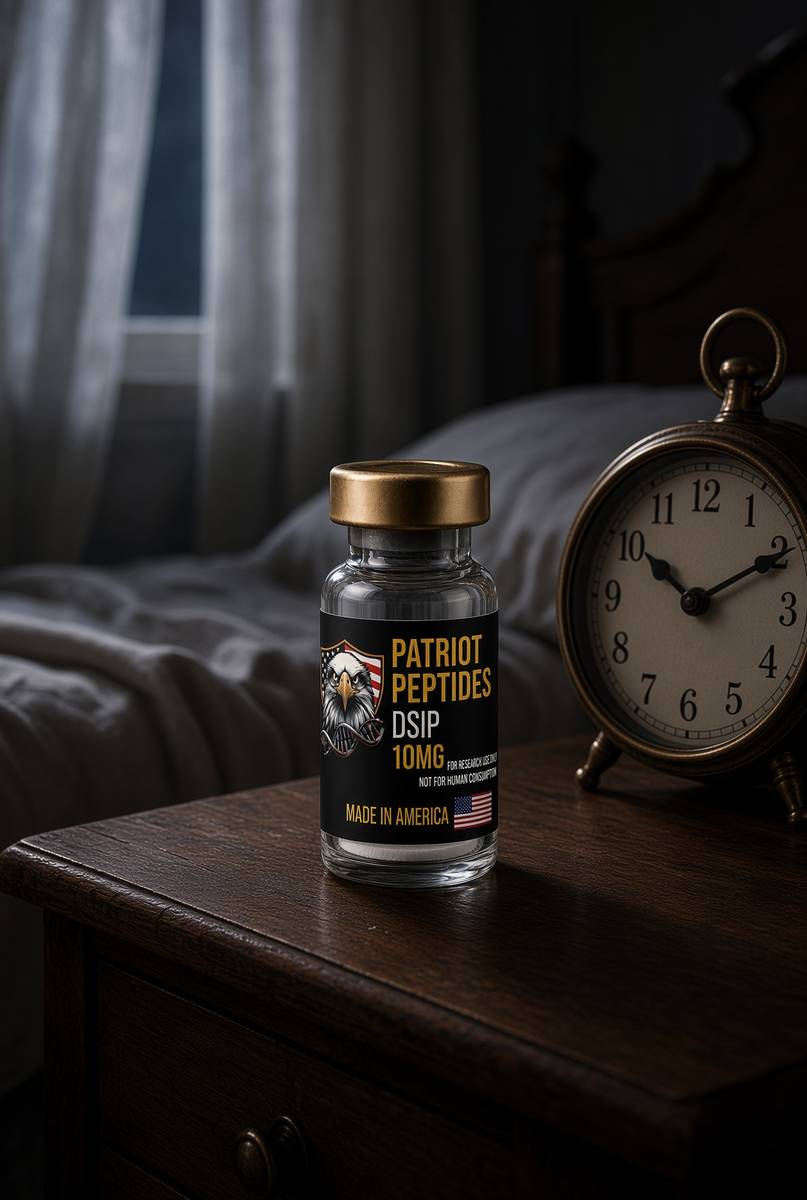 Made in USAOut of stock
Neuropeptide
DSIP
10 mg DSIP — the nonapeptide isolated during slow-wave sleep.
4.7(521)
18 browsing this now · 1 purchased in the last 24 hours
10mg
£25.00
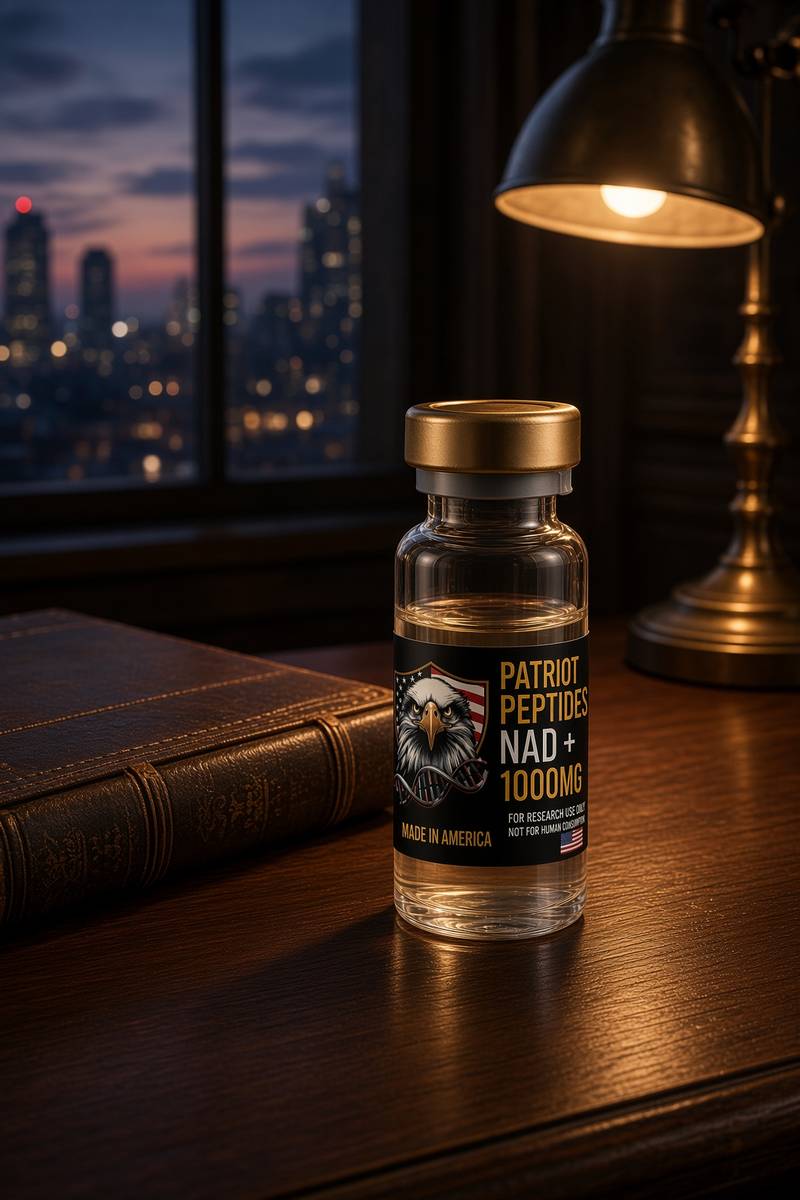 Research only
Research use only. Not a combined-use instruction.
Read next
64 min · long read · The living cell
From gene to protein: how a cell actually reads itself
DNA is transcribed, spliced, exported, translated and folded. A research peptide is the ligand at the end of that pipeline, already made. This essay is every machine in between — polymerases, spliceosome, ribosome — with the actual rates attached.
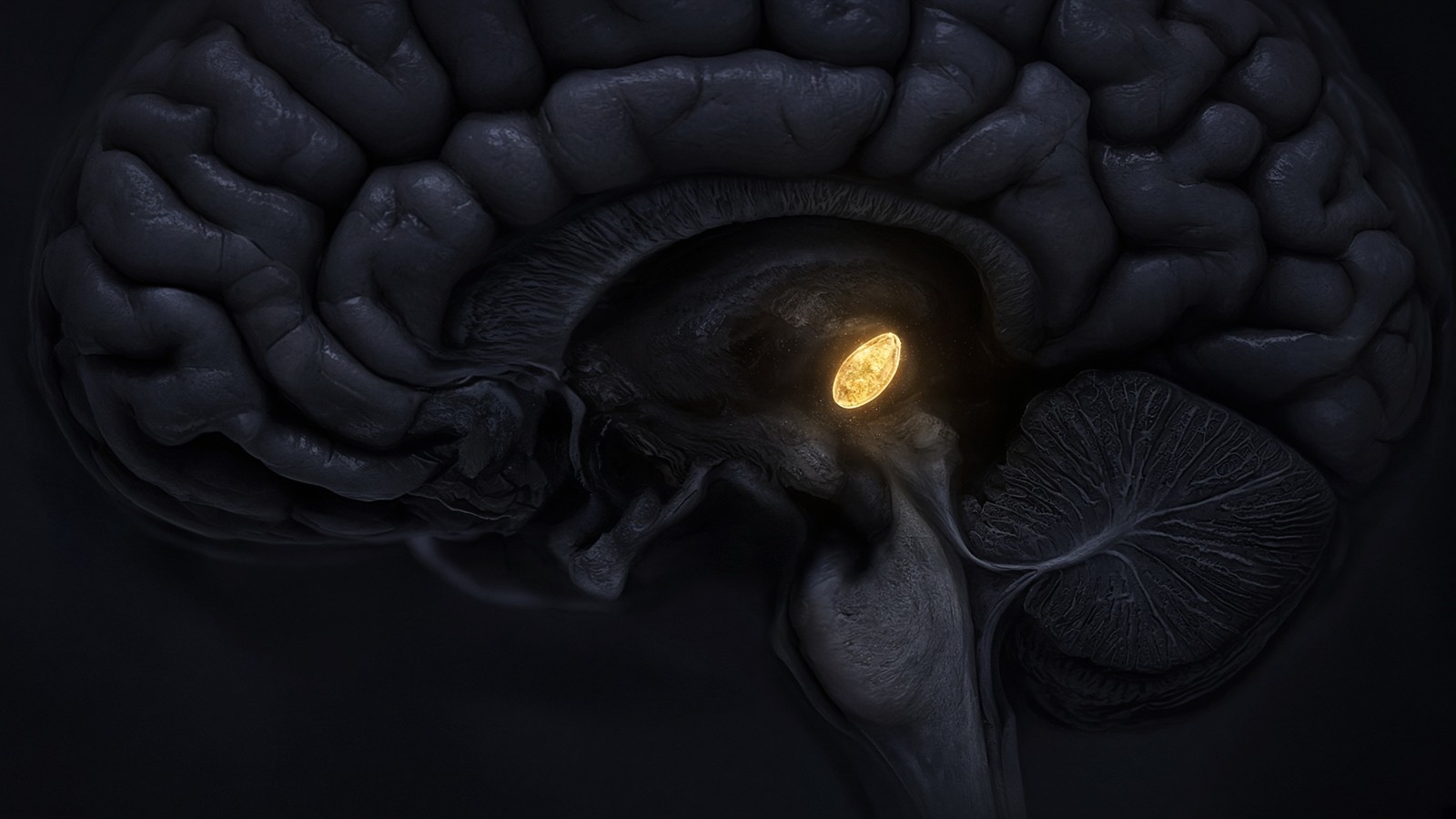
49 min · long read · Peptide research
Epithalon, telomeres and the pineal clock
A four-residue peptide from the Khavinson school sits where melatonin, telomerase and aging research overlap. The claim is large. The molecule is tiny. The assays are specified.

49 min · long read · Peptide research
The pineal, melatonin and the 24-hour gene
The SCN is a transcription-translation loop that keeps ~24-hour time. The pineal converts its night signal into melatonin via AANAT. Peripheral clocks then decide when liver may make glucose. Aging flattens the peak.
65 min · long read · The living cell
The living cell is a city, and you are 36 trillion of them
A 70 kg adult is on the order of 36 trillion cells, most of them red blood cells with no nucleus. A typical nucleated cell holds about ten billion proteins and two metres of DNA. The body recycles 40–60 kg of ATP a day. Those figures are published; this essay is what they mean.
More in this desk
82 min · long read · The living cell
Pathophysiology from the genome to a person who notices
Disease is a stack: genome, transcriptome, proteome, metabolome, organelle, cell fate, tissue, organism. A peptide binds one node. The rest of the stack keeps running. CFTR, type 2 diabetes and a tendon as worked examples.
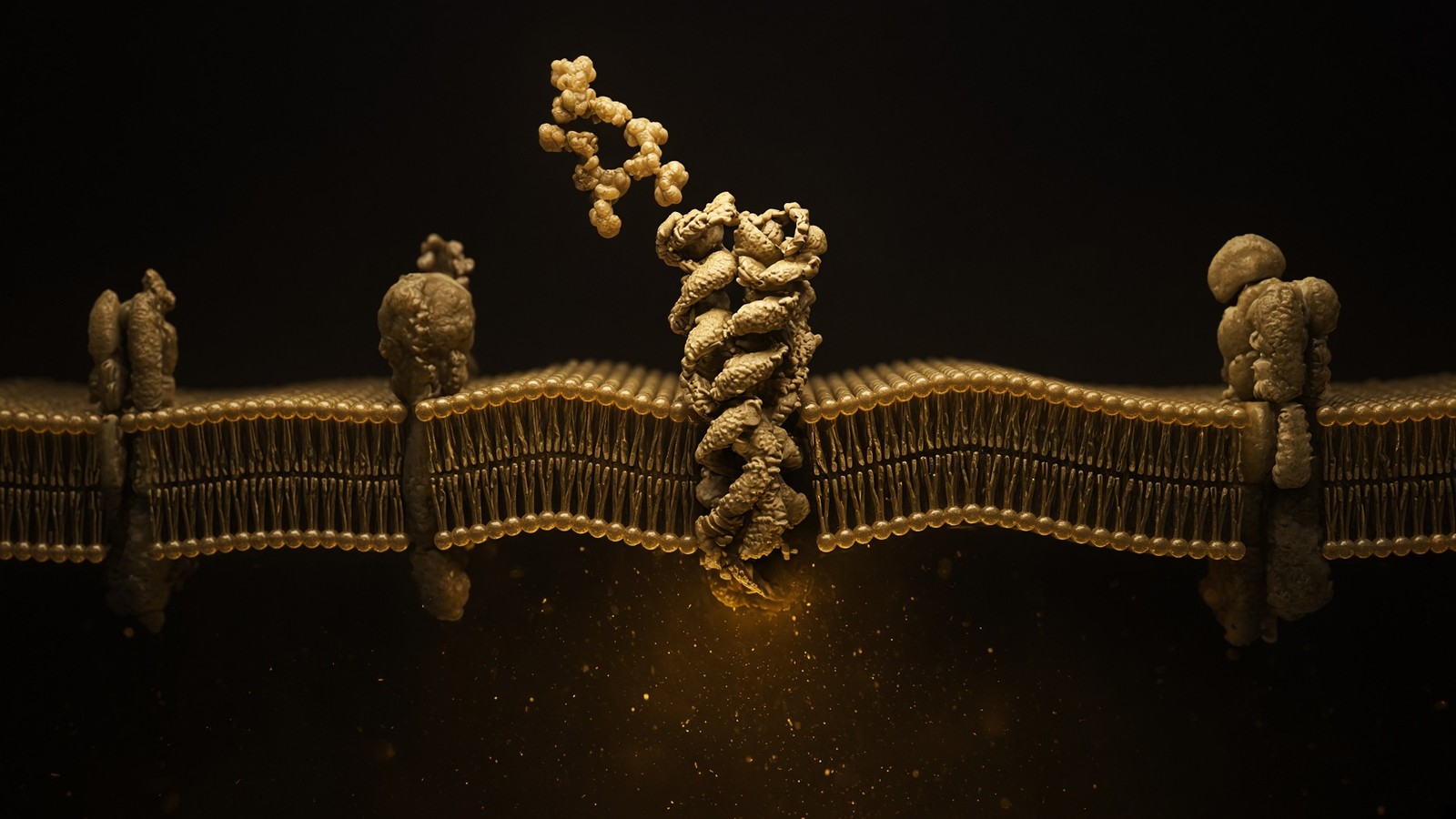
70 min · long read · The living cell
How peptides talk to cells: occupancy, amplification, arrestin
A peptide is a ligand. Most of the catalogue binds a GPCR on the cell surface: one occupancy, then enzymes make thousands of second messengers. That amplification is real, and it is not magic. Desensitisation is why more ligand is not more signal forever.
64 min · long read · The living cell
Mitochondria: the bacterium you kept, the genome it kept, the peptides it writes
You turn over 40–60 kg of ATP a day using a 16,569-base genome that still uses a bacterial genetic code. NAD+ is the hydride carrier Complex I spends. MOTS-c is a 16-mer translated from mitochondrial 12S rRNA — Lee, Kim, Cohen, 2015. That last sentence is real, and it is surprising.
57 min · long read · The living cell
Proteostasis: the cell that eats its own mistakes
Ten billion proteins, a 76-residue tag, a 2.5-megadalton proteasome, and autophagy for whole organelles. Hershko, Ciechanover and Rose, 2004. Ohsumi, 2016. DSIP is a sleep-isolation nonapeptide, not an autophagy ligand.
Essays describe published research. They are not medical advice and they do not authorise human use of any catalogue item.