

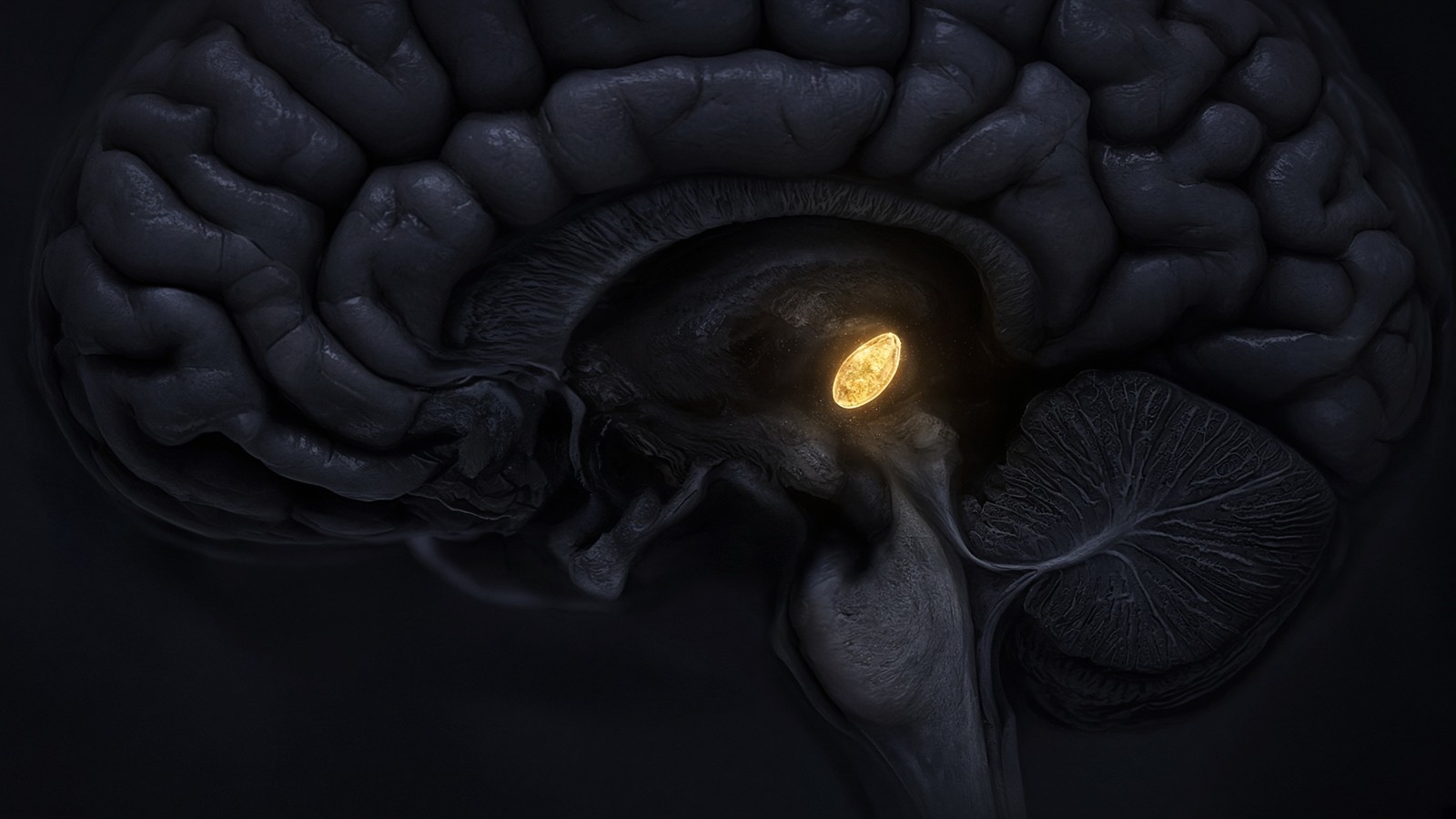
Peptide research · 49 min · 10,733 words
Epithalon, telomeres and the pineal clock
A four-residue peptide from the Khavinson school sits where melatonin, telomerase and aging research overlap. The claim is large. The molecule is tiny. The assays are specified.
· updated
What this essay actually tells you
- Epithalon is Ala-Glu-Asp-Gly (AEDG), a synthetic tetrapeptide from Khavinson's pineal-peptide programme in St Petersburg. Four residues. A school. A city.
- Reported assays include TERT promoter activity in fibroblasts, TRAP telomerase activity, and nocturnal melatonin amplitude in aged animals. Those are the three claims. Hold all three.
- Most somatic cells silence TERT. Any genuine reactivation is scientifically important and medically double-edged (stem cells versus neoplasia). Both halves of that sentence matter.
What this actually means
Human cells do not divide forever. Hayflick counted about fifty doublings in cultured fibroblasts, then a stop. The stop is in large part the telomere: a TTAGGG cap that shortens each round of replication because DNA polymerase cannot finish a linear end. Telomerase (TERT plus an RNA template, TERC) can add the repeats back. Embryos and some stem cells run it. Most somatic cells silence TERT, a tumour-suppression bargain, because a cell that can rebuild its telomeres is a cell that can become a problem. Epithalon is Ala-Glu-Asp-Gly, a synthetic tetrapeptide from Vladimir Khavinson's pineal-peptide programme in St Petersburg. The headline claims are that AEDG can switch TERT back on in ordinary fibroblasts, lengthen telomeres in those cultures, restore the night-time melatonin peak in old animals, and in some rodent studies move lifespan. Those are measurable claims. They're also a literature that Western labs have treated as a starting library, not a closed canon, and that's where we sit too.
A four-residue peptide is a small object to hang a large claim on. Epithalon is Ala-Glu-Asp-Gly, AEDG, about 390 daltons, a synthetic tetrapeptide from Vladimir Khavinson's pineal-peptide programme in St Petersburg. It began as a defined stand-in for epithalamin, a pineal extract. The headline claims that followed are that AEDG can switch TERT back on in ordinary fibroblasts, lengthen telomeres in those cultures, restore the night-time melatonin peak in old animals, and in some rodent studies move lifespan and tumour incidence. Those are measurable claims. They sit where three literatures already had names: Hayflick's finite-division census, the telomerase solution to the end-replication problem, and the pineal's darkness chemistry. A molecule that small, pointed at those three, is interesting because of the tumour-suppression bargain that keeps TERT off in most of the soma, not in spite of it. Interesting is the word the evidence currently earns. The assays that would earn a stronger word are specified later. The chemistry of the end comes first, because that's the machine the tetrapeptide is being asked to move.
In short. Epithalon is four residues, AEDG, from a St Petersburg pineal programme. The claims are TERT, telomeres, melatonin and rodent lifespan. Assays first.
Human cells don't divide forever. Leonard Hayflick and Paul Moorhead showed that in 1961, in a paper that's still assigned reading because it's a census rather than a mood. Human diploid fibroblasts in culture divide, the population doubles some forty to sixty times depending on the strain, the donor age and the era of the medium, and then they stop. Hayflick's WI-38 cells became a vaccine substrate and a gerontology object at once. He didn't know the counter. He knew the count. The field spent the next three decades arguing whether the stop was a medium artefact, a differentiation, or a clock. Alexey Olovnikov named the shrinkage theoretically. Jim Watson named it from the structure of DNA. Elizabeth Blackburn, Carol Greider and Jack Szostak found the enzyme that can restock the end, and took the 2009 Nobel Prize in Physiology or Medicine for telomeres and telomerase. Fifty years from a culture dish to a reverse transcriptase. If you're reaching for a tetrapeptide in this neighbourhood, you're reaching into that fifty-year argument. The papers are still the way in.
In short. Hayflick counted finite fibroblast divisions in 1961. The counter turned out to be the telomere. Telomerase is the enzyme that can restock it.
Most somatic cells silence TERT on purpose. That's the tumour-suppression bargain. A tetrapeptide that claims to flip it back on is interesting because of that bargain, not in spite of it.
The Hayflick limit is a counting argument
Alexis Carrel had claimed that cultured chick-heart cells were immortal. Hayflick's argument, which the field eventually accepted, was that Carrel had been feeding living cells in with the medium: a contamination of the census, not a refutation of finite division. Primary human diploid fibroblasts, carefully passaged, without a feeder of fresh cells, run out of doublings. The morphology at the stop isn't death. The cells flatten, enlarge, remain metabolically active, and refuse further mitosis. Later work named that state replicative senescence and hung a secretome on it, Campisi's SASP, which is the neighbouring essay. Here the point is narrower. A finite number of doublings is a counting argument. Something in the cell was being spent. Hayflick didn't have the something. He had the number, classically about fifty, later written as a range of forty to sixty because donor age, tissue, and how you count a split all move the integer. The number is still the finding. The enzyme is the later explanation, and it's a beautiful one.
In short. Carrel's immortal cultures were a contamination artefact. Honest diploid fibroblasts stop after about forty to sixty doublings, still alive, no longer dividing.
What happens at the stop isn't a single fate, and that matters for any later claim that a peptide moved the count. Replicative senescence is one: the cell is metabolically active, doesn't divide, and begins to secrete cytokines, proteases and growth factors that neighbours hear. If checkpoints are lost — p53 mutant, p16 gone — the population can continue into crisis, a chaos of end-fusions, anaphase bridges and breakage-fusion-bridge cycles, from which a rare clone emerges with TERT on or with ALT, a recombination workaround, running. That clone isn't young. It's selected. Hayflick's dish, with checkpoints intact, senesces. A tumour's biography is Hayflick's dish with the checkpoints shot. A TRAP band in a culture, without a karyotype and without a sentence about p53 status, can't tell you which of those two biographies you've started. That's why the assays listed later include karyotype as a first-class measurement, not as optional safety decoration. You want to know which story the dish is telling.
In short. A stopped culture may senesce with checkpoints intact, or crash into crisis if p53 and p16 are gone. A TERT-on escape is selected, not young.
The counting is also tissue-shaped, which is easy to forget if fibroblasts are the only dish you've ever held. Fibroblasts in a dish are the classical object because they're easy to passage and because Hayflick used them. Keratinocytes, endothelial cells, lymphocytes, chondrocytes: each has its own doubling budget and its own relationship to TERT. Stem-cell compartments keep a trickle of telomerase so the tissue can outlast a body. The germline keeps more. A circulating lymphocyte can pulse TERT when a clone has to expand. Most of the rest of the soma uses the Hayflick limit as a tumour-suppression mechanism and accepts the cost, which is that epithelia, marrow and endothelium will eventually run the cap down. Leukocyte telomere length, the epidemiological favourite, is a noisy correlate of all-cause mortality and a terrible individual clock. Fibroblasts in a dish aren't a person. Induced pluripotent stem cells reset telomeres and don't reset everything. Hold those distinctions before a single number is offered as biological age, and hold them twice before a tetrapeptide is asked to move that number.
In short. Different tissues have different doubling budgets. Stem cells keep a trickle of telomerase. A dish of fibroblasts is not a person, and leukocyte length is a noisy correlate.
Diagram
- Hayflick limit~40–60 doublingsHuman fibroblasts in 1961. They were not immortal. He counted.
- End-replication5–15 kb TTAGGGDNA polymerase needs a primer. The lagging strand shortens. Olovnikov named the problem.
- Shelterin6 proteinsTRF1, TRF2, POT1, TIN2, TPP1, Rap1. The end is hidden from the damage response.
- TERT offmost somatic cellsTumour suppression. Stem cells and germline keep it on. So do most cancers.
- SenescenceSASPp16, p21, the secretome Campisi named. A cell that refuses to die and talks too much.
Blackburn, Greider and Szostak, Nobel 2009. Epithalon’s literature sits on TERT and pineal melatonin — a tetrapeptide claiming two of the rare promoters anyone names in a peptide essay. The machines are real. A large Western RCT of telomere length in adults is not on the shelf next to the vial.
- Hayflick limit
- ~40–60 doublings
- Human telomere repeat
- TTAGGG
- Somatic telomere length
- ~5–15 kb
- Shelterin
- 6 proteins
- Telomerase
- TERT + TERC
- Epithalon
- AEDG, ~390 Da
Human diploid fibroblasts in culture. Hayflick and Moorhead, 1961.
The disposable sequence at the end so the essential sequence is not.
A distribution, not a ruler. Newborns longer; scatter at any age is large.
TRF1, TRF2, POT1, TIN2, TPP1, Rap1. The cap that hides the end from ATM/ATR.
Reverse transcriptase plus RNA template. Off in most soma on purpose.
Ala-Glu-Asp-Gly. Khavinson's defined stand-in for pineal epithalamin.
What the cell was counting: TTAGGG and a polymerase that cannot finish
The end-replication problem was staring at the structure of DNA from the moment the structure was known. Conventional DNA polymerases synthesise 5′ to 3′ and need a primer. The leading strand can, in principle, run to the end. The lagging strand cannot, because the last RNA primer leaves a gap when it's removed, and because processing of the end after replication shortens it further. Watson wrote the problem down in 1972 in Nature New Biology. Olovnikov, independently and with a theorist's nerve, proposed marginotomy in the Journal of Theoretical Biology in 1973: a shortening at each division as a counting mechanism for ageing. Neither of them yet had the enzyme. Both of them had the geometry. Linear chromosomes shrink. The essential genes must not be the thing that shrinks. Evolution's answer in vertebrates was a repetitive disposable sequence at the end, plus a protein complex that lies to the damage response, plus — in cells that are allowed it — a reverse transcriptase that restocks the repeats. That's the kit. We're about to name the parts.
In short. DNA polymerase cannot finish a linear lagging strand, so ends shrink each division. Olovnikov and Watson named the problem; telomeres are the disposable sequence that takes the loss.
The sequence is almost childishly repetitive, and that's the point. TTAGGG, TTAGGG, TTAGGG, for five to fifteen kilobases in a typical human somatic cell, with a G-rich 3′ overhang of a few tens to a couple of hundred nucleotides. Newborns run longer. Centenarians run shorter. The scatter between individuals at the same chronological age is large enough that a single number sold as biological age should be asked which assay, which tissue, which extraction, and whether a laboratory actually ran it. Sperm and some stem-cell compartments keep a longer reserve. The length is a distribution, not a ruler. What isn't in dispute is the chemistry of the repeat, the existence of the overhang, and the fact that a blunt or exposed end of linear DNA is, to the cell, indistinguishable from a double-strand break until something hides it. Ciliates solved a related problem with a different repeat and a lot of telomerase. Yeast solved it with a different repeat and a lot of genetics. Vertebrates settled on TTAGGG and shelterin.
In short. Human telomeres are TTAGGG repeats, typically five to fifteen kilobases, with a G-rich overhang. Length is a distribution, not a clock you can read off one number.
Each S phase spends some of that reserve. The end-replication problem is the theoretical minimum. Nucleolytic processing of the C-strand, oxidative damage at the G-rich repeats, and replication stress at the difficult-to-replicate end all add to the debit. Estimates for human fibroblasts often sit around fifty to two hundred base pairs lost per division, which is why forty to sixty doublings can exhaust a five-to-fifteen-kilobase cap, and why the integer is a range rather than a constant. When the remaining duplex is too short to hold shelterin in a stable t-loop, the disguise fails. ATM and ATR, the apical kinases of the DNA-damage response, treat a chromosome end as a break. p53 and p21 fire. Often p16INK4a joins them. The cell senesces or dies. That's the counting as a molecular sentence rather than as a flask count. A peptide literature that reports longer telomeres in a culture is claiming to have slowed that debit, or to have restocked the reserve, or to have selected the cells that still had reserve. Those are three different experiments. The write-up has to say which.
In short. Each division spends telomere sequence. When the remaining repeats cannot hold the cap, ATM sees a break and p53 stops the cell. Longer telomeres in a dish still need a named mechanism.
Shelterin hides an end that would otherwise look like a break
Shelterin, named and dissected by Titia de Lange's laboratory, is six proteins. The complex does two jobs that look like one: it hides the chromosome end from the DNA-damage response, and it regulates how much telomerase, if any, is allowed to see the end. Without that hiding, every telomere would look like a double-strand break, ATM and ATR would fire constitutively, and the genome would fuse itself into chaos. A telomere is therefore not a decorative cap. It's a folded, protein-coated argument that this particular DNA end isn't an emergency. When the repeats get too short to hold the argument, the emergency is declared. Talk about 'telomere support' as if the cap were a vitamin, and you've missed what the cap is for. Talk about the cap as if it made TERT untouchable, and you've missed dyskeratosis congenita, where too little telomerase is a disease of marrow, lung and skin. The interesting pharmacology, if it existed as a licensed medicine, would have to know the difference. Length and hiding are related. They aren't the same job.
In short. Shelterin is six proteins that cap vertebrate telomeres so the damage response does not treat a chromosome end as a break. The cap is an argument, not a vitamin.
TRF1 and TRF2 bind double-stranded TTAGGG via Myb-like domains. TRF1 is more of a length regulator: too much of it can keep telomerase off an already-long end. TRF2 is more of an end-protection factor. Remove TRF2 and you get telomere fusions, anaphase bridges, breakage-fusion-bridge cycles, the genomic chaos that a tumour-suppression system is supposed to prevent by senescing the cell before it gets that far. POT1 binds the single-stranded G-overhang with oligonucleotide/oligosaccharide-binding folds. Take POT1 off and ATR treats the overhang as replication protein A sitting on a resection. TPP1, which isn't TPP1 the lysosomal protease — nomenclature is a prank — binds POT1 and is the subunit that recruits telomerase when telomerase is allowed. TIN2 ties TRF1, TRF2 and TPP1 together. Rap1 binds TRF2 and, in mammals, is less of a transcriptional regulator than its yeast namesake and more of a quiet partner. Six names. One complex. A peptide claim that moved telomere length without ever mentioning these proteins has skipped the machine that actually holds the end.
In short. TRF1 and TRF2 bind the duplex, POT1 the overhang, TPP1 recruits telomerase, TIN2 ties the complex, Rap1 sits on TRF2. Lose TRF2 and ends fuse.
Diagram
5′— (TTAGGG)n ··· TRF1 · TRF2 · TIN2 · TPP1 · POT1 · Rap1 —3′ overhang
TRF1/TRF2 bind double-strand TTAGGG. POT1 binds the single-strand overhang. TIN2 and TPP1 hold the complex.
t-loop: the overhang invades upstream repeats so the end is not an end. Rap1 and TRF2 keep NHEJ off the chromosome.
TERT + TERC extend the repeats when the complex allows. In most of your cells the reverse transcriptase is transcriptionally off.
TTAGGG repeats, a 3′ overhang, a t-loop. Shelterin makes a chromosome end look like a loop rather than a double-strand break. Lose the disguise and ATM/ATR treat the end as damage — fusions, crisis, or senescence.
The t-loop, seen first by Griffith, Rosenfield, de Lange and colleagues, is the architectural joke that makes the hiding work. The 3′ overhang invades the duplex repeats upstream and forms a displacement loop. The end is now a lariat, not a terminus. TRF2 is required to keep this structure honest. Electron microscopy of that lariat is one of the more satisfying pictures in chromosome biology, because it converts a sequence motif into a fold you can see. The fold is also why length isn't a linear countdown in every cell at every moment. A long telomere can still fail if shelterin is lost. A short telomere can still hold if the remaining repeats and the remaining proteins are enough to tuck the overhang. Length and capping are related and they aren't identical. Southern blots of terminal restriction fragments ask about length. A DNA-damage focus at a telomere, γH2AX or 53BP1 sitting on an end, asks about capping. Both belong in a write-up that claims a peptide moved the end. One without the other is half a sentence, and the half you skipped is often the interesting one.
In short. The t-loop tucks the overhang back into the duplex so the end is a lariat, not a break. Length and capping are related; they are not the same measurement.
de Lange's reviews remain the papers you'd actually cite if you were going to talk about the cap. Shelterin as a named complex, Genes & Development 2005, and the subsequent work on how TRF2 suppresses ATM while POT1 suppresses ATR, are the wiring diagram. The diagram matters for Epithalon because a tetrapeptide that claimed to lengthen telomeres could, in principle, have done so by recruiting telomerase, by slowing the debit, by altering processing, or by changing how shelterin occupies the remaining repeats. Those are different blot series. The St Petersburg papers that still get cited measured telomerase activity and telomere length in culture. They didn't, as far as a Western reader can see, walk through TRF2 occupancy, t-loop frequency, or ATM foci at ends as a function of AEDG. That isn't an insult. It's a description of what was asked. Later work, if it's going to move the claim from a starting library toward a closed mechanism, would have to ask those questions with the six proteins on the page. The cap is the machine. Length is one readout of it.
In short. de Lange named the cap and mapped which subunits silence ATM and ATR. A length claim without shelterin occupancy or damage foci at ends is still an incomplete mechanism.
Telomerase is a reverse transcriptase that most of you keep off
Telomerase is TERT, the reverse transcriptase, plus TERC, the RNA template, also called hTR. TERC carries a template for TTAGGG. TERT reverse-transcribes that template onto the 3′ overhang, processively in a decent assay, adding repeats. The catalytic cycle is a reverse transcriptase cycle, which is why nucleoside analogue inhibitors built for HIV have been pointed at TERT with mixed enthusiasm, and why a TERT claim is a gene-level claim rather than a vitamin claim. Biogenesis of the ribonucleoprotein involves dyskerin and the other H/ACA proteins, TCAB1, and a Cajal-body itinerary. Mutations in that pathway give dyskeratosis congenita and related telomeropathies: marrow failure, pulmonary fibrosis, a skin and nail picture, the human genetic proof that too little telomerase is a disease. Too much, or too much in the wrong cell, is a different disease, and it's called cancer often enough that the sentence has to be written slowly. Stem cells need the enzyme. Many tumours hijack it. That's the double edge, and it isn't a rhetorical flourish. It's the biology of a gene most of your tissues have chosen to keep quiet.
In short. Telomerase is TERT plus the RNA template TERC. Too little is a marrow and lung disease. Too much in the wrong cell is often cancer.
Carol Greider, working in Elizabeth Blackburn's laboratory, found an activity in Tetrahymena extracts that added telomeric repeats onto a primer. The 1985 Cell paper is the enzymatic birth of the field. Szostak's yeast genetics had already shown that telomeres are essential for chromosome stability, and that linear ends without a proper cap are lethal or rearranging. The three of them took the 2009 Nobel. The lectures are public and still the cleanest short course. What the prize recognised was a system, not a supplement: a repetitive end, an RNA-templated polymerase that restocks it, and the genetic demonstration that the end isn't optional. Between 1985 and 2009 the field learned that most human somatic cells silence TERT transcriptionally, that cancers usually reactivate it or use ALT, and that the Hayflick limit is, in large part, that silencing plus a DNA-damage checkpoint. A tetrapeptide that claims to move TERT is therefore asking to sit down at the table the Nobel set. The invitation is the assay, not the folklore. That's a high table. The assays are how you earn a chair.
In short. Greider and Blackburn found telomerase in Tetrahymena in 1985. The 2009 Nobel recognised a system: a repetitive end, an enzyme that restocks it, and genetics that showed the end is essential.
Most somatic cells silence TERT transcriptionally, on purpose. The promoter is there. The gene is there. The product isn't wanted, because a cell that can rebuild its telomeres without limit is a cell that has taken one of the brakes off neoplastic progression. Stem cells keep a trickle. The germline keeps more. Lymphocytes can pulse it. The rest of the soma uses the Hayflick limit as tumour suppression and accepts tissue ageing as the cost. Talk about boosting telomerase as if it were a vitamin, and you've missed the bargain. Talk about the bargain as if it made TERT untouchable, and you've missed the telomeropathies and the stem-cell papers. The interesting pharmacology would be cell-type-specific, reversible, and accompanied by karyotypes. That pharmacology, as a licensed medicine, doesn't sit in this catalogue. What sits here is a characterised tetrapeptide whose literature claims to move TERT expression, which is a transcriptional claim, not a nucleotide-analogue claim. Different floor. Same gene. Same bargain waiting in the next paragraph of any honest write-up.
In short. Most somatic cells silence TERT as tumour suppression and accept tissue ageing as the cost. Any real pharmacology would need to be cell-type-specific and come with karyotypes.
ALT is the other way to keep an end, and tumours know it
A minority of cancers, often mesenchymal, don't turn TERT on. They lengthen telomeres by recombination: ALT, alternative lengthening of telomeres, associated with loss of ATRX or DAXX, with ALT-associated PML bodies, and with extra-chromosomal C-circles that a diagnostician can assay. ALT is a reminder that the cell has more than one way to solve an end, and that solving the end isn't the same as being healthy. A TERT-on cancer and an ALT cancer have both escaped the counting. They haven't become young. They've become a problem. When a peptide literature reports telomerase activity in a culture, the adult question isn't only whether TRAP lit up. It's which cells, which karyotype, which p53 status, and whether anyone looked for ALT, because the assay isn't a moral judgement. Fetal fibroblasts in a dish can lengthen telomeres under a great many conditions, including serum, oncogene expression, and contamination with a TERT-positive line. That's why independent replication, karyotype, and a named enzyme assay belong together. One band isn't a biography. It's a band.
In short. Some tumours lengthen telomeres by recombination rather than TERT. A TRAP signal in culture still needs karyotype, p53 status, and an honest look for ALT.
TERT promoter mutations are among the most common noncoding drivers in cancer. C228T and C250T generate ETS-binding sites and were reported across melanoma, glioblastoma, bladder, a long list, in the 2013 papers that made the promoter itself an oncogene. The soma keeps TERT off with a promoter that is one C-to-T from being on. That's how thin the bargain is, and how little a word like activation should be allowed to hide. If you want TERT on in a fibroblast, you're asking for a state that evolution spent a promoter's worth of sequence trying to prevent in that fibroblast. Maybe a tetrapeptide can ask. Maybe a culture condition can ask. Maybe an artefact can look like asking. The karyotype is still the adult measurement. So is a sequencing look at the promoter, if anyone is going to claim a peptide switched TERT in a line that might already have been one substitution away from on. Skip that look and you haven't yet grown up next to the cancer literature. One base. That's the margin the soma actually uses.
In short. TERT promoter mutations are common cancer drivers: one C-to-T from on. Asking TERT on in a fibroblast is asking for a state evolution tried to prevent.
Chromatin at a silenced promoter is half the TERT problem
Two metres of diploid DNA fold into a nucleus a few micrometres across. Nucleosomes, loops, topologically associating domains, A and B compartments, chromosome territories: the hierarchy is real, and it's why finding a promoter among 3.1 billion base pairs is the first problem of gene regulation. Heterochromatin at the nuclear periphery, euchromatin more interior, lamina-associated domains as a silencing neighbourhood. TERT lives in that packing problem. In most somatic cells the TERT promoter is in a repressed chromatin state: CpG methylation in the neighbourhood, histone marks that don't invite Pol II, a promoter that is present and not used. Stem cells and the germline keep it available. Cancers that take the TERT route reopen it, sometimes with the promoter mutations already named, sometimes with rearrangements that hijack an enhancer, sometimes with epigenetic drift that you can actually stain for. A claim that a four-mer moved TERT is a claim that something in this packing, or in the transcription machinery that reads it, moved. That's a large claim for four residues. It's still a claim you can test.
In short. TERT sits in packed chromatin and is repressed in most soma. A tetrapeptide that moves TERT is claiming to have moved packing, transcription factors, or the polymerase that reads the promoter.
Diagram
- 2 nmB-DNA0.34 nm/bp. Diploid G1 is ~2 metres of this.
- 11 nmNucleosome147 bp around a histone octamer. ~30 million per nucleus.
- loopsCTCF / cohesinEnhancers meet promoters by folding, not by sliding.
- µmA/B compartmentsHi-C: open A, closed B, territories at the lamina.
- 6–10 µmNucleusThe room. The search problem is the entire point of gene regulation.
Packing is not storage. It is the first regulatory decision: a promoter buried in H3K27me3 is not a promoter, it is furniture. Transcription starts when this origami opens the right 1,000 base pairs among 3.1 billion.
NAD+ belongs in this paragraph as a coin, not as a protocol. Sirtuins deacylate lysines using NAD+ as co-substrate. PARP1 polymerises ADP-ribose onto DNA-damage foci and can drain the pool after a genotoxic hit. Both families sit on chromatin metabolism. The neighbouring essay on NAD+ as the currency of cellular time is the full argument: salvage through NAMPT, CD38 as an age-associated drain, the NADH/NAD+ ratio as a fuel gauge. This piece needs only the adjacency. Telomeres, chromatin and a consumed nucleotide pool are three clocks that happen to share a nucleus. Epithalon isn't NAD+. GHK-Cu, Pickart's copper tripeptide, has a published microarray literature that claims a broad fibroblast transcriptome shift, which is a different shape of evidence from a TERT-specific claim. Three objects in one catalogue. Three assays. Blend them under 'epigenetic' or 'ageing' and a chromatogram gets ignored. Hold the packing, hold the coin, hold the tetrapeptide, and don't staple them into a mix. Adjacent clocks still want their own measurements, and they still repay being read as adjacent rather than as one story.
In short. NAD+ is a coin chromatin enzymes spend; GHK-Cu has a broad array literature. Neither is Epithalon. Telomeres, chromatin and the nucleotide pool are adjacent clocks.
CpG methylation at the TERT promoter is one of the more studied silencing marks, and it isn't a simple on-off switch. Some cancers transcribe TERT from a still-methylated promoter; some silenced somatic promoters are less methylated than the caption wants. Histone acetylation and H3K4 methylation in the neighbourhood correlate with activity more honestly than a single bisulphite number. Chromatin immunoprecipitation at the TERT promoter, ATAC-seq accessibility, a nascent-RNA assay that actually watches Pol II: those are the measurements a transcriptional claim owes. A PCR of TERT mRNA in a treated culture is a start. It doesn't tell you whether the promoter opened, whether a pause released, whether the message stabilised, or whether a contaminating TERT-positive cell took over the flask. Four residues can't remodel a megabase of heterochromatin in the way a pioneer transcription factor can. If AEDG does anything at this floor, it's almost certainly local and contingent. Local and contingent is still interesting. It's also why independent labs have found the result harder to own than the original corpus suggested.
In short. TERT silencing is chromatin as well as sequence. A PCR of the message is a start; ChIP, accessibility and nascent RNA would be the adult follow-up.
Transcription of TERT is the actual claim
A protein-coding gene is transcribed when chromatin is open enough, a promoter is found, a pre-initiation complex assembles, and Pol II is allowed to leave the pause. TFIID finds the promoter. Mediator connects enhancers. TFIIH opens the DNA and phosphorylates CTD Ser5. Promoter-proximal pausing, DSIF and NELF, is the default in mammals. P-TEFb, CDK9 and cyclin T, phosphorylates CTD Ser2 and the pause factors, and elongation is then allowed at twenty to forty nucleotides a second, with long pauses, capping already done, splicing already boarding. Roeder on the PIC, Core and Adelman on pausing, Kornberg's structural work: transcription is a named machine. Say a four-mer activates transcription without naming which of those steps moved, and you've named a result without a mechanism. TERT is a modest-sized gene with a promoter that most somatic cells have decided to keep quiet. If a literature claims that a tetrapeptide moves TERT, the claim is that something in the list above moved, or that an assay artefact looked like one of those. Either way, the next experiment has a name.
In short. Transcription is TFIID, Mediator, a pause, P-TEFb, then elongation. A tetrapeptide that 'activates TERT' has to name which of those steps moved.
Diagram
Closed chromatin (H3K27me3, DNA methylation) hides the promoter. Pioneer factors and histone acetyltransferases open it.
PIC: TFIID, TFIIH, Mediator, Pol II. Ser5 phosphorylation of the CTD lets the polymerase leave the promoter.
Elongation ~20–40 nt/s. Capping, splicing, cleavage and polyadenylation happen on the still-growing RNA.
Human genes are islands in 3.1 billion base pairs of mostly noncoding sequence. Promoter, enhancers, chromatin state and the Mediator complex decide whether Pol II is allowed to fire. Epithalon’s literature sits on TERT and pineal clocks — two of the rare promoters anyone bothers to name in a peptide essay.
Khavinson's group has argued for a complementary-peptide interaction with promoter DNA, including at TERT: short peptides as sequence-specific transcriptional cues, a motif-to-motif match between a four-mer and a promoter stretch. That isn't the mainstream model of how mammalian transcription factors work. Mainstream transcription factors are folded proteins, often with dimerisation domains, activation domains, and a DNA-binding surface that occupies a major groove as a structured object. Four residues can't fold into a receptor-shaped handshake of the usual kind. If you've looked at a ribbon diagram, you know that. Complementary peptide–DNA binding is possible in principle. Peptide nucleic acids exist. Short peptides can bind DNA with low affinity in vitro. Possible in principle isn't the same as a solved occupancy at the TERT promoter with the structural biology a four-mer would still owe you. Independent Western molecular biologists would still call the mechanism unresolved. We wouldn't pretend otherwise, and we won't pick a favourite from the remaining unproven hypotheses. Open is allowed. Closed would be nicer. Open is what we have.
In short. Khavinson proposed that short peptides bind complementary promoter DNA. That is not how most mammalian transcription factors work, and the structural occupancy at TERT remains unresolved.
The remaining hypotheses are a short, honest list. Direct nucleic-acid binding: the complementary-peptide proposal, possible, not nailed. An unnamed receptor that ends at the TERT promoter through a signalling cascade — MAPK and IGF axes have been mentioned in the same corpus — which would make AEDG a ligand rather than a DNA-binding object. A pineal-first model, in which the tetrapeptide restores a melatonin or clock output and TERT moves downstream of that, which would make the fibroblast result a different experiment from the aged-animal melatonin curve. A culture artefact: serum, selection, a TERT-positive contaminant, a TRAP false positive from a PCR that likes repeats. Those four aren't equally likely and they aren't equally tested. They're the list a referee would write in the margin. A later paper that closed even one of them with a named blot, a knockout, or a structure would move the literature. Until that paper exists, the transcriptional claim is a claim, the mechanism is open, and the useful response is still the assay rather than a story about four residues whispering to a promoter.
In short. Possible mechanisms include DNA binding, an unnamed receptor, a pineal-first cascade, or a culture artefact. None is proven. The useful response is still a named assay.
From epithalamin to AEDG: a school, a city, a defined tetrapeptide
Vladimir Khavinson's Institute of Bioregulation and Gerontology in St Petersburg treated short peptides as gene-activating ligands long before epigenetic peptide was an English phrase. The programme began with tissue extracts — epithalamin from pineal, and a family of other organ preparations — and then reduced motifs to synthetic peptides of two to four residues that could be specified, synthesised, and assayed. That reduction is the scientifically honest move in the story. An extract is a mixture. A tetrapeptide is a sequence. Once you have a sequence you can synthesise it, put a mass on a certificate, and ask whether the defined object still does what the extract did. AEDG was the defined stand-in for the pineal extract. The extract literature and the tetrapeptide literature are related and they aren't identical, which is why a paper has to say which reagent went into the animal or the dish. Epithalamin is a pineal preparation. Epithalon, also spelled Epitalon in a large fraction of the English papers, is Ala-Glu-Asp-Gly. Mixture, then sequence. That's the move that made the claim testable.
In short. Khavinson reduced pineal extracts to the synthetic tetrapeptide AEDG so a sequence, not a mixture, could be assayed. Epithalamin is the extract; Epithalon is the four-mer.
The school is large, internally consistent, and thinner in independent Western replication than a molecule this famous should be. That sentence isn't an insult. It's how a single-institute programme ages when it's read from outside. Zagreb's BPC-157 corpus has the same shape: many models, many endpoints, a recurring theme, and a need for outside labs to own the clean pieces. St Petersburg's peptide-bioregulator corpus has that shape at TERT, melatonin and rodent lifespan. Internal consistency is real evidence of a programme that kept asking the same questions. It isn't the same evidence as a pre-registered multicentre replication. Western gerontology and telomere labs have treated the Khavinson papers as a starting library rather than a closed canon, which is about right. The three claims you actually have to hold are TERT in culture, rodent lifespan and tumour incidence, and nocturnal melatonin amplitude in aged animals. Hold them at the size of the evidence. Don't inflate cell-culture TRAP into a human outcome. A dish is a dish. A lifespan table is a lifespan table. A person is neither.
In short. The St Petersburg corpus is large and internally consistent. Independent Western replications remain thinner. Hold TERT, lifespan and melatonin at the size of the papers, not larger.
AEDG has no globular fold. Four residues are a peptide in the chemical sense and a ligand only if something in the cell binds them with enough affinity and specificity to start a pathway. Short peptides can be surprisingly stable or surprisingly fragile depending on the termini, the sequence, and the proteases in the dish or the plasma. Ala-Glu-Asp-Gly is small enough to be underestimated and charged enough to be a poor passive-membrane guest, which is why a write-up that doesn't say how the peptide met the cell has skipped pharmacokinetics even in vitro. In a culture dish the peptide can be in the medium at micromolar, which is a different experiment from a nanomolar circulating concentration in a rodent. Dose, route, degradation, and whether the tetrapeptide was amidated or left with free termini, all move the object. Characterisation isn't pedantry. It's how you know you're still talking about AEDG rather than about a degradation product or a batch impurity that happened to be interesting. Four residues leave very little room to hide. The mass has to match.
In short. Four residues have no fold. Dose, termini, proteases and how the peptide met the cell decide whether the experiment is still about AEDG.
What the 2003–2004 fibroblast papers actually reported
Khavinson, Bondarev and colleagues reported, in the Bulletin of Experimental Biology and Medicine in 2003, that Epithalon induced telomerase activity and elongated telomeres in human somatic cells, specifically fetal fibroblast cultures. A 2004 follow-up reported that the peptide promoted overcoming of the division limit in those cells. Those two papers are the ones that still get cited whenever the molecule is discussed in English. They're cell-culture papers. TRAP, telomere length in a dish, a fibroblast that isn't a person. Fetal fibroblasts are a particular object: they aren't senescent, they have more remaining telomere reserve than an adult dermal fibroblast, and they're closer to a developmental state in which TERT isn't as thoroughly locked off. A result in that dish is a result in that dish. It's evidence that something in the culture, in the presence of the tetrapeptide, moved a telomerase assay and a length assay. It isn't, on its own, evidence that an adult somatic cell in a tissue would do the same, and it isn't a trial of telomere length in people. Cite them as that literature. That's already interesting enough.
In short. The 2003–2004 papers reported TRAP-positive telomerase and longer telomeres in human fetal fibroblasts. That is a dish result, not a human trial.
TRAP, the telomeric repeat amplification protocol, asks whether telomerase is enzymatically active in a lysate. Kim and colleagues published it in 1994. A primer, a lysate, a PCR that amplifies the repeats the enzyme added, a ladder on a gel or a quantitative readout. It's sensitive, which is a virtue and a hazard. Sensitivity means you can see a real low-level activity. It also means a contaminating TERT-positive cell, a PCR artefact that likes repeats, or a lysate prepared without the right RNase and protease discipline, can light a band that isn't the biology you thought. Controls that belong on every TRAP gel are a heat-inactivated lysate, an RNase-treated lysate, a no-lysate PCR, and, if you're making a claim this large, an independent enzyme assay or an antibody for TERT protein that matches the activity. The 2003 paper used the assay the field used. A later replication would still owe those controls in public, in a journal a telomere lab actually reads, with the fibroblast strain named and the passage number on the page. Sensitivity is a gift. Controls are how you spend it.
In short. TRAP is a sensitive PCR for telomerase activity in a lysate. Sensitivity is a virtue and a hazard. Heat, RNase and no-lysate controls belong on every gel.
Telomere length in those cultures was the second measurement. The classical method is Southern blotting of terminal restriction fragments: digest away the subtelomere with restriction enzymes that don't cut TTAGGG, run the smear, hybridise. The smear is a distribution. Mean TRF is a number you can write down, with a variance you shouldn't hide. qPCR methods after Cawthon are cheaper and higher-throughput and they report a T/S ratio, telomere template versus a single-copy gene, which is a relative number that needs a standard the lab actually trusts. Flow-FISH and Q-FISH put a fluorescent probe on the ends in cells or on metaphase spreads and can, in the right hands, see the shortest ends, which are the ends that matter for the checkpoint. A paper that says telomeres got longer without saying which of those methods, and without showing the smear or the ratio with error, hasn't yet made the length claim inspectable. The St Petersburg papers used the methods of their time. Inspectable, in 2026, still means the gel or the ratio in public. Mean length hides the shortest ends. The checkpoint sees the shortest ends.
In short. Length is a smear, a T/S ratio, or a FISH signal, depending on the method. Mean length hides the shortest ends, and the shortest ends are what the checkpoint sees.
Overcoming the division limit, the 2004 phrasing, is the Hayflick claim. If TERT came on in a somatic fibroblast that still had to decide about p53, the Hayflick parameter would move: more doublings before the telomere checkpoint. That's a fate claim, a big one. It brings p53 and karyotype with it as mandatory measurements. A culture that divides past its usual stop may have reactivated telomerase, or it may have selected a variant that lost a checkpoint, or it may have been miscounted. Karyotype asks whether the chromosomes paid a price: fusions, aneuploidy, marker chromosomes, the mess that crisis writes. A culture that is still diploid, still checkpoint-intact, and still TRAP-positive after extra doublings is a very different object from a culture that escaped by breaking p53. The 2003–2004 papers are the starting library for that distinction. They aren't the last word on it. Independent Western replications of the TERT result remain thinner than the original corpus, which is the sentence the citation deserves on the same page. More doublings is a fate. Fates need chromosomes.
In short. More doublings in culture is a Hayflick claim and needs p53 status and karyotype. Escape by checkpoint loss is not the same as restocking the telomere.
Anisimov's rodents: lifespan, tumours, and a gerontology endpoint
Vladimir Anisimov's group reported lifespan and tumour-incidence shifts in mice and rats given epithalamin or the tetrapeptide. Those papers are the gerontology half of the same library. Lifespan in a rodent is a real endpoint. It's also an endpoint that moves with strain, diet, infection status, housing temperature, and how you handle the last-quartile deaths. A peptide that shifts median or maximum lifespan in a named strain, with a tumour table, is a result a gerontologist can argue with. A peptide that 'promotes longevity' without those numbers is a caption. Anisimov's tables are in the literature: SHR mice, other strains, epithalamin versus AEDG, spontaneous tumour incidence as a co-endpoint rather than an afterthought. Tumour incidence belonging in the same table as lifespan is the adult move. A TERT-adjacent intervention that lengthened life by increasing neoplastic risk would be a different finding from one that lengthened life and reduced tumours. The papers report shifts in both directions depending on the model, which is how a careful gerontology programme looks, and also how a programme looks when the field outside hasn't yet meta-analysed it.
In short. Anisimov reported rodent lifespan and tumour-incidence shifts with epithalamin or AEDG. Lifespan is a real endpoint. Strain, diet and the tumour table still decide what the number means.
Spontaneous tumour incidence in ageing rodents is the oncology half of the bargain, written as a table. If a pineal peptide or its tetrapeptide stand-in reduced some tumours and did not increase others, that's a sentence a cancer biologist wants to see next to a TERT claim, because TERT-on is how most human cancers solve the end. Rodents aren't people. Mouse telomeres are much longer than human telomeres, and laboratory mice get cancers that a human fibroblast literature doesn't predict one-for-one. That's a genuine limit on translation, not a reason to ignore the tables. It's a reason to read them as rodent gerontology. Independent Western labs haven't made Anisimov's lifespan results a closed canon either. Some pineal-peptide and melatonin-adjacent lifespan work exists outside St Petersburg. A large, pre-registered, multi-strain replication of AEDG specifically, with modern husbandry and a pre-specified tumour code, is still the experiment the claim would like to have. We won't write that experiment into existence. We won't ignore the papers that do exist. Both halves of that sentence are required.
In short. Mouse telomeres are longer than human ones, so rodent tumour tables do not translate one-for-one. They still belong next to a TERT claim, and they have not been closed by a modern multi-strain replication.
Epithalamin and AEDG are, again, related reagents rather than one vial. An extract can contain melatonin, other peptides, and whatever else a pineal preparation carries. A tetrapeptide cannot. If both reagents moved lifespan, the parsimonious reading is that something in the pineal motif is enough. If only the extract moved it, the tetrapeptide isn't the active principle and the TERT papers in fibroblasts are a separate claim. The literature treats them as a family. If you want to be about Epithalon, you have to use the tetrapeptide, characterised, and say so. That's one reason a catalogue holds AEDG as a defined sequence rather than as a pineal powder. The other reason is the fibroblast work, which was done with the synthetic four-mer. Two reagents, two claims, one school. Mix them and a reader ends up citing an extract for a sequence result, or a sequence for an extract result, and then wondering why a replication failed. Identity of the reagent is how you know which claim you tested. Sequence is the identity we can put a mass on.
In short. Epithalamin is an extract; AEDG is a sequence. If a paper used one, a replication has to use the same one. Identity of the reagent is how you know which claim you tested.
The pineal half is a clock, not a sleep story
The pineal gland translates darkness into melatonin. Light hits intrinsically photosensitive retinal ganglion cells, melanopsin, peak sensitivity around 480 nm. The suprachiasmatic nucleus keeps a 24-hour transcription-translation loop: CLOCK and BMAL1 drive Period and Cryptochrome; PER and CRY proteins accumulate, repress CLOCK/BMAL1, degrade, and the cycle restarts. Only at night, after the SCN has certified darkness, does a multi-synapse path through the paraventricular hypothalamus and the intermediolateral column of the spinal cord end at the superior cervical ganglion, which then releases norepinephrine onto pinealocytes. Norepinephrine, via β1 and α1 adrenergic receptors, raises cAMP and calcium. AANAT, arylalkylamine N-acetyltransferase, is transcribed and stabilised. That enzyme acetylates serotonin to N-acetylserotonin. HIOMT, also called ASMT, then methylates that to melatonin, N-acetyl-5-methoxytryptamine. AANAT is the night-gated, rate-limiting step. Protein can rise tens-fold after dark and collapse in minutes if you turn a light on, because proteasomal degradation is the off-switch and cAMP is what holds it back.
In short. Light hits the retina, the SCN certifies night, and AANAT then makes melatonin from serotonin. The pineal is an output of the clock, not the clock itself.
David Klein's biochemistry is the reference for AANAT as the night enzyme. The anatomical joke of mammalian pineal melatonin is that the light doesn't hit the pineal. It hits the retina, the SCN computes night, and a nervous system writes a chemical. A pineal in a dish, disconnected, isn't a clock in the mammalian sense. Melatonin then leaves into blood and CSF, occupies MT1 and MT2, both GPCRs, and tells the pituitary, the SCN itself, and peripheral tissues that the organism is in the dark phase. At pharmacological concentrations it's also a radical scavenger, which has launched a thousand supplement labels and a smaller number of careful papers. Physiological nocturnal nanomolar isn't the same chemistry as a milligram oral bolus. Ageing flattens the nocturnal peak even when the room is dark: less AANAT competence, a noisier SCN, a pineal that has calcified in many adults because pinealocytes live next to corpora arenacea and time isn't kind to that neighbourhood. The flattened curve is a real measurement. You can draw it. You can miss it if the lights aren't controlled.
In short. Ageing flattens the night-time melatonin peak even in the dark. Physiological nanomolar melatonin is not a milligram supplement, and the pineal is not a disconnected gland in a dish.
A peptide studied as pineal-adjacent is therefore sitting on two of ageing biology's few oscillators you can measure in a 24-hour window: the melatonin curve and the telomere. That's the interesting geometry, and it's how a four-residue claim got so large. Khavinson's literature reports restoration of nocturnal melatonin amplitude in aged animals as a recurring endpoint. That's a 24-hour assay with a dark control, a radioimmunoassay or LC-MS for the indoleamine, and an animal whose photoperiod you actually controlled. It also isn't a sleep score in a person. Melatonin is a darkness certificate, antioxidant at high concentrations, calendar to the pituitary, not merely a drowsy feeling. Epithalon is the tetrapeptide AEDG. They turn up in the same conversation because of the pineal literature. Different molecules, different assays. DSIP, WAGGDASGE, is a third object, a nonapeptide isolated from rabbit cerebral venous blood during delta-wave sleep, and it isn't this piece. Three ligands people type when they type night. One chromatogram each. Keep the three unmixed and the night stays measurable.
In short. The tetrapeptide papers sit on two measurable oscillators: the melatonin curve and the telomere. Melatonin, AEDG and DSIP are three different molecules.
Whether a flattened melatonin curve is a cause of other ageing phenotypes or a marker of a clock that's already drifting is the sort of question a field argues for decades. Circadian disruption isn't a small literature. IARC classifies night-shift work as a probable carcinogen in part because of clock–tissue mismatch. Hepatic BMAL1 gates gluconeogenic enzymes. Pancreatic clocks gate insulin secretion. The neighbouring circadian essay is the darkness half of that map. This piece is the telomere half, with the pineal as the other oscillator the tetrapeptide papers claimed. Morning light on melanopsin ipRGCs is still how you set the SCN, and it's still free. A characterised tetrapeptide is how the Russian literature proposed to study what ageing flattened at the pineal. Those two sentences can sit on the same page without one eating the other. Treat a dark-cycle control as optional and you haven't yet earned the melatonin endpoint, with or without a peptide in the cage. Night is the assay. Light is the confound. Photoperiod is the method.
In short. A flattened melatonin curve may be cause or marker; the field still argues. Light still sets the SCN. A peptide assay of nocturnal amplitude still needs a controlled night.
The pineal writes a chemical after a nervous system has certified darkness. A tetrapeptide that claims to restore that amplitude is claiming to move an axis — SCN, ganglion, AANAT, or the pinealocyte's competence to listen — and that is a 24-hour measurement, not a mood.
Assays that matter, and the ones that do not
TRAP asks whether telomerase is enzymatically active in a lysate. Southern blots or qPCR of terminal restriction fragments ask whether the cap actually got longer. FISH methods ask about the shortest ends and about whether a metaphase spread still looks like a diploid human karyotype. Karyotypes ask whether the chromosomes paid a price. A 24-hour melatonin curve, in the dark, with a named assay for the indoleamine, asks the pineal half. Clock-gene panels, Per2 and Bmal1, ask whether a transcriptional loop moved. A testimonial, a before-and-after photograph, a thread: none of those are on that list. The list isn't a taste. It's the minimum set that would let another lab believe, or refute, the three claims the St Petersburg school actually made. If you have a TRAP assay, a telomere-length method, a karyotype pipeline, a pinealocyte culture, or a rodent dark-cycle melatonin curve, you know what you're holding. If you wanted a therapy, you wanted a different building and a regulator. The assays are how a starting library becomes a conversation.
In short. The live assays are TRAP, telomere length, karyotype, and a dark-cycle melatonin curve. Testimonials are not on that list. A therapy would be a different legal class.
- TRAP, with heat-inactivated, RNase-treated and no-lysate controls. Activity in a lysate, not a caption.
- Telomere length by Southern TRF, qPCR T/S, or FISH, with the distribution shown, not only a mean.
- Karyotype on the same cultures. Fusions, aneuploidy and marker chromosomes are how crisis writes.
- p53 and p16 status if extra doublings are the claim. Checkpoint loss is a different biography from TERT-on.
- Nocturnal melatonin amplitude in a controlled photoperiod, RIA or LC-MS, aged animals if that is the paper you are citing.
- A named sequence on a chromatogram. AEDG is not epithalamin, not melatonin, not DSIP.
Reported Epithalon activities in the same corpus include transcriptional shifts along MAPK and IGF axes. Those aren't TERT and they aren't melatonin. They're the sort of pathway readouts a four-mer might produce if it bound an unnamed receptor or if a culture changed its growth-factor tone. MAPK and IGF are also the sort of pathways that move when serum, density, or passage changes, which is why a blinded, vehicle-controlled, passage-matched design isn't optional. An IGF shift in a fibroblast is a different experiment from a TERT promoter occupancy, and both are different from a pineal melatonin curve. Lumping them under peptide activation is how a literature becomes unfalsifiable. Split them. Name the blot. If MAPK phosphorylation is the claim, the time course is minutes to hours and the inhibitor is on the next lane. If TERT mRNA is the claim, the time course is hours to a day and the chromatin and TRAP follow. If melatonin is the claim, the time course is 24 hours and the lights are off. Three clocks, three designs. That's not fussiness. That's how you stop three stories becoming one untestable paragraph.
In short. MAPK and IGF readouts appear in the same corpus and are separate claims. Each needs its own time course, controls and named blot, not a blended activation story.
What a genuine, controllable TERT pharmacology would look like is worth writing down, because it's the standard the tetrapeptide is being asked to meet and hasn't met. Cell-type specificity: on in a stem-cell or progenitor compartment that needs renewal, off in a keratinocyte that is one mutation from trouble. Reversibility: an off-switch, because a promoter that stays on is a promoter a tumour can use. Karyotype safety: serial cytogenetics, not a single spread at the end. Promoter genotype: C228T and C250T checked, so you aren't crediting a peptide for a mutation the line already had. Independent replication: a second city, a named fibroblast strain, a pre-registered analysis. Human evidence, if anyone is going to talk about people: a trial of telomere dynamics with a specified tissue, a specified assay, and a specified safety package, which doesn't currently exist as a large Western randomised study. Hold that list next to the 2003–2004 papers and the Anisimov tables. The gap is the story as much as the claim, and it's the reason the physiology here is longer than the closing sentence.
In short. A real TERT pharmacology would be cell-type-specific, reversible, karyotyped, independently replicated, and, if human, trialled. That package is not what the current papers are.
Senescence is what the counting becomes when the cap fails
Replicative senescence is Hayflick's stop written as a cell-fate sentence. Short telomeres that can no longer hold shelterin trigger a persistent DNA-damage response at the ends, p53, p21, often p16, a G1 arrest that is supposed to be permanent. The cell doesn't go quiet. Campisi named the senescence-associated secretory phenotype: IL-6, IL-8, matrix metalloproteinases, TGF-β, a mix that is context-dependent, early SASP sometimes fibrotic, later SASP more inflammatory. A wound wants that letter for a week. A seventy-year-old dermis, a stiff kidney, a fat pad full of p16-high cells, wants it to stop. The neighbouring essay on senescence, SASP and the aged cell is the inflammatory half. This piece needs the nuclear half. A tetrapeptide that restocked telomeres in a fibroblast that would otherwise have senesced is, in principle, a senomorphic-adjacent claim at the entrance to that state, not a senolytic. Senolytics kill the arrested cell. Restocking the cap, if it happened, would be a decision not to enter the arrest. Different floors. Same ageing tissue. Same neighbours waiting to hear the letter.
In short. Short telomeres drive replicative senescence and a secretory phenotype neighbours hear. Restocking a telomere, if it happened, would be a decision not to enter that arrest.
Stress-induced senescence can bypass the telomere: too much ROS, too much replication stress, an oncogene, a chemotherapeutic that left survivors. Those arrests still use p53 and p16, still can write a SASP, and they won't be rescued by a TERT claim even in principle, because the insult wasn't a short end. That distinction is why a peptide literature that only ever assays telomeres can miss the larger senescent burden in an aged tissue. It's also why NAD+ salvage sits next door. Senescent and inflammatory cells are often CD38-high and NAD+-hungry, and a consumed cofactor pool is a different clock from a consumed telomere. GHK-Cu's reported transcriptome, collagen up, some MMPs down, SOD up, is repair-adjacent in fibroblasts, a senomorphic flavour rather than a telomerase flavour. Three catalogue objects, three mechanisms, one ageing organism. The job is to keep them unscrewed. If a note asks for a senescence mix, the arrest still hasn't been named. Name the arrest and the tool becomes obvious, or obviously the wrong one. Telomeres are one entrance. They aren't the building.
In short. Not all senescence is telomere-driven. ROS, oncogenes and some drugs arrest cells by other routes, and a TERT claim would not, even in principle, rescue those.
Related clocks, and the jobs we will not mix
The circadian essay next door is the darkness half: melanopsin, SCN, AANAT, shift work, phones at midnight, hepatic clocks gating glucose. This piece borrowed the pineal as an oscillator and then stayed on the telomere. Read both if the night is the question. Read this one if the end of the chromosome is the question. AEDG is the probe the Russian literature named for both, which is a geometry, not a reason to run them as one blot. The NAD+ essay is the cofactor half of cellular time: sirtuins, PARP1, CD38, NAMPT salvage. Telomeres and NAD+ meet at chromatin and at ageing epidemiology, and they remain two measurements. The senescence essay is the fate half: p16, SASP, senolytics as a different pharmacological idea. A reader who wants the nucleus as a building — pores, lamina, nucleolus, packing, transcription, telomeres, pineal — should read the Cell-desk nucleus piece, which holds Epithalon next to Casgevy so a transcriptional claim isn't allowed to masquerade as a gene editor. This piece is the peptide essay: the sequence, the school, the assays, the gap.
In short. Circadian biology, NAD+, senescence and the nucleus essay are neighbouring maps. AEDG sits on telomeres and melatonin. Keep the jobs separate.
Casgevy, exagamglogene autotemcel, is a licensed CRISPR-Cas9 editor of a BCL11A enhancer in haematopoietic stem cells, so fetal haemoglobin comes back in sickle cell disease and transfusion-dependent β-thalassaemia. Sequence is changed. The editor is a ribonucleoprotein. The indication is a marketing authorisation. That's what a gene editor looks like when it has grown up. Occupying a promoter, if that's even what AEDG does, doesn't rewrite a base. GHK-Cu is a copper ligand with a broad transcriptomic signature. DSIP is WAGGDASGE. Melatonin is N-acetyl-5-methoxytryptamine. Somatropin is 191 residues at a cytokine receptor. Four residues at a TERT promoter, if the papers are right, would still be a transcriptional literature, not an editor, not a hormone, not an indoleamine. The search bar will keep offering to blend them. The chromatogram will not. Holding several peptides in one catalogue is easy. Holding them as the same kind of claim is how you end up assaying the wrong one. Names first. Then the blot that belongs to that name.
In short. A gene editor changes sequence and can be licensed. Epithalon is four residues with a transcriptional literature. Melatonin, DSIP and GHK-Cu are different molecules again.
Western telomere biology didn't stand still while the St Petersburg papers aged. Single-telomere length analysis, long-read sequencing of ends, TERT-promoter reporter lines, CRISPR interference at the promoter, organoid systems that aren't a fetal fibroblast flask, human genetic cohorts that tie telomere length to disease with Mendelian randomisation rather than with a caption: the field has tools the 2003 papers didn't. Those tools are available to anyone who wants to ask the AEDG question again. They're also why a starting library from the early 2000s can't be asked to do the work of a 2026 mechanism paper. Cite the library. Use the new tools. Don't pretend the library already used them. A replication that put AEDG on a TERT-promoter reporter, with a shelterin ChIP, a karyotype, and a named fibroblast strain, would be more interesting than another review that recites TRAP as if the assay were the conclusion. The peptide is synthesised. The assays are public. The experiment is still, in the Western literature, more available than done. That's an invitation, not a verdict.
In short. Modern telomere tools — long-read ends, promoter reporters, CRISPRi — were not in the 2003 papers. They are available now. The Western AEDG experiment remains more available than done.
Four residues, two clocks, and an open mechanism
Retrace the argument without inflating it. Linear chromosomes shrink because polymerase can't finish a lagging end. TTAGGG is the disposable sequence. Shelterin hides the end so ATM and ATR don't fire. Telomerase, TERT plus TERC, can restock the repeats and is off in most somatic cells as tumour suppression. Cancers turn it back on or use ALT. Hayflick counted the divisions in 1961. Blackburn, Greider and Szostak explained the counter in a prize lecture in 2009. Against that building, a tetrapeptide. AEDG, 390 daltons, Khavinson's school, Anisimov's rodents, TRAP in a dish, melatonin amplitude in the dark, a literature we've read and will not inflate. No large Western randomised trial of telomere length in adults. No named receptor. No karyotype safety package of the kind a genuine TERT pharmacology would owe you. Mechanism, the complementary-peptide DNA argument, remains unresolved in mainstream transcription-factor biology. Independent replications remain thinner than the original corpus. Those are facts about a literature, not a mood about a city. The physiology is larger than four residues. The four residues are still a published sequence.
In short. Telomeres, shelterin, telomerase, Hayflick, a Nobel, then four residues with a real and unreplicated-enough literature. No large Western adult telomere trial. Mechanism still open.
The molecule in a characterised vial is still Ala-Glu-Asp-Gly. Sequence and mass are the identity. Fetal fibroblasts, TRAP, telomere length, rodent melatonin curves and rodent lifespan tables are the papers. A dark night is still the control that costs nothing if the pineal half is the question. Morning light is still how the SCN is set. Karyotype is still the adult measurement if TERT came on. We stock a characterised tetrapeptide because the sequence is published and the assays are nameable. We don't stock a rewrite of the Hayflick limit. The machines in the first half of this piece are real whether or not AEDG ever sat on a TERT promoter. That's the order of operations. Ends first. Papers second. The lyophilised sequence third, labelled, without a protocol or a dose or a trial that doesn't exist. Research-use-only is the legal class of the reagent. It's also the only honest sentence left when the physiology has been told straight. Four residues. Two clocks. An open mechanism. That's the whole object, at the size of the evidence.
In short. AEDG is a characterised tetrapeptide for named assays. The Hayflick limit, melatonin and telomerase remain physiology, larger than four residues.
- Hayflick 1961: diploid fibroblasts, about forty to sixty doublings, then a stop that is now a telomere checkpoint.
- TTAGGG, shelterin, t-loop. Blackburn, Greider and Szostak, Nobel 2009. TERT plus TERC. Off in most soma on purpose.
- Epithalon is AEDG, from epithalamin to a defined tetrapeptide. Khavinson, Bondarev 2003–2004: TRAP and length in fetal fibroblasts.
- Complementary peptide–DNA at a TERT promoter is not mainstream transcription-factor biology. Say so. Mechanism remains open.
- Anisimov: rodent lifespan and tumour incidence. Pineal: SCN, norepinephrine, AANAT, HIOMT, melatonin. Ageing flattens the nocturnal peak.
- Assays: TRAP, telomere length, karyotype, a dark-cycle melatonin curve. A large Western adult telomere RCT is not in the literature.
Questions the essay actually answers
- Does Epithalon lengthen telomeres in people?
- The primary reports are cell-culture TERT/TRAP data and animal melatonin and lifespan papers from the Khavinson and Anisimov groups. That is a long way from a large Western randomised trial of telomere length in adults.
- Is this the same as melatonin?
- No. Melatonin is N-acetyl-5-methoxytryptamine from pinealocytes. Epithalon is the tetrapeptide AEDG. They turn up in the same conversation because of the pineal literature. Different molecules, different assays.
- Why is telomerase a double-edged claim?
- Stem cells need it. Many tumours hijack it. Any genuine TERT reactivation has to be argued with karyotypes as well as TRAP assays. The tumour-suppression bargain is the point of the gene being off in most of the soma.
- What is the Hayflick limit?
- Leonard Hayflick and Paul Moorhead, Experimental Cell Research 1961: human diploid fibroblasts in culture divide a finite number of times, classically about forty to sixty doublings, then stop. They did not yet know the counter was the telomere. Olovnikov and Watson named the end-replication problem. Blackburn, Greider and Szostak found the enzyme.
- What is shelterin?
- A six-protein complex — TRF1, TRF2, POT1, TIN2, TPP1, Rap1 — that coats vertebrate telomeres. It hides the chromosome end from the DNA-damage response and helps the 3′ overhang tuck back into a t-loop. Lose TRF2 and you get end-fusions. It is a cap, not a vitamin.
- What assays actually matter if someone studies AEDG?
- TRAP with proper lysate controls, telomere length by Southern TRF, qPCR or FISH, karyotype on the same cultures, and, for the pineal half, a nocturnal melatonin curve in a controlled photoperiod. Photographs aren't on that list.
- Is the complementary-peptide DNA mechanism accepted?
- No. Khavinson proposed that short peptides bind complementary sequences in promoters, including TERT. That is not the mainstream model of mammalian transcription factors. Independent Western replications of the TERT result remain thinner than the original corpus. The mechanism is unresolved.
- What is epithalamin versus Epithalon?
- Epithalamin is a pineal extract from the same St Petersburg programme. Epithalon, also spelled Epitalon, is the synthetic tetrapeptide Ala-Glu-Asp-Gly, the defined stand-in. An extract is a mixture. A tetrapeptide is a sequence. A paper has to say which.
- Did Anisimov show that the tetrapeptide extends rodent lifespan?
- Anisimov's group reported lifespan and tumour-incidence shifts in mice and rats given epithalamin or the tetrapeptide, including work in SHR mice. Those papers are a gerontology literature, strain- and husbandry-sensitive, not a meta-analysis to over-read, and not a human outcome.
- Is Epithalon a licensed telomerase medicine?
- No. It is a characterised research tetrapeptide. There is no MHRA marketing authorisation as a telomerase drug, and there is no large Western randomised trial of telomere length in adults.
Hypothetical research reconstitution
How this vial is typically mixed
Hypothetical research reconstitution for the named catalogue vial. Not a protocol, not medical advice, not a use instruction. These amounts sit in published and commonly cited laboratory ranges. The vial is labelled for research use only — not for human or veterinary administration.
Epithalon
50mg
Mix with 5 ml bacteriostatic water → 10 mg/ml
- Hypothetical aliquot
- 5–10 mg
- 0.50–1.00 ml · 50–100 units on a U-100 syringe
- How often
- Once daily, evening, for 10–20 consecutive days
- 10–20 days, two cycles a year in the Khavinson-school notes
Bench steps
- Let the vial sit until it is no longer cold to the touch.
- Wipe the stopper with 70% isopropyl alcohol. Let it dry.
- Draw 5 ml bacteriostatic water (0.9% benzyl alcohol).
- Run the water slowly down the inside glass — do not blast the cake.
- Roll between finger and thumb until the cake is gone. Do not shake.
- Label the date. Store the solution at 2–8 °C. Do not freeze. Use within 30 days unless the note below says otherwise.
Tetrapeptide (AEDG). Short pulses, not a daily-forever molecule in that literature.
Bacteriostatic water and sterile syringes ship with peptide orders over £75. Kit details · 10 ml bacteriostatic water
The molecule in the essay
The same published structure the essay describes — HPLC-characterised.

Read next

49 min · long read · Peptide research
The pineal, melatonin and the 24-hour gene
The SCN is a transcription-translation loop that keeps ~24-hour time. The pineal converts its night signal into melatonin via AANAT. Peripheral clocks then decide when liver may make glucose. Aging flattens the peak.
49 min · long read · Peptide research
Senescent cells refuse to die, and they talk too much
Hayflick watched fibroblasts stop dividing. Campisi named the SASP — the inflammatory letters those arrested cells keep sending. Clearing p16-high cells in mice (INK-ATTAC) delayed aging phenotypes. The pathology is accumulation, not the programme itself.
49 min · long read · Peptide research
NAD+: the currency of cellular time
NAD+ is nicotinamide adenine dinucleotide, the hydride coin Complex I wants oxidised and the stoichiometric substrate sirtuins, PARP1 and CD38 spend. Salvage through NAMPT is the kinetic bottleneck; the pool falls with age. Restoration in mice moves muscle, endothelium and stem-cell assays; human NR and NMN trials more often move the metabolome than a hard clinical endpoint. This essay is that topology, the named papers, and why a 1000 mg cake of lyophilised β-NAD+ is a laboratory reagent rather than an infusion.
More in this desk

53 min · long read · Peptide research
Recovery, GH pulses and the CJC / ipamorelin pair
Somatotrophs have two 'go' receptors. CJC without DAC is a slightly longer GHRH pulse. Ipamorelin is a selective ghrelin-receptor key that does not yank ACTH. Together they are the pair Bowers already showed is more than additive — not a gym protocol.
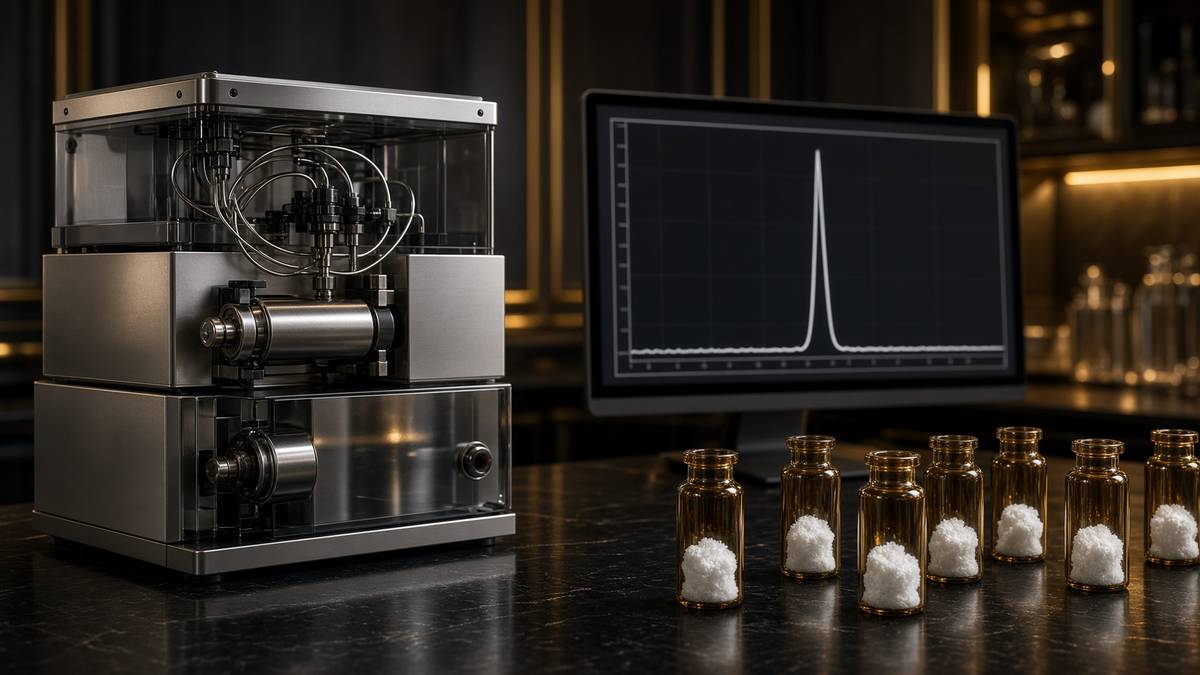
53 min · long read · Peptide research
How research peptides are made — and why HPLC actually matters
Solid-phase peptide synthesis builds a chain one residue at a time. HPLC then asks whether the main peak is what you think it is. ≥98% is not a slogan. It is a chromatogram.
52 min · long read · Peptide research
Fatigue, cellular energy and the NAD+ / MOTS-c neighbourhood
NAD+ is the rechargeable chip every cell spends on fuel and DNA repair — and the pool shrinks with age. MOTS-c is a mitochondrial 16-mer sent out under metabolic stress. Two answers to 'I have no energy' that are not coffee.
51 min · long read · Peptide research
Melanocortin circuits: pigment, appetite and PT-141
Melanotan II lights MC1, MC3, MC4 and MC5 — pigment plus the rest of the sheet. PT-141 is the free-acid cousin pointed at MC3 and MC4, the circuitry papers use for desire and energy, not skin colour. Same Arizona family. Different question.
Essays describe published research. They are not medical advice and they do not authorise human use of any catalogue item.