

Peptide research · 49 min · 10,819 words
Senescent cells refuse to die, and they talk too much
Hayflick watched fibroblasts stop dividing. Campisi named the SASP — the inflammatory letters those arrested cells keep sending. Clearing p16-high cells in mice (INK-ATTAC) delayed aging phenotypes. The pathology is accumulation, not the programme itself.
· updated
What this essay actually tells you
- A senescent cell has stopped dividing (often via p16/p21) but refuses apoptosis and secretes inflammatory cytokines. That's the SASP. Alive, useless, loud.
- Baker, van Deursen and colleagues showed that clearing p16-positive cells in mice (INK-ATTAC) delayed several aging phenotypes. Kill the lingerers, the tissue looks younger. Mice.
- Senescent cells are useful in wound closure and tumour suppression. The problem is when they linger. That's the whole debate, and both halves are true.
What this actually means
A cell that takes too much damage has three options: repair, die (apoptosis), or senesce. Senescence is the third: stop dividing, stay metabolically alive, and secrete a cocktail of cytokines, proteases and growth factors called the SASP. In a young tissue that is a wound-healing and tumour-suppression trick. The arrested cell cannot found a clone, and the SASP recruits a clean-up crew. In an old tissue, senescent cells accumulate and the SASP becomes chronic noise: fibrosis, immune drift, a patch of tissue that ages faster than its genome alone would predict. Hayflick described the arrest in 1961. Campisi named the secretory phenotype that made senescence more than a cell-cycle footnote. Baker, van Deursen and colleagues then built INK-ATTAC mice, in which p16Ink4a-positive cells can be killed on purpose; clearing them delayed several ageing phenotypes (Nature 2011, 2016). Dasatinib plus quercetin is the blunt pharmacological cousin, exploiting senescent-cell anti-apoptotic pathways (SCAPs). None of the catalogue peptides we stock is a senolytic. GHK-Cu's arrays sit, at most, on the senomorphic/repair side of the map: a quieter secretory profile in fibroblasts, not a licence to call a copper tripeptide a senolytic.
A senescent cell has stopped dividing and hasn't died, which is the whole rude fact, and it's older than the word most people now use for it. Leonard Hayflick and Paul Moorhead, writing in Experimental Cell Research in 1961, watched human diploid fibroblasts run through a finite number of doublings and then flatten, enlarge, and refuse further mitosis. The cells were metabolically alive. They consumed glucose. They wrote protein. They wouldn't found a clone. Later work hung two molecular badges on that arrest — p16INK4a, which parks CDK4 and CDK6 so Rb stays on E2F, and p21, a p53 target that parks CDK2 — and then hung a secretome on the same cell. Judith Campisi named that secretome the senescence-associated secretory phenotype: IL-6, IL-8, matrix metalloproteinases, TGF-β neighbourhood signals, a cocktail of cytokines, proteases and growth factors sent to every neighbour still willing to divide. Alive, not cycling, loud. The pathology of ageing isn't the existence of that programme. It's the accumulation of cells that won't leave once the programme has done its useful week.
In short. A senescent cell has stopped dividing, stayed alive, and started sending inflammatory messages to its neighbours. The danger is when those cells pile up.
A cell that takes too much damage has three options, and they aren't synonyms — repair, die, or arrest and stay. It can repair the lesion and re-enter the cycle. It can die on purpose: Bax and Bak pore the outer mitochondrial membrane, cytochrome c leaves, APAF1 assembles the apoptosome, caspases cut, a neighbour eats the corpse, inflammation is limited. Or it can senesce: a durable G1 arrest, often p16 and p21 together, a cell that has left the cycle and won't come back by the same door that a quiescent hepatocyte uses. Quiescence is a reversible exit. Senescence is a pause that stuck. Differentiation is a transcriptional identity, expensive to reverse, which is why induced pluripotent stem cells were a Nobel and not a hobby. Mitosis is two living cells with partitioned genomes. Four or five nouns. A tissue that's healing uses more than one of them in the same week. A caption that says repair, or anti-ageing, without naming which fate moved hasn't yet left marketing. This page is the senescent noun, written at the length you'd want before anyone is allowed to hang a peptide on it.
In short. Damaged cells can fix themselves, die neatly, or arrest and stay. Senescence is the third. Repair without naming which of those happened is just a caption.
We stock GHK-Cu as a characterised copper tripeptide with a fibroblast transcriptome that looks, on older arrays, less fibrotic: collagen up, some matrix metalloproteinases down, superoxide dismutase up. We stock lyophilised β-NAD+ because senescent and inflammatory cells are often CD38-high and the cofactor pool is a neighbouring invoice. We stock Epithalon as a tetrapeptide with a pineal and TERT literature, which is one entrance into replicative arrest and not a way to clear the cell afterwards. None of those listings is a senolytic. A senolytic exploits the anti-apoptotic networks that keep an arrested cell from taking the death it refused — Kirkland’s SCAPs, dasatinib plus quercetin, navitoclax, a FOXO4–p53 peptide in papers. Calling a copper complex a senolytic would be a category error this page won't make. Neighbourhood on a reading list is a courtesy. Identity is a mechanism plus an assay. The rest of this page is the cell-fate floor: Hayflick’s census, Campisi’s mail, the INK-ATTAC mouse, the blunt pharmacology, and the honest distance between those documents and a catalogue vial.
In short. The copper peptide, the NAD+ cake and the tetrapeptide sit near ageing biology. None of them kills senescent cells. This page is that distinction, with the papers named.
The neighbouring cell-cycle essay already put senescence on floor 6 of a stack that starts at the genome and ends at a person who notices. Stay here for the arrested cell as a problem in its own right. Divide, senesce, die, or stay. Those aren't moods. Mitosis is a spindle and a cyclin-B wave. Apoptosis is a mitochondrial pore and a caspase cascade. Senescence is a durable CDK blockade plus, often, a secretome Campisi named, plus a refusal of the apoptotic vote that a damaged cell was supposed to take. Stay, if you're being precise, includes quiescence, which can reverse, and terminal differentiation, which doesn't reverse because you asked nicely. Peptide papers that claim repair are almost always claiming one of those without saying which. The point of writing the secretome, the kill-switch mouse and the senolytic pair at this length is so that when a tripeptide or a tetrapeptide or a dinucleotide is placed next to an aged tissue, you can ask the only grown-up question: which fate, which cell type, which assay, which species. Start with the vial and you're selling the gap as furniture.
In short. The cell-cycle essay put this fate on a floor with mitosis and death. Here the arrested cell is the whole topic, so a ligand has to name the assay it actually moved.
The SASP is how a cell that has stopped dividing keeps ageing the cells that have not. Arrest was the observation. The mail is the problem.
Hayflick counted. The counter was the telomere.
Alexis Carrel had claimed that cultured chick-heart cells were immortal, and Hayflick's argument, which the field eventually accepted, was that Carrel had been feeding living cells in with the medium: a contamination of the census, not a refutation of finite division. Primary human diploid fibroblasts, carefully passaged, without a feeder of fresh cells, run out of doublings. Experimental Cell Research, 1961, Hayflick and Moorhead: a finite proliferative lifespan in culture, classically written later as about forty to sixty doublings because donor age, tissue, and how you count a split all move the integer. The morphology at the stop isn't death. The cells flatten, enlarge, remain metabolically active, and refuse further mitosis. Hayflick didn't have the molecular counter. He had the number. The number is still the finding. Everything that follows — telomeres, shelterin, p53, p16, the SASP — is commentary on a census that was already true in 1961, in a dish, with a haemocytometer and a refusal to accept that the medium was a secret source of new cells.
In short. Hayflick showed in 1961 that human fibroblasts divide a limited number of times and then stop, still alive. Someone had been accidentally adding fresh cells to older cultures.
What you see at the stop, if you bother to look at the dish rather than at a caption, is a population that has become heterogeneous on the way down. Early passages are small, spindle-shaped, cycling. Late passages throw off cells that are larger, flatter, sometimes multinucleated, with more lysosomes, a nucleus that has started to look folded, a cytoplasm that has started to look busy in the wrong way. The colony-forming efficiency falls. The time between splits lengthens. Then the culture sits there, metabolically ticking, and you can keep feeding it for weeks. That's not a corpse. It's also not a working tissue. Hayflick measured doublings, not a vital essence running out. The later molecular account didn't replace the census. It explained why a linear chromosome, copied by a polymerase that needs a primer, can't finish its lagging-strand ends forever, and why a cell that notices those ends has a checkpoint rather than a mystery. Keep the dish in mind when a caption says cellular rejuvenation. Rejuvenation of what, in which passage, counted how.
In short. Late-passage fibroblasts get large and flat and stop making colonies, but they don't die. The culture just sits there. That living stop is the original observation.
Alexey Olovnikov, in 1971 and then 1973, and independently Jim Watson around the same years, named the end-replication problem. DNA polymerase synthesises 5′ to 3′ and needs an RNA primer. On the lagging strand of a linear chromosome the terminal primer leaves a gap that can't be filled. Each S phase, therefore, the end would shrink. That's a counting argument with a polymerase attached, and it's why Hayflick’s integer was never going to be a mystical quota. The cell was spending sequence. Elizabeth Blackburn, Carol Greider and Jack Szostak found the solution that evolution had already written: telomerase, a reverse transcriptase with its own RNA template, adding TTAGGG repeats so the end can be restocked. Nobel Prize in Physiology or Medicine, 2009. Most human somatic cells keep that enzyme transcriptionally off on purpose. Stem cells and the germline keep it on. The purpose of the off-switch is tumour suppression. A cell that can rebuild its telomeres forever is a cell that can become a clone that doesn't stop. Most cancers reactivate TERT or use ALT, a recombination workaround. The bargain is tissue renewal versus neoplastic risk.
In short. Each division trims the chromosome ends. Telomerase can put the DNA back, but most body cells keep that enzyme off so a damaged cell can't grow forever.
Diagram
- Hayflick limit~40–60 doublingsHuman fibroblasts in 1961. They were not immortal. He counted.
- End-replication5–15 kb TTAGGGDNA polymerase needs a primer. The lagging strand shortens. Olovnikov named the problem.
- Shelterin6 proteinsTRF1, TRF2, POT1, TIN2, TPP1, Rap1. The end is hidden from the damage response.
- TERT offmost somatic cellsTumour suppression. Stem cells and germline keep it on. So do most cancers.
- SenescenceSASPp16, p21, the secretome Campisi named. A cell that refuses to die and talks too much.
Blackburn, Greider and Szostak, Nobel 2009. Epithalon’s literature sits on TERT and pineal melatonin — a tetrapeptide claiming two of the rare promoters anyone names in a peptide essay. The machines are real. A large Western RCT of telomere length in adults is not on the shelf next to the vial.
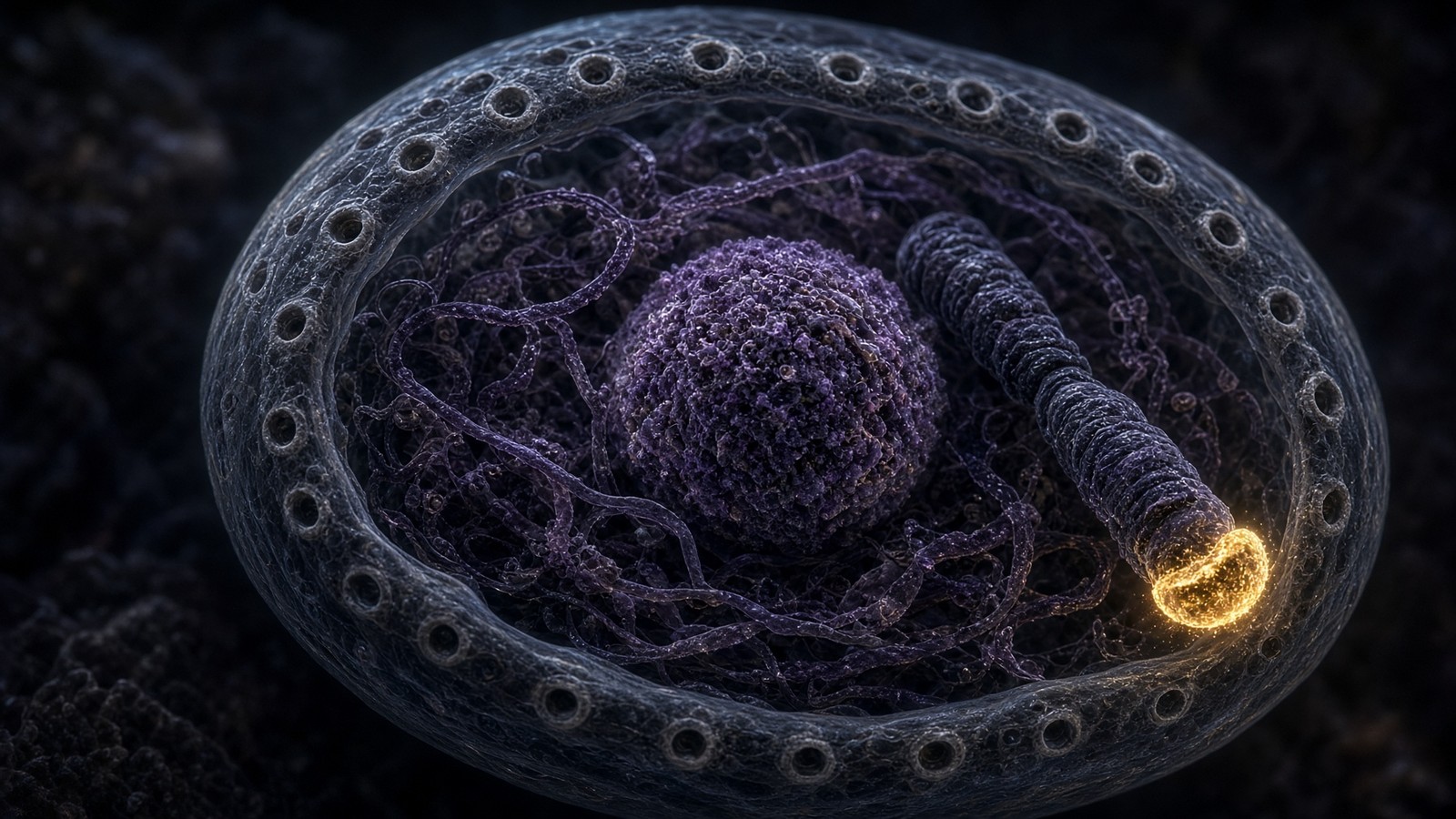
Human telomeres are TTAGGG repeats, typically five to fifteen kilobases at birth in a given cell type, bound by shelterin — TRF1, TRF2, POT1, TIN2, TPP1, Rap1 — and tucked into a t-loop so the 3′ overhang isn't an overhang that ATM would like. Lose TRF2 and you get end-fusions; de Lange’s laboratory spent a career making that geometry undeniable. Each S phase, because of the end-replication problem and because of processing, the repeats shorten. When they are short enough, shelterin can't hide the end, the DNA-damage response treats a chromosome end as a break, ATM and ATR fire, p53 and p21 and often p16 engage, and the cell senesces or dies. Persistent 53BP1 foci at the ends are the Hayflick checkpoint in a picture. That is replicative senescence: a telomere-driven, DNA-damage-response-enforced G1 arrest. It isn't the only road into the same state. It's the road Hayflick was counting without knowing the units. A peptide literature that only ever assays telomere length can miss every other entrance, and an aged tissue has more than one.
In short. When the chromosome caps get too short, the cell treats the end as broken DNA and permanently stops dividing. That is one way to become senescent, not the only way.
That sentence is why Epithalon’s literature is large relative to four residues, and why this essay still won't call the tetrapeptide a senolytic. Khavinson’s school reported that AEDG can move TERT, that TRAP assays in cultured fibroblasts can light up, that telomeres in those cultures can measure longer. Anisimov’s rodent papers sit on lifespan and tumour incidence with epithalamin and the synthetic tetrapeptide. Those are gene-level claims: a promoter, a reverse transcriptase, a pineal melatonin amplitude in the dark. Restocking a cap, if it happened, would be a decision not to enter replicative arrest, which is senomorphic-adjacent at the entrance and is still not clearance of a cell that has already arrived. A TRAP band without a karyotype is an incomplete sentence, because a somatic cell that turned TERT on while p53 was missing would be a clone story, not a youth story. The Epithalon essay holds that claim next to shelterin. This one holds it next to Hayflick and refuses the same inflation. Four residues. A promoter argument. Not dasatinib.
In short. A short peptide studied for telomerase effects would, at most, change the decision to enter this arrest. It wouldn't kill cells that have already stopped.
Two doors into the same arrest, and a third the oncologists already knew
Stress-induced premature senescence can bypass the telomere. Too much reactive oxygen, too much replication stress, a radiation dose, a chemotherapeutic that left survivors, a mitochondrion that won't be quiet: the DNA-damage response still fires, p53 and p16 still engage, the cell still arrests, and it can still write a SASP. The insult wasn't a short end. Toussaint and colleagues spent the 2000s putting hydrogen peroxide and other stressors onto fibroblasts and watching a Hayflick-shaped morphology appear in a week instead of in fifty doublings. The markers overlap and aren't identical. Telomere-associated foci are the replicative signature. A pan-nuclear γH2AX hailstorm after a millimolar peroxide pulse is a different picture that can resolve into the same fate. That distinction is why a peptide literature that only ever assays telomeres can miss the larger senescent burden in an aged kidney or a fat pad. It's also why NAD+ salvage sits next door. A consumed cofactor pool, a PARP1 burst, a CD38-high immune neighbour: those are clocks, and they aren't the telomere clock, and they can still deliver a cell to p16.
In short. Cells can also arrest because of chemical stress, radiation or a sick mitochondrion, without waiting for their chromosome caps to run out. Aged tissue uses more than one door.
Oncogene-induced senescence is the safety catch the tumour biologists named first. Serrano, Lin, McCurrach, Beach and Lowe, Cell 1997: oncogenic Ras, in a cell that still has p53 and p16INK4a, provokes a premature arrest rather than a clean transformation. Too much Myc, via ARF, can do a similar favour, or trip apoptosis, depending on the cell. The 9p21 locus that encodes p16 also encodes ARF from an alternate reading frame; the locus is a tumour-suppressor neighbourhood that senescence and apoptosis both use. Lose p16 or p53 and the catch is gone, which is why that locus is deleted or silenced in a depressing fraction of human cancers. Therapy-induced senescence is the cousin oncologists already knew without always using the word: some chemotherapies and some radiotherapies leave a residue of arrested, SASP-writing cells in the treated field. Those cells can hold a tumour in check for a time. They can also nurse a relapse. The field is still arguing about whether to clear them, and when. Three doors, one furniture set: p16, p21, a durable G1, a secretome. Collapse them into ageing as a single knob and you get a supplement aisle.
In short. A cancer gene that fires too hard can force a cell to arrest instead of founding a tumour. Some cancer treatments leave the same arrested cells behind. Several roads, one stop.
The doors matter for any later pharmacological sentence. A senolytic doesn't care, in principle, how the cell arrived, so long as the anti-apoptotic crutches it now leans on are the ones the drug occupies. A TERT claim cares a great deal how the cell arrived, because restocking a telomere will not, even in principle, reverse an arrest that was written by Ras or by a platinum adduct. A copper-tripeptide transcriptome that looks less fibrotic cares about the secretome, not about the telomere, and not about BCL-2. Three jobs. An aged dermis, a stiff kidney, a visceral fat pad, will contain a mixture of arrivals, which is why a single-mechanism caption applied to ‘senescent cells’ as a pool is already a simplification. The INK-ATTAC mouse, later, kills on p16 transcription, which is a marker that several doors can light. That's a feature of the tool and a limit of the interpretation. Name the door when you can. Name the marker when you can't. Do not name a peptide as if it were a door.
In short. Drugs that kill arrested cells don't much care how the cell got there. A telomerase claim does. Real tissue is a mixture, so one caption is already too simple.
p16, p21, and a G1 that will not reverse by the same door
p16INK4a is the INK4-family inhibitor that binds CDK4 and CDK6 and keeps cyclin D from completing the handshake that would phosphorylate Rb. Rb, while hypophosphorylated, holds E2F transcription factors and keeps S-phase genes off. A cell with p16 on is a cell that has closed the G1 restriction point from the kinase side. The protein accumulates with chronological age in many mammalian tissues; Krishnamurthy, Sharpless and colleagues made that a quantitative observation, not a rumour, and the INK-ATTAC design later used the p16Ink4a promoter as a handle on the cells that had lit the gene. p16 is a senescence marker when it stays on, a tumour suppressor when it's deleted, and a reason CDK4/6 inhibitors such as palbociclib exist as licensed medicines in hormone-receptor-positive breast cancer. That last sentence is a medicine-class fact, not a catalogue neighbour. We don't stock a CDK4/6 inhibitor. We stock ligands that occupy other floors. When a chemist actually wants to stop G1, they occupy the kinase. When a caption wants to say regeneration, it occupies a feeling. Feelings don't phosphorylate Rb.
In short. p16 is a brake that stops the enzymes a cell needs before it copies its DNA. The brake comes on with age. Cancer drugs can occupy the same enzymes. A research peptide doesn't.
p21, the product of CDKN1A, binds cyclin–CDK complexes, especially CDK2, and can arrest G1 or G2. It's a p53 target, so a p21 induction after damage is often a p53 signature — not always, because p53-independent routes to p21 exist, including some TGF-β neighbourhoods. A cell with p21 on and p16 off may still reverse; a cell with p16 on is closer to the senescence that doesn't reverse by the same door. The two brakes aren't redundant. p53–p21 is the acute damage response, minutes to hours, a pause that can still become repair or apoptosis. p16 is the slower, often more durable latch, the one an oncogene-stressed cell and a telomere-exhausted cell both tend to throw. SA-β-gal, the blue stain at pH 6, is a lysosomal β-galactosidase activity, useful and imperfect: late-passage cells light up, some non-senescent cells with fat lysosomes also light up, and a write-up that reports only the blue hasn't yet done senescence. Put p21, p16, SA-β-gal, a SASP cytokine, lamin B1 loss, and a lack of Ki-67 on the same figure and you may say the word.
In short. p21 is a faster brake, often written by p53 after damage. p16 is the slower latch. One blue stain isn't enough to call a cell senescent. Use several marks together.
The rest of the marker set earns its keep because no single stain is a fate. Lamin B1 is lost from the nuclear lamina of many senescent cells; Freund, Campisi and colleagues put that on the map, and a lamin B1 drop is now a common companion blot. HMGB1, a nuclear alarmin, relocates to the cytoplasm and then to the medium; Davalos and Campisi made that a SASP-adjacent fact. Persistent DNA-damage foci, 53BP1 and γH2AX at telomeres or at unresolved breaks, are the checkpoint still shouting. Heterochromatin foci (SAHF) appear in some human senescent cells and not in all mouse ones, which is why a mouse paper that skipped them isn't necessarily lying. Lipofuscin dyes, including the commercially convenient Sudan-Black-derived probes, stain the rubbish a long-lived lysosome has hoarded. Flow cytometric combinations exist. Spatial transcriptomics is starting to find p16-high cells in human tissues without dissociating them into a lie. Pick the panel that matches the claim. A Ki-67-negative cell isn't senescent; it might be quiescent, differentiated, or dead. A p16-high cell in a human biopsy is a candidate, not a conviction. Senescence is a diagnosis with several clauses.
In short. No single stain proves the state. Lost nuclear lamina, DNA-damage spots, a missing division marker and the secreted signals together make the case.
People use old, damaged, tired and senescent as if they were one word. They're not. Mitosis is two living cells. Apoptosis is a living cell becoming a corpse on purpose, tidy, usually unnoticed by the innate immune system. Senescence is a living cell that has stopped dividing and often started secreting, metabolically active, resistant to apoptosis in many tissues, a problem for the neighbours. Quiescence is a living cell that has left the cycle and can come back when mitogen and space say so — a satellite cell, a hepatocyte after partial hepatectomy, a memory lymphocyte. Differentiation is a living cell that has locked an identity. Four or five nouns, already named above, and they still get mashed because ageing as a product category wants one knob. A senescent fibroblast in a seventy-year-old dermis isn't an old fibroblast in the sense of a calendar. It's a cell that took a fate. Some of its neighbours, same calendar, are still cycling, still quiescent, still doing their jobs. Chronological age of the organism and senescent fraction of a tissue are correlated and aren't identical. The INK-ATTAC results, later, are what made that distinction causal rather than poetic.
In short. Senescent doesn't mean old. Some cells in young tissue arrest; many cells in old tissue have not. Age of the body and this cell fate are related, not the same thing.
Campisi named the mail
Arrest was the observation. What Campisi added is ruder. The arrested cell doesn't go quiet. Coppé, Patil, Rodier, Campisi and colleagues, PLoS Biology 2008, made the senescence-associated secretory phenotype a measurable object rather than a mood: conditioned media, antibody arrays, the demonstration that senescent fibroblasts can change the behaviour of neighbours, including epithelial cells that were considering becoming a tumour. The cocktail is context-dependent and still has a core. IL-6 and IL-8 are the cytokines everyone can quote. CXCL1, CXCL2, MCP-1 sit next to them. Matrix metalloproteinases — MMP-1, MMP-3, MMP-10 in many fibroblast SASPs — chew extracellular matrix. TGF-β family members, sometimes activin, lean the neighbourhood toward fibrosis. VEGF appears in some lists. Inhibin, IGFBPs, GM-CSF, a spreading set of alarmins. Early SASP can be TGF-β-leaning and more autocrine, a way for the arrest to reinforce itself. Later SASP is often more inflammatory, NF-κB-heavy, a paracrine problem. A wound wants that letter for a week. A seventy-year-old dermis, a stiff kidney, a fat pad full of p16-high cells, wants it to stop.
In short. Arrested cells keep sending a mix of inflammatory signals, matrix-cutting enzymes and growth factors. That mail helps a wound for a week and harms a tissue that can't turn it off.
Diagram
Closed chromatin (H3K27me3, DNA methylation) hides the promoter. Pioneer factors and histone acetyltransferases open it.
PIC: TFIID, TFIIH, Mediator, Pol II. Ser5 phosphorylation of the CTD lets the polymerase leave the promoter.
Elongation ~20–40 nt/s. Capping, splicing, cleavage and polyadenylation happen on the still-growing RNA.
Human genes are islands in 3.1 billion base pairs of mostly noncoding sequence. Promoter, enhancers, chromatin state and the Mediator complex decide whether Pol II is allowed to fire. Epithalon’s literature sits on TERT and pineal clocks — two of the rare promoters anyone bothers to name in a peptide essay.
The SASP is written, which is why a transcription diagram belongs on this page. NF-κB is the inflammatory workhorse; Chien, Campisi and others showed that silencing it in senescent cells collapsed a large fraction of the cytokine output without lifting the arrest. C/EBPβ sits on IL-6. GATA4, stabilised when p62-dependent autophagy of it fails, is another SASP driver in the Campisi neighbourhood. mTOR licences the translation of selected SASP transcripts; Laberge, Campisi, 2015, is why rapamycin reduces IL-6 output from senescent cells and became the textbook senomorphic example. p38 MAPK is a crucial regulator. The cGAS–STING path, once cytoplasmic DNA from a damaged nucleus or a mitochondrion is noticed, feeds the same inflammatory transcription. None of that's a leak from a broken cell. It is polymerase, chromatin, a kinase, a cytokine gene. A copper-tripeptide microarray that moves MMP-1 and collagen is sitting on this floor as a hypothesized counter-secretome, which is a transcriptional claim, not a kill-switch. Rapamycin sitting on mTOR is a pharmacological occupancy of the same floor. Occupancy, here, means a drug at a kinase, not a brand word. Name the promoter or sit down.
In short. The inflammatory mix is made on purpose by gene-reading machines inside the arrested cell. Quiet those machines, or kill the cell. Those are different jobs.
Paracrine consequences are why a cell-fate floor has a tissue-floor megaphone. Conditioned medium from senescent fibroblasts can push pre-malignant epithelia toward invasion, which is the Coppé result people remember, and can also reinforce senescence in neighbours via IL-8 and CXCR2, which is the Acosta and Gil result, a chemokine loop that makes the arrest contagious in the useful sense and the dangerous one. Stem-cell niches hear the mail as a reason to stop feeling like niches: too much IL-6, too much TGF-β, a hematopoietic stem cell that plates less well, a satellite cell that won't activate. Matrix that has been chewed by MMP-1 is a wrecked mechanical environment that tells surviving fibroblasts, via integrins, to behave worse — the same wreck photoageing already knew from Fisher and Voorhees. Fibrosis is a SASP that leaned TGF-β for too many months. Immune cells are recruited, and then, in aged tissue, often fail to clear the sender, which is how a temporary wound programme becomes a chronic infiltrate. The cell is the unit. The tissue is what a person can point at. Skip the unit and you write a cream. Skip the tissue and you write a blot that won't matter.
In short. The messages change neighbours: they can spread the arrest, spoil stem-cell niches, chew matrix and call in immune cells. A person feels the tissue, not the single cell.
A wound wants a week. Ageing wants them gone.
Demaria, Ohtani, Desprez, Campisi and colleagues, Developmental Cell 2014, put a number on the useful half. Senescent fibroblasts and endothelial cells appear at wound sites; they secrete PDGF-AA among other things; mice in which those cells can be cleared show delayed wound closure. Optimal healing, in that paper, wanted the arrested cell for a few days. Clear them too early and the granulation tissue is poorer. Leave them forever and you have a different paper, a fibrosis paper, a diabetic-ulcer paper, a radiation-field paper. Development uses the same trick: senescent cells help to pattern some embryonic tissues and then they are cleared. The placenta has a senescent conversation. A temporary SASP is a tool evolution already reached for. The pathology isn't the tool. The pathology is a tool that won't put itself back in the box, because the immune clearance that works in a young wound — macrophages, natural killer cells, a coordinated phagocytosis of the sender — works less well in an old fat pad. Both halves are true. Write senescent cells as villains only and you've skipped the wound paper. Write them as friends only and you've skipped the INK-ATTAC paper.
In short. Wounds heal better if some arrested cells are present for a few days and then cleared. In old tissue the clearance step fails, and the same cells overstay.
Why the clearance step fails is an immunology problem sitting on a cell-fate problem, and it belongs here so accumulation doesn't look like a mysterious fog. Natural killer cells and macrophages can recognise senescent cells — NKG2D ligands, a changed surface, a SASP that's also a recruitment signal — and eat them. Pereira, Muñoz-Espín and others have been putting names on the handshake and on the ways the handshake fails with age. HLA-E on some senescent cells engages NKG2A and dampens NK killing; a senescent cell that has already refused the apoptotic vote can also refuse the immune one. Aged macrophages phagocytose less well. The SASP recruits, and then, in an old fat pad, often fails to finish the job, which is how a temporary wound programme becomes a chronic infiltrate. Senolytics, on this reading, are a pharmacological attempt to do the killing the immune system stopped doing. That's a research reading, not a licence to skip immunology. A peptide that ‘modulates immunity’ in a caption hasn't yet named NKG2D, HLA-E, or a phagocytosis assay, and until it has it's still a caption. The lingerers linger because two death routes were declined.
In short. Immune cells can find and eat arrested cells after a wound. In older tissue that clean-up slows, and the arrested cells stay. Drugs that kill them are trying to finish that missed job.
Tumour suppression is the other useful half, and it isn't a metaphor. An oncogene-stressed cell that senesces hasn't founded a tumour. p16 and p53, the brakes already named, are among the commonest losses in human cancer precisely because that catch works until it's shot. The SASP complicates the morality: the same secretome that can recruit an immune clearance of a pre-malignant neighbour can, in a different context, nurse invasion, angiogenesis and a stroma that a carcinoma likes. Coppé’s senescent fibroblasts didn't do one thing to epithelia. They did context. Therapy-induced senescence, already mentioned, sits on this knife-edge every time a medical oncologist gives a drug that arrests more than it kills. Clear every senescent cell in a wound and healing can go worse. Clear every senescent cell in a field that's holding a damaged clone and you might, in principle, either prevent a relapse or remove a restraint. Timing is the whole problem, and the field still argues about how much clearance is too much. Blanket clearance as a wellness idea is how a serious mouse tool becomes a brochure. Timed clearance as a research programme is how the 2011 paper earned its keep.
In short. Arrest stops a damaged cell founding a cancer, which is useful. The messages it then sends can help or harm, depending on when and where. Timing is the whole fight.
Accumulation is the pathology. That sentence is the one this page will keep. Young tissue has senescent cells; they appear, they do a job, they are cleared. Old tissue has more of them, in more postcodes, for longer, and the mail has become chronic noise: fibrosis, immune drift, a patch of tissue that ages faster than its genome alone would predict. Franceschi’s inflammageing is, in part, this sentence at organism scale — a chronic, sterile, cytokine-tinged state that tracks age and tracks morbidity — though inflammageing has other sources too, including the bone marrow, the gut, visceral fat as an endocrine organ, and a thymus that involuted on schedule. Senescent cells are one sender. They're not the only sender. A paper that attributes every IL-6 rise in an eighty-year-old to p16-high fibroblasts hasn't met a macrophage. A paper that ignores p16-high fibroblasts because macrophages exist hasn't read Baker. The honest inventory is plural. This page owns the senescent sender. The NAD+ essay owns a drain that inflammation and senescent-adjacent immune cells both open. Keep the jobs on separate lines even when the tissue is the same.
In short. Young tissue uses these cells and then removes them. Old tissue keeps too many, for too long. They are one source of chronic inflammation, not the only source.
Diagram
01 Genome
Variant, CNV, methylation, telomere length
The script. Most of it never becomes a phenotype you can bill for.
02 Transcriptome
Which genes are on, splice isoforms, noncoding RNA
The script being read this hour. A cell type is a transcriptome.
03 Proteome
Abundance, PTMs, localisation, complexes
The machines. Phosphorylation can flip a pathway without new DNA.
04 Metabolome
NAD+/NADH, ATP/AMP, acetyl-CoA, ROS
The fuel gauges. They feed back onto the genome through sirtuins and chromatin.
05 Organelle
Mitochondria, ER stress, lysosome, nucleus
Compartments fail as units. A tired mitochondrion is a tired cell.
06 Cell fate
Proliferation, senescence, apoptosis, identity
Hayflick, SASP, p53. The cell decides whether to keep being a citizen.
07 Tissue
Inflammation, fibrosis, barrier, innervation
Where a person actually hurts. Collagen, endothelium, synapses.
08 Organism
Glucose curve, VO₂, sleep, fertility, lifespan
The readout. Everything above is allowed to be invisible until it isn’t.
Pathophysiology is this stack, not a single molecule. A research peptide occupies one node — a receptor, a cofactor, a cytoskeletal motif — and the rest of the stack is still running. That is why ‘what does it do?’ is a bad question and ‘where does it bind?’ is a good one.
Name the postcodes, because senescence as a systemic fog is how a tissue fact becomes a caption. Dermis: photoaged skin is MMP-1, fragmented type I collagen, p16-high fibroblasts, a SASP that looks a lot like the Coppé cocktail, which is why GHK-Cu’s arrays sit next door as a hypothesized counter-secretome and still aren't a senolytic. Visceral adipose tissue: p16-high cells, a macrophage infiltrate, insulin resistance that improved in some mouse clearance experiments, Kirkland and Tchkonia’s neighbourhood. Kidney: tubular and interstitial senescence, a fibrosis conversation, one of the INK-ATTAC phenotypes that moved. Joint: senescent chondrocytes and synovial cells in osteoarthritic models, a reason some senolytic trials picked osteoarthritis and then had to survive contact with human endpoints. Heart: senescent cardiomyocytes are rarer; senescent endothelial cells and fibroblasts are not, and cardiac stress tolerance was on the 2011 list. Atherosclerotic plaque has a senescent endothelial and macrophage conversation. Brain: senescent-like glia, a messier marker problem, a field that shouldn't be allowed to use SA-β-gal alone. Each postcode is an assay. ‘Ageing’ is not.
In short. Different organs carry these cells in different places: skin, fat, kidney, joint, vessel. Each site needs its own measurement. Ageing as one fog is a caption.
- Hayflick count
- ~40–60 doublings
- Telomere
- 5–15 kb at birth
- SASP core
- IL-6, IL-8, MMPs
- INK-ATTAC
- Nature 2011 / 2016
- SCAPs
- BCL-2, PI3K/AKT, HSP90
- D+Q
- dasatinib + quercetin
- GHK-Cu
- not a senolytic
- Catalogue peptides
- not senolytics
Human diploid fibroblasts, 1961. Donor age and tissue move the integer. The stop is senescence.
TTAGGG, shelterin, t-loop. Too short, and ATM treats the end as a break.
Coppé, Campisi, 2008. Context adds TGF-β, VEGF, activin, chemokines. Early versus late lists differ.
p16Ink4a promoter, caspase kill-switch, AP20187. Mice. Delayed ageing phenotypes, not a human licence.
The crutches that keep an arrested cell from taking apoptosis. Senolytics occupy these, not p16 itself.
Zhu, Kirkland, Aging Cell 2015. A leukaemia kinase inhibitor plus a flavonoid. Trials are small.
Copper tripeptide, Pickart arrays, senomorphic-adjacent at most. Different job from D+Q.
NAD+ is a cofactor. Epithalon is telomere-adjacent. Neither clears p16-high cells.
INK-ATTAC: a kill-switch under p16, then a healthier mouse
Darren Baker, Tobias Wijshake, Jan van Deursen, James Kirkland and colleagues, Nature 2011, built a mouse in which the p16Ink4a promoter drives a transgene they called INK-ATTAC: a FKBP–caspase-8 fusion that dimerises and kills the cell when you give AP20187, a small-molecule dimeriser with no other job in this story. In BubR1-hypomorphic progeroid mice, clearing p16-positive cells delayed several ageing phenotypes: cataracts, sarcopenia-adjacent muscle, a fat depot that looked less like an old fat depot. The cells weren't mere markers. Removing them moved the organism. That's the cleanest causal sentence the field has, and it's a mouse sentence. The design kills on p16 transcription, which is a handle, not a complete definition of senescence; some senescent cells are p16-low and p21-high, some p16-high cells may not be fully senescent, and a promoter fusion will have a false-positive and a false-negative rate like every other tool. Hold those limits. The result still stands. p16-high cells, in that organism, drove phenotypes people care about. Markers that you can delete and then watch the phenotype recede are no longer just markers.
In short. Researchers put a kill-switch behind a gene that senescent cells turn on. When they killed those cells in mice, several signs of ageing slowed. That is cause, in a mouse.
The 2016 follow-up, Baker, Childs, van Deursen, Nature again, took the same switch into naturally aged mice rather than a progeroid shortcut. Median lifespan moved. Healthspan assays moved: cataracts, kidney function, cardiac stress tolerance, a coat that looked less like an old mouse, exploratory behaviour in some tests. Not every ageing phenotype moved, which is itself data. Senescent cells aren't the whole of ageing. They're a driver of some of it. Clearing them from midlife, in that design, was more useful than clearing them from a mouse that was already at the far end, which is a timing result the wellness industry skipped and the paper did not. Subsequent tissue-specific and disease-model clearance papers — adipose, atherosclerosis-adjacent, osteoarthritis-adjacent, tauopathy-adjacent in some hands — populated a map that's still being argued, paper by paper, with the usual mixture of robust results and underpowered ones. The 2011 and 2016 pair remain the papers you should actually read before a senolytic headline. Mice. Transgenic kill-switch. AP20187 isn't a medicine. The causal claim is still the one the field cites.
In short. A later mouse study, in ordinary old animals rather than a premature-ageing strain, found a longer healthier life after the same clearance. Not every ageing trait moved.
The 2011 mouse wasn't an ordinary old mouse, and that fact belongs next to the causal claim so the claim stays the right size. BubR1 is a spindle-assembly-checkpoint protein; hypomorphic BubR1 mice age fast, accumulate p16-high cells early, and die early. That's a progeroid shortcut, useful because you can ask a clearance question in months rather than in three years, and limited because a checkpoint-weak mouse isn't a seventy-year-old human. Baker’s design was: if p16-high cells are drivers in this accelerated model, killing them should recede some of the acceleration. It did, for some phenotypes. The 2016 paper then paid the three-year cost in wild-type animals and still saw a healthspan and a median-lifespan move, which is why the pair is cited together. A sceptic can still say that p16 transcription is a handle, that some senescent cells were missed, that some p16-high cells weren't senescent, and that a caspase fusion is a cruder death than a drug will ever be. All of that can be true and the causal sentence still stands. Shortcuts are how you get to the expensive experiment. They're not the expensive experiment.
In short. The first kill-switch mice aged too fast because of a checkpoint defect. The later paper used ordinary old mice and still saw a benefit. Shortcut first, then the slower test.
Translating a transgenic kill-switch into a drug is the next, harder act, and honesty about that gap is the difference between a journal and a forum. AP20187 only works because the mouse was engineered to listen to it. A human doesn't carry INK-ATTAC. A human carries p16-high cells, a SASP, SCAPs, and a liver that will have opinions about whatever you swallow. The pharmacological idea is to find a vulnerability the engineered caspase was exploiting in a cruder way: senescent cells, having refused apoptosis, up-regulate the networks that keep them from reversing that refusal. Hit those networks harder than a normal cell can tolerate, and the arrested cell dies, and the cycling neighbour, in a lucky therapeutic window, doesn't. That is senolysis as a strategy. It isn't a completed medicine. It isn't a licence to treat ageing as an indication, which regulators haven't granted and which this catalogue isn't about to imply. The mouse said the cells were causal. The clinic, where it exists at all, is small, indication-specific, and early. Collapse those two sentences and you've skipped the consent form.
In short. The mouse switch isn't a human drug. The hope is to find a weakness only the arrested cells lean on. That work is early, and ageing isn't a licensed disease here.
Clearance of p16Ink4a-positive senescent cells delays ageing-associated disorders. The sentence is a mouse sentence. It is also, as of 2011, no longer a metaphor.— Baker DJ, Wijshake T, Tchkonia T, LeBrasseur NK, Childs BG, van de Sluis B, Kirkland JL, van Deursen JM. Nature. 2011; 479: 232–236.
SCAPs, D+Q, and the difference between killing and quieting
Why does a senescent cell refuse apoptosis in the first place? Because the same damage signals that wrote the arrest would, in another cell, have written death. The DNA-damage signals that wrote the arrest are the same class of signals that, in another cell, would have written PUMA and NOXA and opened Bax/Bak pores. The arrested cell has, instead, up-regulated a set of senescent-cell anti-apoptotic pathways, SCAPs in Kirkland’s vocabulary: BCL-2 family guardians (BCL-2, BCL-xL, BCL-W, sometimes MCL-1), PI3K–AKT, tyrosine-kinase dependence, HSP90, p21 itself in some contexts, a dependence that's a vulnerability. Zhu, Tchkonia, Kirkland, Aging Cell 2015, is the paper that turned that observation into a drug screen: dasatinib, a tyrosine-kinase inhibitor licensed for certain leukaemias, plus quercetin, a flavonoid that hits PI3K among other things, cleared senescent cells in culture and in mice with a selectivity the screen was designed to find. The pair is blunt. Dasatinib isn't a geroprotector by training; it's a BCR-ABL drug with pleural-effusion baggage. Quercetin isn't a precision ligand; it's a polyphenol with a dozen reported targets. Together, in the papers, they hit SCAPs that senescent cells lean on more than their neighbours do. That's the idea. Blunt isn't a synonym for fake.
In short. Arrested cells stay alive by turning up survival pathways that damaged cells would normally use to die. A leukaemia drug plus a plant flavonoid can knock those crutches away.
Diagram
A growing mammalian cell turns over a few percent of its proteome per hour. 10 billion proteins is a warehouse with a shredder on the floor, not a museum. Ageing is partly what happens when the shredder slows and the warehouse fills with unfolded inventory.
Hershko, Ciechanover, Rose — Nobel 2004. E1 activates, E2 conjugates, E3 selects the victim. K48-linked chains go to the 26S proteasome; K63 is more often a signal. Autophagy handles the organelles the proteasome cannot swallow. mTOR vs AMPK is the appetite switch.
Ubiquitin belongs on this page because the apoptotic vote is, among other things, a proteostasis vote. MCL-1 is turned over quickly by the proteasome; park the barrel, or park the E3 that sentences MCL-1, and a cell that should have died becomes harder to kill. BCL-2 family proteins sit at the outer mitochondrial membrane as guardians against cytochrome c release; BH3-only proteins occupy them; Bax and Bak make the pores. Hershko, Ciechanover and Rose, Nobel 2004, gave us the tag. The senescent cell is a cell that has biased that machinery toward stay-alive, which is why navitoclax (ABT-263), a BCL-2/BCL-xL inhibitor, works as a senolytic in some models and thrombocytopenia in people, because platelets need BCL-xL. FOXO4-DRI, Baar, de Keizer, Cell 2017, is a peptide that, in papers, disrupts a FOXO4–p53 nuclear complex senescent cells lean on, so p53 can leave the nucleus and help the mitochondrial death the cell had been postponing. A research ligand. Not a catalogue claim of ours. The ubiquitin diagram is the intracellular half of a fate the SASP then broadcasts. GHK-Cu isn't on this diagram. Neither is NAD+. Neither is Epithalon.
In short. Cells tag unwanted proteins for destruction. Senescent cells keep the tagged survival proteins instead of dying. Some experimental drugs push that vote back toward death.
The rest of the first-generation list is a similar mixture of borrowed drugs and experimental ligands. Fisetin, another flavonoid, senolytic in some mouse tissues in Yousefzade, Kirkland and colleagues’ hands, oral, messy target-wise, a nutraceutical-adjacent reputation you shouldn't lean on. HSP90 inhibitors, in some screens. Cardiac glycosides, in others, a reminder that a hit can be a toxin with a window. CAR-T cells aimed at senescent-cell surface markers — uPAR was one published handle — are an immunotherapy idea, not a peptide idea, and they bring cytokine-release risk into a conversation that was already about cytokines. A BCL-xL-selective PROTAC is an attempt to spare platelets. The list will lengthen. The category remains: occupy a SCAP, kill the cell, spare the neighbour if the window is real. Senomorphics are the other category, and they aren't a milder senolytic. They aim at the SASP without killing the sender. Rapamycin reducing IL-6 output is the textbook example, an mTOR occupancy, not a recommendation and not a catalogue listing. Metformin’s inflammatory literature is sometimes filed here and is a different, messier object. Keep kill and quiet as two verbs.
In short. Other experimental killers exist, some borrowed from cancer care. A second class of drugs tries only to hush the inflammatory mail. Killing and hushing aren't the same job.
Human D+Q studies are small, indication-specific, and not an anti-ageing licence. Justice, Kirkland and colleagues, EBioMedicine 2019, gave dasatinib plus quercetin to people with idiopathic pulmonary fibrosis; physical function moved a little in an open-label cohort, the disease wasn't reversed, n was small. Hickson, Kirkland, EBioMedicine 2019, gave the pair to people with diabetic kidney disease; senescent-cell markers in adipose and skin fell, a proof-of-concept that the blunt pair can move a human marker, not a licence to treat ageing. Subsequent trials have picked osteoarthritis, Alzheimer’s-adjacent indications, survivors of childhood cancer, a spreading set of bets, some randomised, most still early. Navitoclax’s thrombocytopenia is a reminder that a SCAP can be a normal cell’s crutch too. FOXO4-DRI hasn't become a medicine. Fisetin trials exist and have not, at the time of writing, rewritten gerontology. Read the n. Read whether the trial was blinded. Read whether the endpoint was a marker or a function. Then read the INK-ATTAC papers again, because the mouse is still cleaner than the clinic, and pretending otherwise is how a Nature figure becomes a supplement stack.
In short. A few small human studies of the drug pair moved some markers and some function in specific diseases. They didn't produce a pill for ageing, and the numbers were small.
What the catalogue is not
GHK-Cu is glycine-histidine-lysine holding Cu²⁺, Pickart’s plasma tripeptide, a copper chaperone for lysyl oxidase and SOD1 with a 2000s fibroblast microarray literature. Collagen transcripts up, TIMP up, MMP-1 and MMP-3 down, SOD up, a repair-shaped spreadsheet. If that transcriptional claim survives RNA-seq with copper-matched controls, it would sit next to the SASP as a hypothesized counter-secretome: a fibroblast asked to shut up and rebuild matrix rather than chew it. That is senomorphic-adjacent at most, a conversation-room claim, a reason to blot MMP-1 and IL-6 in a dish that already has a senescent neighbour. It doesn't occupy a SCAP, and it isn't dasatinib, navitoclax, or FOXO4-DRI. Calling GHK-Cu a senolytic would be a category error we won't make, and stacking the words because both appear in ageing reviews is how a literature gets muddy. Copper delivery to a matrix enzyme is already interesting. A cream with an anti-ageing caption isn't this vial, and this vial isn't a kill-switch. Pickart’s arrays are a map of what to blot. They're not a licence.
In short. The copper tripeptide may push a fibroblast toward rebuilding matrix rather than chewing it. That's not the same as killing the arrested cell. Do not mix the jobs.
Pickart reported plasma GHK at roughly 200 nanograms per millilitre at age twenty and about 80 nanograms per millilitre at age sixty. Those are his numbers, a named measurement from the laboratory that isolated the peptide, not a multi-centre reference interval, and they are still worth holding because they put a clock on a circulating ligand rather than a rumour. A falling plasma tripeptide isn't a senescent-cell count. It isn't p16 immunohistochemistry. It isn't a SASP multiplex. Restoration stories write themselves from the arithmetic, and most of them should be sent back. Restoring a circulating copper ligand isn't the same work as restoring a dermis, and it's certainly not the same work as clearing a p16-high fat pad. Ageing changes a thousand other plasma peptides. GHK is the one this catalogue can name, weigh, and complex with a metal. The senescence literature can sit it next to MMP-1 and collagen as a hypothesized counter-secretome. It can't sit it next to dasatinib. A falling number is a reason to look. The look has to be an assay with copper stoichiometry declared, a cell type named, and a readout that isn't a photograph of someone’s cheek.
In short. Blood levels of this copper peptide appear to fall with age. That's a reason to study the ligand, not a proof that adding it back clears senescent cells.
NAD+ salvage sits next door because senescent and inflammatory cells are often CD38-high and NAD+-hungry, and a consumed cofactor pool is a different clock from a consumed telomere. Camacho-Pereira, Verdin, Cell Metabolism 2016, put CD38 on the age-associated drain. Sirtuins still want the dinucleotide. PARP1 still spends it at breaks. The 1000 mg cake we stock is lyophilised β-NAD+, the intact cofactor for assays, not a senolytic, not a senomorphic, not a protocol for clearing p16-high cells. Raising a cofactor pool might, in principle, change how a sirtuin talks to a FOXO or to PGC-1α in a cell that isn't yet senescent. It will not, except in a brochure, substitute for INK-ATTAC. MOTS-c, the mitochondrial 16-mer, is a further neighbour on the energy campus and is equally not a senolytic. Three floors: fate, cofactor budget, mitochondrial peptide. A stack that treats them as interchangeable anti-ageing juice hasn't named a mechanism. We'll sell you the named objects. We won't design the blot that pretends they are one juice.
In short. Old and inflamed cells often burn through NAD+. Refilling that helper molecule is a different experiment from killing senescent cells. Same ageing conversation, different invoice.
Epithalon is Ala-Glu-Asp-Gly. The Khavinson literature sits on TERT transcription and nocturnal melatonin — a gene-level claim about a tetrapeptide, which this journal already refused to inflate into a cyclin, a CDK inhibitor, or a human telomere trial. Replicative senescence is one door. Restocking a telomere, if a TRAP assay and a karyotype ever said it happened cleanly, would be a decision at that door, not a clearance of cells that entered through Ras, peroxide, or a platinum adduct, and not a senolytic of the cells already sitting in a seventy-year-old fat pad writing IL-6. Pineal amplitude is a third conversation, circadian, AANAT, darkness. Three neighbouring literatures. One tissue-level problem. None of those vials is dasatinib. An email that asks for a senescence stack of GHK-Cu, NAD+ and Epithalon is an email that hasn't yet named a fate, a drain, or a door. Name one. Then pick the characterised ligand that actually sits on it. The journal’s job is to keep them unscrewed.
In short. The four-amino-acid peptide is studied for telomeres and for the pineal clock. Neither job is senolytic. Do not bottle three different mechanisms as one ageing stack.
Diagram
| Node | Catalogue | Conversation |
|---|---|---|
| GPCR | Ipamorelin, MT2, PT-141, retatrutide, CJC | Second messengers, secretion, appetite, pigment |
| RTK / IGF1R | IGF-1 LR3 | IRS–PI3K–Akt–mTOR and Shc–ERK |
| Cytokine receptor | Somatropin (HGH) | GHR–JAK2–STAT5b, hepatic IGF-1 |
| Cofactor | NAD+ | Sirtuins, PARPs, CD38, redox |
| Actin buffer | TB-500 / Tβ4 motif | G-actin sequestration, motility |
| Growth-factor-like | BPC-157 | VEGFR2 / FAK / eNOS neighbourhood |
| Copper ligand | GHK-Cu | Transcriptome shift in fibroblasts |
| MC fragment | KPV | NF-κB, PepT1, no pigment |
| Nuclear / pineal | Epithalon (AEDG) | TERT and melatonin literatures |
| mtORF peptide | MOTS-c | AMPK, folate–methionine cycle |
Each row is a different kind of molecular conversation. The catalogue peptides bind at these nodes; they are not interchangeable, and stacking them because a forum did mixes unrelated literatures.
So the honest inventory, from our bench, in one paragraph that won't be repeated as a refrain. We stock GHK-Cu as 100 milligrams of the lyophilised Gly-His-Lys copper(II) complex, HPLC-characterised, the sequence and the metal the papers name. We stock NAD+ as 1000 milligrams of lyophilised β-NAD+, the cofactor. We stock Epithalon as the characterised tetrapeptide with a pineal and TERT library attached. None of that's a senolytic programme. If you want dasatinib plus quercetin, that's a different shop, a clinician, and a trial, and the leukaemia drug already has a pharmacovigilance file this webshop isn't going to impersonate. If you want FOXO4-DRI, that's a paper, Baar 2017, a research ligand we don't list. If you want INK-ATTAC, you want a mouse facility and a material-transfer agreement, not a vial. We'll keep the three characterised objects on the shelf because the neighbouring literatures are real. We won't write your discussion section, and we won't let the SASP become a sales adjective for a copper complex. The map is the courtesy. Identity is sequence plus mass plus chromatogram plus a named node.
In short. We sell a copper peptide, a NAD+ standard and a tetrapeptide, each for the papers they actually sit on. We don't sell a senolytic, and we won't pretend otherwise.
How to assay the shout without lying
Decide what you're claiming before you thaw a vial, because one blue stain will not carry four nouns. Presence of senescent cells is a panel: p16, p21, SA-β-gal, lamin B1, a persistent DNA-damage focus, Ki-67-negative, ideally more than two of those on the same cells, ideally in tissue rather than only in a late-passage dish. A late-passage dish is a Hayflick neighbourhood. It isn't ageing. Aged mouse tissue isn't a late-passage dish either, and a whole-liver homogenate p16 qPCR is a hepatocyte diluted by immune cells that may be the actual signal. SASP is a second claim: ELISA or multiplex on IL-6, IL-8, MMP-1, a transcriptome if you can afford it, conditioned-medium transfer if the paracrine sentence is the sentence. Clearance is a third claim: the marker panel falls, a fate stain for apoptosis goes up in the p16-high compartment, a tissue endpoint moves. Senomorphic is a fourth: the arrest remains, the mail quiets. Four claims. A figure that reports SA-β-gal alone and then writes senolytic in the title has done one stain and stolen three nouns. Design the assay as if a sceptical reader will have to believe it. That's you, if you're going to run it.
In short. Say whether you're counting arrested cells, measuring their messages, killing them, or hushing them. Each claim needs its own measurements, not one blue stain.
Cell-type choice is a control, not a convenience. IMR-90 and WI-38 are the classical human diploid fibroblasts Hayflick’s intellectual grandchildren still use; they will give you replicative senescence if you wait, and stress-induced senescence if you add peroxide or etoposide. They won't tell you what a p16-high endothelial cell does in an aged glomerulus. Primary hepatocytes senesce reluctantly. Keratinocytes have their own p16 clock. Adipocyte progenitors are a Kirkland neighbourhood. Chondrocytes are an osteoarthritis neighbourhood. Neurons mostly don't divide, so neuronal ‘senescence’ is a marker argument that should make you nervous unless the paper is very careful about glia. Mouse and human SASP lists overlap and aren't identical; SAHF are a human-biased appearance. If the claim is ageing, the animal has to be old, the tissue has to be named, and the cell sort, if you can afford it, has to be done. p16-tdTomato and related reporters exist so you can sort rather than pray. A HEK293 well will tell you whether a construct is toxic. It won't tell you whether a copper tripeptide quieted a SASP.
In short. Use the cell that has the job you're claiming. A lab fibroblast isn't a kidney lining, not a fat-cell precursor, and not an old human tissue. Name the species and the age.
Pharmacological controls are how you name the verb. A senolytic claim should die, as a claim, if a pan-caspase inhibitor rescues the cells, or if the dying compartment isn't the p16-high one. Dasatinib alone, quercetin alone, and the pair are three arms, because the original screen said synergy and a write-up that skips the singles hasn't earned the plus sign. Navitoclax plus a platelet-aware readout if you're in an animal. Rapamycin as a senomorphic control: arrest should stay, IL-6 should fall. Palbociclib will induce a G1 arrest that isn't senescence until time and p16 have said so; a CDK4/6 inhibitor is a way to make a pause, not a way to mimic Hayflick. Hydrogen peroxide or etoposide will induce a stress senescence if you want a dish quickly; telomere-driven senescence will not, except by waiting. FK866 will collapse NAD+ and is a drain-side tool, not a senolytic. If this sounds like a lot of work, that's because fate is a lot of work. A kit on a homogenate is allowed as a scout. It isn't allowed as the only figure in a senolytic title.
In short. Use comparison drugs so you can tell killing from hushing from a simple pause. If only one stain moved, you don't yet have a senolytic result.
Machines, named, because we stained for senescence isn't a methods line. A plate reader for SA-β-gal is a start and a temptation. Immunofluorescence for p16, p21, γH2AX, 53BP1, lamin B1, HMGB1, on a scope you can count foci on, with a blinded scorer or a pipeline that was validated against a human. qPCR and RNA-seq for CDKN2A, CDKN1A, IL6, CXCL8, MMP1, a SASP panel that was pre-specified rather than data-dredged. Multiplex ELISA or Meso Scale on the medium. Flow for C12FDG plus a DNA-content dye, with the usual autofluorescence caveat that senescent cells are already fluorescent in the wrong ways. Immunohistochemistry on aged tissue, with an antibody that actually works in mouse, which several p16 antibodies don't. Spatial transcriptomics if the budget is a genome-centre budget. None of that's glamorous. All of it's how you stop a fate essay becoming a mood. The copper complex, the NAD+ cake and the tetrapeptide are for the assays that sit on their actual nodes. They're not standards for a senolytic experiment they don't belong in.
In short. Name the machine and the stain. A blue well is a scout. Antibodies, message counts and tissue sections are how a fate claim becomes a figure another lab can trust.
- Name the fate: replicative, stress-induced, oncogene-induced, or a mixed aged tissue. The door changes the interpretation of a TERT claim.
- Name the panel: p16, p21, SA-β-gal, lamin B1, a DNA-damage focus, Ki-67-negative. One stain is a scout.
- Name the verb: presence, SASP, senolysis, or senomorphic quieting. Four claims. Four readouts.
- Name the cell type and the age of the organism. A late-passage dish is not ageing.
- Name the control: caspase rescue, singles of a combination, rapamycin as a quieting arm, a cycling-cell toxicity arm.
- Do not file GHK-Cu, NAD+ or Epithalon as senolytics. Neighbourhood is a reading list. Identity is a node.
Close: accumulation, not the programme
The programme is conserved enough to be interesting and contextual enough to refuse a single knob, which is why headlines keep getting the size wrong. Yeast have a replicative lifespan that Guarente’s laboratory hung SIR2 on; they don't have a Campisi SASP in the mammalian sense. Mice have p16, a SASP, an INK-ATTAC phenotype, and a lifespan you can measure in a couple of years. Humans have p16-high cells in skin, fat, kidney and joint, a Coppé-shaped secretome in culture, and no licensed senolytic for ageing. Wound biologists and tumour biologists will keep reminding gerontologists that the programme is useful until it lingers. Gerontologists will keep reminding them that lingering isn't a rare accident after fifty. Both are reading the same cell. The popular story got loud because INK-ATTAC made causality look simple. The work got hard because a human isn't a transgenic mouse, because SCAPs are shared with platelets and with tumours, and because a copper tripeptide with a matrix microarray isn't a kill-switch no matter how many times a forum puts them in the same cart. Conservation is a licence to measure. It isn't a licence to dose.
In short. The arrest programme shows up across animals, but a mouse kill-switch isn't a human treatment. Useful in a wound, harmful when it lingers: both remain true.
The public papers are the reading list, and they are short enough to actually read. Hayflick and Moorhead, 1961, the census. Olovnikov and then Blackburn, Greider, Szostak, the counter. Serrano, Lowe, 1997, the oncogene catch. Coppé, Campisi, 2008, the mail. Demaria, Campisi, 2014, the wound. Baker, van Deursen, Kirkland, Nature 2011 and 2016, the kill-switch. Zhu, Kirkland, Aging Cell 2015, D+Q. Laberge, Campisi, 2015, mTOR and a quieter SASP. Baar, de Keizer, 2017, FOXO4-DRI as a peptide idea. Hickson and Justice, 2019, the small human D+Q cohorts. Camacho-Pereira, Verdin, 2016, CD38, so the NAD+ neighbour stays named. Pickart and Margolina, so the copper microarray stays the size of a microarray. That's a fortnight of evenings, not a guru. The senolytic headlines will still be there when you come back, and they will look smaller, which is the correct size for a first-generation pharmacology sitting on a real mouse result.
In short. A short stack of named papers covers the dish, the mail, the mouse kill-switch, the first drugs and the small human studies. Read those before any headline.
What you should leave with is a topology, not a shopping list. Senescence is a durable arrest, often p16 and p21, a cell that refused apoptosis and wrote a SASP. Hayflick counted the replicative door. Campisi named the mail. Baker and van Deursen showed that p16-high cells drive some ageing phenotypes in mice. Senolytics occupy SCAPs; D+Q is the blunt pair; human data are small and indication-specific. Senomorphics occupy the mail. GHK-Cu is senomorphic-adjacent at most, a copper tripeptide with a repair-shaped fibroblast literature. NAD+ is the cofactor next door. Epithalon is a telomere-adjacent tetrapeptide, an entrance argument, not a clearance tool. Catalogue peptides we stock aren't senolytics. The pathology is accumulation, not the existence of a programme a wound still needs. If your experiment needs a senolytic, the papers are cited above and the molecules aren't on this shelf. If it needs a characterised copper complex, a dinucleotide, or a tetrapeptide, those are listed, HPLC-characterised, with the kit in the box, for the nodes they actually occupy.
In short. Leave with the map: arrest, mail, mouse cause, blunt drugs, small human studies, and three catalogue objects that sit nearby without doing the killing.
Ageing, on this node, is a useful programme that started to linger. p16-high cells accumulate, the SASP becomes chronic, immune clearance misses, fibrosis and low-grade inflammation write themselves into a fat pad and a dermis and a kidney, and a transgenic switch that kills the lingerers makes some of that writing recede in a mouse. That sentence is a research programme. It isn't a diagnosis, and it isn't a product. The programme runs on HPLC-characterised reagents where a ligand is the question, on mice whose age you state, on panels rather than a single blue stain, and on a willingness to publish the trial that didn't move the endpoint. We'll keep the copper complex, the cofactor and the tetrapeptide on the shelf because those neighbouring literatures are real and because the arrested cell is a fate a peptide paper has to be able to name even when the peptide doesn't occupy it. We won't write your discussion section. Time, in a cell, is also telomeres and NAD+ budgets and proteostasis and a hundred other clocks. This one you can stain.
In short. Ageing here looks like a useful stop-signal that overstayed. That's a research programme, not a diagnosis or a product, and you study it with stains and named mice.
Research-use-only. The lyophilised ligands on the neighbouring listings are laboratory reagents, HPLC-characterised, labelled for in-vitro work: a copper tripeptide in a fibroblast transcriptome experiment, a dinucleotide in a sirtuin or PARP tube, a tetrapeptide in a TRAP assay that still owes a karyotype. They're not senolytics, not senomorphics, not medicines, and not food. The physiology in the paragraphs above is public, cited, and older than the vials. Use it to design the experiment you have the controls for, with the fate named, the door named, the verb named, and the stains written down. Read Hayflick, read Campisi, read Baker, then decide whether your question is arrest, mail, or clearance. We'll sell you the characterised objects that sit next to that question. We won't tell you a copper complex is a kill-switch, and we won't tell you a mouse Nature paper is a clinic. Cellular time is a set of rates. This rate you can count, in a dish or a tissue, with a panel on the bench beside it.
In short. The nearby vials are research chemicals for experiments, not medicines and not senolytic drugs. The biology is public. Name the fate, then pick the reagent that actually sits on it.
Questions the essay actually answers
- Are senolytics available as a medicine for aging?
- Dasatinib is a leukaemia drug. Quercetin is a flavonoid. The combination is in small, indication-specific trials for senescence-related conditions, not a licensed anti-ageing pill. We don't sell it, and a copper tripeptide isn't a substitute.
- Is senescence always bad?
- No. It's a tumour-suppression and wound-healing programme. Demaria 2014: clearing senescent cells too early delayed wound closure in mice. The pathology is accumulation and a chronic SASP. Timing is the whole problem.
- Is GHK-Cu a senolytic?
- No. Pickart's arrays suggest a repair-shaped fibroblast transcriptome — collagen up, some MMPs down. That's senomorphic-adjacent at most. Senolytics exploit anti-apoptotic pathways to kill the arrested cell. Different job, different molecule.
- What is the SASP?
- The senescence-associated secretory phenotype: cytokines, chemokines, proteases and growth factors (IL-6, IL-8, MMPs, TGF-β neighbourhood) written by an arrested cell. Campisi's sentence, Coppé 2008. A wound wants it for a week. Chronic tissue wants it to stop.
- What is INK-ATTAC?
- A mouse transgene (Baker, van Deursen, Kirkland, Nature 2011 and 2016) that puts a caspase kill-switch under the p16Ink4a promoter. Give AP20187 and p16-high cells die. Several ageing phenotypes delayed. Mice. Not a human drug.
- What is the Hayflick limit?
- Hayflick and Moorhead, 1961: human diploid fibroblasts divide a finite number of times — classically about 40–60 doublings — then arrest. The counter is the telomere. The stop is replicative senescence, a DNA-damage checkpoint, not a vital essence running out.
- What are SCAPs?
- Senescent-cell anti-apoptotic pathways: BCL-2-family proteins, PI3K/AKT, tyrosine kinases, HSP90, the crutches that keep an arrested cell from taking the death it refused. Senolytics occupy those crutches. Zhu, Kirkland, 2015, for D+Q as a first blunt pair.
- Is Epithalon a senolytic?
- No. The Khavinson literature sits on TERT and pineal melatonin — an entrance into replicative arrest, not clearance of a cell that has already arrived. A TRAP band without a karyotype is unfinished. We stock the tetrapeptide as a characterised research ligand.
- How should senescent cells be measured?
- A panel, not a single blue stain: p16, p21, SA-β-gal, lamin B1, persistent DNA-damage foci, Ki-67-negative, plus a SASP readout if the mail is the claim. Name the tissue, the species, the age. A late-passage dish isn't ageing.
- Is this essay a protocol?
- No. It's the cell-fate floor under the peptide neighbourhood: arrest, SASP, INK-ATTAC, SCAPs. GHK-Cu, NAD+ and Epithalon are HPLC-characterised research materials sitting on other nodes. Not medicines, not doses, not senolytics.
Hypothetical research reconstitution
How this vial is typically mixed
Hypothetical research reconstitution for the named catalogue vial. Not a protocol, not medical advice, not a use instruction. These amounts sit in published and commonly cited laboratory ranges. The vial is labelled for research use only — not for human or veterinary administration.
GHK-Cu
100mg
Mix with 5 ml bacteriostatic water → 20 mg/ml
- Hypothetical aliquot
- 1–2 mg
- 0.05–0.10 ml · 5–10 units on a U-100 syringe
- How often
- Once daily
- 4–8 weeks
Bench steps
- Let the vial sit until it is no longer cold to the touch.
- Wipe the stopper with 70% isopropyl alcohol. Let it dry.
- Draw 5 ml bacteriostatic water (0.9% benzyl alcohol).
- Run the water slowly down the inside glass — do not blast the cake.
- Roll between finger and thumb until the cake is gone. Do not shake.
- Label the date. Store the solution at 2–8 °C. Do not freeze. Use within 30 days unless the note below says otherwise.
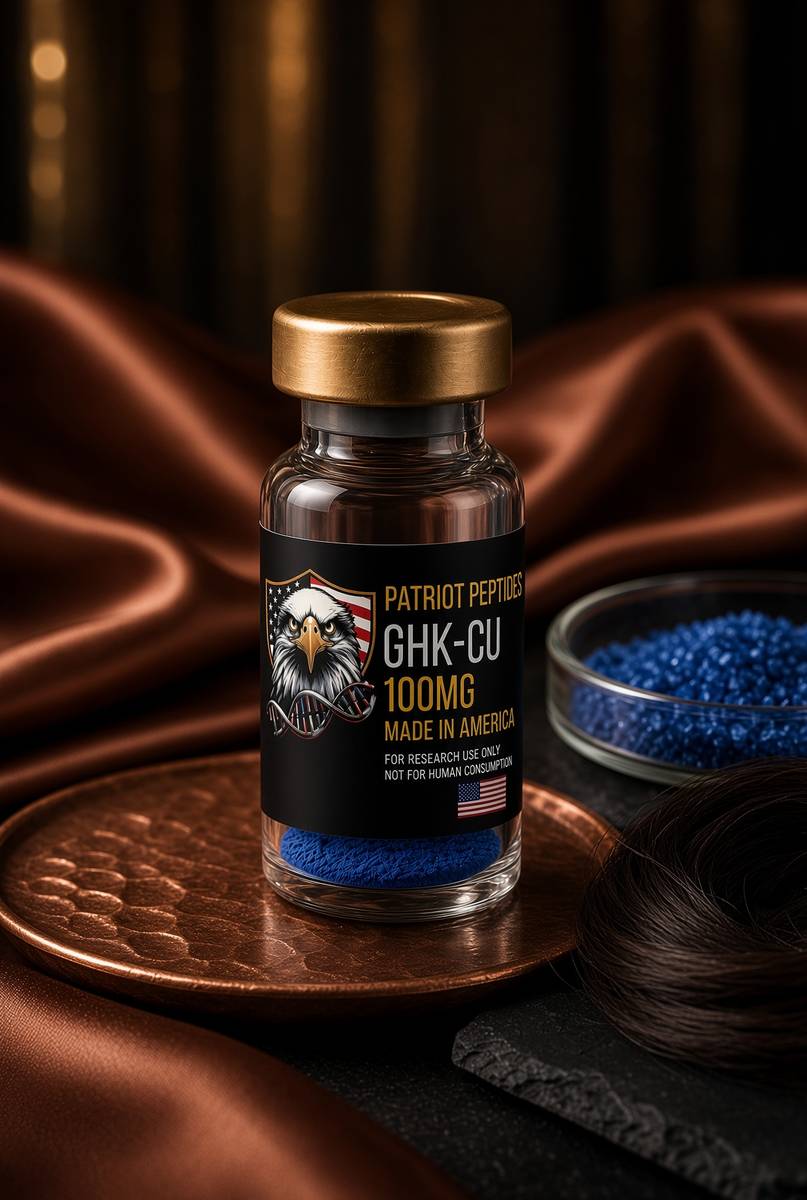
The solution is blue if the copper is on the peptide. Grey or colourless is the wrong cake. 100mg wants 5 ml or the syringe marks get silly.
Bacteriostatic water and sterile syringes ship with peptide orders over £75. Kit details · 10 ml bacteriostatic water
The molecule in the essay
The same published structure the essay describes — HPLC-characterised.
 Research onlyOut of stock
Copper complex
GHK-Cu
100 mg GHK-Cu. Pickart’s copper tripeptide, lyophilised.
4.9(590)
110 browsing this now · 5 purchased in the last 24 hours
100mg
£35.00
Read next
45 min · long read · Peptide research
GHK-Cu: a copper tripeptide that rewrites a spreadsheet of genes
Pickart isolated GHK from plasma fractions that made old liver tissue synthesise proteins like young tissue. The tripeptide holds copper. The live claim is a transcriptome, not a moisturiser.
49 min · long read · Peptide research
NAD+: the currency of cellular time
NAD+ is nicotinamide adenine dinucleotide, the hydride coin Complex I wants oxidised and the stoichiometric substrate sirtuins, PARP1 and CD38 spend. Salvage through NAMPT is the kinetic bottleneck; the pool falls with age. Restoration in mice moves muscle, endothelium and stem-cell assays; human NR and NMN trials more often move the metabolome than a hard clinical endpoint. This essay is that topology, the named papers, and why a 1000 mg cake of lyophilised β-NAD+ is a laboratory reagent rather than an infusion.
49 min · long read · Peptide research
Epithalon, telomeres and the pineal clock
A four-residue peptide from the Khavinson school sits where melatonin, telomerase and aging research overlap. The claim is large. The molecule is tiny. The assays are specified.
50 min · long read · Peptide research
Sirtuins, caloric restriction and the NAD+ budget
Yeast SIR2, worm daf-16, mouse SIRT1 — a conserved story about spending NAD+ to deacylate the proteins that decide whether a cell is in famine or feast. The cofactor is the budget. We stock it at 1000mg.
More in this desk

53 min · long read · Peptide research
Recovery, GH pulses and the CJC / ipamorelin pair
Somatotrophs have two 'go' receptors. CJC without DAC is a slightly longer GHRH pulse. Ipamorelin is a selective ghrelin-receptor key that does not yank ACTH. Together they are the pair Bowers already showed is more than additive — not a gym protocol.
53 min · long read · Peptide research
How research peptides are made — and why HPLC actually matters
Solid-phase peptide synthesis builds a chain one residue at a time. HPLC then asks whether the main peak is what you think it is. ≥98% is not a slogan. It is a chromatogram.
52 min · long read · Peptide research
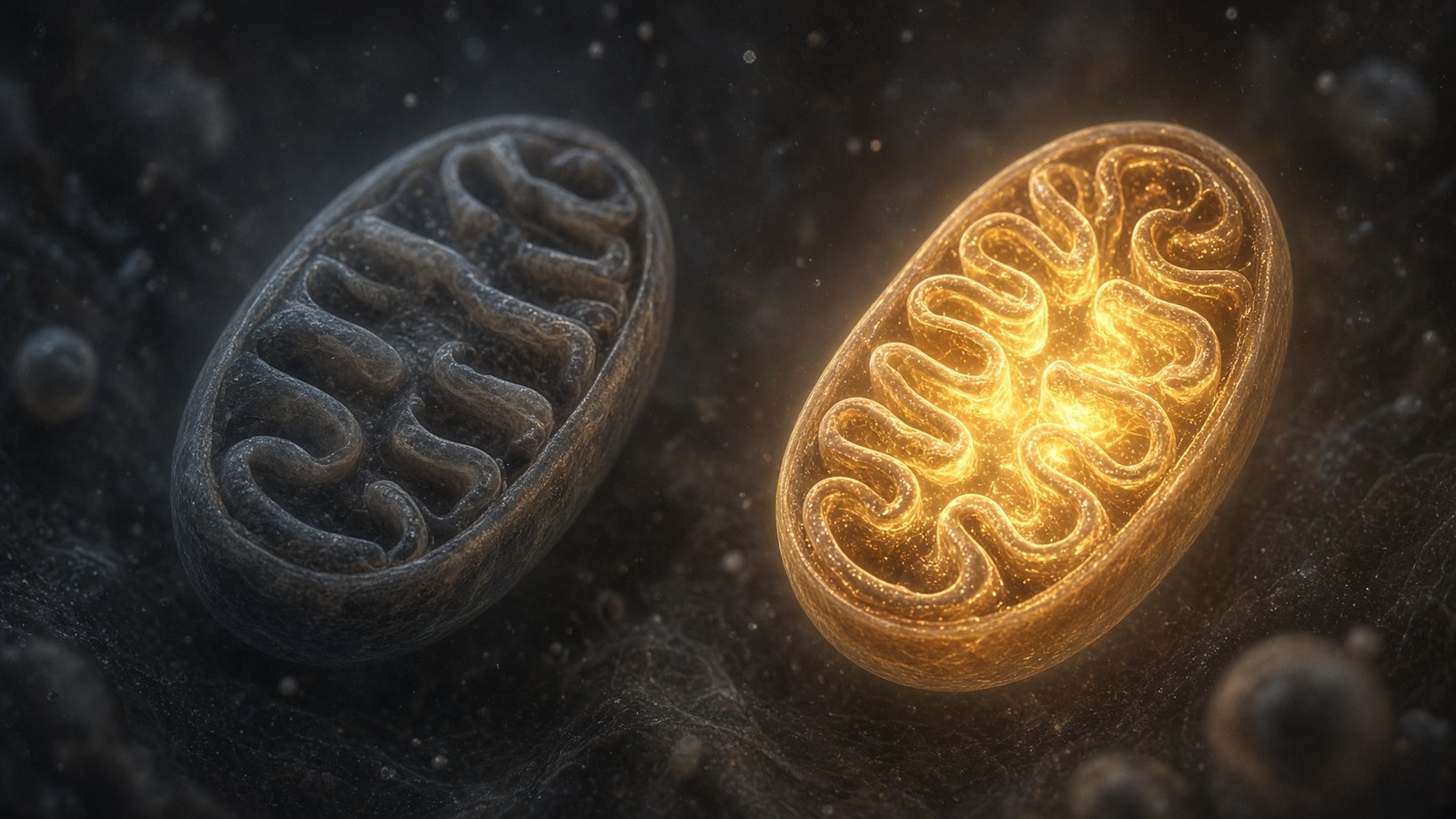
Fatigue, cellular energy and the NAD+ / MOTS-c neighbourhood
NAD+ is the rechargeable chip every cell spends on fuel and DNA repair — and the pool shrinks with age. MOTS-c is a mitochondrial 16-mer sent out under metabolic stress. Two answers to 'I have no energy' that are not coffee.
51 min · long read · Peptide research
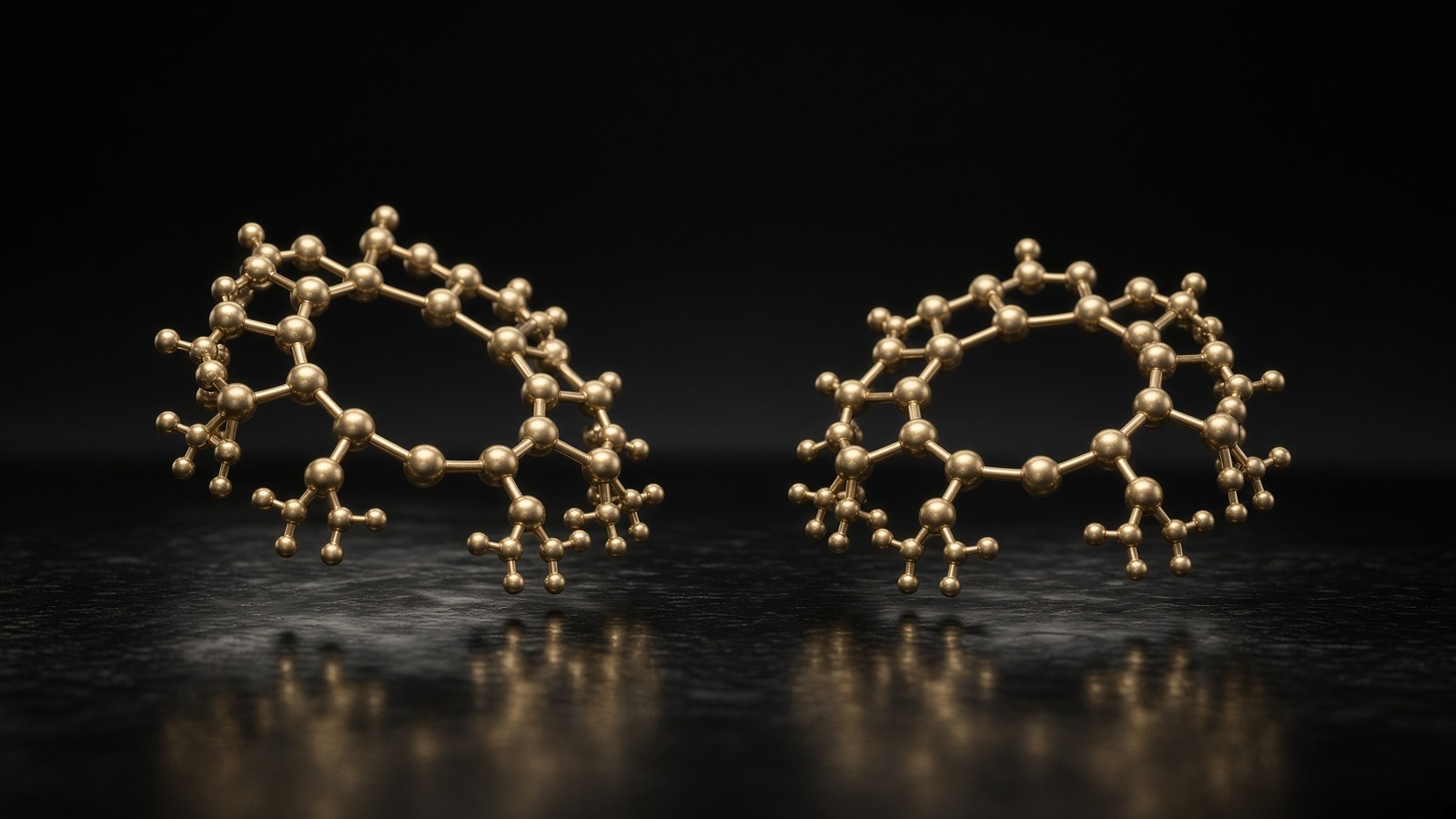
Melanocortin circuits: pigment, appetite and PT-141
Melanotan II lights MC1, MC3, MC4 and MC5 — pigment plus the rest of the sheet. PT-141 is the free-acid cousin pointed at MC3 and MC4, the circuitry papers use for desire and energy, not skin colour. Same Arizona family. Different question.
Essays describe published research. They are not medical advice and they do not authorise human use of any catalogue item.