

Peptide research · 45 min · 9,853 words
GHK-Cu: a copper tripeptide that rewrites a spreadsheet of genes
Pickart isolated GHK from plasma fractions that made old liver tissue synthesise proteins like young tissue. The tripeptide holds copper. The live claim is a transcriptome, not a moisturiser.
· updated
What this essay actually tells you
- Loren Pickart isolated GHK in the 1970s from albumin fractions that made old liver tissue, in culture, synthesise proteins like young tissue. That's the origin story, and it's a dish, not a face cream.
- Gly-His-Lys holds Cu²⁺ in a square-planar complex so lysyl oxidase and SOD can get copper without Fenton chemistry from free metal. Chaperone, not a copper sprinkle.
- Microarrays report thousands of transcripts shifting (collagen up, some MMPs down). Breadth is the claim. Modern RNA-seq replication is the live question, and we'd like to see more of it.
What this actually means
In the 1970s Loren Pickart fractionated human plasma looking for whatever made old liver tissue, in culture, synthesise proteins the way young tissue does. The active piece was a tripeptide, glycine-histidine-lysine, usually carrying a copper ion. Plasma GHK is not a rumour: Pickart reported roughly 200 ng/ml at age twenty and about 80 ng/ml at age sixty. Copper is required to finish collagen (lysyl oxidase, the cross-linking enzyme, is a copper enzyme) and copper-zinc superoxide dismutase needs the metal too. Free Cu²⁺, left loose, is also a Fenton reagent that makes hydroxyl radicals from peroxide. GHK's job, on this chemistry, is to hold the ion in a square-planar complex and deliver it without the chaos. The unusual claim is breadth. Pickart and Margolina's microarray work reports thousands of human transcripts shifting in cultured cells: collagen and decorin and SOD up, some MMPs and a fibrinogen/metastatic cassette down. That's a spreadsheet, not a single receptor. Whether it survives a modern RNA-seq replication with proper multiple-testing correction is the live question, and a good one. We'd like that replication as much as anyone.
In the early 1970s Loren Pickart was fractionating human plasma for a reason that still sounds almost rustic. Cultured liver tissue from older donors synthesised protein in a pattern that looked tired. Albumin-rich fractions from young plasma, added to those cultures, shifted the pattern toward the youthful one. The active piece, once the fractionations had been honest enough, was three amino acids: glycine, histidine, lysine. GHK. It usually arrived with a copper ion attached, which turned out not to be a contaminant. Pickart and Thaler published the growth-modulating plasma tripeptide in 1973. The observation refused to go away, which is more than most 1970s peptide lore managed. Three residues is small enough to be underestimated and chemically tidy enough to survive scepticism. A defined ligand, a metal, a dish, a protein-synthesis readout. That's an origin story you can still stand next to, fifty years on, without needing a cream or a testimonial to hold it up.
In short. In the 1970s a chemist found a three-amino-acid piece of blood that made old liver cells make protein like young ones.
Plasma is a crowded solvent. Albumin alone is a warehouse of hitch-hikers: fatty acids, metals, peptides, drugs, the debris of other tissues. Isolating a tripeptide from that mess, in the era before cheap mass spectrometry, meant chromatography, bioassay, and the patience to throw most fractions away. Pickart's assay was protein synthesis in liver tissue that had already aged. The young-plasma fractions restored a synthetic pattern the old tissue had lost. That's a restoration claim of a very specific kind: not lifespan, not a face, not a clinic endpoint. A dish. A labelling experiment. Amino acids into protein. When the active peak resolved to Gly-His-Lys, the field could have filed it as a curiosity and moved on. It did not, because the same tripeptide kept turning up next to copper enzymes that finish extracellular matrix and next to superoxide dismutase, which mops the first radical mitochondria leak. A plasma peptide that holds the metal those enzymes need is a sentence biochemistry can work with.
In short. Pickart pulled GHK out of plasma by asking which fraction made old liver tissue build protein again. The answer was three amino acids, usually carrying copper.
Old liver tissue, in culture, synthesising proteins like young tissue once a copper tripeptide from plasma was in the medium. Three residues. One metal. A 1970s fractionation that refused to go away.
A circulating number that falls
Pickart reported plasma GHK at roughly 200 nanograms per millilitre at age twenty and about 80 nanograms per millilitre at age sixty. Those are his numbers, and they should be treated as such: a named measurement from the laboratory that isolated the peptide, not a multi-centre reference interval. Even on that caveat they're worth holding, because they put a clock on a circulating ligand rather than a rumour. Two hundred nanograms per millilitre of a 340-dalton complex is a nanomolar neighbourhood. Sixty-year-old plasma, on the same method, is holding less than half. Restoration stories write themselves from that arithmetic, and most of them should be sent back. Restoring a circulating tripeptide isn't the same work as restoring a dermis, a follicle, or a liver. It's a reason to look. The look has to be an assay with copper stoichiometry declared, a cell type named, and a readout that isn't a photograph of someone's cheek. Ageing changes a thousand other plasma peptides. GHK is the one this essay can name, weigh, and complex with a metal.
In short. Pickart measured about 200 nanograms of GHK per millilitre of plasma at twenty, and about 80 at sixty. A falling number is a reason to look, not a restoration plan.
Why a plasma tripeptide would fall with age is a separate question from whether adding it back does anything useful in a dish. Possible accounts include reduced synthesis, faster clearance, a change in the albumin fraction that carries it, or a measurement that is really tracking something correlated. None of those has been closed. The honest position is the one Pickart's own isolation already implied: GHK is present, it binds copper, and the concentration isn't constant across a human life. A restoration experiment in culture is then a defined perturbation of a defined ligand. A restoration experiment in a mammal is a different paper, with pharmacokinetics, copper status, and a tissue endpoint. Conflating the two is how a 1973 fractionation becomes a cream. This essay stays with the ligand, the metal, the enzymes that want the metal, and the microarray claim that tried to turn all of that into a spreadsheet of genes. Each of those can be argued without a protocol.
In short. Nobody has a complete story for why plasma GHK falls. The useful fact is that the ligand is measurable, copper-binding, and not constant across a life.
Human serum albumin binds Cu²⁺ at its N-terminus, the ATCUN motif, amino-terminal copper-and-nickel: aspartate-alanine-histidine in humans, a square-planar grip that looks, at a glance, like a longer cousin of GHK. Albumin is the bulk carrier. GHK is a trace peptide isolated from albumin-rich fractions, which is why people still argue about how much of Pickart's original activity was peptide, how much was albumin-bound copper, and how much was both. The isolation resolved to a tripeptide, and the tripeptide binds copper on its own. That doesn't make GHK a miniature albumin. Albumin is 66 kilodaltons, a fatty-acid warehouse, a drug sponge, and a copper buffer at millimolar protein concentration. GHK is about 340 daltons when complexed, nanomolar on Pickart's plasma numbers, and interesting because it is small enough to be a reagent. Confusing the two is how a copper-albumin spike gets filed as a GHK-Cu experiment. Measure the peptide. Measure the metal. Name which carrier you added. Albumin is allowed to be in the medium. It isn't allowed to be unnamed.
In short. Albumin also binds copper at its N-terminus, in bulk. GHK is a tiny, named peptide from those fractions. They are not interchangeable reagents.
Three letters, one amide chemistry
Glycine, histidine, lysine. The peptide bonds between them are ordinary amides: the carboxyl carbon of one residue joined to the nitrogen of the next, planar because of resonance, trans in almost every case. Nothing about GHK requires a special covalent trick. What is special is the side-chain set. Glycine has no side chain, which makes the N-terminus a flexible handle. Histidine carries an imidazole, a nitrogen heterocycle that is the classic copper ligand in proteins: haemocyanin, SOD1, the type-1 blue copper sites, a hundred crystal structures. Lysine carries a primary amine on a four-carbon tether, solvent-exposed, a place for a charge and, in some complexes, a distant coordination option. Three residues is below the length at which a chain folds into a globular domain. GHK is a ligand, not a tiny enzyme. It doesn't have an active site of its own. Its job, if the word is allowed, is to hold a metal and, perhaps, to be recognised as a ligand in its own right. Those are different jobs, and the literature has spent fifty years mixing them.
In short. GHK is glycine-histidine-lysine, three ordinary peptide bonds. Histidine's imidazole is the classic copper-binding group. The chain is too short to fold into an enzyme.
Diagram
- Amino acid~110 DaTwenty side chains. The alphabet.
- Peptide bondamide, planarCarboxyl carbon to the next nitrogen. Resonance holds it flat.
- Oligopeptide< ~20 residuesMost hormones and fragments. GHK is three. KPV is three.
- Polypeptide20–50+Insulin 51. GLP-1 31. Retatrutide is a designed chain in this band.
- Proteinfolded machineHaemoglobin, a GPCR, lysyl oxidase. Tertiary structure worth drawing.
Insulin (Banting and Best, 1921) was the first peptide anyone bothered calling a medicine. A collagen hydrolysate is food. A named sequence with a mass and a chromatogram is a research peptide. The shared word is the accident.
A research peptide earns the word by identity. One primary structure, a calculated mass, a chromatogram on which a main peak can be pointed at, a certificate that says what else is in the vial. GHK-Cu is glycine-histidine-lysine with Cu²⁺, CAS 89030-95-5, a complex mass of about 340.7 grams per mole. Hydrolysed collagen powder is the opposite object: type I helix, a thousand residues a chain, chopped by industrial proteases until the average fragment is two to five kilodaltons, a population, batch-variable, no single HPLC peak that means one molecule. Both get called peptides in English. Only one of them is a ligand you can name in a write-up. The neighbouring essay on collagen powder versus research peptides is the grocery-aisle half of this argument. This one is the metal half. If a tub lists grams and a flavour, you're holding food. If a vial lists a sequence, a metal, a mass and a purity, you're holding a reagent. Mixing the words is how a laboratory term walked into a supermarket and forgot to walk back.
In short. GHK-Cu is one named chain plus copper, with a mass and a chromatogram. Collagen powder is chopped-up helix, a mixture, food. The shared word 'peptide' is an accident.
Square-planar copper is the product
Cu²⁺ is a d⁹ ion with a strong preference for square-planar or distorted octahedral geometry. GHK offers it a tridentate grip: the N-terminal nitrogen of glycine, a deprotonated peptide-bond nitrogen, and the imidazole nitrogen of histidine. Crystal structures and solution studies put the copper in a square-planar complex, with water or another oxygen often completing the plane or sitting at a longer axial distance. The lysine side chain is usually not the fourth ligand in the simple 1:1 complex; it is a charge and a handle. That geometry is why the complex is stable enough to keep free Cu²⁺ from roaming and labile enough, in the right neighbourhood, to hand the metal to an enzyme that wants it. Stability and lability aren't opposites here. They're the two requirements of a chaperone. Too tight and the enzyme never sees the ion. Too loose and the ion is a Fenton reagent in the buffer. GHK sits in the window that plasma albumin and the dedicated copper chaperones also occupy, at a much smaller scale and with a much shorter resume.
In short. GHK holds Cu²⁺ in a square-planar grip through histidine and backbone nitrogens. Tight enough to stop free copper roaming, loose enough to hand the metal on.
Call it an ionophore and you've said something true and incomplete. An ionophore is a ligand that carries a metal across a barrier the free ion would not cross cleanly. GHK-Cu has been used that way in culture: copper delivery to cells that need the metal for lysyl oxidase and for SOD1, without dumping a redox-active pool into the medium. Call it a ligand in its own right and you've said the other half. Some of the fibroblast work reads as if the tripeptide is recognised, as if TGF-β signalling and integrin tone are being shifted by occupancy of something that isn't just a copper shortage. The two accounts aren't mutually exclusive. A cell that has been copper-starved will change a lot of transcripts when copper returns. A cell that has been offered a peptide-metal complex may also see the peptide. Distinguishing those requires a copper-matched control, a GHK-without-copper arm, and preferably a copper ionophore that isn't GHK. Most of the older papers didn't run all three. That isn't a reason to throw the complex out. It's a reason to read the figure legends before the abstracts.
In short. GHK-Cu is both a copper carrier and, possibly, a ligand the cell can notice. Telling those apart needs controls most older papers skipped.
Diagram
- GHKGly-His-LysPickart, 1970s plasma fraction. ~200 ng/ml at 20; ~80 ng/ml at 60.
- Cu²⁺ complexsquare-planarHistidine imidazole + backbone nitrogens. The product is the complex.
- Lysyl oxidaseLOX / LOXLCopper enzyme. No metal, no collagen cross-links, a weak gel.
- SOD1Cu/ZnFirst mop for superoxide. Same metal, different job.
- Free Cu²⁺FentonCu⁺ + H₂O₂ → HO·. Delivery without a redox-active pool is the point.
Pickart and Margolina’s microarrays claim thousands of transcripts. Modern RNA-seq with multiple-testing correction is the replication the claim still owes. Copper delivery to LOX and SOD would remain interesting if the spreadsheet shrinks.
- GHK
- 3 residues
- Complex mass
- 340.7 Da
- Plasma at 20 years
- ~200 ng/ml
- Plasma at 60 years
- ~80 ng/ml
- Coordination
- square-planar Cu²⁺
- LOX / SOD1
- copper enzymes
- Array claim
- thousands of transcripts
- RNA-seq replication
- still owed
Gly-His-Lys. Too short to fold. A ligand, not a tiny enzyme.
GHK · Cu²⁺. CAS 89030-95-5. Identity is a mass.
Pickart's number. A nanomolar neighbourhood.
Same method, less than half. A clock, not a protocol.
Imidazole plus peptide nitrogens. The grip is the chemistry.
Cross-links and the first superoxide mop. No metal, no job.
Pickart and Margolina. Breadth is the extraordinary part.
2000s arrays were noisy. Multiple-testing is now religion.
Copper is a feature and a hazard
A human adult carries something on the order of 100 milligrams of copper, most of it bound. Ceruloplasmin is the major plasma carrier and a ferroxidase. Albumin binds copper at an N-terminal site. Inside the cell, CTR1 (SLC31A1) is the main importer. Atox1 is a cytosolic chaperone that hands Cu⁺ to the Wilson and Menkes ATPases, ATP7B and ATP7A, which pump copper into the trans-Golgi for loading onto secreted enzymes, or out of the cell when the load is high. CCS loads SOD1. Cytochrome c oxidase in mitochondria takes copper through its own chaperone set, COX17, SCO1, SCO2. There is, by design, almost no free copper in a healthy cytosol. Rae, O'Halloran and colleagues measured the free Cu⁺ concentration as vanishingly low, buffered by a surplus of ligands. That's the point of a chaperone network. The metal is too useful and too dangerous to be allowed to wander. GHK isn't Atox1 and it isn't CCS. It's a small, circulating complex that sits on the same chemical problem those proteins were built to solve: move copper, do not spill it.
In short. Cells keep almost no free copper. Dedicated proteins import it, hand it on, and load it onto enzymes. GHK is a small circulating version of that same idea.
The hazard is Fenton chemistry, named for the iron reaction and equally available to copper. Cu⁺ plus hydrogen peroxide yields Cu²⁺, a hydroxide, and a hydroxyl radical. The hydroxyl radical is indiscriminate. It attacks bases, lipids, protein side chains; it doesn't wait for a named pathway. Superoxide can reduce Cu²⁺ back to Cu⁺, so a small pool of free copper plus a little peroxide becomes a catalytic radical factory. That's why adding copper sulphate to a culture and calling it a GHK-Cu experiment is a category error. The free ion and the complex are different reagents. The free ion is what Wilson disease patients accumulate in liver and brain when ATP7B fails, and what Menkes patients cannot distribute when ATP7A fails. Those monogenic diseases are the existence proof that copper handling isn't a wellness topic. It's metal biochemistry with a clinical shadow. A tripeptide that holds Cu²⁺ in a square-planar grip is interesting because of that shadow, not in spite of it.
In short. Free copper plus peroxide makes hydroxyl radicals, which attack whatever they meet. Wilson and Menkes disease show what happens when copper handling fails. The complex exists to avoid that.
Delivery without a redox-active pool is therefore the chemical sentence, before any transcriptome is mentioned. Lysyl oxidase needs copper in the trans-Golgi or the extracellular space, depending on the family member and the paper. SOD1 needs copper in the cytosol, loaded by CCS. A complex that can donate to those routes, or to the transporters that feed them, is doing chaperone work at peptide scale. A complex that merely raises total copper in a lysate has not demonstrated donation. The assay that distinguishes those isn't a total-copper kit. It's an activity assay for LOX or SOD, a comparison against a copper salt at the same metal concentration, and a GHK-without-copper arm so you know whether the peptide is doing anything the metal is not. Stoichiometry belongs in the write-up: moles of GHK, moles of Cu²⁺, whether the complex was preformed, whether the medium already contained copper from serum. Papers that skip those lines are studying a mixture they haven't named.
In short. The point of the complex is to deliver copper to enzymes without leaving a radical-making pool. That needs activity assays and declared stoichiometry, not a total-copper kit.
Lysyl oxidase finishes the gel
Collagen that has just been secreted isn't yet a cable. The triple helix of type I is a hydrogen-bonded rope, glycine every third residue, hydroxyproline holding the three chains, a beautiful structure that will still slide if you pull on it. Load-bearing connective tissue requires covalent cross-links between chains and between fibrils. Lysyl oxidase (LOX) and the LOX-like enzymes LOXL1 through LOXL4 do that job. They oxidatively deaminate the ε-amino group of specific lysine and hydroxylysine residues in collagen and elastin, leaving an aldehyde: allysine or hydroxyallysine. Those aldehydes then condense, aldol products, Schiff bases, and, with time and further chemistry, the pyridinolines of mature collagen and the desmosines of elastin. The enzyme carries copper and a lysine tyrosylquinone cofactor, LTQ, which is built in place from a tyrosine and a lysine once copper is bound. No copper, no LTQ, no aldehyde, no cross-link. A culture deprived of copper doesn't make a dermis. It makes a weak gel. That sentence is older than GHK and doesn't depend on any microarray.
In short. Lysyl oxidase uses copper to turn lysine in collagen and elastin into aldehydes that cross-link. Without the metal you get a weak gel, not a load-bearing matrix.
The LOX family isn't one enzyme with one tissue. LOX itself is the canonical collagen and elastin cross-linker, secreted as a proenzyme, activated by BMP-1/tolloid proteases that cut the propeptide. LOXL1 is particularly tied to elastin and to the elastic-fibre failures of pseudoexfoliation glaucoma and, in mice, to pelvic-floor and lung elastic defects. LOXL2 has a different reputation: fibrosis, tumour stroma, a target people have tried to antibody. The family sits on the same metal and the same chemistry, then writes different pathologies depending on which isoform is loud and where. A copper-delivery reagent that changes LOX activity in a fibroblast culture is therefore sitting on a node that wound healing, fibrosis, aneurysm biology and tumour stroma all touch. That's a reason to be precise, not a reason to advertise. Cross-links that fail give you fragile tissue. Cross-links that run too hard give you a stiff, fibrotic one. TGF-β induces LOX. Hypoxia induces LOX. The peptide that feeds the enzyme copper is one input among several, and writing it as the only input hasn't looked at the family.
In short. Five related enzymes cross-link matrix. Too little copper-dependent activity leaves tissue fragile; too much helps fibrosis. GHK-Cu sits on that node, not above it.
Maquart, Pickart, Borel and colleagues showed, in 1988, that the GHK-Cu complex stimulated collagen synthesis in fibroblast cultures. That paper is still the one to hand a sceptic. The readout was collagen, the cells were fibroblasts, the ligand was the copper complex. Wegrowski, Maquart and Borel followed with sulphated glycosaminoglycan synthesis, the proteoglycan half of the same neighbourhood. Those are protein and carbohydrate outputs, not a 4,000-gene spreadsheet. They're also the findings that don't require you to believe anything extraordinary about transcription. A fibroblast given copper in a form it can use, in a medium that may have been marginally copper-limited, will finish more matrix. Decorin, the small leucine-rich proteoglycan that binds collagen fibrils and TGF-β, sits on the same street. SPARC, secreted protein acidic and rich in cysteine, also called osteonectin, is a matricellular protein that sits at the interface of cells and matrix and is one of the transcripts later arrays put on the up list. The 1980s biochemistry didn't need those names to be true. The 2000s arrays added them, with all the noise that addition implied.
In short. In 1988 the copper complex made cultured fibroblasts produce more collagen. That finding does not require a 4,000-gene story. It requires copper getting to the matrix enzymes.
Elastin is the other LOX substrate, and it is the one ageing skin and ageing lung actually miss. Tropoelastin is secreted, aligned on a fibrillin microfibril scaffold, and then cross-linked by LOX family members into desmosine and isodesmosine, the tetrafunctional residues that make elastin a rubber. Adult dermis makes almost no new elastin under ordinary conditions. Solar elastosis is a mess of damaged elastic material, not a fresh network. A reagent that feeds LOX copper in a fibroblast culture can still be asked, honestly, what it does to tropoelastin transcription and to cross-link density. Answering that with a photograph of a face is the usual category error. Answering it with desmosine, a LOX activity assay, and a defined cell type is a paper. The GHK literature has more of the former than a copper essay would like, and enough of the latter to keep the ligand on a bench. Hair-follicle dermal papilla is another elastin-and-matrix neighbourhood, and we'll get there. First the other copper enzyme, because superoxide doesn't wait for a fibril to finish.
In short. Elastin needs the same copper cross-linking to become rubber. Adult skin barely makes new elastin. A fair test is chemistry and a cell type, not a photograph.
SOD1 is the other copper job
Superoxide is the first radical the respiratory chain leaks: oxygen plus an extra electron, O₂•⁻. Superoxide dismutase catalyses the disproportionation, two superoxide and two protons to oxygen and hydrogen peroxide. The peroxide is still a problem, but it is a problem catalase and peroxiredoxins know how to handle. SOD1 is the cytosolic Cu/Zn enzyme. The copper is the redox-active metal at the active site; the zinc is structural, a second-site stabiliser. CCS, the copper chaperone for SOD1, loads the copper. Mutations in SOD1 cause a subset of familial amyotrophic lateral sclerosis, which is how a radical-mop enzyme became a neurodegeneration gene, and which is a different essay. The sentence this essay needs is simpler. A cell that cannot place copper on SOD1 is a cell whose first antioxidant enzyme is disarmed. A reagent that delivers copper in a form CCS or SOD1 can use is therefore sitting on oxidative defence as well as on matrix. Pickart's arrays put SOD transcripts on the up list. Activity would be the better readout. Transcript is a vote. Activity is the enzyme.
In short. SOD1 is the cytosolic enzyme that turns superoxide into peroxide and oxygen. It needs copper at the active site. Delivery to that enzyme is a second job for the same metal.
The two copper jobs, matrix and radical mop, share a budget and a hazard. Feed copper carelessly and you may raise LOX and SOD while also raising hydroxyl radical from the unbound fraction. Feed it as GHK-Cu and the hypothesis is that the bound fraction dominates. Testing that hypothesis is a ROS readout plus an activity readout, in the same dish, with a copper-salt arm that will almost certainly look dirtier on the ROS side. Older papers sometimes reported antioxidant effects of GHK-Cu in vitro, including in the presence of peroxide, which is consistent with the complex keeping copper from Fenton cycling, or with SOD-related activity, or with the peptide being a modest sacrificial ligand. Those are different mechanisms. A square-planar Cu²⁺ complex can, in principle, do redox of its own; it can also sequester the ion so that redox does not happen in bulk solvent. Distinguishing ligand-as-shield from ligand-as-enzyme-loader from ligand-as-transcription-factor is the whole experimental problem. Collapsing those three into 'copper peptide, therefore repair' has stopped doing chemistry.
In short. The same metal finishes collagen and arms SOD1. Spilled, it makes radicals. The complex is a bet that bound copper does the jobs and unbound copper does the damage.
β-Aminopropionitrile, the lathyrism toxin from sweet pea, inhibits lysyl oxidase. Animals and people exposed to it get fragile collagen, aneurysms, a skeleton that will not hold. That's the existence proof, older than GHK, that LOX activity isn't a cosmetic detail. A copper-delivery reagent sits on the other side of the same enzyme: more metal, more cofactor maturation, more aldehydes, more cross-links, if the cell is writing collagen in the first place. BAPN is the inhibitor control a LOX paper should still run. If GHK-Cu raises hydroxyproline or collagen in a dish and BAPN abolishes the mechanical consequence, you have a cross-link story. If the collagen protein goes up and the gel is still weak, you have a synthesis story without a finish. Those are different papers. Most GHK figures report synthesis. Fewer report cross-links. Desmosine, pyridinoline, or a LOX activity assay would finish the sentence the 1988 paper started. Until they do, the honest caption is more collagen made, not a stronger cable proven.
In short. A sweet-pea toxin that blocks lysyl oxidase leaves tissue fragile. That is why copper delivery to the enzyme matters, and why cross-link assays still beat collagen photographs.
The fibroblast is a matrix factory with opinions
A dermal fibroblast isn't a passive bricklayer. It transcribes collagen I and III as the bulk of the dermis, collagen IV as a basement-membrane component at the dermoepidermal junction, and a sheet of matricellular proteins and proteoglycans that decide how those collagens pack. Decorin is a small leucine-rich proteoglycan that binds collagen fibrils, sets fibril diameter, and sequesters TGF-β. Without decorin, fibrils are irregular and TGF-β is louder than it should be; the knockout mouse is a skin and tendon phenotype with a fibrosis undertone. SPARC/osteonectin sits at cell-matrix contacts, binds collagen, and modulates adhesion and proliferation. Tenascin, fibronectin, thrombospondins: the matricellular census is long. A ligand that changes collagen transcription without changing decorin is a different reagent from one that moves both. Pickart and Margolina's arrays put collagen I, III and IV up, and decorin up, and SPARC up. That's a coordinated-factory claim, not a single-gene claim. Coordinated is more interesting. Coordinated is also easier to fake on a noisy array, which is why the next heading exists.
In short. Fibroblasts build dermis from collagen plus helpers such as decorin and SPARC. GHK-Cu arrays claim that whole factory shifts together, which is interesting and easy to over-read.
The scissors are matrix metalloproteinases. MMP-1 is interstitial collagenase: it cuts native type I and III collagen at a specific site, the first committed step in turning a fibril back into fragments that gelatinases can finish. MMP-3 is stromelysin-1: proteoglycans, fibronectin, laminin, and some activation of other MMPs. Both are transcriptionally inducible, both sit in the inflammatory and wound programmes, both are loud in photoaged dermis and in the senescent secretory phenotype Campisi named SASP. TIMPs, tissue inhibitors of metalloproteinases, are the sheaths. Four TIMPs, overlapping specificities, a stoichiometry that is local and not a simple serum number. A fibroblast that writes more TIMP and less MMP-1 is a fibroblast that has been told to keep matrix rather than chew it. That's a wound-resolution signal, or a fibrosis signal, depending on duration and on whether the collagen being kept is well organised. The arrays put TIMP up and MMP-1 and MMP-3 down. Neighbouring the senescence essay isn't a flourish. SASP includes those MMPs. A ligand claimed to quiet them is sitting next to the aged-cell literature whether anyone files it there or not.
In short. MMP-1 and MMP-3 cut matrix; TIMPs hold those scissors. The arrays claim scissors down and sheaths up, which is also the neighbourhood of senescent-cell secretions.
Photoaged dermis is the tissue that made MMP-1 famous outside a tumour. Ultraviolet B induces interstitial collagenase in fibroblasts through AP-1, and the enzyme then nicks type I fibrils at a single site, after which gelatinases finish the job. Fisher, Voorhees and colleagues spent the 1990s putting that pathway on slides: c-Jun, MMP-1, fragmented collagen, a wrecked mechanical environment, a fibroblast that then writes less new collagen because the wrecked matrix tells it, via integrins, to stop. GHK-Cu's arrays putting MMP-1 down and collagen up are therefore sitting on photoageing biochemistry whether the reviews said so or not. Sitting on isn't reversing. An AP-1 blot, an MMP-1 ELISA on conditioned medium from UV-treated fibroblasts, and a copper-matched control would be the paper. A cream with a sun-damage claim isn't. The senescence SASP includes MMP-1 too, so the same scissors show up in two ageing programmes. A ligand claimed to quiet those scissors is adjacent to both. Adjacent is a reading list. It still isn't a sunscreen, and it still isn't a senolytic. Keep the UV experiment and the SASP experiment on separate plates.
In short. Sun-damaged skin turns on MMP-1, which nicks collagen. GHK-Cu arrays sit next to that pathway. Sitting next to a pathway is not a sunscreen and not a proof.
TGF-β is the double-edged growth factor of this tissue. In a clean wound it recruits fibroblasts, induces collagen and LOX, and helps close the defect. In a chronic wound or a fibrotic organ the same factor keeps writing matrix until the organ is a scar. Dose, duration, context, and which TGF-β isoform, which receptor, which Smad versus non-Smad arm: the difference between healing and fibrosis isn't a different molecule. It's the same molecule left on too long, or heard in a cell that has already senesced, or heard without the decorin that would have buffered it. Integrin signalling is the mechanical half of the same conversation. Fibroblasts feel the stiffness of the matrix they sit on through integrins, focal-adhesion kinase, and a cytoskeletal argument TB-500's essay treats from the actin side. A stiffer matrix makes more TGF-β available from the latent complex, a feed-forward that fibrosis researchers know by heart. Pickart's arrays reported TGF-β and integrin signalling in fibroblasts shifting rather than simply amplifying. 'Reset' is a strong verb. 'Shifted in a wound-resolution direction in a 2000s microarray' is the verb the data will actually carry.
In short. TGF-β heals a wound and, left on, scars an organ. Integrins tell the fibroblast how stiff the neighbourhood is. The arrays claim those signals were reset, which is a strong word.
The spreadsheet claim
Most ligands occupy a receptor and move a pathway. GHK-Cu's published microarrays claim something ruder: on the order of thousands of human transcripts, a shift toward a younger, less fibrotic, more DNA-repair-competent pattern. Collagen genes up. Decorin up. TIMPs up. DNA-repair transcripts up. SOD up. MMP-1 and MMP-3 down. A fibrinogen and metastatic cassette down. TGF-β and integrin signalling in fibroblasts moved in parallel. Pickart, Vasquez-Soltero and Margolina put those lists into a series of reviews and papers in the 2000s and 2010s, drawing on Affymetrix-era profiles of cultured human cells treated with the complex. Breadth is an extraordinary claim. A copper ionophore that rescued two enzymes would already be worth a bench. A copper complex that rewrites a few percent of the expressed genome is a different object, closer to a differentiation factor than to a metal chaperone. Extraordinary claims aren't automatically false. They're expensive. They cost replication on a platform that did not exist when the first arrays were run.
In short. The unusual claim is breadth: thousands of genes, repair up, some destruction down. That is much larger than 'copper reached lysyl oxidase', and it still needs a modern repeat.
A 2000s microarray was a miracle and a mess. Affymetrix GeneChips hybridised labelled cRNA to a forest of short oligonucleotides. The dynamic range was compressed. Cross-hybridisation was real. Probe-set annotation lagged the genome. Batch effects could look like biology if the treated and control chips were not balanced. Multiple-testing correction — Bonferroni, Benjamini-Hochberg false discovery rate — was known and was not always the religion it became once RNA-seq and a generation of statisticians had their way. Fold-change cut-offs of 1.5 or 2.0, without an adjusted p-value, populated a great many supplementary tables. Some of those tables contained real biology. Some contained noise that clustered into pathways because pathways are what enrichment software is for. Reading Pickart and Margolina honestly means holding that history in one hand and the gene lists in the other. Collagen, TIMP, MMP, SOD, decorin aren't random. They're the neighbourhood the 1988 biochemistry already pointed at. The DNA-repair cassette and the metastatic cassette are further out. Further out is where replication has to work harder.
In short. Early gene chips were noisy, and statistical correction was not always strict. The matrix genes match older biochemistry. The huge spreadsheet around them is the part that still needs repeating.
RNA-seq is the replication the claim still owes. A defined human fibroblast line, copper stoichiometry declared, GHK-without-copper and copper-without-GHK arms, a pre-registered analysis, a false-discovery-rate threshold, and a second cell type so the result isn't one line's idiosyncrasy. qPCR on a shortlist isn't that replication; it's a sanity check. ATAC-seq or a chromatin mark would ask whether the transcriptional claim has a chromatin half. None of that work, done to 2020s standards, has closed the argument in a way a sceptical genome centre would stamp. Until it exists, two things can be true at once. Copper delivery to LOX and SOD is enough to be interesting, and is already supported by enzymology older than the arrays. The transcriptome-reset is a hypothesis with a published outline, not a finished map. Holding both isn't fence-sitting. It's what you do when the chemistry is solid and the genomics is a first draft. Needing the spreadsheet to be finished before you'll look at the complex has the dependency backwards.
In short. A modern RNA-seq study with proper controls is still missing. Copper delivery is already interesting. The giant gene-reset remains a hypothesis with an outline.
Diagram
Closed chromatin (H3K27me3, DNA methylation) hides the promoter. Pioneer factors and histone acetyltransferases open it.
PIC: TFIID, TFIIH, Mediator, Pol II. Ser5 phosphorylation of the CTD lets the polymerase leave the promoter.
Elongation ~20–40 nt/s. Capping, splicing, cleavage and polyadenylation happen on the still-growing RNA.
Human genes are islands in 3.1 billion base pairs of mostly noncoding sequence. Promoter, enhancers, chromatin state and the Mediator complex decide whether Pol II is allowed to fire. Epithalon’s literature sits on TERT and pineal clocks — two of the rare promoters anyone bothers to name in a peptide essay.
Transcription, in a human fibroblast, isn't a spreadsheet. It's RNA polymerase II finding a promoter in a chromatin landscape, assembling a pre-initiation complex with TFIID and Mediator, pausing 20 to 60 nucleotides downstream, and then elongating at something like 20 to 40 nucleotides per second while the message is capped and spliced. A change in a microarray intensity is a change in the steady-state abundance of that message, which is synthesis minus decay. An apparent upregulation can be more transcription, less decay, or a probe-set artefact. An apparent downregulation of MMP-1 can be less Pol II at the MMP1 promoter, or a miRNA, or a change in the fraction of cells in the dish that were writing MMP-1 because they were stressed. The Cell-desk essay on gene to protein is the machine. This essay is the ligand someone placed in the medium and then asked the machine for a census. Treating the census as a mechanism is the usual overreach. Treating the census as a map of what to blot next is the adult use of an array.
In short. A gene-chip result is a change in message abundance, not a movie of polymerase. Use the list to pick blots. Do not confuse the list with a mechanism.
If you had to pick a shortlist from the published census, you'd pick genes a blot can name. COL1A1 and COL1A2 for the type I helix, COL3A1 for the wound collagen, COL4A1 for basement membrane. DCN for decorin. SPARC. TIMP1. MMP1 and MMP3. SOD1. Those aren't thousands. They're the neighbourhood Maquart already pointed at, plus the scissors and the first radical mop. A qPCR panel of those, with copper controls, would already be more convincing than another pathway-enrichment wheel. The DNA-repair names, various excision-repair and strand-break transcripts that appeared on the up list, are the ones that need the most scepticism, because cultured fibroblasts are always a little broken and a copper-dependent drop in Fenton load would move those messages without a dedicated repair programme. Priority is a scientific virtue. Blot collagen, TIMP and MMP-1 this month. Leave the cassette for the RNA-seq. A review that gives every hit a paragraph hasn't chosen, and choosing is the job a write-up is for.
In short. If you must pick genes to measure first, pick collagen, decorin, TIMP, MMP-1 and SOD1. Those match older biochemistry. The rest can wait for RNA-seq.
Proteostasis of a warehouse that lives outside the cell
Collagen is the most abundant protein in a mammal, and most of its life is spent outside the cell that wrote it. That makes extracellular-matrix proteostasis a different problem from the cytosolic one Hershko, Ciechanover and Rose described. Inside, a misfolded chain is tagged with ubiquitin and sent to the 26S proteasome, or, if it is an organelle-scale mess, to autophagy. Procollagen, in the endoplasmic reticulum, is still in that world. HSP47 is the collagen-specific chaperone. Chains that cannot triple-helix, the osteogenesis-imperfecta problem and a dozen milder folding defects, are retrotranslocated and destroyed by ER-associated degradation, which is to say ubiquitin and the proteasome. A fibroblast's intracellular collagen QC is therefore a ubiquitin story. GHK-Cu isn't an E3 ligase ligand. Nobody has shown it occupies that machinery. What it has been claimed to do is change how much collagen the cell writes, how much TIMP it writes, and how much MMP it writes: the transcriptional half of warehouse management. The ubiquitin diagram earns its place as the intracellular half of the same warehouse, not as a GHK target.
In short. Bad collagen inside the cell is tagged with ubiquitin and destroyed. GHK-Cu has not been shown to touch that tag.
Diagram
A growing mammalian cell turns over a few percent of its proteome per hour. 10 billion proteins is a warehouse with a shredder on the floor, not a museum. Ageing is partly what happens when the shredder slows and the warehouse fills with unfolded inventory.
Hershko, Ciechanover, Rose — Nobel 2004. E1 activates, E2 conjugates, E3 selects the victim. K48-linked chains go to the 26S proteasome; K63 is more often a signal. Autophagy handles the organelles the proteasome cannot swallow. mTOR vs AMPK is the appetite switch.
Once collagen has been secreted and cross-linked, the proteasome cannot reach it. Turnover of mature matrix is MMP, cathepsin, and then further proteolysis of the fragments. Photoaged dermis is, among other things, a turnover failure: collagen fibrils fragmented by MMP-1, poorly replaced, a wrecked mechanical environment that tells the fibroblast, via integrins, to behave worse. Campisi's SASP is a cellular contribution to that wreck: senescent cells secrete MMPs, inflammatory cytokines, and TGF-β family members, and they refuse to die. The neighbouring essay on senescence is that pathology. This one is a ligand claimed to push the same fibroblast in the other direction, more collagen, more TIMP, less MMP. If that transcriptional claim survives RNA-seq, it would sit next to SASP as a counter-secretome, not as a senolytic. Senolytics kill the cell. A matrix-repair transcriptome would ask the cell to shut up and rebuild. Those are different pharmacological ideas, and stacking the words because both appear in ageing reviews is how a literature gets muddy. Keep the jobs separate. p16 isn't a copper peptide. GHK isn't dasatinib plus quercetin.
In short. Mature collagen is cut by enzymes outside the cell. Ageing dermis and senescent secretions chew matrix. GHK-Cu is claimed to push the other way.
Fibrinogen on the down list is a curiosity worth a sentence. Fibroblasts aren't hepatocytes; they aren't the main source of circulating fibrinogen. Some extrahepatic fibrinogen transcription exists, and fibrinogen-related transcripts can appear in injury and tumour stroma. Metastatic cassettes on arrays are, similarly, a mixed bag of adhesion molecules, proteases and motility genes that oncology arrays have taught enrichment software to light up. Downregulation of that cassette in a fibroblast treated with GHK-Cu is a hypothesis about a less invasive, less matrix-chewing phenotype. It's also the sort of array language that has been wrong before. Until someone measures invasion, not a pathway score, the metastatic sentence should stay in the supplementary table. Decorin, TIMP and MMP-1 can be blotted this week. The cassette can wait. Priority of follow-up is a scientific virtue the original reviews did not always practise, because reviews are where every hit gets a paragraph. A write-up has to choose.
In short. Some array headlines, such as a metastatic-gene cassette, are weaker than collagen and MMP. Measure invasion before believing the headline. Blot the matrix genes first.
Hair follicle, anagen, dermal papilla
A hair follicle is a matrix organ with a clock. Anagen is the growth phase, catagen the regression, telogen the rest. The dermal papilla is a cluster of specialised fibroblasts at the base of the follicle; it inducts the epithelium, sets follicle size, and is the mesenchymal half of the conversation that decides whether a follicle stays in anagen. The extracellular neighbourhood of the papilla is collagen, proteoglycans, laminin, a basement membrane, and a copper-dependent cross-link census like any other connective-tissue niche. Copper peptides entered the hair literature because papilla cells in culture respond to them on growth and on the size of the follicle they will support, in models that people who run hair assays already know how to over-interpret. Follicle organ-culture, whisker-pad models, and dermal-papilla proliferation assays are real tools. They're also a field with a high ratio of abstract to histology. GHK-Cu sits in that field as a copper-and-matrix reagent, not as a named GPCR agonist of a hair-cycle receptor. Promising a density number from a research vial has left the paper.
In short. Hair follicles grow, rest and shrink on a clock. The dermal papilla is a cluster of fibroblasts whose matrix GHK-Cu has been studied in. That is a culture literature, not a density claim.
Anagen programmes include VEGF, IGF-1, several Wnts, and a suppression of TGF-β that would otherwise push the follicle toward catagen. That TGF-β sentence should sound familiar; it is the same factor the dermal-fibroblast arrays were arguing about. A papilla that hears less fibrotic TGF-β and more organised matrix is a papilla that might keep a larger follicle in anagen for longer. Might. The experiment is follicle length in organ culture, Ki-67 in the matrix, and a copper-matched control. The experiment isn't a before-and-after of a scalp. Cosmetic copper-peptide lotions have used the hair papers as a reading list for decades, which is their right and is also why this ligand confuses grocery-aisle 'peptides' with research sequences more than BPC-157 ever did. BPC-157 never had a shampoo. GHK did. The distinction is still identity. Three letters, one metal, a mass, a chromatogram, a papilla assay that names those. A lotion that says 'copper peptides' on the bottle hasn't automatically earned that sentence.
In short. The same TGF-β argument turns up in hair growth. Papilla models can ask the question. A lotion labelled copper peptides has not automatically asked it.
AHK-Cu, alanine-histidine-lysine with copper, is the cousin that hair papers sometimes name instead. The histidine-lysine copper grip is related; the N-terminal residue isn't glycine. Some dermal-papilla studies use AHK-Cu, some use GHK-Cu, some say copper peptide and don't tell you which. That's a problem, because they aren't the same molecule, and a papilla assay that cannot name the ligand is an assay you cannot replicate. GHK is the plasma isolation. AHK is a designed or hydrolytic relative that found a home in the hair literature. If you want GHK-Cu, write GHK-Cu, show the mass, and don't borrow an AHK figure from a different paper. Folklore bundles them because both are copper tripeptides and both have been put on papilla cells. Biochemistry doesn't bundle them. Three letters still have to be the right three letters. The metal still has to be declared. Hair-cycle readouts still have to be anagen length, Ki-67, or follicle diameter, not a brand name on a bottle. Identity first, then the clock of the follicle.
In short. AHK-Cu is a related copper tripeptide often used in hair papers. It is not GHK-Cu. Name the three letters, the metal, and the follicle readout.
Cosmetic chemistry stole the word. Identity did not.
Cosmetic copper peptides are a real product category and a linguistic problem. Some serums contain characterised GHK-Cu at a declared percentage. Many contain a hydrolysate, a copper salt, and a marketing sentence that has borrowed Pickart's isolation without borrowing his chromatogram. The skin-care literature then measures hydration, wrinkle scores, and volunteer photography, endpoints that can move with glycerin. None of that falsifies the fibroblast biochemistry. It does mean that 'copper peptide', as a phrase on a bottle, isn't a synonym for the complex this essay is about. A named GHK-Cu mass, a metal stoichiometry, and a chromatogram are what make a reagent a reagent. Hydrolysed collagen powder, sold in tubs with a scoop, is food: a 2–5 kDa population of type I fragments, Pro-Hyp in the blood after you eat it if you believe Iwai and Sato, nutrition, allowed to be interesting, not a ligand. The neighbouring essay on collagen powder is the long form. The short form is: count the sequences. If you can't count them, you aren't holding this molecule.
In short. Some creams contain real GHK-Cu; many just say copper peptides. Collagen powder is food. A research complex is one sequence, one metal, one chromatogram.
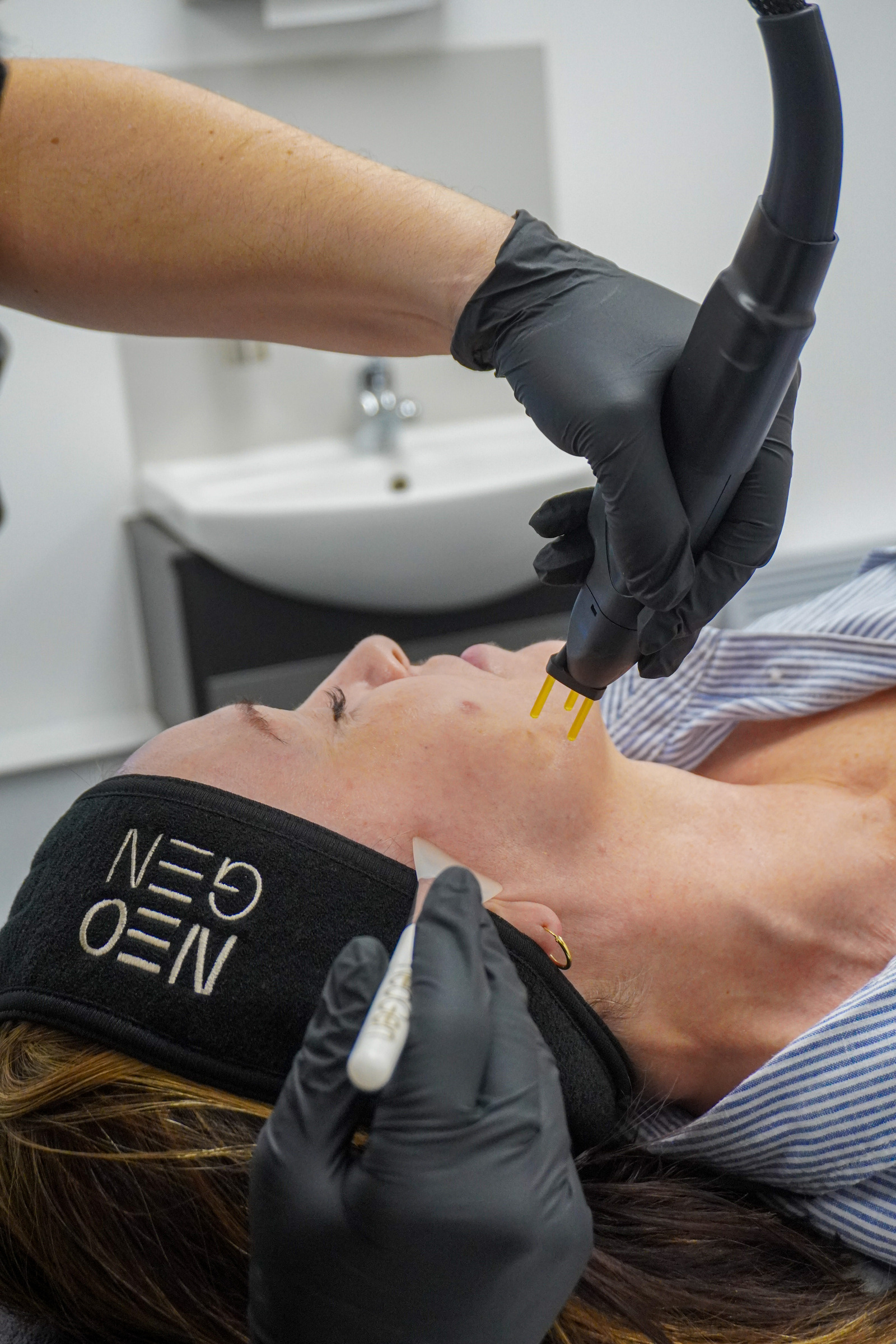
NEOGEN nitrogen plasma, in the clinic essay next door, denatures collagen with a pulse of ionised N₂ and then waits ninety days for fibroblasts to write a new band. Heat-shock protein 47, TGF-β1, MMP clearance of the denatured gel, TIMP trying to keep that clearance from becoming a hole: the histology is textbook wound healing with a thermal start. GHK-Cu's fibroblast arrays move collagen, TIMPs and MMPs. That's why the two essays are filed as neighbours. Neighbouring is a reading list. It isn't a bowl. Nobody is pouring a research complex into a CE-marked handpiece, and a thermal denaturation isn't a copper-delivery assay. The clinic owns the energy settings and the consent. The catalogue owns a characterised ligand. People who want a combined protocol are asking for something neither document is. Read both. Keep the jobs. The shared tissue is dermis. The shared cell is a fibroblast. The shared temptation is to treat a reading list as a recipe, which is how a journal becomes a brochure.
In short. A clinic plasma device and this copper complex both sit on fibroblast collagen biology. That is a reason to read both essays, not a reason to mix them in a protocol.
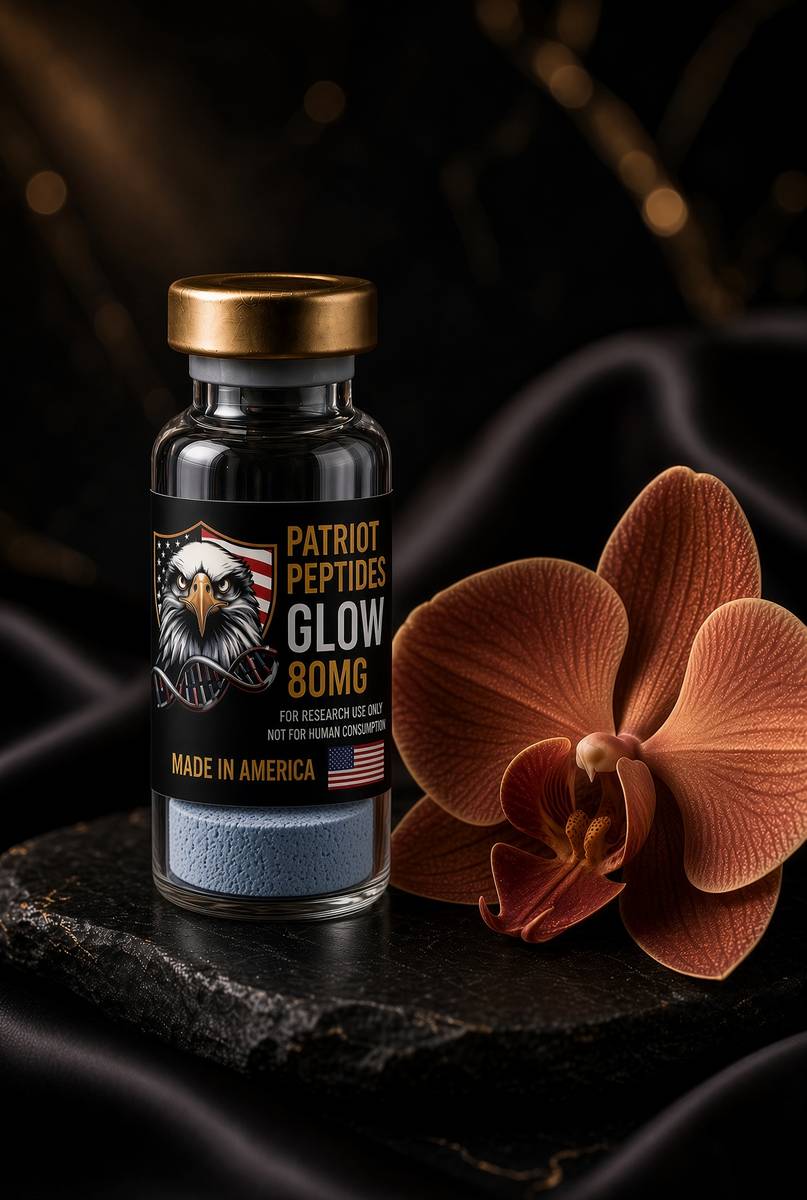
GLOW, in the catalogue, is a cap-count decision: 50 milligrams of GHK-Cu lyophilised with 10 milligrams each of BPC-157, TB-500 and KPV. Four named sequences, one cake, so a bench that wants all four doesn't open four caps. It isn't a cosmetic brand and it isn't this essay's molecule. BPC-157 is a gastric 15-mer with a VEGFR2 and nitric-oxide literature. TB-500 orbits the actin-binding motif of thymosin β4. KPV is the anti-inflammatory tail of α-MSH, NF-κB, PepT1 in gut models. Those three have their own pages. Mixing them with GHK-Cu in a vial doesn't merge the mechanisms. Copper delivery doesn't become actin sequestration by sharing a stopper. If you need the copper complex, you need the copper complex, with stoichiometry, without a gastric peptide as a confound. Blend papers have to name four ligands and four readouts. Most people who ask for the blend want one readout and four folklore threads. That request answers itself.
In short. A blend vial puts GHK-Cu next to three other named peptides for bench convenience. It does not merge their mechanisms. This essay is the copper complex alone.
Assays that ignore copper are not studying GHK-Cu
GHK acetate without copper is a tripeptide. Copper sulphate without GHK is a metal salt. GHK-Cu is the complex. Those three reagents will not give the same result in a fibroblast, a papilla cell, or a LOX activity assay, and running only one of them is how a literature becomes uninterpretable. Serum-containing medium already carries copper on albumin and ceruloplasmin; the amount varies by batch. A 'GHK' experiment in 10 percent foetal bovine serum is, among other things, a copper-reallocation experiment whose baseline metal the authors may not have measured. Chelex-treated medium, defined copper, preformed complex, and a stated molar ratio are the minimum adult methods. Cell-free Fenton assays that add free Cu²⁺ plus peroxide plus a colour reagent, then show that GHK reduces the colour, have demonstrated that the peptide binds copper. They haven't demonstrated a transcriptome, a cross-link, or a follicle. Binding is the chemistry. Biology is what happens after donation. Conflating the two is the most common figure in the cosmetic-adjacent papers, and it is the figure you should discount first.
In short. GHK alone, copper alone, and GHK-Cu are three different experiments. Serum already contains copper. If the methods skip stoichiometry, the result does not name this complex.
Identity tests belong on the reagent before they belong on the lysate. Reverse-phase HPLC at 214 or 220 nanometres sees peptide bonds. A main peak area percent is purity of a sort; a fat shoulder is a mixture wearing the complex's clothes. Mass spectrometry asks whether the mass is the mass of GHK, of GHK-Cu, of a dimer, of a deletion peptide from a missed coupling. Solid-phase synthesis of a tripeptide isn't heroic, which is why deletion and truncation impurities are the thing to look for rather than a failed synthesis. Copper content can be measured by ICP or by a careful UV-visible spectrum of the d-d band; the square-planar complex isn't colourless in concentrated solution. Certificates that list a sequence and a purity without a metal number have characterised a peptide, not the complex. The product is the complex. That sentence is the one this catalogue will keep, because it is the one the enzymology requires. A beautiful chromatogram of GHK acetate is a different vial.
In short. Check the chromatogram, the mass, and the copper content before the cell assay. A pure tripeptide without metal is not GHK-Cu, however clean the peak.
Doses in the culture literature wander. Nanomolar, if you're trying to look like Pickart's plasma. Micromolar, if you're trying to look like a 1988 collagen-synthesis paper that needed a signal a hydroxyproline assay could see. High micromolar, if someone has imported a cosmetic-serum percentage into a dish without converting it. Those aren't the same experiment, and a transcriptome at 10 micromolar isn't a restoration of a 200 nanogram-per-millilitre plasma tone. Copper toxicity also has a dose. SOD1 and LOX want metal; mitochondria and DNA don't want a Fenton mill. A concentration series isn't optional if the claim is a reset rather than a poison. Report the molarity of the complex, not a percentage, not a milligram per millilitre without a molecular weight, and not a drop of stock. The stock's copper ratio belongs in the same sentence. People have published fibroblast papers in which the only number was a dilution of an unnamed serum. Those papers are how a ligand acquires a reputation it has not earned, and how it loses one it has. Molarity isn't pedantry. It's the difference between a restoration and a spill.
In short. Culture doses range from plasma-like nanomolar to high micromolar. Those are different experiments. Report molarity of the complex, and a concentration series.
- Name the reagent: GHK-Cu, not 'copper peptide' and not GHK acetate with a hope.
- Declare moles of peptide and moles of Cu²⁺. Preformed complex, or mixed in the medium.
- Measure baseline copper in the medium, especially if serum is present.
- Run GHK-without-copper and copper-without-GHK, or say why you did not.
- Read out enzyme activity (LOX, SOD) as well as transcripts. Transcript is a vote.
- If you claim a transcriptome, use RNA-seq and a false-discovery-rate threshold, not a 2004 fold-change cut-off.
What would a modern replication look like, in working English. A single human dermal-fibroblast line, authenticated, a defined passage window because senescent fibroblasts write a different matrix. Medium with measured copper. GHK-Cu at two concentrations that bracket Pickart's plasma nanomolar and the higher doses culture papers used. Arms: complex, GHK, Cu²⁺, vehicle. Twenty-four and forty-eight hour RNA-seq, plus a LOX activity assay and a SOD activity assay on parallel plates. A collagen I ELISA or a hydroxyproline measurement so the protein exists, not only the message. MMP-1 in the conditioned medium. A second donor line. Pre-registered primary endpoints: a shortlist of COL1A1, COL3A1, DCN, MMP1, TIMP1, SOD1, and a global FDR on the rest. That experiment is expensive and boring and would settle more than another review. Until someone runs it, the live literature is Maquart 1988 on collagen synthesis, the LOX and SOD enzymology, the plasma concentrations Pickart reported, and a microarray census that is allowed to be a census. Hypothesis-generating is a respectable status. It isn't a finished map.
In short. A fair modern test would measure copper, compare three reagents, and read both gene messages and enzyme activity in defined fibroblasts. That experiment is still the one to want.
DNA-repair transcripts on the up list deserve a similar coolness. Fibroblasts in culture are under oxidative and replicative stress that a dermis in situ isn't always under. A copper complex that reduces Fenton load could spare DNA and, secondarily, change the transcription of repair genes. A copper complex that genuinely induces a repair programme would be a different finding, closer to the Epithalon literature's TERT claims than to a metal chaperone. Those two interpretations need a comet assay, a γH2AX focus count, or a defined repair reporter, not an enrichment score for 'DNA repair' on an old chip. The senescence essay next door is the place p16, p21 and SASP are argued properly. This ligand hasn't been shown to reverse Hayflick. It has been shown, in older biochemistry, to change matrix output from a fibroblast. Keeping those magnitudes honest is the whole tone of a copper essay that doesn't want to become a cream. Ageing biology is full of molecules that touch a real enzyme and then acquire a spreadsheet. The enzyme remains the better friend.
In short. DNA-repair genes on an old chip may just mean less oxidative stress in the dish. That is not the same as reversing cellular ageing. Matrix output is the stronger, older finding.
Copper delivery to lysyl oxidase and SOD is enough to be interesting. The transcriptome-reset is a hypothesis with a published outline, not a finished map. Hold both.
Metastasis language in a fibroblast paper is a third place to keep a cool head. MMP-1 and MMP-3 are, among other things, invasion tools; fibrinogen-related genes and adhesion cassettes light up oncology enrichments. A dermal fibroblast isn't a carcinoma. Down-regulation of a 'metastatic cassette' in that cell is a statement about a less matrix-chewing, less motile mesenchymal phenotype, if it is a statement about anything biological at all. Tumour stroma, LOXL2, and copper in angiogenesis are real oncology topics with their own ligands and their own trials. Filing GHK-Cu as an anti-metastatic peptide because an Affymetrix chip said so is how a repair-biology reagent acquires a second life it has not earned. If an oncology lab wants the complex as a copper ionophore next to a tetrathiomolybdate experiment, that is a named comparison. Tetrathiomolybdate is a copper chelator with a clinical history. GHK-Cu is a copper donor. They point opposite ways. Opposite reagents can both be interesting. They can't both be the same sentence.
In short. A fibroblast is not a tumour. Array talk of a metastatic cassette is a weak headline. Copper chelators and copper donors point opposite ways and should not share a caption.
What the ligand is, once the brochure is off
Strip the cream, the hair photograph and the 4,000-gene adjective, and GHK-Cu is still a chemically serious object. A plasma tripeptide, isolated because old tissue in a dish synthesised protein like young tissue. A square-planar Cu²⁺ complex via histidine and backbone nitrogens. A falling plasma concentration on Pickart's numbers. A copper enzyme, lysyl oxidase, that cannot finish collagen or elastin without the metal. A second copper enzyme, SOD1, that cannot mop superoxide without the metal. A 1988 fibroblast paper in which the complex raised collagen synthesis. A later microarray census that may or may not survive RNA-seq, and that already points at the same neighbourhood the enzymology named. Hair-follicle and dermal-papilla models as a second tissue with the same matrix logic. Cosmetic chemistry as a linguistic hazard, not a disproof. Assays that ignore copper as a different experiment. That's a reagent. A moisturiser, a hydrolysate, a senolytic and a hair-density claim are other objects. The live question is the map. The live chemistry is the complex.
In short. Under the marketing, GHK-Cu is a small copper-carrying plasma peptide that feeds matrix and antioxidant enzymes. The giant gene story is extra, and still on trial.
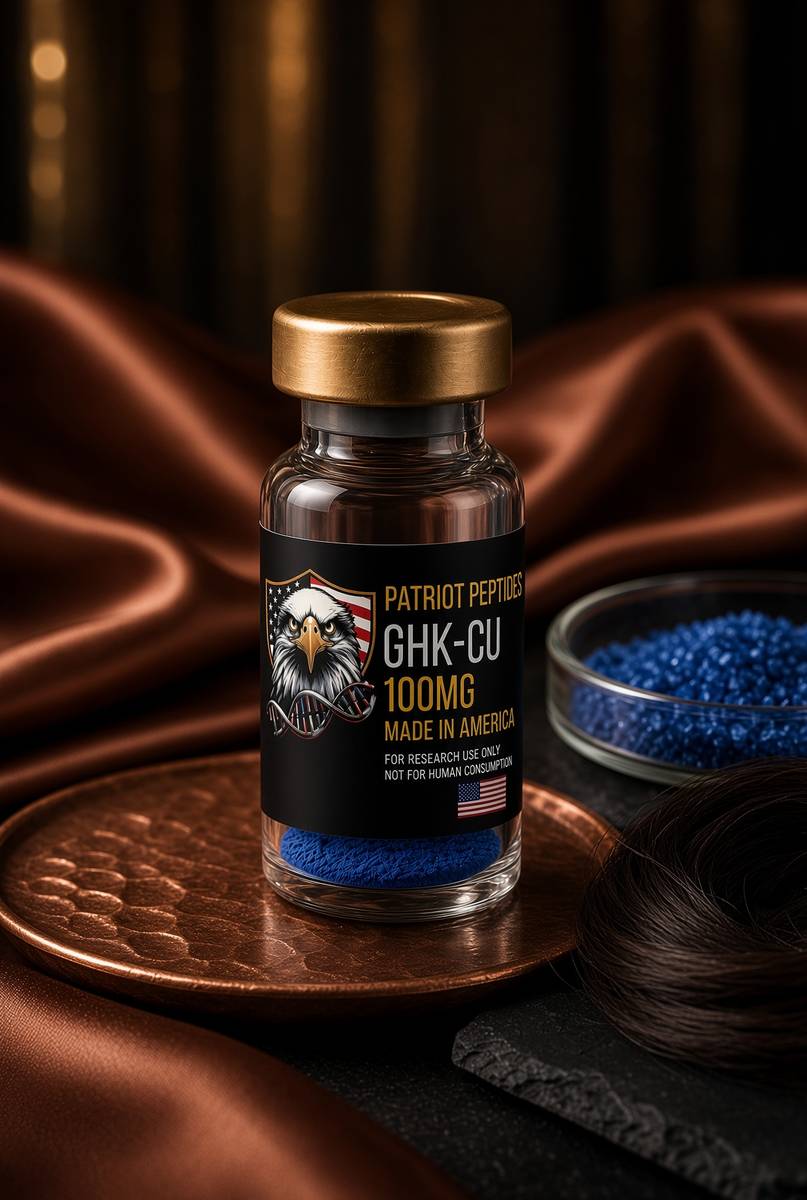
Patriot Peptides lists GHK-Cu as 100 milligrams of the lyophilised Gly-His-Lys copper(II) complex, HPLC-characterised, the sequence and the metal the papers name. The neighbouring reading list is the collagen-powder essay, so the grocery word doesn't win; the senescence essay, so SASP's MMPs sit on the table; and the NEOGEN essay, so thermal remodelling of dermis isn't mistaken for a copper assay. None of those neighbours is a protocol for mixing the vial with a device, a powder, or a senolytic. If you need this ligand, declare stoichiometry, run the metal controls, and pick a readout LOX, SOD, collagen, TIMP or MMP can actually answer. If you need a transcriptome, pay for RNA-seq. The complex will still be interesting if the spreadsheet shrinks. It will be more interesting if the spreadsheet survives. Either result is science. The brochure is the thing that cannot survive either result, and it doesn't need to. Research use only is the legal class of the reagent, and the right last word.
In short. The listed complex is the named Gly-His-Lys copper compound for laboratory assays. Declare the metal. Pick a real readout.
Questions the essay actually answers
- Is GHK-Cu a collagen supplement?
- No. It is a copper-binding tripeptide, Gly-His-Lys · Cu²⁺, studied in fibroblast and hair-follicle models. Collagen cross-linking is one copper-dependent process it touches. Hydrolysed collagen powder is a food mixture with no single sequence.
- Why does the copper matter?
- Free Cu²⁺ catalyses Fenton chemistry. GHK holds copper in a square-planar complex so enzymes such as lysyl oxidase and SOD1 can receive metal without a redox-active pool. Leave the copper out and you are studying GHK, not GHK-Cu.
- Did the microarray reset really move thousands of genes?
- That is Pickart and Margolina's published claim, from Affymetrix-era profiles. Modern RNA-seq with proper multiple-testing correction is the replication the claim still owes. Copper delivery plus TGF-β modulation would remain interesting if the spreadsheet shrinks.
- What does lysyl oxidase actually do?
- LOX and the LOXL enzymes oxidatively deaminate lysine and hydroxylysine in collagen and elastin, so covalent cross-links can form. The enzyme is copper-dependent and builds a lysine tyrosylquinone cofactor once the metal is bound. No copper, a weak gel.
- Are cosmetic copper peptides the same reagent?
- Sometimes a serum contains characterised GHK-Cu. Often the bottle says copper peptides and does not declare a mass, a stoichiometry or a chromatogram. Identity is the distinction. This essay is the named complex.
- Does GHK-Cu grow hair?
- Dermal-papilla and follicle organ-culture models exist, sitting on the same copper-and-matrix logic as the fibroblast work. That is a literature. It is not a density claim and not a shampoo. Anagen assays name the ligand; photographs of scalps do not.
- How is this different from GLOW, BPC-157 or KPV?
- GHK-Cu is the copper complex. GLOW is a blend vial that includes it next to BPC-157, TB-500 and KPV as a cap-count. BPC-157 is a gastric 15-mer. KPV is the anti-inflammatory tail of α-MSH. Four mechanisms. This page is one of them.
- What should you write down when you run this complex?
- Moles of GHK and moles of Cu²⁺, whether the complex was preformed, baseline copper in the medium, and a copper-salt arm plus a GHK-without-copper arm. Activity readouts for LOX or SOD beat a pathway score. RNA-seq beats a 2004 fold-change table.
- Is this a medicine or a moisturiser?
- Neither. The listing is a lyophilised research complex, HPLC-characterised, for laboratory assays. Cosmetic copper-peptide products and any licensed medicine are different objects, different labels, different evidence.
- Where does senescence come into it?
- SASP includes MMP-1 and other matrix-chewing factors. GHK-Cu arrays claim MMP down and TIMP up, a counter-secretome if the claim holds. That is a neighbour of Campisi's literature, not a senolytic. p16 is a different invoice.
Hypothetical research reconstitution
How these vials are typically mixed
Hypothetical research reconstitution for the named catalogue vial. Not a protocol, not medical advice, not a use instruction. These amounts sit in published and commonly cited laboratory ranges. The vial is labelled for research use only — not for human or veterinary administration.
GHK-Cu
100mg
Mix with 5 ml bacteriostatic water → 20 mg/ml
- Hypothetical aliquot
- 1–2 mg
- 0.05–0.10 ml · 5–10 units on a U-100 syringe
- How often
- Once daily
- 4–8 weeks
Bench steps
- Let the vial sit until it is no longer cold to the touch.
- Wipe the stopper with 70% isopropyl alcohol. Let it dry.
- Draw 5 ml bacteriostatic water (0.9% benzyl alcohol).
- Run the water slowly down the inside glass — do not blast the cake.
- Roll between finger and thumb until the cake is gone. Do not shake.
- Label the date. Store the solution at 2–8 °C. Do not freeze. Use within 30 days unless the note below says otherwise.
The solution is blue if the copper is on the peptide. Grey or colourless is the wrong cake. 100mg wants 5 ml or the syringe marks get silly.
GLOW
80mg (50 GHK-Cu / 10 BPC-157 / 10 TB-500 / 10 KPV)
Mix with 4 ml bacteriostatic water → 20 mg/ml of the blend
- Hypothetical aliquot
- 5 mg of blend (≈ 0.25 ml)
- 0.25 ml · 25 units on a U-100 syringe
- How often
- Once daily, or five days on / two off
- 4–6 weeks
Bench steps
- Let the vial sit until it is no longer cold to the touch.
- Wipe the stopper with 70% isopropyl alcohol. Let it dry.
- Draw 4 ml bacteriostatic water (0.9% benzyl alcohol).
- Run the water slowly down the inside glass — do not blast the cake.
- Roll between finger and thumb until the cake is gone. Do not shake.
- Label the date. Store the solution at 2–8 °C. Do not freeze. Use within 30 days unless the note below says otherwise.
Four sequences, one cake. You cannot dose the four independently from this vial. Blue from the copper. Fridge.
Bacteriostatic water and sterile syringes ship with peptide orders over £75. Kit details · 10 ml bacteriostatic water
The vials this essay sits on
Named sequences the essay maps — GHK-Cu, GLOW. Hypothetical research neighbourhood, not a protocol, not a medicine. One press puts every in-stock vial in the bag.
 Research onlyOut of stock
Copper complex
GHK-Cu
100 mg GHK-Cu. Pickart’s copper tripeptide, lyophilised.
4.9(590)
44 browsing this now · 5 purchased in the last 24 hours
100mg
£35.00
 Made in USAOut of stock
Copper complex
GLOW
80 mg blend — 50 mg GHK-Cu, 10 mg BPC-157, 10 mg TB-500, 10 mg KPV.
4.8(548)
83 browsing this now · 5 purchased in the last 24 hours
80mg
£65.00
Research use only. Not a combined-use instruction.
Read next
49 min · long read · Peptide research
Collagen powder is not a research peptide
Type I collagen is a thousand-residue triple helix. Industrial ‘collagen peptides’ are a 2–5 kDa hydrolysate of that helix — thousands of fragments, no single HPLC peak. GHK-Cu is three letters and a metal.
49 min · long read · Peptide research
Senescent cells refuse to die, and they talk too much
Hayflick watched fibroblasts stop dividing. Campisi named the SASP — the inflammatory letters those arrested cells keep sending. Clearing p16-high cells in mice (INK-ATTAC) delayed aging phenotypes. The pathology is accumulation, not the programme itself.
45 min · long read · Clinic
NEOGEN nitrogen plasma: what the energy actually does to skin
NEOGEN plasma at eLIVEate Me in Buckinghamshire. Nitrogen plasma denatures collagen without a laser chromophore. A course of three, then 90 days of rebuild.
More in this desk

53 min · long read · Peptide research
Recovery, GH pulses and the CJC / ipamorelin pair
Somatotrophs have two 'go' receptors. CJC without DAC is a slightly longer GHRH pulse. Ipamorelin is a selective ghrelin-receptor key that does not yank ACTH. Together they are the pair Bowers already showed is more than additive — not a gym protocol.
53 min · long read · Peptide research
How research peptides are made — and why HPLC actually matters
Solid-phase peptide synthesis builds a chain one residue at a time. HPLC then asks whether the main peak is what you think it is. ≥98% is not a slogan. It is a chromatogram.
52 min · long read · Peptide research
Fatigue, cellular energy and the NAD+ / MOTS-c neighbourhood
NAD+ is the rechargeable chip every cell spends on fuel and DNA repair — and the pool shrinks with age. MOTS-c is a mitochondrial 16-mer sent out under metabolic stress. Two answers to 'I have no energy' that are not coffee.
51 min · long read · Peptide research
Melanocortin circuits: pigment, appetite and PT-141
Melanotan II lights MC1, MC3, MC4 and MC5 — pigment plus the rest of the sheet. PT-141 is the free-acid cousin pointed at MC3 and MC4, the circuitry papers use for desire and energy, not skin colour. Same Arizona family. Different question.
Essays describe published research. They are not medical advice and they do not authorise human use of any catalogue item.