

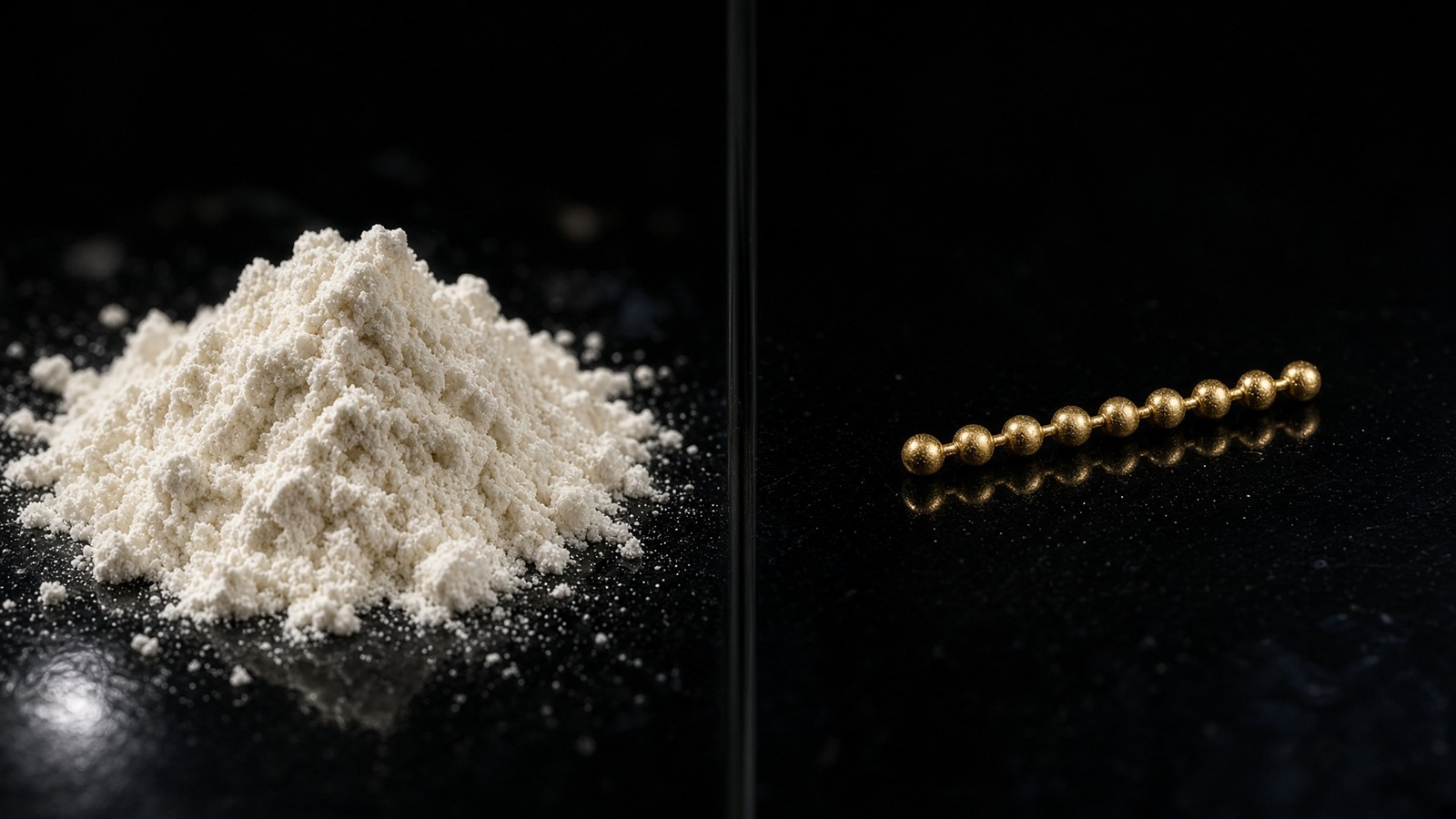
Peptide research · 49 min · 10,798 words
Collagen powder is not a research peptide
Type I collagen is a thousand-residue triple helix. Industrial ‘collagen peptides’ are a 2–5 kDa hydrolysate of that helix — thousands of fragments, no single HPLC peak. GHK-Cu is three letters and a metal.
· updated
What this essay actually tells you
- Industrial 'collagen peptides' are a 2–5 kDa hydrolysate of hide or fish. Thousands of fragments, no single sequence, no single HPLC peak. Food.
- BPC-157 is GEPPPGKPADDAGLV. GHK-Cu is glycine-histidine-lysine holding Cu²⁺. KPV is the C-terminal tripeptide of α-MSH. Those are ligands. Count the residues.
- If the tub answers 'how much?' in grams, it's food. If the vial answers with a one-letter code and a mass, it's a research peptide. We stock the second.
What this actually means
If the tub says 'collagen peptides' and lists grams, you are buying a food hydrolysate. Type I collagen is a heterotrimeric (α1)₂α2 triple helix, each chain about a thousand residues, with glycine every third position (Gly–X–Y, often Gly–Pro–Hyp). Industry chops hide or fish collagen with enzymes until the average fragment is 2–5 kDa, so it dissolves in coffee. There is no single sequence. There is no receptor occupancy curve. There is no HPLC peak of one molecule. Iwai, Sato and others did show that di- and tripeptides such as Pro–Hyp appear in blood after you eat the hydrolysate, and those fragments are studied as a mixture. That's nutrition, and it's allowed to be interesting. A research peptide is the opposite object: one primary structure, a mass, a chromatogram, a paper. GHK-Cu is glycine-histidine-lysine with copper. BPC-157 is GEPPPGKPADDAGLV. KPV is the last three residues of α-MSH. Those are ligands. Mixing the words is how a grocery aisle stole a laboratory term.
Let's start with a word that's been wrecked, because collagen powder did most of the public damage. A tub of hydrolysed collagen lists grams, a flavour, and a source — bovine hide, fish skin, porcine bone — and calls the contents peptides because the average fragment sits in the same mass band as a hormone. A research vial lists a one-letter code, a calculated mass, and a chromatogram on which a main peak can be pointed at. Both objects are amino-acid chains joined by amides. That's where the kinship ends. Type I collagen is a heterotrimeric triple helix, two α1(I) chains and one α2(I) chain, each about a thousand residues, glycine every third position, hydroxyproline holding the three strands, a D-period of 67 nanometres once the helices pack into a fibril. Industrial collagen peptides are an enzymatic hydrolysate of that helix: two to five kilodaltons, thousands of overlapping fragments, no single sequence, no single HPLC peak. GHK-Cu is glycine-histidine-lysine holding Cu²⁺. Three letters and a metal. The shared syllable is an accident of English, not a shared object. This page is the chemistry of that split.
In short. Collagen powder and a named research ligand both get called peptides. Only the second has one sequence, one mass and one chromatogram.
Collagen is the most abundant protein in a mammal, and it earns that rank by being a cable rather than a memo — a structural rope, not a hormone. Bone, tendon, dermis, cornea, vessel wall: type I is the load-bearing polymer those tissues are built from. The factory that writes it is a fibroblast, an osteoblast, a tenocyte; the product is a secreted heterotrimer that other enzymes then cross-link. When a food plant makes collagen peptides, it isn't purifying that heterotrimer. It is digesting a hide, a bone, a fish skin, until the average piece dissolves in coffee. Endopeptidases cut. The product is a population, batch-dependent, overlapping, unnamed. That can still be a decent protein supplement. It's a nutrition conversation, and nutrition is allowed to be interesting. Calling the contents a peptide in the same sentence as GHK-Cu or BPC-157 is a category error the grocery aisle has every incentive to keep making. A laboratory that lets the words blur has stopped doing identity. Ask for the residues. If the answer is a gram weight, it's food.
In short. Collagen is a structural protein, the cable in skin, bone and tendon. Chopping it into a drinkable powder doesn't turn it into a named ligand.
The working definition we use on a research bench is boring on purpose, and that's a kindness. One primary structure. A mass. A chromatogram. A paper that named the residues. GHK-Cu is Gly-His-Lys·Cu²⁺, Pickart's plasma tripeptide, a square-planar copper complex, a certificate with HPLC and a mass. BPC-157 is GEPPPGKPADDAGLV, fifteen residues from a gastric protein, proline-rich, a single peak. KPV is Lys-Pro-Val, the C-terminal tripeptide of α-MSH. Each of those can be written in one-letter code, weighed as a single mass, and shown as a main HPLC peak. That's the object. Hydrolysed collagen can't point at those letters, that mass, or that peak, because it's thousands of fragments at once. Identity tests that mean everything on a research vial — reverse-phase HPLC plus mass spectrometry of one peak — are meaningless as a purity claim on broth. A CAS number and a one-letter code belong to ligands. A scoop belongs to food. Mixing the words is how a grocery aisle stole a laboratory term.
In short. A research peptide is one named chain, a measured mass, and a chromatogram. Collagen powder is a mixture with a gram weight.
So the job of this page is the gory version of a split the neighbouring essays only plant as a flag, and we'll walk it slowly. What a peptide is, next door, has to mention collagen powder in order to rescue the word; it doesn't have to walk the helix. The copper-and-repair-transcriptome essay has to mention lysyl oxidase, because GHK carries the metal that enzyme needs; it doesn't have to walk the hydrolysate. The synthesis-and-HPLC essay has to say that a clean peak of the wrong chain is a waste of a month; it doesn't have to say why a tub never had a peak to start with. This page walks the helix, the D-period, the copper enzyme, the industrial cut, the charitable nutrition paper, and the three ligands people keep filing in the same drawer as a scoop. Type I collagen, two α1(I) and one α2(I), Gly-X-Y, hydroxyproline, a thousand residues, a 67-nanometre D-period. Food collagen peptides, enzymatic hydrolysate, two to five kilodaltons, no single sequence, grams as food. GHK-Cu, three letters and a metal, defined, characterised. The rest is why those sentences can't be collapsed.
In short. This page walks the collagen helix, the industrial digest, and the named ligands people confuse with the powder. They are different objects.
Ask for the sequence. If the answer is a gram weight, it is food. If the answer is a one-letter code and a mass, we can talk.
Two α1(I), one α2(I), a thousand residues
Type I collagen is a heterotrimer: two α1(I) chains, gene COL1A1, and one α2(I) chain, gene COL1A2. Each chain's helical domain is about a thousand residues. The exact census is a little longer once you count the N- and C-telopeptides that sit outside the helix and do the cross-link chemistry, and longer still in the procollagen that left the endoplasmic reticulum with registration peptides still attached. The working number, the one you can live with on a bench, is a thousand-residue triple helix. The two α1 chains and the one α2 chain wind around each other, right-handed as a triple helix built from three left-handed polyproline-II-like strands. Ramachandran's group in Madras, and Rich and Crick in Cambridge, argued the geometry in the 1950s; the field has been measuring it ever since. Osteogenesis imperfecta, the brittle-bone diseases, is in large part a genetics of those two genes: a glycine substitution in the helical domain is enough to wreck packing. That's how tightly the cable is specified. A food hydrolysate of the same protein has thrown the specification away on purpose.
In short. Type I collagen is two matching chains and one slightly different chain, each about a thousand amino acids, wound into a triple helix.
Glycine every third residue isn't decoration — it's the packing rule that lets three chains sit down together. The repeating triplet is Gly-X-Y. X is often proline. Y is often hydroxyproline, the residue a prolyl 4-hydroxylase made from proline after the chain was written. Glycine is the only side chain small enough — a hydrogen — to sit at the sterically crowded interior of the triple helix. Substitute a bulkier residue there and the helix bulges; substitute enough of them and the molecule never leaves the quality-control of the endoplasmic reticulum. Proline and hydroxyproline, with their pyrrolidine rings, restrict the backbone angles so the chain prefers the polyproline-II conformation the triple helix is built from. Hydroxyproline then donates a hydrogen bond, water-mediated in the crystal structures, that holds the three strands together thermally. A collagen peptide in the grocery sense has been cut across those triplets at thousands of positions. The packing rule is gone. What remains is a mixture of short Gly-X-Y scraps, dipeptides, tripeptides, and everything in between, none of them a helix, none of them a cable, none of them a ligand with a name.
In short. Glycine sits every third residue so the three chains can pack. Proline and hydroxyproline stiffen the twist. A hydrolysate has cut that pattern to bits.
Hydroxyproline is a post-translational modification, not a twenty-first amino acid the ribosome encoded. Prolyl 4-hydroxylase, a 2-oxoglutarate-dependent dioxygenase in the endoplasmic reticulum, oxidises selected prolines in the Y position of Gly-X-Y. The enzyme needs iron, ascorbate, and molecular oxygen. Scurvy is the existence proof: without vitamin C the hydroxylase stalls, under-hydroxylated chains fail to form a stable triple helix, and connective tissue falls apart. Hydroxylysine is the cousin modification, written by lysyl hydroxylases, and some of those hydroxylysines are then glycosylated. None of this chemistry is available to a solid-phase synthesiser making GHK. None of it's preserved as a single species when a food protease chews the finished helix. The hydrolysate may still contain hydroxyproline as an amino acid, which is why nutrition labels sometimes boast about it, and which is a composition number, not an identity. A residue census of a mixture isn't a sequence. Collagen is unusual among proteins for how much of its character is written after translation. Chopping the product doesn't keep the character. It keeps some of the letters.
In short. Hydroxyproline is added to collagen after the chain is made, and vitamin C is required for that step. A powder's hydroxyproline number is a composition, not a sequence.
The triple helix is a rope about one and a half nanometres across and three hundred nanometres long for a type I molecule. That's already a different scale from GHK, which is three residues and a few tenths of a nanometre, and from BPC-157, which is fifteen residues and a few nanometres. A type I heterotrimer, three chains of about a thousand residues each, sits near 300 kilodaltons before the telopeptides and the cross-links are argued over. The hydrolysate that industry sells as collagen peptides has been cut until the average piece is two to five kilodaltons, twenty to fifty residues if you pretend the pieces are uniform, which they are not. Sharing a mass band with some peptide hormones — insulin is 5.8 kilodaltons, a 2–5 kDa fragment overlaps that neighbourhood — isn't sharing a molecule. Insulin has a sequence, two chains, three disulphides, and a receptor tyrosine kinase. A 3 kDa collagen fragment has a statistical length and a glycine-rich composition. The peptide-bond diagram on this page is the amide both objects share. Length, fold and identity are the facts the amide doesn't settle.
In short. A type I collagen molecule is hundreds of times larger than a research tripeptide. Cutting it into coffee-sized pieces doesn't make those pieces insulin, or GHK.
Diagram
- Amino acid~110 DaTwenty side chains. The alphabet.
- Peptide bondamide, planarCarboxyl carbon to the next nitrogen. Resonance holds it flat.
- Oligopeptide< ~20 residuesMost hormones and fragments. GHK is three. KPV is three.
- Polypeptide20–50+Insulin 51. GLP-1 31. Retatrutide is a designed chain in this band.
- Proteinfolded machineHaemoglobin, a GPCR, lysyl oxidase. Tertiary structure worth drawing.
Insulin (Banting and Best, 1921) was the first peptide anyone bothered calling a medicine. A collagen hydrolysate is food. A named sequence with a mass and a chromatogram is a research peptide. The shared word is the accident.
Biosynthesis is a factory with named rooms, and it's worth walking once so the food digest can be seen as the opposite process. COL1A1 and COL1A2 are transcribed, spliced, translated into the rough endoplasmic reticulum. Signal peptides come off. Prolyl and lysyl hydroxylases modify the chains. HSP47, the collagen-specific chaperone, walks the folding. The C-propeptides register the two α1 chains and the one α2 chain so the triple helix zips from the C-terminus toward the N-terminus. The molecule moves through Golgi, is secreted as procollagen, and extracellular proteinases — ADAMTS-2, BMP-1/tolloid — cut the N- and C-propeptides. Only then is the helix a collagen molecule that can pack into a fibril. Lysyl oxidase, later, writes the covalent cross-links. A food factory starts at the other end: a tissue that already did all of that, hide or bone or fish skin, is denatured and then cut. Gelatin is the denatured helix. Collagen peptides, in the industrial sense, are gelatin cut smaller. Nobody ran COL1A1. Nobody formed a helix. Nobody asked lysyl oxidase to do anything. The letters are recycled. The object is new, and it's a mixture.
In short. Cells build collagen through a long, named pipeline of folding and cutting. A food factory starts from finished tissue and digests it. Opposite directions.
The D-period is 67 nanometres
Once the processed helices pack side by side, they don't pack in register. Each molecule is staggered by 67 nanometres relative to its neighbours, the D-period Hodge and Petruska described, a number electron microscopy and low-angle X-ray scattering have been returning for decades. The stagger produces a gap region and an overlap region, the banding you can see on a well-prepared fibril, and it's also where the cross-links sit. The D-period is a structural fact of type I fibrils in tendon, bone, dermis and cornea, with tissue-specific packing and tissue-specific interruptions. It isn't a fact of a hydrolysate. A two-to-five-kilodalton fragment is a few nanometres at most, fully extended; it can't reconstruct a 67-nanometre stagger by being swallowed. People who talk as if drinking collagen peptides rebuilds a D-period in the dermis are skipping the biosynthesis, the secretion, the registration, the fibril packing and the copper enzyme, and replacing all of that with a grocery word. Amino acids and a few dipeptides do appear in plasma. A 67-nanometre cable doesn't.
In short. Collagen molecules pack with a 67-nanometre stagger to make a fibril. Drinking small fragments doesn't rebuild that stagger.
The hierarchy above the molecule is as specified as the helix. Molecules pack into fibrils, tens to hundreds of nanometres across. Fibrils pack into fibres. Fibres, in tendon, pack into fascicles, and fascicles into a load-bearing organ with a crimp, a sheath, a vascular and neural supply that's deliberately sparse. Dermis writes a different weave, more isotropic, type I and type III together, a mechanical environment fibroblasts feel through integrins. Bone mineralises the fibril. Cornea stacks the fibrils in orthogonal lamellae so the tissue is transparent. Same type I genes, different higher-order architecture, different verdict if the architecture fails. A peptide that increases collagen, as a hydroxyproline number in a dish, hasn't yet told you which architecture it's serving. A powder that supplies glycine, proline and hydroxyproline hasn't told you anything about architecture at all. It has told you that a mammal ate some amino acids. The D-period, the fibre, the tissue: those are cell and enzyme and time. They're not a scoop.
In short. Molecules become fibrils, fibres and tissues, each with a different architecture. A powder supplies amino acids. It doesn't supply that hierarchy.
Type I isn't the only collagen, and naming the others once stops a tub from pretending it's the whole extracellular matrix. Type II is the cartilage helix, a homotrimer of α1(II). Type III is the wound and reticular collagen, often a partner of type I in dermis and vessel. Type IV is the basement-membrane network, not a fibril, the sheet under epithelium and endothelium. Types V and XI sit inside type I and type II fibrils and help set diameter. FACITs, multiplexins, MACITs: the family has twenty-eight types in humans, different genes, different assemblies, different diseases when they fail. Alport syndrome is type IV. Epidermolysis bullosa has a type VII chapter. Ehlers–Danlos has several collagen chapters. Industrial collagen peptides are overwhelmingly type I, because hide, bone and fish skin are overwhelmingly type I. A type I hydrolysate isn't type IV, isn't a basement membrane, and isn't a cartilage recipe. Even as food it's one feedstock. As a research ligand it isn't a ligand. The family is large. The tub is narrow. The vial, if it's GHK-Cu, is three residues and doesn't pretend to be a type.
In short. Humans have many collagen types. The powder is almost always chopped type I from hide or fish. It's still a mixture, and still not a named ligand.
- GHK-Cu
- 3 residues, ~340 Da
- KPV
- 3 residues
- BPC-157
- 15 residues, ~1.4 kDa
- Collagen hydrolysate piece
- 2–5 kDa average
- Type I α chain
- ~1000 residues, ~100 kDa
- Type I heterotrimer
- ~300 kDa, ~300 nm
- D-period
- 67 nm
Gly-His-Lys·Cu²⁺. A defined ligand. One HPLC peak.
Lys-Pro-Val, the tail of α-MSH. Also a single sequence.
GEPPPGKPADDAGLV. A gastric fragment, not a collagen scrap.
Thousands of overlapping fragments. No single sequence.
Gly-X-Y. Two α1(I), one α2(I) in the helix.
The secreted cable before fibrils pack.
Hodge–Petruska stagger. A fibril fact, not a powder fact.
Hydroxyproline holds the helix. Lysyl oxidase holds the cable.
A newly secreted type I helix is still a hydrogen-bonded rope. Pull on it and the three strands can slide. Load-bearing connective tissue requires covalent cross-links between chains and between molecules. Lysyl oxidase, LOX, and the LOX-like enzymes LOXL1 through LOXL4, do that job. They oxidatively deaminate the ε-amino group of specific lysine and hydroxylysine residues in the telopeptides, leaving an aldehyde: allysine or hydroxyallysine. Those aldehydes then condense — aldol products, Schiff bases, and, with time, the pyridinolines of mature collagen and the desmosines of elastin. The enzyme carries copper and a lysine tyrosylquinone cofactor, LTQ, built in place from a tyrosine and a lysine once copper is bound. No copper, no LTQ, no aldehyde, no cross-link. A culture deprived of copper doesn't make a dermis. It makes a weak gel. That sentence is older than GHK, older than collagen powder, and doesn't depend on any microarray. It is why a copper tripeptide and a tub of hydrolysate get mentioned at the same dinner, and why that mention is a muddle rather than a mechanism.
In short. Lysyl oxidase uses copper to cross-link collagen so the helix becomes a load-bearing cable. Without the metal you get a weak gel.
β-Aminopropionitrile, the lathyrism toxin from sweet pea, inhibits lysyl oxidase. Animals and people exposed to it get fragile collagen, aneurysms, a skeleton that won't hold. Menkes disease, a failure of the copper-transporting ATPase ATP7A, starves secreted copper enzymes and produces a connective-tissue phenotype that looks, in places, like a cross-link failure. Scurvy starves the hydroxylase instead of the oxidase and the helix itself never sets. Three existence proofs, three different inputs, one tissue that falls apart when the cable isn't finished. A copper-delivery reagent such as GHK-Cu sits on the oxidase side of that triangle. A vitamin C conversation sits on the hydroxylase side. A hydrolysate sits on neither. It's a supply of residues, some of them already hydroxylated because the animal that grew the hide already ran those enzymes. Feeding finished letters isn't running the factory. The factory is still a fibroblast, still HSP47, still LOX, still copper, still time. Treat a scoop as a substitute for that factory and you've confused a feedstock with an enzyme.
In short. Block lysyl oxidase, starve copper, or skip vitamin C, and connective tissue fails. A collagen powder doesn't replace those enzymes.
This is the overlap that keeps the muddle alive, and it should be stated without flinching. Lysyl oxidase is copper-dependent. GHK carries copper. Collagen needs lysyl oxidase. So a tub of hydrolysate and a vial of GHK-Cu get mentioned in the same breath, and then someone says peptides as if that settled it. It doesn't. One is a mixture you eat. The other is Gly-His-Lys·Cu²⁺, characterised, a defined ligand with a published fibroblast signature. Maquart, Pickart, Borel and colleagues showed in 1988 that the copper complex stimulated collagen synthesis in fibroblast cultures. Pickart and Margolina's later arrays put collagen, decorin, TIMPs up and some MMPs down. Those are claims about a named complex in a dish. They're not claims about a 2–5 kDa hydrolysate in a mug. Copper delivery to LOX is a mechanism you can name. Swallowing glycine and proline is nutrition. Both can be true. They're still two different jobs. The copper-and-repair-transcriptome essay is the ligand in full. This page only needs the sentence that belongs in a split: the enzyme that finishes collagen uses copper; the powder isn't that enzyme, and it isn't the copper ligand either.
In short. GHK-Cu carries copper toward the enzyme that cross-links collagen. That doesn't make collagen powder the same object as GHK-Cu.
Diagram
- GHKGly-His-LysPickart, 1970s plasma fraction. ~200 ng/ml at 20; ~80 ng/ml at 60.
- Cu²⁺ complexsquare-planarHistidine imidazole + backbone nitrogens. The product is the complex.
- Lysyl oxidaseLOX / LOXLCopper enzyme. No metal, no collagen cross-links, a weak gel.
- SOD1Cu/ZnFirst mop for superoxide. Same metal, different job.
- Free Cu²⁺FentonCu⁺ + H₂O₂ → HO·. Delivery without a redox-active pool is the point.
Pickart and Margolina’s microarrays claim thousands of transcripts. Modern RNA-seq with multiple-testing correction is the replication the claim still owes. Copper delivery to LOX and SOD would remain interesting if the spreadsheet shrinks.
Elastin is the other LOX substrate, and it's the one a collagen tub never was. Tropoelastin is secreted, aligned on a fibrillin microfibril scaffold, and cross-linked into desmosine and isodesmosine, the tetrafunctional residues that make elastin a rubber. Adult dermis makes almost no new elastin under ordinary conditions. A type I hydrolysate doesn't contain tropoelastin sequence in any useful sense; hide is collagen, not elastic-fibre feedstock, and the digest is still a mixture. Cosmetic copy that slides from collagen peptides to elasticity is sliding from a type I hydrolysate to a different protein with a different gene, a different cross-link, and a different developmental window. GHK-Cu, as a copper donor, can in principle sit on elastin cross-linking as well as collagen cross-linking, because LOX does both. That is still a copper-enzyme sentence, not a powder sentence. Keep the proteins named. Collagen I. Elastin. LOX. GHK-Cu. Four objects. A tub that says peptides and means hide digest is one feedstock. It doesn't absorb the other three by sharing a syllable with the fourth.
In short. Elastin is a different rubbery protein that also needs copper cross-links. Collagen powder isn't elastin, and it isn't the copper ligand either.
What a food factory actually does
The feedstock is an animal leftover that already lived a life as a cable. Bovine hide, porcine skin and bone, fish skin and scale: type I collagen, cross-linked, sometimes mineralised, sometimes still wearing bits of other matrix. Industry doesn't want the cable. It wants a soluble protein. The first historical product was gelatin: acid or alkaline pretreatment to nick the cross-links and unravel the helix, then hot-water extraction, a denatured, water-soluble coil that sets as a gel when you cool it. Gelatin is already not collagen. The triple helix is gone. The D-period is gone. What remains is a polydisperse, glycine-rich, proline-rich protein that still has a large average molecular weight. Collagen peptides, in the industrial vocabulary, are the next cut. Endopeptidases — often bacterial proteases chosen for price and for the fragment-size they leave — digest the gelatin until the average piece is two to five kilodaltons, so it dissolves in cold liquid and doesn't gel. That last property is the specification the marketing department actually needed. Coffee. A smoothie. No lumps. The word peptide arrived because the fragments had entered the mass band where hormones live.
In short. Factories unravel hide or fish collagen into gelatin, then cut it smaller so it dissolves in coffee. That drinkable cut is sold as collagen peptides.
Enzymatic hydrolysate is the honest name, and it's worth saying before anyone reaches for a one-letter code. The enzymes aren't sequencing the protein. They are cutting where their active sites fit: after a hydrophobic residue for one protease, after a charged residue for another, a cocktail so the digest doesn't stall. The product is a broad molecular-weight distribution, typically centred at two to five kilodaltons, with a tail of smaller di- and tripeptides and a tail of larger leftovers. Batch to batch, the distribution moves. Source to source — bovine versus marine — the residue census moves, because fish type I isn't cow type I in every triplet, and because skin isn't bone. There's no single sequence. There's no one fragment that's the product. A certificate that listed every species in a hydrolysate would be a proteomics paper, and it would be out of date when the next lot ran. What the tub lists instead is grams, a flavour, sometimes a source, sometimes an average molecular weight. Those are food-label facts. They're not a one-letter code. They're not a mass of a named chain. They're not an HPLC main peak.
In short. The digest is a mixture whose average size is two to five kilodaltons. The pieces change with the batch and the animal. There's no one chain to name.
Thousands of overlapping fragments isn't a figure of speech. A type I α chain of a thousand residues, cut into twenty-to-fifty-residue pieces, already yields dozens of possible windows; cut with a protease that has more than one preferred site, and allow incomplete digestion, and the combinatorial set is thousands. Many of those fragments share N- or C-terminal sequences. Many contain the Gly-X-Y triplet still intact over a short run. A few of the smallest pieces, Pro-Hyp, Hyp-Gly, Pro-Hyp-Gly, are abundant enough, and stable enough to proteases, that they survive digestion in the gut and appear in plasma. Those are the fragments the charitable nutrition papers actually name. The rest of the population is a background of glycine-rich peptides that become free amino acids on the way through the enterocyte, or that never made it into a paper because they are unremarkable. A mixture can have biology. A mixture still doesn't have a single sequence, a single mass, or a single receptor curve. Pointing at Pro-Hyp as if it redeemed the tub is pointing at one droplet and calling it the sea.
In short. A thousand-residue chain, cut in many places, makes thousands of overlapping pieces. A couple of small fragments get named. The rest is still a mixture.
Grams as food is the other half of the identity test. A research vial of GHK-Cu is sold in milligrams of a complex whose molar mass is about 340 daltons. A tub of collagen peptides is sold in grams to tens of grams per serving, because it's being used as a protein supplement, and because the fragments have no occupancy at a named receptor that would make a milligram interesting. If the tub answers how much in grams, it's food. If the vial answers with a one-letter code and a mass, it's a research peptide. Dose unit's a clue to object class. Hormones and designed ligands are counted in milligrams and micrograms, sometimes in nanomoles, because a 15-residue surface occupies a receptor at nanomolar concentrations. Broth is counted in grams because it's being eaten as protein. Confusing those two arithmetic habits is how a scoop and a lyophilised cake end up in the same sentence. They should not. One is a serving. The other is a reagent. The word peptide doesn't convert a serving into a reagent.
In short. Collagen powder is sold in grams because it's food. A research ligand is weighed in milligrams of one named chain. The unit already tells you the object.
Source stories — grass-fed bovine, wild-caught marine, hydrolysed fish collagen, bovine collagen peptides — are feedstock marketing, not identity. Marine type I has a slightly different thermal stability and a slightly different residue census; that's why fish gelatin melts in the mouth and why marine hydrolysates are sold to people who don't want cattle. Bovine hide is cheap and abundant. Porcine skin is a close cousin of human type I, which is a homology the cosmetic industry likes and which still doesn't make a digest into a ligand. Kosher, halal, allergen, sustainability: those are food-ethics sentences. They're allowed. They don't put a peak on a chromatogram. A research peptide from solid-phase synthesis has no hide, no fish, no pasture. It has a resin, an Fmoc cycle, a TFA cleavage, a preparative cut, a mass. Comparing a marine hydrolysate to a bovine hydrolysate is a nutrition comparison. Comparing either to GHK-Cu is a category error. The source of a mixture is still a mixture. The factory of a ligand is a chemist.
In short. Hide, fish or pig changes the food story. It doesn't give the powder a single sequence. A research peptide was built on a bead, not extracted from a skin.
Gelatin and collagen peptides are often sold as if one were the upgrade of the other. Gelatin still gels; the peptides don't. That's a solubility specification, not a biological promotion. Both are hydrolysates of type I. Both are mixtures. Gelatin's average fragment is larger. Collagen peptides have been cut further so a cold drink stays clear. Neither has a receptor occupancy curve. Neither has a one-letter code. The upgrade language is marketing's way of saying the product dissolved. A chemist looking at the two objects sees a molecular-weight distribution that moved left, and a gelation temperature that fell off the bottom of the chart. Useful if you're formulating a beverage. Silent if you're asking what occupies a fibroblast receptor, or what occupies lysyl oxidase, or what occupies anything at all. Occupancy is a pharmacological word and it wants a named protein. A distribution can't occupy. It can be digested. It can supply amino acids. It can, as the next heading says, put a few dipeptides into plasma. That's the ceiling of the charitable account, and it's still food.
In short. Gelatin and collagen peptides are the same kind of mixture at different fragment sizes. Dissolving better isn't the same as becoming a ligand.
The charitable nutrition paper
You digest what you eat, which is the charitable starting point and still not a receptor story. A 2–5 kDa hydrolysate arriving in the stomach is a substrate for pepsin, then for trypsin, chymotrypsin, elastase, and the brush-border peptidases of the small intestine. Most of it becomes free amino acids and di- and tripeptides. The enterocyte takes those up: amino-acid transporters for the monomers, PepT1, the proton-coupled oligopeptide transporter, for many di- and tripeptides. Inside the enterocyte most oligopeptides are hydrolysed further. What reaches the portal blood is mostly amino acids, plus a minority of fragments that were stable enough, or abundant enough, to survive. That is ordinary protein nutrition, the same fate a steak or a gelatin dessert would have had, with a head start because the factory already did some of the cutting. Collagen is a poor source of tryptophan and isn't a complete protein; it's a good source of glycine, proline and hydroxyproline. Those are composition facts. They are why a hydrolysate can still be a reasonable supplement in a diet that wants those residues. They're not a mechanism for rebuilding a D-period.
In short. You break collagen powder down to amino acids and a few tiny fragments, as you do with other protein foods. That is nutrition, not a named ligand at a receptor.
Iwai, Hasegawa, Taguchi and colleagues, Journal of Agricultural and Food Chemistry, 2005, identified food-derived collagen peptides in human blood after oral ingestion of gelatin hydrolysates. Pro-Hyp, and related small fragments, appeared in plasma. Sato and a trail of nutrition papers followed the observation into fibroblast and bone-cell models, treating those di- and tripeptides as a mixture with possible effects on hyaluronan, on collagen synthesis, on a osteoblast readout. That literature is real. It should be stated. After you drink a collagen hydrolysate, Pro-Hyp and friends do show up in blood, and those fragments are being studied as a mixture. A mixture can have biology. Hydroxyproline-containing dipeptides aren't nothing. They're also not GHK. They're not BPC-157. They're not a single HPLC peak of a designed ligand. Plasma appearance of Pro-Hyp is a pharmacokinetic fact about a food. It's the charitable ceiling, and a careful reader will take it as a careful reader should: named fragments, a mixture, nutrition journals, not a receptor occupancy curve, not a certificate, not a one-letter code that belongs on a research vial.
In short. After you drink the powder, small pieces such as Pro-Hyp do appear in blood. That's a real nutrition finding. It still describes a mixture, not one ligand.
Hyp-Gly is the other named fragment, and there are a handful more. The papers that treat them as bioactive usually apply the mixture, or a synthetic Pro-Hyp, to a fibroblast or a chondrocyte and report a modest change in a matrix gene or a glycosaminoglycan. Some of that work is decent. Some of it's a hydroxyproline assay looking at a cell that was given hydroxyproline, which is a less exciting sentence. Synthetic Pro-Hyp is at least a defined dipeptide; it can be made on a resin, weighed, and shown as a peak. It's still not collagen, not type I helix, not a hydrolysate, and not GHK-Cu. If a laboratory wants Pro-Hyp as a reagent, it should buy Pro-Hyp, not a tub, and it should write Pro-Hyp in the methods. Using a hydrolysate and then attributing the result to Pro-Hyp is attributing a population's behaviour to one member you didn't quantify in that lot. The charitable paper doesn't ask you to do that. The marketing department does. Keep the synthetic dipeptide, the hydrolysate, and the copper tripeptide in three different bottles. Three objects. Three write-ups.
In short. A few collagen fragments have names and can even be made as pure dipeptides. That still doesn't turn a tub of mixed powder into one research chain.
Does eating collagen rebuild skin collagen? You digest it to amino acids and some dipeptides such as Pro-Hyp. Those fragments are studied as a mixture. That's not the same as a defined ligand occupying a receptor, and it isn't a one-to-one replacement of dermal type I helix. Amino acids are still useful. Glycine and proline are abundant in the helix a fibroblast will write if it's writing helix. Supplying them doesn't write COL1A1, doesn't hydroxylate the chain, doesn't register the heterotrimer, doesn't pack a D-period, and doesn't load copper onto lysyl oxidase. People who feel better on a hydrolysate may be eating more protein, drinking more water, or noticing a placebo a tub with a beauty claim is designed to elicit. None of those possibilities is a reason to be rude about nutrition. All of them are reasons not to file the tub next to a characterised tripeptide. Dermal type I is a cellular product. Food is a residue supply. The arrow from supply to product runs through a fibroblast, not through a scoop.
In short. Eating collagen doesn't slot new helix into the skin. It supplies amino acids and a few dipeptides. The skin's own cells still have to build the cable.
A chromatogram of broth is not a certificate
Reverse-phase HPLC on a C18 column, acetonitrile and dilute trifluoroacetic acid, detection at 214 or 220 nanometres, is how a research peptide shows that one species dominates the vial. The main peak is the sentence. Mass spectrometry then asks whether that peak's mass matches the calculated monoisotopic mass of the published sequence. Purity without identity is a clean peak of the wrong thing. Identity without purity is the right chain in a mess. The two numbers travel together on a certificate worth keeping. ≥98% HPLC means the main peak dominates the chromatogram. That is honesty about the vial, not a clinical claim. Apply the same test to a collagen hydrolysate and the chromatogram is a forest. Thousands of fragments, overlapping hydrophobicity, no one peak that's the product. You can integrate the forest. You can't point at a tree and say that's the ligand. Identity tests that mean everything on a research vial are meaningless as a single-peak claim on broth. A name on a tub with a gram weight is a serving. A name on a vial with neither HPLC nor mass is a rumour with a stopper.
In short. A research vial earns its name with one main HPLC peak and a matching mass. Collagen powder would show a forest of peaks, because it's a mixture.
What a hydrolysate can honestly show is a size distribution. Gel-permeation or size-exclusion chromatography, sometimes a mass-spectrometric peptide map, an amino-acid composition, perhaps a hydroxyproline assay as a collagen-content proxy. Those are food-science measurements. They tell you the average fragment is two to five kilodaltons, that glycine, proline and hydroxyproline are abundant, that this lot looks like the last lot within a tolerance a food specification will accept. They don't tell you a sequence. A peptide map of a hydrolysate is a census of many species; a peptide map of a research ligand, when the word is used properly, is a confirmation that the named chain is present. Same English phrase, opposite analytical jobs. Confusing them is how a tub borrows the glamour of a certificate. The synthesis-and-HPLC essay next door is the making of a defined chain: Merrifield's resin, Fmoc cycles, preparative cuts, the two numbers. This page only needs the negative: a method built to judge one peak can't certify a population, and a population can't borrow that method's prestige by printing the word peptide on the lid.
In short. Food labs measure average fragment size and amino-acid mix. That's a fair test for a powder. It isn't the identity test used for a named research chain.
Diagram
Reverse-phase C18 holds hydrophobic chains longer. A fat shoulder is a mixture wearing a compound’s clothes. ≥98% HPLC means the main peak dominates. Without MS you can still have a clean peak of the wrong chain.
GHK-Cu's certificate, when it's worth keeping, lists the sequence Gly-His-Lys, the copper, a purity as a main-peak area percent, and a mass consistent with the complex. CAS 89030-95-5 sits on some of those documents. Solid-phase synthesis of a tripeptide isn't heroic, which is why the impurities to look for are deletions, leftover protecting groups, and a peptide that never met its metal. A beautiful chromatogram of GHK acetate is a different vial from the complex. Copper content is part of identity for this ligand; HPLC of the peptide without a metal number has characterised a tripeptide, not GHK-Cu. The neighbouring copper essay argues that at catalogue length. Here the certificate is a contrast class. The tub lists grams, a flavour, a source, sometimes an average molecular weight. It doesn't list a one-letter code, because there isn't one. It doesn't list a main-peak percent that means a single species, because there isn't one. Reading both labels with the same seriousness is how the split stays honest. The vial is a reagent. The tub is food. HPLC is the receipt for the first. A scoop is the serving for the second.
In short. A GHK-Cu certificate names the three letters, the copper, a peak and a mass. A collagen tub names grams and a source. Read both labels as they are.
Net peptide content, counter-ion, residual moisture: the grown-up numbers on a research solid have no analogue that means the same thing on a hydrolysate. A lyophilised cake of GHK-Cu is a porous solid whose residual water, Karl Fischer, predicts whether the chain is still itself in six months. The hydrolysate is often already a dry powder sitting in a kitchen cupboard, hygroscopic, a food, not a specification about a single amide. TFA salt versus acetate matters for a milligram-scale ligand in a dish; it doesn't matter for a ten-gram serving of broth. People who import certificate language onto a tub — pharmaceutical grade collagen peptides, HPLC tested, 98 percent pure — are importing a method that can't do the job they hired it for. Ninety-eight percent of what. The main peak of a forest. An amino-acid composition that sums to ninety-eight percent of the solid. A marketing number with no trace. Purity is a chromatogram of one species. A hydrolysate doesn't have that chromatogram. Using the word anyway is how a laboratory term walked into a supermarket and forgot to walk back.
In short. Purity language from research vials doesn't transfer to a mixed food powder. Ninety-eight percent of a mixture isn't a single-chain certificate.
GHK-Cu is three letters and a metal
In the early 1970s Loren Pickart fractionated human plasma looking for whatever made old liver tissue, in culture, synthesise proteins the way young tissue does. The active piece was a tripeptide, glycine-histidine-lysine, usually carrying a copper ion. Pickart and Thaler published the growth-modulating plasma tripeptide in 1973. Plasma GHK, on his numbers, sat near 200 nanograms per millilitre at age twenty and about 80 nanograms per millilitre at age sixty. Those are his measurements, a named isolation, not a multi-centre reference interval, and they're still the origin story you can stand next to. Three residues is small enough to be underestimated and chemically tidy enough to survive scepticism. The histidine imidazole holds Cu²⁺. Backbone nitrogens complete a square-planar complex. The lysine is a charge and a handle. GHK-Cu is Gly-His-Lys·Cu²⁺. It isn't a hydrolysate of albumin, even though it came out of albumin-rich fractions. It isn't a collagen fragment, even though collagen needs the metal it carries. It's a defined ligand. Count the residues. There are three.
In short. Pickart isolated GHK from plasma in the 1970s: three amino acids, usually holding copper. That isolation is a named ligand, not a scoop of powder.
The complex is the product. Cu²⁺ is a d⁹ ion with a strong preference for square-planar geometry. GHK offers a tridentate grip: the N-terminal nitrogen of glycine, a deprotonated peptide-bond nitrogen, and the imidazole nitrogen of histidine. Crystal structures and solution studies put the copper in that plane, with water often nearby. Stability and lability are both required of a chaperone. Too tight and lysyl oxidase never sees the ion. Too loose and the ion is a Fenton reagent in the buffer, Cu⁺ plus hydrogen peroxide yielding a hydroxyl radical. Free copper sulphate is a different reagent from GHK-Cu. GHK acetate without copper is a different reagent from GHK-Cu. Assays that ignore copper aren't studying this molecule. Assays that dump a hydrolysate into a dish and mention copper peptides in the discussion aren't studying this molecule either. The copper essay next door is the enzymology, the arrays, the controls. This page is the identity that makes those controls possible: one sequence, one metal, one mass, one chromatogram. Hide digest has none of those four.
In short. GHK holds copper in a square-planar grip so enzymes can receive the metal without a radical-making spill. The powder doesn't do that job.
Maquart, Pickart, Laurent, Gillery, Monboisse and Borel, FEBS Letters, 1988: the GHK-Cu complex stimulated collagen synthesis in cultured fibroblasts. That paper is still the one to hand a sceptic who thinks this ligand is a moisturiser. The readout was collagen. The cells were fibroblasts. The ligand was the copper complex. Wegrowski, Maquart and Borel followed with sulphated glycosaminoglycans, the proteoglycan half of the same neighbourhood. Those are protein and carbohydrate outputs, not a four-thousand-gene spreadsheet, and they don't require you to believe anything extraordinary about transcription. A fibroblast given copper in a form it can use will finish more matrix if the medium was even slightly copper-limited. That's already interesting. It's also already a different experiment from feeding the same fibroblast a 2–5 kDa type I hydrolysate and measuring hydroxyproline. One is a defined complex at a stated molarity. The other is a population of fragments at a gram-per-litre food concentration. Both might move a hydroxyproline number. Only one of them has a mechanism you can name without waving at a tub.
In short. In 1988 the copper complex made cultured fibroblasts produce more collagen. That's a named-ligand experiment, not a powder-in-a-mug experiment.
The later microarray work — Pickart, Vasquez-Soltero, Margolina — reported thousands of human transcripts shifting in cultured cells treated with the complex: collagen and decorin and SOD up, some MMPs and a fibrinogen and metastatic cassette down. Breadth is the extraordinary claim. 2000s arrays were noisy. Multiple-testing correction wasn't always the religion it's now. RNA-seq replication is the live question, and the copper essay treats it as a live question rather than a finished map. Copper delivery to LOX and SOD is enough to be interesting even if the spreadsheet shrinks. The point for this page is narrower. A transcriptome is a claim about a defined ligand in a defined cell. A hydrolysate doesn't have a transcriptome in that sense, because the treatment is a population. You can still put a hydrolysate on a fibroblast and run an array. You will then have an array of a mixture, batch-dependent, unreplicable the moment the lot changes. GHK-Cu's census may or may not survive RNA-seq. It's at least a census of one complex. That's the bar a research peptide clears and a scoop doesn't.
In short. GHK-Cu has a published gene-list in fibroblasts, still awaiting a modern repeat. A mixed powder can't offer that kind of single-ligand census.
Identity, then, for the ligand this catalogue actually holds. Sequence: Gly-His-Lys. Metal: Cu²⁺, preferably as a preformed complex with the stoichiometry declared. Mass: about 340.7 daltons for the complex, confirmed by mass spectrometry. Chromatogram: a main peak at 214 or 220 nanometres on reverse-phase C18. Paper: Pickart 1973 for the isolation, Maquart 1988 for collagen synthesis, the later reviews for the array hypothesis. Job on a bench: copper delivery to a copper enzyme, or a fibroblast matrix readout with copper controls, not a cream and not a hydrolysate arm pretending to be the same treatment. That's a research peptide. Hydrolysed collagen fails every clause. No sequence, no single mass, no main peak, no paper that named the residues of the product, because the product is a population. The shared word is the whole of the kinship. Count the residues. If you can't count them, you aren't holding this molecule. If you can count them and there are three, plus a metal, you might be. Then look at the certificate.
In short. GHK-Cu is three named amino acids, a copper ion, a mass and a chromatogram. Collagen powder fails every one of those tests.
Three ligands people confuse with the tub
GHK-Cu is the example that earns the confusion, because it lives in cosmetic chemistry and in the repair-transcriptome literature at the same time. Three residues, one copper, Pickart's arrays. Cosmetic serums have used copper peptides for decades, some of them characterised GHK-Cu at a declared percentage, many of them a hydrolysate plus a copper salt plus a sentence that borrowed Pickart without borrowing his chromatogram. That's why this ligand confuses grocery-aisle peptides with research sequences more than BPC-157 ever did. BPC-157 never had a shampoo. GHK did. The distinction is still identity. Three letters, one metal, a mass, a chromatogram. Not a hydrolysate of hide. Collagen cross-linking is one copper-dependent process the complex touches. Hydrolysed collagen powder is a food mixture with no single sequence. Different objects, sharing a syllable and, in the dinner conversation, a metal. The copper essay is the full reading list. Here it's the three-residue end of the length scale, proof that an oligopeptide can still be a ligand, and proof that a ligand isn't a scoop.
In short. GHK-Cu earns the mix-up because creams already say copper peptides. The research object is still three letters and a metal, not chopped collagen.
BPC-157 is GEPPPGKPADDAGLV, fifteen residues, a fragment of body protection compound, a gastric protein Sikiric and colleagues isolated and then studied as a pentadecapeptide. Proline-rich, which is part of why it's unusually stable in gastric juice: DPP-4 and many trypsin-family enzymes find less to like. The published literature is endothelial and gastric, with a VEGFR2 and nitric-oxide trail, wound and tendon models, a rat-heavy bibliography that a careful reader will take as a careful reader should. In rodent tendon work the 15-mer has been reported to help tenocytes crawl, survive and organise collagen, and to bring in small vessels. That's a defined chain in a tendon model, not a collagen powder in a mug. BPC-157 isn't collagen. It isn't a hydrolysate. It's a defined 15-mer with a mass near 1.4 kilodaltons and a chromatogram. The proline-rich gastric origin and the proline-rich collagen helix share a residue, not an identity. Collagen is proline-rich and everywhere. BPC-157 is proline-rich and gastric. Filing them together because both contain proline is filing a hormone with a steak because both contain nitrogen.
In short. BPC-157 is fifteen named residues from a stomach protein. It is proline-rich, like collagen, and that shared residue doesn't make it collagen powder.
KPV is lysine-proline-valine, the last three residues of α-MSH. Luger's dermatology group and Getting's inflammation group showed that this fragment still calms inflammatory transcription, NF-κB, in keratinocytes and macrophages. Dalmasso, Merlin and colleagues showed that KPV can ride PepT1, the intestinal oligopeptide transporter, which is why DSS-colitis models keep appearing in this literature. Three residues, a transporter, an NF-κB literature. Subtract the tan. Keep the quieting. Collagen hydrolysate contains three-residue fragments, because any digest of a thousand-residue chain does, and some of those fragments may even be Lys-Pro-something, because collagen has lysines and prolines. Length isn't identity. A 3-mer of defined sequence, the tail of a melanocortin, with a named transporter and a named transcription-factor literature, isn't a 3-mer-sized piece of a type I helix of unknown sequence. If you want KPV, write KPV, show the mass, and don't borrow a hydrolysate. If you want a hydrolysate, write the lot number and stop saying peptide as if that named a ligand.
In short. KPV is the last three residues of the tanning hormone, kept for inflammation work. Being three residues long doesn't make it a collagen-powder fragment.
Diagram
| Node | Catalogue | Conversation |
|---|---|---|
| GPCR | Ipamorelin, MT2, PT-141, retatrutide, CJC | Second messengers, secretion, appetite, pigment |
| RTK / IGF1R | IGF-1 LR3 | IRS–PI3K–Akt–mTOR and Shc–ERK |
| Cytokine receptor | Somatropin (HGH) | GHR–JAK2–STAT5b, hepatic IGF-1 |
| Cofactor | NAD+ | Sirtuins, PARPs, CD38, redox |
| Actin buffer | TB-500 / Tβ4 motif | G-actin sequestration, motility |
| Growth-factor-like | BPC-157 | VEGFR2 / FAK / eNOS neighbourhood |
| Copper ligand | GHK-Cu | Transcriptome shift in fibroblasts |
| MC fragment | KPV | NF-κB, PepT1, no pigment |
| Nuclear / pineal | Epithalon (AEDG) | TERT and melatonin literatures |
| mtORF peptide | MOTS-c | AMPK, folate–methionine cycle |
Each row is a different kind of molecular conversation. The catalogue peptides bind at these nodes; they are not interchangeable, and stacking them because a forum did mixes unrelated literatures.
Length isn't identity, and that's the whole sorting rule for this drawer. A defined 15-mer is a different object from a 15-mer-sized scrap of a thousand-residue helix whose sequence you can't write. A copper-binding tripeptide is a different object from a Gly-X-Y fragment that fell out of a digest. Sharing a mass band with insulin doesn't make a collagen piece into a hormone; sharing proline with BPC-157 doesn't make a hydrolysate gastric; sharing the word peptide with the catalogue doesn't make a scoop a reagent. The test that sorts the drawer is the one this page has been repeating because it works. Can you write the one-letter code? Can you weigh a single mass? Can you show a main HPLC peak? Can you point at a paper that named those residues as the product? GHK-Cu, BPC-157 and KPV pass. A tub of hydrolysed collagen fails, and should be allowed to fail without being insulted as food. Food is a respectable class. It is just not this class. The peptide map on this page is four objects so a reader can see them at once. A map is a distinction, not a protocol, and a syllable isn't a structure.
In short. Same length or the same word doesn't make two chains the same molecule. If you can't write the letters and show one peak, you're holding a mixture.
Why the syllables blur
Copper, proline and the word peptide are the three glues. Lysyl oxidase is copper-dependent; GHK carries copper; collagen needs lysyl oxidase; so the tub and the vial share a dinner. Collagen is proline-rich; BPC-157 is proline-rich; so a gastric 15-mer and a hide digest share a residue people can pronounce. Everything with an amide gets called a peptide once the marketing department has had coffee; so a 2–5 kDa hydrolysate, a tripeptide ligand, a 15-mer, a 39-residue triple agonist and insulin all wear the same noun. Each glue is a real chemical observation. None of the glues is identity. The fix isn't to stop saying copper, or proline, or peptide. The fix is to ask the next question every time the glue is offered. Which sequence. Which mass. Which peak. Which paper. If the answer is a gram weight, it's food. If the answer is a one-letter code and a mass, we can talk. That question is rude at a dinner and correct on a bench. This page exists so the bench keeps asking it after the dinner has used all three glues in one sentence.
In short. Copper, proline and the word peptide make the powder and the ligands sound related. Ask for the sequence and the relation falls apart.
Cosmetic chemistry stole the word without stealing the chromatogram, and that theft is a separate object from the food tub. Some serums contain characterised GHK-Cu. Many contain a hydrolysate, a copper salt, and a volunteer photograph. Skin-care endpoints — hydration, wrinkle scores, lighting — can move with glycerin. None of that falsifies the fibroblast biochemistry Pickart and Maquart published. It does mean that copper peptide, as a phrase on a bottle, isn't a synonym for the complex, and collagen peptide, as a phrase on a tub, isn't a synonym for a research ligand. Three objects live in that corner of a bathroom shelf: a characterised copper tripeptide, a cosmetic mixture wearing the same words, and a food hydrolysate wearing a third copy of the word peptide. A laboratory that wants the first should order the first, with HPLC and a metal number. A person who wants the third should eat it as food, if they want to, without filing it under research peptides. A person who wants the second is shopping, which is allowed, and isn't running the 1988 experiment.
In short. Creams, collagen drinks and GHK-Cu share marketing words. Only the named copper tripeptide is a research ligand with a chromatogram.
GLOW, in the catalogue, is a cap-count decision: GHK-Cu lyophilised with BPC-157, TB-500 and KPV so a bench that wants four named sequences doesn't open four caps. It isn't a cosmetic brand, not a collagen protocol, and not this essay's object. Four chains, four certificates, one cake. Mixing them in a vial doesn't merge the mechanisms and doesn't turn any of them into a hydrolysate. Copper delivery doesn't become gastric cytoprotection by sharing a stopper. A blend paper has to name four ligands and four readouts. A hydrolysate paper has to name a mixture and stop. People who ask whether GLOW is a collagen product are asking whether four sequences, one of which touches lysyl oxidase with copper, add up to a hide digest. They don't. The question is the muddle in a single SKU-shaped sentence. The answer is the same test as the rest of this page. Write the letters. If you can write four sets of letters, you're holding four ligands. If you can only write a gram weight, you're holding food. GLOW is the first kind of sentence. The tub is the second.
In short. A blend of four named research chains is still four sequences, not a collagen drink. Convenience in one vial isn't a new identity.
Two factories, one stolen noun
Bruce Merrifield, Journal of the American Chemical Society, 1963: park the C-terminus on a resin bead, add residues one at a time, wash away what didn't couple. The Nobel was 1984. Fmoc chemistry, TFA cleavage, preparative HPLC, a freeze-dried cake: that's how GHK, BPC-157, KPV and almost every short research chain on a modern shelf get made. Each cycle is a chance to fail. A deletion peptide is a slightly wrong chain that can still look like a peak. HPLC asks whether the main peak dominates. Mass spectrometry asks whether that peak is the named chain. The synthesis-and-HPLC essay is that receipt in full. The food factory is the other factory, and it isn't a chemist. It's a protease working on a hide. No residue was chosen. No cycle was monitored. No main peak was cut from a shoulder. The product is a distribution, which is what a protease on a mixed substrate always produces. Same amide bond, in the trivial sense that every fragment still has peptide bonds. Different factory, different identity, different document at the end. A chromatogram for the first. A serving size for the second.
In short. Research peptides are built one amino acid at a time on a bead and checked by HPLC. Collagen powder is chopped by enzymes. Same kind of bond, different factory.
The ribosome is a third factory and it belongs in one paragraph so collagen itself isn't left without a birth. COL1A1 and COL1A2 are messages. The ribosome writes the α chains. The endoplasmic reticulum hydroxylates them. The cell secretes a helix. That factory produces type I collagen, the protein, the cable, the D-period, the thing a hydrolysate used to be part of. Solid-phase synthesis produces a designed or isolated ligand, milligrams, a peak. Enzymatic hydrolysis produces a food. Three factories, three objects, one English noun covering the second and the third and, lazily, the first as well, because collagen is a polypeptide. Proteins are the long, folded versions of the same chemistry. Collagen is a protein. A collagen peptide, in grocery English, is a piece of that protein after a protease has been paid to wreck it. A research peptide is a short chain somebody decided to make, or a short chain somebody isolated and then made again so the isolation could be a reagent. The noun won't sort those. The factory will. Ask who made it, on what, and what document they issued when they were done.
In short. Cells make collagen as a protein. Chemists make research peptides on a bead. Food plants cut leftover collagen with enzymes. Three factories, three objects.
A receptor occupancy curve is the pharmacological document a defined ligand can earn and a hydrolysate cannot. Occupancy is the fraction bound at a given concentration, θ = [L] / ([L] + Kd) for a simple isotherm, and it wants a single L. GHK-Cu may be a copper chaperone more than a classical GPCR ligand; the lock is still nameable: the metal, LOX, SOD1, perhaps something the fibroblast notices as peptide. BPC-157 has a VEGFR2 neighbourhood. KPV has NF-κB and PepT1. Insulin has the insulin receptor. A hydrolysate has a thousand L at once, most of them at concentrations you haven't measured, none of them with a Kd you can quote without pretending the mixture is a monomer. You can still put a hydrolysate on a cell and get a curve of some readout against milligrams per millilitre. That curve is a food-science dose response. It isn't occupancy. Using occupancy language about a tub is how a nutrition paper puts on a white coat it hasn't earned. Keep the word for a named chain at a named protein. The rest is a mixture doing mixed things.
In short. A single ligand can have a binding curve at a named protein. A mixed powder cannot, because you don't have a single L to put into the equation.
Sequence or scoop
Named sequences, lyophilised, characterised against the published structure: that's the object the neighbouring essays assume, and it's smaller than the internet wanted. GHK-Cu is three letters and a copper. BPC-157 is GEPPPGKPADDAGLV. KPV is the tail of α-MSH. Each has a mass. Each has a chromatogram. Each has a paper that named the residues. Collagen powder has a gram weight, a 2–5 kDa distribution, a feedstock, and a nutrition literature in which Pro-Hyp appears in plasma. Type I collagen, the protein those fragments used to belong to, has two α1(I) chains, one α2(I) chain, Gly-X-Y, hydroxyproline, a thousand residues, a 67-nanometre D-period, and a copper enzyme that cross-links the cable. Those are three layers — protein, hydrolysate, ligand — and the stolen noun tries to wear all three. This page is the argument that they should be undressed and filed apart. Food hydrolysate: grams, a mixture, Pro-Hyp in plasma if you want the charitable paper. Research peptide: sequence, mass, chromatogram, a receptor or a named assay. Only the second object belongs on a certificate.
In short. A research peptide is a named, freeze-dried, checked chain. Collagen powder is a mixed food with a gram weight. Keep the two on separate labels.
The neighbouring essays are the rest of the map. What are peptides: the amide, the length bands, insulin, the protease tax, the five sequences the catalogue can actually write down. How research peptides are made, and why HPLC actually matters: Merrifield's cycle, deletion sequences, the two numbers on a certificate, the forest a hydrolysate would show if anyone injected it. GHK-Cu, copper and the repair transcriptome: Pickart, the square-planar complex, lysyl oxidase, the 1988 fibroblast paper, the array hypothesis, the controls that ignore copper and so fail. BPC-157 as gastric cytoprotection, KPV as a melanocortin tail, reconstitution as mass over volume: those pages assume this one has already rescued the word from the grocery aisle. A peptide, on a research vial, means a defined primary structure. On a tub it means a hydrolysate that happens to be in the same mass band as some hormones. Sharing a mass band isn't sharing a molecule. Sharing an amide isn't sharing a molecule. Sharing a syllable is how the aisle won until someone asked for the sequence.
In short. Read the definition, HPLC and GHK-Cu essays next. This one is the split they all need: sequence and a peak, or a scoop of mixed powder.
Type I collagen will still be a thousand-residue triple helix tomorrow. Industrial collagen peptides will still be a 2–5 kDa hydrolysate of that helix, thousands of fragments, no single HPLC peak. GHK-Cu will still be three letters and a metal. Lysyl oxidase will still be the copper enzyme that cross-links the cable. The dinner conversation will still try to hold all four in one noun. Let it try. Then ask for the residues. If the answer is a gram weight, it's food, and food is allowed to be interesting in its own literature, Iwai and Sato and a mug. If the answer is Gly-His-Lys and a mass and a peak, it's a ligand, and the ligand has a bench, a certificate, and a copper enzyme it might actually feed. Count the residues. Count the peaks. Count the factories. The helix, the digest and the tripeptide won't collapse into each other just because English was lazy. The catalogue on this desk stocks the third. It doesn't stock the second. It never stocked the first. That's the whole split, from a 67-nanometre D-period down to three letters that hold a metal. Research-use-only. Not for human consumption / not a medicine.
In short. The helix, the chopped powder and the copper tripeptide remain three different things. Ask for the sequence, the mass and the peak.
- Type I collagen is a heterotrimer: two α1(I), one α2(I), Gly-X-Y, hydroxyproline, about a thousand residues a chain, a triple helix that packs with a 67-nanometre D-period.
- Lysyl oxidase is the copper enzyme that cross-links the helix into a load-bearing cable. GHK-Cu is a defined copper ligand that sits on that metal problem. The powder is not the enzyme and is not the ligand.
- Industrial collagen peptides are an enzymatic hydrolysate of hide or fish, typically 2–5 kDa, thousands of overlapping fragments, batch-variable, no single sequence, no single HPLC peak. Grams as food.
- Iwai, Sato and others showed that Pro-Hyp and related di- and tripeptides appear in plasma after you eat the hydrolysate. A mixture can have biology. A mixture still does not have a one-letter code.
- GHK-Cu is Gly-His-Lys·Cu²⁺, Pickart 1973, Maquart 1988, HPLC plus mass. BPC-157 is GEPPPGKPADDAGLV. KPV is the C-terminal tripeptide of α-MSH. Those are ligands. Count the residues.
- Ask for the sequence. If the answer is a gram weight, it is food. If the answer is a one-letter code and a mass, we can talk.
Questions the essay actually answers
- Is GHK-Cu a collagen peptide?
- No. It's a copper-binding tripeptide with a published transcriptomic signature. Collagen hydrolysate is a mixture of many fragments. Different objects, unfortunately sharing a syllable. GHK-Cu is Gly-His-Lys·Cu²⁺, a mass, a chromatogram. The powder is grams of a 2–5 kDa digest.
- Are collagen peptides research peptides?
- Hydrolysed collagen is a food: a 2–5 kDa mixture of thousands of fragments, no single sequence, no single HPLC peak. A research peptide has a defined sequence, a mass, a chromatogram, and a job in a paper. GHK-Cu is three letters and a metal. BPC-157 is GEPPPGKPADDAGLV. Grams versus a one-letter code.
- Does eating collagen rebuild skin collagen?
- You digest it to amino acids and some dipeptides such as Pro-Hyp. Those fragments are studied as a mixture. That's not the same as a defined ligand occupying a receptor, and it isn't a one-to-one replacement of dermal type I helix. Amino acids are still useful. They don't add up to a defined ligand.
- What is type I collagen actually?
- A heterotrimeric triple helix of two α1(I) chains and one α2(I) chain, each about a thousand residues, glycine every third position (Gly-X-Y, often Gly-Pro-Hyp). The molecules pack into fibrils with a 67-nanometre D-period. Lysyl oxidase, a copper enzyme, writes the covalent cross-links that make the cable load-bearing.
- Why does copper come into this conversation?
- Lysyl oxidase needs copper to cross-link collagen. GHK-Cu is a defined tripeptide that holds Cu²⁺ and has been studied as a copper donor in fibroblast cultures. The powder isn't a copper ligand. Sharing a dinner conversation about metal and matrix isn't sharing a molecule.
- What is Pro-Hyp?
- A dipeptide, proline-hydroxyproline, that appears in plasma after you eat a collagen hydrolysate. Iwai, Sato and others documented that. It's one named fragment from a mixture, studied as nutrition. It isn't GHK, isn't BPC-157, and isn't a certificate for the tub.
- Is BPC-157 a collagen fragment?
- No. BPC-157 is GEPPPGKPADDAGLV, fifteen residues from a gastric protein, proline-rich enough to survive acid, with a VEGFR2 and nitric-oxide literature. Collagen is also proline-rich. A shared residue isn't a shared identity. Count the letters. They're a gastric 15-mer, not a hide digest.
- Does this catalogue sell collagen powder?
- No. The peptide catalogue is named sequences. Food supplements, if any, are listed as food, not as research ligands. We try not to steal our own words. GHK-Cu, BPC-157 and KPV are ligands with chromatograms. A scoop is a different object.
- How do you tell a hydrolysate from a ligand?
- Ask for the sequence. If the answer is a gram weight, it's food. If the answer is a one-letter code and a mass, and a main HPLC peak that matches that mass, it's a research peptide. Average molecular weight and a source animal are food-label facts, not identity.
- What does an HPLC certificate mean here?
- On a research vial, HPLC plus mass spectrometry ask whether one named chain dominates and whether that chain is the published sequence. On a collagen tub the same method would show a forest. Purity language imported from ligands onto broth is a caption, not a measurement. A forest can't be ≥98% of one peak.
Hypothetical research reconstitution
How this vial is typically mixed
Hypothetical research reconstitution for the named catalogue vial. Not a protocol, not medical advice, not a use instruction. These amounts sit in published and commonly cited laboratory ranges. The vial is labelled for research use only — not for human or veterinary administration.
GHK-Cu
100mg
Mix with 5 ml bacteriostatic water → 20 mg/ml
- Hypothetical aliquot
- 1–2 mg
- 0.05–0.10 ml · 5–10 units on a U-100 syringe
- How often
- Once daily
- 4–8 weeks
Bench steps
- Let the vial sit until it is no longer cold to the touch.
- Wipe the stopper with 70% isopropyl alcohol. Let it dry.
- Draw 5 ml bacteriostatic water (0.9% benzyl alcohol).
- Run the water slowly down the inside glass — do not blast the cake.
- Roll between finger and thumb until the cake is gone. Do not shake.
- Label the date. Store the solution at 2–8 °C. Do not freeze. Use within 30 days unless the note below says otherwise.
The solution is blue if the copper is on the peptide. Grey or colourless is the wrong cake. 100mg wants 5 ml or the syringe marks get silly.
Bacteriostatic water and sterile syringes ship with peptide orders over £75. Kit details · 10 ml bacteriostatic water
The molecule in the essay
The same published structure the essay describes — HPLC-characterised.
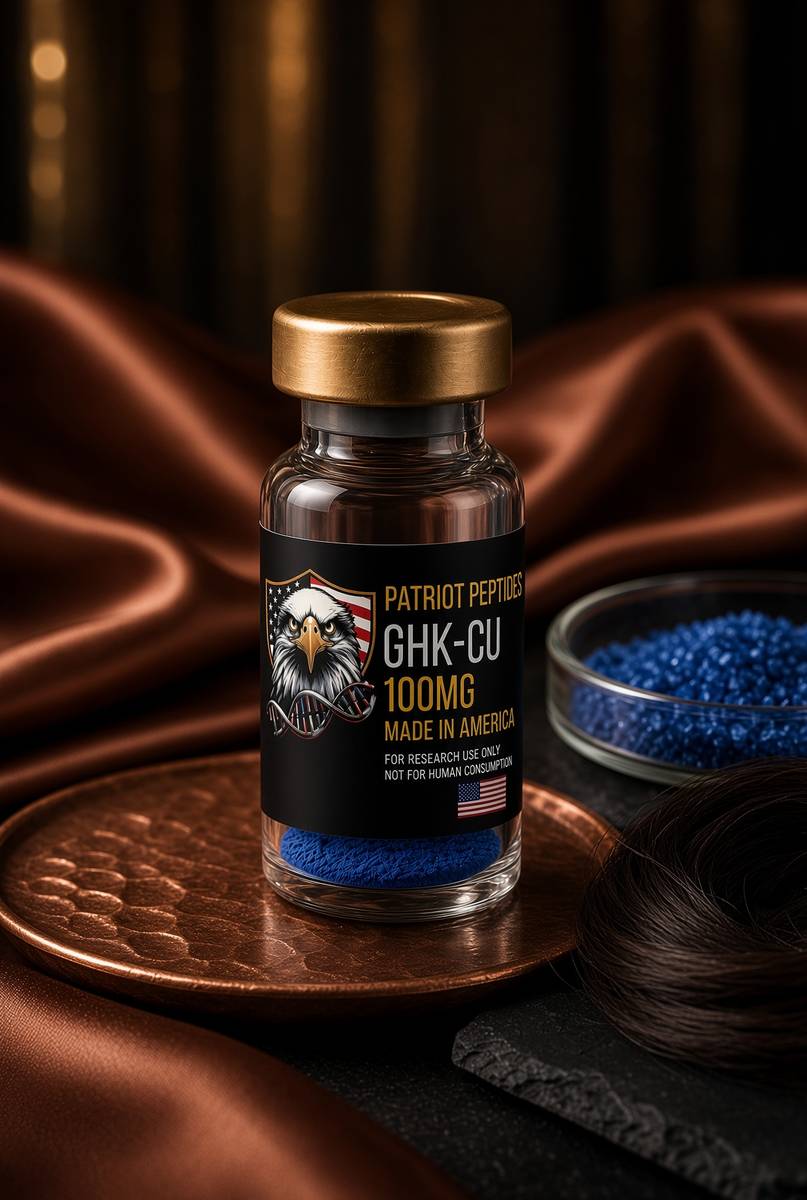 Research onlyOut of stock
Copper complex
GHK-Cu
100 mg GHK-Cu. Pickart’s copper tripeptide, lyophilised.
4.9(590)
110 browsing this now · 5 purchased in the last 24 hours
100mg
£35.00
Read next
45 min · long read · Peptide research
GHK-Cu: a copper tripeptide that rewrites a spreadsheet of genes
Pickart isolated GHK from plasma fractions that made old liver tissue synthesise proteins like young tissue. The tripeptide holds copper. The live claim is a transcriptome, not a moisturiser.
49 min · long read · Peptide research
What are peptides? Short chains that run the body
Peptides are amino acids joined by peptide bonds — shorter than proteins, more specific than most small-molecule drugs. Insulin was the first. GLP-1 agonists are the current proof. The catalogue here is the same chemistry, labelled for research.
53 min · long read · Peptide research
How research peptides are made — and why HPLC actually matters
Solid-phase peptide synthesis builds a chain one residue at a time. HPLC then asks whether the main peak is what you think it is. ≥98% is not a slogan. It is a chromatogram.
More in this desk

53 min · long read · Peptide research
Recovery, GH pulses and the CJC / ipamorelin pair
Somatotrophs have two 'go' receptors. CJC without DAC is a slightly longer GHRH pulse. Ipamorelin is a selective ghrelin-receptor key that does not yank ACTH. Together they are the pair Bowers already showed is more than additive — not a gym protocol.
52 min · long read · Peptide research
Fatigue, cellular energy and the NAD+ / MOTS-c neighbourhood
NAD+ is the rechargeable chip every cell spends on fuel and DNA repair — and the pool shrinks with age. MOTS-c is a mitochondrial 16-mer sent out under metabolic stress. Two answers to 'I have no energy' that are not coffee.
51 min · long read · Peptide research
Melanocortin circuits: pigment, appetite and PT-141
Melanotan II lights MC1, MC3, MC4 and MC5 — pigment plus the rest of the sheet. PT-141 is the free-acid cousin pointed at MC3 and MC4, the circuitry papers use for desire and energy, not skin colour. Same Arizona family. Different question.
51 min · long read · Peptide research
GHRH and ghrelin mimetics: two keys on the same pituitary lock
Somatotrophs have two ‘go’ receptors — GHRHR (Gs–cAMP) and GHSR (Gq). Bowers showed that occupying both releases more GH than the sum of either. That is synergy as a receptor fact, not a smoothie.
Essays describe published research. They are not medical advice and they do not authorise human use of any catalogue item.