


Peptide research · 50 min · 10,941 words
Why peptides are the next chapter of medicine
More than a hundred peptide drugs are already approved. Insulin opened the century. GLP-1 agonists moved weight into bariatric territory. Oral tablets, biased agonists and triple ligands are the current argument.
What this essay actually tells you
- More than a hundred peptide drugs are approved worldwide. Insulin is the ancestor. GLP-1 receptor agonists are the current industrial wave, and the wave is not subtle.
- Jastreboff et al., NEJM 2023: retatrutide (GIP/GLP-1/glucagon) produced 24.2% mean weight loss at 12 mg over 48 weeks. That's the number. The paper is public.
- Fatty-acid acylation (semaglutide, tirzepatide, retatrutide) makes albumin carry the chain so DPP-4 does not destroy it in minutes. Half-life trick. Whole industry.
What this actually means
Peptide medicines are not a new idea. Banting and Best isolated insulin in 1921; it remains the ancestor. Desmopressin, oxytocin, teriparatide, octreotide, semaglutide: a century of approvals, now more than a hundred worldwide depending on how you count analogues and diagnostics. What changed is range. Wilding et al., NEJM 2021 (STEP 1): semaglutide 2.4 mg produced 14.9% mean weight loss. Jastreboff et al., NEJM 2022 (SURMOUNT-1): tirzepatide 15 mg, 20.9%. Jastreboff et al., NEJM 2023: retatrutide 12 mg, 24.2% at 48 weeks. Oral semaglutide exists because of SNAC, a permeation enhancer that is chemistry, not wishful thinking, and a special case rather than a general oral-peptide era. Dual and triple agonists occupy more than one class-B GPCR with one chain. Fatty-acid acylation (the liraglutide–semaglutide trick) makes albumin carry the peptide so DPP-4 does not destroy it in minutes. Biased agonism, stapled helices, cyclic backbones and peptide-drug conjugates are the other live axes. This is a platform: more specific than most pills, smaller than most antibodies, aimed at the large extracellular faces a statin never saw. Catalogue sequences are research reagents, not licensed medicines.
If you've only met peptide medicines lately, the start date will surprise you. We've been injecting them for a century, and we can name the year. Frederick Banting and Charles Best, Toronto 1921, prepared a pancreatic extract that lowered blood sugar in a depancreatised dog and then, in January 1922, in a dying boy named Leonard Thompson. The molecule was insulin: fifty-one residues, two chains, three disulphide bridges, a ligand at a receptor tyrosine kinase — a membrane enzyme that adds phosphate to itself when the hormone lands. Muttenthaler, King, Adams and Alewood, writing in Nature Reviews Drug Discovery in 2021, put the worldwide count of approved peptide drugs above a hundred. Oxytocin, desmopressin, teriparatide, octreotide, calcitonin, glatiramer, semaglutide: a pharmacy shelf that was already waiting. What changed is range. A gut-hormone analogue can now move mean body weight into the territory that used to belong to bariatric surgery. That's a clinical fact with three New England Journal papers attached. We'll walk the platform under those papers: the amide, the protease tax, the albumin handle, the oral special case, and the legal distance between a licensed pen and a characterised research chain.
In short. Insulin was already a peptide medicine in 1921, and more than a hundred peptide drugs are approved now — what's new is how far they reach.
Small molecules won the twentieth century because they were pills you could swallow. Antibodies won the last thirty years because they were specific. Peptides sit in the gap: enough surface to pick one receptor out of a family, small enough to manufacture at insulin-like scale, able to occupy the large extracellular faces that a statin never saw. A typical small-molecule drug is a few hundred daltons and lives in a pocket. A typical signalling peptide is one to five kilodaltons and presents a surface. Class-B G protein-coupled receptors — GLP-1R, GIPR, GCGR, GHRHR, the secretin family — have extracellular domains built to catch a peptide, not a statin. That architectural mismatch is why the incretin decade is a peptide decade. It's also why oral delivery remains the exception rather than the rule: the same amide bonds that make the surface are food for proteases, and a stomach is a protease festival. Sequence, protease, half-life, receptor. Everything after insulin is a longer conversation with those four nouns. The count sits above a hundred. The interesting question isn't whether peptides work. It's which receptor set you want, how long the chain should live, and whether you're holding a medicine or a reagent.
In short. Pills are small and swallowable, antibodies are large and specific, and peptides sit in the middle — enough surface to pick one receptor, still a chain an enzyme can eat.
We stock the published LY3437943 backbone because Coskun's laboratory and then Jastreboff's trial made a unimolecular agonist at GIPR, GLP-1R and GCGR a public structure with a Phase 2 weight-loss curve. Unimolecular just means one chain doing three receptor jobs, not three hormones mixed in a syringe. The listing is the American-made research solid, HPLC-MS on the certificate, labelled for the bench. It isn't Eli Lilly's pen, and it isn't a medicine. Neighbouring essays already did the other floors: what a peptide is, how solid-phase synthesis and HPLC ask whether the main peak is the named chain, and the triple-agonist receptor story in full. This page is the industrial present of the class. More than a hundred approvals. Insulin as ancestor. GLP-1, GIP and glucagon as the current metabolic argument. Fatty-acid acylation as the half-life trick that made a week possible. SNAC as the chemistry that made one tablet possible, and the reason that tablet isn't a general oral-peptide era. Biased agonism, stapled helices, cyclic backbones and peptide-drug conjugates as the other axes a medicinal chemist is actually arguing about. A catalogue sequence is a research reagent. We'll say that once, mean it, and then do the biochemistry.
In short. The triple-agonist chain in the catalogue is the published research structure, not the licensed pen, and this page is the platform that pen sits on.
If you're sitting down with this class for an afternoon, you need names and numbers rather than a mood about the future. Banting and Best, 1921. Sanger's sequence in the 1950s. Du Vigneaud's oxytocin in 1953. Merrifield's resin in 1963. Genentech's recombinant insulin, approved as Humulin in 1982. Native GLP-1, destroyed in about two minutes by dipeptidyl peptidase-4 — the clipper enzyme — at alanine-2. Liraglutide's C16 palmitate. Semaglutide's C18 diacid and a weekly clock. Wilding, STEP 1, New England Journal of Medicine 2021: semaglutide 2.4 mg, 14.9% mean weight loss. Jastreboff, SURMOUNT-1, 2022: tirzepatide 15 mg, 20.9%. Jastreboff again, 2023: retatrutide 12 mg, 24.2% at 48 weeks. Buckley, Science Translational Medicine 2018: SNAC, transcellular stomach absorption, Rybelsus as a formulated exception. Verdine's hydrocarbon staple. Lefkowitz and Kobilka's 2012 chemistry Nobel for the GPCR. That's the reading list. We'll walk it in order, and then draw the line the label already drew: a research chain shares chemistry with a licensed analogue and doesn't share a marketing authorisation, a device, or a pharmacovigilance file. The physiology is public. The vial is a reagent.
In short. The reading list is short and named: insulin, a hundred approvals, three weight-loss trials, one oral tablet, and a research vial that isn't a pen.
Insulin in 1921 was the first peptide anyone bothered calling a medicine. Everything since has been a longer argument with the same backbone chemistry.— Banting and Best, 1921–22, plus a century of footnotes. Muttenthaler et al., Nat Rev Drug Discov. 2021, for the census above a hundred.
An amide, a surface, a century
A peptide bond is an amide linkage — a flat chemical join — between the carboxyl carbon of one amino acid and the α-amino nitrogen of the next, formed by condensation. Water leaves. The product is planar: the carbon, the oxygen, the nitrogen and the hydrogen sit in one plane because the nitrogen lone pair conjugates into the carbonyl, giving the C–N bond partial double-bond character. Pauling and Corey measured that planarity; Ramachandran mapped the allowed φ and ψ angles. Resonance is why even a short chain has a backbone dipole and a preferred secondary structure, and why a fifteen-residue surface is already a three-dimensional object rather than a floppy string of letters. Average residue mass is about 110 daltons, which is why a 15-mer sits near 1.4 kilodaltons and a 51-residue insulin monomer near 5.8. Oligopeptides typically sit under twenty residues. Polypeptides run longer. Proteins are the folded machines, often past fifty residues, with tertiary structure worth drawing. Insulin lives on the grey band and we still call it a peptide hormone. That's the useful test on the bench: whether you can write a one-letter code, weigh a single mass, and show a main HPLC peak.
In short. A peptide bond is a flat amide join between amino acids, and that flat backbone is why a short chain can already present a shape a receptor can read.
Diagram
- Amino acid~110 DaTwenty side chains. The alphabet.
- Peptide bondamide, planarCarboxyl carbon to the next nitrogen. Resonance holds it flat.
- Oligopeptide< ~20 residuesMost hormones and fragments. GHK is three. KPV is three.
- Polypeptide20–50+Insulin 51. GLP-1 31. Retatrutide is a designed chain in this band.
- Proteinfolded machineHaemoglobin, a GPCR, lysyl oxidase. Tertiary structure worth drawing.
Insulin (Banting and Best, 1921) was the first peptide anyone bothered calling a medicine. A collagen hydrolysate is food. A named sequence with a mass and a chromatogram is a research peptide. The shared word is the accident.
The surface is why this class exists as pharmacology at all. A 15-residue face offers charges, hydrogen bonds, a hydrophobic patch, a proline kink, enough contacts to pick one receptor out of a family at nanomolar or picomolar concentrations. Small-molecule drugs, a few hundred daltons, rarely match that at the large extracellular domains of class-B GPCRs. Antibodies match it and then some, and they bring a twenty-day half-life and a manufacturing cost that a weekly metabolic peptide is still cheaper than, at insulin-like scale. Peptides occupy the middle of that triangle: more specific than most pills, smaller than most antibodies, aimed at faces a statin never saw. Setmelanotide occupies MC4R for rare obesity syndromes. Bremelanotide occupies melanocortin receptors on demand. Octreotide occupies somatostatin receptors and is also the scaffold a radioligand hangs off. Teriparatide occupies the parathyroid hormone receptor and is an anabolic bone agent. The grammar is the same. The indication isn't. If we talk about peptides as if they were one therapy, we've skipped the interesting sentence: name the receptor. The receptor is where this class actually lives.
In short. A short chain can touch a receptor in many places at once, which is why it can be picky — so name the receptor, because the word peptide isn't a therapy.
The same amide is food. Dipeptidyl peptidase-4 — the clipper that sits in plasma and on cell surfaces — clips incretins and GHRH after proline or alanine at position 2; native GLP-1 lasts about two minutes in plasma. Neprilysin, the trypsin family, renal filtration of a small unbound chain: the rest of the tax. Nature solved stability with geography. Hypothalamic releasing hormones travel a millimetre in portal blood and die on arrival, which is the design. Therapeutic analogues can't live on a millimetre. They need hours or a week, which is why every industrial programme since liraglutide has been an argument with proteases and with clearance, not an argument with the receptor's existence. Fatty-acid acylation, PEGylation, D-amino acids, lactam bridges, hydrocarbon staples, head-to-tail cyclisation: those are the cheats. A lyophilised cake is a different cheat, a storage cheat, water removed so hydrolysis is slow until somebody adds solvent. The sister essay on freeze-drying takes that half. Here we need the sentence that belongs in a therapeutics argument: a native peptide is often a beautiful hormone and a terrible drug, and the difference is a clock.
In short. Enzymes cut native peptides in minutes, so medicines cheat that clock with fat chains, rings, odd amino acids or staples, while freeze-drying is only a storage cheat.
Insulin, 1921: the first peptide anyone called a medicine
Frederick Banting and Charles Best, Toronto, 1921. A pancreatic extract that dropped blood sugar in a depancreatised dog, then in Leonard Thompson in January 1922. James Collip cleaned the extract enough to inject. John Macleod ran the department and shared the 1923 Nobel Prize in Physiology or Medicine with Banting, who shared his prize money with Best. The molecule itself took another thirty years to become a sequence. Fred Sanger worked out the two chains and the disulphides in the 1950s and collected his first chemistry Nobel in 1958 for that, the first protein anyone had sequenced. Fifty-one residues: an A chain of 21, a B chain of 30, three disulphide bridges, two of them interchain, one of them a loop on A. A zinc-coordinated hexamer in the granule, a monomer at the receptor. That's the first peptide we bothered calling a medicine, and it's still the manufacturing education for the whole class: two chains, three disulphides, a recombinant industry that had to be invented when animal glands ran short. Everything after is a longer argument with the same backbone chemistry, including the incretin analogues that made the word fashionable a hundred years later.
In short. Banting and Best isolated insulin in 1921, Sanger sequenced its 51 residues in the 1950s, and it is still the ancestor of peptide medicine.
The receptor isn't a GPCR, and that fact belongs at the front so the later headings don't swallow it. Insulin occupies the insulin receptor, a receptor tyrosine kinase — a dimer already waiting in the membrane that adds phosphate to itself. Ligand binding rearranges the extracellular α-subunits; the intracellular β-subunits autophosphorylate; IRS proteins dock; PI3K–Akt and Ras–MAPK run. Glucose transporters move to the muscle and adipose membrane. Hepatic gluconeogenesis quiets. IGF-1 is the cousin ligand at IGF1R, another RTK, which is why IGF-1 LR3 sits in a different mechanistic essay from a GLP-1 analogue. The point of putting insulin at the front of a therapeutics page is historical and chemical. A short amino-acid chain, injected, occupied a receptor and changed a life. The GLP-1, GIP and glucagon medicines of the last decade proved the same grammar again, at a different family of receptors, with a different half-life trick. The chemistry didn't change in between. The lock did. If we treat the incretin decade as a creation event, we've skipped the reason a peptide can be a medicine at all.
In short. Insulin binds a kinase receptor, not the seven-helix receptors most gut-hormone drugs use, but the idea is the same: a short chain occupies a lock and physiology moves.
Recombinant manufacture is the industrial half of the ancestor story, and it's why a 51-residue hormone is a different factory from a 15-mer on a catalogue shelf. Animal glands, then semi-synthesis, then Genentech's 1978 insulin in Escherichia coli, approved in 1982 as Humulin: the first recombinant peptide medicine, and the template for every subsequent tank. A 191-residue somatropin followed. A catalogue of research 15-mers did not. Solid-phase synthesis, Merrifield 1963, Nobel 1984, is cheaper and cleaner for chains that short, and it doesn't ask a bacterium to fold two chains and form the right disulphides. The two factories still share the amide, the HPLC question, and the legal distinction between a licensed pen and a characterised reagent. Insulin remains a medicine. A lyophilised research chain with a paper behind it remains a reagent. If we blur that distinction, we're not reading the label. The ancestor is allowed to be both a historical fact and a manufacturing lesson without turning every sequence on a shelf into a prescription. Goeddel's 1979 PNAS paper is the recombinant document. Merrifield's 1963 JACS paper is the resin document. Read both before treating manufacture as a mood.
In short. Recombinant insulin in 1982 taught the industry how to make a peptide at scale, while short research chains are still built on resin, not in a tank.
A century of insulin analogues is itself a half-life and a kinetics lesson, and we keep it here so the incretin heading doesn't pretend to have invented formulation. Regular insulin, NPH, lente, the first attempts to slow absorption from a subcutaneous depot. Then the rapid analogues: insulin lispro, aspart, glulisine, sequence tweaks that stop hexamer lingering so the monomer arrives faster. Then the basal analogues: glargine, detemir, degludec, isoelectric precipitation or albumin binding so a day or more is covered from one injection. Detemir already hangs a fatty acid. Degludec multihexamers. The grammar — change the sequence or hang a handle so pharmacokinetics match the indication — is the same grammar liraglutide and semaglutide later used on a gut hormone. Endocrinology learned it on insulin first. The incretin decade industrialised it on class-B GPCRs. A therapeutics page that starts at STEP 1 without this paragraph is missing the homework. The receptor changed. The formulation problem didn't.
In short. Insulin analogues already taught the field to speed or slow a peptide on purpose, and gut-hormone drugs reused that lesson at a different receptor.
The census: more than a hundred
Muttenthaler, King, Adams and Alewood, Nature Reviews Drug Discovery 2021, is the paper you actually cite when you write 'more than a hundred'. Trends in peptide drug discovery: a census of approvals, a map of half-life tricks, a sober account of oral delivery as a still-hard problem. Wang and colleagues, in Signal Transduction and Targeted Therapy, put a similar count on the table and walked the indications. The exact integer moves with the year and with whether you include diagnostics, imaging ligands, and close analogues of the same backbone. The shape of the number doesn't. Insulin and the gonadotrophins, then oxytocin and vasopressin analogues, then somatostatin analogues, then parathyroid hormone fragments, then GLP-1 receptor agonists as an industrial wave rather than a trickle. Desmopressin is a D-amino-acid and deamination trick on vasopressin so a V2 agonist can be a diabetes-insipidus and haemophilia medicine. Octreotide is a cyclic somatostatin analogue that made a twice-daily injection, then a long-acting repeatable depot, a viable life for acromegaly and neuroendocrine tumours. Teriparatide is PTH 1–34, anabolic at bone when the exposure is intermittent. These aren't footnotes to semaglutide. They're the platform semaglutide joined.
In short. A 2021 review put approved peptide drugs above a hundred — insulin, oxytocin analogues, bone and gut hormones are all on that list, and semaglutide joined it rather than founding it.
Approved peptide drugs span more than one lock family, which is the bit a metabolism headline skips, and we shouldn't. GPCR ligands: GLP-1R, GIPR, GCGR, MC4R, V2, OXTR, the somatostatin receptors, GnRH receptors, the PTH receptor. Enzyme inhibitors and modulators: glatiramer is a statistical peptide mixture used in multiple sclerosis, an odd member of the class and still a peptide medicine. Ion-channel and membrane-active sequences exist, though they're a smaller slice of the pharmacy fridge than of the natural-product literature. Radiolabelled diagnostics and therapeutics — 111In-octreotide, 177Lu-DOTATATE, 177Lu-PSMA ligands — hang a metal-chelator off a peptide that already knew the receptor, and turn a ligand into a targeted radiation source. That last group is a peptide-drug conjugate in all but the marketing department's name, and it's already licensed, not a slide about next year. Setmelanotide (MC4R) and bremelanotide (PT-141) show the same grammar outside metabolism: a melanocortin ring, a named receptor, an indication the regulator actually wrote down. Different receptors. Same platform problem. Keep the chain alive long enough to occupy the target, and no longer than the indication wants.
In short. Peptide medicines hit many kinds of target: gut-hormone receptors, kidney water receptors, bone, pigment pathways, and even tumour imaging, so metabolism is the loud chapter, not the only one.
Manufacturing splits the census in a way we care about as chemists and a headline doesn't. Long chains and disulphide-rich hormones — insulin, somatropin, the gonadotrophins, PTH analogues at the upper end — are recombinant, a tank, a folding problem, a different identity-test suite. Short and medium chains, especially those with D-amino acids, fatty-acyl handles, or non-canonical residues a ribosome won't write, are solid-phase synthesis: Fmoc chemistry, TFA cleavage, reverse-phase HPLC, a mass. Merrifield's cycle is how most of a research catalogue gets made, and how a surprising fraction of licensed peptides get made too. A 39-residue designed incretin analogue with a C18 diacid is a synthesis problem, not a fermentation problem. Cyclosporine, historically, was a fungal cyclic peptide and a reminder that nature was doing non-ribosomal peptide chemistry before medicinal chemists named it. The factory isn't the identity. Sequence plus mass plus chromatogram is the identity. A regulator then asks a different question: formulation, device, impurities as a clinical file, pharmacovigilance. That question is how a chain becomes a medicine. It isn't how a chain becomes a research reagent. Both questions start with the same amide.
In short. Long hormones are grown in tanks and short designed chains are built on resin; a medicine then needs a formulation file, while a research vial needs a chromatogram and a mass.
What the census doesn't contain is also a fact. It doesn't contain collagen hydrolysate, a 2–5 kilodalton food mixture with no single HPLC peak. It doesn't contain a research 15-mer with a rodent literature and no marketing authorisation. It doesn't contain a stack of named chains sold as one idea. Muttenthaler's number is a regulatory number: a sequence, or a close analogue, that a competent authority has licensed as a drug, a diagnostic, or an imaging agent. Mixing that number with a catalogue of lyophilised research solids is how a journal becomes a shop window. The solids can be the ligands those programmes were built from or against. They can share a backbone with an investigational molecule. They don't inherit the label. We'll unmix them once, here, and then do the physiology. The physiology below doesn't depend on the unmix. The legal class does. A hundred approvals is an argument that the platform works. It isn't an argument that every named sequence is a member of the hundred.
In short. The hundred are licensed medicines and diagnostics, and a research chain can share a backbone with one of them and still not be one of them.
- Insulin
- 1921, 51 residues
- Approved peptide drugs
- >100 worldwide
- Native GLP-1 half-life
- ~2 minutes
- Albumin-bound analogue
- days to a week
- STEP 1 semaglutide
- 14.9% at 2.4 mg
- SURMOUNT-1 tirzepatide
- 20.9% at 15 mg
- Retatrutide Phase 2
- 24.2% at 12 mg, 48 weeks
- Oral SNAC bioavailability
- single-digit percent
Banting and Best. Two chains, three disulphides. First peptide medicine.
Muttenthaler, Nat Rev Drug Discov 2021. Analogues and diagnostics move the integer.
DPP-4 clips alanine-2. The reason sitagliptin and acylation both exist.
C16 liraglutide, C18 diacid semaglutide, tirzepatide, retatrutide. Handle, not a myth.
Wilding, NEJM 2021. GLP-1R. The first industrial weight number.
Jastreboff, NEJM 2022. GIPR plus GLP-1R.
Jastreboff, NEJM 2023. GIPR, GLP-1R, GCGR. Investigational.
Rybelsus. Special case, huge tablet next to the injection. Not a general oral era.
Half-life is the industrial invention
Native GLP-1 is a terrible drug, and we mean that as a compliment to the hormone. The L-cell writes it after a meal. The β-cell and a set of brainstem neurons read it. Dipeptidyl peptidase-4 clips it at alanine-2. The kidney clears what is left. Plasma half-life is about two minutes. Sitagliptin and the other DPP-4 inhibitors exist because of that clip: they spare the native peptide rather than replace it. Replacement needed a different trick. Exenatide, a Heloderma venom peptide, already had a DPP-4-resistant sequence and a few hours of exposure, twice daily. Liraglutide hung a palmitate chain, C16, on a lysine so circulating albumin would carry the analogue through a day. Semaglutide used a C18 diacid spacer and an aminoisobutyric acid substitution at position 8, and the week became the clock. Tirzepatide and retatrutide inherit the same grammar: a lipid side-chain that binds albumin, a plasma reservoir whose own half-life is measured in weeks, a subcutaneous depot that feeds that reservoir. The lipid isn't a membrane punch. It's a handle. Reverse-phase chromatography notices it immediately, because a C18 column holds a fatty-acylated chain longer than the naked peptide of the same backbone.
In short. Native GLP-1 dies in about two minutes, but a fat chain stuck on the analogue lets blood albumin carry it for days, and that handle is how a weekly clock became possible.
Fatty-acid acylation is the industrial core of the current metabolic wave — hanging a fat chain on the peptide so albumin will carry it. Knudsen and colleagues at Novo Nordisk made the liraglutide palmitate a development candidate; the later C18 diacid on semaglutide is the same idea with a longer leash and a spacer that changes albumin affinity. Albumin is the most abundant plasma protein, half-life on the order of three weeks, a fatty-acid binder by day job. Hang a fatty acid on a peptide and a fraction of the dose rides that reservoir instead of being filtered or clipped in the first pass. Free peptide still occupies the receptor. Bound peptide is a depot in solution. The equilibrium is the half-life. Detemir had already done this on insulin. The incretin analogues did it on class-B GPCRs and then watched body-weight curves move into a range the field hadn't seen from a weekly injection. Jastreboff 2023's retatrutide chain carries the same class of handle. Half-life trick. Whole industry. If we write the 24.2% as a mysterious property of 'triple' without mentioning albumin, we've skipped the reason the chain was still there at the end of the week.
In short. Albumin already carries fatty acids in blood, so stick one on a peptide and a fraction of the dose rides that long-lived protein — weekly dosing is that physics.
The other cheats are older than the incretin decade and still earn their keep. PEGylation increases hydrodynamic radius so the kidney can't filter the chain as a small peptide; it also presents a steric shield. D-amino acids, as in ipamorelin's D-2-Nal and D-Phe, or desmopressin's D-arginine, make a peptide bond that most mammalian proteases don't recognise as food. Head-to-tail cyclisation, or a disulphide, or a lactam bridge, removes a free terminus and locks a loop. Verdine's hydrocarbon staple — an all-hydrocarbon bridge between two non-natural residues, locking an α-helix so a protease can't find a flexible loop — is the intracellular-targeting version of the same idea, and it's been a serious oncology and stapled-peptide literature since Walensky, Verdine and colleagues put a BH3 helix on a page in Science in 2004. Cyclic peptides, from cyclosporine to modern macrocycles, buy both protease resistance and, sometimes, a hint of oral exposure that a linear chain doesn't have. None of these is a future slide. All of them are how a native memo becomes a drug substance. The indication decides which cheat you spend.
In short. Other tricks include polyethylene glycol coats, mirror-image amino acids, rings and chemical staples that lock a helix, and all of them exist to stop enzymes eating the chain.
Keep the chain alive long enough to occupy the target, and no longer than the indication wants. That's the whole formulation brief, and it's why a daily liraglutide, a weekly semaglutide, an on-demand bremelanotide and a twice-yearly depot octreotide can share a platform without sharing a clock. Excess exposure isn't free. Gastric emptying delays, gallbladder emptying, lean-mass questions, heart-rate ticks, the tachyphylaxis of a receptor that has been occupied all week: those are what a half-life buys you on the other side of the ledger. A research lyophilised solid doesn't inherit any of those curves. It was freeze-dried to be a standard, not formulated to be a week. If you want a precursor of the clinical conversation, the conversation is in the labels and the New England Journal papers, with n, with adverse events, with what happened after discontinuation. If you want an enzyme or a binding assay, the listing is the ligand. Precursor identity is a mechanism. So is formulation. They aren't the same mechanism, and collapsing them is how a certificate becomes a dosing rumour.
In short. A medicine's half-life is chosen to match the job, and longer isn't always better, while a freeze-dried research solid doesn't come with that clock built in.
Three numbers that moved the field
Wilding, Batterham, Calanna and colleagues, New England Journal of Medicine 2021, STEP 1: once-weekly semaglutide 2.4 mg in adults with overweight or obesity, mean body-weight reduction 14.9% at 68 weeks against 2.4% on placebo, n in the high hundreds, gastrointestinal events the dominant adverse story. That paper is why a gut peptide left the diabetes clinic and entered the weight clinic as a first-class object. The receptor is GLP-1R. The half-life trick is the C18 diacid. The physiology is reduced intake, delayed gastric emptying, a brainstem satiety sentence, glucose-dependent insulin secretion as the older job still running. 14.9% is a least-squares mean, not a promise to a person, and the distribution under that mean includes people who lost much more and people who lost little. A mean isn't a destiny — look at a waterfall plot and you'll see the spread. And 14.9% isn't modest if you've looked at orlistat. The chemistry was never new. The clinical result is what changed, and then people noticed.
In short. A 2021 trial of weekly semaglutide showed about 15% mean weight loss, and that is the paper that moved a gut peptide into the weight clinic.
At 48 weeks, retatrutide at 12 mg produced a mean body-weight reduction of 24.2%.— Jastreboff AM et al. Triple–Hormone-Receptor Agonist Retatrutide for Obesity — A Phase 2 Trial. N Engl J Med. 2023; 389: 514–526.
Diagram
GLP-1R
β-cell, brainstem, stomach
Incretin, delayed emptying, satiety. Semaglutide’s occupancy.
GIPR
β-cell, adipocyte
Second incretin. Lipid handling. Tirzepatide added this.
GCGR
hepatocyte
Glycogenolysis and, biased, energy expenditure. The third occupancy.
LY3437943 is a fatty-acylated unimolecular agonist at GIPR, GLP-1R and GCGR (Coskun, Cell Metab 2018). Jastreboff, NEJM 2023: 24.2% mean weight loss at 48 weeks, 12 mg, Phase 2 — clinical literature, not a use instruction for a research vial.
Jastreboff, Aronne, Ahmad and colleagues, New England Journal of Medicine 2022, SURMOUNT-1: tirzepatide once weekly for obesity, 15 mg, 20.9% mean weight loss, a dual agonist at GIPR and GLP-1R, already a licensed diabetes medicine under another trial family. Coskun, Sloop and colleagues had put the dual engineering, LY3298176, on the page in Cell Metabolism in 2018: unimolecular, lipid-handled, a designed ratio rather than two hormones in a syringe. Adding GIPR to GLP-1R was the argument. Whether GIP agonism is a metabolic virtue, a brake, or a context-dependent mix is still a live literature; the clinical curve isn't in dispute. 20.9% is the number a bariatric surgeon has to take seriously, because it sits in the range of some procedures and arrives without an anastomosis. Gastrointestinal events again. Lean-mass composition is a quieter, later conversation the field is still having, because a scale doesn't tell you whether the lost kilograms were adipose or the muscle you wanted to keep. Dual occupancy moved the mean. It didn't abolish the adult safety conversation. If we only cheer 20.9%, we've stopped reading the tables.
In short. Tirzepatide occupies two gut-hormone receptors and, in a 2022 trial, produced about 21% mean weight loss — dual occupancy moved the average, and it didn't end the safety argument.
Jastreboff again, New England Journal of Medicine 2023: retatrutide, LY3437943, a triple agonist at GIPR, GLP-1R and GCGR, Phase 2, 12 mg, 24.2% mean body-weight reduction at 48 weeks, n=338. Coskun's laboratory had already shown that a unimolecular, fatty-acylated chain could be written to occupy all three secretin-family receptors with a glucagon arm tuned not to wreck the glucose curve. The design question, if you're writing the chain, isn't three hormones in a syringe. It's one backbone, one lipid so albumin will carry the chain through a week, and a set of relative potencies a medicinal chemist would call bias. Semaglutide had shown that the first occupancy was enough for large endpoints. Tirzepatide added the second. The third is glucagon, and the art is the ratio: enough GCGR for energy expenditure and hepatic lipid oxidation, not so much that hepatic glucose output cancels the glycaemic gain. 24.2% is a Phase 2 least-squares mean. It looks like bariatric surgery drawn with a peptide. It's also an investigational-medicine trial, with a safety board, not a protocol for a research solid. Phase 3 is how a mean becomes a label, or does not.
In short. Retatrutide occupies three related receptors, and a 2023 Phase 2 trial reported 24.2% mean weight loss at 48 weeks — that's an investigational result, not a vial instruction.
Three numbers we should actually remember, three papers, one industrial decade. 14.9, 20.9, 24.2. GLP-1R, then GIPR, then GCGR on the same chain. The through-line is older than the decade. Bayliss and Starling named secretin in 1902 and, with it, the idea that a chemical messenger could travel in blood. McIntyre, Elrick and Unger made the incretin effect a measurement: oral glucose raises more insulin than the same glucose in a vein. Dipeptidyl peptidase-4 explained the two-minute clock. Exenatide, liraglutide, semaglutide, tirzepatide, a triple. Each step is a receptor occupancy plus a half-life trick, not a new theory of fat. Gastrointestinal events, gallbladder, lean-mass composition, heart rate, and what happens after discontinuation are the adult conversation the field is actually having, and it isn't settled. A peptide that empties a stomach and a brainstem satiety circuit will have a gut-adverse-event profile. A peptide that empties a body will empty some lean tissue too unless resistance work and protein intake are part of the protocol the trial actually ran. Read the tables. Read the n. Read whether the control was lifestyle, placebo, or a licensed analogue. The chemistry is a platform. The cheer is optional.
In short. Fourteen point nine, twenty point nine, twenty-four point two: three trials, more receptors each time, and gut side-effects and what happens after stopping are the adult questions still open.
Unimolecular is a choice that has a prehistory. Richard DiMarchi, Matthias Tschöp, Brian Finan and colleagues spent the 2010s showing that glucagon and GLP-1 could be written into one sequence as a co-agonist, and that GIP could be added without the chain falling apart as chemistry. Day et al., Nature Chemical Biology and then Nature Medicine, are the papers in which a glucagon/GLP-1 co-agonist lost more weight in obese rodents than a GLP-1 agonist alone, with the glucagon arm supplying energy expenditure and a lipid-oxidation cue. Those were still two occupancies. The dual GIP/GLP-1 work that became tirzepatide is Coskun's 2018 Cell Metabolism paper on LY3298176. LY3437943 is the next increment: keep both incretins, add GCGR, hang the lipid, and ask whether the ratio can be tuned. A cocktail of three native hormones wouldn't ask that question cleanly, because three half-lives would drift. One backbone is how you keep the ratio you designed. That's the entire point of unimolecular, and it's why the engineering paper is a sequence argument before it's a clinical argument. Bias, in this heading, is a designed ratio, not a marketing word.
In short. One chain was chosen so the three receptor effects travel together in blood, because mixing three separate hormones would let their timings drift apart.
Class-B GPCRs, and why a statin never saw them
Diagram
Outside
Peptide ligand
Named sequence in the nM–µM pocket. Shape complementarity, not vibes. A 15-mer and a 4-mer do not fit the same hole.
Membrane
7-TM receptor
Helices rearrange. The cytoplasmic face becomes a GEF for a heterotrimeric G protein (Gs, Gi, Gq, G12/13).
Inside
Second messengers
cAMP, IP₃, Ca²⁺, β-arrestin. One occupied receptor can spawn thousands of messenger molecules. That is amplification.
~800 GPCRs in the human genome. Seven transmembrane helices, an extracellular ligand pocket, an intracellular G-protein handshake. Catalogue neighbours: ipamorelin at GHSR, PT-141/MT2 at melanocortin receptors, retatrutide at GLP-1R/GIPR/GCGR.
Class B GPCRs, the secretin family, are the architectural reason a long peptide can occupy three related pockets with one chain. Each receptor has a large N-terminal extracellular domain that catches the C-terminal half of the hormone in solution, raising the local concentration of the peptide's N-terminus, which then inserts into the transmembrane bundle from the outside and does the activating work. Two steps, both aqueous-facing. GHRH, GLP-1, GIP, glucagon and secretin itself share this geometry. Truncating the N-terminus is how you make an antagonist, because you keep the catch and lose the insertion. A designed chain in the thirty-to-forty-residue band can therefore be written to fit three related class-B pockets without becoming a submarine. The ligand doesn't have to enter the cell. Information crosses as conformation. Lefkowitz and Kobilka's 2012 chemistry Nobel was for the GPCR family as a structural object; the incretin decade is what happens when medicinal chemistry takes that family seriously as a metabolic tool rather than as a curiosity of gut extracts. Cryo-EM has since given us occupied poses of GLP-1R, GIPR and GCGR. Related pockets. Related, not identical. Bias lives in the difference.
In short. These receptors catch a peptide outside the cell and change shape, so the message is the shape change and the peptide doesn't need to go inside.
We've got about eight hundred GPCRs in the human genome, seven transmembrane helices, an extracellular face that binds ligand, an intracellular face that acts as a guanine-nucleotide exchange factor for a heterotrimeric G protein. Class A, rhodopsin-like, includes GHSR and the melanocortin receptors: smaller pockets, still peptide-competent, the family most small-molecule drugs historically hit. Class B is the secretin family already named. Class C is glutamate-like, class F frizzled. Roughly a third of approved small-molecule drugs have historically aimed at this superfamily, almost all at class A, almost all at pockets a few hundred daltons can fill. Peptide therapeutics exist as a class because class B, and a slice of class A, present faces those pills can't cover. Occupancy rearranges the helices. The G protein spends GTP. The information that crossed the five-nanometre bilayer is conformation. The peptide, in the boring and correct case, is still outside, or is on its way to a lysosome after the receptor was internalised as a complex. That's how a chain that never enters the cell can run the cell. 'It gets in and repairs' isn't a mechanism at this lock.
In short. Most peptide drugs stick to a surface receptor and stay outside: the receptor changes shape, a G protein spends energy, and that is the message.
Affinity, occupancy, efficacy, tissue: four nouns we have to keep apart if the experiment is going to mean anything. Affinity is how tightly the ligand binds, Kd. Occupancy is the fraction bound at a given concentration, θ = [L] / ([L] + Kd) for a simple isotherm. Efficacy is what the occupied receptor does: full agonist, partial agonist, biased agonist, antagonist. Tissue is which cell has the receptor, how many copies — typically a thousand to a hundred thousand — and which effectors sit downstream. Spare receptors mean a full response can come from a fraction occupied, which is why EC50 can sit below Kd and why a binding assay and a functional assay aren't the same experiment. Nanomolar occupancy at a class-B GPCR is ordinary for a native peptide. Picomolar happens when the contacts are excellent and the receptor is willing. A statin never saw this face because a statin is a HMG-CoA reductase inhibitor in a hepatocyte, a few hundred daltons in a catalytic pocket, a different kingdom of pharmacology. Mixing the two objects because both are drugs that changed a population is a newspaper move. The pocket is the fact. Write the pocket.
In short. How tightly a chain binds, how many receptors it fills, what those receptors do, and which cell has them, are four different measurements — and a cholesterol pill never saw this kind of surface.
Amplification, bias, arrestin
Diagram
× 1
Ligand
One peptide in one pocket. nM–µM. Shape, not a mood.
× 10–10²
G proteins
The occupied GPCR is a GEF. Each Gα is a catalyst.
× 10³–10⁴
cAMP / IP₃ / Ca²⁺
Adenylyl cyclase and PLC do not make one molecule. They make a cloud.
× 10⁴–10⁶
PKA / PKC / CaMK
Kinases phosphorylate many substrates per messenger.
× tissue
Secretion, transcription, motility
The organism-level readout. Still not a protocol.
This is the only magic, and it is not magic. A nanomolar ligand can move a micromolar messenger because enzymes sit between them. Desensitisation (GRK, β-arrestin, endocytosis) is how the cell refuses to let ‘more ligand’ mean ‘more signal’ forever.
Amplification is the only magic, and we should admit it's arithmetic. One occupied GPCR can catalyse GDP/GTP exchange on tens to hundreds of G proteins. Each Gαs-GTP can activate adenylyl cyclase to make many cyclic AMP molecules from ATP. Each cAMP-activated protein kinase A can phosphorylate many substrates. A nanomolar occupancy can therefore move a micromolar messenger cloud. GLP-1R, GIPR and GCGR all couple primarily to Gs, so cAMP is the shared grammar; what the cell does with that cAMP depends on whether it's a β-cell, a hepatocyte, a gastric myocyte or a brainstem neuron. Local nanodomains, AKAPs, phosphodiesterases sitting next to a channel, mean a cAMP rise beside a granule isn't a cAMP rise beside a nucleus. That's why 'cAMP went up' is the beginning of an experiment, not the end of a mechanism. Gαq takes the other door: phospholipase C, IP3, calcium from stores, protein kinase C. GHSR, which ipamorelin occupies, is mostly this Gq route. Two second-messenger systems on one secretory cell is how Bowers showed a GHRH analogue plus a ghrelin mimetic release more growth hormone than the sum of either. Grammar, not a stack.
In short. One receptor can make thousands of messenger molecules because enzymes sit in between, and that flood is ordinary biochemistry — it's why a tiny amount of peptide can change a cell.
Biased agonism is an active design axis at class-B GPCRs, and it's still a bit messy in the data, which is the honest sentence. Two ligands at the same receptor can prefer G protein versus β-arrestin, or one Gα subtype versus another, or cAMP versus a β-arrestin-scaffolded MAPK programme. Incretin analogues have a published bias literature: some GLP-1R agonists recruit arrestin more than others; whether that helps or hurts nausea, tachyphylaxis, or insulin secretion is argued in print rather than settled by a press release. Retatrutide's published profile is a set of relative potencies at three receptors, which is bias of a different kind — between receptors on one chain, not only between pathways at one receptor. Most research sequences on a catalogue shelf don't have a clean published bias profile. It's the difference between a designed ligand and a hormone that hits every family member. Read Coskun for the potencies they measured. Run the assay you actually have if you need a pathway split. Don't write arrestin as a villain or a hero. Arrestin is how a β-cell survives a week of occupancy without remaining stuck in the on position.
In short. Two drugs at the same receptor can prefer different inside-the-cell paths, which is biased agonism, and the incretin data are real and still messy, so don't invent a profile you haven't measured.
Desensitisation is how the cell refuses to let more ligand mean more signal forever, and it's the physiological reason a weekly incretin analogue has a gastric-emptying tachyphylaxis that the label already knows about. G-protein-coupled receptor kinases phosphorylate the occupied receptor. β-arrestin binds the phosphorylated tail, sterically blocks further G-protein coupling, and can recruit the endocytic machinery. Internalisation follows. Some receptors recycle; some are degraded. A research binding isotherm in a transfected well, harvested at twenty minutes, won't show you that week. A person on a licensed pen will. The gap isn't a scandal. It's the difference between occupancy as a pharmacological event and occupancy as a chronic exposure. Formulation, albumin binding, receptor number, spare receptors, and the fact that a human is tens of trillions of cells of many types all sit between a dish and a waist. Fatty-acid acylation is how licensed analogues buy the week. A lyophilised cake of the published sequence is a ligand for an experiment you control. Both can occupy the same pocket. Only one of them is an investigational or licensed medicine. Keep the objects apart and the 24.2% remains readable.
In short. Cells turn the signal down after a while: the receptor is tagged, pulled inside, and stopped from shouting, which is why more peptide isn't more effect forever.
Oral tablets are a special case, not an era
Oral peptides were a joke until they were a formulated exception, and we can name the exception. SNAC, sodium N-[8-(2-hydroxybenzoyl)amino]caprylate, is the permeation enhancer in Rybelsus, oral semaglutide. Buckley, Bækdal, Vegge and colleagues, Science Translational Medicine 2018, put the mechanism on the page: SNAC creates a local high-pH microenvironment in the stomach, helps the peptide stay soluble rather than pepsin-food, and aids transcellular flux across gastric epithelium. The tablet is taken on an empty stomach, with a sip of water, and then a wait, because food and more water wreck the local chemistry the enhancer needs. Bioavailability is still single-digit percent, which is why the oral dose is huge next to the injection — milligrams swallowed to match a milligram-scale subcutaneous exposure, with a lot of peptide destroyed on the way. That's engineering honesty. A tablet exists. The tablet is a compromise. It isn't the opening of a general oral-peptide era in which any 15-mer can be put in a blister pack and expected to occupy a class-B GPCR at the far end of a gut. Rybelsus is a special case built around one chain, one enhancer, one set of instructions.
In short. One GLP-1 tablet exists because a helper chemical helps it cross the stomach lining, but only a few percent gets through, so that's a special case, not a new era of peptide pills.
Why the era hasn't arrived isn't a mystery of willpower, and we don't need one. A peptide in the jejunum is still a peptide: proteases, a mucus layer, tight junctions that weren't built to admit a kilodalton chain, first-pass hepatic extraction, a charge pattern that doesn't look like a small-molecule drug. Cyclic peptides and a handful of macrocycles have inched oral bioavailability up in other programmes; cyclosporine was the historical existence proof that a ring can sometimes make it. Those remain special cases too, often with a narrow therapeutic index and a formulation department that earned its keep. Immunogenicity of longer chains, manufacturing cost at oral doses that have to be ten or a hundred times the injected dose, and the simple fact that gastric pH isn't a universal solvent, remain live problems. They're being engineered. They aren't wished away. An oral dual or triple agonist is an active industrial argument, and it will arrive, if it arrives, as another formulated exception with its own enhancer, its own fasting instructions, and its own bioavailability confession. Until then, the injection is the rule, the tablet is the exception, and a research cake is neither.
In short. Guts digest peptides, and a few rings and one helper-chemical tablet have squeezed through, but most peptide medicines are still injections, and a research cake isn't a tablet.
Buccal, inhaled, depot, and device tricks sit in the same heading so they don't get sold as oral. Inhaled insulin had a regulatory life and a commercial death; the lung can absorb a peptide, and the business didn't want the inhaler. Depot octreotide and lanreotide are how a somatostatin analogue becomes monthly. Semaglutide's subcutaneous pen is a device as much as a molecule. Oral SNAC is chemistry plus a ritual. None of these is a reason to write that peptides can be pills now across a class that is still, for the median approval, an injection. Formulation is the unglamorous half of therapeutics, and it's the half that decides whether a beautiful ligand is a medicine. The research solid on a catalogue listing is the ligand those programmes start from or compare against. It doesn't inherit a route. If your experiment needs the chain in a well, reconstitute it as mass over volume in a solvent the sequence accepts, and write the concentration on the tube. If your question is a tablet, the tablet papers are Buckley and the Rybelsus label. Different objects.
In short. Inhalers, monthly depots and pens are other delivery routes, and they aren't proof that every peptide is now a pill.
Staples, rings, conjugates
Stapled peptides are Verdine's contribution to the half-life and the fold at once, and they belong here because they're how a helix becomes an intracellular argument we can actually test. An α-helix in water often breathes apart. Two olefin-bearing non-natural residues, placed one and five or one and eight apart, can be closed by olefin metathesis into an all-hydrocarbon bridge. The helix is locked. Proteases find less loop. Cell penetration, in some sequences, improves because a stable amphipathic helix is a different object from a disordered chain. Walensky, Kung, Escher and Verdine, Science 2004, put a stapled BH3 helix against BCL-2-family proteins and showed that a peptide could be a drug-like antagonist inside a cell, which linear BH3 peptides were not. The oncology literature that followed is mixed in the way a hard intracellular target is mixed: some staples bind, some staples stick to membranes, some staples never become a medicine. The chemistry is real. The licence is earned case by case. A staple isn't a brand. It's a conformational constraint, and it's one more answer to the native-peptide problem of two minutes and a floppy fold.
In short. A chemical staple can lock a peptide into a helix so enzymes struggle to cut it, and sometimes so it can work inside a cell — real chemistry, earned one sequence at a time.
Cyclic peptides are the older cousin, and we already have them in a pharmacy fridge. Cyclosporine, from Tolypocladium, a non-ribosomal eleven-residue ring, oral enough to be a transplant medicine, a reminder that nature was doing this before a medicinal chemist named macrocycles. Octreotide is a cyclic somatostatin analogue; the ring is part of why twice-daily, then monthly, became possible. Desmopressin isn't cyclic but carries a D-amino acid and a deaminated terminus, a different lock on the same problem. Modern libraries of cyclic peptides — phage display, mRNA display, DNA-encoded rings — are how people now hunt ligands at protein–protein faces that a small molecule can't cover and an antibody is too large or too costly to send. Oral cyclic programmes exist. Some will work. Most will confess a bioavailability that would make a statin laugh. The point of putting rings in this page isn't to announce a new era. It's to say that conformational constraint is a platform move, like acylation, like PEGylation, like a staple, and that the approved set already contains rings. A linear 15-mer on a research shelf is a different conformational object. Don't write it as a cycle because cycles are fashionable.
In short. Some peptide medicines are rings, which helps them survive enzymes and, in a few cases, be swallowed, but a straight research chain isn't a ring just because rings are in the news.
Peptide-drug conjugates are the other industrial present, and they're already licensed rather than imagined. A peptide that already knew a receptor — octreotide at SSTR2, a PSMA-binding motif at prostate-cancer epithelium — is given a chelator and a radionuclide. 177Lu-DOTATATE, Lutathera, is a licensed peptide-receptor radionuclide therapy for somatostatin-receptor-positive neuroendocrine tumours. 177Lu-PSMA-617, Pluvicto, is the prostate-cancer cousin. Imaging versions with gallium-68 or indium-111 are how you see the receptor before you irradiate it. The peptide is the address. The payload is the drug. Antibody-drug conjugates are the larger, slower, more famous cousins; peptide-drug conjugates are smaller, faster to clear, and already a nuclear-medicine practice. Outside radionuclides, people hang cytotoxics, oligonucleotides, and small-molecule warheads off targeting peptides with the same logic. The research question is always the same: does the peptide still occupy the receptor once you have hung the cargo, and does the cargo release where you meant. A catalogue sequence isn't a conjugate until somebody has done that chemistry and shown the occupancy still exists. Neighbourhood isn't identity. A reading list can sit them together. An experiment can't.
In short. Some peptide drugs carry a radioactive payload to a tumour that already shows the matching receptor: the peptide is the address, the radiation is the treatment, and that pairing is already licensed.
The current argument
Oral tablets, biased agonists and triple ligands are the current argument, and the dek said so because that's the industrial present, not a season. Dual and triple agonists at class-B GPCRs are the loudest metabolic chapter: how much glucagon, how much GIP, whether a fourth occupancy (amylin, PYY, a glucagon-like peptide-2 arm) is a better next chain or a worse ratio. Oral SNAC is the delivery chapter, with other enhancers and other rings in the queue. Biased agonism is the pathway chapter, still messy, still worth measuring. Peptide-drug conjugates are the oncology chapter already in hospital. Stapled and cyclic programmes are the intracellular and oral-adjacent chapter, slower, harder, occasionally licensed. Manufacturing cost at metabolic scale, immunogenicity of longer non-native chains, and the lean-mass composition of large weight loss are the adult constraints. None of those sentences is a prediction. They're the axes a medicinal chemistry group is actually spending money on. If we replace them with a line about the future of medicine being peptides, we haven't named an axis. Name the axis. Then name the receptor. Then name whether you're looking at a Phase 3 programme or a research solid.
In short. The live fights are about extra receptors on one chain, about tablets, and about which inside-the-cell path a ligand prefers — those are design arguments, not a prediction about the future.
Safety is the other half of the current argument, and we shouldn't treat it as a spoiler. Gastrointestinal events are the class effect of GLP-1R occupancy at therapeutic exposure: nausea, vomiting, diarrhoea, constipation, a subset who stop. Gallbladder events sit in the labels. Lean-mass loss sits in the DEXA papers and in the sports-medicine conversation that followed the weight curves into the gym. Heart-rate small-increases sit in the retatrutide Phase 2 table. Pancreatitis and C-cell stories from rodent thyroid sit in the historical GLP-1 file and in the monitoring language regulators actually wrote. What happens after discontinuation — weight regain, the set-point the analogue had been leaning on — is now a trial endpoint rather than an anecdote, because a medicine that only works while it is taken is still a medicine, and should be described as one. None of this makes the 14.9, 20.9 or 24.2 disappear. It makes them adult. A research reagent doesn't inherit this file. A licensed or investigational pen does. Mixing the two so that a certificate of analysis has to answer a gallbladder question is how a catalogue gets ahead of a regulator, and this page won't do that work.
In short. Gut side-effects, muscle loss, and weight coming back after stopping are the real safety conversation, and those belong to medicines with labels, not to a research certificate.
Beyond metabolism the pipeline is quieter and, in places, more licensed than we tend to think. Setmelanotide is already an MC4R medicine for rare genetic obesity. PTH analogues and a sclerostin-adjacent bone conversation continue. Oxytocin analogues for labour and haemorrhage haven't left the labour ward. Antiviral and antimicrobial peptides keep almost becoming a class and then meeting toxicity and cost. Radioligand peptides are a growth industry in nuclear medicine, not a blog. Intracellular stapled programmes keep knocking on BCL-2, β-catenin and MDM2 and sometimes knocking long enough to earn a development candidate. The picture that fits is a platform with many indications, one of which got very loud because three New England Journal papers moved body weight into bariatric range. Loud isn't the same as only. A therapeutics page that can't leave the waist hasn't earned the word platform. Insulin opened the century on glucose. Oxytocin opened a different room. Octreotide opened a tumour-receptor room. Semaglutide opened a weight room that insulin never had. The amide didn't notice which room it was in.
In short. Peptide medicines already cover rare obesity, bone, labour, tumours and diabetes — weight loss is the loud chapter, and it isn't the only room in the building.
The pen and the vial
Diagram
| Node | Catalogue | Conversation |
|---|---|---|
| GPCR | Ipamorelin, MT2, PT-141, retatrutide, CJC | Second messengers, secretion, appetite, pigment |
| RTK / IGF1R | IGF-1 LR3 | IRS–PI3K–Akt–mTOR and Shc–ERK |
| Cytokine receptor | Somatropin (HGH) | GHR–JAK2–STAT5b, hepatic IGF-1 |
| Cofactor | NAD+ | Sirtuins, PARPs, CD38, redox |
| Actin buffer | TB-500 / Tβ4 motif | G-actin sequestration, motility |
| Growth-factor-like | BPC-157 | VEGFR2 / FAK / eNOS neighbourhood |
| Copper ligand | GHK-Cu | Transcriptome shift in fibroblasts |
| MC fragment | KPV | NF-κB, PepT1, no pigment |
| Nuclear / pineal | Epithalon (AEDG) | TERT and melatonin literatures |
| mtORF peptide | MOTS-c | AMPK, folate–methionine cycle |
Each row is a different kind of molecular conversation. The catalogue peptides bind at these nodes; they are not interchangeable, and stacking them because a forum did mixes unrelated literatures.
A licensed pen is a medicine: formulation, device, pharmacovigilance, a label, a manufacturing authorisation, a batch that a hospital pharmacy will accept. A research sequence is the published primary structure on a certificate, used as a ligand in an assay. They can share a backbone — retatrutide and Lilly's LY3437943 are the same architecture in the papers — and still not share a legal class. The vial on this catalogue is US-made, HPLC-MS characterised, labelled for laboratory use. It isn't Lilly's product, and it isn't a compounded analogue wearing a trial's clothes. The interesting question isn't whether peptides work. It's which receptor set you want to occupy, how long the chain should live, and whether you're holding a medicine or a reagent. On this bench the last one is always the reagent. Jastreboff's participants didn't reconstitute a research vial. They received an investigational product in a protocol with a safety board. Keep the objects apart and the 24.2% remains readable. Fuse them and you have a shopping list wearing a journal's clothes. Sister essays take the making and the freeze-drying. This paragraph is the legal floor the rest of the physiology stands on.
In short. A licensed pen is a medicine with a device and a safety file. A research vial is the published chain for a tube, even if they share a backbone.
Catalogue sequences are research reagents, not licensed medicines, and we should read the rest of the shelf that way too. BPC-157 is GEPPPGKPADDAGLV, a gastric 15-mer with a rodent endothelial literature. GHK-Cu is three residues and a copper, a fibroblast transcriptome. KPV is the tail of α-MSH. Ipamorelin is a selective GHSR pentapeptide. MOTS-c is a 16-mer a mitochondrion translated from its own 12S rRNA. None of those is in Muttenthaler's hundred. None of them inherits a STEP trial. They're named ligands with papers, masses and chromatograms, stocked because the papers are real and because an experiment that can't write the one-letter code isn't yet doing peptide work. Collagen powder is hydrolysed food. Insulin is a medicine. Semaglutide in a pen is a medicine. The LY3437943 research solid is a reagent. Five legal classes, one shared syllable. The syllable is the accident. The certificate is the claim. Write the sequence on the tube. Weigh it. Name the lock. That's the whole honest use of a research peptide, and it's a smaller object than a lot of captions wanted. Smaller is the point.
In short. Most sequences on a research shelf are named chains for experiments, not approved drugs — insulin and the GLP-1 pens are medicines, and the shared word is the accident.
Neighbourhood on a reading list is a courtesy, not a combination claim. Retatrutide occupies three class-B GPCRs and then organism-level fuel demand changes; mitochondrial flux will follow because flux follows fuel, not because a triple agonist is a Complex I ligand. MOTS-c sits on AMPK in the papers that named it. NAD+ is a dinucleotide cofactor, a sirtuin and PARP substrate, a different invoice. CJC without DAC and ipamorelin occupy GHRHR and GHSR on a somatotroph. GHK-Cu is a copper ligand. Stacking them because the word energy is doing too much work is how a journal becomes a smoothie. A reading list can sit them together. An experiment can't. We'll sell you the named objects. We won't design the blot, and we won't write a protocol that pretends a weekly incretin, a mitochondrial 16-mer and a dinucleotide are one juice. The map diagram is there so the neighbourhood stays a neighbourhood. Identity is sequence plus mass plus chromatogram plus, if you are licensed, a label. This catalogue stops before the label.
In short. A triple gut-hormone chain, a mitochondrial peptide and a cofactor can share a reading list, but they don't share a receptor, a mechanism or a protocol.
Close: a platform with a label
The node is conserved, which is the only reason we can set a 1921 extract, a 1958 sequence, a 1963 resin, a 1982 recombinant tank and a 2023 Phase 2 curve in one page without a collage. The peptide bond didn't change. Proteases didn't retire. Class-B GPCRs were always going to want a surface rather than a statin. What changed is half-life engineering, a manufacturing base that can make a weekly analogue at population scale, and a set of clinical endpoints — body weight, HbA1c, cardiovascular outcomes in the licensed GLP-1 file — that forced people who don't care about amides to care about this class. Muttenthaler's hundred is the census. Wilding and Jastreboff are the current metabolic proof. Buckley is the oral exception. Verdine is the intracellular constraint. Lutathera is the conjugate already in a hospital. Conservation isn't a licence to treat a Phase 2 mean as a vial instruction. It's a licence to take the biochemistry seriously enough to measure it, with the receptor named, the half-life trick named, and the legal class named. The popular story got loud because the node is central. The work got hard for the same reason.
In short. From insulin to a triple agonist, the backbone chemistry stayed put, while half-life tricks and large trials are what changed — and a trial mean is still not a recipe for a research vial.
The public papers are the reading list, and they're short enough to actually read. Banting and Best, 1921–22. Sanger, the insulin sequence. Goeddel, recombinant insulin, 1979. Merrifield, JACS 1963. Muttenthaler, Nature Reviews Drug Discovery 2021, the census. Knudsen, the liraglutide acylation logic. Wilding, STEP 1, 2021, 14.9%. Jastreboff, SURMOUNT-1, 2022, 20.9%. Jastreboff, retatrutide Phase 2, 2023, 24.2%. Coskun, Cell Metabolism 2018, the dual unimolecular engineering. Buckley, Science Translational Medicine 2018, SNAC. Lefkowitz and Kobilka, the 2012 Nobel lectures, so the lock has a structure. Walensky and Verdine, Science 2004, so the staple has a document. The Lutathera label, so the conjugate isn't a slide. That's a fortnight of evenings, not a guru. The headlines will still be there when you come back, and they'll look smaller, which is the correct size for a mean, a permeation enhancer, and a research solid that was never in those trials. Sister essays on this desk take the definition of a peptide, the HPLC receipt, the freeze-dried cake, and the triple-agonist receptor story in full. This page was the platform they all sit on.
In short. A short stack of named papers covers the ancestor, the census, the three weight trials, the tablet chemistry and the lock — read those before any headline.
What you should leave with is a topology, not a shopping list. A peptide is a short amino-acid chain, an amide backbone, a surface a receptor can read. Insulin opened the century. More than a hundred peptide drugs are approved. Native gut peptides die in minutes; fatty-acid acylation makes albumin carry the analogue so a week is possible. Semaglutide, tirzepatide and retatrutide moved mean weight into bariatric territory at one, two and three class-B GPCRs. Oral SNAC made one tablet possible and didn't open a general oral era. Biased agonism, staples, rings and peptide-drug conjugates are the other axes. Catalogue sequences are research reagents, HPLC-characterised, not licensed medicines. The 24.2% is a Phase 2 mean in a medicine trial. The listing is the published backbone for a tube. If your experiment needs the ligand, weigh it, name the receptor, and write the concentration. If it needs a medicine, this catalogue doesn't sell one. If it needs a headline, the headlines will still overclaim tomorrow, and the amide won't notice.
In short. Leave with the map: an amide, a hundred approvals, a half-life trick, three trial numbers, one special tablet, and a research vial that isn't a pen.
- Insulin, 1921, Banting and Best. Fifty-one residues. The ancestor. Recombinant manufacture from 1982.
- Muttenthaler, Nat Rev Drug Discov 2021: more than a hundred peptide drugs approved worldwide. Analogues and diagnostics move the integer.
- Native GLP-1 lasts about two minutes (DPP-4 at Ala2). Fatty-acid acylation (C16, C18 diacid) is the albumin handle. Half-life trick. Whole industry.
- STEP 1 14.9%. SURMOUNT-1 20.9%. Retatrutide Phase 2 24.2% at 12 mg, 48 weeks. Three papers, three receptor counts, one industrial decade.
- Rybelsus is SNAC chemistry, single-digit bioavailability, a fasting ritual. Special case. Not a general oral-peptide era.
- Biased agonism, stapled helices, cyclic backbones and peptide-drug conjugates are live design axes. Some are already licensed.
- A research chain shares chemistry with a licensed analogue and does not share a label. Catalogue sequences are reagents. Write the one-letter code.
Research-use-only. Not for human consumption / not a medicine. The lyophilised chain on a listing such as the published LY3437943 structure is a laboratory reagent, HPLC-MS characterised, labelled for in-vitro work: a binding isotherm, a cAMP assay, a transfected well whose receptor you can actually name. The physiology in the paragraphs above is public, cited, and older than the vial. Use it to design the experiment you have the controls for, with the lock named, the half-life trick named if you are using one, and the legal class left where the label put it. Read Muttenthaler, read Wilding, read both Jastreboffs, read Buckley, then weigh the cake. We'll sell you the characterised sequence. We won't tell you it is the next chapter of medicine in a pen you don't hold. The next chapter of medicine, where it is a peptide, is already a hundred approvals long, and it lives in a pharmacy fridge with a device and a pharmacovigilance file. This rate you can measure, in a tube, with a chromatogram on the bench beside it.
In short. The vial is a research chemical for experiments, not a medicine and not food — the biology is public, so weigh it, name the receptor, and keep the claim the size of the chromatogram.
Questions the essay actually answers
- How many peptide drugs are approved?
- More than a hundred worldwide, depending on how you count analogues and diagnostics. Muttenthaler, King, Adams and Alewood, Nature Reviews Drug Discovery 2021, is the census. Insulin remains the ancestor. GLP-1 receptor agonists are the current industrial wave, which is why the conversation sounds new when it is not.
- What are the three weight-loss numbers worth remembering?
- STEP 1 semaglutide 14.9% (Wilding, NEJM 2021). SURMOUNT-1 tirzepatide 20.9% (Jastreboff, NEJM 2022). Retatrutide Phase 2, 24.2% at 12 mg, 48 weeks (Jastreboff, NEJM 2023). Three papers, three receptor counts, one industrial decade. Means, not destinies.
- Is a research retatrutide vial the medicine?
- No. It is the published LY3437943 structure, US-made, HPLC-MS characterised, labelled for research use. Lilly’s medicine is a different product in a different legal frame: formulation, device, pharmacovigilance. Same backbone on paper. Not the same object. Jastreboff 2023 is an investigational-medicine trial, not a protocol for a reagent.
- What is fatty-acid acylation, and why does it matter?
- A fatty-acid chain — palmitate on liraglutide, a C18 diacid on semaglutide, the same class of handle on tirzepatide and retatrutide — lets circulating albumin carry the peptide. Native GLP-1 is clipped by DPP-4 in about two minutes. The handle is the half-life trick that made a weekly clock possible. Whole industry, not a brand.
- Is Rybelsus the start of an oral-peptide era?
- It is a special case. SNAC (sodium N-[8-(2-hydroxybenzoyl)amino]caprylate) locally raises gastric pH and helps semaglutide cross; Buckley, Sci Transl Med 2018. Bioavailability is still single-digit percent, so the oral dose is huge next to the injection. A tablet exists. A general oral-peptide era does not, yet.
- What is biased agonism?
- Two ligands at the same GPCR can prefer G protein versus β-arrestin, or one receptor over another on a unimolecular chain. Incretin analogues have a published bias literature that is real and still messy. Most catalogue peptides do not have a clean published bias profile. Measure the split before you claim one.
- Why does insulin open this century of medicines?
- Banting and Best, 1921, a pancreatic extract that lowered glucose. Sanger sequenced the 51 residues in the 1950s. Recombinant Humulin, 1982, taught the industry how to make a peptide at scale. Every later analogue is a longer argument with the same amide, including the incretin pens that made the word fashionable.
- What are peptide-drug conjugates?
- A peptide that already knew a receptor carries a payload — often a radionuclide. 177Lu-DOTATATE (Lutathera) is licensed for somatostatin-receptor-positive neuroendocrine tumours; 177Lu-PSMA ligands for prostate cancer. The peptide is the address. The cargo is the drug. Already a hospital practice, not a slide about the future.
- If I'm using a research peptide, what should I write down?
- Sequence, mass, chromatogram, named receptor, named second messenger. Native peptides last minutes; acylation, staples, rings and D-amino acids are the cheats that keep them alive. A research solid is a reagent. A licensed pen is a medicine. Occupancy in a well is not a waist. Write the concentration on the tube.
Hypothetical research reconstitution
How this vial is typically mixed
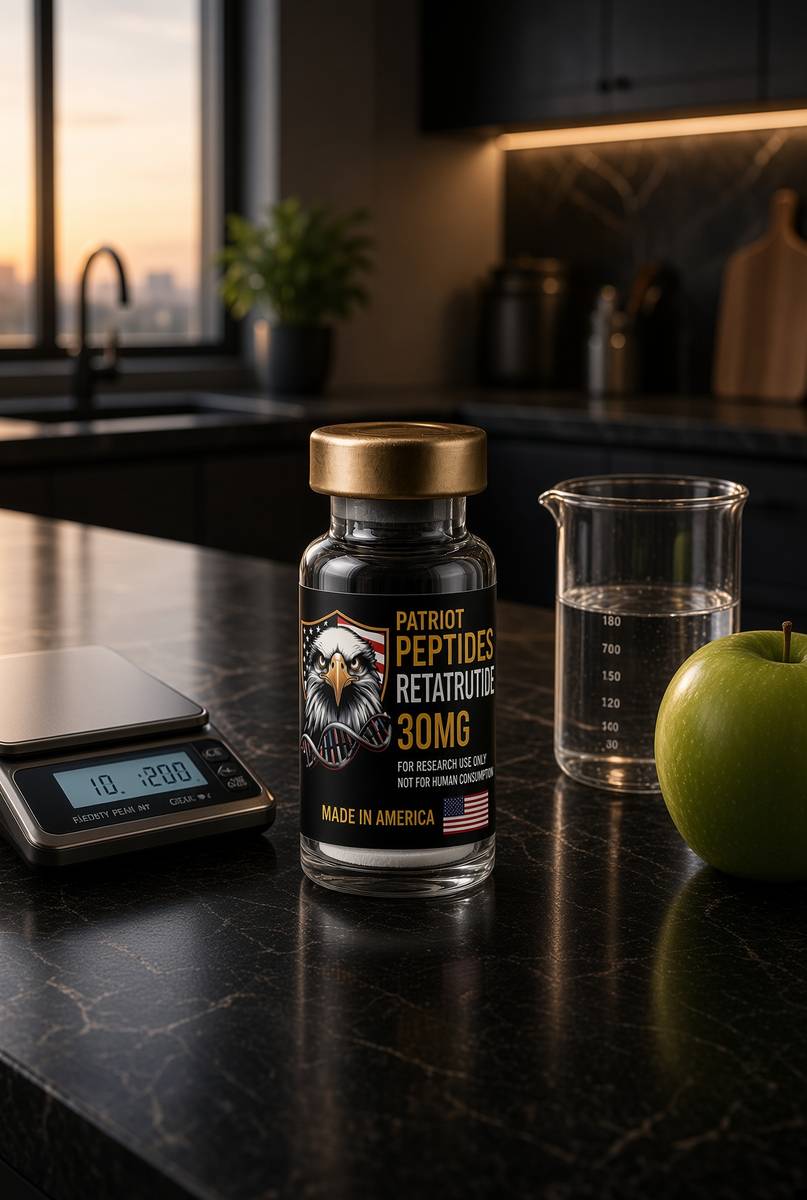
Hypothetical research reconstitution for the named catalogue vial. Not a protocol, not medical advice, not a use instruction. These amounts sit in published and commonly cited laboratory ranges. The vial is labelled for research use only — not for human or veterinary administration.
Retatrutide
30mg
Mix with 3 ml bacteriostatic water → 10 mg/ml
- Hypothetical aliquot
- 1–2 mg to start; published trial arms ran higher by week
- 0.10–0.20 ml · 10–20 units on a U-100 syringe (at 1–2 mg)
- How often
- Once weekly
- The Jastreboff NEJM 2023 arms ran 48 weeks. That is a trial, not a shop protocol.
Bench steps
- Let the vial sit until it is no longer cold to the touch.
- Wipe the stopper with 70% isopropyl alcohol. Let it dry.
- Draw 3 ml bacteriostatic water (0.9% benzyl alcohol).
- Run the water slowly down the inside glass — do not blast the cake.
- Roll between finger and thumb until the cake is gone. Do not shake.
- Label the date. Store the solution at 2–8 °C. Do not freeze. Use within 30 days unless the note below says otherwise.
LY3437943 architecture. Weekly, not daily. Those milligram figures are what the papers used on the investigational medicine — they are not a use instruction for this reagent.
Bacteriostatic water and sterile syringes ship with peptide orders over £75. Kit details · 10 ml bacteriostatic water
The American-made molecule
Identical to Eli Lilly’s LY3437943. Synthesised in the United States. HPLC-characterised.
 Made in USAOut of stock
Incretin
Retatrutide
US-made retatrutide 30mg — the published structure LY3437943, HPLC-MS verified.
4.6(609)
60 browsing this now · 5 purchased in the last 24 hours
30mg
£120.00
Read next
49 min · long read · Peptide research
What are peptides? Short chains that run the body
Peptides are amino acids joined by peptide bonds — shorter than proteins, more specific than most small-molecule drugs. Insulin was the first. GLP-1 agonists are the current proof. The catalogue here is the same chemistry, labelled for research.
46 min · long read · Peptide research
Retatrutide (LY3437943): the published triple-agonist structure
A fatty-acylated unimolecular agonist at GIPR, GLP-1R and GCGR. US-made, HPLC-MS verified, labelled for laboratory research — not a medicine.
53 min · long read · Peptide research
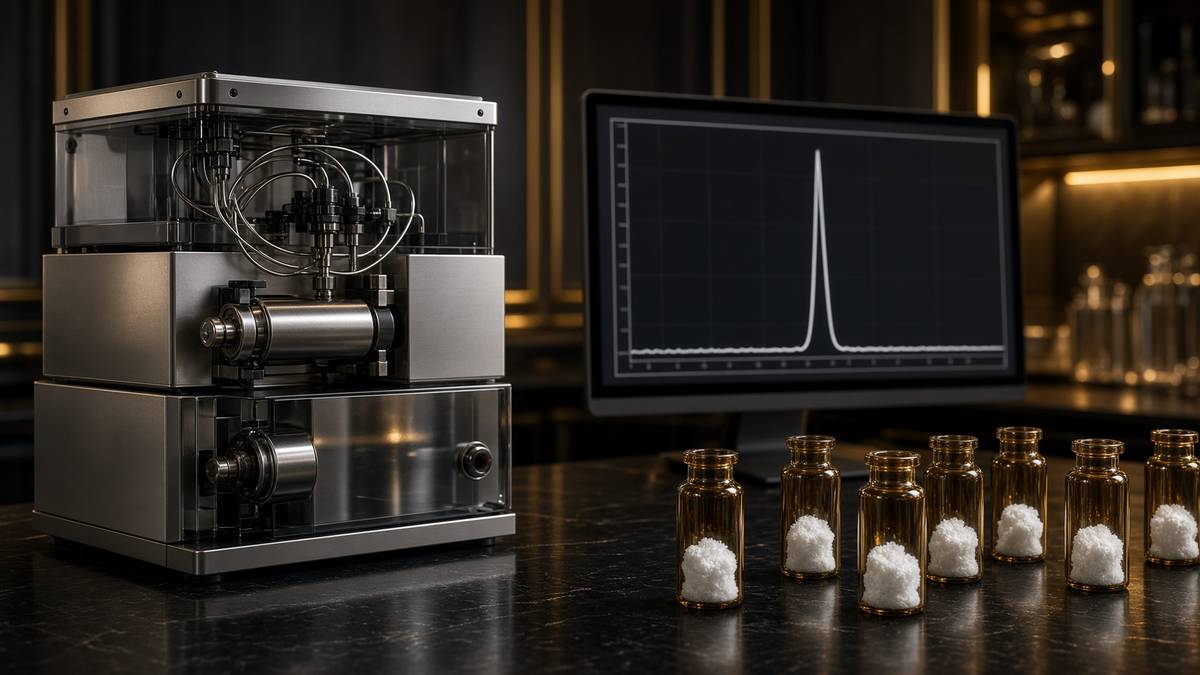
How research peptides are made — and why HPLC actually matters
Solid-phase peptide synthesis builds a chain one residue at a time. HPLC then asks whether the main peak is what you think it is. ≥98% is not a slogan. It is a chromatogram.
More in this desk

53 min · long read · Peptide research
Recovery, GH pulses and the CJC / ipamorelin pair
Somatotrophs have two 'go' receptors. CJC without DAC is a slightly longer GHRH pulse. Ipamorelin is a selective ghrelin-receptor key that does not yank ACTH. Together they are the pair Bowers already showed is more than additive — not a gym protocol.
52 min · long read · Peptide research
Fatigue, cellular energy and the NAD+ / MOTS-c neighbourhood
NAD+ is the rechargeable chip every cell spends on fuel and DNA repair — and the pool shrinks with age. MOTS-c is a mitochondrial 16-mer sent out under metabolic stress. Two answers to 'I have no energy' that are not coffee.
51 min · long read · Peptide research
Melanocortin circuits: pigment, appetite and PT-141
Melanotan II lights MC1, MC3, MC4 and MC5 — pigment plus the rest of the sheet. PT-141 is the free-acid cousin pointed at MC3 and MC4, the circuitry papers use for desire and energy, not skin colour. Same Arizona family. Different question.
51 min · long read · Peptide research
GHRH and ghrelin mimetics: two keys on the same pituitary lock
Somatotrophs have two ‘go’ receptors — GHRHR (Gs–cAMP) and GHSR (Gq). Bowers showed that occupying both releases more GH than the sum of either. That is synergy as a receptor fact, not a smoothie.
Essays describe published research. They are not medical advice and they do not authorise human use of any catalogue item.