

Peptide research · 46 min · 10,143 words
Retatrutide (LY3437943): the published triple-agonist structure
A fatty-acylated unimolecular agonist at GIPR, GLP-1R and GCGR. US-made, HPLC-MS verified, labelled for laboratory research — not a medicine.
· updated
What this essay actually tells you
- LY3437943 is a fatty-acylated unimolecular triple agonist at GIPR, GLP-1R and GCGR. The published research structure. That's the molecule, named.
- Patriot Peptides material is that named structure, synthesised in the United States and verified by HPLC-MS. We are not Eli Lilly. We make the chain they published.
- This listing is a laboratory reagent. Retatrutide has no MHRA marketing authorisation as a medicine. The NEJM paper is next to the vial so you can see which experiment you're holding.
What this actually means
Retatrutide is a lab-made peptide that occupies three class-B GPCRs at once: GLP-1R, GIPR and the glucagon receptor. The published research structure is LY3437943. Our retatrutide is that named structure, synthesised in the United States, HPLC-MS verified, labelled for laboratory use. We are not Eli Lilly. This is not a licensed medicine.
Retatrutide is a single chain. Eli Lilly's investigational code for that chain is LY3437943, and the structure is public: a fatty-acylated peptide engineered so one molecule occupies three class-B G-protein-coupled receptors at once. The receptors are the glucose-dependent insulinotropic polypeptide receptor (GIPR), the glucagon-like peptide-1 receptor (GLP-1R), and the glucagon receptor (GCGR). All three couple primarily to Gs, the stimulatory G protein that raises cyclic adenosine monophosphate. Coskun and colleagues described the engineering in Cell Metabolism in 2018: unimolecular, lipid-handled, balanced enough at glucagon not to wreck a glucose curve while still buying energy expenditure. The design question isn't three hormones in a syringe. It is one backbone, one lipid so albumin will carry the chain through a week, and a set of relative potencies a medicinal chemist would call bias. Semaglutide had already shown that GLP-1R occupancy, on its own, could move large clinical endpoints. Tirzepatide added GIPR. Retatrutide asks what a third occupancy does on the same chain. That's a chemistry question with a public trial attached, and both halves are interesting.
In short. Retatrutide is one peptide built to occupy three gut-hormone receptors at once. The published name for that chain is LY3437943.
Incretin biology went from a niche endocrine topic to the centre of metabolic research in a decade, which still slightly startles you if you trained when GLP-1 was a footnote in a gut-hormone chapter. The through-line is older than the decade. Bayliss and Starling named secretin in 1902 and, with it, the idea that a chemical messenger could travel in blood and tell a distant organ what to do. McIntyre, Elrick and Unger made the incretin effect a measurement: oral glucose raises more insulin than the same glucose in a vein, because the gut has already warned the pancreas. Dipeptidyl peptidase-4 explained why the native peptides die in minutes. Exenatide, then liraglutide, then semaglutide, then tirzepatide, then a triple. Each step is a receptor occupancy plus a half-life trick, not a new theory of fat. What follows is the structure, the three receptors, the Gs–cAMP grammar, the lipid handle, the Phase 2 paper, and the distance between a published backbone and a licensed pen. It's physiology with names on it, told at the length the chain actually needs.
In short. Gut hormones that raise insulin after a meal are a century-old idea. Retatrutide is the latest chain in that line, occupying three related receptors.
A unimolecular, fatty-acylated agonist at GIPR, GLP-1R and GCGR — three class-B GPCRs, primarily Gs–cAMP, one lipid handle so albumin carries the chain through the week.— Coskun T et al. Cell Metab. 2018. The engineering paper for LY3437943, not a protocol.
The published structure LY3437943
Eli Lilly's investigational code is a laboratory name before it is a brand. LY3437943 is how the papers index the chain: a single-chain, fatty-acylated peptide with measurable potency at GIPR, GLP-1R and GCGR. Coskun, Sloop, Loghin and colleagues put that engineering on the page in Cell Metabolism in 2018. The point of a unimolecular agonist, as opposed to co-formulating three hormones, is stoichiometric honesty. Three separate peptides would have three clearances, three tissue distributions, three opportunities for one occupancy to outrun the others after a meal. One backbone carries three pharmacophores through the same plasma, the same albumin reservoir, the same week. Relative potency is then a property of the sequence and the lipid, not a property of which vial you opened first. That's why the field talks about bias rather than dose-mixing. The glucagon occupancy was the risky one. Enough GCGR for energy expenditure and hepatic lipid oxidation; not so much that hepatic glucose output wrecks the glycaemic gain you just bought with the two incretin arms. The ratio is the drug, and Coskun wrote it as a sequence.
In short. LY3437943 is one chain with three jobs, published as chemistry. Putting three hormones in one molecule keeps their timing together in blood.
Class B GPCRs, the secretin family, are the architectural reason a long peptide can occupy three related pockets. Each receptor has a large N-terminal extracellular domain that catches the C-terminal half of the hormone in solution, raising the local concentration of the peptide's N-terminus, which then inserts into the transmembrane bundle from the outside and does the activating work. Two steps, both aqueous-facing. GHRH, GLP-1, GIP, glucagon and secretin itself share this geometry. Truncating the N-terminus is how you make an antagonist, because you keep the catch and lose the insertion. A designed chain in the thirty-to-forty-residue band can therefore be written to fit three related class-B pockets without becoming a submarine. The ligand doesn't have to enter the cell. Information crosses as conformation. Lefkowitz and Kobilka's 2012 chemistry Nobel was for the family; the incretin decade is what happens when medicinal chemistry takes that family seriously as a metabolic tool rather than as a curiosity of gut extracts. Related pockets, one chain, a shape change. That's the lock this molecule was built for.
In short. These receptors catch a peptide outside the cell and change shape. The message is the shape change. The peptide does not need to go inside.
Fatty-acid acylation is the industrial half-life trick of this whole class. Native GLP-1 is destroyed in about two minutes by dipeptidyl peptidase-4, which clips the chain at alanine-2, and by renal clearance of a small peptide that has nothing to hold onto. Liraglutide hung a C16 palmitoyl on a lysine so circulating albumin would carry the analogue through a day. Semaglutide used a C18 diacid and an aminoisobutyric acid substitution at position 8, and the week became the clock. Tirzepatide and retatrutide inherit the same grammar: a lipid side-chain that binds albumin, a plasma reservoir whose own half-life is measured in weeks, a subcutaneous depot that feeds that reservoir. The lipid isn't a membrane punch. It is a handle. Reverse-phase chromatography notices it immediately, because a C18 column holds a fatty-acylated chain longer than the naked peptide of the same backbone. That's why identity of this molecule is a chromatogram plus a mass, not a nickname on a box. Skip the lipid in the calculation and you've identified a different object, which is a useful thing to notice before you write a caption.
In short. A fat chain stuck on the peptide lets blood albumin carry it for days. Native gut hormones last minutes. That handle is how a weekly clock became possible.
Unimolecular is a choice that has a prehistory. Richard DiMarchi, Matthias Tschöp, Brian Finan and colleagues spent the 2010s showing that glucagon and GLP-1 could be written into one sequence as a co-agonist, and that GIP could be added without the chain falling apart as chemistry. Day et al., Nature Chemical Biology and then Nature Medicine, are the papers in which a glucagon/GLP-1 co-agonist lost more weight in obese rodents than a GLP-1 agonist alone, with the glucagon arm supplying energy expenditure and a lipid-oxidation cue. Those were still two occupancies. The dual GIP/GLP-1 work that became tirzepatide is Coskun's 2018 Cell Metabolism paper on LY3298176, a different chain and a different trial literature. LY3437943 is the next increment: keep both incretins, add GCGR, hang the lipid, and ask whether the ratio can be tuned so glycaemia does not pay for the extra expenditure. A cocktail of three native hormones wouldn't ask that question cleanly, because three half-lives would drift. One backbone is how you keep the ratio you designed. That's the whole point of unimolecular, and it's a sequence argument before it's a clinical one.
In short. One chain was chosen so the three receptor effects travel together. Mixing three separate hormones would let their timings drift apart in blood.
- Native GLP-1 half-life
- ~2 minutes
- Albumin-bound analogue
- days to a week
- Class-B GPCR
- 7TM + large ECD
- LY3437943 occupancies
- GIPR, GLP-1R, GCGR
- Jastreboff 2023, 12 mg
- 24.2% at 48 weeks
- Research aliquot
- 30 mg, US-made
DPP-4 clips alanine-2. The reason sitagliptin and acylation both exist.
Lipid handle. The reservoir is albumin, not a delayed-release myth.
Secretin family. Catch, then insert. Gs–cAMP is the default grammar.
One chain. Coskun, Cell Metab 2018. Unimolecular, not a cocktail.
Least-squares mean. Phase 2, n=338. Clinical literature.
Published structure, HPLC-MS. Distinct from a licensed pen.
Diagram
GLP-1R
β-cell, brainstem, stomach
Incretin, delayed emptying, satiety. Semaglutide’s occupancy.
GIPR
β-cell, adipocyte
Second incretin. Lipid handling. Tirzepatide added this.
GCGR
hepatocyte
Glycogenolysis and, biased, energy expenditure. The third occupancy.
LY3437943 is a fatty-acylated unimolecular agonist at GIPR, GLP-1R and GCGR (Coskun, Cell Metab 2018). Jastreboff, NEJM 2023: 24.2% mean weight loss at 48 weeks, 12 mg, Phase 2 — clinical literature, not a use instruction for a research vial.
A century of gut hormones, honestly told
In 1902, William Bayliss and Ernest Starling cut the nerves to a loop of dog jejunum, poured acid into the lumen, and watched the pancreas secrete anyway. The only remaining path was chemical. They named the messenger secretin, and a few years later Starling, in the Croonian Lectures, gave physiology the word hormone: a chemical messenger secreted into blood, acting at a distance. That experiment is still the origin story of endocrinology as a discipline distinct from nervism. Secretin itself is a class-B GPCR ligand at SCTR, Gs-coupled, a pancreatic bicarbonate cue. It isn't an incretin. It is the prototype of the family the incretins belong to. If you start the retatrutide story at a 2023 headline, you've skipped the reason a thirty-residue gut peptide can occupy a seven-helix receptor at all. The architecture is a hundred and twenty years of the same idea: the gut writes a peptide, the blood carries it, a distant cell has a receptor, and the receptor isn't a metaphor. Hormone is still the right word, and it's still Starling's.
In short. In 1902 two physiologists showed the gut can send a chemical message in blood. They named secretin, then the word hormone. Incretins are later members of that family.
The word incretin is older than the 1964 curves. Jean La Barre, working with Zunz in Brussels in 1929, coined it for a putative intestinal factor that stimulated pancreatic secretion of insulin — intestin and secretin fused into a name. La Barre proposed, in 1932, that such a factor might be useful in diabetes. The extract chemistry of that decade couldn't isolate it, and insulin itself was still a new enough object that a second pancreatic conversation from the gut felt like a luxury. Moore, Edie and Abram had already, in 1906, tried duodenal extracts on glucose, which is a reminder that the idea kept recurring whenever someone noticed the gut and the pancreas talking. What 1964 added was a paired measurement that could not be waved away: the same glucose, two routes, two insulin curves. What the 1970s added was a named peptide. What the 1980s added was a second named peptide hiding in proglucagon. The word was waiting. The receptors took another fifty years to become a weekly analogue. That lag is worth keeping in view, because it stops a 2023 headline looking like a creation event rather than the latest occupancy in a long argument.
In short. Incretin was coined around 1929 for a gut factor that helps the pancreas release insulin. The word sat waiting until named peptides and receptors arrived.
The incretin effect is a measurement before it is a drug. Give glucose by mouth and the insulin rise is larger than the rise you get from the same glucose load in a vein. McIntyre, Holdsworth and Turner put that contrast into the Lancet in 1964. Elrick, Stimmler, Hlad and Arai published the same shape the same year in the Journal of Clinical Endocrinology. The gut, they argued, must be releasing something that amplifies the β-cell's response to glucose. Unger's radioimmunoassay work on glucagon, and the language of an entero-insular axis, made the conversation quantitative rather than anecdotal. Oral versus intravenous is still how you teach the effect in a practical class. Everything that follows — GIP, GLP-1, DPP-4 inhibitors, fatty-acylated analogues, duals, triples — is an attempt to name, then occupy, the messengers responsible for that difference. A screenshot of a weight-loss mean is a long way downstream of a paired glucose curve, which I still think is the under-taught bit. Start with the measurement. The drugs came later.
In short. More insulin follows sugar you swallow than sugar put in a vein. That difference is the incretin effect, measured in 1964, and it is why these receptors matter.
Gastric inhibitory polypeptide was isolated first. Brown, Mutt, Pederson and colleagues, in the early 1970s, pulled a peptide from intestinal extracts that slowed gastric acid, and named it for that job. Dupré then showed it also amplified insulin when glucose was present, which is a different job wearing the same letters. The field eventually preferred glucose-dependent insulinotropic polypeptide, keeping the acronym GIP, because the insulinotropic physiology is what survived contact with human metabolic disease. The gastric-inhibitory name wasn't a fraud. It was a first assay. Hormones are often named for the experiment that found them, then renamed for the experiment that mattered. K-cells in the proximal small intestine write GIP in response to fat and carbohydrate. The receptor, GIPR, is a class-B GPCR on β-cells and on adipocytes. Tirzepatide added this occupancy on purpose. Retatrutide keeps it. If you still hear GIP described as a stomach-slowing peptide and nothing else, you've missed the rename, and the dual and triple papers that followed will look like they invented a receptor that was already there.
In short. GIP was first named for slowing the stomach, then renamed for raising insulin when glucose is present. Same peptide. The second job is why dual agonists exist.
GLP-1 arrived through proglucagon. Habener's laboratory cloned the precursor; Holst, Ørskov and colleagues showed that the gut processes that precursor differently from the pancreatic α-cell, yielding glucagon-like peptide-1 as a post-translational product of L-cells, denser toward the ileum and colon. Drucker's work made the receptor a therapeutic object rather than a curiosity of a radioimmunoassay. Native GLP-1 is a thirty-one-residue peptide, amidated, potent at GLP-1R, and almost useless as a drug because DPP-4 clips it at alanine-2 in minutes and the kidney clears what remains. The insulinotropic effect is glucose-dependent, which is why hypoglycaemia isn't the dominant failure mode of this class in the way it is for a sulphonylurea. GLP-1R also lives on the brainstem and on the stomach. Delayed gastric emptying and central satiety aren't side-effects of a β-cell drug. They are the receptor being where it is. Semaglutide's clinical literature is what happens when you occupy that receptor well enough, long enough, in enough people, with a half-life that survives the week.
In short. GLP-1 is cut from a larger gut protein and tells pancreas, brain and stomach that a meal has arrived. The native peptide dies in minutes, which is why analogues were built.
Dipeptidyl peptidase-4 is a serine protease on endothelial cells and in plasma that removes two N-terminal residues from peptides with a proline or alanine in the second position. GLP-1 and GIP are substrates. Mentlein, Gallwitz and Schmidt put the cleavage on the page in the early 1990s. Sitagliptin, licensed in 2006, occupies the enzyme rather than the receptor: it lets more native incretin survive the meal. That's a different therapeutic idea from injecting an analogue, and it produces a different magnitude. DPP-4 inhibitors are oral, modest on weight, useful on glucose. The analogue strategy accepts that native peptide is the wrong pharmacokinetic object and builds a chain the enzyme cannot eat as fast, then hangs a lipid on it so albumin will hide what remains. Both strategies exist because the two-minute half-life is real. If you're talking about boosting GLP-1, it's worth saying whether you mean the enzyme or the receptor, because those are two different mechanisms wearing one hormone's name. Sitagliptin is the enzyme-side proof. The weekly analogues are the receptor-side proof.
In short. An enzyme called DPP-4 destroys native GLP-1 and GIP in minutes. Some medicines block that enzyme. Others rebuild the hormone so the enzyme cannot eat it as fast.
Exenatide is the Gila-monster chapter, and it isn't a joke. Eng, Kleinman, Singh and Raufman isolated exendin-4 from the venom of Heloderma suspectum in 1992. The peptide occupies GLP-1R, resists DPP-4 because the second residue is not alanine, and lasts hours rather than minutes. Byetta, the synthetic exendin-4, was licensed in 2005 as the first GLP-1 receptor agonist for type 2 diabetes. Twice daily, a lizard sequence, a proof that occupancy at this receptor moved glucose in people. Liraglutide followed as a human GLP-1 analogue with a C16 fatty acid, once daily, then as a weight-management dose. Semaglutide moved the clock to weekly. Each of those steps is a published medicinal-chemistry argument, not a rebrand. The lizard is in the story because evolution had already solved DPP-4 resistance, and a laboratory was paying attention to venom. The weekly human analogues are in the story because albumin binding is a better industrial clock than a twice-daily pen from a desert lizard. Both decisions were made. Only one of them became the weekly grammar this chain inherits.
In short. The first GLP-1 medicine came from Gila-monster venom, which resists the enzyme that eats human GLP-1. Later drugs copied human GLP-1 and added a fat handle instead.
Wilding and colleagues, STEP 1, New England Journal of Medicine 2021: semaglutide 2.4 mg once weekly, adults with overweight or obesity, 68 weeks, mean weight reduction 14.9 percent against placebo. That paper is why GLP-1R occupancy stopped being a diabetes footnote and became a population-level metabolic tool. The receptor had always been on brainstem and stomach. The analogue had become weekly. The trial was large enough, long enough, and honest enough about gastrointestinal events that a regulator and a journal could both live with the sentence. Jastreboff, Kaplan, Lefkowitz, Wu and colleagues then published SURMOUNT-1 in 2022: tirzepatide, the dual GIPR/GLP-1R agonist (Lilly's LY3298176), 15 mg, 72 weeks, 20.9 percent. Adding the second incretin moved the mean. Retatrutide is the next occupancy, not a different theory. If you can't keep those three papers in order — one receptor, two, then three — a 24.2 percent figure will look like a miracle rather than a dose-response on a related chain. Keep them in order and the decade looks like chemistry, which is more interesting.
In short. Semaglutide showed one receptor could move weight a long way. Tirzepatide added a second receptor and moved it further. Retatrutide is the third occupancy on that same path.
The history isn't a product ladder. Secretin taught us that peptides travel. The 1964 oral-versus-intravenous curves taught us that the gut amplifies insulin. GIP was isolated, misnamed, renamed. GLP-1 was hiding in proglucagon. DPP-4 explained the minutes. A venom peptide proved the receptor was druggable. Fatty acylation bought the week. Dual occupancy beat single occupancy on a weight endpoint in a large randomised trial. Triple occupancy was the next medicinal-chemistry question, and Coskun's group wrote a chain that could ask it without three clearances fighting each other. Along the way, gastric inhibitory polypeptide kept its acronym and changed its job description, which is a useful reminder that names are assays, not essences. If you want the 2023 headline without the 1902 experiment, you can have the headline. You just won't see why a class-B receptor, a lipid handle, and a glucagon occupancy belong in the same sentence. Three numbers, three papers, one industrial decade. That's a nicer story than a miracle, and it's the one the chemistry actually tells.
In short. The story runs from a 1902 gut extract to a three-receptor chain. Each step named a messenger, an enzyme, or a half-life problem, not a marketing era.
GLP-1R: the occupancy that was already enough
GLP-1R is a class-B GPCR on pancreatic β-cells, on neurons in the nucleus tractus solitarius and hypothalamus, on gastric smooth muscle and vagal afferents, and on the heart. Occupancy raises cAMP. On the β-cell, that cAMP, in the presence of glucose, amplifies insulin granule release: the classical incretin. On the stomach, emptying slows, so appearance of carbohydrate in the portal vein is delayed. On the brainstem, satiety advances and meal size falls. Those three sentences are why a diabetes receptor became a weight receptor without changing protein. Semaglutide's clinical literature is occupancy at this one receptor, stretched across a week by albumin binding, producing double-digit mean weight loss and a gastrointestinal event profile that is now the class signature. Retatrutide includes this occupancy. It doesn't replace it. If you talk about the triple as if the GLP-1 arm were a rounding error, you've not looked at where the satiety and the nausea both come from. The first occupancy was enough for large endpoints. The later occupancies are arguments about what else you can buy without giving the first one back.
In short. The GLP-1 receptor sits on pancreas, brain and stomach. Occupying it raises insulin after glucose, slows the stomach, and reduces appetite. One receptor did a lot.
Delayed gastric emptying is pharmacology, not a personality. GLP-1R tone on the stomach and on vagal afferents slows the grind and the dump. A mixed meal sits longer. Post-prandial glucose spikes flatten because appearance rate falls, not only because insulin rose. Early in analogue treatment the emptying effect is obvious; with continued weekly occupancy there is tachyphylaxis of the gastric effect in some studies while the satiety and weight effects continue, which is a reminder that one receptor can write more than one sentence and that those sentences desensitise on different clocks. Nausea tracks the gastric and the central occupancies. It is dose-related in every large trial in this class. Titration exists because a gastrointestinal epithelium and a brainstem nucleus both notice a sudden rise in occupancy. Calling nausea 'just a side-effect' as if it were unconnected to the mechanism is a way of not having read the receptor map. The mechanism is the map, and the queasiness is on it. That's a kinder sentence than it sounds, because it stops the nausea looking like a contaminant.
In short. GLP-1 slows how fast the stomach empties a meal, which flattens a sugar spike and can make people feel sick. That is the receptor working, including the part nobody enjoys.
Central satiety is the reason the weight endpoint exists at this magnitude. GLP-1R-expressing neurons in the hindbrain see both circulating analogue and vagal traffic. Meal termination arrives earlier. Hedonic drive isn't a separate mystical compartment; it is partly this nucleus and its projections. Wilding's STEP 1 mean of 14.9 percent is what that occupancy produced in a randomised, placebo-controlled, lifestyle-wrapped trial at 2.4 mg weekly. It isn't a law of nature that every subsequent analogue must beat. It is a demonstration that the first receptor, occupied well, is already a large lever on intake. Retatrutide's GLP-1R arm is that lever still being pulled. The GIPR and GCGR arms are additional levers, not a replacement theory of appetite. When a later chain is treated as the GLP-1 that finally works, the 2021 paper in which GLP-1 already worked has been quietly deleted, and the gastrointestinal events that follow this molecule wherever it goes will look like a surprise. Keep STEP 1 in the room. The triple makes more sense with it there.
In short. GLP-1 in the brain ends a meal earlier. That appetite effect, stretched across a week, is why a single-receptor drug already produced large weight-loss trials.
GIPR: the second incretin, and the rename that mattered
GIPR is the other incretin receptor. It is a class-B GPCR, Gs-coupled, expressed on β-cells, where it amplifies insulin in a glucose-dependent manner, and on adipocytes, where the literature on lipid handling is real and still argued about in detail. K-cells sit higher in the gut than L-cells; a mixed meal that includes fat is a strong GIP stimulus. In type 2 diabetes the insulinotropic effect of GIP dulls more than GLP-1's does, which is one reason the first generation of incretin medicines ignored GIPR and went after GLP-1R. Tirzepatide reopened the receptor as a therapeutic object by occupying it together with GLP-1R, in a unimolecular dual agonist, and beating semaglutide on weight. The adipocyte sentence is the one people either overclaim or skip. GIPR occupancy can change how a fat cell handles lipid; whether that's storage, blood-flow, or a more interesting remodelling depends on the paper, the species, and the co-occupancy. Retatrutide keeps this arm. It doesn't make GIP a weight-loss brand of its own. It makes GIPR a second microphone on a chain that already had a loud first one, which is a more interesting claim.
In short. GIP is the other meal hormone that raises insulin. Its receptor also sits on fat cells. Tirzepatide added this occupancy; retatrutide keeps it on the same chain.
The rename from gastric inhibitory polypeptide to glucose-dependent insulinotropic polypeptide is a small lecture in how not to fossilise a first assay. Brown's isolation was an acid-inhibition experiment. Dupré's insulin curves were the physiology that survived. Keeping the acronym was a kindness to the literature; changing the words was an honesty to the β-cell. You'll still find textbooks that lead with inhibition of gastric acid and mention insulin in a dependent clause. You'll also find copy that talks as if GIP were invented in 2022. Both are distortions. The peptide is the same forty-two-residue hormone from a K-cell. The receptor is the same class-B protein. What changed is which assay the field was willing to build a drug around, and that change waited until a dual agonist could occupy GIPR without abandoning GLP-1R. Dual occupancy is a medicinal-chemistry sentence. It isn't a discovery that GIP exists. McIntyre's oral-versus-intravenous difference already had room for more than one messenger. The 1970s isolated one of them and named it for the wrong job. The 2010s occupied it on purpose.
In short. GIP kept its letters and changed its job title from stomach-slowing to insulin-raising. The peptide did not change. The experiment the field cared about did.
Adipocyte lipid handling is the GIPR sentence that refuses to be a caption. The receptor is there. Knockout and agonist papers in rodents don't all point the same way; some read as storage, some as a healthier distribution, some as a partner to GLP-1R that only makes sense in combination. Human adipose GIPR biology is thinner than the β-cell literature. Tirzepatide's clinical advantage over semaglutide is an organism-level fact from SURMOUNT-1 and from head-to-head glucose trials; it isn't a biopsy of an adipocyte in those same participants showing a named lipid enzyme moving. Retatrutide inherits the dual incretin logic and adds glucagon. The useful way to hold the adipocyte is as a tissue that has the receptor, that handles lipid, and that has not yet given us a human assay as clean as a gastric-emptying curve or a satiety visual analogue score. Occupancy is still occupancy. A missing assay isn't a missing receptor. It's a missing assay, and you're allowed to say so without filling the gap with a story. That's adult GIPR, and it sits well next to the louder GLP-1R arm.
In short. Fat cells carry GIP receptors, so this occupancy can change how they handle lipid. The human details are less settled than the insulin story. The receptor is still there.
GCGR: hepatic glucose, energy expenditure, and the art of bias
Glucagon has a reputation as the anti-insulin, and in a starving liver that reputation is earned. α-cells write glucagon; hepatocytes carry GCGR, another class-B Gs-coupled receptor; cAMP rises; glycogenolysis and gluconeogenesis run; hepatic glucose output climbs. That's how a brain keeps a millimolar glucose when you have not eaten. Give a large glucagon dose to a fed person and you will see the glucose you were taught to expect. The medicinal-chemistry question for a triple agonist is whether a smaller, biased occupancy at the same receptor can buy two other hepatocyte jobs — lipid oxidation and a rise in energy expenditure, including futile cycling of glycogen and urea — without handing back the glycaemic gains of the incretin arms. Coskun's engineering is that question written as a sequence. Enough GCGR to lift energy expenditure. Not enough to wreck glycaemia. Bias, here, is a ratio of potencies and a tissue distribution, not a moral quality. The art is the ratio. Lilly spent years on it because the ratio is the drug, not a third hormone poured into the same syringe.
In short. Glucagon tells the liver to put sugar into blood. Used carefully on the same chain, that receptor can also raise energy use. The hard part is the dose of that effect.
Glucagon itself was named in 1923, when Kimball and Murlin found a hyperglycaemic activity in pancreatic extracts that was not insulin. For decades it was the contaminant you had to remove if you wanted a clean insulin preparation, then the emergency syringe in a hypoglycaemic crisis, then Unger's radioimmunoassay made it a hormone you could draw on a graph. The α-cell writes it when glucose is low, when amino acids arrive, when the sympathetic nervous system leans on the islet. The hepatocyte is the principal addressee. Heart, adipose, kidney and brain have smaller GCGR sentences that a triple-agonist paper should not be asked to finish. Native glucagon lasts minutes; a dual or triple analogue lasts a week because of the lipid, not because glucagon became a different protein. Occupying GCGR with a designed analogue is therefore not giving glucagon as a native infusion. It is occupying the receptor with a different ligand, at a different occupancy-time curve, in the company of two incretin occupancies. Treating the third arm as a glucagon drip skips the concentration, the duration, and the company it keeps.
In short. Glucagon was named in 1923 as the pancreas activity that raises blood sugar. Occupying its receptor with a designed analogue is not the same as giving native glucagon.
Energy expenditure is the theoretical defence against the adaptation that usually attends large weight loss. Eat less for long enough and resting expenditure falls more than the loss of mass predicts; the organism is defending a former weight. GLP-1R and GIPR occupancy mostly work on intake. GCGR occupancy is the arm that was put on the chain to work on output: hepatic futile cycles, a possible brown-fat neighbourhood in rodents, a measured rise in energy expenditure when glucagon is given to humans. Tan, Salem and others have measured that rise. Some of it is liver. Some of it, in mice, is brown adipose tissue, where GCGR expression is a published observation. Adult human brown fat is a real PET-CT object; it is also tens of grams, not a second liver. Occupancy at GCGR sits in the thermogenesis neighbourhood. That doesn't make retatrutide a brown-fat ligand in the sense of a UCP1 agonist. Jastreboff 2023 measured weight, glucose, lipids, heart rate, and adverse events. It did not image uncoupling protein 1. Neighbourhood isn't identity, and the brown-fat essay is the place to keep that distinction kind.
In short. The glucagon receptor was added to lift energy use so the body fights weight loss less. That is a neighbourhood of thermogenesis, not proof that brown fat is the target.
Hepatic lipid is the other GCGR sentence, and it belongs here so it doesn't get smuggled in as a miracle. Glucagon-receptor tone on a hepatocyte pushes β-oxidation, lowers de novo lipogenesis in some models, and can empty triglyceride that insulin and surplus carbohydrate had been writing. Roy Taylor's twin-cycle hypothesis says type 2 diabetes is, in large part, a liver full of fat that keeps making glucose and a pancreas that then fails its first-phase dump. DiRECT emptied that liver with a formula diet. Incretin analogues empty body weight from the intake side and take liver fat with them. A GCGR arm is, in theory, a more direct hepatic lipid cue. Retatrutide's clinical literature shows large losses of weight and improvements in metabolic markers; MRI-PDFF of liver fat is a related, not identical, readout, and should be read in the papers that actually performed it. The variable is intrahepatic triglyceride. The tools that empty it are several. Pretending only one receptor can do so is how a depot stays full while an argument about purity goes on. You're allowed to hold more than one tool.
In short. Glucagon-receptor tone can ask the liver to burn fat rather than store it. That is a real hepatic story, and it is separate from the appetite story.
Diagram
Outside
Peptide ligand
Named sequence in the nM–µM pocket. Shape complementarity, not vibes. A 15-mer and a 4-mer do not fit the same hole.
Membrane
7-TM receptor
Helices rearrange. The cytoplasmic face becomes a GEF for a heterotrimeric G protein (Gs, Gi, Gq, G12/13).
Inside
Second messengers
cAMP, IP₃, Ca²⁺, β-arrestin. One occupied receptor can spawn thousands of messenger molecules. That is amplification.
~800 GPCRs in the human genome. Seven transmembrane helices, an extracellular ligand pocket, an intracellular G-protein handshake. Catalogue neighbours: ipamorelin at GHSR, PT-141/MT2 at melanocortin receptors, retatrutide at GLP-1R/GIPR/GCGR.
Gs, cAMP, and why one occupancy is a flood
The three receptors share a grammar. Ligand occupies the extracellular face. The transmembrane bundle rearranges. The intracellular face becomes a guanine-nucleotide exchange factor for a heterotrimeric G protein, primarily Gs. Gαs-GTP activates adenylyl cyclase. Cyclase converts ATP to cyclic AMP. Protein kinase A and EPAC read the cAMP. On a β-cell the readout is insulin granule priming and fusion, glucose-dependent. On a hepatocyte it is glycogen phosphorylase, CREB, a gluconeogenic programme, a push on β-oxidation. On a gastric myocyte and a brainstem neuron it is the emptying and satiety sentences already named. Lefkowitz and Kobilka's Nobel was for showing that this family is a structural object, not a cartoon of seven squiggles. Cryo-EM has since given us GLP-1R, GIPR and GCGR in occupied poses. The pockets are related, which is why a unimolecular agonist is a possible object rather than a fantasy. Related is not identical. Bias is the difference: a designed ratio, not a mood. That's the lock-class sentence this chain lives inside.
In short. All three receptors use the same inside-the-cell language: they raise cAMP. What happens next depends on whether the cell is a pancreas cell, a liver cell, or a neuron.
Amplification is the only magic, and it is arithmetic. One occupied GPCR can catalyse GDP/GTP exchange on many G proteins. Each Gαs-GTP can keep adenylyl cyclase running long enough to make many cAMP molecules. Each cAMP-activated PKA can phosphorylate many substrates. A nanomolar occupancy can therefore move a micromolar messenger cloud. Local nanodomains, AKAPs, phosphodiesterases sitting next to a channel, mean a cAMP rise beside a granule is not a cAMP rise beside a nucleus. That's why 'cAMP went up' is the beginning of a mechanism, not the end of one. Spare receptors mean a tissue can produce a full response from a fraction occupied, so EC50 can sit below Kd. Efficacy is what the occupied receptor actually does: full agonist, partial agonist, biased agonist. Retatrutide's published profile is agonism at three related class-B receptors with a designed ratio. The ratio is the claim. A sentence that says it hits glucagon so it burns fat has replaced the ratio with a mood. Keep the arithmetic. The flood is ordinary biochemistry, and it's why a tiny occupancy can move a cell you're interested in.
In short. One receptor can make thousands of messenger molecules because enzymes sit in between. That flood is ordinary biochemistry, and it is why a tiny occupancy can move a cell.
Desensitisation is how the cell refuses to let more ligand mean more signal forever. G-protein-coupled receptor kinases phosphorylate the occupied receptor. β-arrestin binds the phosphorylated tail, sterically blocks further G-protein coupling, and can recruit the endocytic machinery. Internalisation follows. Some receptors recycle; some are degraded. Biased agonism, in the modern literature, is the observation that two ligands at the same GPCR can prefer G protein versus arrestin, or one Gα subtype versus another. Incretin analogues have a published bias literature that is real and still messy. Most of it isn't a reason to invent a bias profile for a research chain that hasn't been through that assay in your hands. It is a reason to read Coskun for the potencies they did measure, and to stop treating arrestin as a villain or a hero. Arrestin is how a β-cell and a hepatocyte survive a week of occupancy without remaining stuck in the on position. Tachyphylaxis of gastric emptying, mentioned above, is this biology as a clinical observation: the emptying sentence quiets on a different clock from satiety.
In short. Cells turn the signal down after a while: the receptor is tagged, pulled inside, and stopped from shouting. That is why more peptide is not more effect forever.
Diagram
× 1
Ligand
One peptide in one pocket. nM–µM. Shape, not a mood.
× 10–10²
G proteins
The occupied GPCR is a GEF. Each Gα is a catalyst.
× 10³–10⁴
cAMP / IP₃ / Ca²⁺
Adenylyl cyclase and PLC do not make one molecule. They make a cloud.
× 10⁴–10⁶
PKA / PKC / CaMK
Kinases phosphorylate many substrates per messenger.
× tissue
Secretion, transcription, motility
The organism-level readout. Still not a protocol.
This is the only magic, and it is not magic. A nanomolar ligand can move a micromolar messenger because enzymes sit between them. Desensitisation (GRK, β-arrestin, endocytosis) is how the cell refuses to let ‘more ligand’ mean ‘more signal’ forever.
A research binding isotherm and a person are different objects, and the second-messenger diagram doesn't close that gap. Diffusion, unstirred layers, plasma proteases, albumin binding, receptor number per cell, spare receptors, and the fact that a human is tens of trillions of cells of many types all sit between a well and a waist. Fatty-acid acylation is how licensed incretin analogues buy half-life against albumin in a formulated product with a device and a pharmacovigilance file. A lyophilised cake of the published sequence is a ligand for an experiment you control. Both can occupy the same pocket in a transfected cell. Only one of them is an investigational or licensed medicine. This paragraph is the place to say that without turning it into a chorus. The chemistry of occupancy is shared. The legal class, the fill-finish, the pen, and the trial pharmacy are not. Jastreboff's participants did not reconstitute a research vial. They received an investigational product in a protocol with a safety board. Keep the objects apart and the 24.2 percent remains readable. Fuse them and you have a shopping list wearing a journal's clothes.
In short. A dish and a person are different experiments. The same receptor pocket can be occupied in both. Only one of those settings is a medicine trial.
A fatty-acylated chain, and how you know it is the chain
Albumin is the reservoir. Human serum albumin circulates at about 0.6 millimolar, with a half-life of roughly nineteen days, and it has fatty-acid binding sites that a medicinal chemist can aim at. Hang a C16 or C18 diacid on a lysine of an incretin analogue and a large fraction of the peptide in plasma is bound, protected from rapid filtration, slowly available for receptor occupancy as the free fraction equilibrates. The week isn't a delayed-release coating. It is mass-action against a protein you already have in grams per litre. Native GLP-1 can't play this game; it has no handle and DPP-4 is fast. Liraglutide played it daily. Semaglutide, tirzepatide and retatrutide play it weekly. The same handle that buys the clock makes the chain hydrophobic, which is why a reverse-phase C18 column holds it, why the lyophilised cake behaves as it does in a reconstitution, and why a chromatogram of this molecule is not the chromatogram of a naked fifteen-mer. Identity of a fatty-acylated peptide is a retention time plus a mass that includes the lipid. Skip the lipid in the calculation and you've identified a different object.
In short. Blood albumin grabs the fatty tail and carries the peptide for days. That is the weekly clock. It also makes the chain stickier on a chemistry column.
A peptide bond is an amide: the carboxyl carbon of one amino acid joined to the nitrogen of the next, planar because of resonance, hydrolysed slowly unless an enzyme is paid to hurry. Solid-phase peptide synthesis, Merrifield's method, builds that chain from the C-terminus on a resin, one residue per cycle, with protecting groups so the side chains don't freelance. A designed incretin analogue is in the polypeptide band, tens of residues, plus a lipid attached at a specified lysine. Each cycle is an opportunity for a deletion peptide, a failure of deprotection, an aspartimide, a racemisation. The lipid attachment is another opportunity for a miss. The reason a certificate carries HPLC and mass spectrometry is that a human eye cannot see any of those misses in a white cake. Absorbance at 214 or 220 nanometres watches the peptide bond. A single sharp peak at the expected retention time is the adult result. A fat shoulder is a mixture wearing the compound's clothes. Mass spectrometry then asks whether the peak's mass matches the calculated monoisotopic mass of the published sequence including the fatty-acyl handle. That's identity, and it's a nicer sentence than a nickname.
In short. The peptide is a string of amino acids with a fat chain attached. A column and a mass spectrometer are how you check that the string and the fat are the ones in the paper.
Diagram
Reverse-phase C18 holds hydrophobic chains longer. A fat shoulder is a mixture wearing a compound’s clothes. ≥98% HPLC means the main peak dominates. Without MS you can still have a clean peak of the wrong chain.
Patriot Peptides synthesises the published LY3437943 structure in the United States and puts HPLC-MS on the certificate: ≥98 percent by the chromatogram, mass matched to the named chain, 30 mg as a lyophilised cake. We are not Eli Lilly. The sequence architecture, including the acylation, is the architecture the papers drew. A manufacturer's investigational product is a different object: formulation, buffer, preservative, device, fill-finish, cold chain, investigator brochure, a regulator's permission to put that fill into a person. Two objects can share a primary structure and not share a legal class. Water and water-for-injection share a formula; only one of them is a licensed excipient with a sterility file. Bioequivalence is a clinical and regulatory claim. A chromatogram is an identity claim. We make the second. If you need the vial to be the same as the trial, you're asking a chemical to do a regulatory job. Chemicals are bad at that. The certificate is still worth reading. It's how you know which chain you're holding, which is the whole of a reagent's job.
In short. A chromatogram and a mass tell you which chain is in the glass. That is identity. A medicine is a different legal object, even when the backbone matches a paper.
Jastreboff 2023 is a paper. It is not a protocol.
Jastreboff, Kaplan, Frías and colleagues published a Phase 2 trial of retatrutide in the New England Journal of Medicine in 2023. Three hundred and thirty-eight adults in the United States, with obesity or with overweight plus a weight-related condition, and without diabetes, were randomised to once-weekly subcutaneous retatrutide or placebo for forty-eight weeks. The randomisation ratio was 2:1:1:1:1:2:2 — an ugly fraction on purpose, with more people on placebo and on the top and bottom doses. The 12 mg arm, the one that owns the sentence everyone quotes, had sixty-two people and started at 2 mg. The primary end point was percent weight change at twenty-four weeks, where 12 mg produced a least-squares mean of −17.5 percent versus −1.6 percent on placebo. The forty-eight-week figure is a secondary clock. Phase 2 is a dose-finding, signal-finding, go-or-no-go experiment. It isn't marketing authorisation, not a rare-event census, not a ten-year durability study. The how-to-read-a-Phase-2 essay walks n, estimands, and the safety table at a slower pace. We need the numbers here because they are part of the molecule's public life. They're a paper, and papers have methods you can actually read.
In short. A 2023 trial in 338 adults tested weekly retatrutide for 48 weeks. That is a dose-finding experiment in people, not a licence and not a recipe.
At forty-eight weeks, retatrutide at 12 mg produced a mean body-weight reduction of 24.2 percent. The least-squares mean for that arm sat at −24.2 percent, with a 95 percent confidence interval from −26.6 to −21.8, against −2.1 percent on placebo. Some participants lost more: a quarter of that arm lost 30 percent or more. Some lost less. A mean is a centre of a distribution, not a promise to a body. The 12 mg figure is sixty-two people at a maintenance dose, not three hundred and thirty-eight people all doing the same thing. Placebo matters because counselling, injection ritual, expectation and time all move weight a little; without that arm you can't tell the molecule from the wrapping. Gastrointestinal events were the common adverse events, dose-related, mostly mild to moderate, partly mitigated by starting at 2 mg rather than 4 mg. Discontinuation because of adverse events occurred in 6 to 16 percent of retatrutide arms and in none of the placebo arm. Heart-rate increases peaked at twenty-four weeks and declined thereafter. That's the paper. Quote the methods, not just the mean, and it gets more interesting rather than less.
In short. At 48 weeks the 12 mg group's average weight change was 24.2 percent. That is a trial mean with side effects and dropouts attached, not a forecast for a single body.
Weight was the headline. The paper also moved waist circumference, systolic blood pressure, and a set of lipid and glycaemic markers that a cardiometabolic reader actually came for. Participants did not have diabetes; this was not a glycaemic-superiority trial. Fasting glucose and insulin still fell as weight fell, which is what you expect when a smaller person, eating less, with a quieter liver, writes a different HOMA-IR. Triglycerides moved. LDL moved less dramatically than enthusiasts sometimes claim for the class, and should be read as the table rather than as a statin replacement. Liver enzymes are a noisy proxy for intrahepatic fat; improvements in ALT in a weight-loss trial are consistent with emptying that depot and are not a biopsy. None of those secondaries convert Phase 2 into Phase 3, and none of them convert a mean into a personal forecast. They do stop the false sentence that the only number in the paper is 24.2 percent. The 24.2 percent is the number a screenshot wanted. The rest of the results section is why a Phase 3 programme in obesity, diabetes, and fatty liver was a rational next experiment rather than a leap of branding.
In short. The trial also moved waist, blood pressure, fats and fasting glucose. Those extra numbers still sit inside a Phase 2 paper. They do not turn a mean into a forecast.
At 48 weeks, retatrutide at 12 mg produced a mean body-weight reduction of 24.2%.— Jastreboff AM et al., N Engl J Med. 2023; 389: 514–526. Clinical literature — not a use instruction for a research vial.
Nausea, diarrhoea, vomiting and constipation aren't an asterisk. In the 12 mg arm, nausea was reported in 28 of 62 participants, which is 45 percent. Vomiting was 12 of 62, about 19 percent. Placebo nausea was 11 percent; placebo vomiting was rare. Starting the same maintenance dose at 2 mg rather than 4 mg moved those numbers down, which is why titration is a gastrointestinal strategy with a published contrast rather than a branding exercise. Serious adverse events occurred in 4 percent of the retatrutide groups and 4 percent of placebo. Cutaneous hyperesthesia showed up more on drug than on placebo; none of those events were severe. Dose-dependent heart-rate increases peaked at 24 weeks and then eased, which is an observation a cardiometabolic reader circles and a Phase 3 programme has to finish. If you only remember 24.2 percent, you haven't finished the paper. The mean and the event table are the same document. A medicine-shaped object that produces a 24.2 percent mean weight change and a double-digit stop-for-adverse-event rate is a serious object. It is also an object whose stop-rate is part of the benefit-risk.
In short. Gut side effects were common and dose-related. Some people stopped because of them. A headline that quotes only 24.2 percent has not finished the paper.
A scale doesn't tell you whether the lost mass was fat, lean, or water. Dual-energy X-ray absorptiometry in incretin trials typically shows that most of the loss is fat, and that a minority is lean tissue, which is what happens in any large energy deficit, bariatric surgery included. The useful worry is whether the lean fraction is larger than diet-matched loss, whether bone follows, and whether a person who already had little muscle to spare is the wrong body for a 24.2 percent mean. Jastreboff 2023 isn't a body-composition monograph; read the tables that exist and don't invent DXA you were not given. Protein intake, resistance work, and the fact that a smaller person has a smaller absolute lean mass to keep are physiology, not a secret extra occupancy. GCGR tone can, in principle, increase energy expenditure in a way that includes amino-acid oxidation; that is one of the reasons the ratio was so carefully biased. Treating 24.2 percent as cost-free skips a densitometry scan, a nitrogen balance, and a sarcopenic seventy-year-old. The mean is still the mean. It just isn't free.
In short. Most of the lost weight in this class is fat, and some is lean tissue, as in any large energy deficit. A scale cannot tell those compartments apart.
Retatrutide has no MHRA marketing authorisation as a medicine, and as of the day this is written it is not an FDA-licensed medicine either. Investigational. That word is doing legal work. A Phase 2 publication in the New England Journal is a scientific event. It isn't a product licence, not a NICE appraisal, not a blue box on a pharmacy shelf. TRIUMPH is the Phase 3 programme; different n, different duration, different job. A pen sold as if Jastreboff had been a regulator is counting on the difference between a journal and an agency going unnoticed. The paper is allowed to claim that, in this population, this dose range, this duration, this lifestyle wrap, once-weekly retatrutide produced a large, dose-dependent reduction in body weight, that the 12 mg arm's 48-week mean sat at 24.2 percent, that common adverse events were gastrointestinal and dose-related, and that the signal is large enough to justify Phase 3. That's a lot. It is also not more than that. A go-signal isn't a licence. A 48-week curve that has not flattened is a reason to measure later, not a reason to write forever into a caption.
In short. Retatrutide is not a licensed UK medicine. A strong Phase 2 paper is a reason to run Phase 3. It is not permission to treat the trial as a product.
Neighbourhood is not identity
MOTS-c is MRWQEMGYIFYPRKLR, sixteen residues translated from mitochondrial 12S rRNA in a reading frame nobody asked an rRNA to have. Lee, Kim, Cohen, Cell Metabolism 2015: AMPK, the folate–methionine cycle, insulin-sensitivity papers in mice, nuclear translocation under stress. It is one of the least likely peptides in a metabolic catalogue, and it is real chemistry. The organelle that writes MOTS-c is the organelle that will notice, downstream, if a person becomes smaller and a hepatocyte becomes less fatty. That's a shared postcode with retatrutide's organism-level effects, not a shared receptor. MOTS-c isn't a ligand at GLP-1R, GIPR or GCGR. It doesn't have a fatty-acyl handle. It doesn't have a Phase 2 weight curve in the New England Journal. Putting both on a reading list is allowed because both live near fuel. Putting both in one sentence as if they were one occupancy is a blending error. The pathophysiology stack still holds: receptor floor, then tissue, then organism. Skip a floor and you write a caption that two vials cannot cash. Neighbourhood is geography. Identity is a receptor, a mass, and a paper.
In short. MOTS-c is a short peptide a mitochondrion writes from its own RNA. It lives near fuel and energy, like this story. It is not the same receptor, chain, or trial.
NAD+ is the oxidised hydride coin. Dehydrogenases mint NADH. Complex I wants NAD+ back. Sirtuins and PARPs spend NAD+ as a substrate, which is why the pool is a budget as well as a redox gauge. SIRT1 deacetylation of PGC-1α is a real paper-trail in metabolic transcription; SIRT3 in the matrix is a real paper-trail in oxidative metabolism. A smaller person, eating less, with less ectopic fat, is a different NADH production rate and a different demand on that coin. None of that is retatrutide occupying a sirtuin, and none of it is a dinucleotide occupying GLP-1R. The cofactor doesn't stroll through plasma membranes into a hepatocyte matrix because an essay named both objects. eLIVEate's intramuscular NAD+ is a clinic appointment on a different counter. The lyophilised β-NAD+ in a peptide catalogue is a reagent for an assay you control. Three related objects can sit on one afternoon's reading list — a triple agonist, a mitochondrial sixteen-mer, a hydride coin — without becoming a stack. Neighbourhood is geography. Identity is a receptor, a mass, and a paper. Keep those nouns and the reading list stays useful.
In short. NAD+ is the coin mitochondria use to move electrons. Weight loss changes that budget later. That does not make a cofactor into a gut-hormone receptor ligand.
Brown adipose tissue is the heater with UCP1, a regulated proton leak Cannon and Nedergaard spent a career defending. Adult humans have some; PET-CT found it in 2009. GCGR occupancy sits near thermogenesis because glucagon raises energy expenditure and, in rodents, can talk to brown fat. The brown-fat essay already refused to staple those facts into a product claim, and this one will not reopen the staple. A retatrutide paper that doesn't stain UCP1 hasn't shown UCP1. A MOTS-c paper that activates AMPK in a mouse hasn't occupied a class-B GPCR. An NAD+ assay hasn't delayed gastric emptying. The catalogue can stock all three as characterised ligands because a metabolic laboratory might want all three as reagents. The laboratory still has to name the lock. If you can't name the lock, you don't yet have a mechanism. If you name three locks and imply one key, you've blended a reading list into a shopping basket. That's the neighbourhood sentence, and it's a kindness to all three objects if you let it be.
In short. Brown fat, MOTS-c and NAD+ sit near energy expenditure. Retatrutide occupies three gut-hormone receptors. Shared neighbourhood, different locks, different papers.
What this vial is, and what the papers remain
Two objects can share a backbone and not share a life. Lilly discovered, developed, formulated and trialled retatrutide. Coskun's group wrote the engineering. Jastreboff and the investigators ran the Phase 2. The New England Journal published it. Patriot Peptides reads those papers, synthesises the published LY3437943 structure in the United States, verifies identity by HPLC-MS, and ships a 30 mg lyophilised cake as a laboratory ligand. Same sequence architecture, including the fatty-acyl handle. Different manufacturer, different dossier, different device, different legal class. We are not Eli Lilly, and we'll keep putting that in plain type because the alternative is a confusion nobody here wants. HPLC-MS on the certificate is identity, not bioequivalence. Bioequivalence is a clinical and regulatory claim. A sentence that says 'same peptide, same thing' is doing chemistry with a missing course in pharmaceutical law. Sit the course. Then buy the reagent, or don't. The papers will still be there in the morning, with the 24.2 percent still a least-squares mean from sixty-two people at 12 mg, still not a caption for glass.
In short. The published chain can be synthesised as a laboratory ligand. That is not the same object as a company's investigational medicine, even when the backbone matches.
The physical object is a cake. Lyophilisation pulls water off a frozen solution under vacuum so a peptide that would hydrolyse in a week of liquid can sit as a solid with a measurable residual moisture. Reconstitution is then a solvent choice, a concentration, a pH, and a time, all of which belong in the experiment you're actually running. Native incretins in plasma meet DPP-4 and albumin; a reconstituted aliquot in a tube meets whatever protease, plastic, and light you failed to control. Fatty-acylated chains adsorb to some surfaces more than naked fifteen-mers do, which is a bench fact, not a personality. None of that is a protocol for a person. It is why a laboratory ligand is supplied lyophilised, why a certificate mentions HPLC-MS rather than a device increment, and why confusing a cake with a formulated injector is a category error even before the law arrives. The law arrives anyway. The cake remains a cake. Identity is a chromatogram and a mass that includes the lipid. Presentation is a freeze-dried solid in glass, waiting for the experiment you write down.
In short. The solid in the glass is freeze-dried peptide. Adding water is a chemistry step for an experiment you specify, not a hidden set of human instructions.
Read this next to the incretin-history essay, the Phase 2 reading lesson, the liver-fat piece, the brown-fat essay, and the occupancy essay on how peptides talk to cells. Secretin, 1902. Oral versus intravenous glucose, 1964. GIP isolated and renamed. GLP-1 recovered from proglucagon. DPP-4 named as the minutes. Exenatide from a lizard. Liraglutide and semaglutide as albumin-bound human analogues. Tirzepatide as the dual. Retatrutide as the triple. Coskun for the chain. Jastreboff for the 24.2 percent. Gs–cAMP for the grammar. C18 chromatography for the identity of a lipidated peptide. MOTS-c and NAD+ for the neighbouring jobs you should not blend. The molecule is a designed occupancy at three class-B receptors. The trial is a designed occupancy in three hundred and thirty-eight people. The vial is a designed occupancy in a tube you specify. Those three sentences share a structure. They don't share a protocol, and we won't write one. A map is not a route, and this one ends at the chemistry plus the paper, which is the right size for both.
In short. The history, the receptors, the trial and the neighbouring mitochondria essays are the map. A map is not a route, and this one ends at the chemistry plus the paper.
Research-use-only. That sentence belongs here, at the end, as the class of the object rather than a refrain through the physiology. Patriot Peptides synthesises the published LY3437943 structure in the United States, verifies identity by HPLC-MS, and fills a 30 mg lyophilised cake. We are not Eli Lilly. Retatrutide has no MHRA marketing authorisation as a medicine; the object in glass is a characterised laboratory ligand of the published backbone, distinct from the investigational product that sat in a Phase 2 pharmacy. Jastreboff et al. remains clinical literature. Coskun et al. remains the engineering paper. The chromatogram is on the certificate. The three receptors, the Gs–cAMP grammar, the lipid handle, and the 24.2 percent mean are all still true in the morning. Guest checkout attests a laboratory purpose. The trial papers are in PubMed. Go there if you're reading clinical work. Stay here if you wanted the chain explained as chemistry with a public life, from a secretin-family lock to a unimolecular triple.
In short. The chain is a laboratory ligand of a published structure. The trial is a public paper. Neither sentence is a set of instructions for a person.
Three class-B receptors, one chain, a lipid so albumin will carry it, a Phase 2 mean of 24.2% at 12 mg and 48 weeks. Occupancy is a pharmacological word. A vial is a chemical one. A paper is a paper.
- LY3437943 is a fatty-acylated unimolecular agonist at GIPR, GLP-1R and GCGR. Coskun, Cell Metab 2018. All three are class-B GPCRs, primarily Gs–cAMP.
- GLP-1R: incretin, delayed gastric emptying, central satiety. Semaglutide showed this occupancy was enough for large endpoints.
- GIPR: second incretin, adipocyte lipid handling. Gastric inhibitory polypeptide was renamed glucose-dependent insulinotropic polypeptide. Tirzepatide added this receptor.
- GCGR: hepatic glucose output plus energy expenditure. The art is bias — enough for EE, not enough to wreck glycaemia.
- Albumin binding via the lipid side-chain stretches half-life into the weekly range. Native GLP-1 lasts minutes because of DPP-4.
- Jastreboff et al., NEJM 2023, Phase 2: at 48 weeks, 12 mg, mean body-weight reduction 24.2%. Clinical literature, not a use instruction.
- No MHRA marketing authorisation. US-made published structure, HPLC-MS, 30 mg. Independent of Eli Lilly. A ligand, not a pen.
- MOTS-c and NAD+ live near fuel and mitochondria. Neighbourhood is not identity.
Questions the essay actually answers
- Is this the same molecule as Eli Lilly’s retatrutide?
- The published research structure is LY3437943, a fatty-acylated unimolecular agonist at GIPR, GLP-1R and GCGR. This vial is that named structure, synthesised in the United States and HPLC-MS verified. We are not Eli Lilly. A shared backbone is not a shared formulation, device, dossier or legal class.
- Where is it made?
- In the United States. American synthesis of the published LY3437943 structure, HPLC-MS identity, 30 mg lyophilised. Independent of Eli Lilly.
- Is retatrutide a licensed medicine?
- No. Retatrutide has no MHRA marketing authorisation, and is not FDA-licensed as of this writing. Jastreboff et al., NEJM 2023, describes an investigational medicine in a Phase 2 trial. That paper is not a use instruction for a laboratory ligand.
- What does triple agonist actually mean?
- One chain occupies three class-B GPCRs: GLP-1R, GIPR and GCGR. All three signal primarily through Gs–cAMP. Semaglutide occupies the first. Tirzepatide occupies the first two. Retatrutide occupies all three, with a designed glucagon bias. Unimolecular, not three hormones mixed in a syringe.
- Why add the glucagon receptor at all?
- GLP-1R and GIPR mostly work on intake. GCGR was put on the chain as an energy-expenditure and hepatic-lipid arm, against the metabolic adaptation that usually attends large weight loss. The art is bias: enough occupancy for that arm, not enough to wreck glycaemia. Coskun et al., Cell Metab 2018, is the engineering paper.
- Was GIP named for the stomach or for insulin?
- Both, in that order. Isolated as gastric inhibitory polypeptide (Brown, Pederson, Dupré). Renamed glucose-dependent insulinotropic polypeptide when the β-cell job proved to be the one that mattered. Same acronym, same peptide, different assay. Tirzepatide and retatrutide occupy this receptor on purpose.
- What did Jastreboff et al., NEJM 2023, actually report?
- Phase 2, n=338, 48 weeks, once-weekly retatrutide or placebo. At 48 weeks the 12 mg arm's least-squares mean weight change was −24.2% versus −2.1% on placebo. The primary end point was 24 weeks (−17.5% versus −1.6%). Gastrointestinal events were common and dose-related. That is the paper, at the length of a result, not a protocol.
- Does 24.2% mean everyone on 12 mg lost a quarter of their weight?
- No. 24.2% is a least-squares mean for sixty-two people at 12 mg, 48 weeks, 95% confidence interval −26.6 to −21.8. Some lost more, including a subset who lost 30% or more. Some lost less. A mean is a centre of a distribution.
- Are MOTS-c or NAD+ the same sort of object?
- No. MOTS-c is a sixteen-residue mitochondrial ORF with AMPK papers. NAD+ is a hydride cofactor. Both live near fuel and mitochondria. Retatrutide occupies three plasma-membrane class-B GPCRs. Neighbourhood is not identity.
- Why does this chain carry a fatty acid?
- So albumin binds it and stretches half-life into the weekly range. Native GLP-1 is clipped by DPP-4 in about two minutes. Liraglutide, semaglutide, tirzepatide and retatrutide all use a lipid handle against that clock. The same handle is why a C18 column holds the chain and why MS must include the lipid in the mass.
Hypothetical research reconstitution
How these vials are typically mixed
Hypothetical research reconstitution for the named catalogue vial. Not a protocol, not medical advice, not a use instruction. These amounts sit in published and commonly cited laboratory ranges. The vial is labelled for research use only — not for human or veterinary administration.
Retatrutide
30mg
Mix with 3 ml bacteriostatic water → 10 mg/ml
- Hypothetical aliquot
- 1–2 mg to start; published trial arms ran higher by week
- 0.10–0.20 ml · 10–20 units on a U-100 syringe (at 1–2 mg)
- How often
- Once weekly
- The Jastreboff NEJM 2023 arms ran 48 weeks. That is a trial, not a shop protocol.
Bench steps
- Let the vial sit until it is no longer cold to the touch.
- Wipe the stopper with 70% isopropyl alcohol. Let it dry.
- Draw 3 ml bacteriostatic water (0.9% benzyl alcohol).
- Run the water slowly down the inside glass — do not blast the cake.
- Roll between finger and thumb until the cake is gone. Do not shake.
- Label the date. Store the solution at 2–8 °C. Do not freeze. Use within 30 days unless the note below says otherwise.
LY3437943 architecture. Weekly, not daily. Those milligram figures are what the papers used on the investigational medicine — they are not a use instruction for this reagent.
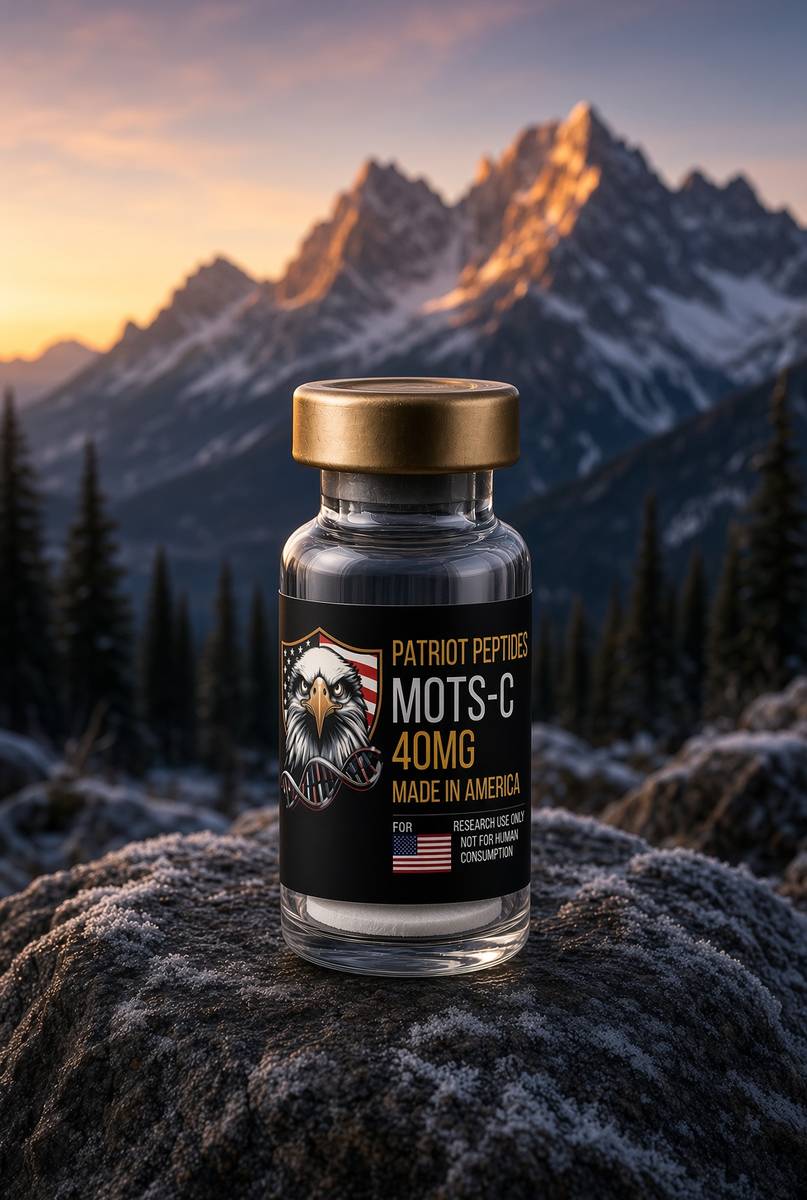
MOTS-c
40mg
Mix with 2 ml bacteriostatic water → 20 mg/ml
- Hypothetical aliquot
- 5–10 mg
- 0.25–0.50 ml · 25–50 units on a U-100 syringe
- How often
- Two or three times per week
- 4–8 weeks
Bench steps
- Let the vial sit until it is no longer cold to the touch.
- Wipe the stopper with 70% isopropyl alcohol. Let it dry.
- Draw 2 ml bacteriostatic water (0.9% benzyl alcohol).
- Run the water slowly down the inside glass — do not blast the cake.
- Roll between finger and thumb until the cake is gone. Do not shake.
- Label the date. Store the solution at 2–8 °C. Do not freeze. Use within 30 days unless the note below says otherwise.
Mitochondrial 16-mer. Fridge. Do not freeze. The 5 mg mark is where most bench notes start.
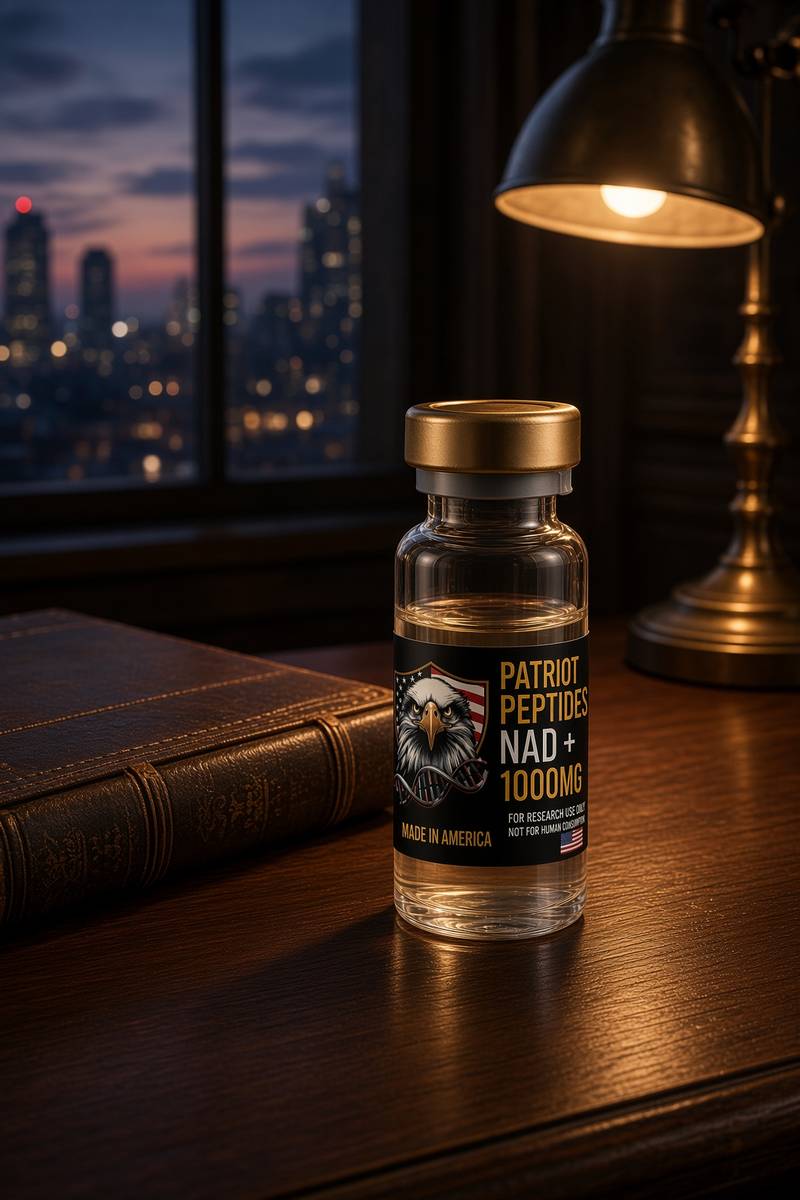
NAD+
1000mg
Mix with 10 ml bacteriostatic water → 100 mg/ml
- Hypothetical aliquot
- 50–100 mg
- 0.50–1.00 ml · 50–100 units on a U-100 syringe
- How often
- Two or three times per week in published infusion and assay notes
- 4–8 weeks, then a pause
Bench steps
- Let the vial sit until it is no longer cold to the touch.
- Wipe the stopper with 70% isopropyl alcohol. Let it dry.
- Draw 10 ml bacteriostatic water (0.9% benzyl alcohol).
- Run the water slowly down the inside glass — do not blast the cake.
- Roll between finger and thumb until the cake is gone. Do not shake.
- Label the date. Store the solution at 2–8 °C. Do not freeze. Use within 30 days unless the note below says otherwise.
A 1000mg cake wants 10 ml. Protect from light. Solution yellows as it oxidises — that is the cofactor dying, not a flavour. Use promptly.
Bacteriostatic water and sterile syringes ship with peptide orders over £75. Kit details · 10 ml bacteriostatic water
The vials this essay sits on
Named sequences the essay maps — Retatrutide, MOTS-C, NAD+. Hypothetical research neighbourhood, not a protocol, not a medicine. One press puts every in-stock vial in the bag.
 Made in USAOut of stock
Incretin
Retatrutide
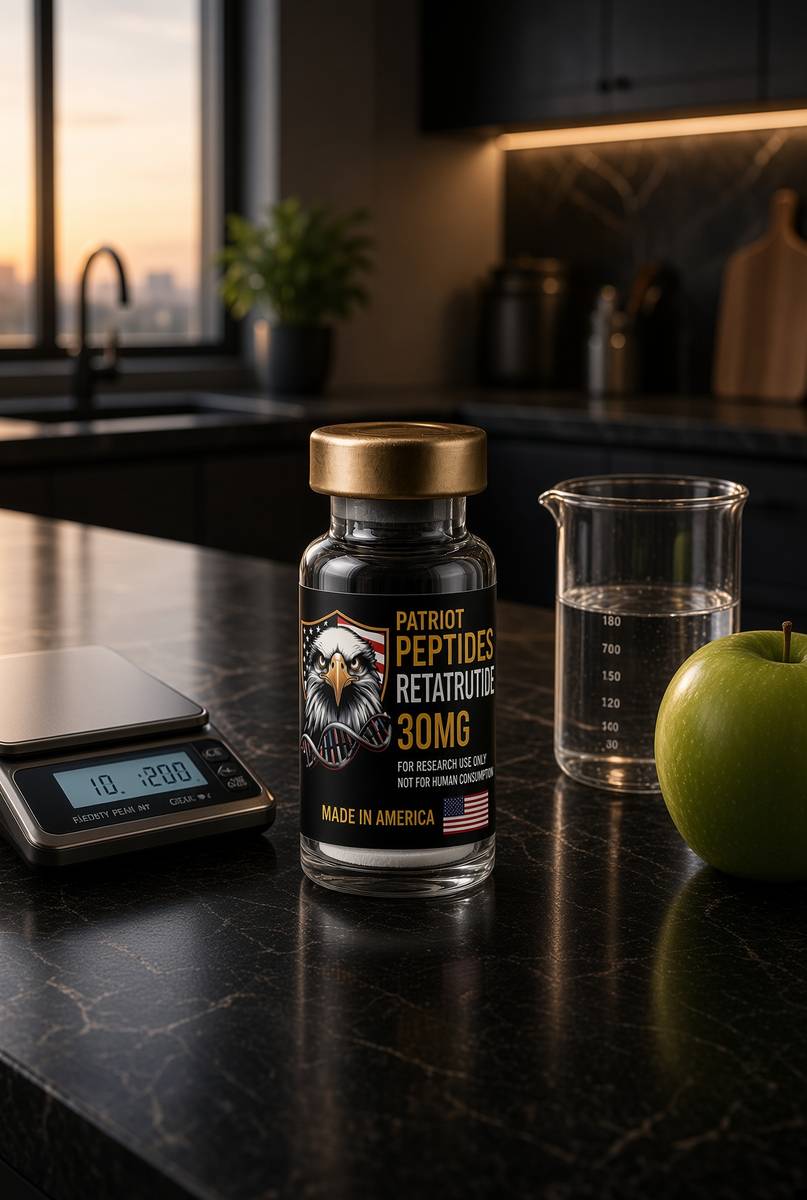
US-made retatrutide 30mg — the published structure LY3437943, HPLC-MS verified.
4.6(609)
114 browsing this now · 5 purchased in the last 24 hours
30mg
£120.00
 Made in USA
 Research only
Research use only. Not a combined-use instruction.
Read next
48 min · long read · Peptide research
From secretin to retatrutide: a century of gut hormones
Bayliss and Starling named the first hormone in 1902. A hundred and twenty years later a single American-made chain occupies GIP, GLP-1 and glucagon at once. The through-line is the gut talking to the pancreas.

45 min · long read · Peptide research
How to read a Phase 2 paper without lying to yourself
Jastreboff et al., NEJM 2023, is a public Phase 2 trial of retatrutide: 338 adults, placebo, 48 weeks, 24.2% mean weight loss at 12 mg. n, randomisation, adverse events, and why a research vial of the published structure is not the investigational medicine.
49 min · long read · Metabolism
Liver fat is the variable type 2 diabetes actually cares about
Ectopic fat in the liver overproduces glucose and VLDL. Empty it — by energy deficit, by carbohydrate restriction, or by both — and first-phase insulin can return. That is the twin-cycle in working clothes.
39 min · long read · Metabolism
Brown fat, UCP1, and heat as a decision
Brown adipose tissue is a heater with a named protein, UCP1, that spends the mitochondrial proton gradient as warmth instead of ATP. Adults have some; PET-CT found it in 2009. Cannon and Nedergaard wrote the review. Occupancy at the glucagon receptor lives in that neighbourhood. It is not a brown-fat drug.
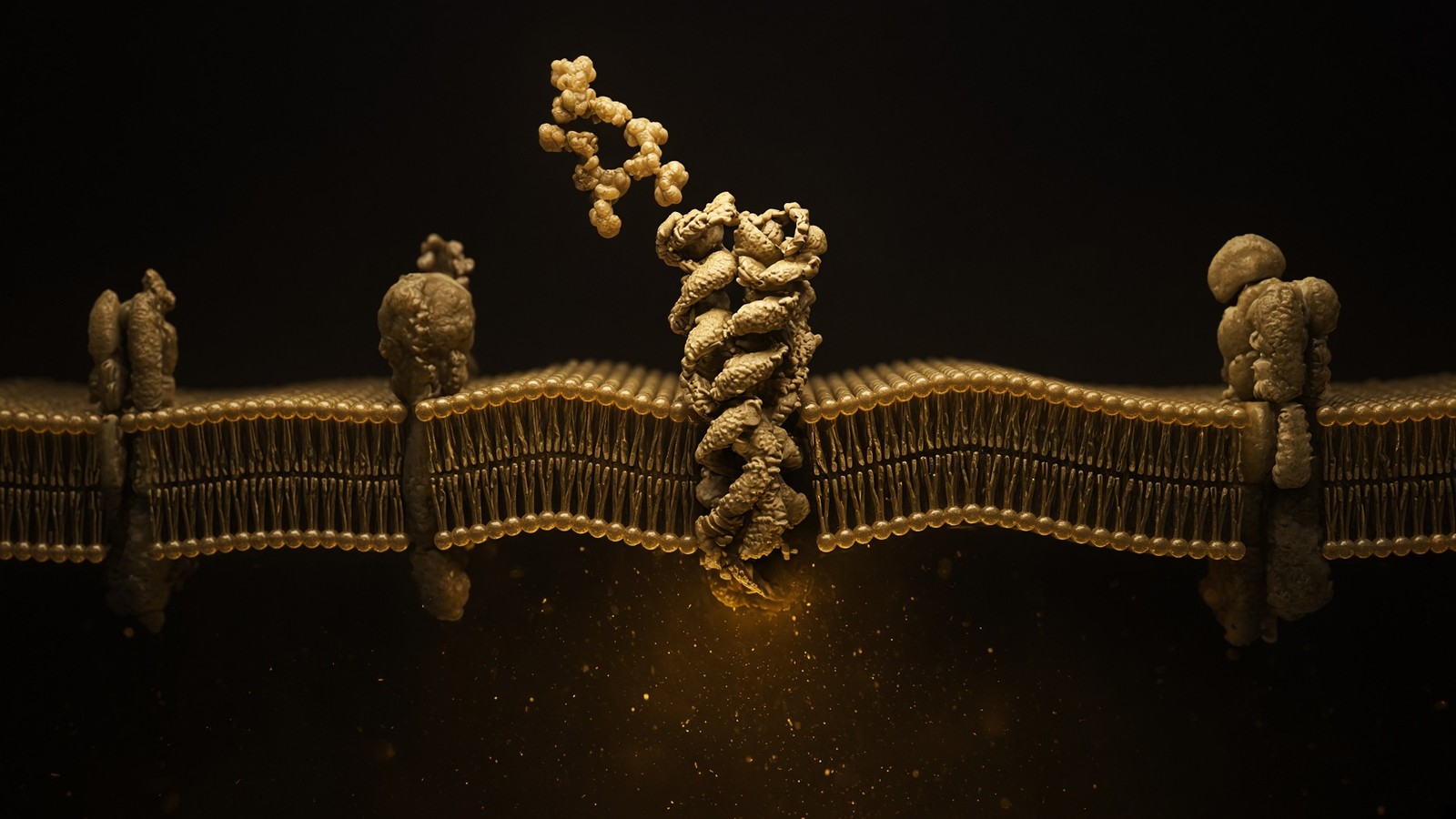
70 min · long read · The living cell
How peptides talk to cells: occupancy, amplification, arrestin
A peptide is a ligand. Most of the catalogue binds a GPCR on the cell surface: one occupancy, then enzymes make thousands of second messengers. That amplification is real, and it is not magic. Desensitisation is why more ligand is not more signal forever.

48 min · long read · Peptide research
Appetite, body weight and the peptides that sit on metabolic literature
Retatrutide is the published triple-agonist chain LY3437943 — GLP-1, GIP and glucagon on one molecule. MOTS-c is a mitochondrial 16-mer that talks to AMPK. One is an incretin story. One is a fuel-gauge story. Neither is a diet.
51 min · long read · Metabolism
Human metabolism, without the slogan
Calories are bookkeeping. The actual system is a set of hormonally gated fluxes through glycogen, fat and amino acids — with the liver as air-traffic control.
More in this desk

53 min · long read · Peptide research
Recovery, GH pulses and the CJC / ipamorelin pair
Somatotrophs have two 'go' receptors. CJC without DAC is a slightly longer GHRH pulse. Ipamorelin is a selective ghrelin-receptor key that does not yank ACTH. Together they are the pair Bowers already showed is more than additive — not a gym protocol.
53 min · long read · Peptide research
How research peptides are made — and why HPLC actually matters
Solid-phase peptide synthesis builds a chain one residue at a time. HPLC then asks whether the main peak is what you think it is. ≥98% is not a slogan. It is a chromatogram.
52 min · long read · Peptide research
Fatigue, cellular energy and the NAD+ / MOTS-c neighbourhood
NAD+ is the rechargeable chip every cell spends on fuel and DNA repair — and the pool shrinks with age. MOTS-c is a mitochondrial 16-mer sent out under metabolic stress. Two answers to 'I have no energy' that are not coffee.
51 min · long read · Peptide research
Melanocortin circuits: pigment, appetite and PT-141
Melanotan II lights MC1, MC3, MC4 and MC5 — pigment plus the rest of the sheet. PT-141 is the free-acid cousin pointed at MC3 and MC4, the circuitry papers use for desire and energy, not skin colour. Same Arizona family. Different question.
Essays describe published research. They are not medical advice and they do not authorise human use of any catalogue item.