


Peptide research · 45 min · 9,811 words
How to read a Phase 2 paper without lying to yourself
Jastreboff et al., NEJM 2023, is a public Phase 2 trial of retatrutide: 338 adults, placebo, 48 weeks, 24.2% mean weight loss at 12 mg. n, randomisation, adverse events, and why a research vial of the published structure is not the investigational medicine.
What this essay actually tells you
- Jastreboff, Kaplan, Frias, NEJM 2023: retatrutide Phase 2, n=338, 48 weeks. Placebo −1.6%; 12 mg −24.2% mean body weight. Gastrointestinal adverse events were dose-limiting. Quote the methods, not just the mean.
- Phase 2 asks dose, safety signal, and whether an endpoint moved. It does not license a medicine. Phase 3 is larger, longer, and still not a product in this catalogue.
- The 30 mg listing is the published LY3437943 structure as a lyophilised HPLC research solid. It is not Eli Lilly’s investigational pen, not a protocol, and not the trial. Research use only.
What this actually means
A Phase 2 paper is a dose-finding, signal-finding, go-or-no-go experiment in people. It is not a licence, not a rare-event census, not a durability study, and not a protocol for a research vial. Jastreboff et al., New England Journal of Medicine 2023, randomised 338 adults with obesity — or overweight plus a weight-related condition — and without diabetes, to once-weekly subcutaneous retatrutide or placebo for 48 weeks. The 12 mg arm’s least-squares mean weight change at 48 weeks was −24.2%. Gastrointestinal events were common, dose-related, and mostly mild to moderate. Discontinuations for adverse events happened on drug and not on placebo. That is the paper. Patriot Peptides stocks a characterised research sequence of the published LY3437943 structure, synthesised in the United States, labelled for laboratory use. We are not Eli Lilly. The vial is not the investigational medicine in that trial.
A Phase 2 paper is the easiest object in medicine to lie with, because it arrives already dressed as a headline. Someone screenshots a mean, strips the sample size, forgets the placebo, forgets the gastrointestinal events, forgets that the primary clock was not the clock in the tweet, and then treats a randomised experiment in a few hundred people as a personal forecast. The lie is rarely a fake number. The lie is a real number asked to do a job it was not hired for. Jastreboff, Kaplan, Frías and colleagues published a Phase 2 trial of retatrutide in the New England Journal of Medicine in 2023. The 12 mg arm's least-squares mean weight change at 48 weeks was −24.2%. That sentence is true. Almost every useful sentence around it is the one people skip. We are going to walk those sentences with you: n, randomisation, placebo, endpoints, adverse events, and the legal distance between an investigational medicine and a research vial. The number stays. The job it is allowed to do gets named.
In short. The usual lie is not a fake number. It is a real Phase 2 mean, stripped of n, placebo, side effects and the actual clock, then treated as a forecast.
This is a reading lesson with one worked example, and the example is public enough that you can keep the PDF open beside the page. We will walk n, randomisation, placebo, endpoints, adverse events, and the legal distance between an investigational medicine and a research vial of the published structure. We will not invent trial arms, we will not tidy the safety table, and we will not pretend Patriot Peptides is Eli Lilly. The molecule in the paper is LY3437943, a fatty-acylated triple agonist at GIPR, GLP-1R and GCGR. The vial we stock is that published backbone, made in the United States, HPLC-MS characterised, labelled for laboratory use. Same sequence architecture. Different object. If you came here for a protocol, you are in the wrong building. If you came here because 24.2% has been following you around the internet and you wanted someone to sit with the paper rather than the screenshot, you are in the right one. A mean is a centre of a distribution. A vial is a ligand. A licence is a regulator's sentence. Three objects. One afternoon.
In short. One paper, read properly: n, randomisation, placebo, side effects, and why our US-made research vial is not Lilly's investigational medicine. No protocol.
What a clinical phase actually is
People talk about the trials as if they were one thing. They are not, and the names are doing real work. A first-in-human Phase 1 study asks, in a small number of people, whether the molecule can be given at all: pharmacokinetics, acute tolerability, a first look at dose. It is not trying to prove that obesity moved. Phase 2 takes a patient population and asks whether a dose range produces a clinically interesting signal, what the common adverse events look like, and which dose is worth the expense of Phase 3. Phase 3 is the large, longer, more representative experiment that regulators actually lean on for a marketing-authorisation decision — still not a guarantee, still not safe for everyone, still not a physiology. Phase 4 is what you learn after a licence, in the wild, where the inclusion criteria have been replaced by whoever walks in. Jastreboff 2023 is Phase 2. That is not a minor caption. It is the job description of the entire paper, and once you hear it that way the screenshot starts looking under-employed.
In short. Phase 1 asks if you can give it. Phase 2 asks if a dose range signals, and what the common harms are. Phase 3 is the big experiment. This paper is Phase 2.
Phase 2 is allowed to be smaller than Phase 3 because its question is narrower. You are not yet asking does this work in the people who will actually receive a licensed pen. You are asking is there a dose, a direction, and a tolerability picture that justify spending the next hundred million. That permission to be smaller is also a restriction: you will see common events and you will miss uncommon ones. A 338-person trial can tell you that nausea is frequent at 12 mg. It cannot tell you the rate of a one-in-a-thousand harm. Quoting Phase 2 as a complete safety story skips why Phase 3 exists. Quoting Phase 2 as a complete efficacy story skips why the primary endpoint sat at 24 weeks and why the curve was still falling at 48. Smaller on purpose. Blind to rare events on purpose. Still a serious paper. Still not the last word. That is the bargain, and it is a fair one if you keep both halves in the room.
In short. Phase 2 is smaller on purpose. It can see common nausea. It cannot census a one-in-a-thousand harm, and it is not the last word on how far the curve goes.
There is a fourth confusion that a research catalogue has to name out loud, because the internet will not. A clinical phase is a property of an investigational medicinal product in a regulated experiment. It is not a property of a lyophilised sequence on a catalogue. You cannot be in Phase 2 with a research vial. You can read a Phase 2 paper about a named structure. You can buy, if you are a laboratory, a characterised aliquot of that published structure. Those two sentences do not combine into a third sentence in which the aliquot inherits the trial. We will keep saying this until it is boring. Boredom is the point. Excitement is how people skip how the trial was actually run. Shared backbone is chemistry. Shared legal class would be a regulator's sentence we do not have. HPLC-MS on the certificate is identity of a ligand. It is not bioequivalence to a formulated investigational product, and it is not a seat in NCT04881760. Two objects. One reading list.
In short. Phase 2 belongs to an investigational medicine in a regulated experiment. A research vial does not inherit a trial by sharing a published backbone.
n is a census of a specific room
n is the number of people who were randomised. In Jastreboff 2023, n equals 338. That is the headline census. It is not the number in each arm, and the arm is the unit that actually ate the dose. The randomisation ratio was 2:1:1:1:1:2:2, which is an ugly fraction on purpose: more people on placebo and on the top and bottom doses, fewer on the start-dose experiments in the middle. Placebo received 70. The 1 mg arm received 69. The two 4 mg arms received 33 and 34. The two 8 mg arms received 35 and 35. The 12 mg arm, the one that owns the 24.2% sentence, received 62. When a screenshot says retatrutide 24.2%, it is talking about sixty-two people at a maintenance dose of 12 mg, not about three hundred and thirty-eight people all doing the same thing. n is a census of a specific room. The furniture in that room is the arm. Quote the furniture.
In short. n=338 is who was randomised. The 24.2% figure belongs to the 12 mg arm, which had 62 people, not the whole trial.
Sixty-two is not a rounding error and it is not a country. It is enough, given the size of the effect, to be very confident that the mean moved. Look at the confidence interval on that 48-week 12 mg figure: −26.6% to −21.8%. The interval does not include zero, it does not include placebo, and it is not a smudge. What 62 cannot do is tell you how a 68-year-old with heart failure, or a person with type 2 diabetes, or a person who has already had bariatric surgery, would have fared. Those people were not in the room. Exclusion criteria are not fine print. They are the walls of the room. Read them before you generalise the furniture. A large mean in a picky room is still a large mean. It is not a census of the people who will later walk into a clinic, and it is not a forecast for a body that would have failed screening. Walls first. Then the mean. Then, maybe, a cautious sentence about what the next phase is for.
In short. 62 people at 12 mg is enough to trust a large mean. It is not a census of diabetes, heart failure, or post-bariatric bodies. Exclusion criteria are walls.
The other n people forget is the n who leave, and it is as much part of the result as the ones who stayed. A trial reports who completed, who discontinued because of an adverse event, who discontinued for other reasons, and how missing weight was handled in the analysis. Jastreboff's safety table said discontinuation of retatrutide or placebo because of adverse events occurred in 6 to 16% of participants on drug and in none of the participants on placebo. That is not a gossip column. That is part of the effect. If the people who felt worst dropped out, and you only quote the ones who stayed, you have performed a kind of taxidermy on the result. We will come back to estimands. For now: n is who started, who finished, and who the analysis pretends finished. Three different numbers. One screenshot. The screenshot almost always picks the prettiest of the three. You do not have to.
In short. n is also who left. 6–16% on retatrutide stopped for adverse events; none on placebo. A mean that ignores dropouts is taxidermy.
- Randomised
- 338
- Placebo arm
- 70
- 12 mg arm
- 62
- Primary clock
- 24 weeks
- The screenshot clock
- 48 weeks
- Placebo at 48 weeks
- −2.1%
- ≥5% at 12 mg / 48 w
- 100%
- ≥30% at 12 mg / 48 w
- 26%
Adults, US, May 2021–November 2022. NCT04881760.
Once-weekly subcutaneous placebo. Lifestyle counselling on every arm.
Started at 2 mg. This is the arm behind −24.2% at 48 weeks.
Percent change in body weight. 12 mg: −17.5% vs placebo −1.6%.
Key secondary. 12 mg LS mean −24.2% (95% CI −26.6 to −21.8).
The counselling, the injection, the time.
Every completer-analysis person in that arm hit a 5% reduction. Mean is not the floor.
A tail, not a promise. A mean of 24.2% sits in a distribution.
Randomisation is a machine, not a mood
Randomisation exists because human assignment is corrupt even when everyone is honest. Investigators like winners. Participants who look ready get the interesting arm in open studies. Prognostic factors cluster. A random number, stratified on the things you already know matter, is the least romantic solution and the only one that usually works. Jastreboff stratified on sex and on BMI below or at-or-above 36, then used that 2:1:1:1:1:2:2 ratio so that placebo, 1 mg and 12 mg would have more stable means, while the 4 mg and 8 mg arms were split to test whether starting at 2 mg rather than 4 mg would spare the gut. That split is not a trivia question. It is the paper teaching you that dose is not only a destination. It is a path, and the path has its own adverse-event rate. Start dose is a variable. Maintenance dose is a variable. Confusing the two is how a 12 mg sentence loses the 2 mg start that made it tolerable enough to measure.
In short. Randomisation, stratified on sex and BMI, is how you stop honest people assigning winners to the interesting arm. The start-dose split is part of the result.
Double-blind means the participant and the site staff should not know which syringe is which. In an injection trial that is a manufacturing and labelling problem as much as a statistical one: matched volume, matched device, matched ritual. Blinding is never perfect — a person who is nauseated every Tuesday has a clue — but the alternative is an open-label study in which expectation does half the work and then poses for the camera. When you read a Phase 2 paper, ask who was blinded, who was not (the statistician? an unblinded pharmacist?), and whether the primary endpoint could be gamed by someone who knew the arm. Weight on a calibrated scale is harder to game than a symptom score. It is not impossible. People still drink less the week of a visit. That is one reason placebo arms exist, and one reason lifestyle counselling was given to everybody rather than being left as a rumour in the drug arm. Ritual is real. Randomisation plus blinding is how you stop ritual from posing as a receptor.
In short. Double-blind is a labelling problem: matched syringes. Weight is harder to fake than a mood score. Placebo still exists because expectation and the week-of-weigh-in are real.
Read the ratio until it is a picture. 2:1:1:1:1:2:2 is seven groups, not four doses plus placebo. The two 4 mg groups differ by how they started. The two 8 mg groups differ by how they started. The 12 mg group started at 2 mg; there is no 12 mg-from-the-first-week arm in this paper, which is already a piece of clinical judgement. If you collapse those seven groups in your head into on retatrutide versus not, you have thrown away the dose-finding, which was the assignment. Phase 2 is allowed to look messy in the design because the mess is the experiment. A clean two-arm story is what Phase 3 is for, once Phase 2 has told you which mess to keep. Seven groups. Two questions hiding in the middle: what maintenance dose, and what start. Both questions earned their arms. A screenshot that files them under on drug has not read the ratio, and the ratio was the point.
In short. Seven groups, not two. Start dose is a variable. Collapsing the trial into on-drug versus not throws away the reason Phase 2 exists.
Placebo is not nothing
Every participant received a treatment-plan intervention: regular counselling from a dietitian or qualified clinician, pointed at US government guidance on diet and activity, without a mandated kilocalorie deficit. That is not they did nothing in the placebo arm. That is an active behavioural programme plus a weekly subcutaneous injection of nothing, plus the act of being weighed, plus the act of being in a trial. At 24 weeks the placebo least-squares mean weight change was −1.6%. At 48 weeks it was −2.1%. If you quote 24.2% without 2.1%, you are claiming the counselling, the syringe ritual and the calendar as if they were the glucagon receptor. They are not. They are the floor. A contrast needs two numbers. The pretty one is not the whole contrast. Placebo is the other half of the sentence, and it is doing more work than a dummy syringe has any right to, which is exactly why it had to be there.
In short. Placebo lost 2.1% at 48 weeks on counselling plus a dummy injection. 24.2% is a contrast with that floor, not with a fantasy of zero effort.
There is a folk move that says placebo is unethical once you know the drug works. In Phase 2 you do not yet know that in the sense a regulator means, and even if you did, you would still need a contemporaneous control because trials drift. Sites get better at counselling. Batches of scales change. A pandemic happens in the middle of recruitment — this one ran May 2021 to November 2022. Historical controls are how you fool yourself with a calendar. Jastreboff used a contemporaneous placebo. That is why the 24.2% is a scientific number and not a testimonial. Testimonials have n=1, no randomisation, no blinding, and a narrator who already bought the story. We do not run testimonials as if they were a protocol. Neither should you. A contemporaneous dummy arm is not cruelty. It is how you stop 2021 from posing as a molecule. The calendar is a covariate. Placebo is how you name it.
In short. A contemporaneous placebo is how you stop the calendar from posing as a drug. Testimonials are n=1 with a narrator. They are not a protocol.
Endpoints, clocks, and the number people screenshot
The primary end point of Jastreboff 2023 was the percentage change in body weight from baseline to 24 weeks. Not 48. Twenty-four. That is the clock the statistical power was built around. At that clock, the least-squares means were −7.2% at 1 mg, −12.9% in the combined 4 mg group, −17.3% in the combined 8 mg group, and −17.5% at 12 mg, against −1.6% on placebo. The 12 mg contrast with placebo was −15.8 percentage points (95% CI −17.6 to −14.1). If the paper had stopped there, it would already have been a serious Phase 2. It did not stop there. Forty-eight weeks was a key secondary end point, pre-specified, and that is the clock that produced the number on every slide deck. Primary is the job the trial was sized to do. Secondary is allowed to be more interesting. Mixing those job titles is how a screenshot promotes a number. We will keep the titles on.
In short. The primary clock was 24 weeks, where 12 mg was −17.5% versus −1.6% placebo. 48 weeks is a key secondary. That is the screenshot number's real job title.
At 48 weeks the least-squares mean percentage change was −8.7% at 1 mg (95% CI −10.5 to −6.8), −17.1% in combined 4 mg, −22.8% in combined 8 mg, and −24.2% at 12 mg (95% CI −26.6 to −21.8), against −2.1% on placebo (95% CI −3.5 to −0.7). In kilograms, the 12 mg arm's mean change was −26.2 kg (95% CI −28.8 to −23.6), which Lilly's simultaneous release also stated as 57.8 lb. The contrast with placebo at 48 weeks was −22.1 percentage points (95% CI −24.9 to −19.3). We are repeating the intervals on purpose. A mean without an interval is a poster. An interval that excludes placebo by a country mile is how you know the signal is not a timing accident. It is still a Phase 2 signal. It is still a secondary clock. Both of those can be true at once. Percent, kilograms, pounds: pick one unit and stay in it. Mixing units is how two honest numbers become a dishonest comparison.
In short. At 48 weeks, 12 mg was −24.2% (CI −26.6 to −21.8), or −26.2 kg, versus placebo −2.1%. A mean without an interval is a poster. It is still Phase 2.
At 48 weeks, retatrutide at 12 mg produced a mean body-weight reduction of 24.2%.— Jastreboff AM et al., N Engl J Med. 2023;389:514–526. Key secondary end point. Clinical literature — not a use instruction for a research vial.
Who was in the room, and who was locked out
Inclusion is a door. Jastreboff's door opened for adults aged 18 to 75 with a BMI of 30 to 50, or a BMI of 27 to less than 30 plus at least one weight-related condition. Enrolment was managed toward roughly equal women and men; the published baseline table landed at about 52% men. Mean age was 48.2 years with a standard deviation of 12.7. Mean body weight was 107.7 kg. Mean BMI was 37.3. A substantial Hispanic or Latino fraction was enrolled, which is not always true of US obesity trials and is worth saying because representative is a word papers like more than they earn. This one earned some of it on ethnicity and sex. It did not earn it on diabetes, because diabetes was an exclusion. There is a separate Phase 2 in type 2 diabetes (Rosenstock, Lancet 2023). Mixing those two papers into one memory is how you invent a population. One door. One room. A different door in Lancet. Two papers, two rooms, two means you should not average in your head.
In short. Adults 18–75, BMI 30–50 or 27–<30 plus a condition, no diabetes. Mean age 48, mean BMI 37.3, about half men. Diabetes is a different paper.
Exclusion is a wall, and walls are how a signal becomes visible. Diabetes. Previous or planned surgical treatment for obesity. Medicines that promote weight loss or weight gain. A change in body weight of more than 5 kg in the three months before screening. Those walls are why you cannot read 24.2% onto a person two months after a sleeve gastrectomy, or onto a person already on a high-dose GLP-1 agonist, or onto a person whose weight is still moving on a crash diet. Phase 2 is allowed to be picky. Pickiness is how you see a signal. Pickiness is also how a signal fails to travel. When a later Phase 3 programme (TRIUMPH) opens the door to type 2 diabetes, to established cardiovascular disease, to knee osteoarthritis, to sleep apnoea, it is not repeating Jastreboff. It is asking whether the signal survives a less tidy room. That is the whole point of the next phase. Treating Phase 2 as if it already answered those rooms is the lie. Different door. Different paper. Different n.
In short. No diabetes, no recent bariatric surgery, no weight-loss drugs, no big recent weight change. Phase 2 is picky on purpose. Later rooms are different papers.
A mean is not a person
Least-squares mean is a model-based centre. It is not what happened to the average volunteer in a kitchen. It is what the statistical model estimates for that arm after it has done the work the protocol said it would do with baseline covariates and missing data. You do not have to worship the model. You do have to know it is there. The 24.2% is that centre for the 12 mg arm at 48 weeks. Around it sits a distribution. Responder rates are how the paper lets you see the distribution without dumping 62 spaghetti lines on a slide. At 48 weeks, a weight reduction of 5% or more, 10% or more, and 15% or more had occurred in 100%, 93% and 83% of the 12 mg group, against 27%, 9% and 2% of placebo. In the 12 mg group, 26% of participants had a reduction of 30% or more. That tail is real. It is also not a contract. A centre, a spread, a tail. Three pictures. The screenshot usually prints only the first.
In short. 24.2% is a model-based centre, not a kitchen average. At 12 mg / 48 weeks, 100% hit 5% loss and 26% hit 30% or more. A tail is not a contract.
The combined 8 mg group at 48 weeks sat at −22.8%, with 100%, 91% and 75% hitting 5%, 10% and 15%. Combined 4 mg: −17.1%, with 92%, 75% and 60%. 1 mg: −8.7%. Placebo, again, −2.1%. Dose-response is the Phase 2 signature you came for. If 1 mg and 12 mg had produced the same mean, the paper would have been a puzzle rather than a go-signal. They did not. The curve climbed with dose, the gut events climbed with dose, and the start-dose experiment said that starting lower spared some of the gut. That triad — efficacy up, adverse events up, path matters — is what a dose-ranging study is for. A later programme can pick a maintenance dose and a titration schedule. This paper is how they knew they needed one. Four doses, a dummy arm, a gut that voted, a mean that climbed. That is a Phase 2 doing its job, not a menu of SKUs.
In short. Dose-response is the point: 1 mg −8.7%, 4 mg −17.1%, 8 mg −22.8%, 12 mg −24.2% at 48 weeks. Efficacy up, gut events up, start dose matters.
Confidence intervals are not decorative parentheses. The 12 mg 48-week interval (−26.6 to −21.8) is the range in which the modelled mean sits with 95% confidence under the paper's assumptions. It is not the range of individual outcomes. Individuals went further than −26.6 and shallower than −21.8; that is what a distribution is. Mixing those two sentences is a standard lie: the confidence interval says I will lose between 22 and 27 percent. No. The interval is about the mean of an arm in a model, not about your waist. If you need a picture of a person, look at the responder thresholds and still remember you are looking at a group that passed the inclusion door. A 95% CI is a statement about a centre. A body is a draw from a distribution. You were not in this room. The interval does not know your waist, and it is not trying to.
In short. A 95% CI is about the modelled mean of an arm, not about one body. Your waist is a draw from a distribution, and you were not in this room.
Adverse events are the other half of the paper
If you only remember 24.2%, you have not read the paper, and that is the kindest way to put it. The most common adverse events in the retatrutide groups were gastrointestinal — nausea, diarrhoea, vomiting, constipation — and they were dose-related, mostly mild to moderate in severity, and partly mitigated by a lower starting dose. That sentence is in the abstract because the authors knew what you were going to do. Nausea at 12 mg was reported in 28 of 62 participants, which is 45%. In the 8 mg arm that started at 4 mg, nausea hit 21 of 35, which is 60%. Placebo nausea was 8 of 70, 11%. Starting the same maintenance dose at 2 mg rather than 4 mg moved those numbers down. That is why titration is not a branding exercise in this class. It is a gastrointestinal strategy with a published contrast. Counts, not a shrug. Percentages, not as expected. The gut voted, and the vote is in the table.
In short. GI events are the other headline. Nausea 45% at 12 mg, 60% in the 8 mg arm that started at 4 mg, 11% on placebo. Starting lower spared some of the gut.
Diarrhoea, vomiting and constipation followed the same shape at different heights. Vomiting on placebo was rare, about 1%. Vomiting on 12 mg was 12 of 62, about 19%. The 8 mg arm that started at 4 mg reported vomiting in 9 of 35, 26%. These are not a bit of nausea, as with any GLP-1. These are the actual counts. They occurred mostly during escalation. They were mostly not severe. They still caused people to stop. Discontinuation because of adverse events sat between 6 and 16% across retatrutide arms and at 0% on placebo. A medicine that produces a 24% mean weight change and a double-digit stop-for-AE rate is a serious object. It is also an object whose stop-rate is part of the benefit-risk, not an asterisk. Read the stop-rate before you screenshot the mean. The people who left are still part of n. The table did not hide them. A caption that does has not finished the paper.
In short. Vomiting about 19% at 12 mg versus about 1% on placebo. Stops for AEs: 6–16% on drug, 0% on placebo. The stop-rate is part of the result.
Serious adverse events occurred in 4% of the retatrutide groups and 4% of placebo: fifteen events in thirteen people, not a cluster that lets you tell a simple morality play. There was one death, adjudicated as undetermined as to cardiovascular cause. Cutaneous hyperesthesia and skin-sensitivity events showed up in 7% on retatrutide and 1% on placebo; none were severe or serious, none stopped the drug, and there were no overt skin findings. Dose-dependent heart-rate increases peaked at 24 weeks and declined thereafter. That last sentence is the one cardiometabolic readers circled. A rise that peaks and then falls is not the same object as a rise that just keeps rising. It is also not nothing. Phase 3 is where you find out whether that pulse is a curiosity or a problem in a larger, sicker, longer-exposed population. Phase 2 is allowed to put the observation on the table and not finish the argument. A quiet SAE table is arithmetic, not a completed safety story.
In short. SAEs 4% on both arms. One undetermined death. Skin sensitivity 7% vs 1%. Heart rate rose with dose, peaked at week 24, then came down. Phase 2 tables; Phase 3 arguments.
- GI events: nausea, diarrhoea, vomiting, constipation — dose-related, mostly mild to moderate, worse during escalation, partly spared by a 2 mg start.
- Nausea: 11% placebo; 45% at 12 mg; 60% in the 8 mg arm that started at 4 mg.
- Discontinuation for AEs: 6–16% on retatrutide, 0% on placebo.
- Serious AEs: 4% on both sides. One death, cause undetermined.
- Heart rate: dose-dependent increase, peak at 24 weeks, decline after.
- Cutaneous hyperesthesia: 7% vs 1%, not severe, not a reason to stop in this trial.
There is a particular lie that treats adverse events as a personality test. Those people could not handle it; I would. You do not know that. You were not randomised. You do not have their stomach, their dose path, their unpublished residual of last year's cholecystectomy. The careful move is to read the percentages as properties of a regimen in a population, then to remember that a research vial is not a regimen. We will get to that. First we have to finish what Phase 2 is allowed to claim. A 45% nausea rate is a property of 12 mg in that room, on that path, with that counselling wrap. It is not a test of character you can sit from the internet. Populations have percentages. People have stomachs. The paper measured the first. It did not measure yours, and it was never trying to.
In short. Adverse events are properties of a regimen in a population, not a test of character. You were not randomised, and a research vial is not that regimen.
What Phase 2 is allowed to claim
Jastreboff 2023 is allowed to claim that, in this population, this dose range, this duration, this lifestyle wrap, once-weekly retatrutide produced a large, dose-dependent reduction in body weight, that the 12 mg arm's 48-week mean sat at 24.2%, that common adverse events were gastrointestinal and dose-related, that a lower start dose mitigated some of those events, and that heart rate rose and then eased. It is allowed to claim that the signal is large enough, and the tolerability picture clear enough, to justify a Phase 3 programme. That is a lot. It is also not more than that. A go-signal is not a licence. A 48-week curve that has not flattened is a reason to measure 80 weeks later, not a reason to write and then they lived at the new weight forever in the caption. Allowed claims are still claims. They come with a population, a clock and a table. Take all three or you have left the paper.
In short. Phase 2 may claim a large dose-dependent signal, a GI picture, a start-dose lesson, and a go-signal for Phase 3. It may not claim a licence or forever.
It is also allowed to be wrong in ways that only a larger trial will show. Effect sizes shrink when you leave a picky Phase 2 room and enter a Phase 3 room with more diabetes, more heart disease, more concomitant medicines, more ordinary non-adherence. Sometimes they do not shrink. TRIUMPH-1, reported in 2026 in a much larger obesity population followed to 80 weeks, put the 12 mg mean near 28% on the efficacy estimand — a different n, a different clock, a different paper, cited here only to make the methodological point that Phase 2 did not cap the curve. We are not going to launder those later numbers back into 2023. If you want TRIUMPH, read TRIUMPH. If you want to know how to read a Phase 2 paper, stay in 2023 long enough to finish how the trial was run. Later files are later files. 2023 is still 2023. Quote each with its own n and its own clock.
In short. Phase 2 can over- or under-shoot Phase 3. Later TRIUMPH papers are different n and different clocks. Do not launder 2026 back into 2023.
What Phase 2 is not
Phase 2 is not marketing authorisation, and the distinction is legal rather than snobbish. Retatrutide, as of the day we write this, is not an MHRA-licensed medicine in the United Kingdom and not an FDA-licensed medicine in the United States. Investigational. That word is doing legal work. A Phase 2 publication in the NEJM is a scientific event. It is not a product licence, not a NICE appraisal, not a blue box on a pharmacy shelf. Selling a retatrutide pen as if Jastreboff had been a regulator is counting on you not knowing the difference between a journal and an agency. We sell a research sequence. We label it as one. We are not going to pretend a citation is a licence. A journal is a paper. An agency is a licence. A catalogue is a ligand. Three buildings. The PDF lives in the first. The vial lives in the third. Nobody in this paragraph works in the second.
In short. A NEJM Phase 2 paper is not a licence. Retatrutide remains investigational. A journal is not an agency, and a citation is not a blue box.
Phase 2 is not a rare-event census, and the arithmetic is not a smear. Three hundred and thirty-eight people followed for 48 weeks produce a few hundred person-years of observation. That is a respectable number for nausea. It is a coin-flip for anything that happens once per thousand patient-years. MACE, pancreatitis, medullary thyroid stories, gallbladder events, suicide-signal arguments — those fights, when they happen in this class, are fought with larger and longer files. Jastreboff reported the serious events it had. It did not have many. Absence of evidence in a small file is not evidence of absence. That sentence is not an accusation aimed at the molecule. It is a description of arithmetic. Common events, this paper can see. Rare events, this paper can put on a table if they happened to occur. A quiet table is not a completed safety story. Phase 3 and Phase 4 exist because of that gap, not because someone forgot to finish 2023.
In short. 338 people cannot census a one-in-a-thousand harm. A quiet SAE table in Phase 2 is not a completed safety story. That is arithmetic, not a smear.
Phase 2 is not a durability study, and it is not a withdrawal study. Forty-eight weeks is long for a dose-ranging trial and short for a chronic disease. The 12 mg curve was still falling. That is interesting. It is not a plateau. What happens when you stop, what happens to lean mass, what happens at three years, what happens if you try to titrate down to a maintenance that holds rather than a dose that keeps dropping weight — those are other protocols. Some of them now exist as Phase 3. They are not hidden in Table 2 of 2023. If you write 24.2% and then you keep it off you have added a clause the authors did not write. A falling curve is a reason to keep measuring. It is not a forever. Chronic disease wants years. This paper gave you 48 weeks, honestly, with a secondary clock that was still moving. Stay with what they measured.
In short. 48 weeks is not a plateau and not a withdrawal study. And then you keep it off is a clause the 2023 authors did not write.
Phase 2 is not a protocol for a research peptide. This is the sentence this journal exists to keep in the room. The people in Jastreboff received a formulated investigational product, in a device, under a protocol, with inclusion criteria, pregnancy tests, rescue rules, and a board watching the safety. A lyophilised cake of the published LY3437943 structure is a chemical. It has a chromatogram and a mass. It does not have a device history file. It does not have a risk-management plan. It is labelled for in-vitro research, not for the experiment you just read. Reading a trial protocol as a shopping list is how people get hurt and how research catalogues get deserved trouble. We will not help you do it. Formulated product, device, board, inclusion door. Research cake, HPLC, a label. Two objects that share a backbone and do not share a job. Keep them on separate spikes. The paper is public. The cake is a ligand. Neither is a shopping list.
In short. The trial used a formulated investigational product under a protocol. A research cake of the published structure is a chemical with a chromatogram, not that product.
Diagram
Outside
Peptide ligand
Named sequence in the nM–µM pocket. Shape complementarity, not vibes. A 15-mer and a 4-mer do not fit the same hole.
Membrane
7-TM receptor
Helices rearrange. The cytoplasmic face becomes a GEF for a heterotrimeric G protein (Gs, Gi, Gq, G12/13).
Inside
Second messengers
cAMP, IP₃, Ca²⁺, β-arrestin. One occupied receptor can spawn thousands of messenger molecules. That is amplification.
~800 GPCRs in the human genome. Seven transmembrane helices, an extracellular ligand pocket, an intracellular G-protein handshake. Catalogue neighbours: ipamorelin at GHSR, PT-141/MT2 at melanocortin receptors, retatrutide at GLP-1R/GIPR/GCGR.
Three receptors, one chain, one paper
The chemistry is public and it is the reason the paper exists. Retatrutide is a unimolecular agonist at three class-B GPCRs. GLP-1R, the receptor semaglutide occupied alone, sits on β-cells, brainstem, stomach and heart, and accounts for incretin tone, delayed emptying and satiety. GIPR, the receptor tirzepatide added, sits on β-cells and adipocytes. GCGR, the third microphone, sits on hepatocytes and, in the biased setting this chain was engineered for, buys energy expenditure and lipid oxidation without simply being the anti-insulin. All three couple primarily through Gs to cAMP. One occupied receptor is a catalyst, not a stoichiometric switch: many G proteins, many cyclase turnovers, a micromolar messenger from a nanomolar occupancy. That amplification is why a weekly injection of a peptide can move a 107 kg mean baseline the way this paper moved it. It is also why you do not get to skip receptors and talk about fat melting as if a thermodynamic caption were a mechanism. Occupancy, amplification, organism. Three floors. The curve lives on the last one.
In short. LY3437943 occupies GLP-1R, GIPR and GCGR, all Gs–cAMP class-B GPCRs. Amplification is why a weekly peptide can move body weight. Fat melting is not a mechanism.
Native GLP-1 dies in minutes on DPP-4. The industrial trick, from liraglutide through semaglutide, tirzepatide and retatrutide, is a fatty-acid handle so albumin carries the chain through the week. That is formulation-adjacent chemistry on the peptide itself, and it is in the published structure. It is not a reason to confuse a research aliquot with a pen. A pen is a device plus a buffer plus a preservative plus a dose increment plus a company that has to pick up the phone when a batch goes wrong. A research vial is a cake in glass with a certificate. Albumin binding is a property of the sequence-plus-lipid. Pharmacovigilance is a property of a licensed or investigational product. We make the first. We do not pretend to be the second. We are not Eli Lilly. Half-life engineering is chemistry. A pen is a product. A certificate is identity. Three sentences, and only the third is ours to print on a vial.
In short. Fatty acylation is how the chain lives long enough to be weekly. It is not a pen, not a pharmacovigilance system, and not Lilly. We make the published backbone as a reagent.
Read the companion pages if you want the chemistry at catalogue length: the triple-agonist structure piece, and the peptide-therapeutics piece that puts insulin, SNAC and this 24.2% on one timeline. This page is the reading lesson. The receptors are here so you remember that a weight curve is a downstream organism-level readout of occupancy, not a free-floating miracle. Occupancy happens at a GPCR. Amplification happens inside a cell. Weight happens in a person who also received counselling and who also, in this trial, did not have diabetes. Skip any of those layers and you are back to lying, just with a nicer diagram. A curve is not a blot. A blot is not a person. A person in this paper passed an inclusion door you probably have not stood in. Layers. That is the whole of the method, and it is why we keep naming the receptor even when the screenshot wants only the mean.
In short. A weight curve is an organism readout of GPCR occupancy, in a counselled person without diabetes. Skip a layer and the diagram becomes a lie.
Why a research vial is not the investigational medicine
Two objects can share a primary structure and not share a legal class. Water and water-for-injection share a formula; only one of them is a licensed excipient with a sterility file. LY3437943 as published, and Lilly's investigational retatrutide as used in NCT04881760, share a backbone architecture. They do not share a manufacturer's dossier, a device, a fill-finish line, a cold-chain specification written for a trial pharmacy, an investigator brochure, or a regulator's permission to put that fill into a person. Patriot Peptides synthesises the published structure in the United States, verifies identity by HPLC-MS, and labels the vial for laboratory research. That is the whole of the claim. Needing the vial to be the same as the trial is asking a chemical to do a regulatory job. Chemicals are bad at that. Backbone is a sequence. Legal class is a file. HPLC is identity. Bioequivalence is a clinical claim we are not making. Four nouns. One of them is on our certificate.
In short. Shared backbone is not shared legal class. We make the published US-synthesised structure as a laboratory ligand. We do not make Lilly's investigational product.
Formulation is not a footnote. A trial product is buffered, isotonic, preserved or not according to a file, filled to a volume that matches a pen or a syringe, stability-tested in that container. A research cake is lyophilised so it does not hydrolyse in the post. Reconstitution, in our kit, is a laboratory act with bacteriostatic water for a bench. It is not a translation of Lilly's fill. pH, tonicity, residual moisture, aggregation, extractables from a stopper — those are the unglamorous reasons two things with the same sequence are not the same object. We put a reconstitution note on peptide orders over £75 so a laboratory can get a cake into solution without inventing a solvent. We do not put a dose on that note. We do not put Jastreboff's 12 mg on that note. 12 mg is a trial regimen. It is not a reconstitution recipe. A milligram in a paper is a regimen. A milligram on a certificate is a mass. Keep the units attached to their objects.
In short. A trial fill is a formulated product. A research cake is a lyophilised chemical. 12 mg is a regimen in a paper, not a reconstitution recipe on our kit.
We are not Eli Lilly. We will keep putting that in plain type because the alternative is a lawsuit and a confusion we do not want. Lilly discovered, developed, formulated and trialled retatrutide. Jastreboff and the investigators ran the Phase 2. The NEJM published it. We read it, we stock a research sequence of the published structure, and we write pages so a customer who can sit still for twenty minutes understands the difference. HPLC-MS on the certificate is identity, not bioequivalence. Bioequivalence is a clinical and regulatory claim. We are not making it. If a forum says same peptide, same thing, the forum is doing chemistry with a missing course in pharmaceutical law. Sit the course. Then buy the reagent, or do not. Discovery, trial, paper, catalogue. Four jobs. We do the fourth. We will not audition for the first three, and we will not let a chromatogram pretend it sat in an investigator brochure.
In short. We are not Eli Lilly. HPLC-MS is identity of a research sequence, not bioequivalence to an investigational medicine. Forums skip that course.
Diagram
| Node | Catalogue | Conversation |
|---|---|---|
| GPCR | Ipamorelin, MT2, PT-141, retatrutide, CJC | Second messengers, secretion, appetite, pigment |
| RTK / IGF1R | IGF-1 LR3 | IRS–PI3K–Akt–mTOR and Shc–ERK |
| Cytokine receptor | Somatropin (HGH) | GHR–JAK2–STAT5b, hepatic IGF-1 |
| Cofactor | NAD+ | Sirtuins, PARPs, CD38, redox |
| Actin buffer | TB-500 / Tβ4 motif | G-actin sequestration, motility |
| Growth-factor-like | BPC-157 | VEGFR2 / FAK / eNOS neighbourhood |
| Copper ligand | GHK-Cu | Transcriptome shift in fibroblasts |
| MC fragment | KPV | NF-κB, PepT1, no pigment |
| Nuclear / pineal | Epithalon (AEDG) | TERT and melatonin literatures |
| mtORF peptide | MOTS-c | AMPK, folate–methionine cycle |
Each row is a different kind of molecular conversation. The catalogue peptides bind at these nodes; they are not interchangeable, and stacking them because a forum did mixes unrelated literatures.
How to read the figures without becoming a poster
Start with the axes. Percent change from baseline is not kilograms, and kilograms are not BMI points, and BMI points are not waist centimetres. Jastreboff reported several of those. The screenshot almost always picks percent, because 24.2 is a bigger-looking number than the placebo-adjusted 22.1, and because 26.2 kg requires you to remember the 107.7 kg baseline. Mixed units are how two honest numbers become a dishonest comparison. If a thread puts 24.2% next to a surgery paper's kilogram change, the thread has already failed Year 10. Stay in one unit. Stay on one clock. Stay in one estimand. Percent is allowed. Kilograms are allowed. Mixing them to win an argument is not. The baseline is 107.7 kg because that is who showed up. Forget the baseline and 26.2 kg becomes a floating object. Floating objects are how posters work. They are not how papers work.
In short. Pick one unit, one clock, one estimand. 24.2% is not 26.2 kg is not the 22.1-point contrast with placebo. Mixing units is how honest numbers become a dishonest comparison.
Then ask who is in the line. Treatment-regimen estimands try to include people who stopped. Efficacy estimands often describe what happened on treatment. Missing weights can be imputed, retrieved, or ignored. Papers in this class have learned, after a decade of argument, to show more than one. Jastreboff's main weight figures are least-squares means under a mixed model; the paper and its supplement are where the missing-data rules live. You do not need to re-derive them. You do need to know that 24.2% is not a classroom average of 62 kitchen scales on week 48 with nobody missing. If a later Phase 3 press release quotes an efficacy estimand and a treatment-regimen estimand that differ, that difference is the dropout talking. Read both. Do not pick the prettier one and call it honesty. Who is in the line is the whole of the figure. A modelled mean is a modelled mean. A kitchen scale is a kitchen scale. They are allowed to differ.
In short. Ask who is in the line and what happened to missing weights. 24.2% is a modelled LS mean, not 62 kitchen scales with nobody missing.
Error bars are not whiskers of sadness. They are usually 95% confidence intervals on the modelled mean, sometimes standard error, sometimes a prediction interval that someone has mis-labelled. Read the caption. If the bar is a CI on the mean, overlapping zero would have been a problem for that arm's contrast; overlapping the neighbouring dose might mean the trial cannot tell 8 mg from 12 mg on that clock. In this paper the doses separated more cleanly at 48 weeks than some readers expected at 24, which is a reminder that a primary clock can be conservative. It is also a reminder not to invent a best dose from a Phase 2 with split start-dose arms and a still-falling curve. Captions on bars are doing work. Skip them and you have looked at a picture without reading the units. 8 mg and 12 mg looking close at 24 weeks and less close at 48 is information. It is not a licence to pick a favourite from a still-moving curve.
In short. Read the caption on the bars. CIs are about means, not people. Close doses at week 24 are not a licence to pick a favourite.
- Name the phase. If it is Phase 2, do not ask it to be Phase 3.
- Name n, then name n per arm. 338 is not 62.
- Name the clock. Primary was 24 weeks. 24.2% is 48 weeks.
- Name the contrast. Always put placebo in the sentence.
- Name the population. No diabetes. No recent surgery. BMI door.
- Read the adverse-event table before you screenshot the mean.
- Ask who is missing and which estimand you are looking at.
- Then, and only then, decide what the number is allowed to mean. It is not a protocol for a research vial.
The lies people tell with this paper
Lie one: 24.2% at 12 mg without 48 weeks, without least-squares mean, without placebo −2.1%, without n=62. Lie two: everyone lost a quarter of their weight, which is a mean dressed as a minimum; the 5% responder rate at 12 mg was 100%, the 30% rate was 26%. Lie three: side effects were just GI, so they do not count, as if a 45% nausea rate and a 6–16% AE-discontinuation rate were a rounding error. Lie four: Phase 2 in 338 people means we know the safety. No. It means we know the common events in a picky room. Lie five: the research vial is the trial drug. Shared published structure is not shared product. Lie six: I am basically in the trial if I match the BMI. You are not randomised, not blinded, not counselled on-protocol, not covered by an investigator brochure. You are a person on the internet with a PDF. That is a fine thing to be. It is not a trial protocol. Six ways to strip a paper. None of them need a fake number. All of them need you to stop.
In short. The usual lies: strip the clock and placebo, treat a mean as a minimum, shrug off GI events, over-claim safety, equate vial with trial, imagine you were in it.
Lie seven is quieter and, in a research catalogue, more poisonous: the paper is a use instruction. It is not. We will not provide one. Guest checkout on this shop attests laboratory research use. The reconstitution kit is a solvent and a sterile field for a bench. The journal is a reading list. Jastreboff's 1 mg, 4 mg, 8 mg and 12 mg are investigational regimens in a US trial of a formulated product. They are not catalogue SKUs. Asking us to map them onto a lyophilised 30 mg vial is asking us to commit a category error in public. We like public. We like categories more. Milligrams in a paper are a regimen. Milligrams on a certificate are a mass of a ligand. A use instruction would be a third object we do not print. Research use only is the whole of the legal class. It is also the whole of the offering next to this PDF.
In short. The paper is not a use instruction. Trial milligrams are regimens of a formulated product, not SKUs of a 30 mg research cake.
- Do not strip the clock, the interval, the placebo or the n-per-arm.
- Do not treat a least-squares mean as what happened to every body.
- Do not file GI events under ‘as expected’ without the percentages.
- Do not ask 338 people to census rare harms.
- Do not confuse a published backbone with a trial fill or a licensed pen.
- Do not treat a trial protocol as a shopping list. Research use only.
Phase 3 is a different paper, on purpose
A Phase 2 go-signal is a hypothesis generator with a budget. Lilly's TRIUMPH programme is what that budget bought: larger n, longer clocks, rooms that include type 2 diabetes, severe obesity with cardiovascular disease, osteoarthritis, sleep apnoea. By 2026 those papers and toplines exist. TRIUMPH-1, in more than two thousand adults with obesity followed to 80 weeks, reported dose-dependent means at 4, 9 and 12 mg that sat in the same neighbourhood as Jastreboff's still-falling 48-week curve, then kept going. That is satisfying if you like dose-response. It does not retroactively turn 2023 into Phase 3. It does not licence a research vial. It does not retire the GI table. If anything, a bigger file is where you look even more carefully at who stopped, who kept a pulse-rate change, and what the treatment-regimen estimand did when the world got less tidy. Different n. Different clock. Different room. Same backbone. Still not a catalogue SKU.
In short. TRIUMPH is the Phase 3 that Phase 2 earned. Different n, different clocks, different rooms. It does not rewrite 2023 and it does not licence a research vial.
We mention the later programme so you do not walk out of this page thinking Phase 2 is the end of the sentence. We refuse to let it become the only sentence. If you are going to quote a number, quote it with its paper, its phase, its n, its clock and its contrast. Jastreboff 2023, Phase 2, n=338, 12 mg, 48 weeks, LS mean −24.2% versus placebo −2.1%. That is a legal, scientific, complete sentence. Reta melts 25% of you is not. Patriot Peptides will print the first kind of sentence until the keys wear down. We will not print the second. Paper, phase, n, clock, contrast. Five tags on a number, and then the number is allowed out of the building. Strip a tag and you are back to a headline. Headlines are how 24.2% got lonely. We are putting its friends back.
In short. Quote numbers with paper, phase, n, clock and contrast. Jastreboff 2023, Phase 2, n=338, 12 mg, 48 weeks, −24.2% vs −2.1% is a sentence. Reta melts 25% is not.
How we reads a paper
We read the abstract last. We read inclusion and exclusion first, then the figure of the design, then the primary endpoint sentence, then Table 1 to see who actually showed up, then the primary result with its interval, then the safety table before the secondary fireworks. We check whether the screenshot clock is the primary clock. We check n per arm. We check who funded it — this one is Lilly, which is not a scandal and not invisible. We check whether the object in the paper is the object on our shelf. Here it is not. Here it shares a published structure with the object on our shelf. That is the most careful wording we have. It is also the wording that keeps a microbiologist, a biochemist and an MD willing to put their names near a catalogue that includes this chain. Abstract last is a habit. Shared structure, different object is a legal sentence. Both are cheaper than a lawsuit and more useful than a headline.
In short. Abstract last. Doors, design, primary clock, Table 1, interval, safety table, funder, then: is the paper's object the shelf's object. Here, shared structure, different object.
If you take one habit from this page, take that order. If you take one fact, take n=62 behind the 24.2%. If you take one boundary, take this: a research vial of the published LY3437943 structure is a laboratory ligand, US-made, HPLC-MS on the certificate, labelled for research use only. It is not Eli Lilly's investigational medicine. It is not a Phase 2 participant pack. It is not a licence. The paper is public. The chromatogram is on the vial. The rest is you not lying to yourself. We can help with the first two. The third is unpaid work, and it is the only work that matters once the PDF is closed. Sixty-two people, a modelled mean, a gut table, a legal class. Hold them together and the screenshot loses its power. That is the whole of the reading lesson. It was never a protocol. It was always a paper, sitting next to a cake, asking you to keep the objects apart.
In short. Remember n=62 behind 24.2%. Remember the vial is a US-made research ligand of the published structure, not Lilly's medicine. The paper is public. Do not lie to yourself with it.
We are not Eli Lilly. We make the published structure in America, label it for research, and put the paper next to the vial so you can see exactly what you are holding — and what you are not.
Questions the essay actually answers
- What is a Phase 2 trial, and what is it not?
- Phase 2 is a randomised experiment in patients that asks whether a dose range produces a signal worth taking into Phase 3, and what the common adverse events look like. It is not marketing authorisation, not a rare-event safety census, not a ten-year durability study, and not a use instruction for a research vial. Jastreboff 2023 is Phase 2. TRIUMPH is Phase 3. Different n, different duration, different job.
- What did Jastreboff et al., NEJM 2023, actually report?
- In 338 adults with obesity or overweight plus a weight-related condition, and without diabetes, once-weekly retatrutide produced dose-dependent weight loss. At 48 weeks the 12 mg group’s least-squares mean change was −24.2% versus −2.1% on placebo. The primary endpoint was 24 weeks, where 12 mg was −17.5% versus −1.6% placebo. Gastrointestinal events were the common adverse events. That is the paper. It is not a protocol.
- What does n=338 mean?
- Three hundred and thirty-eight people were randomised. The 12 mg arm had 62 of them; some 4 mg start-dose arms had 33 or 34. That is enough to see a large mean weight change and common GI events. It is not enough to map uncommon harms, long-term heart outcomes, or what happens when you stop. n is a census of a specific room, not a country.
- Why does the placebo arm matter if everyone got lifestyle advice?
- Because counselling, injection ritual, expectation and time all move weight a little. Placebo lost 2.1% at 48 weeks. The 12 mg figure of 24.2% is a contrast against that arm, not against a thought experiment in which nobody did anything. Without placebo you cannot tell the molecule from the counselling, the syringe ritual and the calendar.
- Were the gastrointestinal events a footnote?
- No. Nausea, diarrhoea, vomiting and constipation were the most common adverse events, dose-related, mostly mild to moderate, partly mitigated by starting at 2 mg rather than 4 mg. Discontinuation because of adverse events occurred in 6–16% of retatrutide arms and in none of the placebo arm. A paper that only quotes 24.2% has not been read.
- Is Patriot’s research vial the same as Eli Lilly’s investigational medicine?
- No. The published research structure is LY3437943. We synthesise that named structure in the United States and put HPLC-MS on the certificate. We are not Eli Lilly. We do not make their formulation, their pen, their GMP commercial file or their pharmacovigilance system. The vial is labelled for laboratory research. The paper describes an investigational medicine in a trial. Those are different objects.
- Does 24.2% mean everyone on 12 mg lost a quarter of their weight?
- No. 24.2% is a least-squares mean for the 12 mg group at 48 weeks, with a 95% confidence interval from −26.6% to −21.8%. Some people lost more: 26% of that arm lost 30% or more. Some lost less. A mean is a centre of a distribution, not a promise to a body.
- Can I treat this Phase 2 paper as a protocol for a research peptide?
- No. The paper is a clinical experiment on an investigational medicine, with inclusion criteria, a treatment plan intervention, dose escalation, and a safety board. A lyophilised research sequence is a laboratory ligand. Guest checkout attests research use. We do not give doses, and we do not treat a trial protocol as a shopping list.
Hypothetical research reconstitution
How this vial is typically mixed
Hypothetical research reconstitution for the named catalogue vial. Not a protocol, not medical advice, not a use instruction. These amounts sit in published and commonly cited laboratory ranges. The vial is labelled for research use only — not for human or veterinary administration.
Retatrutide
30mg
Mix with 3 ml bacteriostatic water → 10 mg/ml
- Hypothetical aliquot
- 1–2 mg to start; published trial arms ran higher by week
- 0.10–0.20 ml · 10–20 units on a U-100 syringe (at 1–2 mg)
- How often
- Once weekly
- The Jastreboff NEJM 2023 arms ran 48 weeks. That is a trial, not a shop protocol.
Bench steps
- Let the vial sit until it is no longer cold to the touch.
- Wipe the stopper with 70% isopropyl alcohol. Let it dry.
- Draw 3 ml bacteriostatic water (0.9% benzyl alcohol).
- Run the water slowly down the inside glass — do not blast the cake.
- Roll between finger and thumb until the cake is gone. Do not shake.
- Label the date. Store the solution at 2–8 °C. Do not freeze. Use within 30 days unless the note below says otherwise.
LY3437943 architecture. Weekly, not daily. Those milligram figures are what the papers used on the investigational medicine — they are not a use instruction for this reagent.
Bacteriostatic water and sterile syringes ship with peptide orders over £75. Kit details · 10 ml bacteriostatic water
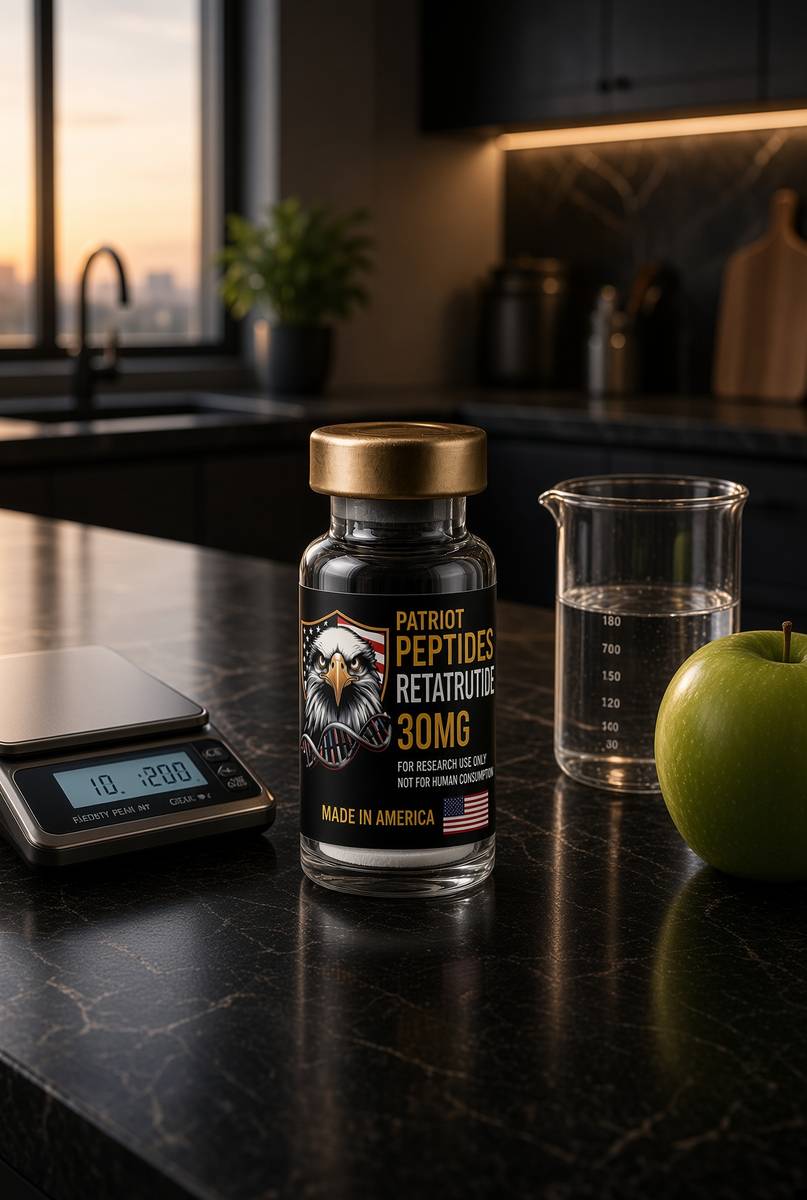
The American-made molecule
Identical to Eli Lilly’s LY3437943. Synthesised in the United States. HPLC-characterised.
 Made in USAOut of stock
Incretin
Retatrutide
US-made retatrutide 30mg — the published structure LY3437943, HPLC-MS verified.
4.6(609)
93 browsing this now · 5 purchased in the last 24 hours
30mg
£120.00
Read next
46 min · long read · Peptide research
Retatrutide (LY3437943): the published triple-agonist structure
A fatty-acylated unimolecular agonist at GIPR, GLP-1R and GCGR. US-made, HPLC-MS verified, labelled for laboratory research — not a medicine.

50 min · long read · Peptide research
Why peptides are the next chapter of medicine
More than a hundred peptide drugs are already approved. Insulin opened the century. GLP-1 agonists moved weight into bariatric territory. Oral tablets, biased agonists and triple ligands are the current argument.
More in this desk

53 min · long read · Peptide research
Recovery, GH pulses and the CJC / ipamorelin pair
Somatotrophs have two 'go' receptors. CJC without DAC is a slightly longer GHRH pulse. Ipamorelin is a selective ghrelin-receptor key that does not yank ACTH. Together they are the pair Bowers already showed is more than additive — not a gym protocol.
53 min · long read · Peptide research
How research peptides are made — and why HPLC actually matters
Solid-phase peptide synthesis builds a chain one residue at a time. HPLC then asks whether the main peak is what you think it is. ≥98% is not a slogan. It is a chromatogram.
52 min · long read · Peptide research
Fatigue, cellular energy and the NAD+ / MOTS-c neighbourhood
NAD+ is the rechargeable chip every cell spends on fuel and DNA repair — and the pool shrinks with age. MOTS-c is a mitochondrial 16-mer sent out under metabolic stress. Two answers to 'I have no energy' that are not coffee.
51 min · long read · Peptide research
Melanocortin circuits: pigment, appetite and PT-141
Melanotan II lights MC1, MC3, MC4 and MC5 — pigment plus the rest of the sheet. PT-141 is the free-acid cousin pointed at MC3 and MC4, the circuitry papers use for desire and energy, not skin colour. Same Arizona family. Different question.
Essays describe published research. They are not medical advice and they do not authorise human use of any catalogue item.