


Peptide research · 48 min · 10,564 words
Appetite, body weight and the peptides that sit on metabolic literature
Retatrutide is the published triple-agonist chain LY3437943 — GLP-1, GIP and glucagon on one molecule. MOTS-c is a mitochondrial 16-mer that talks to AMPK. One is an incretin story. One is a fuel-gauge story. Neither is a diet.
What this essay actually tells you
- Retatrutide is the published LY3437943 structure: GIP, GLP-1 and glucagon on one American-made chain. We are not Eli Lilly. Not a pen.
- Jastreboff et al., NEJM 2023, is a Phase 2 paper on an investigational medicine. It is not a use instruction for this research vial.
- MOTS-c is a mitochondrial 16-mer on AMPK. Different genome. Adjacent metabolic reading list. Not retatrutide's little brother.
What this actually means
If you typed lose weight or Ozempic into this shop, the peptide on the shelf is not a pen. It is the published LY3437943 structure — one American-made chain that occupies GLP-1, GIP and glucagon receptors. Those receptors sit behind fullness, how fast the stomach empties, insulin after a meal, and how the liver spends fuel. Semaglutide showed one receptor was enough to move large endpoints (STEP 1). Tirzepatide added GIP (SURMOUNT-1). Jastreboff et al., NEJM 2023, is Phase 2 on an investigational medicine: 24.2% mean weight loss at 12 mg, 48 weeks, a literature note, not a use instruction for the research vial. MOTS-c is a different door: sixteen amino acids, MRWQEMGYIFYPRKLR, written in mitochondrial DNA, exported when the cell is under metabolic stress, sitting on AMPK. Two literatures people file under metabolism. Two vials. Zero diet plans.
Appetite is a gut-hormone conversation before it is a kilogram. Occupy a receptor for GLP-1, GIP or glucagon and, in a trial, a weight can move — that lesson from the last decade is real. It describes a different object from the one on this shelf. Semaglutide in a pen is a medicine: marketing authorisation, a device, a pharmacovigilance file. Tirzepatide is the dual that followed. Retatrutide, in the papers, is the triple. What we stock isn't any of those pens. It is the published LY3437943 structure: one American-made chain that occupies the receptors for glucose-dependent insulinotropic polypeptide, glucagon-like peptide-1 and glucagon. MOTS-c lands nearby because both words sound like energy. MOTS-c is sixteen amino acids a mitochondrion translated from its own 12S ribosomal RNA — a ligand sitting on a fuel-gauge kinase called AMP-activated protein kinase. Two literatures. Two named sequences. We'll unbundle them as physiology with papers on it, not as a diet written as chemistry.
In short. Weight-loss searches land on two research sequences. One occupies three gut-hormone receptors. The other is a mitochondrial sixteen-mer. We'll keep them apart.
Retatrutide is a single polypeptide engineered so one molecule occupies three class-B G-protein-coupled receptors at once. Eli Lilly's investigational code for that chain is LY3437943, and the structure is public. Coskun and colleagues described the engineering in Cell Metabolism in 2018: unimolecular, fatty-acylated — a fat handle hung on the chain so blood albumin will carry it — balanced enough at glucagon not to wreck a glucose curve while still buying energy expenditure. The three receptors — GLP-1R, GIPR and GCGR — all couple primarily to Gs, the stimulatory G protein that raises cyclic adenosine monophosphate, cAMP, a small messenger that tells the cell to get moving. Semaglutide had already shown that GLP-1R occupancy on its own could move large clinical endpoints. Tirzepatide added GIPR. Retatrutide asks what a third occupancy, glucagon, does to energy expenditure on the same chain. The chemistry is public. The vial we ship is that chemistry, synthesised in the United States, verified by HPLC-MS, labelled for the bench. The manufacturer of that solid is not Eli Lilly. A characterised research chain is a different legal object from a formulated pen.
In short. Retatrutide is one published chain built to occupy three related receptors. The research solid is that named structure, made in America, not a company's pen.
MOTS-c is Met-Arg-Trp-Gln-Glu-Met-Gly-Tyr-Ile-Phe-Tyr-Pro-Arg-Lys-Leu-Arg, written MRWQEMGYIFYPRKLR in the one-letter code: sixteen residues translated from an open reading frame in mitochondrial 12S rRNA. Lee, Kim, Cohen and colleagues put that peptide on the metabolic map in Cell Metabolism in 2015 — AMPK, the folate–methionine cycle, insulin-sensitivity assays in mice. Kim and Lee followed in 2018 with nuclear translocation under metabolic stress. Reynolds and colleagues, in Nature Communications in 2021, put an exercise-inducible, age-dependent physiology on the same sequence. The organelle that wrote MOTS-c is the organelle that will notice, downstream, if a person becomes smaller and a hepatocyte becomes less fatty. That's a shared postcode with retatrutide's organism-level effects, not a shared receptor. MOTS-c occupies none of GLP-1R, GIPR or GCGR, carries no fatty-acyl handle, and has no Phase 2 weight curve in the New England Journal of Medicine. Different genome. Adjacent reading list. We'll keep those jobs apart while still naming both, because the search was allowed to be generous and the science isn't allowed to pretend they are one ligand.
In short. MOTS-c is sixteen amino acids a mitochondrion writes from its own RNA. It talks to the cell's fuel-gauge kinase. That's a different origin story from a gut-hormone chain.
One is an incretin story. One is a fuel-gauge story. Neither is a diet. The search bar is allowed to be that generous. The essay is not allowed to pretend they are one ligand.— Reading of the retatrutide and MOTS-c pair against the metabolic literature they actually sit on.
Two literatures, one search bar
A search bar is a blunt instrument, and that's all right — we can still be precise after it. Appetite, body weight, Ozempic, metabolism, energy: those queries pull a licensed incretin class, a Phase 2 triple agonist, a mitochondrial open reading frame, and a dinucleotide cofactor into the same afternoon. Biochemistry doesn't owe the search that courtesy. Retatrutide is a plasma-membrane ligand. The peptide stays outside. Information crosses as conformation of a seven-helix receptor, then as a G protein spending GTP, then as cAMP. MOTS-c is a peptide the matrix translated, a chain that can leave the organelle, sit on AMPK, and under stress visit the nucleus to talk to nuclear genes. One occupancy is extracellular and incretin. The other is intracellular and bioenergetic. Filing them under one caption because both papers mention fuel is a friendly neighbourhood, not a shared lock. We'll walk both trails because a metabolic reading list often wants both doors, and because pretending the second door doesn't exist turns a larger neighbourhood into a single-ligand cartoon.
In short. Appetite searches mix a gut-hormone receptor story with a mitochondrial peptide story. They share a fuel neighbourhood. They do not share a lock.
The licensed world has to stay in view so the research solids can't borrow its clothes. Semaglutide, as Wegovy or Ozempic depending on indication and brand, is a GLP-1 receptor agonist with marketing authorisations, titration schedules and a gastrointestinal event table that a regulator has read. Tirzepatide, as Mounjaro or Zepbound, occupies GIPR as well as GLP-1R and has its own licences. Liraglutide, dulaglutide, exenatide and lixisenatide fill out the older incretin shelf. Orlistat still sits on lipase. Naltrexone–bupropion and phentermine–topiramate occupy central circuits by other routes. Bariatric surgery remains the largest durable intervention on body weight the clinic actually has. None of those objects is LY3437943 as a lyophilised cake, and none of them is MRWQEMGYIFYPRKLR. Human metabolic medicine exists. It is monoclonal, small-molecule, surgical and, in the incretin decade, peptide-as-medicine. A research catalogue that stocks the published triple-agonist backbone and a mitochondrial 16-mer is stocking characterised sequences for assays you can write down. That's a different legal class, and we'll keep saying so without turning the distinction into a chorus.
In short. Licensed weight medicines already exist: one-receptor pens, two-receptor pens, older pills, surgery. The sequences in this essay are research chemistry, not those products.
Body weight itself isn't a receptor. It's an integral over years of intake, expenditure, a defence of former mass that Leibel, Rosenbaum and Hirsch measured as a drop in resting expenditure larger than the lost tissue predicts, and a set of endocrine messages — leptin from adipose, insulin from β-cells, ghrelin from the empty stomach, PYY and GLP-1 from the fed gut — that the hypothalamus and hindbrain read as a budget. Schwartz, Woods, Seeley and colleagues spent the 1990s and 2000s putting that budget on paper as a homeostatic circuit, then had to watch hedonic and environmental inputs refuse to stay outside the diagram. An incretin analogue mostly turns the intake valve. A glucagon occupancy is an argument about the expenditure valve. AMPK is how a cell, not a person, notices that ATP is running behind AMP. Those three sentences already live at different floors of a pathophysiology stack: organism, tissue, cell. A peptide that occupies a floor doesn't own the floors above it. That's why what does it do? is a bad question, and why we name receptors, kinases and papers instead of outcomes a vial can't cash.
In short. Body weight is a long-running budget of eating and burning, read by the brain. A receptor occupancy is one valve on that budget, not the budget itself.
The incretin effect is a measurement
In 1902, William Bayliss and Ernest Starling cut the nerves to a loop of dog jejunum, poured acid into the lumen, and watched the pancreas secrete anyway. The only remaining path was chemical. They named the messenger secretin, and a few years later Starling, in the Croonian Lectures, gave physiology the word hormone: a chemical messenger secreted into blood, acting at a distance. Secretin itself occupies SCTR, a class-B G-protein-coupled receptor, Gs-coupled, a pancreatic bicarbonate cue. It isn't an incretin. It is the prototype of the family the incretins belong to. If we start a retatrutide paragraph at a 2023 headline, we've skipped the reason a thirty-residue gut peptide can occupy a seven-helix receptor at all. The architecture is more than a century of the same idea: the gut writes a peptide, the blood carries it, a distant cell has a receptor, and the receptor isn't a metaphor. Class B, the secretin family, is that geometry made structural. GHRH, GLP-1, GIP, glucagon and secretin share it. Retatrutide was writable because that family already existed as related pockets.
In short. In 1902 the gut was shown to send a chemical message in blood. Secretin named the family. Incretins are later members of that same receptor clan.
The incretin effect is a paired curve before it is a drug. Give glucose by mouth and the insulin rise is larger than the rise you get from the same glucose load in a vein. McIntyre, Holdsworth and Turner put that contrast into the Lancet in 1964. Elrick, Stimmler, Hlad and Arai published the same shape the same year in the Journal of Clinical Endocrinology. The gut, they argued, must be releasing something that amplifies the β-cell's response to glucose. Unger's radioimmunoassay work on glucagon, and the language of an entero-insular axis, made the conversation quantitative rather than anecdotal. Oral versus intravenous is still how you teach the effect in a practical class. Everything that follows — GIP, GLP-1, DPP-4 inhibitors, fatty-acylated analogues, duals, triples — is an attempt to name, then occupy, the messengers responsible for that difference. A screenshot of a weight-loss mean is a long way downstream of a paired glucose curve. Hold the measurement. The receptors were cloned later. The analogues were built later still. The measurement is why those later objects had a job to do.
In short. More insulin follows sugar you swallow than sugar put in a vein. That difference, measured in 1964, is the incretin effect, and it is why these receptors matter.
Gastric inhibitory polypeptide was isolated first. Brown, Mutt, Pederson and colleagues, in the early 1970s, pulled a peptide from intestinal extracts that slowed gastric acid, and named it for that job. Dupré then showed it also amplified insulin when glucose was present, which is a different job wearing the same letters. The field eventually preferred glucose-dependent insulinotropic polypeptide, keeping the acronym GIP, because the insulinotropic physiology is what survived contact with human metabolic disease. K-cells in the proximal small intestine write GIP in response to fat and carbohydrate. The receptor, GIPR, is a class-B GPCR on β-cells and on adipocytes. In type 2 diabetes the insulinotropic effect of GIP dulls more than GLP-1's does, which is one reason the first generation of incretin medicines ignored GIPR and went after GLP-1R. Tirzepatide reopened the receptor as a therapeutic object by occupying it together with GLP-1R. Retatrutide keeps that occupancy on the same chain. If we still say GIP just inhibits the stomach, we've missed the rename, and we'll misread every dual and triple paper that followed.
In short. GIP was first named for slowing the stomach, then renamed for raising insulin when glucose is present. The second job is why dual agonists exist.
GLP-1 arrived through proglucagon. Habener's laboratory cloned the precursor; Holst, Ørskov and colleagues showed that the gut processes that precursor differently from the pancreatic α-cell, yielding glucagon-like peptide-1 as a post-translational product of L-cells, denser toward the ileum and colon. Drucker's work made the receptor a therapeutic object rather than a curiosity of a radioimmunoassay. Native GLP-1 is a thirty-one-residue peptide, amidated, potent at GLP-1R, and almost useless as a medicine because dipeptidyl peptidase-4 clips it at alanine-2 in minutes and the kidney clears what remains. The insulinotropic effect is glucose-dependent, which is why hypoglycaemia isn't the dominant failure mode of this class in the way it is for a sulphonylurea. GLP-1R also lives on the brainstem and on the stomach. Delayed gastric emptying and central satiety aren't side-effects of a β-cell drug. They are the receptor being where it is. Mentlein, Gallwitz and Schmidt put the DPP-4 cleavage on the page in the early 1990s. Sitagliptin occupies the enzyme. The analogue strategy occupies the receptor with a chain the enzyme can't eat as fast. Both exist because the two-minute half-life is real.
In short. GLP-1 is cut from a larger gut protein and tells pancreas, brain and stomach that a meal has arrived. An enzyme destroys the native peptide in minutes.
Diagram
GLP-1R
β-cell, brainstem, stomach
Incretin, delayed emptying, satiety. Semaglutide’s occupancy.
GIPR
β-cell, adipocyte
Second incretin. Lipid handling. Tirzepatide added this.
GCGR
hepatocyte
Glycogenolysis and, biased, energy expenditure. The third occupancy.
LY3437943 is a fatty-acylated unimolecular agonist at GIPR, GLP-1R and GCGR (Coskun, Cell Metab 2018). Jastreboff, NEJM 2023: 24.2% mean weight loss at 48 weeks, 12 mg, Phase 2 — clinical literature, not a use instruction for a research vial.
One receptor, then two, then three
Exenatide is the Gila-monster chapter, and it isn't a joke. Eng, Kleinman, Singh and Raufman isolated exendin-4 from the venom of Heloderma suspectum in 1992. The peptide occupies GLP-1R, resists DPP-4 because the second residue isn't alanine, and lasts hours rather than minutes. Byetta, the synthetic exendin-4, was licensed in 2005 as the first GLP-1 receptor agonist for type 2 diabetes. Twice daily, a lizard sequence, a proof that occupancy at this receptor moved glucose in people. Liraglutide followed as a human GLP-1 analogue with a C16 fatty acid, once daily, then as a weight-management dose. Semaglutide moved the clock to weekly with a C18 diacid and an aminoisobutyric acid substitution at position 8, so albumin would carry the chain through the week. Each of those steps is a published medicinal-chemistry argument. Fatty-acid acylation is the industrial half-life trick of this whole class: the lipid is a handle, not a membrane punch, and reverse-phase chromatography notices it immediately because a C18 column holds a fatty-acylated chain longer than the naked peptide of the same backbone.
In short. The first GLP-1 medicine came from Gila-monster venom. Later analogues copied human GLP-1 and added a fat handle so blood albumin would carry them for days.
Wilding and colleagues, STEP 1, New England Journal of Medicine 2021: semaglutide 2.4 mg once weekly, adults with overweight or obesity, sixty-eight weeks, mean weight reduction 14.9 percent against placebo. That paper is why GLP-1R occupancy stopped being a diabetes footnote and became a population-level metabolic tool. The receptor had always been on brainstem and stomach. The analogue had become weekly. The trial was large enough, long enough, and honest enough about gastrointestinal events that a regulator and a journal could both live with the sentence. STEP 1 is one receptor, occupied well, producing double-digit mean weight loss in a randomised, placebo-controlled, lifestyle-wrapped protocol. It isn't a law of nature that every subsequent analogue must beat. It is a demonstration that the first occupancy was already a large lever on intake. Retatrutide's GLP-1R arm is that lever still being pulled. When a triple is treated as the GLP-1 that finally works, the paper in which GLP-1 already worked has been deleted, and we lose why gastrointestinal events follow this molecule wherever it goes.
In short. Semaglutide's STEP 1 trial showed one receptor could move weight a long way: about fifteen percent in sixty-eight weeks. The later duals and triples start from that fact.
Jastreboff, Kaplan, Lefkowitz, Wu and colleagues then published SURMOUNT-1 in the New England Journal of Medicine in 2022: tirzepatide, the dual GIPR/GLP-1R agonist, Lilly's LY3298176, 15 mg, seventy-two weeks, 20.9 percent mean weight reduction. Adding the second incretin moved the mean. The dual is a different chain from retatrutide, a different trial literature, and a licensed medicine in indications a regulator has named. The intellectual point for us is the occupancy count. One receptor was enough for large endpoints. Two receptors moved the mean further in a large randomised trial. Three receptors was the next medicinal-chemistry question, not a different theory of fat. If we can't keep those three papers in order — STEP 1, SURMOUNT-1, then Jastreboff's 2023 retatrutide Phase 2 — a 24.2 percent figure starts to look like a miracle rather than a dose-response on a related chain. Context isn't a courtesy. Context is how a least-squares mean stays readable instead of becoming a caption for glass.
In short. Tirzepatide added a second receptor and, in SURMOUNT-1, moved the mean further still. Retatrutide is the third occupancy on that same path, not a new theory.
Unimolecular is a choice with a prehistory. Richard DiMarchi, Matthias Tschöp, Brian Finan and colleagues spent the 2010s showing that glucagon and GLP-1 could be written into one sequence as a co-agonist, and that GIP could be added without the chain falling apart as chemistry. Day and colleagues, in Nature Chemical Biology and then Nature Medicine, are the papers in which a glucagon/GLP-1 co-agonist lost more weight in obese rodents than a GLP-1 agonist alone, with the glucagon arm supplying energy expenditure and a lipid-oxidation cue. Those were still two occupancies. Coskun's 2018 Cell Metabolism paper on LY3298176 is the dual that became tirzepatide. LY3437943, described in the same season's engineering literature, is the next increment: keep both incretins, add GCGR, hang the lipid, and ask whether the ratio can be tuned so glycaemia doesn't pay for the extra expenditure. Three separate peptides would have three clearances, three tissue distributions, three opportunities for one occupancy to outrun the others after a meal. One backbone carries three pharmacophores through the same plasma. Relative potency is then a property of the sequence, which is the entire point of unimolecular.
In short. One chain was chosen so the three receptor effects travel together in blood. Mixing three separate hormones would let their timings drift apart.
Three class-B receptors on one American-made chain
GLP-1R is a class-B GPCR on pancreatic β-cells, on neurons in the nucleus tractus solitarius and hypothalamus, on gastric smooth muscle and vagal afferents, and on the heart. Occupancy raises cAMP. On the β-cell, that cAMP, in the presence of glucose, amplifies insulin granule release: the classical incretin. On the stomach, emptying slows, so appearance of carbohydrate in the portal vein is delayed. On the brainstem, satiety advances and meal size falls. Those three sentences are why a diabetes receptor became a weight receptor without changing protein. Delayed gastric emptying is pharmacology, not a personality. A mixed meal sits longer. Post-prandial glucose spikes flatten because appearance rate falls, not only because insulin rose. Nausea tracks the gastric and the central occupancies. It is dose-related in every large trial in this class. Titration exists because a gastrointestinal epithelium and a brainstem nucleus both notice a sudden rise in occupancy. Retatrutide includes this occupancy. It doesn't replace it. If we talk about the triple as if the GLP-1 arm were a rounding error, we've missed where the satiety and the nausea both come from.
In short. The GLP-1 receptor sits on pancreas, brain and stomach. Occupying it raises insulin after glucose, slows the stomach and reduces appetite. One receptor already did a lot.
GIPR is the other incretin receptor. It is a class-B GPCR, Gs-coupled, expressed on β-cells, where it amplifies insulin in a glucose-dependent manner, and on adipocytes, where the literature on lipid handling is real and still argued about in detail. K-cells sit higher in the gut than L-cells; a mixed meal that includes fat is a strong GIP stimulus. The adipocyte sentence is the one people either overclaim or ignore. GIPR occupancy can change how a fat cell handles lipid; whether that's storage, blood flow, or a more interesting remodelling depends on the paper, the species and the co-occupancy. Human adipose GIPR biology is thinner than the β-cell literature. Tirzepatide's clinical advantage over semaglutide is an organism-level fact from SURMOUNT-1 and from head-to-head glucose trials; it isn't a biopsy of an adipocyte in those same participants showing a named lipid enzyme moving. Retatrutide keeps this arm. It doesn't make GIP a weight-loss brand of its own. It makes GIPR a second microphone on a chain that already had a loud first one. Occupancy is still occupancy. A missing human assay isn't a missing receptor.
In short. GIP is the other meal hormone that raises insulin. Its receptor also sits on fat cells. Tirzepatide added this occupancy; retatrutide keeps it on the same chain.
Glucagon has a reputation as the anti-insulin, and in a starving liver that reputation is earned. α-cells write glucagon; hepatocytes carry GCGR, another class-B Gs-coupled receptor; cAMP rises; glycogenolysis and gluconeogenesis run; hepatic glucose output climbs. That's how a brain keeps a millimolar glucose when you haven't eaten. Give a large glucagon dose to a fed person and you'll see the glucose you were taught to expect. The medicinal-chemistry question for a triple agonist is whether a smaller, biased occupancy at the same receptor can buy two other hepatocyte jobs — lipid oxidation and a rise in energy expenditure, including futile cycling of glycogen and urea — without handing back the glycaemic gains of the incretin arms. Coskun's engineering is that question written as a sequence. Enough GCGR to lift energy expenditure. Not so much that hepatic glucose output wrecks the glycaemic gain you just bought with the two incretin arms. Bias, here, is a ratio of potencies and a tissue distribution. Glucagon itself was named in 1923, when Kimball and Murlin found a hyperglycaemic activity in pancreatic extracts that wasn't insulin. Occupying GCGR with a designed analogue isn't giving native glucagon as a drip.
In short. Glucagon tells the liver to put sugar into blood. Used carefully on the same chain, that receptor can also raise energy use. The hard part is the size of that effect.
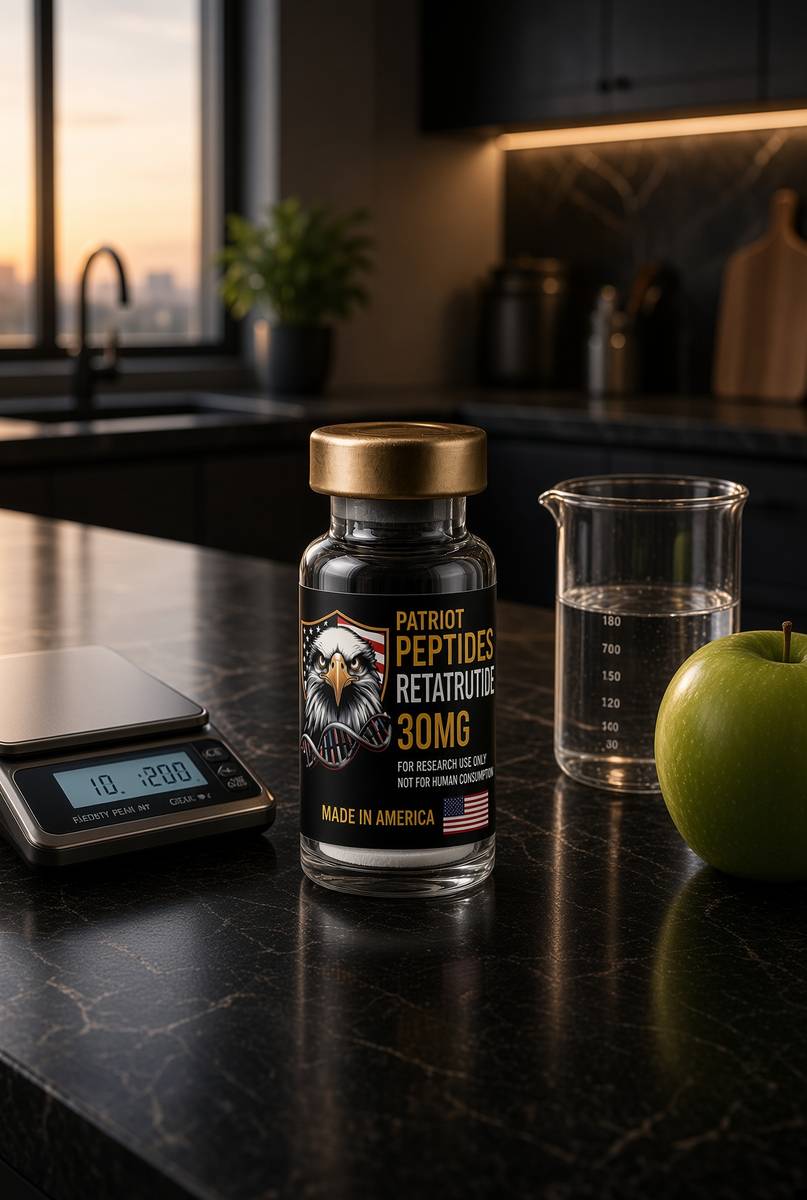
The published research structure is LY3437943: GIP, GLP-1 and glucagon on one American-made chain. Patriot Peptides synthesises that named backbone in the United States and puts HPLC-MS on the certificate. The manufacturer of the research solid is independent of Eli Lilly. The object in glass is a characterised lyophilised ligand rather than a formulated injector. Two objects can share a primary structure and not share a legal class, a device, a buffer, a cold chain or an investigator brochure. Water and water-for-injection share a formula; only one of them is a licensed excipient with a sterility file. Bioequivalence is a clinical and regulatory claim. A chromatogram is an identity claim. The certificate does the second job. If we need the vial to be the same as the trial, we're asking a chemical to do a regulatory job, and chemicals are bad at that. Identity of a fatty-acylated peptide is a retention time plus a mass that includes the lipid. Skip the lipid in the calculation and you've identified a different object. Hold the named structure. Hold the American synthesis. Hold the distance from a pen. Those three facts are the listing.
In short. The published chain is LY3437943, made in America as a research solid. That is identity of a sequence, not a company's medicine and not an injector.
Diagram
Outside
Peptide ligand
Named sequence in the nM–µM pocket. Shape complementarity, not vibes. A 15-mer and a 4-mer do not fit the same hole.
Membrane
7-TM receptor
Helices rearrange. The cytoplasmic face becomes a GEF for a heterotrimeric G protein (Gs, Gi, Gq, G12/13).
Inside
Second messengers
cAMP, IP₃, Ca²⁺, β-arrestin. One occupied receptor can spawn thousands of messenger molecules. That is amplification.
~800 GPCRs in the human genome. Seven transmembrane helices, an extracellular ligand pocket, an intracellular G-protein handshake. Catalogue neighbours: ipamorelin at GHSR, PT-141/MT2 at melanocortin receptors, retatrutide at GLP-1R/GIPR/GCGR.
Gs, cAMP and the class-B geometry
Class-B GPCRs, the secretin family, catch a long peptide in two steps. Each receptor has a large N-terminal extracellular domain that binds the C-terminal half of the hormone in solution, raising the local concentration of the peptide's N-terminus, which then inserts into the transmembrane bundle from the outside and does the activating work. Two steps, both aqueous-facing. Truncating the N-terminus is how you make an antagonist, because you keep the catch and lose the insertion. A designed chain in the thirty-to-forty-residue band can therefore be written to fit three related class-B pockets without becoming a submarine. The ligand doesn't have to enter the cell. Information crosses as conformation. Lefkowitz and Kobilka's 2012 chemistry Nobel was for the GPCR family as a structural object; the incretin decade is what happens when medicinal chemistry takes the secretin clan seriously as a metabolic tool rather than as a curiosity of gut extracts. Cryo-EM has since given us GLP-1R, GIPR and GCGR in occupied poses. The pockets are related, which is why a unimolecular agonist is a possible object. Related isn't identical. Bias is the difference.
In short. These receptors catch a peptide outside the cell and change shape. The message is the shape change. The peptide does not need to go inside.
The three receptors share a grammar once the bundle has rearranged. The intracellular face becomes a guanine-nucleotide exchange factor for a heterotrimeric G protein, primarily Gs. Gαs-GTP activates adenylyl cyclase. Cyclase converts ATP to cyclic AMP. Protein kinase A and EPAC read the cAMP. On a β-cell the readout is insulin granule priming and fusion, glucose-dependent. On a hepatocyte it is glycogen phosphorylase, CREB, a gluconeogenic programme, a push on β-oxidation. On a gastric myocyte and a brainstem neuron it is the emptying and satiety sentences already named. Amplification is arithmetic rather than mystery. One occupied GPCR can catalyse GDP/GTP exchange on many G proteins. Each Gαs-GTP can keep adenylyl cyclase running long enough to make many cAMP molecules. Each cAMP-activated PKA can phosphorylate many substrates. A nanomolar occupancy can therefore move a micromolar messenger cloud. Local nanodomains, AKAPs, phosphodiesterases sitting next to a channel, mean a cAMP rise beside a granule isn't a cAMP rise beside a nucleus. That's why cAMP went up is the beginning of an experiment, not the end of a mechanism.
In short. All three receptors use the same inside-the-cell language: they raise cAMP. What happens next depends on whether the cell is pancreas, liver or a neuron.
Desensitisation is how the cell refuses to let more ligand mean more signal forever. G-protein-coupled receptor kinases phosphorylate the occupied receptor. β-arrestin binds the phosphorylated tail, sterically blocks further G-protein coupling, and can recruit the endocytic machinery. Internalisation follows. Some receptors recycle; some are degraded. Biased agonism, in the modern literature, is the observation that two ligands at the same GPCR can prefer G protein versus arrestin, or one Gα subtype versus another. Incretin analogues have a published bias literature that is real and still messy. Most of it isn't a reason to invent a bias profile for a research chain that hasn't been through that assay in your hands. It is a reason to read Coskun for the potencies they did measure, and to stop treating arrestin as a villain or a hero. Arrestin is how a β-cell and a hepatocyte survive a week of occupancy without remaining stuck in the on position. Tachyphylaxis of gastric emptying, reported in the GLP-1 analogue literature, is this biology as a clinical observation: one receptor writes more than one sentence, and those sentences desensitise on different clocks.
In short. Cells turn the signal down after a while: the receptor is tagged, pulled inside, and stopped from shouting. That is why more peptide is not more effect forever.
Diagram
× 1
Ligand
One peptide in one pocket. nM–µM. Shape, not a mood.
× 10–10²
G proteins
The occupied GPCR is a GEF. Each Gα is a catalyst.
× 10³–10⁴
cAMP / IP₃ / Ca²⁺
Adenylyl cyclase and PLC do not make one molecule. They make a cloud.
× 10⁴–10⁶
PKA / PKC / CaMK
Kinases phosphorylate many substrates per messenger.
× tissue
Secretion, transcription, motility
The organism-level readout. Still not a protocol.
This is the only magic, and it is not magic. A nanomolar ligand can move a micromolar messenger because enzymes sit between them. Desensitisation (GRK, β-arrestin, endocytosis) is how the cell refuses to let ‘more ligand’ mean ‘more signal’ forever.
- Native GLP-1 half-life
- ~2 minutes
- LY3437943 occupancies
- GIPR, GLP-1R, GCGR
- STEP 1, semaglutide 2.4 mg
- −14.9% at 68 weeks
- SURMOUNT-1, tirzepatide 15 mg
- −20.9% at 72 weeks
- Jastreboff 2023, 12 mg
- 24.2% at 48 weeks
- MOTS-c
- MRWQEMGYIFYPRKLR
- AMPK
- αβγ, Thr172
- Research solids
- two named sequences
DPP-4 clips alanine-2. The reason sitagliptin and acylation both exist.
One American-made chain. Coskun, Cell Metab 2018. Unimolecular, not a cocktail.
Wilding, NEJM 2021. One receptor. The first large lever on intake.
Jastreboff, NEJM 2022. Two receptors. Dual incretin, licensed neighbour.
Least-squares mean. Phase 2, n=338. Clinical literature, not a protocol.
16-mer from mtDNA 12S rRNA. Lee, Cell Metab 2015. AMPK neighbourhood.
Fuel gauge. LKB1/CaMKK2. Phosphorylates ACC, TSC2, Raptor, ULK1.
LY3437943, US-made, HPLC-MS. MOTS-c 16-mer. Laboratory ligands, not a diet.
Jastreboff 2023 belongs in a literature note
Jastreboff, Kaplan, Frías and colleagues published a Phase 2 trial of retatrutide in the New England Journal of Medicine in 2023. Three hundred and thirty-eight adults in the United States, with obesity or with overweight plus a weight-related condition, and without diabetes, were randomised to once-weekly subcutaneous retatrutide or placebo for forty-eight weeks. The 12 mg arm, the one that owns the sentence everyone quotes, had sixty-two people and started at 2 mg. The primary end point was percent weight change at twenty-four weeks, where 12 mg produced a least-squares mean of −17.5 percent versus −1.6 percent on placebo. The forty-eight-week figure is a secondary clock. Phase 2 is a dose-finding, signal-finding, go-or-no-go experiment. It asks whether an endpoint moved, whether a safety signal appeared, and which dose to take forward. It licenses no medicine, and it is neither a rare-event census nor a ten-year durability study. Phase 3 is larger, longer, and still not a product in this catalogue. The how-to-read-a-Phase-2 essay on this desk walks n, estimands and the safety table at a slower pace. We need the numbers because they are part of the molecule's public life.
In short. A 2023 trial in 338 adults tested weekly retatrutide for 48 weeks. That is a dose-finding experiment in people, not a licence and not a recipe.
At forty-eight weeks, retatrutide at 12 mg produced a mean body-weight reduction of 24.2 percent. The least-squares mean for that arm sat at −24.2 percent, with a 95 percent confidence interval from −26.6 to −21.8, against −2.1 percent on placebo. Some participants lost more: a quarter of that arm lost 30 percent or more. Some lost less. A mean is a centre of a distribution, not a promise to a body. The 12 mg figure is sixty-two people at a maintenance dose, not three hundred and thirty-eight people all doing the same thing. Placebo matters because counselling, injection ritual, expectation and time all move weight a little; without that arm you can't tell the molecule from the wrapping. That 24.2 percent belongs in the literature note on a product page and in a paragraph that cites Jastreboff by name. It describes an investigational medicine in a trial. It doesn't describe this listing, which is a characterised research solid of the published backbone. Quote the methods, not just the mean. The paper is public. The paper isn't a use instruction for a research vial.
In short. At 48 weeks the 12 mg group's average weight change was 24.2 percent. That is a trial mean, not a forecast for a single body and not a caption for a research solid.
Nausea, diarrhoea, vomiting and constipation aren't an asterisk. In the 12 mg arm, nausea was reported in 28 of 62 participants, which is 45 percent. Vomiting was 12 of 62, about 19 percent. Placebo nausea was 11 percent. Starting the same maintenance dose at 2 mg rather than 4 mg moved those numbers down, which is why titration is a gastrointestinal strategy with a published contrast rather than a branding exercise. Discontinuation because of adverse events occurred in 6 to 16 percent of retatrutide arms and in none of the placebo arm. Dose-dependent heart-rate increases peaked at twenty-four weeks and then eased. Weight was the headline; waist circumference, systolic blood pressure, triglycerides and fasting glucose also moved, as you'd expect when a smaller person, eating less, with a quieter liver, writes a different metabolic set-point. None of those secondaries convert Phase 2 into Phase 3, and none of them convert a mean into a personal forecast. They do stop the false sentence that the only number in the paper is 24.2 percent. The mean and the event table are the same document.
In short. Gut side effects were common and dose-related. Some people stopped because of them. A headline that quotes only 24.2 percent has not finished the paper.
Retatrutide has no MHRA marketing authorisation as a medicine, and as of the day this is written it isn't an FDA-licensed medicine either. Investigational is doing legal work in that sentence. A Phase 2 publication in the New England Journal is a scientific event rather than a product licence, a NICE appraisal, or a blue box on a pharmacy shelf. TRIUMPH is the Phase 3 programme: different n, different duration, different job. Jastreboff et al., NEJM 2023, is a Phase 2 paper on an investigational medicine. It isn't a use instruction for this research vial. Selling a pen as if that paper had been a regulator confuses a journal with an agency. The paper is allowed to claim that, in this population, this dose range, this duration, this lifestyle wrap, once-weekly retatrutide produced a large, dose-dependent reduction in body weight, that the 12 mg arm's 48-week mean sat at 24.2 percent, and that common adverse events were gastrointestinal and dose-related. That's a lot. It is also not more than that. A go-signal isn't a licence.
In short. Retatrutide is not a licensed UK medicine. A strong Phase 2 paper is a reason to run Phase 3. It is not permission to treat the trial as a product.
At 48 weeks, retatrutide at 12 mg produced a mean body-weight reduction of 24.2%.— Jastreboff AM et al., N Engl J Med. 2023; 389: 514–526. Clinical literature — not a use instruction for a research vial.
Glucagon, energy expenditure and the adaptation problem
Energy expenditure is the theoretical defence against the adaptation that usually attends large weight loss. Eat less for long enough and resting expenditure falls more than the loss of mass predicts; the organism is defending a former weight. Leibel's classic inpatient work made that defence a measurement rather than a complaint. GLP-1R and GIPR occupancy mostly work on intake. GCGR occupancy is the arm that was put on the chain to work on output: hepatic futile cycles, a possible brown-fat neighbourhood in rodents, a measured rise in energy expenditure when glucagon is given to humans. Tan, Salem and others have measured that rise. Some of it is liver. Some of it, in mice, is brown adipose tissue, where GCGR expression is a published observation. Adult human brown fat is a real PET-CT object after 2009; it is also tens of grams, not a second liver. Occupancy at GCGR sits in the thermogenesis neighbourhood. That doesn't make retatrutide a brown-fat ligand in the sense of a UCP1 agonist. Jastreboff 2023 measured weight, glucose, lipids, heart rate and adverse events. It didn't image uncoupling protein 1. Neighbourhood isn't identity.
In short. The glucagon receptor was added to lift energy use so the body fights weight loss less. That is a neighbourhood of heat production, not proof that brown fat is the target.
Hepatic lipid is the other GCGR sentence, and it belongs here so it doesn't get smuggled in as a miracle. Glucagon-receptor tone on a hepatocyte pushes β-oxidation, lowers de novo lipogenesis in some models, and can empty triglyceride that insulin and surplus carbohydrate had been writing. Roy Taylor's twin-cycle hypothesis says type 2 diabetes is, in large part, a liver full of fat that keeps making glucose and a pancreas that then fails its first-phase dump. DiRECT emptied that liver with a formula diet. Incretin analogues empty body weight from the intake side and take liver fat with them. A GCGR arm is, in theory, a more direct hepatic lipid cue. Retatrutide's clinical literature shows large losses of weight and improvements in metabolic markers; MRI-PDFF of liver fat is a related, not identical, readout, and should be read in the papers that actually performed it. The variable is intrahepatic triglyceride. The tools that empty it are several. Pretending only one receptor can do so is how a depot stays full while we argue about purity. A research solid of LY3437943 is a ligand for an assay you specify, which is a different object from a formula-diet clinic.
In short. Glucagon-receptor tone can ask the liver to burn fat rather than store it. That is a real hepatic story, and it is separate from the appetite story.
A scale doesn't tell you whether the lost mass was fat, lean or water. Dual-energy X-ray absorptiometry in incretin trials typically shows that most of the loss is fat, and that a minority is lean tissue, which is what happens in any large energy deficit, bariatric surgery included. The real worry is whether the lean fraction is larger than diet-matched loss, whether bone follows, and whether a person who already had little muscle to spare is the wrong body for a 24.2 percent mean. Jastreboff 2023 isn't a body-composition monograph; read the tables that exist and don't invent DXA you weren't given. Protein intake, resistance work, and the fact that a smaller person has a smaller absolute lean mass to keep are physiology, not a secret extra occupancy. GCGR tone can, in principle, increase energy expenditure in a way that includes amino-acid oxidation; that's one of the reasons the ratio was so carefully biased. Treating 24.2 percent as cost-free skips a densitometry scan, a nitrogen balance, and a sarcopenic seventy-year-old. Those sentences live in clinical literature. They don't migrate onto a certificate of analysis.
In short. Most of the lost weight in this class is fat, and some is lean tissue, as in any large energy deficit. A scale cannot tell those compartments apart.
MOTS-c is a mitochondrial 16-mer
Mitochondria keep a genome of their own, a circular chromosome inherited down the maternal line, sixteen and a half kilobases in humans, encoding thirteen respiratory-chain polypeptides, two ribosomal RNAs and twenty-two transfer RNAs. That was the census until short open reading frames in those same transcripts started turning up as peptides the organelle actually makes. Humanin, from 16S rRNA, was the first famous one. MOTS-c is the 12S rRNA entry: a sixteen-residue peptide, MRWQEMGYIFYPRKLR, translated from a reading frame nobody asked a ribosomal RNA to have. Lee, Kim, Cohen, Cell Metabolism 2015, is the paper that put it on a metabolic desk. The sequence is small enough to leave the organelle. The papers say it can. Cytosol first, nucleus under stress. A peptide the matrix wrote, read by a cytosolic kinase, sometimes talking to nuclear genes. That's a different origin story from Merrifield solid-phase synthesis of a class-B GPCR ligand, even when both end as lyophilised cakes on the same shelf. Different genome. The mitochondrial genome used the mitochondrial code; a cytosolic ribosome would have misread some of those triplets. The organelle made this one itself.
In short. Mitochondria keep their own DNA. MOTS-c is sixteen amino acids written in that second genome, from a ribosomal RNA that was not supposed to encode a peptide.
Lee, Kim, Cohen and colleagues, Cell Metabolism 2015: MOTS-c promotes metabolic homoeostasis in mice, with AMPK and the folate–methionine cycle as the named neighbourhood, and with reductions in diet-induced obesity and insulin resistance among the reported assays. The folate–methionine cycle is one-carbon metabolism: tetrahydrofolate carrying methyl groups, methionine becoming S-adenosylmethionine, SAM donating those methyls to DNA, proteins and lipids, homocysteine either remethylated or sent down trans-sulphuration. A mitochondrial peptide that talks to that cycle is talking to nucleotide synthesis, to methylation tone, and to a redox-adjacent sulphur path. AMPK is the other named node, and it is the one a fuel-gauge essay can't skip. The 2015 paper is mouse physiology plus biochemistry, which is a real literature and a long way from a Phase 2 weight curve in the New England Journal. Treating MOTS-c as a junior retatrutide because both papers mention metabolic homoeostasis is a blending error with a search query on top. The 16-mer is the object. The kinase is the lock. The cycle is a neighbourhood. Write those three, then stop before the sentence becomes a diet.
In short. The 2015 paper put MOTS-c on AMPK and on one-carbon metabolism in mice. That is a mitochondrial-stress literature, not a three-receptor weight trial.
Kim, Lee and colleagues, Cell Metabolism 2018, added the nuclear sentence. Under metabolic stress the peptide can translocate to the nucleus and regulate nuclear gene expression, a retrograde signal from an organelle that is supposed to stay in its lane. Mitochondria already talk to the nucleus by several routes: ATP and ROS as metabolites, the unfolded-protein response of the matrix, calcium. A 16-mer that walks in and sits on chromatin-adjacent transcription is a more literal message. Reynolds, 2021, Nature Communications: exercise-induced MOTS-c, age-dependent physiology, a human-adjacent observation that the peptide isn't only a knockout-mouse curiosity. Those papers are the MOTS-c corpus you can actually cite. They are AMPK phosphorylation, metabolic cages, insulin clamps, nuclear fractionation, exercise bouts, rather than gastric-emptying curves, satiety scores, or a 24.2 percent least-squares mean. Adjacent metabolic reading list is the honest filing. Upgrading the 16-mer into retatrutide's little brother is the dishonest one, and we won't make it. The genomes differ. The receptors differ. The trial literature differs. The search bar can live with that. The blot already does.
In short. Later papers showed MOTS-c can go to the nucleus under stress, and that exercise can raise it. Those are still AMPK-neighbourhood findings, not gut-hormone findings.
A 16-mer from 12S rRNA isn't a class-B GPCR ligand that forgot to grow a fatty-acyl handle. GLP-1R occupancy, delayed gastric emptying and a weekly albumin-bound clock aren't its jobs. Molecular weight is on the order of 2.2 kilodaltons, sixteen residues, no lipid. Retatrutide is a much longer, acylated chain aimed at three extracellular pockets. MOTS-c is a mitochondrial product aimed at a cytosolic kinase and, under stress, at nuclear transcription. Calling the 16-mer a little brother of the triple agonist is how two origin stories get compressed into one mood. The compression is the error. Sibling would imply a shared parent. The parent of LY3437943 is medicinal chemistry on the secretin-family hormones. The parent of MOTS-c is an open reading frame in mtDNA that a cytosolic genome wouldn't have written that way. Adjacent on a reading list is allowed. Little brother isn't. Keep the one-letter code in view — MRWQEMGYIFYPRKLR — and the temptation to merge the two objects has to argue with a sequence.
In short. MOTS-c is not a smaller version of retatrutide. Different genome, different target, different papers. Sixteen letters on a mitochondrial RNA are the whole identity.
Diagram
Matrix
- TCA cycle · β-oxidation · mtDNA nucleoids
- NADH produced here. Complex I spends it.
- MOTS-c (MRWQEMGYIFYPRKLR) from 12S rRNA.
Inner membrane
- I → II → III → IV → V (ATP synthase)
- ~150 mV proton-motive force
- ~40–60 kg of ATP turned over per human day
mtDNA is 16,569 bp, 37 genes, 13 proteins of the respiratory chain. Nuclear DNA encodes the other ~1,200 mitochondrial proteins. NAD+ is the hydride carrier between dehydrogenases and Complex I. MOTS-c is a 16-mer translated from 12S rRNA — a peptide the mitochondrion wrote itself.
AMPK is a fuel gauge, not a diet
AMP-activated protein kinase is a heterotrimeric enzyme, αβγ, that binds AMP and ADP at the γ-subunit and is phosphorylated at Thr172 on the α-subunit by LKB1 — the tumour suppressor; Shaw, Alessi, Hardie, 2003 to 2004 — or, in calcium-rich conditions, by CaMKK2. Hardie spent a career on this enzyme as an energy sensor. When AMP/ATP rises — exercise, ischaemia, a genuine fast, a mitochondrial insult — AMPK phosphorylates acetyl-CoA carboxylase, which slows the first step of fatty-acid synthesis and, via malonyl-CoA, derepresses carnitine palmitoyltransferase-1 so fatty acids can enter mitochondria. It phosphorylates TSC2 and Raptor, which quiets mTORC1, so the cell stops building protein quite so hard. It phosphorylates ULK1 at activating serines, so autophagy has a chance. Over a longer window it leans on PGC-1α and mitochondrial biogenesis. Herzig and Shaw called it a guardian of metabolism and mitochondrial homoeostasis. That's a cell's fuel gauge. It isn't a diet. A ligand that sits on AMPK sits one phosphorylation away from those clients. Sitting is a neighbourhood. It isn't a demonstration that a 16-mer emptied a person's adipose depot in a randomised trial, and the MOTS-c papers haven't claimed that trial.
In short. AMPK is the kinase a cell uses to notice that energy is short. It slows building, encourages fat burning and can start recycling. A diet is a different object.
One-carbon metabolism is the other MOTS-c neighbourhood, and it's easier to skip because it sounds like a vitamin brochure. It isn't. Tetrahydrofolate carries one-carbon units at several oxidation states. The methionine cycle takes a methyl from 5-methyl-THF onto homocysteine via methionine synthase, making methionine, then SAM, the universal methyl donor. MOTS-c papers report a signature in this cycle — 5-methyl-THF, AICAR-adjacent notes in some of the early mechanistic writing — that the authors read as a constraint on de novo purine synthesis and a cue into AMPK. AICAR itself is a pharmacological AMPK activator, an analogue of ZMP, used in dishes and in a handful of human infusion studies you already know how to cite. MOTS-c isn't AICAR. The comparison exists because both conversations lean on AMPK and on a purine-adjacent metabolite. Name the cycle. Name the kinase. Name the 16-mer. Then the mechanism is a set of measurements rather than a poster about mitochondrial boosting. Folate and methionine are nutrients. The cycle is enzymology. The peptide is sixteen residues from 12S rRNA. Three objects. One neighbourhood.
In short. MOTS-c papers also sit on the folate–methionine cycle, the cell's methyl-group bookkeeping. That is enzymology next to AMPK, not a vitamin brochure.
AMPK and an incretin GPCR can both move organism-level fuel, and that coincidence is how they ended up in the same search. Occupying GLP-1R reduces intake; body weight falls; a smaller, less fatty liver writes a different AMP/ATP and a different NAD+/NADH; AMPK and sirtuins notice later. Occupying AMPK in a myocyte or a hepatocyte changes local fuel choice first; organism-level weight is a long way up the stack, and the MOTS-c mouse papers that report it are reporting a different experiment from Jastreboff 2023. The pathophysiology essay on this desk already drew the floors: genome, transcriptome, proteome, metabolome, organelle, cell fate, tissue, organism. Retatrutide occupies floor three as a GPCR ligand and then the organism floor moves in a trial. MOTS-c occupies floor three as a 16-mer and floor four as an AMPK neighbourhood; organism-level readouts in mice sit on that occupancy without becoming a Phase 2 mean in people. Skip a floor and you write a caption that two vials can't cash. Keep the floors and both literatures remain interesting. Interest isn't identity.
In short. A gut-hormone receptor and a fuel-gauge kinase can both change how a body handles energy, but they do so at different levels. Shared outcome is not shared mechanism.
Metformin is the honest AMPK-adjacent medicine to name so the 16-mer can't borrow its clothes. Guanidine derivatives from Galega officinalis, phenformin then metformin, licensed for type 2 diabetes, a first-line tablet in a formulary with a lactic-acidosis conversation and a thirty-year evidence base. Zhou, Mu, Hardie and colleagues showed metformin activates AMPK; later work argued the enzyme is a downstream reporter of a mild Complex-I inhibition and a change in AMP/ATP, not necessarily the sole therapeutic target. Foretz, Viollet, Shaw: the genetic papers that keep that argument honest. The point for this page is legal class and literature class. Metformin is a medicine. AICAR is a tool compound. MOTS-c is a characterised mitochondrial 16-mer with mouse and cell papers. Retatrutide as LY3437943 in this catalogue is a characterised class-B triple agonist with a Phase 2 literature that describes an investigational medicine. Four objects. Four jobs. An AMPK conversation that can't name metformin hasn't yet visited the clinic shelf. An AMPK conversation that names metformin and then captions a 16-mer as its peptide cousin hasn't yet visited the sequence.
In short. Metformin is the licensed diabetes tablet that sits near AMPK. MOTS-c is a research 16-mer on the same kinase neighbourhood. Related conversation, different legal class.
Adjacent reading list, different ligand
NAD+ is the third object a metabolic search keeps dragging onto this page, and it deserves one honest paragraph so it doesn't become a silent stack. Nicotinamide adenine dinucleotide is a hydride coin: dehydrogenases mint NADH, Complex I wants NAD+ back, sirtuins and PARP1 spend NAD+ as a substrate rather than recycle it. The pool falls with age in several tissues, in part because CD38 rises. MOTS-c and NAD+ share an organelle in the loose sense that mitochondria notice both a 16-mer and a dinucleotide budget. Retatrutide shares neither receptor nor cofactor with either of them. A smaller person after an incretin analogue is a different NADH production rate; that's downstream physiology, not occupancy of a sirtuin by LY3437943. The neighbouring NAD+ essay on this desk is the topology of salvage, drains and mitochondria. The neighbouring energy-and-fatigue condition essay files NAD+ and MOTS-c as two energy doors. This page files retatrutide and MOTS-c as two metabolic doors. Three pairings, three maps, still three ligands. A reading list can sit them together. An experiment can't treat them as one juice.
In short. NAD+ is the electron-carrying coin mitochondria spend. It sits near MOTS-c on an energy reading list. It is not a gut-hormone receptor ligand either.
The catalogue map of metabolic ligands is larger than two vials, and the map is the reason to keep identity boring. Ipamorelin occupies GHSR, a Gq-coupled receptor on somatotrophs; CJC without DAC occupies GHRHR; somatropin occupies GHR and writes IGF-1; IGF-1 LR3 occupies IGF1R, a tyrosine kinase. Those are a growth-hormone axis, a different essay. Retatrutide occupies GLP-1R, GIPR and GCGR. MOTS-c sits on AMPK. NAD+ is a cofactor. Semaglutide and tirzepatide as medicines occupy subsets of the incretin sheet and live in a formulary. Filing all of that under energy is how a smoothie gets built. Filing each under its lock is how a laboratory designs a blot. Spare receptors, desensitisation, compartmentation and the fact that a 10 nM dish isn't a person all still apply. The peptide-map diagram that follows is a neighbourhood sketch, not a combination claim. If a bench wants the named triple-agonist chain and the named 16-mer, that's two sequences for two questions. Logistics can put both cakes in a bag. Biochemistry will not merge the pockets.
In short. A metabolic shelf holds several locks: gut-hormone receptors, a growth-hormone axis, a mitochondrial peptide, a cofactor. Name the lock. Do not blend the keys.
Brown adipose tissue, UCP1, and the thermogenesis essay on this desk are the last adjacent objects to name before the map closes. Cannon and Nedergaard spent a career defending brown fat as a regulated proton leak. Adult humans have some; Cypess, Virtanen and the 2009 PET-CT papers found it. GCGR occupancy sits near thermogenesis because glucagon raises energy expenditure. MOTS-c sits near mitochondria because it was written there. NAD+ sits near Complex I because that's the hydride coin. Retatrutide occupies three plasma-membrane class-B GPCRs. Four true sentences. Zero licence to staple them into a product claim. A retatrutide paper that doesn't stain UCP1 hasn't shown UCP1. A MOTS-c paper that activates AMPK in a mouse hasn't occupied a class-B GPCR. An NAD+ assay hasn't delayed gastric emptying. The laboratory still has to name the lock. If you can't name the lock, you don't yet have a mechanism. If you name three locks and imply one key, you have a blending error with a shopping basket. We'll keep the locks named.
In short. Brown fat, MOTS-c and NAD+ sit near energy expenditure. Retatrutide occupies three gut-hormone receptors. Shared neighbourhood, different locks, different papers.
Diagram
| Node | Catalogue | Conversation |
|---|---|---|
| GPCR | Ipamorelin, MT2, PT-141, retatrutide, CJC | Second messengers, secretion, appetite, pigment |
| RTK / IGF1R | IGF-1 LR3 | IRS–PI3K–Akt–mTOR and Shc–ERK |
| Cytokine receptor | Somatropin (HGH) | GHR–JAK2–STAT5b, hepatic IGF-1 |
| Cofactor | NAD+ | Sirtuins, PARPs, CD38, redox |
| Actin buffer | TB-500 / Tβ4 motif | G-actin sequestration, motility |
| Growth-factor-like | BPC-157 | VEGFR2 / FAK / eNOS neighbourhood |
| Copper ligand | GHK-Cu | Transcriptome shift in fibroblasts |
| MC fragment | KPV | NF-κB, PepT1, no pigment |
| Nuclear / pineal | Epithalon (AEDG) | TERT and melatonin literatures |
| mtORF peptide | MOTS-c | AMPK, folate–methionine cycle |
Each row is a different kind of molecular conversation. The catalogue peptides bind at these nodes; they are not interchangeable, and stacking them because a forum did mixes unrelated literatures.
What the catalogue actually holds
Two objects can share a backbone and not share a life. Lilly discovered, developed, formulated and trialled retatrutide. Coskun's group wrote the engineering. Jastreboff and the investigators ran the Phase 2. The New England Journal published it. Patriot Peptides reads those papers, synthesises the published LY3437943 structure in the United States, verifies identity by HPLC-MS, and ships a lyophilised cake as a laboratory ligand. Same sequence architecture, including the fatty-acyl handle. Different manufacturer, different dossier, different device, different legal class. HPLC-MS on the certificate is identity, not bioequivalence. The physical object is a cake. Lyophilisation pulls water off a frozen solution under vacuum so a peptide that would hydrolyse in a week of liquid can sit as a solid with a measurable residual moisture. Reconstitution is then a solvent choice, a concentration, a pH and a time, all of which belong in the experiment you are actually running. Fatty-acylated chains adsorb to some surfaces more than naked fifteen-mers do, which is a bench fact. None of that is a protocol for a person. Presentation is a freeze-dried solid in glass. Identity is a chromatogram and a mass that includes the lipid.
In short. The published chain can be made as a freeze-dried laboratory ligand. That is not the same object as a company's investigational medicine, even when the backbone matches.
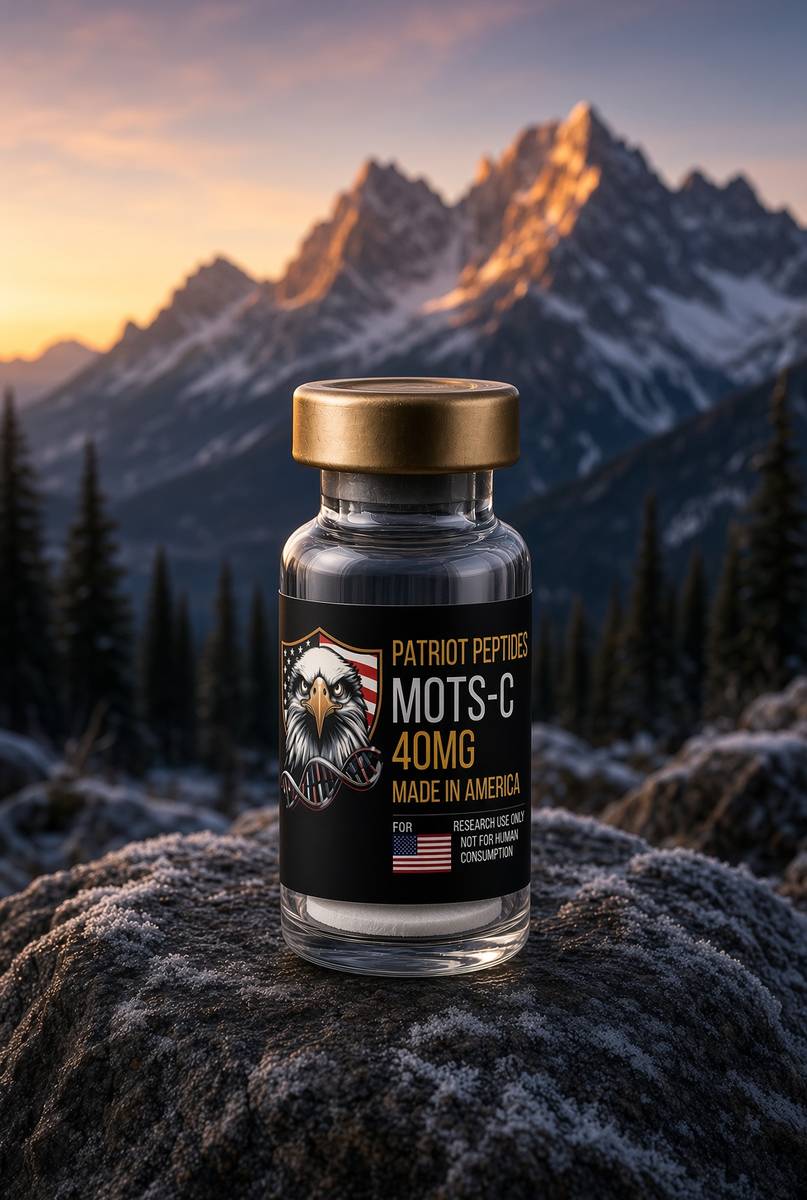
MOTS-c in the same catalogue is the named 16-mer, MRWQEMGYIFYPRKLR, HPLC-characterised, lyophilised, a reagent for an AMPK question a tube can actually ask. Sequence confirmed, because other 16-mers can share a nominal mass at low resolution. Counter-ion and residual water belong on the certificate for the same reason they belong on any peptide cake: TFA at high residual can move a dish on its own, and water is mass that isn't peptide. The 2015 Lee paper, the 2018 nuclear-translocation paper, and the 2021 exercise paper are the documents you'd cite. Mouse metabolic cages aren't a human titration. Phospho-AMPK Thr172, phospho-ACC, a nuclear fractionation, a folate-cycle metabolome: those are assays. Organism-level weight in a diet-induced-obese mouse is an assay too, and it is still not Jastreboff 2023. The button that puts both named sequences in a bag is a reading-list convenience for a bench that wants both doors, which is logistics rather than a claim that a GPCR and a kinase share a pocket. HPLC will tell you both chains are in the aliquot if you bought both. A caption will tell you they are one metabolic juice. The chromatogram is the better witness.
In short. MOTS-c on the shelf is the named sixteen-letter sequence, checked as chemistry, for AMPK experiments. Putting both sequences on a bench is logistics, not a combined mechanism.
Identity for a fatty-acylated incretin analogue is a retention time plus a mass that includes the lipid. Identity for a mitochondrial 16-mer is a peak plus 2.2 kilodaltons plus a fragmentation ladder that spells MRWQEMGYIFYPRKLR. Purity as a percentage is a peak-area statement, usually at 214 nanometres, and it is only as honest as the method's ability to see truncations, deletions and, in the acylated chain, missed lipids. A clean peak of the wrong chain is still the wrong chain. The catalogue is research solid in both cases: characterised sequences, American-made in the retatrutide line, labelled for laboratory use, a reconstitution you can write as milligrams per millilitre in a stated solvent. Concentration in a well isn't a dose in a person. Oral gavage in a mouse isn't a capsule advice column. Subcutaneous investigational product in a Phase 2 pharmacy is a third object again. We won't convert any of those into a how-to. The papers that already ran the models and the trial are in PubMed. Go there if you're running an experiment. Stay here if you wanted the receptors, the 16-mer and the two genomes unbundled.
In short. Each sequence is identified by chromatography and mass. A dish concentration is not a human dose. The papers already wrote their methods.
What this page will not do
The limit of the afternoon is a map. Appetite remains an organism-level behaviour read by hypothalamus and hindbrain. Body weight remains an integral over intake, expenditure and a defence of former mass. GLP-1R, GIPR and GCGR remain three class-B GPCRs with a shared Gs–cAMP grammar and different tissue sentences. STEP 1 remains one receptor. SURMOUNT-1 remains two. Jastreboff 2023 remains Phase 2 on an investigational medicine, with 24.2 percent as a 12 mg, 48-week least-squares mean that belongs in a literature note. MOTS-c remains MRWQEMGYIFYPRKLR, a mitochondrial 16-mer on AMPK, a different genome, an adjacent reading list. Licensed human medicines for type 2 diabetes and for chronic weight management already sit on this physiology with pens, tablets and, where indicated, surgery. Those programmes had regulators, numbers needed to treat, and harm tables. Holding the trial literature and the research solids as different objects is the whole skill. The neighbouring clinic, if a person needs one, is a clinic. The neighbouring diet and sleep essays on this journal still explain more everyday glucose noise than a receptor occupancy, which is a fact about ordinary physiology rather than a slight at the papers.
In short. The map stops at receptors, a mitochondrial peptide and the papers. Licensed metabolic medicines already exist. Everyday glucose still cares about meals and sleep.
A weight-loss clinic is a multidisciplinary service with dietitians, a prescriber, a pathway and, when it is honest, a conversation about lean mass, gall bladder, mental health and what happens when the analogue stops. This page isn't that service. A diet is a pattern of intake; the DiRECT formula, a protein-forward plate, a Mediterranean pattern, a genuine fast — those are interventions with their own literatures, and none of them is a 16-mer or a triple agonist. Sleep remains the largest native endocrine event of the day; growth hormone still pulses in slow wave, and a satiety nucleus still notices a short night. Filing a research peptide as a substitute for those essays is how a journal becomes a vending machine. The incretin history essay, the Phase 2 reading lesson, the liver-fat piece, the brown-fat essay, the mitochondria essay and the occupancy essay on how peptides talk to cells are the rest of the map. Secretin, 1902. Oral versus intravenous glucose, 1964. GIP isolated and renamed. GLP-1 recovered from proglucagon. DPP-4 named as the minutes. Coskun for the chain. Jastreboff for the 24.2 percent. Lee for the 16-mer. Gs–cAMP for one grammar. AMPK for the other.
In short. This page is not a clinic and not a meal plan. Sleep, food pattern and licensed medicines remain the ordinary physiology. The essays next door finish the map.
Research-use-only is the legal class of the solids. That sentence belongs here, at the close, as the class of the object rather than a refrain through the physiology. The cakes are characterised sequences for laboratory work: identity, purity, a reconstitution you can write down. Retatrutide as listed is the published LY3437943 structure, synthesised in the United States, HPLC-MS verified, a ligand distinct from Eli Lilly's investigational product. MOTS-c as listed is the named 16-mer from 12S rRNA. Captioning either as a treatment for obesity, as a substitute for a licensed pen, or as a diet would be a different legal class and a different literature. A class-B GPCR remains a seven-helix protein whether or not anyone opened a vial. AMPK remains a heterotrimeric kinase. The incretin effect remains a paired glucose curve from 1964. Two ligands sit on that literature. The literature is interesting. Interest isn't an indication. Guest checkout attests a laboratory purpose. The papers that already ran the trial and the mouse assays are in PubMed. Go there if you're reading experimental work. Stay here if you wanted the two genomes explained as chemistry with a public life.
In short. The powders are laboratory sequences. The receptors, the kinase, the trial and the 16-mer stay on separate lines. Interest is not an indication.
Two genomes. Two locks. One metabolic reading list. The 24.2 percent is a Phase 2 mean. The 16-mer is a mitochondrial sequence. Neither sentence is a diet.— Closing reading of the retatrutide and MOTS-c pair.
- Retatrutide is the published LY3437943 structure: GIP, GLP-1 and glucagon on one American-made chain. Independent of Eli Lilly. A characterised ligand, not a pen.
- The incretin effect is oral versus intravenous glucose, McIntyre 1964. GIP was isolated and renamed. GLP-1 was hiding in proglucagon. DPP-4 explained the minutes.
- STEP 1: one receptor, semaglutide, −14.9% at 68 weeks. SURMOUNT-1: two receptors, tirzepatide, −20.9% at 72 weeks. Retatrutide is the third occupancy.
- GLP-1R: satiety, slower gastric emptying, glucose-dependent insulin. GIPR: second incretin, adipocyte lipid handling. GCGR: hepatic glucose output plus energy expenditure. The art is bias.
- Gs–cAMP is the shared grammar. Class-B geometry is catch-then-insert. Desensitisation is why more ligand is not more signal forever.
- Jastreboff et al., NEJM 2023, Phase 2: 24.2% mean weight loss at 12 mg, 48 weeks. Investigational medicine. Literature note, not a use instruction for the research vial.
- MOTS-c is MRWQEMGYIFYPRKLR, a mitochondrial 16-mer from 12S rRNA, sitting on AMPK and the folate–methionine cycle. Different genome. Adjacent reading list.
- AMPK is a cellular fuel gauge. Metformin is the licensed neighbour. MOTS-c is not retatrutide’s little brother and not a diet.
- The catalogue holds two named research solids. HPLC-MS identity. Laboratory class. Mapping is not treating.
Questions the essay actually answers
- Is your retatrutide the same as the Lilly medicine?
- The published structure is LY3437943, a fatty-acylated unimolecular agonist at GIPR, GLP-1R and GCGR. This vial is that named structure, synthesised in the United States and HPLC-MS verified. We are not Eli Lilly. A shared backbone is not a shared formulation, device, dossier or legal class. This is not a licensed medicine.
- Why is MOTS-c on a weight essay?
- Because metabolic-stress and AMPK papers sit next to incretin papers on a reading list. MOTS-c is MRWQEMGYIFYPRKLR, a mitochondrial 16-mer — a different genome and a different ligand. Search maps the neighbourhood. It does not make the 16-mer a smaller retatrutide.
- What is the incretin effect?
- Oral glucose raises more insulin than the same glucose in a vein, because the gut has already warned the pancreas. McIntyre, Holdsworth and Turner, Lancet 1964; Elrick the same year. GIP and GLP-1 are the named messengers. DPP-4 is why the native peptides die in minutes. Everything in this essay sits downstream of that paired curve.
- What did STEP 1 and SURMOUNT-1 show?
- STEP 1 (Wilding, NEJM 2021): semaglutide 2.4 mg weekly, 68 weeks, mean weight reduction 14.9% — one receptor. SURMOUNT-1 (Jastreboff, NEJM 2022): tirzepatide 15 mg, 72 weeks, 20.9% — two receptors. Retatrutide is the third occupancy on that ladder. Context for a 24.2% Phase 2 mean, not a product comparison on this shelf.
- What did Jastreboff et al., NEJM 2023, actually report?
- Phase 2, n=338, 48 weeks, once-weekly retatrutide or placebo. At 48 weeks the 12 mg arm's least-squares mean weight change was −24.2% versus −2.1% on placebo. Gastrointestinal events were common and dose-related. That paper describes an investigational medicine. It is not a use instruction for this research vial.
- Why add the glucagon receptor at all?
- GLP-1R and GIPR mostly work on intake. GCGR was put on the chain as an energy-expenditure and hepatic-lipid arm, against the metabolic adaptation that usually attends large weight loss. The art is bias: enough occupancy for that arm, not enough to wreck glycaemia. Coskun et al., Cell Metab 2018, is the engineering paper.
- What is MOTS-c, exactly?
- A sixteen-residue peptide, MRWQEMGYIFYPRKLR, translated from an open reading frame in mitochondrial 12S rRNA. Lee, Kim, Cohen, Cell Metab 2015: AMPK and the folate–methionine cycle in mice. Later papers add nuclear translocation under stress and an exercise-inducible physiology. Characterised research sequence. Not a junior incretin.
- Does AMPK mean MOTS-c is a diet?
- No. AMPK is a cellular fuel-gauge kinase (αβγ, Thr172, LKB1/CaMKK2) that responds to AMP/ATP. Metformin is the licensed AMPK-adjacent medicine. MOTS-c sits on that neighbourhood in mouse and cell papers. A kinase occupancy in a dish is not a meal pattern and not a clinic.
- Is this a substitute for a weight-loss clinic or a licensed pen?
- No. Semaglutide, tirzepatide and other licensed medicines live in a formulary with devices and pharmacovigilance. Bariatric surgery remains the largest durable clinic intervention. This page maps two research sequences that sit on metabolic literature. Diet and sleep still explain everyday glucose noise. A map is not an appointment.
- What is the legal class of these vials?
- Characterised lyophilised sequences for laboratory work. Retatrutide as listed is the published LY3437943 structure, US-made, HPLC-MS verified. MOTS-c is the named 16-mer. Human metabolic medicine lives in a formulary with a different legal class.
Hypothetical research reconstitution
How these vials are typically mixed
Hypothetical research reconstitution for the named catalogue vial. Not a protocol, not medical advice, not a use instruction. These amounts sit in published and commonly cited laboratory ranges. The vial is labelled for research use only — not for human or veterinary administration.
Retatrutide
30mg
Mix with 3 ml bacteriostatic water → 10 mg/ml
- Hypothetical aliquot
- 1–2 mg to start; published trial arms ran higher by week
- 0.10–0.20 ml · 10–20 units on a U-100 syringe (at 1–2 mg)
- How often
- Once weekly
- The Jastreboff NEJM 2023 arms ran 48 weeks. That is a trial, not a shop protocol.
Bench steps
- Let the vial sit until it is no longer cold to the touch.
- Wipe the stopper with 70% isopropyl alcohol. Let it dry.
- Draw 3 ml bacteriostatic water (0.9% benzyl alcohol).
- Run the water slowly down the inside glass — do not blast the cake.
- Roll between finger and thumb until the cake is gone. Do not shake.
- Label the date. Store the solution at 2–8 °C. Do not freeze. Use within 30 days unless the note below says otherwise.
LY3437943 architecture. Weekly, not daily. Those milligram figures are what the papers used on the investigational medicine — they are not a use instruction for this reagent.
MOTS-c
40mg
Mix with 2 ml bacteriostatic water → 20 mg/ml
- Hypothetical aliquot
- 5–10 mg
- 0.25–0.50 ml · 25–50 units on a U-100 syringe
- How often
- Two or three times per week
- 4–8 weeks
Bench steps
- Let the vial sit until it is no longer cold to the touch.
- Wipe the stopper with 70% isopropyl alcohol. Let it dry.
- Draw 2 ml bacteriostatic water (0.9% benzyl alcohol).
- Run the water slowly down the inside glass — do not blast the cake.
- Roll between finger and thumb until the cake is gone. Do not shake.
- Label the date. Store the solution at 2–8 °C. Do not freeze. Use within 30 days unless the note below says otherwise.
Mitochondrial 16-mer. Fridge. Do not freeze. The 5 mg mark is where most bench notes start.
Bacteriostatic water and sterile syringes ship with peptide orders over £75. Kit details · 10 ml bacteriostatic water
The vials this essay sits on
Named sequences the essay maps — Retatrutide, MOTS-C. Hypothetical research neighbourhood, not a protocol, not a medicine. One press puts every in-stock vial in the bag.
 Made in USAOut of stock
Incretin
Retatrutide
US-made retatrutide 30mg — the published structure LY3437943, HPLC-MS verified.
4.6(609)
114 browsing this now · 5 purchased in the last 24 hours
30mg
£120.00
 Made in USA
Research use only. Not a combined-use instruction.
Read next
46 min · long read · Peptide research
Retatrutide (LY3437943): the published triple-agonist structure
A fatty-acylated unimolecular agonist at GIPR, GLP-1R and GCGR. US-made, HPLC-MS verified, labelled for laboratory research — not a medicine.
48 min · long read · Peptide research
From secretin to retatrutide: a century of gut hormones
Bayliss and Starling named the first hormone in 1902. A hundred and twenty years later a single American-made chain occupies GIP, GLP-1 and glucagon at once. The through-line is the gut talking to the pancreas.
49 min · long read · Metabolism
Regulating blood sugar: the control system
Glucose is a tightly bound variable. Here is the hardware — pancreas, liver, muscle, incretins — and the places it fails.
More in this desk

53 min · long read · Peptide research
Recovery, GH pulses and the CJC / ipamorelin pair
Somatotrophs have two 'go' receptors. CJC without DAC is a slightly longer GHRH pulse. Ipamorelin is a selective ghrelin-receptor key that does not yank ACTH. Together they are the pair Bowers already showed is more than additive — not a gym protocol.
53 min · long read · Peptide research
How research peptides are made — and why HPLC actually matters
Solid-phase peptide synthesis builds a chain one residue at a time. HPLC then asks whether the main peak is what you think it is. ≥98% is not a slogan. It is a chromatogram.
52 min · long read · Peptide research
Fatigue, cellular energy and the NAD+ / MOTS-c neighbourhood
NAD+ is the rechargeable chip every cell spends on fuel and DNA repair — and the pool shrinks with age. MOTS-c is a mitochondrial 16-mer sent out under metabolic stress. Two answers to 'I have no energy' that are not coffee.
51 min · long read · Peptide research
Melanocortin circuits: pigment, appetite and PT-141
Melanotan II lights MC1, MC3, MC4 and MC5 — pigment plus the rest of the sheet. PT-141 is the free-acid cousin pointed at MC3 and MC4, the circuitry papers use for desire and energy, not skin colour. Same Arizona family. Different question.
Essays describe published research. They are not medical advice and they do not authorise human use of any catalogue item.