

Peptide research · 47 min · 10,350 words
Why peptides are freeze-dried — and what reconstitution actually is
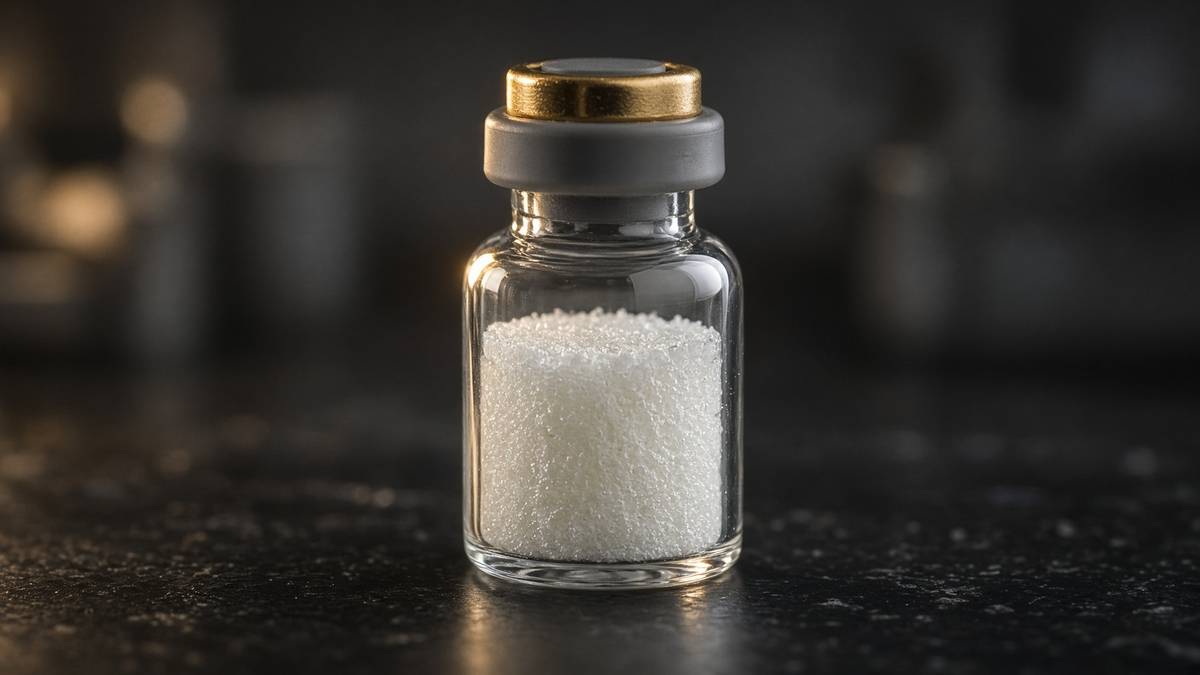
Water hydrolyses peptide bonds, oxidises methionine and grows microbes. Lyophilisation sublimes the ice so the chain ships as a porous cake. Reconstitution is mass divided by volume — laboratory handling, not a protocol for a body.
· updated
What this essay actually tells you
- Lyophilisation freezes a solution and sublimes the ice under vacuum so the peptide ships as a porous cake instead of hydrolysing in water. That's the whole reason it looks like a puck.
- Residual moisture (Karl Fischer) predicts shelf life. Heat, light, oxygen and leftover water are the four ways the cake becomes a different molecule. Pick your favourite way to ruin it.
- Reconstitution is mass ÷ volume. Bacteriostatic water is 0.9% benzyl alcohol to inhibit growth after puncture. Laboratory solvent. The label isn't being coy.
What this actually means
A peptide bond is an amide — the flat join between two amino acids — and water can undo it. Leave a 15-residue chain in a warm aqueous solution for months and you will not have the same molecule: aspartimide at Asp-Gly, deamidation at Asn, methionine sulphoxide, a yellow tryptophan oxidation product, and whatever grew after the first needle went through the stopper. Freeze-drying (lyophilisation) solves the storage problem by freezing the solution and pulling the ice off as vapour under vacuum, below the triple point of water. What remains is a porous cake, not kitchen powder, whose residual moisture, measured by Karl Fischer titration, is the number that predicts shelf life. Reconstitution means adding a measured volume of a suitable solvent so the cake becomes a solution of known concentration. That's arithmetic, and it is still not a dose. Bacteriostatic water is water plus 0.9% benzyl alcohol to slow growth after puncture. Laboratory solvent, nothing more romantic.
The peptide bond is an amide — the flat join between two amino acids — and water can undo it. That fact is older than any catalogue, and it is why a research peptide ships as a white plug rather than as a millilitre of solution. Hydrolysis of an amide, water splitting the join, is thermodynamically favoured in aqueous solvent: the equilibrium sits on the side of the free carboxyl and the free amine, because two solvated products outrank one planar linkage once water is abundant. Kinetics are the truce. At cold and dry, the activation barrier is high enough that a fifteen-residue chain can last months as a solid without becoming a different molecule. Warmth, leftover water, oxygen and light cancel that truce. Aspartate next to proline is a known scission site. Asparagine deamidates through a cyclic succinimide. Methionine becomes methionine sulphoxide, which is a different side chain. Cysteine finds the wrong partner or a cystine precipitate. Tryptophan goes yellow. After the first needle goes through the stopper, microbes add a living variable. This is organic chemistry sitting in a vial. The cake exists because someone removed most of that water on purpose.
In short. Water can cut peptide bonds. Cold and dry slow that enough for a freeze-dried cake to last months. Solution starts the clock again.
What we're going to do together is the physical chemistry of that cake, and the arithmetic of putting it back into a known volume of a solvent the sequence actually accepts. It is laboratory handling. Neighbouring pages already did the other floors: what a peptide is, how solid-phase synthesis and HPLC — high-performance liquid chromatography, the column that asks whether the main peak is the published chain — work, and GHK-Cu as a polar tripeptide that happens to dissolve without a fight. Here the objects are water, ice, vacuum, collapse temperature, residual moisture, pores, benzyl alcohol, and mass divided by volume. Bacteriostatic water appears because it is the laboratory solvent listing on the same shelf: sterile water with 0.9 percent benzyl alcohol after repeat puncture. Related product, not a medicine. We will stay with reconstitution as a bench sum, not a protocol for a body. Five milligrams in two millilitres is 2.5 milligrams per millilitre on a tube. That's the whole trick, and it stays on the bench. Papers named below already ran the stability studies. Those methods live in PubMed. Stay here if you wanted the phase diagram explained.
In short. This page explains freeze-drying and the sums for making a solution of known strength. It is bench handling, not a method for a body.
Reconstitution is arithmetic: mass on the certificate, volume you add, concentration you write on the tube. That's the whole trick, and people still skip the writing-on-the-tube bit.
The peptide bond is an amide, and water has a thermodynamic opinion
A peptide bond is the amide linkage between the carboxyl carbon of one amino acid and the α-amino nitrogen of the next, formed by condensation, planar because of resonance. Pauling and Corey measured that planarity; the C–N bond is shorter than a simple amine-to-carbonyl single bond, about 1.33 ångströms, with roughly forty percent double-bond character. That's why the backbone has a preferred ω dihedral near 180 degrees — trans, the usual layout — and why even a short chain carries a dipole. It's also why hydrolysis is a respectable organic reaction rather than a rumour. Water, or hydroxide, or a protonated carbonyl, can return the two residues to free carboxyl and free amine. The condensation that made the bond expelled water. Putting water back is the reverse, and the reverse is downhill once the products are solvated. Oligopeptides typically sit under twenty residues; polypeptides run longer; proteins are the folded assemblies. The amide chemistry does not care which noun you picked. A fifteen-residue research solid and a 51-residue insulin chain obey the same carbonyl. Length changes the number of weak points, not the existence of the weak point.
In short. A peptide bond is a flat amide join between amino acids. Water can undo that join. Short chains and long chains share the same chemistry.
Thermodynamics says hydrolysis is favoured. Kinetics say how fast. In dilute acid the carbonyl is protonated and water attacks; in base, hydroxide attacks the neutral carbonyl and the tetrahedral intermediate collapses to products. Both paths are textbook. Both are slow at low temperature in the near-absence of water. Both accelerate when you raise temperature, when you raise the activity of water, and when the local sequence donates intramolecular catalysis. Manning, Patel and Borchardt, Pharmaceutical Research 1989, and the 2010 update by Manning, Chou, Murphy, Payne and Katayama, remain the reviews a formulation group actually cites: deamidation, hydrolysis, oxidation, β-elimination, racemisation, aggregation, the lot. A pH-rate profile for a given amide is often a U-shape, acid limb and base limb, with a minimum that is sequence-dependent and not automatically pH 7. Buffer catalysis is real. Phosphate is not innocent. Acetate is not innocent. The solvent you pick for the hours of an experiment is part of the experiment, which is a later heading. The storage format that removes most of the water is this heading's point. We freeze-dry because the kinetics of a dry cake are the ones we can live with.
In short. Hydrolysis is favoured but often slow when cold and dry. Heat, leftover water and some buffers speed it up. Reviews from Manning and Borchardt mapped the paths.
Arrhenius is rude about the fridge. Many of these reactions roughly double in rate for every ten degrees, which is why a warehouse in summer is a different experiment from a cold room, and why a cake left on a bench under a lamp is a different molecule by the time someone remembers it. Water activity in the solid state is the other lever. A lyophilised cake is not anhydrous in the philosophical sense; it holds residual moisture, bound to the peptide, to buffer salts, to the inner glass, to the stopper. Karl Fischer titration, later, is how you put a number on that. Below a few percent by weight the hydrolysis rate in the solid often drops into the range a dating study can live with. Above that, you have a hydrolysis experiment in slow motion that still looks like a pretty plug. Light and oxygen are the parallel risks: methionine, cysteine and tryptophan don't need the amide to fail in order for the chain to become a different analyte. Four variables, then, before anyone has added a drop of solvent: heat, water, oxygen, light. A fridge is a rate constant. We still use one.
In short. Warmer storage speeds breakdown. Leftover water in the dry cake does the same. Heat, water, air and light are the four things that ruin a vial you have not yet opened.
Diagram
- Amino acid~110 DaTwenty side chains. The alphabet.
- Peptide bondamide, planarCarboxyl carbon to the next nitrogen. Resonance holds it flat.
- Oligopeptide< ~20 residuesMost hormones and fragments. GHK is three. KPV is three.
- Polypeptide20–50+Insulin 51. GLP-1 31. Retatrutide is a designed chain in this band.
- Proteinfolded machineHaemoglobin, a GPCR, lysyl oxidase. Tertiary structure worth drawing.
Insulin (Banting and Best, 1921) was the first peptide anyone bothered calling a medicine. A collagen hydrolysate is food. A named sequence with a mass and a chromatogram is a research peptide. The shared word is the accident.
Named failure modes: Asp–Pro, Asn, Met, Cys, Trp
Aspartate next to proline is a scission site you will meet if you age a peptide in acid. The side-chain carboxyl of Asp can assist cleavage of the following amide; proline's tertiary nitrogen and the geometry of that junction make Asp–Pro particularly willing. Oliyai and Borchardt worked the pathway, kinetics and mechanism of aspartyl degradation in model peptides through the 1990s; the papers are still the ones a stability study reaches for. Acidic pH accelerates the cleavage. A TFA-containing HPLC mobile phase, a dilute acetic-acid reconstitution solvent left for days, a cake that was not dry enough — any of those can nick the chain at Asp–Pro and give you two fragments that still absorb at 214 nanometres. The chromatogram grows extra peaks. The mass of the main peak is no longer the mass on the certificate. If the assay thought it was occupying a receptor with the intact sequence, the assay is now a mixture. This is why a label that says BPC-157 is not a stability statement. BPC-157 is GEPPPGKPADDAGLV, proline-rich, with aspartates. The sequence is the map of the weak points. Read it before you blame the freezer. The chemistry was already written in the one-letter code.
In short. Aspartate followed by proline is a known break point, especially in acid. The chain can snap there and the assay is then a mixture, not the labelled sequence.
Aspartimide is the other aspartate problem, and it does not require proline. Asp–Gly is the classic pair; Asp–Ser and Asp–His join the list. The side-chain carboxyl attacks the following nitrogen, closes a five-membered succinimide, and can open again to either Asp or iso-Asp. Iso-aspartate inserts an extra methylene into the backbone. The chain is longer by one carbon in the wrong place, the geometry at that residue has changed, and a receptor contact that wanted the original carboxylate is looking at a different object. Racemisation through the succinimide is the bonus insult: you can grow D-Asp in a supposedly L-chain. Wakankar and Borchardt, Journal of Pharmaceutical Sciences 2006, wrote the formulation considerations; if you have run a difficult solid-phase synthesis you already met aspartimide on resin, which is the same five-membered ring wearing a protecting-group story. In a lyophilised cake with leftover water, the ring is a dating-study peak. In solution at slightly basic pH it can be a days-to-weeks peak. The name on the vial does not mention it. The chromatogram will, if you look. One extra carbon in the backbone is enough to change the molecule you thought you weighed.
In short. Aspartate next to glycine can cyclise and reopen as the wrong isomer, iso-aspartate. That extra carbon in the backbone is a different molecule, even if the letters look similar.
Asparagine deamidation is the clock Robinson and Robinson spent a career measuring. The side-chain amide of Asn attacks, again via a succinimide, and opens to a mix of Asp and iso-Asp. Geiger and Clarke, Journal of Biological Chemistry 1987, laid out deamidation, isomerisation and racemisation at asparaginyl and aspartyl residues in a paper we still reach for as statute. Sequence matters brutally. Asn–Gly can deamidate on a timescale of hours to days at 37 °C and physiological pH; Asn–Pro is sluggish; a following bulky residue can hinder the cyclisation. In a research vial the temperature is hopefully lower, but the pH of an unbuffered aqueous solution is not a number you get to ignore, and the water activity of a damp cake is not zero. Deamidation converts a neutral side chain into a carboxylate, or into iso-Asp. Charge changes. Hydrogen bonds change. A glycine-rich copper tripeptide is less of a deamidation story; a longer chain with Asn–Gly is a dating-study story. If your assay is quantitative, a deamidated contaminant is an undeclared co-solute with a different isoelectric point and, sometimes, a different affinity. You have added a second molecule without meaning to.
In short. Asparagine can lose its side-chain amide and become aspartate or iso-aspartate. Charge and shape both change. Some sequences do this much faster than others.
Methionine becomes methionine sulphoxide. That is a different side chain, full stop. The thioether is oxidised to a sulphoxide, two diastereomers at sulphur, polar where the original was hydrophobic, bulkier, no longer the packing residue the structure wanted. Hydrogen peroxide, peroxyl radicals, dissolved oxygen plus light, trace metal — pick the oxidant, pick the paper. Li, Schöneich and Borchardt reviewed chemical instability of protein pharmaceuticals until this path had no right to surprise anyone. In a living cell, methionine sulphoxide reductases can reverse the modification. In a vial they're not present. Photostability is not a sticker on a stopper; it is why a clear glass of a Met-containing peptide on a windowsill is an oxidation experiment. Fatty-acylated incretin analogues carry methionines or not depending on the published sequence; you still read the one-letter code rather than assuming the class is safe. Residual moisture helps, because radical chemistry in a slightly wet solid is not the same as in a bone-dry glass. Oxygen in the headspace is the other reagent. Stoppering under dry nitrogen is a manufacturing sentence. Leaving the cap off is a different one. Air is a reactant once the thioether is invited.
In short. Methionine oxidises to methionine sulphoxide, a more polar side chain the original sequence did not ask for. Air, light and leftover water all help. A cell can reverse this. A vial cannot.
Cysteine is a nucleophile, a metal ligand, and a redox problem. Two thiols oxidise to a disulphide. The correct pairing in a chain that has several cysteines is a folding fact; the incorrect pairing is a scrambled isomer or an intermolecular cystine that precipitates. Thiolate–disulphide exchange is fast once a single thiolate is present, and the pKa of a typical cysteine sits near 8.3, so mildly basic reconstitution solvents are not a restful home for a free thiol. Trace copper or iron catalyses the oxidation. A peptide that was supplied as a free thiol and is now a dimer has a different mass, a different HPLC retention, and a different surface. A peptide that needed a specific disulphide — insulin is the ancestor: two chains, three disulphides — and has reshuffled them is not the ligand the paper drew. Reducing agents exist for the bench and they are named in the papers; they're not a reason to treat a cake as immortal. Precipitation of cystine is how a solution goes cloudy and a concentration written on a tube becomes a lie. Cloudy is data. It's not a mixing failure you ignore.
In short. Cysteine can pair wrongly or form a solid that drops out of solution. The mass and the chromatogram both change. A cloudy tube is a result, not a nuisance.
Tryptophan goes yellow. Photo-oxidation, often through the indole, yields kynurenine, N-formylkynurenine and a small family of coloured products that advertise themselves at wavelengths a peptide should not own. Histidine and tyrosine join the oxidative roll-call when metals and peroxides are invited. Hovorka and Schöneich wrote oxidative degradation of pharmaceuticals as a map, not as folklore. A yellow cake that was white at release is a spectrum, not a mood. Ultraviolet from a fluorescent tube is enough, over weeks, if the vial is clear and the headspace holds oxygen. The neighbouring synthesis essay already said identity is sequence plus mass plus chromatogram. Oxidation of Trp is how you keep the mass almost right — plus sixteen, plus thirty-two — and still fail the chromatogram and the colour. None of these named failure modes — Asp–Pro scission, aspartimide, Asn deamidation, Met sulphoxide, Cys pairing, Trp colour — require a villain. They require water, oxygen, light, heat, and time. Lyophilisation is how you take most of the water off the table. It does not take oxygen, light, heat or a damp stopper off the table. Those remain yours to manage, which is why the next headings exist.
In short. Tryptophan can photo-oxidise and turn the solid yellow. Histidine and tyrosine can oxidise too. Colour in a cake that used to be white is chemistry, not cosmetics.
Microbes after the first puncture
A sealed, sterile vial of a lyophilised solid is, at the moment of manufacture, a closed system. The stopper is a barrier. The cake is dry enough that most bacteria and fungi are not having a good time, because water activity is a growth variable as well as a hydrolysis variable. The first needle through the stopper ends that sentence. You have now connected the headspace to a syringe, a needle, a solvent bottle, a laboratory atmosphere, and whatever lived on the stopper's outer face. Subsequent punctures repeat the invitation. Aqueous peptide solutions, especially if they contain buffer salts or a little acetate, are respectable culture media at room temperature. Days are enough. Treating 'reconstituted Tuesday, used Friday' as interchangeable with 'reconstituted this morning' has added colony-forming units as an undeclared co-solute. Endotoxin is the quieter version of the same story: you may not see turbidity and you may still have lipopolysaccharide in an assay that cares about innate immune receptors. Sterility of the dry cake was a manufacturing claim. Sterility of the solution after puncture is a handling claim. They're not the same claim.
In short. The dry sealed cake is a closed system. The first needle opens it. After that, the solution can grow microbes unless the solvent and the handling say otherwise.
Bacteriostatic water exists as a laboratory answer to repeat puncture, and it gets its own heading later because people keep asking it to be a buffer, a permission, or a dose. The chemistry is simple: sterile water plus 0.9 percent benzyl alcohol, the alcohol as an antimicrobial preservative so that a multi-puncture vial does not become a culture on the same day. Preservative is not sterilant. It slows growth; it does not license poor technique, tap water, or a week on a warm shelf. Some peptides and some proteins will not thank you for benzyl alcohol — interfacial and hydrophobic effects, occasional aggregation — which is why the solvent is sequence-dependent and why the paper, not a comment thread, names it. For a polar research solid used over the hours of an experiment, bacteriostatic water is a documented laboratory solvent. For a hydrophobic chain the paper reconstituted in dilute acetic acid or a named co-solvent, benzyl alcohol is an extra solute you did not budget. Microbes remain a reason not to ship the peptide already dissolved. Hydrolysis and oxidation were already enough. Growth after puncture is the third.
In short. Benzyl alcohol in bacteriostatic water slows growth after the stopper is punctured. It does not make poor handling safe, and it is not the right solvent for every sequence.
Lyophilisation is a phase diagram, not a dehydrator
Diagram
Water hydrolyses peptide bonds, oxidises methionine and grows microbes. Lyophilisation sublimes the ice below the triple point. Reconstitution is arithmetic. Bacteriostatic water is 0.9% benzyl alcohol after puncture — a laboratory solvent, not a permission.
The triple point of water sits near 0.01 °C and 611 pascals, about 6.1 millibar. Below that pressure, ice prefers to become vapour without becoming liquid. That's the whole physical trick. Freeze the solution so the water is ice and the solutes are a freeze-concentrate. Drop the chamber pressure below the vapour pressure of that ice. Supply just enough heat, usually through a shelf, that the ice sublimes and the product temperature stays below the collapse temperature of the freeze-concentrate. The water leaves as vapour, is caught on a cold condenser, and is no longer in the vial. Primary drying is that sublimation. Secondary drying is the later, warmer step that desorbs water still bound to the peptide and the excipients. A kitchen dehydrator blows warm air over a liquid and hopes. A freeze-dryer walks around the liquid region of the phase diagram on purpose. Franks, European Journal of Pharmaceutics and Biopharmaceutics 1998, put the principles into practice in language a process group can use. Tang and Pikal, Pharmaceutical Research 2004, wrote the design paper. If you can't point at product temperature, chamber pressure and collapse temperature, you are describing a wish, not a cycle.
In short. Freeze-drying pulls ice straight to vapour under vacuum, below the pressure where ice would melt. That avoids a liquid stage. A food dehydrator is a different machine.
Freezing is not a footnote. As ice crystals grow, everything that's not water is pushed into a shrinking liquid domain: peptide, buffer, salts, any bulking agent, any sugar. Concentration in that freeze-concentrate can be enormous. pH can crash if a buffer salt crystallises and leaves its partner behind; sodium phosphate is the famous case, a several-unit pH drop in the frozen state that has wrecked more than one protein. The glass transition of the freeze-concentrate, written Tg', is the temperature below which that concentrate is a glass rather than a viscous liquid. Collapse temperature sits near it, sometimes a little above, sequence- and excipient-dependent. Ice crystal size is history: a slow freeze tends to larger crystals, larger pores later, faster vapour flow in primary drying; a deep, fast freeze tends to small crystals, a finer cake, a longer primary dry. Annealing — holding the frozen product for a time to let crystals ripen — is a lever process engineers actually pull. Geidobler and Winter reviewed controlled ice nucleation because cake appearance and drying time both care. The pores you will later wet are being decided now, in the freezer, before the vacuum pump is invited.
In short. As the solution freezes, ice leaves behind a sticky concentrated soup of peptide and salts. Crystal size in that freeze sets the pores of the cake you will later wet.
Primary drying is sublimation under vacuum with the product held colder than its collapse temperature. Shelf temperature is not product temperature. The shelf supplies heat; sublimation spends heat; the product sits at a temperature you measure with a probe, or infer from manometric temperature measurement, or regret not measuring. Chamber pressure must be low enough that ice sublimes, high enough that heat transfer still works, and matched to the condenser so vapour does not choke in the duct. Nail, Jiang, Chongprasert and Knopp wrote fundamentals of freeze-drying that process people still hand to new colleagues. Exceed collapse temperature and the freeze-concentrate flows. The cake shrinks, or melts back into a film, or forms a skin that then blocks vapour. Melt-back is as depressing as it sounds: you have made a sticky glass instead of a porous solid, residual moisture will be higher, reconstitution will be slower, and the appearance on inspection is a failure even if the mass is still right. Hold below collapse, wait out the sublimation front as it moves down the vial, and you get a cake whose pores are the ghosts of the ice you just removed. That wait is hours to days.
In short. Primary drying is ice turning to vapour while the product stays cold enough not to collapse. Too warm and the cake melts into a sticky film. The wait is long on purpose.
Collapse temperature is sequence- and excipient-dependent, which is why a cycle that made a beautiful mannitol cake can wreck a sugar-free peptide. Mannitol likes to crystallise and hold structure; sucrose and trehalose tend to stay amorphous and protect a protein by forming a glass around it; peptides without a designed excipient list are at the mercy of their own sequence and whatever counter-ion they brought from purification, often trifluoroacetate. Carpenter, Pikal, Chang and Randolph, Pharmaceutical Research 1997, set out rational design of stable lyophilised protein formulations: glass, cryoprotectant, a bulking agent if you need a cake you can inspect, a residual moisture specification, a stopper that does not donate water back. A research peptide cake in a small vial is a thinner version of that argument. Exceed collapse and you get melt-back. Stay under it, with a chamber pressure below about 6 millibar so you are on the ice–vapour side of the triple point, and primary drying can finish. The specification that tells you it finished is not the clock. It is product temperature rising toward shelf temperature as the last ice goes, or a pressure-rise test, or residual moisture later.
In short. Each formula has a temperature above which the frozen matrix sags. Sugars and fillers change that number. Go above it and you get a film instead of a cake.
Secondary drying is desorption of bound water. The ice is gone; water still held on polar groups, in the amorphous glass, on the inner surface of the vial, is not. You raise shelf temperature, carefully, because the product can now tolerate more heat than it could while ice was present, and you keep the chamber dry so the desorbed vapour leaves. Too aggressive a ramp and an amorphous cake can collapse after all, or a protein can unfold in a glass that just became a rubber. Too timid a secondary dry and Karl Fischer will read 4 or 8 percent and the dating study will look like hydrolysis in the solid state. Typical pharmaceutical targets sit in the low single-digit percent by weight, often under 1 to 3 percent, peptide- and excipient-dependent. Bound water is not a moral failing of the cycle. It is isotherm physics: a dry solid in equilibrium with a residual water activity. Pikal's work on the process, and the Costantino, Langer and Klibanov papers on moisture-induced aggregation of lyophilised insulin, are why 'bone dry' is not a specification and 'dry enough' is. You number it. You don't admire the cake and guess.
In short. After the ice is gone, a warmer vacuum step pulls off water still stuck to the peptide. The leftover water is measured, not guessed. Too much, and the solid still hydrolyses.
History is shorter than you might think. Altmann was freeze-drying tissue in the 1890s so that histology could have a dry object; Die Elementarorganismen is not a peptide paper and it already had the physics. Flosdorf and Mudd, Journal of Immunology 1935, put serum into 'lyophile' form with apparatus you can still recognise: freeze, vacuum, condenser. World War II industrialised the trick for plasma and then for penicillin, because a bottle of solution was a logistics problem and a dry solid was a shelf. Jennings wrote the introductory monograph; Rey and May edited the pharmaceutical handbook. A modern peptide cake is the same phase diagram with a tighter specification, a butyl stopper, sometimes a nitrogen headspace, and a residual-moisture number instead of a prayer. The pores you can see if you look closely are still the ghosts of ice crystals. That's why the cake is not kitchen powder. Powder is what you get when you mill a solid. A lyophilised cake is a porous body whose internal surface was templated by ice. Wetting, later, is capillary flow into those pores. Treating it as protein powder in a shaker bottle is how you make foam and call it a method.
In short. Freeze-drying is old: tissue in the 1890s, serum in the 1930s, plasma and penicillin in the war. A peptide cake is the same physics with a tighter water specification.
- Triple point of water
- ~6.1 mbar, 0.01 °C
- Collapse temperature
- sequence-dependent
- Residual moisture
- often <1–3% w/w
- Benzyl alcohol in bacteriostatic water
- 0.9% w/v
- Peptide-bond hydrolysis
- favoured, slow if cold/dry
- Reconstitution
- mass / volume
- Cake pores
- ghosts of ice
- Industrial origin
- WWII plasma, penicillin
Below this pressure ice sublimes. Primary drying lives here.
Exceed it and the frozen matrix flows. Melt-back, not a cake.
Karl Fischer. The number that predicts solid-state hydrolysis.
Antimicrobial after repeat puncture. Laboratory solvent, not a dose.
Asp–Pro scission, Asn deamidation via succinimide. Kinetics are the truce.
Certificate milligrams over millilitres added. Write it on the tube.
Capillary wetting, then wait. Shaking makes foam.
Altmann's tissue, Flosdorf–Mudd sera, then scale. Same phase diagram.
Residual moisture is the specification that predicts shelf life
Karl Fischer titration is how you measure water in a solid that looks dry. The reaction is stoichiometric: iodine, sulphur dioxide, a base, an alcohol, and water. Volumetric Karl Fischer suits larger water contents; coulometric Karl Fischer generates iodine electrochemically and is the usual choice when the answer is supposed to be a few milligrams of water in a few hundred milligrams of cake. Fischer published the method in Angewandte Chemie in 1935, the same era Flosdorf was bottling lyophile serum, which is a coincidence the history of analysis enjoys. A pretty plug that is still 8 percent water is a hydrolysis experiment in slow motion, and it will look innocent until a dating study, or an assay, says otherwise. Pharmacopoeial chapters exist so that 'dry' is a number. For many lyophilised peptides the working band is the low single-digit percent by weight, often under 1 to 3 percent. Sequence, excipient and storage temperature decide where in that band you need to sit. The certificate that came with a research solid should be allowed to mention moisture, or you should be allowed to ask. Appearance is not an assay. You can't see 8 percent water with the naked eye.
In short. Karl Fischer is a chemical test for leftover water in the cake. A pretty plug can still be wet enough to break down. Dry is a number, often under a few percent.
Solid-state hydrolysis is not a contradiction. Once residual moisture and water activity are high enough, amides still hydrolyse, asparagines still deamidate, and proteins still unfold and aggregate in a glass that thought it was asleep. Costantino, Langer and Klibanov, Pharmaceutical Research 1994, watched moisture-induced aggregation of lyophilised insulin and removed the excuse that a solid cannot misbehave. The glass transition of the dry solid, Tg, is a different number from Tg' of the freeze-concentrate; storage well below Tg is the usual advice, which is why a fridge or a freezer is a rate constant rather than a personality trait of the lab. Temperature excursions through Tg turn a glass into a rubber, mobility rises, and the dating study you thought you had becomes fiction. Buffer salts in the cake can crystallise on storage and dump water into the remaining amorphous phase, locally raising water activity. Stoppers donate moisture. That last sentence is not a joke: butyl rubber holds water, and a badly dried stopper is a reservoir sitting millimetres above the cake. Secondary drying of the product is wasted if the closure then rains on it. The cap is part of the specification. Treat it that way.
In short. A solid can still hydrolyse if it holds enough water. Warmth that softens the dry cake, and a damp stopper, both feed that reaction. Insulin already taught this.
Heat, light, oxygen and a damp stopper are the four ways a lyophilised peptide becomes a different molecule while you are not looking. Heat is Arrhenius, already named. Light is tryptophan and methionine, already named, and a reason amber glass exists. Oxygen is the headspace reagent for Met, Cys and Trp; vacuum-stoppering or nitrogen-stoppering is a manufacturing choice, and cracking the vial in laboratory air is a handling choice. The damp stopper is the one people forget. A fridge is still the right piece of furniture, because even a well-dried cake has a residual rate, and residual rates integrate over months. Freeze if the dating study says so; frost that condenses when you open a cold vial is new water, which is why you let a vial warm, closed, before you pop the cap. None of this is glamour. It is why the storage line on a research listing is a chemical sentence. It's also why shipping as a cake beats shipping as a solution: the cake has had most of the water removed on purpose, and the solution has not. You are buying time. The freeze-dryer already spent it for you. Handling is how you keep the change.
In short. Heat, light, air and a damp cap all change the dry molecule. Keep the vial closed until it warms. A fridge slows the chemistry; it does not stop the need for a dry cake.
The cake is a structure. The pores are ghosts of ice.
Look closely at a well-made lyophilised plug and you are looking at a foam whose bubbles were ice. Primary drying removed the ice; the solid that had been the freeze-concentrate remains as walls. Pore size tracks crystal size. Specific surface area can be large, which is good for wetting and good for picking up moisture from a damp headspace. The cake is brittle because it is mostly air and a thin solid network. It's not a packed powder. It will shrink from the glass if collapse nipped it, or sit as a free-standing plug if the cycle behaved. Inspection is data: melt-back, puffing, collapse, a film on the glass, a cake that has crawled up the wall — each is a process sentence. A research vial is a smaller stage of the same play a manufacturing freeze-dryer runs with thermocouples and a condenser the size of a cupboard. The physics does not scale down into 'just a white bit at the bottom'. If the white bit is a film, wetting will be slow and residual moisture was probably high. If it is a porous plug, capillary action has something to climb.
In short. The holes in the cake are where ice crystals used to be. That structure is why a freeze-dried plug wets along the pores, and why a melted film does not.
Wetting is capillary action, then patience. You introduce a measured volume of a suitable solvent down the wall or onto the cake so that liquid can climb the pores. Surface tension and pore radius set the capillary pressure; the liquid front moves; the solid dissolves into that front as it goes. Waiting is the method. Swirling, gently, once the cake is wetted, can help a stubborn plug finish dissolving. Shaking is how you make foam. Foam is a large air–water interface. Peptides, being amphipathic by nature of having side chains, will sit at that interface, unfold if they have enough length to unfold, and sometimes stay there as a scum on the glass. The concentration you then draw from the bulk is lower than the concentration you wrote on the tube. You have made a lying solution and an interesting film. Protein formulation groups learned this the hard way with agitation studies; a fifteen-residue chain is less of an unfolding story and still enough of a foaming story. The instruction is dull on purpose. Wet, let solvent climb, wait. The pores were built for that. They were not built for a vortex mixer.
In short. Add solvent and let it climb the pores. Wait. Shaking makes foam, and foam leaves peptide stuck on the glass so the liquid is weaker than you think.
Thinking of the cake as kitchen powder fails here for a structural reason, not a snobbish one. Whey shaken into a bottle is already a soluble mixture designed to wet in turbulence. A lyophilised peptide cake is a low-mass, high-surface, sequence-dependent solid whose first job is to take up solvent without being beaten into an aerosol of bubbles. Some cakes dissolve in seconds once wetted. Some hydrophobic cakes sit as a skin if the solvent is wrong, which is a solubility fact and not a mixing fact. Some cakes look dissolved and are a fine suspension; a Tyndall haze is not clarity. If the assay is quantitative you still check, by ultraviolet absorbance at a peptide-bond wavelength, or by a method the paper named, that the mass you think you dissolved is in the bulk. Incomplete wetting is how a certificate milligram-mass and a pipette millilitre-volume produce a concentration that exists only on the label. The arithmetic assumes dissolution. Dissolution is an observation. Foam is the opposite of that observation. Look at the tube. If it's not a true solution, the division you wrote down is a hope.
In short. This is not protein powder in a shaker. Wrong solvent leaves a film. Haze is not a true solution. If the measurement needs a real concentration, check that the cake actually dissolved.
Reconstitution is mass divided by volume
Concentration is milligrams divided by millilitres. The mass is the mass on the certificate, the one HPLC-MS already spoke to, not the mass you hope is in a cake because a label rounded it. The volume is the volume of solvent you actually add, delivered with a pipette or a syringe that was meant for laboratory volume, not with a gesture. Divide. Write the result on the tube, with units, with the solvent named, with the date. That is reconstitution. It is arithmetic for a bench. If you add 2.0 millilitres of solvent to 5.0 milligrams of peptide you have 2.5 milligrams per millilitre, provided the cake dissolved and the volume is 2.0 millilitres and the mass was 5.0 milligrams. Each of those provisos is an experimental claim. The neighbouring synthesis essay already argued that a name on a vial is a rumour without a chromatogram. A concentration on a tube is the same flavour of rumour without the division written down. People still skip the writing. Then they skip the dissolution check. Then they compare assays that were never on the same millimolar footing.
In short. Divide the milligrams on the certificate by the millilitres you add. Write that concentration on the tube. The sums only hold if the cake actually dissolved.
The tube is part of the experiment. A concentration that lives only in someone's head is how a dilution series becomes folklore. Laboratory practice, not a personality: labelled vessel, named solvent, named concentration, named date, sometimes a named pH if you buffered. From that stock you take a volume into the assay. The assay's micromolar arithmetic is then a further division, still mass-over-volume at heart, still not a dose. I'm labouring this because reconstitution is so often reread as a prelude to a body. It is not. A research solid becomes a research solution so that a pipette can deliver a known mass into a known volume of medium, buffer or reaction. The body does not appear in that sentence. If someone wants a clinical protocol they want a licensed product, a label, a pharmacovigilance system, and a different building. What we're doing here is making sure the millimoles in the tube match the millimoles the paper thought it used. That match is the difference between a replicate and a waste of a week. Write on the tube. Then the week has a chance.
In short. Write the strength, the solvent and the date on the tube. You pipette from that stock into an experiment. That is bench arithmetic, not a treatment plan.
Polar research peptides often dissolve in water or in dilute acetic acid. Basic residues, TFA counter-ions from cleavage and HPLC, a short chain with a decent charge at low pH — those facts make aqueous solvent a reasonable first attempt, and dilute acetic acid a reasonable second if water alone leaves a film. GHK is three residues and a copper and is not a solubility problem in water. BPC-157 is proline-rich and polar enough that aqueous solvent is the usual laboratory start. The synthesis essay's HPLC mobile phase, water and acetonitrile with a little TFA, already told you these chains can live in acidified water. Acidified water is a common solvent for polar sequences, not a universal one. pH of unbuffered water is a wanderer; dissolved carbon dioxide pulls it acidic; glass leaches; the peptide itself is a buffer if you put enough of it in. If the assay cares about pH you use a buffer the paper named, and you remember that phosphate is not always kind to asparagine or to freeze-drying, and that 'water' is not a pH specification. Solvent is part of the experiment. Pretending otherwise is how a film on the glass becomes a lying concentration.
In short. Many polar peptides dissolve in water or a little acetic acid. That is common, not universal. If the experiment cares about pH, water alone is not a pH.
Hydrophobic stretches and fatty-acylated chains are a different solubility class. The incretin analogues that hang a C16 or C18 diacid on lysine so that albumin will carry them in plasma are amphiphiles. They can need a co-solvent the paper actually names, or a pH window, or a waiting time that looks like stubbornness and is actually hydration of an alkyl chain. Retatrutide, tirzepatide, semaglutide: published structures, published formulation literatures, none of which is 'treat it like GHK'. Aggregation, micelles, adsorption to plastic — the industrial formulation groups already fought those fights so that a pen could exist. A research solid of the published chain is not that pen. It is a cake that may still want the solvent the paper specified. Adsorption to the tube is how a nanomolar dilution disappears; a little serum albumin in an assay buffer is sometimes the paper's answer, and sometimes the answer is a different plastic. Read the paper. A film of a fatty-acylated peptide on glass is a very expensive way to run a zero-concentration control and not know it. The alkyl chain wanted a different neighbourhood. Give it the one the structure asked for.
In short. Oily or fatty-tailed chains may need the solvent the paper names, not water by habit. They can stick to plastic and leave you with less dissolved than the label says.
Co-solvents belong to the paper that named them. Dimethyl sulphoxide, a little acetonitrile, dilute acetic acid, a specified buffer at a specified pH — those are experimental conditions. They're not a licence to invent a cocktail because a cake looked sulky. A co-solvent that the assay then carries into cells is a variable; DMSO at the wrong percent is a pharmacology of its own. Dilute, if you must start in a strong solvent, into the aqueous system the experiment actually runs, and check that the peptide stayed dissolved at the new polarity. Precipitation on dilution is a classic way to have a stock that looks honest and a working solution that is a suspension. We will not tabulate recipes. Sequence, counter-ion, temperature and the paper decide. Polar chains often take water or dilute acetic acid; hydrophobic and fatty-acylated chains may take what the paper specified; bacteriostatic water is an antimicrobial aqueous solvent after puncture, not a universal key. Tap water is none of these. Concentration remains milligrams over millilitres, verified if the assay is quantitative. The liquid is a reagent. Choose it the way you choose any other.
In short. Use the solvent the paper names. Strong solvents can hurt the assay if you carry them in. If the peptide falls out when you dilute, the working solution is no longer the concentration you wrote.
Many polar research peptides dissolve in water or in dilute acetic acid. Fatty-acylated chains can need a co-solvent the paper actually names. Pretending they behave like GHK is how you get a film on the glass and a lying concentration.
Bacteriostatic water is a laboratory solvent
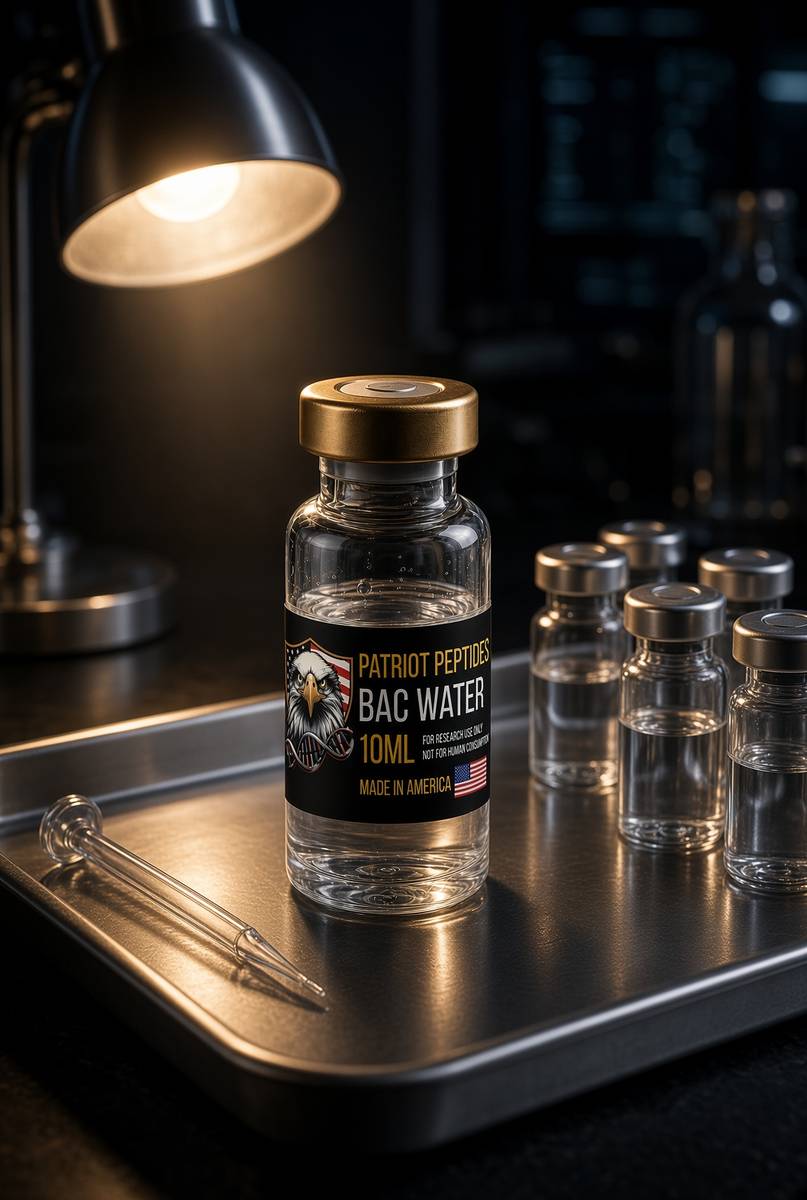
Bacteriostatic water for injection, in the pharmacopoeial sense, is sterile water plus 0.9 percent benzyl alcohol. The alcohol is the antimicrobial preservative. The water is the solvent. The pair exists so that a vial which will be punctured more than once does not become a culture medium on the first afternoon. Nine milligrams of benzyl alcohol per millilitre is a documented concentration, not a folk pinch. It's not a high enough organic fraction to rescue a hydrophobic sequence, and it's not a buffer system. pH of bacteriostatic water is the pH of that water plus that alcohol plus whatever carbon dioxide it dissolved, wandering unless you measure it. Some assays will not tolerate benzyl alcohol. Some peptides will not. Some cells in culture will not. The listing on this catalogue is a laboratory solvent for polar research solids that will see repeat puncture over the hours of an experiment. Related product, bac-water, sitting next to the cakes because reconstitution needs a named liquid. That's the whole romance. It is a solvent with a preservative, for the bench, after the needle. It's not a medicine, not a protocol, and not a universal peptide vehicle.
In short. Bacteriostatic water is sterile water with 0.9 percent benzyl alcohol to slow microbes after repeat puncture. It is not a buffer and it will not dissolve every peptide.
Benzyl alcohol does not hold pH. It does not license injection, ingestion, or any other application to a body. It does not cancel hydrolysis, deamidation or oxidation; those are chemistry of the peptide and the water, and the alcohol is a spectator to them. It may even encourage aggregation of some chains at interfaces, which protein formulation literature has already reported, so a polar research peptide that is happy in bacteriostatic water is a happier case than a general law. Multi-dose preservative systems in licensed medicines are a regulated design with killing-curves and compatibility studies. A research bottle of bacteriostatic water is a solvent with a preservative, used so that after you puncture a stopper the next few hours are not a culture. Technique still matters: wipe, sterile needle, laboratory air that you don't pretend is a clean room if it is not. Preservative is a rate reduction for growth, not a sterilising autoclave in a millilitre. If the experiment needs a buffer, you use a buffer. If it needs sterility for a cell assay, you use sterile technique and a solvent the cells accept. The alcohol bought you hours, not a different legal class.
In short. Benzyl alcohol does not set pH and does not make the solution a medicine. It only slows growth after puncture. Buffers, sterile technique and the paper still do their own jobs.
Tap water is ions, microbes and chlorine: three undeclared variables, and often a fourth in the form of dissolved copper or iron from domestic pipework, which will catalyse the methionine and cysteine oxidations already named. Hard-water calcium and magnesium are coordination chemistry you did not budget. Municipal chloramine is an oxidant. The microbiome of a tap is not a blank. Distilled water is better and still not sterile. Autoclaved Milli-Q is a laboratory sentence. Bacteriostatic water is a laboratory sentence with a preservative. The reason this paragraph exists is that people really do ask, and the answer is not a style preference. An assay that thinks it is measuring a peptide in clean solvent is, in tap water, measuring a peptide plus metals plus an oxidant plus a colony. You will not see that on a cheap UV scan of the main peak. You will see it later, as noise, as a failed replicate, as a yellowed tube, as a cell assay that looks like innate immunity walked in. Choose the solvent as if it were a reagent. It is. The sink is a cocktail. The experiment did not order that cocktail.
In short. Tap water brings salts, chlorine, metals and microbes. Those are extra reagents you did not mean to add. Use a laboratory water, not the sink.
Related product bac-water is the laboratory solvent listing on the same shelf as the cakes. That adjacency is practical, not a hint about a body. Polar peptides, repeat puncture, benzyl alcohol at 0.9 percent, sterile water as the bulk. Hydrophobic and fatty-acylated chains still want whatever the paper specified; the listing does not override a paper. Once the cake is a solution, the clock named in the opening paragraphs starts again: hydrolysis, oxidation, whatever came through the needle. Hours of an experiment are what a solution is for. Months of a warehouse are what a cake is for. We don't ship the stuff dissolved, because a lorry and a warehouse are not an experiment with a known start time. The solvent bottle is for the start time you choose on the bench. Mass over volume, a solvent the sequence actually accepts, a cake that was dry enough to still be itself. Arithmetic. Handling. A listing. The next heading is why the cake, before any of that, still needed a chromatogram. Dry is a storage format. It's not identity.
In short. The bacteriostatic-water listing is the laboratory liquid that sits beside the cakes. Solutions are for the hours of an experiment. Cakes are for storage and shipping.
The cake still needs a certificate
Diagram
Reverse-phase C18 holds hydrophobic chains longer. A fat shoulder is a mixture wearing a compound’s clothes. ≥98% HPLC means the main peak dominates. Without MS you can still have a clean peak of the wrong chain.
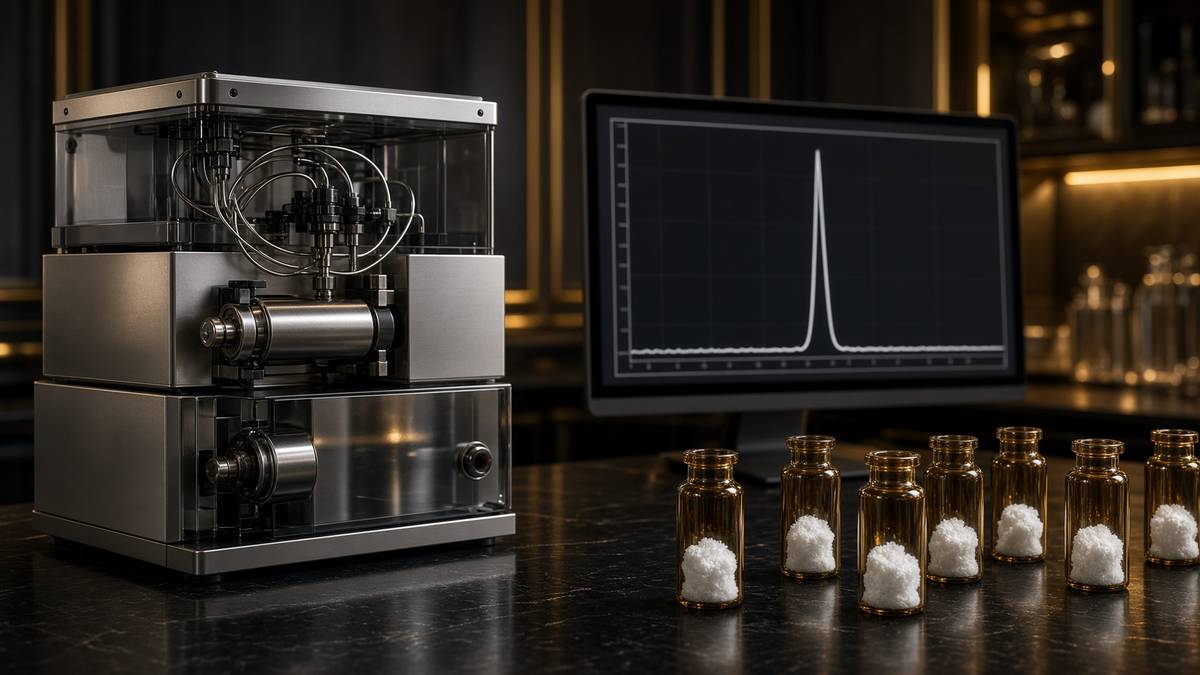
Lyophilisation is a storage format. It's not a purification. Whatever you loaded into the vial is what the cake is, plus whatever the cycle did to it. If the load was a 90 percent crude, the cake is a 90 percent crude with nicer handling. If the load was a main peak at or above 98 percent by HPLC, with a mass that matches the published sequence, the cake is that object with the water pulled off. Reverse-phase C18 holds hydrophobic chains longer; an acetonitrile gradient with a little TFA lets them go in order; detection at 214 or 220 nanometres watches the peptide bond. A single sharp peak at the expected retention time is the adult result. A fat shoulder is a mixture wearing a compound's clothes. Mass spectrometry then asks whether the peak's mass is the calculated monoisotopic mass, including a fatty-acyl handle if the structure has one, including copper if the structure is GHK-Cu. The neighbouring synthesis essay is that argument at length. This page needs the one sentence: a beautiful lyophilised plug of the wrong chain is a very tidy way to waste a month. Dry does not mean right.
In short. Freeze-drying stores whatever you put in the vial. A pretty cake can still be the wrong chain or a mixture. HPLC and mass spectrometry are how you know.
Reconstitution cannot repair a deletion peptide. It cannot un-oxidise methionine, un-deamidate asparagine, or un-scramble a disulphide. It can hide a problem, if undissolved material is left on the glass and you assay the supernatant, or if a co-solvent you added is now 2 percent of a cell medium. It can create a problem, if shaking foamed the chain onto the wall, if tap water brought metals, if a week at room temperature after puncture grew something. The certificate speaks to the solid as released. The solution has a history that starts when you add solvent. For a quantitative assay you still want the solid's HPLC-MS, because that is identity and purity of the starting material, and you want a handling record that does not add undeclared variables. ≥98 percent HPLC is a specification on the cake because that's the level at which the main species is allowed to be the variable in the tube. No clinical claim hides in that number. Laboratory hygiene. A clean peak of the wrong mass is still the wrong molecule, which is why HPLC and MS travel together. Freeze-drying then keeps that molecule still enough to ship. Solvent does not invent a better chain.
In short. Adding solvent does not fix a wrong or dirty solid. It can even make new problems. The certificate describes the cake; the solution's history starts when the liquid goes in.
Neighbouring essays sit on the other floors of the same building. What peptides are: amino acids joined by this amide, shorter than proteins, more specific than most small-molecule drugs, insulin as the first medicine anyone bothered naming, the catalogue as published primary structures labelled for the bench. How they are made: Merrifield's resin, Fmoc cycles, TFA cleavage, C18 HPLC, a mass. GHK-Cu: glycine-histidine-lysine holding copper, a polar tripeptide whose reconstitution is not a heroic solvent story and whose certificate still matters because a copper complex is a stoichiometry as well as a sequence. This page is water as enemy, ice as template, vacuum as the path around the liquid, Karl Fischer as the number, mass over volume as the arithmetic, benzyl alcohol as a preservative after puncture. Read them as a set if you are holding a vial. The cake is the storage form of the object those pages defined. Solvent is how that object becomes a concentration. Neither page is a protocol for a body. The synthesis chromatogram does not become optional because the plug looks professional. Looks are not a peak area. You still want the trace, and you still want the mass.
In short. Other pages cover what peptides are, how they are made, and GHK-Cu. This page is how the dry cake becomes a known solution.
Once it is a solution, the clock starts again
Hours of an experiment are a respectable lifetime for many aqueous peptides if the tube is cold, closed, and not a metal-catalysed oxidation bath. Months are not. The opening paragraphs named why: hydrolysis thermodynamically favoured, deamidation at Asn, Asp–Pro nicks, methionine sulphoxide, cysteine pairing, tryptophan colour, microbes after puncture. Lyophilisation bought you the months by removing most of the water. Reconstitution spends that purchase. A freezer full of aliquots of solution is a common laboratory habit and a different stability study from a freezer full of cakes; freeze–thaw of aqueous peptides can precipitate, can foam at the ice interface, can concentrate solutes in the last liquid in ways that echo the freeze-concentrate of lyophilisation without the controlled drying. If you need the same concentration on Thursday that you mixed on Monday, that is a dating question, not a hope. Ultraviolet, HPLC, a fresh cake — pick the check that matches how much the assay cares. The cake on the shelf remains the stock format. The solution is the working format. Mixing those jobs is how a laboratory ends up assaying a yellow liquid and calling it by the name on a two-month-old tube.
In short. A solution is for the hours of an experiment. The dry cake is for months. Freezing liquid aliquots is a different, often harsher, story than keeping the cake dry.
Verification is allowed to be boring. If the assay is quantitative, you still check that the cake dissolved: clear, not opalescent unless the paper said it would be, no film, absorbance or a second method in the range you expect from the mass and the extinction. Adsorption to pipette tips at low micromolar is a real loss; some papers pre-treat plastic or keep a carrier protein in the diluent. Light on a clear tube on the bench is the tryptophan experiment again. A warm block is Arrhenius again. Repeat puncture of a working vial is the microbe experiment again, which is the only reason bacteriostatic water entered this page. None of these checks is a ritual. Each maps to a reaction already named. The point of writing them in one place is so that reconstitution stays what it is: laboratory handling of a characterised solid into a solution of known concentration, in a solvent the sequence accepts, for the duration of an experiment, with a certificate that already said the solid was the published chain. Duration of an experiment is hours, perhaps a working day on ice. It's not a warehouse.
In short. If the measurement must be quantitative, check the cake dissolved and the plastic did not steal peptide. Keep the working solution for the experiment, not for storage.
The dry cake, between experiments, still wants the four enemies kept off: heat, light, oxygen, moisture. Closed, cold, dark, stopper intact. Let a refrigerated vial warm before you open it so that room air does not condense on a sub-zero plug and add the water you spent a freeze-dryer removing. Don't store cakes in a humid fridge door next to a beaker of something wet. Don't leave them in sun on a loading dock and then ask Karl Fischer to forgive you. Manufacturing freeze-drying can stopper under vacuum or dry nitrogen; your laboratory cannot redo that once you have cracked the cap, which is a reason not to crack it until you need the solution. A desiccator is a tool. So is putting the vial back where the temperature is a number you measure. I realise this reads like a list of obvious points. The obvious points are the ones that turn a ≥98 percent cake into a different analyte without anyone touching a pipette. Residual moisture was the specification. Handling is how you keep the specification true after the parcel arrived.
In short. Keep unused cakes closed, cold and dark. Let a cold vial warm before opening so water does not condense on the plug. Once the cap is off, you cannot put the factory dryness back.
Handling a cake is not a protocol
We're staying on the bench: no body drawn, no milligrams-per-millilitre scheme that looks like a personal protocol, and no injection sites, body-weight divisors, or calendars. Those objects belong to licensed medicines and to the people who are legally allowed to prescribe them. A research cake plus a laboratory solvent is a reagent. The arithmetic here — certificate mass, pipette volume, concentration on a tube — is how a bench gets a known micromolar solution for an assay, a chromatography standard, a binding curve. If a sentence here is being reread as instructions for a person, the rereading is the error. Cannon and Nedergaard, in a different essay on this desk, had to keep saying brown fat is a tissue, not a product. This page has to keep saying reconstitution is handling, not a prelude. The papers that studied peptide stability in humans studied licensed products with formulations, devices and pharmacovigilance. A catalogue vial is the published primary structure, characterised, freeze-dried so that structure survives a warehouse. Different legal class. Different object. Same amide chemistry, which is why the chemistry was worth writing down.
In short. This is how a laboratory makes a solution of known strength. It is not a plan for a person. Medicines have licences, devices and monitoring. A research cake is a reagent.
So here is the picture, in one pass. Water hydrolyses amides, oxidises methionine, and grows microbes; those reactions are slow when cold and dry and fast enough, in solution, that we ship a cake. Lyophilisation freezes, sublimes ice below the triple point with the product held under collapse temperature, then desorbs bound water until Karl Fischer sits in the low single-digit percent. The pores are ghosts of ice; wet them, wait, don't shake foam into a lying concentration. Reconstitution is mass over volume in a solvent the sequence accepts — water or dilute acetic acid for many polar chains, a named co-solvent when the paper is talking about a hydrophobic or fatty-acylated one. Bacteriostatic water is sterile water plus 0.9 percent benzyl alcohol after repeat puncture, the related listing on this shelf, not a buffer. The cake still needs HPLC and a mass, because dry is not identity. Research-use-only is the legal class of the solid and of the solvent. A fridge is a rate constant. The phase diagram does not care what we wanted the molecule for. It cares whether the water was ice, vapour, or still in the cake.
In short. Dry cakes last because most of the water is gone. Solutions are for the experiment. The solvent listing is laboratory water with a preservative.
- Amide hydrolysis is thermodynamically favoured and kinetically slow when cold and dry. Asp–Pro scission, Asn deamidation via succinimide, Met sulphoxide, Cys disulphides, Trp oxidation are the named paths.
- Lyophilisation: freeze, primary drying (sublimation under vacuum, product below collapse temperature), secondary drying (desorb bound water). Below the triple point of water, about 6 mbar.
- WWII plasma and penicillin industrialised the process. Altmann freeze-dried tissue decades earlier. A peptide cake is the same physics with a residual-moisture specification.
- Karl Fischer residual moisture often needs to sit under 1–3 percent by weight or solid-state hydrolysis resumes. Heat, light, oxygen and a damp stopper are the four enemies of the closed vial.
- Cake pores are ghosts of ice crystals. Wet, capillary, wait. Shaking makes foam and a lying concentration.
- Reconstitution is milligrams on the certificate divided by millilitres added. Polar chains: water or dilute acetic acid. Hydrophobic or fatty-acylated chains: the co-solvent the paper specifies.
- Bacteriostatic water is sterile water plus 0.9 percent benzyl alcohol after repeat puncture. Related product bac-water is that laboratory solvent listing, a preservative system for the bench.
- HPLC-MS still belongs to the cake. Freeze-drying stores the object. It does not create purity or identity.
Questions the essay actually answers
- Why not just ship peptides dissolved?
- Hydrolysis, oxidation and microbes. A freeze-dried cake with low residual moisture is the storage format that keeps the primary structure through a warehouse and a lorry. Solutions are for the hours after you add solvent, not for months in transit. The amide is thermodynamically unhappy in water; kinetics only protect you when the cake is cold and dry.
- Can I use tap water?
- Tap water brings ions, microbes, chlorine and often dissolved metals, and the metals catalyse methionine and cysteine oxidation. Bacteriostatic water is a laboratory solvent with 0.9 percent benzyl alcohol after puncture. Distilled or deionised laboratory water is the other honest baseline. The sink is a reagent cocktail you did not mean to add.
- What does Karl Fischer have to do with a vial?
- It measures residual water in the cake. That number predicts shelf life. A pretty plug that is still 8 percent water is a hydrolysis experiment in slow motion. Many lyophilised peptides aim for the low single-digit percent by weight, often under 1 to 3 percent. Appearance is not an assay. Fischer's iodine–sulphur dioxide stoichiometry is.
- What is bacteriostatic water, exactly?
- Sterile water plus 0.9 percent benzyl alcohol as an antimicrobial preservative so repeat puncture does not turn the vial into a culture on the same day. It is not a buffer, not a pH specification, not a universal solvent for hydrophobic chains, and not a permission. Related product bac-water is that laboratory listing. Preservative slows growth. Technique still matters.
- Why does shaking a cake make foam?
- The cake is a porous solid templated by ice. Solvent is supposed to climb those pores by capillary action. Shaking beats in air, creates a large interface, and peptides sit there, sometimes as a film on the glass. The bulk concentration then lies. Wet, wait, swirl gently if the paper does. Foam is not a method.
- Do all peptides dissolve in the same solvent?
- No. Polar chains often take water or dilute acetic acid. Hydrophobic stretches and fatty-acylated incretin analogues may need a co-solvent the paper actually names. A C18-acylated chain is not GHK, and treating it as if it were is how you get a film on the glass and a concentration that exists only on the label. Sequence first, then solvent. Then the division.
- What is collapse temperature?
- The temperature above which the frozen concentrate flows instead of holding the shape templated by ice. Exceed it during primary drying and you get melt-back: a film or a shrunken plug, higher residual moisture, slow wetting. It sits near the glass transition of the freeze-concentrate and depends on sequence and excipients. Shelf temperature is not this number. Product temperature is.
- Once reconstituted, how long does the solution last?
- For the hours of an experiment, if you keep it cold, closed, and in a solvent the sequence accepts. That is a dating question for the assay you are running, not a warehouse lifetime. Hydrolysis, oxidation and microbes resume when water is back. The dry cake remains the stock format. A week of solution on a warm shelf is a different molecule with the same label.
- Is reconstitution a dose?
- No. It is milligrams on the certificate divided by millilitres you add, written on a tube, used so a pipette can deliver a known mass into an assay. No body-weight divisor, no injection map, no calendar. Licensed medicines have formulations, devices and pharmacovigilance. A research cake is a characterised solid. Arithmetic for a bench.
- Why does a freeze-dried cake still need HPLC?
- Because lyophilisation stores whatever you loaded. A beautiful plug of a deletion peptide is still a deletion peptide. Reverse-phase C18 plus a mass is identity and purity of the solid. Reconstitution cannot repair a wrong chain. The neighbouring synthesis essay is that chromatogram. This essay is only how the object is dried and dissolved.
Hypothetical research reconstitution
How this vial is typically mixed
Hypothetical research reconstitution for the named catalogue vial. Not a protocol, not medical advice, not a use instruction. These amounts sit in published and commonly cited laboratory ranges. The vial is labelled for research use only — not for human or veterinary administration.
Bacteriostatic water
10ml
Water + 0.9% benzyl alcohol — the diluent, not a peptide
- Hypothetical aliquot
- Whatever the peptide card above specifies
- See the peptide you are reconstituting
- How often
- —
- —
Bench steps
- This bottle is the water, not the molecule.
- Draw only what the peptide card asks for (usually 1–5 ml, 10 ml for the 1000mg NAD+ cake).
- Do not mix two peptides in this bottle. Mix in the peptide vial.
- Keep sealed, room temperature or fridge. Discard 28 days after first puncture.
Not a dose. If a peptide listing is in the bag, use this as the 0.9% benzyl-alcohol water those cards call for.
Bacteriostatic water and sterile syringes ship with peptide orders over £75. Kit details · 10 ml bacteriostatic water
The molecule in the essay
The same published structure the essay describes — HPLC-characterised.
Read next
49 min · long read · Peptide research
What are peptides? Short chains that run the body
Peptides are amino acids joined by peptide bonds — shorter than proteins, more specific than most small-molecule drugs. Insulin was the first. GLP-1 agonists are the current proof. The catalogue here is the same chemistry, labelled for research.
53 min · long read · Peptide research
How research peptides are made — and why HPLC actually matters
Solid-phase peptide synthesis builds a chain one residue at a time. HPLC then asks whether the main peak is what you think it is. ≥98% is not a slogan. It is a chromatogram.
45 min · long read · Peptide research
GHK-Cu: a copper tripeptide that rewrites a spreadsheet of genes
Pickart isolated GHK from plasma fractions that made old liver tissue synthesise proteins like young tissue. The tripeptide holds copper. The live claim is a transcriptome, not a moisturiser.
More in this desk

53 min · long read · Peptide research
Recovery, GH pulses and the CJC / ipamorelin pair
Somatotrophs have two 'go' receptors. CJC without DAC is a slightly longer GHRH pulse. Ipamorelin is a selective ghrelin-receptor key that does not yank ACTH. Together they are the pair Bowers already showed is more than additive — not a gym protocol.
52 min · long read · Peptide research
Fatigue, cellular energy and the NAD+ / MOTS-c neighbourhood
NAD+ is the rechargeable chip every cell spends on fuel and DNA repair — and the pool shrinks with age. MOTS-c is a mitochondrial 16-mer sent out under metabolic stress. Two answers to 'I have no energy' that are not coffee.
51 min · long read · Peptide research
Melanocortin circuits: pigment, appetite and PT-141
Melanotan II lights MC1, MC3, MC4 and MC5 — pigment plus the rest of the sheet. PT-141 is the free-acid cousin pointed at MC3 and MC4, the circuitry papers use for desire and energy, not skin colour. Same Arizona family. Different question.
51 min · long read · Peptide research
GHRH and ghrelin mimetics: two keys on the same pituitary lock
Somatotrophs have two ‘go’ receptors — GHRHR (Gs–cAMP) and GHSR (Gq). Bowers showed that occupying both releases more GH than the sum of either. That is synergy as a receptor fact, not a smoothie.
Essays describe published research. They are not medical advice and they do not authorise human use of any catalogue item.