

Clinic · 45 min · 9,790 words
NEOGEN nitrogen plasma: what the energy actually does to skin
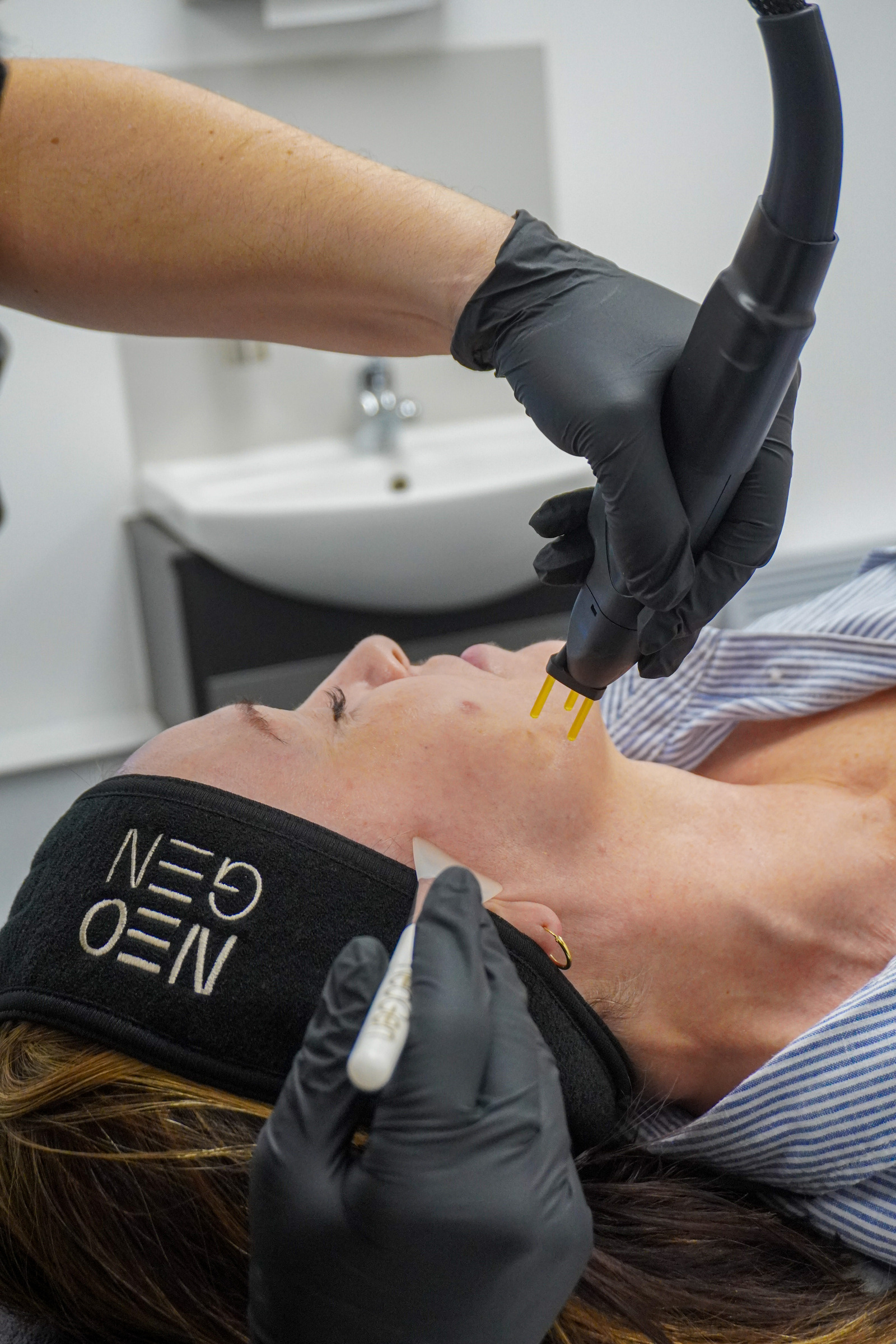
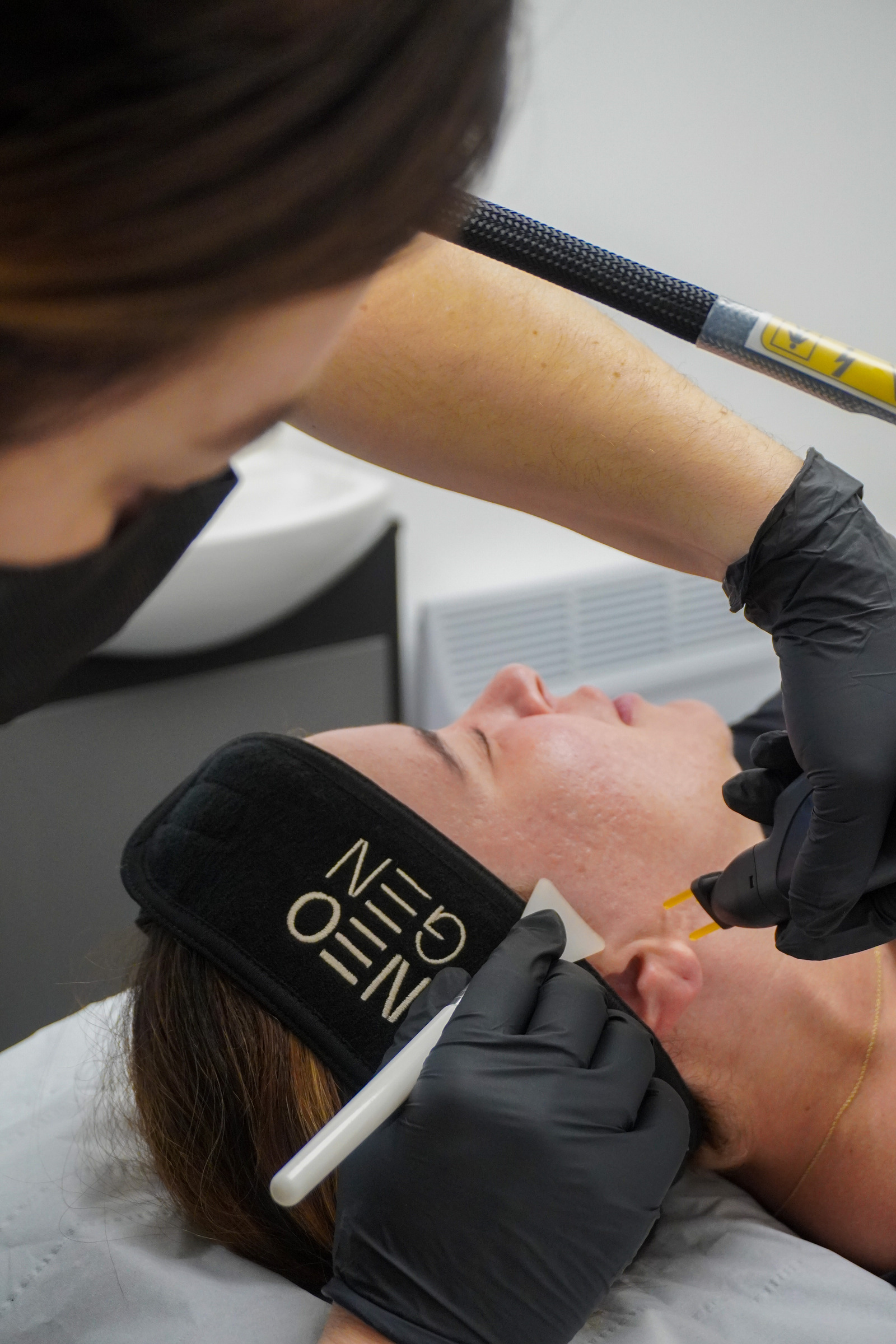
NEOGEN plasma at eLIVEate Me in Buckinghamshire. Nitrogen plasma denatures collagen without a laser chromophore. A course of three, then 90 days of rebuild.
· updated
What this essay actually tells you
- NEOGEN ionises nitrogen gas into plasma and delivers a thermal pulse that denatures dermal collagen. Fibroblasts then rebuild types I and III over months, which is the actual tightening.
- A typical course is three treatments because collagen remodelling is slow. The scab is not the result. The repair is.
- GHK-Cu's published fibroblast arrays shift collagen, TIMPs and MMPs. Adjacent biology. Not a product mixed into the appointment, and we don't sell it that way.
What this actually means
Lasers hunt a colour. Melanin, haemoglobin, water. Miss the chromophore and the beam does nothing useful; hit too much of it and the epidermis pays on the way in. Nitrogen plasma does not play that game. Energist NeoGen ionises a stream of N2 and the thing that hits the face is a pulse of charged gas dumping heat. Epidermis cooks just enough to go bronze and shed. A few tenths of a millimetre down, collagen fibrils unwind at about 60–70 °C, and fibroblasts treat the denatured matrix as a wound, which is the entire therapeutic idea. Over the next three months they lay new type I and type III. That is why a course of three exists rather than one dramatic pass. Copper sits on the same reading list because GHK-Cu's fibroblast arrays move collagen, TIMPs and MMPs. We stock that ligand for the bench. Nobody is pouring it into the handpiece, and the clinic in Buckinghamshire would not thank us if we suggested it.
Lasers hunt a colour, which is a different game from the one this device is playing. A carbon-dioxide beam at 10,600 nanometres is absorbed by water. An alexandrite at 755 nanometres is absorbed by melanin. Miss the chromophore and the pulse is a waste of electricity; hit too much of it and the epidermis pays on the way in. Nitrogen plasma doesn't play that game. Energist NeoGen PSR couples ultra-radiofrequency into a stream of N2 and what arrives at the face is a pulse of ionised gas dumping kinetic energy as heat. No dye, no water peak, no melanin requirement. Epidermis cooks just enough to go bronze and shed. A few tenths of a millimetre down, collagen fibrils unwind at about 60–70 °C, and fibroblasts treat the denatured matrix as a wound, which is the entire therapeutic idea. Over the next three months they lay new type I and type III. That's why a course of three exists rather than one dramatic pass. Copper sits on the same reading list because GHK-Cu's published fibroblast arrays move collagen, TIMPs and MMPs. Adjacent biology.
In short. Lasers need a colour target. Nitrogen plasma dumps heat without one. Collagen unwinds, then fibroblasts rebuild it over months.
The device has a manufacturer's name, and it's worth saying early. Energist NeoGen PSR is a nitrogen-plasma resurfacing system: radiofrequency energy strips electrons from a nitrogen stream, and the working product is a plasma, the fourth state of matter, ions and electrons in a brief pulse. Typical energy at the handpiece sits in a range of about 0.8 to 4 joules. Passes and pulse stacking then decide whether the operator is chasing texture, laxity or pigment. Peak epidermal temperature can exceed 100 °C for milliseconds. The gradient falls off steeply, so dermal heating is a controlled denaturation rather than a burn through subcutaneous fat. That sentence is thermal dosimetry, not a brand story. Kilmer, Foster, Bogle, Dover and colleagues put plasma skin regeneration into the dermatologic literature in the mid-2000s, and the histology has been fairly consistent ever since: a necrotic epidermal band that sheds as a bronzed eschar, with neocollagenesis still going at about ninety days. The physics hasn't become more mysterious. The copy around it has grown louder. The millimetres have not.
In short. The clinic device ionises nitrogen with radiofrequency and fires a heat pulse. Skin surface cooks in milliseconds; deeper collagen is warmed more gently.
Nitrogen is the working gas because it's inert — a quietly important choice. An oxygen-containing plasma would oxidise tissue as it heated it: charring, not a clean thermal gradient. N2 lets the pulse heat and leave. What you see afterwards is a bronzed, dry epidermal sheet that flakes over days. That's thermally desiccated epidermis, not a haemorrhagic scab and not a chemical peel dressed as physics. Under it, keratinocytes migrate from adnexal remnants — hair follicles, sweat ducts — and rebuild the surface. Same reservoir that lets a deep chemical peel or a fully ablative laser heal without a graft. We've watched this histology in papers for twenty years. Air plasma and nitrogen plasma aren't interchangeable reagents, any more than a CO2 laser and an Er:YAG laser are interchangeable because both are 'light'. The gas is a measurement variable. Named, it stops being a caption. Unnamed, it's how a handpiece becomes a personality.
In short. Nitrogen is used because it doesn't burn the surface the way an oxygen plasma would. The bronze flake is dried skin, not a bloody scab.
eLIVEate Me, in Buckinghamshire, is the partner clinic that actually owns a NeoGen and a diary. JP sets the energy, the passes, the interval and the consent. Patriot Peptides doesn't take a commission on that booking, doesn't write the appointment as a reconstitution of a catalogue cake, and doesn't pretend a CE-marked nitrogen-plasma device and a lyophilised research tripeptide share a pharmacokinetic file. Same stretch of extracellular-matrix biology, in the sense that both stories mention collagen I, collagen III, TIMPs and MMPs. Different product, different company, different regulator's attention. Adults can want both a paper and an appointment. Bundling them is how a research reagent becomes a medical claim it isn't allowed to be, and how a clinic becomes a webshop it's not. This page is the device physics, the denaturation temperature, the ninety-day rebuild, and the copper ligand that rhymes with that rebuild. Rhyme isn't a recipe. The rest of the page is the biochemistry you'd want before treating a bronze crust as a result, or a vial as a facial.
In short. The clinic in Buckinghamshire runs the device. The copper peptide on the research shelf is a separate object. Same tissue questions, different rooms.
Why nitrogen, and why plasma is not a laser
Plasma skin regeneration, as a named technique, isn't a 2020s invention with a new logo. Kilmer, Fitzpatrick, Goldberg and others described nitrogen-plasma resurfacing in the mid-2000s: ultra-radiofrequency coupled into N2, a millisecond thermal pulse, a bronzed epidermal sheet, dermal collagen denaturation without a chromophore. Bogle, Arndt and Dover evaluated the technology in Archives of Dermatology in 2007. Foster, Moy and Fincher reviewed the same neighbourhood in the Journal of Cosmetic Dermatology in 2008. The papers are what they're — device studies, histology, downtime, a Fitzpatrick-aware consult — not a randomised comparison against every laser on the market, and not a licence to file a handpiece as a collagen drug. Read them at the size they actually are. A necrotic epidermal band that sheds. A dermal band that remodels over months. Energy in joules, not in feelings. If a clinic protocol still looks like those papers, that's because the tissue did not change its mind about temperature. Fibroblasts still work at fibroblast speed. Collagen still denatures in the sixties of Celsius. The rest is settings.
In short. Plasma resurfacing was described in the mid-2000s with histology and downtime, not as a new collagen drug. The tissue physics hasn't changed.
Energy at the handpiece is typically 0.8 to 4 joules, and it's the passes and the pulse stacking that decide the job. One pass at modest energy is a texture conversation: a thin necrotic sheet, a milder dermal pulse. Stacked pulses, or a second pass over a zone of laxity, deposit more heat in the same neighbourhood and push the denaturation deeper. Pigment is a different bargain again, because although the plasma did not need melanin to work, melanin still sits in the epidermis that's about to become a crust. Higher energy on a darker phototype is how you buy a more obvious bronze and a higher risk of post-inflammatory pigment. None of that's mysterious. It's thermal dosimetry on a surface that happens to be a face. The operator owns the settings because the operator owns the complication. Listing a joule number here as if it were a recipe would be doing the clinic's job without the clinic's insurance. We will name the range. We won't write the pass.
In short. Dose is joules, passes and stacking. More heat means a thicker crust and a deeper collagen unwind. The clinician, not a page, sets that.
The thermal gradient is the whole reason this isn't a kitchen burn. Peak epidermal temperature can exceed 100 °C for milliseconds: enough to desiccate keratinocytes, not enough, on a well-chosen pulse, to carbonise the surface the way an oxygen plasma or a poorly controlled electrosurgery would. A few tenths of a millimetre down, the temperature has already fallen into the sixties and seventies of Celsius, which is the window where type I collagen's triple helix comes apart and the tissue shortens in the chair. Deeper still, into fat, the pulse should be a non-event if the energy and the dwell were honest. That fall-off is why nitrogen plasma can denature dermis without needing a chromophore to stop the beam, and why the same pulse isn't a licence to treat a neck at full facial energy. Thickness is a measurement variable. So is pulse width. So is whether the operator stacked. A gradient you can't name is a burn you've not yet measured. The histology after a well-run pulse is boring in the useful way: necrotic epidermis, surviving adnexae, denatured but not cooked dermis.
In short. Heat is highest at the surface for a split second and cooler a fraction of a millimetre down, where collagen actually unwinds. That fall-off is the treatment.
Give the fibroblast ninety days. That is the histology. One heroic pass just gives you a worse scab and the same cell, still working at fibroblast speed.
Collagen denatures at a surprisingly modest temperature
The triple helix of type I collagen unwinds at roughly 60–70 °C. That isn't cauterisation. Hydrogen bonds go, the fibril shortens, and the tissue tightens in the chair. Type I is a heterotrimer, two α1(I) chains from COL1A1 and one α2(I) chain from COL1A2, each helical domain about a thousand residues, glycine every third position so the three strands can pack. Hydroxyproline, written after translation by prolyl 4-hydroxylase, holds the three chains thermally; lose that residue and the melting temperature falls, which is part of why scurvy wrecks connective tissue. The denaturation temperature of a hydrated fibril in dermis is lower than the denaturation temperature of a dry, cross-linked tendon in a calorimeter, which is why the clinical window sits in the sixties rather than at some heroic hundred-and-something. Instant tightening is that unwind. It's real, it's visible, and it isn't the result people actually booked the diary for. The delayed tightening — the one that's still being argued about at three months — is fibroblasts laying new collagen I and III onto a matrix they have read as damaged. Two mechanisms. One pulse. Don't file the shrink as the rebuild.
In short. Collagen's triple helix falls apart around 60 to 70 °C. The skin tightens at once, but the lasting change is new collagen built later.
Delayed tightening is a cell, not a thermometer, and that cell works at fibroblast speed. Fibroblasts read denatured matrix as damage: integrins feel a wrecked mechanical environment, TGF-β1 is released from latent complexes and newly transcribed, and the cell switches into a wound programme. Collagen I and III are written, hydroxylated, chaperoned through the endoplasmic reticulum by HSP47, secreted as procollagen, cut, packed into fibrils, and eventually cross-linked. That pipeline doesn't clock in for a single afternoon. Levenson's classic wound-healing curves, and every histology series after a thermal insult that bothered to wait, put meaningful neocollagenesis on a scale of weeks to months. Ninety days isn't a marketing interval. It's roughly how long a dermal fibroblast takes to lay a thicker, better-organised band you can still see on a stain. One heroic pass just gives you a worse scab and the same cell, still working at fibroblast speed. The scab isn't the result. The repair is. A day-three photograph is a picture of the crust, not of the outcome.
In short. The later tightening is fibroblasts treating damaged collagen as a wound and rebuilding it for about three months. Day-three crust isn't that work.
Type III is the wound collagen; type I is the load-bearing cable. Early granulation tissue is rich in type III, a finer fibril, a provisional matrix. Over weeks the ratio shifts toward type I, the heterotrimer that dermis actually lives on, packed with a 67-nanometre D-period once the helices stagger. Plasma resurfacing is asking for both: an early type III response because you've made a wound, and a later type I replacement because you wanted a dermis, not a scar. Histology after plasma skin regeneration reports new collagen I and III in the upper dermis, a thicker organised band at three months, which is the sentence the course is built on. It isn't a promise that the D-period of a twenty-year-old has been restored, and it isn't a promise about elastin. Adult dermis makes almost no new elastin under ordinary conditions. Solar elastosis is damaged elastic material, not a factory you can switch on with a joule number. Collagen I and III are the honest readout. Elastin is a harder story and should be named as one.
In short. Early repair lays type III collagen; later repair shifts toward type I, the main skin cable. Elastin is a separate, harder problem.
- Collagen denaturation
- 60–70 °C
- Epidermal peak
- >100 °C, ms
- Handpiece energy
- 0.8–4 J
- Working gas
- N₂
- Course
- 3 treatments
- Neocollagenesis
- ~90 days
- GHK-Cu
- 340.7 Da
- Plasma GHK at 20 / 60
- ~200 / ~80 ng/ml
Type I triple helix in hydrated dermis. Instant shrink is this unwind. Delayed tightening is the cell.
Desiccates keratinocytes into a bronze eschar. Not a burn through fat if the gradient is honest.
Energist NeoGen PSR. Passes and stacking decide texture versus laxity.
Inert. Oxygen in the pulse would char. Nitrogen heats and leaves.
Remodelling is slow. Treatment two lands while treatment one is still being edited.
Types I and III. Histology, not a day-three photograph of the crust.
Gly-His-Lys · Cu²⁺. CAS 89030-95-5. Research ligand. Not a handpiece accessory.
Pickart's numbers. A falling ligand is a reason to look, not a restoration protocol.
HSP47, TGF-β1, and the fibroblast that does the work
Heat-shock protein 47 is the collagen-specific chaperone, and it belongs on this page because thermal injury and collagen folding share a named protein. HSP47, gene SERPINH1, sits in the endoplasmic reticulum and walks nascent procollagen chains so they can triple-helix. Nagata's laboratory put it on the map: no HSP47, and collagen folding fails, with a mouse phenotype that's lethal and a human genetics of osteogenesis imperfecta and severe connective-tissue folding defects when the gene is hit hard enough. After a thermal insult, heat-shock proteins rise as a class; HSP47 rises as the collagen specialist. That's a fibroblast doing quality control on a product it has just been asked to make more of. It isn't a reason to write HSP47 as a device setting. It's a reason to stop talking about 'collagen stimulation' as if the helix assembled itself in the extracellular space. The helix is folded inside the cell, with a chaperone, before anyone secretes it. A plasma pulse denatures the old fibril outside. The new fibril still has to be written, hydroxylated, chaperoned and secreted. HSP47 is that indoor step, named.
In short. HSP47 is a helper protein inside the cell that folds new collagen. Heat injury raises it. The new helix is built indoors, not in the crust.
TGF-β1 is the double-edged growth factor of this tissue, and thermal remodelling leans on it whether anyone names it or not. In a clean wound it recruits fibroblasts, induces collagen and lysyl oxidase, and helps close the defect. In a chronic wound or a fibrotic organ the same factor keeps writing matrix until the organ is a scar. Dose, duration, context, and which TGF-β isoform, which receptor, which Smad versus non-Smad arm: the difference between healing and fibrosis isn't a different molecule. It's the same molecule left on too long, or heard in a cell that has already senesced, or heard without the decorin that would have buffered it. After nitrogen plasma, TGF-β1 is part of how the denatured gel becomes a rebuild programme. That's desirable for ninety days in a face that wanted tightening. It would be less desirable as a permanent loud signal in a keloid-prone dermis, which is one reason a consult isn't a coupon. Plasma doesn't invent TGF-β1. It asks a wound pathway to run. Naming the factor keeps the pathway honest.
In short. TGF-β1 tells fibroblasts to make matrix after injury. Helpful for a timed rebuild; harmful if the same signal never switches off.
The denatured gel has to be cleared as well as replaced. Matrix metalloproteinases, MMP-1 in particular — interstitial collagenase — nick native type I and type III at a specific site so gelatinases can finish the job. After a thermal insult those scissors come out, which is appropriate: you've just made a population of unwound fibrils that shouldn't sit forever as a stiff, disordered mass. TIMPs, tissue inhibitors of metalloproteinases, are the sheaths. Four TIMPs, overlapping specificities, a local stoichiometry. A fibroblast that writes more MMP than TIMP will chew a hole. A fibroblast that writes more TIMP than MMP will keep matrix, including matrix you might have wanted gone. Histology after plasma resurfacing matches the textbook wound-healing arc: necrotic epidermis, surviving adnexae, a clearance-and-rebuild dermis, then a thicker organised band at three months. The arc is why a second pass a month later lands on tissue that's still being edited, and why a photograph of the bronze sheet is a photograph of the start. Scissors and sheaths, then new helix. Not a scab.
In short. Enzymes must cut away the unwound collagen before new fibres can be laid. Inhibitors keep that cutting from becoming a hole.
Diagram
Closed chromatin (H3K27me3, DNA methylation) hides the promoter. Pioneer factors and histone acetyltransferases open it.
PIC: TFIID, TFIIH, Mediator, Pol II. Ser5 phosphorylation of the CTD lets the polymerase leave the promoter.
Elongation ~20–40 nt/s. Capping, splicing, cleavage and polyadenylation happen on the still-growing RNA.
Human genes are islands in 3.1 billion base pairs of mostly noncoding sequence. Promoter, enhancers, chromatin state and the Mediator complex decide whether Pol II is allowed to fire. Epithalon’s literature sits on TERT and pineal clocks — two of the rare promoters anyone bothers to name in a peptide essay.
Transcription of collagen isn't a same-day event, and a plasma pulse doesn't skip the machine. COL1A1, COL1A2 and COL3A1 have to be found in chromatin, a pre-initiation complex assembled, RNA polymerase II released from pausing, the message spliced and exported, the chain translated into the rough endoplasmic reticulum. A change in a stain at ninety days is a change in that pipeline accumulated across thousands of fibroblasts, not a joule number that 'became collagen' in the chair. TGF-β signalling through Smads is one of the ways those promoters are opened after injury. Mechanical stretch through integrins is another. The Cell-desk essay on gene to protein is the machine. This page is the thermal insult that asked the machine to run a wound programme. Treating the crust as a mechanism is the usual overreach. Treating the crust as a clock that started a transcriptional programme is the adult use of a device paper. Pol II still elongates at something like 20 to 40 nucleotides per second. Heat doesn't make it a laser.
In short. New collagen means genes being read, messages built and protein folded, which takes weeks. The heat pulse starts that work. It isn't the work.
A dermal fibroblast isn't a passive bricklayer. It transcribes collagen I and III as the bulk of the dermis, collagen IV as a basement-membrane component at the dermoepidermal junction, and a sheet of matricellular proteins and proteoglycans that decide how those collagens pack. Decorin binds fibrils, sets diameter, and sequesters TGF-β. SPARC sits at cell-matrix contacts. The cell feels stiffness through integrins, focal-adhesion kinase, and a cytoskeletal argument the actin essays treat from another door. A wrecked matrix after thermal denaturation is a mechanical signal as much as a chemical one. The fibroblast that rebuilds is reading both. That's why energy, pass count and interval aren't interchangeable with a cream, and why a ligand claimed to shift the same cell's transcriptome — more collagen, more TIMP, less MMP — sits on the same reading list without being a setting on the handpiece. Two inputs, one cell type. The cell doesn't care which company sold which input. A paper does.
In short. Fibroblasts build skin matrix and feel whether that matrix is intact. Heat wrecks the old fibres; the cells notice and change what they make.
The bronze eschar is not the result
What you see afterwards is a bronzed, dry epidermal sheet that flakes over days. Call it a scab if you like, in ordinary English, and then put the word down, because a haemorrhagic scab is a different object: blood, fibrin, a wound that reached vessels. The bronze eschar of nitrogen plasma is thermally desiccated epidermis, keratinocytes cooked just enough to die in place and then shed as a sheet. Under it the dermoepidermal junction and the adnexal remnants decide whether re-epithelialisation is tidy. A well-chosen pulse leaves those remnants. A pulse that was too greedy, or stacked on thin skin, can take more than the sheet and then you have a different healing problem. The bronze isn't a trophy. It's a visible marker that the epidermis took a millisecond above boiling and is now a necrotic band. Patients photograph it because it's photographable. Histology photographs the dermis at ninety days because that's where the claim lives. Two cameras. Two timescales. Don't let the first steal the second.
In short. The bronze flake is dried surface skin, not a bloody scab. It shows the top layer took the heat. The real change is deeper and slower.
Re-epithelialisation after a plasma pulse uses the same reservoir a fully ablative laser uses. Keratinocytes migrate from hair follicles and from eccrine sweat ducts, cover the denuded surface, and rebuild a stratum corneum over days. That's why hair-bearing facial skin forgives a necrotic epidermal band that glabrous skin would not, and why eyelids and some neck zones are thinner, less adnexal, and get lower energy. Same physics as a Baker-Gordon peel or a fully ablative CO2 pass, with a different way of depositing the heat. The plasma did not invent adnexal healing. It relies on it. If a consult skips appendageal density and talks only about joules, the consult has skipped the healing organ. Fitzpatrick phototype still belongs in the same conversation because the crust will look different and post-inflammatory pigment is a keratinocyte-melanocyte problem, not a chromophore-absorption problem. Nitrogen plasma sidestepped melanin as a requirement. It did not sidestep melanin as a complication.
In short. New surface skin grows out from hair follicles and sweat ducts. Thinner, less hairy sites need gentler settings. Skin colour still shapes the crust.
The scab isn't the result. The repair is. That sentence is the whole clinical argument, and it's the one a day-three photograph most likes to flatten. A bronze eschar means the epidermis was thermally killed and will shed. Remodel of the dermis, replacement of type I collagen, TGF-β1 finishing its recruitment, HSP47 walking new chains, lysyl oxidase writing cross-links: those jobs haven't happened yet, and they run on a different clock. A typical course is three treatments because that clock is slow, and because a second and third pulse can land while the first is still being edited. One pass is a wound. Three is how you stack a programme without asking one insult to do ninety days of work overnight. A single heroic pass sold as a finished collagen result has measured the crust and invoiced the fibroblast as if it were a laser. The cell is slower than a pulse. Give it the months it actually uses.
In short. The bronze crust is the start, not the outcome. New collagen takes months, which is why a course of three exists.
The scab is not the result. The repair is. Day three is a necrotic sheet. Day ninety is whether the fibroblast showed up.
Why a course of three, and why ninety days
A typical course is three treatments, spaced on the order of a month, because collagen remodelling is slow. Treatment two lands while treatment one is still being remodelled: fibroblasts already writing type III, MMPs already clearing denatured gel, TGF-β1 already in the neighbourhood. The second thermal pulse is therefore not a repeat of a naive dermis. It's a pulse into a wound programme that has started. That's either a feature — stacking the stimulus while the factory is open — or a reason to wait if the first insult was heavy. The clinic owns that judgement. The journal can only name the clock. Levenson's classic wound-healing curves, and every subsequent series that plotted collagen content against time, put the rise on weeks and the remodelling on months. Ninety days after the last pulse is a reasonable histology time point, not a loyalty scheme. Courses of one exist in the world. They exist as wounds. Courses of three exist because someone sat with the curve. The collagen curve is the reason the course exists.
In short. Three sessions about a month apart stack work on a slow rebuild. The second pulse hits tissue already repairing the first.
Histology after plasma skin regeneration is pretty consistent across the mid-2000s series, which is a better sentence than most device categories earn. A necrotic epidermal band. Surviving follicular and eccrine epithelium. Upper-dermal collagen showing tinctorial change consistent with denaturation, then, at later time points, a thicker, better-organised collagen band, type I and type III both represented. Neocollagenesis still going at about ninety days. That's the picture Bogle, Kilmer, Foster and colleagues were pointing at. It's also the picture a sceptic should demand if a new handpiece claims the same physics. Energy in, necrotic sheet out, dermal rebuild on a three-month clock. If the stain at day seven looks dramatic, you're looking at injury. If the stain at day ninety looks organised, you're looking at the claim. That distinction earns its keep if you've ever been asked to read a device paper that only showed the crust. Show the later band, or admit you've a wound photograph.
In short. Under the microscope, day seven is injury. Around day ninety you may see a thicker, better-ordered collagen layer. That later picture is the claim.
Spacing isn't a personality. A month between pulses is a compromise between still being in the remodelling window and not restacking heat onto an epidermis that hasn't finished coming back. Too soon, and you're pulsing necrotic or barely re-epithelialised surface; downtime lengthens and pigment risk rises. Too late, and you've let the first wound programme close before the second stimulus arrives, which is a legitimate choice if the first pass was aggressive, and a slower way to stack if it was not. Eyes, lids and neck are thinner and get lower energy; they also get more conservative spacing when they're treated at all. None of this is mysterious. It's thermal dosimetry plus epithelial kinetics on a face. JP owns the settings because JP owns the complication. A page that printed a calendar as a protocol would be doing his job without his room. We will say a month is typical. We won't pretend typical is a law of collagen.
In short. A month between sessions is a usual compromise: surface healed enough, deeper rebuild still running. Thinner sites are treated more gently.
Fitzpatrick still belongs in the consult
Fitzpatrick phototype still belongs in the consult, even though the plasma did not need melanin as a chromophore. That distinction is the one a clever sentence most likes to smash. Chromophore-independence means the pulse doesn't require pigment to deposit energy. It doesn't mean pigment is irrelevant to the aftermath. More epidermal melanin makes a more obvious crust and carries a higher risk of post-inflammatory hyperpigmentation, because keratinocyte injury plus melanocyte activity is how that pigment is written, laser or plasma or peel. Darker phototypes can still be treated. They're treated with more conservative energy, more honest downtime counselling, and sometimes with a different device altogether if the pigment risk is the dominant problem. Fitzpatrick's 1975 scale was a sunlight conversation. It remains a crust-and-pigment conversation. Nitrogen plasma sidestepped the absorption requirement. It did not sidestep the melanocyte. The pulse doesn't need a colour target, and pigment can still complicate the aftermath.
In short. The pulse doesn't need pigment to work. Darker skin can still crust more obviously and pick up colour afterwards, so settings still change.
Eyes, lids and neck are thinner, less densely adnexal in places, and they get lower energy. Periorbital skin can still be a plasma indication in experienced hands; it's also how you buy a complication if the joule number was copied from a cheek. Neck skin has fewer follicles than a beard cheek, a different mechanical load, and a reputation for scarring if ablative energy is greedy. None of that's a reason to mystify the anatomy. It's a reason to let the clinician who owns the device own the map. A journal essay that listed a periocular protocol would be a protocol, and this page isn't one. What the page can say is narrower and still useful: thermal dosimetry scales with thickness and with adnexal reserve; Fitzpatrick phototype scales the crust and the pigment risk; the bronze sheet isn't the result; three sessions on a ninety-day clock is how the fibroblast is actually employed. JP's room, JP's consent, JP's energy. Buckinghamshire isn't a catalogue number.
In short. Eyelids and neck are thinner and less forgiving. Energy comes down. The clinician who owns the device owns those decisions.
Mitochondria notice, because collagen is expensive
Diagram
Matrix
- TCA cycle · β-oxidation · mtDNA nucleoids
- NADH produced here. Complex I spends it.
- MOTS-c (MRWQEMGYIFYPRKLR) from 12S rRNA.
Inner membrane
- I → II → III → IV → V (ATP synthase)
- ~150 mV proton-motive force
- ~40–60 kg of ATP turned over per human day
mtDNA is 16,569 bp, 37 genes, 13 proteins of the respiratory chain. Nuclear DNA encodes the other ~1,200 mitochondrial proteins. NAD+ is the hydride carrier between dehydrogenases and Complex I. MOTS-c is a 16-mer translated from 12S rRNA — a peptide the mitochondrion wrote itself.
Collagen synthesis is expensive, which is why mitochondria belong in a plasma essay even though the handpiece never names them. Each type I heterotrimer is three thousand-residue chains, heavily hydroxylated, folded, secreted. Prolyl 4-hydroxylase and lysyl hydroxylase spend 2-oxoglutarate, iron, molecular oxygen and ascorbate on those modifications. Peptide-bond formation itself spends GTP on the ribosome. Trafficking through Golgi spends more ATP. A fibroblast asked to replace a denatured band is therefore a cell whose respiratory chain has been given a job. Complex I still wants oxidised NAD+. ATP synthase still spends the proton-motive force. A tissue that has just taken a thermal pulse is also a tissue that has a transient injury metabolism: leakier membranes, a ROS blip, a heat-shock programme. The rebuild that follows isn't a mystical glow. It's millimoles of ATP and a named set of dioxygenases. Photobiomodulation at cytochrome c oxidase is a neighbouring clinic conversation, Dermalux, a different essay. This paragraph is only the invoice: new collagen is an energy-intensive product. The organelle that mints the phosphate will notice.
In short. Making collagen costs a lot of cellular energy. Mitochondria supply that energy. A heat treatment asks those organelles to fund a rebuild.
Prolyl 4-hydroxylase is the existence proof that collagen is a post-translational product, not a sequence you can dump into a wound. The enzyme, a 2-oxoglutarate-dependent dioxygenase in the endoplasmic reticulum, oxidises selected prolines in the Y position of Gly-X-Y. It needs iron, ascorbate and molecular oxygen. Scurvy is what happens when the ascorbate is missing: under-hydroxylated chains fail to form a stable triple helix, and connective tissue falls apart. A plasma pulse doesn't supply ascorbate, iron or oxygen. It supplies denatured matrix and a TGF-β1-leaning wound signal. The fibroblast still has to run the hydroxylase. HSP47 still has to walk the fold. Lysyl oxidase, later and extracellular, still has to see copper if the new fibril is to become a cable rather than a gel. Those indoor and outdoor steps are why a thermal device and a copper tripeptide can share a reading list. They're also why sharing a reading list isn't sharing a bowl. The pulse denatures. The cell hydroxylates. The metal finishes. Three jobs.
In short. New collagen must be chemically finished inside the cell, including a vitamin-C-dependent step. Heat doesn't do that finishing. The cell does.
After a thermal insult the fibroblast's energy budget isn't a lifestyle topic. Heat-shock proteins are induced, including HSP47 and the more generic HSP70 family; that induction is itself ATP-expensive. Mitochondria in injured cells can leak more superoxide for a time, and SOD1, the cytosolic copper-zinc enzyme, is part of how that leak is mopped. A copper-delivery ligand sits next to that sentence the way it sits next to lysyl oxidase: same metal, different enzyme, still not a facial. NAD+ as a hydride carrier sits next to the same organelle from another door, and in-clinic NAD+ at eLIVEate is a different product again. The point of naming the mitochondrion here is narrower. A ninety-day collagen programme is a ninety-day ATP programme. A device paper that never mentions the organelle has still employed it. A catalogue that sells a cofactor or a copper complex hasn't thereby earned a place in the handpiece. Neighbourhood, on this page, is a courtesy on a reading list. It isn't a combination claim.
In short. Injured cells spend energy on heat-shock proteins and on mopping extra oxidants. The rebuild that follows is still an energy bill, paid by mitochondria.
Where a copper tripeptide enters the reading list
Loren Pickart, in the early 1970s, fractionated human plasma and found a tripeptide that shifted protein synthesis in aged liver tissue toward a younger pattern — a small chain with a large afterlife. Glycine, histidine, lysine. It usually arrived with a copper ion attached, which turned out not to be a contaminant. Pickart and Thaler published in 1973. Maquart, Pickart, Borel and colleagues showed, in 1988, that the GHK-Cu complex stimulated collagen synthesis in fibroblast cultures. That paper is still the one to hand a sceptic: the readout was collagen, the cells were fibroblasts, the ligand was the copper complex. Plasma GHK, on Pickart's numbers, sat around 200 nanograms per millilitre at age twenty and about 80 at age sixty. Restoration stories write themselves from that arithmetic, and most of them should be sent back. Restoring a circulating tripeptide isn't the same work as restoring a dermis after nitrogen plasma. It's a reason to look. The look has to be an assay with copper stoichiometry declared, a cell type named, and a readout that isn't a photograph of a bronze eschar.
In short. A three-amino-acid piece of blood, usually carrying copper, was found in the 1970s and later shown to raise collagen in cultured skin cells.
Cu2+ is a d9 ion with a strong preference for square-planar geometry. GHK offers it a tridentate grip: the N-terminal nitrogen of glycine, a deprotonated peptide-bond nitrogen, and the imidazole nitrogen of histidine. The lysine side chain is usually a charge and a handle, not the fourth ligand in the simple 1:1 complex. That geometry is why the complex is stable enough to keep free copper from roaming and labile enough, in the right neighbourhood, to hand the metal to an enzyme that wants it. Lysyl oxidase needs copper to build its lysine tyrosylquinone cofactor and to oxidatively deaminate lysine in collagen and elastin; no metal, no cross-link, a weak gel. SOD1 needs copper at the active site to disproportionate superoxide. Free copper plus peroxide is Fenton chemistry and a hydroxyl radical. Delivery without a redox-active pool is therefore the chemical sentence, before any transcriptome is mentioned. GHK-Cu is that bet at peptide scale. It isn't Atox1 and it isn't CCS. It's a small circulating complex on the same problem those proteins were built to solve.
In short. GHK holds copper tightly enough to stop it making radicals, loosely enough to pass it to enzymes that cross-link collagen or mop superoxide.
GHK-Cu's published fibroblast arrays shift collagen, TIMPs and MMPs. Pickart, Vasquez-Soltero and Margolina put those lists into reviews in the 2010s, drawing on Affymetrix-era profiles of cultured human cells treated with the complex. Collagen genes up. Decorin up. TIMPs up. MMP-1 and MMP-3 down. A DNA-repair cassette up, a metastatic cassette down, TGF-β and integrin signalling in fibroblasts moved rather than simply amplified. Breadth is an extraordinary claim. A copper ionophore that rescued two enzymes would already be worth a bench. A copper complex that rewrites a few percent of the expressed genome is a different object, closer to a differentiation factor than to a metal chaperone. Extraordinary claims aren't automatically false. They're expensive. They cost replication on RNA-seq with a false-discovery-rate threshold, copper-matched controls, and a second cell type. Until that replication exists, two things can be true at once. Copper delivery to lysyl oxidase and SOD is enough to be interesting. The spreadsheet-reset is a hypothesis with a published outline. Adjacent to a plasma rebuild, the interesting neighbourhood is still collagen, TIMP and MMP.
In short. Gene-chip studies claim the copper peptide turns collagen and its protectors up and some collagen-cutting enzymes down. That list still wants a modern repeat.
Diagram
- GHKGly-His-LysPickart, 1970s plasma fraction. ~200 ng/ml at 20; ~80 ng/ml at 60.
- Cu²⁺ complexsquare-planarHistidine imidazole + backbone nitrogens. The product is the complex.
- Lysyl oxidaseLOX / LOXLCopper enzyme. No metal, no collagen cross-links, a weak gel.
- SOD1Cu/ZnFirst mop for superoxide. Same metal, different job.
- Free Cu²⁺FentonCu⁺ + H₂O₂ → HO·. Delivery without a redox-active pool is the point.
Pickart and Margolina’s microarrays claim thousands of transcripts. Modern RNA-seq with multiple-testing correction is the replication the claim still owes. Copper delivery to LOX and SOD would remain interesting if the spreadsheet shrinks.
A nitrogen-plasma pulse denatures dermal collagen and asks fibroblasts to rebuild types I and III over months. That's one object. A copper tripeptide, in dishes, moves the same cell's collagen, TIMP and MMP transcripts and supplies a metal those matrix enzymes use. Those sentences can sit on one page without becoming a protocol. Mixing them in a bowl is how you invent a homemade post-plasma serum that neither the device manufacturer nor a research-label catalogue is allowed to bless. We're sometimes asked to mix them in a bowl. We don't. eLIVEate's tool is a CE-marked nitrogen-plasma device. GHK-Cu on the catalogue is Gly-His-Lys with copper, HPLC-characterised, labelled for laboratory use. The clinic wouldn't thank anyone for suggesting the second be poured into the first. Partner clinic. Their diary, their consent, their energy settings. Our chromatogram. The overlap is intellectual. It's supposed to stay that way.
In short. Heat-triggered rebuild and copper-peptide cell biology share collagen language. That's a reading list, not a reason to mix a vial into the device.
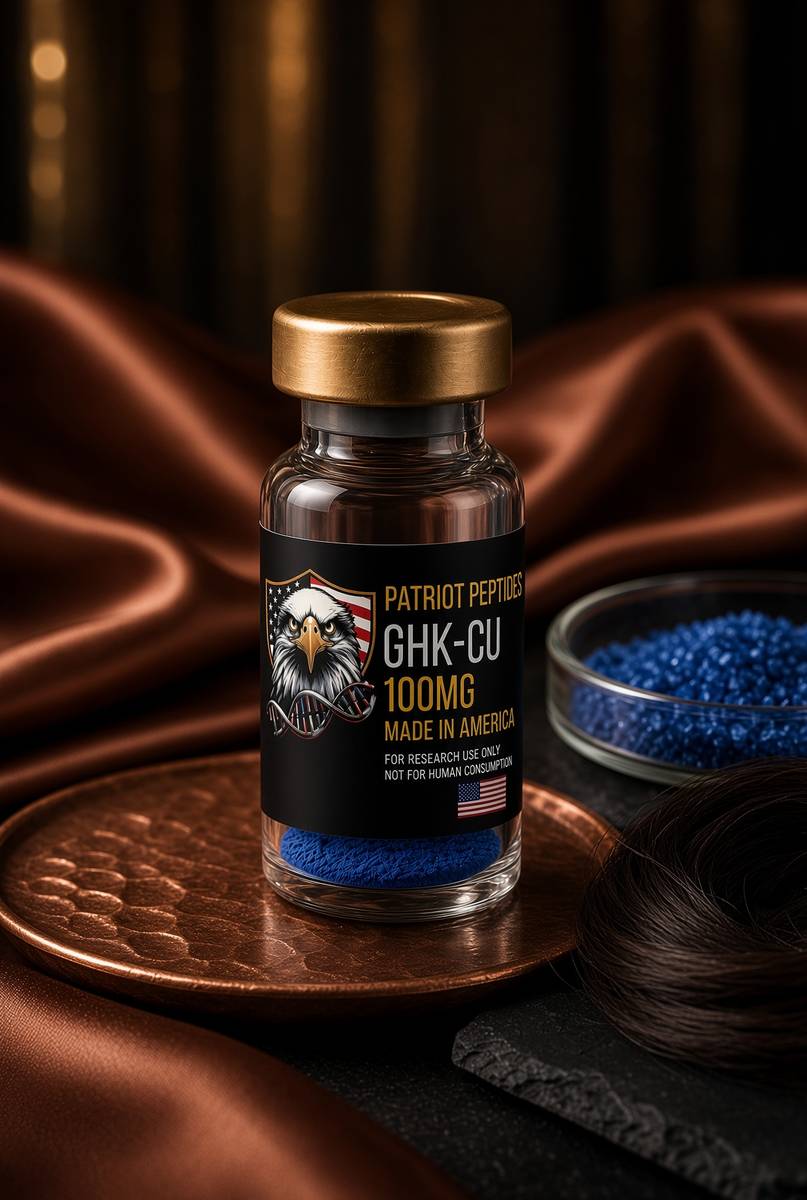
The Patriot vial is a research ligand. Gly-His-Lys holding Cu2+, CAS 89030-95-5, a complex mass of about 340.7 grams per mole, HPLC-characterised, lyophilised, labelled for in-vitro work. It's the same carbon skeleton Maquart put on fibroblasts in 1988 and the same complex Pickart's arrays treated as a transcriptome reagent. It isn't a CE-marked device accessory. It isn't a serum. It isn't poured into the NeoGen handpiece, and the handpiece wasn't designed to receive it. If you can't yet say how many nanomoles went into a well, the experiment hasn't started. A social post that treats the vial as a facial hasn't read the label, and the label is the legal class of the object. Water, light and freeze-thaw are the enemies of a copper-peptide solution; the lyophilised solid is how you store it. None of those sentences is a dose. None of them is a route. None of them is a schedule after nitrogen plasma. The physiology above doesn't depend on the vial. The label does.
In short. The copper peptide in the catalogue is a laboratory chemical with a chromatogram. It isn't a cream and it isn't loaded into the plasma handpiece.
Adjacent biology is not a mixed protocol
eLIVEate Me is a separate company. The appointment is nitrogen plasma, booked in Buckinghamshire, under their governance, with a consent form and a clinician who sets joules. Patriot Peptides doesn't take a commission on that booking. Same stretch of matrix biology, in the sense that both rooms mention collagen. Different product, different regulator's attention. You can want both a paper and an appointment in the same month. Bundling them is how a research reagent becomes a medical claim it isn't allowed to be, and how a clinic becomes a webshop it's not. The physics of ionised nitrogen doesn't depend on that split. The denaturation temperature doesn't depend on it. The ninety-day fibroblast clock doesn't depend on it. The label on the vial does. Partner clinic. Their diary. Our chromatogram. Keep them in different drawers, even when the reading lists sit next to each other on purpose.
In short. The clinic booking and the research vial are different companies and different legal objects. You can read both. You shouldn't blend them.
The emails arrive because the tissue is the same. A plasma pulse denatures collagen; GHK-Cu papers talk about collagen. A plasma pulse asks TGF-β1 and HSP47 to work; copper enzymes finish the helix those proteins helped to write. MMP and TIMP appear on both pages. It isn't a stupid question. It's a category error that happens when two honest literatures share a noun. The fix isn't to pretend they don't share it. The fix is to keep the objects named. Energist NeoGen PSR is a nitrogen-plasma device. GHK-Cu is a square-planar copper tripeptide. eLIVEate books the first. The catalogue sells the second as a laboratory reagent. A facial isn't a stack. A chromatogram isn't a consent form. We will keep filing the essays next to each other because the overlap is real. We won't write the sentence that turns the overlap into a protocol. That sentence doesn't survive contact with either object.
In short. People mix the two stories because both mention collagen. Shared words aren't a shared product. Name the device and name the ligand.
What mixing would actually be, if anyone did it, is a category error with a chemical shadow. Adding a copper complex to a thermally injured epidermis isn't a published plasma-skin-regeneration protocol. It's an uncontrolled metal-and-wound experiment on a face that's already running TGF-β1, MMPs and a necrotic sheet. Free copper is a Fenton reagent. Bound copper is a different object, but the binding doesn't survive every vehicle, every pH, every time-on-the-bench. Device manufacturers write IFUs about energy, gas and aftercare. They don't write IFUs about research peptides. Research labels write that the contents aren't for human use. They don't write aftercare for a bronze eschar. Putting the two documents in one drawer is how a category error gets written. This page won't design that experiment. It will say why the experiment isn't the appointment, and why the appointment isn't the vial.
In short. Putting a research copper peptide onto freshly heat-injured skin isn't a published treatment. It's an untested mix of metal chemistry and a wound.
Diagram
| Node | Catalogue | Conversation |
|---|---|---|
| GPCR | Ipamorelin, MT2, PT-141, retatrutide, CJC | Second messengers, secretion, appetite, pigment |
| RTK / IGF1R | IGF-1 LR3 | IRS–PI3K–Akt–mTOR and Shc–ERK |
| Cytokine receptor | Somatropin (HGH) | GHR–JAK2–STAT5b, hepatic IGF-1 |
| Cofactor | NAD+ | Sirtuins, PARPs, CD38, redox |
| Actin buffer | TB-500 / Tβ4 motif | G-actin sequestration, motility |
| Growth-factor-like | BPC-157 | VEGFR2 / FAK / eNOS neighbourhood |
| Copper ligand | GHK-Cu | Transcriptome shift in fibroblasts |
| MC fragment | KPV | NF-κB, PepT1, no pigment |
| Nuclear / pineal | Epithalon (AEDG) | TERT and melatonin literatures |
| mtORF peptide | MOTS-c | AMPK, folate–methionine cycle |
Each row is a different kind of molecular conversation. The catalogue peptides bind at these nodes; they are not interchangeable, and stacking them because a forum did mixes unrelated literatures.
The catalogue map of ligands is larger than one copper tripeptide, and the map is the reason to keep identity boring. GHK-Cu is a copper ligand with a fibroblast-transcriptome literature. KPV is an NF-κB-quieting fragment of α-MSH, a keratinocyte story more than a dermal-cable story. BPC-157 sits on a gastric and endothelial neighbourhood. TB-500 is an actin-buffer motif. NAD+ is a cofactor. MOTS-c is a 16-mer from mitochondrial 12S rRNA. Filing all of that under 'skin' is how a forum builds a smoothie. Filing each under its node is how a laboratory designs a blot. Spare receptors, compartmentation, and the fact that a nanomolar dish isn't a person all still apply. The peptide-map diagram that follows is a neighbourhood sketch, not a combination claim. If a bench wants the named copper complex, that's one sequence for one question. Logistics of a rebuild after nitrogen plasma is a clinic question. Two jobs. Two rooms.
In short. Other research peptides sit near skin or energy biology. Each occupies a different node. A map isn't a recipe for mixing them into a facial.
Neighbouring clinic procedures share tissue without sharing physics. CELL STORY is silica spicules that puncture stratum corneum, a micro-injury and delivery conversation, Percutaneous Collagen Induction's shallower cousin. Dermalux is photons at 415, 633 and 830 nanometres, porphyrins and cytochrome c oxidase, a course of six because transcription accumulates. In-clinic NAD+ is a cofactor solution put into muscle, a different legal object from a lyophilised dinucleotide. NEOGEN is heat and collagen. Four procedures, four neighbouring ligand literatures, one partner clinic in Buckinghamshire. The index essay on peptides and aesthetic procedures is the map so you don't have to guess which page belongs next to which appointment. Nothing on that map is a protocol for mixing a research vial into a facial. Start with the physics. Then, if a ligand's paper is actually about that physics, read the ligand. A course of three nitrogen-plasma pulses is still a course of three nitrogen-plasma pulses if you never open the GHK-Cu essay. The reverse is also true.
In short. Other clinic tools next door use spicules, coloured light, or a NAD injection. They share skin as a topic, not a mechanism and not a bundle.
What an honest measurement would actually be
A fair measurement after plasma isn't a selfie. Histology at a named interval, with stains that actually see collagen I and III, is the gold standard the mid-2000s papers used. High-frequency ultrasound or optical coherence tomography can follow dermal thickness non-invasively if someone bothers to calibrate. Punch biopsies are a clinic decision, not a journal instruction. MMP-1 ELISA on conditioned medium belongs to a dish, not to a cheek. Photographs, if you must, should be standardised: same light, same camera, same interval, and a willingness to show day ninety as well as day three. A bronze eschar is easy to photograph because it's brown. A reorganised dermal band is not. Device papers that only show the crust are injury papers. Device papers that show the later band are remodelling papers. Ask which one you've been handed. Then ask what energy, what phototype, what interval, and whether anyone named the gas. Nitrogen is a measurement variable. Unnamed, it's just a caption.
In short. Read the treatment by later collagen organisation, not by a day-three photograph of the bronze crust. Name the energy, the skin type and the wait.
If a bench wants to study GHK-Cu next to thermal denaturation, the dish is the place, and the controls are the point. Heat a type I gel or a fibroblast-derived matrix into the 60–70 °C window, or apply a defined thermal pulse the way a methods paper would, not the way a handpiece would. Then add GHK-Cu at a declared copper stoichiometry, with a GHK-without-copper arm, a copper-salt arm, and a vehicle. Read collagen I/III, TIMP-1, MMP-1, HSP47, a TGF-β1 readout, and, if you claim a cable, a cross-link or a LOX activity assay. RNA-seq if you're going to mention a transcriptome, with a false-discovery-rate threshold. BAPN if you're going to mention lysyl oxidase. None of that's a facial. None of that's an eLIVEate protocol. It's how you ask whether a copper complex changes what a thermally insulted fibroblast does, which is a legitimate question the arrays only outlined. Design it so the result would still stand if someone repeated the assay next door.
In short. A fair lab test would heat collagen or cells, add the copper peptide with proper comparison dishes and measure collagen, cutting enzymes and the folding helper.
What plasma doesn't prove is as important as what the histology shows. Elastin isn't restored: adult dermis barely writes tropoelastin. A thicker dermal band isn't a twenty-year-old's D-period, and it isn't a birth certificate. Whether GHK-Cu would help, hinder, or do nothing in that wound is a separate experiment, and that experiment isn't the appointment. Fitzpatrick type remains relevant because pigment complications don't require a chromophore to exist. The device also doesn't replace a fully ablative laser, a radiofrequency microneedling system, or a peel; those are different energy-delivery problems with their own papers. Nitrogen plasma is a thermal pulse that denatures collagen without a laser chromophore, followed by a fibroblast rebuild of types I and III over months. That's a large, named, measurable claim. Neighbouring claims can stay on neighbouring pages: the copper spreadsheet, the LED lamp, the spicule facial. The pulse doesn't need them to stay interesting.
In short. Plasma's own claim is already large: planned heat, and then new collagen. It isn't a proof about elastin, skin type, or the copper peptide.
- Name the insult: energy in joules, passes, nitrogen as the gas, phototype.
- Name the clock: day-three eschar is injury; ~90 days is the rebuild claim.
- Name the product: collagen I and III, not a selfie, not elastin unless you stained it.
- If the dish is GHK-Cu, declare copper stoichiometry, a GHK-only arm and a copper-salt arm.
- If you claim a cable, show LOX activity or a cross-link, not only a transcript.
- Do not pour the vial into the handpiece. Adjacent is a reading list.
Close: energy, a cell, a ligand on another shelf
Elastin is the harder story, and it deserves a heading's worth of honesty even without a heading. Tropoelastin is secreted, aligned on a fibrillin microfibril scaffold, and then cross-linked by LOX family members into desmosine and isodesmosine, the tetrafunctional residues that make elastin a rubber. Adult dermis makes almost no new elastin under ordinary conditions. Solar elastosis is a mess of damaged elastic material, not a fresh network you can switch on with 2 joules of nitrogen plasma. A reagent that feeds LOX copper in a fibroblast culture can still be asked what it does to tropoelastin transcription and to cross-link density. A plasma pulse can still be asked, on a stain, whether elastic fibres look less wrecked. Answering either question with a photograph of a face is the usual category error. Answering with desmosine, a LOX activity assay, or an elastic stain at ninety days is a paper. Until those papers are the ones in the consult, the honest caption after NEOGEN is new collagen I and III, not a new rubber network. Collagen is enough to be interesting.
In short. Adult skin barely makes new elastic fibre. Plasma's honest readout is new collagen, not a restored rubber network from youth.
Photoageing is a different thermal and photon problem, and collapsing it into plasma resurfacing is how MMP-1 gets asked to do two jobs at once. Ultraviolet B induces interstitial collagenase in fibroblasts through AP-1, and the enzyme then nicks type I fibrils; Fisher, Voorhees and colleagues spent the 1990s putting that pathway on slides. Fragmented collagen wrecks the mechanical environment, and the fibroblast writes less new collagen because the wrecked matrix tells it, via integrins, to stop. Nitrogen plasma also denatures collagen, but it does so in a millisecond pulse at 60–70 °C, with a necrotic epidermal band, as a planned wound. UV is chronic, chromophore-dependent at DNA and at urocanic acid, and it doesn't book a course of three. GHK-Cu's arrays putting MMP-1 down sit next to the UV story more cleanly than they sit next to a planned denaturation, which actually needs MMPs to clear the gel. Adjacent is a reading list. It's still not a sunscreen, and it's still not a plasma setting. Keep the UV experiment and the plasma experiment on separate plates.
In short. Sun damage slowly nicks collagen through a different path than a planned heat pulse. Don't treat those as the same injury or the same fix.
How to use this page is narrower than device copy usually is. Read it for the physics: nitrogen plasma, no chromophore, 60–70 °C, HSP47, TGF-β1, a bronze eschar, a ninety-day rebuild of types I and III, a course of three. Read the GHK-Cu essay for the copper chaperone, the lysyl oxidase node, and the microarray claim. Read the map essay if you're trying to place NEOGEN next to CELL STORY, Dermalux and in-clinic NAD+. Then book, or do not, with the clinician who owns the device. Procedures belong to the person who sets the energy, the interval and the consent. Research sequences belong on a bench with a chromatogram. Adults can want both information and a treatment without anyone bundling them. We don't take a commission on eLIVEate bookings, which is the simplest way we know of keeping the two objects from collapsing into a product code. Start with the physics. Leave the vial in the vial.
In short. Use this page for the heat physics and the three-month rebuild. Use the copper-peptide essay for the ligand. Book the device with the clinic that owns it.
Leave with a map of the biology, not a basket of products. Energist NeoGen PSR ionises nitrogen and delivers a thermal pulse. Epidermis becomes a bronze eschar and sheds. Dermal type I collagen denatures at about 60–70 °C. Fibroblasts, via TGF-β1 and a heat-shock programme that includes HSP47, rebuild types I and III over weeks to months. A typical course is three because that clock is slow. The scab isn't the result. The repair is. Fitzpatrick phototype still shapes the crust and the pigment risk even though melanin wasn't the absorption requirement. GHK-Cu is a square-planar copper tripeptide whose fibroblast arrays shift collagen, TIMPs and MMPs, and whose metal feeds lysyl oxidase and SOD1. Adjacent biology. Not a product mixed into the appointment. eLIVEate Me in Buckinghamshire owns the device and the diary. The catalogue owns a research ligand. Mitochondria will notice the rebuild because collagen is expensive. Transcription will notice because COL1A1 doesn't write itself. None of those sentences is a protocol. All of them are measurable.
In short. Carry this: nitrogen heat, collagen unwind, months of rebuild, three sessions, copper peptide next door on paper, not in the handpiece.
Kilmer, Bogle, Foster, Dover: those are the device papers to put on the bench if the question is nitrogen plasma rather than a brand. Nagata on HSP47 if the question is how a new helix is walked through the endoplasmic reticulum. Levenson if the question is how long a wound takes to accumulate collagen. Pickart and Thaler, 1973, and Maquart, 1988, if the question is the copper tripeptide. Pickart, Vasquez-Soltero and Margolina if the question is the microarray census, read as a hypothesis-generating list, not as a finished genome. Fitzpatrick, 1975, if the question is why phototype still belongs in a consult that no longer needs melanin to deposit energy. That's a week of evenings, not a personality. The bronze photographs will still be there when you come back, and they will look smaller. The ninety-day stains will look larger. That re-weighting is the point of sitting with the primary papers instead of with the handpiece copy. The tissue did the work. The papers named the work. The crust was the clock starting.
In short. Named papers cover the device, the folding helper, the wound clock, the copper peptide and skin type. Read those before the waiting-room line.
Ageing dermis, on this node, is a matrix that has been nicked more often than it has been replaced: MMP-1 from ultraviolet and from senescent secretions, a wrecked mechanical environment, a fibroblast that has started to write less collagen because integrins told it the neighbourhood was already a mess. Nitrogen plasma is a planned, bounded version of damage, a millisecond at denaturation temperature, then a request to run the wound programme in the other direction. That sentence is a research and a clinical programme. It isn't a diagnosis of ageing, and it isn't a product. The programme runs on joules, on phototype, on interval, on histology rather than well-being scores, and on a willingness to publish the stain that did not thicken. GHK-Cu sits on the same node from the ligand side: copper to the cross-linking enzyme, a claimed shift in the warehouse transcriptome. Two doors. One tissue. Time, in a dermis, is also elastin you won't get back, and pigment you may not want, and a hundred other clocks. This one you can heat, and then wait.
In short. Ageing skin is collagen nicked faster than it's replaced. Plasma is a planned injury that asks the repair programme to run. That's a programme, not a product for time.
Research-use-only. Not for human consumption / not a medicine. The GHK-Cu on the listing is a laboratory reagent, HPLC-characterised, labelled for in-vitro work: a fibroblast dish, a copper-stoichiometry experiment, a TIMP and MMP panel, a lysyl oxidase activity assay whose aldehyde you actually measure. The physiology in the paragraphs above is public, cited, and older than the vial: Kilmer, Bogle, Foster, Nagata, Levenson, Pickart, Maquart. Use it to design the experiment you have the controls for, with the drain of the old fibril named, the compartment of the new helix named, and the time point written down. The appointment at eLIVEate Me in Buckinghamshire is a different legal object, a CE-marked nitrogen-plasma device, a clinician, a consent. We will sell you the named ligand. We won't tell you it's a serum you can put on a bronze eschar and draw as youth. Cellular time in a dermis is a set of rates. This rate you can heat, in a clinic, or weigh, in a tube, with a chromatogram on the bench beside it. Keep the two rates in two rooms.
In short. The copper peptide is a research chemical for experiments, not a medicine and not part of the plasma appointment. The heat biology is public. Measure it. Don't mix the rooms.
Questions the essay actually answers
- How is nitrogen plasma different from a CO₂ laser?
- CO₂ at 10,600 nm needs water as a chromophore. Nitrogen plasma ionises N₂ and dumps heat without a colour target, so pigment is not the absorption requirement. Both can denature collagen. Crust, downtime and the Fitzpatrick rules still differ.
- Why a course of three?
- Dermal fibroblasts lay new type I and III collagen over roughly 90 days after a thermal insult. A second and third pass land during that remodelling window. One pass is a wound. Three is how you stack the programme without asking one insult to do ninety days of work overnight.
- Is GHK-Cu part of the appointment?
- No. It is a copper-binding tripeptide with published fibroblast gene-expression data. We keep it on a research label. The appointment is nitrogen plasma, booked with eLIVEate Me in Buckinghamshire. Nobody is pouring the vial into the handpiece.
- What is the bronze crust?
- Thermally desiccated epidermis, not a haemorrhagic scab. Keratinocytes cooked just enough to die in place and then shed as a sheet. Under it, keratinocytes migrate from hair follicles and sweat ducts. The crust is the clock starting. The result is the later dermal band.
- Does Fitzpatrick type still matter?
- Yes. The pulse does not need melanin to deposit energy. Darker epidermis still makes a more obvious crust and carries a higher risk of post-inflammatory pigment. Chromophore-independence is not pigment-irrelevance.
- What temperature denatures collagen?
- Type I's triple helix unwinds at about 60–70 °C in hydrated dermis. Instant tightening is that unwind. Delayed tightening is fibroblasts rebuilding types I and III over months, with HSP47 walking the new chains and TGF-β1 leaning the wound programme.
- What does HSP47 do here?
- Heat-shock protein 47, gene SERPINH1, is the collagen-specific chaperone in the endoplasmic reticulum. After thermal injury it rises with the heat-shock programme and walks nascent procollagen so the triple helix can form. The new fibril is folded indoors. The pulse denatured the old one outside.
- Is the research vial mixed into the treatment?
- No. The Patriot listing is Gly-His-Lys·Cu²⁺, HPLC-characterised, labelled for laboratory use. eLIVEate's tool is a CE-marked nitrogen-plasma device. Adjacent biology. Different companies. No commission on the booking.
- How long until collagen rebuilds?
- Meaningful neocollagenesis is a weeks-to-months clock. Histology after plasma skin regeneration still shows new type I and III at about 90 days. That is why the course exists, and why a day-three photograph is a photograph of injury.
- What is Energist NeoGen PSR?
- A nitrogen-plasma resurfacing system: ultra-radiofrequency coupled into an N₂ stream, typical handpiece energy 0.8–4 J, a millisecond thermal pulse, no laser chromophore. The clinic in Buckinghamshire owns the device and the settings.
Hypothetical research reconstitution
How this vial is typically mixed
Hypothetical research reconstitution for the named catalogue vial. Not a protocol, not medical advice, not a use instruction. These amounts sit in published and commonly cited laboratory ranges. The vial is labelled for research use only — not for human or veterinary administration.
GHK-Cu
100mg
Mix with 5 ml bacteriostatic water → 20 mg/ml
- Hypothetical aliquot
- 1–2 mg
- 0.05–0.10 ml · 5–10 units on a U-100 syringe
- How often
- Once daily
- 4–8 weeks
Bench steps
- Let the vial sit until it is no longer cold to the touch.
- Wipe the stopper with 70% isopropyl alcohol. Let it dry.
- Draw 5 ml bacteriostatic water (0.9% benzyl alcohol).
- Run the water slowly down the inside glass — do not blast the cake.
- Roll between finger and thumb until the cake is gone. Do not shake.
- Label the date. Store the solution at 2–8 °C. Do not freeze. Use within 30 days unless the note below says otherwise.
The solution is blue if the copper is on the peptide. Grey or colourless is the wrong cake. 100mg wants 5 ml or the syringe marks get silly.
Bacteriostatic water and sterile syringes ship with peptide orders over £75. Kit details · 10 ml bacteriostatic water
The molecule in the essay
The same published structure the essay describes — HPLC-characterised.
 Research onlyOut of stock
Copper complex
GHK-Cu
100 mg GHK-Cu. Pickart’s copper tripeptide, lyophilised.
4.9(590)
100 browsing this now · 5 purchased in the last 24 hours
100mg
£35.00
Partner clinic
NEOGEN nitrogen plasma at eLIVEate Me
Great Missenden, Buckinghamshire. Book on their diary. We take no commission.
Prices and booking for NEOGEN nitrogen plasmaRead next
49 min · long read · Clinic
Peptides and aesthetic procedures: a map, not a protocol
NEOGEN, CELL STORY, Dermalux and in-clinic NAD+ at eLIVEate Me — four procedures, four neighbouring peptide literatures. Read the map. It is not a bundle.
45 min · long read · Peptide research
GHK-Cu: a copper tripeptide that rewrites a spreadsheet of genes
Pickart isolated GHK from plasma fractions that made old liver tissue synthesise proteins like young tissue. The tripeptide holds copper. The live claim is a transcriptome, not a moisturiser.
47 min · long read · Clinic
Dermalux LED phototherapy: light as a mitochondrial instruction
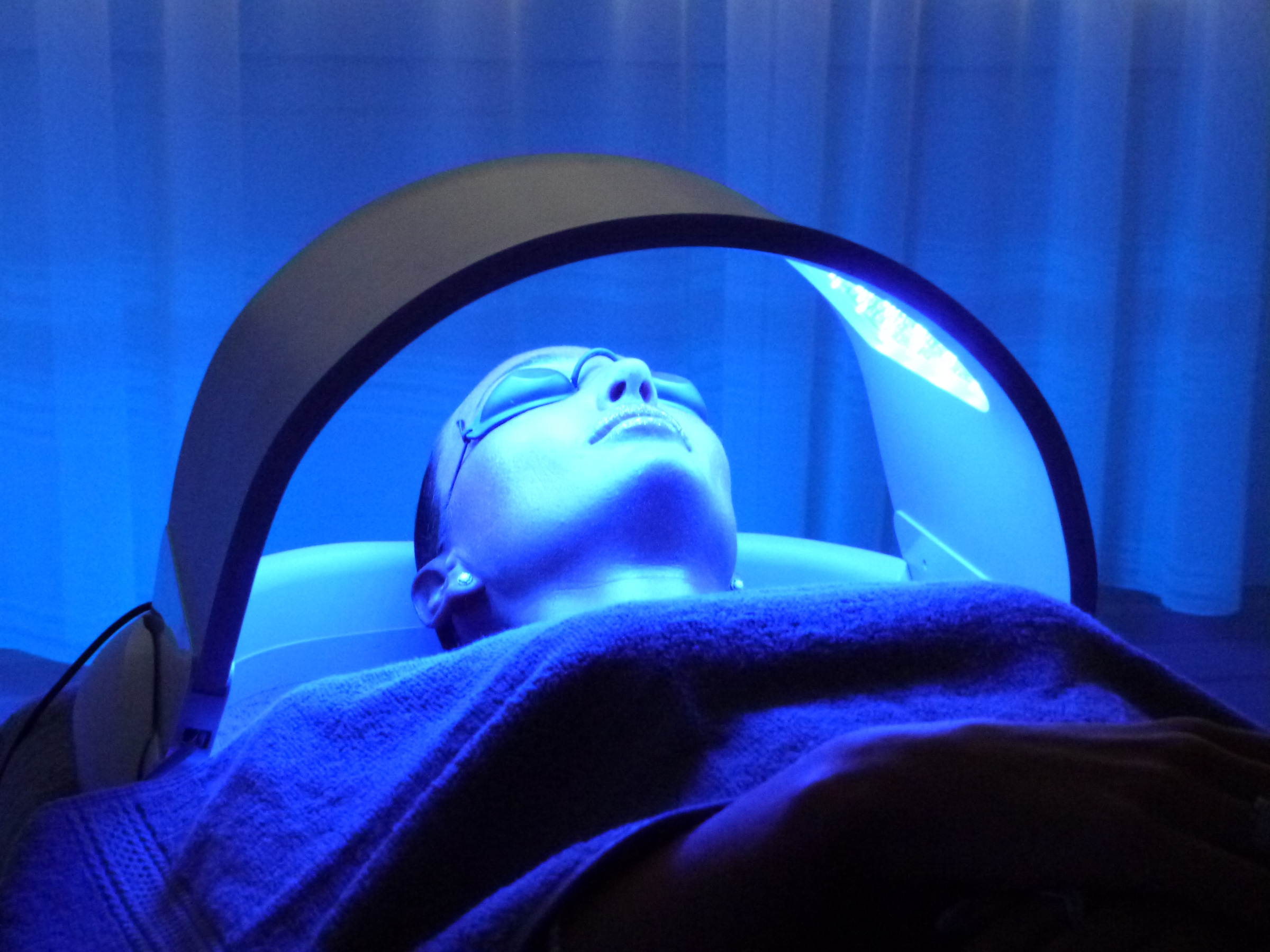
Dermalux LED in Buckinghamshire. Blue 415 nm hits acne bacteria; red 633 nm and near-infrared 830 nm talk to cytochrome c oxidase. A course of six is how repair accumulates.
More in this desk
50 min · long read · Clinic
CELL STORY liquid microneedling: 50,000 Microspears, no needle gun
CELL STORY at eLIVEate Me in Great Missenden. Sponge Microspears open transient channels, stimulate collagen, and shed in 72 hours — microneedling without a gun.

49 min · long read · Clinic
In-clinic NAD+ and the lyophilised research vial are not the same product
In-clinic NAD+ at eLIVEate Me (£200/month IM) is not Patriot’s 1000 mg lyophilised research vial. Same molecule class, different product, different till.
Essays describe published research. They are not medical advice and they do not authorise human use of any catalogue item.