

Clinic · 49 min · 10,805 words
Peptides and aesthetic procedures: a map, not a protocol
NEOGEN, CELL STORY, Dermalux and in-clinic NAD+ at eLIVEate Me — four procedures, four neighbouring peptide literatures. Read the map. It is not a bundle.
· updated
What this essay actually tells you
- Thermal remodelling (NEOGEN) sits next to GHK-Cu's collagen/MMP literature. Micro-injury (CELL STORY) sits next to GHK-Cu and KPV. Reading lists, not recipes.
- Photobiomodulation (Dermalux) is a mitochondrial instruction. Repair-peptide papers are a different door into the same stretch of tissue.
- Patriot Peptides takes no commission on eLIVEate bookings. The journal is a map. We didn't bundle a facial with a vial, and we're not about to.
What this actually means
Aesthetic procedures are physics first. NEOGEN is a thermal pulse that denatures collagen. CELL STORY is silica spicules that puncture the stratum corneum. Dermalux is photons absorbed by cytochrome c oxidase and by bacterial porphyrins. In-clinic NAD+ is a cofactor solution put into muscle. Each of those insults or inputs has a published biology, and each biology has a ligand literature that rhymes with it. Rhyme isn't a recipe, which is the sentence we keep having to write. GHK-Cu next to remodelling, KPV next to inflammatory tone, BPC-157 and TB-500 next to repair and migration, melanocortins next to pigment, lyophilised β-NAD+ next to the sirtuin budget. This page is the index so you don't have to guess which essay belongs next to which appointment. Nothing on it is a protocol for mixing a research vial into a facial. eLIVEate is a partner clinic in Great Missenden. We don't take a commission on the booking. Their diary is medical-aesthetic work. Our till is research reagents. Different rooms, different paperwork, and we keep them that way because that's how both jobs stay clean.
If you walk into a treatment room in Great Missenden, the first thing worth naming is physics, not a peptide. A nitrogen-plasma pulse is a thermal dump that denatures collagen — heat that unfolds the triple helix of the dermis's main cable. Silica spicules are high-aspect-ratio needles that puncture stratum corneum, the dead outer brickwork of skin. A light-emitting-diode head is a set of wavelengths absorbed by cytochrome c oxidase — the last enzyme of the respiratory chain — and by bacterial porphyrins. An intramuscular NAD+ appointment is a charged dinucleotide put into a muscle belly. Each of those insults or inputs has a published biology, and each biology has a ligand literature that rhymes with it. Rhyme is not a recipe, which is the sentence this page exists to keep writing. GHK-Cu next to remodelling. KPV next to inflammatory tone. BPC-157 and TB-500 next to repair and migration. Melanocortins next to pigment. Lyophilised β-NAD+ next to the sirtuin budget. The four clinic essays already walk the devices. This one is the index, so you don't have to guess which paper belongs next to which appointment, and so nobody has to invent a homemade post-procedure serum to fill the gap.
In short. A clinic procedure is physics hitting tissue. A peptide paper is a named chain in a dish. Sharing a tissue is not a recipe.
Four appointments sit on one partner diary at eLIVEate Me in Great Missenden, Buckinghamshire, and it's worth walking through them as themselves. NEOGEN is nitrogen plasma, typically a course of three, a bronze epidermal sheet, ninety days of dermal rebuild. CELL STORY is liquid microneedling with roughly fifty thousand siliceous Microspears, channels for hours, spicules for a couple of days, no steel gun. Dermalux is photobiomodulation at 415, 633 and 830 nanometres, often a course of six, because transcription does not clock in for a single afternoon. In-clinic NAD+ is a supervised intramuscular administration, weekly on that diary, a prepared solution under the clinic's governance. JP owns the energy settings, the fluence, the depth and the consent. We do not. Partner clinic is a precise commercial sentence, not a warm feeling. It means their diary, their CE-marked devices, their medical-aesthetic paperwork. It also means the reading lists that follow are ours, written because the physics and the ligand papers share tissues, and written as maps because maps are what a journal can honestly sell.
In short. Four appointments live in one Buckinghamshire diary: heat, glass needles, coloured light, and a cofactor injection. Each has its own physics.
The ligand list is short on purpose, and each name gets a spoken gloss so it doesn't sit as a code. GHK-Cu is glycine-histidine-lysine holding Cu²⁺ in a square-planar complex, Pickart's plasma tripeptide, Maquart's fibroblast collagen papers, a microarray claim about collagen, TIMPs and MMPs. KPV is lysine-proline-valine, the C-terminal tripeptide of α-MSH, Luger and Getting's NF-κB work, a fragment kept because it quiets inflammatory transcription without the tanning programme of a pan-melanocortin agonist. BPC-157 is GEPPPGKPADDAGLV, a proline-rich gastric 15-mer, Sikiric's corpus, cleaner independent papers at VEGFR2, focal-adhesion kinase and nitric-oxide tone. TB-500 orbits the LKKTETQ actin-binding motif of thymosin β4, Goldstein and Safer's G-actin sequesterer, a clerk for monomers rather than a motor. Melanotan II is a cyclic pan-agonist at MC1R, MC3R, MC4R and MC5R, pigment and appetite and sebum, a different receptor sheet. β-NAD+ is nicotinamide adenine dinucleotide, the hydride coin Complex I wants oxidised and the stoichiometric substrate sirtuins, PARP1 and CD38 spend. Those are named objects. Filing them next to appointments is a library decision. Mixing them into a bowl isn't a protocol, and we don't invent those.
In short. The nearby peptide papers name copper delivery, an anti-inflammatory tail, vessel repair, cell crawling, pigment receptors, and a cellular cofactor. Named objects, not a cocktail.
Patriot Peptides takes no commission on eLIVEate bookings. That sentence belongs early, because the rest of the map is easier to trust once the money is out of the way. We did not bundle a facial with a vial. We do not write a reconstitution of a catalogue cake as an aftercare step. We do not take a cut of the diary. Adults can want a paper and an appointment in the same month without anyone collapsing those objects into a SKU. The clinic is a medical-aesthetic practice in Great Missenden. The catalogue is HPLC-characterised research sequences, labelled for laboratory use. Different rooms, different paperwork, different regulator's attention. We'll name the physics, name the adjacent ligand literature, and then send you to the four dedicated essays and to the clinician who actually holds the handpiece. Neighbourhood, in this journal, is a courtesy on a reading list. It is not a combination claim, and it is not a discount. You're allowed to be curious about both. We're allowed to keep them on facing pages.
In short. The writers of this journal take no cut of the clinic bookings. A map can sit two objects together without selling them as one.
Physics is the organising principle
Start with the insult or the input, because that is what the tissue actually saw. Thermal remodelling is a temperature and a dwell: type I collagen's triple helix unwinds at roughly 60–70 °C, fibroblasts read denatured matrix as damage, and neocollagenesis runs on a ninety-day clock. Micro-injury is a length and a density: spicules of 100–250 micrometres walk through a 10–20 micrometre stratum corneum, open transient channels, and then sit as a mild foreign body until desquamation. Photobiomodulation is a wavelength and a fluence: 633 and 830 nanometres overlap cytochrome c oxidase, 415 nanometres overlaps coproporphyrin III in Cutibacterium acnes, and the dose–response is biphasic. Cofactor administration is a molecule, a route and a set of ecto-enzymes: intact NAD+ is charged, 663 daltons, a poor plasma-membrane passenger, a substrate for CD38 and CD73 the moment it sits outside a cell. Four classes. Four clocks. Four methods. A peptide paper belongs next to one of those classes only if the paper is actually about that class — collagen and MMPs next to heat, NF-κB next to barrier injury, nitric oxide and actin next to a repair question, the sirtuin budget next to the nucleotide.
In short. Name the heat, the needle length, the colour of the light or the injected molecule first. The peptide paper, if it belongs, comes after that physics.
Rhyme, on a reading list, means the papers share a stretch of tissue and a set of named molecules. A nitrogen-plasma pulse and GHK-Cu both talk to dermal fibroblasts about collagen, matrix metalloproteinases and TIMPs. A spicule facial and KPV both talk to keratinocytes about inflammatory tone after barrier disruption. A red-and-near-infrared head and a BPC-157 paper both spend time on nitric-oxide biology and on a tissue that is trying to rebuild. That is adjacency. Adjacency is how libraries are organised. It is not how serums are formulated. The move we will not make, and have had to refuse in email, is to treat adjacency as a homemade protocol: weigh the copper tripeptide into a post-plasma moisturiser, drop the gastric 15-mer into a LED session, reconstitute the research NAD+ cake as a substitute for the intramuscular appointment. Those sentences confuse a paper with a treatment plan. They also confuse two legal objects. A CE-marked device in a clinic and a lyophilised sequence on a research label do not inherit each other's files because they were filed on facing pages. You're looking at a shelf mark, not a recipe.
In short. A rhyme on a reading list means the papers share a tissue. It does not mean anyone should mix a chain into a facial.
The four dedicated essays already exist, and they are the place for the numbers this index will only point at. NEOGEN nitrogen plasma: what the energy actually does to skin. CELL STORY liquid microneedling: 50,000 Microspears, no needle gun. Dermalux LED phototherapy: light as a mitochondrial instruction. In-clinic NAD+ and the lyophilised research vial are not the same product. Read those for the device physics, the histology, the fluence, the depth, the Fitzpatrick rules, the pharmacokinetic awkwardness of a charged dinucleotide. This page is only the map that sits them next to GHK-Cu, KPV, BPC-157, TB-500, the melanocortins and β-NAD+. If you came here looking for a stack — a facial plus a vial plus a schedule — you will leave with a reading list instead. That is the useful product. A stack would be a protocol we are not licensed to write, and a protocol we would not write even if we were, because the papers do not authorise it and the bookings are not ours to sweeten. Four essays. One index. That's the offer.
In short. Four longer essays already walk the devices and the cofactor. This page is the index, so you do not have to guess the neighbours.
A facial is not a stack, and a research sequence is not an ingredient list. Cosmetic peptides in a clinic protocol — amino acids, Centella, a calming complex, whatever JP paints into a channel — are a different regulatory object from a lyophilised research ligand with a single HPLC peak and a mass on the certificate. Both get called peptides in English. Only one of them is a defined primary structure a methods line can name. Confusing those two objects is how a laboratory term walked into a treatment room and forgot to walk back. Physics first. Then, if a ligand's paper is actually about that physics, read the ligand. Combining them in a bowl, asking for a reconstitution that turns a catalogue cake into aftercare, or asking the clinic to put our vial in the handpiece: those are emails we have answered, and the answer is still that the journal is a map. A map is allowed to sit two interesting objects next to each other without pretending they are one.
In short. Start with what the device actually does to tissue. Then, if a named chain's paper is about that job, read the chain. Do not mix them in a bowl.
The four clocks refuse to be averaged, which is the other reason a stack is a bad object. Thermal remodelling writes new collagen on a ninety-day histology. Spicule channels close in hours; the silica needles shed over about 48–72 hours, so the foreign-body conversation outlasts the hole. Photobiomodulation moves ATP in a sitting and collagen transcription over a course of six or twelve. Intramuscular NAD+ is a weekly diary, a plasma curve measured in hours, a tissue question the clinic has to own as a clinic. Fibroblasts do not work at photon speed. Keratinocytes do not close a channel on a sirtuin timetable. Writing one calendar for heat, glass, light and a nucleotide skips the cell you were trying to talk about. The map keeps the clocks separate because the papers do. A course of three plasma passes is not a course of six LED sessions wearing a different badge, and a weekly injection is not a 72-hour shed. If you remember one practical sentence from the physics heading, remember that: the tissue already has a clock, and we don't get to average it.
In short. Each procedure runs on its own clock: months for heat, days for glass needles, a course for light, a weekly diary for the cofactor. Do not average them.
Start with the physics. Then, if a ligand's paper is actually about that physics, read the ligand. A facial is not a stack, and we will not write you one.
Thermal remodelling: NEOGEN, collagen, copper
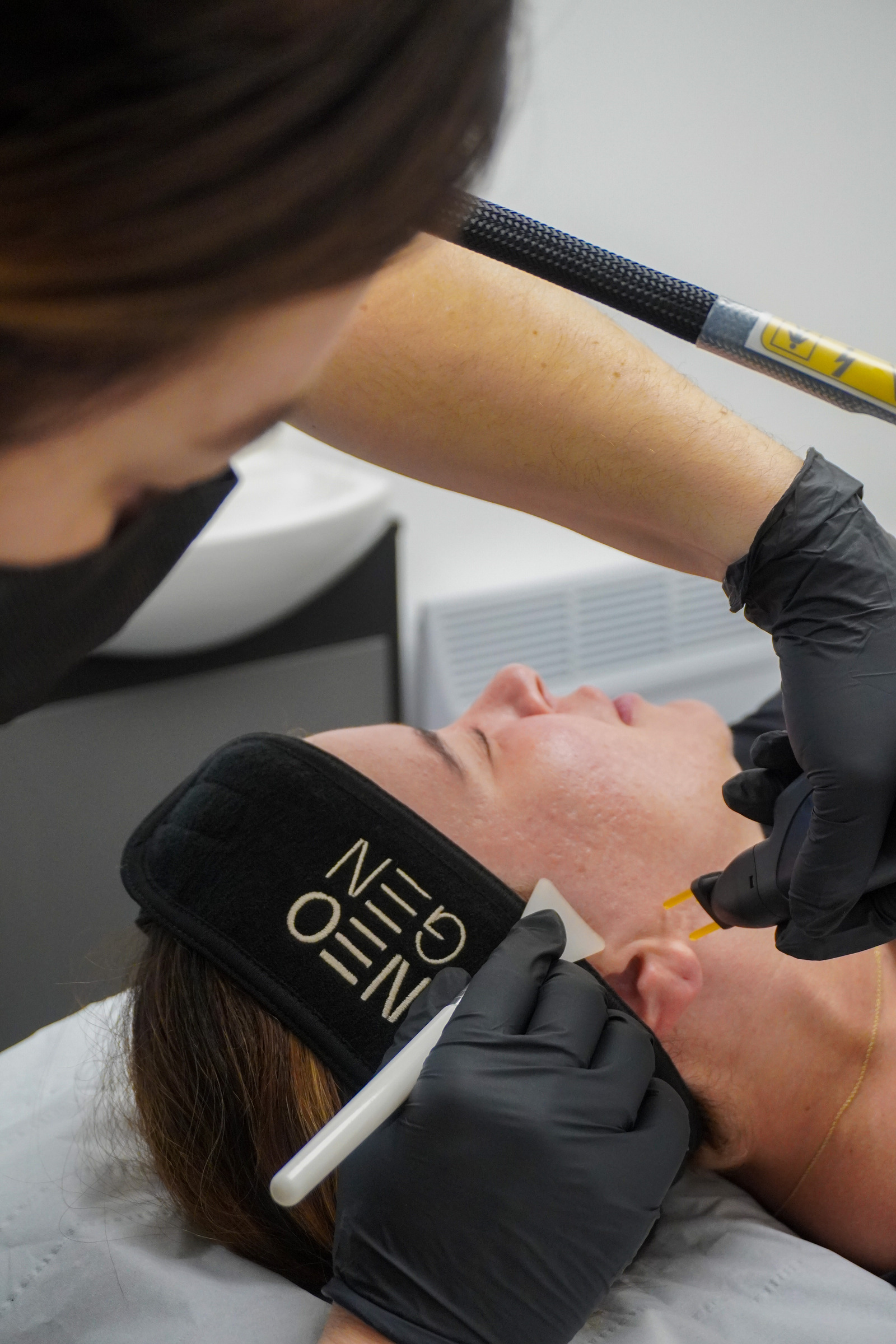
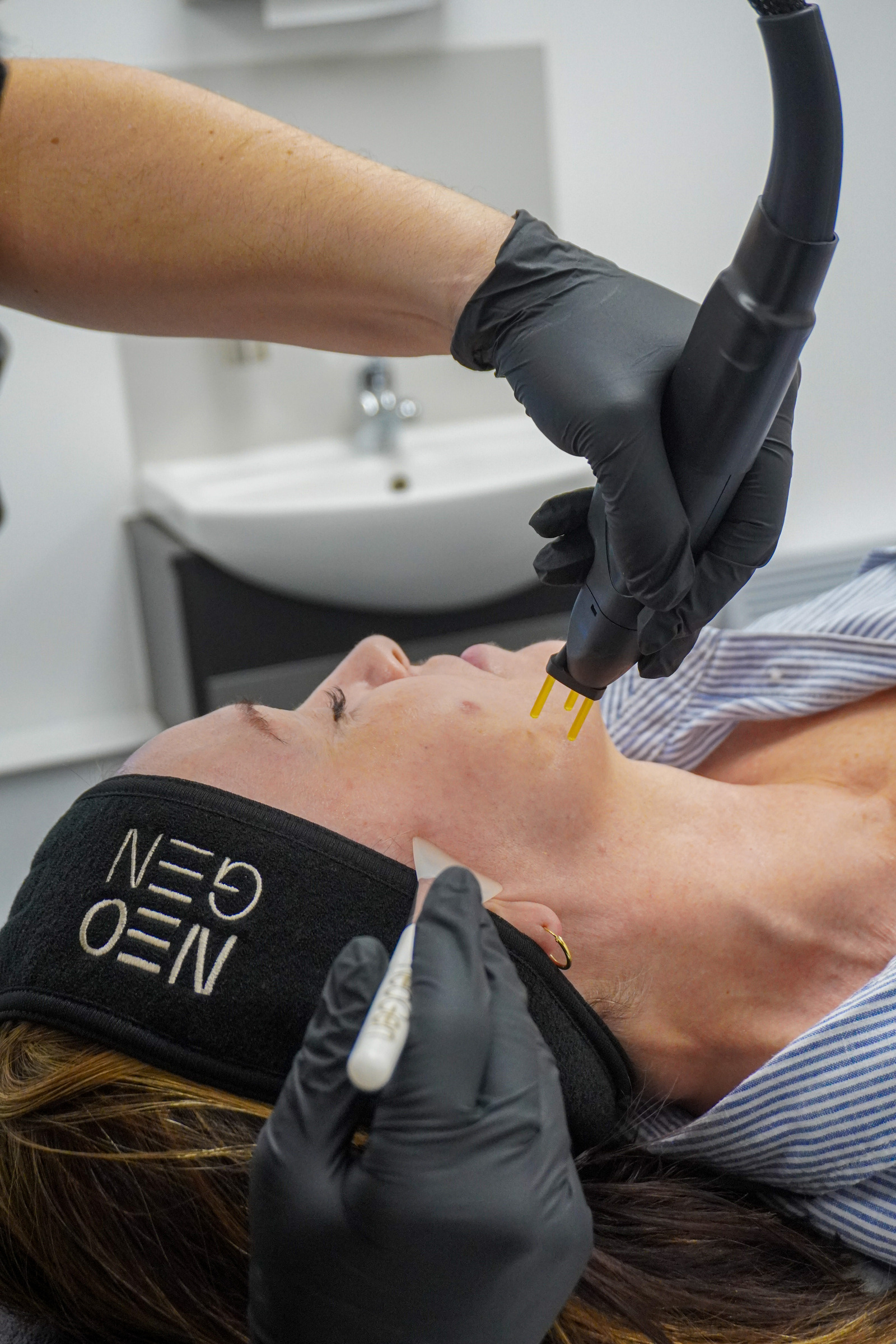
A CO₂ laser at 10,600 nanometres is absorbed by water. An alexandrite at 755 nanometres is absorbed by melanin. The operator is always negotiating a chromophore: too little pigment and the beam is a waste of electricity; too much and the epidermis takes the hit on the way in. Plasma skin regeneration, described in the mid-2000s by Kilmer, Foster and colleagues, sidesteps that bargain. Energist NeoGen PSR couples ultra-radiofrequency into a nitrogen stream. What arrives at the face is a fourth state of matter, ions and electrons, dumping kinetic energy as heat. No dye, no water peak, no melanin requirement. Energy at the handpiece is typically 0.8–4 joules; passes and pulse stacking decide whether the target is texture, laxity or pigment. Nitrogen is the working gas because it is inert. An oxygen-containing plasma would oxidise tissue as it heated it — charring, not a clean thermal gradient. Peak epidermal temperature can exceed 100 °C for milliseconds. The gradient falls off steeply, so dermal heating is a controlled denaturation rather than a burn through the fat. Fitzpatrick phototype still matters. More epidermal melanin changes how the crust looks, not whether you needed a chromophore to start with.
In short. Nitrogen plasma is charged gas dumping heat, not a coloured laser beam. The surface bronzes and sheds. Collagen underneath is heated without needing a pigment target.
The triple helix of type I collagen unwinds at roughly 60–70 °C. That is not cauterisation. Hydrogen bonds go, the fibril shortens, and the tissue tightens in the chair. Instant tightening is that unwind, a thermal shrink of a hydrogen-bonded rope, visible before anyone has left the building. The delayed tightening — the one people actually book a course for — is not that instant shrink. Fibroblasts read denatured matrix as damage, up-regulate transforming growth factor-β1, and secrete new collagen I and III over weeks to months. Heat-shock protein 47, the endoplasmic-reticulum chaperone that walks collagen through folding, rises after thermal injury. Matrix metalloproteinases clear the denatured gel; tissue inhibitors of metalloproteinases try to stop that clearance becoming a hole. Histology after plasma resurfacing matches the textbook wound-healing arc: a necrotic epidermal band that sheds as a bronzed eschar, surviving adnexae (hair follicles, sweat ducts) from which keratinocytes migrate, then a thicker, better-organised dermal band at about three months. Give the fibroblast ninety days. That is the histology. One heroic pass just gives you a worse scab and the same cell, still working at fibroblast speed.
In short. Type I collagen's triple helix comes apart around sixty to seventy degrees. That shrink is instant. The useful rebuild takes months of fibroblast work.
That arithmetic is why a course of three, spaced about a month apart, is the usual plan at eLIVEate. Treatment two lands while treatment one is still being remodelled. Treatment three stacks the programme without asking one insult to do ninety days of work overnight. Eyes, lids and neck are thinner and get lower energy. Fitzpatrick phototype belongs in the consult: darker epidermis makes a more obvious crust and carries a higher risk of post-inflammatory pigment, even though the plasma did not need melanin to work. None of this is mysterious. It is thermal dosimetry on a surface that happens to be a face, and JP owns the settings. The peptide conversation, when it is honest, starts after that sentence rather than instead of it. A copper tripeptide does not set joules. A copper tripeptide does not choose a Fitzpatrick type. A copper tripeptide does not own the consent form. What it owns, on the published side, is a fibroblast literature that talks about the same extracellular-matrix molecules the plasma just asked the dermis to rebuild. That is why the essays were filed next to each other. Filing is not mixing.
In short. A course of three plasma treatments stacks a ninety-day collagen rebuild. The device settings belong to the clinician. The copper-peptide papers sit next door in the library.
Type I collagen is the load-bearing polymer of dermis; type III is the wound and reticular partner that often rises first after an insult and then gives way, over weeks, as type I takes the architecture back. A plasma pass that denatures both is asking for that sequence, not for a scoop of hydrolysate to rebuild a 67-nanometre D-period by being swallowed. Adnexal remnants — hair follicles, sweat ducts — are the reservoir that lets a bronzed epidermis re-epithelialise without a graft, the same reservoir a deep peel or a fully ablative laser uses. HSP47 is the chaperone in the endoplasmic reticulum that walks the new chains through folding; TGF-β1 is the cytokine that told the fibroblast to start. Named machines, named collagen types, a named clock. The copper complex sits next to that factory because lysyl oxidase finishes the gel once the helix has been secreted, not because anyone weighed Gly-His-Lys into the plasma stream. Read the collagen-helix essay if the D-period is the question. Read this paragraph as the reason heat and copper share a shelf without sharing a bowl.
In short. After a burn-like insult, skin writes wound collagen first and then load-bearing collagen. Oil glands and hair follicles reseed the surface. Copper helps finish the new cable, in the papers, not in the handpiece.
Loren Pickart, fractionating human plasma in the early 1970s, isolated a tripeptide that shifted protein synthesis in aged liver tissue toward a younger pattern. Glycine-histidine-lysine, usually carrying Cu²⁺. Pickart and Thaler, 1973. Maquart, Pickart, Borel and colleagues showed in 1988 that the copper complex stimulated collagen synthesis in fibroblast cultures; Wegrowski followed with sulphated glycosaminoglycans. The later microarray claims are broader and messier — thousands of transcripts, collagen and TIMPs up, some MMPs down, a repair-shaped transcriptome — and they still owe a modern RNA-seq with copper-matched controls. The narrower truth does not need the spreadsheet. Lysyl oxidase, the enzyme that oxidatively deaminates lysine in collagen and elastin so the aldehydes can cross-link, is copper-dependent. Superoxide dismutase 1 is too. A plasma tripeptide that holds Cu²⁺ in a square-planar grip, tight enough to stop free copper running Fenton chemistry, labile enough to hand the metal on, is a chaperone for those two jobs. Thermal remodelling asks fibroblasts to write new type I and type III and then to finish it. Copper sits on the finishing step. That is the rhyme. It is a reading list, not a recipe.
In short. A copper-holding tripeptide from plasma sits in fibroblast papers on collagen and on the enzyme that cross-links it. That literature rhymes with heat-triggered rebuild. It is not a cream.
Cu²⁺ is a d⁹ ion with a strong preference for square-planar geometry — a flat four-ligand grip. GHK offers a tridentate grip: the N-terminal nitrogen of glycine, a deprotonated peptide-bond nitrogen, the imidazole of histidine. Crystal structures put the copper in that plane, water or another oxygen often completing it. The lysine is usually a charge and a handle, not the fourth ligand. Pickart reported plasma GHK at roughly 200 nanograms per millilitre at age twenty and about 80 at sixty; those are his numbers, not a multi-centre reference interval, and they are a reason to look rather than a restoration plan. CAS 89030-95-5. Complex mass about 340.7 grams per mole. Catalogue material is the complex, HPLC-characterised, the ligand the fibroblast papers actually dissolved. eLIVEate's tool is a CE-marked nitrogen-plasma device. Mixing them in a bowl is not a protocol. We do not invent those, and we do not take a commission on the booking either. Partner clinic. Their diary, their consent, their energy settings. The copper essay next door walks the ionophore-versus-ligand argument, the arrays, the hair-follicle side-street. This paragraph is only the adjacency: heat first, copper on a different shelf, both about the same stretch of matrix.
In short. The copper complex is three amino acids holding a metal in a flat grip. Heat asks skin to rebuild collagen. The metal is how the finishing enzyme works. Two shelves.
Diagram
- GHKGly-His-LysPickart, 1970s plasma fraction. ~200 ng/ml at 20; ~80 ng/ml at 60.
- Cu²⁺ complexsquare-planarHistidine imidazole + backbone nitrogens. The product is the complex.
- Lysyl oxidaseLOX / LOXLCopper enzyme. No metal, no collagen cross-links, a weak gel.
- SOD1Cu/ZnFirst mop for superoxide. Same metal, different job.
- Free Cu²⁺FentonCu⁺ + H₂O₂ → HO·. Delivery without a redox-active pool is the point.
Pickart and Margolina’s microarrays claim thousands of transcripts. Modern RNA-seq with multiple-testing correction is the replication the claim still owes. Copper delivery to LOX and SOD would remain interesting if the spreadsheet shrinks.
Matrix metalloproteinases and their tissue inhibitors are the other half of a remodelling sentence, and they are why a copper microarray that moves MMPs and TIMPs gets filed here at all. After a thermal insult the denatured gel has to be cleared; MMP-1 (collagenase-1) and MMP-3 (stromelysin-1) are among the named cutters. If they run too hard you get a hole. If they do not run you get a scar of leftover junk. TIMPs try to hold the cutters to a wound-shaped window. Pickart's arrays, for what a 2000s Affymetrix chip is worth, put some MMPs down and TIMPs up, a repair-looking ratio. Wunsch and Matuschka, in a different literature, saw MMP-1 fall after a course of red and near-infrared light. Two inputs, one family of enzymes, a dermis that has to decide how much old collagen to throw away while it writes new. That is a genuine neighbourhood. Dumping a copper tripeptide onto a freshly bronzed plasma field because an array once moved MMP-1 is a guess with a shopping list, not a paper. The useful move is to read both papers and leave the energy settings with the clinician.
In short. Remodelling is a balance between enzymes that cut old collagen and brakes that stop them cutting too far. Copper papers and heat papers both mention that balance. That is still two experiments.
Micro-injury: spicules, channels, inflammatory tone
Sponges build skeletons out of silica. The spicules that end up in a Microspear vial are those skeletons, cleaned and size-selected: stiff, high-aspect-ratio needles, typically a tenth to a quarter of a millimetre long and a few micrometres across. Human stratum corneum is 10–20 micrometres on the face. Arithmetic says the spicule walks through the dead layer and into living epidermis as if the brick wall were a curtain. A 1.5 millimetre steel needle, by contrast, is seventy times that depth and routinely meets capillary loops in the papillary dermis. Hence pin-point bleeding, hence topical anaesthetic, hence the injury look people associate with microneedling. CELL STORY's claim is that about 50,000 of those silica needles, painted on rather than stamped, can do two jobs at once. First, delivery: Zhang, Kim and others have shown that sponge spicules raise transdermal flux of macromolecules that otherwise bounce off intact skin. The channels are real and short-lived. Second, stimulus: the spicules stay put until the surface sheds, so for two or three days the epidermis is dealing with a forest of inert glass splinters.
In short. Sponge-grown silica needles are long enough to pierce the dead surface of facial skin and usually short enough to miss the bleeding layer. They open tiny doors, then stay as a mild irritant for days.
Des Fernandes, in the mid-2000s, named the steel-needle version Percutaneous Collagen Induction: puncture the dermis, do not ablate the epidermis, let a TGF-β3-leaning repair lay collagen without a scar. Histology after needling shows more type I and type III collagen weeks later. Spicule microneedling is a shallower cousin of the same idea. You should not expect the dermal remodelling of a 2 millimetre medical stamp from a 200 micrometre silica needle. What you should expect is a more honest version of what a liquid facial can actually reach: the barrier, the viable epidermis, and a milder fibroblast nudge. Keratinocytes, once punctured, write interleukin-1 and talk to fibroblasts through TGF-β. The spicules themselves, hanging around until desquamation at about 48–72 hours, keep that conversation going after the channels have closed. Look, it is a shallower insult than a medical stamp. A 200 micrometre needle is not a 2 millimetre pass, and JP will not pretend otherwise. JP's eight-step protocol puts amino acids, Centella and a calming complex into those channels. Those are the clinic's actives. They are not a Patriot vial.
In short. Steel microneedling punches deeper and bleeds. Spicule microneedling is a shallower cousin of the same repair idea. The clinic's own actives go into the channels, not a research chemical.
Two lifetimes, two jobs, and the marketing copy usually names only one. Channel lifetime is hours: a hole a few micrometres across in stratum corneum is a temporary breach, closed by lipids and by keratinocytes that have not forgotten how to be a brick wall. Spicule lifetime is days: the silica needle is a foreign body until the surface sheds it, typically two to three days, which is why the face can still feel like a mild sandpaper after the appointment is over. Delivery, if the clinic is putting actives in, uses the first lifetime. Stimulus uses the second. Confusing them is how a 'liquid microneedling' caption promises dermal drug delivery for seventy-two hours from a channel that closed before supper. Zhang and Kim's flux papers are about the open hole. Fernandes' collagen papers are about the repair conversation. CELL STORY is trying to do a bit of both at epidermal depth. That is a lawful, limited claim. It is also why GHK-Cu (matrix) and KPV (inflammatory tone) sit on the reading list as two different neighbours of two different lifetimes, and why neither neighbour is an instruction to load a research cake into the liquid.
In short. The tiny holes close in hours. The glass needles stay until the surface sheds, over a couple of days. Delivery uses the holes. The lingering needles are the stimulus.
If you have just made thousands of micro-channels, the honest reading list is short, and GHK-Cu is on it again for the same matrix reasons the plasma heading already named. Collagen I and III, TIMPs, a copper-dependent cross-link, a fibroblast that has been told there is a repair job on. Micro-injury is a different door into that job from heat, which is why the two procedures are not interchangeable and why the copper paper sits next to both without being a post-procedure serum for either. Depth first. A 200 micrometre silica needle is an epidermal and upper-dermal conversation. A nitrogen-plasma pulse that denatures collagen at 60–70 °C is a thermal conversation with a different clock. Both end at a fibroblast. Both have a published copper-tripeptide neighbourhood. Filing GHK-Cu next to CELL STORY as well as next to NEOGEN is therefore not indecision. It is the same ligand next to two physics classes that both remodel matrix. The reconstitution that would collapse those classes into one bowl remains unwritten, on purpose.
In short. The copper tripeptide sits next to spicule injury as well as next to heat, because both ask fibroblasts to rebuild matrix. Same neighbour. Two different insults.
KPV is the other named neighbour, and it is here for inflammatory tone rather than for collagen. Lysine-proline-valine, mass 342.4, CAS 67724-34-9, the last three residues of α-melanocyte-stimulating hormone. The parent hormone is thirteen residues, Ac-SYSMEHFRWGKPV-NH2, a POMC product; the tanning pharmacophore sits in the middle, His-Phe-Arg-Trp, the tetrapeptide melanocortin receptors actually want in the pocket. Keep the tail. Lose most of the pigment, most of the MC4R appetite agonism, most of the extras a cyclic analogue brings. What remains is small enough to be a substrate of the intestinal oligopeptide transporter PepT1, and stubborn enough, in the papers that bother to measure it, to suppress NF-κB in keratinocytes and macrophages. Luger, Brzoska, Haycock, Moustafa, Getting: IκB preserved, p65 less nuclear, cytokine transcripts down, residual activity when MC1R is missing or blocked. A barrier that has just been punctured by fifty thousand silica needles is running an inflammatory programme. That is why KPV sits on this reading list. It is not why anyone should paint a research tripeptide into a spicule field. Clinic actives are the clinic's. The fragment is a defined ligand for a dish that asked about NF-κB without a tan.
In short. A three-letter piece of the tanning hormone quiets inflammatory genes in skin lining without much pigment. After thousands of tiny punctures, that literature is a neighbour. Still not a cream.
Pigment, if pigment is the question, is a different receptor and a different essay. MC1R on melanocytes pushes tyrosinase toward eumelanin; Melanotan II is a cyclic pan-agonist built around a D-phenylalanine and a lactam, occupancy at MC1R, MC3R, MC4R and MC5R on purpose. Afamelanotide is the linear licensed photoprotective analogue. Setmelanotide is the MC4R obesity ligand. None of those is KPV, and none of them is a post-spicule recommendation. A pan-melanocortin agonist would confound an inflammatory-tone assay with a tanning programme; that is the intellectual reason the fragment exists. Filing MT2 next to a facial because both words sit near skin is how a search bar organises a shop, not how a paper organises a bench. Depth first, ligand second, and only if the ligand's paper is actually about that depth. CELL STORY's depth is tens to a few hundreds of micrometres. KPV's published depths are a keratinocyte monolayer, a reconstructed epidermis, a mouse ear, a colon epithelium on PepT1. Overlap is real. Identity is not. The dedicated KPV essay and the dedicated CELL STORY essay are where those sentences get their numbers. This page only sits them facing each other.
In short. If the question is pigment, that is a different receptor family and a different paper. The short anti-inflammatory fragment was kept so a tan would not confuse the result.
Five melanocortin receptors is a family portrait, not a facial menu. MC1R is pigment and, on macrophages and keratinocytes, the receptor the inflammation literature first reached for. MC2R is the ACTH receptor on the adrenal cortex and wants a longer ligand. MC3R and MC4R live in hypothalamus; MC4R is the appetite brake Farooqi and O'Rahilly put into the obesity clinic. MC5R lives on sebaceous epithelium. Treating the family as a sunbed story is how you miss four of those five sentences. Treating every fragment of α-MSH as a Gs ligand is how you miss the point of KPV. The fragment can still bind MC1R in some assays. The reason it exists as a research object is that a useful fraction of the anti-inflammatory work does not require that binding. On a clinic map, that sentence does one job: it stops a reader from filing Melanotan II next to CELL STORY because both sit near skin in a search bar. Pigment after plasma, pigment after spicules, pigment as a Fitzpatrick consult — those are the clinician's. The pan-agonist is a different essay. The tail is the neighbour of micro-injury because NF-κB, not because anyone tans on purpose in Great Missenden.
In short. Five related receptors read the tanning-hormone family: pigment, adrenal, appetite, oil glands. The short tail was kept for inflammation. It is not a tanning product next to a facial.
Photobiomodulation is a mitochondrial instruction
Cytochrome c oxidase sits at the end of the electron-transport chain and hands electrons to oxygen. It is also green-brown, copper-and-haem rich, and a respectable absorber of red and near-infrared light. Tiina Karu's argument, now the field's working model and the one Hamblin's reviews keep restating, is that nitric oxide can bind those copper centres — CuA, CuB, haem a/a3 — and pause the enzyme, a reversible brake. Photons at about 633 or 830 nanometres kick NO off. Electron transport resumes. ATP rises. A small reactive-oxygen signal leaves the mitochondrion and the nucleus changes its mind: different transcription, including the matrix genes a dermis uses to rebuild. This is why LED phototherapy can be cold and still do work. You are not coagulating collagen. You are talking to Complex IV, which is a much stranger and more interesting sentence than a heat lamp. Dermalux Tri-Wave specifies 415, 633 and 830 nanometres on one head. Clinic devices exist so that joules per square centimetre sit on the useful shoulder of a U-shaped curve rather than in a bathroom-bulb anecdote. Too little fluence, nothing happens. Too much, you inhibit the same enzyme you meant to help: the biphasic Arndt–Schulz pattern photobiomodulation inherited.
In short. Red and near-infrared light are absorbed by the last enzyme of the respiratory chain. The working idea is that photons kick nitric oxide off that enzyme so energy production resumes.
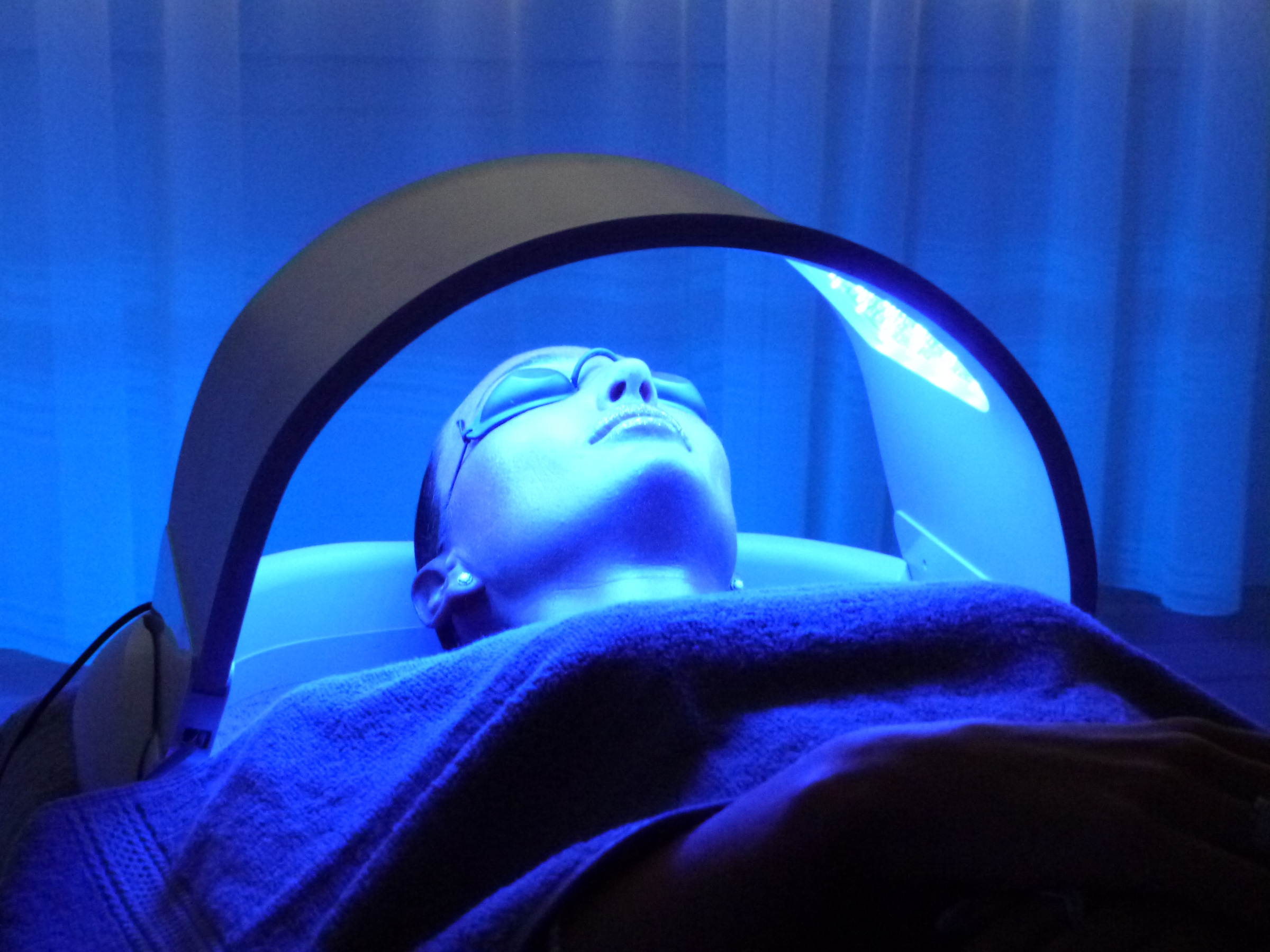
Blue is a different weapon. Cutibacterium acnes makes coproporphyrin III. That porphyrin absorbs in the Soret band, around 415 nanometres, and photochemistry then generates reactive oxygen inside the organism. The bacterium is a better target than your mitochondrion at that wavelength, which is why blue is the blemish channel and red and near-infrared are the repair channels. Combining them on one device is a clinical convenience, not evidence that one photon does everything. After a plasma pulse or a spicule facial, the red and near-infrared pair is the settling tool: calmer inflammatory tone, more ATP for a tissue that just ran a wound programme. Blue stays the antimicrobial lever. Wavelength is identity here, the way sequence is identity for a peptide. A broad infrared heater is warmth. A 633-nanometre diode occupying cytochrome c oxidase is photochemistry at a named photoacceptor. JP's protocol uses the three channels that way. The essay next door, Dermalux LED phototherapy, walks the fluence and the course. This paragraph is the mitochondrial sentence the repair-peptide papers have to sit next to without being allowed to replace.
In short. Blue light hits a pigment inside acne bacteria and kills them with their own chemistry. Red and near-infrared talk to mitochondria. Same lamp. Two jobs.
Wunsch and Matuschka, Photomedicine and Laser Surgery, 2014, measured what a course of red and near-infrared LED phototherapy did to human skin: more collagen, more elastin, less MMP-1. That is a dermal readout of a mitochondrial instruction, measured after repeated sessions, not after a single glow. Collagen transcription is not a same-day event. Fibroblasts need repeated cues to shift the dermal matrix in a way histology will still see at week six. That is why diaries sell courses — often six, sometimes twelve — and why a single thirty-minute session is allowed to be a complexion change without being a remodelling. Harry Whelan's NASA LED papers treated photobiomodulation as a wound-healing aid for astronauts and diabetic ulcers. Same cytochrome c oxidase, different body. The field learned the hard way that one sitting can move ATP and still leave the matrix where it was. Writing a LED session as a completed collagen programme skips that table. Writing a peptide vial as a way to skip the course skips the photoacceptor. Two clocks. Two inputs. One tissue.
In short. A named human study found more collagen and elastin after a course of red and near-infrared light, not after one session. Transcription accumulates. A single glow is allowed to be just a glow.
Photobiomodulation is a mitochondrial instruction. Repair-peptide papers are a different door into the same stretch of tissue. That is the fact this heading exists to hold. BPC-157's cleaner papers sit on VEGFR2 internalisation and phosphorylation, focal-adhesion kinase and paxillin, endothelial migration, a nitric-oxide set-point Sikiric's group kept arguing was restored rather than simply raised. TB-500 and thymosin β4 sit on G-actin sequestration, the LKKTETQ motif, a buffer of monomers so a cell can push a lamellipodium; Goldstein, Safer, Huff, the pyrene-actin curves, the scratch assays. Those are ligand doors. The lamp is a photon door. Both spend time in a tissue that is trying to move cells and to keep nitric-oxide tone in a useful window. Neither makes the other redundant. Neither is sold into the appointment. We stock the ligands, HPLC-characterised, for the assays those papers actually ran. eLIVEate owns the head. No commission on the booking. A dish that sees 830 nanometres and a dish that sees GEPPPGKPADDAGLV are not the same experiment even when the downstream blot is an endothelial phospho-protein. Input identity is a mechanism. Shared tissue is a shelf mark.
In short. Light talks to mitochondria. Repair peptides talk to vessels or to the cell's crawling machinery. Same stretch of tissue, two different doors. Neither replaces the other.
Diagram
Matrix
- TCA cycle · β-oxidation · mtDNA nucleoids
- NADH produced here. Complex I spends it.
- MOTS-c (MRWQEMGYIFYPRKLR) from 12S rRNA.
Inner membrane
- I → II → III → IV → V (ATP synthase)
- ~150 mV proton-motive force
- ~40–60 kg of ATP turned over per human day
mtDNA is 16,569 bp, 37 genes, 13 proteins of the respiratory chain. Nuclear DNA encodes the other ~1,200 mitochondrial proteins. NAD+ is the hydride carrier between dehydrogenases and Complex I. MOTS-c is a 16-mer translated from 12S rRNA — a peptide the mitochondrion wrote itself.
Repair peptides: a different door, not an adjunct
Body protection compound-157 is Gly-Glu-Pro-Pro-Pro-Gly-Lys-Pro-Ala-Asp-Asp-Ala-Gly-Leu-Val, written GEPPPGKPADDAGLV, mass 1419.5 daltons, CAS 137525-51-0. Predrag Sikiric's group in Zagreb took a cytoprotective activity in gastric juice and synthesised this 15-mer, proline-rich, stubborn in acid, and then spent three decades dropping it into injury models. The origin story is chemistry: most fifteen-mers die in the stomach; four prolines starve several proteases of a comfortable cut site. The cleaner independent replications live one floor down from the mucosa, at endothelium. VEGFR2 is internalised and phosphorylated. Focal-adhesion kinase and paxillin light up. Nitric-oxide tone in a vessel or a gut wall moves as if a set-point had been restored. Those are phosphorylation blots and organ-bath traces. They are not a crystal, and they are not a facial. Forum culture glued the 15-mer to a LED session because both words sit near repair. Biochemistry did not glue them. One occupies, on the useful papers, a receptor tyrosine kinase neighbourhood and an NO argument. The other occupies copper centres on Complex IV with a photon. You can run both conversations about the same dermis. You cannot run them as if they were one invoice.
In short. A fifteen-amino-acid stomach fragment has vessel and nitric-oxide papers. That is a ligand door into repair. It is not a substitute for a lamp, and it is not a cream.
Thymosin β4 is a forty-three-residue, intrinsically disordered peptide, the principal G-actin sequestering peptide of animal cells. Mutational mapping put the actin contact on LKKTETQ, residues 17–23. Research TB-500, as the trade analogue is usually sold, orbits that motif; full-length Tβ4 is a different object, and the N-terminal tetrapeptide Ac-SDKP is a third. HPLC-MS is how you know which of those three you reconstituted. Structurally, sequestration is a steric sentence: the peptide drapes across the monomer so that neither the barbed-end face nor the pointed-end face is free to dock. Profilin binds a different surface and delivers monomers to barbed ends. Cofilin severs aged filaments. Arp2/3 nucleates branches. The peptide is the clerk who decides how many monomers are free to join. Writing TB-500 as a growth factor is how you skip the clerk and invent a motor. The motor is actin. A fibroblast or a keratinocyte asked to migrate after micro-injury or a thermal eschar is, among other things, an actin-treadmill problem. That is why the analogue sits on this map. It is not why a motif analogue belongs in a Dermalux head or a Microspear bowl.
In short. A short chain related to thymosin holds spare actin so a cell can crawl. After injury, crawling is a real question. The chain is still a laboratory ligand, not a device setting.
Diagram
BPC-157: Pro-rich, acid-stable, Sikiric corpus. VEGFR2 internalisation, FAK–paxillin, eNOS-dependent NO tone. A cytoprotection story that escaped the stomach.
TB-500: cytoskeletal buffer. Injury releases Tβ4 extracellularly; VEGF, MMPs and keratinocyte migration follow. SDKP is a separate N-terminal anti-fibrotic pharmacophore. Two literatures, two jobs.
Thymosin β4 is the principal G-actin sequestering peptide. TB-500 is built around the LKKTETQ motif. BPC-157 is a gastric 15-mer (GEPPPGKPADDAGLV) that talks to VEGFR2 and focal adhesions. Related in folklore. Unrelated in mechanism.
Two lyophilised cakes, two certificates, one rumour. BPC-157 and TB-500 get filed as a healing stack because both showed up in injury models and both were short enough to freeze-dry. The sequences did not agree. One talks, on the cleaner papers, to a receptor tyrosine kinase and to focal-adhesion kinase. The other parks actin monomers so a cell can push a lamellipodium. This catalogue keeps both vials because both literatures are real, and keeps them apart because the literatures are not one literature. Filing them next to Dermalux is a third decision, and it is the one this clinic essay has to justify. The justification is tissue, not mechanism. A dermis that has taken a plasma pulse, a spicule field or a course of 830 nanometres is a dermis asking about endothelial tone, about whether a keratinocyte can migrate, about whether a fibroblast can crawl into a remodelled matrix. Those are lawful questions for the two ligands. They are not a licence to write the ligands as adjuncts sold into the appointment. eLIVEate books the head. We do not take a cut.
In short. Two repair chains get sold as a pair. One talks to vessel signals. The other holds actin. They share injury stories, not a receptor, and neither is bundled into the light appointment.
NASA LED work and a gastric 15-mer share a customer: a laboratory that reads wound papers. Customer is not mechanism. Whelan's diodes were a cytochrome c oxidase conversation in ulcers and in cells that had to heal in low gravity. Sikiric's 15-mer was a stomach conversation that wandered into tendon and endothelium because a stable peptide that talks to vessels gets tried wherever vessels matter. Hamblin's reviews and the Zagreb corpus cite different machines, different species, different clocks. Putting them on facing pages of a journal is how you stop a reader from thinking the lamp is a peptide, or the peptide is a lamp. Putting them in the same appointment is how two honest objects become one confusing one. The dedicated BPC-and-TB essay takes the pair apart at catalogue length, with the actin-treadmill diagram, the VEGFR2 blot, the single-lab-programme caveat. The dedicated Dermalux essay takes the photoacceptor apart, with Karu, with Wunsch and Matuschka, with the U-shaped fluence. This page only says the sentence once, in the voice you'd want from a teacher who has both papers on the desk: photons at Complex IV; ligands on a different shelf; same stretch of tissue; no bundle.
In short. Wound papers and light papers share readers. They do not share a machine. Keep the lamp and the chains on facing pages, not in the same bowl.
A cofactor in two rooms
Every dehydrogenase you met in first-year biochemistry passes a hydride to NAD+. That is job one: glycolysis, the TCA cycle, electrons to Complex I. Job two is newer and ruder. Sirtuins, PARPs and CD38 consume NAD+ as a substrate, not a recyclable cofactor. Nick DNA and PARP1 can drain the local pool in minutes. Age, and CD38 — the body's most enthusiastic NADase, Camacho-Pereira, Verdin, Cell Metabolism 2016 — rises, and tissue NAD+ falls. Massudi and others measured roughly a fifty per cent drop in human skin between young adult and elderly. Salvage through NAMPT tries to refill what those three families spend; nicotinamide riboside and NMN feed the same pool from different rungs. Intact extracellular NAD+ is a charged molecule of 663 daltons and a poor passenger across a plasma membrane. Ectonucleotidases, CD38 facing out, CD73, connexins as a disputed door: put the dinucleotide in a muscle belly and you have an extracellular bolus sitting in front of enzymes that would rather see nicotinamide, NMN or NR. Pharmacokinetics do not transfer from a freeze-dried solid to that bolus, and they do not transfer from that bolus to a mitochondrial matrix.
In short. NAD+ carries electrons in ordinary metabolism and is also spent by DNA-repair and ageing-linked enzymes. Levels in skin have been measured as falling with age. Intact NAD+ does not easily enter cells.
What you do next is the split, and we get asked about it every week. A clinic can inject a prepared NAD+ solution into muscle on a weekly diary. We sell freeze-dried β-NAD+ as a cofactor for enzyme assays. The legal class, the sterility file, the pharmacokinetics and the job are not the same, and you're allowed to want both rooms without anyone collapsing them into one product. eLIVEate's appointment, where it exists, is a supervised administration of a clinic-compounded or licensed preparation, often a fifteen-minute intramuscular sitting, weekly, under their governance. Patriot's listing is lyophilised β-NAD+, 1000 mg, ≥98 per cent by HPLC, molecular weight 663.43, formula C21H27N7O14P2, CAS 53-84-9, the reagent you weigh into a dehydrogenase, a sirtuin or a PARP assay. Restoration experiments in the literature usually do not inject NAD+ itself. They feed precursors, because those can be taken up and funnelled into salvage. Human NR and NMN trials reliably move the NAD+ metabolome and less reliably move the endpoints people actually wanted. The appointment is a wellness practice built on a real cofactor. The cake is a standard.
In short. A clinic can inject a prepared NAD+ solution. A laboratory cake is the same molecule class freeze-dried for assays. Related chemistry. Different job, different law, different room.
Nicotinamide riboside is the Brenner contribution: a nucleoside phosphorylated by NRK1 and NRK2 to NMN, then adenylated to NAD+, a bypass of NAMPT, the kinetic bottleneck. Trammell, Brenner, Nature Communications 2016: oral NR raises the human NAD+ metabolome, with NAAD as a marker. NMN is one rung down, Yoshino and Imai in mice, Yoshino and Klein in a 2021 clamp in prediabetic women, a modest muscle-insulin signal, no claim to have reversed ageing. Those precursors are how most restoration papers actually raise an intracellular pool, because they can be taken up. Intact NAD+ is the awkward object in the catalogue and in the muscle: charged, chopped by ecto-enzymes, a standard in a tube, a bolus in a clinic whose tissue fate the clinic has to argue for itself. Putting NR, NMN, the cake and the appointment in one sentence as 'NAD+ therapy' is how a node this central becomes a brand. Four experiments. Four papers, if you have them. This journal's NAD+ essay is the topology. This clinic page is only the reminder that an intramuscular diary in Buckinghamshire does not inherit an oral-precursor metabolome, and a freeze-dried cake does not inherit either.
In short. Most top-up papers use smaller precursor molecules that cells can import, not intact NAD+. A clinic injection, a research cake and those precursors are four different experiments.
eLIVEate is a separate company. Patriot Peptides does not take a commission on that booking, does not write the appointment as a reconstitution of the catalogue cake, and does not pretend the two legal objects share a pharmacokinetic file. Same carbon skeleton, in the sense that β-NAD+ is β-NAD+. Different product, different company, different regulator's attention. The longer NAD+ essay is the redox-and-sirtuin map: Imai and Guarente on SIR2, Revollo on NAMPT, Brenner on nicotinamide riboside, Yoshino and Klein on a human NMN clamp, Kory and Mootha on SLC25A51 as the mitochondrial importer. This paragraph is only the unmix for a clinic page. If you want the mechanism of why anyone bothers, read that essay. If you want a clinician to put a prepared solution into muscle in Buckinghamshire, that is an in-person medical-aesthetic service on eLIVEate's diary. If you want a cofactor for a tube, the cake is the cofactor. Adults can want a paper and an appointment. Bundling them is how a research reagent becomes a medical claim it is not allowed to be, and how a clinic becomes a webshop it is not.
In short. The injection, where it exists, is a different product at a different company. The freeze-dried solid is for a test tube. We take no cut of the diary.
Mitochondria notice a thin NAD+ pool twice: Complex I wants oxidised NAD+ as a hydride acceptor, and SIRT3 wants NAD+ as a deacylase substrate in the matrix. A LED head occupying cytochrome c oxidase and a nucleotide sitting on the sirtuin budget are therefore two mitochondrial conversations, and they are allowed to live on the same campus without being the same corridor. Photons at 830 nanometres are a photodissociation of nitric oxide from Complex IV. A NAD+ number is a pool size and a redox ratio, compartmented, with NAMPT as the salvage bottleneck and CD38 as the chronic drain. MOTS-c, if it is on the same shelf, is a 16-mer translated from mitochondrial 12S rRNA, AMPK-adjacent, Lee and Cohen 2015, a third invoice. Confusing a lamp, a dinucleotide and a mitochondrial peptide is how a journal becomes a stack. We stock the named objects. We will not write them as a protocol, and we will not write them as each other. The Dermalux heading already said the lamp is a mitochondrial instruction. This heading says the cofactor is a different mitochondrial instruction. Two doors. Do not walk them as if they were the same corridor.
In short. Mitochondria care about NAD+ and they care about red light, for different reasons. A lamp, a cofactor and a mitochondrial peptide are three objects, not one energy juice.
How to use the four essays
NEOGEN is heat and collagen. Read the nitrogen-plasma essay for the chromophore-free physics, the 60–70 °C unwind, the bronze eschar, the ninety-day histology, the course of three, the Fitzpatrick caveat. Then, if the matrix neighbourhood is the reason you came, read GHK-Cu for the copper chaperone, lysyl oxidase, the 1988 fibroblast paper, the array claim and its limits. CELL STORY is channels and stimulus. Read the spicule essay for the 100–250 micrometre arithmetic, the 72-hour shed, Fernandes' parent idea, the clinic's own actives. Then GHK-Cu again for matrix, and KPV for NF-κB without a tan. Dermalux is light and mitochondria. Read the LED essay for Karu, for 415 against porphyrins, for 633 and 830 at cytochrome c oxidase, for Wunsch and Matuschka, for a course of six. Then BPC-157 and TB-500 if the question is a ligand door into overlapping repair biology, not if the question is which button JP presses. NAD+ in clinic is the cofactor, in person. Read the split essay so the lyophilised cake and the intramuscular appointment stay two objects. This page is only the map. It will not get longer by repeating those numbers.
In short. Heat and collagen. Channels and stimulus. Light and mitochondria. A cofactor in person. Four essays hold the numbers. This page only points.
Procedures belong to the clinician who sets the energy, the fluence, the depth and the consent. Research sequences belong on a bench with a chromatogram. That split is not rudeness. It is how a CE-marked device and a research-labelled vial stay employable in the same postcode. JP's diary is medical-aesthetic work: consult, phototype, energy, aftercare that is the clinic's, a follow-up that is the clinic's. Our listings are Gly-His-Lys·Cu²⁺, Lys-Pro-Val, GEPPPGKPADDAGLV, a TB-500 analogue, β-NAD+, each with a sequence or a formula, a mass, a purity, a certificate. If a peptide is in an appointment, it will be in the clinician's protocol, a cosmetic-class ingredient in a bowl, a different object. If a peptide is in this journal, it is a defined sequence with a paper next to it. Adults can want both information and a treatment without anyone bundling them. The simplest way we know of keeping the two objects from collapsing into a SKU is the one already stated: we do not take a commission on eLIVEate bookings. Money that does not change hands does not have to be explained away later.
In short. The clinician owns the device settings and the consent. The named chains on a research label belong in a laboratory. Wanting both is allowed. Bundling them is not how this journal works.
Ask for the sequence. If the answer is a gram weight, a flavour, or a proprietary blend in a facial, you are holding a cosmetic or a food. If the answer is a one-letter code, a calculated mass and a chromatogram on which a main peak can be pointed at, you are holding a research ligand. GHK-Cu is Gly-His-Lys·Cu²⁺, CAS 89030-95-5, about 340.7 grams per mole. KPV is Lys-Pro-Val, 342.4. BPC-157 is GEPPPGKPADDAGLV, 1419.5. TB-500 orbits LKKTETQ; the certificate has to say whether you reconstituted the analogue or the 43-mer. β-NAD+ is C21H27N7O14P2, 663.43, CAS 53-84-9. Hydrolysed collagen is a population of fragments. A calming complex in a spicule protocol is a clinic formula. Identity tests that mean everything on a research vial — reverse-phase HPLC plus mass spectrometry of one peak — are meaningless as a purity claim on a facial. Mixing the words is how a laboratory term walked into a treatment room. This page exists so the words walk back, and so a booking in Great Missenden does not have to carry a chromatogram it never asked for.
In short. A research chain has one sequence, one mass and one clean peak. A facial ingredient list does not. The shared English word 'peptide' is an accident, not a kinship.
Partner clinic is not a franchise, not a white-label, not a shared checkout and not a joint protocol. eLIVEate Me is a medical-aesthetic practice in Great Missenden, Buckinghamshire, with its own governance, its own consent, its own CE-marked devices and its own diary. Patriot Peptides is a catalogue of characterised research reagents. We share a curiosity about the same stretch of tissue, and we share a refusal to pretend that curiosity is a SKU. No commission on the booking is the commercial half of that refusal. Separate websites, separate jobs, separate regulators' attention are the rest. A reader who wants a plasma course books it with the clinician. A laboratory that wants Gly-His-Lys·Cu²⁺ orders a vial with a certificate. A reader who wants both in the same month is an adult, and we will not punish the curiosity by bundling it. We will also not reward it with a discount that would make the map look like a catalogue insert. The four clinic essays, the peptide essays they point at, and this index are the whole of the offer. Read them. Book, or do not. Weigh a chain, or do not. The map does not get a vote.
In short. Partner clinic means two companies, two sets of rules, and no cut of the diary. Shared curiosity about skin is not a shared product. Book one, order the other, or neither.
Diagram
| Node | Catalogue | Conversation |
|---|---|---|
| GPCR | Ipamorelin, MT2, PT-141, retatrutide, CJC | Second messengers, secretion, appetite, pigment |
| RTK / IGF1R | IGF-1 LR3 | IRS–PI3K–Akt–mTOR and Shc–ERK |
| Cytokine receptor | Somatropin (HGH) | GHR–JAK2–STAT5b, hepatic IGF-1 |
| Cofactor | NAD+ | Sirtuins, PARPs, CD38, redox |
| Actin buffer | TB-500 / Tβ4 motif | G-actin sequestration, motility |
| Growth-factor-like | BPC-157 | VEGFR2 / FAK / eNOS neighbourhood |
| Copper ligand | GHK-Cu | Transcriptome shift in fibroblasts |
| MC fragment | KPV | NF-κB, PepT1, no pigment |
| Nuclear / pineal | Epithalon (AEDG) | TERT and melatonin literatures |
| mtORF peptide | MOTS-c | AMPK, folate–methionine cycle |
Each row is a different kind of molecular conversation. The catalogue peptides bind at these nodes; they are not interchangeable, and stacking them because a forum did mixes unrelated literatures.
- NEOGEN
- nitrogen plasma
- CELL STORY
- silica spicules 100–250 µm
- Dermalux
- 415 / 633 / 830 nm
- In-clinic NAD+
- IM appointment
- GHK-Cu
- Gly-His-Lys·Cu²⁺
- KPV
- Lys-Pro-Val
- Commission
- none
Collagen unwind ~60–70 °C; 90-day rebuild; course of three. Adjacent: GHK-Cu.
Channels for hours; spicules ~48–72 h. Adjacent: GHK-Cu, KPV.
Porphyrins and cytochrome c oxidase. Course of six. Ligand door: BPC-157, TB-500 papers.
Prepared solution, clinic governance. Not the 1000 mg β-NAD+ cake.
Square-planar copper. LOX, SOD1, fibroblast collagen. Reading list, not a serum.
α-MSH tail. NF-κB, IκB, often MC1R-independent. Inflammatory tone, not pigment.
Patriot takes no cut of eLIVEate bookings. Map, not a bundle.
Match the ligand to the question, which is the only combinatorial advice here, and it is library advice. Collagen write-and-finish after a thermal insult: GHK-Cu's fibroblast and lysyl-oxidase papers. Inflammatory tone after barrier puncture, without a tanning confound: KPV. Endothelial migration and nitric-oxide set-point, as a probe in other models: BPC-157. Actin sequestration and a crawl: TB-500 or the 43-mer, named which. Pigment: MC1R, and not the fragment. Sirtuin and PARP budget, as an in-vitro cofactor: β-NAD+. Photons at Complex IV: the lamp, not a peptide. Intramuscular NAD+ as a clinic practice: the diary, not the cake. Each of those matches is a reading-list match. None of them is a dose, a route, a schedule, or a reason to open a vial in a treatment room. If your question is two of them at once, read two essays. Do not average the ligands. A catalogue that holds a copper tripeptide, a melanocortin tail, a gastric 15-mer, an actin analogue and a dinucleotide is a catalogue of named objects, not a protocol generator.
In short. Pick the paper that matches the question: collagen, inflammation, vessels, crawling, pigment, or a cofactor. Two questions means two essays, not a homemade mix.
Aftercare is the clinician's to write, not ours. Downtime after plasma is a bronze sheet and a clinician's list. Downtime after spicules is a couple of days of foreign-body conversation and a clinician's list. A LED course is a diary of return visits. An intramuscular NAD+ plan is a weekly appointment and a consent. Research reconstitution — bacteriostatic water, a milligram amount, a concentration a blot needs — is a laboratory act described in a neighbouring essay for people who already have an assay. Crossing those documents is how a reader decides we have implied a homemade protocol. We have not. The reconstitution essay is for a tube. The clinic essays are for a booking. The peptide essays are for a mechanism. Three floors. A 10 milligram cake is not a post-facial step, and the label is the legal class of the object. A journal page is not a prescription, and a consent form is the clinic's. We would rather lose the click than blur the floors.
In short. Aftercare belongs to the clinician. Mixing and measuring a research chain belongs to a laboratory. We won't write a homemade aftercare plan.
- Name the physics: heat, spicule depth, wavelength, or a nucleotide in muscle.
- Read the dedicated clinic essay for that physics before the ligand essay.
- If a ligand paper is actually about that physics, read the ligand. Adjacency is a shelf mark.
- Do not combine a catalogue sequence with a facial, a lamp, or an injection.
- Book the diary with the clinic, or do not. There is no cut, and no vial in the bundle.
Close: a map, public papers, two rooms
The tissues are conserved, which is the only reason a plasma-resurfacing histology, a fibroblast copper paper, a keratinocyte NF-κB blot, a cytochrome c oxidase absorption spectrum and a sirtuin assay can sit in one essay without being a collage. Dermis writes type I and type III. Fibroblasts finish that cable with a copper enzyme. Keratinocytes run NF-κB when the barrier is broken. Complex IV absorbs red and near-infrared photons in a fibroblast and in an astronaut's ulcer. NAD+ is spent and salvaged in skin as in liver, with CD38 as a drain that ageing writes. Conservation is not a licence to treat a dish as a face, or a mouse as a booking, or a booking as a reconstitution. It is a licence to take the biochemistry seriously enough to measure it, in the system you actually have, with the physics named first. The popular story got loud because the tissues are the ones a mirror sees. The work got honest when someone named the chromophore, the spicule length, the photoacceptor, the dinucleotide, and then stopped.
In short. Skin, collagen, inflammation, mitochondria and a cellular cofactor are real biology in more than one species. That does not turn a dish into a facial, or a facial into a laboratory mix.
The public papers are the reading list, and they are short enough to actually read. Kilmer and colleagues on plasma skin regeneration. Pickart and Thaler, 1973, and Maquart, 1988, on GHK-Cu. Fernandes on percutaneous collagen induction. Zhang and Kim on sponge spicules as transdermal devices. Luger, Brzoska, Haycock on KPV and NF-κB. Karu on cytochrome c oxidase as photoacceptor. Wunsch and Matuschka, 2014, on collagen after a red and near-infrared course. Whelan on NASA LEDs. Sikiric's gastric 15-mer, read with the independent VEGFR2 papers in hand. Goldstein and Safer on thymosin β4 and G-actin. Camacho-Pereira, Verdin, 2016, on CD38. Massudi on human-skin NAD+. Imai and Guarente on SIR2; Brenner on nicotinamide riboside. That is a fortnight of evenings, not a guru, and it is the stack this map was drawn from. The restoration headlines and the facial-plus-vial pitches will still be there when you come back, and they will look smaller. A named paper next to a named physics is the unit of currency on this page. A testimonial is not.
In short. A short stack of named papers covers the heat, the copper, the glass needles, the light, the repair chains and the cofactor. Read those before any bundled offer.
What you should leave with is a topology, not a shopping list. Thermal remodelling sits next to GHK-Cu's collagen and MMP literature. Micro-injury sits next to GHK-Cu and KPV. Photobiomodulation is a mitochondrial instruction; repair-peptide papers are a different door into the same stretch of tissue. In-clinic NAD+ is a prepared intramuscular solution at another company; lyophilised β-NAD+ is a laboratory solid. Melanocortin pan-agonists occupy pigment; the tripeptide tail occupies inflammatory tone. Patriot Peptides takes no commission on eLIVEate bookings. The journal is a map. We did not bundle a facial with a vial. If your experiment needs a defined ligand, the peptide essays name the sequence, the mass and the assay. If your face needs a device, the clinic essays name the physics and the diary. If your question was always a stack, you came looking for a protocol this page is not licensed to write, and that is a success for the map rather than a failure of hospitality.
In short. Leave with the map: heat next to copper papers, punctures next to copper and an anti-inflammatory tail, light as a mitochondrial instruction, repair chains as another door, two different NAD+ objects. No bundle.
Research-use-only. Not for human consumption / not a medicine. The sequences on the facing essays — GHK-Cu, KPV, BPC-157, TB-500, β-NAD+ — are laboratory reagents, HPLC-characterised, labelled for in-vitro work: a fibroblast dish, an NF-κB reporter, a scratch, a sirtuin tube, a standard curve. The procedures on this page are medical-aesthetic appointments at eLIVEate Me in Great Missenden, booked with the clinician who owns the device, under that clinic's governance. The physiology in the paragraphs above is public, cited, and older than either listing. Use it to choose which essay to read next, with the physics named, the ligand named only if its paper matches, and the two rooms kept apart. We will sell you the characterised chain. We will not tell you it belongs in a facial, and we will not take a cut of the booking that might have tempted us to. A map is a set of adjacencies. This adjacency you can read, in a chair or at a bench, without anyone collapsing the objects.
In short. The named chains are research chemicals for experiments, not medicines and not facial ingredients. The appointments are the clinic's. Read the map. Keep the rooms apart.
Questions the essay actually answers
- Which peptide ‘goes with’ a facial?
- None as a product bundle. Thermal remodelling rhymes with GHK-Cu's collagen and MMP literature. Micro-injury rhymes with GHK-Cu and with KPV's NF-κB papers. Repair and migration rhyme with BPC-157 and TB-500, a different door from a lamp. Those are reading lists. We sell the vials as research reagents. eLIVEate books the diary.
- Why put clinic devices and research vials in one journal?
- Because the physics — heat, spicules, photons, a nucleotide — and the ligand papers share tissues. Seeing the overlap without blurring the objects is the point. We share a postcode-adjacent curiosity with a clinic we actually like, and we take no commission on eLIVEate bookings, which keeps the curiosity honest.
- Is GHK-Cu part of a NEOGEN or CELL STORY appointment?
- No. It is a copper-binding tripeptide with published fibroblast gene-expression and collagen-synthesis data. We keep it on a research label. The appointments are nitrogen plasma or spicule microneedling, booked with eLIVEate. Filing the essays next to each other is a library decision, not a protocol.
- How is nitrogen plasma different from a CO₂ laser?
- CO₂ at 10,600 nm needs water as a chromophore. Nitrogen plasma ionises N₂ and dumps heat without a colour target, so pigment is not the absorption requirement. Both can denature collagen at roughly 60–70 °C. Crust, downtime and the Fitzpatrick rules still differ, and the recovery chair will remind you.
- Does CELL STORY deliver research peptides through the spicules?
- No. Microspears punch channels for clinic actives in a cosmetic protocol. That is a different object from a lyophilised research sequence with a single HPLC peak. We sell the second. eLIVEate books the first. Depth is 100–250 µm; the clinic owns what goes in.
- Is Dermalux just a red heat lamp?
- No. Therapeutic LEDs are narrow-band. 633 and 830 nm overlap cytochrome c oxidase absorption; 415 nm overlaps C. acnes porphyrins. A broad infrared heater is warmth. This is photochemistry at named photoacceptors. Repair-peptide papers are a different door into the same tissue, not a substitute for the head.
- Can the research NAD+ vial replace a clinic NAD+ appointment?
- No. The vial is lyophilised β-NAD+ for laboratory assays. The clinic plan is an in-person administration of a prepared solution under eLIVEate's governance. Same carbon skeleton on a whiteboard. Different pharmacokinetics, different regulator, no commission on the booking.
- Why a course of three for plasma, and six for LED?
- Dermal fibroblasts lay new type I and III collagen over roughly 90 days after a thermal insult; a second and third plasma pass land during that window. Wunsch and Matuschka measured matrix changes after a course of red and near-infrared light, not after a single glow. ATP can move in a sitting. Transcription accumulates.
- Do you take a commission on eLIVEate bookings?
- No. Patriot Peptides takes no commission on eLIVEate bookings. The journal is a map. We did not bundle a facial with a vial. Partner clinic: their diary, their consent, their devices. Our listings are characterised research reagents.
- Is this a protocol for mixing peptides into aesthetic aftercare?
- No. It is an index of four procedure classes and the ligand literatures that rhyme with them. Rhyme is not a recipe. Procedures belong to the clinician. Sequences on this catalogue are for in-vitro work, not for a bowl.
Hypothetical research reconstitution
How this vial is typically mixed
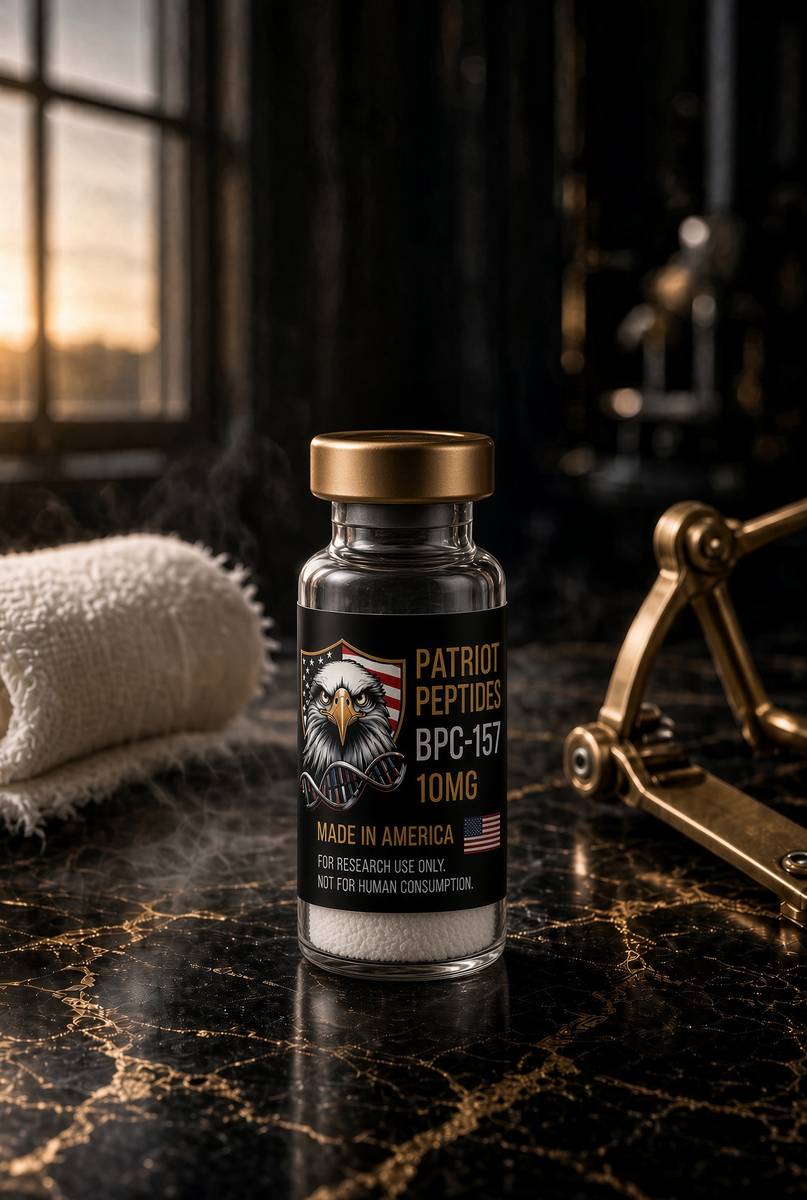
Hypothetical research reconstitution for the named catalogue vial. Not a protocol, not medical advice, not a use instruction. These amounts sit in published and commonly cited laboratory ranges. The vial is labelled for research use only — not for human or veterinary administration.
BPC-157
10mg
Mix with 2 ml bacteriostatic water → 5 mg/ml · 5,000 mcg/ml
- Hypothetical aliquot
- 250 mcg
- 0.05 ml · 5 units on a U-100 syringe
- How often
- Once or twice daily
- 2–4 weeks in the papers that actually run a course
Bench steps
- Let the vial sit until it is no longer cold to the touch.
- Wipe the stopper with 70% isopropyl alcohol. Let it dry.
- Draw 2 ml bacteriostatic water (0.9% benzyl alcohol).
- Run the water slowly down the inside glass — do not blast the cake.
- Roll between finger and thumb until the cake is gone. Do not shake.
- Label the date. Store the solution at 2–8 °C. Do not freeze. Use within 30 days unless the note below says otherwise.
Stable in bacteriostatic water in the fridge. 500 mcg is the upper end of what most bench notes call a daily aliquot; 250 mcg is the usual starting mark.
Bacteriostatic water and sterile syringes ship with peptide orders over £75. Kit details · 10 ml bacteriostatic water
The molecule in the essay
The same published structure the essay describes — HPLC-characterised.
Partner clinic
eLIVEate Me
Great Missenden, Buckinghamshire. Book on their diary. We take no commission.
Clinic treatments and pricesRead next
45 min · long read · Clinic
NEOGEN nitrogen plasma: what the energy actually does to skin
NEOGEN plasma at eLIVEate Me in Buckinghamshire. Nitrogen plasma denatures collagen without a laser chromophore. A course of three, then 90 days of rebuild.
50 min · long read · Clinic
CELL STORY liquid microneedling: 50,000 Microspears, no needle gun
CELL STORY at eLIVEate Me in Great Missenden. Sponge Microspears open transient channels, stimulate collagen, and shed in 72 hours — microneedling without a gun.

49 min · long read · Clinic
In-clinic NAD+ and the lyophilised research vial are not the same product
In-clinic NAD+ at eLIVEate Me (£200/month IM) is not Patriot’s 1000 mg lyophilised research vial. Same molecule class, different product, different till.
47 min · long read · Clinic
Dermalux LED phototherapy: light as a mitochondrial instruction
Dermalux LED in Buckinghamshire. Blue 415 nm hits acne bacteria; red 633 nm and near-infrared 830 nm talk to cytochrome c oxidase. A course of six is how repair accumulates.
Essays describe published research. They are not medical advice and they do not authorise human use of any catalogue item.