

Peptide research · 51 min · 11,114 words
Ipamorelin: the ghrelin receptor without the circus
A pentapeptide GHS-R1a agonist that raises GH with minimal ACTH, cortisol or prolactin. Raun 1998 is still the paper. Selectivity is the entire product.
What this essay actually tells you
- Ipamorelin is Aib-His-D-2-Nal-D-Phe-Lys-NH2, a selective GHSR-1a agonist designed to avoid the ACTH and prolactin noise of GHRP-6. That's the whole design brief.
- Raun et al., 1998 (Eur J Endocrinol) is the clean selectivity paper. Read it before a forum. Five residues, a receptor, a 1998 figure.
- GHSR is also a hunger receptor. Selectivity versus older GHRPs is the whole point of this pentapeptide as a probe. Hunger comes with the territory. ACTH doesn't have to.
What this actually means
Ghrelin is the stomach hormone that says hungry and, at the pituitary, turns up growth-hormone release. Early lab copies of that idea (GHRP-6, hexarelin) also shoved ACTH, cortisol and prolactin around, which is a messy experiment. Ipamorelin was designed to press the ghrelin receptor and mostly leave the stress axis alone. That selectivity is why it is still the cleanest secretagogue to put on a bench, and why we stock it rather than the circus. Hunger comes with the receptor. A later gut-recovery trial failed, which is information: a clean GH secretagogue is not a general gut medicine. The GHRH analogue on the next shelf is a different lock on the same cell.
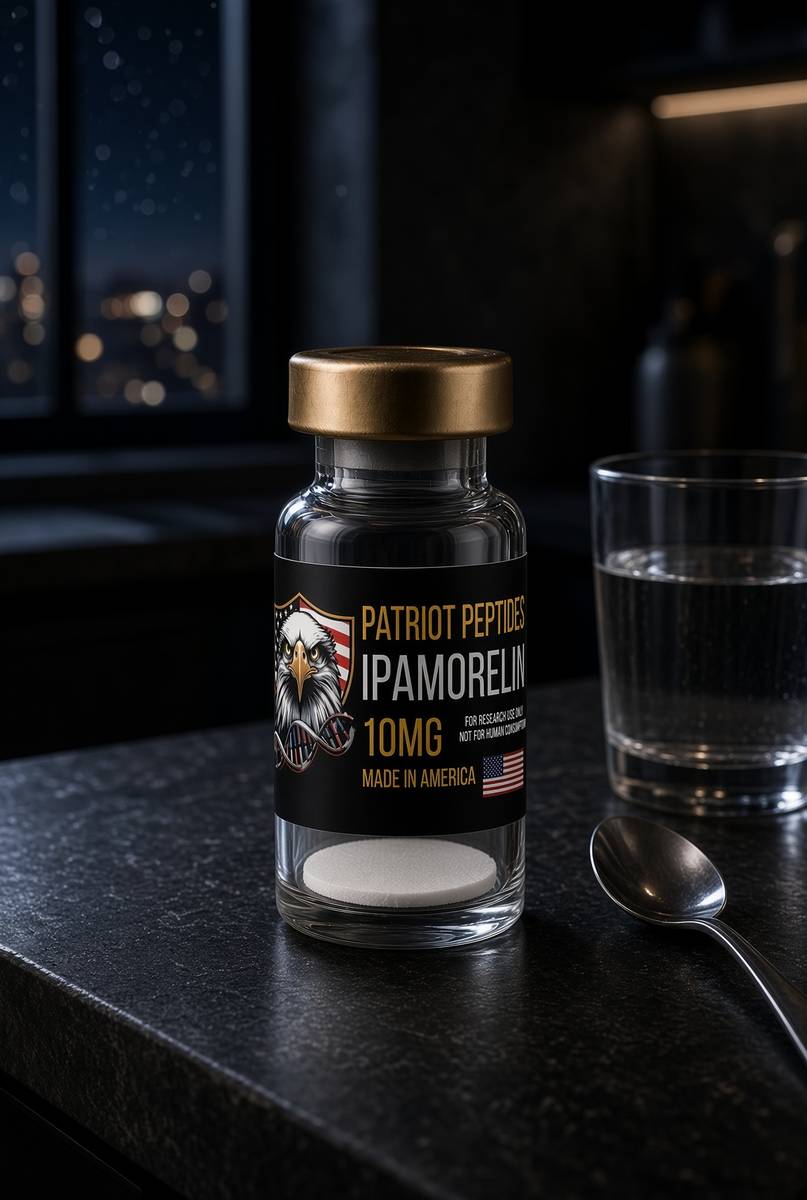
Ipamorelin is Aib-His-D-2-Nal-D-Phe-Lys-NH2, a pentapeptide agonist at GHS-R1a — that’s the ghrelin receptor. Five residues, a C-terminal amide, two D-amino acids, and an aminoisobutyric acid sitting at the front of the chain. Novo Nordisk published it. Raun, Hansen, Nielsen, Heinig, Andersen, Thøgersen, Ankersen and Madsen, European Journal of Endocrinology, 1998, 139: 552–561. In a dish of rat pituitary cells it released growth hormone. In swine and in rats, plasma GH rose. ACTH, cortisol and prolactin did not, at the same doses that worked for GH, unlike GHRP-6 and hexarelin run in the same protocols. That comparison is why we still reach for this analogue a quarter of a century later. Molecular weight 711.9. CAS 170851-70-4. The catalogue cake is ten milligrams, lyophilised, HPLC at or above 98 per cent, the sequence those tables name. It occupies a class-A GPCR rather than being the stomach hormone, a GHRH analogue, or recombinant growth hormone. How cleanly it sits on that one receptor is the reason it exists.
In short. Ipamorelin is a five-amino-acid key for the ghrelin receptor. It raises growth hormone and mostly leaves the stress hormones alone.
If you’re holding the vial, you deserve to know which molecule is in the cake and which question that molecule is allowed to ask. The neighbouring essay on this desk is the whole growth-hormone axis: GHRH, ghrelin, somatostatin, the 191-residue ligand, hepatic IGF-1, four laboratory analogues on four receptors. The GHRH analogue without the Drug Affinity Complex is the other on-switch, a tetrasubstituted twenty-nine-mer that still pulses. A shorter piece on GHRH and ghrelin mimetics as two keys on one somatotroph sits one shelf over. This piece is one receptor, written at the length the pentapeptide actually needs. We’ll walk the sequence, the orphan receptor, the stomach ligand that arrived three years later, the Gq path onto a granule, the older hexapeptides that also shoved ACTH around, Raun’s tables, the hunger address you can’t skip, a failed ileus programme, and why two ligands in one syringe still have to be two named questions. It isn’t a protocol. Papers that already ran secretagogues in slices and in animals are in PubMed, with concentrations and sampling intervals. Stay here if you wanted the chemistry and the receptor explained.
In short. This page is one receptor and one five-residue ligand. The rest of the growth-hormone axis has its own pages. This is the clean ghrelin-receptor one.
A somatotroph — that’s a pituitary cell packed with growth hormone — reads a ratio in portal blood, a cyclic-AMP increment from GHRH, a calcium current from GHS-R1a, a Gi brake from somatostatin, and a readily-releasable pool of dense-core granules packed with the 191-residue four-helix bundle. GHRH is the go. Somatostatin is the stop. Ghrelin, occupying GHS-R1a, turns the volume up. Johannes Veldhuis spent a career showing that the product of that ratio is a digital signal: night-time bursts, a low interpulse baseline, suppression by hyperglycaemia, amplification by fasting. A secretagogue analogue is a probe at the second of those on-receptors. How cleanly it sits there decides whether you’ve isolated GHS-R1a or written a stress-axis sentence on top of the GH sentence. Five amino acids decide the first of those clocks. The older hexapeptides decided, by accident, to bring extra hormones along for the ride. We’re going to make the case for the cleaner tool, named at every floor, with the papers you’d want on the bench. The receptor is early. The tables are the finding.
In short. Pituitary cells release growth hormone in bursts. This analogue turns up one of the two on-switches, and it was built to leave the stress axis out of the table.
GH went up. ACTH, cortisol and prolactin mostly did not. That was the finding, and it is still the reason a bench reaches for this analogue rather than GHRP-6.— Raun K, Hansen BS, Nielsen KL, Heinig CH, Andersen PH, Thøgersen H, Ankersen M, Madsen K. Ipamorelin, the first selective growth hormone secretagogue. Eur J Endocrinol. 1998; 139: 552–561.
Five residues, a C-terminal amide
Let’s write the sequence in full, because a five-mer has nowhere to hide. Position 1 is aminoisobutyric acid, Aib, a non-proteinogenic residue with two methyls on the alpha carbon. Position 2 is histidine, the same first proteinogenic residue Bowers put on GHRP-6. Position 3 is D-2-naphthylalanine, a bulky aromatic D-amino acid that isn’t in the genetic code. Position 4 is D-phenylalanine, another D-aromatic. Position 5 is lysine, amidated at the C-terminus. Aib-His-D-2-Nal-D-Phe-Lys-NH2. That’s the whole ligand. The D-residues and the Aib are why plasma aminopeptidases, and a handful of other proteases, have a harder time than they would with an all-L pentapeptide of equivalent mass. The C-terminal amide is the usual secretagogue finish, matching GHRP-6 and hexarelin, and it’s part of how the receptor’s extracellular face reads the chain. You shouldn’t have to guess which stereochemistry is in the cake. The certificate that can show this sequence and this mass has named the ligand you’re about to weigh. That’s the starting point, and it’s already more chemistry than a five-letter abbreviation ever gives you.
In short. The chain is five units: a branched starter, histidine, two mirror-image aromatics, and an amidated lysine. That exact string is the ligand.
Aib at the N-terminus is a pharmacokinetic sentence as well as a structure. Aminopeptidases like a normal L-amino acid with a hydrogen on the alpha carbon. Aib has two methyls there. The enzyme stalls. That’s the same logic that put Aib at position 8 of semaglutide, and the same logic that made a generation of peptidomimetic chemists treat alpha-methyl residues as a cheap way to buy minutes in plasma. Minutes, for a secretagogue, are the useful window: long enough to occupy GHS-R1a through a burst, short enough that a trough can still happen. Ipamorelin wasn’t built to last a week. It was built to be a pulse-length ligand at a receptor whose endogenous agonist is itself a short-lived acylated peptide. The D-2-Nal and the D-Phe add proteolytic resistance and fill a hydrophobic pocket the receptor presents. They’re not decoration, and they’re not a potency contest against somatropin, which is a different receptor on a different cell. They’re how a five-mer remains a five-mer long enough to be a probe.
In short. The unusual starter amino acid slows the enzymes that would otherwise chew the chain from the front. The analogue lasts a burst, not a week.
Molecular weight 711.9 grams per mole. Formula on the certificate, mass on the chromatogram, CAS 170851-70-4. The biologically handled anomer question that a dinucleotide has to answer doesn’t arise here: there’s one sequence, one amide, one set of D-residues. What does arise is the usual lyophilised-peptide hygiene. Residual moisture, heat, light, and leftover acid from cleavage are how a perfectly synthesised pentapeptide becomes a mixture after the fact. The solid is a white to off-white cake. Purity is a chromatogram, not a hunch. Water is the enemy once the stopper is off. None of those sentences is a dose, a route, or a schedule. If you can’t say how many nanomoles went into a well, you haven’t started. Ten milligrams is the size of the cake, not a human serving, and the label is the legal class of the object. The cake is a laboratory solid for the assays we’ll name as we go: a pituitary-cell GH release, a GHS-R1a occupancy, a secretagogue challenge whose other hormones you actually draw.
In short. The vial is freeze-dried pentapeptide, a named mass and a chromatogram, for weighing into experiments. That is a laboratory chemical, not a dose.
Length isn’t a small GHRH. GHRH is a forty-four-residue hypothalamic peptide; the first twenty-nine, amidated, already occupy GHRHR with full efficacy. That receptor is class B, secretin-family, a large extracellular domain, Gs, cyclic AMP. GHS-R1a is class A, rhodopsin-like, a small-molecule-shaped peptide pocket among the helices, Gq first. A chemist who designs a ghrelin-receptor agonist is designing against a different lock from the chemist who tetrasubstitutes GRF(1–29). Five residues can fill a class-A pocket. They can’t mimic a class-B ectodomain ligand. Treat ‘growth-hormone peptide’ as one substance and you’ll mix those objects, then misread both a certificate of analysis and a pituitary-slice paper. Ghrelin itself is twenty-eight residues with an octanoyl on serine 3. Ipamorelin isn’t a truncated ghrelin. It’s a synthetic secretagogue that occupies the same receptor because the receptor was an orphan first and the stomach introduced itself later. Two lengths. Two biosynthetic origins. One granule downstream, if the lock turns.
In short. This five-mer is not a short version of GHRH, and it is not a short version of ghrelin. Different receptors, different shapes, one pituitary cell downstream.
The orphan, then the stomach ligand
Cyril Bowers spent the 1980s making smaller, stronger peptides that released GH from pituitary cells without being GHRH. That was a genuine surprise. The hypothalamic go peptide was already on the table, isolated in 1982; a hexapeptide that released GH by a different route implied a second receptor the textbooks hadn’t drawn. GHRP-6, His-D-Trp-Ala-Trp-D-Phe-Lys-NH2, worked. It released GH from rat pituitary cells, from animals, later from people. It also moved ACTH, cortisol and prolactin, which is a messy experiment if the question was isolated growth-hormone release. Hexarelin, His-D-2-methyl-Trp-Ala-Trp-D-Phe-Lys-NH2, did the same extra work with more potency. GHRP-2 sat in the same family. The field had ligands and no clone. Medicinal chemistry ran ahead of molecular biology, which isn’t rare and is how you end up with a drawer of hexapeptides that occupy a protein you can’t yet name. The drawer was useful. It was also noisy on the stress axis, and the tables said so at the time. That’s the neighbourhood this pentapeptide was written against.
In short. In the 1980s chemists found short peptides that released growth hormone without being GHRH. They worked, and they also shoved stress hormones around.
Howard, Smith and colleagues cloned the receptor in 1996. Science, 273: 974–977: a receptor in pituitary and hypothalamus that functions in growth-hormone release. GHS-R, growth-hormone secretagogue receptor, an orphan class-A GPCR with two splice forms. GHS-R1a is the seven-helix functional receptor. GHS-R1b is a truncated five-helix variant that doesn’t signal as a GH secretagogue receptor on its own and has been argued over as a modulator ever since. The clone explained the hexapeptides. It didn’t clean them. Ligands that had been dirty on ACTH before the clone were still dirty on ACTH after the clone, because the off-axis pharmacology was a property of those chains at those concentrations, not a property of ignorance about the sequence. Naming the target is necessary. It isn’t sufficient. Cite Howard 1996 and then use GHRP-6 as if the clone had subtracted the prolactin, and you’ve cited a paper without letting it change the protocol. The lock now had a name. The older keys still fitted more than one door.
In short. The receptor was cloned in 1996 and named GHS-R. Putting a name on the lock did not make the older keys any cleaner on stress hormones.
Kojima, Hosoda, Date, Nakazato, Matsuo and Kangawa, Nature 1999, 402: 656–660, found the endogenous ligand three years later. Ghrelin: a twenty-eight-residue peptide from the stomach, uniquely octanoylated on serine 3. The acylation is obligatory for GHS-R1a agonism. Ghrelin O-acyltransferase, GOAT, installs that lipid in the stomach, a post-translational modification so unusual that the isolation paper had to argue for it. Des-acyl ghrelin circulates in larger amounts and is a different conversation: it doesn’t occupy GHS-R1a as the acylated peptide does, and papers that treat total ghrelin as the agonist are measuring a mixture. At the pituitary, GHS-R1a sits on somatotrophs and synergises with GHRH. In the arcuate, the same receptor sits on NPY/AgRP neurons and is the reason ghrelin is an orexigenic signal as well as a secretagogue. Vagal afferents carry a third copy of the story. One ligand, several addresses, one G protein family. The body introduced itself a decade after the chemists had started occupying the lock, which is a lovely order of events if you like your pharmacology slightly backwards.
In short. Ghrelin is a twenty-eight-amino-acid stomach hormone with a fat chain on one serine. That fat chain is required. The same receptor also sits on hunger circuits.
Synthetic growth-hormone secretagogues don’t need that octanoyl, because they were built against the orphan rather than copied from the stomach. Ipamorelin is one of those synthetic peptides. It isn’t ghrelin. It doesn’t carry a serine-3 lipid. It doesn’t share ghrelin’s twenty-eight-residue backbone, ghrelin’s GOAT dependence, or ghrelin’s circulating des-acyl majority species. It occupies the same class-A receptor, raises calcium by the same Gq-first route, and inherits the geography of that receptor whether a protocol only sampled GH or not. The distinction is the whole product, restated as chemistry. Write ‘ghrelin mimetic’ and then treat the analogue as if it were the acylated twenty-eight-mer, and you’ve mixed a synthetic pentapeptide with a stomach hormone. Lawful as a shorthand in a sentence that immediately names the sequence. Unhelpful as attribution, if a gastric-emptying phenotype is then credited to ‘ghrelin’ when the ligand in the well was Aib-His-D-2-Nal-D-Phe-Lys-NH2. Same lock. Different keys. Different biographies.
In short. Ipamorelin occupies the ghrelin receptor but is not ghrelin. It has no fat chain, no twenty-eight-residue backbone, and a different origin story.
Diagram
Hypothalamus
GHRH · somatostatin
Go and stop. Class-B GPCRs on the somatotroph.
Stomach / arcuate
ghrelin → GHS-R1a
Volume knob. Synergises with GHRH. Ipamorelin sits here.
Pituitary
GH pulses
191 residues. Night-time bursts. Veldhuis spent a career on the pattern.
Liver
IGF-1 + IGFBP3 + ALS
JAK2–STAT5b at the GH receptor. Much of the growing is this hormone.
Tissue
IGF1R
RTK. IRS–PI3K–Akt–mTOR. IGF-1 LR3 asks this microphone with IGFBPs taken out.
CJC without DAC is DPP-IV-resistant GRF(1–29) that still pulses. Ipamorelin is selective GHS-R1a. Somatropin is the 191-residue ligand. IGF-1 LR3 bypasses the pituitary. Confuse the four and the methods section is already wrong.
Receptor geography is the sentence a GH-only assay will try to skip, and we shouldn’t let it. GHS-R1a is expressed on somatotrophs, which is why a secretagogue raises GH. It’s expressed in the arcuate on NPY/AgRP neurons, which is why ghrelin is hunger as well as hormone. It’s expressed on vagal afferents, which is why some of the gastric and appetite story is a nerve rather than a pituitary. It’s expressed in the enteric nervous system, which is why a later clinical programme could even ask about postoperative ileus. Cardiac and bone addresses exist in the literature and aren’t this essay’s centre, but they’re real enough that a sentence saying ‘GH secretagogue’ was never only a GH sentence. A catalogue pentapeptide that occupies GHS-R1a will inherit that geography. Modified GRF(1–29) will not, because it occupies GHRHR. The two ligands are how you isolate the two locks. Pretend the pentapeptide is a pituitary-only tool and a clean GH table becomes a confused feeding study. Name the addresses. Then pick the readout that matches the one you actually care about.
In short. The ghrelin receptor lives on pituitary cells, hunger neurons and gut nerves. A ligand at that receptor inherits all of those addresses, not just the growth-hormone one.
GHS-R1a is a class-A GPCR
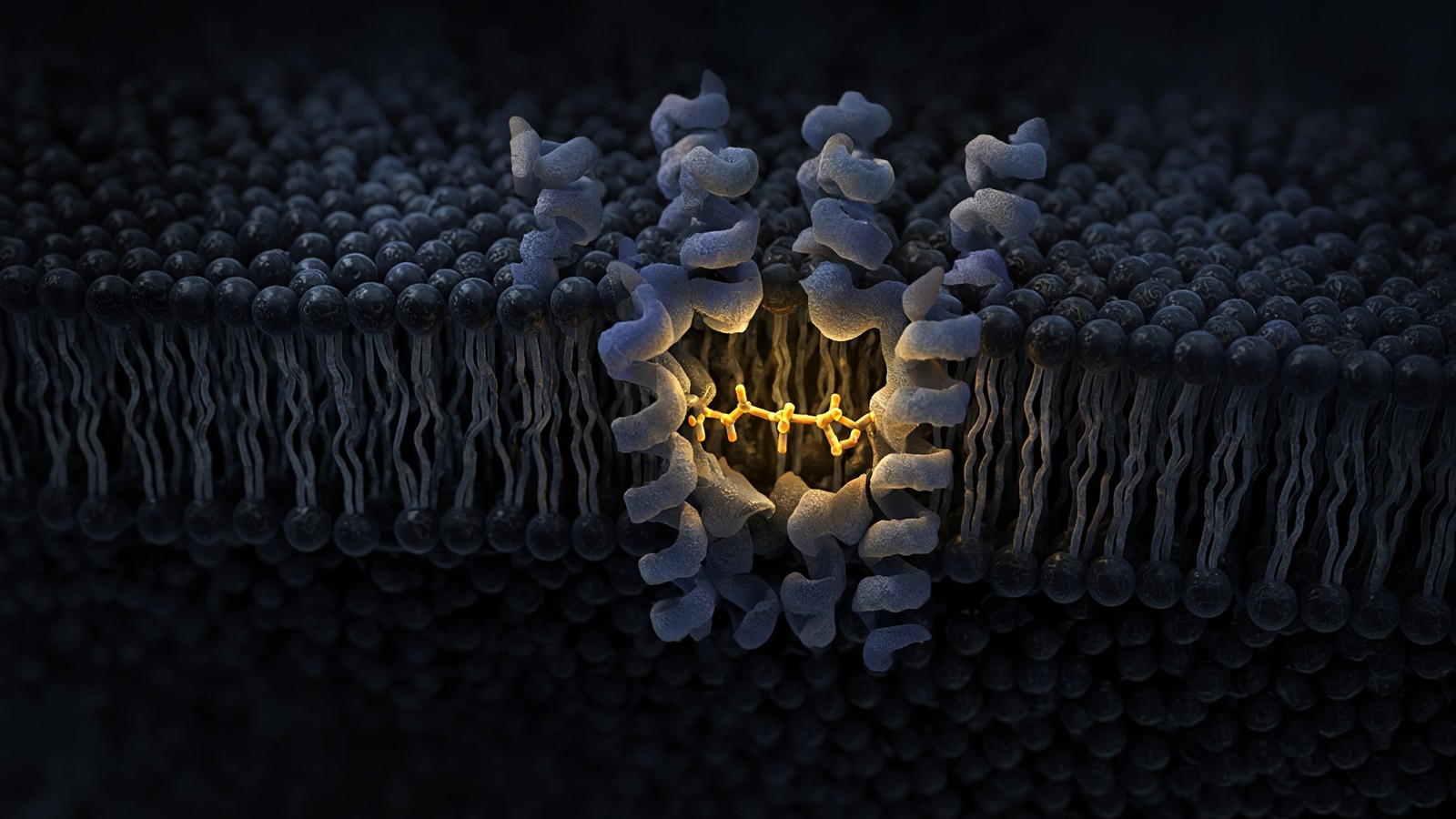
GHS-R1a is a class-A GPCR, rhodopsin-like, seven transmembrane helices, a peptide-binding pocket among the helices and extracellular loops rather than a large hormone-catching ectodomain. Occupancy rearranges the helices. The intracellular face becomes a guanine-nucleotide exchange factor, predominantly for Gq/11. Lefkowitz and Kobilka’s chemistry Nobel in 2012 was for this family, and a secretagogue essay is allowed to say so because the family logic is the logic of the analogue: ligand stays outside, information crosses as conformation, amplification is enzymatic. Class A is a different extracellular architecture from the secretin-family class B that GHRHR belongs to. A chemist who designs ipamorelin is designing against a small peptide cleft, which is why five residues suffice. A chemist who designs modified GRF(1–29) is designing against an ectodomain-plus-transmembrane pair, which is why twenty-nine residues still matter. Two locks. Two ligand lengths. One granule downstream if both locks turn. Confuse the classes and the two analogues start looking like two strengths of one juice, which they’re not. They’re two shapes for two pockets.
In short. The ghrelin receptor is a seven-helix protein in the rhodopsin family. The ligand stays outside. A G protein on the inside does the work.
Gq is the first amplifier. GTP-bound Gαq occupies phospholipase C-β. PIP2 is cleaved to IP3 and diacylglycerol. IP3 opens IP3-gated channels on the endoplasmic reticulum. Calcium rises from stores. Diacylglycerol occupies protein kinase C. The calcium rise, in a somatotroph, is the proximate co-trigger for exocytosis of stored growth hormone, and it also depolarises the cell so that L-type voltage-gated calcium channels, Cav1, open and add a plasma-membrane calcium current on top of the store release. Block those channels with a dihydropyridine in a pituitary slice and part of the GH pulse collapses, which is old pharmacology and still a useful control if someone claims a secretagogue released hormone by a novel inner path. GHRH gets to the same granule through Gs, adenylyl cyclase, cyclic AMP, protein kinase A, and a PKA-dependent encouragement of the same L-type current. Two routes. One fusion event. The granule is a dense-core vesicle packed with GH, already synthesised, waiting. A pulse, on the seconds-to-minutes clock, is mostly that fusion.
In short. The ghrelin receptor raises calcium inside the pituitary cell, from stores and through membrane channels. Stored growth hormone then leaves in a burst.
Diagram
Outside
Peptide ligand
Named sequence in the nM–µM pocket. Shape complementarity, not vibes. A 15-mer and a 4-mer do not fit the same hole.
Membrane
7-TM receptor
Helices rearrange. The cytoplasmic face becomes a GEF for a heterotrimeric G protein (Gs, Gi, Gq, G12/13).
Inside
Second messengers
cAMP, IP₃, Ca²⁺, β-arrestin. One occupied receptor can spawn thousands of messenger molecules. That is amplification.
~800 GPCRs in the human genome. Seven transmembrane helices, an extracellular ligand pocket, an intracellular G-protein handshake. Catalogue neighbours: ipamorelin at GHSR, PT-141/MT2 at melanocortin receptors, retatrutide at GLP-1R/GIPR/GCGR.
A Gi component is real, and it’s part of why the electrophysiology of a somatotroph seeing ghrelin isn’t a carbon copy of one seeing GHRH. Gαi can lower adenylyl cyclase tone, close some potassium channels, and change the firing pattern of an already excitable cell. Somatotrophs fire action potentials. The depolarisation that GHRH and ghrelin both encourage, by different G proteins, is how Cav1 opens. A secretagogue that also leans on Gi won’t simply add a Gq calcium bump on a quiet Gs background; it will redraw the electrical state of the cell. That’s a reason synergy is super-additive rather than a polite sum, and a reason a lab that voltage-clamps a somatotroph and one that only measures medium GH aren’t looking at the same object. β-arrestin is recruited, as for any self-respecting class-A GPCR. Biased ligands exist in the medicinal-chemistry literature — G protein versus arrestin, Gq versus Gi — and they aren’t this catalogue. Ipamorelin is a peptide agonist at GHS-R1a, characterised as a GH secretagogue, not as a bias probe. That’s a feature of the design brief, not a missing experiment.
In short. A second G protein, Gi, also sits on this receptor, so the cell’s electrical state changes as well as its calcium. That is one reason the two on-switches add up to more than either alone.
Constitutive activity is a property this receptor is famous for, and a property we have to keep honest. GHS-R1a signals a bit without ligand. Inverse agonists exist in the literature because of that basal tone. The physiological argument is that a constitutively noisy secretagogue receptor sets a floor under somatotroph excitability and under arcuate NPY tone, and that acylated ghrelin then turns the volume further up. Whether a given analogue is a full agonist, a partial agonist, or something with inverse-agonist neighbourhood on some readouts is a concentration-and-assay question, not a one-line answer. Raun’s tables treated ipamorelin as an agonist that released GH. They didn’t claim to have quieted basal GHS-R1a. Inverse agonism is a different design brief, and the non-peptide inverse-agonist papers are a different chemical class. If your blot is about constitutive activity, this pentapeptide is probably the wrong tool. If your blot is about raising GH from a Gq-coupled occupancy without an ACTH confound, it’s the right one. Pick the question the analogue was built to answer.
In short. This receptor leaks a little signal even before a ligand arrives. Ipamorelin is an agonist that turns the volume up, not a drug designed to silence that leak.
Desensitisation is why more ligand isn’t more signal forever, and it’s ordinary GPCR biology applied to a class-A receptor whose endogenous ligand in life is a pulse. Occupied GHS-R1a is phosphorylated by GRKs, binds β-arrestin, and is internalised. Recycle or degrade, depending on the duration and the cell. A somatotroph that sees continuous secretagogue tone will, within hours, present fewer receptors and a smaller calcium increment per molecule of ligand. That’s the same arithmetic Lefkowitz spent a career on. Ghrelin in life doesn’t sit on the receptor all day; it pulses with meals, with fasting, with a circadian colour. A laboratory analogue arriving from the periphery occupies one receptor in that village. Continuous application in a well is a different experiment from a bolus in an animal, and both are different from a nocturnal endogenous ghrelin wave. Write the time course. Write whether the receptor had a chance to recover. Getting out of the way is a pharmacokinetic property. It’s also a scientific decision, and it’s why a pulse-length five-mer still has a job in 2026.
In short. If the receptor stays occupied for too long, it is pulled inside and the cell hears less. A short pulse leaves so hearing can recover.
Diagram
× 1
Ligand
One peptide in one pocket. nM–µM. Shape, not a mood.
× 10–10²
G proteins
The occupied GPCR is a GEF. Each Gα is a catalyst.
× 10³–10⁴
cAMP / IP₃ / Ca²⁺
Adenylyl cyclase and PLC do not make one molecule. They make a cloud.
× 10⁴–10⁶
PKA / PKC / CaMK
Kinases phosphorylate many substrates per messenger.
× tissue
Secretion, transcription, motility
The organism-level readout. Still not a protocol.
This is the only magic, and it is not magic. A nanomolar ligand can move a micromolar messenger because enzymes sit between them. Desensitisation (GRK, β-arrestin, endocytosis) is how the cell refuses to let ‘more ligand’ mean ‘more signal’ forever.
Two G proteins, one granule
Bowers showed, decades ago, that a GHRH analogue plus a ghrelin-mimetic secretagogue releases more GH than the arithmetic sum of either ligand. That’s synergy as a receptor fact, not a smoothie. GHRHR is class B, Gs, cyclic AMP, protein kinase A, L-type calcium, GH transcription on a slower clock via Pit-1 and CREB, and exocytosis on the minutes clock. GHS-R1a is class A, Gq/Gi, phospholipase C, IP3, calcium from stores, a different route onto the same granules. Cyclic AMP and calcium converge on the fusion machinery. Give GHRH alone and you get a pulse. Give a secretagogue alone and you get a pulse that still wants GHRH tone in the background; in hypothalamic–pituitary clamp experiments, a secretagogue in the absence of GHRH produces a smaller burst than the pair. Give both, and the output is super-additive because the second messengers are. The large nocturnal pulses that Veldhuis deconvolved are, on this picture, a GHRH event amplified by ghrelin tone and permitted by a somatostatin trough. Two receptors, two G proteins, one granule. That’s a somatotroph, not a cocktail.
In short. GHRH raises one internal alarm, the ghrelin receptor raises calcium, and together they empty more growth-hormone granules than either signal alone.
Somatostatin is the stop, and if you add a secretagogue without naming it you’ve described two-thirds of the hypothalamic sentence. Brazeau, Vale, Guillemin, Science 1973: a fourteen-residue cyclic peptide from hypothalamic extracts that inhibited growth-hormone release in pituitary cells, named for that job before its wider life as a gut and pancreatic hormone was mapped. On the somatotroph the relevant receptors are mainly SSTR2 and SSTR5, class-A GPCRs coupled to Gi. Adenylyl cyclase falls. Cyclic AMP falls. The L-type calcium current that GHRH had opened is opposed. Granule fusion slows. Somatostatin tone is high between pulses and drops as a pulse is allowed through. The go is therefore a triple event: GHRH up, ghrelin tone present, somatostatin down, arriving as a ratio. An analogue at GHS-R1a still has to live with that ratio. It can’t repeal Gi at SSTR2. It can only raise the Gq side of a contest that the stop peptide is still fighting. Arginine, in clinical GHRH tests, is there in part to suppress somatostatin. Name the stop if you claim a pulse. The analogue doesn’t cancel it.
In short. Somatostatin is the brain’s stop signal for growth hormone. A pulse is a ratio of two on-switches to that off-switch, not a button.
The gates on a secretagogue challenge are metabolic as well as hypothalamic, which is why a fed animal and a fasted animal aren’t the same assay. Fasting raises ghrelin and amplifies GH. Hyperglycaemia suppresses GH and will blunt a secretagogue challenge. Free fatty acids suppress GH release, one of the reasons obesity is a low-GH state. Slow-wave sleep is the largest physiological window for a nocturnal burst; a daytime challenge is a different probe from an endogenous night pulse. Thyroid hormone is permissive for GH synthesis; a hypothyroid somatotroph writes fewer granules. Sex steroids shape amplitude and frequency. Glucocorticoids, in excess, suppress the axis at hypothalamus and pituitary, which is one of the crueller ironies of a dirty secretagogue that also raises cortisol. The somatotroph isn’t an isolated oscillator. It’s a cell reading a hypothalamic ratio, a metabolic plasma, and a sleep clock. A laboratory pentapeptide occupies one receptor in that village. The village is still there when the analogue arrives, and it still has a vote on how large the burst will be.
In short. Sleep, sugar, fat, fasting and other hormones all gate these bursts. The analogue occupies one receptor; the rest of the body still has a vote.
Name both ligands if you apply both. That’s the whole standard the pituitary-slice papers already set, and it’s the sentence worth repeating because the two receptors are so easy to mash together. Modified GRF(1–29) without DAC occupies GHRHR. Ipamorelin occupies GHS-R1a. Combined, they recapitulate the large pulse the textbooks draw. Combined without naming both concentrations, they become a stack, and a stack is a purchasing habit rather than an experiment. The papers that combined GHRH and a secretagogue in pituitary slices named both receptors and both doses. Synergy is a G-protein fact. Isolating each ligand is how you know which receptor did the work. The GHRH analogue sits on the next shelf as a different sequence, tetrasubstituted, tens of minutes, still a pulse, deliberately without the maleimide that would glue it to albumin. Reconstitute both into one syringe and call it the axis, and you’ve stopped being able to attribute the GH peak. Attribution is the job, and it’s a kindness to your future self when you read the figure back.
In short. If you use the GHRH analogue and this pentapeptide together, write both names and both amounts. Otherwise you cannot tell which receptor did the work.
The circus: GHRP-6 and hexarelin
GHRP-6 is His-D-Trp-Ala-Trp-D-Phe-Lys-NH2, the hexapeptide that proved a second GH-releasing receptor existed before anyone had cloned it. Bowers, Momany, Reynolds, Hong, a run of Endocrinology papers in the 1980s. It released GH. It also released ACTH and prolactin, and cortisol followed the ACTH, which is what corticotrophs do when you occupy their secretagogue-sensitive machinery. Fine if you were cataloguing side-effects. Poor if you wanted GH as the variable. Use GHRP-6 to raise GH and then read an IGF-1 blot, a glucose clamp, or an immune panel, and you’re reading GH plus a glucocorticoid bump plus a prolactin bump. Downstream, cortisol will antagonise some of the IGF-1 pattern, mobilise glucose, and alter immune readouts. Prolactin will confuse a reproductive endpoint. The extra noise isn’t a personality defect of a useful hexapeptide. It’s off-axis pharmacology at GH-effective doses. Treating it as a bonus — more hormones, more physiology — is how a clean question becomes a mixture. We wanted a tool that left that mixture on the bench.
In short. GHRP-6 raised growth hormone and also raised ACTH, cortisol and prolactin. That extra noise is a confound if growth hormone was the variable you wanted.
Hexarelin is the louder cousin: His-D-2-methyl-Trp-Ala-Trp-D-Phe-Lys-NH2, more potent at GHS-R1a, still dirty on ACTH and prolactin, later given a cardiac-GHS-R literature of its own that we won’t pretend to referee here. GHRP-2 sat in the same family. When Smith’s group cloned GHS-R, those ligands had a named target; they still had the off-axis baggage. The secretagogue field then split, as fields do, into cleaner tools and louder ones. A louder one isn’t a better reagent. It’s a reagent plus a confound. If you wanted GHS-R1a, you wanted a ligand that occupies GHS-R1a and leaves the corticotroph and lactotroph as nearly silent as the tables allow. That’s a design brief. Ipamorelin was the pentapeptide written against that brief. Non-peptide secretagogues — the mk-series, anamorelin in the cachexia literature — are a different chemical class with their own selectivities and their own clinical programmes. They aren’t this vial. They belong in a sentence so that ‘secretagogue’ isn’t allowed to mean one substance. Same receptor family. Different chemistry. Different files.
In short. Hexarelin and related peptides were stronger and still noisy on the stress axis. The field then split into cleaner tools and louder ones. This analogue is a cleaner tool.
Corticotrophs and lactotrophs aren’t somatotrophs, which is obvious until a hexapeptide treats them as collateral. The anterior pituitary is a mixed neighbourhood: GH cells, ACTH cells, prolactin cells, TSH cells, gonadotrophs, a vascular portal stream, folliculostellate glia. A ligand can be selective at a receptor and still meet that receptor on more than one cell type, or meet a related receptor, or raise a paracrine that the neighbour hears. GHRP-6’s ACTH effect has been argued as corticotroph GHS-R, as hypothalamic CRH, as both, depending on the preparation. The argument isn’t settled enough to build a protocol on, and we won’t pretend otherwise. What is settled is the table: at GH-effective doses, GHRP-6 and hexarelin move ACTH, cortisol and prolactin, and ipamorelin does not, in the species and assays Raun ran. Want isolated GHS-R1a agonism on a somatotroph and then, with the older hexapeptides, you’ve measured a mixture. Selectivity is how you know which cell did the work. Extra hormones in the same plasma draw are how you stop knowing. The 1998 tables are how you see the difference.
In short. The pituitary is a mixed neighbourhood of cell types. Older secretagogues talked to more of those neighbours. The 1998 tables are how you see the difference.
Cortisol as a confound deserves a named paragraph because the hepatic programme is where many GH papers actually live. Hepatocytes reading pulsatile GH at GHR write IGF-1, the acid-labile subunit, and IGFBP3, a STAT5b programme Veldhuis and the rodent-pattern literature spent decades on. Glucocorticoids antagonise some of that programme, raise glucose, change immune transcription, and will move the very endpoints a secretagogue study often reports as GH effects. A dirty secretagogue therefore writes two sentences at the liver: a GH sentence and a cortisol sentence. Unpicking them after the fact, with a single IGF-1 draw and no ACTH time course, isn’t possible. Raun’s design — GH, ACTH, cortisol, prolactin, same doses, same animals, same tables — is the minimum a selectivity claim owes. Report a secretagogue IGF-1 rise without showing the ACTH line, and you haven’t earned the word selective. Use GHRP-6 and then talk as if the IGF-1 were a pure GHS-R1a-to-GH-to-liver path, and you’ve skipped the corticotroph. Extra cortisol will scramble the liver readout you thought was growth hormone.
In short. Extra cortisol will scramble the liver readout you thought was growth hormone. That is why a clean secretagogue is a better tool than a louder one.
Raun 1998 is still the paper
Raun, Hansen, Nielsen, Heinig, Andersen, Thøgersen, Ankersen and Madsen, European Journal of Endocrinology, 1998, 139: 552–561. The title is the claim: ipamorelin, the first selective growth hormone secretagogue. Novo Nordisk chemistry. In vitro, on primary rat pituitary cells, the pentapeptide released GH with a potency and efficacy that sat in the secretagogue family. The dose–response for GH rose. The dose–responses for ACTH and prolactin, run in the same preparations, did not, at concentrations that were already effective for GH. In vivo, in rats and in swine, plasma GH rose after administration. ACTH, cortisol and prolactin did not, at doses that were effective for GH, in contrast to GHRP-6 and hexarelin run in the same protocols. That last clause is why the paper is assigned reading. Selectivity as data. If you only read one GHS-R paper on this analogue, read this one. The tables are the argument. Everything after them here is geography, synergy, and the reasons a clean GH secretagogue is still not a universal drug. Twenty-five years on, those four-hormone tables have not been replaced by a better peptide tool.
In short. The 1998 paper showed growth hormone rising in dishes and in animals while ACTH, cortisol and prolactin stayed quiet. Those tables are still the reason to use this analogue.
In vitro is a pituitary-cell assay, and it’s the right first object because it asks whether the analogue can release GH from somatotrophs without a hypothalamus in the well. Primary rat anterior-pituitary cells, a static or perifusion system, GH by radioimmunoassay in the medium, ACTH and prolactin in the same medium. A slice or a dispersed-cell preparation still contains mixed pituitary cell types, which is why measuring the other hormones isn’t optional: the neighbourhood is in the well. A rise in medium GH with a flat ACTH line, at the same concentration, is the in-vitro half of selectivity. Efficacy sat with the family; the point wasn’t that ipamorelin was the most potent secretagogue ever weighed. The point was that potency at GHS-R1a didn’t have to drag corticotrophs and lactotrophs along with it. Cite Raun and then only report GH, and you’ve cited a selectivity paper for a potency claim. Bring the other hormones to the table, or don’t use the word selective. That’s a courtesy to the 1998 design, and it’s how the finding stays a finding rather than a brand.
In short. In a dish of pituitary cells, the analogue released growth hormone and did not raise ACTH or prolactin at the same concentrations. That is the first half of the finding.
In vivo is a plasma curve, and it’s the right second object because a dish can’t tell you whether an intact HPA axis will answer. Rats and swine, characterised analogue, GH, ACTH, cortisol, prolactin drawn on a time course. Swine matter because their GH axis is closer to human, on several pharmacological counts, than a rat’s is, and because Bowers and others had already used swine as a secretagogue species. Plasma GH rose. The stress-axis hormones did not, at GH-effective doses. GHRP-6 and hexarelin, in the same protocols, did move those hormones. Species is still a variable: rodent sexual dimorphism of GH pattern is sharper than human; GHS-R1a constitutive activity and tissue distribution aren’t identical across mammals; a swine curve isn’t a healthy-adult curve. Raun didn’t claim to have closed human endocrinology. The paper claimed a selective GH secretagogue in the assays it ran. That claim has survived more scrutiny than most peptide claims of the late 1990s, which is why a catalogue that stocks the sequence still points at 139: 552–561 rather than at a rumour.
In short. In rats and pigs, blood growth hormone rose and the stress hormones did not, at the same doses. Older peptides in the same tests did move those stress hormones.
The analogue doesn’t meaningfully bind the motilin receptor, a related GPCR that some ghrelin-family ligands graze. Motilin is a gut peptide. Its receptor is a class-A cousin. Cross-talk at that receptor is how a secretagogue becomes a gastric-motility story whether you asked it to or not. Raun’s characterisation included that negative, and it belongs in a write-up that’s about to claim a clean GHS-R1a probe. Oral bioavailability is poor, as you’d expect for a pentapeptide with those side chains, those charges, and a digestive tract full of peptidases. Research use in the papers is parenteral in animal protocols, or in vitro. That’s a pharmacokinetic fact, not a suggestion, and not a dosing instruction. A later programme did ask a gut question anyway, by the parenteral route, because GHS-R1a is expressed in the enteric nervous system. That programme is a later heading. Hold the chemistry here: five residues, GHS-R1a, not motilin, poor oral survival, GH tables that stayed clean. The gut question is allowed. It isn’t implied by the GH tables.
In short. It does not meaningfully occupy the related gut-hormone receptor for motilin. Swallowed, a five-amino-acid chain like this barely survives. The papers inject it or put it in a dish.
- Sequence
- Aib-His-D-2-Nal-D-Phe-Lys-NH2
- Receptor
- GHS-R1a (GHSR)
- Endogenous ligand
- ghrelin, 28 aa
- Raun 1998
- GH up, ACTH/cortisol/prolactin quiet
- GHRP-6
- His-D-Trp-Ala-Trp-D-Phe-Lys-NH2
- Partner receptor
- GHRHR, Gs–cAMP
- Catalogue cake
- 10 mg, ≥98% HPLC
- Ileus programme
- primary endpoint missed
Five residues, C-terminal amide. CAS 170851-70-4. 711.9 g·mol⁻¹.
Class-A GPCR. Gq/11 first, Gi component, β-arrestin. Howard, Science 1996.
Ser3-octanoylated by GOAT. Kojima, Kangawa, Nature 1999. Ipamorelin is not ghrelin.
Eur J Endocrinol 139: 552–561. Versus GHRP-6 and hexarelin in the same protocols.
The circus. GH plus ACTH, cortisol, prolactin. Bowers, 1980s.
Bowers synergy. Two G proteins, one granule. Name both ligands if you apply both.
Lyophilised pentapeptide. The sequence Raun published. Reagent, not a protocol.
Novo Nordisk / Helsinn. A clean GH secretagogue is not a universal gut drug.
Why the paper is still assigned reading isn’t nostalgia. Most peptide claims of that decade didn’t come with four-hormone tables, a named comparator, and a species that wasn’t only the rat. Most didn’t survive contact with a clone, an endogenous ligand, and a clinical programme that failed at a different address. Raun’s analogue did. GHS-R1a is still the lock. Ghrelin is still the stomach ligand. GHRP-6 is still dirty on ACTH at GH-effective doses. The pentapeptide is still the cleanest peptide secretagogue to put on a bench if the question is isolated GHS-R1a agonism and a GH readout. A quarter of a century is a long time for a five-mer to remain the tool of choice. It remained the tool of choice because the design brief was narrow and the tables were honest. Broader briefs — gut motility, body composition, a stacking partner, a sleep protocol — are how a selective probe gets asked to be a universal drug. The paper didn’t write those briefs. Later people did. We can admire the tables without borrowing them for a job they never applied for.
In short. The 1998 tables still matter because they named four hormones and a comparison peptide, and because the cleaner finding has not been replaced by a better peptide tool.
Geography a GH assay does not sample
Arcuate NPY/AgRP neurons carry GHS-R1a, and they’re why ghrelin is an orexigenic signal as well as a secretagogue. Occupancy on those neurons, in the textbook picture, raises NPY and AgRP, suppresses POMC, and the animal eats. Vagal and circulating routes both feed that circuit; the relative weight of nerve versus hormone is still argued, which is how a hypothalamus paper ought to age. A pentapeptide agonist at GHS-R1a will inherit some of that conversation. Hunger comes with the receptor. ACTH doesn’t have to. That pair of sentences is the product, restated as anatomy. If you wanted GH and didn’t want a feeding phenotype, you still have to house the animals as if appetite might move, because the receptor isn’t only on the somatotroph. If you wanted appetite and didn’t want a cortisol confound, that’s exactly why ipamorelin exists as a probe rather than GHRP-6. Selectivity versus older GHRPs is the whole point of this pentapeptide as a hunger-circuit tool. Relative, not absolute. Still the cleaner probe, and still a probe that talks to the neurons that write ‘eat’.
In short. The same receptor sits on brain neurons that drive hunger. Appetite comes with the lock. A stress-hormone rise does not have to come with it.
Vagal afferents carry a third copy of the story, and they’re the reason some of ghrelin’s gastric and appetite effects survive a degree of peripheral isolation that a naive pituitary-only model can’t explain. GHS-R1a on the vagus, a nerve up to the nucleus of the tractus solitarius, then hypothalamus: a loop the isolation paper didn’t have to invent, and that later vagotomy and capsaicin experiments spent a decade mapping. A laboratory analogue given systemically will see pituitary, vagus and arcuate in some combination that depends on dose, route, species and whether the animal was fasted. That isn’t a reason to avoid the analogue. It’s a reason to name the readout. GH in plasma is a pituitary readout. Gastric emptying is an enteric and vagal readout. Food intake is an arcuate-and-vagus readout. IGF-1 at a week is a hepatic integral of whatever GH pulses actually happened. Four numbers. Four floors. A single ‘secretagogue effect’ sentence that doesn’t say which floor is the sentence we’re here to unpack. Measure the floor you claim. The receptor will still be in the others.
In short. Gut nerves also carry this receptor, so stomach emptying and appetite are separate measurements from a blood growth-hormone curve. Name which one you ran.
The enteric nervous system expresses GHS-R1a, which is why a GH secretagogue was ever a candidate for postoperative ileus, and why the failure of that candidate is information rather than an embarrassment. Ileus is a motility problem after surgery: the gut is slow, feeding is delayed, hospital days accumulate. Ghrelin’s prokinetic neighbourhood, and motilin’s, made a GHS-R1a agonist a plausible probe. Ipamorelin was asked that question in a Novo Nordisk and Helsinn programme. It didn’t meet its primary endpoint. A clean GH secretagogue isn’t a universal gut drug, even though the receptor is expressed in the enteric nervous system. Receptor geography isn’t a licence to generalise the indication. That sentence belongs here because the alternative is to treat every address of GHS-R1a as a use. The analogue remains a selective GH-releasing ligand at the pituitary. The gut programme remains a missed endpoint. Both can be true. If you want gastric emptying you still have to measure gastric emptying, with sham and with a motilin comparator, and not infer it from a GH peak. The organ you claim is the organ you measure.
In short. The receptor sits in the gut as well. A later trial that asked whether this analogue would restart the bowel after surgery did not succeed. A growth-hormone tool is not automatically a gut medicine.
Hunger comes with the receptor
Selectivity versus older GHRPs is relative, not absolute, and the clone itself is why. GHS-R1a is a hunger receptor. Ghrelin rises before meals and in fasting. Occupancy on arcuate NPY/AgRP neurons is the textbook orexigenic path. Occupancy on the vagus is a second path. A pentapeptide agonist will, at some dose, in some species, in some metabolic state, talk to those paths. Raun’s tables subtracted ACTH, cortisol and prolactin from the GH experiment. They didn’t subtract the hypothalamus. The product is a cleaner GH probe that still carries the orexigenic address of its receptor. That’s a feature if the question is appetite circuitry without a glucocorticoid confound. It’s a caveat if the question is isolated somatotroph calcium in an animal that can still eat. Write the food intake. Write the fasting state. Write whether body weight was a planned endpoint or an afterthought. Hunger isn’t a side-effect in the brochure sense. It’s the receptor, doing a job it had before any analogue was synthesised. Cleaner on stress hormones doesn’t mean silent on appetite. Measure food intake if that matters to you.
In short. This receptor is a hunger receptor as well as a growth-hormone receptor. Cleaner on stress hormones does not mean silent on appetite. Measure food intake if that matters.
Ghrelin’s broader physiology — insulinostatic tone, cardiac GHS-R, bone — is real and is why people keep trying to drug this receptor. Ghrelin can suppress insulin secretion in some preparations, a pancreatic address that makes a glucose protocol mandatory if anyone is going to talk about fuel. Cardiac GHS-R has a hexarelin-adjacent literature that didn’t transfer cleanly onto every peptide agonist, which is a warning about assuming family-wide cardiology. Bone and GH/IGF-1 are a different floor: GH and IGF-1 talk to the epiphysis; ghrelin and GHS-R1a have additional bone papers that a somatotroph assay won’t see. A characterised pentapeptide is how you ask the next question with the receptor actually named. It isn’t how you inherit every phenotype ever published under the word ghrelin. Ipamorelin isn’t ghrelin. Tissue, species, acylation, and the second-messenger mix all move. The useful move is to pick one address, pick one readout, and say whether the ACTH line was shown. Breadth is a reason to be careful. It isn’t a reason to write a universal secretagogue sentence. One lock. Many rooms. You choose the room.
In short. Ghrelin also talks to insulin, heart and bone in published papers. This five-mer occupies the same receptor. It does not automatically copy every one of those stories.
Anamorelin is the named clinical neighbour in cachexia, a non-peptide GHS-R1a agonist developed for appetite and lean mass in cancer-associated wasting, with a pharmacology and a trial history that aren’t this vial. The mk-series compounds are another non-peptide drawer. Small molecules win on oral bioavailability. Peptides win on a different surface and, in this case, on a published four-hormone selectivity table. Confusing ipamorelin with anamorelin is how a research pentapeptide becomes a cachexia headline it hasn’t earned, and how a licensed-adjacent small molecule becomes a reconstitutable cake it isn’t. Same receptor family. Different chemical class, different pharmacokinetics, different trial file, different legal object. We name them so the pentapeptide stays a pentapeptide. If the question is oral GHS-R1a agonism in a wasting syndrome, the anamorelin papers are the file. If the question is a selective peptide probe of somatotroph calcium and GH exocytosis, Raun’s analogue is the file. Pick the file. Don’t merge the drawers. The lock can take more than one key without the keys becoming each other.
In short. A different, non-peptide drug at the same receptor has been studied for appetite and wasting. That is another molecule, another kind of chemistry, another set of trials.
What a selective pentapeptide lets you ask
What does isolated GHS-R1a agonism do to somatotroph calcium and GH release when GHRH is present, and when it is absent. That’s the first experiment, and it’s a pituitary-slice or primary-cell experiment before it is an animal. Measure medium GH. Measure ACTH and prolactin in the same well, because mixed pituitary cells are still mixed. Add a GHRH analogue at a stated concentration if synergy is the question; leave it out if isolation is the question. Block L-type channels with a dihydropyridine if the calcium current is the claim. A somatostatin analogue, octreotide or a more selective SSTR2 ligand, is how you ask whether the stop can still win. Those are controls the slice papers already use. A stacking partner isn’t an experiment. A concentration series with named comparators — GHRP-6, hexarelin, ghrelin, a GHRH analogue — is an experiment. The pentapeptide we stock is the ligand for the isolated-GHS-R1a column of that series. It isn’t the series. You bring the comparators, the concentrations, and the other hormones. The analogue brings one clean occupancy.
In short. The first honest question is what this receptor does to growth-hormone release, with GHRH present or absent, while you also measure the stress hormones in the same dish.
What does it do to gastric emptying and to arcuate NPY neurons without a cortisol confound. That’s the second experiment, and it’s why selectivity isn’t only a pituitary courtesy. A dirty secretagogue that raises cortisol will move gastric tone and feeding by a glucocorticoid path as well as by GHS-R1a, and you won’t know which. Raun’s analogue lets you ask the receptor question with a quieter HPA line. Measure emptying with a named meal or a coloured marker, in a named species, with a motilin comparator if you’re in that neighbourhood. Measure food intake over a stated window, fasted versus fed. Measure NPY/AgRP transcripts or a fibre photometry signal if you have the kit and the ethics. Don’t infer those from a GH peak. The receptor is in all of those places. The GH peak is one place. A later ileus programme already showed that a clean GH table doesn’t guarantee a gut endpoint. That failure is a gift to assay design. It tells you to measure the organ you claim. Because stress hormones stay quieter, you can ask the gut question without cortisol muddying the result.
In short. Because stress hormones stay quieter, you can ask about stomach emptying and hunger without cortisol muddying the result. Measure those things directly. Do not guess them from a growth-hormone peak.
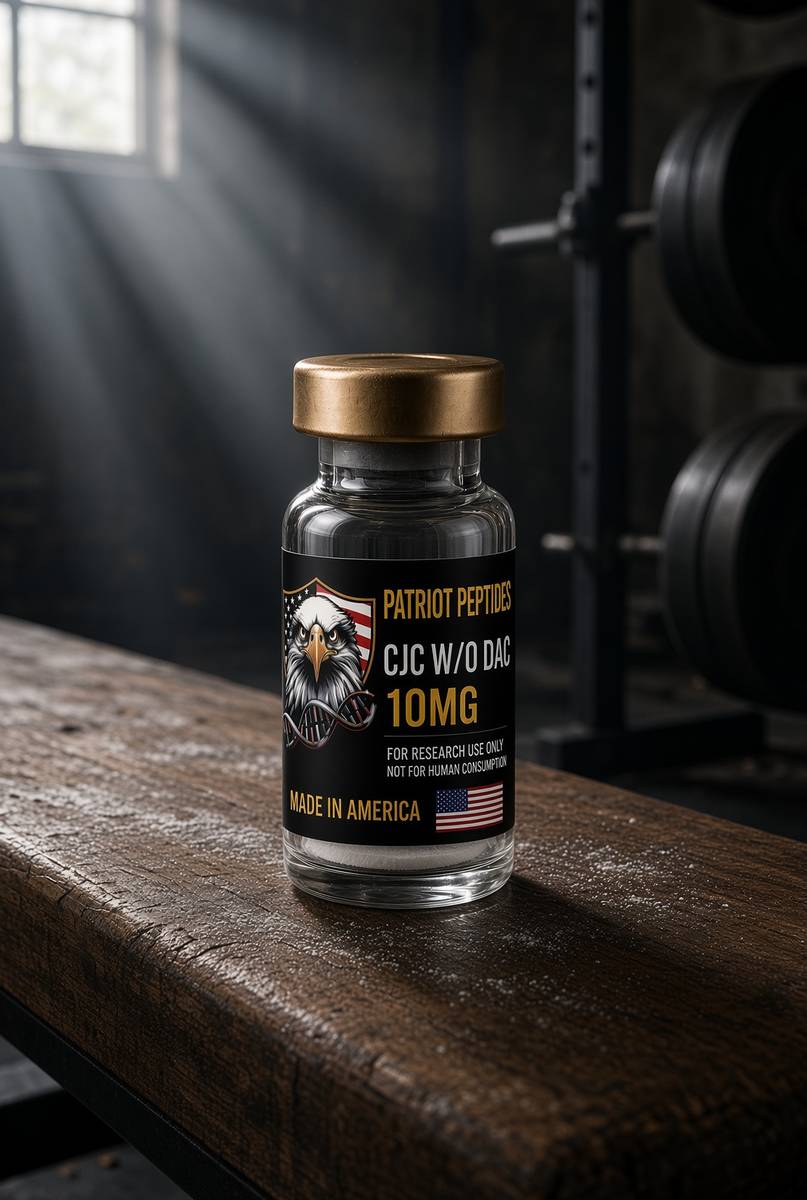
What does it do in combination with a DPP-IV-resistant GHRH analogue: two receptors, two G proteins, one pulse, each ligand named. That’s the third experiment, and it’s Bowers, restated with cleaner tools than GHRP-6. Modified GRF(1–29) without DAC is the pulse-length GHRH analogue this desk already wrote up: D-Ala2, Gln8, Ala15, Leu27, tens of minutes, still a trough, deliberately without the maleimide. Ipamorelin is the GHS-R1a pentapeptide. Co-application in a slice or in an animal is how you ask for the large pulse the textbooks draw. Name both concentrations. Sample GH frequently enough to see a burst rather than an integral. Sample ACTH so the selectivity claim survives the combination. Metabolic state of the animal, because glucose and fasting gate the somatotroph. The blend vial in the catalogue is ten milligrams of each, freeze-dried together, a logistics object for a reading list that already contained two ligands. It’s still two named sequences. It isn’t a protocol. It isn’t a reason to stop attributing the peak. Write both names. That pairing is an experiment.
In short. Together with a short GHRH analogue, this pentapeptide can make the large pituitary burst the textbooks draw. Write both names. That pairing is an experiment, not a recipe.
Sampling is the unglamorous half, and it’s where secretagogue papers most often cheat. A single clinic GH, drawn at nine in the morning, reports a trough more often than a peak and can’t distinguish a missed burst from a quiet baseline. Frequent sampling, every ten or twenty minutes around the dose, is how you prove a pulse; it’s also how Veldhuis deconvolved mass and frequency in the physiological literature this analogue sits under. IGF-1 is the integral: a hepatic average over hours, useful, and blind to whether the morning was one large burst or a flattened plateau. Occupy GHS-R1a and then draw IGF-1 at a week, and you’ve measured the liver’s running mean, not the somatotroph’s calcium. Draw GH at twenty-minute intervals if the question is the pulse. Draw IGF-1 if the question is the hepatic programme. Draw ACTH and prolactin if the question is selectivity. Name which integral you meant. The numbers don’t substitute for each other, and a dirty secretagogue can look ‘stronger’ on a sparse IGF-1 draw while having written a cortisol sentence the draw can’t see. One morning blood test is usually a quiet gap.
In short. One morning blood test for growth hormone is usually a quiet gap. Frequent samples show bursts. IGF-1 averages hours of liver output and hides those bursts.
A dish isn’t a somatotroph in a sleeping human, and a somatotroph in a sleeping human isn’t a hepatocyte, and a hepatocyte isn’t an NPY neuron. Species is a variable: rodent sexual dimorphism of GH pattern is sharper than human; GHS-R1a constitutive activity and tissue distribution aren’t identical across mammals; swine are closer on some secretagogue counts, which is why Raun used them. Concentration is a variable: nanomolar in a well isn’t a plasma free-fraction after proteases, first-pass and dilution have had their turn. Route is a variable: in vitro, intravenous, subcutaneous, a portal-adjacent experiment if someone is serious about pituitary exposure. DPP-IV won’t be this analogue’s main enemy — it isn’t a GHRH backbone with an Ala2–Asp3 bond — but plasma peptidases still exist, and a time course still has to be written. The pentapeptide is how you isolate the GHS-R1a floor. It isn’t how you skip floors. Apply the analogue and measure GH, then IGF-1, then a composition or emptying endpoint, and you’ve walked the floors. Apply four analogues at once and measure a waist, and you haven’t.
In short. A cell dish, a rat and a person are three different systems. Use this analogue to isolate one receptor, then measure the next step down, in order.
- Ipamorelin is Aib-His-D-2-Nal-D-Phe-Lys-NH2. Five residues, C-terminal amide, GHS-R1a. Raun, Eur J Endocrinol 1998.
- GHS-R1a is class-A, Gq/Gi, Ca2+ from stores and L-type current. Ghrelin is the 28-residue Ser3-octanoylated stomach ligand. The analogue is not ghrelin.
- GHRHR is the other on-switch: class-B, Gs–cAMP–PKA. Bowers: the pair is more than additive. Name both ligands if you apply both.
- GHRP-6 and hexarelin raise ACTH, cortisol and prolactin at GH-effective doses. Ipamorelin, in Raun’s tables, does not. Selectivity is the product.
- Hunger, vagus and enteric GHS-R1a come with the receptor. A later ileus programme missed its primary endpoint. Measure the organ you claim.
The 10 mg cake is not a stack
The catalogue listing is lyophilised ipamorelin, ten milligrams, HPLC at or above 98 per cent, Aib-His-D-2-Nal-D-Phe-Lys-NH2, molecular weight 711.9, CAS 170851-70-4. A white to off-white cake in a vial, a certificate of analysis, a reconstitution kit. It’s the same carbon skeleton Raun’s tables name. It’s a laboratory reagent. The form is the form you weigh into a pituitary-cell assay, a GHS-R1a binding experiment, an animal secretagogue challenge whose sampling interval you actually write down. Purity is a chromatogram, not a hunch. Sequence identity is the only honest link between a catalogue vial and a paper. HPLC and mass spectrometry are how we know that chain is in the cake. A certificate that can show a main peak and a mass has named the microphone; without those, you’re holding a rumour about a white powder. The kit in the box is bacteriostatic water and syringes so reconstitution is a documented step rather than an argument. None of those sentences is a dose, a route, or a schedule for combining this analogue with anything else. Identity first. Then the assay.
In short. The vial is freeze-dried pentapeptide, ten milligrams, identity on a chromatogram, for weighing into experiments. That identity is what lets a paper cite it honestly.
The blend is a different object, and it has to stay a different object. CJC + ipamorelin, twenty milligrams, is ten milligrams of tetrasubstituted GRF(1–29) without DAC plus ten milligrams of this pentapeptide, freeze-dried together. Two named sequences, two masses, two retention times, a certificate that names both. Logistics for a reading list that already contained two ligands, the same cap-count decision other pairs in the catalogue have made. It’s still GHRHR plus GHS-R1a. It’s still Bowers’ two G proteins on one granule. It isn’t a protocol, and it isn’t a licence to stop attributing the GH peak. The singles remain on the shelf so a lab that wants only GHS-R1a can occupy only GHS-R1a. Treat the blend as a stronger ipamorelin and you’ve mixed a class-B Gs ligand with a class-A Gq ligand and called the mixture a dose. Treat the single as a weaker blend and you haven’t read the receptor sheet. Two cakes. Two questions. A reading list can sit them together. An experiment can’t collapse them. The pair is still two named occupancies, even when they share a stopper.
In short. A second vial holds this pentapeptide freeze-dried with a short GHRH analogue. That is two named chains in one cake, not one stronger medicine and not a recipe.
Diagram
| Node | Catalogue | Conversation |
|---|---|---|
| GPCR | Ipamorelin, MT2, PT-141, retatrutide, CJC | Second messengers, secretion, appetite, pigment |
| RTK / IGF1R | IGF-1 LR3 | IRS–PI3K–Akt–mTOR and Shc–ERK |
| Cytokine receptor | Somatropin (HGH) | GHR–JAK2–STAT5b, hepatic IGF-1 |
| Cofactor | NAD+ | Sirtuins, PARPs, CD38, redox |
| Actin buffer | TB-500 / Tβ4 motif | G-actin sequestration, motility |
| Growth-factor-like | BPC-157 | VEGFR2 / FAK / eNOS neighbourhood |
| Copper ligand | GHK-Cu | Transcriptome shift in fibroblasts |
| MC fragment | KPV | NF-κB, PepT1, no pigment |
| Nuclear / pineal | Epithalon (AEDG) | TERT and melatonin literatures |
| mtORF peptide | MOTS-c | AMPK, folate–methionine cycle |
Each row is a different kind of molecular conversation. The catalogue peptides bind at these nodes; they are not interchangeable, and stacking them because a forum did mixes unrelated literatures.
Four laboratory analogues sit on four microphones of the same axis, and confusing them is how a journal becomes a stack. Modified GRF(1–29) without DAC asks what a slightly prolonged GHRH pulse does to somatotrophs, to GH burst mass, and to the hepatic STAT5b programme when troughs are still allowed. Ipamorelin asks what selective GHS-R1a agonism does to the same granule, and to arcuate and gastric addresses, without dragging ACTH and prolactin into the table. Recombinant somatropin asks the GH receptor itself, skipping the hypothalamus and the pituitary, and the answer will depend on whether you dose it as a pulse or as a drip. IGF-1 LR3 bypasses the pituitary and the liver and asks the tyrosine kinase on a myotube or a hepatocyte, with binding proteins taken out of the fight. Four ligands, four receptors, four questions. The axis essay on this desk is the wiring they share. This essay is the second microphone, at the length the pentapeptide deserves. Confuse the four and you’re assembling a stack. A stack isn’t an experiment. Attribution is the job, and it’s why the four vials don’t become one sentence just because they rhyme on a reading list.
In short. Four related peptides ask four different receptors on the same hormone axis. Mixing them hides which one worked. This essay is the ghrelin-receptor one.
Somatropin as a comparison has a flattening problem of its own, even without a secretagogue in the syringe. A daily subcutaneous bolus of recombinant GH doesn’t reproduce nocturnal pulsatility. It produces a broad plasma peak and a long tail, a pattern closer to a drip than to a Veldhuis burst, and the liver notices. Children with GH deficiency still grow on that regimen, which is one of the cleaner endocrine success stories of the late twentieth century, because a growing epiphysis will accept a flattened IGF-1 rise. Adults with true deficiency shift composition on it. Healthy adults given the same flattened signal are a different population, and acromegaly remains the experiment of nature for what chronic excess does to soft tissue, insulin sensitivity and myocardium. The research 191-mer is the ligand those programmes used. If the question needs a pulse generated by the somatotroph, with somatostatin still in the contest and GHS-R1a as a named volume knob, the pentapeptide is a microphone, not a larger IU count of somatropin. Occupying GHR skips the gate this analogue lives at.
In short. Injected growth hormone is a broad peak, not a night burst, and it talks to a different receptor. If the experiment needs the pituitary still in charge, this analogue is the tool.
Close: selectivity is the entire product
Ipamorelin is Aib-His-D-2-Nal-D-Phe-Lys-NH2, a pentapeptide agonist of GHS-R1a, a class-A GPCR coupled primarily to Gq/11 — phospholipase C, IP3, calcium — with additional Gi and β-arrestin components. GHS-R1a on somatotrophs synergises with GHRH, which is Gs and cyclic AMP, to amplify GH exocytosis; Bowers showed the pair is more than additive. The receptor is also expressed in hypothalamus and vagal afferents, which is why ghrelin is an orexigenic signal. Ghrelin is a twenty-eight-residue, serine-3-octanoylated stomach hormone; Kojima and Kangawa, Nature 1999. Ipamorelin isn’t ghrelin. Raun, European Journal of Endocrinology 1998, demonstrated GH release in vitro and in vivo with no meaningful ACTH, cortisol or prolactin rise at GH-effective doses, unlike GHRP-6 and hexarelin, which recruit those axes. The analogue doesn’t meaningfully bind the motilin receptor. Oral bioavailability is poor; the papers use parenteral animal protocols or in-vitro work. A later Novo Nordisk and Helsinn ileus programme didn’t meet its primary endpoint, a useful reminder that a clean GH secretagogue isn’t a universal gut drug. Those sentences are the molecular field we’ve been keeping.
In short. Five residues, one receptor, growth hormone up, stress hormones mostly quiet, synergy with GHRH, hunger as part of the lock. The analogue is not the stomach hormone.
The neighbouring essays take the rest of the map. The growth-hormone axis, properly explained: four microphones, four questions, the wiring this analogue sits on. CJC-1295 without DAC: why the maleimide is absent, why tesamorelin is the licensed GHRH neighbour, why tens of minutes is a scientific number rather than a compromise. GHRH and ghrelin mimetics as two keys: Bowers’ synergy restated as a receptor fact, somatostatin still in the background, the two-input device a somatotroph actually is. Somatropin: the 191, JAK2–STAT5b, adult-GHD composition trials, acromegaly as caution. IGF-1 LR3: the 83-mer, the Arg3 substitution, the dish that actually sees the kinase, glucose in the protocol. How peptides talk to cells: occupancy, amplification, arrestin, the class-A and class-B distinction this analogue uses on one side of a synergy. Membranes: why the ligand doesn’t need to enter. Read those if you’re holding a different vial, or if you wanted the axis rather than the pentapeptide. Stay here if you wanted to know why Raun’s tables still govern a bench, and why the older noisy keys were worth leaving off.
In short. Other essays cover the full hormone axis and the GHRH partner. This one is why the clean ghrelin-receptor pentapeptide exists, and why the older noisy keys were left on the bench.
Protocols, doses and combinations live in the papers, not here. The groups that already ran secretagogues, GHRH analogues, recombinant GH and IGF-1 analogues in animals and in dishes are in PubMed, with concentrations, sampling intervals and exclusion criteria. Go there if you’re running an experiment. Stay here if you wanted the analogue explained at the depth a Cell desk would allow a review. Tesamorelin remains the licensed GHRH analogue in its indication. Recombinant somatropin remains a medicine in diagnosed deficiency. Anamorelin remains a different chemical class in a different file. The pentapeptide remains a characterised ligand for GHS-R1a, selective against the ACTH and prolactin extras by design, sitting on a receptor whose endogenous agonist arrived after the chemists had already started. The axis will still pulse tonight, whether or not anyone opened a vial, because the hypothalamus and the stomach and the somatotroph weren’t waiting for a chromatogram. The figure is a late readout. The receptor was early. Selectivity was the point, and it still is.
In short. This is the explanation, not a dosing plan. The pituitary will still release growth hormone in bursts tonight, whether or not anyone uses the analogue.
What you should leave with is a topology, not a shopping list. GHS-R1a is a class-A GPCR. Ghrelin is the acylated twenty-eight-mer from the stomach. Ipamorelin is a five-residue synthetic agonist at the same lock, built to raise GH without raising ACTH, cortisol and prolactin at the doses that do the GH job. Gq and a Gi component raise calcium and redraw somatotroph excitability. GHRH, via Gs and cyclic AMP, is the partner on the same granule. Somatostatin is the stop. Hunger, vagus and enteric addresses come with the receptor; a missed ileus endpoint is how you know geography isn’t a use licence. Veldhuis is why the pulse is still the design constraint. Four microphones on the axis; this one is the GHS-R1a microphone. The ten-milligram cake is that sequence, HPLC-characterised, for the assays the topology demands. The blend is two sequences. The GHRH analogue is a different sequence. If your experiment needs the pentapeptide, weigh it, sample frequently, and bring ACTH to the table. If it needs two receptors, name both. If it needs a medicine, this catalogue doesn’t sell one.
In short. Leave with the map: one receptor, a clean growth-hormone table, hunger as part of the lock, synergy with GHRH, and a missed gut trial as a warning not to generalise.
Research-use-only. Not for human consumption / not a medicine. The lyophilised ipamorelin on this listing is a laboratory reagent, HPLC-characterised at or above 98 per cent, labelled for in-vitro work and for the animal protocols a lab already knows how to write: a pituitary-cell GH assay, a GHS-R1a occupancy experiment, a secretagogue challenge whose ACTH line you actually draw. The physiology in the paragraphs above is public, cited, and older than the vial. Use it to design the experiment you have the controls for, with the receptor named, the comparator named, and the time point written down. Read Raun, read Kojima, read Bowers, then weigh the cake. We’ll sell you the pentapeptide. We won’t tell you it’s ghrelin, and we won’t tell you it’s a stack. Five residues. One receptor. The extra hormones left off on purpose. That’s a research chemical for a named question, with a chromatogram on the bench beside it, and a 1998 table that still tells you which hormones to bring to the blood draw.
In short. The vial is a research chemical for experiments, not a medicine. Weigh it, measure growth hormone and the stress hormones, and keep the claim the size of the tables.
Selectivity is the entire product. Five residues, a receptor, a 1998 figure. If you wanted isolated GHS-R1a, that is the decision.
- Sequence: Aib-His-D-2-Nal-D-Phe-Lys-NH2. Five residues, C-terminal amide. 711.9 g·mol⁻¹. CAS 170851-70-4.
- GHS-R1a: class-A GPCR, Gq/Gi, Ca2+, β-arrestin. Howard, Science 1996. Constitutive activity is real; this analogue is an agonist, not an inverse agonist.
- Ghrelin: 28 residues, Ser3-octanoylated by GOAT. Kojima, Kangawa, Nature 1999. Ipamorelin is not ghrelin and does not need the lipid.
- Raun, Eur J Endocrinol 1998: GH up; ACTH, cortisol and prolactin quiet at GH-effective doses, unlike GHRP-6 and hexarelin.
- Bowers synergy: GHRHR (Gs–cAMP) plus GHS-R1a (Gq/Ca2+) on one granule. Name both ligands if you apply both. Somatostatin is still the stop.
- Hunger, vagus, enteric GHS-R1a: geography the GH assay does not sample. A Novo Nordisk / Helsinn ileus programme missed its primary endpoint.
- CJC without DAC is the GHRH microphone, pulse-length, no maleimide. Somatropin is the 191. IGF-1 LR3 is the kinase. Four questions, not a stack.
- Ten milligrams, HPLC-characterised. The blend is two sequences freeze-dried together. Still two microphones. Attribution is the job.
Questions the essay actually answers
- Why is ipamorelin preferred to GHRP-6 in a clean assay?
- At GH-effective doses it does not meaningfully raise ACTH, cortisol or prolactin, which GHRP-6 and hexarelin often do. That was the point of Raun, Eur J Endocrinol 1998, 139: 552–561, and it remains the point. Hunger still comes with GHS-R1a; the stress axis does not have to.
- Does it work by itself?
- GHS-R1a agonism releases GH and synergises with GHRH. In pituitary physiology the large pulses are the combination: Gs–cAMP from GHRHR plus Gq–calcium from GHS-R1a, permitted by a somatostatin trough. Isolating each ligand is how you know which receptor did the work. A secretagogue in the absence of GHRH produces a smaller burst than the pair.
- Is ipamorelin the same as ghrelin?
- No. Ghrelin is a 28-residue stomach hormone, octanoylated on serine 3 by GOAT (Kojima, Kangawa, Nature 1999). Ipamorelin is Aib-His-D-2-Nal-D-Phe-Lys-NH2, a synthetic pentapeptide agonist at the same receptor, GHS-R1a. It does not carry the lipid, does not share the backbone, and was built against the orphan before the stomach ligand was found.
- What did Raun 1998 actually show?
- Ipamorelin released GH in vitro from rat pituitary cells and in vivo in rats and swine, with no meaningful ACTH, cortisol or prolactin rise at GH-effective doses, unlike GHRP-6 and hexarelin in the same protocols. European Journal of Endocrinology, 139: 552–561. The dose–response tables are the argument for selectivity.
- How does it work with a GHRH analogue?
- GHRHR is class-B, Gs–cAMP–PKA, L-type calcium, GH exocytosis. GHS-R1a, which ipamorelin occupies, is class-A, Gq/Gi, calcium by a different route. The two paths meet at the granule; co-application releases more GH than either ligand alone. That is synergy, a G-protein fact Bowers described. Name both concentrations so you can still attribute the peak.
- Does it raise cortisol or prolactin?
- Not meaningfully, at GH-effective doses, in the assays Raun ran. That is the distinction from GHRP-6 and hexarelin. Selectivity is relative, not absolute: GHS-R1a is still a hunger receptor, still in hypothalamus and vagus. Bring ACTH, cortisol and prolactin to the table if you claim the word selective.
- Is this a gut drug? What happened in the ileus programme?
- A Novo Nordisk / Helsinn programme asked whether ipamorelin would recover postoperative ileus. It did not meet its primary endpoint. GHS-R1a is expressed in the enteric nervous system, which made the question lawful. A clean GH secretagogue is not thereby a universal gut medicine. Receptor geography is not a use licence.
- What is GHS-R1a?
- The ghrelin receptor: a class-A GPCR cloned by Howard, Smith and colleagues in 1996 as an orphan growth-hormone secretagogue receptor. Dominant coupling is Gq/11 (PLC–IP3–Ca2+) with a Gi component and β-arrestin recruitment. Endogenous ligand is octanoylated ghrelin. Addresses include somatotrophs, arcuate NPY/AgRP neurons, vagal afferents and enteric neurons.
- Is ipamorelin a licensed medicine?
- No. The listing is a characterised laboratory pentapeptide for the assays in this essay, labelled for in-vitro work. Tesamorelin is the licensed GHRH analogue in its indication. Recombinant somatropin is a medicine in diagnosed deficiency. Anamorelin is a different, non-peptide GHS-R1a ligand with its own trial file. This cake is none of those.
- If you use this analogue, what belongs in the write-up?
- Which chain: Aib-His-D-2-Nal-D-Phe-Lys-NH2, not GHRP-6, not ghrelin, not the blend unless both sequences are named. Concentration. Whether a GHRH analogue was co-applied, and at what concentration. Sampling: frequent GH if the pulse is the question, ACTH/prolactin if selectivity is the claim, IGF-1 if the hepatic integral is the question. Metabolic state of the animal, because glucose and fasting gate the somatotroph.
Hypothetical research reconstitution
How these vials are typically mixed
Hypothetical research reconstitution for the named catalogue vial. Not a protocol, not medical advice, not a use instruction. These amounts sit in published and commonly cited laboratory ranges. The vial is labelled for research use only — not for human or veterinary administration.
Ipamorelin
10mg
Mix with 2 ml bacteriostatic water → 5 mg/ml · 5,000 mcg/ml
- Hypothetical aliquot
- 200–300 mcg
- 0.04–0.06 ml · 4–6 units on a U-100 syringe
- How often
- Once or twice daily (morning and/or evening)
- 8–12 weeks
Bench steps
- Let the vial sit until it is no longer cold to the touch.
- Wipe the stopper with 70% isopropyl alcohol. Let it dry.
- Draw 2 ml bacteriostatic water (0.9% benzyl alcohol).
- Run the water slowly down the inside glass — do not blast the cake.
- Roll between finger and thumb until the cake is gone. Do not shake.
- Label the date. Store the solution at 2–8 °C. Do not freeze. Use within 30 days unless the note below says otherwise.
GHS-R1a hexapeptide. The 200 mcg mark is the usual starting aliquot. Stacks with CJC-1295 no DAC in the papers that run both.
CJC-1295 (no DAC)
10mg
Mix with 2 ml bacteriostatic water → 5 mg/ml · 5,000 mcg/ml
- Hypothetical aliquot
- 100–300 mcg
- 0.02–0.06 ml · 2–6 units on a U-100 syringe
- How often
- Once daily, often with ipamorelin in the same window
- 8–12 weeks
Bench steps
- Let the vial sit until it is no longer cold to the touch.
- Wipe the stopper with 70% isopropyl alcohol. Let it dry.
- Draw 2 ml bacteriostatic water (0.9% benzyl alcohol).
- Run the water slowly down the inside glass — do not blast the cake.
- Roll between finger and thumb until the cake is gone. Do not shake.
- Label the date. Store the solution at 2–8 °C. Do not freeze. Use within 30 days unless the note below says otherwise.
No DAC — the pulse, not the drip. This is not CJC with DAC. Fridge. Often paired with the ipamorelin listing or the 10/10 blend.
CJC-1295 / Ipamorelin
20mg (10mg + 10mg)
Mix with 2 ml bacteriostatic water → 5 mg/ml of each peptide in the blend
- Hypothetical aliquot
- 200–300 mcg of the blend (100–150 mcg of each)
- 0.04–0.06 ml · 4–6 units on a U-100 syringe
- How often
- Once daily, typically evening
- 8–12 weeks
Bench steps
- Let the vial sit until it is no longer cold to the touch.
- Wipe the stopper with 70% isopropyl alcohol. Let it dry.
- Draw 2 ml bacteriostatic water (0.9% benzyl alcohol).
- Run the water slowly down the inside glass — do not blast the cake.
- Roll between finger and thumb until the cake is gone. Do not shake.
- Label the date. Store the solution at 2–8 °C. Do not freeze. Use within 30 days unless the note below says otherwise.
Two sequences, one cake. 2 ml gives 5 mg/ml of each. You cannot split the ratio.
Bacteriostatic water and sterile syringes ship with peptide orders over £75. Kit details · 10 ml bacteriostatic water
The vials this essay sits on
Named sequences the essay maps — Ipamorelin, CJC without DAC, CJC + Ipamorelin. Hypothetical research neighbourhood, not a protocol, not a medicine. One press puts every in-stock vial in the bag.
 Research only
Growth axis
Ipamorelin
10 mg ipamorelin. The clean ghrelin-receptor pentapeptide.
4.7(457)
98 browsing this now · 4 purchased in the last 24 hours
10mg · In stock
£30.00
 Research only
Growth axis
CJC without DAC
10 mg CJC without DAC — a GHRH pulse, not a weekly drip.
4.6(620)
91 browsing this now · 4 purchased in the last 24 hours
10mg · In stock
£30.00
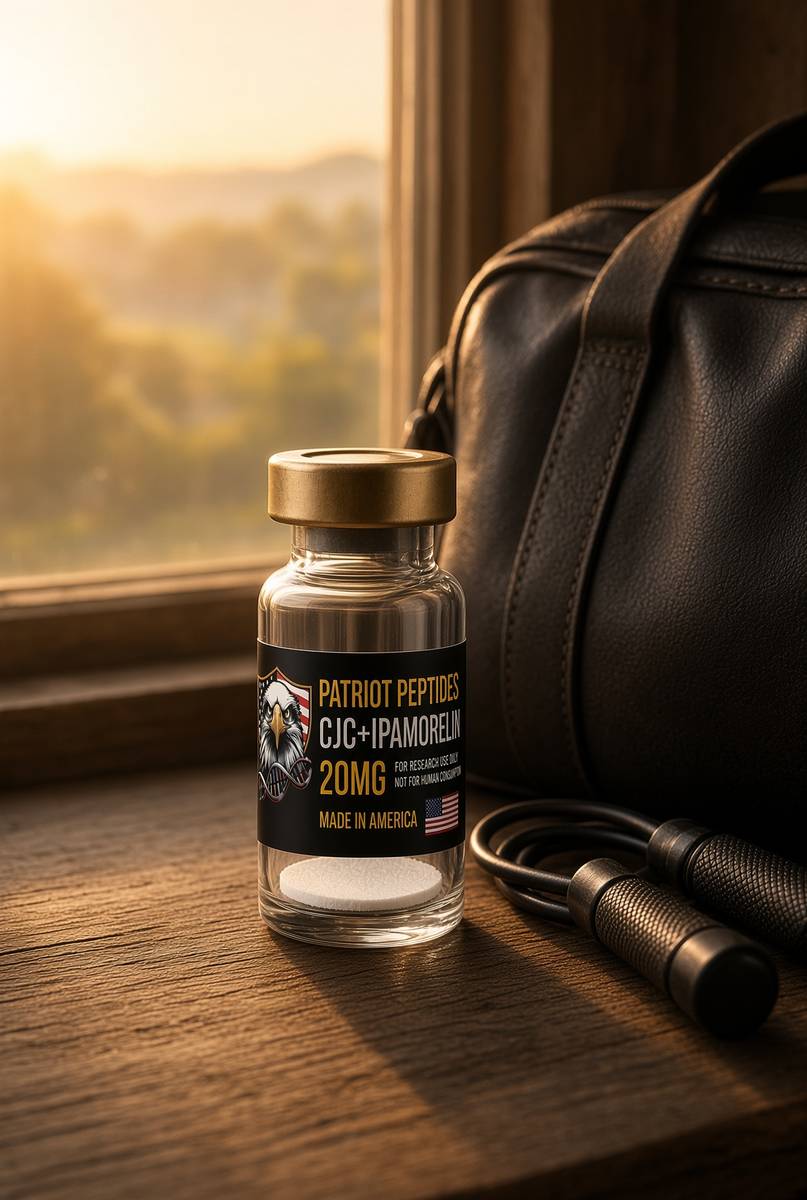 Made in USAOut of stock
Growth axis
CJC + Ipamorelin
20 mg blend — 10 mg CJC without DAC plus 10 mg ipamorelin.
4.8(534)
53 browsing this now · 3 purchased in the last 24 hours
20mg
£50.00
Research use only. Not a combined-use instruction.
Read next
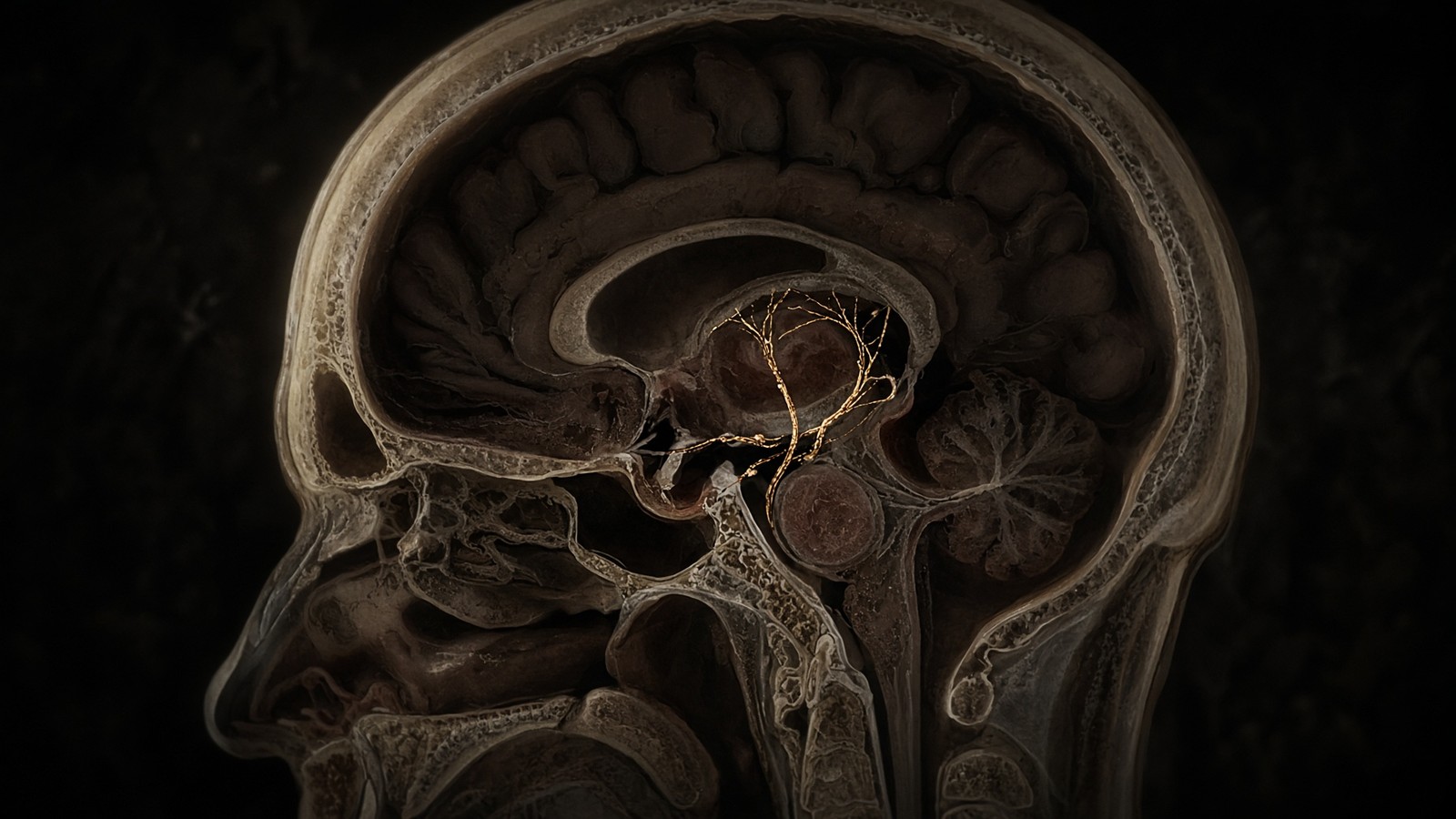
44 min · long read · Peptide research
The growth-hormone axis, properly explained
GHRH, ghrelin, somatotropin and IGF-1 are one conversation. CJC without DAC, ipamorelin, HGH and IGF-1 LR3 are four different microphones.
41 min · long read · Peptide research
CJC-1295 without DAC: a GHRH analogue that still pulses
Modified GRF(1–29) with four substitutions that dodge DPP-IV, and deliberately without the Drug Affinity Complex that would glue it to albumin for a week. The design constraint is physiology.
51 min · long read · Peptide research
GHRH and ghrelin mimetics: two keys on the same pituitary lock
Somatotrophs have two ‘go’ receptors — GHRHR (Gs–cAMP) and GHSR (Gq). Bowers showed that occupying both releases more GH than the sum of either. That is synergy as a receptor fact, not a smoothie.
More in this desk

53 min · long read · Peptide research
Recovery, GH pulses and the CJC / ipamorelin pair
Somatotrophs have two 'go' receptors. CJC without DAC is a slightly longer GHRH pulse. Ipamorelin is a selective ghrelin-receptor key that does not yank ACTH. Together they are the pair Bowers already showed is more than additive — not a gym protocol.
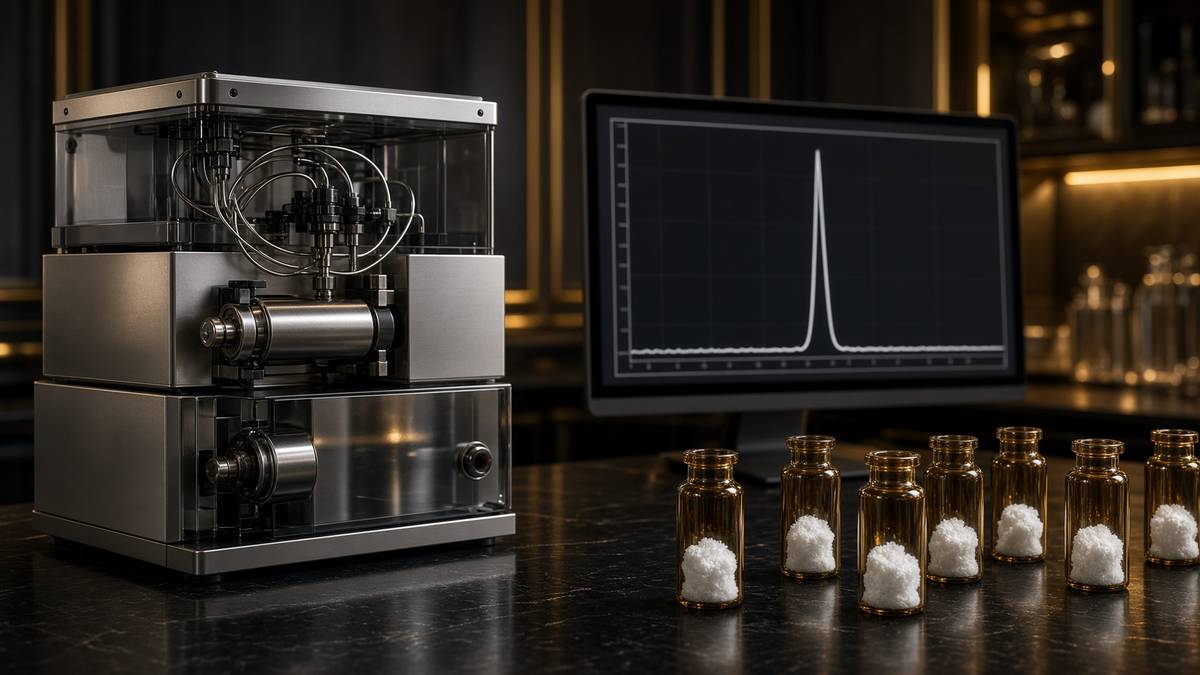
53 min · long read · Peptide research
How research peptides are made — and why HPLC actually matters
Solid-phase peptide synthesis builds a chain one residue at a time. HPLC then asks whether the main peak is what you think it is. ≥98% is not a slogan. It is a chromatogram.
52 min · long read · Peptide research
Fatigue, cellular energy and the NAD+ / MOTS-c neighbourhood
NAD+ is the rechargeable chip every cell spends on fuel and DNA repair — and the pool shrinks with age. MOTS-c is a mitochondrial 16-mer sent out under metabolic stress. Two answers to 'I have no energy' that are not coffee.
51 min · long read · Peptide research
Melanocortin circuits: pigment, appetite and PT-141
Melanotan II lights MC1, MC3, MC4 and MC5 — pigment plus the rest of the sheet. PT-141 is the free-acid cousin pointed at MC3 and MC4, the circuitry papers use for desire and energy, not skin colour. Same Arizona family. Different question.
Essays describe published research. They are not medical advice and they do not authorise human use of any catalogue item.