

Peptide research · 4 min · 828 words
AOD-9604: the tail of growth hormone, and not the hormone
Residues 177–191, plus a tyrosine. The fragment was meant to move fat without IGF-1. Rodents agreed more than the human trials did. It is not somatropin, not a GHRH peptide, and not a GLP-1 drug.
What this essay actually tells you
- AOD-9604 is Tyr-hGH 177–191, the tail of growth hormone. It does not activate the growth-hormone receptor and should not raise IGF-1.
- Obese rodents increased lipolysis in the early work. The human obesity programme did not produce an approved drug.
- It is not somatropin, not sermorelin, not MK-677, and not semaglutide. A sports ban is a classification, not a physique trial.
What this actually means
AOD-9604 is a short piece of the end of human growth hormone. It does not turn on the growth-hormone receptor and should not raise IGF-1. Obese rodents lost fat in early studies. The human programme did not become a drug. It is not HGH and it is not semaglutide.
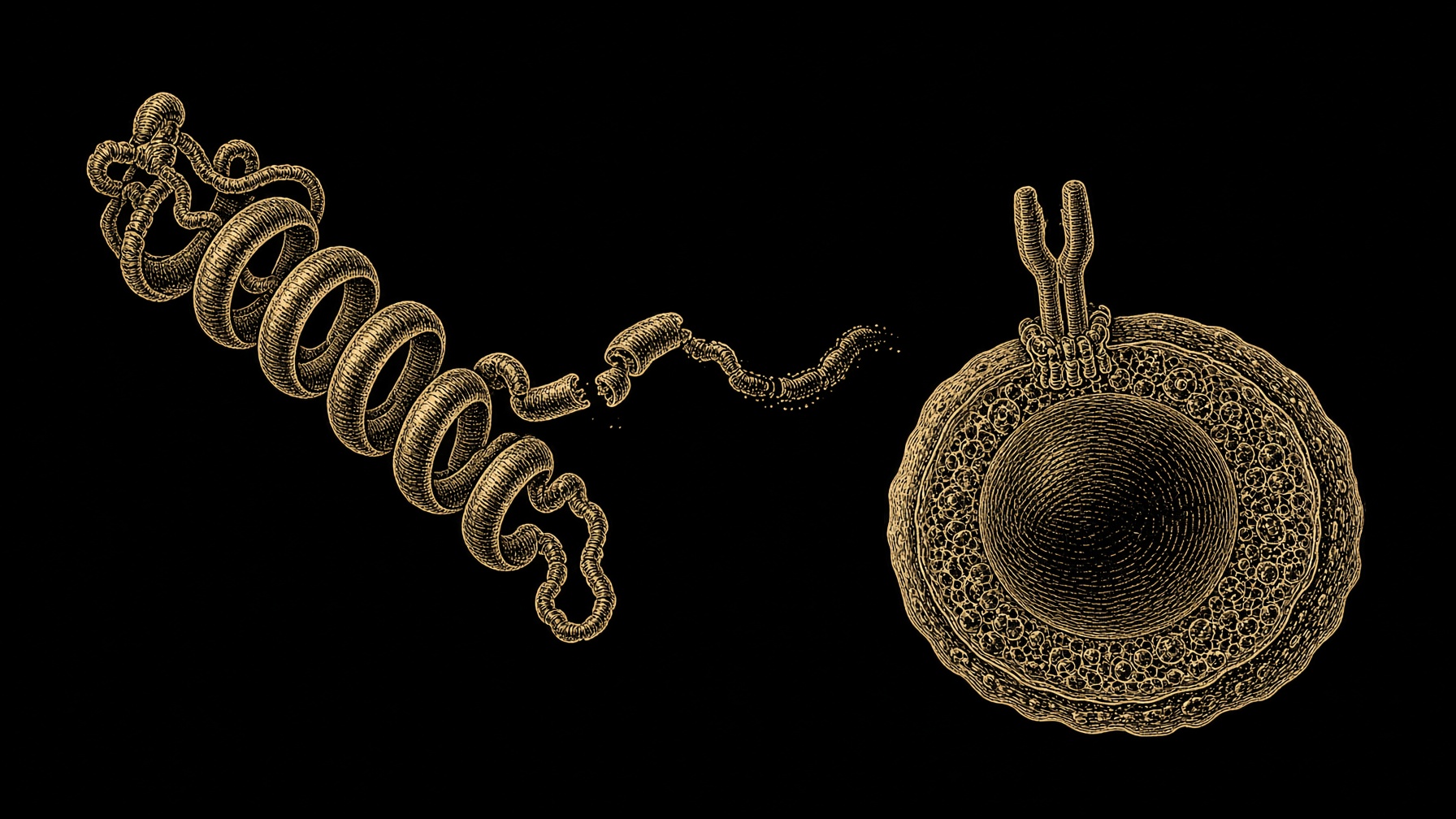
AOD-9604 is a short peptide built from the tail of human growth hormone. The parent idea, from Frank Ng and colleagues in Melbourne, was that a fragment around residues 177 to 191 of the 191-amino-acid hormone could push fat cells to release fat without doing the rest of what growth hormone does. AOD-9604 is that region with a tyrosine added at the front, so you will also see it written Tyr-hGH 177–191. It does not bind and activate the growth-hormone receptor the way the full 191 does. It does not raise IGF-1. It is not a secretagogue, so it does not ask the pituitary for a pulse. If a product is raising IGF-1, it is not behaving as this fragment. It is behaving as growth hormone, or as something else entirely.
In short. AOD-9604 is a piece of the end of growth hormone, with one extra amino acid. It was meant to touch fat without being growth hormone. It does not raise IGF-1. If IGF-1 rises, you do not have this fragment.
The animal work is why the fragment was taken seriously. In obese rodents the peptide increased lipolysis and reduced fat mass, and it did so without a clear IGF-1 rise and without the hyperglycaemia people worry about with intact growth hormone. A rodent fat pad is not a person. Metabolic Pharmaceuticals took AOD-9604 into human obesity trials on the back of that story. The programme did not produce an approved drug. Later sports-prohibition listings put the fragment on banned lists because of the growth-hormone family resemblance, not because a physique trial had shown a result. A ban is a rule about a class. It is not a clinical outcome.
In short. Obese animals lost fat in the early papers without an IGF-1 rise. The human obesity programme did not become a medicine. Being banned in sport is a rule, not a published result in athletes.
What people confuse it with
Full somatropin is 191 residues, one receptor, JAK2 and STAT5, IGF-1 from the liver, and a real medicine for growth-hormone deficiency with a real list of costs at abuse doses. Tesamorelin and CJC without DAC ask the pituitary to release that hormone. MK-677 asks it all day through the ghrelin receptor. Semaglutide and tirzepatide cut appetite through incretin receptors and have the trial numbers to show it. AOD-9604 does none of those jobs. The commercial sentence that it is 'HGH without the side effects' keeps the surname and loses the receptor. Side effects of growth hormone come from being growth hormone. A fragment that does not turn the receptor on cannot offer the effects either. You do not get the IGF-1, the nitrogen retention, or the water, because you did not start the pathway.
In short. It is not HGH, not CJC, not MK-677, and not a GLP-1 drug. Those work by receptors this fragment does not touch. Skipping the side effects also skips the action.
There is a separate, thinner literature on cartilage and on the local injection of the fragment in joint models. It is not a reason to rename the peptide a repair drug, and it is not BPC-157 or TB-500, which are different sequences with different papers. Identity is the first kindness. Sixteen residues from the tail of growth hormone, a tyrosine on the front, no GHR activation, no IGF-1. Anyone selling a vial that 'acts like HGH on fat only' is describing the hope of the 1990s rodent work, not the medicine that failed to appear, and not the 191-residue hormone sitting on a different page of this journal.
In short. A few joint studies exist and do not turn it into a repair peptide. The honest description is a 16-residue tail of growth hormone that does not turn growth hormone's receptor on.
- The chain
- Tyr–hGH 177–191
- The receptor
- not GHR
- The hope
- lipolysis
- Not this
- GLP-1, GHRH, ghrelin
The C-terminal fragment. Not the 191-residue hormone.
Does not switch on JAK2–STAT5. IGF-1 should not rise.
Rodent fat loss without IGF-1. Human obesity trials did not produce a drug.
Semaglutide, sermorelin and MK-677 are other mechanisms with other data.
Questions the essay actually answers
- What is AOD-9604?
- A synthetic fragment of human growth hormone, residues 177 to 191, with a tyrosine added. It was studied as a fat-loss peptide that would not act as full growth hormone.
- Does AOD-9604 raise IGF-1?
- It should not. It does not activate the growth-hormone receptor the way the full 191-residue hormone does. A rise in IGF-1 means the product is not behaving as this fragment.
- Is AOD-9604 approved for weight loss?
- No. Animal work showed lipolysis. The human obesity programme did not produce an approved medicine.
- Is AOD-9604 the same as HGH?
- No. HGH is 191 amino acids and signals through its receptor to IGF-1. AOD-9604 is a short piece of the tail. The effects of HGH, wanted and unwanted, come from that receptor.
- How is it different from semaglutide?
- Semaglutide activates the GLP-1 receptor and has large obesity trials. AOD-9604 does not touch that receptor and does not have those results. Same shelf in conversation, unrelated biology.
Read next
46 min · long read · Peptide research
Somatropin: the 191-residue ligand
Recombinant human growth hormone is one of the most studied proteins in endocrinology. Pulsatility, GHR–JAK2–STAT5b, lipolysis, IGF-1 generation — the map is public.
11 min · Bodybuilding
Growth hormone, insulin, myostatin: the other levers on a fibre
After testosterone, the rest of the muscle-drug list is different receptors: a liver hormone, a storage hormone, and a brake. Food decides which of those signals becomes tissue.
5 min · Peptide research
Semaglutide and tirzepatide: one receptor, then two
Semaglutide is GLP-1. Tirzepatide is GLP-1 plus GIP. The obesity trials printed about 15 percent and about 21 percent mean weight loss. Retatrutide adds glucagon. Stopping the drug hands appetite back.
4 min · Peptide research
Sermorelin, GHRP-6, GHRP-2 and hexarelin: two doors, four clocks
Sermorelin is short GHRH. The GHRPs are ghrelin mimics, and they bring cortisol and prolactin with the growth hormone. Ipamorelin is the one that left those behind. MK-677 is the same door held open all day.
5 min · Peptide research
MK-677: the ghrelin mimetic you can swallow
Ibutamoren is not a peptide and not a SARM. It sits on the ghrelin receptor for hours, raises growth hormone and IGF-1, and brings hunger, water and a higher fasting glucose with it.
More in this desk
53 min · long read · Peptide research
How research peptides are made — and why HPLC actually matters
Solid-phase peptide synthesis builds a chain one residue at a time. HPLC then asks whether the main peak is what you think it is. ≥98% is not a slogan. It is a chromatogram.

52 min · long read · Peptide research
Recovery, GH pulses and the CJC / ipamorelin pair
Somatotrophs have two 'go' receptors. CJC without DAC is a slightly longer GHRH pulse. Ipamorelin is a selective ghrelin-receptor key that does not yank ACTH. Together they are the pair Bowers already showed is more than additive — not a gym protocol.
51 min · long read · Peptide research
Fatigue, cellular energy and the NAD+ / MOTS-c neighbourhood
NAD+ is the rechargeable chip every cell spends on fuel and DNA repair — and the pool shrinks with age. MOTS-c is a mitochondrial 16-mer sent out under metabolic stress. Two answers to 'I have no energy' that are not coffee.
50 min · long read · Peptide research
Melanocortin circuits: pigment, appetite and PT-141
Melanotan II lights MC1, MC3, MC4 and MC5 — pigment plus the rest of the sheet. PT-141 is the free-acid cousin pointed at MC3 and MC4, the circuitry papers use for desire and energy, not skin colour. Same Arizona family. Different question.
The page is the mechanism: the protein, what it does in the cell, and the drug or peptide that talks to it.