


Peptide research · 43 min · 9,446 words
Focus, stress tone and the Semax / Selank pair
Semax is an ACTH fragment analogue studied for BDNF. Selank is a tuftsin analogue studied for GABA and enkephalin tone. They share a tail and a country, not a receptor. One vial, two paper trails — not a nootropic, not an anxiolytic.
What this essay actually tells you
- Semax is an ACTH(4–10) analogue with a PGP tail. BDNF/TrkB neighbourhood in nerve cells. Not a nootropic brand.
- Selank is a tuftsin analogue with the same tail. GABA and enkephalin-tone papers. Not a licensed anxiolytic.
- The catalogue stocks the pair in one cake because they share a tail, not a receptor. Research use only.
What this actually means
If you typed 'focus', 'brain fog' or 'anxiety' into this shop, the honest listing isn't a licensed psychiatric medicine. It is two Russian heptapeptides freeze-dried together. Semax rewrites ACTH(4–10) with a Pro-Gly-Pro tail; the papers sit on BDNF and antioxidant-enzyme transcription in nerve cells. Selank rewrites tuftsin the same way; the papers sit on GABA tone and how long enkephalins last. They aren't one molecule. They share a stabilising tail. We stock the pair because a bench that wants both trails shouldn't have to guess which white cake is which.
Two Russian heptapeptides sit freeze-dried in one vial, and they are not a licensed psychiatric medicine. Semax is a rewritten fragment of adrenocorticotropic hormone. Selank is a rewritten fragment of tuftsin. They share a Pro-Gly-Pro tail that peptidases find inconvenient, and they share a country of origin that built a peptide-pharmacology school the West still under-cites. They don't share a receptor. This is the map of those two paper trails: sequences, ancestral proteins, BDNF and TrkB, GABA tone, enkephalin-degrading enzymes, the Moscow institute that made the first analogue, and the real gap between a large Russian clinical literature and a thinner Western randomised one. Mapping isn't treating. A characterised cake is a reagent. A clinic and a formulary are where licensed medicines for attention and anxiety live, and they'll still live there when this page is closed.
In short. Two Russian heptapeptides sit behind searches for focus and anxiety. They share a tail, not a receptor. We'll map both paper trails.
The catalogue lists them as a pair, twenty milligrams, freeze-dried together, because a bench that wants both trails shouldn't have to guess which white cake is which. Semax is Met-Glu-His-Phe-Pro-Gly-Pro. Selank is Thr-Lys-Pro-Arg-Pro-Gly-Pro. Seven residues each. One ancestral protein is POMC, cut to ACTH, then trimmed to a tetrapeptide message and given a glyproline handle. The other ancestral protein is immunoglobulin G, from which Najjar cut a four-residue macrophage cue called tuftsin, later given the same handle. HPLC will tell you both chains are in the aliquot. A forum caption will tell you they are one nootropic. The chromatogram is the better witness. What follows is chemistry, transcription, inhibitory tone, and a literature that is real in Russian and thinner in the journals a Western paper prefers to cite. Hold those facts at once and the vial becomes readable. Drop any one of them and you're back in marketing.
In short. The vial is both named sequences together so a bench does not guess which cake is which. HPLC is the witness. A forum caption is not.
Nootropic is a marketing word. Corneliu Giurgea coined it in the 1960s around piracetam, and the internet has been inflating it ever since. BDNF is a neurotrophin: a secreted protein that nerve cells write, release, and read through a receptor tyrosine kinase called TrkB. GABA is γ-aminobutyric acid, the principal inhibitory transmitter of the mammalian brain, occupying ionotropic GABA-A receptors and metabotropic GABA-B receptors at a large fraction of synapses. Enkephalins are pentapeptides that occupy opioid receptors and die in minutes under neprilysin and aminopeptidase N. Those four nouns — BDNF, TrkB, GABA, enkephalin — are the neighbourhoods the papers actually name. We'll use them. We'll leave nootropic on the forum where the word earns its keep. A heptapeptide isn't a personality, not a study timetable, and not a substitute for the medicines a psychiatrist writes on a letter. It is a ligand with a mass, a sequence, and a literature. Read the literature. Then decide whether your assay matches it.
In short. Nootropic is a marketing word. BDNF, TrkB, GABA and enkephalin are the nouns the papers actually use. This page uses those.
They share a tail and a country, not a receptor. One listing in the catalogue because a bench that wants both trails should not guess which cake is which.— Reading of the Semax and Selank pair
Two ancestries, one glyproline trick
Adrenocorticotropic hormone is thirty-nine residues cut from pro-opiomelanocortin in the anterior pituitary. The N-terminal message, residues 1 to 13, overlaps α-melanocyte-stimulating hormone. Residues 4 to 10 — Met-Glu-His-Phe-Arg-Trp-Gly — were, in the 1960s and 1970s, the fragment that kept extra-adrenal effects when the steroidogenic C-terminus was discarded: attention, grooming, a set of behavioural assays de Wied and the Utrecht school ran on ACTH fragments until the field had a name for them. Semax keeps residues 4 to 7, Met-Glu-His-Phe, and replaces the rest with Pro-Gly-Pro. That's why some captions say ACTH(4–10) analogue and the sequence on the certificate says ACTH(4–7) plus a tail. Both captions are trying to point at the same seven letters. The His-Phe dyad is what remains of the melanocortin core His-Phe-Arg-Trp. Arg-Trp is gone. The tan went with it. What stayed, in the Moscow papers, is a transcriptional conversation in nerve cells: BDNF, TrkB, a cluster of antioxidant enzymes. A melanocortin fragment that kept the cognitive literature and left the pigment. That's the first ancestry.
In short. Semax keeps four residues of ACTH and adds a Pro-Gly-Pro tail. The tanning motif is incomplete. The cognitive papers are what remained.
Tuftsin is four residues, Thr-Lys-Pro-Arg, cut from the CH2 domain of immunoglobulin G, residues 289 to 292 of the heavy chain. Victor Najjar and Kenji Nishioka published it in Nature in 1970 as a phagocytosis-stimulating peptide: macrophages noticed it, and the tetrapeptide had a name before most of the internet's readers were born. It is an immune cue, not a neurotransmitter. Selank is tuftsin plus Pro-Gly-Pro: Thr-Lys-Pro-Arg-Pro-Gly-Pro. The same glyproline handle Semax wears. The ancestral job is macrophage tone, cytokine writing, a peptide the immune system already knew how to make. The Selank papers, from Seredenin's school at the Zakusov Institute of Pharmacology, sit on GABA tone and on how long enkephalins last before peptidases eat them. Immune ancestry, anxiolytic literature. That's the second ancestry. If you treat the two heptapeptides as interchangeable, you haven't looked at the N-terminus. MEHF isn't TKPR. POMC isn't IgG. A shared tail is a stability trick, not a shared lock, and the blot won't forgive the confusion.
In short. Selank is tuftsin — a four-residue immune peptide from IgG — plus the same Pro-Gly-Pro tail. Different ancestor from Semax. Different papers.
They share a country in the precise sense that matters for a paper trail. The Institute of Molecular Genetics of the Russian Academy of Sciences, Moscow, under Nikolai Myasoedov and with Igor Ashmarin as the physiologist who kept arguing that short ACTH fragments were more than cortisol and pigment, built Semax. The Zakusov Institute of Pharmacology, under Sergei Seredenin, built Selank from tuftsin on the same glyproline logic Ashmarin had been teaching. Soviet and then Russian peptide pharmacology treated four-to-seven-residue chains as legitimate drugs in a way most Western companies did not, until incretins forced the West to remember that peptides can be medicines. The two institutes aren't one lab. The two sequences aren't one molecule. Filing them under one search query is how a catalogue is allowed to be generous. Filing them under one receptor is a category error we won't make. The Pro-Gly-Pro tail is the only chemistry they actually share, and even that chemistry is a handle, not a pharmacophore.
In short. Semax came from the Institute of Molecular Genetics in Moscow. Selank came from the Zakusov Institute. Same country, same tail, two labs, two sequences.
- Semax
- MEHFPGP, ~813 Da
- Selank
- TKPRPGP, ~751 Da
- ACTH
- 39 residues
- Tuftsin
- TKPR, 4 residues
- Mature BDNF
- 119 amino acids, ~13.5 kDa
- TrkB
- NTRK2, RTK
ACTH(4–7) plus Pro-Gly-Pro. Seven residues. BDNF / TrkB neighbourhood.
Tuftsin plus the same tail. Seven residues. GABA and enkephalin neighbourhood.
The parent hormone. Steroidogenic C-terminus discarded in the analogue.
IgG CH2 fragment. Najjar and Nishioka, Nature 1970. Immune ancestry.
The neurotrophin Semax papers sit on. Not a heptapeptide. A protein a neuron writes.
The receptor tyrosine kinase that reads BDNF. PLC-γ, PI3K–Akt, MAPK–ERK, CREB.
Semax: the ACTH fragment that kept cognition and left the tan
Write the letters out. Methionine, glutamic acid, histidine, phenylalanine, proline, glycine, proline. MEHFPGP on a certificate, Met-Glu-His-Phe-Pro-Gly-Pro in a paper, CAS 80714-61-0 if you want the registry number the Russian pharmacy already used. Native ACTH(4–10) is Met-Glu-His-Phe-Arg-Trp-Gly. The analogue keeps the first four and substitutes Pro-Gly-Pro for Arg-Trp-Gly. That substitution is the entire design. Arg-Trp is the second half of the melanocortin core tetrapeptide His-Phe-Arg-Trp; without it, MC1R occupancy is no longer the point, and a tanning assay is the wrong experiment. Pro-Gly-Pro is a glyproline, a collagen-adjacent tripeptide Ashmarin's school had already noticed peptidases handle slowly. The result is a heptapeptide that lasts long enough in a biological fluid to be a ligand rather than lunch, and that points at nerve-cell transcription rather than at pigment. Molecular weight is about 813 daltons. Polar. Charged at physiological pH on the glutamate and the histidine. A typical peptide, in other words, with an atypical literature.
In short. Semax is Met-Glu-His-Phe-Pro-Gly-Pro. Four residues of ACTH plus a tail that peptidases dislike. The tanning half of the melanocortin motif is gone.
de Wied's Utrecht work on ACTH(4–10) and on the related fragment Org 2766 is the Western background the Moscow group inherited. Extra-adrenal ACTH fragments changed avoidance behaviour, attention assays and nerve regeneration readouts in rodents without moving corticosterone the way the full thirty-nine-mer does. That was already interesting in 1975. What Moscow added was the glyproline tail and a sustained programme at the Institute of Molecular Genetics: synthesis, stability, a shift from behavioural pharmacology toward gene expression in brain tissue. Levitskaya, Dolotov, Grivennikov, Shadrina — those names recur on the BDNF papers. Myasoedov is the chemist. Ashmarin is the physiologist arguing, in Russian, that a short peptide can be a transcriptional cue. The Western reader who stops at 'ACTH fragment' has stopped too early. The fragment is the ancestry. The papers that made Semax a named object are the transcription papers, and they are written, largely, in the journals of that institute and its collaborators. Read them as a starting library. That's the honest posture, and it's the same posture this journal already took with Khavinson.
In short. Western ACTH-fragment work is the background. Moscow added a tail and a transcription programme. Read that library as a start, not as a closed canon.
The melanocortin family sits next door on this desk, in the KPV and Melanotan II essay, and the comparison is the point of putting Semax on a related-slug list. α-MSH is thirteen residues, Ac-SYSMEHFRWGKPV-NH2. The His-Phe-Arg-Trp core occupies MC1R through MC5R. Melanotan II is a cyclic super-agonist of that core and does pan-agonist things: pigment, appetite, flushing, arousal. KPV is the C-terminal tripeptide, the anti-inflammatory tail that mostly doesn't tan. Semax is a third subtraction: keep a piece of the N-terminal ACTH message, discard enough of the core that pigment is no longer the assay, add a tail so the chain survives. Three design moves from one precursor. Three different experiments. If you bundle Semax with a tanning analogue because both words contain melanocortin, you haven't looked at the sequences. His-Phe isn't His-Phe-Arg-Trp. A pan-agonist is a different object. The melanocortin essay is the family portrait. This page is the fragment that walked away from the portrait and into a BDNF blot.
In short. α-MSH, Melanotan II and KPV are other melanocortin design moves. Semax kept a cognitive literature and left pigment. Different experiment.
Diagram
Semax
ACTH(4–7) + PGP
Met-Glu-His-Phe-Pro-Gly-Pro. BDNF / TrkB neighbourhood, antioxidant enzyme transcription, Russian Institute of Molecular Genetics corpus. A melanocortin fragment that kept the cognitive papers and left the tan.
Selank
tuftsin + PGP
Thr-Lys-Pro-Arg-Pro-Gly-Pro. GABA tone, enkephalin-degrading enzymes, anxiolytic literature from the same school. Immune-peptide ancestry (tuftsin is TKPR), not an SSRI and not a licensed anxiolytic.
The Pro-Gly-Pro tail is why both last long enough to be a ligand instead of lunch. They share a country and a stabilising motif. They do not share a receptor. Not a nootropic. Not an anxiolytic. Two named sequences.
The early Semax models weren't 'focus' in the way a search bar means it. They were cerebral ischaemia, optic-nerve crush, a Morris water maze after a hypoxia, survival of cortical neurons in culture under oxidative load. Gusev and colleagues in Moscow published clinical series on ischaemic stroke using the nasal drops the Russian Federation had registered; those series exist, they aren't nothing, and they aren't a multicentre Western randomised trial with a pre-registered primary endpoint and a data-monitoring committee the EMA would recognise. Hold both sentences. A paper that wants an animal model can name the model. A person who typed 'brain fog' into a shop has named a complaint, not a middle-cerebral-artery occlusion. The gap between those two objects is the entire intellectual problem of this page. We'll keep naming it. The sequence is real. The ischaemia literature is real. The complaint is real. They aren't the same experiment, and a lyophilised cake doesn't collapse them.
In short. Early Semax papers were stroke, hypoxia and nerve-crush models, not a search-bar complaint. The sequence is real. The complaint is a different object.
BDNF, TrkB, and the transcription neighbourhood
Brain-derived neurotrophic factor is a 119-residue mature protein, cut from a precursor, secreted, and read. Yves-Alain Barde, Hans Thoenen and colleagues isolated it in 1982 as the second neurotrophin after nerve growth factor. The family is NGF, BDNF, NT-3, NT-4. BDNF is the one activity-dependent transcription made famous: a neuron that fires writes more of it, the protein is released, nearby synapses are stabilised, and the circuit that was used is the circuit that is kept. That's Hebb in secreted form. The human gene is BDNF on 11p14.1; a common Val66Met polymorphism in the pro-region changes sorting into the activity-dependent pathway and has been argued over in psychiatry for twenty years. None of that polymorphism literature is a Semax paper. It is the protein the Semax papers sit next to. A heptapeptide isn't BDNF. A heptapeptide that changes how much BDNF messenger RNA a hippocampal neuron writes is a transcriptional neighbourhood. Neighbourhood is the word we'll keep using until a Western lab has replicated the blot under its own controls.
In short. BDNF is a secreted protein a firing neuron writes to keep the synapses it just used. Semax papers sit next to that gene. The heptapeptide is not the protein.
TrkB is tropomyosin receptor kinase B, gene NTRK2, a receptor tyrosine kinase. BDNF binding dimerises it. Autophosphorylation follows. Three canonical effectors sit on the phosphotyrosines: PLC-γ, which makes IP3 and diacylglycerol and raises calcium; PI3K, which makes PIP3 and activates Akt, a survival kinase; and the Shc–Grb2–Sos–Ras–Raf–MEK–ERK cascade, which ends, often, at CREB in the nucleus. CREB is cAMP-response-element-binding protein, a transcription factor that, once phosphorylated, helps RNA polymerase II find the BDNF gene itself, among others. The loop can close: BDNF through TrkB through ERK through CREB through more BDNF. That's why a neurotrophin literature is always in danger of sounding like a perpetual-motion machine, and why a paper has to specify time, cell type, and whether the antibody was any good. Semax papers from Dolotov, Shadrina, Grivennikov and colleagues reported increases in BDNF and TrkB mRNA in rat hippocampus after administration of the heptapeptide. Those are the blots. They are the neighbourhood. They aren't a demonstration that a reconstituted cake, in a person, occupied TrkB in prefrontal cortex on a Tuesday.
In short. TrkB is the receptor that reads BDNF and talks to survival and transcription kinases. Semax papers report more BDNF and TrkB RNA in rat hippocampus.
Diagram
Closed chromatin (H3K27me3, DNA methylation) hides the promoter. Pioneer factors and histone acetyltransferases open it.
PIC: TFIID, TFIIH, Mediator, Pol II. Ser5 phosphorylation of the CTD lets the polymerase leave the promoter.
Elongation ~20–40 nt/s. Capping, splicing, cleavage and polyadenylation happen on the still-growing RNA.
Human genes are islands in 3.1 billion base pairs of mostly noncoding sequence. Promoter, enhancers, chromatin state and the Mediator complex decide whether Pol II is allowed to fire. Epithalon’s literature sits on TERT and pineal clocks — two of the rare promoters anyone bothers to name in a peptide essay.
Transcription is the right floor for this claim, and the pathophysiology essay on this desk already taught the floors. Genome, transcriptome, proteome, metabolite, organelle, cell fate, tissue, organism. A peptide that changes a transcript has climbed from the proteome floor (a ligand somewhere) to the transcriptome floor (a gene being read differently). It hasn't become a transcription factor. It hasn't become BDNF. It hasn't become a licensed cognitive enhancer. The honest experimental programme is named assays: qPCR or RNA-seq for BDNF and NTRK2, a TrkB phosphorylation blot, a CREB-Ser133 blot, a dendritic-spine count if you are ambitious, a species, a time point, a vehicle control. If a paper can't show those, it hasn't yet left the caption. The Moscow corpus sometimes can. Independent Western replications of the same panel, in the same cell type, with the same antibody lot, remain thinner than the original library. That sentence isn't an insult. It's how this journal already treated Khavinson's TERT claims, and it's how a starting library is supposed to be read.
In short. A peptide that changes a transcript has reached the gene-reading floor. It has not become the protein. Named blots, a species, a time point: that is the programme.
MAPK and CREB are the second-messenger neighbourhood one floor down from the gene. If Semax is doing anything that a Western signalling lab would recognise, the path is likely to run through a receptor — melanocortin or otherwise — into a kinase, into CREB, into BDNF transcription. Some papers have argued for MC4R or for a still-unnamed site; the field hasn't closed that argument, and we won't pretend it has. What can be said without guessing the lock: the published readouts sit downstream of kinase signalling and inside the nucleus, on a clock of hours rather than milliseconds. That's a transcriptional clock, not a synaptic one. A spike is over in two milliseconds. A CREB-driven gene is minutes to hours. If you talk about Semax as if it were a stimulant, you've mixed those clocks. Caffeine is an adenosine-receptor antagonist on a minutes clock. Methylphenidate is a catecholamine-reuptake blocker on a minutes clock. A heptapeptide reported to move BDNF mRNA is, if the papers are right, a slower object. Clock isn't optional. The assay has to match the clock or the assay is the wrong experiment.
In short. The published Semax readouts sit on a hours-long transcription clock, not a millisecond spike. That is a different object from a stimulant.
Nerve growth factor appears in some of the same papers, and vascular endothelial growth factor in a smaller set, usually in the ischaemia models where a vascular readout is the point. Those are additional transcripts, not a second mechanism you can put on a shop caption. NGF occupies TrkA. VEGF occupies VEGFR2, which is a different neighbourhood this catalogue already visits in the BPC-157 literature, and mixing those jobs would be a mistake. Semax isn't BPC-157. A gastric 15-mer with endothelial papers is a vessel story. An ACTH-fragment analogue with hippocampal BDNF papers is a nerve-cell-transcription story. Shared word 'repair' is how forums talk. It isn't how a blot is labelled. If your assay is NGF in a PC12 cell, say so. If your assay is BDNF in dentate gyrus, say so. If your assay is a person trying to write an essay, you've left the literature and entered a complaint, and the complaint belongs with a clinician, not with a certificate of analysis.
In short. Some Semax papers also name NGF or VEGF. Those are extra transcripts, not a second product claim, and not the same story as BPC-157.
Antioxidant enzymes as a second readout
Copper-zinc superoxide dismutase is SOD1, a cytosolic enzyme that converts superoxide to hydrogen peroxide. Glutathione peroxidase takes the peroxide on to water, using glutathione as the reductant. Catalase does a similar job in peroxisomes. After ischaemia, those enzymes are part of how a neuron survives the reperfusion burst of reactive oxygen species. Semax papers have reported transcriptional up-regulation of Cu,Zn-SOD and related antioxidant enzymes in nerve cells and in brain tissue after the heptapeptide. That's a second readout, sitting next to BDNF, not instead of it. It's also why the ischaemia models weren't a random choice. A fragment studied in a stroke literature will, if it does anything, show up on the assays a stroke literature already runs: infarct volume, neurological score, antioxidant transcripts, sometimes a Morris maze a week later. Those assays are specified. They aren't a personality test. They aren't a reason to caption a vial as neuroprotection in the abstract, because neuroprotection in the abstract is how a field talks itself into a failed trial. Name the enzyme. Name the tissue. Name the species. Then the sentence can be argued.
In short. Semax papers also report more superoxide dismutase and related enzymes in nerve cells. That is a stroke-model readout, sitting next to BDNF, not a caption.
Reactive oxygen species aren't a villain in every sentence. Mitochondria make superoxide as a fraction of electron-transport slip. NADPH oxidases make it on purpose in immune cells. A neuron uses redox tone as a signal; too little is as unphysiological as too much. What ischaemia does is dump the tone into injury: calcium, reverse glutamate uptake, xanthine oxidase, a burst when oxygen returns. Antioxidant-enzyme transcription is one of the slower answers a cell has, hours rather than seconds. SOD protein has to be written, folded, metallated with copper and zinc, and sent to where the superoxide is. A heptapeptide that changes that transcription is interesting for a blot. It isn't a peroxide sponge. It isn't N-acetylcysteine, which is a cysteine source for glutathione. It isn't edaravone, which is a licensed free-radical scavenger in some stroke indications in Japan. Different objects, different assays, different legal classes. The Semax literature sits on the transcriptional side of that comparison. Keep the comparison honest and the enzyme stays interesting. Collapse it into 'antioxidant peptide' and you have a supplement aisle.
In short. Ischaemia dumps redox tone into injury. Antioxidant-enzyme transcription is a slow cellular answer. Semax papers sit there. That is not a peroxide sponge.
Selank: tuftsin rewritten, not a second Semax
Write the second set of letters. Threonine, lysine, proline, arginine, proline, glycine, proline. TKPRPGP on the certificate, Thr-Lys-Pro-Arg-Pro-Gly-Pro in the paper, CAS 129954-34-3. Tuftsin is the first four. Najjar isolated it as a fragment the spleen makes from IgG; without a spleen, tuftsin production falls, and the phagocytosis literature of the 1970s treated that as a real deficiency rather than a curiosity. The tetrapeptide occupies a site on neutrophils and macrophages that later work tried, with mixed success, to clone as a proper receptor. What matters for this page is the ancestry: an immune peptide, a phagocytosis cue, a chain the body already wrote from antibody. Selank is that cue plus Pro-Gly-Pro. The tail is the same glyproline Semax wears. The N-terminus is a different protein. Treating the two heptapeptides as a matched pair of 'brain peptides' is how a search query talks. Biochemistry talks in sequences. TKPR isn't MEHF. A macrophage cue with a stability handle isn't an ACTH fragment with a stability handle. The pair in the catalogue is a cap-count decision, not a claim that the locks match.
In short. Selank is Thr-Lys-Pro-Arg-Pro-Gly-Pro: tuftsin plus the same tail Semax wears. The N-terminus is an immune peptide, not an ACTH fragment.
The immune papers didn't vanish when the anxiolytic papers arrived. Selank has a published conversation with cytokines: interleukin-6, interferons, a shift in T-helper tone in some rodent and human-cell assays from the Moscow groups. Uchakina, Kozlovskaya, Seredenin — those names sit on that corner of the corpus. An immune peptide analogue that still talks to cytokines is, intellectually, the expected result. An immune peptide analogue that also sits on GABA-tone papers is the surprise that made Selank a named object rather than a tuftsin footnote. Both corners are in the library. A bench that wants the cytokine corner should say so. A bench that wants the GABA corner should say so too. A caption that says 'anxiolytic and immune-modulating nootropic' has stacked three marketing words on one heptapeptide and told you nothing about the assay. We'll unstack them. Cytokine writing is one literature. GABAergic tone is another. Enkephalin half-life is a third. They can all be true in different dishes. They aren't one mechanism, and they aren't a reason to skip the primary papers.
In short. Selank still has cytokine papers, as a tuftsin analogue should. The GABA-tone papers are a second corner. They are not one mechanism.
Seredenin's school at the Zakusov Institute of Pharmacology is the Selank address the way Myasoedov's institute is the Semax address. Sergei Seredenin spent a career on the genetics of stress responses in rats, on benzodiazepine-site ligands, and on why some animals freeze and some animals move when the room is wrong. Selank arrived in that programme as a tuftsin analogue with anxiolytic activity in the usual rodent batteries: elevated plus-maze, open field, conflict tests, the assays a pharmacology department runs before it believes a molecule is interesting. Kozlovskaya's group carried much of the peptide work. The important intellectual move, for a reader coming from a Western psychiatry department, is that this was never an SSRI programme and never a benzodiazepine-chemistry programme. It was a peptide programme that borrowed tuftsin and asked what a glyproline handle would do to behaviour. The answer, in those batteries, was an anxiolytic-like profile without the muscle-relaxant and amnestic pattern a full GABA-A positive allosteric modulator produces. That's a phenotype. A phenotype isn't a receptor occupancy until someone has named the lock and shown the binding.
In short. Selank comes from Seredenin's pharmacology institute, out of stress-genetics and rodent anxiolytic batteries. A phenotype is not yet a named lock.
GABA tone is a transmitter story, not a tablet
γ-Aminobutyric acid is the principal inhibitory transmitter of the adult mammalian brain. Glutamate decarboxylase makes it from glutamate; vesicular transporters pack it; a spike releases it into the cleft; GABA-A and GABA-B receptors read it; GAT-1 and friends take it back. About one in three synapses is GABAergic, more in some nuclei. GABA-A is a pentameric ligand-gated chloride channel: occupancy opens a pore, chloride moves, the membrane is harder to fire. Benzodiazepines are positive allosteric modulators of that channel; they don't open it by themselves, they make GABA better at opening it, and they have a well-described clinical profile because of it. Barbiturates and some anaesthetics sit on the same channel at different sites. GABA-B is a class-C GPCR, a heterodimer of GABBR1 and GABBR2, Gi/o-coupled, a slower inhibitory brake through potassium channels and calcium-channel suppression. Baclofen occupies it. Two receptors, two clocks, one transmitter. A literature that says 'GABA tone' without saying which receptor hasn't yet said enough, and a shop caption that says it has said even less.
In short. GABA is the brain's main inhibitory transmitter. GABA-A is a chloride channel; GABA-B is a slower GPCR. Tone is not a brand. Name the receptor.
The Selank papers sit on that transmitter in two ways, neither of which is 'Selank is GABA'. Some report changes in GABA concentration, in GAD expression, or in the abundance of GABA-A subunit transcripts after the heptapeptide. Others report an interaction with the benzodiazepine site that is allosteric and partial rather than a diazepam-shaped occupancy — a claim that, if it holds, would explain an anxiolytic-like battery without a full sedative-amnestic profile. The Western reader should want a radioligand displacement curve, a subunit-transfected HEK cell, a concentration-response, and an independent lab. Some of that exists in the Russian literature. Less of it exists in the journals a London lab would automatically trust. That's the same honesty this page already applied to Semax and BDNF, and it's the same honesty the Epithalon essay applied to TERT. A starting library is allowed to be interesting. It isn't allowed to be a closed canon. GABA-A is a pentamer with a combinatorial explosion of subunits; α1-containing receptors are the ones benzodiazepines sedate through; α2 and α3 are the ones the anxiolytic literature would rather occupy. If Selank papers don't specify the subunit, the sentence is still unfinished.
In short. Selank papers report GABA-level, subunit-transcript or partial benzodiazepine-site effects. That library is real and still wants independent curves.
Diagram
Outside
Peptide ligand
Named sequence in the nM–µM pocket. Shape complementarity, not vibes. A 15-mer and a 4-mer do not fit the same hole.
Membrane
7-TM receptor
Helices rearrange. The cytoplasmic face becomes a GEF for a heterotrimeric G protein (Gs, Gi, Gq, G12/13).
Inside
Second messengers
cAMP, IP₃, Ca²⁺, β-arrestin. One occupied receptor can spawn thousands of messenger molecules. That is amplification.
~800 GPCRs in the human genome. Seven transmembrane helices, an extracellular ligand pocket, an intracellular G-protein handshake. Catalogue neighbours: ipamorelin at GHSR, PT-141/MT2 at melanocortin receptors, retatrutide at GLP-1R/GIPR/GCGR.
An SSRI occupies the serotonin transporter. A benzodiazepine occupies an allosteric site on GABA-A. Methylphenidate occupies the dopamine and noradrenaline transporters. Those are licensed psychiatric medicines, with indications, contraindications, a summary of product characteristics, and a prescriber who is allowed to write them. Selank is a tuftsin analogue with a GABA-tone literature. Semax is an ACTH-fragment analogue with a BDNF literature. The search bar bundled 'focus' with one and 'anxiety' with the other because the internet is allowed to be that generous. Biochemistry isn't. A heptapeptide doesn't become an SSRI by sitting next to the word anxiety, and it doesn't become methylphenidate by sitting next to the word focus. Licensed medicines live in a clinic and a formulary. This vial lives on a certificate of analysis. The distinction is legal as well as scientific, which is why the legal class of the vial belongs at the close, once, rather than as a refrain through the physiology. The physiology is allowed to be interesting without being a prescription.
In short. SSRIs, benzodiazepines and methylphenidate are licensed medicines with named locks. These heptapeptides have papers. Papers are not a formulary.
Diagram
× 1
Ligand
One peptide in one pocket. nM–µM. Shape, not a mood.
× 10–10²
G proteins
The occupied GPCR is a GEF. Each Gα is a catalyst.
× 10³–10⁴
cAMP / IP₃ / Ca²⁺
Adenylyl cyclase and PLC do not make one molecule. They make a cloud.
× 10⁴–10⁶
PKA / PKC / CaMK
Kinases phosphorylate many substrates per messenger.
× tissue
Secretion, transcription, motility
The organism-level readout. Still not a protocol.
This is the only magic, and it is not magic. A nanomolar ligand can move a micromolar messenger because enzymes sit between them. Desensitisation (GRK, β-arrestin, endocytosis) is how the cell refuses to let ‘more ligand’ mean ‘more signal’ forever.
Second messengers are how a GPCR occupancy becomes a cell-wide event, and they're easy to smuggle into a peptide caption that hasn't named a receptor. cAMP, IP3, calcium, then protein kinase A, protein kinase C, CaMK, then a transcription factor. One occupied receptor can load many G proteins; each cyclase or phospholipase can make many messengers; the arithmetic is the only magic, and Lefkowitz spent a career making it less magical. GABA-A doesn't use that arithmetic. It is a pore. Chloride moves in milliseconds. A benzodiazepine changes the pore's opinion about GABA on that same clock. A transcriptional change in a GABA-A subunit, by contrast, is hours, a gene, a new pentamer inserted into a membrane. Those are different experiments that both get filed under 'GABA' by a caption in a hurry. Selank papers that measure subunit mRNA are on the slow clock. Selank papers that claim a benzodiazepine-site interaction are on the fast one. Read the paper before you decide which clock you're holding. A lyophilised cake doesn't get to occupy both clocks by being freeze-dried next to Semax.
In short. A GPCR makes a cloud of messengers over minutes. GABA-A opens a pore in milliseconds. Subunit transcription takes hours. Selank papers need to say which clock.
Enkephalin half-life is peptidase politics
Met-enkephalin is Tyr-Gly-Gly-Phe-Met. Leu-enkephalin is Tyr-Gly-Gly-Phe-Leu. Hughes, Smith, Kosterlitz and colleagues isolated them in 1975 from brain as the endogenous ligands the opioid receptors had been waiting for. They occupy μ and δ receptors, they are pentapeptides, and they die in minutes. Neprilysin (neutral endopeptidase, CD10), aminopeptidase N, and a set of related zinc metallopeptidases cut them. The half-life is the point of the design: a synaptic peptide that lasted hours wouldn't be a synaptic peptide. Inhibit the degrading enzymes and the same released enkephalin lasts longer; that's a pharmacological strategy with its own history, from racecadotril in the gut to experimental dual enkephalinase inhibitors in pain. Selank papers report inhibition of enkephalin-degrading enzymes. That's peptidase politics, not an opioid-receptor occupancy. The heptapeptide isn't morphine. It isn't an enkephalin. If the papers are right, it is a way of changing how long the pentapeptides the cell already released remain in the neighbourhood. A concentration-response against NEP, a mass-spectrometric disappearance curve, a naloxone challenge to test whether the behavioural readout is opioid-dependent: those are the assays. Some of the Moscow papers ran versions of them. A forum summary didn't.
In short. Enkephalins are pentapeptides that opioid receptors read and peptidases eat in minutes. Selank papers sit on those enzymes, not on the opioid receptor itself.
Peptidase politics is also why the shared Pro-Gly-Pro tail isn't a small detail. A peptide without protection is lunch. Dipeptidyl peptidase-IV, proline-specific endopeptidases, aminopeptidases — plasma and the extracellular space are a factory for cutting chains. Incretin chemists spent two decades putting fatty acids and α-aminoisobutyric acid and D-residues onto GLP-1 so the chain would see Monday. Glyprolines are an older, smaller version of the same thought: proline in the right place makes a lot of peptidases clumsy. Ashmarin's school treated Pro-Gly-Pro itself as a ligand in some assays, a collagen-fragment echo with its own endothelial and gastric papers, which is a third object this page isn't going to smuggle in as a mechanism for Semax or Selank. The tail on the two heptapeptides is, on the conservative reading, why they last long enough to be ligands. On the less conservative reading, PGP is doing some of the talking. The conservative reading is the one a paper can defend today. Stability against proteolysis is a pharmacokinetic fact. A pharmacophore is a separate claim. Don't upgrade the first into the second because the upgrade makes a nicer caption.
In short. The Pro-Gly-Pro tail is why both heptapeptides last long enough to be ligands. That is stability. It is not, on the conservative reading, the lock itself.
Half-life is the unglamorous variable every peptide literature eventually has to face. Native ACTH is cleared on a minutes-to-an-hour clock, depending on the fragment and the compartment. Tuftsin is shorter. Semax and Selank, with the tail, last longer in the fluids the Russian pharmacokinetic papers measured — still not albumin-glued weekly incretins, still not small-molecule hours-to-days. Intranasal administration is how the Russian pharmacy presented both as medicines, a device-and-mucosa story this catalogue doesn't tell, because this catalogue isn't a pharmacy and the vial isn't a spray. A lyophilised solid reconstituted in bacteriostatic water is a laboratory object. The half-life that matters for a dish is the half-life in the medium, in the presence of whatever serum the protocol added, against whatever peptidases the cells released. Measure it if you're running the assay. Don't infer a human nasal-mucosa half-life from a certificate of analysis. The certificate says which chains are in the cake. It doesn't say how long they last in a mammal you aren't licensed to dose.
In short. With the tail, both chains last longer than the unprotected fragments. That is still a short peptide half-life, and a dish is not a nasal mucosa.
The Pro-Gly-Pro tail is the only chemistry they share
Glyprolines, in Ashmarin's vocabulary, are short proline-containing peptides related to collagen fragments. Pro-Gly-Pro is the simplest. Collagen is a glycine-every-third-residue polymer with a high proline and hydroxyproline census; when it is cut, PGP-shaped pieces appear, and some of those pieces have been argued as ligands at formyl-peptide receptors and as players in neutrophil chemotaxis. That neutrophil literature is a fourth object, and it isn't this page, and it isn't a reason to call Semax or Selank a collagen peptide. What the Moscow school took from the glyproline observation was practical: put PGP on the C-terminus of a short message you already cared about, and the message survives. Semax is MEHF plus that thought. Selank is TKPR plus that thought. Two messages. One thought. The thought is proteolysis. It is the reason both last long enough to be ligands instead of lunch, which is the sentence this page will keep, because it is the sentence a chemist can defend without guessing a receptor. Shared tail, shared country, separate N-termini, separate paper trails. The catalogue put them in one vial for the last of those facts, not for the first.
In short. Pro-Gly-Pro is a glyproline handle. Moscow put it on two different messages so peptidases would be clumsy. That is the only chemistry the pair actually shares.
A C-terminal proline is already a small gift against carboxypeptidases. A Pro-Gly-Pro tripeptide is a larger one. The peptide bond N-terminal to proline is a known awkwardness for many endopeptidases; DPP-IV actually prefers it, which is why incretins die at a proline, and why the glyproline trick isn't a universal cloak. Context is the sequence. MEHFPGP and TKPRPGP present different N-termini to aminopeptidases and different internal bonds to whatever endopeptidase is in the tube. In-vitro plasma stability of the two heptapeptides is a measurable number, and the Russian papers reported numbers. Recapitulate them if your assay cares. Don't assume that a shared three-letter tail means a shared disappearance curve. Don't assume that a shared disappearance curve means a shared receptor. Pharmacokinetics isn't pharmacodynamics. The tail is a handle. The N-terminus is the message. HPLC will resolve the two chains in the blend if the method is any good; a single peak would be a reason to ask the manufacturer what they actually made. Two peaks, two masses, two sequences. That's what a pair looks like on a chromatogram.
In short. A shared tail does not mean a shared disappearance curve or a shared receptor. HPLC should show two chains. Pharmacokinetics is not pharmacodynamics.
Moscow, and how to read a school the West under-cites
The Institute of Molecular Genetics of the Russian Academy of Sciences sits in Moscow and ran, through the last Soviet decades and after, a peptide programme that treated ACTH fragments as more than endocrinology. Nikolai Myasoedov is the name on the chemistry. Igor Ashmarin is the name on the physiology: a career of arguing that short peptides, including glyprolines and ACTH fragments, are regulatory molecules a Western receptor-screen culture was slow to take seriously. Semax is one output of that argument. The institute registered a nasal-drop medicine in the Russian Federation in the 1990s; stroke, optic neuropathy, and cognitive impairment after organic brain injury are the indications the Russian label carried. That's a pharmacy fact in one country, not a UK marketing authorisation or an EMA opinion, and not a caption that turns a freeze-dried cake into a medicine. The analogue chemistry is public. The sequence is MEHFPGP. A British bench ordering the pair holds that sequence plus Selank, made as a research solid, characterised, labelled for the laboratory. The Russian pharmacy is a different object in a different legal frame, and this page won't hide behind it.
In short. Semax was built at the Institute of Molecular Genetics in Moscow and registered there as a nasal medicine. That pharmacy is not this research vial.
Vladimir Khavinson's pineal school in St Petersburg is the comparison this journal has already taught. Epithalon is four residues, Ala-Glu-Asp-Gly, with papers on TERT and on nocturnal melatonin amplitude. The St Petersburg corpus is large. Independent Western replications of the TERT result remain thinner than the original library. The Epithalon essay said that out loud, and then stocked the tetrapeptide as a characterised ligand because the sequence is published and the assays are nameable. Semax and Selank deserve the same sentence, from a different city and a different ancestral protein. The Moscow and Zakusov corpora are large. They include animal work, cell work, and clinical series that a Russian regulator accepted. They don't include, in any abundance, the kind of large, pre-registered, Western randomised trials a NICE appraisal would want before a medicine is a medicine here. That gap is information. It isn't a reason to throw the blots away. It isn't a reason to upgrade the blots into a UK indication. Starting library, named assays, independent replication still owed. The sentence is getting repetitive because the fact is stable.
In short. This journal already treated Khavinson as a starting library, not a closed canon. The Moscow Semax and Selank papers deserve the same honest reading.
Language is part of the under-citation. A substantial fraction of the primary Semax and Selank literature is in Russian, in journals that PubMed indexes unevenly, with English abstracts that flatten methods. Translation is a real cost. So is the Cold War hangover that taught a generation of Western labs to treat Soviet peptide claims as a genre rather than as papers. Some of those papers are weak. Some are not. The way to tell is the way to tell anywhere: named reagents, named doses in milligrams per kilogram, a vehicle control, a sample size, a statistic that isn't a paired t-test on a western that wasn't blinded. Apply that standard and the library sorts itself. Apply a flag instead of a standard and you'll either swallow everything or swallow nothing, which are both ways of not reading. This page is an attempt to read. BDNF and TrkB transcripts, antioxidant enzymes, GABA-tone and enkephalin-peptidase readouts, rodent batteries, a Russian label that isn't ours. That's the sorted pile. The unsorted pile is the forum.
In short. Much of the primary literature is in Russian and unevenly indexed. Read it with the usual methods standard, not with a flag and not with a forum.
The St Petersburg tetrapeptide was a starting library, not a closed canon. The Moscow heptapeptides are the same kind of object: real papers, named assays, a Western replication still owed.— Reading, after the Epithalon essay's treatment of Khavinson
What the Russian clinic held, and what a Western randomised trial did not
Semax nasal drops, in the Russian Federation, were a registered medicine with a package leaflet, a dose in drops, and a set of neurological indications that clustered around ischaemic stroke, transient ischaemic attack, optic-nerve disease, and cognitive impairment after organic brain injury. Gusev's clinical series are the ones a review article will cite: patients, a control group that isn't always randomised the way CONSORT would now demand, endpoints that mix neurological scores with a clinician's impression. Those papers aren't empty. They're also not a 3,000-person, event-driven, double-blind trial with a steering committee in London and a primary endpoint locked before first patient in. Stroke medicine in the West ran that kind of trial on alteplase, on thrombectomy, on aspirin, and failed a long list of neuroprotectants that had looked beautiful in a rodent. The graveyard of NXY-059, of magnesium, of a dozen glutamate antagonists, is the reason a cautious reader doesn't upgrade a Russian series into a Western standard of care. The cautious reader also doesn't pretend the series never happened. Both pretences are lazy. The literature is lopsided by geography. Say so.
In short. Russia registered Semax as nasal drops for stroke-adjacent indications. Western stroke medicine ran larger trials on other drugs and buried many neuroprotectants. Geography lopsided the evidence.
Selank, on the Russian label, sat in a different drawer: anxiolytic, sometimes with an immune footnote, a nasal drop again, a different institute's output. The rodent batteries that got it there are the elevated plus-maze and friends, which have their own reproducibility conversation in Western behavioural pharmacology. Anxiolytic drug development in the West, after the benzodiazepines, spent decades on SSRIs, SNRIs, buspirone, pregabalin, and a graveyard of NK1 antagonists and CRF1 antagonists that had looked beautiful in a plus-maze. A plus-maze isn't a person with GAD-7 scores and a job they can't do. Translational failure is the default in this therapeutic area, which is why a peptide with a plus-maze literature and a Russian label is interesting as chemistry and unfinished as medicine in every jurisdiction that isn't the one that labelled it. This catalogue doesn't sell the label. It sells the sequence. The sequence is TKPRPGP. The label is someone else's paperwork. Mixing them is how a research house becomes a rumour, and the rumour is the thing this page is here to stop.
In short. Selank's Russian label was anxiolytic. Western anxiolytic development failed many plus-maze winners. The sequence is still TKPRPGP. The label is someone else's paperwork.
Western randomised evidence, for both heptapeptides, is thinner. PubMed will return English-language papers from the same groups, a handful of small studies outside Russia, reviews that re-cite the original corpus, and a long tail of commentary that isn't data. A systematic review with a pre-registered protocol and a risk-of-bias table would be the right next document; this page isn't that document, and won't pretend a narrative walk through named papers is a GRADE assessment. What a bench can do today is the modest thing: buy a characterised sequence, run a named assay, write down the concentration, the cell type, the time, the antibody, and whether the result survived a vehicle and a scrambled peptide. That's how a starting library becomes a literature other cities will cite. It's also why the pair is on the shelf. The shelf is for ligands. The clinic is for medicines. The forum is for a word, nootropic, that this page has now used enough times to send back. If your question is a person, the person needs a clinician. If your question is a blot, the blot needs a sequence. We sell the second.
In short. Western randomised trials are scarce. A bench can still run a named assay on a characterised chain. That is how a starting library earns citations in other cities.
Focus and anxiety are complaints. The papers named ligands.
Focus is a human sentence. The cell version, if you insist on one, is a prefrontal circuit: pyramidal cells, fast-spiking interneurons, a catecholamine tone that inverted-U-curves dopamine at D1 receptors, a noradrenaline tone at α2A, a working-memory delay that dies if the room is wrong. ADHD medicines that a formulary actually holds — methylphenidate, lisdexamfetamine, atomoxetine — sit on transporters in that circuit. BDNF sits on a slower trophic clock in hippocampus and cortex; it isn't a synonym for attention. Semax papers that move BDNF mRNA in a rat hippocampus haven't thereby occupied a human D1 receptor on a weekday morning. The search bar is allowed to file 'focus' against the heptapeptide because the internet bundled them. The page isn't allowed to pretend the bundle is a mechanism. Brain fog is an even looser complaint: sleep debt, iron, thyroid, depression, long viral aftermath, a room that is too warm. Van Cauter's sleep-restriction work still explains more next-morning misery than a neurotrophin blot, and the sleep essays on this desk already said so. A peptide literature doesn't retire those mundane causes. It sits beside them, smaller, named, waiting for an assay.
In short. Focus is a prefrontal-circuit complaint. BDNF is a slower trophic protein. Semax papers on the second have not occupied the first. Mundane causes still exist.
Anxiety is also a human sentence, and the cell version isn't one cell. Amygdala, bed nucleus of the stria terminalis, periaqueductal grey, a hypothalamic-pituitary-adrenal cascade, a GABA-A pentamer whose subunit composition decides whether the drug sedates or quiets or both. Licensed anxiolytics occupy those objects: SSRIs on the serotonin transporter, with a delay the patient has to survive; benzodiazepines on GABA-A, with a speed the patient can feel and a dependence the prescriber has to manage; pregabalin on α2δ subunits of calcium channels. Selank papers that sit on GABA tone and enkephalin half-life are in that neighbourhood in the loose, reading-list sense. Neighbourhood isn't indication. A plus-maze isn't a GAD-7. A cytokine shift in a mononuclear-cell culture isn't a panic attack. The honest use of this page, if you arrived with the word anxiety, is to be sent back to a clinician if the word names a person, and to be handed a sequence if the word names an assay. Both sendings are a form of respect. Pretending the vial is the clinician is the other thing, and it is the thing a research house isn't for.
In short. Anxiety names a person or an assay. Licensed medicines occupy transporters and GABA-A. Selank papers sit nearby on a reading list. Nearby is not an indication.
Study drug is the third search that lands here, and it deserves a short, plain paragraph because the alternative is a wink. A study drug, in the internet's mouth, is a stimulant or a wakefulness agent taken to write an exam. Modafinil, methylphenidate, lisdexamfetamine: those have pharmacology, law, and a professional who is allowed to prescribe them in named indications. Semax has a BDNF neighbourhood in nerve-cell papers. It doesn't have a catecholamine-transporter occupancy, a wake-promoting licence, or a place on a campus formulary. Using a research heptapeptide as a stand-in for a stimulant is a category error with a legal shadow. This page won't wink. The pair in the catalogue is two characterised sequences for a bench. The exam is a different institution. The licensed medicine is a third. If a caption on another site suggested otherwise, the caption was doing a job this page won't do. Read the blot. Leave the timetable alone.
In short. A study drug, in the internet's mouth, is a stimulant for an exam. Semax is a BDNF-neighbourhood heptapeptide. Those are not the same object, and this page will not wink.
One vial, two certificates' worth of chain
The listing is Semax plus Selank, twenty milligrams, freeze-dried together, made in the United States, HPLC-characterised, a pair because the paper trails are the two trails a search for focus or anxiety actually names in this catalogue. There isn't a second vial to bundle. The cake is already both sequences. A bench that wanted only one would still be looking at a blend, which is a reason to read the label twice. The cap-count decision is the same decision GLOW made for four repair peptides and the CJC-ipamorelin blend made for two pituitary ligands: if the reading list wants both, don't make the reader guess which white solid is which. Guessing is how a laboratory writes the wrong methods. Two masses, two retention times, a certificate that names MEHFPGP and TKPRPGP. That's the object. It isn't a stack in the forum sense. It isn't a protocol. It isn't a recommendation to combine two mechanisms in a mammal. It is logistics for a reading list that already contained two ligands, and a refusal to pretend they are one.
In short. One twenty-milligram cake holds both named sequences so a bench does not guess which solid is which. That is logistics for a reading list, not a stack.
Reconstitution is mass over volume, bacteriostatic water in the kit, a laboratory solvent, a concentration you write down. HPLC-MS is how the manufacturer knows which chains left the building. The kit doesn't authorise a mammal. The certificate doesn't authorise a clinic. Occupancy, if you have a receptor and an assay, is a concentration, a cell type, a time. Transcriptional neighbourhoods — BDNF, TrkB, antioxidant enzymes — are papers you can try to recapitulate. GABA-tone and enkephalin-peptidase neighbourhoods are papers you can try to recapitulate. Crossing a blood-brain barrier is a different paper, and the barrier essay on this desk already refused to stamp a passport on either heptapeptide. Polar, charged, seven residues, peptidase substrates: as a class they aren't LAT1 cargo and not a claudin-5 key. Intranasal delivery in a Russian pharmacy is a mucosa-and-device story with its own measurements. A Transwell insert is a model. A brain isn't a dish. The occupancy essay, the barrier essay, and this one are three floors of the same building. Skip a floor and the caption gets ahead of the chemistry.
In short. Reconstitute, write the concentration, run the named assay. Barrier crossing is a different paper, and most short polar peptides do not hold a ticket.
Adjacent reading, and what this page will not do
The melanocortin essay is the family this fragment walked away from. POMC, ACTH, α-MSH, five GPCRs, MC1R as pigment, MC4R as appetite, Melanotan II as the pan-agonist, KPV as the anti-inflammatory tail. Semax is the other subtraction: cognitive papers, no tan. Read that essay if you want the receptors this one left behind. The barrier essay is the wall most peptides never climb: claudin-5, P-glycoprotein, astrocyte endfeet, Kp,uu as the occupancy-relevant ratio, a Transwell that isn't a brain. Semax and Selank have literatures. Literatures aren't stamps. The occupancy essay is how a peptide talks to a cell: a lock, a shape change, a flood of messenger, a desensitisation. If Semax or Selank occupy a GPCR, that essay is the floor they stand on. If they change a transcript without a named lock, the transcription diagram on this page is the honest picture, and the lock is still owed. What-are-peptides is the orientation piece for anyone who arrived from a grocery-aisle hydrolysate and needs the difference between a ligand and a collagen powder explained once, slowly, without contempt.
In short. Read the melanocortin essay for the family Semax left. Read the barrier essay for the wall. Read occupancy for the lock. This page is the two sequences.
What this page won't do is write a protocol. It won't dose. It won't tell you how to pass an exam, quiet a panic, or replace a medicine a psychiatrist already chose. It won't stack the pair with DSIP, with a racetam, with a stimulant, or with a melatonin. Adjacent in a catalogue isn't adjacent in a synapse. It won't pretend a Russian label is a UK label. It won't pretend a plus-maze is a person. It won't pretend a BDNF blot is attention. The papers that already ran the ischaemia models, the plus-mazes, the hippocampal qPCRs and the peptidase assays are in the literature, a lot of it in Russian, some of it in English. Go there if you're running an experiment. Stay here if you wanted the two sequences explained, the ancestries unbundled, the tail named, the clocks separated, and the legal class of the vial stated once at the end rather than waved like a flag through the physiology. The physiology is the interesting part. The flag is the boring part. Both have to be on the page.
In short. This page maps two sequences and their papers. It does not dose, stack, or replace a medicine. Methods live in the literature. Stay here for the map.
Two heptapeptides, then, and two honest jobs. Semax: Met-Glu-His-Phe-Pro-Gly-Pro, an ACTH(4–7) analogue, Institute of Molecular Genetics, a melanocortin fragment that kept the cognitive papers and left the tan, sitting on BDNF, TrkB and antioxidant-enzyme transcription in nerve cells. Selank: Thr-Lys-Pro-Arg-Pro-Gly-Pro, a tuftsin analogue, Zakusov Institute, immune ancestry, sitting on GABA tone and on how long enkephalins last. They share a Pro-Gly-Pro tail, which is why both last long enough to be ligands, and they share a country that built a peptide school the West still reads late. They don't share a receptor. The catalogue holds them as a pair, twenty milligrams, freeze-dried, because a bench that wants both trails shouldn't guess which cake is which. Licensed psychiatric medicines live in a clinic and a formulary. Research-use-only. This solid is a research reagent. The paper trails are real. The Western randomised evidence is thinner. That's the whole of the honest paragraph, and it is enough to hold the vial without confusing it for a personality.
In short. Semax sits on BDNF and TrkB. Selank sits on GABA and enkephalin enzymes. Shared tail, shared country, separate locks. The pair is a reagent, not a personality.
A melanocortin fragment that kept the cognitive papers and left the tan, next to a tuftsin analogue that kept the immune ancestry and picked up a GABA literature. Two N-termini. One tail. One certificate. That is the pair.
- Semax: Met-Glu-His-Phe-Pro-Gly-Pro. ACTH(4–7) plus Pro-Gly-Pro. Institute of Molecular Genetics, Moscow. BDNF, TrkB, antioxidant-enzyme transcription.
- Selank: Thr-Lys-Pro-Arg-Pro-Gly-Pro. Tuftsin plus the same tail. Zakusov Institute. GABA tone, enkephalin-degrading enzymes, immune ancestry.
- The PGP tail is stability against proteolysis. Shared handle, not a shared lock. HPLC should show two chains.
- Nootropic is a marketing word. BDNF is a neurotrophin. GABA is a transmitter. The papers use the second two.
- Russian labels and clinical series exist. Large Western randomised trials do not, in any abundance. Starting library, not closed canon. Same posture as Khavinson.
- Licensed medicines for anxiety and attention live in a clinic and a formulary. This listing is two characterised heptapeptides. One cake, twenty milligrams.
- The barrier essay is next door if the next question is crossing. Polar heptapeptides do not arrive with a Kp,uu stamp.
Questions the essay actually answers
- Is this a nootropic?
- Nootropic is a marketing word. Semax is MEHFPGP, an ACTH-fragment analogue with a BDNF and TrkB literature in nerve cells. Selank is TKPRPGP, a tuftsin analogue with GABA-tone and enkephalin-peptidase papers. Two named research heptapeptides, not a licensed cognitive enhancer.
- Do Semax and Selank share a receptor?
- No. They share a Pro-Gly-Pro tail and a country of origin. Semax's published neighbourhood is nerve-cell transcription: BDNF, TrkB, antioxidant enzymes. Selank's is inhibitory tone and enkephalin half-life, with an immune ancestry from tuftsin. Different N-termini. Different locks. The catalogue holds them together as a reading-list pair.
- Why are they in one vial?
- Because a bench that wants both paper trails shouldn't have to guess which white cake is which. The listing is twenty milligrams of both named sequences, freeze-dried together, HPLC-characterised. It is logistics, not a claim that the receptors match, and not a protocol for combining mechanisms in a person.
- What is the Pro-Gly-Pro tail actually doing?
- It is a glyproline handle. Proline-rich C-termini make a lot of peptidases clumsy, so the heptapeptides last long enough to be ligands instead of lunch. Ashmarin's school treated PGP as a stability motif. That's pharmacokinetics. Upgrading it into a shared pharmacophore is a separate, less conservative claim.
- Does Semax increase BDNF in people?
- The primary reports are rodent and cell papers from the Moscow groups: BDNF and TrkB transcripts in hippocampus, antioxidant-enzyme panels, ischaemia models. That's a long way from a large Western randomised trial of BDNF protein in human cortex, and this page won't sell it as one. Named assays, starting library, independent replication still owed.
- Is Selank a licensed anxiolytic?
- In the Russian Federation a nasal-drop medicine with that name has carried anxiolytic indications. In the United Kingdom this listing is a characterised research heptapeptide, TKPRPGP, with a GABA-tone and enkephalin-peptidase literature. Licensed anxiolytics here live in a clinic and a formulary. The sequence isn't the label.
- How should I read the Russian literature?
- The way this journal already reads Khavinson: as a starting library, not a closed canon. Named reagents, named doses, vehicle controls, a statistic that survives scrutiny. Some papers will hold. Some will not. Geography lopsided the clinical evidence. Independent Western randomised trials remain thinner. That gap is information, not a reason to throw the blots away or to upgrade them into a UK medicine.
- Is this a study drug or an ADHD medicine?
- No. Methylphenidate, lisdexamfetamine and atomoxetine occupy catecholamine transporters and live on a formulary in named indications. Semax sits on a BDNF transcriptional neighbourhood in nerve-cell papers. Using a research heptapeptide as a stand-in for a stimulant is a category error. This vial is a laboratory reagent.
- How does Semax relate to Melanotan II and KPV?
- All three are design moves from the POMC / melanocortin family. Melanotan II is a cyclic pan-agonist of the His-Phe-Arg-Trp core. KPV is the anti-inflammatory C-terminal tail. Semax keeps ACTH(4–7), discards enough core that pigment is no longer the assay, and adds Pro-Gly-Pro. Cognitive papers, no tan. Read the melanocortin essay for the family portrait.
- Do they cross the blood-brain barrier?
- Not in any way this catalogue will stamp on a vial. They are polar, charged heptapeptides and peptidase substrates. The barrier essay on this desk is claudin-5, P-glycoprotein, and why a dish isn't a brain. Semax and Selank have papers. Papers aren't a Kp,uu. Occupancy of a receptor doesn't require tourism.
Hypothetical research reconstitution
How this vial is typically mixed
Hypothetical research reconstitution for the named catalogue vial. Not a protocol, not medical advice, not a use instruction. These amounts sit in published and commonly cited laboratory ranges. The vial is labelled for research use only — not for human or veterinary administration.
Semax / Selank
20mg
Mix with 2 ml bacteriostatic water → 10 mg/ml of the pair
- Hypothetical aliquot
- 200–600 mcg
- 0.02–0.06 ml · 2–6 units on a U-100 syringe
- How often
- Once or twice daily
- 10–14 days on, then a pause, in the original Russian notes
Bench steps
- Let the vial sit until it is no longer cold to the touch.
- Wipe the stopper with 70% isopropyl alcohol. Let it dry.
- Draw 2 ml bacteriostatic water (0.9% benzyl alcohol).
- Run the water slowly down the inside glass — do not blast the cake.
- Roll between finger and thumb until the cake is gone. Do not shake.
- Label the date. Store the solution at 2–8 °C. Do not freeze. Use within 30 days unless the note below says otherwise.
The literature on these two is often intranasal, not a drawn subcutaneous mark. Same water, same fridge. Short courses, not a forever molecule.
Bacteriostatic water and sterile syringes ship with peptide orders over £75. Kit details · 10 ml bacteriostatic water
The molecule in the essay
The same published structure the essay describes — HPLC-characterised.
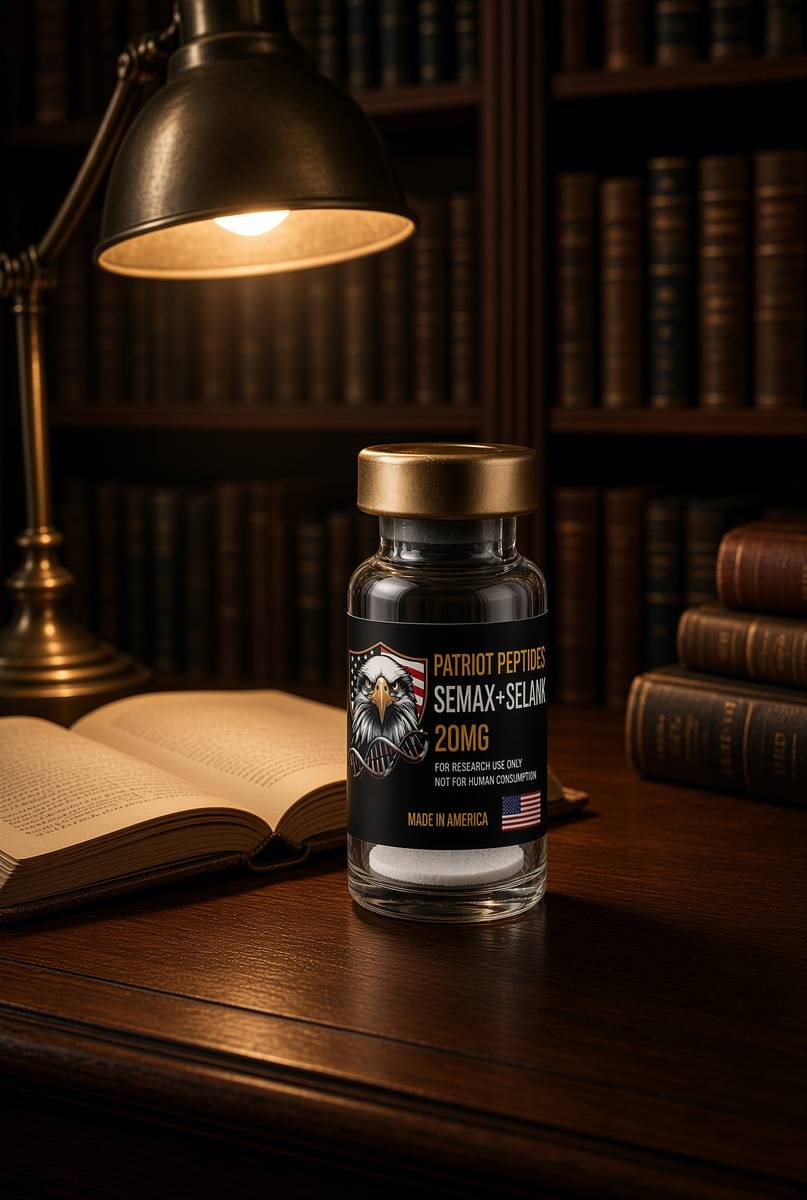 Made in USAOut of stock
Neuropeptide
Semax + Selank
20 mg Semax + Selank — two Russian heptapeptides, one lyophilised vial.
4.7(548)
29 browsing this now · 2 purchased in the last 24 hours
20mg
£40.00
Read next
49 min · long read · Peptide research
What are peptides? Short chains that run the body
Peptides are amino acids joined by peptide bonds — shorter than proteins, more specific than most small-molecule drugs. Insulin was the first. GLP-1 agonists are the current proof. The catalogue here is the same chemistry, labelled for research.
46 min · long read · Peptide research
Melanocortins: from tanning receptors to inflammatory off-switches
MC1R makes pigment. MC4R runs appetite — and its loss is a monogenic obesity syndrome. KPV keeps the anti-inflammatory tail of α-MSH. MT2 is the pan-agonist that does not know subtle.
More in this desk

53 min · long read · Peptide research
Recovery, GH pulses and the CJC / ipamorelin pair
Somatotrophs have two 'go' receptors. CJC without DAC is a slightly longer GHRH pulse. Ipamorelin is a selective ghrelin-receptor key that does not yank ACTH. Together they are the pair Bowers already showed is more than additive — not a gym protocol.
53 min · long read · Peptide research
How research peptides are made — and why HPLC actually matters
Solid-phase peptide synthesis builds a chain one residue at a time. HPLC then asks whether the main peak is what you think it is. ≥98% is not a slogan. It is a chromatogram.
52 min · long read · Peptide research
Fatigue, cellular energy and the NAD+ / MOTS-c neighbourhood
NAD+ is the rechargeable chip every cell spends on fuel and DNA repair — and the pool shrinks with age. MOTS-c is a mitochondrial 16-mer sent out under metabolic stress. Two answers to 'I have no energy' that are not coffee.
51 min · long read · Peptide research
Melanocortin circuits: pigment, appetite and PT-141
Melanotan II lights MC1, MC3, MC4 and MC5 — pigment plus the rest of the sheet. PT-141 is the free-acid cousin pointed at MC3 and MC4, the circuitry papers use for desire and energy, not skin colour. Same Arizona family. Different question.
Essays describe published research. They are not medical advice and they do not authorise human use of any catalogue item.