

Bodybuilding · 7 min · 1,440 words
T3: the hormone that rewrites the cell, then quiets the gland
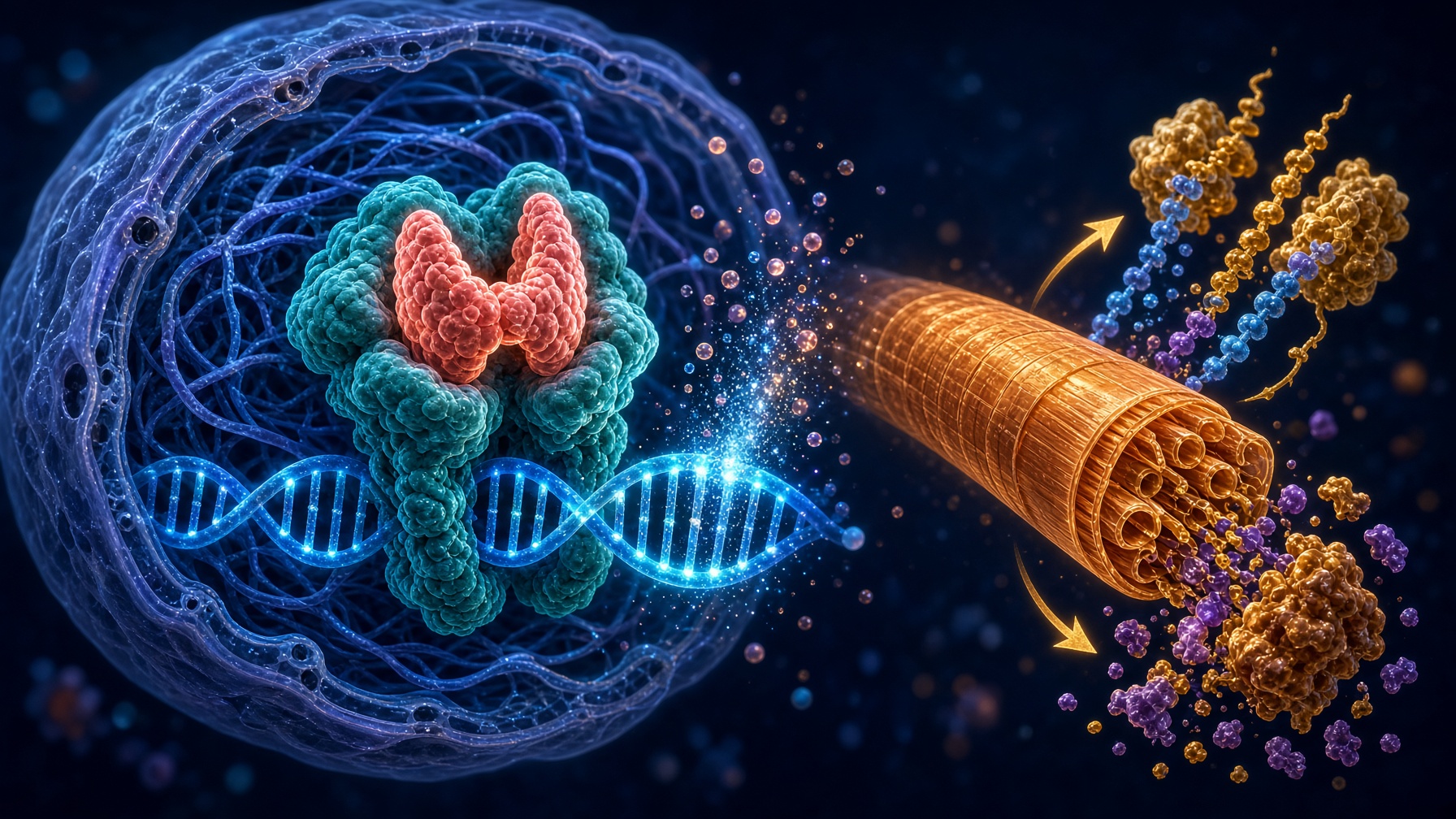
Liothyronine is T3. It binds a nuclear receptor and raises metabolic rate over days by changing genes, not by opening a fat droplet. Muscle turns over faster. TSH falls, and your own thyroid stands down.
What this essay actually tells you
- Liothyronine is T3. It binds a nuclear receptor and raises metabolic rate over days by changing genes. DIO2 makes T3 from T4.
- Muscle synthesis and breakdown both rise. In excess, breakdown wins. TSH falls and your own thyroid stands down.
- It is not the beta-2 receptor. Clenbuterol opens a droplet today. T3 rewrites the cell and bills the heart over days.
What this actually means
T3 switches genes on, so cells burn more over days. Muscle both builds and breaks protein faster, and in excess the breaking wins. The pituitary sees the hormone and stops asking your thyroid to work. That gland is slow to start again. It is not clenbuterol.
Liothyronine is T3, the thyroid hormone that actually sits on the receptor. The gland mostly secretes T4, thyroxine, which is a prohormone. Cells that need the active hormone strip one iodine off with a deiodinase, DIO2, and make T3 locally. DIO3 strips a different iodine and makes reverse T3, which occupies the receptor poorly and is one reason a starved body can turn the signal down without the gland having failed. T3 enters the nucleus, binds the thyroid hormone receptor, and that receptor sits on DNA as a pair with RXR. Genes for the sodium-potassium pump, for mitochondrial enzymes, for uncoupling proteins, and for the machinery of protein turnover get written faster. Metabolic rate rises over days because more pumps are burning ATP to push sodium out of cells, not because a fat droplet was opened at lunch. That delay is the whole difference from clenbuterol.
In short. The body turns T4 into T3, and T3 switches genes on. Metabolism rises over days because cells run more pumps. It is not a switch that empties a fat cell this afternoon.
Muscle hears this loudly, and it hears both directions. Thyroid hormone increases protein synthesis and protein breakdown. In excess, breakdown wins. The fibre turns over faster and the net is loss, especially if the food does not cover the new rate. Myosin isoform also shifts. In animals, extra T3 pushes some slow fibres toward faster ones. That is a change in which myosin gene is being written, not a hypertrophy programme. A person can look flatter as glycogen and fluid leave, and smaller if the calorie gap is real, and then call the flatness a cut working. The heart is in the same nuclear conversation. Rate rises. The risk people meet in the case literature is an arrhythmia, including atrial fibrillation, because the node and the atrial muscle have been told to run quicker for days. Potassium and the beta-2 story on the clenbuterol page are a different route to a similar pulse.
In short. In muscle, T3 speeds both building and breaking. In excess, breaking wins. The heart is told to beat faster for days, which is how people end up in an odd rhythm.
The pituitary is reading it too
The pituitary and the hypothalamus stop asking once T3 is high. TSH falls. The thyroid gland, if it was making your own T4, stands down. That is negative feedback, the same shape as LH falling when an androgen occupies the androgen receptor, except the axis is TRH, TSH and the gland in the neck. Come off a long run of liothyronine and your own T4 does not restart the afternoon you stop. The deiodinases and the gland take time. A blood test in that window shows a low TSH and a low T4 and looks, to a hurried reader, like a gland that failed. It is a gland that was told not to bother. Levothyroxine, T4, is the replacement doctors use when the gland has actually failed, precisely because tissues can still choose how much T3 to make. Liothyronine skips that choice and puts the active hormone in the blood for everyone.
In short. Extra T3 tells the pituitary to stop asking. Your own thyroid goes quiet. When you stop, it does not wake up the same day. A blood test then can look like a failed gland when it is only a rested one.
A diet already lowers T3 on purpose. Less food, less leptin, less DIO1 and DIO2 activity, more reverse T3, a lower metabolic rate. That is the starvation defence, and it is why a long cut feels cold and flat. Adding liothyronine talks over that defence. The rate goes back up, hunger often goes up with it, muscle protein turns over faster, and the heart was never consulted. Clenbuterol on top is a second thermogenic bill, beta-2 and cyclic AMP, not a second copy of this nuclear receptor. An androgen on top still suppresses LH and still asks the marrow for red cells. T3 will not protect HDL and will not spare the fibre because you meant well. Read the blood-panel page for TSH, free T4 and free T3 as numbers. This page is only the hormone that changes the genes, and the gland that goes quiet while it does.
In short. A diet already turns T3 down to save you. Taking it talks over that. Hunger, a faster heart, and faster muscle breakdown come with the rate. It does not cancel the cost of a steroid or of clenbuterol.
Which receptor in which tissue
There is not one thyroid receptor. TRα1, from the gene THRA, is the one in heart and in skeletal muscle. TRβ1, from THRB, is the one in liver. TRβ2 is the one in the pituitary and the hypothalamus, which is why TSH falls so fast: the feedback receptor and the muscle receptor are different proteins from the same family. A liver full of TRβ1 writes the LDL receptor harder, so cholesterol in the blood can fall while the muscle is being wasted. That split is why a blood test can look 'better' on lipids in the same week the flatness is lost tissue. Without hormone, the receptor is not idle. It sits on the DNA with corepressors, NCoR and SMRT, and actively keeps those genes quiet. T3 swaps the corepressors for coactivators. Taking the hormone away again is not a return to zero. It is the repressor coming back.
In short. Heart and muscle use one thyroid receptor. The pituitary uses another, which is why TSH drops. The liver uses a third, which is why cholesterol can fall while the muscle shrinks. An empty receptor is not silent. It sits on the DNA and holds genes off.
Inside the fibre the bill is concrete. T3 turns up the sodium-potassium pumps, and it turns up SERCA, the pump that stuffs calcium back into the store after every twitch. Both pumps burn ATP to move ions. More twitches' worth of ion work, even at rest, is heat. Myosin heavy chain genes shift too: slow myosin is written less, faster myosin more, which changes the fibre's character without adding filaments in parallel. Breakdown is not vague. In excess thyroid hormone the ubiquitin ligases that tag protein for the proteasome, the ones a muscle uses when it is being dismantled, rise, and lysosomal disposal rises with them. Synthesis rises as well. Nitrogen loss is what you get when the second number is larger. New mitochondria can appear, because PGC-1α listens to T3 in several tissues, and UCP3 in muscle leaks some of the gradient as heat instead of ATP. More mitochondria that waste the gradient are not a stronger fibre. They are a warmer one.
In short. The fibre spends ATP on pumps it did not need, shifts toward faster myosin, and tags more protein for the bin. It can grow new mitochondria and still get weaker, because some of that new machinery leaks energy as heat.
- The hormone
- T3
- The lock
- nuclear receptor
- The fibre
- turnover up
- The gland
- TSH falls
Liothyronine. T4 is the prohormone. DIO2 makes T3. DIO3 makes the inactive reverse T3.
Genes change over days. Not the beta-2 receptor. Not a droplet opened at lunch.
Synthesis and breakdown both rise. In excess, breakdown wins.
The pituitary stops asking. Your own T4 stands down and is slow to return.
Questions the essay actually answers
- How does T3 raise metabolic rate?
- Liothyronine binds the thyroid hormone receptor in the nucleus and turns on genes for pumps and mitochondrial enzymes. Cells spend more ATP pushing sodium around. That takes days. It is not a fat droplet opening this afternoon.
- What is the difference between T3 and T4?
- The gland mostly releases T4. Tissues convert it to T3 with the deiodinase DIO2 when they want the active hormone. Liothyronine is T3 already, so it skips that local decision and the pituitary sees it immediately.
- Does T3 burn muscle?
- It speeds both protein building and protein breakdown. When there is too much, breakdown wins, especially if the food does not cover the higher rate. The flat look on a cut is often glycogen and fluid as well as actual tissue.
- Why does TSH drop?
- The pituitary reads T3 and stops releasing TSH. The thyroid gland then makes less of your own T4. After you stop, that asking takes time to come back. A low TSH with a low T4 in that window is feedback, not a gland that has failed.
- Is T3 the same as clenbuterol?
- No. Clenbuterol sits on the beta-2 receptor and raises cyclic AMP within minutes, for about a day. T3 changes genes over days. Putting them together is two bills, not one stronger drug.
Read next
7 min · Bodybuilding
Clenbuterol: one receptor opens the fat cell and bills the heart
Clenbuterol sits on the beta-2 receptor, raises cyclic AMP, and lets a fat cell open its store. Muscle shakes because it wears the same receptor. The heart does too. Leave it occupied and the cell takes the receptor inside.
7 min · Bodybuilding
The blood test: which line is which organ
Total testosterone, LH, oestradiol, prolactin, haematocrit and the liver enzymes are different questions. ALT after squats is muscle. A low LH is suppression. Read the sentences, not the flags.
10 min · Bodybuilding
Androgens: the hormone that talks to the muscle nucleus
Testosterone binds a receptor in the myonucleus, adds nuclei, and asks for food. It is not growth hormone, not a cycle written as an essay, and not a fibre you can buy.

11 min · Bodybuilding
Growth hormone, insulin, myostatin: the other levers on a fibre
After testosterone, the rest of the muscle-drug list is different receptors: a liver hormone, a storage hormone, and a brake. Food decides which of those signals becomes tissue.
More in this desk

18 min · Bodybuilding
What each steroid does at the cell
Testosterone, nandrolone, trenbolone, boldenone, the DHT cousins, the orals. One receptor. Why two of them are not two muscles, what that asks of food, and what the side effects actually are.
16 min · Bodybuilding
Actin and myosin: the motor inside the fibre
The sarcomere, the thin rope, the thick motor, the eight-nanometre stroke, and the calcium switch that lets a nerve turn all of it on. One ATP per pull.
13 min · Bodybuilding
Coming off: SERMs, hCG, and what a supplement cannot do
How a SERM restarts GnRH, how each hCG and FSH option talks to the testis or the ovary, and how zinc, ashwagandha and CoQ10 turn that signal back into testosterone and sperm.
12 min · Bodybuilding
Creatine: the phosphate the fibre keeps next to the myosin
Phosphocreatine rebuilds ATP at the cross-bridge in a fraction of a second. Filling the store buys a few more hard reps. The early weight is water. The myosin still has to be earned.
The page is the mechanism: the protein, what it does in the cell, and the drug or peptide that talks to it.