

Bodybuilding · 7 min · 1,441 words
Haematocrit: the red cells androgens tell the marrow to make
Testosterone raises haematocrit by freeing iron and driving erythropoietin signalling. The mid-fifties is where clinics stop. Donating blood lowers the number and does not switch the signal off.
What this essay actually tells you
- Androgens raise haematocrit by driving red-cell production, in part by suppressing hepcidin so iron reaches the marrow. Boldenone has the loudest reputation.
- Clinics commonly interrupt testosterone as haematocrit climbs through the mid-fifties. Dehydration and sleep apnoea raise the number too.
- Donating blood lowers it until the marrow replaces the cells, and repeated donations drain iron. A sauna lowers it only by adding plasma.
What this actually means
Haematocrit is the share of blood that is red cells. Androgens raise it by pushing the marrow, in part through iron. Clinics worry as it climbs through the mid-fifties. Dehydration and sleep apnoea raise it too. Giving blood drops the number only until new cells are made.
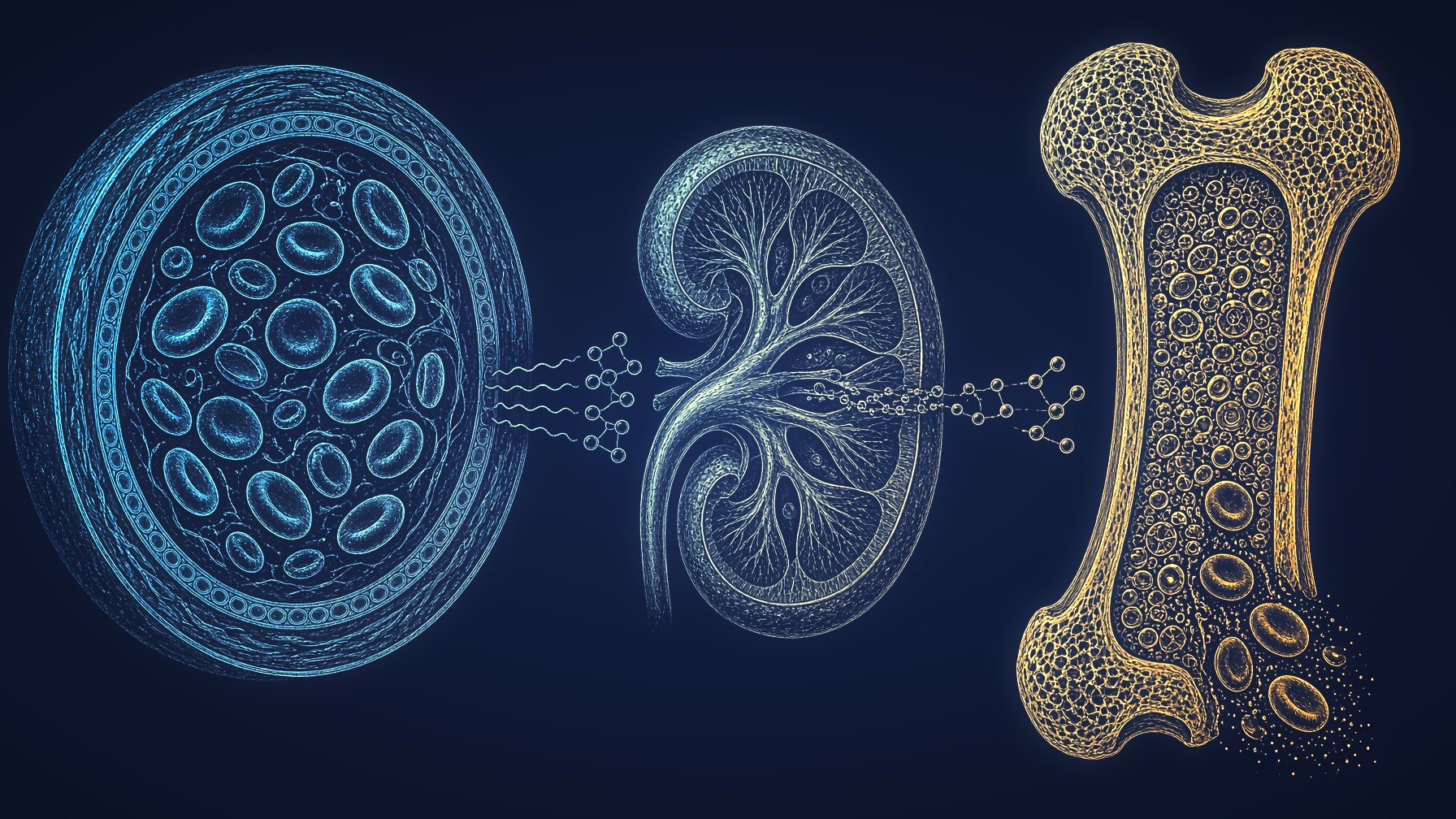
Haematocrit is the percentage of your blood, by volume, that is red cells. Forty-two to forty-eight is a typical male window. Haemoglobin is the protein inside those cells. They move together until something odd is wrong with the cells themselves. Androgens raise both. Testosterone does it. Boldenone has a reputation for doing it harder, which matches how strongly that molecule drives erythropoiesis in animals and in the men who have the blood tests. The mechanism is not a mystery and it is not 'thick blood' as a vibe. The kidney and the liver change iron handling, erythropoietin signalling rises, and the marrow makes more erythrocytes. Bachman's work showed testosterone suppressing hepcidin, the hormone that locks iron away. More iron available to the marrow, more red cells, higher haematocrit.
In short. Haematocrit is how much of your blood is red cells. Testosterone tells the body to make more of them, partly by freeing iron. Boldenone is the androgen with the loudest reputation for this.
A higher haematocrit carries more oxygen per litre. That is the only nice sentence, and it is why erythropoietin became a doping drug in endurance sport. It is also why the same change is a clinical problem past a point. Viscosity rises. Flow in the small vessels gets less forgiving. Platelets and clotting factors are moving through a thicker fluid. The trials of testosterone as a medicine, and the endocrine guidelines that came off them, treat a haematocrit climbing through the mid-fifties as the moment to stop and rethink, not as a badge of a high dose working. Fifty-four percent is the figure that keeps appearing in those documents. It is a threshold clinicians chose, not a law of physics, and it is there because events start to cluster as you go further, not because 53 is holy and 54 is poison.
In short. More red cells can carry more oxygen, which is why endurance doping used this lever. Past the mid-fifties, clinics treat the number as a reason to stop, because the blood is genuinely thicker.
What else packs the cells
Dehydration raises haematocrit without a single new cell. You lost plasma, the cells are a larger share of what is left, and a glass of water plus a repeat test will show it. A night in a sauna, a diuretic, a long flight, a morning draw after no fluid: all of them nudge the number. Sleep apnoea raises it for a more serious reason. Low oxygen at night is a real erythropoietin signal, the same signal altitude sends. A man on testosterone who also stops breathing in his sleep is adding two stimuli. Blaming only the vial misses the airway. Altitude, cigarettes via carbon monoxide, and a rare primary marrow disease do the same trick. The androgen is the common new variable in this sport. It is not the only variable on the form.
In short. A dry morning, a sauna or a flight can raise the number without new cells. Sleep apnoea raises it properly, because low oxygen is a signal to make more red cells. Testosterone is often the new cause, not the only one.
Donating a unit of blood drops the number for a while. It does not switch the androgen receptor in the marrow off. The signal that said 'make cells' is still running, iron leaves with the donation, and the haematocrit climbs back unless the signal stops or the iron runs out. Running out of iron is its own injury: ferritin falls, the cells get smaller, and you have traded viscosity for a deficiency. Repeated donations as a way to stay on a drug the marrow is obeying is a loop, not a cure. The clean experiment is still the one the guidelines describe. Take the androgen stimulus down, recheck, and look for apnoea if the number was high before the drug or will not fall after it.
In short. Giving blood lowers the number for a bit and does not turn the signal off. Do it often enough and you drain your iron. The number comes back if the androgen is still telling the marrow to build.
How to read the result
Ask for haemoglobin and haematocrit together, and look at the mean cell volume if someone is talking about iron. A high haematocrit with a normal cell size is production, not dehydration's only signature, though plasma volume still matters. A high haematocrit with a crashing ferritin is donations or a diet that cannot feed the marrow you just instructed. Pair it with the lipid and the liver lines on the same form, because the androgen that thickened the blood is often the androgen that lowered HDL. None of these numbers is a personality. They are the tissues answering. The bill-outside-the-fibre essay lists the rest of the invoice. This page is only the red-cell line of it.
In short. Read haemoglobin with haematocrit, and ferritin if you have been donating. A high number with normal-sized cells means you are making more cells. The same drug is often lowering HDL at the same time.
The weeks it takes, and the drugs that linger
New red cells are not a weekend project. Erythropoietin from the kidney, iron freed because hepcidin fell, and a marrow that has to run the whole erythroid line: the haematocrit on testosterone climbs over weeks to a few months, then finds a new plateau. A blood test on day four of a cycle will not show it. A blood test in month three will. Boldenone's ester is slow, and the erythropoietic push lasts as long as the androgen is still around, which with the undecylenate ester is measured in months after the last injection. People stop, donate once, watch the number dip, and discover in the autumn that it has climbed back because the drug had not actually left. Testosterone enanthate and cypionate clear faster. The marrow does not have a separate off-switch from the blood level. When the androgen goes, hepcidin recovers, and production eases. The cells already in circulation live about four months. The number falls by a mix of slower production and the old cells dying, not by a flush.
In short. Haematocrit rises over weeks, not days. Boldenone hangs around for months, so the number can climb back after you thought you had stopped. Red cells you already made live about four months.
Symptoms people ignore because they wanted the number: a pounding head, a ruddy face, itching after a warm shower, visual change, a clot in a place a young man should not have one. None of those proves the haematocrit is the cause. All of them are a reason to know the number rather than guess it. Blood pressure often rises on the same androgens, and a thick blood plus a higher pressure is a worse combination than either line alone. Sleep apnoea both raises haematocrit and raises blood pressure, and testosterone can worsen apnoea, so the three lock together. Treating only the blood test, with a donation, leaves the airway and the pressure doing the same job overnight. The useful panel is haematocrit, haemoglobin, ferritin if you have been bled, and a question about snoring.
In short. Headaches, a red face, itching in the warm, or a clot are reasons to know the number. Blood pressure and sleep apnoea travel with it. Taking a unit of blood does not fix the snoring or the pressure.
- The number
- percent red cells
- The signal
- androgen, hepcidin, EPO
- The fake rise
- lost plasma
- The other signal
- night-time hypoxia
Mid-forties is ordinary for a man. The mid-fifties is where clinics flinch.
Testosterone frees iron and the marrow obliges. Boldenone is louder.
Dehydration, sauna, a long flight. Repeat the test after fluids.
Sleep apnoea raises haematocrit whether or not an androgen is present.
Questions the essay actually answers
- What is haematocrit?
- The percentage of blood volume that is red cells. Haemoglobin is the oxygen-carrying protein inside them. Androgens raise both by telling the bone marrow to make more cells.
- Why does testosterone thicken blood?
- It increases erythropoiesis. One route is suppressing hepcidin so more iron reaches the marrow, with erythropoietin signalling rising alongside. The result is more red cells in the same vessels.
- Which steroid raises haematocrit most?
- Boldenone has the strongest reputation, and the animal and clinical pattern fits a strong erythropoietic androgen. Testosterone does it too. The blood test matters more than the reputation.
- Does giving blood fix high haematocrit?
- It lowers the number until the marrow replaces the cells. If the androgen signal is still on, the number returns, and repeated donations drain iron stores.
- Can dehydration look like high haematocrit?
- Yes. Lose plasma and the cells are a bigger fraction of what remains. A repeat test after normal fluids separates that from a true increase in red-cell mass. Sleep apnoea is the other common cause.
Read next

12 min · Bodybuilding
The bill outside the fibre: axis, blood, liver, heart
The androgen receptor is in more places than the biceps. Fertility, HDL, haematocrit, the left ventricle, the voice, the tendon. A map of the tissues. Not a course.

18 min · Bodybuilding
What each steroid does at the cell
Testosterone, nandrolone, trenbolone, boldenone, the DHT cousins, the orals. One receptor. Why two of them are not two muscles, what that asks of food, and what the side effects actually are.
7 min · Bodybuilding
The blood test: which line is which organ
Total testosterone, LH, oestradiol, prolactin, haematocrit and the liver enzymes are different questions. ALT after squats is muscle. A low LH is suppression. Read the sentences, not the flags.

12 min · Bodybuilding
Steroid families: four chemistries, one receptor
Testosterone, the 19-nors, the DHT-derived, and the orals that rent the liver. Wet and dry are oestrogen and water, not two kinds of muscle.
More in this desk
16 min · Bodybuilding
Actin and myosin: the motor inside the fibre
The sarcomere, the thin rope, the thick motor, the eight-nanometre stroke, and the calcium switch that lets a nerve turn all of it on. One ATP per pull.
13 min · Bodybuilding
Coming off: SERMs, hCG, and what a supplement cannot do
How a SERM restarts GnRH, how each hCG and FSH option talks to the testis or the ovary, and how zinc, ashwagandha and CoQ10 turn that signal back into testosterone and sperm.
12 min · Bodybuilding
Creatine: the phosphate the fibre keeps next to the myosin
Phosphocreatine rebuilds ATP at the cross-bridge in a fraction of a second. Filling the store buys a few more hard reps. The early weight is water. The myosin still has to be earned.
12 min · Bodybuilding
The tendon clock: the cable is older than the muscle
Myofibrils turn over in days. Tendon collagen turns over in months to years. Heavy slow strain is how a tenocyte keeps the rope. A fast jump in strength pulls on tissue that has not caught up.
The page is the mechanism: the protein, what it does in the cell, and the drug or peptide that talks to it.