

Bodybuilding · 9 min · 1,967 words
The bill outside the fibre: axis, blood, liver, heart
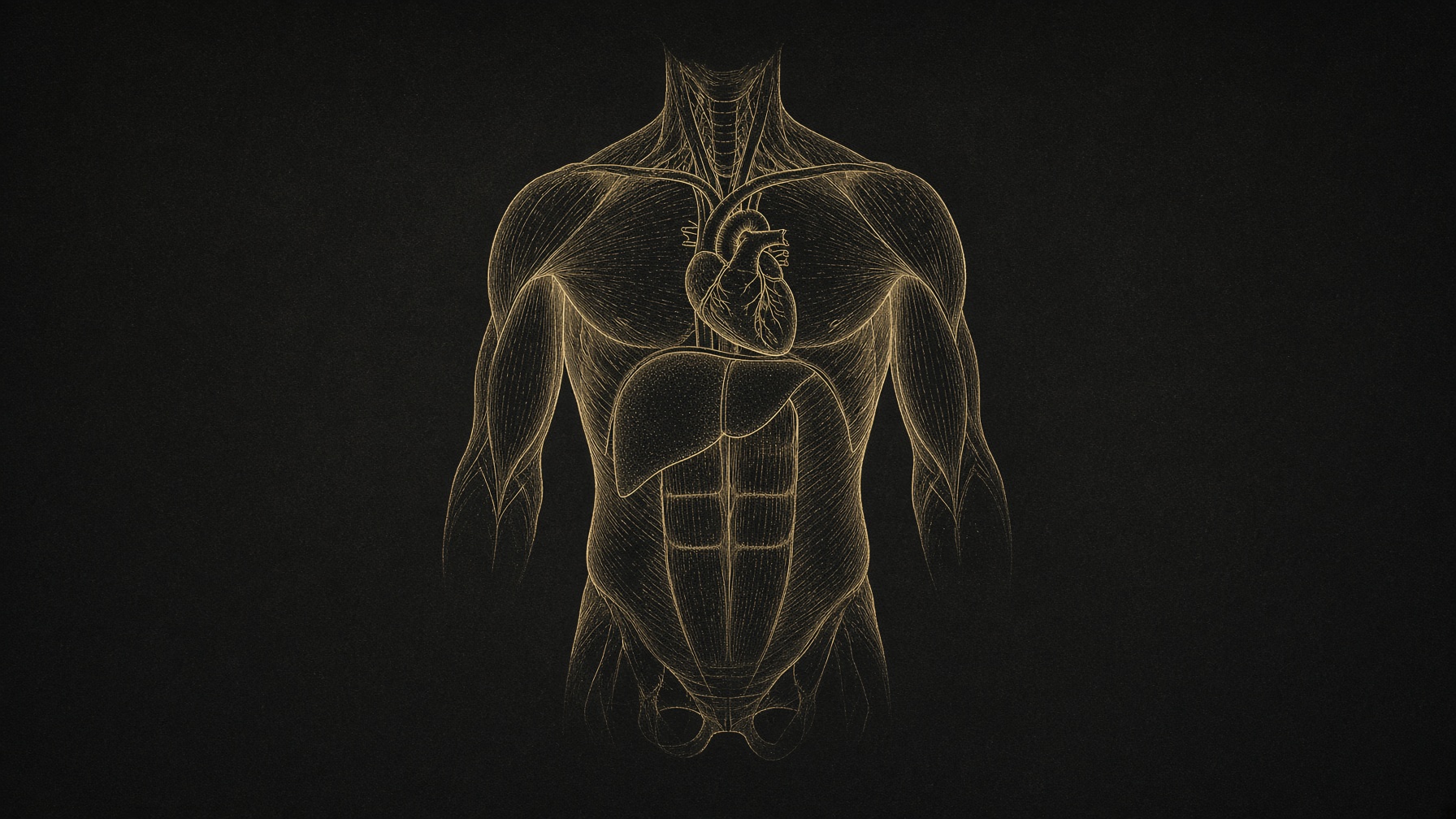
The androgen receptor is in more places than the biceps. Fertility, HDL, haematocrit, the left ventricle, the voice, the tendon. A map of the tissues. Not a course.
What this essay actually tells you
- Exogenous androgen suppresses GnRH, LH and FSH. The testis stands down, sperm can stop, and recovery is measured in months and is not guaranteed. SARMs do this too.
- 17α-alkylated orals lower HDL and can injure the liver. ALT also rises after a hard squat, so GGT and bilirubin are the cleaner liver clues. Haematocrit climbing through the mid-fifties is when clinicians worry. Donating blood does not turn the signal off.
- Long-term use is associated with a thicker left ventricle and more coronary plaque. Gynaecomastia is gland, not chest fat. Voice change in women can last. No dose and no post-cycle schedule on this page.
What this actually means
Steroids shut down your own testosterone and can stop sperm. Orals hurt HDL and can hurt the liver. Blood gets thicker and blood pressure rises. The heart, skin, hair, voice and tendons all have the same receptor or sit downstream of it. Recovery of the axis takes months and is not guaranteed. There is no dose on this page.
The fibre essays are about myosin. This one is about everywhere else the same hormone lands, because that is the information people skip until a blood test arrives. The androgen receptor is in skeletal muscle, and it is also in skin, hair follicles, larynx, bone, liver, heart, prostate, and the hypothalamus that decides whether your own testis is allowed to work. Aromatase and 5α-reductase then split the molecule, so some tissues see testosterone, some see dihydrotestosterone, and some see oestradiol. The family essay told you which drugs can make which of those. This page is what the tissues do with them. No dose. No course. Patriot Peptides does not sell these medicines.
In short. Testosterone does not only talk to muscle. Skin, liver, heart, blood and the brain's hormone switch all have a say. This page is that map.
The switch is the hypothalamic–pituitary–gonadal axis, and it is blunt. The hypothalamus releases GnRH. The pituitary releases luteinising hormone, which tells the Leydig cells in the testis to make testosterone, and follicle-stimulating hormone, which the Sertoli cells need for sperm. Any androgen that looks enough like the real thing tells the hypothalamus the job is done. GnRH falls, LH falls, FSH falls, the testis makes less, and over weeks it gets smaller because the cells were standing down. Sperm count can fall to nothing. That is negative feedback, the same logic as a thermostat, and it happens with testosterone, with 19-nors, with most orals, and with the SARMs that were supposed to be selective. Fertility is the part people treat as theoretical. It is not theoretical. Recovery, when the drug stops, takes months and is not guaranteed. Some men remain suppressed. A calendar you found on a forum is not a promise from the axis.
In short. Extra androgen tells your brain you have enough, so your own production shuts down. The testes shrink. Sperm can stop. Coming back takes months, and it does not always happen.
Oestradiol is the metabolite people try to delete, and the tissues that want it are not optional. Bone density listens to it. A share of IGF-1 tone listens to it. Libido listens to it. Joints notice when it is gone, which is the dry-compound story from the family essay landing on a person whose own testosterone has also been switched off. Too much, relative to androgen, grows glandular tissue under the nipple. That is gynaecomastia, a breast bud, not the fat on the chest of a heavier man. Dieting does not remove an established bud. Aromatising drugs make more oestradiol, and they make more of it in a body with more fat, because aromatase lives there. Nandrolone and trenbolone can grow the same bud through the progesterone receptor even when oestradiol is not high. Measuring one hormone and guessing the other is how that gets missed.
In short. Some oestrogen is required for bones, joints and sex drive. Too much, next to the androgen, grows tissue under the nipple. That tissue is not chest fat, and it does not diet off.
Liver, lipids, blood, heart
The liver's complaint depends on the chemistry. A 17α-alkylated oral — methandienone, stanozolol, oxandrolone, oxymetholone — is built to survive first pass, and the liver cannot clear it on the usual path. Cholestasis, itching, jaundice, and transaminases that climb are the pattern, worse with some orals than others, present as a direction in all of them. Injected testosterone does not carry that particular tax. Here is the trap in the blood test: a brutal leg session also raises ALT and AST, because muscle contains those enzymes and damaged fibres leak them. GGT and bilirubin point more honestly at the liver. A high ALT the morning after squats is not, by itself, a destroyed liver, and a normal ALT on a harsh oral is not a free pass. HDL is the number the oral moves even when you feel fine. Hepatic lipase goes up, HDL goes down, and the change is not the butter on the plate.
In short. Orals are the ones that bother the liver, because of a chemical trick that lets them survive. A hard workout can also raise the same blood enzymes, so the number needs a second look. HDL falls anyway.
Androgens make more red cells. Erythropoietin tone rises, haemoglobin rises, haematocrit — the fraction of blood that is cells — rises with them. Boldenone and high-dose testosterone have the reputation. The whole class can do it. Blood gets thicker, blood pressure often rises, and the combination is a clotting story rather than a muscle story. Clinicians start to worry as haematocrit moves through the mid-fifties. Giving blood drops the number for a while and does not turn the signal off, and doing it often enough drops iron. Sleep apnoea gets worse when the blood is thicker and the neck is heavier. None of that is a reason I am going to write a blood-donation schedule. It is the reason a haematocrit is not a vanity metric.
In short. These hormones thicken the blood. Past a point, that is a clot and blood-pressure problem. Donating blood lowers the number briefly. It does not switch the hormone off.
The heart sees the blood pressure, the thickened blood, the worsened lipids, and the androgen receptor it has of its own. Case series and the imaging studies — Baggish and others in long-term anabolic-steroid users — find thicker left ventricles, weaker pumping than the muscle mass would suggest, and more coronary plaque than in men who lift without the drugs. It is not every user, and a single course is not a destiny. It is also not 'cardio will cancel it'. A beta-agonist on top, the clenbuterol class from the other essay, hits the same heart through a different receptor. Stimulants before a heavy session raise the rate-pressure product again. The biceps do not get a vote.
In short. Long-term use shows up on heart scans: a thicker ventricle, worse lipids, more plaque. Extra cardio does not erase that. Adding stimulant-type drugs adds a second bill.
Skin, hair, voice, tendon, and the axis afterwards
Skin has androgen receptors in the sebaceous gland, so acne is a mechanism, not a hygiene failure. Hair follicles on the scalp lose hair if they are genetically sensitive to DHT. An androgen does not invent that sensitivity. It supplies the ligand. Follicles on the face and body gain hair under the same ligand, which is why a woman's jawline and a man's hairline can be the same molecule with two addresses. The larynx is androgen tissue. A deepened voice in a woman can stay deepened after the drug is gone, because the vocal fold changed shape. Prostate tissue sees DHT. Lower-urinary symptoms can worsen. Modern trials of replacement doses have not shown that ordinary testosterone replacement creates prostate cancer. Abuse doses are not replacement doses, and this page is not going to pretend the literatures are the same.
In short. Acne, scalp hair, body hair and the voice are the same receptor in different places. Genetics decide the scalp. A deepened voice can be permanent. Prostate symptoms are a different question from prostate cancer.
Tendon collagen does not keep the fibre's clock. Strength can jump in weeks. A tendon's cross-links take longer. Stanozolol in particular has a bad reputation in the tendon literature, stiff collagen and ruptures, on top of the simple problem that the bar got heavier faster than the attachment. The practical sentence from the fibre essay still stands, and it stands harder here. Pain in a tendon is the limb telling you the myosin won. Adding a drug because the tendon hurts is how the myosin wins by more.
In short. Muscle gets stronger faster than tendon gets tougher. Some orals make that gap worse. A sore tendon is a reason to reduce load, not a reason to add a drug.
When the drug stops, the axis has to notice the silence and start GnRH again. That gap is why people feel flat, lose some of the tissue, and watch their own testosterone sit low. Three classes of medicine get used by clinicians in that neighbourhood, and I am naming the locks, not a course. A selective oestrogen receptor modulator blocks the oestrogen receptor in the hypothalamus, so the brain no longer thinks oestradiol is high, and GnRH can rise. An aromatase inhibitor blocks the making of oestradiol, which can wake the axis and can also strip the oestradiol that bone and joints wanted. Human chorionic gonadotropin binds the LH receptor on the Leydig cell and asks it to make testosterone even while the pituitary is quiet. Doses, weeks, and combinations of those three are a prescribing decision. They are how people end up with crushed oestradiol, a still-silent axis, and a shopping list they call recovery. If fertility matters, that is a doctor with a semen analysis, not a flowchart.
In short. After you stop, your own testosterone may stay low for months. Some medicines can nudge the switch back on. The doses are a doctor's job. Guessing them is how oestrogen gets wiped out and fertility stays a rumour.
Women and adolescents are not a smaller version of this map. In women the same receptor changes the voice, the clitoris, the hair and the cycle, and several of those changes do not reverse. In adolescents, oestradiol from aromatised androgen closes the growth plates. A boy who wanted to be taller and took an aromatising androgen can end the opposite. Mood sits on the same axis: some people get irritable or grandiose on the way up and depressed on the way down, when the testis has not restarted. That is physiology plus a person. It is not a cartoon of rage, and it is not nothing. Read the family essay if you still need which molecule aromatises. Read the food essay if the question was how to grow a fibre without sending this bill. This page was only the bill.
In short. In women, some of these changes stay. In teenagers, the hormone can stop height early. Mood often lifts on the way up and drops when your own production is still off.
- Axis
- LH and FSH fall
- Liver and HDL
- orals pay
- Blood and heart
- thicker blood, higher pressure
- Skin, voice, nipple
- androgen and oestradiol
Testis stands down. Sperm can stop. Recovery is months, and not certain.
17α-alkylation. A hard workout also raises ALT, so read GGT too.
Haematocrit, lipids, left ventricle. Cardio does not cancel the receptor.
Acne and hair follow DHT. A breast bud is gland, not fat. Voice change can last.
Questions the essay actually answers
- Why do steroids shrink the testes?
- The brain reads the androgen and stops sending luteinising hormone. The testicular cells that make testosterone stand down. Follicle-stimulating hormone falls too, so sperm production falls with it.
- Does the body's own testosterone come back?
- Often, over months. Not always. A forum calendar is not a measurement. Fertility questions belong with a clinician and a semen analysis.
- What is gynaecomastia, as opposed to chest fat?
- Glandular tissue under the nipple, driven by oestradiol relative to androgen, or by progestogenic drugs such as trenbolone and nandrolone. Established gland does not diet off.
- Why is ALT a confusing blood test for someone who lifts?
- Muscle leaks ALT and AST after hard training. GGT and bilirubin point more specifically at the liver. Orals can injure the liver even when you feel well, and a single high ALT after squats is not automatically that injury.
- Do these drugs damage the heart?
- Long-term anabolic-steroid use is associated with a thicker left ventricle, worse lipids, higher blood pressure and more coronary plaque. It is not every user. It is not cancelled by extra cardio.
- Will you write a post-cycle plan?
- No. SERMs, aromatase inhibitors and hCG occupy real receptors, and the doses are a prescription. This catalogue does not sell anabolic steroids, and this page does not assemble a recovery protocol.
Read next
10 min · Bodybuilding
Steroid families: four chemistries, one receptor
Testosterone, the 19-nors, the DHT-derived, and the orals that rent the liver. Wet and dry are oestrogen and water, not two kinds of muscle.
8 min · Bodybuilding
Androgens: the hormone that talks to the muscle nucleus
Testosterone binds a receptor in the myonucleus, adds nuclei, and asks for food. It is not growth hormone, not a cycle written as an essay, and not a fibre you can buy.
8 min · Bodybuilding
Growth hormone, insulin, myostatin: the other levers on a fibre
After testosterone, the rest of the muscle-drug list is different receptors: a liver hormone, a storage hormone, and a brake. Food decides which of those signals becomes tissue.
9 min · Bodybuilding
Food and training: how to spend the fibre you have
The practical half of the muscle series. Recruit the fast fibres, feed them, sleep, and stop asking a drug to do a week's work.
More in this desk
14 min · Bodybuilding
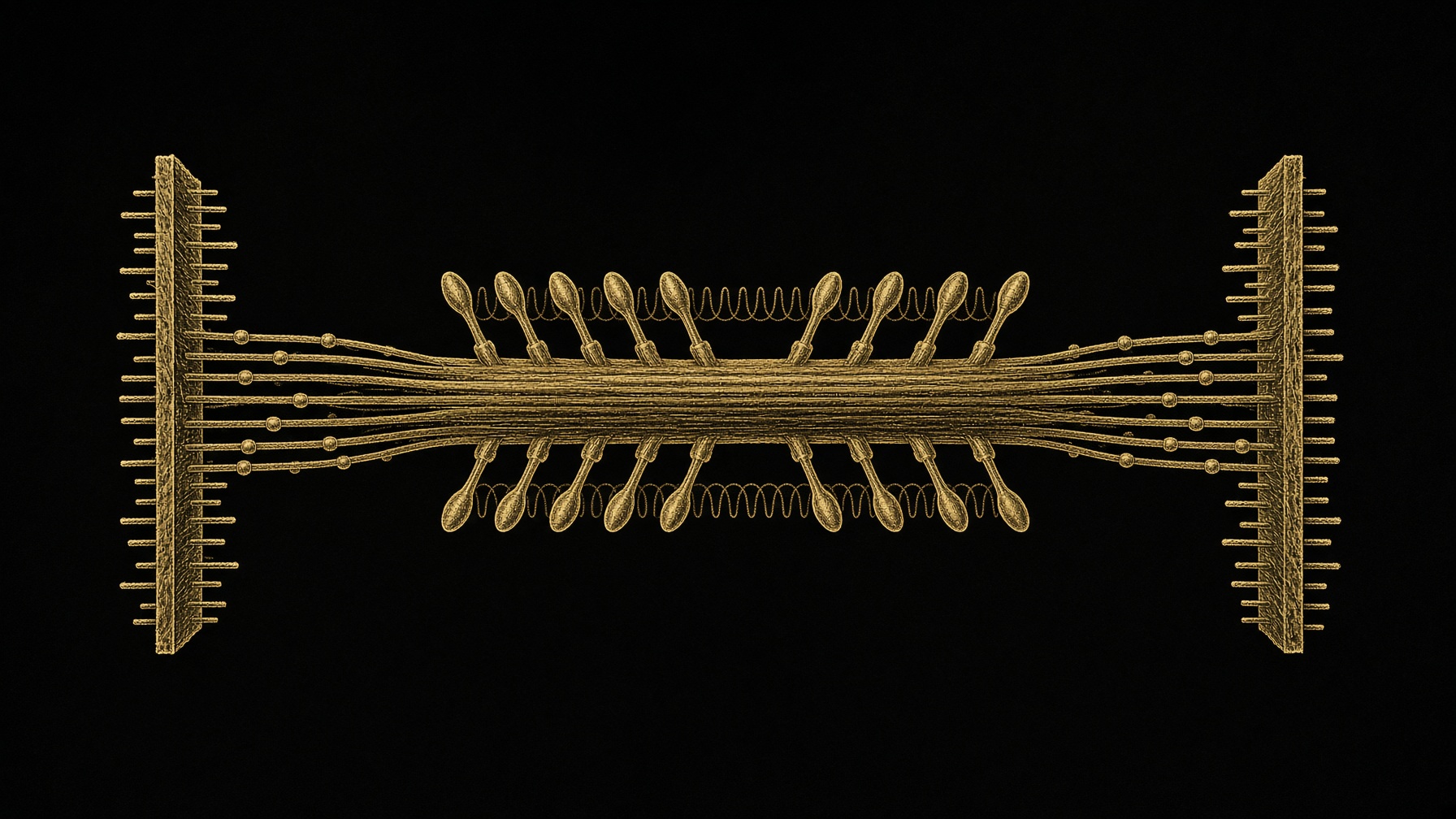
Actin and myosin: the motor inside the fibre
The sarcomere, the thin rope, the thick motor, the eight-nanometre stroke, and the calcium switch that lets a nerve turn all of it on. One ATP per pull.
10 min · Bodybuilding
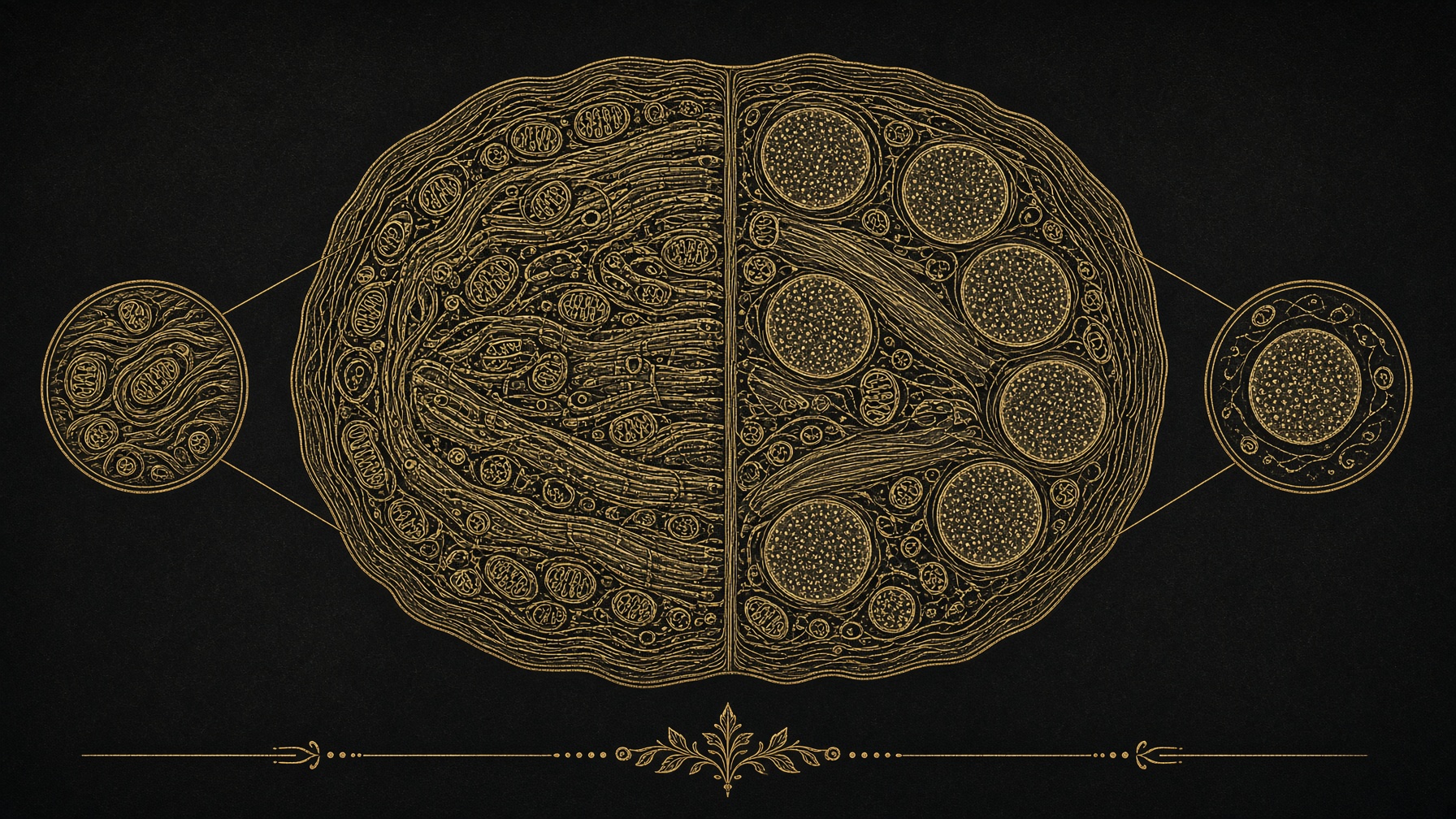
Type I and type II: the two fibres a muscle actually is
Slow fibres last. Fast fibres throw the force. Diet, drugs and workouts all land on that split — so the muscle series starts with the myosin, not the vial.
9 min · Bodybuilding
What the set is doing: failure, volume, rest, range
Why the last reps matter more than the first, why ten hard sets is a floor and not a personality, and why a short rest quietly deletes the tension you came for.
8 min · Bodybuilding
How a fibre grows: tension, time, and the protein ledger
Synthesis minus breakdown, for weeks. Why soreness is the wrong score, why the pump is water, and why long ranges of motion keep showing up in the trials.
Essays describe published research. They are not medical advice and they do not authorise human use of any catalogue item.