

Bodybuilding · 10 min · 2,112 words
Type I and type II: the two fibres a muscle actually is
Slow fibres last. Fast fibres throw the force. Diet, drugs and workouts all land on that split — so the muscle series starts with the myosin, not the vial.
What this essay actually tells you
- Human skeletal myosin: MYH7 is type I (slow, oxidative), MYH2 is type IIa, MYH1 is type IIx. The rodent IIb gene is not the human fast fibre. Schiaffino’s map, not a gym caption.
- Henneman’s size principle: small motor neurons fire first and innervate type I. High-threshold motor neurons, and the type II fibres they own, join when force demand rises. Easy work never reads them.
- Repeated hard efforts spend glycogen and phosphocreatine in the fast fibres. Easy work spends fat through mitochondria. A meal only helps the motor units the session actually recruited.
What this actually means
You have slow fibres that keep going and fast fibres that produce force and tire. Hard lifting wakes the fast ones. Easy cardio trains the slow ones. Carbohydrate feeds the fast work. Protein feeds both. Drugs later in this series act on these same fibres. They do not invent a new kind.
A muscle is not one tissue doing one job. It is a bundle of fibres, and the fibres are not interchangeable. The slow ones can hold a posture for an hour. The fast ones can move a heavy bar for a few seconds and then they are done. Diet, drugs and programmes all land on this split, which is why a series about building muscle has to start here rather than at a vial. Myosin heavy chain is the protein that decides the split. The gene writes the motor. The motor writes the metabolism.
In short. Muscle is made of different fibres. Slow ones last. Fast ones are strong and tire quickly. Everything else in this series lands on that split.
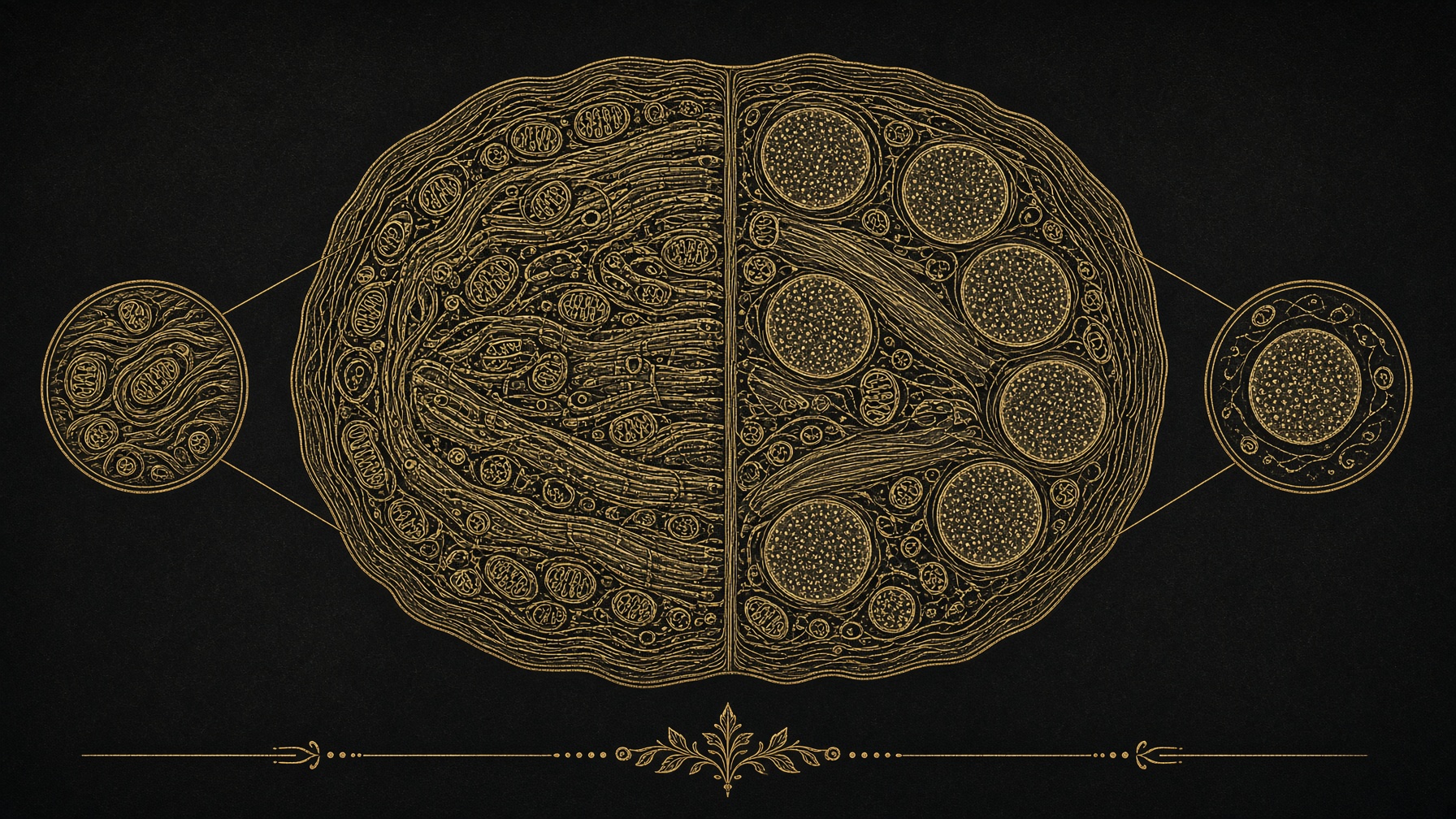
Type I fibres express MYH7, the slow myosin. They are smaller, darker on a classic ATPase stain after acid preincubation, packed with mitochondria, myoglobin and capillaries. They run on fat and carbohydrate through oxidative phosphorylation and they do not empty their glycogen in a hurry. Type IIa fibres express MYH2. They are the fast oxidative-glycolytic middle: a decent myosin ATPase, still some mitochondria, able to repeat hard efforts if you feed them. Type IIx fibres — MYH1 in humans; the old textbooks still say IIb, which is the rodent gene — are the pale, glycolytic, high-force fibres. They live on glycogen and phosphocreatine. A set of heavy squats is mostly their afternoon.
In short. Slow fibres burn fuel with oxygen and keep going. Fast fibres make a big force from stored carbohydrate and then they fade. Humans have a middle type as well.
You do not choose a fibre the way you choose a playlist. A motor neuron chooses it. Henneman's size principle, 1965, still holds: small motor neurons, with a low threshold, fire first, and they innervate type I fibres. Larger motor neurons fire when the force demand rises, and they innervate type II. A light set that never approaches the hard reps leaves the big motor units unread. A heavy set, or a lighter set taken close to the point where you cannot complete another honest rep, recruits them. That is why 'tone' from tiny weights and a long walk is mostly a type I story, and why a physique that looks like it was built under a bar was a type II story. Both fibres matter. They are recruited in an order, not by a wish.
In short. Your nervous system turns fibres on from slow to fast as the effort gets harder. Easy work never really wakes the strong fibres.
Fibre type is also a fuel story, which is where diet walks in. Type I fibres at an easy pace lean on fatty acids: CPT-1, the β-oxidation spiral, a mitochondrial volume that can take the acetyl-CoA. Type IIx fibres in a hard set lean on glycogen and on the phosphocreatine that creatine kinase uses to rephosphorylate ADP for a few seconds. Type IIa sits between them. A low-carbohydrate week does not convert a IIx fibre into a I fibre. It starves the fuel the fast fibre was built to use, so the top sets get worse and the fast motor units drop out earlier. A huge carbohydrate load without any heavy work fills glycogen in fibres you never recruited. The meal has to meet the motor unit that did the work. The protein essay next door is the leucine half of that meeting. This page is the fibre half.
In short. Slow fibres prefer fat at an easy pace. Fast fibres want stored carbohydrate for hard efforts. Food only helps the fibres you actually switched on.
One myosin, three jobs
The contractile difference is kinetic. Slow myosin splits ATP more slowly and stays attached to actin a little longer, which is economical for a fibre that has to hold. Fast myosin cycles quickly, produces more power, and spends ATP like it is leaving. Bottinelli, Schiaffino, the single-fibre work of the 1990s: specific force is not wildly different; power and velocity are. A type IIx fibre can shorten faster and throw a higher peak power than a type I fibre from the same person. That is why a sprinter's vastus and a cyclist's vastus can weigh the same and still be different machines. Hypertrophy adds sarcomeres in parallel and makes the fibre fatter. It does not, by itself, change the myosin gene. A bigger slow fibre is still slow.
In short. Fast fibres are not simply stronger versions of slow ones. Their motor protein runs quicker, so they produce more power. Growing a fibre does not automatically change its type.
The stain and the gel are how we know, and a feeling after leg day is not a gel. Myosin ATPase histochemistry, Brooke and Kaiser, sorts fibres by pH. SDS-PAGE of a single fibre, or an antibody against MYH7, MYH2 and MYH1, sorts them by the protein. Most human vastus lateralis sits in a mix: often something like a half type I, a large share of IIa, and a smaller share of IIx that falls further if you train. Pure IIx is rare in people who lift; hybrid IIa/IIx fibres are common, and training tends to push the hybrid toward IIa. Endurance months push the other way, toward more oxidative character inside the fast pool. Schiaffino's reviews are the map. A programme that claims it 'converted slow to fast' has usually just stopped using the slow fibres and hypertrophied the fast ones. The census moved because the used fibres grew.
In short. Labs sort fibres by the myosin protein, not by how the session felt. Lifting tends to grow the fast fibres and shift them toward the middle type. It does not rewrite you into a new species.
Satellite cells and myonuclei are the slow part of getting bigger, and they are not evenly interested. A fibre is a syncytium: many nuclei, one cytoplasm, each nucleus serving a domain. When a fibre grows past what its nuclei can support, satellite cells under the basal lamina donate nuclei. Type II fibres, the ones that hypertrophy most under heavy load, are where that donation shows up in the human biopsy literature. Type I fibres hypertrophy too, less dramatically in most resistance studies. This is the neighbourhood androgens later occupy — Sinha-Hikim's work on testosterone and satellite cells — and it is also the neighbourhood a loaded bar occupies without a drug. Myonuclear addition is weeks. A phospho-blot is hours. Do not confuse them.
In short. A growing fibre eventually needs more nuclei, donated by small stem cells on its surface. Heavy lifting asks for that mostly in the fast fibres.
Tendons and the extracellular matrix do not keep the fibre's timetable. A fast fibre can add contractile protein faster than a tendon adds collagen cross-links. That lag is one reason a sudden jump in load, drug-assisted or not, shows up as a tendon complaint before it shows up as a better squat. The matrix essay is not this page. The practical sentence is. Bone, tendon and muscle are one limb. Feed and load the limb, not only the myosin.
In short. Muscle can get ahead of tendon. Load the whole limb, not only the part that looks good in a mirror.
What a week actually asks of each fibre
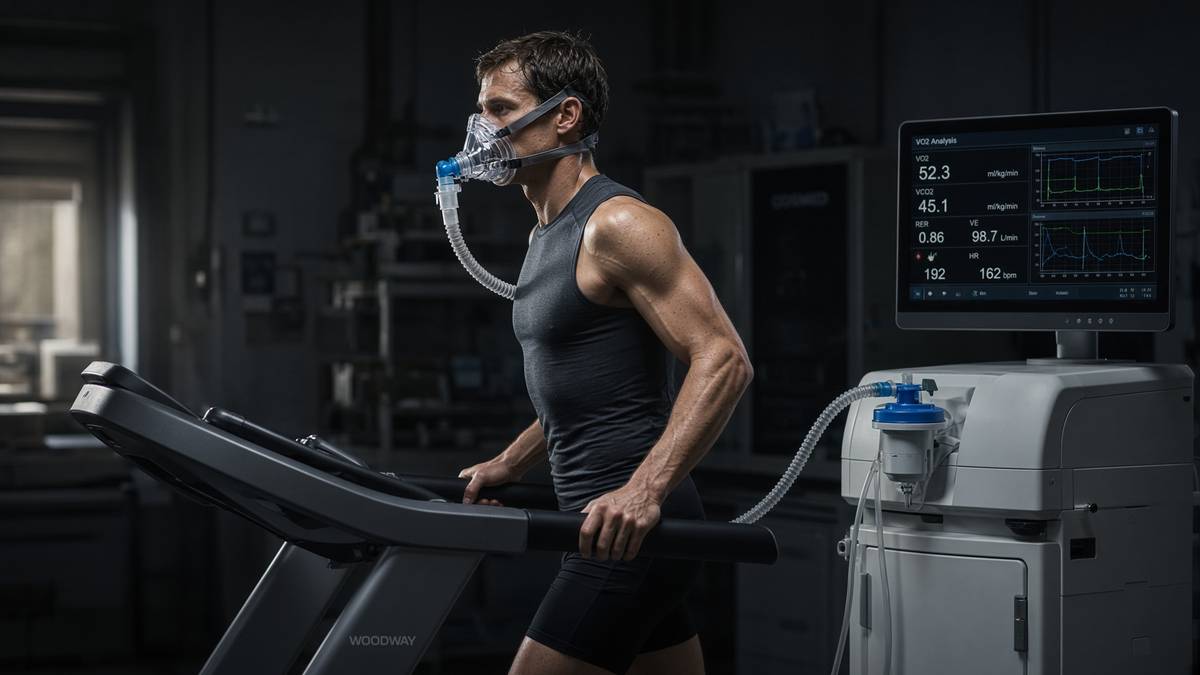
Easy aerobic work is a type I session with a mitochondrial bill. Heart rate conversational, fat oxidation high, capillaries and slow fibres doing the hours. It does not recruit much IIx, and it should not be asked to. The mitochondria essay next door is that bill in full. Use it for the engine. Do not use it as a substitute for the sets that wake the fast fibres.
In short. Easy cardio trains the slow fibres and the mitochondria. It is not a replacement for heavy lifting.
Heavy or hard resistance work is a type II session. Compounds taken to a real effort — roughly the last few reps before form breaks — recruit the high-threshold motor units. Rest long enough, two to three minutes on the big lifts, that the next set can still produce force. Short rests turn a strength set into a lactate set and drop the load, which is a different stimulus, useful in places, dishonest if you were trying to keep the weight moving. Schoenfeld's volume work puts a useful floor near ten hard sets per muscle per week for people who already lift, with room above that until recovery fails. That is a landmark from meta-analyses, not a programme I am handing you. The fibre does not count sets. It counts tension in the motor units that contain it.
In short. To train fast fibres, lift hard and rest enough to lift hard again. About ten serious sets a week per muscle is a researched starting region, not a plan stamped on you.
Diet follows the fibre you claimed you trained. A week of heavy lower-body work spends glycogen in vastus IIa and IIx. Carbohydrate in the meals around those sessions refills it. A week of only easy cycling spends less glycogen and more fat, and a low-carbohydrate pattern is less punishing there. Protein is not fibre-specific in the way glycogen is: every fibre that is turning over myosin needs essential amino acids, and the protein essay's range — about 1.6 to 2.2 grams per kilogram per day, spread across meals — is the range that covers both. Creatine monohydrate, three to five grams a day, raises phosphocreatine mostly where the fast fibres use it. That is a food-adjacent molecule with a mechanism, not a hormone.
In short. Hard lifting spends carbohydrate in the fast fibres, so eat carbohydrate around that work. Protein still has to cover every fibre. A small daily dose of creatine supports the fast-fibre energy store.
Drugs do not get their own fibre. Androgens, growth hormone, insulin and the rest push the same cells. They push harder on the fibres you recruit, and they push some processes — satellite cells, nitrogen retention, collagen, fat cells — that a set does not push equally. The next two essays name those levers one at a time. They are not prescriptions. A type II fibre still has to be recruited by a motor neuron before any of those molecules has a sarcomere to talk to.
In short. Drugs act on the same fibres training does. They do not invent a third kind of muscle, and they still need you to recruit the fibre.
The size principle is the whole programming argument in one sentence: force demand decides which fibres hear the session.— Henneman, 1957–1965, and every EMG study that watched motor units join in order.
- Type I · MYH7
- slow oxidative
- Type IIa · MYH2
- fast, still oxidative
- Type IIx · MYH1
- fast glycolytic
Mitochondria, fat oxidation, posture and easy miles. Recruited first.
The fibre lifting actually grows. Repeats hard efforts if glycogen is there.
Highest power, shortest life. Phosphocreatine and glycogen. Hybrids shift toward IIa with training.
Where the rest of this series sits
The next page is the motor itself: actin, myosin, the sarcomere, and the stroke. The page after that is how a fibre actually gets bigger: synthesis, breakdown, tension, and why soreness is the wrong score. The androgen essay is the nuclear receptor inside the myonucleus, and the satellite cell under the basal lamina. The growth-hormone, insulin and myostatin essay is the other chairs. The set essay is why the reps are shaped the way they are. The food-and-training essay is the week. This page was the census.
In short. Next: the motor, actin and myosin, then how a fibre grows, then the hormones, the sets and the food.
Questions the essay actually answers
- What is the difference between type 1 and type 2 muscle fibres?
- Type I fibres use slow myosin (MYH7), lots of mitochondria and fat oxidation, and they fatigue slowly. Type II fibres use fast myosin. IIa (MYH2) still has mitochondria. IIx (MYH1) is the most glycolytic and the most powerful, and it tires first.
- Can I turn type 1 fibres into type 2 with a programme?
- Not in the way the caption claims. Training changes size and shifts hybrid fast fibres toward IIa. The slow-to-fast story is mostly 'the fast fibres grew because you finally recruited them.'
- Why do light weights sometimes fail to build muscle?
- Because of Henneman's size principle. Easy effort recruits small motor units and type I fibres. Fast fibres join when the set is heavy or when a lighter set is taken close to failure.
- Do fast fibres need carbohydrate?
- For repeated hard efforts, yes. They run on glycogen and phosphocreatine. A low-carbohydrate week does not make them oxidative. It makes the top sets worse.
- Is this a training plan or medical advice?
- No. It is the census of human myosin heavy chains and how recruitment and fuel meet them. The set landmarks are from the research literature, not a programme. Pain, illness and a tendon that has already complained need a clinician.
Hypothetical research reconstitution
How this vial is typically mixed
Hypothetical research reconstitution for the named catalogue vial. Not a protocol, not medical advice, not a use instruction. These amounts sit in published and commonly cited laboratory ranges. The vial is labelled for research use only — not for human or veterinary administration.
IGF-1 LR3
1000mcg
Mix with 1 ml bacteriostatic water → 1,000 mcg/ml
- Hypothetical aliquot
- 20–50 mcg
- 0.02–0.05 ml · 2–5 units on a U-100 syringe
- How often
- Once daily
- 4–6 weeks, then a pause
Bench steps
- Let the vial sit until it is no longer cold to the touch.
- Wipe the stopper with 70% isopropyl alcohol. Let it dry.
- Draw 1 ml bacteriostatic water (0.9% benzyl alcohol).
- Run the water slowly down the inside glass — do not blast the cake.
- Roll between finger and thumb until the cake is gone. Do not shake.
- Label the date. Store the solution at 2–8 °C. Do not freeze. Use within 30 days unless the note below says otherwise.
A thousand micrograms, not milligrams. 50 mcg is 5 units. Over-mixing the cake with a large water volume makes the marks unreadable — 1 ml is the point.
Bacteriostatic water and sterile syringes ship with peptide orders over £75. Kit details · 10 ml bacteriostatic water
The molecule in the essay
The same published structure the essay describes — HPLC-characterised.

Read next
8 min · Bodybuilding
Androgens: the hormone that talks to the muscle nucleus
Testosterone binds a receptor in the myonucleus, adds nuclei, and asks for food. It is not growth hormone, not a cycle written as an essay, and not a fibre you can buy.

8 min · Bodybuilding
How a fibre grows: tension, time, and the protein ledger
Synthesis minus breakdown, for weeks. Why soreness is the wrong score, why the pump is water, and why long ranges of motion keep showing up in the trials.
14 min · Bodybuilding
Actin and myosin: the motor inside the fibre
The sarcomere, the thin rope, the thick motor, the eight-nanometre stroke, and the calcium switch that lets a nerve turn all of it on. One ATP per pull.
9 min · Bodybuilding
What the set is doing: failure, volume, rest, range
Why the last reps matter more than the first, why ten hard sets is a floor and not a personality, and why a short rest quietly deletes the tension you came for.
10 min · Bodybuilding
Steroid families: four chemistries, one receptor
Testosterone, the 19-nors, the DHT-derived, and the orals that rent the liver. Wet and dry are oestrogen and water, not two kinds of muscle.
8 min · Bodybuilding
Androgens, peptides, and the meal
The nucleus, the growth-hormone receptor, and leucine do not share a lock. Here is what each one asks of a fibre, and what food still has to supply.
8 min · Bodybuilding
Growth hormone, insulin, myostatin: the other levers on a fibre
After testosterone, the rest of the muscle-drug list is different receptors: a liver hormone, a storage hormone, and a brake. Food decides which of those signals becomes tissue.
9 min · Bodybuilding
Food and training: how to spend the fibre you have
The practical half of the muscle series. Recruit the fast fibres, feed them, sleep, and stop asking a drug to do a week's work.
49 min · long read · Metabolism
Protein, training and muscle protein synthesis
Muscle isn't a mood. It is mechanical tension plus a leucine-gated translational programme. Here is the dose, the threshold, and why the gym still has to happen.
47 min · long read · Metabolism
Mitochondria, VO2 and why training still wins
Endurance work builds the engines. Heavy work builds the chassis. The molecular story is AMPK, PGC-1α, calcium and mTOR — not a shopping list.
More in this desk
Essays describe published research. They are not medical advice and they do not authorise human use of any catalogue item.