


Metabolism · 49 min · 10,800 words
Protein, training and muscle protein synthesis
Muscle isn't a mood. It is mechanical tension plus a leucine-gated translational programme. Here is the dose, the threshold, and why the gym still has to happen.
What this essay actually tells you
- Muscle protein synthesis is a meal-and-loading response: leucine (mTORC1), essential amino acids, and mechanical tension. Three inputs. Skip one and the others notice.
- A practical research range for adults under load is roughly 1.6–2.2 g protein per kg per day, distributed, not a single shake. Grams, kilograms, meals. Not a brand.
- Fasting autophagy and fed MPS are different programmes. You cannot run only one and call it a complete training literature. We'd like both states in the same week, on purpose.
What this actually means
To add or keep muscle you need two things: a reason for the fibre to grow (heavy enough tension) and enough essential amino acids, especially leucine, to switch protein synthesis on. About 1.6 to 2.2 grams of protein per kilogram of body weight per day covers almost everyone who is training. Spreading it over a few meals that each clear a leucine threshold beats one huge steak at midnight. Older adults need a bit more per meal because the switch gets dull (anabolic resistance, not a motivational poster). None of this requires a research peptide, which we mention because the question arrives anyway.
Muscle protein synthesis is a meal-and-loading response, and the three inputs are the whole diagram. Three inputs open the translational programme in a fibre that is actually going to keep the protein it makes: leucine, which is the amino-acid signal mTORC1 listens to at the lysosome; a complete set of essential amino acids, which are the residues the ribosome will have to polymerise into myosin, actin, titin and the rest of the myofibril; and mechanical tension, which is the reason those myofibrils are being added rather than turned over as a few hours of post-prandial synthesis that never accumulates. Skip the leucine and mTORC1 stays quiet even if the plate was large. Skip the other essentials and you have a signal without bricks — the ribosome can't write a myosin heavy chain out of leucine and optimism. Skip the tension and you get a tracer bump in mixed-muscle fractional synthesis that doesn't become sarcomeres. Phillips, Rennie, Wolfe, the McMaster and Nottingham biopsies, thirty years of infusions. The forum version has more certainty and fewer needles.
In short. Muscle grows when three things arrive together: leucine as the switch, the other essential amino acids as bricks, and heavy tension as the reason to keep what you built.
The practical range for adults under load is roughly 1.6 to 2.2 grams of protein per kilogram of body weight per day, split over meals rather than poured into a midnight shake. Morton, Murphy, Phillips, British Journal of Sports Medicine, 2018: a breakpoint near 1.62 g/kg/day beyond which extra protein did little for hypertrophy in typical trainees, with a confidence band that still lets 2.2 g/kg be a reasonable ceiling for people in an energy deficit or with a lot of lean mass to keep. Per meal, 0.3 to 0.4 g/kg of high-quality protein, or roughly two to three grams of leucine, is the working threshold in young adults. Older adults often need closer to 0.4 to 0.5 g/kg because the switch dulls — anabolic resistance, a receptor-and-ribosome problem, not a motivational poster. Animal proteins hit the leucine number in less food. A well-planned plant pattern can get there with more total protein and some attention to lysine and leucine. Grams, kilograms, meals. Not a brand.
In short. Older adults often need a little more at each sitting. People who lift do well on about 1.6 to 2.2 grams of protein per kilogram each day, split over several meals, not one huge drink.
Fasting autophagy and fed muscle protein synthesis are different programmes, and you can't run only one and call it a complete training literature. You can't run only one and call it a complete training literature. Eat protein and carbohydrate after a loaded session and mTORC1 turns on in the motor units you recruited: S6K1 and 4E-BP1 phosphorylated, translation of myofibrillar proteins up, ULK1 held off. Stop eating long enough that AMP/ATP rises, insulin falls, and AMPK phosphorylates ULK1 at a different residue, and the cell starts recycling — Ohsumi's autophagosomes, LC3 lipidation, a lysosomal appetite. Those are shifts, not enemies and not personalities. A week that only clocks build (constant grazing, never empty, never a genuine fasted walk) misses the recycle half. A week that only clocks recycle (under-eating, never loading a bar, never clearing leucine in the fibres that did the work) misses the half this page is for. DiRECT-style remission of type 2 is, among other things, a long recycle shift applied to a fatty liver. Hypertrophy is a build shift applied to a fibre. We would like both states in the same week, on purpose.
In short. A week that only does one is incomplete. Building muscle and recycling old cell parts are different programmes: feeding after lifting builds, going without food recycles.
IGF-1 LR3 is a dish analogue, not a training plan, and that distinction is the whole point of putting it on this page. Native insulin-like growth factor-1 is a seventy-residue insulin-family peptide the liver writes after a growth-hormone pulse, and that loaded muscle also writes as a local splice. Binding proteins 1 through 6, with the acid-labile subunit, lock more than ninety per cent of the circulating ligand. Long Arg3 IGF-1 is an eighty-three-residue laboratory analogue — arginine at position 3, a thirteen-residue N-terminal extension — built so IGF-binding proteins can't hide it from a cultured myoblast. That's a design decision about a buffer in serum-containing medium. It isn't 1.6 g/kg and a loaded bar, and it isn't the mechano-growth-factor transcript Goldspink named after stretch. Neighbouring vials on the same axis (modified GRF(1–29) without DAC, ipamorelin, 191-residue somatropin) occupy three other receptors. This page is the fibre: tension, leucine, essential amino acids, myofibrillar versus sarcoplasmic, the dose, the fast, the biopsy. The analogue sits in one section because the question arrives anyway. It won't be asked to do the session.
In short. It isn't a substitute for protein and lifting, and it isn't a plan for a person. A lab version of the growth factor IGF-1 exists so a dish can see the receptor.
Three inputs, one translational programme
Leucine is the amino acid mTORC1 actually smells, which is still one of my favourite sentences in this literature. Wolfson, Chantranupong, Sabatini, Science 2016: sestrin2 is a cytosolic leucine sensor. Leucine-bound sestrin2 lets go of GATOR2; GATOR2 then restrains GATOR1; GATOR1 is the GAP for RagA/B; the Rag heterodimer, sitting on Ragulator at the lysosomal surface, can load GTP and recruit mTORC1 to the place where Rheb, if it is GTP-loaded, will turn the kinase on. That's the nutrient inbox. The growth-factor inbox is separate: insulin and IGF-1, via IRS–PI3K–Akt, phosphorylate TSC2 and let Rheb stay GTP-loaded. Amino acids can recruit mTORC1 to the lysosome and still leave it idle if Rheb is off. Growth factors can load Rheb and still leave mTORC1 in the cytosol if the Rags are empty. A protein meal does both jobs in a healthy fibre after training, which is why the literature keeps finding that leucine-rich essential-amino-acid mixtures light the kinase and that a carbohydrate-only drink doesn't do the same work. Name sestrin2 if you're going to write leucine. Name Ragulator if you're going to write the lysosome. A leucine-trigger phrase that can't point at a protein is a brand.
In short. That switch sits on a small organelle called the lysosome. Leucine tells a growth switch inside the muscle cell to turn on.
Essential amino acids are the substrate — leucine is a signal and also a residue; the other eight essentials are mostly bricks. Leucine is a signal and also a residue; the other eight essentials are mostly residues. Myosin heavy chain, actin, tropomyosin, troponin, titin, nebulin: long polypeptides with defined compositions. If histidine, lysine, methionine, phenylalanine, threonine, tryptophan, isoleucine or valine is missing, elongation stalls or the chain isn't made. That's why a collagen hydrolysate, leucine-poor and incomplete, is a weak MPS meal even in large grams, and why a whey isolate, leucine-rich and complete, lights synthesis at a smaller serving. Tang, Phillips, 2009, and the later plant-protein comparisons from van Loon's group: matched leucine often closes much of the gap; matched total protein doesn't, if the leucine and the limiting essential never arrived. Non-essential amino acids the fibre can write from intermediates. It can't write the essentials. A paper that reports protein without a leucine milligramme and an essential profile has not yet described the meal. The bricks have names. Count them.
In short. A food missing those can't build contractile protein, however large the serving. Leucine is the switch, but the muscle still needs the other essential amino acids as actual building material.
Mechanical tension is the third input and the one a shake can't forge — the fibre has to be pulled. Goldberg's tenotomy and stretch papers already showed that load, not simply 'work', is the hypertrophic signal. Integrins at the costamere feel the deformation; focal adhesion kinase autophosphorylates; phosphatidic acid, generated by phospholipase D at the membrane, is a direct mTORC1 input Hornberger's laboratory spent a decade naming. LAT1 (SLC7A5) and other amino-acid transporters are upregulated in the loaded fibre, so the same meal produces a higher intracellular leucine in the motor units you actually recruited. Calcium, as a contraction by-product, feeds CaMK and nNOS neighbourhoods that the endurance literature owns; they aren't the hypertrophy kinase. Proximity to failure, in practical language, is how you recruit the high-threshold motor units whose fibres will see this chemistry. A twenty-rep set that never approached the limit leaves those fibres unread. A five-rep set that did, or a fifteen-rep set that did, both count. The variable is tension in the fibre, not the number on the whiteboard.
In short. The fibres you actually worked are the ones that listen. Heavy tension on the fibre is the third ingredient: protein without that load doesn't turn into new contractile machinery.
Skip one input and the others notice, which is why the three-input diagram isn't a brand line on a tub. A leucine-rich meal in an untrained, unloaded limb gives you a few hours of mixed-muscle synthesis that doesn't accrue as new myofibrils; the McMaster unilateral models have been used for exactly this comparison. Tension in a fasted, amino-acid-poor fibre phosphorylates some of the right kinases and then fails to translate, because the ribosome ran out of substrate and because AMPK, if the session was long and glycogen-low, is still sitting on TSC2. Essential amino acids without leucine as the signal, or with leucine below the sestrin2 occupancy that actually lets GATOR2 go, under-fill the nutrient inbox. That's why 2.5 g of leucine in an otherwise incomplete mixture can look, on a phospho-S6K1 blot, like a meal, and why the same blot isn't a hypertrophy paper. Three inputs. One translational programme. The programme has a name — myofibrillar protein synthesis, measured as a fractional synthetic rate — and it has a time course of hours, not a lifestyle. Treat protein as a personality and you skip the three-input diagram: leucine, the other essentials, and tension.
In short. Building muscle is a short programme after a meal and a session. Miss any of the three inputs and the others can't finish the job.
A meal without tension gives you a few hours of synthesis that doesn't accumulate as new sarcomeres. Tension without amino acids is a signal without bricks.— The biopsy literature in one couplet: Phillips, Rennie, Wolfe, and every unilateral model that bothered to infuse a tracer.
mTORC1 at the lysosome is a gate, not a physiology
mTORC1 is a kinase complex: mTOR, Raptor, mLST8, PRAS40, DEPTOR — a gate, not a personality. It sits, when amino acids allow, on the lysosomal surface, which is why a nutrient-sensing story that never names the lysosome is still a cartoon. Saxton and Sabatini's reviews are the map; the crystal and cryo-EM structures of the last decade are why we can now point at residues rather than at a blob. Once recruited and Rheb-activated, mTORC1 phosphorylates S6K1 at Thr389 and 4E-BP1 at several sites including Thr37/46. Phospho-S6K1 phosphorylates ribosomal protein S6 and other clients and is the blot a laboratory actually runs. Phospho-4E-BP1 lets go of eIF4E, which can then join eIF4G, and cap-dependent translation of a subset of mRNAs ramps — including many of the 5′-TOP mRNAs that encode ribosomal proteins themselves. That last clause is how an acute translational response becomes, over days, more ribosomes. Figueiredo, Brook, Smith, Phillips: ribosomal biogenesis is the slow floor under the fast kinase. A single phospho-S6K1 band is a minutes-to-hours event. Hypertrophy is a weeks-to-months integral of those events, plus the transcriptional programme that writes myosin genes, plus the satellite-cell and myonuclear neighbourhood the next-but-one heading won't pretend is optional.
In short. When it is on, protein-making runs faster; one snapshot isn't months of growth. A growth switch sits on a small recycling organelle inside the cell.
AMPK is the veto, the other switch, the one that turns growth down when the fibre is empty. A rising AMP/ATP ratio — endurance work, a glycogen-empty fibre, a genuine fast — lets LKB1 (or CaMKK2) phosphorylate AMPK, and AMPK phosphorylates TSC2 and Raptor in the direction that quiets mTORC1. It also phosphorylates ULK1 at the serines that start autophagy. Kim, Guan, 2011; Egan, Shaw, 2011: opposite phosphorylations of ULK1 by mTORC1 and AMPK. Concurrent training is, at this node, the art of not letting a long AMPK-high session chronically cancel the mTORC1 session you wanted in the same fibres. People who row and squat solve it daily by separating the stimuli in time, by eating after the heavy work, and by not turning either session into a six-hour suffer-festival. The interference literature (Hickson 1980, then Coffey, Hawley, and a generation of molecular follow-ups) is real and also smaller than the internet needs it to be, once volume and recovery are sane. AMPK isn't the enemy of muscle. Chronic AMPK tone in a fibre you're trying to hypertrophy is a scheduling error.
In short. Leaving that on all day is a timing mistake. When energy in the fibre is low, another switch turns growth down and starts recycling.
Insulin and IGF-1 are the growth-factor inbox, and they aren't the meal — amino acids still have to arrive. A carbohydrate-rich drink will raise insulin and help Rheb stay on; it won't occupy sestrin2. A whey serving will occupy sestrin2 and, if it was large enough, raise insulin a little as well. Native IGF-1 occupies IGF1R, an α2β2 receptor tyrosine kinase; IRS proteins recruit PI3K; Akt phosphorylates TSC2; Rheb can load. That's why IGF-1 LR3, in a myotube, lights the same downstream blot as a high-insulin medium, and why glucose belongs in that protocol — hybrid insulin/IGF receptors sit next door. It is also why adding the analogue to an unloaded dish isn't a substitute for the tension input. Akt will phosphorylate FOXO and quiet some atrophy genes. It won't stretch a costamere. The GH–IGF axis we stock (CJC without DAC, ipamorelin, 191-residue somatropin, IGF-1 LR3) is how a laboratory occupies those floors one at a time. A training week occupies them the way physiology does: a nocturnal GH pulse, a local splice after load, a meal. Don't write the vial as the week.
In short. A lab version of IGF-1 is a dish tool, not a training week. Insulin and IGF-1 help the growth switch, but they aren't the meal or the lift.
A meal without tension is therefore a real, measurable, and limited event: a tracer bump that doesn't become sarcomeres. Mixed-muscle fractional synthesis rises for two to four hours after a leucine-sufficient protein serving, even in untrained limbs, and then returns to baseline. Atherton, Smith, the 'muscle full' papers: once the translational machinery has run, further amino acids in the same window don't keep the rate up. That's the argument for spreading protein, and it is also the argument for not treating a 60 g shake as twice a 30 g meal. The extra amino acids oxidise, become urea, become glucose if the liver is short of carbon. Tension changes the picture. A loaded fibre stays sensitive longer, recruits more LAT1, and — over the subsequent 24 to 48 hours — shows a higher myofibrillar FSR than an unloaded fibre given the same meal. MacDougall, Phillips, Damas: the training bout is a priming event for the meals that follow, not a reason to skip the meals. Gate, not physiology. mTORC1 being on is necessary. It isn't sufficient. The integral is what the tape measure eventually reads.
In short. Lifting makes the next meals work better, and more protein in one sitting isn't more growth. A protein meal turns synthesis on for a few hours, then the muscle stops listening.
Diagram
× 1
Ligand
One peptide in one pocket. nM–µM. Shape, not a mood.
× 10–10²
G proteins
The occupied GPCR is a GEF. Each Gα is a catalyst.
× 10³–10⁴
cAMP / IP₃ / Ca²⁺
Adenylyl cyclase and PLC do not make one molecule. They make a cloud.
× 10⁴–10⁶
PKA / PKC / CaMK
Kinases phosphorylate many substrates per messenger.
× tissue
Secretion, transcription, motility
The organism-level readout. Still not a protocol.
This is the only magic, and it is not magic. A nanomolar ligand can move a micromolar messenger because enzymes sit between them. Desensitisation (GRK, β-arrestin, endocytosis) is how the cell refuses to let ‘more ligand’ mean ‘more signal’ forever.
Mechanical tension isn't a meal
The load has to deform the fibre, which is older than mTOR and still earns the heading. That sentence is older than mTOR. Goldberg, 1960s–70s: stretch and tenotomy hypertrophy without a rise in circulating GH that could explain the limb; the signal is local. Costameres couple the sarcomere to the membrane and to the extracellular matrix; integrins (α7β1 in skeletal muscle is the one people name) and the dystrophin–glycoprotein complex both sit in that neighbourhood. Focal adhesion kinase, paxillin, and a Rho–ROCK–actin conversation follow. Phosphatidic acid, from phospholipase D and from diacylglycerol kinases, binds the FRB domain of mTOR and is one of the cleaner lipid inputs to the complex; Hornberger, You, Goodman. Titins as mechanosensors, Filamin-C, the Hippo pathway's YAP/TAZ in satellite cells: the census is long and not all of it has been put on a hypertrophy-critical path in humans. What isn't in dispute is that an unloaded fibre, however well fed, doesn't add myofibrils, and that an electrically silent limb after a fracture atrophies on a time course of days despite ordinary meals. Protein is the bricks. The loaded bar is what files the building notice.
In short. Without that pull, meals don't add contractile protein. The fibre has to be physically pulled: stretch and heavy work are local signals, not a hormone in the blood.
Recruitment is how tension chooses a fibre type, which is why a set that never approached the limit leaves fibres unread. Henneman's size principle: low-threshold motor units first, high-threshold later, as force demand rises or as the set approaches failure. Type II fibres have a larger hypertrophic ceiling in most programmes, more mTORC1 responsiveness in many of the biopsy papers, and they're the ones a light set never meets. That's why 'time under tension' as a brand, applied to a load the person could have doubled, is a poor proxy, and why a hard set of five and a hard set of fifteen can look similar on a myofibrillar-FSR graph once the high-threshold units were in. Schoenfeld, Grgic, the load-versus-repetition meta-analyses: hypertrophy is more repetition-range-agnostic than strength is, provided the set was taken near the limit and the protein was there. Strength, being more neural and more specific, still wants the heavy end. A programme that uses both on purpose is covering two rate-limiters. A programme that picks one and makes a personality out of it's a hobby.
In short. The exact repetition number matters less than whether they were invited. Heavy enough work, or easier work taken close to failure, brings in the larger fibres that grow most.
Satellite cells and myonuclear addition sit on this heading because a fibre that only runs translation in the nuclei it already has will eventually run out of desk space. A satellite cell, Pax7-positive, sits between the sarcolemma and the basal lamina. Load, damage, and local IGF-1/MGF, HGF, and nitric-oxide neighbourhoods can activate it; myogenin and MRFs drive fusion; a new myonucleus is donated. Petrella, Bamman; Snijders, van Loon; the myonuclear-domain debate isn't closed, and some hypertrophy clearly proceeds without a census change, especially early. The transcriptional diagram later on this page is the slow floor: MYH genes, ribosomal RNA, the decision to write more of the machine. Acute MPS is minutes to hours of mTORC1. Adding a nucleus is days. Adding a measurable cross-section is weeks. Quote a four-hour FSR as a hypertrophy result and you have collapsed those timescales. Quote a twelve-week DEXA as an mTORC1 result and you have collapsed them from the other end. Both measurements are legitimate. They aren't the same measurement.
In short. Bigger, longer-term growth can also mean extra nuclei donated by stem-like cells on the fibre's surface. Some growth is just making protein faster in the fibre you have.
Actin in a sarcomere isn't actin in a lamellipodium, and the treadmill diagram is here so those jobs stay on separate lines. Thin filaments are F-actin, capped at the barbed end by CapZ at the Z-disc and at the pointed end by tropomodulin, templated by nebulin in skeletal muscle, and they don't treadmill as a crawl. They're a structure. Hypertrophy, when it is myofibrillar, is more of those structures in parallel (and, if the stretch is chronic, sometimes in series). The treadmill — G-actin adding at barbed ends, leaving at pointed ends, thymosin β4 holding a monomer reserve, profilin and Arp2/3 spending it — is how a satellite cell migrates, how a myoblast fuses, how a costamere remodels, how an endothelial cell crawls into a loaded muscle that now wants more capillaries. TB-500, the research analogue of a thymosin-β4 motif, sits on that monomer buffer and is a different catalogue entry, a different blot, a different essay. Bundling it with a protein target is how a journal becomes a stack. The fibre you're feeding needs sarcomeric actin as a gene product and as a translated polypeptide. It doesn't need a G-actin peptide to count as trained.
In short. That actin in a contractile fibre is a fixed structure, not the crawling actin of a moving cell. Growing muscle means more of those structures.
Diagram
BPC-157: Pro-rich, acid-stable, Sikiric corpus. VEGFR2 internalisation, FAK–paxillin, eNOS-dependent NO tone. A cytoprotection story that escaped the stomach.
TB-500: cytoskeletal buffer. Injury releases Tβ4 extracellularly; VEGF, MMPs and keratinocyte migration follow. SDKP is a separate N-terminal anti-fibrotic pharmacophore. Two literatures, two jobs.
Thymosin β4 is the principal G-actin sequestering peptide. TB-500 is built around the LKKTETQ motif. BPC-157 is a gastric 15-mer (GEPPPGKPADDAGLV) that talks to VEGFR2 and focal adhesions. Related in folklore. Unrelated in mechanism.
Myofibrillar versus sarcoplasmic, because they aren't the same protein
Myofibrillar protein remains the contractile apparatus: myosin heavy and light chains, actin, tropomyosin, troponins, titin, nebulin, the Z-disc census. Sarcoplasmic protein is everything in the aqueous compartment that isn't that apparatus — glycolytic enzymes, creatine kinase, myoglobin, glycogen-related proteins, sarcoplasmic-reticulum residents, a metabolic neighbourhood. Wilkinson, Phillips, Journal of Physiology 2008, and the tracer papers that followed: resistance exercise preferentially raises myofibrillar fractional synthesis; endurance exercise more often lights a mitochondrial and sarcoplasmic set. That split is why a mixed-muscle FSR, blending both fractions, can hide the thing you cared about. If the claim is hypertrophy of the motor, you want the myofibrillar fraction. If the claim is a bigger phosphate and glycogen buffer, the sarcoplasmic fraction is allowed to move, and often does in the first weeks of a high-volume block. Haun, Roberts, Vann, and the sarcoplasmic-hypertrophy debate: some high-volume, high-glycogen programmes swell the non-myofibrillar compartment first. Whether that's a distinct long-term phenotype or a transient phase before myofibrils catch up is still argued. Name the fraction. A tape measure can't.
In short. Myosin and actin are one pile; the soluble enzymes are another. Heavy lifting mainly builds the first. High-volume work can swell the second. Name which you measured.
The practical consequence for feeding isn't a different powder — it's a leucine milligramme and an essential profile on the plate you already have. It's a different expectation. Myofibrillar synthesis wants the three inputs already named, and it wants them on the days you loaded the fibres whose myosin you hope to keep. Sarcoplasmic and mitochondrial protein synthesis want a different stimulus — duration, calcium, AMPK, PGC-1α — and they will take amino acids too, because ribosomes still need residues, but they won't take the place of the heavy session. Concurrent programmes cover both by design. A bodybuilder who only ever does the pump and a marathoner who only ever does the long run are running one fraction hard and hoping the tape or the watch won't notice the other. Sometimes it doesn't notice, for a while. The biopsy does. Skeletal-muscle glycogen sits in the sarcoplasmic story: a few hundred grams in a trained adult, a reason the fibre looks fuller after a high-carbohydrate day, and not a myofibril. People who 'flatten' in a deficit are often losing that glycogen and its water first. That isn't wasted muscle. It is also not a reason to panic-eat at midnight.
In short. Pump and glycogen can make a fibre look bigger without adding the contractile machinery. You don't need a different protein for different kinds of muscle growth; you need the right session.
Fibre-type specificity belongs in this split, because slow and fast fibres don't read the same meal the same way. Type I fibres, more oxidative, denser in mitochondria, smaller on average, still hypertrophy, just less in most programmes; their sarcoplasmic and mitochondrial fractions are busier. Type II fibres, especially IIX/IIA in human biopsy nomenclature, carry more of the myofibrillar increment under heavy load. Training can shift myosin-heavy-chain expression — IIX toward IIA is the common, well-replicated direction — which is a transcriptional event, not an FSR event, and is why the transcription diagram isn't optional. MYH7, MYH2, MYH1 are the genes. Myogenin, MEF2, SRF, and the calcineurin–NFAT neighbourhood listen to activity pattern. A six-week block can change the MHC blot without a large change in fibre cross-section; a six-month block can change both. Collapsing muscle into one tissue is how a paper misses that a vastus lateralis biopsy isn't a soleus, and that a recreational trainee's IIX residual isn't a sprinter's. Write the muscle. Write the fibre if you sorted. Mixed tissue is a scout.
In short. Fast fibres usually add more contractile protein under heavy load. Slow and fast fibres don't grow the same way.
Connective tissue remains the third protein pile people forget, and it isn't sarcoplasmic. Collagen, in the endomysium and tendon, is synthesised on a different time course, wants vitamin C as a cofactor for prolyl hydroxylase, and is loaded by the same tension that the fibre felt, transmitted through the matrix. Miller, Kjaer, the patellar-tendon tracer work: connective-tissue FSR responds to load and is less leucine-gated in the mTORC1 sense than the myofibril is. Gelatin plus vitamin C before loading has a small, specific literature; it isn't a hypertrophy protocol, and it isn't whey. BPC-157 papers on tenocyte outgrowth sit in a different journal neighbourhood entirely — a gastric 15-mer, FAK–paxillin, vessels — and they aren't a collagen-synthesis meal. This paragraph exists so that a sore tendon isn't treated as a protein-target miss. The target for the myofibril is still 1.6 to 2.2 g/kg of complete protein, distributed, under load. The target for the tendon is load, patience, and ascorbate. Two tissues. Two kinetics. One skeleton.
In short. Sore tendons aren't a sign that you under-ate whey. Tendon and the wrapping around fibres are collagen, which listens more to load and to vitamin C than to the leucine switch.
What you can't do is read a DEXA lean-mass change as myofibrillar hypertrophy and then write a mechanistic sentence as if the magnet had seen myosin. Dual-energy X-ray absorptiometry reads electrons, not myosin. Creatine loading, glycogen repletion, inflammation, a full bladder, the time of day, and the technician's region-of-interest all move the number. Ultrasound muscle thickness is better and still includes intramuscular glycogen and connective tissue. MRI and, where someone will actually do it, a biopsy with MHC and a myofibrillar fraction are how you get closer to the protein this heading named. Damas, Phillips, Libardi: the early rise in MPS after a novel programme tracks damage and doesn't predict the hypertrophy that accrues once the programme is no longer novel. That paper is why a four-hour tracer study in week one isn't a twelve-week result. Mechanism and phenotype have to be measured on the timescale of the claim. Myofibrillar versus sarcoplasmic is the first cut. Timescale is the second. A catalogue analogue that phosphorylated Akt in twenty minutes has not yet entered either cut.
In short. Early soreness-related synthesis also fails to predict later growth. A body-scan can't see whether you added contractile protein or just water, glycogen and swelling.
Doses that actually show up in meta-analyses
Morton, Murphy, McKellar, Schoenfeld, Helms, Aragon, Phillips, British Journal of Sports Medicine 2018, is the paper a protein paragraph has to survive, and it's a relief of a paper once you have lived with the forum numbers. Resistance-trained and untrained adults, protein supplementation on top of diet, hypertrophy and strength as endpoints, a breakpoint analysis that put the plateau near 1.62 grams per kilogram per day. Beyond that, in typical trainees in energy balance, additional protein did little for lean-mass gain. The confidence interval and the populations that were thin in the dataset — older adults, aggressive deficits, very large athletes — are why 2.2 g/kg remains a reasonable ceiling rather than a superstition. It is also why 3 g/kg, outside of a hard cut or a very heavy person trying to hold lean mass, is usually expensive urea. Kidney disease is a clinician conversation before anyone copies a forum number; a healthy kidney handles the range above without drama, which isn't a licence to skip the conversation in someone whose eGFR is already a problem. Read the breakpoint. Then read who wasn't in the room.
In short. Going a bit higher can help in a diet or in older age. About 1.6 grams of protein per kilogram per day covers most people who lift.
Per-meal dose remains a different number, and it is the one the muscle-full papers actually measured. Moore, Robinson, Phillips, 2009: in young men, 20 g of high-quality protein after resistance exercise captured most of the mixed-muscle FSR rise; 40 g did a little more, mostly as oxidation. Later work put the per-meal target nearer 0.3 to 0.4 g/kg, or a leucine dose of about 2 to 3 g, which a 25 to 40 g whey serving hits and a smaller plant serving often doesn't. Witard, Tipton; Churchward-Venne; the elderly papers from Pennings and van Loon, where 40 g outperforms 20 g because anabolic resistance raises the threshold. Anabolic resistance isn't laziness. It's a duller mTORC1 response per milligramme of leucine, less blood flow, fewer amino-acid transporters, a more inflamed intramuscular neighbourhood, and often less tension because the person is also moving less. The prescription that follows is boring: more protein per meal, more meals that clear the threshold, and some actual loading, which no powder replaces. Spreading 1.6 to 2.2 g/kg across three to five such meals is the practical diagram. One huge steak at midnight is one meal and a lot of overnight oxidation.
In short. Three to five such meals beat one giant serving. Each meal needs enough high-quality protein to flip the switch — more for older adults.
Energy deficit remains the enemy of synthesis. Stokes, Hector, Phillips, and the contest-prep literature Helms and Aragon keep having to write: when calories fall, MPS drops, MPB may rise, and the protein target moves up if the goal includes keeping the myofibrils you already paid for. The rate of fat loss wants to stay modest — a fraction of a percent of body weight per week, not a crash — because the faster the cut, the more lean mass tends to travel with the fat, especially in people who are already lean. Training stays as heavy as recoverable; volume may need to come down so that the tension input is still there without a recovery hole. Carbohydrate around the session isn't a hypertrophy magic, but it is glycogen and it is an insulin nudge on Rheb, and in a deficit it is often the difference between a useful set and a miserable one. We've all seen the cut that 'worked' and left someone looking untrained. That is this paragraph, ignored. The 2.2 g/kg ceiling earns its keep here. Satiety is a bonus, not the mechanism.
In short. Raise protein, keep the lifting heavy, and lose fat slowly if you want to hold what you built. Eating less makes it harder to keep muscle.
Plant patterns can get there, with more total protein and some attention to lysine and leucine — the bricks still have names. They usually need more total protein, because leucine density and digestibility (DIAAS, PDCAAS, the old chemical scores) are lower in many pulses and grains than in dairy, egg, meat or fish. Pinckaers, van Loon, the potato and wheat studies: once leucine is matched, the acute FSR gap often shrinks; matching total grams isn't matching leucine. Soya is the plant protein that most often looks like a dairy comparison in the acute literature. A mixed-meal pattern, rather than a single plant source, is how lysine and methionine stop being the limiting residue. Creatine isn't an amino acid in the protein-target sense, but it is an arginine-and-glycine-derived buffer that mixed diets get from meat; vegans who train often supplement it for the phosphagen, not for MPS. None of this is a moral ranking of plates. It is arithmetic on leucine milligrammes and essential profiles. A well-planned vegan trainee at 2.0 g/kg with attention to the limiting essentials isn't 'deficient'. A poorly planned one at 1.2 g/kg of bread and almond butter isn't 'plant-based hypertrophy'. The kinase doesn't read the label.
In short. A plant pattern can still support muscle if total protein is a bit higher and each meal brings enough leucine and the other essentials. Mixing sources helps.
Timing, relative to the session, is a smaller lever than the internet sold, which is a relief once you have seen the dose data. The anabolic window as a thirty-minute panic is a misreading of a few early papers in fasted trainees. Schoenfeld, Aragon, Krieger: once daily protein is matched, immediate versus delayed post-exercise protein is a small effect, sometimes zero. Pre-sleep casein, Trommelen and van Loon, is a more interesting timing trick — a slow protein at a meal the Western pattern often skips — and it can raise overnight myofibrillar FSR. That's a distribution win, not a magic hour. Training fasted doesn't 'burn muscle' if the day's protein and some tension are in place; it also doesn't confer a special fat-loss physiology beyond being a convenient way to train before breakfast. Amino acids in the blood after the session still want to arrive. They can arrive as lunch. They don't have to arrive as a shake in the car park. We keep having to say this because the shake industry and the fasted-cardio industry both oversold a clock. The kinase runs on leucine, essentials and tension. The clock is a scheduling courtesy.
In short. Hitting the day's protein, with a decent meal around training, does most of the work. You don't have to drink a shake in the changing room.
- Daily protein under load
- 1.6–2.2 g/kg
- Per-meal protein
- 0.3–0.4 g/kg
- Leucine threshold
- 2–3 g per meal
- MPS window
- 2–4 hours
- Training-primed FSR
- 24–48 hours
- IGF-1 LR3
- 83 residues
- Native IGF-1
- 70 residues
- Myofibrillar vs sarcoplasmic
- two fractions
Morton 2018 breakpoint ~1.62. Ceiling for deficit and older adults toward 2.2.
Young adults. Closer to 0.4–0.5 g/kg in older adults (anabolic resistance).
Sestrin2 occupancy. Whey hits it in less food; many plant servings need more total grams.
Muscle-full effect (Atherton, Smith). Spreading meals beats one midnight steak.
Loaded fibres stay sensitive to the next meals. The bout is a primer, not a substitute.
Arg3 plus a 13-aa extension. Dish analogue. Collapsed IGFBP affinity. Not a training plan.
Liver after GH; local splice after load. Binding proteins lock most of the circulating pool.
Wilkinson, Phillips 2008. Resistance lights the contractile pile. Endurance lights the metabolic pile.
Distribution, the muscle-full effect, and the overnight gap
Atherton, Etheridge, Smith, 2010, and the muscle-full papers around it, are why spreading protein beats one huge bolus. Feeding more in that window raises amino-acid oxidation, urea, and the plasma curve, not the FSR. That's a kinetic fact about mTORC1 clients and about eIF2 charging, not a moral about greed. The practical diagram is three to five leucine-sufficient meals, four to six hours apart, rather than grazing and rather than a single bolus. Areta, Burke, Coffey: in trained people, spreading 80 g of protein as 4 × 20 g across a 12-hour recovery beat 2 × 40 g and beat 8 × 10 g, because 10 g never cleared the threshold and 40 g twice left long gaps. Threshold, then spacing. Both. A 10 g 'snack' that never occupies sestrin2 isn't a distribution win. It's a missed meal wearing a snack's clothes. Write the leucine in the serving, or you have not distributed anything the kinase would recognise.
In short. Several meals that each clear the threshold beat both constant nibbling and one huge bolus. After a decent protein meal the muscle stops listening for a few hours.
Overnight is the longest fast most trainees already run, and it is the one pre-sleep protein was invented to shorten. Trommelen, van Loon: 30 to 40 g of casein before bed raises overnight myofibrillar FSR, sits slowly in the plasma, and doesn't wreck sleep in the papers that bothered to check. That's a useful fourth or fifth meal for people whose last plate was at six. It isn't a requirement, and it isn't a reason to eat a second dinner if the day's 1.8 g/kg already landed in four sittings. Fasted training in the morning, followed by a proper breakfast that clears the threshold, is a fine schedule for people who like it; the session was the tension input, the breakfast is the leucine and the essentials, and the overnight fast was a recycle shift for tissues that aren't trying to hypertrophy at 5 a.m. Muscle is allowed to wait two hours for breakfast. It isn't allowed to wait all day for a gram-per-kilogram target that never arrives. Distribution is a servant of the daily total. It isn't a replacement for it.
In short. A slow protein before bed can fill that gap; it doesn't replace the day's total. The night is already a long stretch without protein.
Older adults need the distribution more, not less, because the switch dulls and a single huge sitting no longer lights the whole day. Anabolic resistance raises the per-meal threshold, so two large meals and a biscuit-based afternoon will under-dose two of the three windows. Cuthbertson, Smith, Rennie; Kumar; the Maastricht work: 0.4 to 0.5 g/kg per meal, leucine-rich, and some actual loading — which in this population is often the input that has quietly vanished, because the person stopped taking the stairs and nobody called it detraining. Protein without tension in a seventy-year-old is still a signal without bricks. Tension without protein, in the same person, is a hospital waiting-room story about delayed recovery. The Morton breakpoint was younger than this paragraph. That's why the 2.2 g/kg ceiling, and the higher per-meal number, earn their keep in clinic-adjacent ageing, and why a 90-year-old eating 0.8 g/kg of tea and toast is running the textbook RDA as if it were a hypertrophy target. It's a deficiency-prevention number. It isn't a loading number. We should probably update the waiting-room posters here too.
In short. The official minimum is enough to avoid deficiency, not enough to hold muscle under load. Older muscle needs more protein at each meal and still needs some loading.
Quality is distribution's quieter twin: leucine density and a complete essential profile, not a brand of powder. A meal that is 40 g of protein on a tracker and 0.8 g of leucine in the chemistry isn't a 40 g meal for mTORC1. Collagen bars, bone broth, gelatin gummies: glycine-rich, leucine-poor, useful for the connective-tissue paragraph, misleading on a protein target. Alcohol, in enough dose, suppresses MPS directly — Parr, Areta, the tracer work — which is a Saturday-night confound a paper has to write down and a trainee has to stop pretending is invisible. Dietary fat doesn't occupy sestrin2; it can slow appearance rate, which sometimes helps a plasma curve and sometimes just delays the threshold. Carbohydrate is insulin and glycogen, already named. The honest food log for this physiology is leucine milligrammes, essential completeness, energy, and whether a loaded session happened in the same day. Macros as four round numbers are a start. They aren't a kinase. Hit 180 g of protein as collagen and wine and you have not distributed a stimulus. You have distributed a label.
In short. Collagen, broth and alcohol don't build muscle the way a complete meal does. Forty grams of protein isn't forty grams of stimulus if the food is low in leucine.
Fasted autophagy and fed MPS are different programmes
Ohsumi's yeast genetics gave autophagy names — ATG genes, LC3 lipidation, a double membrane that swallows cargo — and mammalian physiology added a meal schedule. Mammalian physiology added a meal schedule. mTORC1, amino-acid-and-growth-factor-on at the lysosomal surface, phosphorylates ULK1 at Ser757 and keeps that appetite down. AMPK, AMP/ATP-on, phosphorylates ULK1 at other serines (classically 317 and 777) and starts it, and also leans on TSC2 and Raptor to quiet mTORC1. Kim, Guan; Egan, Shaw. A protein-rich meal after a loaded session is a build shift in those fibres: mTORC1 on, ULK1 held, myofibrillar translation up. An overnight fast plus a morning walk is a recycle shift in liver, in muscle that isn't trying to add sarcomeres at that hour, in immune cells, in a hepatocyte that has some damaged mitochondria to inventory. Both programmes are real. They have different kinases, different cargoes, different timescales. Treating 'autophagy' as a brand you can hack with a hashtag, or treating 'anabolic' as a brand you can hack with a shake, is how a switch becomes a personality. The cell didn't pick a team.
In short. Cells either build protein or recycle old parts, depending on whether they have just been fed and loaded or have gone without. Both jobs matter in the same week.
You can't run only one programme and call it a complete training literature. Permanent build — grazing, never empty, never a genuine AMPK-high walk, never an overnight that lasted the night — is a week without a recycle shift. Permanent recycle — under-eating, skipping the bar, living in a fasted window that never meets a leucine threshold after load — is a week without a build shift, and it's a reliable way to lose the myofibrils you wanted the fast to 'preserve'. The internet picked a side and made it a brand. Physiology kept both buttons. A sensible training week uses them on purpose: heavy sessions followed by leucine-sufficient meals for the fibres that did the work; some hours, including most nights, on the recycle side for everything else; not a sixteen-hour fetish that eats the post-session meal, and not a six-meal bodybuilding template that never lets hepatic AMPK see the dawn. Sixteen-eight is a convenient window, not a constant of nature. Autophagy is graded. MPS is graded. Clocks are for scheduling, not for worship.
In short. Lift and eat for the muscles you wanted to grow. A week of only feeding, or only fasting, is a week with a missing shift.
Fasted cardio doesn't 'burn muscle' if daily protein and some tension are in place. It also doesn't confer a special fat-loss magic, which is the other rumour. What it confers is a convenient AMPK-high window in the tissue that is working, a slightly higher fraction of fat oxidation at a given easy pace because glycogen is lower, and a scheduling habit. The myofibril you loaded yesterday will notice if the whole day stays empty; it won't notice a forty-minute walk before breakfast. The liver will notice the walk, because hepatic glycogen and a glucagon/AMPK conversation are the actual morning story. People who add a fasted walk to a 1.8 g/kg, three-session week are doing two programmes. People who replace the three sessions with a fasted walk and a coffee are doing one, and then wondering why the tape went the wrong way. Catecholamines dump fuel for the next few minutes. They don't transcribe myosin. Write the week's inputs, not the morning's brand.
In short. It isn't a special fat-burning trick; it is just an easy recycle session. Walking before breakfast doesn't melt muscle if you still eat enough protein and still lift.
Concurrent training is the adult version of this heading — strength and endurance in the same week, not a podcast mash. Hickson's original interference paper used a brutal endurance volume on top of strength; of course the strength stalled. Coffey, Hawley, Baar, and the later molecular work: AMPK and mTORC1 can sit in the same fibre on the same day if you don't drown one with the other. Separate them by hours when you can. Eat after the heavy work. Don't turn the endurance session into a glycogen-emptying epic the morning before a squat that needed those fibres. Polarised endurance plus two or three real strength sessions is a programme. Two mediocre sessions mashed together because a podcast picked a favourite is how you end up with a big engine on a small chassis, or the reverse. Mitochondrial biogenesis (AMPK, PGC-1α, calcium) and myofibrillar synthesis (tension, leucine, mTORC1) are the two rate-limiters that actually exist. The neighbouring page is the mitochondrial half. This one is the myofibrillar half. A week that uses both on purpose is just covering the physiology. A week that files one under 'cardio is catabolic' has not read ULK1's two phosphorylation sites.
In short. You can train for endurance and for muscle in the same week if you don't let one session wreck the other. Eat after the heavy lifting.
NAD+ salvage and sirtuin tone rise in genuine fasts, which is the redox reason a fasting page sits next to a 1000 mg cake of lyophilised β-NAD+ on this site. MOTS-c is a sixteen-mer a mitochondrion translated from its own 12S rRNA and sits on AMPK — Lee, Cohen, Cell Metabolism 2015 — which is the recycle-side kinase, not the myofibrillar one. Retatrutide occupies GLP-1, GIP and glucagon receptors and will move body weight and glucose from the fuel-demand side; mitochondrial flux will follow because flux follows fuel, not because a triple agonist is an mTORC1 ligand. Three neighbourhoods. A stack that treats them as interchangeable 'recovery' has not named a receptor, a cofactor, or a reading frame. We'll sell the named objects for the assays they actually sit on. We won't design a protocol that pretends a dinucleotide, a mitochondrial peptide, and a leucine meal are one juice. Fasted autophagy and fed MPS remain different programmes even when the catalogue is in the room.
In short. Those are different tools, not the protein-and-lifting programme. Fasting also touches other lab molecules — a vitamin-like cofactor, a mitochondrial peptide, a gut-hormone copy.
mTORC1 builds. AMPK inventories. A week that only clocks one of them is a week with a missing shift.— The neighbouring fasting essay, restated as a training sentence. Ohsumi named the recycle machinery. This page names the build.
Diagram
Closed chromatin (H3K27me3, DNA methylation) hides the promoter. Pioneer factors and histone acetyltransferases open it.
PIC: TFIID, TFIIH, Mediator, Pol II. Ser5 phosphorylation of the CTD lets the polymerase leave the promoter.
Elongation ~20–40 nt/s. Capping, splicing, cleavage and polyadenylation happen on the still-growing RNA.
Human genes are islands in 3.1 billion base pairs of mostly noncoding sequence. Promoter, enhancers, chromatin state and the Mediator complex decide whether Pol II is allowed to fire. Epithalon’s literature sits on TERT and pineal clocks — two of the rare promoters anyone bothers to name in a peptide essay.
What the biopsies actually measured
Fractional synthetic rate remains the measurement this literature stands on, and it isn't a tape measure. A stable-isotope tracer — typically L-[ring-13C6]phenylalanine, or deuterated water for a longer window — is infused or drunk; muscle is biopsied; the enrichment of the bound protein (or of a myofibrillar or sarcoplasmic fraction) relative to the precursor pool is the rate, usually given as %/hour. Rennie, Wolfe, Phillips, Smith, Atherton: those laboratories made the method a field. Mixed-muscle FSR blends myofibrillar, sarcoplasmic and, depending on the prep, some mitochondrial protein. A myofibrillar prep is extra work and is the one a hypertrophy claim wants. The precursor pool you choose (plasma phenylalanine, intramuscular phenylalanine, aminoacyl-tRNA) changes the number; aminoacyl-tRNA is the honest one and the hardest. A four-hour post-prandial FSR of, say, 0.06 %/h is a real number and a tiny absolute mass. Integrated over meals and days, against a breakdown rate that is also running, it becomes grams. Anyone quoting the four-hour number as 'gained muscle' has not done the integral. Anyone ignoring the four-hour number as 'just acute' has not asked whether the integral ever started.
In short. That rate isn't the centimetres on a tape after three months. Researchers measure muscle-building by tagging amino acids and seeing how fast they land in a sample.
Muscle protein breakdown is the other half of net balance, and it is harder to measure, which is why the internet mostly pretends it doesn't exist. Tracer dilution, 3-methylhistidine, paired FSR and net-balance arteriovenous studies: Biolo, Wolfe, Tipton. Feeding, especially essential amino acids plus insulin, suppresses breakdown as well as raising synthesis; the net is why a meal is anabolic even before you mention mTORC1. Resistance exercise raises both synthesis and, especially when the bout was damaging, breakdown; the net in a fed trainee is still positive over the subsequent day. Fasting raises breakdown relative to synthesis; the net is negative, which is the point of a recycle shift and also the reason a three-day fast isn't a hypertrophy camp. Autophagy and the ubiquitin–proteasome system are the two machines; they aren't synonyms, and the neighbouring proteostasis essay is the warehouse version. For this fibre, the sentence is simpler: net myofibrillar gain is synthesis minus breakdown, in the motor units you loaded, over weeks. Measuring only synthesis is a scout. It's a good scout. It isn't the war.
In short. A meal and a session tip the balance toward build; a long fast tips it the other way. Muscle is always being both built and broken down.
Damas, Phillips, Libardi, 2015 and 2016, are the papers that stopped people treating week-one FSR as a hypertrophy result. Novel eccentric-heavy programmes produce a large MPS response that tracks damage and inflammation; as the programme becomes familiar, the MPS response shrinks and the actual fibre cross-section starts to move. The early tracer was measuring repair. The later tape was measuring growth. Those are correlated in the long run and uncorrelated in the first fortnight. Ribosomal biogenesis — Brook, Wilkinson, Smith, Phillips; Figueiredo's reviews — is one of the better slow markers: more ribosomes, more translational capacity, a reason a trained fibre can do more with the same mTORC1 pulse. Myonuclear addition, where it happens, is another slow marker. MHC isoform shifts are a third. An honest paper that claims hypertrophy names at least one slow readout (CSA, thickness, a myofibrillar fraction over weeks, a ribosomal RNA or protein census) and doesn't stop at phospho-S6K1 at thirty minutes. Phospho-S6K1 is how you know the gate opened. Hypertrophy is how you know something walked through it and stayed.
In short. Real growth shows up later, as thicker fibres. The big synthesis spike in week one of a new programme is often repair, not growth.
What we should demand of a protein-and-training paper isn't complicated, and it is routinely skipped. Name the fraction (myofibrillar, sarcoplasmic, mixed). Name the tracer and the precursor pool. Name the feeding state and the leucine milligrammes in the meal. Name the tension (load, proximity to failure, which muscle, trained or novel). Name the timescale (hours for the kinase, weeks for the phenotype). If the claim is older adults, name the per-meal dose that was supposed to clear anabolic resistance. If the claim is plant protein, name the leucine, not only the grams. If the claim is a research peptide — IGF-1 LR3, a GHRH analogue, a secretagogue — name the receptor, the concentration, the glucose, and stop writing it as a protein target. A paper that can't say those things is a press release. The biopsies that built this field said them. We can too.
In short. If a lab peptide is involved, name the receptor. A serious study names which muscle proteins it measured, how people trained and ate, and over how long.
IGF-1 LR3 is a dish analogue, not a training plan
Native IGF-1 remains seventy residues, three disulfides, an insulin-family peptide. The liver writes the circulating pool after growth hormone occupies GHR and STAT5b transcribes IGF1, IGFBP3 and the acid-labile subunit; the three products travel as a ternary complex with a half-life of hours. Tissues write local IGF-1 as well, including a mechanically gated splice in loaded muscle that Goldspink called mechano-growth factor — an autocrine transcript, argued-over in the usual way of splice-variant fields, and not a vial. Binding proteins 1 through 6 sequester more than ninety per cent of circulating ligand. Free IGF-1 is short-lived and insulin-like; bound IGF-1 is a reservoir. That buffer is a safety system. It is also why native IGF-1 added to serum-containing medium disappears into a sponge, and why Francis, Ballard and the GroPep chemists built Long Arg3 IGF-1: an arginine at position 3 and a thirteen-residue N-terminal extension collapse IGFBP affinity by roughly two orders of magnitude while IGF1R agonism remains. A cultured myoblast actually sees the receptor. That's the job. That's the only job.
In short. The lab version was built so a dish can see the receptor; the muscle's own local version isn't the vial. The body hides most of its IGF-1 behind binding proteins.
IGF1R is a heterotetrameric receptor tyrosine kinase — two alpha chains and two beta chains, the same structural family as the insulin receptor. Ligand binding drives autophosphorylation of the beta-subunit kinase domain; IRS-1/2 and Shc dock; PI3K–Akt–mTOR and Ras–Raf–MEK–ERK light as two lamps. Coolican and Florini, 1997, in myoblasts: PI3K-dependent signalling supports differentiation and hypertrophy; high ERK tone keeps cells cycling and delays fusion. That tradeoff is why more analogue isn't a monotonic good in a differentiation assay, and why a defined concentration beats a crude serum spike. Hybrid IR/IGF1R receptors are common. An analogue that ignores IGF-binding proteins will, at sufficient concentration, look a little like insulin. Hypoglycaemia in animals is the organism-level version of that sentence. Glucose belongs in any protocol that occupies this kinase at high tone. Occupancy is occupancy. Downstream is two lamps, not one mood. A protocol that adds Long R3 and writes we replaced training has mixed a receptor occupancy with a mechanical input the kinase can't forge. Akt won't stretch a costamere. Sestrin2 won't, either, without leucine. The three inputs remain three.
In short. That IGF-1 receptor turns on growth, and at high dose the lab version can act a little like insulin, so glucose has to be watched. It still can't replace lifting.
Four microphones share an axis and don't share a question. Modified GRF(1–29) without DAC asks what a slightly prolonged GHRH pulse does to somatotrophs when troughs are still allowed. Ipamorelin asks what selective GHS-R1a agonism does to the same granule without dragging ACTH and cortisol into the table. Recombinant 191-residue somatropin asks the GH receptor itself, skipping hypothalamus and pituitary. IGF-1 LR3 bypasses the pituitary and the liver and asks the tyrosine kinase on a myotube, with IGFBPs taken out of the fight. Four ligands, four receptors, four questions. Confuse them and you're assembling a stack. A stack is a purchasing habit. It isn't an experiment, and it isn't 1.6 g/kg. Mecasermin is recombinant native IGF-1, licensed for a named paediatric deficiency, a specialist medicine with labelled hypoglycaemia risk; it isn't the catalogue analogue. The analogue can't substitute for a nocturnal GH pulse, can't substitute for the MGF splice a loaded fibre writes, and can't substitute for leucine at sestrin2. Skipping the walk from GH to IGF-1 to a tissue readout is allowed in a dish. Pretending you didn't skip, in a training week, isn't.
In short. The IGF-1 lab version is the last step, for a dish, not a protein meal. Four lab tools sit on four steps of the growth-hormone chain.
So the analogue stays in its lane, and the lane is a culture hood, not a loaded bar. Catalogue IGF-1 LR3 is lyophilised Long R3, HPLC-characterised, the eighty-three-residue chain the myoblast papers actually name. Neighbouring listings on the same axis are the GHRH analogue, the pentapeptide secretagogue, and the 191-residue hormone. Sequence identity is the only honest link between a vial and a paper. A certificate that can't show a main peak and a mass isn't yet a microphone. None of those sentences is a dose for a trainee, a route, or a schedule. A protein target of 1.6 to 2.2 g/kg, meals that clear two to three grams of leucine, and mechanical tension in the motor units you wanted are the training plan this page will own. The dish analogue is how a laboratory occupies IGF1R without a binding-protein sink, with glucose in the protocol, with a proliferation-versus-fusion curve, and with the honesty to write 'we skipped the axis'. Adults can want both a paper and a programme. Bundling them is how a research reagent becomes a medical claim it isn't allowed to be, and how a training week becomes a catalogue. This paragraph is the unmix.
In short. Wanting both is fine; pretending they're the same object isn't. The lab version is a checked chain for cell culture; the training plan is protein, meals and load.
Diagram
| Node | Catalogue | Conversation |
|---|---|---|
| GPCR | Ipamorelin, MT2, PT-141, retatrutide, CJC | Second messengers, secretion, appetite, pigment |
| RTK / IGF1R | IGF-1 LR3 | IRS–PI3K–Akt–mTOR and Shc–ERK |
| Cytokine receptor | Somatropin (HGH) | GHR–JAK2–STAT5b, hepatic IGF-1 |
| Cofactor | NAD+ | Sirtuins, PARPs, CD38, redox |
| Actin buffer | TB-500 / Tβ4 motif | G-actin sequestration, motility |
| Growth-factor-like | BPC-157 | VEGFR2 / FAK / eNOS neighbourhood |
| Copper ligand | GHK-Cu | Transcriptome shift in fibroblasts |
| MC fragment | KPV | NF-κB, PepT1, no pigment |
| Nuclear / pineal | Epithalon (AEDG) | TERT and melatonin literatures |
| mtORF peptide | MOTS-c | AMPK, folate–methionine cycle |
Each row is a different kind of molecular conversation. The catalogue peptides bind at these nodes; they are not interchangeable, and stacking them because a forum did mixes unrelated literatures.
- Name the three inputs: leucine at sestrin2, essential amino acids as substrate, mechanical tension in the fibres you actually recruited.
- Name the dose: 1.6–2.2 g/kg/day, 0.3–0.4 g/kg per meal (higher in older adults), 2–3 g leucine, distributed.
- Name the fraction: myofibrillar if the claim is the motor; sarcoplasmic if the claim is the metabolic pile; mixed is a scout.
- Name the programme: fed MPS after load isn't fasted autophagy. A week that only clocks one is a week with a missing shift.
- Name the timescale: hours for mTORC1 clients and FSR; weeks for CSA, MHC and ribosomal capacity. Week-one damage isn't hypertrophy.
- Name the analogue, if it is even in the room: IGF-1 LR3 occupies IGF1R in a dish. It isn't a training plan. Glucose in the protocol.
Close: three inputs, two programmes, one laboratory analogue
The topology is short enough to hold on one board. Muscle protein synthesis is a meal-and-loading response with three inputs: leucine via sestrin2 and the Rag–Ragulator complex at the lysosome, essential amino acids as the residues the ribosome will polymerise, and mechanical tension as the reason myofibrils accrue rather than a post-prandial bump fading into urea. mTORC1 is the gate, S6K1 and 4E-BP1 the clients, ribosomal biogenesis the slow floor, myosin-gene transcription a slower floor still. Myofibrillar and sarcoplasmic fractions are different piles; resistance exercise lights the first, endurance the second, and a mixed FSR hides the difference. The practical dose for adults under load is 1.6 to 2.2 g/kg/day, distributed across meals that each clear a leucine threshold, with older adults needing more per sitting because the switch dulls. Energy deficit moves the target up. Plant patterns can get there with more total grams. Timing is a servant of distribution, not a panic. Fasted autophagy and fed MPS are different programmes; a complete training literature uses both in the same week, on purpose. IGF-1 LR3 is an eighty-three-residue dish analogue of a seventy-residue hormone. It occupies a tyrosine kinase. It doesn't occupy a squat rack.
In short. Hold the map: three inputs, a daily protein range split across meals, two kinds of muscle protein, two weekly programmes, and a lab version that isn't the plan.
The public papers are a fortnight of evenings, not a guru, and they will look smaller than the headlines when you come back. Morton, Phillips, 2018, the breakpoint. Wolfson, Sabatini, 2016, sestrin2. Wilkinson, Phillips, Rennie, 2008, the two fractions. Damas, Phillips, Libardi, 2016, damage versus growth. Atherton and Smith on muscle-full. Moore on the per-meal dose. Trommelen and van Loon on the overnight meal. Cuthbertson, Rennie, the Maastricht group on anabolic resistance. Hornberger on phosphatidic acid. Goldberg on tension as a local signal. Kim and Guan, Egan and Shaw, ULK1's two sites. Ohsumi, 2016 Nobel, the recycle machinery. Coolican and Florini on the two lamps at IGF1R. Francis and Ballard on the analogue that ignores the buffer. Yakar and Le Roith on why liver IGF-1 isn't the whole of postnatal growth. Schoenfeld, Aragon, Helms, the practical meta-analyses a trainee can actually run. Read the figures. Read the doses. Read whether the control limb was loaded. The restoration-and-secretagogue headlines will still be there when you come back, and they will look smaller next to a leucine milligramme and a bar.
In short. One short stack of named papers covers the dose, the leucine sensor, the two protein piles, the difference between repair and growth, and the dish version. Read those before any headline.
Leave with this, not a shopping list. It's a refusal to let one input pose as three, a refusal to let a four-hour blot pose as twelve weeks of fibre cross-section, and a refusal to let a research analogue pose as a meal. Measure the fraction. Measure the tension. Measure the leucine. Measure the timescale. If the analogue is on the bench, measure glucose and name IGF1R, and then go back to asking whether the fibre was loaded, because the dish won't do that for you. If the analogue isn't on the bench, good: 1.6 to 2.2 g/kg, three to five meals, a programme that recruits the motor units you cared about, and some hours on the recycle side so the rest of the cell can inventory. Kidney disease, pregnancy, an eating-disorder history, and insulin-treated diabetes are clinic conversations. A named dose in a journal isn't one. We'll keep the axis reagents on the shelf at a serious aliquot because the receptors are real and because myoblast papers still need a ligand the buffer can't hide. We won't write your session.
In short. Leave with this: one input isn't three, a quick lab mark isn't months of growth, and a research vial isn't a meal. The session is still yours.
Research-use-only. Not for human consumption / not a medicine. The IGF-1 LR3, modified GRF(1–29), ipamorelin and somatropin listings that sit next to this physiology are laboratory reagents, HPLC-characterised, labelled for in-vitro work: a myoblast curve, a receptor occupancy, a glucose-watched dish. The training literature in the paragraphs above is public, cited, and older than those vials — leucine, tension, essentials, a breakpoint near 1.6 g/kg, a recycle shift the cell already knew how to run. Use it to design the week you can actually recover from, with the fraction named and the analogue left in its lane. Read Phillips, read Morton, read Wilkinson, then load the bar. We'll sell you the characterised chain if your experiment needs the kinase. We won't tell you it's a substitute for the three inputs, and we won't tell you a shake at midnight is a programme. Muscle is a translational integral under load. This integral you can measure, in a biopsy, with a tracer and a meal log on the bench beside it.
In short. Eat the protein, do the work, and keep the claim the size of the measurement. The lab chains next to this page are research chemicals for experiments, not medicines and not food.
Questions the essay actually answers
- What is muscle protein synthesis, precisely?
- The translational programme that polymerises amino acids into muscle protein, measured as a fractional synthetic rate with a tracer. It's a meal-and-loading response: leucine at mTORC1, essential amino acids as substrate, mechanical tension as the reason myofibrils accrue. Hours, not a lifestyle.
- What are the three inputs?
- Leucine, sensed by sestrin2, recruiting mTORC1 to the lysosome; a complete set of essential amino acids as residues; and mechanical tension in the fibres you actually recruited. Skip one and the others notice. A shake isn't the third input.
- How much protein do adults under load actually need?
- A practical range is 1.6–2.2 g per kg per day, distributed across meals of 0.3–0.4 g/kg (closer to 0.4–0.5 g/kg in older adults) that each provide about 2–3 g of leucine. Morton et al., Br J Sports Med 2018, put the hypertrophy breakpoint near 1.62 g/kg in typical trainees.
- Can I skip lifting if I eat enough protein?
- No. Amino acids without mechanical tension don't accumulate as myofibrils. Protein is the bricks. The loaded bar is what files the building notice. Eating the bricks in a chair mostly makes expensive urea.
- What is the difference between myofibrillar and sarcoplasmic protein?
- Myofibrillar is the contractile apparatus: myosin, actin, titin, the motor. Sarcoplasmic is the soluble metabolic pile: enzymes, glycogen-related proteins, myoglobin. Wilkinson, Phillips, J Physiol 2008: resistance exercise preferentially lights the first; endurance more often lights the second. A mixed measurement hides the claim.
- Are fasting autophagy and fed MPS the same programme?
- No. Fed MPS is mTORC1 on, ULK1 held, translation up in loaded fibres. Fasted autophagy is AMPK on, mTORC1 quieter, ULK1 starting a lysosomal recycle. Different kinases, different cargoes. You can't run only one and call it a complete training literature.
- Is more than 2.2 g/kg of protein useful?
- For hypertrophy, the Morton meta-analysis says rarely. In a hard deficit it can help satiety and spare lean mass. Kidney disease is a clinician conversation before anyone copies a forum number.
- Is IGF-1 LR3 a training plan?
- No. Long Arg3 IGF-1 is an 83-residue laboratory analogue designed to ignore IGF-binding proteins so a cultured myoblast sees IGF1R. Native IGF-1 is a 70-mer the liver writes after GH, and that loaded muscle writes as a local splice. The analogue is a dish reagent. Glucose belongs in the protocol. It doesn't replace 1.6 g/kg and a loaded bar.
- What is anabolic resistance?
- A duller MPS response per milligramme of leucine in older (and inactive) muscle: less mTORC1, fewer transporters, often less tension because loading has quietly stopped. The practical answer is a higher per-meal dose, leucine-rich meals, and some actual loading. It isn't a motivational poster.
- Is this medical advice?
- No. It's physiology: three inputs, a dose range, two protein fractions, two weekly programmes, and a research analogue left in its lane. Kidney disease, pregnancy, eating-disorder history and insulin-treated diabetes need a clinician. The listings next door are labelled for in-vitro work.
Hypothetical research reconstitution
How these vials are typically mixed
Hypothetical research reconstitution for the named catalogue vial. Not a protocol, not medical advice, not a use instruction. These amounts sit in published and commonly cited laboratory ranges. The vial is labelled for research use only — not for human or veterinary administration.
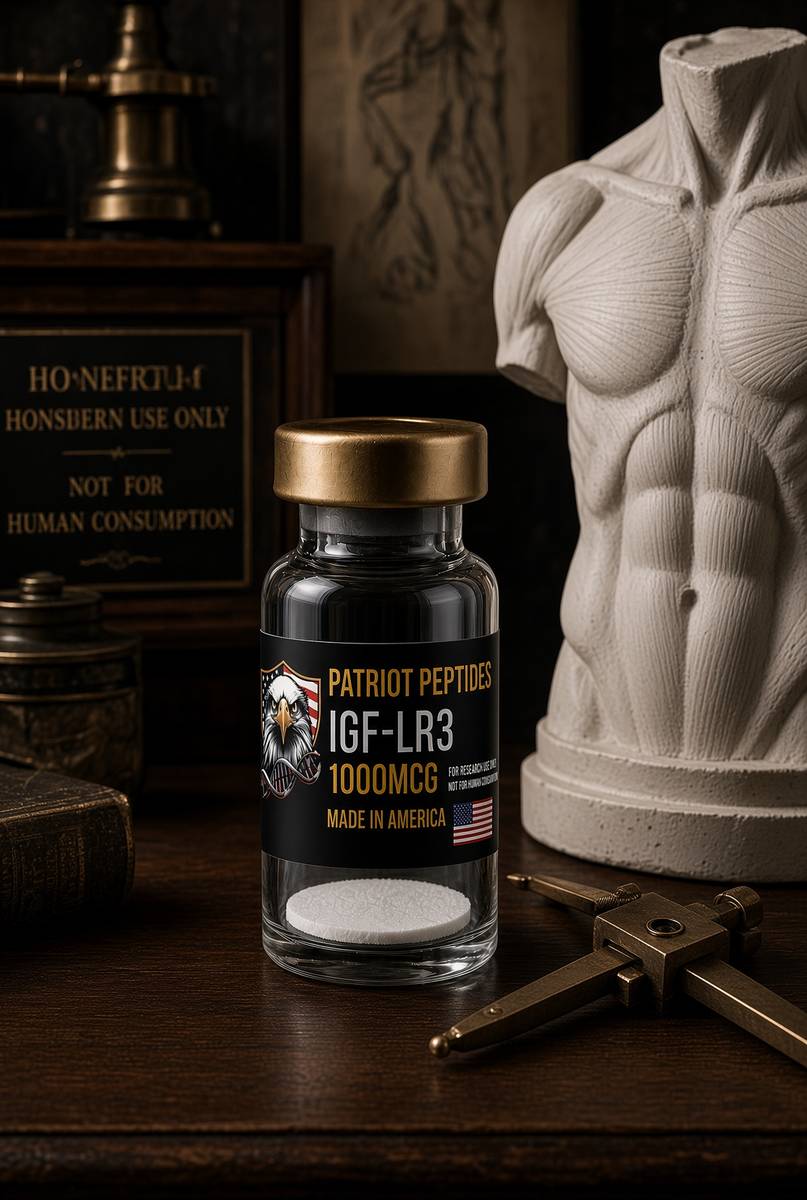
IGF-1 LR3
1000mcg
Mix with 1 ml bacteriostatic water → 1,000 mcg/ml
- Hypothetical aliquot
- 20–50 mcg
- 0.02–0.05 ml · 2–5 units on a U-100 syringe
- How often
- Once daily
- 4–6 weeks, then a pause
Bench steps
- Let the vial sit until it is no longer cold to the touch.
- Wipe the stopper with 70% isopropyl alcohol. Let it dry.
- Draw 1 ml bacteriostatic water (0.9% benzyl alcohol).
- Run the water slowly down the inside glass — do not blast the cake.
- Roll between finger and thumb until the cake is gone. Do not shake.
- Label the date. Store the solution at 2–8 °C. Do not freeze. Use within 30 days unless the note below says otherwise.
A thousand micrograms, not milligrams. 50 mcg is 5 units. Over-mixing the cake with a large water volume makes the marks unreadable — 1 ml is the point.
CJC-1295 (no DAC)
10mg
Mix with 2 ml bacteriostatic water → 5 mg/ml · 5,000 mcg/ml
- Hypothetical aliquot
- 100–300 mcg
- 0.02–0.06 ml · 2–6 units on a U-100 syringe
- How often
- Once daily, often with ipamorelin in the same window
- 8–12 weeks
Bench steps
- Let the vial sit until it is no longer cold to the touch.
- Wipe the stopper with 70% isopropyl alcohol. Let it dry.
- Draw 2 ml bacteriostatic water (0.9% benzyl alcohol).
- Run the water slowly down the inside glass — do not blast the cake.
- Roll between finger and thumb until the cake is gone. Do not shake.
- Label the date. Store the solution at 2–8 °C. Do not freeze. Use within 30 days unless the note below says otherwise.
No DAC — the pulse, not the drip. This is not CJC with DAC. Fridge. Often paired with the ipamorelin listing or the 10/10 blend.
Ipamorelin
10mg
Mix with 2 ml bacteriostatic water → 5 mg/ml · 5,000 mcg/ml
- Hypothetical aliquot
- 200–300 mcg
- 0.04–0.06 ml · 4–6 units on a U-100 syringe
- How often
- Once or twice daily (morning and/or evening)
- 8–12 weeks
Bench steps
- Let the vial sit until it is no longer cold to the touch.
- Wipe the stopper with 70% isopropyl alcohol. Let it dry.
- Draw 2 ml bacteriostatic water (0.9% benzyl alcohol).
- Run the water slowly down the inside glass — do not blast the cake.
- Roll between finger and thumb until the cake is gone. Do not shake.
- Label the date. Store the solution at 2–8 °C. Do not freeze. Use within 30 days unless the note below says otherwise.
GHS-R1a hexapeptide. The 200 mcg mark is the usual starting aliquot. Stacks with CJC-1295 no DAC in the papers that run both.
Bacteriostatic water and sterile syringes ship with peptide orders over £75. Kit details · 10 ml bacteriostatic water
The vials this essay sits on
Named sequences the essay maps — IGF-1 LR3, CJC without DAC, Ipamorelin. Hypothetical research neighbourhood, not a protocol, not a medicine. One press puts every in-stock vial in the bag.
 Research only
 Research only
Growth axis
CJC without DAC
10 mg CJC without DAC — a GHRH pulse, not a weekly drip.
4.6(620)
53 browsing this now · 4 purchased in the last 24 hours
10mg · In stock
£30.00
 Research only
Growth axis
Ipamorelin
10 mg ipamorelin. The clean ghrelin-receptor pentapeptide.
4.7(457)
33 browsing this now · 4 purchased in the last 24 hours
10mg · In stock
£30.00
Research use only. Not a combined-use instruction.
Read next

47 min · long read · Metabolism
Mitochondria, VO2 and why training still wins
Endurance work builds the engines. Heavy work builds the chassis. The molecular story is AMPK, PGC-1α, calcium and mTOR — not a shopping list.
51 min · long read · Metabolism
Human metabolism, without the slogan
Calories are bookkeeping. The actual system is a set of hormonally gated fluxes through glycogen, fat and amino acids — with the liver as air-traffic control.
45 min · long read · Metabolism
How diets actually work
Calories are conservation of energy. Hormones are the routing table. Palatability is why the routing table keeps getting overwritten. Every named diet is a way of leaning on one of those three.
More in this desk
51 min · long read · Metabolism
Reversing type 2 diabetes is a published result, not a slogan
The DiRECT trial put type 2 diabetes into remission by emptying the liver and pancreas of surplus fat. Very-low-calorie and very-low-carbohydrate programmes can both get you there. The mechanism isn't mystical.

50 min · long read · Metabolism
Fasting, autophagy and the mTOR switch
Eat, and mTOR builds. Fast, and AMPK and ULK1 start recycling the cell. The molecular story is a switch, not a personality.
49 min · long read · Metabolism
Liver fat is the variable type 2 diabetes actually cares about
Ectopic fat in the liver overproduces glucose and VLDL. Empty it — by energy deficit, by carbohydrate restriction, or by both — and first-phase insulin can return. That is the twin-cycle in working clothes.
49 min · long read · Metabolism
Regulating blood sugar: the control system
Glucose is a tightly bound variable. Here is the hardware — pancreas, liver, muscle, incretins — and the places it fails.
Essays describe published research. They are not medical advice and they do not authorise human use of any catalogue item.