

Bodybuilding · 9 min · 1,960 words
Food and training: how to spend the fibre you have
The practical half of the muscle series. Recruit the fast fibres, feed them, sleep, and stop asking a drug to do a week's work.
What this essay actually tells you
- Schoenfeld’s volume work puts a useful floor near ten hard sets per muscle per week for people who already lift. Rest two to three minutes on the big lifts so the next set is still force, not just lactate.
- Protein 1.6–2.2 g/kg/day, a surplus on the order of 200–400 kcal to grow, carbohydrate around the sessions that spend glycogen, creatine 3–5 g/day for phosphocreatine. Morton’s breakpoint sat near 1.62 g/kg. Harris saturated the store.
- Sleep is when a large share of growth-hormone pulses fire. A drug cannot recruit a motor unit you never loaded, and it cannot put leucine in the cytosol. Steroids, insulin-as-a-shortcut and beta-agonists are not this plan.
What this actually means
Lift three times a week hard enough to use the fast fibres, with enough rest between sets. Eat 1.6 to 2.2 grams of protein per kilogram, more carbohydrate on hard days, and a small calorie surplus if you want to grow. Take 3–5 grams of creatine. Sleep. That week beats any drug sitting on top of a chaotic one.
You can ignore every drug in the previous essays and still add muscle. Most people who look as if they train have done exactly that. The week that does it is dull on purpose. You recruit the fast fibres often enough that they grow. You eat enough protein that the ribosome can finish myosin. You eat enough energy that the body is not dismantling last month's fibres to get through Thursday. You sleep. You repeat it longer than a burst of motivation. The hormones you already make — a pulse of growth hormone in deep sleep, insulin after the meal, testosterone at whatever your axis currently writes — sit on top of that week. They are not a substitute for it.
In short. Muscle grows from hard lifting, enough protein, enough food, and sleep, repeated for months. Your own hormones help. They do not replace the week.
Start with the fibre you mean to keep. If you want a larger, stronger muscle, the sets have to reach type II. That means a load you cannot move forever: heavy work in the five-to-ten-rep neighbourhood, or lighter work taken to the last honest reps before the set falls apart. Henneman still sorts the motor units. Leave three reps in reserve on most sets if you are going to be able to come back tomorrow; take some sets closer when the joint is happy. Rest two to three minutes on squats, hinges and presses so the next set is still a force set and not a panting contest. About ten hard sets per muscle per week is the region Schoenfeld's meta-analyses keep finding as a floor for trained people, with more available until sleep and tendons say no. Write that down as a landmark. Then adjust it because you are a person, not a forest plot.
In short. Lift hard enough to wake the fast fibres, rest long enough to do it again, and accumulate roughly ten serious sets a week per muscle. That is a research landmark, not a personality.
Progress is a heavier bar, or one more rep at the same bar, or the same work with a joint that is quieter than last month. It is not a new exercise every Monday. The set essay is the evidence behind the numbers: how close to failure, how many sets, how long a rest, why the stretched part of the rep keeps winning trials. This paragraph is the week those numbers have to survive inside. Type II fibres answer tension they have seen before, repeated, a little harder. Change the movement when it hurts or when it stalls for a fortnight, not because you were bored. Easy cardio stays in the week for the heart and the type I fibres — two or three sessions you can talk through — parked away from the heavy work so you are not glycogen-empty when you need a squat. The mitochondria essay is that half. This one is the myofibril.
In short. Add a little weight or a rep over time. Keep some easy cardio for the heart, but do not do it in a way that wrecks the heavy session.
Protein is already a whole essay, so I will not pretend to rewrite sestrin2. The working range for someone who lifts is still about 1.6 to 2.2 grams per kilogram of body weight a day, in three to five meals that each clear a leucine threshold — roughly a palm-and-a-half of meat, fish, eggs, dairy or a carefully built plant plate. After the session that recruited the fast fibres, one of those meals should land within a couple of hours. The muscle-full effect means a second identical shake an hour later is mostly urea. Collagen does not count as that meal. Neither does wine. Older lifters need the per-meal dose a little higher, because the switch is duller.
In short. Eat about 1.6 to 2.2 grams of protein per kilogram a day, split into real meals, with one of them after you lift. A collagen bar is not that meal.
Energy, carbohydrate, creatine, sleep
A surplus is how new tissue gets paid for. Something like 200 to 400 kilocalories above what holds your weight is the band most hypertrophy studies wander around: enough to build, not so much that the gain is mostly fat. Weigh yourself a few mornings a week and look at the trend, not the Tuesday. If the trend is flat for a fortnight and the lifts are flat, eat a little more. If the waist is racing ahead of the bar, eat a little less. In a deficit — when you want fat gone and muscle kept — protein stays at the top of that range, lifting stays heavy so the type II fibres still hear their name, and the scale is allowed to drop slowly. A crash diet plus cardio and no bar is how you keep type I endurance and lose the muscle you meant to show off. Androgens defend lean mass in that deficit better than training alone, in the trial literature, and they still do not belong in this paragraph as a plan.
In short. To grow, eat a little more than you burn — a few hundred calories, not a dirty bulk. To lose fat, keep lifting heavy and keep protein high, and drop weight slowly.
Carbohydrate is the fast fibre's fuel, not a moral category. A hard lower-body day can spend a serious fraction of vastus glycogen. Put starch or fruit around that session — before, after, or both — so the next day's sets still recruit the fibres you think you are training. On easy days you need less. A low-carbohydrate pattern can work for people whose training is easy and aerobic, and it punishes people whose training is heavy. Type IIx does not become a fat-burning specialist because you skipped rice. It becomes a fibre that drops out of the set. Fat in the diet is for hormones and for calories. It is not the glycogen.
In short. Eat carbohydrate around hard sessions so the fast fibres have fuel. You need less on easy days. Skipping it does not turn strength work into fat-burning work.
Creatine monohydrate is the one supplement I will talk about without flinching, because the mechanism is small and the trials are boring in the best way. Three to five grams a day saturates phosphocreatine in muscle over a few weeks. Type II fibres use that store for the first seconds of a heavy rep. You get a little more force and a little more cell water. You do not get a new receptor. Load with twenty grams a day for a week if you are impatient; the daily dose gets you to the same place. Drink water. If your kidneys are unhealthy, ask a doctor before you add it. Everyone else has a cheap molecule with a job.
In short. Three to five grams of creatine a day helps the fast fibres repeat hard efforts. It is not a hormone. It is a fuel store you can fill from a jar.
Sleep is when a large share of the growth-hormone pulses actually happen, and when the nervous system lets you recruit those motor units again tomorrow. Five hours and a pre-workout stimulant is a smaller hormone pulse and a worse squat. You do not need a perfect score. You need most nights to be long enough that you are stronger on Friday than you were on Monday. Alcohol after the session blunts synthesis — the tracer papers are unkind — so a heavy day and a heavy night out are a cancelled pair.
In short. Sleep is part of the training, because growth hormone and recovery live there. Short nights and a lot of alcohol give back the session you just did.
What to stop expecting a drug to do
A drug cannot recruit a motor unit you never asked for. It cannot put leucine in the cytosol. It cannot put glycogen in a IIx fibre that trained fasted and carbohydrate-free. It can raise the gain on a week that already contains tension, protein and energy, which is the honest reading of Bhasin, and it can paper over a week that is missing those, for a while, with a bill attached. If you are not adding reps or load across a month, fix the sets, the food and the sleep before you fix the receptor. The fibre is a patient accountant. It keeps what you repeated.
In short. If the lifts are not moving, change the training and the food first. A drug amplifies a week that already works. It does not invent the week.
Here is the week in one sitting, so you can actually use it. Three days of lifting that cover squats or a hinge, a press, a pull, and some single-leg or arm work, taken hard, rested properly. Two easy conditioning sessions on other days. Protein at 1.6 to 2.2 grams per kilogram, one meal after lifting. Carbohydrate piled next to the hard days. Creatine daily. Bed before you are useless. A modest surplus if the mirror and the bar both say you are stuck too small; a slow deficit if you are carrying fat you would rather not keep, with the lifting left in. Deload every month or two, or when a tendon starts muttering. That is the whole practical section. It is not a twelve-week PDF. It is the physiology, scheduled.
In short. Lift three days, walk or cycle easily twice, eat protein every day, eat more carbohydrate when you lift hard, take creatine, sleep, and eat a little extra if you want to grow. Repeat for months.
None of that is medical advice. Chest pain, a joint that swells, a period that has stopped, a mood that has turned, or blood pressure you have never measured are reasons to see a clinician, not reasons to add a compound. Anabolic steroids, insulin as a muscle drug, and beta-agonists are outside this shop and outside this plan. The peptides in the catalogue remain research reagents for named receptors. In-vitro. Not a cycle sitting at the bottom of a diet article.
In short. This is a way to eat and train, not a prescription. Steroids and insulin-as-a-shortcut are not part of it. The peptides for sale are for the bench, not for this week.
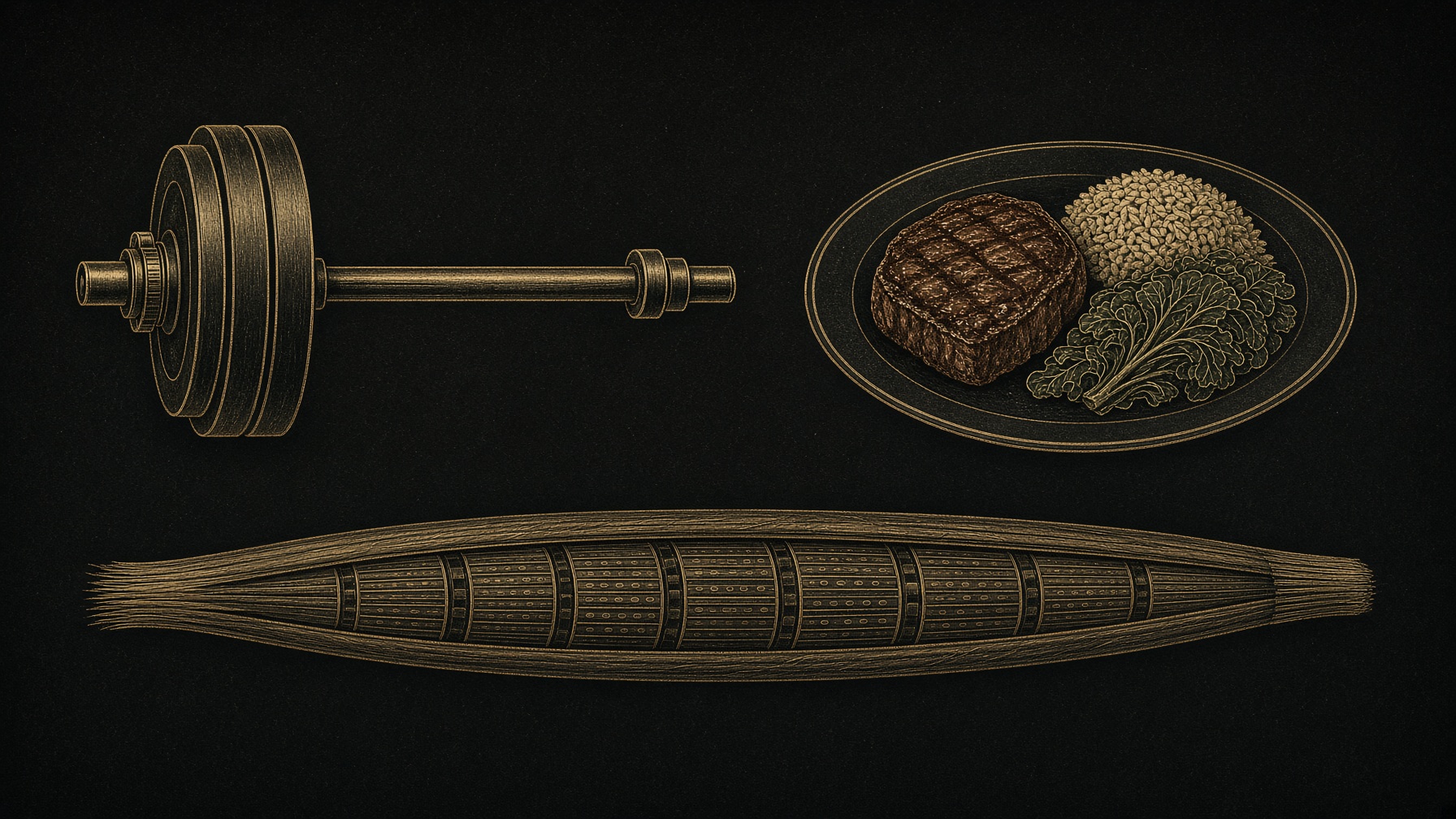
- Tension
- type II recruited
- Amino acids
- 1.6–2.2 g/kg
- Energy
- a small surplus to grow
- Fuel
- carbohydrate on hard days
Hard sets, enough rest, about ten per muscle each week as a floor.
Spread through the day. One meal after the session that mattered.
A slow deficit to lose fat, with the heavy sets kept.
Creatine 3–5 g daily for the phosphocreatine store.
Questions the essay actually answers
- How do I actually build muscle without drugs?
- Lift hard enough to recruit fast fibres, about ten sets a week per muscle as a starting region, eat 1.6–2.2 g protein per kg, keep a small calorie surplus, sleep, and add weight or reps over months.
- How many calories above maintenance should I eat?
- A band around 200–400 kcal above the intake that holds your weight is enough for most people to grow without gaining mostly fat. Watch the weekly trend, not one morning.
- Should I still lift if I am trying to lose fat?
- Yes. Keep the heavy work so type II fibres stay recruited, keep protein high, and lose weight slowly. Crash dieting plus cardio and no bar is how muscle disappears.
- When should I eat carbohydrate?
- Around the hard sessions, because fast fibres spend glycogen. Easy days need less. Fat does not replace that fuel.
- Is creatine a PED?
- It is a legal dietary supplement that fills the phosphocreatine store, which fast fibres use for short hard efforts. Three to five grams a day. It is not testosterone and not a hormone.
- Is this medical advice?
- No. It is training and nutrition physiology in plain clothes. Illness, pain, and any thought of using steroids or insulin for muscle belong with a doctor. Research peptides in the catalogue are not this plan.
Read next
10 min · Bodybuilding
Type I and type II: the two fibres a muscle actually is
Slow fibres last. Fast fibres throw the force. Diet, drugs and workouts all land on that split — so the muscle series starts with the myosin, not the vial.

8 min · Bodybuilding
How a fibre grows: tension, time, and the protein ledger
Synthesis minus breakdown, for weeks. Why soreness is the wrong score, why the pump is water, and why long ranges of motion keep showing up in the trials.
9 min · Bodybuilding
What the set is doing: failure, volume, rest, range
Why the last reps matter more than the first, why ten hard sets is a floor and not a personality, and why a short rest quietly deletes the tension you came for.
8 min · Bodybuilding
Androgens: the hormone that talks to the muscle nucleus
Testosterone binds a receptor in the myonucleus, adds nuclei, and asks for food. It is not growth hormone, not a cycle written as an essay, and not a fibre you can buy.

10 min · Bodybuilding
Steroid families: four chemistries, one receptor
Testosterone, the 19-nors, the DHT-derived, and the orals that rent the liver. Wet and dry are oestrogen and water, not two kinds of muscle.
8 min · Bodybuilding
Androgens, peptides, and the meal
The nucleus, the growth-hormone receptor, and leucine do not share a lock. Here is what each one asks of a fibre, and what food still has to supply.
8 min · Bodybuilding
Growth hormone, insulin, myostatin: the other levers on a fibre
After testosterone, the rest of the muscle-drug list is different receptors: a liver hormone, a storage hormone, and a brake. Food decides which of those signals becomes tissue.

49 min · long read · Metabolism
Protein, training and muscle protein synthesis
Muscle isn't a mood. It is mechanical tension plus a leucine-gated translational programme. Here is the dose, the threshold, and why the gym still has to happen.

47 min · long read · Metabolism
Mitochondria, VO2 and why training still wins
Endurance work builds the engines. Heavy work builds the chassis. The molecular story is AMPK, PGC-1α, calcium and mTOR — not a shopping list.
More in this desk
14 min · Bodybuilding
Actin and myosin: the motor inside the fibre
The sarcomere, the thin rope, the thick motor, the eight-nanometre stroke, and the calcium switch that lets a nerve turn all of it on. One ATP per pull.

9 min · Bodybuilding
The bill outside the fibre: axis, blood, liver, heart
The androgen receptor is in more places than the biceps. Fertility, HDL, haematocrit, the left ventricle, the voice, the tendon. A map of the tissues. Not a course.
Essays describe published research. They are not medical advice and they do not authorise human use of any catalogue item.