

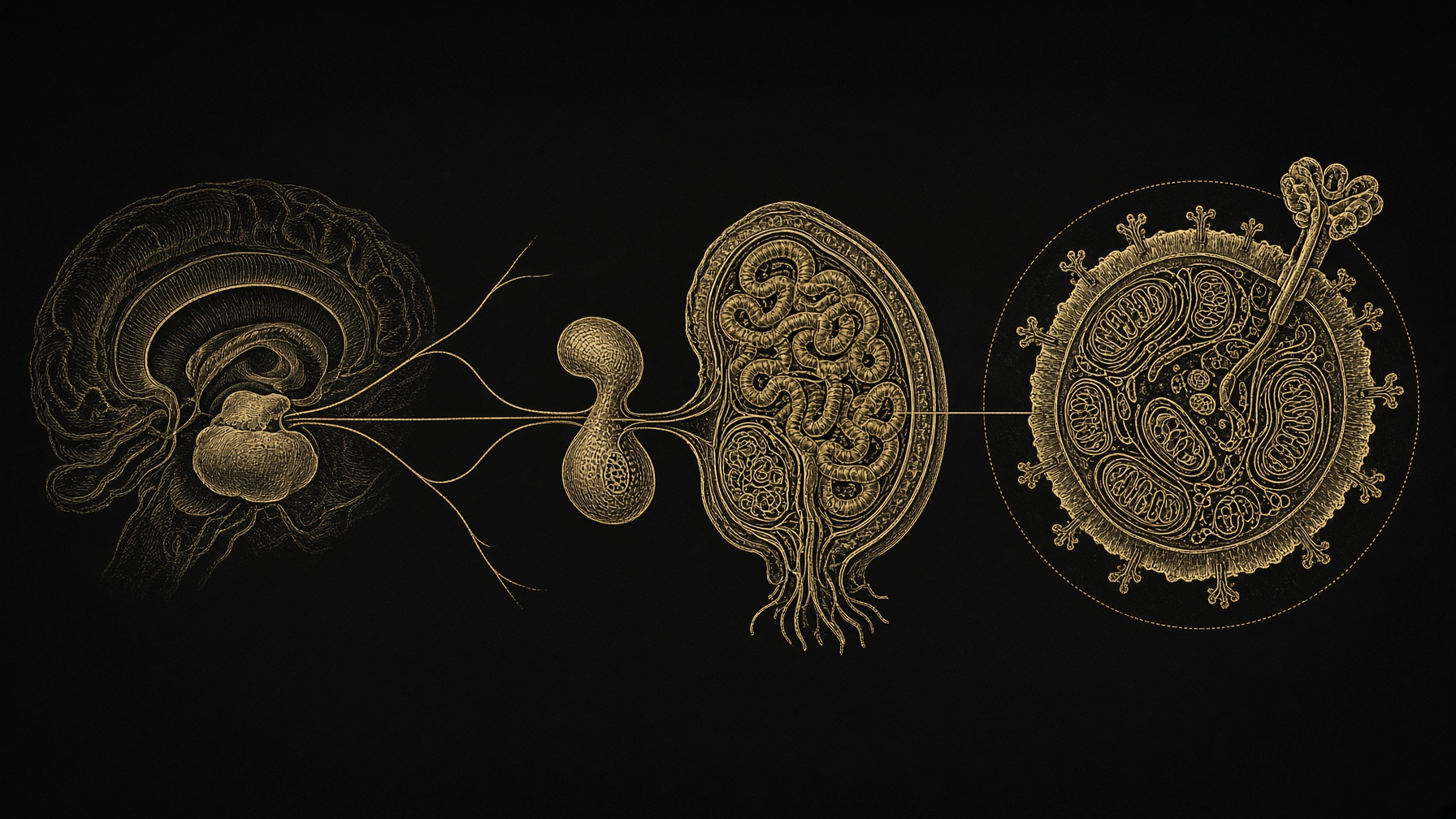
Bodybuilding · 10 min · 2,256 words
Coming off: SERMs, hCG, and what a supplement cannot do
How a SERM restarts GnRH, how each hCG and FSH option talks to the testis or the ovary, and how zinc, ashwagandha and CoQ10 turn that signal back into testosterone and sperm.
What this essay actually tells you
- Exogenous androgen suppresses GnRH, LH and FSH. SERMs occupy hypothalamic oestrogen receptors so GnRH can rise. Clomiphene is enclomiphene plus long-lived zuclomiphene. Aromatase inhibitors lower oestradiol and are not that restart.
- hCG, urinary or recombinant, agonises LHCGR for longer than LH because of the beta carboxy-terminal peptide. FSH products (hMG, urofollitropin, follitropin) are a separate Sertoli-cell signal. Kisspeptin stimulates GnRH neurons. A sustained GnRH agonist desensitises the pituitary after a flare.
- Zinc, vitamin D, CoQ10, NAC and ashwagandha do not bind LHCGR, FSHR or the oestrogen receptor. They are not a PCT. No dose and no calendar is given.
What this actually means
After anabolic steroids, the brain stops asking the testes to work. Enclomiphene blocks oestrogen feedback so GnRH, LH and FSH rise and testosterone production starts again. hCG mimics LH at the Leydig cell and restores the high testosterone inside the testis that sperm need. FSH drugs finish spermatogenesis. Alongside that, zinc and vitamin D let the cell make the hormone, ashwagandha lowers the cortisol still suppressing GnRH, and CoQ10, carnitine and antioxidants decide whether the sperm that appear seventy days later can swim.
When an exogenous androgen has been in the system, the hypothalamus reads it as job done. Gonadotrophin-releasing hormone falls. Luteinising hormone and follicle-stimulating hormone fall. The Leydig cells stop making testosterone, the testis shrinks, and sperm production stalls, because Sertoli cells need FSH and a very high local testosterone. Take the androgen away and there is a gap of weeks to months while that signal returns. PCT is the attempt to close the gap on purpose. A SERM restarts the conversation in the brain. hCG talks to the Leydig cell directly. FSH looks after the sperm. Zinc, vitamin D, ashwagandha, CoQ10 and the fertility antioxidants are what those recovering cells spend once the signal is back. Each one has a step. This is that sequence.
In short. The signal goes quiet on an androgen. A SERM and hCG bring it back. Zinc, vitamin D and the sperm nutrients are what the recovering cells use to make testosterone and rebuild sperm.
The oestrogen receptor in the hypothalamus
Negative feedback is not the androgen receptor alone. A share of the 'you have enough testosterone' message is oestradiol, made locally, sitting on oestrogen receptors in the hypothalamus. Block those receptors and the brain can read a normal or high oestradiol as if it were low, and GnRH can rise. That is what a selective oestrogen receptor modulator is doing when it is used to raise luteinising hormone. Clomiphene is two isomers in one tablet. Enclomiphene, the trans isomer, is the antagonist people actually want at that hypothalamic receptor. Zuclomiphene, the cis isomer, hangs around much longer and behaves more like an oestrogen. Over weeks the zuclomiphene accumulates. That is why clomiphene and enclomiphene are not the same molecule wearing different brands, and why some men feel peculiar on clomiphene in a way that is not 'more LH'. Enclomiphene has been developed on its own for secondary hypogonadism, which is this situation exactly: a brain that has stopped asking, and a testis that can still answer.
In short. Clomiphene blocks the oestrogen signal in the brain, luteinising hormone rises, and the testis starts making testosterone again. Enclomiphene is the isomer that does the blocking. Zuclomiphene lingers and behaves more like oestrogen.
Tamoxifen is a SERM with a different tissue map. In breast it antagonises the oestrogen receptor, which is why it is used against gynaecomastia and against breast cancer. In the hypothalamus it can also lift gonadotrophins. In uterus and bone its behaviour is not identical to clomiphene's. Raloxifene is the one built to be an antagonist in breast and an agonist in bone. Toremifene is a cousin. Swapping the names as if they were one liquid is how the tissue you did not mean to touch gets a ligand. None of them lowers the oestradiol number in the blood. They occupy the receptor. An aromatase inhibitor is the drug that lowers the number, by occupying CYP19. Anastrozole and letrozole are non-steroidal and reversible. Exemestane is a steroid-shaped inhibitor that inactivates the enzyme. An aromatase inhibitor lowers oestradiol by occupying CYP19. If feedback was the only thing holding LH down, LH rises. If oestradiol is driven too low, joints, mood and libido go with it while testosterone is still trying to return. A SERM asks the pituitary to speak. An aromatase inhibitor changes how much oestrogen that returning axis has to work with.
In short. Tamoxifen and raloxifene block oestrogen receptors in a tissue-specific way, and gonadotrophins rise. Aromatase inhibitors drop the oestrogen number itself. Used hard, they also strip the oestrogen that joints, bone and libido use while testosterone is trying to return.
hCG, and the drugs people lump in with it
Human chorionic gonadotropin is the pregnancy hormone. Its alpha subunit is the same family as luteinising hormone, FSH and TSH. The beta subunit is what makes the receptor choose it as an LH-like signal, and a long carboxy-terminal tail, heavily glycosylated, keeps it in the blood far longer than LH, which is supposed to be a pulse and gone. Urinary hCG is purified from the urine of pregnant women. Recombinant choriogonadotropin alfa is the same protein sequence from engineered cells, with a more predictable glycosylation. Both bind the LH/hCG receptor, LHCGR, a G-protein-coupled receptor on the Leydig cell. Cyclic AMP rises, StAR moves cholesterol into the mitochondrion, and testosterone is made even while the pituitary is still asleep. That intratesticular testosterone is the point. Blood testosterone can look fine on an injection of testosterone while the inside of the testis is poor, because the blood never had to come from the Leydig cell. Sperm production wants the local concentration. hCG is how a clinic talks to the Leydig cell without asking the pituitary.
In short. hCG mimics luteinising hormone for much longer than LH itself lasts. It tells the Leydig cell to make testosterone even when the pituitary is quiet. Urinary and recombinant versions hit the same receptor.
Long occupancy is also the catch. LH is brief on purpose. Park an LH-like hormone on LHCGR for days and the receptor can down-regulate, and the Leydig cell can become less interested. That is a mechanism, not a schedule, and it is why 'more hCG' is not a free variable. hCG does not replace FSH. Sertoli cells, which nurse developing sperm, listen to the FSH receptor. Follicle-stimulating hormone alone will not make a useful amount of testosterone. hCG alone will not run spermatogenesis properly if FSH is also absent. Menotropin, human menopausal gonadotropin, is the urinary mixture that brings FSH activity and LH activity together. Urofollitropin is urinary FSH largely stripped of LH. Recombinant follitropin alfa and follitropin beta are FSH only, made in cells. Lutropin alfa is recombinant LH, the short-lived native signal, which is why clinics do not treat it as a once-a-week hCG. Corifollitropin alfa is an FSH fused to a long tail so one injection covers a stretch of follicle stimulation. It is an IVF tool. It is not a men's restart poured into a different bottle.
In short. hCG, urinary or recombinant, binds the LH receptor and the Leydig cell makes testosterone again, including the high concentration inside the testis that sperm need. It lasts longer than natural LH. FSH is the second signal, the one the Sertoli cell needs to finish those sperm. The urinary mix, pure FSH, recombinant LH and long-acting FSH each cover a different piece of that pair.
In an ovary the same molecules wear different clothes. LHCGR on the follicle, hit by hCG, is the trigger that finishes oocyte maturation, the germinal vesicle breaking down, the egg ready to leave. That is why a recombinant hCG injection is the 'trigger shot'. Kisspeptin sits one floor up. It binds KISS1R on the GnRH neuron, GnRH is released, and the pituitary makes its own LH surge. Some IVF work uses kisspeptin as a trigger because the surge is shorter than hCG's long tail, and ovarian hyperstimulation likes hCG's tail less. Pulsatile GnRH itself, a pump that clicks a small release every hour or so, is a real treatment when the hypothalamus is the failed part and the pituitary still works. A GnRH agonist, the depot drugs used to switch a cycle off, does the opposite if you leave it there: a brief flare of LH, then the receptor desensitises and the axis goes quiet. A short exposure to a GnRH agonist produces that flare, a burst of LH. Continued exposure desensitises the receptor and the axis goes quiet, which is what the depot versions are built to do.
In short. In women, hCG is the long LH surge that matures an egg. Kisspeptin makes the pituitary release its own, shorter surge. A GnRH agonist flares, then, if you keep it there, switches the axis off.
How the supplements spend the signal
Once luteinising hormone or hCG is landing on the Leydig cell, the cell still has to spend cholesterol. StAR, CYP11A1 and the rest of steroidogenesis use zinc, and the androgen receptor that will hear the new testosterone uses zinc fingers. Vitamin D, through its receptor in the testis, supports the same enzymes. Selenium is for the sperm you rebuild over the next seventy days, as glutathione peroxidase. Ashwagandha lowers cortisol, and cortisol is one of the signals that keeps GnRH down, so the SERM is pushing a hypothalamus that is no longer also being sat on by the stress axis. That is how HIM REVIVE sits alongside a SERM or hCG: it does not start the signal, it is the cofactors and the quieter cortisol the signal needs if testosterone is going to be finished and felt. Fenugreek, boron and maca then act on free hormone, desire and blood flow once testosterone is actually being made again.
In short. Zinc and vitamin D let the Leydig cell turn the returning LH or hCG signal into testosterone. Ashwagandha takes cortisol off the hypothalamus so that signal is easier to raise. Fenugreek, boron and maca put the testosterone that comes back to work.
Sperm are the slow half, and they are where HIM FERTILITY works next to FSH and the high testosterone inside the testis. Even when blood testosterone looks better in a month, the cells in the ejaculate were started earlier. CoQ10 and acetyl-L-carnitine restore ATP in the midpiece so the new cohort can swim. Zinc, selenium, vitamin E and the carotenoids lower the oxidative nicks in that DNA. The seventy-four-day clock still has to run. The supplements do not skip it. They are why the sperm that come off the line at the end of it have motility and intact DNA, which is the fertility outcome of a restart done properly. HER FERTILITY's folate, choline, NAC and CoQ10 are her half of the same ninety days: neural tube, glutathione, egg mitochondria. NAC does not bind the FSH receptor. It raises the glutathione the Sertoli cell and the oocyte both spend while FSH and LH are doing their jobs.
In short. Blood testosterone can return in weeks. Sperm take about seventy days. CoQ10, carnitine, zinc and selenium are why that new cohort can swim and keep its DNA. Her folate, NAC and CoQ10 do the same job for the egg and the neural tube.
The sequence, written as outcomes. A SERM blocks hypothalamic oestrogen feedback, GnRH rises, LH and FSH rise. hCG, if the Leydig cell needs a direct LH-like signal, drives StAR and cholesterol into testosterone inside the testis, and FSH lets the Sertoli cell use that testosterone to finish sperm. An aromatase inhibitor lowers oestradiol by blocking CYP19. That can lift LH if the axis is only being held down by oestrogen, and it can also flatten oestradiol so far that joints, mood and libido go with it, which is the failure mode of using it as the main restart. Kisspeptin and pulsatile GnRH start the signal from above the pituitary. A GnRH agonist flares LH and then desensitises the receptor if exposure continues. Alongside all of that, zinc and vitamin D let steroidogenesis run, ashwagandha takes cortisol off GnRH, boron and fenugreek raise the free fraction and the sexual response once testosterone exists again, and CoQ10, carnitine and the antioxidants determine the quality of the sperm that appear at day seventy. That is the whole stack of mechanisms. The medicines open the axis. The supplements are how the axis, once open, makes a hormone and a gamete you can measure.
In short. SERMs and hCG reopen the signal. FSH finishes the sperm. Zinc, vitamin D, ashwagandha, CoQ10 and the antioxidants are what that signal is spent on, so testosterone returns and the new sperm can swim.
- SERM
- hypothalamic oestrogen receptor
- hCG
- Leydig LHCGR
- FSH
- Sertoli cell
- Tub
- cofactors only
Clomiphene, enclomiphene, tamoxifen, raloxifene. Asks the pituitary to speak. Does not lower the oestradiol number.
Urinary or recombinant. Long LH-like signal. Testosterone inside the testis. Not FSH. Not a peptide from this catalogue.
Urinary hMG, urofollitropin, recombinant follitropin. Sperm need this plus local testosterone. A different drug from hCG.
Zinc, vitamin D, CoQ10, folate, ashwagandha. They spend the signal the medicines restarted: testosterone made, sperm rebuilt, cortisol down.
Questions the essay actually answers
- Can HIM REVIVE be used as PCT?
- HIM REVIVE supplies the cofactors the Leydig cell uses once a SERM or hCG has turned the signal back on. Zinc and vitamin D let steroidogenesis finish testosterone. Ashwagandha lowers the cortisol still holding GnRH down. Fenugreek, boron and maca act on free hormone and desire after testosterone exists again. The restart signal itself is the SERM or the hCG.
- What is the difference between hCG and LH?
- They share a receptor on the Leydig cell. hCG stays in the blood much longer because of a glycosylated tail. LH is a short pulse. Urinary hCG and recombinant hCG hit the same receptor. Neither one replaces FSH.
- Are clomiphene and enclomiphene the same?
- No. Clomiphene is two isomers. Enclomiphene blocks the hypothalamic oestrogen receptor in the useful direction. Zuclomiphene lasts longer and behaves more like an oestrogen. This page does not dose either.
- Does an aromatase inhibitor restart testosterone?
- It lowers oestradiol by blocking the enzyme that makes it. That is not the same as a SERM asking the pituitary to release LH. Too much of it removes the oestrogen that bone, joints and mood use.
- How do the fertility supplements fit?
- After LH or hCG and FSH are back, sperm still take about seventy to ninety days. CoQ10 and carnitine restore midpiece ATP, so motility returns. Zinc, selenium and the antioxidants lower DNA fragmentation in that new cohort. That is the fertility half of a restart, running on the same clock as HIM FERTILITY.
The formulas in the essay
UK-made food supplements from Vitality Revival — sold here as a separate company’s formulas, not medicines.
 Food supplementSave £5.00
Vitality Revival
HIM FERTILITY
Male fertility support
4.6(606)
25 browsing this now · 3 purchased in the last 24 hours
120 capsules · 30 days
£49.99
£54.99
Read next
9 min · Bodybuilding
The bill outside the fibre: axis, blood, liver, heart
The androgen receptor is in more places than the biceps. Fertility, HDL, haematocrit, the left ventricle, the voice, the tendon. A map of the tissues. Not a course.
16 min · Bodybuilding
What each steroid does at the cell
Testosterone, nandrolone, trenbolone, boldenone, the DHT cousins, the orals. One receptor. Why two of them are not two muscles, what that asks of food, and what the side effects actually are.
9 min · Wellbeing
What is actually in HIM and HER REVIVE
Zinc, vitamin D, ashwagandha, saffron, iodine, and the botanicals. How each one lands in the Leydig cell, the ovary, the thyroid, or a serotonin synapse, and what that does to testosterone, cycle and mood.
7 min · Wellbeing
HIM and HER FERTILITY, at the cell
How CoQ10, carnitine, folate, NAC, zinc and selenium change a sperm's midpiece, its DNA, an egg's mitochondria, and the neural tube.
8 min · Bodybuilding
Androgens: the hormone that talks to the muscle nucleus
Testosterone binds a receptor in the myonucleus, adds nuclei, and asks for food. It is not growth hormone, not a cycle written as an essay, and not a fibre you can buy.
More in this desk
14 min · Bodybuilding
Actin and myosin: the motor inside the fibre
The sarcomere, the thin rope, the thick motor, the eight-nanometre stroke, and the calcium switch that lets a nerve turn all of it on. One ATP per pull.
10 min · Bodybuilding
Steroid families: four chemistries, one receptor
Testosterone, the 19-nors, the DHT-derived, and the orals that rent the liver. Wet and dry are oestrogen and water, not two kinds of muscle.
9 min · Bodybuilding
Type I and type II: the two fibres a muscle actually is
Slow fibres last. Fast fibres throw the force. Diet, drugs and workouts all land on that split — so the muscle series starts with the myosin, not the vial.
9 min · Bodybuilding
Food and training: how to spend the fibre you have
The practical half of the muscle series. Recruit the fast fibres, feed them, sleep, and stop asking a drug to do a week's work.
Essays describe published research. They are not medical advice and they do not authorise human use of any catalogue item.