

Wellbeing · 7 min · 1,537 words
HIM and HER FERTILITY, at the cell
How CoQ10, carnitine, folate, NAC, zinc and selenium change a sperm's midpiece, its DNA, an egg's mitochondria, and the neural tube.
What this essay actually tells you
- Sperm take about seventy-four days plus epididymal transit. CoQ10 and acetyl-L-carnitine feed the midpiece mitochondria. Antioxidants target oxidative DNA damage, and the Cochrane picture is uncertain. Zinc and selenium carry the authorised fertility lines.
- D-aspartic acid's early testosterone result did not hold up cleanly in later trials in trained men. HER FERTILITY uses 400 micrograms of 5-MTHF because the neural tube closes around day twenty-five, plus choline, NAC as a glutathione precursor, and CoQ10 for oocyte mitochondria.
- Neither tub induces ovulation or treats azoospermia, tubal disease, or a clinic protocol. Ninety days is the overlap of his clock and her preconception window.
What this actually means
HIM FERTILITY follows a sperm for the seventy to ninety days it takes to build. CoQ10 and carnitine restore ATP in the midpiece, so motility rises. Antioxidants lower DNA fragmentation. Zinc and selenium are parts of spermatogenesis itself. HER FERTILITY puts methylfolate in before conception so the neural tube can close, CoQ10 so the egg's mitochondria can finish maturation, and NAC so glutathione and ovulation recover. Ninety days is the window those outcomes need.
HIM FERTILITY is built on the seventy-to-ninety-day manufacture of a sperm. HER FERTILITY is built on the egg and on the neural tube that closes around day twenty-five, often before a pregnancy test exists. Zinc contributes to normal fertility and reproduction. Selenium contributes to normal spermatogenesis. Folate contributes to maternal tissue growth in pregnancy. Those sentences are the legal minimum. The cellular version is longer, and it is how count, motility, DNA integrity and egg quality actually move.
In short. His formula covers the three months it takes to build a sperm. Hers covers the egg and the week-four neural tube. The ingredients are how those cells get better at their jobs.
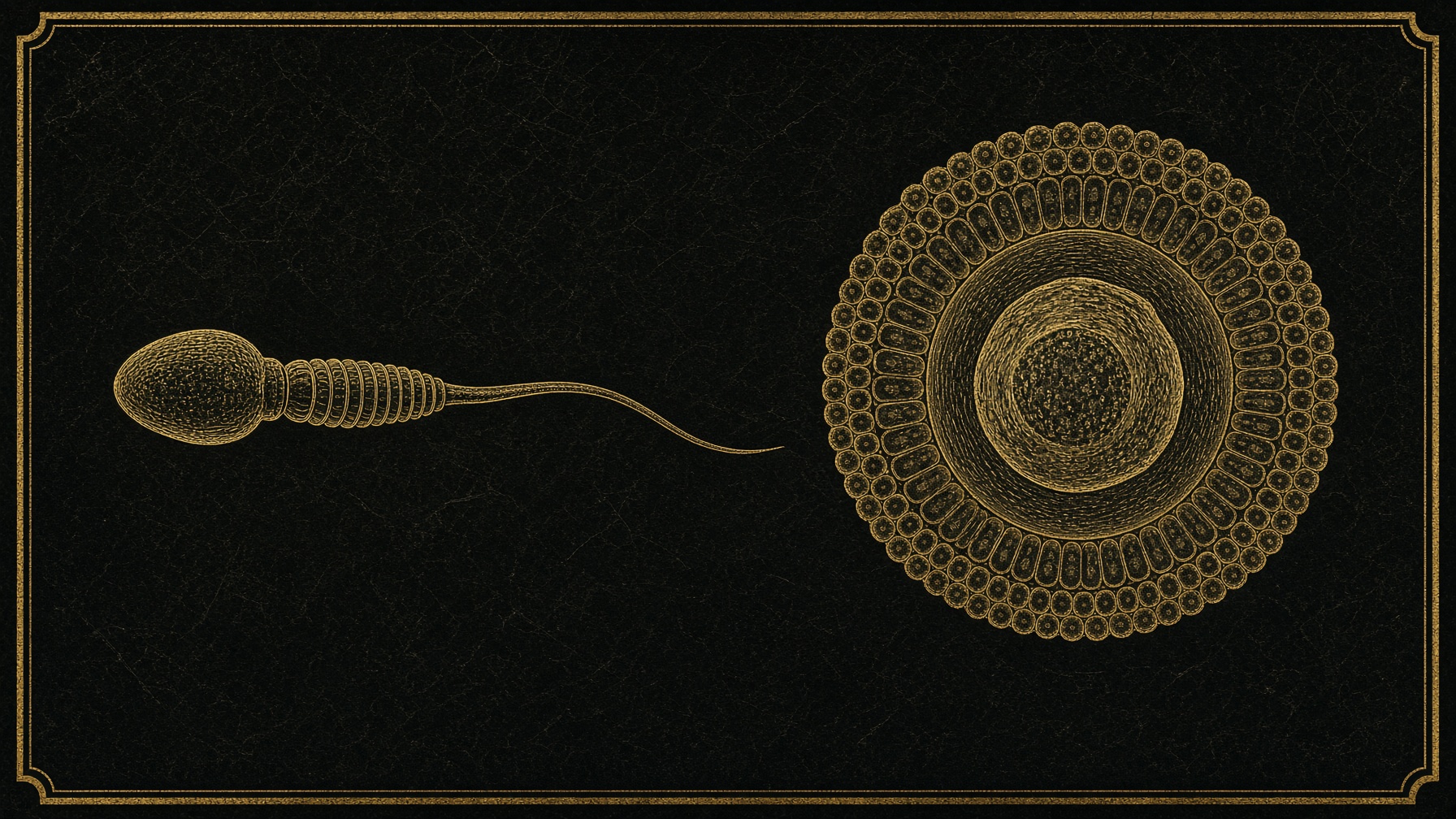
The sperm's engine
A sperm swims on a midpiece that is almost nothing but mitochondria wrapped around the axoneme. Coenzyme Q10 shuttles electrons from complex I and II toward complex III. Short of that shuttle, the tail has less ATP and motility is the first thing a lab sees fall. Balercia's trials in infertile men showed motility rising once CoQ10 was restored, because the midpiece could make ATP again. Acetyl-L-carnitine ferries fatty acids into those same mitochondria. The epididymis is already full of carnitine, which is why putting it back improves progressive motility in men whose problem was a weak tail rather than a missing vas.
In short. CoQ10 and acetyl-L-carnitine restore ATP in the sperm midpiece. Motility comes back because the tail has fuel.
The nucleus of a sperm is packed with protamines, and it is poor at repairing oxidative nicks. Reactive oxygen species also peroxidate the membrane, so you lose motility and you lose DNA integrity together. Selenium builds glutathione peroxidase. Vitamin E sits in the membrane. Vitamin C, lycopene, astaxanthin and trans-resveratrol clear the radicals that enzyme does not catch. The outcome of that stack, across the trials that found one, is a lower DNA-fragmentation index and a membrane that can still fuse with an egg. A little peroxide is a normal signal for capacitation. The point of the formula is to pull an excessive load back into that range, so the sperm that arrive are intact.
In short. Antioxidants cut the oxidative nicks in sperm DNA and stop the membrane going rancid. Fragmentation falls and the sperm stays able to fuse.
D-aspartic acid nudges NMDA receptors in the hypothalamus, and in animal work that raises luteinising hormone. Topo's 2009 study in men found testosterone rising with it. Later trials in younger men who already train hard mostly found the axis was not waiting for another shove, so the ingredient earns its place in men whose luteinising hormone has room to move, and it is quiet in men whose LH is already high. KSM-66 ashwagandha lowers the cortisol that suppresses GnRH, and semen parameters improve in the stressed-men trials for that reason. Red, black and yellow maca have a sperm literature: count and motility move, testosterone often does not, which means the action is in the tubule and the epididymis. Shilajit, saffron, boron, vitamin D and the B vitamins do the same jobs they do in the revive formula, now scored on a semen analysis. Zinc and selenium remain the pair the spermatogenic epithelium uses as metal cofactors. Piperine from black pepper increases the fraction of the rest that actually gets absorbed.
In short. D-aspartic acid can lift luteinising hormone when that signal is sluggish. Ashwagandha and maca improve semen by lowering stress and supporting the tubule. Zinc and selenium are structural parts of making a sperm.
The egg's mitochondria, and the week the tube closes
An oocyte sits in the ovary from fetal life, so its mitochondria have to power maturation, fertilisation, and the first days of an embryo that has not yet switched on its own genome. CoQ10, 300 milligrams in HER FERTILITY, is the electron shuttle in that battery. Bentov and Casper set out the reason older eggs respond to it: restore the shuttle and more oocytes complete maturation with their chromosomes intact. IVF units added it for that reason, and the outcome they are chasing is a higher share of eggs that fertilise and a higher share of embryos that keep going. N-acetylcysteine, 400 milligrams, is the precursor of glutathione. In the PCOS literature, restoring that thiol pool improves ovulation and insulin signalling at the ovary, because oxidative stress was part of what had stalled the follicle. The two together are mitochondrial ATP plus a redox buffer. That is egg quality, measured as maturation, fertilisation, and a follicle that actually ruptures.
In short. CoQ10 restores the egg's mitochondria, so more eggs mature with their chromosomes intact. NAC rebuilds glutathione, and ovulation improves where oxidative stress had stalled the follicle.
Folate is how the neural tube closes. 5-MTHF is the circulating form, 400 micrograms in her capsules, so the embryo does not have to wait for dihydrofolate reductase to activate a synthetic folic acid. Where MTHFR is sluggish, that shortcut is the whole point: methyl groups arrive ready-made. The Medical Research Council's 1991 trial and Czeizel's first-occurrence trial are why the number exists. Folate before conception is what drops neural-tube defects. The tube closes around day twenty-five, which is why the capsules start ahead of a positive test. Choline, 200 milligrams as bitartrate, is the second methyl donor and a structural piece of the developing brain's membranes. Folate shuts the tube. Choline builds the tissue inside it.
In short. Methylfolate, started before conception, is what closes the neural tube. Choline methylates alongside it and builds brain membrane.
Iron as bisglycinate is a chelate the gut tolerates, and iron deficiency stops ovulation as surely as it stops haemoglobin, because the ovary is an energy organ. B12 as methylcobalamin joins folate in the one-carbon cycle and is why tiredness lifts when the deficiency was B12. Iodine and selenium let the thyroid make T4 and convert it to T3. A thyroid in range is one of the conditions an egg needs in order to be recruited. Vitamin D at 2,500 IU acts at the vitamin D receptor in the ovary the same way it does in the testis. Royal jelly, standardised to 10-HDA, carries fatty acids that have been studied for follicle support. Green tea catechins add a further antioxidant in the follicle fluid. Together they are the metabolic ground an ovulating ovary stands on: oxygen delivery, thyroid hormone, vitamin D, and less oxidative noise around the egg.
In short. Iron, B12, iodine, selenium and vitamin D restore ovulation and egg metabolism when those were the missing parts. Royal jelly and green tea sit in the follicle as support and antioxidant.
KSM-66 at 600 milligrams is the ashwagandha dose used when cortisol falls and, in men, semen parameters rise. In her it takes the same pressure off GnRH, so the pulse that recruits a follicle is less likely to be flattened by stress. Resveratrol protects the oocyte spindle from oxidative damage. The three macas support the cycle rhythm the way they support spermatogenesis, at the tissue rather than by inventing a new gonadotrophin. Four capsules a day for ninety days covers one full wave of his sperm and her preconception window together. At the end of that window the measurable outcomes are a semen analysis with more progressive sperm and less fragmented DNA, and an ovary that has had methylfolate, CoQ10, glutathione and thyroid cofactors in place before the tube has to close.
In short. Ninety days is one sperm cycle and her preconception window together. Cortisol comes down, the midpiece has fuel, the egg has glutathione, and folate is already on board.
- His engine
- CoQ10, acetyl-L-carnitine
- His nucleus
- selenium, E, C, carotenoids
- Her deadline
- 5-MTHF 400 µg, choline
- Her battery
- CoQ10, NAC, iron
Mitochondria in the midpiece. ATP returns, and so does progressive motility.
Less DNA fragmentation, a membrane that can still fuse.
Neural tube closes in week four. Methylfolate is what shuts it.
Maturation, fertilisation, and a follicle that ovulates.
Questions the essay actually answers
- How long before a sperm supplement can show up on a test?
- About seventy to ninety days. That is how long it takes to build a sperm and move it through the epididymis. A test next week is last season.
- Does HER FERTILITY replace folic acid from the GP?
- It contains 400 micrograms of 5-MTHF, the circulating form, which is the usual preconception amount that closes the neural tube. A five-milligram folic acid course is a separate, higher-risk regimen. The tub is the 400-microgram methylated form, started before conception, with choline beside it.
- Will CoQ10 and NAC make someone pregnant?
- CoQ10 restores electron transport in the egg and in the sperm midpiece, so motility and maturation improve. NAC rebuilds glutathione, which is how ovulation and DNA integrity respond when oxidative stress was the drag. Folate is what closes the neural tube. Those are the outcomes the ingredients are in the formula to produce.
- Is D-aspartic acid a testosterone booster for fertility?
- It stimulates NMDA receptors in the hypothalamus and can raise luteinising hormone and testosterone, which is what Topo measured in 2009. In younger men who already train and whose LH is already busy, later trials often show less movement. It earns its place when that signal has room to rise.
The formulas in the essay
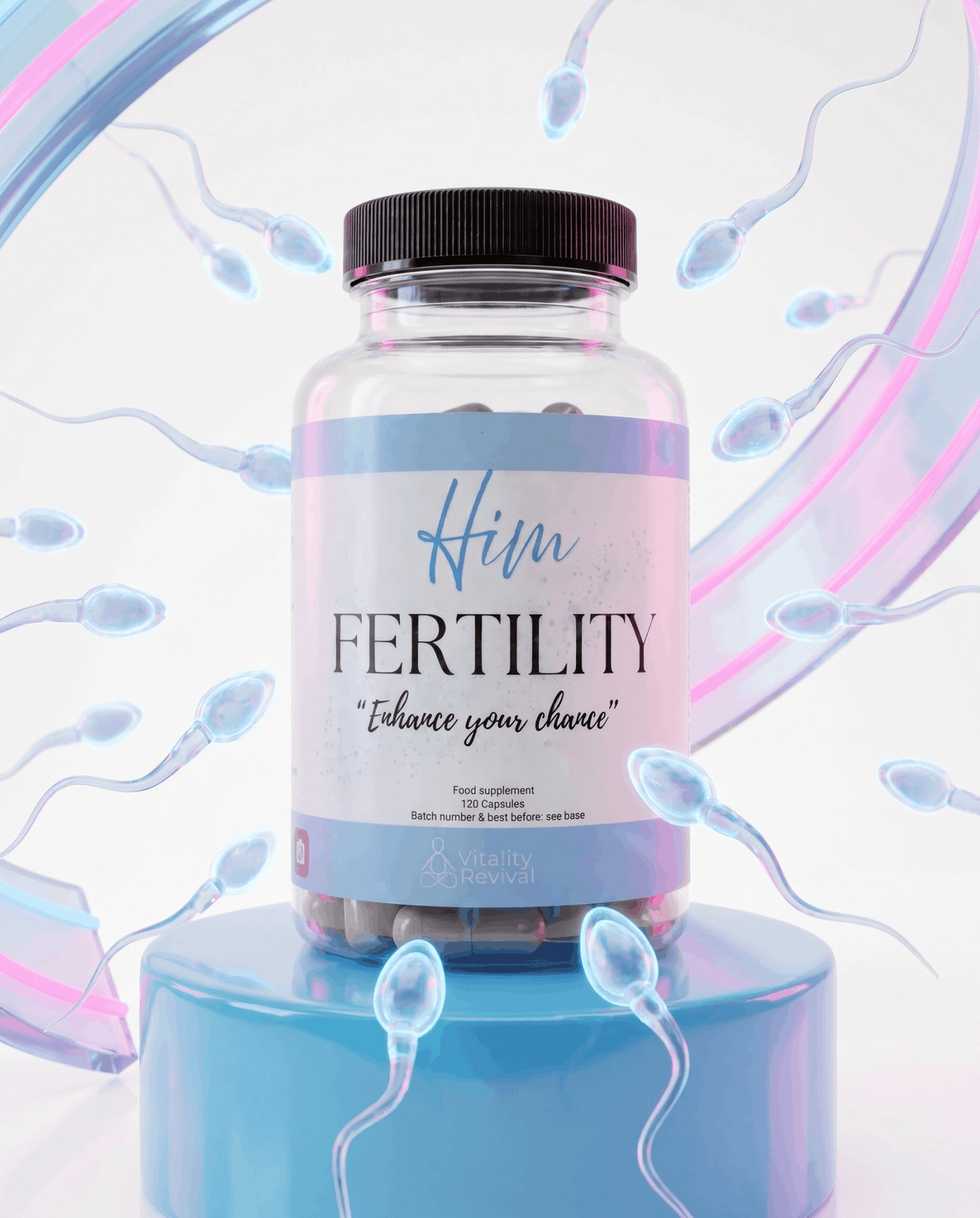
UK-made food supplements from Vitality Revival — sold here as a separate company’s formulas, not medicines.
 Food supplementSave £5.00
Vitality Revival
HIM FERTILITY
Male fertility support
4.6(606)
50 browsing this now · 3 purchased in the last 24 hours
120 capsules · 30 days
£49.99
£54.99
Read next
46 min · long read · Wellbeing
Ninety days: sperm, folate and what a preconception tub can actually do
A sperm cycle is 70–90 days. NHS folate advice is three months.
9 min · Wellbeing
What is actually in HIM and HER REVIVE
Zinc, vitamin D, ashwagandha, saffron, iodine, and the botanicals. How each one lands in the Leydig cell, the ovary, the thyroid, or a serotonin synapse, and what that does to testosterone, cycle and mood.
10 min · Bodybuilding
Coming off: SERMs, hCG, and what a supplement cannot do
How a SERM restarts GnRH, how each hCG and FSH option talks to the testis or the ovary, and how zinc, ashwagandha and CoQ10 turn that signal back into testosterone and sperm.
49 min · long read · Wellbeing
Food supplements and hormones: what the evidence actually supports
Ashwagandha, zinc, fenugreek and saffron have published, modest effects on hormones, stress and mood. HIM REVIVE and HER REVIVE are food supplements built around those ingredients — not TRT, not HRT.
Essays describe published research. They are not medical advice and they do not authorise human use of any catalogue item.