

Wellbeing · 50 min · 11,067 words
Food supplements and hormones: what the evidence actually supports
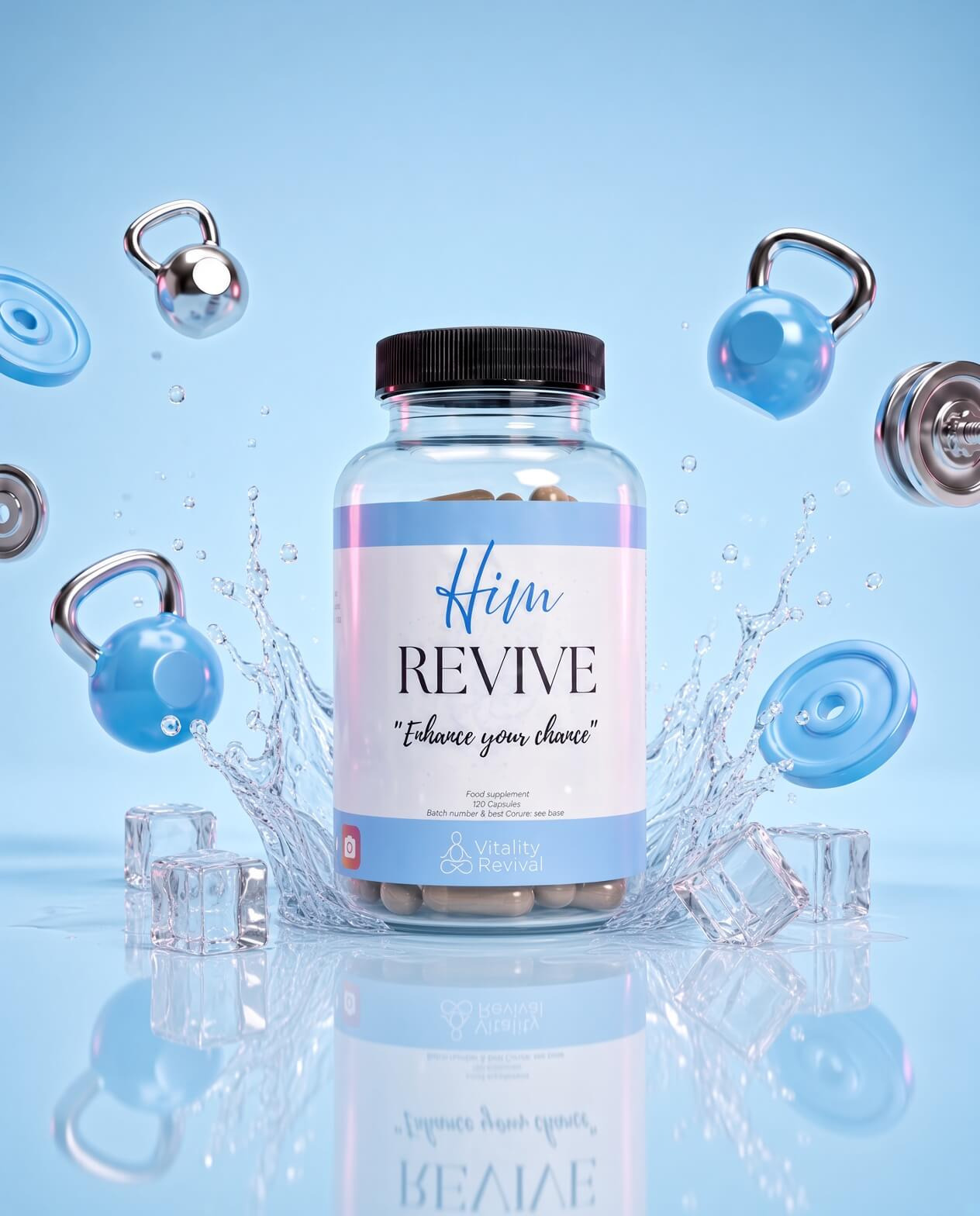
Ashwagandha, zinc, fenugreek and saffron have published, modest effects on hormones, stress and mood. HIM REVIVE and HER REVIVE are food supplements built around those ingredients — not TRT, not HRT.
What this essay actually tells you
- KSM-66 ashwagandha: randomised trials in stressed men where total testosterone and morning cortisol move a bit. Food-supplement signal. Nobody's confusing it with TRT except the people selling it as TRT.
- Zinc and vitamin D repletion move T when you're deficient. Extra zinc in a sufficient man does almost nothing, which is the sentence the mineral aisle keeps skipping.
- HIM REVIVE and HER REVIVE are UK-made food supplements in the catalogue. Testosterone replacement and HRT live in a clinic. These tubs don't.
What this actually means
From the late twenties, men's circulating testosterone declines on the order of 1–2% a year. That's epidemiology, and we've all seen the curve. The fatigue, the quieter libido, the slower gym recovery are often that slope plus sleep, adipose tissue and stress. Cortisol and SHBG do as much of the talking as LH, which is the sentence a lot of 'testosterone support' copy forgets to write. Women have a different clock: the luteal week, postpartum, then the perimenopause stretch where oestradiol and progesterone stop being a monthly metronome. Food supplements cannot replace a missing axis. What they can do, when the ingredients are actually dosed, is give the pathways raw materials and a quieter stress background. KSM-66 ashwagandha has randomised trials in which total testosterone and perceived stress move in stressed men. Zinc deficiency lowers testosterone; repletion brings it back into range, and it does not push a sufficient man into a super-physiological band. Saffron (affron / lepticroside-standardised extracts) has PMS and mood trials that are small and real. That's the stretch of evidence HIM REVIVE and HER REVIVE occupy. They're UK-made food supplements we sell in the catalogue. If someone is pitching either tub as TRT or HRT, they're mixing two different objects. We wrote the ingredients down so you can tell.
Testosterone is a C19 steroid, and it's worth seeing the molecule before the aisle. Four rings, a 17β-hydroxyl, a 3-ketone, molecular weight 288.4, the ligand the androgen receptor was cloned to bind. Leydig cells of the testicular interstitium write most of a man's circulating pool; the adrenal zona reticularis contributes a little androstenedione that peripheral 17β-hydroxysteroid dehydrogenase can finish. Women write a smaller circulating pool from ovary and adrenal, and they listen to it at the same receptor. The chemistry is older than the wellness aisle. Adolf Butenandt isolated the hormone from tens of thousands of litres of urine in the 1930s; Leopold Ruzicka synthesised it; both men shared the 1939 Nobel for that work. What a food-supplement label can honestly say about this molecule is a much smaller sentence than the isolation papers, and a much smaller sentence than a testosterone ester in a clinic fridge. The rest of this page is the axis, the enzymes, the binding protein, the receptor, and the randomised evidence a tub is allowed to sit next to without pretending to be the ester.
In short. Testosterone is a small steroid hormone made mainly in the testes. A food supplement isn't that molecule and it isn't a prescription version of it.
From the late twenties, men's circulating testosterone declines on the order of one to two percent a year — a slope, not a cliff. Harman and the Baltimore Longitudinal Study of Aging put that slope on paper; the Massachusetts Male Aging Study, Travison, Araujo and McKinlay, saw the same direction in a community cohort. Cross-sectional and longitudinal numbers disagree on the exact percent, which is a methods fact rather than a scandal: morning versus afternoon, total versus free, immunoassay versus mass spectrometry, and how much of the slope is age and how much is the adipose tissue, sleep debt and illness that travel with age. The fatigue, the quieter libido, the slower gym recovery are often that slope plus those companions. Cortisol and sex hormone-binding globulin do as much of the talking as luteinising hormone, which is the sentence a lot of 'testosterone support' copy forgets to write. A man whose total sits at 14 nmol/L and whose SHBG has climbed, or whose nights have collapsed, isn't the same experiment as a man whose total sits at 7 nmol/L with a high LH. The first man has a food-supplement-shaped conversation. The second man has a clinic.
In short. Men's testosterone falls slowly from the late twenties. Sleep, body fat and stress often explain as much of how that feels as the hormone number itself.
Women have a different clock, and it isn't a smaller version of the male one. The luteal week, postpartum, then the perimenopause stretch where oestradiol and progesterone stop being a monthly metronome: those are ovarian and hypothalamic events, not a smaller version of the male slope. PMS is a luteal-phase object with a serotonergic literature. Perimenopause is a decade of noisy oestradiol, not a single blood test. Food supplements can't replace a missing axis on either side of that bed. What they can do, when the ingredients are actually dosed, is give named pathways raw materials and a quieter stress background. KSM-66 ashwagandha has randomised trials in which total testosterone and perceived stress move in stressed men. Zinc deficiency lowers testosterone; repletion brings it back into range, and it doesn't push a sufficient man into a super-physiological band. Saffron extracts have PMS and mood trials that are small and real. That's the stretch of evidence the two tubs in this catalogue occupy. They're UK-made food supplements. If someone is pitching either as testosterone replacement or as hormone replacement therapy, they're mixing two different objects.
In short. Women's hormone timing is a monthly and then a midlife clock, not a slower copy of the male decline. Supplements can feed pathways. They can't replace an axis.
HIM REVIVE and HER REVIVE are the catalogue objects, and they aren't the axis. Vitality Revival is a separate company; Patriot Peptides sells the formulas as food supplements and doesn't represent them as medicines. HIM REVIVE is KSM-66 ashwagandha, fenugreek, tribulus, shilajit, zinc, boron, vitamin D3, K2, with rhodiola, Korean ginseng and a libido-adjacent botanical set, no caffeine. HER REVIVE is shatavari, saffron, rhodiola, pyridoxal-5-phosphate, methylfolate, D3 at 2,500 IU, selenium, iodine, zinc, and a multi-phase botanical set built for cycle, postpartum and perimenopause. Four capsules a day, two with breakfast and two with dinner, eight to twelve weeks, because steroidogenic and adaptogenic signals don't work on day four. GnRH, LH and FSH are peptide hormones of the same neighbourhood on a whiteboard. Lyophilised research peptides on the other shelf of this shop are a different legal class, and they will be named as such once at the close. The physiology in between doesn't depend on a checkout. It depends on Leydig cells, a G protein, a mitochondrial enzyme and a nuclear receptor.
In short. Two UK food-supplement formulas sit in this story, one for men and one for women. They're not medicines, and they aren't the hormones the glands actually release.
A 3 nmol/L move inside the reference range can be the difference between a man who feels like himself and a man who does not. Still a food-supplement result. Still not a testosterone ester.
The axis is hypothalamic, then pituitary, then Leydig
Gonadotropin-releasing hormone is a ten-residue hypothalamic peptide, which is a slightly outrageous fact the first time you meet it. Schally isolated it; the 1977 Nobel sat on that work and on the rest of the hypothalamic releasing factors. Kisspeptin neurons in the arcuate nucleus — the KNDy population, kisspeptin, neurokinin B, dynorphin — are the pulse generator in current maps, after de Roux and Seminara put KISS1R mutations on hypogonadotropic hypogonadism in 2003. Pulses into pituitary portal blood, every hour or so in a eugonadal man, occupy the gonadotroph's class-A GPCR. Luteinising hormone and follicle-stimulating hormone, two glycoprotein heterodimers sharing an alpha subunit with TSH and hCG, are the pituitary products. LH occupies LHCGR on the Leydig cell. FSH occupies FSHR on the Sertoli cell. Portal concentrations are high, pulsatile, and largely gone before a cubital vein; a peripheral GnRH measurement isn't a photograph of what the gonadotroph just heard. Continuous GnRH agonism, the prostate-cancer trick, down-regulates the receptor and shuts the axis. Pulsatility is the information. A food-supplement tub doesn't occupy this receptor. Ashwagandha isn't a GnRH analogue, and a ten-mer sitting on a G protein is a different object.
In short. A tiny brain peptide arrives in pulses. The pituitary then releases LH and FSH. Those two hormones are what the testes actually hear.
LHCGR is a class-A GPCR with a large leucine-rich ectodomain, the same structural neighbourhood as FSHR and TSHR. Occupancy by LH rearranges the helices. The intracellular face becomes a guanine-nucleotide exchange factor for Gs. GTP-bound Gαs occupies adenylyl cyclase. Cyclic AMP rises. Protein kinase A phosphorylates the steroidogenic acute regulatory protein, StAR, and a set of transcription factors including CREB. StAR is the kinetic bottleneck of acute steroidogenesis: cholesterol, stored as ester in lipid droplets, has to cross the outer mitochondrial membrane and then the aqueous intermembrane space to reach CYP11A1 on the inner membrane. Clark, Stocco, 1990s: without StAR, cholesterol doesn't arrive, and congenital lipoid adrenal hyperplasia is the human proof. Cyclic AMP is the second messenger. It's amplified. One occupied receptor, many cyclase turnovers, a rise in a millimolar nucleotide, a kinase, a phosphoprotein. That's the opposite of a cofactor spent one-for-one. The diagram that follows is that cloud, on purpose, because a Leydig cell is a textbook Gs–cAMP machine and a food-supplement page that won't name the machine has already left the biochemistry.
In short. LH docks on a Leydig cell and raises cyclic AMP. That signal moves cholesterol into mitochondria, first committed step of making testosterone.
FSH is the other gonadotrophin, and it isn't a testosterone hormone — that's a different floor of the same building. Sertoli cells occupy FSHR, another Gs-coupled glycoprotein receptor, and the products are inhibin B, androgen-binding protein, growth factors, and a nurse-cell architecture spermatogenesis can't do without. Inhibin B is the negative-feedback signal the pituitary actually reads for FSH; testosterone and oestradiol are the ones it reads for LH. A semen-analysis conversation lives on this floor more than on the Leydig floor, which is why the neighbouring preconception essay walks CoQ10 and a ninety-day clock rather than this page. LH and FSH share a pituitary and don't share a job. Secondary hypogonadism — low T, low or inappropriately normal LH — is a hypothalamic or pituitary sentence. Primary hypogonadism — low T, high LH — is a testicular sentence. A single total-testosterone number can't tell those two stories apart. A tub isn't a treatment for either story. The two gonadotrophins are the first blood tests a clinic adds after the morning total.
In short. FSH talks to nurse cells that support sperm, not to the cells that make testosterone. Low testosterone with high or low LH are two different diagnoses.
Negative feedback closes the loop, and most of the LH-side feedback in men is oestradiol. Testosterone is aromatised, in hypothalamus and pituitary as well as in adipose, and ERα on kisspeptin and gonadotroph circuits is the brake. Aromatase inhibitors raise LH and total T in eugonadal men; they also raise haematocrit and thin bone if you keep doing it, which is why they're a specialist tool and not a gym supplement. DHT, the 5α-reduced product, feeds back less on LH and more on prostate and hair. Inhibin B, as above, is the FSH brake. Opioids, prolactin, severe illness, and a calorie deficit all quiet GnRH; Kallmann syndrome is the developmental version, failed GnRH-neuron migration, anosmia, a low-LH hypogonadism you can't eat your way out of. The axis is therefore a conversation with several speakers, a clock, and a set of brakes. A randomised ashwagandha trial that moves morning cortisol and a little total T is sitting on the stress-brake neighbourhood of that conversation. It isn't sitting on LHCGR. Naming the floor is how this page stays biochemistry rather than a sales caption.
In short. Testosterone and the oestradiol made from it tell the brain to slow down. Stress, illness and lack of food can apply the same brake by another route.
Diagram
× 1
Ligand
One peptide in one pocket. nM–µM. Shape, not a mood.
× 10–10²
G proteins
The occupied GPCR is a GEF. Each Gα is a catalyst.
× 10³–10⁴
cAMP / IP₃ / Ca²⁺
Adenylyl cyclase and PLC do not make one molecule. They make a cloud.
× 10⁴–10⁶
PKA / PKC / CaMK
Kinases phosphorylate many substrates per messenger.
× tissue
Secretion, transcription, motility
The organism-level readout. Still not a protocol.
This is the only magic, and it is not magic. A nanomolar ligand can move a micromolar messenger because enzymes sit between them. Desensitisation (GRK, β-arrestin, endocytosis) is how the cell refuses to let ‘more ligand’ mean ‘more signal’ forever.
Cholesterol into mitochondria, then four enzymes
Steroidogenesis is a mitochondrial craft that then borrows the smooth endoplasmic reticulum. CYP11A1, cytochrome P450 side-chain cleavage, sits on the inner mitochondrial membrane and cuts cholesterol to pregnenolone: six carbons off as isocaproaldehyde, two electrons from NADPH via ferredoxin reductase and ferredoxin, the first and rate-limiting enzyme once StAR has delivered the substrate. Miller and Auchus, Endocrine Reviews 2011, is still the map a biochemistry paper walks. Pregnenolone leaves the mitochondrion. 3β-hydroxysteroid dehydrogenase type 2, a non-P450 dehydrogenase-isomerase, makes progesterone. CYP17A1, in the endoplasmic reticulum, performs 17α-hydroxylation and then 17,20-lyase; cytochrome b5 is the lyase partner in Leydig cells, which is why the same enzyme in an adrenal fasciculata cell stops at cortisol. 17β-hydroxysteroid dehydrogenase type 3 reduces androstenedione to testosterone. Four enzymes, two organelles, one product. A mutation in any of them is a congenital steroidogenic disorder with a named phenotype. A food supplement doesn't replace a missing CYP17A1. What a mineral cofactor can do, when you were empty, is sit under those enzymes as a catalytic metal. That sentence is zinc's, and it comes two headings down, after the receptor and the binding protein have been named.
In short. Once cholesterol is inside mitochondria, four named enzymes turn it into testosterone. Each enzyme is a protein with a job. A missing one is a disease.
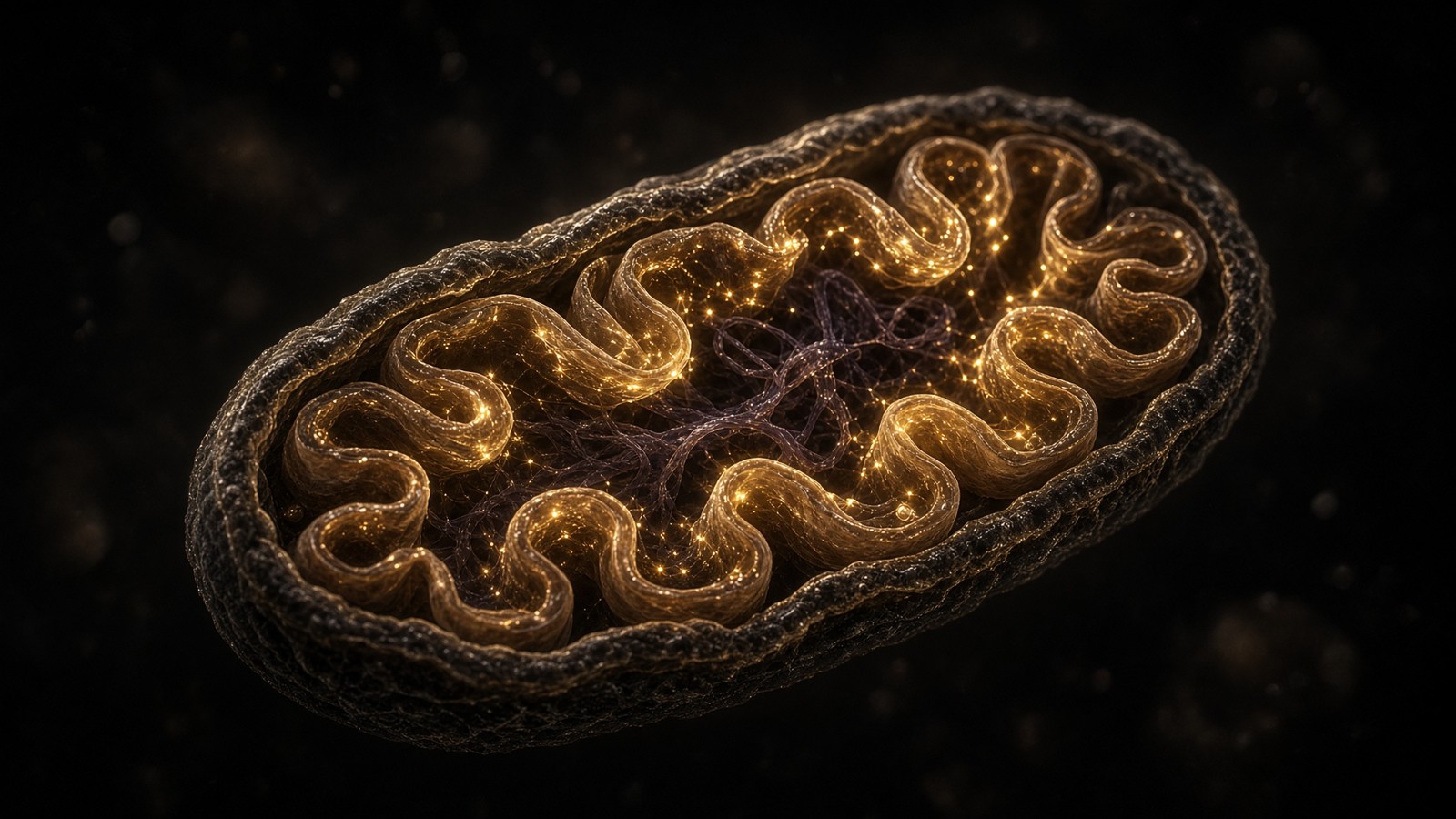
The mitochondrion in this picture isn't the respiratory-chain mitochondrion of the NAD+ essay, and it's also not a different organelle. Same cristae, same genome, a different invoice. CYP11A1 wants NADPH, not NADH; the pentose-phosphate path and mitochondrial transhydrogenases keep that pool. The inner membrane still holds a voltage. Isolated Leydig mitochondria, a StAR assay, a pregnenolone RIA or LC-MS: those are the tools a steroidogenesis paper actually runs. A homogenate total-testosterone kit on a man's serum is a different object, useful, and not a Leydig mitochondrion. Peripheral conversion then decides what the steroid becomes after it leaves the testis. Aromatase, CYP19A1, in adipose and in brain, writes oestradiol. 5α-reductase type 2, SRD5A2, in prostate and skin, writes dihydrotestosterone, a higher-affinity AR ligand. 5α-reductase type 1 is the skin-and-liver isoform. The total you print on a blood slip is therefore a Leydig product plus a set of peripheral fates plus a binding-protein correction you've not yet made. Treating that number as a single gland output is how a forum thread becomes a dosing argument.
In short. The same mitochondria that burn fuel also start this hormone. After testosterone leaves the testis, fat tissue and prostate can change it into other steroids.
Zinc sits under this pathway as a catalytic and a structural metal, which is why Prasad's deficiency papers still belong in a testosterone essay. Several of the steroidogenic dehydrogenases and the androgen receptor itself are zinc-dependent: the receptor's DNA-binding domain is a pair of zinc fingers, cysteine-coordinated, the classical nuclear-receptor fold. Severe dietary zinc deficiency is a documented hypogonadal state — hypogonadism, delayed puberty, a small testis — in the Iranian and Egyptian cohorts Prasad described in the 1960s, and in the adult depletion studies that followed. Serum testosterone falls. LH often rises, a primary-looking picture, because the Leydig cell and the receptor are the failing floors. Repletion brings T back into range. That's a nutrient-deficiency disease and a repletion victory, in the same logical family as niacin and pellagra. It isn't a licence to give a zinc-replete man more zinc and expect a super-physiological total. Extra zinc in a sufficient man does almost nothing to testosterone and may annoy the gut, compete with copper, and make a blood slip look like a protocol. The mineral is real. The deficiency phenotype is real. Treating those two facts as a dosing ladder doesn't follow.
In short. Zinc is built into the hormone-making enzymes and into the receptor that reads testosterone. If you're empty, filling the tank helps. If you're not, extra zinc does almost nothing.
Aromatase in adipose is why a waist can talk to an LH pulse. Adipocytes and stromal cells in fat write CYP19A1; more adipose, more peripheral conversion of testosterone to oestradiol, more ER-mediated negative feedback, often a lower LH and a lower total T, and a higher oestradiol:testosterone ratio that a mass-spec panel will show and a direct immunoassay may muddle. Insulin resistance travels with the same waist: insulin suppresses hepatic SHBG transcription, so free T can look less suppressed than total, which is a trap if you only print one number. Lose the adipose and the ratio often moves back, slowly, because adipocytes don't disappear on a Tuesday. 5α-reductase is the other peripheral fork. Finasteride and dutasteride occupy it; they lower DHT, raise testosterone a little, and have a sexual-side-effect literature that's real for a subset and contested in its permanence. A food-supplement tub doesn't occupy 5α-reductase. Saw palmetto claims otherwise with thinner evidence than the urology clinic uses. Naming the two forks — aromatase, 5α-reductase — is how you stop treating a total-T number as a moral score and start treating it as a map with exits.
In short. Fat tissue can turn testosterone into oestradiol, which then tells the brain to make less LH. Another enzyme in prostate and skin turns it into a stronger androgen.
Sex hormone-binding globulin is a liver glycoprotein that binds testosterone with nanomolar affinity and thereby decides how much of the total is free. Hammond's reviews are the ones to keep on the bench. In plasma, roughly half to two-thirds of testosterone is SHBG-bound, a smaller fraction is albumin-bound, and a few percent is free; 'bioavailable' usually means free plus albumin-bound, because albumin affinity is lower and the off-rate is fast. Free T can be measured by equilibrium dialysis, which is the reference method and isn't what most laboratories run, or estimated by Vermeulen's calculation from total T, SHBG and albumin. Immunoassay free-T kits are noisier than people who buy them admit. SHBG itself rises with thyroxine, with oestrogen, with cirrhosis, with ageing, and falls with insulin, with androgens, with hypothyroidism, with obesity. A rising SHBG at fifty can drop free T while the total looks respectable. A falling SHBG in an insulin-resistant man can prop the free fraction up while the total looks worrying. The number on the slip is therefore three numbers, or it's a blur.
In short. A liver protein soaks up much of the testosterone in blood. Only the unbound fraction is immediately available and that protein moves with thyroid status, insulin and age.
- Male total T, typical morning
- ~8–30 nmol/L
- BSSM hypogonadism band
- <8 nmol/L; 8–12 grey
- Age slope, men
- ~1–2%/year
- KSM-66 in trials
- 600 mg, ~8 weeks
- Free fraction
- a few percent
- HER REVIVE D3
- 2,500 IU
- HER REVIVE zinc
- 30 mg (citrate)
- Protocol clock
- 8–12 weeks
Lab ranges vary. Mass spectrometry beats a direct immunoassay at the low end.
Two morning totals, symptoms, then LH/FSH. A tub does not occupy this diagnosis.
From the late twenties. Harman; Massachusetts Male Aging Study. Adipose and sleep travel with it.
Lopresti 2019; Wankhede 2015. Modest total-T and cortisol moves in stressed or training men.
SHBG-bound is the reservoir. Vermeulen estimate or equilibrium dialysis, not a mystery kit.
Vegetarian cholecalciferol. UK winter 25-OH D is the reason this number is not a dusting.
Repletion dose neighbourhood. Not a megadose, not a TRT substitute.
Four capsules a day. Steroidogenic and adaptogenic stacks do not work on day four.
The receptor is a transcription factor
The androgen receptor is a nuclear receptor, NR3C4 — a 919-residue protein in humans with an N-terminal transactivation domain, a DNA-binding domain of two zinc fingers, a hinge, and a C-terminal ligand-binding domain. Lubahn, French, Wilson and colleagues cloned it in 1988 from the X chromosome; complete androgen-insensitivity syndrome is the human knockout, 46,XY, female external phenotype, a receptor that won't transduce. Ligand — testosterone or DHT — occupies the pocket, a helix-12 lid rearranges, heat-shock proteins let go, nuclear localisation sequences are exposed, and the dimer finds an androgen-response element in a major groove. Coactivators (SRC family, CBP/p300) and corepressors are recruited in a tissue-specific code. The product is transcription: prostate-specific genes, muscle myosins and IGF-1, haematopoietic programme in marrow, a different cassette in each tissue. That's hours to days, not a second-messenger spike. A serum total that moved 3 nmol/L hasn't yet become a myosin blot. The receptor is how it might, slowly, if the androgen-response elements in that fibre were already in a chromatin state that permitted occupancy. A botanical isn't a switch you flip on a receptor; the zinc fingers and the nucleosome still have to do the work.
In short. Testosterone works by entering cells and switching genes on through a receptor that grips DNA. That takes hours to days, not minutes.
DHT occupies the same receptor with higher affinity and a slower off-rate, which is why prostate and scalp hair are DHT tissues and why muscle, which has less 5α-reductase, is more of a testosterone tissue. Two ligands, one receptor, different local enzymes. Selective androgen-receptor modulators were built to exploit that geography and remain a mixed clinical literature; they're medicines-in-waiting or medicines-that-failed, not food supplements. Anti-androgens — bicalutamide, enzalutamide — occupy the pocket or the nuclear-localisation step in oncology. Spironolactone is a weak one, which is why a dermatologist can use it for acne and why a man on it may notice a quieter libido. None of those objects is in a Vitality Revival tub. The transcriptional programme also runs, in muscle, through a second door: androgen-receptor occupancy raises intramuscular IGF-1 and lowers myostatin in some assays, which is how a steroid hormone borrows a tyrosine-kinase neighbourhood. The neighbouring IGF essay owns that kinase. This page walks the nuclear receptor that asked it. Two floors. A stack that treats them as one juice hasn't named a response element or a beta-chain.
In short. A stronger cousin of testosterone does more of the work in prostate and hair. Muscle listens more to testosterone itself. Same receptor, different local chemistry.
Zinc fingers aren't a metaphor. Each finger coordinates a zinc ion with four cysteines; the first finger reads the DNA base sequence, the second finger stabilises the dimer on the half-site. A zinc-deficient cell can have a receptor that doesn't bind DNA properly, which is one reading of Prasad's hypogonadal phenotype that isn't about CYP11A1 at all. Two jobs, one metal. Nuclear-receptor signalling is also why a single total-T number is a poor predictor of a tissue effect: receptor density, coactivator set, local 5α-reductase, local aromatase, and the chromatin state of the target genes all sit between the serum and the blot. Prostate can be busy when muscle is quiet. Haematocrit can climb when libido does not. Those dissociations are why TRT clinics titrate against symptoms and a panel, not against a forum's favourite nanomole. They're also why a food-supplement trial that reports a modest total-T rise and a sleep score is reporting two things, and only one of them is this receptor. Perceived stress can move without AR occupancy moving at all. That's allowed. It's also a different paper.
In short. The receptor uses zinc to hold on to DNA. How much receptor a tissue has and which genes are available, decides the effect more than a single blood number.
Diagram
Closed chromatin (H3K27me3, DNA methylation) hides the promoter. Pioneer factors and histone acetyltransferases open it.
PIC: TFIID, TFIIH, Mediator, Pol II. Ser5 phosphorylation of the CTD lets the polymerase leave the promoter.
Elongation ~20–40 nt/s. Capping, splicing, cleavage and polyadenylation happen on the still-growing RNA.
Human genes are islands in 3.1 billion base pairs of mostly noncoding sequence. Promoter, enhancers, chromatin state and the Mediator complex decide whether Pol II is allowed to fire. Epithalon’s literature sits on TERT and pineal clocks — two of the rare promoters anyone bothers to name in a peptide essay.
Cortisol, sleep, adipose and SHBG do as much of the talking
The HPA axis is the other hypothalamic–pituitary conversation, and it talks to the HPG axis more loudly than a testosterone label usually admits. CRH, ACTH, melanocortin-2, Gs, cyclic AMP, StAR, cortisol: the same steroidogenic logic in zona fasciculata, a different CYP17 outcome, a glucocorticoid instead of an androgen. Glucocorticoid receptor occupancy on GnRH neurons and on Leydig cells quiets the reproductive axis; this is the evolutionary sentence about not starting a pregnancy in a famine, applied to a man whose mornings are all cortisol. Chronic elevation flattens the LH pulse and can drop total T without a testicular lesion. Cushing's is the extreme. A year of bad sleep and a job that never clocks off is the common version. Ashwagandha's cleaner literature is on this floor: morning cortisol down a bit, a perceived-stress scale down a bit, and then, in some of the same men, total T up a bit. That order of operations is a hypothesis with trials behind it, not a proof that Withania occupies LHCGR. An adaptogen trial that doesn't measure cortisol is leaving the probable mechanism in the corridor. An adaptogen sentence that skips cortisol and leads with 'boosts testosterone' has chosen the more saleable hormone.
In short. Long-term high cortisol slows the reproductive axis. Some ashwagandha trials look as if they help testosterone by calming that stress axis first.
Sleep is an endocrine programme, and morning testosterone is one of its products — which is why a broken night shows up on a blood slip. Luboshitzky and others showed that fragmented sleep and restricted sleep drop next-day total T in healthy men; the overnight rise that should peak around waking is thinner if the night was. Slow-wave sleep is also when the largest growth-hormone pulses fire — Takahashi, Kipnis, Daughaday, 1968, GH on the sleep tracing — which is a different axis, a neighbour, not a substitute. The GH axis is GHRH, somatostatin, ghrelin, a 191-residue somatotroph product, hepatic IGF-1. Testosterone is GnRH, LH, a C19 steroid. They share a night and they share a recovery conversation in muscle. They don't share a receptor. A short night is therefore a two-axis insult: less GH in N3, less T in the morning, a cortisol curve that may not have cliffed. Treating that insult as a botanical deficiency is how a sleep problem becomes a shopping list. Treating it as a hypnogram plus a morning blood draw is how you stop. The neighbouring sleep-metabolism essay owns the glucose invoice of the same night. This page walks the androgen invoice.
In short. A broken night lowers next-morning testosterone and also lowers growth hormone. Those are two different hormone systems that both expected you to sleep.
Adipose tissue is an endocrine organ that aromatises, secretes leptin, adiponectin and inflammatory cytokines, and, past a threshold, tracks lower total T in men. The direction of causality is two-way and the literature is honest about it: low T promotes central fat, central fat promotes low T, and a trial that only measures one end of that loop will over-claim. Bariatric series and careful weight-loss trials often see total T rise as the waist falls, SHBG rise as insulin falls, and LH sometimes recover. An aromatase-inhibitor trial in obese men can raise T without improving the metabolic picture the way weight loss does, which is a warning about treating the number as the disease. Oestradiol isn't the enemy; it's the brake and a bone-protective steroid, and driving it to the floor is how you buy haematocrit and a fracture. The food-supplement contribution on this floor is small and specific: if vitamin D and zinc were deficient, replete them; if cortisol is the louder signal, an adaptogen with a trial is a modest tool; the waist remains a waist.
In short. Body fat both lowers testosterone and is encouraged by low testosterone. Losing the fat often moves the number. A capsule doesn't replace that.
Thyroid status talks to this axis through SHBG and through a general metabolic set-point. Thyroxine raises hepatic SHBG; hypothyroidism drops it. A man with undiagnosed hypothyroidism and a low total T has a thyroid clinic problem that will look, if you only print T, like an androgen problem. Iodine and selenium are thyroid-peroxidase and deiodinase cofactors; the UK diet still misses iodine in people who don't eat dairy or white fish, and selenium is a glutathione-peroxidase metal the thyroid uses at a high rate. HER REVIVE puts both in, with D3, because a women's multi-phase formula that skips the thyroid nutrients is a mood blend pretending to be a hormone product. TSH, free T4, and 25-hydroxyvitamin D are the blood tests that decide whether this paragraph applies to you. They're cheap. They aren't a personality. A food-supplement tub that contains iodine at 150 micrograms is a repletion tool for a diet that missed it, inside the tolerable-upper-intake neighbourhood, not a treatment for Graves or for Hashimoto's. Symptoms of a thyroid disorder belong with a clinician, not a checkout, which is the same sentence we will write about hypogonadism two headings from now.
In short. Thyroid hormones change the liver protein that binds testosterone and they need iodine and selenium. A missed thyroid problem can look like a testosterone problem on a single blood test.
Diagram
Hypothalamus
GHRH · somatostatin
Go and stop. Class-B GPCRs on the somatotroph.
Stomach / arcuate
ghrelin → GHS-R1a
Volume knob. Synergises with GHRH. Ipamorelin sits here.
Pituitary
GH pulses
191 residues. Night-time bursts. Veldhuis spent a career on the pattern.
Liver
IGF-1 + IGFBP3 + ALS
JAK2–STAT5b at the GH receptor. Much of the growing is this hormone.
Tissue
IGF1R
RTK. IRS–PI3K–Akt–mTOR. IGF-1 LR3 asks this microphone with IGFBPs taken out.
CJC without DAC is DPP-IV-resistant GRF(1–29) that still pulses. Ipamorelin is selective GHS-R1a. Somatropin is the 191-residue ligand. IGF-1 LR3 bypasses the pituitary. Confuse the four and the methods section is already wrong.
Hypogonadism is a clinic diagnosis
Male hypogonadism is symptoms plus two morning totals, drawn before ten, in a reasonably rested man. The Endocrine Society's 2018 guideline sits in a similar neighbourhood in ng/dL. Immunoassays disagree at the low end; mass spectrometry is the adult measurement. LH and FSH then say whether the problem is testicular (primary: high gonadotrophins) or hypothalamic–pituitary (secondary: low or inappropriately normal). Prolactin, ferritin, a pituitary panel, karyotype in selected young men, overnight oximetry if the neck and the partner's report suggest it: the work-up is a clinic object. A food supplement doesn't treat this. What a food supplement can do is sit in the much larger group of men whose totals are in range and whose afternoons aren't — zinc if they're low, vitamin D if they're low, an adaptogen with a trial behind it if cortisol is the louder signal. Conflating those two populations is how a hypogonadal man delays a diagnosis, and how a eugonadal man is sold a syringe he doesn't need.
In short. True low testosterone is a doctor's diagnosis: symptoms, two morning blood tests, and then more tests to find the level of the problem. A supplement doesn't treat that.
Testosterone replacement, when it's indicated, is a medicine, and the doses tell you so. Mixed esters in an oil, testosterone undecanoate as a long-acting intramuscular, transdermal gels with a transfer warning, a haematocrit to watch, a PSA conversation, fertility to counsel because exogenous T suppresses LH and FSH and can drop a sperm count toward zero. The doses that move a hypogonadal man into range are tens to hundreds of milligrams of ester, not tens of milligrams of a root extract. Enanthate 250 mg is a clinic object with a peak-and-trough; it isn't a food-supplement result. Clomifene and hCG are the fertility-sparing alternatives in selected secondary hypogonadism, still medicines, still a specialist's hand. An online 'TRT clinic' that starts a man on an ester because he is tired and 11 nmol/L on one afternoon blood draw is doing a different trade from the guideline. An online supplement shop that writes the ester's name on a KSM-66 label is doing a third. We sell the second object as a food supplement and we won't borrow the first object's name. The legal class is smaller, and it's the one we'll keep repeating: these tubs aren't testosterone replacement.
In short. Prescribed testosterone is a controlled medicine with blood-count and fertility consequences. The doses are hundreds of milligrams of hormone, not a root extract.
Women's hypogonadism and menopause aren't a smaller syringe of the same ester, and the copy that treats them that way is worse than the men's copy. Premature ovarian insufficiency, hyperprolactinaemia, hypothalamic amenorrhoea from under-fueling: clinic objects, gonadotrophins, a bone conversation. Menopausal hormone therapy — oestradiol as a patch, gel or tablet, progesterone or a progestogen if the uterus is in situ — is a NICE-guided medicine with a risk conversation that belongs in a GP or specialist clinic, not in a checkout. HER REVIVE isn't that prescription. It's multi-phase nutrient and botanical support so the luteal week is less of a personality transplant and the afternoon is less of a cliff. Saffron, P5P, shatavari, thyroid cofactors, D3. A food-supplement claim, written as one. If you need oestradiol 2 mg you already know which building to walk into, and we won't pretend a 40 mg saffron extract is that building. The rest of the women's evidence sits three headings down, after the men's botanicals have been told the truth about their own papers.
In short. Hormone replacement for women is a prescribed oestradiol product with a real risk conversation. A saffron-and-shatavari capsule isn't that prescription.
Symptoms plus two morning totals, then LH and FSH. That sentence is a clinic. A branded root extract does not get to skip it.— Hackett G et al. British Society for Sexual Medicine guidelines on adult testosterone deficiency. 2017, updated 2023. Bhasin S et al. Endocrine Society clinical practice guideline. J Clin Endocrinol Metab. 2018; 103: 1715–1744.
KSM-66: a food-supplement signal, not an ester
Withania somnifera is a Solanaceae root with a long Ayurvedic record and a shorter, better, randomised one. The withanolides — steroidal lactones, withaferin A the most famous — are the phytochemical class the papers name; they aren't testosterone, and they don't occupy LHCGR in any literature a steroid biochemist would defend. KSM-66 is a branded, full-spectrum root extract, withanolides standardised, used in several of the cleaner trials so that a paper can write a dose instead of a mystery blend. Other extracts exist; some are leaf, which has a different withanolide profile and a thinner male-hormone literature. Dose in the trials that moved a hormone or a stress scale is usually 300 to 600 mg a day of the root extract, eight to twelve weeks. A man who swallows a capsule on a Monday and asks about his libido on a Wednesday hasn't read the protocol the papers actually ran. The plant is an adaptogen in the old Soviet sense: a stress-axis modulator with a modest, slow signal. Keep that size in mind when a sales page reaches for the word testosterone.
In short. Ashwagandha is a root extract studied for stress. The branded form used in several trials is KSM-66. It isn't testosterone and it doesn't work overnight.
Lopresti, Drummond and Smith, American Journal of Men's Health 2019, is the hormonal paper a reader has to cite. Randomised, double-blind, placebo-controlled, crossover, forty-three overweight men aged forty to seventy, 600 mg KSM-66 for eight weeks. Salivary testosterone rose relative to placebo, DHEA-S rose, a fatigue scale moved, and the effect sizes were modest. Overweight, stressed, middle-aged: that's the population, and it isn't a twenty-two-year-old eugonadal sprinter. Chandrasekhar, Kapoor and Anishetty, Indian Journal of Psychological Medicine 2012, is the stress paper: high-concentration root extract, sixty days, perceived stress down, serum cortisol down, in adults with chronic stress. Lopresti's 2019 Medicine paper on a different extract (Shoden) is another cortisol-and-stress randomised cell. The useful summary across this neighbourhood: in stressed adults, eight weeks of a standardised root extract often moves morning cortisol down and perceived stress with it, and in overweight older men a testosterone signal appears on top. Nobody who reads the tables confuses that with 250 mg of testosterone enanthate except people selling it as TRT. We sell the tub. We will still say that.
In short. In overweight, stressed older men, eight weeks of 600 mg KSM-66 raised testosterone a little and lowered fatigue. Stress and cortisol often moved too.
Wankhede, Langade, Joshi, Sinha and Bhattacharyya, Journal of the International Society of Sports Nutrition 2015, is the resistance-training paper. Fifty-seven young men, 600 mg KSM-66 or placebo, eight weeks, a supervised programme. Muscle strength, muscle recovery, and testosterone moved more than placebo; body fat moved a little the other way. Sample size isn't huge. The training was real, which is a confounder a caption likes to forget: the extract was stacked on progressive load, not on a sofa. Young men with room to train aren't Lopresti's overweight fifty-year-olds, and the fact that both papers point in the same direction is the interesting part, not a licence to average them. Strength is a neuromuscular and a myofibrillar phenotype; testosterone is one of several hormones that sit under it; ashwagandha may also be a cortisol and a sleep story in the same subjects. The paper did not unpick those. A food-supplement trial rarely does. What it did do is randomise, blind, and measure. That's already more than a lot of the category manages. Resistance-trained men gained more strength and a bit more T than placebo. Useful. Small. Not an ester.
In short. Young men lifting weights on 600 mg KSM-66 gained more strength and a bit more testosterone than placebo. Training was part of the result. The extra was modest.
Effect sizes in this literature look like a better night's sleep, not like a 250 mg testosterone ester. A few nanomoles inside the reference range. A cortisol awakening response that's less of a cliff and more of a slope, or the reverse, depending on the paper and the baseline. Sleep-quality subscales that move in the same direction as the hormone. Drop-outs and gastrointestinal complaints exist and are usually mild. Thyroid is a theoretical caution — Withania has a small literature on stimulating thyroid hormone in animals and a handful of human case-ish reports — so a man on levothyroxine should tell his clinician, which is ordinary supplement hygiene rather than a scandal. Interactions with sedatives and with immunosuppressants get listed because they should. The thing that doesn't get to be listed is TRT. A randomised food-supplement signal in stressed men, where total testosterone and morning cortisol move a bit, is exactly as large as that sentence.
In short. The changes are small: a few nanomoles, a calmer morning cortisol, slightly better sleep scores. Useful in stressed men. Nothing like a testosterone injection.
Zinc and vitamin D move T when you are empty
Ananda Prasad's zinc papers are the reason this mineral isn't a passing aisle trend. Severe deficiency: hypogonadism, growth failure, a characteristic rash, an immune defect. Adult depletion studies: serum testosterone falls, and it recovers when zinc is restored. Prasad, Mantzoros, Beck, Hess and Brewer, Nutrition 1996, put zinc status against serum testosterone in healthy adults and saw the association that every subsequent review still has to mention. Mechanism, as already named: steroidogenic enzymes, AR zinc fingers, and a Leydig cell that doesn't thrive when the metal is gone. Dietary sources are meat, shellfish, seeds; phytate in unleavened bread was the original deficiency partner in the cohorts Prasad saw. Serum zinc is a poor tissue marker; alkaline phosphatase and a proper history are often more informative. The UK diet is less deficient than the 1960s Iranian one, and it isn't immune — older men, people on a narrow plant diet without a plan, gastrointestinal disease. Repletion is a food-supplement job when diet won't do it. Dose is a repletion neighbourhood, not a megadose.
In short. Severe zinc deficiency lowers testosterone and putting zinc back raises it. That's a repair of a shortage, not a way to push a normal level higher.
Extra zinc in a sufficient man does almost nothing to testosterone. That sentence is the one the aisle keeps trying to unwrite. Once the enzymes have their metal and the receptor has its fingers, more cations in plasma don't write more steroid. They do write nausea in some people, and they can drop copper if you keep at it, and they can look like a protocol on a blog. The right experiment is a baseline: serum zinc if you must, more honestly a diet history and a 25-OH D and a morning T on the same draw, then replete what is empty. Treating a eugonadal, zinc-replete man with 50 mg elemental zinc indefinitely isn't a testosterone protocol. It's a mineral surplus. Food-supplement regulation in the UK still allows that surplus to be sold; it doesn't require us to pretend it's an endocrine intervention. We dose zinc because deficiency is common enough to be worth covering in a daily formula, and because the androgen receptor really does use it. We don't dose it as a syringe substitute.
In short. If your zinc level is already normal, taking more won't raise testosterone. It may upset your stomach and it can interfere with copper.
Vitamin D is a secosteroid, not a B vitamin, and the Leydig cell has a vitamin D receptor. CYP2R1 in the liver makes 25-hydroxyvitamin D, the status marker; CYP27B1 in kidney, and in some other tissues, makes the 1,25-dihydroxy hormone that occupies VDR, a nuclear receptor in the same superfamily as AR. Pilz, Frisch, Koertke and colleagues, Hormone and Metabolic Research 2011, supplemented vitamin D in men and saw testosterone rise relative to placebo in a cohort whose baseline 25-OH D wasn't replete. Association studies — Wehr, Nimptsch, others — had already shown that low 25-OH D tracks with low T; association isn't causation, and the trial is why this heading is allowed to exist. UK winter 25-OH D is a national joke: latitude, indoor work, melanin, a diet that doesn't deliver 10 micrograms a day unless you fortify. SACN's 10 microgram recommendation is a bone-and-rickets number; the endocrine neighbourhood often wants a higher repletion dose when 25-OH D sits in the teens of nmol/L. The formulas put vegetarian D3 in so a daily capsule isn't a summer-only product. Run the blood test rather than guessing.
In short. Vitamin D acts through a gene-switching receptor and Leydig cells have it. Supplementing deficient men has raised testosterone a little in a named trial. UK winters run low.
Boron is the thinner mineral. Naghii, Mofid, Asgari, Hedayati and Daneshpour, Journal of Trace Elements in Medicine and Biology 2011: eight healthy men, 6 mg boron for a week, free T up, SHBG down, a cytokine shift, a sample size you could lose down the back of a sofa. The dataset hasn't grown into a field. The mineral is cheap, the dose in a serious formula isn't a dusting, and the mechanism — a SHBG or a hydroxylation story, depending on who you ask — hasn't been nailed with the enzymology CYP11A1 received. We keep boron in because the early signal is in the direction a free-T conversation wants and because 6 mg is inside a food-supplement band. We don't write a week-long n=8 as a guideline. Leading a testosterone page with boron and burying KSM-66, zinc and vitamin D inverts the evidence. Minerals that move T do so mostly by repairing a hole. The hole has to be there. That's the whole mineral chapter, restated.
In short. Boron has a tiny study in which free testosterone rose after a week. The evidence is thin. Zinc and vitamin D are the minerals with a real deficiency story.
Fenugreek, tribulus, shilajit — the honest read
Fenugreek, Trigonella foenum-graecum, is a fabaceous seed with furostanol saponins — a libido literature that often gets billed as testosterone support. Testofen, a specialised extract, has randomised data in ageing men: Rao, Steels, Inder, Abraham and Vitetta, Aging Male 2016, reported symptoms of androgen decline down, sexual function up, and testosterone up relative to placebo over twelve weeks. Wankhede's fenugreek glycoside trial in resisting-training men is another cell, body composition and strength, a T signal that isn't the cleanest in the table. Mechanism sketches include 5α-reductase or aromatase modulation and an androgen-receptor conversation; the enzymology is mixed and the useful read is libido and a symptom score more reliably than a mass-spec total. That's still a signal. It's a food-supplement signal. A formula that puts fenugreek in as a 50-percent-saponin extract at a trial-adjacent dose is at least trying, which is more than we can say for 50 mg of unidentified powder. We put that extract in HIM REVIVE, and in HER REVIVE at 300 mg, because libido and a luteal week are allowed to be endpoints, and because pretending fenugreek is an ester is how this category lost its reputation in the first place.
In short. Fenugreek seed extracts have some randomised data on libido and symptoms and a weaker, mixed effect on the testosterone number itself. Useful, modest, not a medicine.
Tribulus terrestris is the shopfront magnet, and the androgen papers in eugonadal men are much weaker than the label. Neychev and Mitev, Journal of Ethnopharmacology 2005, gave young men tribulus and did not move androgen production. Qureshi, Naughton and Petróczi, a 2014 systematic review, found insufficient evidence for a testosterone effect and a slightly better case for libido as a subjective endpoint. The saponin protodioscin is the named constituent; a LH-from-the-pituitary story gets repeated on labels and doesn't survive contact with the gonadotrophin assays in those papers. We still put a 95-percent-saponin tribulus extract in both formulas, at 300 mg in HER REVIVE, because the libido literature isn't zero. Saying the smaller claim out loud is the price of keeping it. Tribulus is a libido story that got dressed as a T story. In eugonadal men the clothes don't fit. In the rarer older man with a quiet desire and an in-range total, a subjective move is allowed to matter, and it's still not a morning total of 28 nmol/L. A caption that promises that number on a tribulus capsule is describing a different product.
In short. Tribulus is widely sold as a testosterone herb. In healthy men the hormone number usually doesn't move. Libido sometimes does. That's a smaller claim.
Shilajit is a fulvic-acid-rich rock exudate with a purified-extract trial: Pandit, Biswas, Jana and colleagues, Andrologia 2016, reported testosterone and FSH moves in healthy volunteers over ninety days. Sample size is modest; the material is standardised to fulvic acid in serious formulas (50 percent in HIM REVIVE's 10:1 extract) because unstandardised shilajit is a heavy-metal conversation as well as a hormone one. Korean ginseng and rhodiola sit in both formulas as adaptogens with their own fatigue and stress literatures — ginsenosides, salidroside, rosavin — and a thinner direct-T literature than KSM-66. Black maca is a libido-and-energy botanical with Peruvian trial data on desire more than on androgen panels. Muira puama and damiana are traditional and under-trialled in English, which is the sentence we will write rather than a mechanism cartoon. None of these is a licence to skip KSM-66, zinc and D3 in the men's story, or saffron, P5P and the thyroid cofactors in the women's. The evidence gradient still runs zinc and D3 and KSM-66 first, fenugreek next, tribulus as a libido rider, the rest as supporting botanicals.
In short. Shilajit has one modest testosterone trial. Ginseng, rhodiola and maca are mostly energy and desire stories. The strongest men's evidence remains zinc, vitamin D and ashwagandha.
The women's clock is not a smaller version of the men's
A luteal week is a progesterone-and-oestradiol event, not a testosterone event with lipstick. After ovulation the corpus luteum writes both steroids; GABA-A-active neurosteroids derived from progesterone (allopregnanolone) then talk to mood circuits; a subset of women hear that as PMS or PMDD, a serotonergic and a GABAergic literature, SSRIs as the clinic tool that actually has NICE-adjacent evidence. Perimenopause is a different clock: FSH rises, oestradiol becomes noisy, cycles shorten then skip, vasomotor symptoms, a sleep insult that then insults everything in the headings above. Postpartum is a third: a steroid cliff, iron spent, sleep destroyed, thyroiditis in a minority, a mood disorder that's a psychiatric emergency when it is. One formula can't be those three clinics. One formula can put, in one place, the nutrients and botanicals that have randomised data on mood and the cofactors a blood test will thank you for, so the luteal week is less of a personality transplant and the afternoon is less of a cliff. That's a food-supplement claim, and it wants to be written as one.
In short. Women's monthly and midlife hormone shifts are ovarian events with mood and sleep consequences. A supplement can support those weeks. It can't replace ovarian hormones.
Saffron, Crocus sativus, is the women's evidence test the way KSM-66 is the men's. Stigmas, crocin and safranal the named carotenoid and monoterpene, affron and Satiereal the standardised extracts a paper can dose. Agha-Hosseini, Kashani and colleagues, BJOG 2008: a double-blind randomised trial in PMS, saffron 30 mg a day, symptom scores down relative to placebo. Kashani's later work and Lopresti's reviews sit on mood and on SSRI-adjacent sexual dysfunction; sample sizes aren't huge, the direction is consistent enough to be a literature rather than an anecdote, and the probable mechanism is serotonergic more than oestrogenic. That last clause matters. A botanical that talks to 5-HT isn't a phyto-oestrogen, and writing it as HRT is a category error the plant did not ask for. HER REVIVE uses a lepticrosalide-standardised saffron extract at 40 mg, next to P5P and methylfolate, which is a different job from a beauty blend that lists 'saffron' at an unstated micrograms. Small trials, real direction, mood and PMS, not oestradiol 2 mg. If you need the 2 mg you already have a building. If you want the luteal week to be less of a cliff has a literature, and it's this one.
In short. Saffron extracts have randomised trials in PMS and low mood. They appear to work through serotonin, not by replacing oestrogen. The studies are small and the direction is consistent.
Pyridoxal-5-phosphate is the active B6 coenzyme, PLP, the cofactor of amino-acid decarboxylases and transaminases, including the steps that make serotonin, dopamine and GABA. PMS has a B6 literature that's older than saffron's and noisier: some randomised trials on a luteal symptom score, a neuropathy caution at high milligram doses taken for months, and a plausible neurotransmitter mechanism that doesn't require an ovarian receptor. P5P at 20 mg in HER REVIVE is a coenzyme dose, not a 200 mg experiment. Methylfolate, 5-methyltetrahydrofolate, 400 micrograms in the same tub, is the circulating folate species and the form that bypasses a thermolabile MTHFR variant; the neural-tube evidence base was built on folic acid, and a vitality formula that puts methylfolate in isn't claiming to have rerun the MRC vitamin study. Methylcobalamin 500 micrograms sits next to it because B12 and folate share a one-carbon neighbourhood and because a women's fatigue work-up that skips B12 is incomplete. These are nutrients. They aren't hormones. A luteal-week formula that omits them and leads with a mystery phyto-oestrogen has inverted the evidence in a different direction from the men's tribulus problem, and with the same motive.
In short. Active vitamin B6 helps make mood-related brain chemicals and has older PMS trial data. Methylfolate and B12 sit on the same nutrient map. They're not hormones.
Shatavari, Asparagus racemosus, is the Ayurvedic women's root the way ashwagandha is the men's, and the English-language trial base is thinner, which is worth saying out loud. Saponins again, a galactagogue tradition, a handful of peri-menopausal and cycle studies that wouldn't yet carry a guideline. We put a 5:1 extract at 300 mg because the traditional use matches the multi-phase claim and because waiting for a Lopresti-sized RCT before any women's botanical is allowed in a tub is how formulas become a multivitamin with lipstick. Rhodiola rosea at 100 mg, salidroside and rosavin, has a cleaner fatigue-and-stress literature than shatavari and a thinner hormone one; it's in both HIM and HER for that reason. Ginkgo at a 50:1 leaf extract is a microvascular and a cognitive-adjacent botanical with a bleeding caution if someone is anticoagulated. None of these plants is oestradiol. None of them is progesterone. A clinician who has started HRT should be told about the tub, because that's their axis to supervise, not because shatavari is a steroid. Traditional and under-trialled in English is a status, not a slight. It's also not a reason to write a root as a hormone replacement.
In short. Shatavari is a traditional women's herb with fewer English trials than ashwagandha. Rhodiola is on firmer ground for fatigue and stress. Neither plant is oestrogen.
Iodine, selenium, vegetarian D3, zinc and boron: those are the unfashionable half of HER REVIVE, and the half a blood test will actually thank you for. Thyroid peroxidase wants iodine. Deiodinases and glutathione peroxidase want selenium. VDR wants 25-OH D. The androgen and oestrogen receptors want zinc fingers. A wellness gummy pretends to contain this neighbourhood and then doses it at a decorative microgram. A women's hormone formula that skips it and leads with a libido herb has chosen the shopfront. We would rather you ran TSH and 25-OH D than guessed, and we would rather you did not take a second iodine source on top without looking, because 150 micrograms is a repletion, not a challenge test, and because some people are already on a kelp capsule they forgot about. Pregnancy and breastfeeding change the iodine and selenium conversation; the label already says ask a clinician, and this paragraph won't unwrite that. The minerals are the part of the tub that maps onto named enzymes. The botanicals are the part that maps onto trials of mood and stress. Both halves, or it isn't a formula.
In short. Iodine, selenium, vitamin D and zinc are the nutrients thyroid and hormone receptors actually use. They're less glamorous than herbs and more often the thing a blood test shows was missing.
What is actually in the tubs
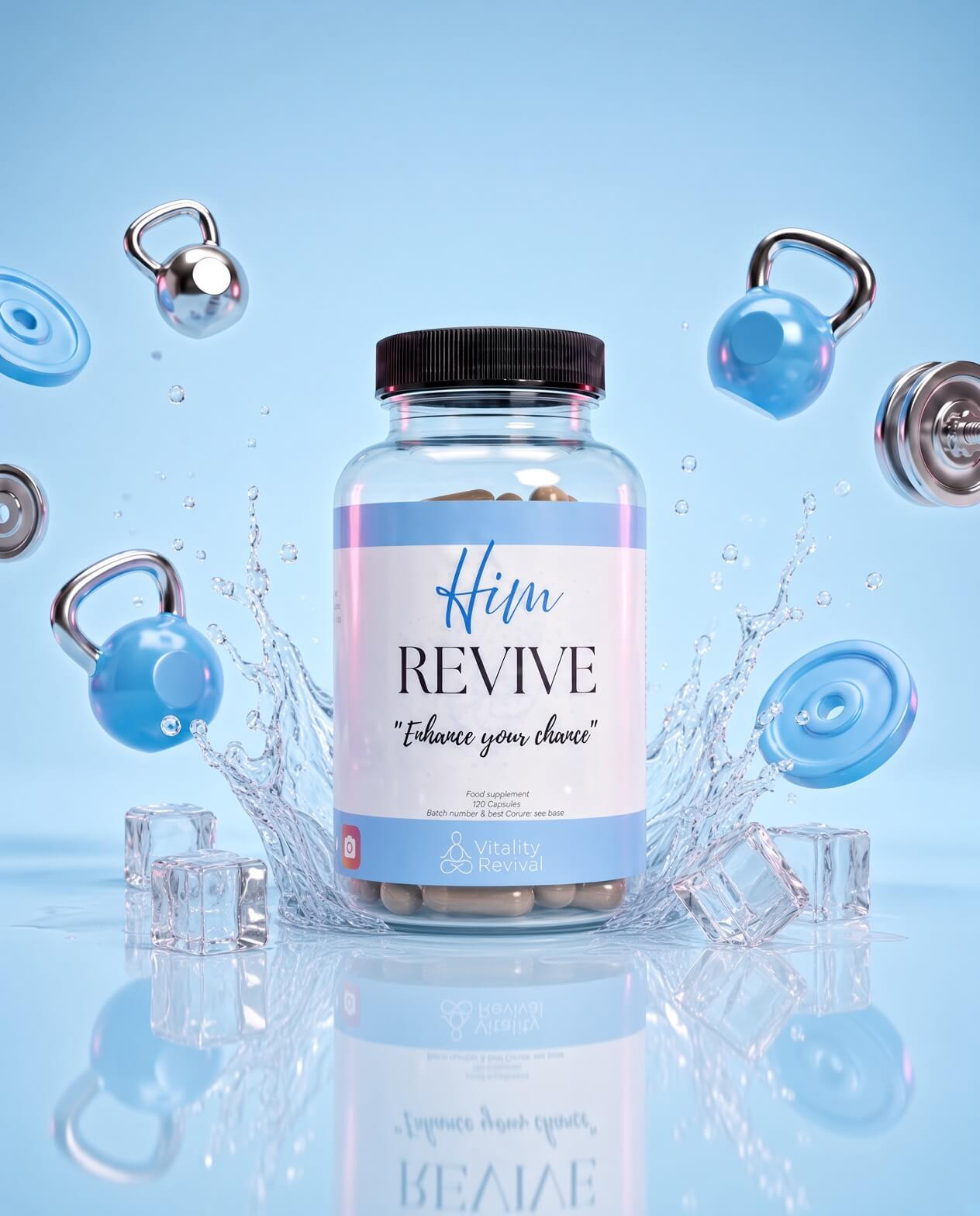
HIM REVIVE is one daily formula so a man isn't stacking six under-dosed bottles. KSM-66 ashwagandha for the HPA-and-T trials just named. Fenugreek seed extract at 50 percent saponins, tribulus at 95 percent saponins, shilajit 10:1 at 50 percent fulvic acid. Korean ginseng at 20 percent ginsenosides, rhodiola at 1 percent salidroside and 3 percent rosavin. Black maca 100:1, muira puama 12:1, damiana 5:1, pine bark at 95 percent OPC, a saffron extract. Zinc as citrate, boron as sodium borate, vegetarian D3, K2 as all-trans MK-7, methylfolate, selenium. No caffeine, because a stimulant crash isn't a hormone pathway. Four capsules a day, two with breakfast, two with dinner, vegetarian HPMC shells, made in England, 120 capsules, thirty days. Food supplement, not a treatment for hypogonadism. If you're on an ester, a gel, clomifene, hCG, or a blood-pressure medicine, that's a clinician conversation first. The reviews that mention GP letters — total T from the low-11s into the mid-14s, D3 from 28 nmol/L to 70-odd — are the shape of a food-supplement result: in range, modest.
In short. The men's formula puts the better-studied root extract with zinc, vitamin D, boron and several libido botanicals and it leaves caffeine out. Four capsules a day for months, not days.
HER REVIVE is built as multi-phase support rather than a product you only reach for on the worst day. Damiana, shatavari, fenugreek and tribulus at 300 mg of extract each; muira puama 250 mg; ginkgo 200 mg; Korean ginseng 200 mg; shilajit 200 mg; rhodiola 100 mg; black maca 50 mg; saffron 40 mg. Then the coenzyme and mineral half: P5P 20 mg, vegetarian D3 2,500 IU, methylfolate 400 micrograms, methylcobalamin 500 micrograms, natural vitamin E 200 IU, zinc citrate 30 mg, selenium 200 micrograms, iodine 150 micrograms, boron 6 mg. Same four-capsule day, same eight-to-twelve-week clock, same vegetarian capsule, made in the UK. That isn't oestradiol, and it isn't a medicine. If you need those, you already know which building. If you're pregnant, breastfeeding, on HRT, on an SSRI, or under a thyroid clinic, ask before you add a tub, because those are their protocols. The luteal-week job is saffron, P5P and methylfolate. The thyroid-and-bone job is iodine, selenium, D3, zinc. The vitality job is the botanical set. Three jobs, one tub, a food-supplement claim written as one. Pink dusting would have been cheaper. It would also have been a different product.
In short. The women's formula combines a PMS-studied saffron extract with active B6, folate, thyroid minerals and traditional women's botanicals. Same slow daily schedule. Not hormone replacement.
Eight to twelve weeks is the protocol, not a tagline. Cortisol rhythms, SHBG, vitamin D stores, and spermatogenesis-adjacent androgen tone move on a weeks-to-months clock. A sperm cycle is seventy to ninety days, which is why the neighbouring fertility essay refuses to talk in Tuesdays; Leydig cells turn over slower than a forum thread. Four capsules split across breakfast and dinner is a compliance design as much as a pharmacokinetic one: fat-soluble D3 and K2 want a meal, zinc is kinder to the gut with food, splitting blunts a single-bolus nausea. No cycling. Daily use. Made in the UK to GMP, vegetarian, non-GMO sourced, a separate company. Vitality Revival's own site stays linked from the product page. We sell the formulas. We don't represent the company, and we don't write TRT or HRT on a label that lists KSM-66 and saffron. Symptoms of hypogonadism or a thyroid disorder belong with a clinician and a blood test. The ingredients list is the claim.
In short. These formulas are meant to be taken every day for two to three months, with meals. They're UK-made food supplements from another company, sold here as food, not as treatment.
Diagram
| Node | Catalogue | Conversation |
|---|---|---|
| GPCR | Ipamorelin, MT2, PT-141, retatrutide, CJC | Second messengers, secretion, appetite, pigment |
| RTK / IGF1R | IGF-1 LR3 | IRS–PI3K–Akt–mTOR and Shc–ERK |
| Cytokine receptor | Somatropin (HGH) | GHR–JAK2–STAT5b, hepatic IGF-1 |
| Cofactor | NAD+ | Sirtuins, PARPs, CD38, redox |
| Actin buffer | TB-500 / Tβ4 motif | G-actin sequestration, motility |
| Growth-factor-like | BPC-157 | VEGFR2 / FAK / eNOS neighbourhood |
| Copper ligand | GHK-Cu | Transcriptome shift in fibroblasts |
| MC fragment | KPV | NF-κB, PepT1, no pigment |
| Nuclear / pineal | Epithalon (AEDG) | TERT and melatonin literatures |
| mtORF peptide | MOTS-c | AMPK, folate–methionine cycle |
Each row is a different kind of molecular conversation. The catalogue peptides bind at these nodes; they are not interchangeable, and stacking them because a forum did mixes unrelated literatures.
Morning blood, named assays, eight weeks
Decide what you're measuring before you open the bottle. Total testosterone is a pool, preferably by LC-MS/MS, drawn between 07:00 and 10:00, twice, because a single afternoon immunoassay is how eugonadal men get mislabelled. SHBG and albumin let you estimate free T; equilibrium dialysis is the reference if the estimate and the picture disagree. LH and FSH name the floor. 25-hydroxyvitamin D, a full blood count, ferritin, TSH, prolactin in selected men: the panel that decides whether this page's food-supplement chapter applies. Haematocrit is a TRT monitoring test, not a supplement one, and it belongs in the clinic conversation if an ester is already in play. Cortisol wants a curve, or at least a morning and an evening, not a hero number. In women the equivalent care is a cycle-day, a TSH, a ferritin, a 25-OH D, and not treating a luteal mood score as an oestradiol deficiency without a clinic. Assays that report 'testosterone' without saying total versus free, morning versus afternoon, mass spec versus immunoassay, are reporting a blur.
In short. Measure morning total testosterone twice, properly and add the binding protein and LH so you know what the number means. Afternoon single tests mislead.
Reading a randomised trial in this category is a specific skill, because the aisle funds a lot of them and the sample sizes are what they are. Ask who was enrolled: deficient, stressed, overweight, eugonadal, young, training. Ask the dose and the extract, not the plant's Latin name. Ask whether the T assay was morning and whether SHBG moved. Ask whether cortisol was measured if the mechanism is supposed to be HPA. Ask whether the training was matched. Ask the effect size in nmol/L, not in percent of a low baseline. A crossover, as in Lopresti 2019, is a gift at these sample sizes; a parallel trial with a noisy immunoassay is a rumour. Industry funding is a reason to read the tables harder, not a reason to throw the trial away, and throwing the trial away is how you end up with folklore. The restoration of a deficient zinc or D status is a different experiment from adding KSM-66 on top of a replete, unstressed, eugonadal man. Mixing those experiments is the aisle's favourite trick. If a paper can't say which of those it ran, it hasn't yet earned a sentence on this page.
In short. In these trials, ask who was studied, what extract and dose, whether the blood was drawn in the morning, and how many nanomoles actually moved. Percentages of a low starting number mislead.
- Name the number: morning total T, twice, mass spec if you can. Free T needs SHBG. Afternoon immunoassays are how this category gets lost.
- Name the floor: LH/FSH, then prolactin, TSH, 25-OH D, ferritin. Primary, secondary, thyroid, deficiency. A single T is a blur.
- Name the extract: KSM-66 600 mg, zinc salt, D3 IU, saffron standardisation. A Latin binomial is not a dose.
- Name the population: deficient, stressed, overweight, eugonadal, training. Repletion is not super-physiology.
- Name the clock: eight to twelve weeks, four capsules, with meals. Day four is not a protocol.
- Keep the ester in the clinic. Keep the tub on the food-supplement shelf. Neighbourhood is not identity.
Close: named enzymes, modest trials, food-supplement objects
The topology is short enough to carry out of the room, and that's the point of drawing it. GnRH pulses, LH occupies LHCGR, cyclic AMP, StAR, cholesterol in, CYP11A1, three more enzymes, testosterone out. SHBG binds it. Aromatase and 5α-reductase fork it. The androgen receptor writes genes with zinc fingers, slowly. Cortisol, sleep, adipose and thyroid talk over that conversation as loudly as LH does. Hypogonadism is two morning totals and a gonadotrophin pair, a clinic, an ester if it's indicated. KSM-66 is a randomised food-supplement signal in stressed and training men, cortisol and a little total T, eight weeks, 600 mg. Zinc and vitamin D move T when you're empty and almost don't when you're not. Fenugreek is libido more than mass-spec T. Tribulus is a libido story that got dressed as a T story. Saffron is a PMS-and-mood literature, serotonergic, small and real. P5P, methylfolate, iodine, selenium and D3 are cofactors a blood test will thank you for. HIM REVIVE and HER REVIVE put those ingredients in two UK-made formulas. They're food supplements rather than replacement. The map is the thing you should leave with.
In short. Carry this: how the hormone is made, what binds it, what the trials actually moved, and how small those moves were.
The public papers are a fortnight of evenings. Miller and Auchus, Endocrine Reviews 2011, for the enzymes. Prasad 1996 and the deficiency corpus for zinc. Pilz 2011 for vitamin D and T. Lopresti 2019 and Wankhede 2015 for KSM-66. Chandrasekhar 2012 for cortisol. Neychev 2005 and Qureshi 2014 so tribulus can't lie to you. Rao 2016 for fenugreek as a symptom-and-libido extract. Agha-Hosseini 2008 and Kashani for saffron in PMS. Hackett and the BSSM, Bhasin and the Endocrine Society, so the diagnosis stays a diagnosis. Harman and the Massachusetts Male Aging Study so the slope is epidemiology rather than a personality. Van Cauter's sleep corpus, next door, so a morning T is allowed to be a night. That isn't a guru. That's a reading list. The captions will still be there when you come back, and they will look smaller, which is the point of giving them a map to look small against. We will keep selling the tubs at a serious dose because that literature is real and because the category is full of dustings. We won't write your blood slip, and we won't write a syringe on a withanolide.
In short. Named papers cover the enzymes, the minerals, the root extract, the saffron trials and the diagnosis. Read those before any label.
Research-use-only, once, for the other shelf. GnRH, LH and FSH are peptide hormones; the lyophilised research peptides in this catalogue — GHRH analogues, secretagogues, a 191-residue somatropin, the rest of that axis — are laboratory reagents, HPLC-characterised, labelled not for human consumption and not a medicine. They occupy named receptors in papers. They don't occupy a food-supplement tub, and they don't occupy this diagnosis. The physiology above doesn't depend on them. The shop happens to hold both classes, which is a reason to keep the labels louder, not quieter. HIM REVIVE and HER REVIVE remain food supplements from a separate company, UK-made, four capsules a day, eight to twelve weeks, KSM-66 and saffron and zinc and D3 at doses a paper would recognise. If your blood tests say deficiency, replete. If they say hypogonadism, walk into the building that does esters. If they say in-range and the afternoons are still a cliff, a tub with a trial behind it's allowed to be a small tool. Small is the size. We will sell you that size. We won't inflate it.
In short. Lyophilised research peptides are laboratory chemicals, not food. The two hormone formulas are food supplements. A low blood test still belongs with a doctor.
Questions the essay actually answers
- Can a food supplement raise testosterone?
- If you are zinc- or vitamin-D-deficient, repletion can move total T inside the reference range. Ashwagandha (KSM-66) has modest RCT data in stressed men. Useful, small, in-range. None of it is testosterone replacement.
- Is HIM REVIVE TRT?
- No. UK-made food supplement: KSM-66, fenugreek, tribulus, shilajit, zinc, boron, D3, K2. It does not treat hypogonadism. If you are on prescribed testosterone, ask your doctor before combining, because that is their axis, not ours.
- Is HER REVIVE HRT?
- No. Multi-phase nutrient and botanical support for cycle, postpartum and perimenopause: shatavari, saffron, rhodiola, P5P, methylfolate, D3, selenium, iodine, zinc. Not oestradiol, not progesterone, not a medicine. If you need those, you already know which building.
- What did the KSM-66 trials actually measure?
- Lopresti 2019: overweight men 40–70, 600 mg for eight weeks, salivary testosterone and DHEA-S up a bit, fatigue down. Wankhede 2015: young men in resistance training, strength and a bit more T than placebo. Chandrasekhar 2012: stress scores and morning cortisol down. Food-supplement effect sizes. Not an ester.
- Does extra zinc raise testosterone if I am already sufficient?
- Almost nothing. Prasad's deficiency work is real: empty, T falls; replete, T returns. A zinc-replete man taking more citrate is running a gut-and-copper experiment, not an endocrine one. Check diet and, if you must, a serum zinc, then decide.
- Why morning blood tests?
- Testosterone has a diurnal peak around waking. An afternoon immunoassay is how eugonadal men get mislabelled and how a 7 nmol/L gets missed after a night shift. Two mornings, total T, SHBG, LH/FSH. Mass spectrometry at the low end. BSSM: under 8 nmol/L, or 8–12 with symptoms, is a clinic conversation.
- Is tribulus a testosterone herb?
- In eugonadal men, mostly no. Neychev 2005 did not move androgen production; Qureshi's 2014 review found insufficient T evidence and a better case for libido as a subjective endpoint. We still put a standardised extract in for that smaller claim. We will not dress it as a morning total.
- What about saffron — is that a hormone?
- No. Standardised extracts (affron, lepticrosalides) have randomised PMS and mood data (Agha-Hosseini 2008, Kashani). Probable mechanism is serotonergic, not oestrogenic. Small trials, consistent direction. Not oestradiol 2 mg, and not a beauty-blend dusting if the milligrams are actually in the capsule.
- How long before anything could move?
- Eight to twelve weeks, four capsules a day, with meals. Cortisol rhythms, SHBG, vitamin D stores and androgen tone do not work on day four. Reviews quoting GP letters in the mid-teens nmol/L from the low-11s are the shape. A jump from 8 to 28 nmol/L is the shape of a prescription, not a capsule.
- Why are these sold next to research peptides?
- Same shop, different legal class. HIM REVIVE and HER REVIVE are UK-made food supplements from Vitality Revival, a separate company. Lyophilised peptides on the other shelf are laboratory reagents labelled for in-vitro work. GnRH and LH are peptide hormones of the axis this page maps; the vials are not a protocol for that axis, and the formulas are not TRT.
The formulas in the essay
UK-made food supplements from Vitality Revival — sold here as a separate company’s formulas, not medicines.
 Food supplementSave £5.00
Vitality Revival
HIM REVIVE
Energy & hormone support
4.6(758)
9 browsing this now · 1 purchased in the last 24 hours
120 capsules · 30 days
£49.99
£54.99
Read next
47 min · long read · Wellbeing
Ninety days: sperm, folate and what a preconception tub can actually do
A sperm cycle is 70–90 days. NHS folate advice is three months. HIM FERTILITY and HER FERTILITY are UK-made food supplements built around that clock — CoQ10, zinc, methylfolate, NAC — not a fertility treatment.
51 min · long read · Metabolism
Human metabolism, without the slogan
Calories are bookkeeping. The actual system is a set of hormonally gated fluxes through glycogen, fat and amino acids — with the liver as air-traffic control.
47 min · long read · Metabolism
Mitochondria, VO2 and why training still wins
Endurance work builds the engines. Heavy work builds the chassis. The molecular story is AMPK, PGC-1α, calcium and mTOR — not a shopping list.
Essays describe published research. They are not medical advice and they do not authorise human use of any catalogue item.