

Wellbeing · 47 min · 10,342 words
Ninety days: sperm, folate and what a preconception tub can actually do
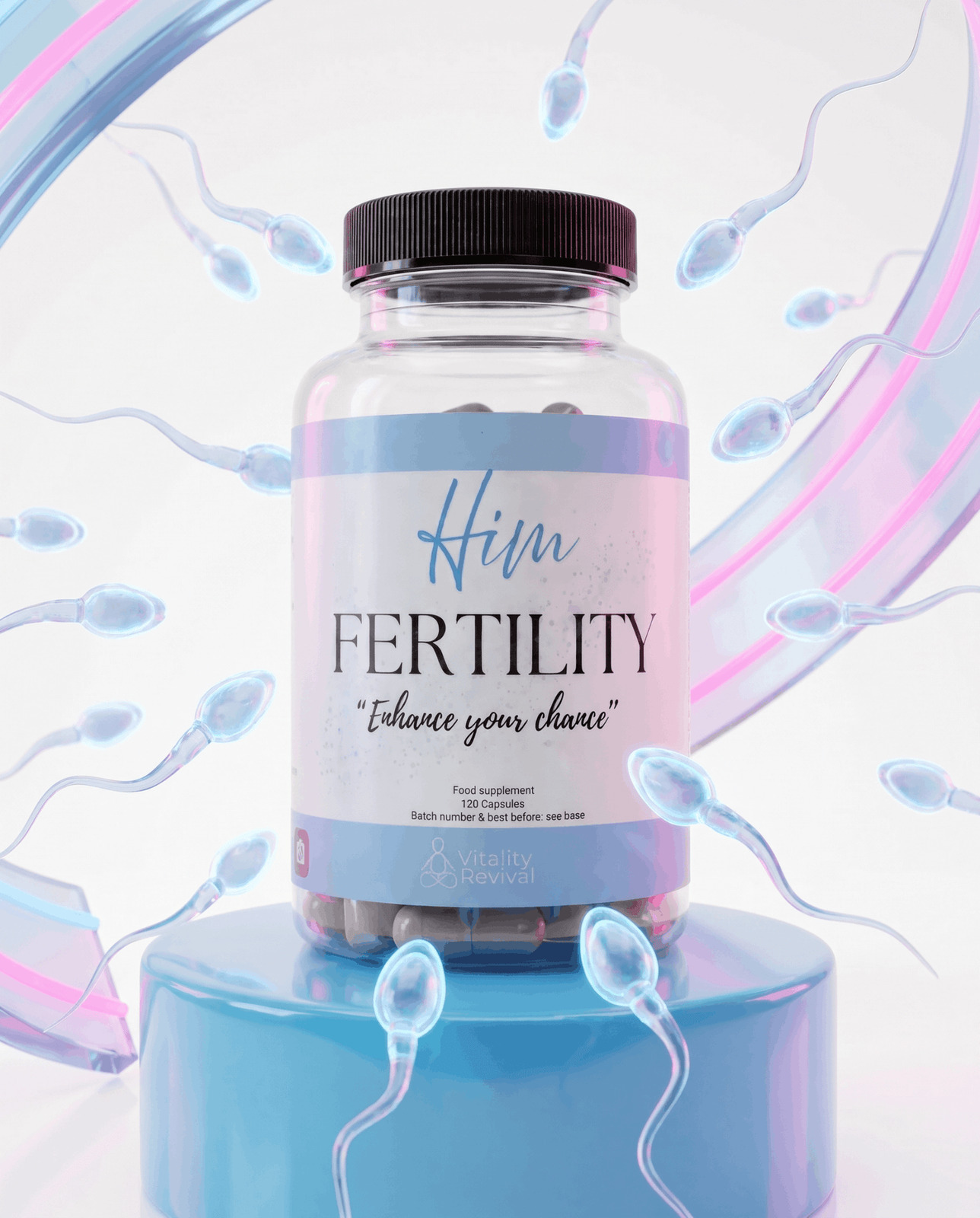
A sperm cycle is 70–90 days. NHS folate advice is three months. HIM FERTILITY and HER FERTILITY are UK-made food supplements built around that clock — CoQ10, zinc, methylfolate, NAC — not a fertility treatment.
What this essay actually tells you
- Human spermatogenesis plus epididymal transit runs about 70–90 days. A semen analysis is a three-month snapshot, not last Tuesday.
- NHS advice is 400 µg folate daily from before conception. Neural-tube closure is week four, often before a positive test, which is why 'I'll start when I'm pregnant' is the wrong clock.
- HIM FERTILITY and HER FERTILITY put CoQ10, zinc, methylfolate and NAC in one tub each. Food supplements. We don't run a fertility clinic, and the ingredients list is the claim.
What this actually means
Spermatogenesis in humans takes roughly 74 days from spermatogonium to a spermatozoon that can be ejaculated, plus epididymal transit of about two weeks. That is why every andrology letter we have seen says come back in three months, and why a semen analysis is a snapshot of last season, not of last Tuesday. DNA in that cell is packed into protamine, then has to survive oxidative stress in a fluid that is not kind to membranes. Motility, morphology and DNA fragmentation are the numbers clinics actually write down. On the other side of the bed, a follicle that ovulates today started work months ago, and neural-tube closure happens in the first 28 days after conception, often before a test is positive. That is why the NHS tells women to take 400 micrograms of folic acid, or equivalent folate, before they try, not after the line is pink. CoQ10, NAC, zinc, selenium, lycopene and methylfolate are the ingredients that show up in the reviews and in the papers. HIM FERTILITY and HER FERTILITY put them in one tub each so nobody is chasing six bottles. They are food supplements. They are not IVF, not clomifene, not a guarantee, and we would rather lose the sale than write the sentence that pretends otherwise.
Human spermatogenesis is a wave, not a morning — a lovely, stubborn clock. Heller and Clermont, using tritiated thymidine in volunteers in the early 1960s, timed the journey from a committed spermatogonium to a spermatozoon released into the seminiferous lumen at about seventy-four days. Epididymal transit adds something like ten to fourteen days, depending on the radioisotope study and the textbook that cites it. Add those clocks and you're looking at seventy to ninety days from a stem-cell decision to a cell a laboratory can count on a Makler chamber. That's why every andrology letter we've seen says come back in three months, and why a semen analysis drawn on a Tuesday is a snapshot of last season's epithelium, not of last Tuesday's supper. The cycle of the seminiferous epithelium in men runs about sixteen days; four such cycles cover the production of one cohort. Amann spent a later career asking people to stop quoting seventy-four as if the epididymis were a corridor without a clock. The sum is stubborn. The thymidine hasn't moved.
In short. A sperm takes about seventy to ninety days to be built, then to leave the epididymis. A lab test today is last season, not last Tuesday.
A semen analysis is that snapshot, written to the WHO laboratory manual, and the numbers on it are centiles, not cliffs. The 2021 sixth edition put the fifth-centile reference limits at about 16 million spermatozoa per millilitre, 39 million per ejaculate, 30 per cent progressive motility, 42 per cent total motility, 4 per cent strict Kruger morphology, volume 1.4 millilitres. Those numbers are centiles from fertile men, not diagnostic cut-offs a clinic treats as a cliff. Computer-aided sperm analysis and a trained technician with a phase-contrast microscope are both legal instruments; they aren't interchangeable without a methods line. Abstinence of two to seven days is part of the pre-analytical, because a short wait under-fills the count and a long one lets motility sag. DNA fragmentation is a separate conversation — TUNEL, sperm chromatin structure assay, 8-oxo-dG — and it isn't on the standard printout. Oxidative nicks in a protamine-packed haploid nucleus are the mechanism most antioxidant stacks are aimed at. If a clinic has asked for antioxidants and zinc, they aren't being mystical. They're buying time on a ninety-day clock, which is the only clock spermatogenesis actually keeps.
In short. A semen test reports count, swimming and shape against WHO numbers. DNA damage is a separate test. The sample reflects months of work, not a weekend.
On the other side of the bed the deadline is earlier than a positive test, which still catches people out. The neural tube of the human embryo closes in the fourth week after conception — cranial neuropore around day twenty-five, caudal around day twenty-eight — often before a period is late and before a line is pink. The Medical Research Council Vitamin Study, Lancet 1991, showed that four milligrams of folic acid prevented most recurrences of neural-tube defects in women who had already had an affected pregnancy. Czeizel and Dudás, New England Journal, 1992, showed a first-occurrence benefit from periconceptional multivitamins that included folic acid. SACN and the NHS took the public-health dose down to 400 micrograms of folic acid daily, started before conception and continued through the first twelve weeks, with five milligrams reserved for higher-risk groups: previous neural-tube defect, some antiepileptic medicines, BMI over 30, a clinician's letter rather than a tub. That's why the advice is three months of folate before you try, not a scramble after the test. The tube has already closed, or it has not.
In short. The baby's neural tube closes in week four, often before a pregnancy test. UK advice is 400 micrograms of folate daily from before you start trying.
HIM FERTILITY and HER FERTILITY put CoQ10, zinc, methylfolate and N-acetylcysteine in one tub each, with the rest of an antioxidant and one-carbon neighbourhood around them, so nobody is chasing six bottles across three shops. They're UK-made food supplements from Vitality Revival, a separate company; Patriot Peptides sells the formulas and doesn't run a fertility clinic. Zinc contributes to normal fertility and reproduction. Selenium contributes to normal spermatogenesis. Folate contributes to maternal tissue growth during pregnancy. Those are authorised claims, written as such. Motility percentages on a semen-analysis letter aren't a licence to caption a checkout as IVF, clomifene, or a pregnancy guarantee. The rest of this page is the epithelium, the midpiece, the one-carbon map and the papers you'd want before deciding what a ninety-day stack can and can't do. The clock is the unit. The tub is a food supplement on that clock.
In short. Two food-supplement tubs put CoQ10, zinc, methylfolate and NAC in one place each. They're not a fertility clinic and they don't promise a pregnancy.
Ninety days is how long a germ cell takes to become a sperm you can count. Marketing departments keep trying to shorten it. Biology has not agreed.— Heller CG, Clermont Y. Spermatogenesis in man: an estimate of its duration. Science. 1963; 140: 184–186. Epididymal transit is the second clock; Amann spent a career saying so.
One spermatogenic wave is the unit of time
The cycle of the seminiferous epithelium is the factory timetable, and in men it runs about sixteen days. A given cross-section of a tubule shows a characteristic association of germ-cell types — spermatogonia, spermatocytes, round spermatids, elongating spermatids — and that association is a stage. Humans have six stages rather than the twelve of the rat; the associations are less tidy, which is why a human biopsy is harder to read than a rodent one and why the duration numbers came from pulse labelling rather than from pretty diagrams. Four cycles, give or take, take a cohort from the committed spermatogonium to spermiation, the release of a spermatozoon into the lumen. Heller and Clermont's seventy-four days is that integral. Misell and colleagues later used stable-isotope labelling of DNA and put the kinetics in a similar band. The important experimental consequence is brutal: a four-week trial of an antioxidant is a trial of a different epithelium from the one that will be in the ejaculate at week twelve. If a paper can't say which wave it treated, it hasn't yet described the intervention.
In short. Sperm are made in repeating waves of about sixteen days. Four waves make one finished cell. A four-week trial hasn't yet seen the cells it thinks it treated.
Epididymal transit is the second clock, and it isn't a corridor. The caput, corpus and cauda are biochemically different neighbourhoods. Spermatozoa leaving the testis are morphologically complete and functionally unfinished: forward motility is acquired along the duct, the membrane is remodelled, cholesterol is taken off, decapacitation factors are added so that the acrosome doesn't fire in the wrong postcode. Tight junctions and a blood-epididymis barrier keep a luminal chemistry that isn't plasma. Carnitine is concentrated here; so is glycerolphosphocholine. Transit time in men is usually quoted at ten to fourteen days, with a cauda store that can sit longer. A high-fever weekend, a hot bath habit, a varicocele, a new medicine, an oxidative insult in the cauda — those can mark cells that were already through spermiation. That's why a second semen analysis is asked for, and why a single bad Tuesday isn't a diagnosis. It's also why an antioxidant stack started today won't rewrite last month's epididymal passengers. The testis writes the cell. The epididymis finishes it. Both take time a caption would rather skip.
In short. After leaving the testis, sperm spend one to two weeks in the epididymis learning to swim. Heat and oxidation can still damage them there.
WHO 2021 numbers are centiles, and the difference matters on a letter. The fifth centile of a fertile reference population isn't the line at which spermatogenesis stops. Plenty of men below 16 million per millilitre conceive; plenty above it do not, because count isn't motility, motility isn't morphology, and none of those is DNA fragmentation or a tubal factor on the other side of the bed. Kruger strict morphology at 4 per cent looks cruel until you remember that the criterion is deliberately harsh — a head shape, an acrosome, a midpiece, a tail, scored under oil — and that the old WHO 1999 15 per cent number was a different system. Computer-aided sperm analysis will give you kinematics (VCL, VSL, LIN, ALH) that a technician's glance will not. A Makler or a Neubauer will give you a concentration that a home kit will not. Name the manual, the abstinence, the days to analysis, and whether the sample was split for a fragmentation assay. A paper that reports 'sperm quality improved' without those has reported a feeling, not a measurement.
In short. WHO cut-offs are the bottom fifth of fertile men, not a cliff. Count, swimming, shape and DNA damage are four different measurements.
DNA fragmentation is the oxidative invoice the standard analysis doesn't print. TUNEL labels free 3′-OH ends. The sperm chromatin structure assay (Evenson) acid-denatures and reads metachromasia as a DNA fragmentation index. 8-oxo-7,8-dihydro-2′-deoxyguanosine is a named lesion on guanine. Comet assays in alkaline buffer pull nicked DNA out of the head. None of these is interchangeable; a 15 per cent DFI on SCSA isn't a 15 per cent TUNEL, and clinics argue about thresholds in the 15 to 30 per cent band for a reason. The mechanism most of the papers actually sit on is reactive oxygen species nicking a nucleus that has traded histones for protamines and has almost no DNA-repair budget left. Aitken, Tremellen, Gharagozloo: the reviews aren't subtle. A fever, a varicocele, a leucocytospermia, a long abstinence, a night of oxidative living — those raise the index. An antioxidant stack is an attempt to lower the generation of those nicks, or to mop them, on the next wave. It isn't a ligase. If you claim a DNA-fragmentation result, run the assay you named, twice, ninety days apart.
In short. DNA damage in sperm is measured with separate tests from the usual semen analysis. Oxidation is the usual mechanism. Repair in that cell is almost gone.
The epithelium that writes a haploid cell
A Sertoli cell is the nurse, the barrier and the clock of the tubule, and the germ cells are passengers on its timetable. Tight junctions between adjacent Sertoli cells form the blood-testis barrier and split the epithelium into a basal compartment, where spermatogonia live, and an adluminal compartment, where meiosis and spermiogenesis run in an immune-privileged fluid that isn't plasma. FSH occupies Sertoli FSH receptors, Gs-coupled, and raises cAMP; androgen-binding protein, transferrin, lactate and a set of paracrine peptides follow. The androgen receptor in the Sertoli cell, not in the germ cell, is the one the knockout literature can't do without: without it, spermatogenesis arrests. Germ cells are passengers on a Sertoli timetable. They move from basement membrane to lumen as the associations progress. A toxin that opens the barrier, a temperature that the scrotum failed to drop (the testis wants something like 34 °C, not 37), a cytokine storm from an orchitis — those are Sertoli problems first. Writing 'sperm quality' as a germ-cell personality misses the cell that actually runs the factory.
In short. Sertoli cells nurse the developing sperm and keep a tight barrier. Male hormones act on those nurse cells. Heat and toxins hit the factory, not just the product.
The germ-cell census has names, and they aren't interchangeable. Type A dark and A pale spermatogonia sit on the basement membrane as the stem and progenitor pool; type B spermatogonia are the ones committed to the next wave. Primary spermatocytes enter meiosis I, a long prophase with leptotene, zygotene, pachytene, diplotene, during which homologous chromosomes pair, synapse and recombine. Crossing-over isn't optional; a recombination failure is an arrest. Secondary spermatocytes exist briefly and divide in meiosis II. Round spermatids are haploid. That haploid genome still has to be transcribed, because a number of spermatid-specific proteins — protamines, transition proteins, the flagellar and acrosomal kit — are written after meiosis, from a genome that no longer has a homologous chromosome to talk to. Then spermiogenesis: Golgi to acrosome, centriole to axoneme, nucleus elongation, cytoplasm shed as a residual body the Sertoli cell eats. Spermiation releases the cell. A morphology score is, among other things, a spermiogenesis score. A count is a stem-cell-to-spermiation score. They fail at different floors.
In short. Stem cells become meiotic cells, and then haploid round cells, then shaped sperm with a head and tail. Count and shape fail at different steps of that ladder.
Spermiogenesis is a construction site with a clock of its own. The acrosome is a Golgi-derived cap, a bag of hydrolases for the zona, assembled in steps a histologist can still stain with periodic acid–Schiff. The manchette, a transient microtubule skirt, helps shape the nucleus and traffic proteins to the tail. The axoneme is a 9+2 microtubule cylinder; outer dense fibres and a fibrous sheath are the mammalian extras; dynein arms are the ATPases that will beat. Mitochondria spiral around the midpiece in a helix that isn't a cartoon. Cytoplasm is stripped. A residual body is phagocytosed. What a Kruger scorer calls a tapered head, a coiled tail, a cytoplasmic droplet left behind, a midpiece defect, is a named failure on this site. Teratozoospermia isn't one disease. Oxidative damage to membranes during the late steps, a temperature insult, a genetic lesion in a flagellar protein (the ciliopathy neighbourhood, DNAH1 and friends) — those are different jobs that look similar on a stained slide. An antioxidant stack is aimed at the first. It won't rebuild a dynein arm.
In short. Shaping a sperm is a construction job: cap, tail, mitochondrial helix, leftover cytoplasm stripped. Odd shapes have many causes. An antioxidant doesn't rebuild a broken tail motor.
The last transcription in that cell is a chromatin event, which is why the transcription diagram belongs on this page and not only on a Pol II essay. Round spermatids still transcribe. CREM, the cAMP-response-element modulator, is the transcription factor the knockout mouse can't spare; without it, spermiogenesis arrests and the adult male is infertile. FSH tone and Sertoli cAMP sit upstream. Protamine genes PRM1 and PRM2, transition-protein genes TNP1 and TNP2, a set of flagellar and acrosomal messages, are written, then the nucleosome is disassembled. Transition proteins replace most histones; protamines replace the transition proteins; cysteine-rich PRM2 in humans forms disulphide bridges that lock the nucleus into a toroid. Humans retain more histone than mice — something like 5 to 15 per cent of the paternal genome stays nucleosomal, at promoters and at imprinted loci, which is why paternal epigenetic memory is a real object and why that genome is more attack-surface than a mouse sperm's. Once protaminated, repair is almost gone. A nick that lands now will still be there at fertilisation. Transcription shut. Packing done. The haploid archive is now a projectile.
In short. Near the end, sperm switch off gene-reading and pack DNA with protamines rather than histones. After that, broken DNA is mostly not repaired.
Diagram
Closed chromatin (H3K27me3, DNA methylation) hides the promoter. Pioneer factors and histone acetyltransferases open it.
PIC: TFIID, TFIIH, Mediator, Pol II. Ser5 phosphorylation of the CTD lets the polymerase leave the promoter.
Elongation ~20–40 nt/s. Capping, splicing, cleavage and polyadenylation happen on the still-growing RNA.
Human genes are islands in 3.1 billion base pairs of mostly noncoding sequence. Promoter, enhancers, chromatin state and the Mediator complex decide whether Pol II is allowed to fire. Epithalon’s literature sits on TERT and pineal clocks — two of the rare promoters anyone bothers to name in a peptide essay.
LH and FSH are the endocrine inputs, and they're second messengers rather than vitamins. LH occupies Leydig-cell LHCGR, a Gs-coupled receptor; adenylate cyclase raises cAMP; protein kinase A phosphorylates StAR; cholesterol enters mitochondria; CYP11A1, 3β-HSD, CYP17A1, 17β-HSD write testosterone. Intratesticular testosterone is orders of magnitude above serum; androgen-binding protein from Sertoli cells holds a luminal store. FSH occupies Sertoli FSHR, also Gs, also cAMP, and the CREM programme above is one of the clients. Exogenous testosterone as a contraceptive, or as a gym drug, shuts LH via negative feedback and empties the intratesticular pool; azoospermia or severe oligozoospermia on a 'testosterone support' history isn't a puzzle. Clomifene and exogenous FSH are clinic objects that occupy this axis. Zinc as a cofactor of steroidogenic enzymes and of androgen-receptor DNA binding is a nutrient on the same campus, not an occupancy. D-aspartic acid has a thin, noisy literature on LH and testosterone; it's in the male tub as a backdrop, not as a 250 milligram testosterone ester. Name the receptor. Name the nucleotide. A food supplement doesn't replace an empty axis.
In short. LH tells Leydig cells to make testosterone via cAMP. FSH talks to Sertoli cells the same way. Extra testosterone from outside switches that signal off.
Diagram
× 1
Ligand
One peptide in one pocket. nM–µM. Shape, not a mood.
× 10–10²
G proteins
The occupied GPCR is a GEF. Each Gα is a catalyst.
× 10³–10⁴
cAMP / IP₃ / Ca²⁺
Adenylyl cyclase and PLC do not make one molecule. They make a cloud.
× 10⁴–10⁶
PKA / PKC / CaMK
Kinases phosphorylate many substrates per messenger.
× tissue
Secretion, transcription, motility
The organism-level readout. Still not a protocol.
This is the only magic, and it is not magic. A nanomolar ligand can move a micromolar messenger because enzymes sit between them. Desensitisation (GRK, β-arrestin, endocytosis) is how the cell refuses to let ‘more ligand’ mean ‘more signal’ forever.
The midpiece is a mitochondrion with a flagellum
Sperm mitochondria are a helix around the midpiece — an endosymbiont still doing the job Margulis named, packed into a compartment a flagellum will spend. The axonemal dyneins hydrolyse ATP at a ferocious rate for a cell that has shed most of its cytoplasm and can't resupply by glycolysis as a muscle fibre can. Some ATP is made along the fibrous sheath by glycolytic enzymes tethered there — a mammalian specialisation, HK1, GAPDH-S, and the rest — and some is mitochondrial, from the helix. Complex I wants oxidised NAD+. Dehydrogenases of what little β-oxidation and residual TCA the cell still runs mint NADH. Electrons walk I, Q, III, cytochrome c, IV. Protons are pumped. ATP synthase spends the voltage. Peter Rich's whole-body 40–60 kilogram ATP turnover isn't this cell's number, but the topology is the same topology, scaled to a projectile. A midpiece defect on a Kruger slide is often a mitochondrial defect you can see. Motility is the physiological readout. Progressive motility at 30 per cent is, among other things, a midpiece invoice.
In short. The midpiece is a spiral of mitochondria that feed the tail motor. Swimming is the readout. A misshapen midpiece is often a mitochondrial problem you can see.
Coenzyme Q10 is ubiquinone — a lipid-soluble redox shuttle in that inner membrane, carrying electrons from Complexes I and II to Complex III, and a chain-breaking antioxidant in the same bilayer. Spermatozoa are unusually dependent on it: the membrane is rich in polyunsaturated fatty acids, the cytoplasm is thin, the antioxidant enzymes are limited, and the cell will live for days in a fluid that generates superoxide. Safarinejad, Journal of Urology 2009: 300 milligrams of CoQ10 in infertile men, a randomised trial, density and motility moved, hormone backdrop included. Lafuente and colleagues, Journal of Assisted Reproduction and Genetics 2013: a meta-analysis in which motility was the cleaner signal than count. Balercia and the Italian asthenozoospermia work sit in the same neighbourhood. Pregnancy and live-birth endpoints in this literature are thinner, which is information rather than a scandal. A quinone can feed a chain and mop a radical without owning a couple's outcome. HIM FERTILITY puts CoQ10 in the male tub for that midpiece job. HER FERTILITY puts 300 milligrams in the female tub for the oocyte-mitochondria job the next heading will name. Same molecule. Two cells. Two jobs.
In short. CoQ10 sits in mitochondrial membranes and also mops radicals. Trials in men show swimming improving more reliably than count. Pregnancy is a harder endpoint.
L-carnitine is how long-chain fatty acids enter mitochondria. Carnitine palmitoyltransferase I on the outer membrane, translocase, CPT II on the inner: the shuttle is older than any fertility caption. Seminal plasma is rich in carnitine, concentrated by the epididymis; sperm oxidise fatty acids as midpiece fuel. Acetyl-L-carnitine is the acetylated form that also donates an acetyl to the CoA pool. Placebo-controlled trials in asthenozoospermia (Lenzi and colleagues, and later combinations with CoQ10) report motility more often than morphology. The honest size is modest. The biochemistry is not. A midpiece that can't import acyl chains won't mint NADH for Complex I, and a tail that can't be paid won't beat. That isn't a reason to treat carnitine as a pregnancy drug. It is a reason to put it in a tub that's already committed to the midpiece, next to CoQ10, and to say so. HIM FERTILITY does that as acetyl-L-carnitine. A clinic that has asked for 'mitochondrial support' on a semen letter is usually pointing at this pair, whether or not the letter used the words.
In short. Carnitine ferries fat into mitochondria so the midpiece can make energy. Male trials again move swimming more than shape. It's fuel handling, not a pregnancy drug.
Reactive oxygen species are the tax on that chain, and spermatozoa pay it at a higher rate than most cells because of the membrane they carry. Docosahexaenoic acid and other long-chain PUFAs in the sperm plasma membrane are there for fusion and for the fluidity capacitation requires; they're also peroxidised at a high rate when superoxide from Complex I and III, or from NOX5, or from a leucocyte in the semen, meets them. Lipid hydroperoxides, 4-hydroxynonenal, malondialdehyde: the aldehydes adduct proteins and DNA and wreck motility before they wreck count. Aitken's laboratory spent decades putting numbers on that. A little ROS is a signal — capacitation itself uses an oxidative step — which is why a total-antioxidant fantasy is as silly as a total-oxidant one. A lot of ROS is a fragmentation index and a motility collapse. The enzymatic mop is superoxide dismutase, glutathione peroxidase (GPx4 in particular, a selenoprotein that moonlights as a structural protein in the midpiece), and catalase. Selenium deficiency is a spermatogenesis lesion in farm animals and a subtler one in men. The nutrient half of the mop is the next heading.
In short. Sperm membranes are rich in fats that oxidise easily. A little oxidation is a normal signal; a lot wrecks swimming and nicks DNA. Selenium enzymes are part of the mop.
Diagram
Matrix
- TCA cycle · β-oxidation · mtDNA nucleoids
- NADH produced here. Complex I spends it.
- MOTS-c (MRWQEMGYIFYPRKLR) from 12S rRNA.
Inner membrane
- I → II → III → IV → V (ATP synthase)
- ~150 mV proton-motive force
- ~40–60 kg of ATP turned over per human day
mtDNA is 16,569 bp, 37 genes, 13 proteins of the respiratory chain. Nuclear DNA encodes the other ~1,200 mitochondrial proteins. NAD+ is the hydride carrier between dehydrogenases and Complex I. MOTS-c is a 16-mer translated from 12S rRNA — a peptide the mitochondrion wrote itself.
- Spermatogenesis
- ~74 days
- Plus epididymis
- 70–90 days
- WHO 2021, 5th centile
- 16 × 10⁶/mL
- Neural-tube closure
- week 4
- NHS folate
- 400 µg daily
- HER FERTILITY folate
- 400 µg 5-MTHF
- CoQ10 male trials
- ~300 mg
- Kruger morphology
- 4%
Heller & Clermont, 1963, tritiated thymidine. Testis only.
The number a semen analysis actually sees. Amann; Misell.
Progressive motility 30%. Strict morphology 4%. Centiles, not cliffs.
Cranial ~day 25, caudal ~day 28. Often before a positive test.
From before conception through twelve weeks. 5 mg in higher-risk groups.
Plus CoQ10 300 mg, NAC 400 mg. Food supplement, not a prenatal protocol.
Safarinejad 2009; Lafuente meta-analysis. Motility cleaner than count.
Strict criterion. A different system from WHO 1999's 15%.
Antioxidants, sized as the papers sized them
Superoxide dismutase, glutathione peroxidase and catalase are the enzymatic half of the mop, and they have cofactors with names. Cu/Zn-SOD (SOD1) and Mn-SOD (SOD2, mitochondrial) dismute superoxide to hydrogen peroxide. Catalase and GPx take the peroxide to water. GPx4 is the interesting isoform in this cell: it reduces phospholipid hydroperoxides in membranes, it's selenium-dependent, and in spermatids it also becomes a structural protein of the mitochondrial capsule. Flohé and colleagues spent a career on that. Selenium as L-selenomethionine is how a tub feeds GPx4; the authorised claim on the label is the quieter 'contributes to normal spermatogenesis', which is the legal sentence, not the blot. Vitamin E (α-tocopherol) is the chain-breaking antioxidant in the PUFA bilayer; vitamin C recycles it in the aqueous phase. Lycopene and astaxanthin are carotenoids that sit in the same membrane neighbourhood with slightly different conjugated-chain lengths. None of these is a second messenger. None of them is FSH. They're reagents the cell already uses, dosed from the diet or from a capsule, aimed at a wave that will take a season to show up on a slide.
In short. Sperm use named enzymes to mop oxidants and those enzymes need selenium, zinc, copper and vitamins E and C. Carotenoids sit in the same membranes.
Zinc is in seminal plasma at millimolar concentrations, which is a remarkable number for a trace metal and a reason the prostate is a zinc tissue. Deficiency maps to hypogonadism and to count: Prasad's work on zinc-deficient states is still the document, and repletion brings testosterone and spermatogenesis back toward range when the lesion was deficiency. Sufficiency is a different experiment. Extra zinc in a replete man does almost nothing to count and may annoy the gut. Zinc is also a chromatin-stability story — it binds protamine-stabilising neighbourhoods — and a superoxide-dismutase cofactor, and a steroidogenic-enzyme cofactor, which is why a single-sentence 'zinc raises fertility' is a category error. The authorised UK claim is that zinc contributes to normal fertility and reproduction. HIM FERTILITY uses zinc citrate; HER FERTILITY uses zinc picolinate at 20 milligrams. Those are salts, not spells. A serum zinc, if you're going to claim deficiency, is a morning sample with the usual caveats about contamination and albumin. We would rather you ran one than guessed. We would rather you did not treat a sufficient plasma zinc as a reason to swallow a horseshoe.
In short. Zinc is abundant in semen. If you're deficient, count and testosterone can fall and then recover. Extra zinc in a replete man does little.
Lycopene and astaxanthin are the carotenoid half, lipid-phase, conjugated double bonds that quench singlet oxygen and scavenge lipid radicals. Tomato-derived lycopene has a small human literature on semen parameters (Gupta, Yamamoto, and later combinations); astaxanthin, a xanthophyll from Haematococcus, has a thinner one. Effect sizes are modest, samples are small, motility and oxidative biomarkers move more readily than live birth. They're in the male tub because the membrane is a PUFA bilayer and because a stack that stops at CoQ10 and selenium has left a lipid-phase gap. They aren't a reason to caption a checkout with a pregnancy rate. Resveratrol sits nearby as a polyphenol with its own noisy mitochondrial-and-sirtuin literature; the male tub uses micronised trans-resveratrol, the female tub uses resveratrol at 150 milligrams, and we won't rerun the Sinclair arguments on a fertility page. A carotenoid is a membrane reagent. A live birth is a couple, a tube, an oocyte, a uterus, and a season.
In short. Lycopene and astaxanthin are coloured fats that protect membranes from oxidation. Human data are small and modest. They're not a pregnancy rate.
N-acetylcysteine is a cysteine donor for glutathione synthesis, a mucolytic in another life, and a glutathione-replenishing nutrient in this one. Glutathione is the substrate GPx spends; a thin GSH pool is a thin mop. Male NAC trials exist and are mixed: some asthenozoospermia cohorts move motility and oxidative markers, some do not, and the Cochrane antioxidant reviews have never been able to turn that mix into a clean live-birth recommendation. The cleaner NAC conversation in a preconception tub is the oocyte and the follicular fluid, where oxidative tone and glutathione sit on oocyte competence in a literature that's still more dish and animal than large human RCT. HER FERTILITY puts 400 milligrams of NAC next to 300 milligrams of CoQ10 for that reason. HIM FERTILITY leans on the carotenoid-and-quinone stack rather than on a large NAC dose. Two cells, two glutathione neighbourhoods, one amino-acid precursor. NAC isn't a fertility medicine. It's a thiol source. Writing it as clomifene doesn't survive contact with either label.
In short. NAC helps the cell rebuild glutathione, the fuel for a selenium enzyme that mops peroxides. Male trials are mixed. It's a thiol source, not a fertility drug.
What actually moves, when it moves, is motility and DNA fragmentation more often than count. That sentence is the one a paper has to keep honest. Count is a stem-cell-to-spermiation integral; an antioxidant started in adulthood won't mint spermatogonia. Motility is a midpiece-and-membrane integral; a quinone, a carotenoid, a carnitine shuttle and a quieter ROS load can change it on the next wave. Morphology is a spermiogenesis integral and moves slowly, if at all, in the food-supplement literature. DNA fragmentation is the nick index and is the endpoint most rationally matched to an oxidative mechanism. Showell and colleagues, in the Cochrane reviews of antioxidants for male subfertility, have repeatedly found that the live-birth evidence is low-quality and heterogeneous: different agents, different doses, different durations, often not a full spermatogenic cycle, often no fragmentation assay, often no female-factor control. A catalogue that keeps modest semen-analysis letters (motility 31 per cent to 44 per cent, morphology 3 per cent to 5 per cent, DNA fragmentation 28 per cent to 21 per cent) is keeping the shape of a food-supplement nudge. A doubling is a different product, not this one.
In short. Swimming and DNA damage move more often than count. Pregnancy evidence for antioxidant capsules is mixed and often low quality. Modest changes are the honest shape.
Folate before the pink line
Neural-tube defects are a closure failure, not a vitamin afterthought. The neural plate folds, the folds meet, the tube becomes a future brain and spinal cord, and the neuropores have to close on a clock that doesn't wait for a pharmacy visit. Failure at the cranial end is anencephaly. Failure at the caudal end is spina bifida, with a range from a closed bony defect to an open myelomeningocele. Folate is the one-carbon donor that nucleotide synthesis and methylation reactions want in a rapidly dividing neuroepithelium. The MRC Vitamin Study Research Group, Lancet 1991, randomised women with a previous affected pregnancy to four milligrams of folic acid and prevented the majority of recurrences. Czeizel and Dudás showed a first-occurrence benefit. Population fortification, where it exists, moved population rates. The UK has been slower than some countries to fortify flour; the NHS advice to take a tablet is the compensation. Week four is the deadline. A positive test at week five is already late for the event you cared about. That isn't scaremongering. It's embryology, dated in days, published in 1991, and it still belongs on this clock, in days.
In short. Neural-tube defects happen when a fold in the early embryo fails to close in week four. Folate prevents many of them. Starting after a positive test is already late.
The NHS number is 400 micrograms of folic acid daily, started before conception and continued through the first twelve weeks. Five milligrams is for higher-risk groups: a previous neural-tube defect, some antiepileptic medicines (valproate and carbamazepine are the named ones), a BMI over 30, coeliac disease or another malabsorptive state, a clinician's letter. SACN has spent years on this brief. The tablet the pharmacy sells is folic acid, pteroylmonoglutamic acid, the oxidised synthetic species, because that's the species the trials used. HER FERTILITY uses 400 micrograms of 5-methyltetrahydrofolate, the circulating reduced species, rather than folic acid alone. The distinction, and it won't be fudged: the neural-tube evidence base is folic acid; methylfolate is the form that doesn't depend on a fully working MTHFR to be reduced, and it's a form a tub can put next to CoQ10 and NAC without pretending the MRC trial has been rerun on 5-MTHF. A preconception formula that puts the folate, the quinone and the thiol in one place is why people stop stacking three bottles. No inositol. We get asked. It isn't in there.
In short. UK advice is 400 micrograms of folic acid daily from before conception. The female tub uses methylfolate at that dose. The big trials used folic acid, and that distinction is worth keeping.
MTHFR is methylenetetrahydrofolate reductase, the enzyme that reduces 5,10-methylene-THF to 5-methyl-THF, the species that donates a methyl to homocysteine via methionine synthase and B12 and so makes methionine, and so makes S-adenosylmethionine. Frosst and colleagues, Nature Genetics 1995, described the common C677T thermolabile variant; heterozygotes are common in European populations, homozygotes less so, and the enzyme runs warmer and worse. Folic acid, to become 5-MTHF, has to be reduced by dihydrofolate reductase and then by MTHFR. 5-MTHF bypasses that last step. Wellness culture has turned MTHFR into a personality. It's a polymorphism with a biochemistry. Most people with C677T don't have a neural-tube defect and don't need a five-milligram tablet; they need the 400 micrograms the NHS already named, in a form the enzyme can handle, and a diet that isn't a folate desert. A tub that uses methylfolate is making a kinetic choice, not a diagnosis. Homocysteine is the blood test if you actually want a one-carbon readout. A direct-to-consumer genotype isn't a clinical folate deficiency.
In short. A common enzyme variant makes folic acid slightly harder to convert to the active folate. Methylfolate skips that step. Most people with the variant still just need the usual dose.
One-carbon metabolism is also a sperm story, which is the sentence male preconception copy keeps forgetting. DNA synthesis in spermatogonia and spermatocytes wants thymidylate. Methylation of the paternal haploid genome — imprints, retained-histone neighbourhoods, the protamine-adjacent remaining nucleosomes — wants SAM. Folate, B12, B6 and choline feed that pool. Male folate status has been associated, in observational work, with sperm DNA fragmentation, with aneuploidy, and with the methylation pattern of the ejaculated cell; intervention data are thinner than the female neural-tube data and should be read as thinner. HIM FERTILITY still puts folate in as 5-MTHF, next to methylcobalamin B12 and P5P, because a haploid archive being packed for delivery is a methylation client. That isn't a licence to tell a man that a methylfolate capsule will rewrite his imprints in a week. It's a licence to stop writing folate as a women's vitamin. The one-carbon map doesn't have a gender. The neural-tube trial does. Hold both.
In short. Folate also feeds DNA building and DNA marking in sperm. That evidence is thinner than the neural-tube trials. It's still a reason men aren't a folate-free zone.
Choline and B12 are the rest of the neighbourhood, and they belong in the same heading so folate doesn't become a lonely hero. Methionine synthase uses B12 as methylcobalamin to take the methyl from 5-MTHF onto homocysteine. Without B12, folate is trapped as 5-MTHF and thymidylate synthesis starves — the methyl-trap, a haematology sentence that's also a dividing-neuroepithelium sentence. HER FERTILITY uses 500 micrograms of methylcobalamin. Choline, as betaine after oxidation, is an alternative methyl donor via betaine-homocysteine methyltransferase, and it's a phospholipid precursor for membranes and for very-low-density lipoprotein in a liver that pregnancy will tax. The female tub uses 200 milligrams of choline as L-bitartrate. That's a nutrient dose, not a phosphatidylcholine infusion. Iodine and selenium, in the same tub, are thyroid-peroxidase and deiodinase cofactors; the UK diet still undershoots iodine in a subset of women of childbearing age, and a thyroid that can't write T4 is a fertility and a neurodevelopment problem before it's a wellness problem. Run TSH. Run ferritin. The unfashionable blood tests still outperform a new bottle.
In short. B12, choline, iodine and selenium sit next to folate in the same metabolic neighbourhood. A thyroid test and a ferritin beat a new bottle if those are the holes.
The oocyte is not a faster sperm
A follicle that ovulates today started work months ago, not this morning, which is the sentence a cycle-day-one start keeps missing. Primordial follicles are the census a woman is born with. A cohort is recruited, grows through primary and secondary stages, becomes antral, and one follicle in a natural cycle becomes dominant and ovulates. Anti-Müllerian hormone, written by granulosa cells of small growing follicles, is a census readout, not a pregnancy prediction. FSH occupies granulosa FSH receptors — Gs, cAMP, the same nucleotide family as the Sertoli story, a different cell — and aromatase writes oestradiol from thecal androgen. The oocyte inside has been arrested in meiosis I since fetal life, which is a stunning sentence and the reason maternal age is an aneuploidy story: the cohesins holding bivalents together have been sitting there for decades. A twenty-eight-day cycle is the visible metronome. The hidden metronome is the months of granulosa and thecal work, and the decades of arrest. Writing a preconception tub as something you start on day one of a cycle you hope to conceive in is the same category error as a four-week sperm trial. The factory opened earlier.
In short. The egg that ovulates today has been growing for months and its chromosomes have been paused since before birth. Starting a tub on day one of that cycle is already late.
Oocyte mitochondria are the other CoQ10 client. An oocyte has something on the order of 10⁵ mitochondrial genomes, a stockpile the early embryo will live on until mitochondrial biogenesis restarts. Membrane potential, ATP for spindle assembly, and the fidelity of chromosome segregation are mitochondrial jobs in this cell. Ben-Meir, Aging Cell 2015: CoQ10 declined with reproductive ageing in mouse oocytes and in human follicular fluid, and CoQ10 supplementation restored mitochondrial function and fertility in the aged-mouse experiments. Human interventional data since have been mixed and often underpowered — IVF additive studies with CoQ10, some reporting more mature oocytes or better embryology, some not, live birth still the scarce endpoint. The correlative human half of Ben-Meir is a follicular-fluid number, not a guarantee. HER FERTILITY puts 300 milligrams of CoQ10 next to NAC 400 milligrams because glutathione and the quinone are the two reagents that literature keeps naming. It doesn't put them there as an IVF protocol. A clinic that has asked you to take CoQ10 for three months before an egg collection is speaking this neighbourhood. Show them the label. Their protocol wins if it conflicts.
In short. Eggs carry a huge mitochondrial stockpile. CoQ10 in that neighbourhood falls with age in mice and in human follicular fluid. Human outcome trials are still mixed.
Iron is the unfashionable one, and pregnancy will spend it. Ferritin in the teens is an afternoon that falls over, a haemoglobin that hasn't yet moved, a thyroid conversion that's already quieter than it looks. The fetus, the placenta and the expansion of maternal red-cell mass are an iron invoice measured in hundreds of milligrams. Bisglycinate is a chelate that's kinder to the gut than sulphate; HER FERTILITY uses 10 milligrams of iron as bisglycinate, a preconception maintenance dose, not a treatment for a ferritin of 8. If the ferritin is 8, that's a clinician and a different milligram number. Vitamin C in a meal helps non-haem absorption; tea at the same moment does not. B12 and folate, already in the tub, are the other two ingredients of a megaloblastic picture that a ferritin alone will miss. We would rather you ran FBC, ferritin and TSH than inferred them from how the afternoon feels. A preconception tub that omits iron is a tub built for a catalogue photograph.
In short. Pregnancy spends iron. A gentle iron salt in a preconception tub is maintenance, not treatment of a very low ferritin. Blood tests still win.
Iodine and selenium are thyroid cofactors the UK diet still misses in a subset of women who will be pregnant by spring. Thyroid peroxidase iodinates thyroglobulin; deiodinases, which are selenoproteins, convert T4 to T3 in tissues. A TSH at the upper end of the reference range is a conversation in a woman trying to conceive in a way it isn't always in a man of the same age, because even modest hypothyroidism associates with subfertility, miscarriage and, at the population edge, with neurodevelopmental cost. SACN and the iodine surveys of UK schoolgirls and pregnant women are the documents; milk and white fish are the dietary half; 150 micrograms of iodine in a tub is the RNI-shaped half. Selenium at 200 micrograms as selenomethionine feeds GPx and the deiodinases. HER FERTILITY puts both next to 2,500 IU of vegetarian vitamin D3, because UK winter 25-OH D is a national joke and because endometrial and immune neighbourhoods care. None of this starts ovulation. Clomifene starts ovulation. Letrozole starts ovulation. A recombinant FSH pen starts a stimulation cycle. Minerals do not. Saying that out loud is the point of a food-supplement page that also sells the tub.
In short. Iodine and selenium help the thyroid make and activate its hormone. UK diets often undershoot iodine. They don't start ovulation; fertility drugs do.
Two tubs, one clock
HIM FERTILITY is the male preconception formula as four capsules a day, 120 capsules, a thirty-day tub on a ninety-day job — which is why the how-to says stay on it. CoQ10, acetyl-L-carnitine, zinc citrate, selenium as selenomethionine, lycopene, astaxanthin, micronised trans-resveratrol, liposomal vitamin C, vitamin E, KSM-66 ashwagandha, D-aspartic acid, shilajit, three-colour maca, boron, vegetarian D3, B vitamins including P5P and methylcobalamin, folate as 5-MTHF. The authorised claims that can be written on a UK label are the zinc and selenium ones named above. The rest is the neighbourhood those claims aren't standing in an empty tub. KSM-66 is the HPA-axis adaptogen with modest testosterone and cortisol RCT data in stressed men — the Revive essay next door owns that argument — sitting here as a hormone backdrop, not as a spermatogonium. D-aspartic acid is a thin LH literature. Saffron is a mood literature. None of those three is CoQ10. The oxidative-and-midpiece half is the half a semen-analysis letter is entitled to care about. Food supplement. Not a fertility treatment. Made in the UK, vegetarian capsules, GMP.
In short. The male tub is CoQ10, carnitine, zinc, selenium and an antioxidant stack in four capsules a day, built for a ninety-day sperm cycle. Food supplement, not a treatment.
HER FERTILITY is the female preconception formula as four capsules a day on the same ninety-day planning habit. KSM-66 600 milligrams, NAC 400 milligrams, CoQ10 300 milligrams, 5-MTHF 400 micrograms, choline 200 milligrams, iron bisglycinate 10 milligrams, zinc picolinate 20 milligrams, selenium 200 micrograms, iodine 150 micrograms, methylcobalamin 500 micrograms, vegetarian D3 2,500 IU, royal jelly, green tea extract, resveratrol, three-colour maca. Folate contributes to maternal tissue growth during pregnancy: that's the authorised claim. The tub doesn't make an egg appear. No inositol, which is the question from the PCOS aisle, and the answer is that this formula wasn't built as a metformin-adjacent insulin stack. If a clinician has you on myo-inositol, that's their protocol and this label doesn't replace it. If you're already pregnant, ask the midwife or GP which prenatal they want you on, because the neural-tube job of this tub is the months before the line is pink and the iron-and-iodine job of pregnancy may want a different milligram number. Preconception is a window. A prenatal is a different window.
In short. The female tub is methylfolate, CoQ10, NAC, iron, choline and thyroid minerals. It's a preconception formula, not a pregnancy-start button and it has no inositol.
Four capsules a day for ninety days is the protocol because the epithelium and the folate advice share a clock. A thirty-day tub is a month of that clock, not the clock. Couples who start both tubs on the same Monday are doing the only synchronisation biology actually offers: his next semen analysis will have seen the stack, her next cycle will have seen the folate, and the neural tube, if there is one, won't be asked to close on a deficiency. The reviews in the catalogue that mention semen-analysis letters — motility in the low thirties to the mid-forties, morphology 3 per cent to 5 per cent, DNA fragmentation 28 per cent to 21 per cent — are the shape of a food-supplement result. Count barely moving is also the shape. We keep those numbers because they're modest and achievable. A fever in month two will still mark a wave. A new vape habit will still oxidise a membrane. A varicocele will still be a varicocele. The stack is a neighbourhood, not a surgery.
In short. Both tubs are four capsules a day for three months, because sperm and folate share that clock. Honest semen-test changes are modest. A doubling isn't this product.
What we won't claim is the rest of the heading, and it's worth being plain. We won't say these tubs get you pregnant. We won't say they replace a clinic. IVF medication, varicocele ligation, tubal surgery, azoospermia, a 47,XXY karyotype, a CFTR compound heterozygote with congenital absence of the vas, premature ovarian insufficiency, a blocked hydrosalpinx: different rooms, different letters, different people. The formulas are for the months you're trying, or the months a clinic asked you to spend on antioxidants and folate while you wait for a cycle. Clomifene occupies hypothalamic and pituitary oestrogen receptors. Recombinant FSH occupies granulosa and Sertoli receptors. A hCG trigger occupies LH receptors. CoQ10 occupies a quinone pocket in a respiratory complex. Zinc occupies a catalytic and structural site on proteins. 5-MTHF donates a methyl. Those are five different kinds of occupancy, and only the first three are medicines. Patriot Peptides sells the tubs as food supplements. Vitality Revival is a separate company; their own site stays on the page. If that sounds unromantic, good. Fertility copy could use less romance and more clocks.
In short. These tubs won't be described as getting you pregnant or as replacing a clinic. Medicines occupy receptors. Nutrients feed enzymes. Different jobs, different law.
Diagram
| Node | Catalogue | Conversation |
|---|---|---|
| GPCR | Ipamorelin, MT2, PT-141, retatrutide, CJC | Second messengers, secretion, appetite, pigment |
| RTK / IGF1R | IGF-1 LR3 | IRS–PI3K–Akt–mTOR and Shc–ERK |
| Cytokine receptor | Somatropin (HGH) | GHR–JAK2–STAT5b, hepatic IGF-1 |
| Cofactor | NAD+ | Sirtuins, PARPs, CD38, redox |
| Actin buffer | TB-500 / Tβ4 motif | G-actin sequestration, motility |
| Growth-factor-like | BPC-157 | VEGFR2 / FAK / eNOS neighbourhood |
| Copper ligand | GHK-Cu | Transcriptome shift in fibroblasts |
| MC fragment | KPV | NF-κB, PepT1, no pigment |
| Nuclear / pineal | Epithalon (AEDG) | TERT and melatonin literatures |
| mtORF peptide | MOTS-c | AMPK, folate–methionine cycle |
Each row is a different kind of molecular conversation. The catalogue peptides bind at these nodes; they are not interchangeable, and stacking them because a forum did mixes unrelated literatures.
What a clinic letter actually contains
A serious male work-up isn't one semen analysis. Two samples, WHO 2021, abstinence stated, then, if the numbers stay down, a hormonal panel (morning testosterone, LH, FSH, prolactin, TSH), a scrotal ultrasound if a varicocele or a missing vas is in question, a karyotype and Y-chromosome microdeletion panel if the count is severely oligozoospermic or azoospermic, CFTR if the vas is absent. Azoospermia splits into obstructive and non-obstructive, and those are different operations, different prognoses, different uses of a food supplement (almost none, in true non-obstructive azoospermia). DNA fragmentation is the extra assay when morphology and motility are the complaint, or when there are recurrent miscarriages, or when IVF has produced poor embryos without an obvious female factor. Oxidative stress assays on semen exist and are less standardised. An antioxidant stack sits next to this letter as an adjunct while you wait, or while a varicocele decision is made, or while a couple tries for another three months. It doesn't sit on the letter as the investigation.
In short. A proper male work-up is two semen tests, hormones, and, if the count is very low, genetics and a scan. A capsule is an adjunct, not the investigation.
A serious female work-up isn't a folate tablet either. History, BMI, cycle regularity, TSH, rubella, a chlamydia screen, a mid-luteal progesterone if you're dating ovulation, AMH and an antral-follicle count if time or age is the question, a tubal test (HyCoSy or HSG) if you've been trying long enough for anatomy to matter, a partner's semen analysis so you aren't investigating one person in isolation. PCOS is a Rotterdam or international-guideline diagnosis, not a chin; inositol and metformin live in that drawer and not in HER FERTILITY. Premature ovarian insufficiency is FSH in the menopausal range under forty, and it isn't a CoQ10 deficiency. Endometriosis is a surgical and imaging conversation. A BMI over 30 is both a fertility factor and the reason the folate dose on the NHS letter may already be five milligrams. The tub is for the months around those letters, for the iron and the iodine and the 400 micrograms and the quinone, not for the letters themselves. If a clinic has given you a stimulation protocol, their medicines occupy receptors this catalogue doesn't sell.
In short. A proper female work-up is hormones, tubes, BMI and the partner's sample. PCOS, early menopause and endometriosis are clinic objects. The tub sits beside that work, not on it.
When the tub is in the way is a shorter paragraph, and it deserves to be. If you're already on a stimulation cycle, ask before you add antioxidants a trialist did not dose. If you're on antiepileptics, the five milligrams of folic acid is a clinician's tablet, not 400 micrograms of methylfolate as a substitute. If you have haemochromatosis, extra iron is a mistake. If you have a thyroid clinic, extra iodine can be a mistake in some autoimmune pictures; their TSH and TPO antibodies win. If you're taking a medicine with a folate interaction (methotrexate is the extreme, some antibacterials the milder), that's a pharmacist. If the semen analysis is azoospermia, a CoQ10 capsule isn't the next step; a karyotype is. If there is a hydrosalpinx, a tubal surgeon is. Patriot Peptides will sell you the formulas. We won't talk you out of a letter you already know you need. The useful use is the couple who are trying, or waiting, whose investigations are normal or near-normal, who would otherwise buy six bottles, and who can tell a ninety-day clock from a miracle.
In short. Skip or check the tub if you're already in a stimulation cycle, on high-dose folate for epilepsy, iron-overloaded, or azoospermic. Investigations still come first.
How to read a fertility-supplement paper
Name the endpoint, because 'sperm quality' isn't one. Concentration, total count, progressive motility, total motility, strict morphology, DNA fragmentation index, seminal ROS, pregnancy, clinical pregnancy, live birth, miscarriage: each is a different integral over a different biology. A paper that moves motility and doesn't report live birth has moved motility. A paper that reports pregnancy without saying how long the couples were trying, how old the women were, and whether tubes were patent has reported a number you can't use. Live birth is the endpoint couples care about and the one this literature is worst at. That isn't a reason to ignore a well-run motility trial. It's a reason not to caption a tub with a live-birth percentage. Duration has to cover a wave: twelve weeks is the minimum that deserves the word spermatogenic; four weeks is a different epithelium. Abstinence windows have to match. Drop-outs have to be counted. Industry-adjacent studies have to be read as such. The Cochrane authors have been saying this for a decade. They aren't being difficult. They're being careful about the measurement.
In short. Count, swimming, shape, DNA damage, pregnancy and live birth are different endpoints. A twelve-week study has seen a sperm cycle; a four-week study has not.
Heterogeneity is the reason a meta-analysis of 'antioxidants' is often a collage. CoQ10 isn't vitamin E isn't a cocktail of six carotenoids plus zinc. Three hundred milligrams isn't 30 milligrams. Asthenozoospermia isn't oligozoospermia isn't mixed. A varicocele left in isn't a varicocele ligated. Female age of 28 isn't female age of 41. Showell, Cochrane, the successive updates: more live births in some pooled analyses, evidence quality low, adverse-event reporting poor, the moment you split by agent the signal wobbles. That pattern is information. It says a neighbourhood of oxidative biology is real, and that the capsule as a clinical instrument is under-specified. A single-agent CoQ10 trial in idiopathic asthenozoospermia, ninety days, WHO 2021 motility, a fragmentation assay, a registered protocol, a live-birth follow-up: that paper would earn more sentences than another cocktail in thirty men for four weeks. Until it exists in bulk, a food-supplement tub is a neighbourhood you can buy in one place, labelled as such, with authorised claims that don't wander onto live birth.
In short. Lumping every antioxidant into one meta-analysis hides dose, duration and which men were studied. The biology is real. The capsule as a pregnancy instrument is still under-specified.
Authorised health claims are the legal floor in the UK, and they're narrower than a forum. Zinc contributes to normal fertility and reproduction. Selenium contributes to normal spermatogenesis. Folate contributes to maternal tissue growth during pregnancy. Supplemental folic acid intake increases maternal folate status; low maternal folate status is a risk factor for neural-tube defects. Those sentences have been through a process. 'Raises motility 40 per cent' has not. 'Gets you pregnant' has not. MHRA and the Advertising Standards Authority are the rooms those last two sentences die in, and they should. A catalogue that sells the tub and also writes the physiology at Cell-desk length is trying to have both an honest mechanism and a legal class. The mechanism is oxidative phosphorylation in a midpiece, one-carbon transfer in a neuroepithelium, a selenoprotein in a mitochondrial capsule. The legal class is food supplement. Mixing the two into a medical claim is how a label becomes a problem. Keeping them in the same page, named, is how you get to see both the chemistry and the legal class.
In short. UK labels may say zinc, selenium and folate do specific jobs. They may not say a tub raises motility by a percentage or gets you pregnant.
- Name the clock: 70–90 days. A four-week trial is a different epithelium.
- Name the endpoint: count, motility, morphology, DFI, pregnancy, live birth. They are not interchangeable.
- Name the assay: WHO 2021, Kruger, SCSA versus TUNEL, abstinence window.
- Name the drain: ROS, varicocele, fever, a toxin, an empty axis. Antioxidants are not a surgery.
- Name the authorised claim if you are writing a label. Motility percentages are not one.
- Write the washout, the partner's age and tubes, and whether a clinic protocol already occupies the receptors.
Close: ninety days, public papers, food supplements
The clock is conserved enough to take seriously and human enough not to steal from a rat. Seventy-four days of spermatogenesis, ten to fourteen of epididymis, a sixteen-day epithelial cycle, a neural tube that closes in week four, a follicle that was recruited months ago, an oocyte whose cohesins have been sitting since fetal life. Those numbers are why a preconception habit is a season and not a long weekend. They're why a semen analysis is a rear-view mirror. They're why NHS folate advice and an andrology letter, for once, agree on ninety days. Conservation with rodents is what gave us the stage maps and the CREM knockout and the GPx4 story. Human timing, human WHO centiles, human MRC doses are what you actually write a tub around. A mouse CoQ10 paper is a licence to measure. It isn't a licence to caption a checkout. The popular story got loud because fertility is a human emergency dressed as a shop. The work got slow because the epithelium doesn't read the shop.
In short. Sperm take a season, the neural tube closes in week four and an egg has been growing for months. That's why preconception is ninety days, not a long weekend.
The public papers are a fortnight of evenings, not a personality. Heller and Clermont, Science 1963, the thymidine clock. WHO 2021, the centiles. MRC Vitamin Study, Lancet 1991, and Czeizel, New England Journal 1992, the neural tube. Frosst, Nature Genetics 1995, MTHFR C677T. Safarinejad, Journal of Urology 2009, and Lafuente's meta-analysis, CoQ10 and motility. Ben-Meir, Aging Cell 2015, CoQ10 and the aged oocyte. Aitken and Tremellen, the oxidative reviews. Showell, Cochrane, the live-birth caution. Prasad on zinc deficiency. Flohé on GPx4. Evenson on SCSA. Amann on why epididymal transit belongs in the sentence. SACN on folate and iodine. That's a reading list. The restoration headlines and the forum doublings will still be there when you come back, and they will look smaller. A Makler chamber, a TUNEL slide, a ferritin, a TSH and a 400-microgram habit will look larger. They should.
In short. Named papers cover the sperm clock, WHO numbers, folate trials, CoQ10, oocyte mitochondria and the caution about live-birth claims. Read those first.
Leave with a map of the biology, not a basket of products. Spermatogenesis plus epididymal transit is seventy to ninety days; a semen analysis is that integral. Motility and DNA fragmentation are the endpoints an oxidative stack can rationally touch; count is less movable in a finished adult epithelium. The midpiece is a mitochondrion: CoQ10, carnitine, NAD+ as the hydride coin Complex I wants oxidised, GPx4 as a selenoprotein. Folate is a one-carbon donor with a fourth-week deadline the NHS already printed; methylfolate is the circulating species, folic acid is the trial species, and both sentences are required. The oocyte is a decades-long meiotic arrest plus a mitochondrial stockpile; CoQ10 and NAC sit on that literature without owning IVF. HIM FERTILITY and HER FERTILITY are UK-made food supplements that put those reagents in one tub each. Clomifene, recombinant FSH and a karyotype are different objects. If your month needs the stack, start now so the next wave sees it. If it needs a medicine, this catalogue doesn't sell one.
In short. Carry this: ninety days, swimming and DNA nicks, a midpiece mitochondrion, folate before week four, two food-supplement tubs. Medicines are a different shelf.
Gametes age, and they don't age as the same object. Sperm DNA fragmentation and motility trend the wrong way with paternal years, oxidative tone and a longer history of fevers and habits; the stem-cell pool usually still produces a count. Oocytes accumulate aneuploidy as cohesins tire, mitochondrial CoQ10 sags, and the census (AMH, antral count) falls; that's the sharper clock, and it isn't a thiol deficiency. A ninety-day stack is a neighbourhood you can tidy. It isn't a decade you can rewind. CD38 and NAMPT and the NAD+ budget of ageing soma are a neighbouring essay, a dinucleotide the midpiece also spends, a research-use-only reagent in the catalogue if you came here from that page. These tubs aren't that reagent. They're zinc, selenium, a quinone, a thiol and a folate, dosed for a season, labelled as food. Ageing of a gonad is a research programme and a clinic letter. It isn't a line on a vegetarian capsule.
In short. Sperm and eggs age differently: DNA nicks and swimming in men, chromosome errors and a falling census in women. A ninety-day stack tidies a neighbourhood. It doesn't rewind years.
HIM FERTILITY and HER FERTILITY are food supplements, not medicines, not fertility treatments, and not a substitute for a varied diet, a clinic letter, or a ninety-day calendar. Distributed by Vitality Revival, made in the UK, sold here because the clock and the ingredients are the same conversation. Don't exceed the labelled intake. If you're pregnant, breastfeeding, on medication, under a stimulation protocol, or already holding a diagnosis that lives in a different room, ask the clinician who owns that room before you open the tub. The physiology in the paragraphs above is public, cited, and older than the capsule. Use it to decide whether a season of CoQ10, zinc, methylfolate and NAC is the adjunct you actually wanted. We will sell you the formulas. We won't tell you they close a neural tube by themselves, double a count, or stand in for a karyotype. The unit of time is ninety days. The legal class is food supplement. Both have to be true at once, or the page is an advert.
In short. These tubs are food supplements, not medicines. Start three months early, ask a clinician if you're already in a protocol, and keep the claim the size of the label.
Questions the essay actually answers
- Why ninety days?
- Human spermatogenesis plus epididymal transit is on the order of 70–90 days (Heller & Clermont; Amann). NHS folate advice is at least three months before trying, because the neural tube closes in week four. Same clock, two sides of the bed. Start now if you want the next semen analysis or the next cycle to have seen the stack.
- Will HIM FERTILITY raise my sperm count?
- Antioxidant stacks (CoQ10, zinc, selenium, lycopene, astaxanthin, L-carnitine) have the cleaner data on motility and DNA fragmentation. Count is a stem-cell-to-spermiation integral and is less movable. Food supplement, built around a 90-day cycle. Not a fertility treatment. The semen-analysis letters we see look like motility 31% to 44%, not a doubling.
- Is HER FERTILITY a prenatal?
- It is a preconception formula: 400 µg 5-MTHF, CoQ10 300 mg, NAC 400 mg, iron bisglycinate, choline, iodine, selenium, methylcobalamin. No inositol. If you are already pregnant, ask your midwife or GP which prenatal they want you on. This tub was built for the months before the line is pink.
- Why methylfolate rather than folic acid?
- The neural-tube trials used folic acid (MRC 1991; Czeizel 1992). 5-methyltetrahydrofolate is the circulating reduced species and bypasses MTHFR C677T. HER FERTILITY uses 400 µg 5-MTHF, the NHS public-health dose, without pretending those RCTs have been rerun on methylfolate. Higher-risk groups still need a clinician's 5 mg folic acid, not a tub.
- Do men need folate too?
- One-carbon metabolism feeds DNA synthesis and methylation in spermatogonia and in the haploid genome being packed. Observational links to fragmentation and aneuploidy exist; intervention data are thinner than the female neural-tube trials. HIM FERTILITY still includes 5-MTHF next to methylcobalamin. Folate is not a women's vitamin. The MRC trial was.
- What did CoQ10 trials in men actually show?
- Safarinejad 2009 and the Lafuente meta-analysis report motility — and sometimes density — moving at doses around 300 mg. Live-birth evidence is thinner. Cochrane reviews of mixed antioxidants for male subfertility remain low-quality on the endpoint couples care about. A quinone can feed a midpiece without owning a pregnancy.
- What is a semen analysis measuring?
- WHO 2021 fifth centiles: about 16 million/mL, 30% progressive motility, 4% strict Kruger morphology. Two samples, 2–7 days' abstinence. DNA fragmentation (TUNEL, SCSA) is a separate assay aimed at oxidative nicks. A Tuesday sample is last season's epithelium, not last Tuesday.
- Can I take these tubs during IVF?
- Ask the clinic. Many protocols already include CoQ10, folate and an antioxidant for three months before a collection; many do not want extra iron, extra iodine, or an unlisted botanical in stimulation. Show both labels. Their occupancy of FSH and LH receptors is the medicine. The tub is a food supplement.
- What will you not claim?
- We won't claim these tubs get you pregnant, replace a clinic, treat azoospermia, open a tube, close a neural tube by themselves, or double a count. Zinc, selenium and folate have authorised UK claims. Motility percentages on a letter are not a licence to wander past them.
- Are HIM FERTILITY and HER FERTILITY medicines?
- No. UK-made food supplements from Vitality Revival, a separate company, sold here as food supplements. Not clomifene, not recombinant FSH, not a fertility treatment. If you need those, you already know which building.
The formulas in the essay
UK-made food supplements from Vitality Revival — sold here as a separate company’s formulas, not medicines.
 Food supplementSave £5.00
Vitality Revival
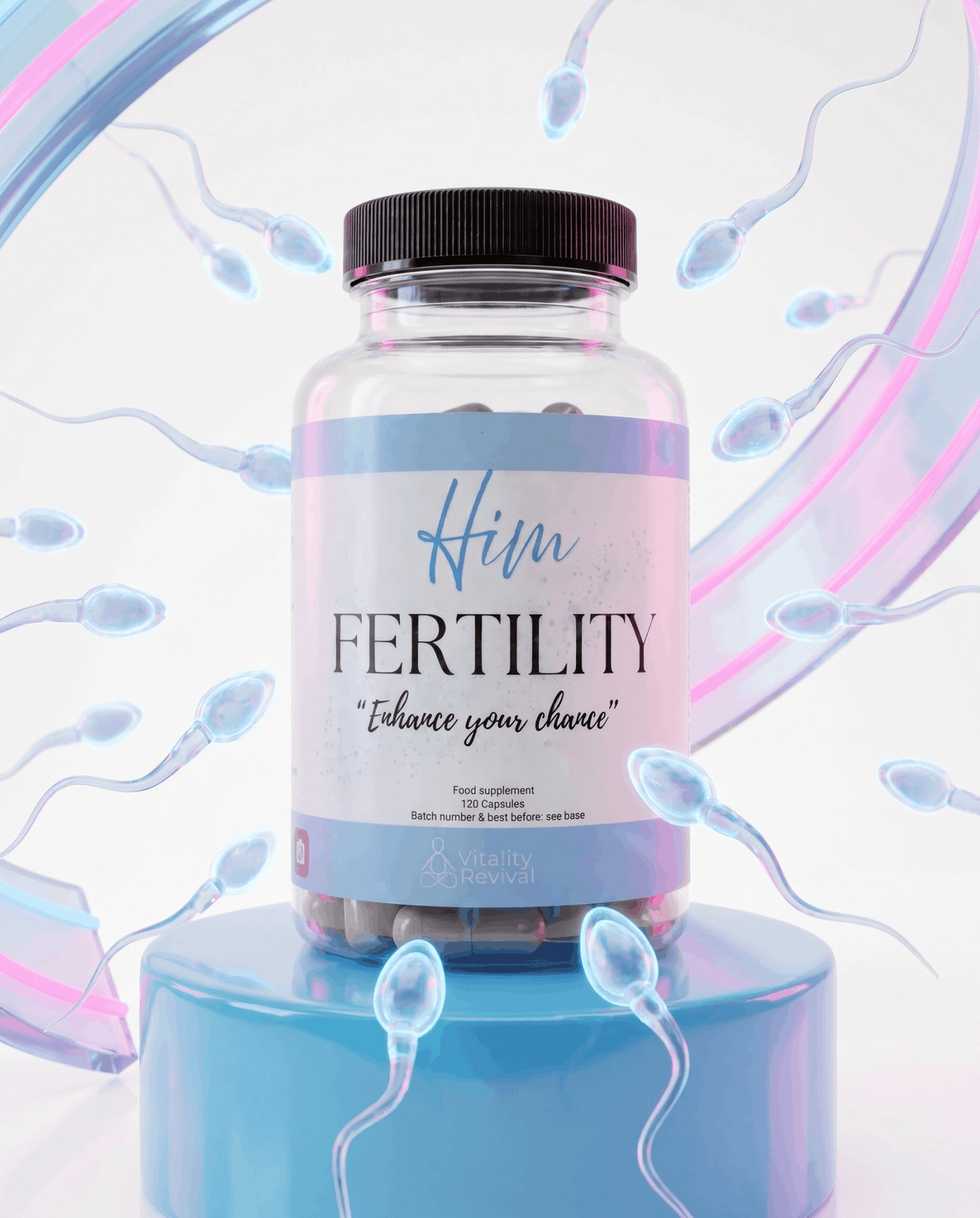
HIM FERTILITY
Male fertility support
4.6(606)
103 browsing this now · 4 purchased in the last 24 hours
120 capsules · 30 days
£49.99
£54.99
Read next
50 min · long read · Wellbeing
Food supplements and hormones: what the evidence actually supports
Ashwagandha, zinc, fenugreek and saffron have published, modest effects on hormones, stress and mood. HIM REVIVE and HER REVIVE are food supplements built around those ingredients — not TRT, not HRT.
49 min · long read · Metabolism
Regulating blood sugar: the control system
Glucose is a tightly bound variable. Here is the hardware — pancreas, liver, muscle, incretins — and the places it fails.
49 min · long read · Metabolism
Protein, training and muscle protein synthesis
Muscle isn't a mood. It is mechanical tension plus a leucine-gated translational programme. Here is the dose, the threshold, and why the gym still has to happen.
Essays describe published research. They are not medical advice and they do not authorise human use of any catalogue item.