

Bodybuilding · 8 min · 1,720 words
SARMs: a different shape in the same receptor
Ostarine, LGD-4033 and RAD-140 are not steroids. They still occupy the androgen receptor, and the papers already show what that does to testosterone, SHBG and HDL.
What this essay actually tells you
- Ostarine, LGD-4033 and RAD-140 are not steroids. They still occupy the androgen receptor. None of them is an approved physique drug.
- Basaria 2013: three weeks of LGD-4033 in healthy men raised lean mass at 1 mg and lowered testosterone, SHBG and HDL. The hypothalamus reads occupancy, not the shape of the molecule.
- Selective was a hope about prostate versus muscle. It was never an exemption for the hormone axis. Half-life of the capsule and recovery of LH are different clocks.
What this actually means
SARMs such as ostarine, LGD-4033 and RAD-140 are nonsteroidal molecules that sit in the androgen receptor. A three-week study of LGD-4033 in healthy men raised lean mass and lowered testosterone, SHBG and HDL. The brain does not spare you because the molecule is not a steroid: hypothalamic androgen receptors still quiet GnRH.
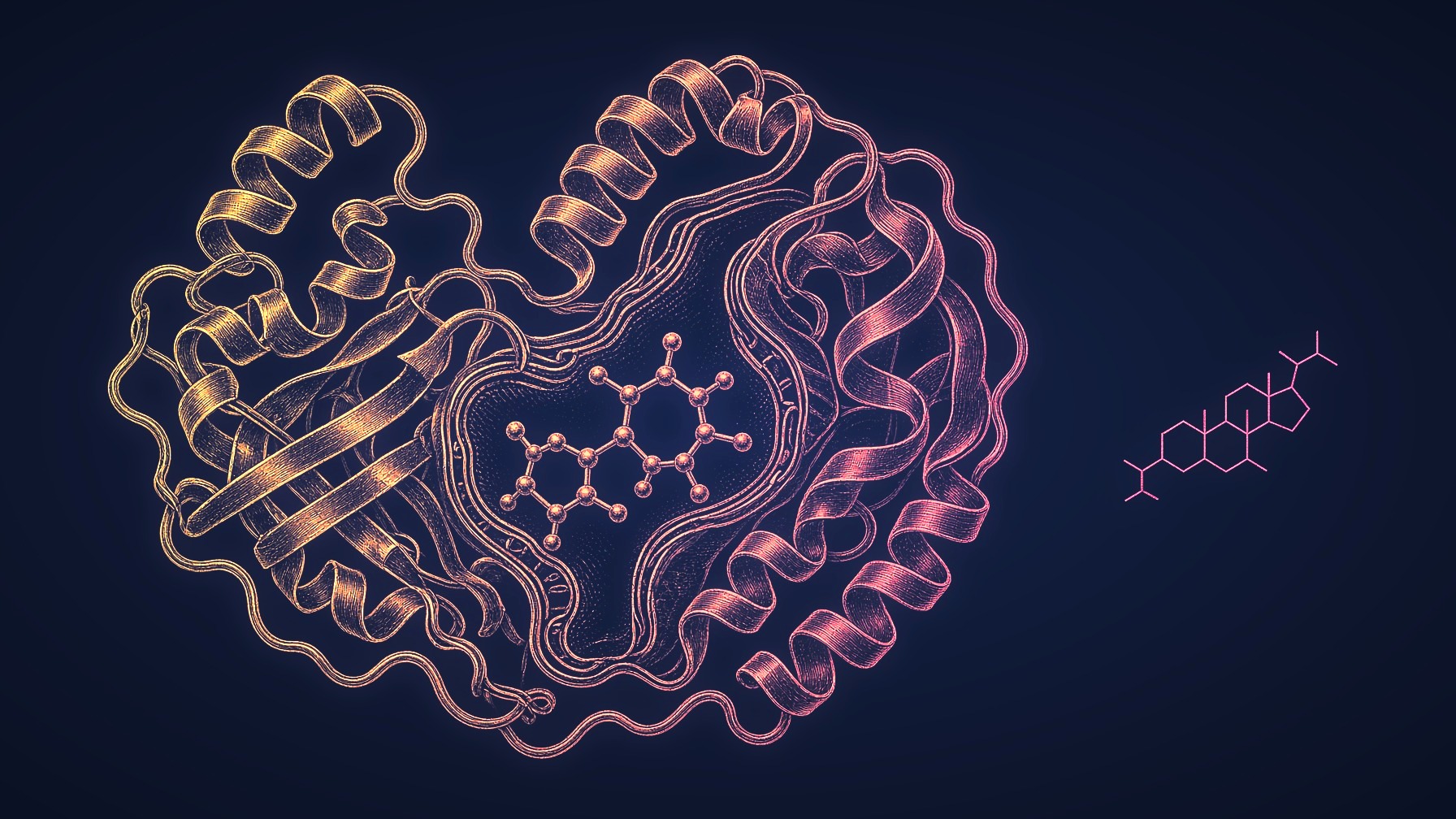
A SARM is a selective androgen receptor modulator. The useful translation is shorter. It is a molecule that is not a steroid, and it still occupies the androgen receptor, the same protein testosterone and DHT use to change which genes a cell transcribes. Ostarine, LGD-4033 and RAD-140 are the three names people actually mean. They were built so the receptor would behave differently in muscle and bone than it does in prostate and skin. That selectivity is real in a dish and in an animal, and it is partial in a man. Partial is the whole argument. A ligand that moves lean mass also talks to the hypothalamus, and the hypothalamus answers by turning your own testosterone down.
In short. SARMs are not steroids. They still sit in the androgen receptor. The ones people name are ostarine, LGD-4033 and RAD-140, and they still switch your own testosterone down.
The androgen receptor is a nuclear receptor. Ligand in, receptor off its chaperones, dimer, DNA, a different set of transcripts. Testosterone and DHT do this with a steroid skeleton. Enobosarm, which is ostarine, and ligandrol, which is LGD-4033, do it with scaffolds a medicinal chemist would not call a steroid. The cell downstream cannot see the drawing. It sees occupancy and it sees how long the receptor stays on the gene. Dalton's group chased tissue selection for years: anabolic in levator ani, less so in prostate, in the classic rodent ratio. That ratio is why the class got its name. A ratio in a rat is not a promise that a man's prostate, hair, liver and pituitary will all decline the invitation.
In short. The receptor only notices that something is sitting in it. Drug companies hoped muscle would listen more than the prostate. In animals that is partly true. In a man the pituitary still listens.
The three names, and the papers
Enobosarm, GTx-024, is the one with the largest human file. Phase 2 work in cancer cachexia moved lean mass. The later POWER trials in non-small-cell lung cancer did not clear the functional bar the company had set. What those programmes did show is that an oral nonsteroid can occupy the androgen receptor hard enough for the receptor to change the transcripts that shift body composition. They also showed the costs that travel with that occupancy: HDL moving the wrong way, because hepatic androgen-receptor signalling turns up hepatic lipase, and the sex-hormone axis not staying naively 'on', because hypothalamic androgen receptors quiet kisspeptin and GnRH.
In short. Ostarine has real human trials in illness, and the cancer endpoint did not clear. It can change lean mass by occupying the androgen receptor. Hepatic lipase still pulls HDL down, and the hypothalamus still switches your own testosterone down.
LGD-4033 has the cleanest short study in healthy men. Basaria and colleagues, Journals of Gerontology, 2013, gave 0.1, 0.3 or 1 milligram a day for three weeks. Lean mass rose at the top dose. So did the suppression. Total testosterone, SHBG and HDL fell in a dose-shaped way, and FSH and LH leaned down with them. Twenty-one days. Not a contest prep, and not a subtle result. The axis noticed a molecule that was never going to show up on a testosterone assay. That is the point people miss when a urine test is the only test they respect. The pituitary does not need the molecule to be testosterone. It needs the androgen receptor in the hypothalamus to be occupied.
In short. In healthy men, three weeks of LGD-4033 put on a little lean mass and lowered testosterone, SHBG and HDL. Your own production drops because the brain thinks the receptor is already busy.
RAD-140, testolone, is the tight binder of the three in the preclinical papers, a drug that was later taken into an early trial in oestrogen-receptor-positive breast cancer because an occupied androgen receptor can oppose that cancer in some women. A cancer trial is an existence proof that the molecule is potent at the androgen receptor. It is not a training study. Grey-market capsules sold under any of these three names are a further problem, and a duller one: case reports of cholestatic liver injury cluster where the bottle was never shown to be the molecule on the label. An undeclared 17α-alkylated oral steroid, which the liver cannot clear in the usual way, or an uncharacterised powder at an unknown amount, will injure a liver while everyone argues about the class. Identity first. Then pharmacology.
In short. RAD-140 is a very tight androgen-receptor ligand. It has been in an early cancer trial, not a muscle trial. Bottles that were never tested are a separate risk, because the powder may not be what the label says.
What 'selective' does not switch off
Selective was supposed to mean muscle and bone yes, prostate and skin no. It was never supposed to mean hypothalamus no. Androgen receptors in the brain that restrain GnRH do not have a special exemption for nonsteroidal ligands. Occupy them and kisspeptin and GnRH quieten, LH falls, the Leydig cell stands down, sperm follow on the same slow clock as they do with testosterone. Recovery is the same architecture as coming off any exogenous androgen: the signal has to return, and the return is measured in months, not in the half-life of the capsule. A SARM that leaves the blood in a day can leave the axis quiet for much longer. Half-life and recovery are different clocks.
In short. Selective does not spare the signal that makes your own testosterone. LH drops, the testis rests, and sperm are on a months-long clock even after the capsule is gone.
Lipids listen too. Hepatic lipase and the androgen receptor in the liver are why oral androgens, steroidal or not, tend to pull HDL down. SHBG falls because the liver is being told an androgen has arrived. Free testosterone calculated from a low SHBG and a suppressed total can look like a paradox on a printout: the number you make is down, the carrier is down, and the androgenic signal in the tissue may still be up because the SARM itself is the signal. Reading only total testosterone, six weeks in, underestimates what the receptor is doing and overestimates how 'mild' the compound was.
In short. HDL and SHBG usually fall. A blood test that only shows total testosterone can make a SARM look milder than the receptor is experiencing.
How a nonsteroid can be 'selective' at all
The androgen receptor does not simply switch on and off. Once a ligand is in the pocket, the receptor recruits a set of coactivators and corepressors, and different ligands recruit different sets. That is the mechanical hope behind selectivity. A SARM can pull the receptor into a shape that muscle and bone answer more willingly than prostate. Enobosarm and LGD-4033 were optimised against that ratio in animals. The ratio is a slope, not a wall. Turn the dose up and the prostate, the skin, and the liver hear it too. Partial agonism is the other phrase. At the receptor, some of these molecules do not drive the gene as hard as DHT does, per occupied receptor. Occupancy still counts. A partial agonist, present all day because you took a capsule, can outdo a full agonist that was only passing through. And the hypothalamus is a tissue the screen was not primarily trying to spare.
In short. SARMs can twist the receptor into a shape muscle likes more than the prostate does. That preference is a slope. Raise the dose, or leave it on all day, and the other tissues hear it anyway. The brain was never the tissue they were trying to spare.
The names that get swept into the same tub are often not SARMs. Cardarine, GW501516, is a PPARδ agonist: it binds that nuclear receptor, the receptor changes lipid and mitochondrial genes, and the drug was abandoned when tumours showed up in long animal studies. It does not sit in the androgen receptor. Andarine, S4, is an older SARM, and the odd one with a visual side effect people actually report: a yellow tint and trouble adapting to the dark, because a metabolite touches a receptor in the eye. YK-11 is sold as a myostatin-blocking SARM. The published evidence that it binds the androgen receptor and then blocks myostatin signalling is thin, and the capsule is frequently not the molecule on the label. A class with three real pharmacological names does not become cleaner by absorbing every powder a website can spell. If the product raises ALT and bilirubin into a cholestatic pattern, treat it as a 17α-alkylated oral until a chromatogram says otherwise. Several case series of 'SARM' liver injury found undeclared steroids, or no identifiable SARM at all.
In short. Cardarine is not a SARM. It hits a different receptor and was dropped after cancers in animals. Andarine can tint vision yellow. YK-11's myostatin story is thin. Liver injuries blamed on SARMs are often undeclared steroids, or a powder that was never checked.
- Ostarine
- enobosarm
- LGD-4033
- 21 days, healthy men
- RAD-140
- tight AR ligand
- The axis
- still shuts
Largest human file. Cachexia trials moved lean mass. The lung-cancer endpoint did not.
Basaria 2013. Lean mass up at 1 mg. Testosterone, SHBG and HDL down.
Preclinical, then an early breast-cancer trial. Not a physique study.
Hypothalamic androgen receptors do not care that the ligand is not a steroid.
Questions the essay actually answers
- What is a SARM?
- A selective androgen receptor modulator. It is not a steroid, and it still binds the androgen receptor that testosterone uses. Ostarine, LGD-4033 and RAD-140 are the names in circulation.
- Do SARMs suppress testosterone?
- Yes. In men given LGD-4033 for three weeks, testosterone, SHBG and HDL fell as the dose rose. The hypothalamus reads androgen-receptor occupancy, not whether the molecule has four rings.
- Is ostarine approved?
- No. Enobosarm was studied for muscle wasting in cancer. The molecule occupies the androgen receptor, lean mass can move, and the cancer trials did not clear the endpoint the company needed.
- Are SARMs safer than steroids?
- They were designed to be kinder to prostate than to muscle, and animal data support a partial split. They still suppress the hormone axis, still tend to lower HDL, and grey-market capsules have been tied to liver injury when the contents were not the labelled molecule.
- Will a SARM show up as testosterone on a blood test?
- No. Total testosterone often falls, because your own production falls. The SARM itself is the androgenic signal, and a standard testosterone assay does not measure it.
Read next
10 min · Bodybuilding
Androgens: the hormone that talks to the muscle nucleus
Testosterone binds a receptor in the myonucleus, adds nuclei, and asks for food. It is not growth hormone, not a cycle written as an essay, and not a fibre you can buy.
12 min · Bodybuilding
Steroid families: four chemistries, one receptor
Testosterone, the 19-nors, the DHT-derived, and the orals that rent the liver. Wet and dry are oestrogen and water, not two kinds of muscle.

18 min · Bodybuilding
What each steroid does at the cell
Testosterone, nandrolone, trenbolone, boldenone, the DHT cousins, the orals. One receptor. Why two of them are not two muscles, what that asks of food, and what the side effects actually are.

7 min · Bodybuilding
SHBG: the protein that decides how much testosterone is free
The liver builds a cage. Most testosterone sits in it. Oestrogen and thyroid hormone make more cage. Insulin and androgens make less. The free fraction is the only part the muscle can use.

12 min · Bodybuilding
The bill outside the fibre: axis, blood, liver, heart
The androgen receptor is in more places than the biceps. Fertility, HDL, haematocrit, the left ventricle, the voice, the tendon. A map of the tissues. Not a course.
13 min · Bodybuilding
Coming off: SERMs, hCG, and what a supplement cannot do
How a SERM restarts GnRH, how each hCG and FSH option talks to the testis or the ovary, and how zinc, ashwagandha and CoQ10 turn that signal back into testosterone and sperm.
More in this desk
16 min · Bodybuilding
Actin and myosin: the motor inside the fibre
The sarcomere, the thin rope, the thick motor, the eight-nanometre stroke, and the calcium switch that lets a nerve turn all of it on. One ATP per pull.
12 min · Bodybuilding
Creatine: the phosphate the fibre keeps next to the myosin
Phosphocreatine rebuilds ATP at the cross-bridge in a fraction of a second. Filling the store buys a few more hard reps. The early weight is water. The myosin still has to be earned.
12 min · Bodybuilding
The tendon clock: the cable is older than the muscle
Myofibrils turn over in days. Tendon collagen turns over in months to years. Heavy slow strain is how a tenocyte keeps the rope. A fast jump in strength pulls on tissue that has not caught up.

12 min · Bodybuilding
Type I and type II: the two fibres a muscle actually is
Slow fibres last. Fast fibres throw the force. Diet, drugs and workouts all land on that split — so the muscle series starts with the myosin, not the vial.
The page is the mechanism: the protein, what it does in the cell, and the drug or peptide that talks to it.