

Bodybuilding · 6 min · 1,422 words
Creatine: the phosphate the fibre keeps next to the myosin
Phosphocreatine rebuilds ATP at the cross-bridge in a fraction of a second. Filling the store buys a few more hard reps. The early weight is water. The myosin still has to be earned.
What this essay actually tells you
- Creatine kinase parks phosphate on creatine at the mitochondrion and rebuilds ATP beside the myosin head. Muscle holds a large phosphocreatine store that short, heavy efforts spend first.
- Feeding creatine raises the store by about a fifth, then it plateaus. A few grams a day for a month and a short larger feed arrive at the same ceiling. Extra reps are the training effect. The early scale weight is water inside the fibre.
- Creatinine on a blood test can rise because more creatine breaks down. That is not, by itself, kidney damage. A single rugby study on DHT has not made creatine a hair-loss mechanism.
What this actually means
Creatine carries phosphate from the mitochondria to the myosin head so ATP can be rebuilt instantly. Filling the muscle store, about twenty percent, gives you extra reps on short heavy efforts. The first kilos on the scale are water inside the fibre. The new muscle comes if those reps were actually hard. It is not a steroid, and it does not write hair loss into the follicle.
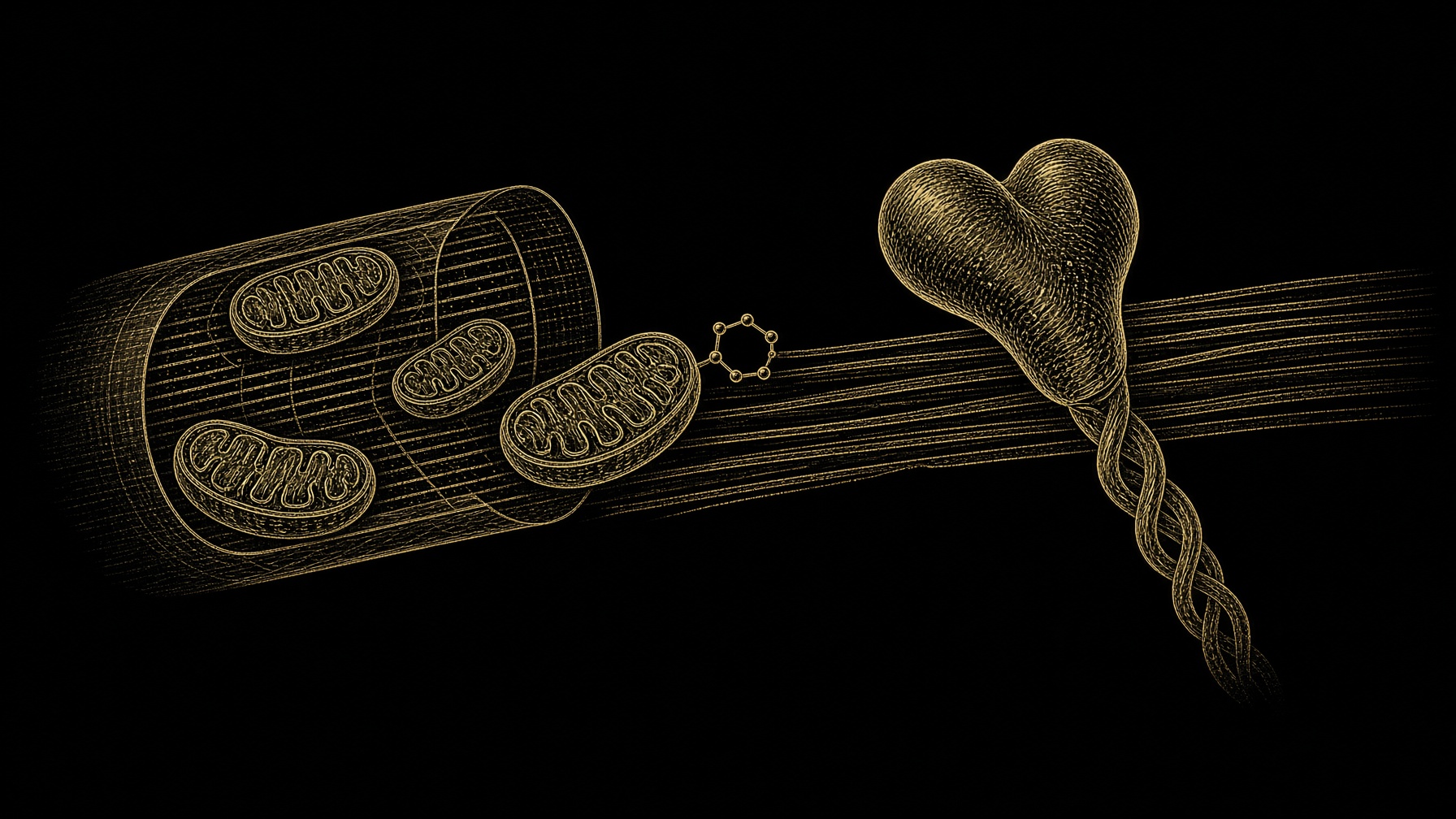
A myosin head does not wait for a mitochondrion. The mitochondria in a fibre sit between the fibrils, often a few micrometres from the cross-bridge that needs the energy now. Diffusion of ATP across that gap is too slow and too small a pool for a heavy triple. The cell solved it with a smaller molecule. Creatine kinase takes a phosphate off ATP and parks it on creatine, making phosphocreatine. At the filament, a second creatine kinase does the reverse: phosphocreatine plus ADP becomes ATP plus creatine, right next to the head that is about to pull. The reaction sits close to equilibrium, which is why it can run either way in a fraction of a second. That is the phosphocreatine shuttle. Creatine is not a stimulant and it is not an androgen. It is the spare phosphate the fibre already knew how to use.
In short. Creatine ferries phosphate from the mitochondria to the myosin head, so the fibre can rebuild ATP in a split second. It is a carrier, not a hormone.
The store is large. Resting muscle holds on the order of 120 millimoles of total creatine per kilogram of dry muscle, and about two thirds of that is already phosphocreatine. A hard set of a few seconds spends the phosphocreatine first. That is why a one-rep max and a five-second sprint live on this pool, and why the set dies when inorganic phosphate and ADP have climbed and the phosphocreatine has not yet been refilled. Between sets, mitochondria rebuild ATP and the shuttle refills the phosphocreatine. Three minutes of rest is partly this chemistry catching up. Shorten the rest and you are asking glycolysis to cover what the shuttle has not restored, which is the burn essay, not a bigger store.
In short. A heavy single and a short sprint spend phosphocreatine. Rest between sets is the time the store refills. Less rest means you are borrowing from glycolysis.
Where the molecule comes from, and what filling the store does
The body makes creatine in the kidney and the liver, from arginine and glycine, then a methyl group from S-adenosylmethionine, which is why it also spends methionine. Diet adds more, mostly from meat and fish. A vegetarian store sits lower, which is why the same few grams move their muscle creatine further. Harris, Söderlund and Hultman, in 1992, showed that feeding creatine raises the muscle content by something like twenty percent, up to a ceiling. Past the ceiling, extra creatine becomes creatinine in the urine. The practical shape of that ceiling is a few grams a day for three or four weeks, or a larger amount for a handful of days if you want the store full sooner. Either way you arrive at the same muscle. You do not arrive at a second androgen receptor.
In short. Meat and your own liver already make creatine. A few grams a day fills the muscle store by about a fifth, then it stops rising. More does not turn into a hormone.
What that fifth buys is extra repetitions and a harder last set, in work that lasts seconds rather than an hour. Greenhaff's biopsy work and a long run of training trials since: more phosphocreatine at the start, slower decline, one or two more reps before the bar stalls, and across weeks those reps become the tension that writes sarcomeres. Strength and lean mass move in the meta-analyses. Part of the scale weight is water. Creatine is osmotically active inside the fibre, so the cell holds a little more fluid. That is the fuller look in the first fortnight, and it is real size on a tape, and it is not new myosin yet. The myosin comes later, if the extra reps were actually heavy. People who take creatine and do not train get a slightly wetter muscle and very little else.
In short. A fuller creatine store means a couple more hard reps. Over weeks those reps build muscle. The early scale weight is water inside the fibre, which is the full look, not fat and not yet new myosin.
Creatinine on a blood test is the spontaneous breakdown product of creatine, filtered by the kidney. A bigger store means a little more creatinine in the blood, which can make an estimated filtration rate look worse than the kidney is. The kidney itself, in healthy people, has been studied at ordinary supplemental intakes for years without a damage signal. A person with kidney disease is a different conversation because their creatinine was already the thing being watched. Hair loss is the other rumour. One small study in rugby players reported a rise in dihydrotestosterone. It has not become a reliable finding, and creatine does not occupy 5α-reductase. If your hair is going, it is the androgen receptor and the follicles you inherited. It is not the shuttle.
In short. Creatinine on a blood test can tick up because more creatine is breaking down, which can make kidney maths look worse than they are. The hair-loss claim comes from one small study and is not how the molecule works.
Brain, fibre type, and the week
The brain runs a smaller version of the same shuttle. Neurons spend ATP on ion pumps, and phosphocreatine buffers that spend. Sleep-deprived and vegetarian brains are the groups where a cognitive effect sometimes shows up, because the store had room. A well-slept, meat-eating brain is closer to full, so the tablet does less. That is the same rule as muscle. Type II fibres, the ones that empty phosphocreatine in a heavy set, are where the gym result lives. Type I fibres are already better at refilling from mitochondria and care less. A marathon is not a creatine sport. A set of five is.
In short. The brain uses the same buffer, mostly when it was short. Fast fibres in a heavy set are where creatine changes the gym. A long run barely notices.
Caffeine and creatine can be taken on the same day. The old worry that caffeine cancels the store came from one protocol with a big caffeine dose during loading. Later work has not made a religion of separating them. What does matter is the store being full on the day you need the reps. Missing a day does not empty it. Muscle creatine falls over weeks, not overnight. The fibre still needs tension, leucine and sleep. Creatine does not phosphorylate mTORC1. It gives the cross-bridge another second of ATP so the set that does phosphorylate those kinases can be completed. Pair it with the food page. Do not pair it with a story in which a white powder replaces the bar.
In short. Keep the store full. It falls over weeks, not overnight. Caffeine is not the enemy of it. The bar still has to be heavy, because creatine only buys the reps. It does not write the sarcomere by itself.
- The reaction
- PCr + ADP ↔ Cr + ATP
- The ceiling
- about a fifth more in the muscle
- The gym
- extra reps in short efforts
- The blood
- creatinine can rise
Creatine kinase, near equilibrium, at the mitochondrion and again at the filament.
Harris 1992. A few grams a day for a month, or a short larger feed. Then it plateaus.
Seconds, not marathons. Type II fibres. The water is intracellular. The myosin still needs the bar.
A breakdown product, not proof the kidney failed. Hair loss is not the mechanism.
Questions the essay actually answers
- Does creatine build muscle by itself?
- It fills the phosphocreatine store so short, hard efforts last a little longer. Those extra reps, repeated for weeks, are what add sarcomeres. Without the training, you mostly gain water inside the fibre.
- Why does the scale jump in the first week?
- Creatine pulls water into the muscle cell. That is the fuller look. It is not fat, and it is not new myosin yet.
- Will it damage kidneys or cause hair loss?
- In healthy people, ordinary intakes have not shown kidney damage. Creatinine on a blood test can rise because more creatine is breaking down, which confuses the estimate. The hair claim rests on one small DHT study and is not a 5α-reductase effect.
- Do I have to load it?
- Loading fills the store in days. A few grams a day fills the same store in three or four weeks. The muscle ends in the same place.
Read next
5 min · Bodybuilding
The burn: lactate is a fuel, not the wreckage
A hard set makes lactate so glycolysis can keep going. Other tissues burn it. The sting is not the muscle being dissolved, and the pump is not stored growth.
14 min · Bodybuilding
Actin and myosin: the motor inside the fibre
The sarcomere, the thin rope, the thick motor, the eight-nanometre stroke, and the calcium switch that lets a nerve turn all of it on. One ATP per pull.
9 min · Bodybuilding
Food and training: how to spend the fibre you have
The practical half of the muscle series. Recruit the fast fibres, feed them, sleep, and stop asking a drug to do a week's work.
9 min · Bodybuilding
Type I and type II: the two fibres a muscle actually is
Slow fibres last. Fast fibres throw the force. Diet, drugs and workouts all land on that split — so the muscle series starts with the myosin, not the vial.
More in this desk

16 min · Bodybuilding
What each steroid does at the cell
Testosterone, nandrolone, trenbolone, boldenone, the DHT cousins, the orals. One receptor. Why two of them are not two muscles, what that asks of food, and what the side effects actually are.
10 min · Bodybuilding
Coming off: SERMs, hCG, and what a supplement cannot do
How a SERM restarts GnRH, how each hCG and FSH option talks to the testis or the ovary, and how zinc, ashwagandha and CoQ10 turn that signal back into testosterone and sperm.
10 min · Bodybuilding
Steroid families: four chemistries, one receptor
Testosterone, the 19-nors, the DHT-derived, and the orals that rent the liver. Wet and dry are oestrogen and water, not two kinds of muscle.
9 min · Bodybuilding
The bill outside the fibre: axis, blood, liver, heart
The androgen receptor is in more places than the biceps. Fertility, HDL, haematocrit, the left ventricle, the voice, the tendon. A map of the tissues. Not a course.
Essays describe published research. They are not medical advice and they do not authorise human use of any catalogue item.