

Bodybuilding · 7 min · 1,513 words
Heat-shock proteins, and what a sauna is actually doing
HSF1 answers unfolded proteins with chaperones. A sauna turns that on, expands plasma, and in Finnish men tracked with fewer cardiac deaths. The growth-hormone bump is real and does not build the muscle.
What this essay actually tells you
- HSF1 answers unfolded proteins with HSP70 and HSP90. Hard eccentric work and passive heat both turn the system on.
- Laukkanen, JAMA Internal Medicine 2015: Finnish men using a sauna four to seven times a week had lower sudden cardiac death than men who went once. Observational.
- Growth hormone rises briefly in the heat and does not add sarcomeres. Heat acclimation expands plasma, so haematocrit falls by dilution.
What this actually means
Heat and hard training unfold proteins, and the cell answers with chaperones such as HSP70. Regular sauna use in a large Finnish study tracked with fewer cardiac deaths. Growth hormone rises for a short time in the heat and that rise does not add muscle. Repeated heat increases plasma volume, which can make haematocrit look lower without changing the marrow.
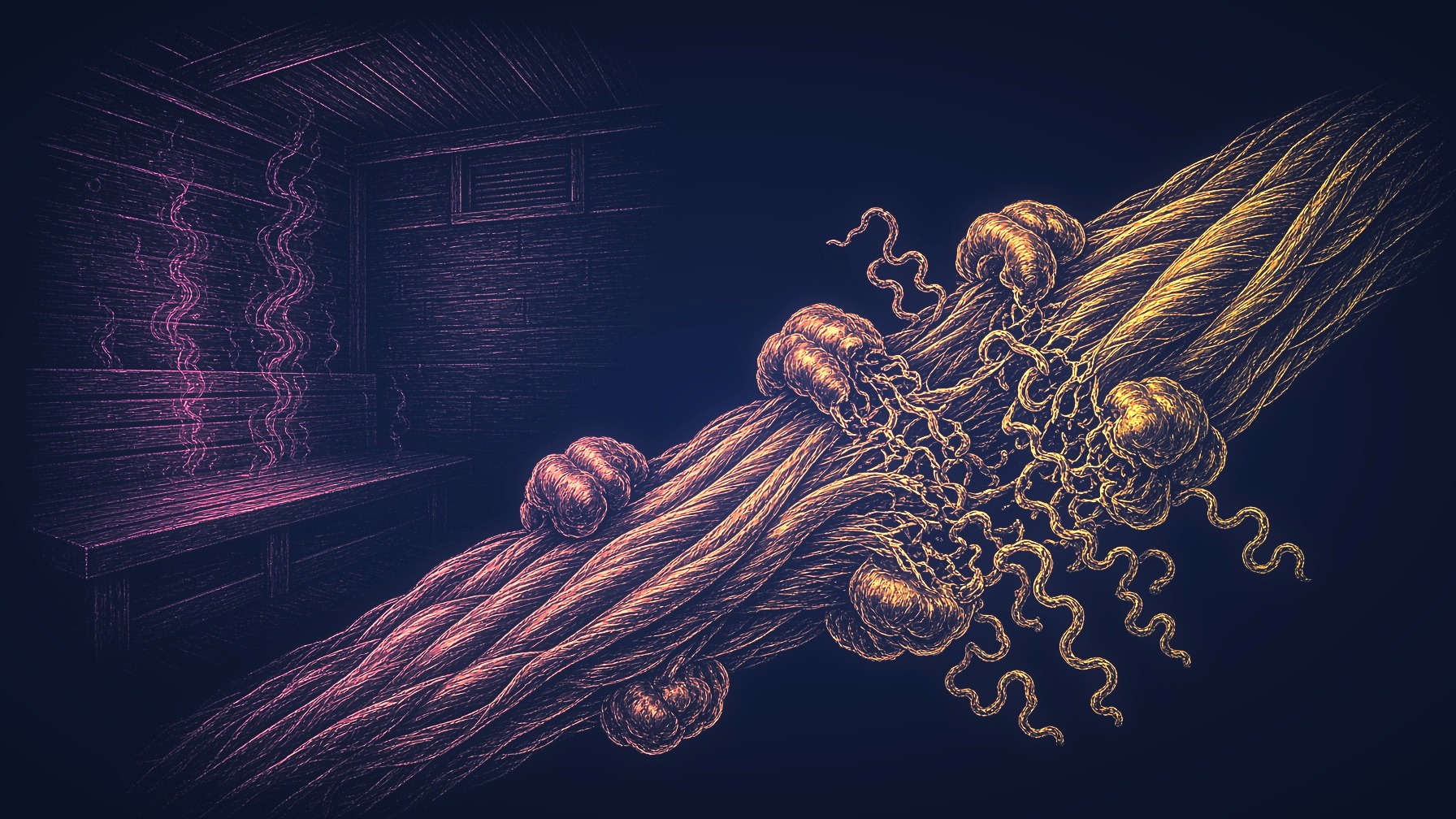
A heat-shock protein is a chaperone. HSF1, the transcription factor, sits quiet until proteins start to unfold, which is what heat does to them, and also what a hard eccentric set does to a few of them. HSF1 then trimerises, binds the heat-shock element, and the cell makes HSP70, HSP90 and the small heat-shock proteins. HSP70 holds an unfolded chain so it does not aggregate, and hands it back to the folding machinery. That is the entire romance. The cell is not 'detoxing'. It is refusing to let a denatured protein become a clot of garbage. Muscle already uses this system after damaging exercise. The repeated-bout effect, where the same session hurts less the next week, rides partly on a cytoskeleton and a chaperone pool that were reinforced by the first insult.
In short. When proteins start to unfold, the cell makes chaperones, especially HSP70, that hold them until they can refold. Hard exercise does this. Heat does this. It is repair equipment, not a detox.
A sauna is a clean way to turn the same switch without the mechanical damage. Core temperature rises, skin blood flow rises, heart rate rises to a brisk walk or harder, plasma volume shifts. Do it repeatedly and you acclimate: more plasma, a lower heart rate at the same heat, a sweat response that starts earlier. Laukkanen, JAMA Internal Medicine, 2015, followed Finnish men for twenty years. Those who used a sauna four to seven times a week had lower rates of sudden cardiac death and of dying of any cause than those who went once. It is observational. The men who sauna often are not identical to the men who never do, in wealth, fitness, or drinking. The dose shape is still awkward to ignore, and it is not a claim that a sauna replaces a blood-pressure tablet or a bar.
In short. Regular saunas are linked, in a big Finnish study, to fewer cardiac deaths. The men who went most often did best. That is a real association, not proof that heat replaces training or medicine.
The growth-hormone spike is a stress spike
Growth hormone does rise in a hot sauna. Leppäluoto measured it. So do other stress hormones, because you are hot, your plasma has shifted, and the pituitary has noticed. The rise is brief. It is the same family of fact as the hormone-spike essay: an acute GH pulse after a hard set does not, by itself, explain who gets bigger. A sauna pulse is even less a training stimulus, because the muscle was not under tension. IGF-1 does not rebuild your programme from one sitting in a hot room. People who stack 'sauna for GH' on top of an actual growth-hormone drug are adding a small endogenous blip to a pharmacological one and calling it synergy. The blip is real. The synergy is a story.
In short. Growth hormone goes up in a hot sauna and comes back down. That pulse does not build muscle. Tension builds muscle. The spike after a sauna is the same kind of spike people already overrate after a workout.
Where heat earns its place next to training is recovery of the tissue you already loaded, and the blood-volume habit. Plasma expansion from heat acclimation is a genuine adaptation, useful in the heat and visible on a haematocrit that falls slightly because the plasma rose, not because the marrow stopped. That is the opposite of the androgen-driven rise in red cells. Mixing the two readings is how a sauna 'fixes' a high haematocrit for an afternoon. Endurance athletes have used heat for this plasma effect for years. Hypertrophy still requires the mechanical signal in the fibre essays. HSP70 will happily refold proteins in a muscle you have not challenged. It will not add sarcomeres in parallel because you sat down.
In short. Heat can expand your plasma volume, which is useful, and it can make a haematocrit look briefly better because you added water, not because you made fewer red cells. It will not grow a muscle you did not train.
What the heat is doing to the pipe
Skin blood flow can rise to several litres a minute in a hot room. Heart rate climbs to keep pressure up while the pipes in the skin are open. That is why a sauna feels like cardio and is not cardio. You have not asked a muscle to produce force, you have asked the heart to supply a dilated skin. Stroke volume and plasma volume adapt if you repeat it. The Finnish cohort's stronger associations sat with the men who went often and stayed in longer, on the order of twenty minutes rather than a two-minute boast. Traditional Finnish heat is roughly 80°C and up, dry, not a steam room and not a hot bath, though those have their own smaller literatures. Association is still association. The men who can sit in that heat four times a week are, on average, not the men in heart failure. The curve is interesting because it kept its shape after the obvious confounders were pencilled in. It is not a prescription written in a sauna catalogue.
In short. A sauna makes the heart work because skin blood flow opens up, not because you lifted anything. The Finnish signal was strongest in men who went often and stayed about twenty minutes. It is a real pattern in the data, not a proof that heat replaces fitness.
Beta-endorphin rises with the heat. So does prolactin, briefly, which is the pituitary noticing stress, not a 19-nor. Neither is a training adaptation you can bank. There is a small research line, Goto and others, in which heating a muscle around resistance work added a little hypertrophy. A little. The mechanical tension was still doing the heavy lifting, and the heat was an adjunct in a controlled setting, not a substitute session. Cold water immediately after lifting is the opposite adjunct and has better evidence of getting in the way, because it blunts the inflammatory signalling the fibre was using. Heat after, if you want a recovery practice, at least points the same direction as the chaperones. Heat instead of the session points nowhere the sarcomere can use.
In short. Heat raises endorphin and, briefly, prolactin. A few studies find a little extra growth when a muscle is warmed around a real session. That is an add-on. Skipping the session and sitting in the heat does not write new muscle. Ice right after lifting is the habit with evidence against it.
Who should not treat heat as a hobby
Alcohol and a sauna are a bad sum. Both drop blood pressure, both impair judgment, and people die of it in a way that is not mysterious. Unstable chest pain, a recent infarct, and being unable to stand the heat without feeling faint are reasons to get out, not reasons to 'push through' a wellness practice. Pregnancy is its own limit on core temperature. None of this makes a dry sauna dangerous for a healthy adult who sits for a quarter of an hour and drinks water afterwards. It makes the folklore of staying until you cannot see a different activity from the one in the Finnish data. The chaperones will still be induced by a tolerable rise in temperature. You do not get a better HSP70 by cooking yourself. You get a worse afternoon.
In short. Do not drink and sit in a sauna. Get out if you have chest pain or you feel faint. A healthy adult sitting a quarter of an hour is the thing the data describe. Staying until you cannot see does not make more chaperones. It makes a worse afternoon.
- The switch
- HSF1
- The Finnish men
- 4–7 times a week
- The GH blip
- minutes, then gone
- Plasma
- you acclimate
Unfolded proteins wake it. It orders HSP70 and HSP90.
Laukkanen 2015. Lower sudden cardiac death. Observational, dose-shaped.
Real, and not a reason the muscle grows. Tension is still the signal.
More blood volume. Haematocrit falls a little because the water rose.
Questions the essay actually answers
- What are heat-shock proteins?
- Chaperones, mainly HSP70 and HSP90, made when HSF1 senses unfolded proteins. They hold damaged proteins so they can refold instead of clumping. Heat and hard exercise both turn the system on.
- Does a sauna raise growth hormone?
- Yes, briefly, as a heat stress. It does not replace the mechanical tension that adds muscle, any more than the short GH rise after a set of squats does.
- Is sauna use linked to living longer?
- In Laukkanen's Finnish cohort, men who took saunas four to seven times a week had lower cardiovascular and all-cause mortality than men who went once a week. It is a long observational study, not a randomised proof.
- Can a sauna replace cardio or lifting?
- No. Heart rate rises and plasma volume adapts, which is useful. Sarcomeres are added by tension. Chaperones repair proteins. They do not write a new programme of muscle.
- Why does haematocrit fall after heat acclimation?
- Plasma volume rises, so red cells are a smaller fraction of the blood. That is not the marrow making fewer cells. It is not the same as treating an androgen-driven rise in red-cell mass.
Read next
11 min · Bodybuilding
Soreness: the Z-disk you pulled apart, a day late
Next-day ache is eccentric damage and the immune cells that come to clear it. Lactate left an hour ago. Being ruined is not the same number as growing.
9 min · Bodybuilding
The hormone spike: the rush after a set isn't the muscle
Testosterone and growth hormone do jump after hard training. The arm that sat in that spike did not grow more. Weeks of a raised baseline are a different story.
7 min · Bodybuilding
Haematocrit: the red cells androgens tell the marrow to make
Testosterone raises haematocrit by freeing iron and driving erythropoietin signalling. The mid-fifties is where clinics stop. Donating blood lowers the number and does not switch the signal off.
11 min · Bodybuilding
How a fibre grows: tension, time, and the protein ledger
Synthesis minus breakdown, for weeks. Why soreness is the wrong score, why the pump is water, and why long ranges of motion keep showing up in the trials.
11 min · Bodybuilding
Growth hormone, insulin, myostatin: the other levers on a fibre
After testosterone, the rest of the muscle-drug list is different receptors: a liver hormone, a storage hormone, and a brake. Food decides which of those signals becomes tissue.
More in this desk
18 min · Bodybuilding
What each steroid does at the cell
Testosterone, nandrolone, trenbolone, boldenone, the DHT cousins, the orals. One receptor. Why two of them are not two muscles, what that asks of food, and what the side effects actually are.
16 min · Bodybuilding
Actin and myosin: the motor inside the fibre
The sarcomere, the thin rope, the thick motor, the eight-nanometre stroke, and the calcium switch that lets a nerve turn all of it on. One ATP per pull.
13 min · Bodybuilding
Coming off: SERMs, hCG, and what a supplement cannot do
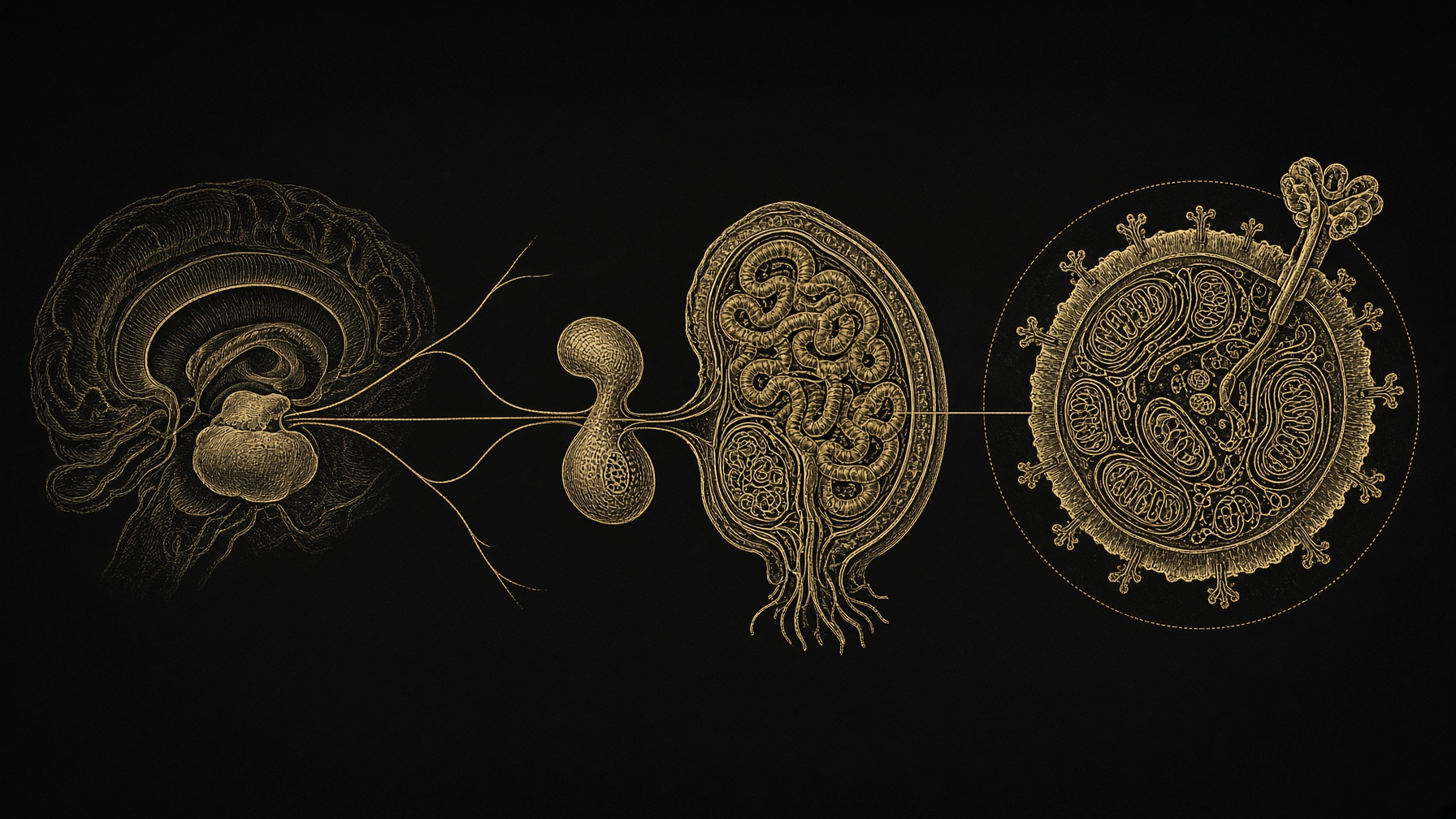
How a SERM restarts GnRH, how each hCG and FSH option talks to the testis or the ovary, and how zinc, ashwagandha and CoQ10 turn that signal back into testosterone and sperm.
12 min · Bodybuilding
Creatine: the phosphate the fibre keeps next to the myosin
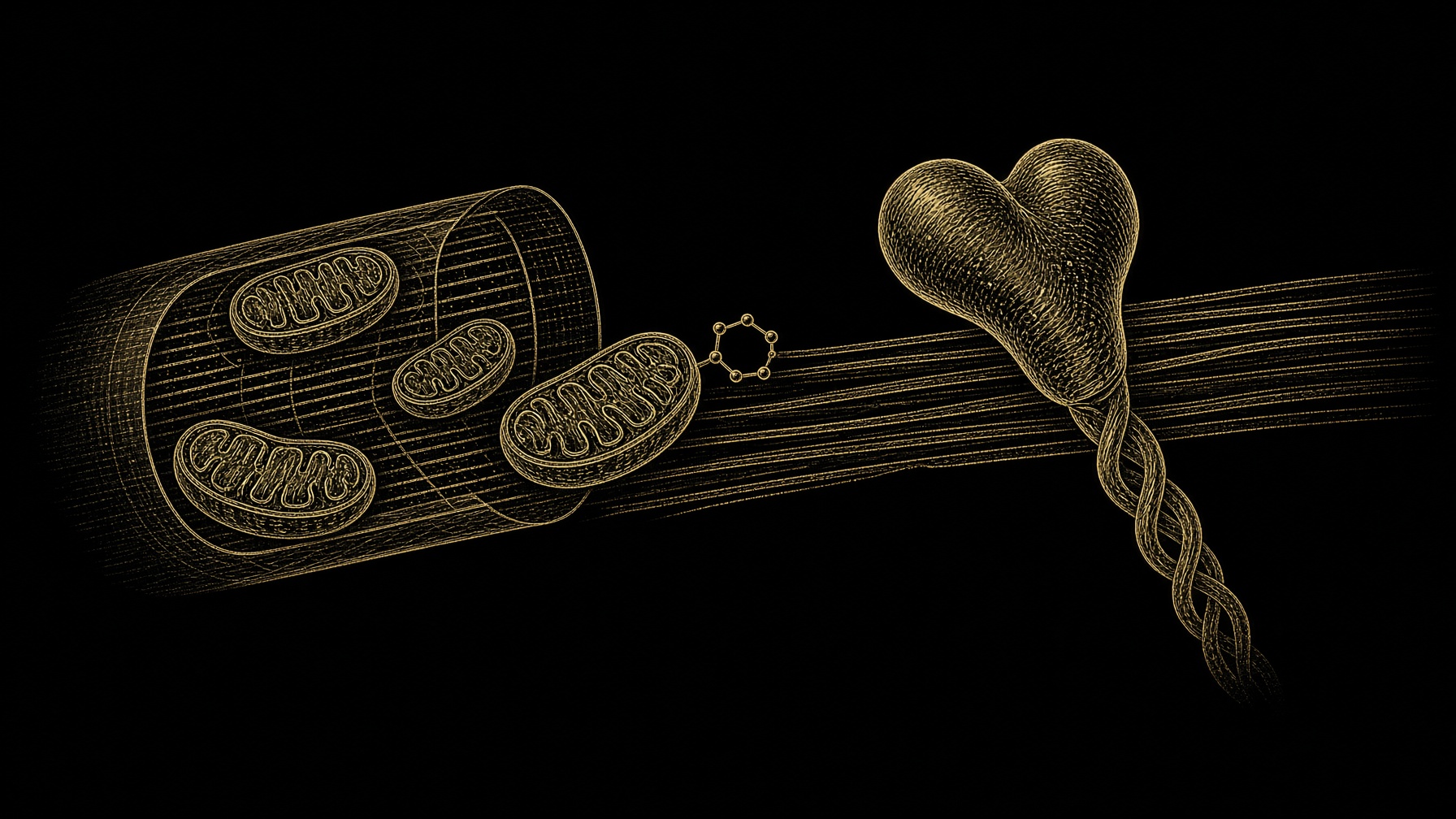
Phosphocreatine rebuilds ATP at the cross-bridge in a fraction of a second. Filling the store buys a few more hard reps. The early weight is water. The myosin still has to be earned.
The page is the mechanism: the protein, what it does in the cell, and the drug or peptide that talks to it.