

Bodybuilding · 7 min · 1,648 words
DHT and the follicle: which androgens the scalp actually hears
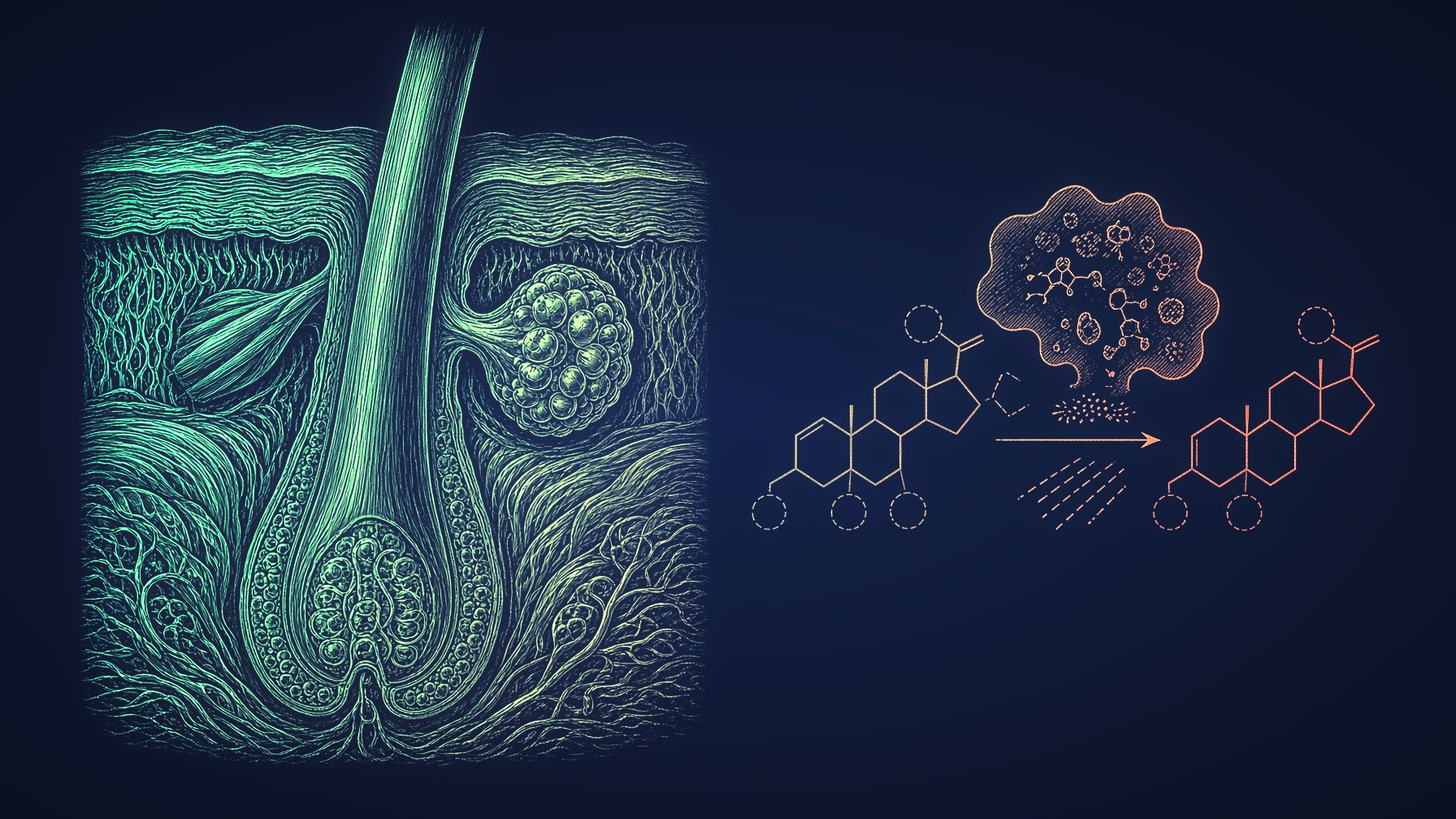
5α-reductase turns testosterone into DHT, and only some follicles miniaturise. Nandrolone is softened by the same enzyme. Trenbolone ignores it. Finasteride is a prostate drug borrowed for a hairline.
What this essay actually tells you
- DHT is testosterone reduced by 5α-reductase. It binds the androgen receptor harder. Only genetically susceptible follicles miniaturise.
- Finasteride blocks the type-2 enzyme. Nandrolone is converted to a weaker androgen in the scalp, so blocking the enzyme can make nandrolone harsher. Trenbolone does not need the enzyme.
- Minoxidil lengthens the growth phase and does not block DHT. Kaufman 1999 is the finasteride hair-count trial. Creatine is not a hair-loss drug.
What this actually means
DHT is the stronger androgen made from testosterone in skin and prostate. It miniaturises genetically sensitive hairs. Finasteride blocks that conversion and can slow baldness. Nandrolone is weakened by the same enzyme, so blocking it can backfire. Trenbolone and ready-made DHT drugs do not pass through it.
DHT is dihydrotestosterone, what you get when 5α-reductase takes testosterone and reduces the double bond in the A ring. The product binds the androgen receptor harder than testosterone does, and it lets go more slowly. Skin, the prostate, and the beard use this conversion on purpose. So does the hair follicle on a scalp that is going to thin. James Hamilton showed, in the 1940s, that men castrated before puberty did not develop male-pattern baldness, and that giving them testosterone later only produced it if they were genetically susceptible. The hormone is the signal. The follicle's genes decide whether the signal miniaturises the hair. That split has not been improved on. A man can have a high DHT and a full head, and a man can thin on an ordinary one, because the papilla is the variable.
In short. DHT is testosterone after an enzyme edit, and it grips the androgen receptor harder. It only miniaturises hairs that are genetically set up to listen. Hamilton showed that eighty years ago.
There are two enzymes worth naming. SRD5A2, type 2, is the one in prostate and in the follicle that finasteride blocks. SRD5A1, type 1, is more widely spread, including skin and liver, and dutasteride blocks both. The follicle that miniaturises shortens its growth phase, anagen, and the shaft that emerges is finer, until the pore is making a colourless wisp. That is androgenetic alopecia: miniaturisation, a change in the organ, unlike shock loss or the telogen effluvium after fever, which comes back at the same thickness. The hair you see in the shower from a seasonal shed is a different count.
In short. Type-2 5α-reductase is the follicle enzyme finasteride blocks. Dutasteride blocks type 1 as well. The follicle shortens its growth phase and the hair gets finer. A seasonal shed is a different event.
Which androgens actually arrive as DHT
Testosterone is a substrate. A share of it becomes DHT in the scalp, which is why injectable testosterone can thin a susceptible hairline even though the injection never touched the skin. Nandrolone is the awkward one. 5α-reductase converts it to dihydronandrolone, and DHN is a weaker androgen than nandrolone. In the scalp and the prostate, the enzyme softens nandrolone rather than sharpening it. Blocking the enzyme with finasteride, while nandrolone is the androgen on board, removes that softening and leaves the stronger parent molecule in the tissue. That is enzyme logic, and it is the opposite of what finasteride does to testosterone. Trenbolone is barely a substrate at all. It does not need the enzyme to be androgenic, so blocking the enzyme does not disarm it. Drostanolone, mesterolone and the other DHT-derived drugs are already reduced. They arrive as the potent form. There is no upstream enzyme left to inhibit.
In short. Testosterone becomes DHT in the scalp. Nandrolone becomes a weaker androgen there, so blocking the enzyme can make nandrolone harsher, not kinder. Tren and the DHT-derived drugs do not need the enzyme.
Finasteride at one milligram a day is the trial Kaufman published in 1999: more hair counted on the vertex, and the frontal scalp moved less dramatically, over a year and beyond. Dutasteride suppresses serum DHT further because both enzymes are shut. Both drugs also lower DHT in the prostate, which is why the five-milligram finasteride dose exists for urinary symptoms, and why a young man should know he is taking a prostate drug for a hair. Sexual side effects are real in a minority and, in a smaller minority, are reported to linger. The mechanism of the lingering ones is still argued. The existence of the complaint is not a reason to pretend the enzyme is optional in every tissue. Brain, penis and prostate all see androgens. You are choosing a tissue when you block the conversion, not deleting a waste product.
In short. Finasteride at the hair dose regrows vertex hair in the trials. It is still a hormone drug. A minority get sexual side effects, and some say those linger. You are changing DHT in every tissue that used the enzyme, not only the scalp.
What a shampoo cannot do
Minoxidil is a different door. It is a potassium-channel opener that lengthens anagen and does not block 5α-reductase. It can thicken a hair while DHT is still sitting on the papilla, which is why the two are stacked in clinics, and why stopping minoxidil returns the hair to the clock the androgens set. A topical anti-androgen stays local only to the extent it does not go systemic. Many of them do, a little. Creatine's one rugby paper on DHT has not turned creatine into a baldness drug; the creatine essay already said so, and nothing since has made that paper larger. The variables that do the work are genetic susceptibility, how much testosterone you are offering the enzyme, and whether the androgen you added is a substrate, a softened substrate, or an already-reduced DHT analogue.
In short. Minoxidil keeps a hair growing without blocking DHT. Stop it and the follicle goes back to the androgen clock. Creatine is not a hair-loss drug on the strength of one small study.
The clock inside one follicle
A scalp hair spends years in anagen, the growth phase, then a few weeks in catagen, the retreat, then a few months in telogen, resting, before it sheds and the next shaft starts. Androgenetic miniaturisation shortens anagen and lengthens the relative time spent resting. The pore that used to deliver a thick hair for six years starts delivering a thin one for a few months. You notice the shed because telogen hairs fall, and you miss the real change, which is that the replacement is thinner than the hair it replaced. Count the hairs in the drain and you are counting a normal telogen quota plus whatever extra the shortened cycle is throwing. Look at the calibre of the hair still in the skin and you are looking at the disease. A seasonal shed, or the shed after a fever, empties telogen early and the next hair comes back the same thickness. Miniaturisation does not give the thickness back unless the androgen signal at that papilla is reduced for long enough that a later cycle builds a thicker shaft.
In short. Balding shortens the years a hair grows and the next hair comes in thinner. Hairs in the shower can just be a seasonal shed, which grows back the same. Thickness, not the number in the drain, is the thing that matters.
The beard and the scalp are the same hormone doing opposite jobs. DHT makes many beards thicker and, in susceptible scalps, makes the hair finer. The difference is the dermal papilla's programme, not a different molecule. Wnt signalling, the local growth conversation in the follicle, is pushed one way in the beard and the other way on a balding crown. That is why a man can grow a denser beard on testosterone and watch his temples go at the same time, and why blocking 5α-reductase can thicken the scalp and slightly thin the beard or the body hair in some men. You are turning down one signal that two tissues read differently. Finasteride does not know you only meant the mirror.
In short. The same DHT thickens a beard and thins a susceptible scalp, because the follicles are programmed differently. Blocking the enzyme can help the scalp and slightly soften beard and body hair. It cannot do only one of those.
The drugs, and the ones that are not really drugs
Oral finasteride at the one-milligram hair dose lowers serum DHT by about seventy percent. Dutasteride, blocking both enzymes, lowers it by about ninety-five. More suppression is not automatically a better cosmetic result for every man, and it is a more complete removal of DHT from prostate, skin, and anywhere else type-1 enzyme was working. Topical finasteride still reaches the blood. 'Local' is a hope about the amount, not a guarantee of zero systemic effect. Sexual side effects remain a minority event and a real one. Saw palmetto is sold as a natural 5α-reductase inhibitor. Whatever it does in a test tube, it is not in the same league as finasteride, and the hair trials are modest. A plant extract that weakly leans on an enzyme is not a small dose of the drug that has hair-count data. The androgen you are offering the enzyme still decides more than the shampoo.
In short. Finasteride cuts DHT by about seventy percent. Dutasteride cuts it by about ninety-five, and it is a bigger change in every tissue, not a stronger shampoo. Saw palmetto is not a mild finasteride. Topical finasteride still gets into the blood.
- Testosterone
- a substrate
- Nandrolone
- softened by the enzyme
- Trenbolone
- not a substrate
- DHT drugs
- already reduced
Scalp 5α-reductase turns a share of it into DHT.
Becomes weaker DHN. Blocking 5α-reductase removes that softening.
Androgenic without the enzyme. Finasteride does not disarm it.
Masteron and mesterolone do not pass through the enzyme you would block.
Questions the essay actually answers
- What is DHT?
- Dihydrotestosterone, made when 5α-reductase reduces testosterone. It binds the androgen receptor more tightly than testosterone. In a genetically susceptible follicle it shortens the growth phase and miniaturises the hair.
- Does testosterone cause hair loss?
- It can, in men whose follicles are built to listen, because a share of it becomes DHT in the scalp. Hamilton showed castrated men did not develop male-pattern baldness unless androgens were given and the genes were willing.
- Why can finasteride make nandrolone worse for hair?
- In scalp and prostate, 5α-reductase converts nandrolone to dihydronandrolone, which is a weaker androgen. Block the enzyme and that softening stops. The opposite of what finasteride does to testosterone.
- Does finasteride work on trenbolone?
- No. Trenbolone is not meaningfully activated or inactivated by 5α-reductase. It is androgenic on its own. The enzyme was never the step you could block.
- Is minoxidil an anti-androgen?
- No. It is a potassium-channel drug that prolongs the growth phase. It does not stop DHT binding the follicle. Stop minoxidil and the hair returns to the androgen-set cycle.
Read next
10 min · Bodybuilding
Androgens: the hormone that talks to the muscle nucleus
Testosterone binds a receptor in the myonucleus, adds nuclei, and asks for food. It is not growth hormone, not a cycle written as an essay, and not a fibre you can buy.
18 min · Bodybuilding
What each steroid does at the cell
Testosterone, nandrolone, trenbolone, boldenone, the DHT cousins, the orals. One receptor. Why two of them are not two muscles, what that asks of food, and what the side effects actually are.
12 min · Bodybuilding
Steroid families: four chemistries, one receptor
Testosterone, the 19-nors, the DHT-derived, and the orals that rent the liver. Wet and dry are oestrogen and water, not two kinds of muscle.
7 min · Bodybuilding
SHBG: the protein that decides how much testosterone is free
The liver builds a cage. Most testosterone sits in it. Oestrogen and thyroid hormone make more cage. Insulin and androgens make less. The free fraction is the only part the muscle can use.
12 min · Bodybuilding
Creatine: the phosphate the fibre keeps next to the myosin
Phosphocreatine rebuilds ATP at the cross-bridge in a fraction of a second. Filling the store buys a few more hard reps. The early weight is water. The myosin still has to be earned.
More in this desk
16 min · Bodybuilding
Actin and myosin: the motor inside the fibre
The sarcomere, the thin rope, the thick motor, the eight-nanometre stroke, and the calcium switch that lets a nerve turn all of it on. One ATP per pull.
13 min · Bodybuilding
Coming off: SERMs, hCG, and what a supplement cannot do
How a SERM restarts GnRH, how each hCG and FSH option talks to the testis or the ovary, and how zinc, ashwagandha and CoQ10 turn that signal back into testosterone and sperm.
12 min · Bodybuilding
The tendon clock: the cable is older than the muscle
Myofibrils turn over in days. Tendon collagen turns over in months to years. Heavy slow strain is how a tenocyte keeps the rope. A fast jump in strength pulls on tissue that has not caught up.
12 min · Bodybuilding
Type I and type II: the two fibres a muscle actually is
Slow fibres last. Fast fibres throw the force. Diet, drugs and workouts all land on that split — so the muscle series starts with the myosin, not the vial.
The page is the mechanism: the protein, what it does in the cell, and the drug or peptide that talks to it.