

Bodybuilding · 7 min · 1,495 words
Beta-alanine: the scarce half of the buffer inside the fibre
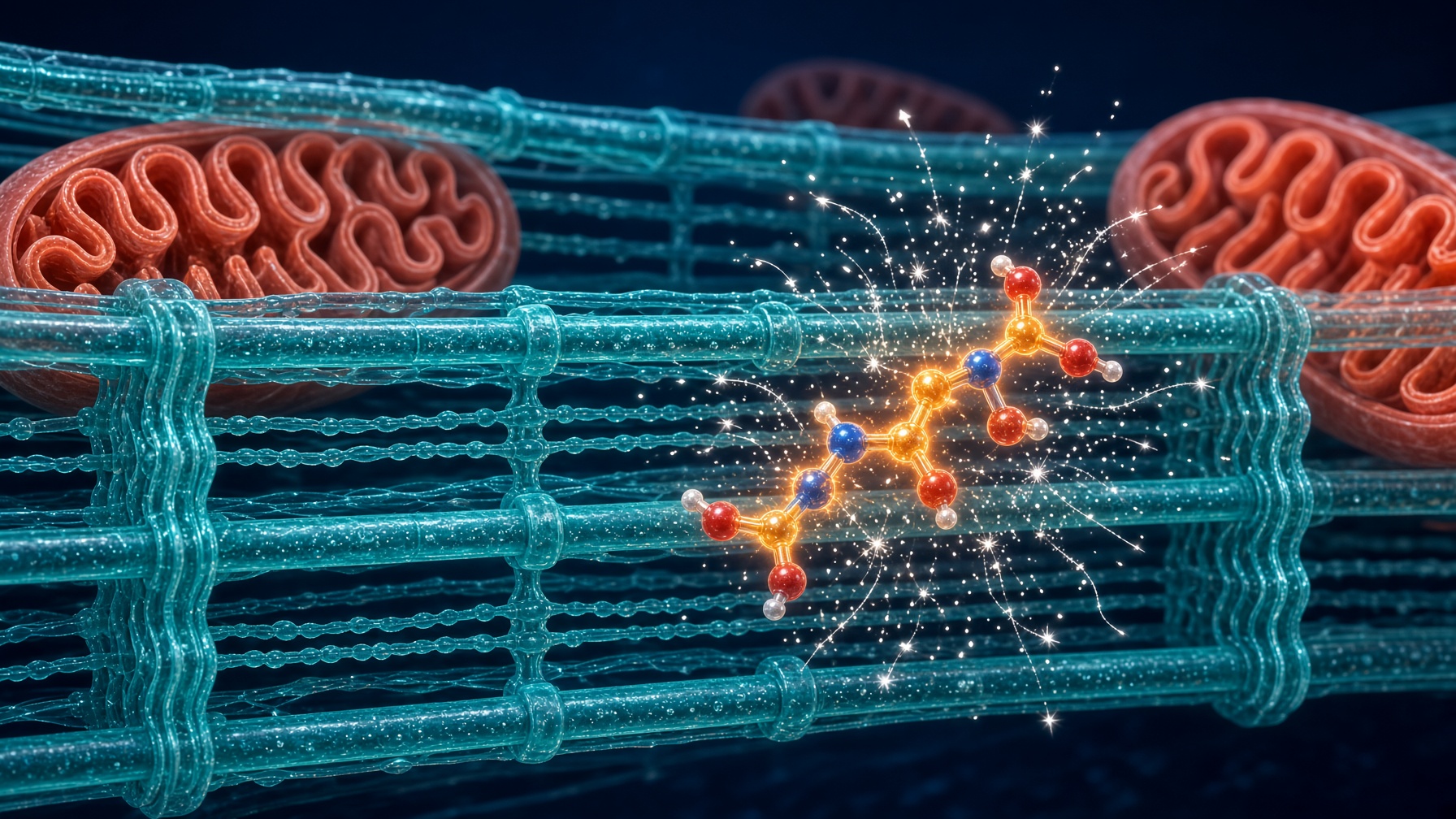
Muscle carnosine catches the hydrogen ions a hard set releases. Beta-alanine is the amino acid the fibre runs out of first, so the store only rises when you supply it. The tingle is a skin nerve. The reps it can save last minutes, not a single.
What this essay actually tells you
- Beta-alanine is the scarce half of carnosine. CARNS1 joins it to histidine inside the fibre. Harris 2006 showed the muscle store rising over weeks.
- Carnosine buffers hydrogen ions where glycolysis dumps them. That window is about thirty seconds to ten minutes, not a one-rep max and not a marathon.
- The tingle is MrgprD on skin nerves, not an allergy. Creatine rebuilds ATP in the first seconds. Bicarbonate buffers the blood. Three different rooms.
What this actually means
Beta-alanine is half of carnosine, and it is the half muscle is short of. Carnosine sits inside the fibre and mops up the acid from a hard set, which is why efforts of about half a minute to ten minutes can last a little longer. The tingle is a nerve in the skin, not an allergy. It takes weeks to fill the store. A one-rep max will not notice. Creatine is a different store for a different few seconds.
Carnosine is a dipeptide, beta-alanine joined to histidine, and skeletal muscle is full of it. The enzyme that makes it, carnosine synthase, is coded by CARNS1. It spends ATP to stitch the two amino acids together. Histidine is rarely the piece that runs out, because meat, fish and the rest of an ordinary diet keep that pool topped up. Beta-alanine is the scarce half. The fibre can only make as much carnosine as the beta-alanine supply allows, which is why feeding beta-alanine raises the muscle store and feeding extra histidine, in someone who already eats protein, usually does not. Harris and colleagues put that on a biopsy in 2006. The store climbed over weeks, not over an afternoon, and it climbed more in the fast fibres, which are the ones that empty glycogen when a set gets hard.
In short. Carnosine is two amino acids joined up, and muscle makes it. Beta-alanine is the half that is usually missing, so taking it fills the store over weeks. The fast fibres, the ones that burn in a hard set, hold the most.
What the store is for, in a set, is the hydrogen ion. Glycolysis turns glucose into pyruvate and, when the mitochondria cannot take pyruvate as fast as the set is making it, into lactate. The chemistry that people call the burn releases hydrogen ions into the cytosol. pH falls. The cross-bridge and the calcium release both get worse at the lower pH, which is one reason the rep dies. The burn page is that story. Carnosine is the local answer. The imidazole ring on the histidine half has a pKa near 6.8, right in the range a working fibre actually reaches, so the ring takes the proton up and holds it. That is a buffer. Bicarbonate does this job in the blood, outside the fibre. Carnosine does it inside, next to the filament. They are not substitutes. One of them cannot reach the compartment the other lives in.
In short. A hard set dumps acid inside the fibre. Carnosine soaks that acid up, because part of the molecule is built to take a hydrogen ion at exactly that acidity. Bicarbonate does the same job in the blood, not inside the muscle.
Which efforts notice, and which ones never will
A single heavy rep does not live here. It lives on phosphocreatine, which is the creatine page: a few seconds, a phosphate handed to ADP, no time for a pH crisis. A long easy ride does not live here either. Type I fibres are already handing pyruvate to mitochondria, hydrogen ions are not piling up, and a bigger carnosine store is a fire extinguisher in a room that is not on fire. The window where the trials keep finding a difference is the work that lasts from about half a minute to about ten minutes, and the last reps of sets that have already gone glycolytic. Hill's rowing work, and the meta-analyses after it, land in that band. You get a few more strokes, a slightly slower fade, not a new one-rep max and not a marathon. People who already have a high store, often those who eat a lot of meat and have trained the fast fibres for years, have less room. Vegetarians start lower, as they do with creatine, and have more ceiling.
In short. It helps efforts that burn, from about thirty seconds up to ten minutes, and the last reps of a hard set. A single max and a long easy run are the wrong jobs. Creatine owns the short one. Mitochondria own the long one.
The tingle is the other thing everyone meets in the first week, and it is not an allergy. Beta-alanine in a sudden peak activates MrgprD, a receptor on sensory neurons in the skin, the same family of receptors that registers certain itches. The neuron fires. The skin prickles for twenty minutes or so. Spread the dose, or use a slower tablet, and the peak never gets high enough to ring that bell, while the muscle store still fills across the month. Histamine is a different molecule. An antihistamine is the wrong tool for a receptor that was never histamine's. The paraesthesia is annoying and it is informative: it means a bolus just hit a nerve ending. It does not mean the fibre has filled. The fibre fills on the slow clock, a gram-scale daily intake for four weeks and more, and it empties on a similar clock when you stop. Missing a day does not wipe it. Stopping for a month does.
In short. The tingle is a nerve ending in the skin, not an allergic reaction. Slowing the dose stops the tingle and still fills the muscle. The muscle itself takes weeks to fill and weeks to empty.
What it does not replace
Creatine and carnosine sit in the same fibre and do different seconds of the same set. Phosphocreatine rebuilds ATP at once. Carnosine holds the pH up once glycolysis is the one paying. Taking both is two stores, not one store taken twice. Beta-alanine does not phosphorylate anything at the myosin head, and creatine does not buffer a hydrogen ion. Sodium bicarbonate is the third, extracellular, and it can add to carnosine in the events long enough for blood pH to matter, with a gut that sometimes objects to the salt load. None of these writes a sarcomere. They let you complete work. The growth is still the tension and the protein, on the food page and the fibre page. A scoop that lets you get two more reps is useful exactly to the extent that those reps were heavy.
In short. Creatine covers the first seconds. Carnosine covers the burn after that. Bicarbonate covers the blood. All three buy work. None of them is the bar, and none of them is the meal.
There is a rodent finding that very large beta-alanine intakes compete with taurine for a transporter and can lower tissue taurine. The human supplemental amounts used in the performance trials have not reproduced a taurine deficiency anyone can diagnose on a person. It is worth knowing, because the transporter is real, and it is not a reason to invent a second supplement out of a mouse dose. Carnosine itself also binds metals and reactive carbonyls, which is why the ageing literature keeps sniffing around it. That is a slow chemistry. It is not why a set of twelve felt shorter. The set of twelve felt shorter, when it did, because a proton was caught by an imidazole ring a few nanometres from the filament, and the cross-bridge got a few more cycles before the pH called time.
In short. Huge doses in rodents can crowd out taurine. Ordinary human amounts have not done that in any way you could see. The gym effect is the acid being buffered, not an anti-ageing story.
- The molecule
- carnosine
- The job
- pKa about 6.8
- The clock
- weeks, not a pre-workout
- The efforts
- half a minute to about ten
Beta-alanine plus histidine, made by CARNS1. Beta-alanine is the half that limits the store.
Takes up hydrogen ions inside the fibre. Bicarbonate does the matching job in blood.
Harris 2006. The tingle is MrgprD on skin nerves, and it is not the store filling.
Not a one-rep max. Not a marathon. Fast fibres. Creatine is the other store.
Questions the essay actually answers
- What does beta-alanine actually do?
- It supplies the scarce half of carnosine. Muscle stitches it to histidine. Carnosine soaks up hydrogen ions during hard glycolytic work, so the last reps fade a little later.
- Why does beta-alanine make your skin tingle?
- A sudden peak activates MrgprD on sensory nerves in the skin. It is not histamine and it is not the muscle store filling. A smaller dose taken more often usually stops the tingle.
- Is it the same as creatine?
- No. Creatine rebuilds ATP in the first few seconds. Carnosine buffers acid after that, in efforts from about thirty seconds to ten minutes. They can sit in the same fibre and do different jobs.
- How long before it works?
- The muscle store rises over several weeks of daily use and falls over weeks when you stop. A single scoop before training does not fill it, even if the skin tingles.
- Will it help a one-rep max?
- That effort is over before pH is the problem. Phosphocreatine is the store that matters there. Beta-alanine earns its keep when the set or the piece has already gone to the burn.
Read next
10 min · Bodybuilding
The burn: lactate is a fuel, not the wreckage
A hard set makes lactate so glycolysis can keep going. Other tissues burn it. The sting is not the muscle being dissolved, and the pump is not stored growth.
12 min · Bodybuilding
Creatine: the phosphate the fibre keeps next to the myosin
Phosphocreatine rebuilds ATP at the cross-bridge in a fraction of a second. Filling the store buys a few more hard reps. The early weight is water. The myosin still has to be earned.

12 min · Bodybuilding
Type I and type II: the two fibres a muscle actually is
Slow fibres last. Fast fibres throw the force. Diet, drugs and workouts all land on that split — so the muscle series starts with the myosin, not the vial.

12 min · Bodybuilding
What the set is doing: failure, volume, rest, range
Why the last reps matter more than the first, why ten hard sets is a floor and not a personality, and why a short rest quietly deletes the tension you came for.
More in this desk

18 min · Bodybuilding
What each steroid does at the cell
Testosterone, nandrolone, trenbolone, boldenone, the DHT cousins, the orals. One receptor. Why two of them are not two muscles, what that asks of food, and what the side effects actually are.
16 min · Bodybuilding
Actin and myosin: the motor inside the fibre
The sarcomere, the thin rope, the thick motor, the eight-nanometre stroke, and the calcium switch that lets a nerve turn all of it on. One ATP per pull.

13 min · Bodybuilding
Coming off: SERMs, hCG, and what a supplement cannot do
How a SERM restarts GnRH, how each hCG and FSH option talks to the testis or the ovary, and how zinc, ashwagandha and CoQ10 turn that signal back into testosterone and sperm.
12 min · Bodybuilding
The tendon clock: the cable is older than the muscle
Myofibrils turn over in days. Tendon collagen turns over in months to years. Heavy slow strain is how a tenocyte keeps the rope. A fast jump in strength pulls on tissue that has not caught up.
The page is the mechanism: the protein, what it does in the cell, and the drug or peptide that talks to it.