

Frontier biology · 47 min · 10,442 words
How a frozen tooth becomes a working gene
Palaeogenomics turned dirt, bone and dental calculus into genomes. De-extinction is downstream of that quieter revolution.
What this essay actually tells you
- Ancient DNA is a race against deamination (C→U) and contamination. Pääbo's lab wrote the wet and computational rules that made genomes from bone possible. Without those rules it's a modern sequence with dirt on it.
- A frozen tooth can yield a working gene if you reconstruct the coding sequence and splice it into a living cell. That's the palaeogenomics-to-edit pipeline, and it's already been done.
- Mammoth haemoglobin and coat alleles are the textbook examples of a fossil becoming an edit. Sequence from bone, cassette into a living relative, phenotype if you're lucky.
What this actually means
DNA falls apart after death, but not instantly and not evenly. In the cold, fragments survive. You can fish those fragments out of a tooth or a bone, sequence them by the billion, and reconstruct the genome of something that has been dead for tens of millennia. That reconstructed text is what CRISPR then pastes, locus by locus, into a living relative. De-extinction is the loud half. Palaeogenomics is the half that actually had to work first.
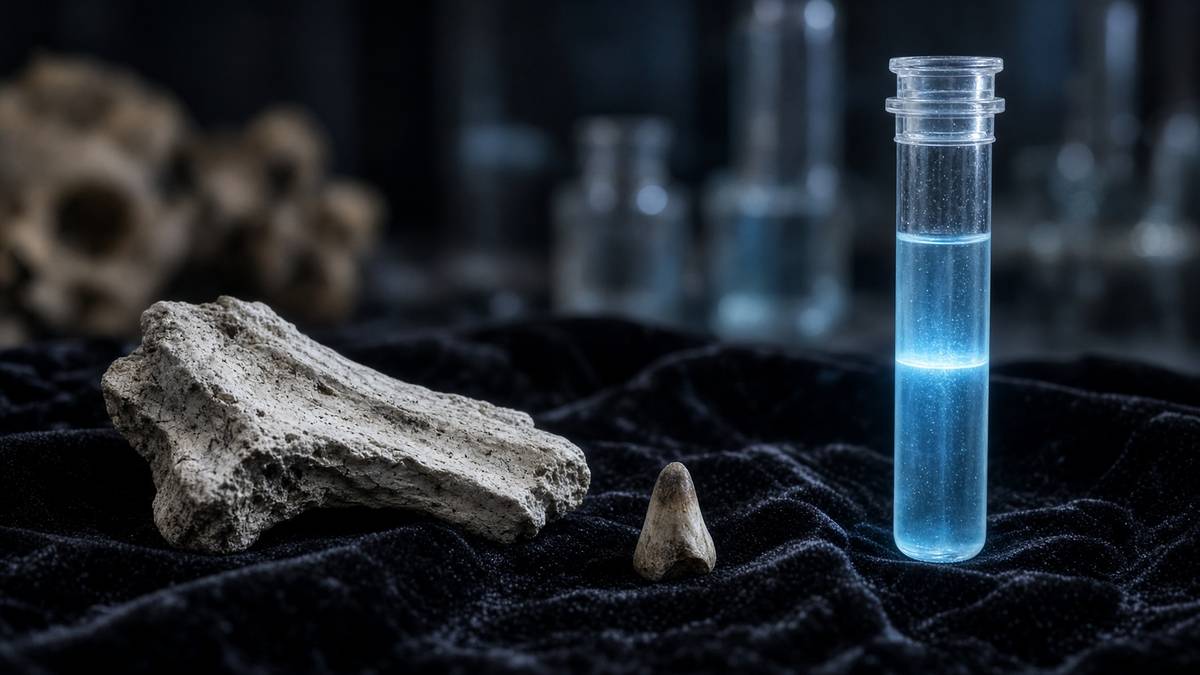
A frozen tooth isn't a time machine. It's a race. After death, DNA doesn't sit in the dark waiting for a sequencer. Cytosines deaminate to uracil. Purines drop out of the backbone. Strands nick, then shatter into ultrashort pieces, typically thirty to seventy bases, the length of a text message rather than a gene. Cold slows that chemistry. Permafrost, a cave, a petrous bone mineralised early in life: those are how anything is left to fish. You extract silica-bound scraps, build a library, sequence by the billion, and reconstruct a consensus the original animal never wrote down as a file. That reconstructed text is what CRISPR later pastes into a living relative. No palaeogenome, no edit list. De-extinction is the loud half of this story. This piece is the quiet half — the damage pattern, the coverage gaps, the working gene pulled out of a 43,000-year-old codon — because that's the half that had to exist before anyone in Dallas could type a locus. I'm still not casual about a tooth that old still binding oxygen in a cuvette.
In short. Dead DNA falls apart. Cold and careful lab work let us reconstruct genomes from scraps. Those reconstructions are what de-extinction actually edits.
The chemically interesting lesion is cytosine deamination. Water attacks C4 of cytosine; the ring loses an amine and becomes uracil. A polymerase copying that strand reads U as T. In the alignment against a reference, you see a C-to-T substitution, concentrated in the single-stranded overhangs at fragment ends. Briggs, Stenzel, Johnson, Green, Pääbo, Proceedings of the National Academy of Sciences 2007, put the misincorporation pattern on paper: 5′ C-to-T, and in double-stranded libraries a complementary 3′ G-to-A. Hofreiter, Jaenicke, Serre, von Haeseler and Pääbo had already shown, in Nucleic Acids Research 2001, that uracil-N-glycosylase collapses those substitutions, which is how you know they are deaminated cytosines and not biology. Thirty to forty percent of cytosines in overhangs can appear as thymine in material a few thousand years old. That's not a curiosity. It's a systematic lie the polymerase will tell you at every C, and it's also the barcode that says the fragment is old. Modern contaminant DNA doesn't carry that end-pattern. The field learned to treat the damage as a feature. mapDamage, PMDtools, schmutzi: those are the programs that ask whether your reads look like a dead molecule or a laboratory technician.
In short. So cytosine in dead DNA turns into uracil, which sequencers read as T. The C-to-T marks at fragment ends are both damage and the stamp that the DNA is ancient.
You don't recover a nucleus. You recover a consensus. Coverage is uneven. Repeats and GC-rich stretches drop out. Mitochondrial DNA, present in hundreds to thousands of copies per cell, reports first; nuclear sequence reports later and thinner. The output of a palaeogenomic pipeline is a text with gaps, a variant list relative to a living sister species, and a damage profile that had better look ancient. Editors therefore don't restore a genome. They restore chosen loci — the ones that likely encode a phenotype you can see and husband: haemoglobin, hair, ear size, dentition. The rest of the extinct animal is imputed from the living relative. That's why a mammoth programme is an edited elephant and a dire-wolf programme is an edited wolf. That's the method, not a workaround. A frozen tooth can still yield a working gene if you reconstruct the coding sequence, synthesise it, and splice it into a living cell that still has polymerases, ribosomes and a membrane. That last clause is the whole of the palaeogenomics-to-edit pipeline. The fossil is sequence. The cell is the factory.
In short. So ancient DNA gives a patched-together text, not a working nucleus. Chosen genes are rebuilt and put into a living relative. The rest of the animal is borrowed from that relative.
What follows is that pipeline, written at the length you would want before anyone is allowed to hang a calf, a pup or a press-render on it. Deamination and contamination as the two races. Petrous bone and cementum as harvest sites. Single-stranded libraries. Uracil glycosylase as a choice, not a default. The 2010 Neanderthal genome as the existence proof. Nucleosome-scale protection that leaves a chromatin footprint in bone. Gene synthesis and a living polymerase as the step that turns a consensus into a protein. Campbell's mammoth haemoglobin as the textbook case of a fossil becoming an assay. Coat alleles as the case that then became an edit. Hayflick's census as the reason the chassis has to be a living fibroblast with a doubling budget, not a permafrost nucleus. Neighbouring essays in this section cover the Dallas mammoth programme, the dire-wolf pups, and the CRISPR tools. Stay here for the quieter revolution those programmes are downstream of. The sci-fi is in the methods, not the adjectives.
In short. That piece is the methods: damage, clean rooms, libraries, a reconstructed gene, and a living cell. The famous animals sit in the next essays.
The chemistry that eats the book
Tomas Lindahl spent a career measuring how DNA falls apart in water, and the 1993 Nature review is still the document a palaeogenomicist has to keep on the bench. Hydrolysis of the N-glycosyl bond of purines leaves an abasic site; the backbone then breaks. Cytosine deaminates to uracil, 5-methylcytosine to thymine. Oxidation produces 8-oxoguanine and a cloud of other lesions. Cross-links weld strands to protein and to each other. None of that's unique to fossils. It's the same chemistry a living cell spends a repair budget on every day — base excision, nucleotide excision, mismatch repair, the PARP1 burst that can empty a NAD+ pool in minutes. The difference is that the fossil has no repair budget. The lesions accumulate. Fragments shorten. What you extract from a Pleistocene bone isn't a chromosome. It's the wreckage of one, size-selected by a few tens of millennia of water and heat. Typical authentic fragments run thirty to seventy base pairs. A PCR that asks for two hundred is asking for a molecule that mostly no longer exists, which is how the early literature filled with contamination. Short-read sequencers were the right machine for a wrong-looking library.
In short. So water knocks bases out of DNA and nicks the strands. A fossil has no repair enzymes, so the pieces get shorter until they are only tens of letters long.
Morten Allentoft, Michael Bunce and colleagues, Proceedings of the Royal Society B 2012, put a number on the wreckage. One hundred and fifty-eight radiocarbon-dated moa bones, a geographically tight New Zealand assemblage, an effective burial temperature of 13.1 °C: the average half-life of a 242-base-pair mitochondrial fragment was 521 years, a per-nucleotide fragmentation rate of 5.50 × 10⁻⁶ per year. Nuclear DNA, on the Illumina libraries they ran, had degraded at least twice as fast. The exponential is real and the residual is large, because taphonomy — how the bone actually sat in the ground — moves preservation more than calendar age does. Permafrost is the obvious exception that's not an exception: cold slows the hydrolysis Lindahl measured. A Wrangel Island mammoth and a Yukon horse aren't magic. They are Arrhenius. The same kinetics are why dinosaur DNA remains a claim that hasn't survived contact with the chemistry. Eighty million years is too many half-lives, even in the cold, for a phosphodiester backbone. Anyone offering you a Tyrannosaurus genome is offering you a contamination story with better lighting. Pleistocene material, in the cold, in dense bone, is the window the field actually has.
In short. In short, cool bone, a few hundred bases of DNA have a half-life of centuries, not years. Ice helps. Dinosaur DNA is still a fantasy because too many half-lives have passed.
Contamination is the other race, and it's the one that nearly killed the field. Modern human DNA is everywhere a human has been: skin cells, breath, a pipette that touched a previous extract. Early Egyptian-mummy sequences, including some of Pääbo's own 1980s work, did not survive later authentication. Higuchi, Wilson and colleagues, 1984, on the quagga, is the paper that's still cited as the first genuine ancient DNA because the animal wasn't a human and the sequence wasn't a laboratory worker. Once the target is a hominin, the contaminant and the specimen speak the same genetic language, and you can't tell them apart by a BLAST hit. Pääbo's group answered with architecture before they answered with software: isolated clean rooms, full-body suits, bleach and UV, reagents that never see a post-PCR laboratory, extraction blanks on every batch, and independent replication in a second lab. They are why a 2010 Neanderthal genome could be published without the field repeating the mummy decade. Computational authentication sits on top of the architecture, not instead of it. A damage pattern on a contaminated library is a contaminated library with a damage pattern. The wet rules are the floor.
In short. So living people's DNA gets into old bones very easily. The fix was sealed clean rooms and independent repeats, not a cleverer computer program on its own.
Methylated cytosine deaminates to thymine, not uracil, and that distinction is a second book hiding in the damage. Uracil-DNA glycosylase won't take a T out. CpG sites in ancient genomes therefore show a C-to-T load that tracks, in part, the methylation the living cell had written. Gokhman, Lavi, Prüfer, Carmel, Science 2014, reconstructed DNA methylation maps from archaic humans that way: the damage is a palaeo-epigenome if you're careful about coverage and about which Cs are CpGs. Pedersen, Willerslev, Nature 2014, recovered nucleosome positioning and methylation from a 4,000-year-old palaeo-Eskimo hair shaft — a chromatin footprint, not just a sequence. Bone and tooth don't keep a nucleus intact, but they do keep, in favourable material, a memory of which stretches were wrapped on a histone octamer and which cytosines carried a methyl. That memory is incomplete, noisy, and precious. A de-extinction programme that only ever pastes coding changes is pasting the exons and leaving the ledger of packing and of methylation to the living sister species. Sometimes that's honest. Sometimes it's the missing half of a coat or a haemoglobin that won't express in the right cell at the right time.
In short. So: some of the damage even records which DNA letters were chemically tagged in life, and which stretches sat on packing proteins. A rebuilt gene still borrows that packaging from the living animal.
Hydrolysis, oxidation, contamination, and the fact that a museum drawer is also a human-DNA reservoir: those are the reasons palaeogenomics is a discipline rather than a sequencer run. The chemistry doesn't care about your research question. A 13,000-year dire-wolf tooth and a 72,000-year skull fragment, the two specimens behind the 2025 pups, survived because they were dense, cold enough, dry enough, and then handled as if they were evidence in a trial. A poorly stored Holocene bone can be a worse library than a well-stored Pleistocene one. Age is a prior, not a measurement. The measurement is endogenous fraction, fragment-length distribution, and the C-to-T profile at the ends. If those three numbers don't look ancient, you don't have a palaeogenome. You have a metagenome of the people who loved the specimen. We would rather have a boring, well-authenticated 40,000-year consensus than a spectacular sequence that can't tell you whose mouth it came out of. The next heading is how Leipzig, and then the rest of the field, made the boring version industrial.
In short. Old isn't the same as usable. The tests are how much of the DNA is really from the bone, how short the pieces are, and whether the damage pattern looks ancient.
The problem is not that there is no DNA in old bone. The problem is that there is DNA from everyone who has touched it, and that the molecules you want are short, damaged, and outnumbered. The rules are how you stop lying to yourself about which is which.— The working premise of the Leipzig clean-room generation; see Pääbo S. Neanderthal Man. 2014, and the methods of Green et al., Science 2010.
The wet and computational rules that made a genome from bone possible
Petrous bone is the harvest site that changed the yield curve. The petrous part of the temporal bone is the densest skeletal element in mammals; the otic capsule mineralises early and turns over slowly. Pinhasi, Gamba, Krause and colleagues showed that a powder from that capsule routinely returns endogenous fractions that teeth and long-bone cortex will not, especially in temperate and warm sites where everything else has gone to microbes. Tooth cementum is the other high-yield tissue, a mineralised matrix that locked DNA in while the animal was still chewing. Dental calculus, the calcified plaque, is a third library, more of a metagenome of diet and mouth flora, and a human palaeogenome when you're lucky. Permafrost-preserved soft tissue is the romantic object and sometimes a good one; collagen in a frozen mammoth can still take a stain. The unromantic truth is that a gram of petrous powder, drilled in a clean room from a skull that looks like nothing in particular, has produced more publishable archaic genomes than a decade of beautifully photographed frozen carcasses. Density, not drama, is the preservation rule. We find that disproportionately moving, because it means the museum drawer was the gold mine all along.
In short. So the densest bit of the skull, and tooth cementum, hold ancient DNA better than famous frozen flesh. A dull powder from that bone has built most of the genomes.
Extraction is silica, not a phenol legend. Ultrashort fragments bind to silica in the presence of a chaotrope; you wash, you elute, you try not to lose the 30-mers. Dabney, Meyer, and the Leipzig protocols of the 2010s are the ones most of the field still walks, with local modifications and a lot of argument about EDTA, temperature and whether to include a bleach pre-wash of the powder. Single-stranded library preparation, Gansauge and Meyer, Nucleic Acids Research 2013, was the actual second industrial leap: ligate adapters to each strand rather than to a double-stranded end, and you recover molecules whose partners have already left. Damaged, nicked, ultrashort DNA is mostly single-stranded in the tube. A double-stranded library throws those molecules away. The single-stranded method is why a few tens of milligrams of a Denisovan finger bone, and later an Altai Neanderthal toe phalanx, produced high-coverage genomes instead of a mitochondrial teaser. Meyer, Kircher, Gnerre, Li, Pääbo, Science 2012: the Altai Neanderthal at about fifty-fold coverage, from a toe, from a cave, from a library method that refused to insist the DNA still look like a chromosome. We still read it as a methods paper.
In short. Short, damaged pieces are captured on silica and copied with a method that doesn't need both strands. That's how a toe bone gave a high-quality Neanderthal genome.
Uracil-DNA glycosylase is a real choice with a cost. Treat the extract with UDG and an endonuclease that nicks at the abasic site, and you cut away the deaminated cytosines. The remaining fragments sequence cleaner; your consensus is less likely to call a damage T as a genuine variant. Prüfer, Racimo, Patterson, Reich, Pääbo, Nature 2014, on the Altai genome, used a UDG-treated library for the high-accuracy calls. Leave the uracils in, and you keep the damage pattern that authenticates the molecule, which is what you want when the question is 'is this Neanderthal or a laboratory worker' rather than 'is this allele real'. Partial UDG treatments, UDG on double-stranded interiors but not on single-stranded overhangs, are the compromise: clean the middle, keep the barcode at the ends. None of those is a default you can skip naming. A preprint that reports variants without saying whether UDG was on is reporting a blur. The same is true of mapping parameters, of whether you used a majority call or a haploid caller on low coverage, and of whether you subtracted a contamination estimate with schmutzi or with a mitochondrial majority. The computational rules are as much the discipline as the bleach.
In short. Here, an enzyme can cut out the damaged letters so the sequence is cleaner, or you can leave them in as a proof of age. You have to say which you did.
Richard Green, Johannes Krause, Pääbo and a long author list, Science 6 May 2010, is the paper that ended the argument about whether a nuclear palaeogenome was possible. A draft Neanderthal genome, assembled from three Vindija bones, compared to present-day humans, with the now-famous result that non-African humans carry a few percent of Neanderthal ancestry. The genome was low coverage, the bones weren't petrous, the libraries weren't yet single-stranded, and the contamination estimates were a fight the authors had in public. It was still a genome. It was still ancient. It still moved medicine, because the alleles that came across the contact — STAT2, several immunity loci, a tar-sebum allele, a long list still being litigated — are in living people. David Reich's laboratory then industrialised the archaeology: thousands of ancient humans, capture arrays, a population genetics that treats a petrous powder as a datapoint. Pääbo took the 2022 Nobel Prize in Physiology or Medicine for palaeogenomics. The prize citation is the quieter revolution this piece is named after. CRISPR and a Dallas freezer are downstream of a bone powder and a damage pattern. We would like more of the coverage to start the sentence there.
In short. So the 2010 Neanderthal genome showed a whole nuclear book could be read from bone. Later work filled in living people's inheritance from that contact. The prize was for that method.
Capture, shotgun, and the microbial majority are the unglamorous rest of the industrialisation. Most molecules in a bone extract are environmental: soil bacteria, fungi, the museum's own microbiome. Endogenous fractions of a few percent are a good day in temperate Europe; a permafrost mammoth can run much higher; a warm Holocene burial can run below one. Hybridisation capture — baiting the library with probes for a chromosome, a panel of SNPs, or a mitochondrial genome — is how you stop wasting a sequencing run on Streptomyces. Shotgun, when the endogenous fraction allows it, is how you avoid bait-shaped bias. Dental calculus is captured for the oral metagenome and for the host on a good day. Cave sediment, without a bone at all, now yields hominin and faunal DNA from the dirt, which is a sentence that would have been laughed out of a 1990s lab meeting and is now a Nature paper. Slon, Pääbo, Science 2017, and the sediment work that followed: the burial is the library. The specimen is optional. Democratic or terrifying, depending on whether you hold the permit or the sequencer. I want you to keep that on the table.
In short. So most DNA in a bone is from soil microbes. Probes can fish out the animal you want, and even cave dirt can now yield genomes without a visible bone.
Diagram
- 2 nmB-DNA0.34 nm/bp. Diploid G1 is ~2 metres of this.
- 11 nmNucleosome147 bp around a histone octamer. ~30 million per nucleus.
- loopsCTCF / cohesinEnhancers meet promoters by folding, not by sliding.
- µmA/B compartmentsHi-C: open A, closed B, territories at the lamina.
- 6–10 µmNucleusThe room. The search problem is the entire point of gene regulation.
Packing is not storage. It is the first regulatory decision: a promoter buried in H3K27me3 is not a promoter, it is furniture. Transcription starts when this origami opens the right 1,000 base pairs among 3.1 billion.
Chromatin is the reason some fragments survive at a characteristic length, and it's the reason a reconstructed coding sequence still has a regulatory problem. In a living nucleus, 146 or 147 base pairs wrap 1.65 turns around a histone octamer; H1 and the linker make a ~166-base-pair chromatosome; loops, TADs and A/B compartments then fold that fibre into a territory. After death the octamer can still occlude nucleases and water for a while. Fragment-length peaks near 147 and 166 bases in some ancient libraries aren't a sequencer artefact. They are a nucleosome that outlived the cell. That's a gift and a limit. You can, in favourable material, ask where the nucleosomes sat and which CpGs were methylated. You cannot, from a tooth, recover the enhancer grammar, the CTCF map, or the phase of a promoter. Hair colour isn't only MC1R. Haemoglobin isn't only three substitutions on a β/δ chimera; it's also when and in which precursor the globin genes open. The living sister species supplies that packing. If you write 'we restored the genome' without a sentence about chromatin has restored the exons and outsourced the search problem of finding them.
In short. Packing proteins can shield DNA after death, leaving a length signature. They don't leave you the full instruction book for when a gene should switch on.
From a consensus to a working gene
A consensus sequence is a vote. At each site you have a pile of ultrashort reads, some deaminated, some mis-mapped, some contaminant. A majority call with a coverage floor — two reads, three, ten, depending on how brave the paper is — produces a letter. Heterozygosity in a diploid extinct genome is a harder vote: you need enough coverage to see both alleles and a contamination model that won't call a modern human allele as the extinct heterozygote. Gaps remain, especially in repeats, in GC-rich promoters, in segmental duplications, in the Y, in the rDNA. Imputation from a living sister fills some of those gaps, and imputation is a prior, not a measurement. The mammoth is imputed against the Asian elephant. The dire wolf against the grey wolf; Aenocyon split from Canis millions of years earlier, so the prior is worse. A coding sequence you intend to synthesise has to be a finished vote at every codon, with deamination-induced stops removed, with frameshifts inspected by a human, with the damage-T not left as a premature terminator. That curation is the unglamorous half of 'we resurrected the gene'. Software doesn't do it alone. Someone sits with the alignment.
In short. So: each DNA letter in a rebuilt gene is a vote among damaged short reads. Gaps are filled from a living relative. A person still has to check the assembly before anyone synthesises it.
Gene synthesis is how the fossil becomes DNA you can hold. You don't PCR a 1.4-kilobase coding sequence out of 50-base fragments. You order the sequence. Commercial synthesis, a plasmid backbone, a promoter the living cell will recognise — CMV, an endogenous globin promoter, a landing site in a safe harbour, depending on the experiment — and then a transfection or a CRISPR knock-in. Campbell's mammoth haemoglobin went into E. coli as a recombinant protein, which is the honest first assay: does the chain fold, bind heme, bind oxygen, and unload it in the cold. Church's group and then Colossal put mammoth alleles into elephant fibroblasts by multiplex CRISPR, which is a different object: not a protein in a bacterium, a living mammalian cell whose genome now carries extinct letters at named sites. Both are palaeogenomics-to-edit. They aren't the same experiment. A reconstituted protein tells you about the biochemistry of the extinct molecule. An edited cell tells you about whether those letters, in a sister chromatin context, produce a phenotype you can score. A cloned neonate tells you about the rest of developmental biology, which is a third invoice.
In short. So the old gene is printed fresh, not copied from the tooth. It can be made as a protein in bacteria, or cut into a living animal cell. Those are different experiments.
Transcription is the step the fossil can't perform. RNA polymerase II, in a living nucleus, still has to find a promoter in three billion base pairs of packed DNA, assemble a pre-initiation complex with TFIID and Mediator, escape the promoter-proximal pause, and elongate at something like twenty to forty nucleotides a second while the message is capped and spliced. A reconstructed mammoth globin coding sequence, dropped into a plasmid with a viral promoter and expressed in E. coli, skips almost all of that on purpose: bacterial RNA polymerase, no chromatin, no spliceosome, a protein assay. The same coding sequence, knocked into an elephant globin locus, has to be found by a mammalian polymerase in a mammalian chromatin neighbourhood, spliced, and translated in an erythroid precursor if you actually want haemoglobin in blood. That's why 'we've the gene' isn't 'we've the phenotype'. The gene is a string. The phenotype is a search-and-expression problem the living cell still has to solve. Neighbouring essays in this journal spend thousands of words on that search. Here the point is narrower. Palaeogenomics hands you the string. The cell, or the bacterium, has to read it.
In short. A reconstructed gene is only a string of letters. A living cell still has to find it, copy it into RNA, and make the protein. The tooth can't do that part.
Diagram
Closed chromatin (H3K27me3, DNA methylation) hides the promoter. Pioneer factors and histone acetyltransferases open it.
PIC: TFIID, TFIIH, Mediator, Pol II. Ser5 phosphorylation of the CTD lets the polymerase leave the promoter.
Elongation ~20–40 nt/s. Capping, splicing, cleavage and polyadenylation happen on the still-growing RNA.
Human genes are islands in 3.1 billion base pairs of mostly noncoding sequence. Promoter, enhancers, chromatin state and the Mediator complex decide whether Pol II is allowed to fire. Epithalon’s literature sits on TERT and pineal clocks — two of the rare promoters anyone bothers to name in a peptide essay.
Splice it into a living cell is therefore a precise sentence, not a metaphor. A coding sequence can be cloned under a heterologous promoter, knocked into an endogenous locus with a nuclease and a donor, or base-edited at the handful of sites that differ from the sister. Prime editors, in Liu's formulation, write small specified changes from an RNA template without a double-strand break; they are the right tool for a missense list and the wrong tool for a gene the sister doesn't have. Whole-gene insertion, recombinases, landing pads: those are the tools when the extinct locus is a deletion in the living relative or a chimeric exon the sister never carried. Elephant fibroblasts are the chassis for the mammoth programme because Elephas maximus is the closest living genome, not because a fibroblast is a mammoth. The cell type decides which phenotypes you can score in a dish — coat genes in a keratinocyte or a mouse, haemoglobin in an erythroid culture or a bacterium, cold-fat genes in an adipocyte — and which you cannot. A fibroblast won't grow a tusk. If that surprises you, you have confused a chassis with an organism.
In short. So: putting the rebuilt gene into a living cell can mean a bacterial protein test, a precise letter-change, or inserting a whole gene. The cell type limits what you can actually see.
Coverage gaps are where a working gene goes wrong in public. A deamination-induced stop codon left in the consensus will give you a truncated protein and a mysterious 'it didn't work'. A GC-rich exon that was never covered will be imputed from the sister and you will have edited an elephant letter thinking it was a mammoth one. A paralogue — β against δ, a keratin against its neighbour, one olfactory receptor among four hundred — will map the ultrashort reads to the wrong place and you will synthesise a chimera that never existed. The cure is boring: more coverage, UDG-treated libraries for the codon-level calls, long-read sequencing of the living sister so the reference isn't a maze, and a human who knows the gene family looking at the alignment before the synthesis order goes in. Campbell's haemoglobin paper did that work in 2010, on three mammoths, with overlapping fragments, and then made the protein. The de-extinction programmes of the 2020s are doing the same work at more loci with better editors. The failure mode hasn't changed. It's still an alignment, and it's still a person.
In short. So missing data and lookalike genes can make a rebuilt sequence wrong. High coverage, damage-aware calling, and a human checking the family of genes are what stop that.
Haemoglobin and coat: a fossil that became an edit
Kevin Campbell, Michael Hofreiter, Alan Cooper and colleagues, Nature Genetics 2010, is the textbook. They retrieved β/δ-globin sequence from three permafrost-preserved Siberian mammoths about 43,000 years dead, reconstructed the chimeric chain that elephantids carry, synthesised it, and expressed authentic woolly-mammoth haemoglobin in bacteria. Three amino-acid substitutions on that chain, relative to Asian elephant, including T12A and E101Q, alter chloride and 2,3-bisphosphoglycerate binding and lower the enthalpy of oxygenation. Heme deoxygenation is endothermic: cold blood holds oxygen more tightly, which is a problem if you're a four-tonne endotherm trying to deliver O₂ to cold extremities without dumping heat. The mammoth substitutions make unloading less temperature-dependent. Reindeer haemoglobin found a similar trick. The paper is a structure-function study of an extinct protein, done with a palaeogenomic sequence and a bacterial factory. No calf was required. No CRISPR was required. A frozen tooth, a consensus, a synthesised gene, a spectrophotometer, and a claim about Pleistocene physiology that you can actually falsify. That's what 'a working gene' looked like before it looked like a press conference.
In short. A team rebuilt mammoth blood protein from frozen DNA, made it in bacteria, and showed it can release oxygen in the cold better than elephant blood protein.
The assay matters because it's the honest size of the claim. Campbell did not restore a circulatory system. He restored a tetramer and measured P50, enthalpy, and effector binding. Structure-function on an extinct protein is palaeogenomics at its most scientific: a named molecule, a named substitution, a named biophysical consequence, a living expression system that doesn't pretend to be the animal. Römpler, Rohland, Lalueza-Fox, Hofreiter, Schöneberg, Science 2006, had already done the coat-colour version: a mammoth MC1R variant recovered from bone, expressed in a cell assay, a receptor that shifts melanin. Those two papers are why 'fossil becomes an edit' isn't a 2020s invention. It's a 2000s methods programme that the CRISPR decade industrialised. What changed isn't the logic. What changed is that the same reconstructed alleles can now be written into a mammalian chromosome rather than into a plasmid, and that a company in Dallas has put a date on a calf. The haemoglobin still has to unload in the cold. The receptor still has to shift pigment. The assay is still the adult conversation. A render of a calf isn't an oxygen-binding curve.
In short. So the 2000s already turned fossil genes into working proteins in the lab, including a mammoth colour receptor. CRISPR later wrote those letters into animal cells. The lab test is still the serious result.
Coat alleles are the other textbook, and they are why a woolly mouse exists. FGF5 is a brake on the hair cycle; loss of function lengthens anagen, which is how you get a long coat. TGFA and KRT27 variants in mammoths have been implicated in shaft structure. MC1R shifts eumelanin toward pheomelanin. A lipid-metabolism allele, chosen because mammoths carried a version of it, is the fat half of cold tolerance. Colossal's multiplex mouse, the 2025 bioRxiv and the animals shown in March 2025, stacked a handful of those modules in Mus musculus and produced golden, shaggy, cold-curious mice in three weeks rather than in a 22-month elephant gestation. The mice aren't mammoths. They are a living assay for whether those modules, stacked, produce a coat programme you can later port into Elephas. That's engineering, and it's more honest than a viral image of a calf. The palaeogenomic contribution is the variant list: which sites in the extinct genome, compared with the elephant, are the ones you bother to write. Without the list, CRISPR is a scissors with nothing to copy. The neighbouring woolly-mouse essay is the phenotype. This one is why the list exists.
In short. So hair and fat genes from mammoths were stacked in ordinary mice to test the coat in weeks. The mice are a rehearsal. The tooth is where the gene list came from.
George Church's laboratory spent the 2010s showing that multiplex CRISPR in elephant cells is the tractable piece. Asian-elephant fibroblasts, a 99.6 percent match already walking around, a palaeogenomic parts list from permafrost, and a punch-list of cold-trait loci: haemoglobin, coat, fat, ear size, a subcutaneous layer. Ben Lamm, in 2026, told reporters the editing phase was largely complete and that ovum retrieval and IVF work had been running for two and a half years. Beth Shapiro, as chief scientist, has been the person willing to say the molecular sentence out loud: you're not bringing back something identical; you're writing a defined set of extinct alleles into a living genome. The Dallas programme is what happens when Campbell's logic leaves the spectrophotometer and enters a reproductive-biology lab. Making an edited cell isn't making a calf. Somatic-cell nuclear transfer, embryo transfer into an endangered surrogate, and the ethics of putting Asian elephants through experimental pregnancy are the remaining gates. Palaeogenomics doesn't open those gates. It only hands you the list you would be unethical to invent.
In short. Elephant cells are being edited with mammoth trait genes. That's now a staffed programme. A living calf is still a pregnancy problem, not a sequencing problem.
The dire-wolf pipeline is the same sentence with a different sister. Ancient DNA from a 13,000-year-old tooth recovered in Ohio and a 72,000-year-old skull fragment from Idaho; a comparison to Canis lupus; CRISPR-Cas9 of about twenty genes, fifteen of them dire-wolf-derived, into grey-wolf cells; cloning; three live births in 2024 and 2025, Romulus, Remus and Khaleesi. The animals exist. Their genomes are mostly grey wolf. The species label is the fight, because Aenocyon dirus split from the Canis wolves millions of years earlier and twenty sites don't automatically make a species. Hold both thoughts. A 13,000-year-old tooth yielded sequence. Sequence yielded edits. Edits yielded animals that howl in this century. That pipeline — palaeogenomics to CRISPR to clone to neonate — is a new industrial capability, whether or not the IUCN ever issues a dire-wolf passport. The mammoth, the dodo and the thylacine are queued on the same factory floor. The fight over names is downstream of the fact that the factory works. We can argue taxonomy after we've admitted the tooth was enough.
In short. Here, a dire-wolf tooth gave a short list of genes, which were edited into grey-wolf cells, which became three pups. The pups are real. Whether they are a species is a separate argument.
What a working gene is, if we're going to keep using the phrase, is a reconstructed coding sequence that a living expression system will turn into a molecule with a measurable activity. Campbell's haemoglobin is the clean case. A coat allele that moves hair length in a mouse is a messier case, because hair is a tissue and a cycle, not a spectrophotometer. An edited elephant fibroblast that carries the haemoglobin substitutions is a case that hasn't yet been an erythroid assay in a calf. Three grades of working. All three are palaeogenomics-to-edit. None of the three is a cloned nucleus from permafrost, because that nucleus doesn't exist as a transplantable object. Jurassic Park imagined a complete, undamaged genome in an amber mosquito, ready for a host egg. The actual method is a damaged consensus, a sister species, a synthesised or edited stretch, and a cell that was alive this morning. If that disappoints you, you have been watching the film. If that leaves you unimpressed, you haven't looked at a 43,000-year-old codon that still binds oxygen.
In short. A working ancient gene means a living cell can make the protein and you can measure what it does. It doesn't mean a frozen nucleus was brought back to life.
- Fragment length
- 30–70 bp typical
- Moa mtDNA half-life
- 521 years / 242 bp
- Deamination barcode
- 5′ C→T (U)
- Altai Neanderthal
- ~50× coverage
- Draft Neanderthal
- Science 2010
- Mammoth Hb
- 3 substitutions
- Dire-wolf edits
- ~20 genes
- Elephant match
- 99.6%
Authentic aDNA. A 200 bp PCR is often asking for a molecule that is gone.
Allentoft, Bunce, Proc B 2012. 13.1 °C. k = 5.50 × 10⁻⁶ nt⁻¹ year⁻¹. Nuclear faster.
Briggs et al., PNAS 2007. UDG collapses it. mapDamage reads it as age.
Meyer et al., Science 2012. Single-stranded library. A toe phalanx.
Green, Krause, Pääbo. Vindija. The existence proof for a nuclear palaeogenome.
Campbell et al., Nat Genet 2010. Chimeric β/δ. Cold unloading. Bacterial expression.
13,000-year tooth, 72,000-year skull. Three pups, 2024–2025. Mostly grey wolf.
The chassis. Palaeogenomics supplies the 0.4% you bother to write.
Why the chassis has to be alive
Permafrost doesn't hand you a nucleus you can transplant. Ice preserves fragments. It doesn't preserve a mitotic spindle, a nuclear lamina, a centrosome, or a cytoplasm that will reorganise around a somatic genome in an enucleated egg. Claims of cloned mice from frozen material exist, and they used recently frozen, laboratory-controlled tissue, not a 40,000-year-old carcass with lysed organelles. Hwang-era headlines and the occasional mammoth-soft-tissue photograph aren't somatic-cell nuclear transfer. SCNT needs a living, or at least a structurally intact, donor nucleus and an oocyte that still knows how to reprogram it. A Pleistocene fibroblast is a ghost. The practical method is the one Dallas is running: take a living Asian-elephant cell, write the extinct alleles into it, and then try to turn that cell into an embryo. The palaeogenome is the parts list. The living cell is the factory and the clock. Confusing those two objects is how the papers becomes a film treatment. We'll not do that here, even though the film treatment is more fun.
In short. A frozen mammoth doesn't contain a nucleus you can put into an egg. You edit a living elephant cell instead, using the old DNA as a parts list.
Leonard Hayflick and Paul Moorhead, Experimental Cell Research 1961, counted the reason the factory has a budget. Human diploid fibroblasts divide a finite number of times — classically about forty to sixty doublings, depending on donor age and how you split the culture — and then flatten, stay metabolically alive, and refuse mitosis. The counter is the telomere. Each S phase spends sequence at the lagging-strand end; when the TTAGGG repeats are too short, shelterin can't hide the end, ATM treats a chromosome as a break, p53 and p16 engage, and the cell senesces. Most somatic cells keep telomerase off on purpose, which is the tumour-suppression bargain. Elephant fibroblasts aren't exempt. They are a large, long-lived mammal's cells in a dish, with a doubling budget you will spend on transfection, selection, cloning and the weeks of culture that multiplex editing actually takes. A programme that can't name passage number, karyotype and a senescence marker is a programme that may be trying to clone from a cell that has already taken Hayflick's stop. Induced pluripotent stem cells reset telomeres and don't reset everything. They are a tool. They aren't a freeze-frame of a mammoth.
In short. Living cells used as the vehicle can only divide so many times before they stop. Editing and cloning both spend that budget. Frozen bone doesn't reset it.
Diagram
- Hayflick limit~40–60 doublingsHuman fibroblasts in 1961. They were not immortal. He counted.
- End-replication5–15 kb TTAGGGDNA polymerase needs a primer. The lagging strand shortens. Olovnikov named the problem.
- Shelterin6 proteinsTRF1, TRF2, POT1, TIN2, TPP1, Rap1. The end is hidden from the damage response.
- TERT offmost somatic cellsTumour suppression. Stem cells and germline keep it on. So do most cancers.
- SenescenceSASPp16, p21, the secretome Campisi named. A cell that refuses to die and talks too much.
Blackburn, Greider and Szostak, Nobel 2009. Epithalon’s literature sits on TERT and pineal melatonin — a tetrapeptide claiming two of the rare promoters anyone names in a peptide essay. The machines are real. A large Western RCT of telomere length in adults is not on the shelf next to the vial.
Somatic-cell nuclear transfer is then a second living-cell problem on top of the first. An oocyte has to reprogram a somatic nucleus: take off the fibroblast's chromatin marks, put on an embryonic set, start a cleavage programme. Dolly was a mammary cell and a few hundred attempts. A cloned macaque, a cloned dog, a cloned ferret: the species list is real and the efficiency is still poor. Elephants have a 22-month gestation, a small number of breeding females you would be willing to enrol, and no domestic industrial oocyte pipeline. Ovum retrieval and IVF work, the two-and-a-half-year programme Lamm has described, is an attempt to build that pipeline before anyone spends a surrogate on a bad embryo. Woolly mice exist because a mouse tells you in twenty days whether the coat cassette was worth the wait. An elephant tells you in two years, after you have used an endangered animal as a vessel. Palaeogenomics made the list. Hayflick made the culture a clock. Reproductive biology is the remaining art. Anyone collapsing those three into 'they cloned a mammoth from ice' hasn't named a machine.
In short. So turning an edited cell into a pregnancy is a separate, inefficient craft. Mice are the rehearsal because an elephant pregnancy lasts nearly two years and uses a rare surrogate.
You can't skip the living cell, and that's the ethical sentence as much as the technical one. Every extinct allele you write is written into a creature that can suffer, or into a culture that came from one. Asian elephants are endangered. Grey wolves are not, but a cloned neonate is still a neonate. Dunnarts and Nicobar pigeons, the chassis species for thylacine and dodo, are living animals enrolled in a developmental experiment whose ecological payoff is speculative. Palaeogenomics doesn't create that ethical load. It makes the load specific: these loci, this sister, this surrogate, this generation number. The papers that's honest about deamination and coverage and still silent about the animal is only half the papers. We're a journal that sells characterised peptides for in-vitro work, and we'll not pretend a research vial is a calf. We'll also not pretend that a palaeogenome is an excuse to skip the living half of the pipeline. Sequence is cheap now. Gestation is not. The tooth was the hard part for thirty years. The pregnancy is the hard part now.
In short. Rebuilt genes end up in living animals or their cells. That ethics problem doesn't vanish because the DNA was old.
Induced pluripotent stem cells, oocyte reprogramming, and extra-uterine support are the three fantasies that get offered as ways around the surrogate. iPSCs from edited elephant fibroblasts would let you make many cell types in a dish and, in principle, a chimera or an embryo if elephant pluripotency is ever as tractable as mouse pluripotency, which it's not yet. In vitro gametogenesis — sperm and eggs from stem cells — is a mouse and a human-research object, not an elephant protocol. Extra-uterine systems are a lamb-in-a-bag literature and a long way from a 22-month, 100-kilogram calf. Naming them is allowed. Treating them as a scheduled alternative to an elephant pregnancy is how a slide deck outruns a field. The palaeogenomic half of this piece can be written in the present tense because the genomes exist. The reproductive half cannot. We'll keep the tenses honest. A frozen tooth has already become a working gene, more than once, in a bacterium and in a dish. It hasn't yet become a working pregnancy of a cold-adapted elephant. That sentence is the current, true scoreboard.
In short. Stem-cell shortcuts and artificial wombs aren't an elephant protocol yet. Rebuilt genes already work in dishes. A cold-adapted calf is still future tense.
What a palaeogenome is not
A palaeogenome isn't a clone. It's not a nucleus. It's not a species passport. It's a consensus sequence with a damage profile, a contamination estimate, and a list of sites that differ from a living relative. Twenty of those sites, written into a grey wolf, produced three animals and an argument that's still running. A few dozen mammoth sites, written into an elephant, haven't yet produced a calf and have already produced a valuation. Both facts can sit in one paragraph. Conservation geneticists who say twenty sites don't make Aenocyon dirus are reading the phylogenetic distance correctly. Engineers who say the pipeline works are reading the neonates correctly. The vocabulary fight is downstream of palaeogenomics, not a refutation of it. If you wanted the extinct genome as a museum object, the 2010 Neanderthal paper already gave you that object, and the high-coverage Altai genome gave you a better one. If you want a walking proxy, you have left palaeogenomics and entered editing, cloning and husbandry. We'll not tidy the border. We'll keep naming which side of it you're on.
In short. Here, an ancient genome is a reconstructed text with error bars, not a cloned animal and not a species card. Walking proxies are an editing project built on that text.
Regulation is the half the consensus usually can't restore. Enhancers, silencers, CTCF sites, the phase of a locus in an erythroid precursor versus a keratinocyte, the methylation ledger Gokhman can sometimes sketch and can't fully rewrite: those are the reasons a pasted exon can sit silent, or speak in the wrong cell, or speak at the wrong amplitude. Mammoth haemoglobin worked in E. coli because bacteria don't ask about erythroid chromatin. Mammoth haemoglobin in a calf will work only if the elephant globin locus still opens in elephant red-cell precursors after the substitutions are in, which is likely and not automatic. Coat alleles in a mouse worked because mouse hair follicles are a fast, well-studied expression system. Coat alleles in an elephant follicle are a different cis-regulatory neighbourhood a few million years away. Imputation of non-coding sequence from the sister is how you fill the gaps. It's also how you quietly decide that the extinct regulation was the sister's regulation. Sometimes that's the only honest option. Sometimes it's the untested assumption underneath a 2028 date.
In short. So old DNA rarely preserves the switches that turn genes on in the right tissue. Living relatives supply those switches, which is a guess as well as a necessity.
Microbes, diet and the burial are in the library too, and they are easy to over-claim. Dental calculus has given us oral microbiomes, milk proteins, and the occasional host genome. Cave sediment has given us hominins who left no bone. Permafrost metagenomes have given us Pleistocene ecosystems as a DNA cloud. All of that's palaeogenomics. None of it's a working gene in the sense Campbell meant. A reconstructed microbial genome from a calculus sample is a beautiful object and a contamination nightmare of its own, because the soil and the lab have microbiomes too. We mention it so that 'ancient DNA' isn't allowed to mean only charismatic megafauna. The same deamination barcode, the same silica extraction, the same requirement that the damage pattern match the claim, apply to a bacterium in a tooth and to a mammoth in a cliff. The edit pipeline does not. Nobody is CRISPR-ing a Pleistocene Treponema into a living mouth, and they should not. Charisma isn't the papers. The chemistry doesn't know who the famous animal is.
In short. Ancient DNA also reads mouth microbes and even DNA from cave dirt. The same damage tests apply. Those results aren't the same thing as rebuilding a mammoth gene.
The rest of the extinct animal is the sister species, and that sentence should be said without apology. An Asian elephant isn't a failed mammoth. It's a living genome with its own ecology, its own pathogens, its own social brain, and a 0.4 percent difference that includes the cold kit plus a great deal of other drift. Write the cold kit and you have a cold-adapted elephant, which is already an extraordinary object. Call it a mammoth and you have made a taxonomic claim the palaeogenome doesn't automatically support. The same for the dire wolf, the dodo, the thylacine. Palaeogenomics can tell you what the extinct genome said at the sites you covered. It can't tell you whether twenty, two hundred or two thousand sites are the ones a species concept wants, because a species concept isn't a coverage statistic. Our job, in this section of the journal, is to keep the molecular sentence and the taxonomic sentence from being used as each other's alibi. Shapiro has been trying to do that in interviews. We can at least do it in a methods essay.
In short. The living relative is most of the rebuilt animal. Adding old trait genes makes a proxy, which is remarkable. It doesn't automatically recreate the extinct species.
How to read a palaeogenomics-to-edit paper
Start with the specimen, not the headline. Which bone, which site, which radiocarbon or stratigraphic date, which milligrams of powder. Petrous and cementum are the yields you should expect to be high; long-bone cortex in a warm site is the yield you should expect to be a microbial metagenome. Then the endogenous fraction, the fragment-length distribution, and the C-to-T profile at the first position. If those three are missing, the paper hasn't yet started. Then UDG: on, off, or partial. Then coverage at the locus they intend to edit, not a genome-wide average that can hide a gap in the exon they synthesised. Then the sister species used for imputation, and a sentence about phylogenetic distance — elephant to mammoth is close; grey wolf to Aenocyon is not. Then the editor: Cas9 cut-and-replace, base editor, prime editor, whole-gene insertion. Then the cell type, the passage, the karyotype if they cloned. Then the assay that made the gene 'working': a binding curve, a coat, a qPCR, a calf. If the assay is a render, you're reading a press office. If the assay is a spectrophotometer, you're reading Campbell. Aim for Campbell.
In short. Read the bone, the damage pattern, the coverage at the actual gene, the living relative, the editor, and the real lab test. A picture of a calf isn't a test.
Contamination estimates belong in the same paragraph as the variant. schmutzi, a mitochondrial majority, a haploid X in a male, a modern-human SNP panel on a Neanderthal library: those are the tools. A mammoth library can be contaminated with elephant if the lab also works on elephants, which de-extinction groups will. A wolf library can be contaminated with dog. Cross-species contamination isn't solved by the C-to-T barcode, because the contaminant can be old too — a museum shelf is a mixed grave. Independent replication in a second laboratory, the Pääbo rule from the 1990s, is still the adult standard and is too often skipped once shotgun palaeogenomics became a production line. For an edit list that will be written into a living animal, we would like the 1990s standard back. Two labs, two libraries, a UDG-treated call at every codon you intend to write. That's slower than a capture array on a thousand petrous powders. It's the right speed for a pregnancy.
In short. Say how much living DNA leaked in, and repeat the key gene in a second lab before you edit an animal. De-extinction groups can contaminate their own samples with the living relative itself.
Phenotype isn't a variant list. A substitution that looks adaptive in a sequence alignment may do nothing in a protein, or may do something in a protein and nothing in a tissue, or may do something in a tissue and nothing in an animal that has to eat and not get eaten. Campbell went all the way to a binding curve. The woolly mouse went all the way to a coat. The dire-wolf pups went all the way to a neonate with a white coat and a heavy head, which is a phenotype and also a selection of the traits that photograph well. The traits that don't photograph — immune genes, a brain, a social repertoire, a parasite load — are still the sister's. A paper that reports 'we edited twenty genes' without a table of which phenotype each gene was supposed to move, and whether it did, is a paper about a scissors. Ask for the table. If the table is haemoglobin P50, coat length, ear area, subcutaneous fat, you have a trait programme. If the table is 'wild type versus dire', you have a brand.
In short. A changed DNA letter isn't automatically a changed body. Demand a table of traits that were supposed to move, and whether they did, in a real assay.
Named machines, because 'we sequenced ancient DNA' isn't a methods line. A clean room with positive pressure. A freezer at −20 °C for bone, colder for extracts. Silica columns or beads. A TapeStation or a Bioanalyzer for fragment length. A qPCR for library concentration. A MiSeq for a cheap damage-pattern check; a NovaSeq or a PromethION for production, short reads still winning on ultrashort aDNA, long reads winning on the living sister's reference. mapDamage2 or damageprofiler. BWA-aln, still, for short damaged reads, or the later adapters. ANGSD, schmutzi, AdmixTools if the question is population history rather than an edit list. On the edit side: a Sanger or a long-read amplicon to confirm the alleles you think you wrote, a karyotype, a TRAP assay if anyone has touched telomerase, a Seahorse if anyone has claimed a metabolic phenotype, a spectrophotometer if anyone has claimed haemoglobin. None of that's glamorous. All of it's how you stop a tooth essay becoming a mood. The neighbouring CRISPR essay is the editor. This one is the library the editor is reading from.
In short. Name the clean room, the sequencer, the damage software, and the assay that scored the trait. 'We sequenced ancient DNA' isn't a method.
Diagram
| Node | Catalogue | Conversation |
|---|---|---|
| GPCR | Ipamorelin, MT2, PT-141, retatrutide, CJC | Second messengers, secretion, appetite, pigment |
| RTK / IGF1R | IGF-1 LR3 | IRS–PI3K–Akt–mTOR and Shc–ERK |
| Cytokine receptor | Somatropin (HGH) | GHR–JAK2–STAT5b, hepatic IGF-1 |
| Cofactor | NAD+ | Sirtuins, PARPs, CD38, redox |
| Actin buffer | TB-500 / Tβ4 motif | G-actin sequestration, motility |
| Growth-factor-like | BPC-157 | VEGFR2 / FAK / eNOS neighbourhood |
| Copper ligand | GHK-Cu | Transcriptome shift in fibroblasts |
| MC fragment | KPV | NF-κB, PepT1, no pigment |
| Nuclear / pineal | Epithalon (AEDG) | TERT and melatonin literatures |
| mtORF peptide | MOTS-c | AMPK, folate–methionine cycle |
Each row is a different kind of molecular conversation. The catalogue peptides bind at these nodes; they are not interchangeable, and stacking them because a forum did mixes unrelated literatures.
- Name the specimen: element, site, date, milligrams. Petrous and cementum before a photograph of ice.
- Name the damage: fragment length, endogenous fraction, 5′ C-to-T. If these are missing the paper has not started.
- Name UDG, coverage at the edited exon, and the sister used to impute gaps.
- Name the editor and the cell: base editor, prime editor, knock-in; fibroblast, keratinocyte, iPSC; passage and karyotype.
- Name the assay that made the gene working: binding curve, coat, qPCR, neonate. A render is not an assay.
- Keep taxonomy downstream. A proxy organism is already extraordinary. A species passport is a different claim.
Close: a quieter revolution, public papers, a pipeline that works
The chemistry is older than the field. Lindahl measured the lesions in living cells before anyone drilled a petrous bone. Cytosine deamination, depurination, oxidative nicks: the same list a DNA-repair essay would write, minus the enzymes that would have fixed them. What Pääbo's generation added was the refusal to treat those lesions as a reason to stop, and the refusal to treat a BLAST hit as a reason to believe. Clean rooms, silica, single-stranded libraries, damage as barcode, a Nobel in 2022. Reich added the production line that made ancient humans a population-genetic object. Campbell added the sentence that a reconstructed coding sequence can be a protein with a phenotype. Church and the Dallas programme added the sentence that the same sequence can be an edit in a living sister. None of those sentences cancels the earlier one. The lesions are still there. The contamination is still there. The living cell is still required. Conservation of the problem is why a 1984 quagga paper, a 2010 Neanderthal genome and a 2025 wolf pup can sit in one essay without being a collage. I want you to keep that on the table.
In short. So the damage chemistry was known before the field was. What changed was learning to read through it, then to turn chosen old genes into proteins and edits.
The public papers are a fortnight of evenings, not a guru. Lindahl, Nature 1993, so the lesions stay named. Higuchi, Wilson, 1984, the quagga, so the first genuine sequence stays in the picture. Hofreiter, Pääbo, Nucleic Acids Research 2001, deamination as C-to-T and UDG as the check. Briggs, PNAS 2007, the end-pattern. Allentoft, Proc B 2012, the 521-year half-life. Dabney and Meyer, the silica and single-stranded protocols. Green, Krause, Pääbo, Science 2010, the draft Neanderthal. Meyer, Science 2012, the high-coverage Altai genome from a toe. Gokhman, Science 2014, methylation from damage. Pedersen, Nature 2014, nucleosomes in palaeo-hair. Campbell, Nature Genetics 2010, mammoth haemoglobin. Römpler, Science 2006, mammoth MC1R. Pinhasi and Krause on petrous bone. Shapiro on the molecular sentence that an edited sister isn't the extinct species. That's a reading list. The 2028 calf, the three pups, the woolly mice, will still be there when you come back, and they will look like what they are: downstream of this list, not a replacement for it.
In short. A short stack of named papers covers the damage, the clean-room genome, the skull-bone harvest, the rebuilt blood protein, and the warning that an edit isn't a species.
What you should leave with is a map, not a render. Ancient DNA is a race against deamination and contamination. Pääbo's lab wrote the wet and computational rules that made genomes from bone possible. A frozen tooth can yield a working gene if you reconstruct the coding sequence and splice it into a living cell. Mammoth haemoglobin and coat alleles are the textbook cases of a fossil becoming an edit. The output is a consensus, not a nucleus. Editors restore chosen loci; the rest of the animal is the sister. Hayflick's census still applies to the chassis. Transcription still has to happen in a living polymerase. Chromatin packing and methylation are mostly the sister's. Taxonomy is a separate claim. The pipeline — tooth, fragments, library, consensus, variant list, CRISPR, cell, and only then, maybe, an animal — did not exist when most of us learned biology. It exists now, in Leipzig and in Texas and in a dozen other clean rooms, with a press office attached to some of them. Our job is to describe it without inflating the taxonomy or shrinking the achievement. Both sins are avoidable if you just say what the papers says.
In short. So leave with the map: damage versus dirt, a rebuilt gene in a living cell, haemoglobin and coat as the examples, no frozen nucleus, and names kept smaller than the press release.
De-extinction is downstream of that quieter revolution, and it's allowed to be impressive without being magic. Three gene-edited wolf pups howl in this century because a tooth held a sequence and a scissors could write a subset of it. A mammoth-like calf, if 2028 holds, will howl in a different register for the same reason. A dodo and a thylacine are in the queue with worse chassis problems and the same palaeogenomic premise. We'll keep the scoreboard boring on purpose: genomes, yes; working genes, yes, in a cuvette and in a dish; edited neonates of a living species wearing extinct traits, yes, in one canid case; a walking mammoth, not yet. Treating a press-render as a census is how this subject gets cheap. Treating the pipeline as imaginary is how you miss the decade you're living in. Palaeogenomics is the reason neither mistake is necessary. The tooth was a library. The rules made it readable. The living cell made it a gene. That's already one of the stranger true sentences in biology, and we're not going to tidy it up.
In short. So old genomes are real, some old genes already work in the lab, and one set of edited wolf pups exists. A mammoth calf is still a target, not a census.
Research-use-only, once, because this journal's other shelves hold characterised peptides and a NAD+ cake, and because a palaeogenomic piece shouldn't pretend it's a protocol for either. Nothing in the paragraphs above is a kit for cloning a frozen carcass, a licence to edit an elephant, or a product. The physiology and the methods are public, cited, and older than any press office currently attached to them. Use them to read the next de-extinction paper with the drain named — deamination, contamination, coverage, chassis — and the assay named. Read Pääbo, read Campbell, read Shapiro's interviews, then look at the tooth. We'll keep the molecular sentence the size of the papers. A frozen tooth can become a working gene. That's enough. It was always enough. The calf, if and when it arrives, will be a reproductive-biology result hanging off that sentence, not a replacement for it. Time, in a genome, is a set of lesions. This set you can sequence, in a clean room, with a damage profile on the bench beside it.
In short. This is a methods piece, not a cloning kit or a product. The papers are public. Read the damage, the coverage and the real assay before the headline.
Questions the essay actually answers
- What is palaeogenomics?
- Fishing ultrashort DNA fragments out of bone, tooth or dirt, sequencing them by the billion, and reconstructing the genome of something that has been dead for millennia. Authentication by C-to-T deamination at fragment ends is part of the definition, not a flourish.
- How do you get DNA from a frozen tooth?
- Cold slows hydrolytic decay. Cementum and petrous bone are the harvest sites. Silica extraction of 30–70 bp fragments, single-stranded libraries, and a damage profile (C-to-T at the ends) come next. You don't recover a nucleus.
- What is deamination, and why does it matter?
- Cytosine loses an amine and becomes uracil; polymerases read U as T, so alignments show C-to-T, especially in single-stranded overhangs (Briggs et al., PNAS 2007). It's both a systematic error and the barcode that says the molecule is ancient. UDG removes it if you want cleaner calls.
- Why does de-extinction depend on palaeogenomics?
- CRISPR pastes reconstructed sequence into a living relative. No palaeogenome, no edit list. De-extinction is the loud half; this is the half that had to work first. Campbell's 2010 mammoth haemoglobin is the textbook case of a fossil becoming a working molecule.
- Can you clone a frozen nucleus from permafrost?
- Not as a practical method. Ice preserves fragments, not a transplantable mitotic nucleus. The working route is to write extinct alleles into a living sister cell (elephant, wolf, dunnart, pigeon) and then attempt SCNT or IVF. Jurassic Park imagined the other object.
- What did mammoth haemoglobin actually show?
- Campbell, Hofreiter, Cooper, Nature Genetics 2010: three substitutions on the chimeric β/δ-globin, expressed in bacteria, lower the enthalpy of oxygenation so the protein can unload O₂ in the cold. A spectrophotometer, not a calf. Coat alleles (MC1R, FGF5 and neighbours) are the parallel story.
- How do you know the DNA is ancient rather than contamination?
- Clean-room extraction, blanks, independent replication, short fragment lengths, and a C-to-T damage pattern that modern DNA lacks. Once the target is a hominin, BLAST can't tell specimen from technician. The wet architecture is the floor; mapDamage sits on top of it.
- Why petrous bone?
- It's the densest part of the temporal bone, mineralised early, low turnover. Endogenous yields routinely beat long-bone cortex and, in warm sites, beat everything else. Tooth cementum is the other high-yield tissue. Density, not drama.
- Does a reconstructed genome restore the whole animal?
- No. Coverage gaps, lost regulation, and phylogenetic distance mean editors restore chosen loci. The rest of the extinct animal is imputed from the living sister. That's why a mammoth programme is an edited elephant. That's the method, and it should be said plainly.
- What is the palaeogenomics-to-edit pipeline?
- Specimen → silica extract → library → damage-aware consensus → codon-level curation → gene synthesis or CRISPR into a living cell → an assay that makes the gene working (binding curve, coat, neonate). A press-render isn't a step on that list.
Read next
48 min · long read · Frontier biology
The mammoth is being rewritten in Texas
Inside Colossal Biosciences’ Dallas headquarters, Asian elephant cells are taking on the genes of a 4,000-year-old ghost. The target is a calf around 2028. This is not a film treatment.
46 min · long read · Frontier biology
Romulus, Remus and the argument over a dire wolf
Three pups born from grey-wolf cells edited with Ice Age DNA became the most famous animals of 2025. They are also the most disputed.
50 min · long read · Frontier biology
We can rewrite a genome the way a word processor rewrites a sentence
CRISPR cut DNA. Base editors change one letter without a double-strand break. Prime editors write arbitrary edits from an RNA template. The machinery is no longer hypothetical.
44 min · long read · Frontier biology
The dodo and the thylacine are in the same queue as the mammoth
Colossal’s pipeline is not one animal. After dire wolves and a mammoth timeline: a Mauritius bird rebuilt from a Nicobar pigeon, and a Tasmanian tiger rebuilt from a fat-tailed dunnart.
49 min · long read · Frontier biology
The woolly mouse is the mammoth’s twenty-day dress rehearsal
Colossal edited seven coat-and-metabolism genes into laboratory mice and got golden, shaggy, cold-curious animals. Elephant gestation is 22 months. A mouse tells you in three weeks whether the edit was worth the wait.
More in this desk
51 min · long read · Frontier biology
Tardigrades taught a human protein how to ignore radiation
Dsup, a disordered DNA-binding protein from a water bear, protects cultured human cells from X-rays. The animal that dries to a tun and lives through vacuum brought a transferable shield.
50 min · long read · Frontier biology
Xenobots: frog cells that became a new kind of machine
No genome was rewritten. Skin and heart cells from Xenopus were sculpted — first by hand, then by an evolutionary algorithm — into millimetre-scale organisms that walk, heal, and assemble copies of themselves.
49 min · long read · Frontier biology
We have the Neanderthal genome. Some of it is still in you.
Svante Pääbo pulled a genome out of bone powder, won the 2022 Nobel, and found that most people outside Africa carry a percent or two of an extinct human. Palaeogenomics is not only mammoths.
48 min · long read · Frontier biology
Brain organoids: a cortex the size of a lentil
Stem cells, left to their own patterning, build layered neural tissue in a dish. They are not minds. They are the most honest model of human development we have ever had.
Essays describe published research. They are not medical advice and they do not authorise human use of any catalogue item.