

Frontier biology · 51 min · 11,185 words
Tardigrades taught a human protein how to ignore radiation
Dsup, a disordered DNA-binding protein from a water bear, protects cultured human cells from X-rays. The animal that dries to a tun and lives through vacuum brought a transferable shield.
What this essay actually tells you
- Tardigrades survive desiccation, vacuum and doses of ionising radiation that would sterilise most animals. Dsup is one of the proteins that make that possible. Named, sequenced, transferable.
- Human cells given tardigrade Dsup show reduced DNA breaks under X-rays. A transferred damage-suppression protein. Not a metaphor, and not a press release.
- The trick is binding chromatin so breaks are harder to make. The genome still has to be there to protect. No force field. Protein on DNA.
What this actually means
Tardigrades (water bears) can dry to a glass, sit in space, take radiation doses that would kill a person, and walk away when you add water. In 2016 a Japanese group found a tardigrade protein, Dsup, that binds DNA like a disordered blanket and, when put into human cells in a dish, cut X-ray damage roughly in half. Nobody is transfecting astronauts yet, and we won't be the ones who imply they're. The protein exists, the transfer worked, and the animal that made it's 0.5 millimetres long. That last fact never stops being funny.
Tardigrades survive desiccation, vacuum and ionising radiation. That sentence is true, and it's also how a phylum became a meme. The biochemistry is less cute, which is why we're here. When Ramazzottius varieornatus dries, it doesn't die. It glassifies. Intrinsically disordered proteins replace water, metabolism stops, and the animal becomes a tun that has been recovered from the outside of a spacecraft. Radiation tolerance is partly a side-effect of being dry — fewer free radicals when there's no water to radiolyse — and partly a kit of proteins that protect DNA while the animal is helpless. Dsup, damage suppressor, is the celebrity of that kit. It has a name, a sequence, and a transfer experiment: put it into cultured human cells and X-ray-induced DNA breaks fall. Celebrities in biochemistry usually disappoint. This one mostly didn't. The trick isn't a force field. The trick is a disordered protein sitting on chromatin so hydroxyl radicals and photons have a harder time making a break. Protein on DNA. We'll keep saying that until the coverage does.
In short. Water bears can dry out, sit in space, and take radiation that would kill a person. One of their proteins, moved into human cells, cuts X-ray damage roughly in half.
Hashimoto, Horikawa, Saito, Kunieda and colleagues, Nature Communications 20 September 2016, is the paper the rest of this page walks. They sequenced a high-quality genome of Ramazzottius varieornatus, one of the most stress-tolerant tardigrades, and then did the experiment everyone wanted: put a tardigrade-unique nuclear protein into human embryonic-kidney cells and irradiate them. Breaks fell by about forty percent. Survival rose. Follow-up work — Chavez, Cruz-Becerra, Kadonaga, eLife 2019 — mapped Dsup as a nucleosome-associated disordered protein, not a magic repair factor. It gets in the way of the chemistry that radiation does to DNA. Plant labs have tried it. Fly labs have tried it. A 2025 yeast paper put it on chromatin across a genome and watched oxidative damage fall. Some radiotolerance claims have replicated; some have been modest. That's what a real transferable trait looks like. Not a superhero origin. A buffer you can move. We'll take the buffer.
In short. In 2016 a Japanese group put the protein into human cells and X-rayed them. Breaks fell. Later work showed it sits on packed DNA and blocks the chemistry of radiation, not a repair enzyme.
What follows is that protein at Cell-desk length: the animal and the tun, the glass of anhydrobiosis, the 445-residue sequence, the HEK293 X-ray figures, the nucleosome biochemistry, the transfers that worked and the ones that were modest, then the two adult problems that didn't go away when the transfer worked. HEK293 is an immortal line. An astronaut isn't. Radiation chemistry is hydroxyl radicals and double-strand breaks, and PARP1 will still spend NAD+ on the breaks Dsup failed to prevent. If you're coming to this cold, you need names and numbers rather than a mood about water bears. Hashimoto 2016, Chavez 2019, Jönsson's 2007 Foton-M3 flight, Horikawa's kilogray doses, Boothby's CAHS fibres, the ≤1.2 percent horizontal-gene-transfer ceiling that retired a louder claim. That's the reading list. Nobody is transfecting astronauts. We won't be the ones who imply they're. The protein exists, the transfer worked, and the animal that made it is half a millimetre long. That last fact never stops being funny, and it isn't the payload.
In short. This piece is the map: the dry animal, the protein, the human-cell X-ray test, and why a dish isn't a space programme. The papers are named. The mascot isn't the result.
A catalogue that already writes about CRISPR, a minimal cell, and a licensed haematopoietic edit is allowed a tardigrade. Extremophile biology keeps donating parts. Taq polymerase was a hot spring. CRISPR was a virus war in Streptococcus. Dsup is what a moss piglet donated. The parts list of this century is being written by animals that don't care about us, and we find that deeply cheering. Neighbourhood isn't identity. Dsup isn't Cas9, not a peptide in the freezer, not JCVI-syn3.0. It's a disordered nuclear protein that associated with nucleosomal DNA in a human cell and made X-ray breaks harder to score. The neighbouring essays cover the scissors, the 473-gene bacterium, the BCL11A enhancer. Stay here for the quieter, stranger transfer: a tardigrade gene, a human nucleus, a comet assay. The sci-fi move has been said out loud — astronauts, radiotherapy patients, seed banks, a mammoth cell line you would rather not have cosmic rays chew on in a freezer. The honest move is also obvious. Dsup is one protein from one tardigrade, characterised in dishes, not a clinical programme.
In short. Hot springs gave us a copying enzyme. Bacteria gave us gene editing. A moss piglet gave us a DNA shield. Same century, different animals, none of them a medicine yet.
The animal, not the meme
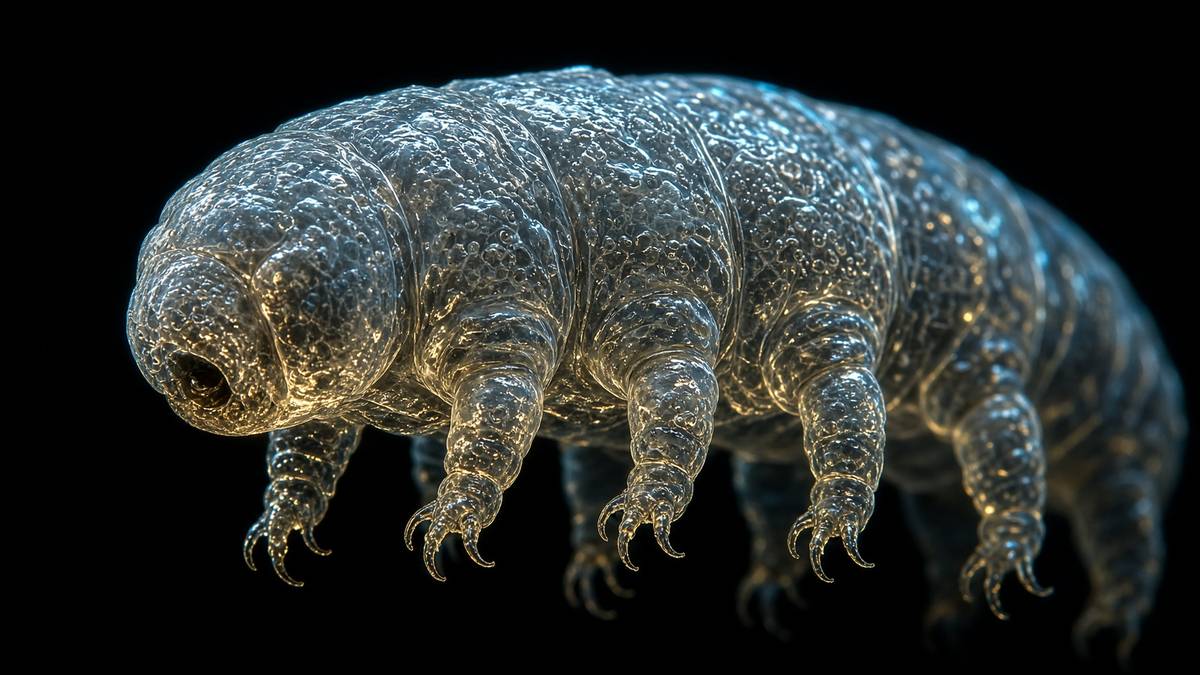
Tardigrada is a phylum of segmented, eight-legged micrometazoans, typically a tenth of a millimetre to a millimetre and a half, most often about half a millimetre when you find one in a drop of moss water. Water bears, moss piglets: the common names are doing aesthetic work a methods section doesn't need. They have a cuticle they moult, stylets they punch plant cells with, and a nervous system that's a respectable miniature, not a joke. About 1,400 species are named. Most of them live in films of water on moss, lichen, soil and sediment, which is an environment that dries out on a weather timetable. The evolutionary answer to that timetable, in the species that have it, is anhydrobiosis: a reversible halt in which body water falls below a few percent, metabolism becomes undetectable, and the animal folds into a tun. Add water, and it walks off. Hydrated, metabolising tardigrades are much more ordinary, which the viral posts always skip. The trick is the dry state, and the kit that makes the dry state survivable. Ramazzottius varieornatus is one of the more stress-tolerant members of that club, which is why Kunieda's group sequenced it.
In short. Water bears are tiny eight-legged animals that live in damp moss. When the moss dries they shut down, and when you add water they walk off. The dry state is the trick.
K. Ingemar Jönsson, Elke Rabbow, Ralph Schill, Mats Harms-Ringdahl and Petra Rettberg, Current Biology 9 September 2008, put desiccated adults of Richtersius coronifer and Milnesium tardigradum on the outside of a spacecraft. Foton-M3, September 2007, Biopan-6, ten days at 258 to 281 kilometres, the TARDIS experiment — Tardigrades in Space — plus sister payloads. Space vacuum alone, which is an extreme dehydration, didn't dent survival relative to ground controls. Vacuum plus solar ultraviolet did. In the harshest UV-all condition, 116.5 to 400 nanometres, three Milnesium specimens survived. In the UV-A/B band, 68 percent of Milnesium revived within thirty minutes of rehydration, then many of those died in the days that followed; some still produced viable embryos. A UV dose above 7,000 kilojoules per square metre, in vacuum, isn't a laboratory lamp. The paper added the first animal to the short list of organisms recovered after open-space exposure. Tuns, not metabolising animals. Dried, not flying. The viral posts skip that clause. We won't. The recovery is still extraordinary, and it's a desiccation-plus-vacuum result with a UV tax, not a claim that a hydrated water bear shrugs at low Earth orbit.
In short. Dried water bears spent ten days on the outside of a spacecraft in 2007. Vacuum alone they handled. Sunlight in vacuum killed most of them. A few still woke up.
Ionising radiation is a different invoice from vacuum, and the doses are the reason the meme exists. Several studies have shown that tardigrades survive gamma irradiation well above 1 kilogray, and that desiccated and hydrated animals often respond similarly, which already tells you the shield isn't only the absence of water. Horikawa, Sakashita, Katagiri and colleagues, International Journal of Radiation Biology 2006, on Milnesium tardigradum, is the dose paper a methods section still cites: lethal doses in the kilogray range, orders of magnitude above the four to five gray that's an adult human LD50 for a whole-body acute hit. Ramazzottius is in the same brutal neighbourhood. Kunieda's later sentence, that X-ray tolerance is thought to be a side-product of adaptation to severe dehydration, is the other half. Dry storage makes fewer radicals. The protein kit handles the radicals that still get made, and the DNA lesions that accumulate while the animal can't repair because it has no metabolism. Dsup sits in that second half. A kilogray animal isn't a kilogray protein. One protein, moved into a human cell, bought about forty percent fewer breaks at laboratory X-ray doses. Keep the scales on separate lines.
In short. Water bears survive radiation doses thousands of times a lethal human dose, wet or dry. One protein in a human cell is a much smaller, measured slice of that toughness.
The genome paper is also a controversy paper. Boothby, Tenlen, Goldstein and colleagues, Proceedings of the National Academy of Sciences 2015, had reported that Hypsibius dujardini carried an enormous fraction of foreign genes, on the order of 17 percent, a horizontal-gene-transfer carnival. Hashimoto's Ramazzottius assembly, with cleaner contamination controls, put putative foreign genes at 1.2 percent or less. Koutsovoulos, Blaxter and the Edinburgh tardigrade group had already argued that the carnival was mostly bacterial contamination in the tube. The 2016 genome is, among other things, that argument settled in favour of a tardigrade that's a tardigrade: loss of some pathways that promote stress damage, expansion of families that ameliorate damage, and a set of tardigrade-unique proteins expressed at high level, Dsup among them. Gene-expression profiles moved only modestly during dehydration and rehydration, which is how you write 'constitutive' in a results section. The tun programme isn't a panic transcription burst. A lot of it's already on. That's a more interesting animal than a walking compost heap of stolen genes, and it's the animal whose protein ended up in HEK293.
In short. A 2015 paper claimed these animals were stuffed with stolen genes. Better genomes said no: they're tardigrades, with their own stress proteins already switched on.
Dsup associates with nuclear DNA and suppresses X-ray-induced DNA damage in cultured human cells.— Hashimoto T, Horikawa DD, Saito Y, et al. Extremotolerant tardigrade genome and improved radiotolerance of human cultured cells by tardigrade-unique protein. Nat Commun. 2016; 7: 12808.
Anhydrobiosis is a glass, not a trick
Anhydrobiosis is a reversible ametabolic state entered as body water leaves. The animal contracts into a tun and the remaining water is no longer a bulk solvent. Two physical stories have been told about how a cell survives that. One is trehalose: a non-reducing disaccharide that replaces water at membranes and proteins and then vitrifies, a glass, so that chemistry slows to a geological crawl. Artemia cysts and the chironomid Polypedium vanderplanki run that story hard. Tardigrades, awkwardly, don't always accumulate much trehalose. Some species make a little; Ramazzottius doesn't make the amount a trehalose theory wants. The second story is intrinsically disordered proteins that do the vitrifying themselves. Cytosolic abundant heat-soluble proteins, CAHS; secretory abundant heat-soluble, SAHS; mitochondrial abundant heat-soluble, MAHS. Boothby, Tapia, Goldstein, Nature Materials 2017, and the papers that followed: CAHS proteins form gels and fibres as water leaves, a vitrified cytoplasm that's a tardigrade invention rather than a borrowed sugar. A glass, not a crystal. Crystals exclude, crack, and kill. Glasses slow. That's the physical chemistry of a tun, and Dsup isn't it. Dsup is a nuclear specialist on a different invoice.
In short. When a water bear dries, its insides turn to a glass. Special floppy proteins, not just sugar, do most of that work. The radiation protein is a separate job in the nucleus.
CAHS proteins are the cytoplasmic half of the dry kit. As water activity falls they undergo a disorder-to-helix transition, assemble into a three-dimensional gel, and the cytoplasm stops being a liquid. Rehydration reverses it. Mitochondrial MAHS is the organelle-local version of the same idea; SAHS is secreted, a less well-told story. Late embryogenesis abundant proteins, the LEA family known from plant seeds, sit in some tardigrade genomes too. None of these is Dsup. The tun is a systems phenotype: vitrified cytosol, protected membranes, a nucleus whose DNA is both less attacked because the water is gone and actively shielded by nuclear proteins, then a repair burst when water and ATP return. Pull one protein out and move it into a hydrated human cell and you have asked a much narrower question: can this one polypeptide, in a nucleus that's still wet, still mitotic, still making radicals from a millimolar water pool, reduce the breaks an X-ray tube makes. That narrower question is the one that got a yes. The systems phenotype is the animal. Confusing them is how a CAHS fibre becomes a space-medicine slide.
In short. The dry-body proteins that gel the cell aren't the DNA-shield protein. Moving the shield into a wet human cell asks a smaller question, and that smaller question is the one that worked.
Radiation and desiccation share a chemistry, which makes Dsup a side-product of drying. Ionising radiation deposits energy in a track. In a hydrated cell most of that energy lands in water and makes hydroxyl radicals, hydrogen atoms, solvated electrons: the radiolysis cloud. Hydroxyl radicals attack the C4 of the deoxyribose, the bases, the phosphodiester backbone; they're how an X-ray becomes a strand break. Dry a cell and you dry the cloud. Direct hits on DNA still happen — a photon or a particle ionising the helix itself — but the indirect, water-mediated majority shrinks. An animal that already had to survive having no water, and then having water rush back and start chemistry at every damaged site, already needed a way to keep the helix readable through that cycle. A disordered protein that coats chromatin and soaks or sterically blocks hydroxyl radicals is a desiccation tool that looks, in an X-ray cabinet, like radiotolerance. Kunieda said this out loud. The HEK293 experiment is that tool, removed from the tun, dropped into a cell that's 70 percent water and always will be. Forty percent fewer breaks in that cell is a hydrated-nucleus number, which is the harder room.
In short. Most radiation damage is water split into fragments that then hit DNA. A dry animal has less of that. The protein still helps in a wet human cell.
Rehydration is the other half of anhydrobiosis. While the tun sits, lesions accumulate because ligases need water and ATP. When water returns, metabolism returns, and a DNA-repair programme has to run on a damaged template before the first mitosis. Repair-gene expression is partly constitutive, partly a rehydration wave. Dsup isn't a ligase, not a glycosylase, not a polymerase. If it reduces the lesion load going into that wave, repair has less to do. If it stays bound during the wave, it could in principle get in the way of repair as well as of radicals, which is a real experimental worry and a reason a protection phenotype in a dish has to be scored as survival and as breaks, not as breaks alone. Hashimoto scored both. Chavez scored hydroxyl-radical cleavage of reconstituted chromatin in a tube, where there's no repair to get in the way. Two assays, two rooms. The animal, in moss, has to survive both rooms in series: a dry month, then a wet hour in which the genome is read again. A human cell given Dsup is being asked only about the wet, irradiated hour. That's already a result.
In short. After drying, the animal must also repair what broke while it was switched off. The shield protein isn't a repair enzyme. It only means the repair crew has less mess to face.
Dsup, named and sequenced
Dsup is a 445-amino-acid protein from Ramazzottius varieornatus, molecular mass about 42.8 kilodaltons, UniProt P0DOW4, with little sequence homology to anything in the rest of the tree. Hashimoto pulled it out of a chromatin-associated fraction: a tardigrade-unique polypeptide that sat with nuclear DNA, carried a nuclear-localisation signal in the C-terminal region, and, when the C-terminus was deleted, lost both nuclear association and the protection phenotype. That deletion is the first mechanism sentence. The protein has to be on the DNA, or at least in the chromatin neighbourhood, to work. It's highly charged, enriched in serine, alanine, glycine and lysine — SAGK, the disorder-promoting quartet — and predicted from the start to be intrinsically disordered except for a stretch around residues 140 to 220 that may form helix. Hashimoto and Kunieda, in a 2017 follow-up, already speculated that it might function with a flexible structure rather than a rigid fold, as a physical shield. The speculation aged well. Small-angle X-ray scattering, circular dichroism and later infrared work have since shown a mostly disordered monomer in solution that tightens when DNA is present. Disorder isn't a missing structure. Disorder is the structure that can drape.
In short. Dsup is a 445-unit protein unique to these animals, floppy rather than rigidly folded, and it only protects DNA when its tail can take it into the nucleus.
Intrinsically disordered proteins aren't a curiosity in this phylum; they're the design language of the tun. CAHS, SAHS, MAHS, Dsup: hydrophilic, charged, low in hydrophobic cores, high in residues that refuse to bury. A fold is a specific surface. A disordered chain is a cloud of surfaces, and a cloud can cover a nucleosome in a way a globular domain the same mass can't. Mínguez-Toral, Cuevas-Zuviría, Alvarez-García, Pacios, Scientific Reports 2020, ran the electrostatics and the molecular-dynamics trajectories: Dsup adjusts to DNA shape, a positive cloud against a negative helix, not a lock and key. Later biochemical work found high-affinity binding to both single-stranded and double-stranded DNA, with affinity falling once the ligand dropped below about thirty base pairs, which is a length, not a sequence. Thirty base pairs is a couple of helical turns, shorter than a nucleosome wrap, long enough to be a patch rather than a base-specific reader. Sequence-nonspecific, length-dependent, charge-driven. That's a coat, not a transcription factor. Anyone modelling Dsup as a DNA-binding domain in the zinc-finger sense has brought the wrong cartoon to the session.
In short. Unlike a typical DNA-reading protein, this one is a floppy charged cloud that drapes over DNA of many sequences, as long as the stretch is long enough.
A short motif in the C-terminus is the one place Dsup looks like a known chromatin protein, and it's the place Chavez used as a handle. Residues 363 to 369, RRSSRLTS in Ramazzottius, align with the core of the nucleosome-binding domain of high-mobility-group N proteins, HMGN1, HMGN2, HMGN3: a small, disordered, nuclear family that binds nucleosomes without much sequence preference and changes how compact the fibre is. Mutate the motif and nucleosome binding falls. The Hypsibius exemplaris orthologue, Dsup-like, UniProt A0A1W0XB17, carries a related stretch and also binds nucleosomes and also protects DNA from hydroxyl radicals in the reconstituted system. Two species, one architecture: a disordered body, a C-terminal chromatin-engagement module with an HMGN-like signature, a nuclear-localisation signal. Hashimoto's C-terminal deletion had already said the tail was required in cells. Chavez said why, in a tube, with a defined nucleosome. HMGN proteins aren't radioprotectants in textbooks. They're chromatin-remodelling neighbours. Dsup appears to have taken a related docking idea and grown a much larger disordered shield on top of it. That's an evolutionary sentence, not a product sentence.
In short. A short patch near the end of the protein looks like a known DNA-packing helper. Change that patch and the protein no longer holds onto packed DNA properly.
The NLS, a 22-residue stretch in the C-terminal region, is what actively parks Dsup on the right side of the envelope. Hashimoto showed co-localisation with nuclear DNA in transfected cells, and showed that the C-terminal truncation that lost DNA association also lost the nuclear picture. In a tardigrade, the protein is made constitutively and is already in the nucleus when the moss dries. In a HEK293 cell it has to be transcribed from a plasmid or a genomic insertion, translated in the human cytosol, imported, and then find chromatin that's human, not tardigrade: different histone variants, different linker lengths, different nuclear-body geography. That it found that chromatin, and that the protection phenotype followed, is the slightly outrageous part. Human nucleosomes are still an octamer of histones with 147 base pairs wrapped 1.65 turns. The docking surface Dsup wants is apparently that old. The rest of the tardigrade nucleus didn't have to come along. Portability at the nucleosome is a stronger claim than portability at the organism, and it's the claim the dish actually made.
In short. The protein has to be carried into the human nucleus and then find human packed DNA. It did. The rest of the water-bear cell didn't have to come with it.
What Dsup isn't belongs on the same page as the sequence. It isn't a catalase. It isn't superoxide dismutase. Chavez's reconstituted system had no enzymes of antioxidant defence, and the DNA was still protected from hydroxyl-radical cleavage, so scavenging the radical cloud in bulk isn't the required story. It isn't a ligase, not Ku, not DNA-PKcs, not a glycosylase. Hashimoto's comet assays were run immediately after irradiation, before a repair programme would have had time to finish a ligation cycle, and the break reduction was already there. It isn't trehalose and it isn't a CAHS fibre; those are cytoplasmic dry-state tools. It isn't a force field. We'll use that phrase once, because the coverage did, and then we'll drop it. A force field would be physics the rest of the nucleus couldn't do. Dsup is a polypeptide occupying space on the nucleosome, a physical buffer, a more boring and more useful sentence. The 2016 paper named it damage suppressor because that's the phenotype. The 2019 paper named the substrate: nucleosomes, hydroxyl radicals, a coverage of chromatin with disordered SAGK-rich regions. Substrate first, then the brand name.
In short. It isn't an antioxidant enzyme, not a DNA-repair enzyme, and not a force field. It's a protein that sits on packed DNA and makes breaks harder to make.
Diagram
- 2 nmB-DNA0.34 nm/bp. Diploid G1 is ~2 metres of this.
- 11 nmNucleosome147 bp around a histone octamer. ~30 million per nucleus.
- loopsCTCF / cohesinEnhancers meet promoters by folding, not by sliding.
- µmA/B compartmentsHi-C: open A, closed B, territories at the lamina.
- 6–10 µmNucleusThe room. The search problem is the entire point of gene regulation.
Packing is not storage. It is the first regulatory decision: a promoter buried in H3K27me3 is not a promoter, it is furniture. Transcription starts when this origami opens the right 1,000 base pairs among 3.1 billion.
Chromatin is the object Dsup actually binds. In a living nucleus, 147 base pairs wrap around a histone octamer; H1 and the linker make a chromatosome; loops then fold that fibre into a territory. Chavez reconstituted mononucleosomes on 147-base-pair and 181-base-pair DNA and found that Ramazzottius Dsup prefers the nucleosome to free DNA, and that linker DNA helps. It also binds nucleosome arrays, and adding histone H1 doesn't kick it off: Dsup and H1 can occupy the same particle. That last result is how you know Dsup isn't simply a substitute linker histone. It's an additional coat. The model in the 2019 paper is coverage: disordered regions enriched in serine, alanine, glycine and lysine form a diffuse mass over the nucleosome surface and reduce hydroxyl-radical access to the backbone. Coverage is a steric and electrostatic sentence. It predicts that a C-terminal docking mutant will fail, that free DNA will be a worse substrate, and that a tube without any repair enzyme will still show protection. Those three predictions held. Two metres of DNA sit in a few micrometres of human nucleus. Dsup doesn't unpack that. It sits on it.
In short. DNA in a nucleus is wrapped on packing proteins. Dsup prefers that wrapped form, can share it with the usual packing histone, and covers it so damaging fragments can't reach as easily.
Human cells, X-rays, fewer breaks
The transfer experiment is the reason this protein left a tardigrade journal and entered a human one. Hashimoto expressed Dsup constitutively in HEK293 cells, a transformed human embryonic-kidney line, and irradiated them with X-rays. Alkaline comet assays, which score single-strand breaks and alkali-labile sites as DNA that streams out of a lysed nucleus in an electric field, were run immediately after 10 gray. Tail DNA in untransfected cells sat at 33 percent; in Dsup-expressing cells it sat at 16 percent, less than half. Neutral comet assays, which keep the duplex together and so report double-strand breaks, showed about a 40 percent reduction in fragmented DNA. γ-H2AX foci, the phosphorylated-histone mark that accumulates at double-strand breaks, were fewer per nucleus in a Dsup-dependent way. Cell viability after 4 gray, scored over days with a resazurin reagent, was higher. Those are four measurements, four ways of asking whether the genome took less of a hit and whether the cell noticed. They all moved in the same direction. Forty percent isn't invulnerability. It's a large, named, dish-sized effect, and it's the number a methods section should keep using instead of 'protected'.
In short. Human cells given the protein and then X-rayed had about half as much broken DNA in one test, about 40 percent less in another, and more of them survived.
Name the machines, because 'we measured DNA damage' isn't a methods line. A comet assay is single-cell gel electrophoresis: cells embedded in agarose, lysed, the DNA unwound, a field applied, a fluorescent stain, a tail moment. Alkaline conditions denature and reveal single-strand breaks; neutral conditions report double-strand breaks. γ-H2AX is an antibody against histone H2AX phosphorylated at serine 139, counted as foci on a fluorescence microscope or as intensity on a blot; it's a double-strand-break reporter, not the break itself, and it can also move with replication stress. PrestoBlue is resazurin reduced by metabolically active cells to a fluorescent product, a plate-reader viability number, not a clonogenic survival curve. Hashimoto used a Pantak HF 350 X-ray generator and a SpectraMax Gemini EM. Those details are how you know the 40 percent is an experiment rather than a mood. A sceptical colleague will also want the untransfected comparison, a vector-only comparison, and a Dsup mutant that can't bind DNA as the specificity check. The 2016 paper has the first two. The C-terminal truncation is the third. If a phenotype survives a DNA-binding mutant, you were never looking at chromatin coverage. You were looking at transfection.
In short. The tests have names: a gel that pulls broken DNA out of a cell, a stain for a break-flag on packing proteins, and a dye for whether cells are still metabolically alive.
Four gray and ten gray are laboratory doses. A whole-body acute dose of about four to five gray is in the range of an adult human LD50 without intensive care; ten gray is well into the lethal-to-mammals neighbourhood. Radiotherapy fractions are typically one to two gray to a tumour volume, with surrounding tissue seeing less. A HEK293 well sitting in an X-ray cabinet at 4 or 10 gray is therefore a genotoxic hit the size of a serious accident or a concentrated therapeutic fraction, delivered all at once to a cycling transformed line. It isn't a year of cosmic rays on the way to Mars, which is a mixed field of protons and high-Z particles at a much lower dose rate, and it isn't a radiotherapy course, which is fractionated on purpose so that repair can work between fractions. Dsup reduced the lesion load from an acute X-ray hit in this line. Extrapolating from that well to an astronaut, a patient, or a seed bank is a different paper, with a different radiation quality, a different cell cycle, and a different nucleus. The 2016 figures remain the starting measurement they always were.
In short. The X-ray doses used on the cells are in the range that would be very serious for a whole person. They aren't the same as space travel or a hospital radiotherapy course.
HEK293 is a chassis with a biography, which is why a 40 percent figure doesn't automatically travel. The line comes from human embryonic kidney, adenovirus-5-transformed, a hypotetraploid karyotype, a p53 pathway that isn't a primary fibroblast's, a doubling time that laughs at Hayflick, and a transfection appetite that made it the workhorse of a thousand overexpression papers. It's a superb place to ask whether a tardigrade protein can be made, imported, and scored against an X-ray tube. It's a poor place to ask what a hepatocyte, a CD34-positive stem cell, a neuron, or a keratinocyte would do with the same protein. Transformed lines tolerate insults that primary cells answer with senescence or apoptosis. They also have repair programmes and chromatin states that primary tissues don't share. Hashimoto wasn't hiding this. Cultured human cells is the phrase in the title. Follow-up work in tobacco, in Drosophila, in yeast, is how you ask whether the chassis was the result. Some of those chassis said yes, more modestly. The honest reading of 2016 is a transferable chromatin buffer in a permissive human line. Writing 'human cells' as if that were 'a human' skips the karyotype.
In short. The human cells in the key experiment are a hardy laboratory line, not a typical body tissue. The result is real for that line. Other tissues have to be tested on their own.
Improved radiotolerance, in the 2016 title, is survival as well as breaks, and both have to move. A protein that hid breaks but left the cell dead would be a staining artefact. Hashimoto's Dsup moved tail DNA, γ-H2AX and viability together, which is the pattern you want. It didn't make the cells immortal to X-rays. It shifted the curve. Subsequent work has had to ask whether Dsup also changes transcription of repair genes — some papers have reported upregulation of repair programmes in Dsup-expressing mammalian cells — and whether that transcriptional neighbour is required for the phenotype. Chavez's tube assay, with no transcription and no repair, says the physical coverage is sufficient to protect DNA from hydroxyl radicals. Sufficiency in a tube isn't exclusivity in a cell. A cell could have both: a coat that reduces the lesion load, and a transcriptional response that mops up what remains. An honest assay names which half it's scoring. The 2016 comets, harvested immediately, are the coat. The viability, scored over days, is the coat plus everything the cell did afterwards.
In short. Breaks fell and survival rose together, which is the pattern you want. Some of the later survival may also be the cell turning on its own repair genes, which is a separate question.
Nucleosomes, not a force field
Chavez, Cruz-Becerra, Fei, Kassavetis, Kadonaga, eLife 2019, is the mechanism paper the 2016 phenotype required. They purified Ramazzottius Dsup, reconstituted mononucleosomes, and asked what the protein preferred. Nucleosomes over free DNA. Arrays as well as monomers. Binding independent of DNA sequence. A C-terminal region, including an HMGN-like motif, required for the nucleosome interaction and for protection from hydroxyl-radical-mediated cleavage. The Hypsibius Dsup-like protein did the same jobs. Hydroxyl radicals, in that tube, were generated chemically, not by an X-ray generator: a defined oxidative insult aimed at the backbone, scored as cleavage of the labelled DNA. No ligase in the tube. No polymerase. No NAD+ pool for PARP1 to spend. Protection in that system is physical. The model they drew is the one this page is willing to keep: Dsup binds specifically to nucleosomes and protects chromosomal DNA from hydroxyl radicals via coverage of the chromatin with disordered regions enriched in SAGK residues. Coverage. We used 'blanket' once, in the plain-English register, because Hashimoto's own speculation invited it. The adult word is coverage. The adult object is a nucleosome.
In short. A 2019 study put the purified protein on packed DNA in a test tube and showed it blocks oxidative cutting without any repair machinery present. That's a physical cover.
Hydroxyl radicals are the chemical the coverage is for, and they're worth a named paragraph because 'radiation damage' is a blur. Water radiolysis yields •OH, H• and e−(aq). The hydroxyl radical abstracts hydrogen from deoxyribose, especially at C4′, and the resulting sugar radical can open the backbone: a single-strand break. Two such events close together on opposite strands, or a radical plus a nearby replication fork, become a double-strand break. Bases are oxidised too: 8-oxoguanine is the celebrity, a miscoding lesion glycosylases have to find. Direct ionisation of the helix, without water, still happens, especially in a dry tun, and makes breaks and base damage by a different route. Dsup's documented in-vitro talent is against the hydroxyl-radical route on nucleosomal DNA. That's the hydrated-cell route, which is why a HEK293 well was a fair first test. Whether the protein also changes the direct-ionisation cross-section of a dry helix is a different, drier experiment, and a tardigrade tun is the organism that would care. Human cells in culture never take that exam. They take the wet one. Forty percent fewer wet breaks is the grade.
In short. Radiation mostly harms wet cells by turning water into a fragment that then cuts DNA. The protein's proven talent is blocking that cut on packed DNA.
Linker histone H1 is the other coat already on the fibre. H1 sits at the entry and exit of the nucleosomal DNA, stabilises the chromatosome, and promotes folding of the fibre. If Dsup were simply competing for that site, adding H1 would displace it or block protection. Chavez added H1 and still had Dsup on the particle. Two coats. In a living tardigrade nucleus both would be present; in a human nucleus H1 is certainly present, and Dsup, arriving as a transgene, has to find space on a fibre that's already occupied by H1, by HMGN proteins, by transcription factors, by repair complexes, by the whole crowded nuclear proteome. That it can share a particle with H1 in a tube is encouraging. That a human nucleus is more crowded than a tube is why a 40 percent effect in HEK293 is already a lot of occupancy for a foreign disordered protein, and why anyone proposing to put Dsup into a primary tissue has to ask what else it displaces. Chromatin is a budget of surfaces. A new coat spends some of them. The protection phenotype is the intended spend. Transcriptional side-effects, if they appear, are the side-spend.
In short. The usual packing histone can stay on DNA at the same time as Dsup, so the tardigrade protein is an extra cover, not a replacement. A living nucleus is more crowded than a tube.
Preferential nucleosome binding over free DNA surprised people who had read Hashimoto as 'it binds DNA'. It does bind DNA. It binds nucleosomes better. That preference is how a protein becomes a chromatin factor rather than a nucleic-acid sponge that would also coat mitochondrial DNA, RNA, and every phosphate in the cell. A sponge would be toxic. A nucleosome-preferring coat can, in principle, live in a nucleus at a useful concentration. The HMGN-like motif is the best current explanation for the preference, and the C-terminal deletions that lose nucleosome binding lose protection, which is the causal chain the field actually has. Later affinity work, with DNA ligands of defined length, still shows that naked DNA of thirty base pairs and up is a good ligand in isolation. Both things can be true: a protein can bind naked DNA in a gel-shift and still prefer a nucleosome when both are on offer. In a nucleus both are on offer, and the nucleosome wins by mass. That's where the radicals have to be blocked if the genome is the thing you're trying not to fragment. Dsup was scored on nuclear comets and nuclear γ-H2AX. Nuclear is the claim.
In short. The protein can stick to plain DNA, but it prefers DNA wrapped on packing proteins. That preference is probably why it can live in a nucleus without coating everything.
Diagram
Closed chromatin (H3K27me3, DNA methylation) hides the promoter. Pioneer factors and histone acetyltransferases open it.
PIC: TFIID, TFIIH, Mediator, Pol II. Ser5 phosphorylation of the CTD lets the polymerase leave the promoter.
Elongation ~20–40 nt/s. Capping, splicing, cleavage and polyadenylation happen on the still-growing RNA.
Human genes are islands in 3.1 billion base pairs of mostly noncoding sequence. Promoter, enhancers, chromatin state and the Mediator complex decide whether Pol II is allowed to fire. Epithalon’s literature sits on TERT and pineal clocks — two of the rare promoters anyone bothers to name in a peptide essay.
Transcription is the step the dish had to get right before any comet was scored. RNA polymerase II, in a human nucleus, still has to find a promoter, assemble a pre-initiation complex, escape the pause, and elongate while the message is capped and spliced. Hashimoto put Dsup behind a promoter a human cell would recognise; the tardigrade's own cis-regulatory grammar didn't have to travel. The messenger is a tardigrade coding sequence codon-optimised or not, depending on the construct, translated by human ribosomes into a 445-residue chain that then takes a human nuclear-import path. That's already a lot of heterologous biology succeeding. Expression level is a variable the 2016 paper treats as Dsup-expressing versus not; a later assay that wants a dose curve will have to count molecules per nucleus, because coverage is a stoichiometry. Too little and the fibre is naked in patches. Too much and you're looking at a crowded nucleus, a possible transcription interference, a possible mitotic problem. The protection phenotype is an expression-window phenotype. If you write 'Dsup cells' without a blot or an immunofluorescence for the protein hasn't shown that the polymerase did the living step.
In short. In the dish, human machinery has to copy the tardigrade gene into a message and build the protein before any DNA is shielded. How much protein is made is part of the result.
A buffer you can move
Transferability is the claim that made Dsup more than a tardigrade anecdote, and it has a scoreboard that's mixed in the way real scoreboards are. Human HEK293: yes, breaks down, survival up, Hashimoto 2016. Tobacco, Nicotiana tabacum: Dsup-expressing plants have been reported with improved tolerance to genome damage, a plant-lab version of the same buffer idea, modest in the way plant stress papers often are. Drosophila: Dsup-expressing flies have been used as a metazoan transfer, again a protection phenotype, again not a superhero. Budding yeast, Nature Communications 2025: Dsup coats the yeast genome without obvious locus bias, reduces oxidative DNA damage independently of ROS scavenging or a large transcriptional stress programme, and uses at least two C-terminal regions for multivalent nucleosome contact; survival and longevity after hydroxyl-radical stress improved. That yeast paper is the cleanest post-2019 in-vivo biochemistry we've, and it still reads as coverage, not as a new enzyme. Some radiotolerance claims in other chassis have been modest or have needed the right expression window. That's what a real transferable trait looks like. A buffer you can move. Not a spell that works the same in every nucleus.
In short. The protein has now been put into human cells, plants, flies and yeast. Protection shows up in several of those, more strongly in some than others. That's a movable buffer, not a spell.
The sci-fi destinations have been said out loud, and they should be sized. Astronauts: galactic cosmic rays are a mixed, high-LET, low-dose-rate field that a 10-gray X-ray cabinet doesn't simulate; a chromatin coat that helps against hydroxyl radicals may do less against a dense ion track, and a gene-therapy delivery problem sits in front of any of that. Radiotherapy patients: a protein that reduces breaks in normal tissue could, in principle, widen a therapeutic window, and could, in principle, also protect the tumour; nobody has a clinical programme. Seed banks and cell-therapy manufacturing: a cheaper, less regulated neighbourhood, where a transgene that helps cells sit through irradiation or oxidative storage is a process improvement rather than a medicine. Frozen de-extinction fibroblasts, the Dallas neighbourhood this journal already covers, are another process thought: cosmic rays in a freezer are a slow insult, and a coat on chromatin is at least the right kind of object to think about. Thinking isn't a protocol. None of those destinations has a Dsup medicine, a Dsup crop on the market, or a Dsup astronaut. The literature has a protein and a set of dishes. Stay with the dishes.
In short. People have suggested astronauts, cancer radiotherapy, seed stores and frozen cells. None of those is a product. The published facts are still cells, plants, flies and yeast.
Kunieda and Hashimoto applied to patent the Dsup gene in 2015, which is a fact about how a transferable trait enters the world and not a fact about a clinic. Patents on extremophile genes are a genre: Taq was a genre-defining argument, CRISPR was a war, antifreeze proteins from fish have a patent thicket. A patent is a claim on a use. It isn't evidence that the use works in the setting the claim names. We mention it so that 'named, sequenced, transferable' includes the industrial half of transferable. Someone thought the sequence was worth owning. The scientific half remains the papers: a genome, a human-cell phenotype, a nucleosome mechanism, a yeast genome-wide coat. Those four objects are the scoreboard. A patent office isn't a fourth assay. A moss-piglet extract labelled as Dsup, or a supplement with a water-bear on the bottle, isn't the protein in the papers. We'd not. The protein in the papers is a recombinant coding sequence, expressed in a named chassis, scored with a comet, a focus count, or a cleavage gel. Extract of moss is a different object with a different, worse, methods section.
In short. The gene was patented, which tells you someone saw a use. It doesn't tell you the use works in people. A water-bear supplement isn't the protein in the papers.
What hasn't been shown belongs in this heading so the buffer doesn't inflate overnight. Dsup hasn't been shown to protect a person. It hasn't been shown, in a controlled study, to protect a primary human stem-cell graft, a neuron, a hepatocyte in situ, or a whole animal that isn't a fly or a tardigrade. It hasn't been shown to help against high-LET ions at space-relevant dose rates. Head-to-head comparison with amifostine or a PARP inhibitor in the same well would shrink the romance and improve the paper. Modest replication in some chassis is already a kind of comparison. We'll keep the 40 percent, the nucleosome preference, the yeast coat, and the open list. Transferable means the coding sequence works outside the animal it evolved in. It doesn't mean the phenotype is a medicine, a mission, or a mammoth-freezer protocol. The neighbouring CRISPR essay has the same shape: a working enzyme, a remaining door. Here the working protein is the coat. The remaining door is every nucleus that isn't that line.
In short. Nobody has shown protection in a person, in most human tissues, or against space radiation. Transferable means the gene works outside a water bear, not that it's a treatment.
The chassis still has a doubling counter
Hayflick and Moorhead, Experimental Cell Research 1961, counted why a human cell in a dish isn't an unlimited factory. Human diploid fibroblasts divide a finite number of times — classically forty to sixty doublings — then flatten and refuse mitosis. The counter is the telomere. Each S phase spends sequence at the lagging-strand end; when the TTAGGG repeats are too short, shelterin can't hide the end, ATM treats a chromosome as a break, p53 and p16 engage, and the cell senesces. Most somatic cells keep telomerase off on purpose, which is the tumour-suppression bargain. HEK293 doesn't sit on that counter. It's transformed, telomerase-positive, karyotypically a mess, a line that will outlive the postdoc. Hashimoto's experiment therefore asked whether Dsup protects a nucleus that has already stepped off Hayflick's clock. A primary fibroblast, a mesenchymal stromal cell, a CD34-positive haematopoietic stem cell, would ask the question inside the clock: every break Dsup fails to stop spends repair, and every repair that uses non-homologous end joining can cost sequence, and the telomere is already a double-strand-break problem in disguise. Immortal isn't a synonym for human.
In short. Ordinary human cells can divide only a limited number of times before they stop. The famous Dsup test used a line that has already escaped that limit, which is a different kind of cell.
Diagram
- Hayflick limit~40–60 doublingsHuman fibroblasts in 1961. They were not immortal. He counted.
- End-replication5–15 kb TTAGGGDNA polymerase needs a primer. The lagging strand shortens. Olovnikov named the problem.
- Shelterin6 proteinsTRF1, TRF2, POT1, TIN2, TPP1, Rap1. The end is hidden from the damage response.
- TERT offmost somatic cellsTumour suppression. Stem cells and germline keep it on. So do most cancers.
- SenescenceSASPp16, p21, the secretome Campisi named. A cell that refuses to die and talks too much.
Blackburn, Greider and Szostak, Nobel 2009. Epithalon’s literature sits on TERT and pineal melatonin — a tetrapeptide claiming two of the rare promoters anyone names in a peptide essay. The machines are real. A large Western RCT of telomere length in adults is not on the shelf next to the vial.
Senescence is how a primary cell answers a break load that Dsup only partly prevents, which is why a viability dye on HEK293 isn't a clonogenic assay on a fibroblast. Four gray to a diploid fibroblast will make senescent cells, a DNA-damage focus that won't extinguish, a secretory programme, a Hayflick stop brought forward. Four gray to HEK293 will kill some cells and leave the rest proliferating, which is what a resazurin curve over a few days is actually watching. If you wanted Dsup as a manufacturing aid for a cell therapy — irradiated feeder layers, oxidative stress in a bioreactor, a freeze-thaw — the relevant chassis is the therapeutic cell, at the relevant passage, with a senescence stain and a karyotype, not a transformed kidney line. If you wanted Dsup as a radioprotectant in a tissue, the relevant chassis is that tissue's stem and progenitor cells, which live on a doubling budget and a p53 budget. The 2016 paper doesn't owe you those experiments. A translational paragraph that skips them owes you an apology. The tardigrade protein doesn't get to skip Hayflick's census because it's cute.
In short. In ordinary cells, leftover DNA breaks can force a permanent stop. A survival dye on an immortal line doesn't measure that stop. The useful tests would use the cells you actually care about.
Induced pluripotent stem cells reset telomeres and don't reset everything. An iPSC-derived cell can take Dsup as a landing-pad insertion, in principle, and then be differentiated into a neuron or a cardiomyocyte and irradiated. In principle is doing a lot of work. Off-target insertions, silencing of the transgene during differentiation, the chromatin state of the differentiated nucleus versus HEK293, the fact that a neuron doesn't offer homology-directed repair if you also damaged it: those are the methods. Casgevy, in the neighbouring essay, takes a patient's own stem cells out, edits them, and puts them back; that's a scissors at an enhancer, a licensed medicine, a manufacturing suite. Dsup would be a cargo in a similar suite only after someone showed that a haematopoietic stem cell with a tardigrade chromatin coat still makes blood, still doesn't become a myeloid neoplasm, and still sees fewer lesions under the insult you actually care about. That's a decade, not a weekend. HEK293 was a weekend, in the best sense: a clear question, a clear protein, a clear 40 percent. Honour the weekend by not pretending it was the decade.
In short. Putting this protein into stem cells that make tissues would be a long safety project. The original human-cell test was a short, clear experiment in a laboratory line, and that's its virtue.
What radiation actually does to DNA
A double-strand break is the lesion the headlines mean, and not the only one an X-ray makes. Track structure deposits energy in nanometre-scale clusters. In water, as already named, hydroxyl radicals do most of the covalent work: sugar-phosphate nicks, oxidised bases, abasic sites. A single-strand break is repairable by a short-patch BER or by ligase after cleaning the ends; a cell makes tens of thousands of them a day from ordinary metabolism and mostly doesn't notice. A double-strand break is rarer and ruder. Non-homologous end joining stitches the ends, often with a small insertion or deletion, throughout the cell cycle. Homology-directed repair copies a sister chromatid across the break, mostly in S and G2. Two breaks on different chromosomes can become a translocation. A break that persists becomes a γ-H2AX focus, a PARP1 burst, an ATM signal, a p53 decision. Hashimoto's neutral comets and γ-H2AX counts are the double-strand-break invoice. The alkaline comets are the broader invoice, single-strand plus alkali-labile. Dsup moved both, which is what you would expect from a coat that reduces radical access to the backbone rather than a specialist in one repair pathway. A repair-enzyme transgene would have moved one invoice more than the other.
In short. X-rays nick one DNA strand or cut both. Cells stitch the double cuts with some errors. Dsup reduced both kinds of cut, which fits a cover, not a specialist repair tool.
PARP1 is the nuclear spend this journal has already written at NAD+ length. A break Dsup fails to prevent still costs cofactor. Poly(ADP-ribose) polymerase 1 binds DNA nicks, cleaves NAD+, and polymerises ADP-ribose onto itself and onto nearby proteins. The polymer is a flag. Repair machinery reads it. Then PARG takes it off. The NAD+ doesn't come back as NAD+; it comes back, at best, as nicotinamide plus ADP-ribose, which salvage has to rebuild. A genotoxic hit can drop cellular NAD+ by millimolar amounts in minutes. In an ischaemic neuron the same burst is how PARP1 kills: NAD+ collapse, glycolytic stall, energy failure on top of the break. Dsup, if it reduces nicks, should spare some of that burst. Nobody, to our reading, has put a PARP1 activity assay and a NAD+ number next to a Dsup comet in the same well. That experiment is sitting there. It would connect this page to the cofactor essay without pretending a tardigrade protein is a sirtuin. Two jobs, one lesion class. A chromatin coat that lowers the lesion load is a supply-side intervention on a drain. The drain still has a name.
In short. Each remaining DNA nick costs the cell a helper molecule used in repair. If the tardigrade protein means fewer nicks, that helper pool should be spared. Someone should measure that.
Linear energy transfer is the variable an X-ray cabinet can't stand in for, and it's the variable a space sentence requires. X-rays and gamma rays are low-LET: sparse ionisations, damage dominated by single radicals, lesions that look like the oxidative damage a mitochondrion already makes. Iron nuclei in galactic cosmic rays are high-LET: a dense track, clustered damage, double-strand breaks that sit next to other double-strand breaks, a repair problem that end joining mishandles and that a simple hydroxyl-radical coat may only partly see. Amifostine and the classical radioprotectants were built around the low-LET, radical-scavenging world. Dsup, on present evidence, lives in that world too. Horikawa's tardigrades survive high doses of gamma, which is low-LET, and they have also been flown; the animal's kit is broader than one protein. Saying 'tardigrades survive space, therefore Dsup will protect an astronaut' is two category errors in series: the animal isn't the protein, and space isn't an X-ray tube. Saying 'Dsup reduces low-LET radical damage to nucleosomal DNA, in some heterologous nuclei, by a measured fraction' is one true sentence. We'll keep the true sentence. The category errors can go back to the internet.
In short. Hospital X-rays and space particles damage DNA in different patterns. The protein has been shown to help with the X-ray pattern. That isn't automatically help against space radiation.
Repair after the fact is the tardigrade talent Dsup doesn't pretend to be. Desiccated animals accumulate lesions they can't fix until water returns; the rehydration wave then runs a repair programme on a damaged genome and, somehow, the animal doesn't become a translocation factory. That programme is still being mapped: which polymerases, which ligases, whether a specialised non-homologous pathway, whether a G2 delay that buys homology-directed repair. Dsup's job, on the evidence, is to make that programme's input smaller. A human cell given Dsup still runs human repair — NHEJ, HDR, BER, nucleotide excision, the Fanconi neighbourhood if the fork collapses — on whatever lesions the coat let through. If Dsup also upregulates some of those genes, as a few mammalian papers have suggested, that's a transcriptional neighbour, not the 2019 tube mechanism. An assay that wants the coat should irradiate and lyse on the minute, as Hashimoto's comets did. An assay that wants the neighbour should add a transcription inhibitor, or a Dsup mutant that binds chromatin but can't do whatever the transcriptional claim is, and watch the viability curve. Two timescales. Two papers. Both allowed. Neither is a force field.
In short. Water bears also repair a lot of damage when they wake up. Dsup is the bit that reduces how much damage arrives. Human cells given Dsup still use human repair for the rest.
- Dsup
- 445 aa, ~42.8 kDa
- X-ray breaks in HEK293
- ~40% fewer
- Human whole-body LD50
- ~4–5 Gy
- Tardigrade radiation
- >1 kGy
- TARDIS / Foton-M3
- 10 days LEO
- Animal length
- ~0.5 mm
- Putative foreign genes
- ≤1.2%
- Nucleosome wrap
- ~147 bp
Ramazzottius varieornatus. UniProt P0DOW4. Disordered, SAGK-rich, C-terminal NLS and HMGN-like motif.
Hashimoto et al., Nat Commun 2016. Alkaline comet tail DNA 16% versus 33% at 10 Gy. Neutral comet ~40% down.
Acute, no intensive care. HEK293 was hit with 4 Gy and 10 Gy in a cabinet.
Horikawa 2006 and the reviews. Hydrated and dry animals. The animal, not the one protein.
Jönsson et al., Curr Biol 2008. Vacuum survived. Vacuum plus solar UV mostly did not. Three Milnesium in the harshest band.
The mascot measurement. The protein does not know it.
Ramazzottius genome, Hashimoto 2016. The 17% HGT carnival did not survive a cleaner assembly.
The docking object. Chavez: Dsup prefers this particle to free DNA, and can sit with H1.
How to design an honest Dsup assay
Decide what you're measuring first. Breaks immediately after irradiation are the coat. Breaks hours later are the coat plus repair. Viability over days is the coat plus repair plus cell-cycle arrest plus whatever transcriptional neighbour you have. Clonogenic survival is the adult viability number; a resazurin well is a scout. γ-H2AX is a focus count, not a break count; it can rise with replication stress in a protein that slows forks as well as with radiation. A comet tail is a mass of DNA that left the nucleus; alkaline and neutral are different lesions. Hydroxyl-radical cleavage of a reconstituted nucleosome is the physical claim, and it needs a labelled fragment, a defined radical source, and a Dsup mutant that can't bind as the lane that should look like the unprotected control. Expression has to be shown: a blot, an immunofluorescence, a mass-spectrometry peptide, something that says the polymerase and the importer did their jobs. Without that, a protection phenotype is a transfection reagent story. Hashimoto had the protein in the nucleus. Chavez had the protein on the particle. Start there, then pick one lesion class, one time point, and one chassis, and write them in the title.
In short. Say whether you're measuring breaks at once, breaks later, or survival over days. Show that the protein was actually made and present on DNA. Pick one cell type.
Pharmacological and genetic controls are how you name the hole. A DNA-binding mutant — C-terminal truncation, HMGN-motif substitution — should lose protection if coverage is the mechanism. A repair-inhibitor panel shouldn't abolish an immediate comet phenotype if the phenotype is the coat; a PARP inhibitor, a DNA-PKcs inhibitor, an ATM inhibitor, used as tools, will tell you whether the survival curve was secretly a repair-upregulation curve. NAC or a catalase overexpression will tell you whether you were looking at bulk scavenging. FK866, if you're in the NAD+ neighbourhood, will tell you whether a spared PARP1 burst is doing some of the viability work. None of those is a reason to run every drug on every well. They're a reason to pick the alternative story you're most afraid of and close it. Cell type is a control, not a convenience. HEK293 will tell you whether the construct works. A primary fibroblast will tell you about senescence. A yeast cell will tell you about a genome-wide coat without an immune system. A plant will tell you about a cell wall and a chloroplast. Publish the one you used. Don't imply the other four.
In short. Use a version of the protein that can't bind DNA as your negative control, and don't treat a hardy laboratory cell as a stand-in for every tissue.
Radiation quality, dose and dose rate have to be written as numbers, not as the word 'radiation'. X-ray or gamma, kilovoltage or cobalt, gray, gray per minute, and whether the dish was on ice so that repair wouldn't run during the exposure. Ten gray at high dose rate in a cabinet is one experiment. A milligray per day of mixed ions is another. Ultraviolet, if someone is still thinking about the Foton-M3 UV-all condition, is a third, a pyrimidine-dimer lesion class Dsup hasn't been shown to own. Hydrogen peroxide is a fourth, a useful hydroxyl-radical cousin if you're trying to match Chavez in a cell rather than in a tube, and it's also a detergent for redox biology if you pick a silly concentration. Write the number. Write the source. Write the minute of harvest. A paper that says 'Dsup protects against radiation' without those four hasn't yet started. A paper that says 'Dsup reduced alkaline-comet tail DNA from 33 percent to 16 percent at 10 gray of X-rays, harvested immediately, in HEK293 expressing full-length protein' has started. Aim for the second paper. The first one is a press release.
In short. Write the kind of radiation, the dose, how fast it was given, and when you looked. Without those, 'protects against radiation' is a catchphrase.
Machines, named, because this is a Cell desk. A comet setup: agarose, lysis, electrophoresis tank, SYBR Gold or equivalent, imaging software that reports tail moment and percent tail DNA, not a photograph of a pretty comet. A fluorescence microscope for γ-H2AX, with a counting rule you would let a colleague use, and a blot if the foci argument gets loud. A clonogenic assay, dishes stained with crystal violet, colonies of fifty cells, a surviving-fraction curve. An X-ray cabinet or a caesium source with a current calibration certificate. For the tube: reconstituted nucleosomes, a native gel for binding, a hydroxyl-radical footprint or a cleavage gel, a labelled DNA, a protein stain that shows H1 and Dsup on the same particle. For expression: Western, immunofluorescence, maybe a CUT&RUN or ChIP if you're going to claim genome-wide occupancy the way the yeast paper did. None of that's glamorous. All of it's how you stop a water-bear essay becoming a mood. The 2016 and 2019 papers already look like this paragraph. A methods section that can't say which of these machines it used isn't yet a Dsup paper. It's a mascot.
In short. Name the gel, the microscope, the radiation source and the protein blot. A photograph of a water bear isn't a measurement.
- Name the protein: full-length Ramazzottius Dsup, a C-terminal truncation, an HMGN-motif mutant, or a Hypsibius orthologue. Show it on a blot.
- Name the chassis: HEK293, a primary fibroblast, yeast, a plant, a fly. Passage and, if human, a senescence marker if the cell still has a clock.
- Name the insult: X-ray or gamma, gray, dose rate, or a defined hydroxyl-radical source. Ultraviolet is a different lesion.
- Name the time point: immediate comet for the coat; hours for repair; days for viability. Do not add them together.
- Name the lesion class: alkaline comet, neutral comet, γ-H2AX, reconstituted-nucleosome cleavage. A viability dye is not a break.
- Close the alternative: DNA-binding mutant, scavenger, repair inhibitor. If the phenotype survives a non-binding mutant you were never looking at coverage.
Diagram
| Node | Catalogue | Conversation |
|---|---|---|
| GPCR | Ipamorelin, MT2, PT-141, retatrutide, CJC | Second messengers, secretion, appetite, pigment |
| RTK / IGF1R | IGF-1 LR3 | IRS–PI3K–Akt–mTOR and Shc–ERK |
| Cytokine receptor | Somatropin (HGH) | GHR–JAK2–STAT5b, hepatic IGF-1 |
| Cofactor | NAD+ | Sirtuins, PARPs, CD38, redox |
| Actin buffer | TB-500 / Tβ4 motif | G-actin sequestration, motility |
| Growth-factor-like | BPC-157 | VEGFR2 / FAK / eNOS neighbourhood |
| Copper ligand | GHK-Cu | Transcriptome shift in fibroblasts |
| MC fragment | KPV | NF-κB, PepT1, no pigment |
| Nuclear / pineal | Epithalon (AEDG) | TERT and melatonin literatures |
| mtORF peptide | MOTS-c | AMPK, folate–methionine cycle |
Each row is a different kind of molecular conversation. The catalogue peptides bind at these nodes; they are not interchangeable, and stacking them because a forum did mixes unrelated literatures.
Close: a protein on DNA, public papers
Nucleosomes are old, hydroxyl radicals are chemistry, and a disordered charged chain that covers the first against the second can work in a nucleus that never met a tardigrade. Human octamers, yeast octamers, a fly nucleus, a plant nucleus: the docking object is the wrap, not the species. That's why a Ramazzottius protein can show up in a HEK293 comet. Conservation isn't a licence to treat a 40 percent dish figure as an astronaut protocol. It's a licence to take the biochemistry seriously enough to measure it, in the chassis you have, with the mutant that can't bind, at the time point that matches the claim. The popular story got loud because the animal is small and the vacuum was real. The work got interesting because the protein moved. Those are different loudnesses. We'll keep them on different lines. Taq, CRISPR, Dsup: three gifts from organisms that weren't trying to help. The first became a polymerase on every bench. The second became a licensed medicine and a Dallas freezer. The third is a nucleosome coat with a measured fraction. That's a remarkable place to stop.
In short. Packed DNA and water-derived damage are shared across life, which is why a water-bear protein can work in a human cell. A dish result is still not a space programme.
The public papers are the reading list, and they're short enough to actually read. Hashimoto, Kunieda, Nature Communications 2016, the genome and the human-cell transfer. Chavez, Kadonaga, eLife 2019, nucleosomes and hydroxyl radicals. Jönsson, Current Biology 2008, ten days on Foton-M3, vacuum versus vacuum-plus-UV. Horikawa, International Journal of Radiation Biology 2006, the kilogray doses. Hashimoto and Kunieda 2017, the disordered-shield speculation that aged well. Boothby, Nature Materials 2017, CAHS gels, so the cytoplasmic glass stays a different invoice. Mínguez-Toral, Scientific Reports 2020, the electrostatic cloud. The 2025 yeast genome-wide coat, so occupancy has a chromosome-scale picture. Koutsovoulos and Blaxter, so the horizontal-gene-transfer carnival stays retired. That's a week of evenings, not a guru. The moss-piglet headlines will still be there when you come back, and they will look smaller. Read the 16 percent versus 33 percent before anyone is allowed to say 'protected'. Read the three surviving Milnesium before anyone is allowed to say 'survives space' without the UV clause. Read the HMGN motif before anyone is allowed to say 'force field'.
In short. A short stack of papers covers the genome, the human-cell test, the packed-DNA mechanism and the space flight. Read those before any headline.
Leave with a topology, not a mascot. Tardigrades, in the tun, survive desiccation, vacuum and ionising radiation; hydrated animals are more ordinary, and solar UV in vacuum is a tax most tuns don't pay. Anhydrobiosis is a glass of disordered cytoplasmic proteins plus a repair wave on rehydration. Dsup is the nuclear specialist that ported: 445 residues, disordered, nucleosome-preferring, HMGN-like at the tail, about 40 percent fewer X-ray breaks in HEK293, a tube mechanism that doesn't need a repair enzyme. Plants, flies and yeast have carried versions of the same coat with mixed, real effect sizes. HEK293 is immortal. A primary cell still has Hayflick's counter, and a person isn't a well. Radiation chemistry is hydroxyl radicals and clustered breaks, PARP1 spends NAD+ on what gets through, and space isn't an X-ray cabinet. If your experiment needs a chromatin buffer, the sequence is public, the mutants are described, and the machines are named above. If it needs a medicine, this journal doesn't sell one, and nobody else has a licensed Dsup either. If it needs a water bear, look in the moss, add water, and try not to write the animal as a vitamin.
In short. Leave with the map: dry animal, glass cytoplasm, nuclear coat, 40 percent fewer breaks in a laboratory human cell, no medicine. The mascot is half a millimetre. The result is a protein.
Research-use-only is the wrong legal class for an animal, and this page isn't a catalogue listing. A neighbouring CRISPR medicine is licensed for two blood diseases; a neighbouring peptide vial, if you came from that shelf, is a characterised laboratory solid and isn't a tardigrade. Confusing those classes is how a reader ends up with a protocol they shouldn't have, or a supplement with a moss piglet on the label. The physiology in the paragraphs above is public, cited, and already in heterologous cells, with asterisks. Use it to read the next Dsup paper with the papers in front of you rather than the press release. Name the species. Name the 445 residues. Name the 16 percent versus 33 percent. Name the nucleosome. Name the fact that an astronaut hasn't been transfected. Then, if you're a radiation biologist or a synthetic biologist, argue about chassis and about dose quality, which are the adult arguments. We won't sell you a tun. We won't tell you the space programme is solved. We'll tell you the protein sat on chromatin and the breaks were harder to make.
In short. This isn't a product page. It's a map of a real protein from a real animal, tested in cells. Read the next paper against the break numbers, not against a catchphrase.
Questions the essay actually answers
- Can tardigrades really survive in space?
- Dried tuns have been recovered after exposure on the outside of a spacecraft (Jönsson et al., Curr Biol 2008, Foton-M3). Vacuum alone they handled. Vacuum plus solar ultraviolet killed most of them; a few Milnesium survived the harshest band. Hydrated, metabolising tardigrades are much more ordinary, which the viral posts always skip. The trick is anhydrobiosis: dry out, wait, add water, walk off.
- Is Dsup a drug?
- It's a protein characterised in cell culture, plants, flies and yeast. Nobody has a licensed Dsup medicine, and anyone selling you one is selling you a moss piglet in a bottle. We'd not.
- What is Dsup?
- Damage suppressor, a 445-amino-acid intrinsically disordered nuclear protein from Ramazzottius varieornatus (UniProt P0DOW4). It binds nucleosomes, covers chromatin with a charged disordered chain, and reduces hydroxyl-radical attack on DNA. Hashimoto et al., Nat Commun 2016; Chavez et al., eLife 2019.
- How much protection did human cells actually get?
- In HEK293 cells, alkaline-comet tail DNA after 10 Gy X-rays fell from 33 percent to 16 percent; neutral comets and γ-H2AX foci moved by about 40 percent; viability after 4 Gy improved. Forty percent fewer breaks is the number. Invulnerability isn't.
- Is it a force field?
- No. It's a polypeptide on chromatin. Chavez showed protection from hydroxyl-radical cleavage of reconstituted nucleosomes in a tube with no repair enzymes present. Coverage, not new physics. The C-terminal HMGN-like motif is required for nucleosome binding.
- How is Dsup different from CAHS proteins?
- CAHS, SAHS and MAHS are cytoplasmic (and mitochondrial, secretory) disordered proteins that vitrify the cell as water leaves — the glass of anhydrobiosis. Dsup is a nuclear chromatin coat. Different compartment, different insult, different assay. The tun uses both. The HEK293 experiment used only Dsup.
- Has Dsup been put into other organisms?
- Yes. Tobacco, Drosophila, and budding yeast have carried it, with protection phenotypes of various sizes. The 2025 yeast paper showed genome-wide chromatin coating and reduced oxidative DNA damage without a large transcriptional stress programme. Mixed effect sizes are what a real transferable trait looks like.
- Why not astronauts?
- Space radiation is a mixed, high-LET, low-dose-rate field. The key experiment was acute X-rays on an immortal human cell line. Delivery, safety over a lifetime of chromatin occupancy, and radiation quality are unsolved. The animal surviving vacuum isn't the protein surviving galactic cosmic rays.
- How should DNA breaks be measured in a Dsup experiment?
- Immediate alkaline and neutral comets for the coat; γ-H2AX as a focus count with its caveats; reconstituted-nucleosome cleavage for the physical claim; clonogenic survival for the adult viability number. Show expression. Include a DNA-binding mutant. Write the gray, the source, and the minute of harvest.
- What does this have to do with CRISPR or the minimal cell?
- Neighbourhood, not identity. CRISPR is how you might write Dsup into a genome; JCVI-syn3.0 is a reminder of the parts list underneath. Dsup is a chromatin buffer, not a nuclease and not a 473-gene bacterium. Same century. Different jobs.
Read next
47 min · long read · Frontier biology
The smallest genome that still counts as alive
JCVI-syn3.0 has 473 genes. That is enough to make a cell that grows. It is also a map of what life cannot do without — and a chassis waiting for modules.
50 min · long read · Frontier biology
We can rewrite a genome the way a word processor rewrites a sentence
CRISPR cut DNA. Base editors change one letter without a double-strand break. Prime editors write arbitrary edits from an RNA template. The machinery is no longer hypothetical.
48 min · long read · Frontier biology
CRISPR is no longer a paper. It is a medicine.
In 2023 the UK and then the US licensed exagamglogene autotemcel — Casgevy — the first CRISPR-based therapy. Sickle-cell and β-thalassaemia patients had their own stem cells rewritten at BCL11A. The sci-fi crossed the pharmacy counter.
More in this desk
50 min · long read · Frontier biology
Xenobots: frog cells that became a new kind of machine
No genome was rewritten. Skin and heart cells from Xenopus were sculpted — first by hand, then by an evolutionary algorithm — into millimetre-scale organisms that walk, heal, and assemble copies of themselves.
49 min · long read · Frontier biology
We have the Neanderthal genome. Some of it is still in you.
Svante Pääbo pulled a genome out of bone powder, won the 2022 Nobel, and found that most people outside Africa carry a percent or two of an extinct human. Palaeogenomics is not only mammoths.
49 min · long read · Frontier biology
The woolly mouse is the mammoth’s twenty-day dress rehearsal
Colossal edited seven coat-and-metabolism genes into laboratory mice and got golden, shaggy, cold-curious animals. Elephant gestation is 22 months. A mouse tells you in three weeks whether the edit was worth the wait.
48 min · long read · Frontier biology
Brain organoids: a cortex the size of a lentil
Stem cells, left to their own patterning, build layered neural tissue in a dish. They are not minds. They are the most honest model of human development we have ever had.
Essays describe published research. They are not medical advice and they do not authorise human use of any catalogue item.