

Frontier biology · 46 min · 10,180 words
The passenger pigeon was a forest process. Someone is rebuilding the bird.
Martha died in 1914. Billions had darkened American skies. Revive & Restore is editing the band-tailed pigeon toward Ectopistes migratorius — not as a museum skin, as an ecological flood.
What this essay actually tells you
- Ectopistes migratorius once darkened North American skies. The last bird, Martha, died in Cincinnati in 1914. We know her name. We don't have her species.
- Revive & Restore's path is to edit a band-tailed pigeon toward passenger-pigeon trait modules. Chassis plus palaeogenome. Nobody's cloning a museum skin.
- The species was a forest process (mast, disturbance, density). A bird without that ecology is a specimen, not a flock, and the edit doesn't restore the oak.
What this actually means
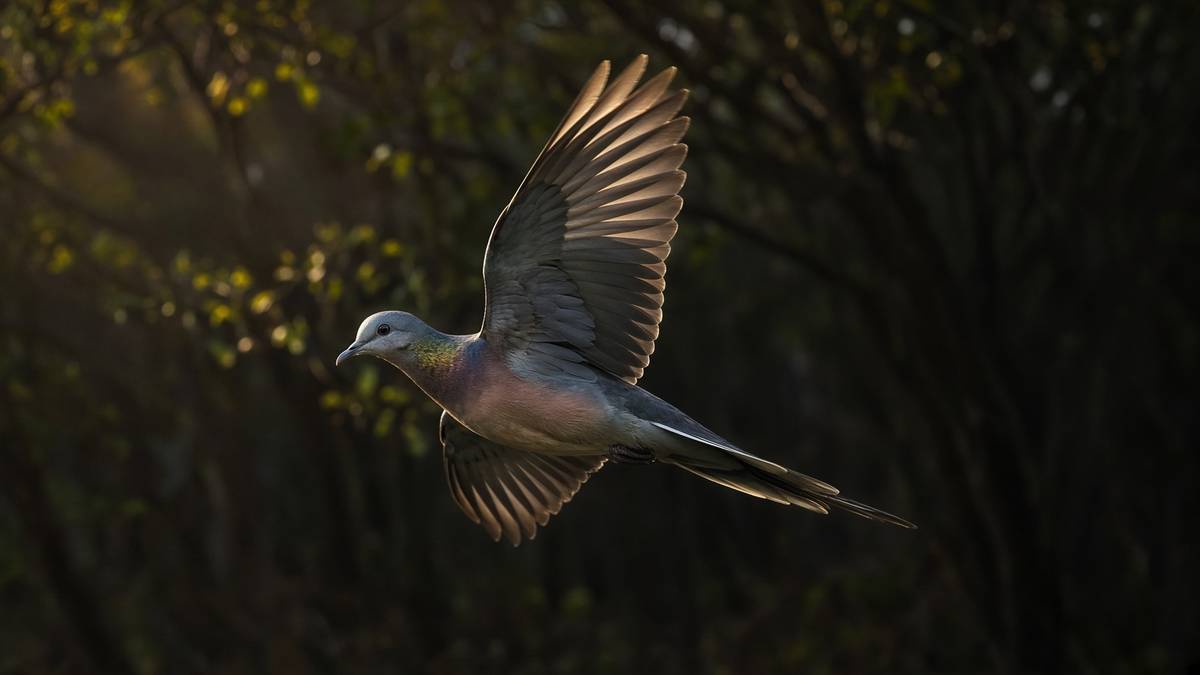
Passenger pigeons weren't rare. They were weather. Flocks of millions broke branches, cycled nutrients, and reshaped eastern forests until hunting and habitat cut them to a single captive bird, Martha, who died at Cincinnati Zoo in 1914. Ben Novak and Revive & Restore have spent a decade reading passenger-pigeon genomes from museum skins and planning edits into the living band-tailed pigeon, the closest relative. The goal isn't one pretty bird. It's a population that can again be a disturbance ecology, the passenger pigeon as a process, not a specimen. We like that ambition more than we trust the timeline, which is a familiar feeling in this corner of the journal.
Ectopistes migratorius wasn't rare. It was the most abundant bird in North America, and possibly on the planet, a nomadic mast-specialist whose flocks were described, without irony, as darkening the sky. Schorger's 1955 monograph still sits on the shelf because it's the attempt to turn those descriptions into a census: on the order of three to five billion birds before industrial hunting. Audubon wrote that the light of noon-day was obscured as by an eclipse. Market hunters filled boxcars. The last great nesting at Petoskey, Michigan, in 1878, was treated as inexhaustible and wasn't. The last bird, Martha, died at the Cincinnati Zoo on 1 September 1914, in the afternoon, and was frozen in a block of ice and sent by train to the Smithsonian, where the skin still sits. We know her name. We don't have her species. Between those two facts sits a century of American conservation, and a genomic programme that's trying, slowly, to put a flock back into an eastern forest.
In short. Passenger pigeons were once so common they darkened American skies. The last one, Martha, died in a Cincinnati zoo in 1914.
Revive & Restore's path is to edit a band-tailed pigeon toward passenger-pigeon trait modules. Chassis plus palaeogenome. That's the whole method of this field, whether the living relative is a pigeon, an elephant or a wolf, and we'll keep the sentence that size. Ben Novak has been the through-line since the Great Passenger Pigeon Comeback was named in 2012, first as a Long Now project with Stewart Brand, then as the lead scientist of a non-profit that treats de-extinction as a conservation tool rather than a Dallas factory floor. The closest living taxon is Patagioenas fasciata, the band-tailed pigeon of western oak and pine. Museum skins of Ectopistes have yielded nuclear genomes. The edit list targets the traits that made the passenger pigeon a super-abundant, nomadic, mast-specialist: life history, sociality, morphological cues. Primordial germ cells and chimeras are the reproductive path, because you don't clone a bird the way you clone a wolf. No passenger-pigeon-like bird has hatched. The genomic and husbandry groundwork is the current true sentence, and we'll keep it that unglamorous.
In short. The plan is to rewrite a living western pigeon so it carries passenger-pigeon traits. Old museum DNA supplies the list. Nothing has hatched yet.
The species was a forest process. Mast, disturbance, density. A bird without that ecology is a specimen, not a flock, and the edit doesn't restore the oak. We're going to spend this page on that sentence, because it's the one the renders skip. Passenger pigeons nested in colonies that could occupy hundreds of square kilometres, broke limbs under their own weight, stripped a mast crop, manured a stand, and left. The next year they were somewhere else, following beech, oak and, while it lasted, American chestnut. A palaeogenome can give you a tail shape and a colour cassette. It can't give you a masting oak, a continuous forest, or the Allee threshold at which a colonial nester still bothers to breed. Revive & Restore has said out loud that the point is ecological restoration of eastern hardwoods, not a pretty skin in a new glass case. We like that they said it. We'll like it more when the methods section and the forest section are held in the same paragraph, which is the job of a Cell-desk essay rather than a launch film.
In short. This bird was a moving forest event, not a pet. Genes can change a pigeon. They can't by themselves put an oak wood back together.
De-extinction press tends to pick charismatic mammals. The passenger pigeon is the American counterexample: a bird so common it was treated as a crop, erased in a human lifetime, and now being reconstructed not for a petting zoo but because forests lost a disturbance regime when the flocks died. Colossal's wolves and mammoths are the well-capitalised, well-photographed half of the same industrial sentence. Novak's project started earlier, aimed at an animal whose ecological job was to be uncountably many, and has spent a decade in museum drawers and avian-reproduction labs rather than in a lobby with a life-sized ice sculpture. A single passenger pigeon is a failure of the concept. A flock that eats mast and moves on is the product. We keep repeating the flock, because the render is always one bird, and because Martha, in a cage, was already the wrong object. Palaeogenomics is the late apology with a methods section. We find the apology more interesting than the mammals, some weeks.
In short. Most de-extinction stories pick big mammals. This one is an American bird whose real job was to arrive in huge numbers and tear through a forest.
Billions, then one named bird
Three to five billion is a number you should sit with until it stops being a catchphrase. Schorger worked from nesting-area estimates, hunter tallies and the handful of observers who tried to count a column of birds that had no edge. The range is wide because the thing being counted was a process, not a roost you could walk around. Even the low end is an ecological flood: a vertebrate biomass that moved, annually, across the eastern deciduous forest with a gut and no edge. Band-tailed pigeons, by comparison, are a respectable western species, locally abundant, nothing like a darkening. That difference is the phenotype the cassette is for. The job isn't a slightly longer tail. A life history and a social programme that, stacked, once made a pigeon into a continent-scale disturbance. If the stacked modules produce a pretty columbid that sits in a barn, the engineering succeeded at the wrong layer. Husbandry of a flock that can still do mast is the assay. A photograph of one bird is how this subject gets cheap.
In short. Billions of them once moved through eastern woods together. A pretty single pigeon in a barn would miss the point of the whole project.
Market hunting was industrial, not folkloric. Birds were netted at nestings, smoked out, shot by the barrel, packed in ice and shipped by rail to New York and Chicago at cents per dozen. Feathers went into mattresses. The Petoskey nesting of 1878 is the named last of the great ones: weeks of slaughter at a colony that still looked infinite to the people standing under it. Habitat was being cut at the same time. The passenger pigeon needed both a mast landscape and a density of conspecifics, and the nineteenth century took both. By the 1890s the flocks were a rumour. The last confirmed wild birds were shot around 1900. Captive birds lingered in Cincinnati and a handful of other aviaries, failing to become a flock because a cage isn't a colony and a pair isn't a density. Conservation arrived as a word in the same decades the bird ran out. Lacey Act, Audubon societies, a museum ethic. Too late for Ectopistes. On time for everything that came after, which is why this extinction is taught as an origin story rather than as an accident.
In short. Hunters and rail shipped them by the ton until the great nestings were gone. Laws arrived after the last wild flocks had already vanished.
Martha was named after Martha Washington, which is a detail a methods section doesn't need and a culture does. She outlived the last males in the Cincinnati collection; George, her companion, died in 1910. For four years she was the species. A highly social bird, whose comfort was a flock large enough to break a limb, sat in a cage a few metres on a side and then died on the floor on 1 September 1914. The zoo iced the body in a three-hundred-pound block and put it on a fast train to Washington. The Smithsonian prepared a study skin and an anatomical specimen. The mount is still one of the museum's treasured objects, which is a polite way of saying it's a relic of a managerial failure so complete that the last individual has a first name. We aren't going to wring that sentence. We're going to put it next to a FASTA file from a different skin, because the programme that wants a flock has to start from drawers, not from a celebrity corpse, and because Martha's genome isn't the one you would pick if you wanted a bird from the billions.
In short. Martha lived alone in a zoo cage after the other captive birds died, then died herself in 1914. Her stuffed body went to the Smithsonian.
Allee effects are the population-biology name for why the last thousands couldn't become the last millions. Some animals breed fine in small numbers. Passenger pigeons, on the evidence of the crash and of the colonial nestings, didn't. Density was the cue: for finding mast, for swamping predators, for the social stimulation that made a colony a colony. Drop below a threshold and the remaining birds aren't a smaller flock. They're a different, failing object. Hung, Shaner, Zink and colleagues, writing in PNAS in 2014, argued that the species had always ridden large population swings with the mast, and that hunting hit a trough from which the density-dependent biology couldn't climb. Murray, Soares, Novak, Shapiro and colleagues, Science 2017, put four nuclear genomes and a pile of mitochondrial ones against the same crash and found a history of huge numbers, efficient selection, and a surprising poverty of neutral diversity — a genome that had been through a selective wringer and then met a gun. Both papers are the documents under this heading. A cassette that rebuilds a silhouette without rebuilding a density programme is a silhouette.
In short. These birds needed huge numbers in order to breed and feed. Once the flocks fell below a threshold, the leftovers couldn't rebuild the species.
The air was literally filled with Pigeons; the light of noon-day was obscured as by an eclipse; and the dung fell in spots, not unlike melting flakes of snow.— John James Audubon, Ornithological Biography, on a passing flock — the census that was never a census
A palaeogenome is a text, not a nucleus
A palaeogenome is a text, not a nucleus. DNA in a museum skin is fragmented, deaminated at the cytosines, and mixed with bacteria, fungus and every handler since the bird was shot. You fish the fragments, sequence them by the million, and reconstruct a consensus of something that has been dead for a century and a half. Damage patterns, C-to-T at the ends, authenticate the molecules rather than being discarded as noise — Pääbo's rules, applied to a drawer rather than to a cave. The output is a FASTA file with coverage gaps, especially in repeats and GC-rich promoters. You don't get a spindle-ready nucleus sitting in a thawed egg. Editors therefore don't restore a genome. They restore chosen loci, the ones that likely encode the phenotype you can see and husband, and they restore them inside a living band-tailed cell whose chromatin, imprints and mitochondria are already a going concern. If you skips this paragraph is selling a clone that doesn't exist. The method is the imputation, and the imputation is why a recovered passenger pigeon, if it arrives, will be an edited band-tailed pigeon.
In short. Museum skins yield smashed, chemically scarred DNA, not a living cell. Scientists rebuild a written genome from those scraps and copy chosen bits into a living pigeon.
Hung, Shaner, Zink, Liu, Huang, Li and colleagues, PNAS 2014, is the first nuclear-genome paper a passenger-pigeon methods section still walks through. They assembled Ectopistes against living columbids, estimated a historically enormous effective population, and argued that drastic fluctuations, not a slow inbreeding decline, left the species exposed when hunting and habitat landed together. The mitochondrial work had started earlier: Hung's own PLOS ONE 2013 mitogenomes from next-generation reads of museum tissue, and Novak's unpublished GenBank sequence from a Field Museum skin shot in 1860. Those are the first texts. They aren't a trait list. A mitogenome tells you about maternal lineage and about a handful of respiratory proteins. A nuclear genome tells you about everything else, including the regulatory sequence the cassette will actually fight with. Coverage in 2014 was a draft, not a chromosome-scale living reference. The living reference had to be the band-tailed pigeon, sequenced in Beth Shapiro's laboratory and later improved, because ultrashort extinct fragments need a scaffold they can lean on.
In short. A 2014 genome paper showed the species had been enormously common, then crashed fast. That written genome is a draft, not a recipe for a whole bird.
Murray, Soares, Novak, Schaefer, Cahill, Parker, Shapiro and colleagues, Science 2017, is the paper with four nuclear genomes, forty-one mitochondrial genomes, and two band-tailed genomes sitting on the same table. Natural selection, they argued, had been unusually efficient in a bird that numerous: deleterious alleles purged, adaptive substitutions accelerated, and neutral diversity eaten down as a side-effect of that sweep-rich history. A large census didn't mean a deep well of spare variation to spend when the world changed. That's a population-genetics sentence with a conservation sting, and it's why a reconstructed cassette can't assume the extinct bird was a genetically luxurious object. Novak extracted from dozens of skins; a few turned out to be mislabelled rock pigeons, which is a museum-drawer comedy the paper is too polite to dwell on. The genomes that survived the filter are on GenBank. Anyone can download them. The open-access half of this programme is further along than the hatch, which is the right order, and which we'll keep saying until a barn has a bird.
In short. A 2017 study read several passenger-pigeon genomes and found surprisingly little spare genetic variety for such a common bird. Those sequences are public.
What a museum mount can't give you is the rest of the nuclear argument. Chromatin is gone. Nucleosomes are gone. The histone marks that told a passenger-pigeon keratinocyte which pigeon genes to treat as furniture and which to fire in a developing feather tract are gone. Hi-C maps, A and B compartments, CTCF loops, the geometry that put an enhancer on a promoter a megabase away — all of that dies with the cell, and it dies faster than the sequence. A palaeogenome is a FASTA file with gaps. The living relative is the only place those letters will ever sit on an octamer again. That's a physical reason, not a philosophical one, for chassis-first. You aren't waking Martha. You're asking a band-tailed nucleus, with band-tailed packing, band-tailed methylation, band-tailed three-dimensional folding, to tolerate a cassette of Ectopistes-derived alleles and still run a developmental programme that hatches. The packing is the half of the genome the drawer can't store.
In short. A stuffed bird doesn't keep the folding and chemical marks that tell genes when to switch on. Only a living relative still has that packing.
Diagram
- 2 nmB-DNA0.34 nm/bp. Diploid G1 is ~2 metres of this.
- 11 nmNucleosome147 bp around a histone octamer. ~30 million per nucleus.
- loopsCTCF / cohesinEnhancers meet promoters by folding, not by sliding.
- µmA/B compartmentsHi-C: open A, closed B, territories at the lamina.
- 6–10 µmNucleusThe room. The search problem is the entire point of gene regulation.
Packing is not storage. It is the first regulatory decision: a promoter buried in H3K27me3 is not a promoter, it is furniture. Transcription starts when this origami opens the right 1,000 base pairs among 3.1 billion.
Chosen loci, not a restored genome. That sentence is the methods section, and it's the sentence conservation geneticists reach for when the word species enters the room. Twenty sites didn't make Romulus and Remus into Aenocyon dirus; a hundred sites won't automatically make an edited band-tailed pigeon into Ectopistes migratorius. Phylogeny is a tree, not a punch list. What a punch list can do is move named traits: tail length and shape, wing pointedness, plumage, the life-history and social alleles if they can be found. Those are husbandry traits. They're also the traits a forest proxy would need if the ecological argument is ever going to be tested rather than painted. Shapiro has said out loud, of the wolves, that you can't bring back something identical. Novak has said the historic passenger pigeon can't be brought back to life, and that the gene sequences of skins are the key to restoring an ecological legacy through the closest living relative. We hold both descriptions. The birds, if they hatch, will be real. The species label is the fight that will follow them around for the rest of their lives.
In short. Copying selected extinct genes into a living pigeon doesn't rewind a species. It can change looks and habits. The name on the passport will be argued.
Chassis first: the band-tailed pigeon
A chassis, in this factory, is a living species close enough that its cells will run an edited genome, and close enough that a surrogate of that species, or of a neighbour, can carry the result. The Asian elephant is the mammoth chassis. The grey wolf is the dire-wolf chassis. The Nicobar pigeon is the dodo chassis. The band-tailed pigeon is the passenger-pigeon chassis. Genetic distance is the first filter and not the only one. Birds lay eggs; the developmental system is the second filter, and it's the one that decides the timetable more honestly than a press office does. You pick the living animal whose reproduction you can actually instrument, then you ask how many extinct alleles that animal will tolerate before the embryo fails. Novak has put the sequence difference on the order of three percent, a company-and-lab-adjacent figure we'll treat as a working distance until a paper tables the alignment at every locus the cassette cares about. Chassis first is the sentence a reproductive biologist writes. Museum-mount-brought-to-life is the sentence a renderer writes. We're staying with the first.
In short. The living species you actually edit and try to breed is the band-tailed pigeon, the closest relative still flying.
Patagioenas fasciata is a large, long-tailed columbid of western oak, pine and mixed forest, from British Columbia through the mountains of Mexico and into Central America, with island forms that taxonomists have argued over. It eats mast — acorns especially — and it can gather in flocks that impress a western observer and wouldn't have impressed Audubon. It isn't a passenger pigeon any more than a Nicobar pigeon is a dodo. It's the closest practical genomic neighbour: New World pigeons, a split measured in millions of years rather than in the few million that separate mammoth from Asian elephant, which is one reason this cassette isn't a coat-colour afternoon. Johnson and Clayton's columbid phylogenies, and the later nuclear trees, put Ectopistes next to Patagioenas rather than inside Columba with the rock dove. That placement is why the scaffold is a band-tailed genome and not a racing Homer. The rock dove will show up later, as a host, because Columba livia is the bird you can actually breed in a loft. Scaffold and host are allowed to be different species. They often should be.
In short. Band-tailed pigeons live in western woods and eat acorns. They're the closest living cousins, not the same bird, and their genome is the template for the edits.
The living relative is doing more work than a chassis metaphor admits. Patagioenas fasciata supplies the nuclear architecture, the mitochondrial population — thirteen proteins still written on-site, the rest imported — the imprinting marks that an avian extra-embryonic programme will have to interpret, and the developmental sequence that turns a blastodisc on a yolk into a hatchling with a bill. Somatic-cell nuclear transfer isn't on the table. An avian oocyte is a yolk-filled cell you don't easily enucleate, and the embryo is already a disc on that yolk when you can get at it. Mitochondrial DNA will remain band-tailed unless someone swaps it, which hasn't been shown and which we won't pretend is a weekend job. The palaeogenome doesn't attend gastrulation. The band-tailed cytoplasm does, or the rock-dove cytoplasm does, depending on which egg the chimera is asked to run in. Those are two different rooms. Mixing them in a sentence is how a hatch gets oversold.
In short. The living pigeon brings its own cell machinery, egg and mitochondria. Ancient sequence can't replace those. Cloning a bird the mammal way isn't on offer.
Band-tailed husbandry is the unglamorous half that has to work before anyone talks about primordial germ cells. These aren't rock doves. They're a native species with a conservation file of their own in parts of the range, a slower breeding rate, and a temperament that doesn't automatically forgive a loft. Revive & Restore and its partners have had to learn how to keep them, how to cycle them, and how to take the cells the germline actually lives in. A breeding colony isn't de-extinction. It's the condition for de-extinction, the way a Nicobar colony in Texas is the condition for a dodo cassette. If you write the passenger-pigeon programme as a CRISPR slide without a sentence about aviaries has skipped a bird lab. If you write that the programme is therefore imaginary has skipped the 2017 genomes. The honest position is narrower. A living relative in a loft. An extinct text in a database. A reproductive trick that has worked in chickens and is being asked to work in pigeons. Three objects. One of them still missing.
In short. Someone has to keep living band-tailed pigeons well enough to work with their eggs and cells. That husbandry is required before any edited bird can exist.
Birds hide the oocyte in a yolk
You don't clone a bird the way you clone a wolf, because of the egg, a sentence every avian developmental biologist will say before you finish the question. Mammalian de-extinction, as currently practised, is somatic-cell nuclear transfer plus a uterus. Avian de-extinction can't be that. The oocyte is a yolk. The embryo is a disc. There's no easy enucleation, no Dolly manoeuvre, no elephant cow to argue about. The workaround the poultry field spent thirty years building is the primordial germ cell. PGCs are the lineage that will become sperm or egg. In chickens they can be isolated from blood at a few days of incubation, cultured, genetically modified, and injected into a recipient embryo whose own germline has been disabled, so that the hatchling is a chimera whose gonads make donor gametes. Mate two such chimeras and the offspring can be wholly donor-derived. That's how you write a chicken that lays another chicken's eggs. Novak's bet, and Colossal's later avian bet, is that you can do the same with pigeons.
In short. You can't clone a bird the way you clone a mammal. Grow the cells that become sperm and eggs, put them in a host, and let that host produce the edited offspring.
The chicken PGC literature is the only reason an avian column on this scoreboard is discussable. van de Lavoir, McGrew, the Roslin and Edinburgh lineage: cultured primordial germ cells, CRISPR-edited chickens, offspring from donor PGCs, a technique that conservation people have already pointed at rare poultry breeds. It isn't a passenger-pigeon paper. It's the existence proof that an avian germline can be a laboratory object. Pigeons aren't chickens. Their PGCs hadn't, for most of the last decade, been a stable culture. Novak has argued in public that Cas9 work in chicken, quail and pigeon is the methods development that unlocks the rest, and that rock doves — Columba livia, the abundant, fast-breeding loft bird — can serve as hosts whose own germlines are emptied so that band-tailed, then edited, PGCs colonise the gonad. Host species and chassis species, split on purpose. The abundant bird carries the scarce genome. That arithmetic is the right way round. It's still an experimental use of a sentient vertebrate, and a serious programme publishes the numbers that fail.
In short. Chicken scientists already grow the cells that become eggs and sperm, edit them, and get chicks. Pigeon work is trying to copy that tool, often using ordinary loft pigeons as hosts.
In the version of the pipeline Novak has walked for a decade, you culture band-tailed PGCs, write the Ectopistes cassette into them, inject them into a host embryo — rock dove, or a band-tailed whose own germline has been disabled — hatch a chimera, and breed. The chimera looks like the host. Its gonads, if the migration and colonisation worked, make gametes whose nuclear genome is the edited one. The next generation is the bird you wanted, or a step toward it if the cassette is being stacked across rounds. Five to seven years from a working PGC culture to a visible bird has been the public clock; Revive & Restore has pointed at the early 2030s for a first hatch. Timelines in this factory have been wrong before, in both directions. The PGC culture is the piece that had to exist before a timeline meant anything. Colossal's September 2025 announcement of pigeon PGC culture sits on the same shelf, a different organisation, the same bottleneck. We'd rather have the cell-culture result than the render. We won't write the cell-culture result as a hatch.
In short. Edited germ cells go into a host egg. The host chick looks ordinary; its offspring, if the trick worked, carry the edited genome. That hatch hasn't happened.
The developmental programme that has to run inside that egg is a transcription problem, which is why the next diagram isn't a decoration. A band-tailed PGC, sitting in a rock-dove gonad, has to keep a germline identity — DAZL, DDX4/VASA, the RNA-binding set that marks the lineage — and then, after fertilisation, the zygote has to unzip a pigeon genome in a yolk-rich cell, gastrulate, make a primitive streak, and put PGCs of its own into a new ridge. RNA polymerase II will read the cassette you wrote only if the chromatin of the chassis permits it. An allele that made sense in a passenger-pigeon skin, sitting in a band-tailed promoter with band-tailed enhancers looping in from a band-tailed topologically associating domain, may not fire at the hour a tail bud needs it. Mosaicism in the chimera, silencing of the insert, and simple failure to migrate down the germ-cell path are the adult failure modes. The factory's avian half is therefore a transcription-and-lineage half. Editing the letters is the tractable piece. Getting a gonad to treat those letters as a germline is the art.
In short. The edited cells must still switch on the right genes at the right hour. Changing the DNA is easier. Making a working ovary or testis is the hard step.
Cas9 work in avian models is the methods development, and it isn't all one enzyme. Classic CRISPR-Cas9 cuts both strands and hopes the cell repairs the way you wanted, which in a PGC you can sometimes force with a donor. Cytosine and adenine base editors change one letter without a double-strand break. Prime editors, Anzalone, Liu, Nature 2019, write a short new sequence from an RNA template. A palaeogenome asks for all three, because some of the differences are single substitutions and some are small insertions the extinct bird actually carried. Off-target writing, on-target mosaicism, and the arithmetic of delivering a dozen guides into one nucleus are the adult problems. A dish of half-edited PGCs is a library, not a parent. You sequence the cell you inject. That's the same discipline a gene-therapy manufacturing suite already knows, pointed at an extinct punch list. A clean we-edited-the-genome line, without those caveats, is a press release. A claim that it can't be done is stuck in 2012.
In short. Several DNA-writing tools can change pigeon letters, one cut or one swap at a time. The cell you actually put into an egg has to be sequenced, not guessed.
Diagram
Closed chromatin (H3K27me3, DNA methylation) hides the promoter. Pioneer factors and histone acetyltransferases open it.
PIC: TFIID, TFIIH, Mediator, Pol II. Ser5 phosphorylation of the CTD lets the polymerase leave the promoter.
Elongation ~20–40 nt/s. Capping, splicing, cleavage and polyadenylation happen on the still-growing RNA.
Human genes are islands in 3.1 billion base pairs of mostly noncoding sequence. Promoter, enhancers, chromatin state and the Mediator complex decide whether Pol II is allowed to fire. Epithalon’s literature sits on TERT and pineal clocks — two of the rare promoters anyone bothers to name in a peptide essay.
Hatch is still the gate. Cultured PGCs, a band-tailed colony, rock-dove hosts, four nuclear genomes and an ecological story about mast are a staffing plan, not a bird. Avian reproduction is littered with chimeras that made gonads and didn't make transmitting gametes, and with transmitting gametes that made embryos that died on day three. The passenger-pigeon cassette will be worse than a breed-swap inside Gallus, because the cassette is trying to move tail, wing, colour, and a life-history programme across a species split. We'd rather have the PGC paper than the painting. We won't write the PGC paper as a hatch. The scoreboard, read honestly, already knows this: dire-wolf-like pups born, mammoth-like calf targeted around 2028, dodo announced and staffed, passenger pigeon announced earlier than most of those and still unhatched. The avian column is a cell-culture and genomics result. Cell culture is how this factory always starts. It isn't how it's allowed to finish, and an eastern oak stand doesn't care about a well.
In short. Grown germ cells and host pigeons are a plan, not a hatch. Many host birds fail to pass on the donor eggs or sperm. The forest still has no flock.
Trait modules, not a museum skin
Name the modules, because headlines skip them. For the mammoth the list is public enough to recite: hair-follicle density and length, subcutaneous fat, ear size, cold-stable haemoglobin. For the dire wolf it was coat, skull, stature, about twenty genes. For the passenger pigeon the list is still being subtracted from the band-tailed neighbourhood: tail length and graduation, pointed wings, the blue-grey and rufous plumage that made a flying column readable as Ectopistes, perhaps a body-mass shift, perhaps a clutch and colonial-nesting programme. A cassette is that list, written as alleles, ranked by how likely they're to move a husbandable phenotype and by how likely they're to kill an embryo. You don't start with the romantic ones. You start with the ones a neonate can survive. Colour before colony. Tail before mast. That ranking is engineering, and it's more honest than a viral image of a bird against an eclipse. Novak's group has talked about morphology first, then behaviour, because you can see a tail in a loft and you can't see a continent-scale nomadism until you have a population.
In short. Each bird is a short list of traits you can actually breed: tail, wings, colour, then the harder social habits. Start with the changes a chick can survive.
Morphology is the tractable half, which isn't the same as easy. Passenger pigeons were slim, long-tailed, long-winged, built for the sort of flight that eats hundreds of kilometres between mast crops. Band-tailed pigeons are stockier, with a squared tail band that gives them the English name. The difference is a skeletal and feather-tract argument: pygostyle and rectrices, carpometacarpus and primaries, a body-mass set point. Some of that will be polygenic, the sort of architecture a palaeogenome covers unevenly and a living reference covers well. Plumage is the photograph: males with a slate head and a rufous breast, females duller, both of them a different object from a band-tailed's wine-and-grey. Melanin-pathway genes — MC1R, TYRP1, the SLC transporters, the same neighbourhood the woolly-mouse gold came from — are the first places a multiplex editor looks, because loss-of-function and swap-of-function at pigment loci are the oldest tricks in vertebrate genetics. A colour-shifted band-tailed is a visible marker that the multiplex landed. It isn't a flock. Pigment isn't disturbance ecology. Keep the jobs separate.
In short. Shape and colour are the first edits because you can see them. A pigeon that looks the part isn't yet a bird that can flood a forest.
Life history is the half that made the billions possible, and it's the half a FASTA file is worst at. Clutch size, age at first breeding, the urge to nest only in a crowd, the nomadism that tracked masting trees across state lines: those are developmental and neuroendocrine programmes, many of them regulatory, many of them still unnamed in living pigeons let alone in a dead one. Passenger pigeons weren't good parents by the standards of a dove-keeper. They laid, they left the nest thick with neighbours, they moved. That's a strategy that only works at density. Reconstructing it means finding the alleles that shifted the band-tailed's more ordinary columbid schedule toward that strategy, or accepting that some of the behaviour will have to be trained, cued, or simply hoped for once a colony exists. Novak has talked about dyeing host parents so a chick sees the right silhouette, which is a husbandry sentence, not a CRISPR sentence. Both kinds of sentence belong in a methods section. Only one of them is a variant table.
In short. How many eggs, when they breed, and whether they nest only in crowds sit in behaviour and timing genes that are hard to read from old skin.
Sociality is the ecological phenotype dressed as ethology. A passenger pigeon colony was a predator-swamping, limb-breaking, locally catastrophic gathering. The cue to join it, the tolerance for a neighbour at a few centimetres, the abandonment of a nest when the density fails: those are circuit problems in a bird brain, and they're the problems a loft won't automatically solve. You can hatch a morphological proxy and still have a bird that wants to be a band-tailed, pair-territorial, western. That would be a scientific result and a conservation disappointment. It would also be information. Failed behavioural cassettes are data. The factory that can't throw a failed list away isn't a factory, it's a museum with a sequencer. We'd like the behavioural assays published — preference for crowd, nest-site choice, flocking on a mast crop — at the same resolution as a plumage photograph. We don't expect to get them first. The photograph always wins the week. The assay wins the decade, if anyone runs it.
In short. The hard trait is wanting to live in huge noisy crowds. A bird that looks right but still prefers a quiet pair is the wrong product.
Regulatory sequence will dominate the interesting half of the cassette, and palaeogenomics is at its weakest there. Amino-acid changes in a coding exon are the easy recoveries: you see them, you can check they aren't damage, you can write them with a base editor. An enhancer that sat four hundred kilobases from a craniofacial transcription factor in an Ectopistes topologically associating domain is a guess, even with a band-tailed Hi-C map in hand, because the passenger pigeon's looping is gone. Some of the tail and some of the nomadism will live in those guesses. This is why a developmental chassis with a staged embryo matters more than another increment of coverage on the extinct FASTA. You write the best guess, you stage the hatchling, you see whether the tail moved. Failed guesses are data. Rockefeller and NYU groups have been named, in Novak's public talks, as the people looking for the social-behaviour and morphology genes. Named collaborators aren't a paper. A paper is a table of loci, a set of embryos, and a failure rate. We're waiting on the table.
In short. Many important differences sit in DNA switches, not in the genes, and those switches are hard to rebuild from old skin. Test the guess in a chick.
You did not keep a passenger pigeon. A flock happened to your forest, like weather, and then the weather stopped.— The ecological object, in working English — density, mast and disturbance, not a skin in a new case
Mast, disturbance, density
Mast is the ecological half of the genome, and it isn't in the FASTA file. Eastern deciduous forests pulse. Oaks, beeches, and, until Cryphonectria parasitica took them in the early twentieth century, American chestnuts, produce seed in boom years and almost nothing in others. Passenger pigeons tracked those booms. A flock would settle, strip, manure, break, and leave a gap in the canopy that the next generation of trees could use. Blockstein and others have written the disturbance-ecology version of that sentence for decades: the bird as a forest process, a mobile gap-maker, a nutrient pulse, a predator of mast that also planted and wasted enough to matter. Chestnut blight, gypsy moth, land clearing, and a century without the flock have rewritten the stand. The oak that remains isn't the oak of 1860. Editing a pigeon doesn't edit a blight fungus, and it doesn't unfragment a woodlot. Anyone promising a restored eastern forest from a variant list without a sentence about chestnut and a sentence about land use is promising a silhouette of an ecosystem.
In short. The birds followed bumper crops of acorns, beech nuts and chestnuts, then moved on. Those woods have changed, and the chestnut is mostly gone.
Disturbance is what the flock did to the stand. Branches broke. Guano whitened the floor and then fed it. Light hit the seedling layer because the canopy didn't. A nesting of millions was a local catastrophe and a local fertiliser, and the forest that grew back was a forest that had been through that mill for millennia. Take the mill away and you get a different understorey, a different mast predator guild, a different argument about what 'restored' means. Revive & Restore has said the point is to put that mill back. We like the honesty of naming a process rather than a mascot. We won't confuse a named process with a delivered one. A loft flock that eats mixed grain isn't a disturbance regime. A released flock that strips a suburban oak and then hits a window is a pest story waiting to be written, and the pest story will be written by people who don't care about your palaeogenome. Ecology is the remaining gate that sequence identity can't open. Habitat, law and a plan are the civic half of the same gate.
In short. Huge nestings broke branches, dropped dung and opened the canopy. Putting that kind of damage-and-renewal back is a forest problem, not only a DNA problem.
Density is the phenotype that mattered, and it's the one a single hatch can't show. Three to five billion birds weren't three to five billion specimens. They were a number at which predation failed, at which a mast crop could be exhausted, at which a colony could be heard for kilometres. The Allee threshold is an ecological number dressed as a breeding-biology number. Fall through it and the species stops being itself, which is what happened in the 1890s with help from the gun. A reconstructed population that never climbs past a few hundred is, on this reading, not a small success. It's a different animal that happens to wear some of the alleles. Novak has been clearer than most people in this industry that the product is a population that can again be a disturbance ecology. The public clock to a first hatch — 2030s, 2032 in some tellings — is therefore the start of the assay, not the end of the project. We'll treat a hatch as a methods result. We'll treat a flock that moves on mast as the phenotype. Those are two different papers.
In short. The species only made sense in huge numbers. A handful of edited birds would still be a collection, not the forest event people remember.
A bird without that ecology is a specimen, not a flock. We're repeating the dek on purpose, because it's the load-bearing sentence and because neighbouring essays have had to invent a version of it. A woolly mouse is a coat assay, not a mammoth steppe; a dire-wolf-like pup on a private reserve isn't Pleistocene North America; a Nicobar-derived hatch isn't a Mauritian frugivore guild. An edited band-tailed pigeon in a barn is the same kind of gap: the organism isn't yet the process. Trait engineering with a living relative as chassis can, in principle, give you the bird. It can't give you the land, the mast, the legal permission, or the neighbours who will decide whether a returning flood is a restoration or a nuisance. Those are conservation questions, not science-fiction ones, and they're the right questions to ask before a hatch. We'd rather they were asked loudly. A committee with teeth, a habitat map, a disease sheet, a plan for the first ten years of a colony: that's the document that should sit next to the variant table. We've seen the variant table. We're waiting on the document.
In short. An edited pigeon in a barn is still just a bird in a barn. The lost thing was a flock doing a job in a real wood, and that job needs land and a plan.
Diagram
- 0.1 nmHydrogen atomA proton and an electron. Chemistry starts here.
- 0.3 nmWater molecule70% of a cell by mass. The solvent life is.
- 1 nmAmino acidTwenty kinds. Peptide bonds string them.
- 2–4 nmResearch peptideA named chain. BPC-157 is 1.4 kDa, 15 residues.
- 4–10 nmGlobular proteinHaemoglobin, a GPCR’s extracellular face.
- 25 nmRibosomeThe factory that reads mRNA into protein.
- 5 nmMembraneA lipid bilayer. Every compartment starts here.
- 0.5–1 µmMitochondrionA bacterium the cell swallowed and kept.
- 6–10 µmNucleusTwo metres of DNA folded into a sphere.
- 10–30 µmTypical cellA city. 10¹⁰ proteins. One genome.
- 1 mmTissue grainA thousand cells talking across ECM.
- 1.7 mYou~36 trillion human cells. Most of them are red blood cells.
Lengths are characteristic, not exact. A research peptide is closer in size to a water molecule than to the cell that assays it — which is why a 15-mer can occupy a receptor pocket a small-molecule drug also wants.
- Passenger pigeon
- Ectopistes migratorius
- Last bird
- Martha, 1 Sept 1914
- Historical census
- 3–5 billion
- Band-tailed pigeon
- Patagioenas fasciata
- Sequence distance
- ~3%
- Nuclear genomes
- Hung 2014; Murray 2017
- Comeback named
- 2012
- Hatch
- not yet
Nomadic mast-specialist of eastern North America. Extinct. Chassis: band-tailed pigeon.
Cincinnati Zoo, iced, sent to the Smithsonian. We know her name. We do not have her species.
Schorger, 1955. A range, not a roost you could walk around. The low end is still a flood.
Closest living relative. Western oak and pine. The letters you actually pack into chromatin.
Novak's working figure against the band-tailed reference. Tens of millions of sites; the cassette takes a ranked subset.
PNAS draft, then four nuclear genomes on a Science cover. Text, not nucleus.
Revive & Restore / Long Now. Earlier than Colossal. Hatch pointed at the 2030s.
PGC chimera path. No passenger-pigeon-like bird has hatched. The forest does not care about a well.
One hatch is a proof of pipeline. Ten are a loft. A hundred, in a forest that still masts, with a nest, a predator sheet and a disease sheet, would be the beginning of an ecological argument. Thousands to millions is the historical object, and nobody serious is promising that this decade. The passenger pigeon is the species that makes the population requirement impossible to dodge, because the bird without the population is famous for having been the last of its kind in a cage. Martha is the existence proof that one is the wrong number. Colossal's Mauritius Dodo Advisory Committee is the dodo version of a conversation that eastern forests will need in American form: state agencies, landowners, tribes, hunting law, agricultural law, the people who remember what a flock that size does to a woodlot. We won't write a rewilding prospectus. We'll write that ecology was named as the point, that naming it's better than not, and that a non-profit isn't a forest. The neighbouring conservation programmes at Revive & Restore — black-footed ferret cloning, genetic rescue of living species — are the bit of this organisation that already looks like a conservation lab.
In short. One hatched bird would prove the method. A species would be a breeding population doing a job in a forest. That second thing is a much longer project.
One hatch is not a flock
Would they be pests? Billions of them were a forest process that also ate crops, and the nineteenth century noticed the crops. A reconstructed population would need habitat, law and a plan, including an honest sentence about agriculture at the edge of whatever wood is asked to host the trial. Those are conservation questions, not science-fiction ones. IUCN translocation guidelines exist because moving a vertebrate into a landscape is how conservation fails as often as it works. An edited pigeon is a novel organism in the regulatory sense even if you call it a restoration in the press sense, and the United States has a statute file for that. We'd rather the file were opened before the hatch than after the first complaint. Novak has said in public that the aim is a bird that looks, acts and functions in forest habitat like the original. Functions is doing the work in that sentence. Functions, in 1860, included stripping a mast crop and moving on. Functions, in 2035, will include not being shot as a nuisance in a county that has forgotten the eclipse. Both functions have to be designed for.
In short. A returning flood of pigeons would also eat crops and annoy people. Habitat, law and a plan have to exist before a release, not after the first complaint.
The eastern forest they would be asked to land on isn't the forest they left. American chestnut is a memory plus a breeding programme plus a blight that hasn't gone away. Beech bark disease has its own map. Oak regeneration is a deer problem, a fire problem, a land-use problem. The continuous canopy that let a column of birds travel is a patchwork of woodlots, towns and soy. A nomadic mast-specialist in that patchwork is a different ecological object from a nomadic mast-specialist in 1860, even if the alleles are perfect. This isn't a reason to stop the genomic work. It's a reason to stop writing the genomic work as a time machine. Palaeoecology can tell you what the process did. Restoration ecology has to tell you what the process can do now. Those are different literatures. Hung and Murray sit in the first. The second is a pile of forestry papers this journal isn't going to summarise, except to say that they exist, they're slower than CRISPR, and they're the half of the comeback that will decide whether a hatch was worth the loft.
In short. Today's eastern woods are cut up, missing chestnut, and full of new diseases. Even a perfect pigeon would be flying through a different place.
Hold the other chassis in one view, because the coverage rarely does. Elephant, wolf, Nicobar pigeon, dunnart, band-tailed pigeon. A twenty-two-month pregnancy, a sixty-three-day canid pregnancy, an egg, a thirteen-day marsupial dash into a pouch, another egg. The palaeogenomes sitting on those animals are a 4,000-year-old mammoth, a 13,000-year-old dire wolf, a seventeenth-century dodo, a 1909 pouch young, and a drawer of passenger-pigeon skins from the 1860s to the 1890s. The factory logic is identical. The instrumentation isn't. If you write 'de-extinction' as if those five sentences were one experiment has skipped a reproductive-biology lab. If you write that the passenger pigeon is therefore imaginary has skipped the 2017 Science paper. The honest position is narrower and less exciting, which is why we prefer it. Five living relatives. Five edit lists. Five surrogate problems. Two of the five have produced neonates, both of them mammals. The three birds and the marsupial are still cell culture, genomes, and a wait.
In short. Mammoth, wolf, dodo, thylacine and passenger pigeon share a method and not a timetable. Only the edited wolves have actually been born.
Diagram
| Node | Catalogue | Conversation |
|---|---|---|
| GPCR | Ipamorelin, MT2, PT-141, retatrutide, CJC | Second messengers, secretion, appetite, pigment |
| RTK / IGF1R | IGF-1 LR3 | IRS–PI3K–Akt–mTOR and Shc–ERK |
| Cytokine receptor | Somatropin (HGH) | GHR–JAK2–STAT5b, hepatic IGF-1 |
| Cofactor | NAD+ | Sirtuins, PARPs, CD38, redox |
| Actin buffer | TB-500 / Tβ4 motif | G-actin sequestration, motility |
| Growth-factor-like | BPC-157 | VEGFR2 / FAK / eNOS neighbourhood |
| Copper ligand | GHK-Cu | Transcriptome shift in fibroblasts |
| MC fragment | KPV | NF-κB, PepT1, no pigment |
| Nuclear / pineal | Epithalon (AEDG) | TERT and melatonin literatures |
| mtORF peptide | MOTS-c | AMPK, folate–methionine cycle |
Each row is a different kind of molecular conversation. The catalogue peptides bind at these nodes; they are not interchangeable, and stacking them because a forum did mixes unrelated literatures.
The quiet American programme
The Great Passenger Pigeon Comeback began in 2012, which is earlier than Colossal, earlier than the woolly mouse, earlier than Romulus and Remus. Stewart Brand and Ryan Phelan stood up Revive & Restore out of the Long Now Foundation with this bird as the demonstration object: genomic intervention for conservation, an American extinction as the test case, eastern forests as the stated beneficiary. Novak came with skins and a conviction that extinction is a genome-plus-population problem rather than a metaphysics. Beth Shapiro's laboratory did the palaeogenomics. George Church's laboratory was on the early methods calls, the same Church who later co-founded the Dallas company that ate the headlines. The passenger pigeon is the unglamorous cousin of the mammoth, started earlier, aimed at an animal whose job was to be uncountably many, and still without a hatch. We've a soft spot for the quiet ones. We also have a rule about scoreboards. Quiet isn't the same as done. A 2012 start date is a staffing fact. A 2032 hatch target is a clock. Neither is a flock.
In short. This project started in 2012, before the famous mammoth company. Being early isn't the same as having a bird. The first-hatch clock still sits in the 2030s.
Novak's decade is skins, then genomes, then the PGC problem. DNA from three privately held passenger pigeons got him in the door; then Shapiro's lab; then dozens of museum extractions; then the 2017 Science cover; then the long wait on an avian germline that chickens had and pigeons didn't. He has said, in talks we've actually watched, that they sequenced on the order of forty mitochondrial genomes and a handful of nuclear ones, that the band-tailed reference failed several times before it sat down, and that the passenger-pigeon nuclear genome is about 990 million base pairs of a bird that's three percent different from its living cousin. Those numbers are the interesting document. Three percent of a billion-base genome is still tens of millions of sites, of which the cassette will take a tiny, ranked subset. The rest of the extinct animal is imputed from Patagioenas. That imputation isn't a scandal. It's how every palaeogenomic trait-engineering programme actually works. Skip this paragraph and you'll spend the rest of the decade arguing about passports rather than about phenotypes.
In short. Years of museum DNA produced public genomes and a living-pigeon reference. Only a small ranked set of those millions of differences will actually be edited.
Scoreboard, kept boring on purpose. Dire-wolf-like pups: born, three of them, 2024 and 2025, grey-wolf genomes with a defined cassette, living on a private reserve, the species label in dispute. Woolly mice: born October 2024, shown March 2025, a coat-and-metabolism rehearsal. Mammoth-like calf: targeted around 2028, Asian-elephant chassis, no calf. Dodo: Nicobar chassis, pigeon PGC culture announced 2025, not hatched. Thylacine: dunnart chassis, hundreds of edits in a cell line, not pouched. Passenger pigeon: band-tailed chassis, genomes in 2014 and 2017, Great Comeback named in 2012, hatch pointed at the 2030s, no bird. That's the current, true board. The passenger pigeon is the oldest named avian project on it and still a genomic and husbandry result. We'll update the board when a hatch forces us to. We won't update it for a painting, a fundraising round, or a timeline that slides. Calendars slip. The methods don't become imaginary when they slip, and they don't become a forest when they hold.
In short. Born: edited wolf pups and woolly mice. Not born: mammoth, dodo, thylacine, passenger pigeon. That's the whole scoreboard, kept dull on purpose.
- Palaeogenome: consensus sequence from museum skins. Hung 2014, Murray 2017. Text, not nucleus.
- Living relative: Patagioenas fasciata. Chassis supplies chromatin, mitochondria, egg.
- Trait cassette: ranked alleles for morphology, then life history and sociality. Colour before colony.
- Surrogate: primordial-germ-cell chimera in a host egg, often a rock dove. Not somatic-cell nuclear transfer.
- Population: not a hatch. Mast, disturbance, density, law, a forest that can still receive a flood.
Named papers, because a programme without documents is a rumour. Hung, PNAS 2014, the draft nuclear genome and the fluctuation argument. Murray, Novak, Shapiro, Science 2017, four nuclear genomes, selection, the diversity sting. Hung, PLOS ONE 2013, the mitogenomes from short reads. Schorger, 1955, the census you still argue with. Audubon, the eclipse sentence everyone quotes and nobody should have to. van de Lavoir and the chicken-PGC literature, the only reason an avian germline is a laboratory object. Anzalone, Liu, Nature 2019, the pencil this factory writes with when a cut is too blunt. Pääbo's ancient-DNA rules, the reason a skin is a text rather than a contamination event. Johnson and Clayton on columbid phylogeny, the reason the scaffold is Patagioenas and not Columba. That's a fortnight of evenings, not a guru. The paintings of Fuertes will still be there when you come back, and they will look smaller, which is the correct size for a painting sitting next to a methods section.
In short. A short stack of named papers covers the genomes, the old census, pigeon germ cells and the editing tools. Read those before any painting.
Here's the map we'd like you to take home, rather than a poster. De-extinction, done honestly, is trait engineering with a living relative as chassis. The palaeogenome is a text with gaps. The chassis supplies the nucleus, the chromatin, the egg, the husbandry. The cassette is a ranked list of alleles you're willing to write and a longer list you aren't. The surrogate is a primordial-germ-cell chimera and an egg, not a cloned nucleus in a uterus. The product, if the ecology half is serious, is a population that can again be a mast-following disturbance, not a named skin. Ectopistes migratorius once darkened North American skies. The last bird, Martha, died in Cincinnati in 1914. Revive & Restore's path is to edit a band-tailed pigeon toward passenger-pigeon trait modules. The species was a forest process. A bird without that ecology is a specimen, not a flock. Treating a hatch as a resurrection is a category error. Treating the programme as vapour is a different category error. Chassis plus palaeogenome, and then the wait, is the remaining honest noun.
In short. Leave with the map: old text, living pigeon, chosen traits, germ-cell host, then a flock in a wood. None of that's a stuffed bird brought to life.
We keep having to say the dates out loud, because the dates are how you stop a comeback becoming a myth. Petoskey nesting, 1878. Last wild birds around 1900. George dead in the Cincinnati collection, 1910. Martha, 1 September 1914. Schorger's book, 1955. Great Passenger Pigeon Comeback named, 2012. Hung mitogenomes, 2013. Hung nuclear genome, PNAS 2014. Murray, Science 2017. Revive & Restore's public hatch window, the 2030s, 2032 in some tellings. Dire-wolf-like males on 1 October 2024, a female on 30 January 2025. Woolly mice born October 2024. Pigeon PGC culture, Colossal, September 2025. Mammoth-like calf, targeted around 2028. Write them in a lab book. The factory is a calendar. The passenger pigeon's calendar started earlier than the famous one and hasn't yet produced an egg you can point a camera at. That isn't a failure of ambition. It's what an avian germline bottleneck looks like when you refuse to blur it with a mammal cloning headline.
In short. The useful dates are the death in 1914, the genomes in 2014 and 2017, and a first-hatch aim in the 2030s. Write them down. A slipped calendar isn't a fake project.
The conservation flywheel is Revive & Restore's preferred frame: tools built for ghosts, applied to the living. Black-footed ferrets cloned from frozen cells, genetic rescue conversations for living birds and mammals, a non-profit that will talk about a passenger pigeon and about a species that isn't yet gone in the same afternoon. Those are real documents. They don't make an edited band-tailed pigeon a conservation win in advance. They do make it harder to write the whole enterprise off as spectacle, and we won't do that writing. A sequencer pointed at a museum skin and a sequencer pointed at a whooping crane are the same machine. A PGC culture that could hatch an Ectopistes-like bird could also hatch a pigeon breed that's down to a few pairs. Platform technologies don't care about the ethical payload. People have to. That's the unsettling elegance, and we're living inside it, and the passenger pigeon is one of the payloads, not the proof that the platform is virtuous. Virtue, if it arrives, will be a forest that masts and a flock that moves on.
In short. The same tools can help living endangered species, and some of that work is already real. That doesn't automatically make a passenger pigeon a conservation win.
Shapiro's molecular sentence travels. Replace grey wolves with band-tailed pigeons and twenty edits with whatever the avian cassette settles at. Colloquially, a hatch will be called a passenger pigeon, and that will make people angry, and some of those people will be right about the vocabulary while being wrong about the achievement. A nineteenth-century skin yielded sequence, sequence yielded an edit list, an edit list is being asked to yield a germline, a germline is being asked to yield a hatch. That pipeline — palaeogenomics to CRISPR to PGC to neonate — is a new industrial capability, whether or not the American Ornithological Society ever issues an Ectopistes passport. The fight over names is downstream of the fact that the pipeline exists. We can argue taxonomy after we've admitted a bird exists, and we can refuse the word 'passenger pigeon' for an edited band-tailed without refusing the genomes that made the argument possible. Both refusals are available. Only one of them is serious. The serious one is the passport. The unserious one is pretending the skins were never sequenced.
In short. The honest name for a hatch would be a band-tailed pigeon carrying chosen extinct traits. Posters will say passenger pigeon. The bird, if it hatches, will still be real.
Close, then, on the bird rather than on the organisations. Ectopistes migratorius once darkened North American skies. The last bird, Martha, died in Cincinnati in 1914. Revive & Restore's path is to edit a band-tailed pigeon toward passenger-pigeon trait modules: chassis plus palaeogenome, primordial germ cells rather than a cloned egg, a cassette aimed at morphology and then at the life-history and social programmes that made a pigeon into a flood. The species was a forest process — mast, disturbance, density. A bird without that ecology is a specimen, not a flock, and the edit doesn't restore the oak. Both halves of that couplet are required. The genomic half is in print. The husbandry half is a loft and a germline that hasn't yet transmitted. The ecological half is a woodland that has had a century to become something else. If a bird hatches, we'll describe the bird, the cassette, the host, and the forest it isn't yet in. Until then the honest paragraph is the one you have just read, and the honest picture is a drawer of skins, a living western pigeon, and a scoreboard we're keeping that boring on purpose.
In short. The path is an edited living pigeon, aimed at a flock that can work a forest. Nothing has hatched. The oak is a separate problem. That's the news.
Someone asked us, after a seminar, whether we'd rather have Martha's skin or Novak's FASTA files. It's a false choice and a useful one. The skin is the fact of the loss, named, dated, iced, on a train, in a case. The files are the fact that the loss wasn't total at the level of sequence, that a living relative still flies, and that a germline trick invented for chickens can, in principle, be pointed at a drawer. We'd rather have both, and a forest, and a plan, and we won't get all four on the same calendar. What we can do in a journal is refuse to collapse them. Sequence is a text; a nucleus is a living architecture; a hatch is a methods result; a flock is a population, and a forest process only if the mast, the stand and the density are there to receive it. Chassis plus palaeogenome is the method. Martha is the reminder of what the method is for. The wait is the remaining true sentence in 2026, and we won't blur it with a painting of an eclipse.
In short. A stuffed last bird and a public genome are different kinds of remains. Neither is a flock in a wood. Hold them separate, and the project stays the right size.
Questions the essay actually answers
- Why the band-tailed pigeon?
- It's the closest living relative of Ectopistes migratorius (Patagioenas fasciata). You edit a living genome toward an extinct one. That's the whole method of this field, whether the chassis is a pigeon, an elephant or a wolf. The band-tailed is the one that's still here.
- When did the last passenger pigeon die?
- Martha died at the Cincinnati Zoo on 1 September 1914, in the afternoon, and was iced and sent to the Smithsonian. The last great wild nestings were already gone; Petoskey, 1878, is the named last of the huge ones. Wild birds were gone around 1900.
- How many were there?
- Schorger's 1955 monograph put the pre-harvest population on the order of three to five billion. The range is wide because the thing being counted was a moving flood, not a roost. Even the low end is an ecological process, not a specimen count.
- Can you clone a bird?
- Not the way you clone a wolf. A bird's oocyte is a yolk; the embryo is a disc. The path is primordial germ cells, cultured and edited, injected into a host embryo whose own germline is disabled, then a chimera that lays the edited genome. Chicken PGC work is the existence proof. Pigeon PGC work is the bottleneck.
- Has a passenger-pigeon-like bird hatched?
- No. Genomes have been published (Hung, PNAS 2014; Murray, Novak, Shapiro, Science 2017). The Great Comeback was named in 2012. Revive & Restore has pointed at the 2030s for a first hatch. Cell culture and husbandry are the current true sentence.
- Would they be pests?
- Billions of them were a forest process that also ate crops. A reconstructed population would need habitat, law and a plan. Those are conservation questions, not science-fiction ones, and they're the right questions to ask before a hatch. We'd rather they were asked loudly.
- Is an edited band-tailed pigeon a passenger pigeon?
- It would be a band-tailed pigeon with a defined set of Ectopistes-derived alleles, on the same logic Beth Shapiro has already used for the wolves. Revive & Restore may call it a passenger pigeon. Conservation geneticists won't. Both descriptions belong in the essay. The bird, if it hatches, will be real. The passport is the fight.
- What does 'forest process' mean here?
- Mast, disturbance, density. Flocks tracked oak, beech and chestnut booms, broke limbs, manured stands, opened canopy, and nested only at huge numbers. A bird without that ecology is a specimen, not a flock, and the edit doesn't restore the oak.
- Where does this sit relative to the mammoth and the dodo?
- Same industrial sentence, different chassis and a quieter American non-profit. Dire-wolf-like pups exist. A mammoth-like calf is targeted around 2028. The dodo uses a Nicobar pigeon and an egg. The passenger pigeon uses a band-tailed pigeon and an egg, and it was named as a project earlier than most of the Dallas list.
- What is a palaeogenome?
- A consensus sequence reconstructed from fragments in museum skins. Coverage gaps, damage maps, no nucleus, no chromatin. Editors restore chosen loci. The living sister species imputes the rest. Hung 2014 and Murray 2017 are the passenger-pigeon documents.
Read next
44 min · long read · Frontier biology
The dodo and the thylacine are in the same queue as the mammoth
Colossal’s pipeline is not one animal. After dire wolves and a mammoth timeline: a Mauritius bird rebuilt from a Nicobar pigeon, and a Tasmanian tiger rebuilt from a fat-tailed dunnart.
48 min · long read · Frontier biology
The mammoth is being rewritten in Texas
Inside Colossal Biosciences’ Dallas headquarters, Asian elephant cells are taking on the genes of a 4,000-year-old ghost. The target is a calf around 2028. This is not a film treatment.
46 min · long read · Frontier biology
Romulus, Remus and the argument over a dire wolf
Three pups born from grey-wolf cells edited with Ice Age DNA became the most famous animals of 2025. They are also the most disputed.
More in this desk
51 min · long read · Frontier biology
Tardigrades taught a human protein how to ignore radiation
Dsup, a disordered DNA-binding protein from a water bear, protects cultured human cells from X-rays. The animal that dries to a tun and lives through vacuum brought a transferable shield.
50 min · long read · Frontier biology
Xenobots: frog cells that became a new kind of machine
No genome was rewritten. Skin and heart cells from Xenopus were sculpted — first by hand, then by an evolutionary algorithm — into millimetre-scale organisms that walk, heal, and assemble copies of themselves.

50 min · long read · Frontier biology
We can rewrite a genome the way a word processor rewrites a sentence
CRISPR cut DNA. Base editors change one letter without a double-strand break. Prime editors write arbitrary edits from an RNA template. The machinery is no longer hypothetical.
49 min · long read · Frontier biology
We have the Neanderthal genome. Some of it is still in you.
Svante Pääbo pulled a genome out of bone powder, won the 2022 Nobel, and found that most people outside Africa carry a percent or two of an extinct human. Palaeogenomics is not only mammoths.
Essays describe published research. They are not medical advice and they do not authorise human use of any catalogue item.