

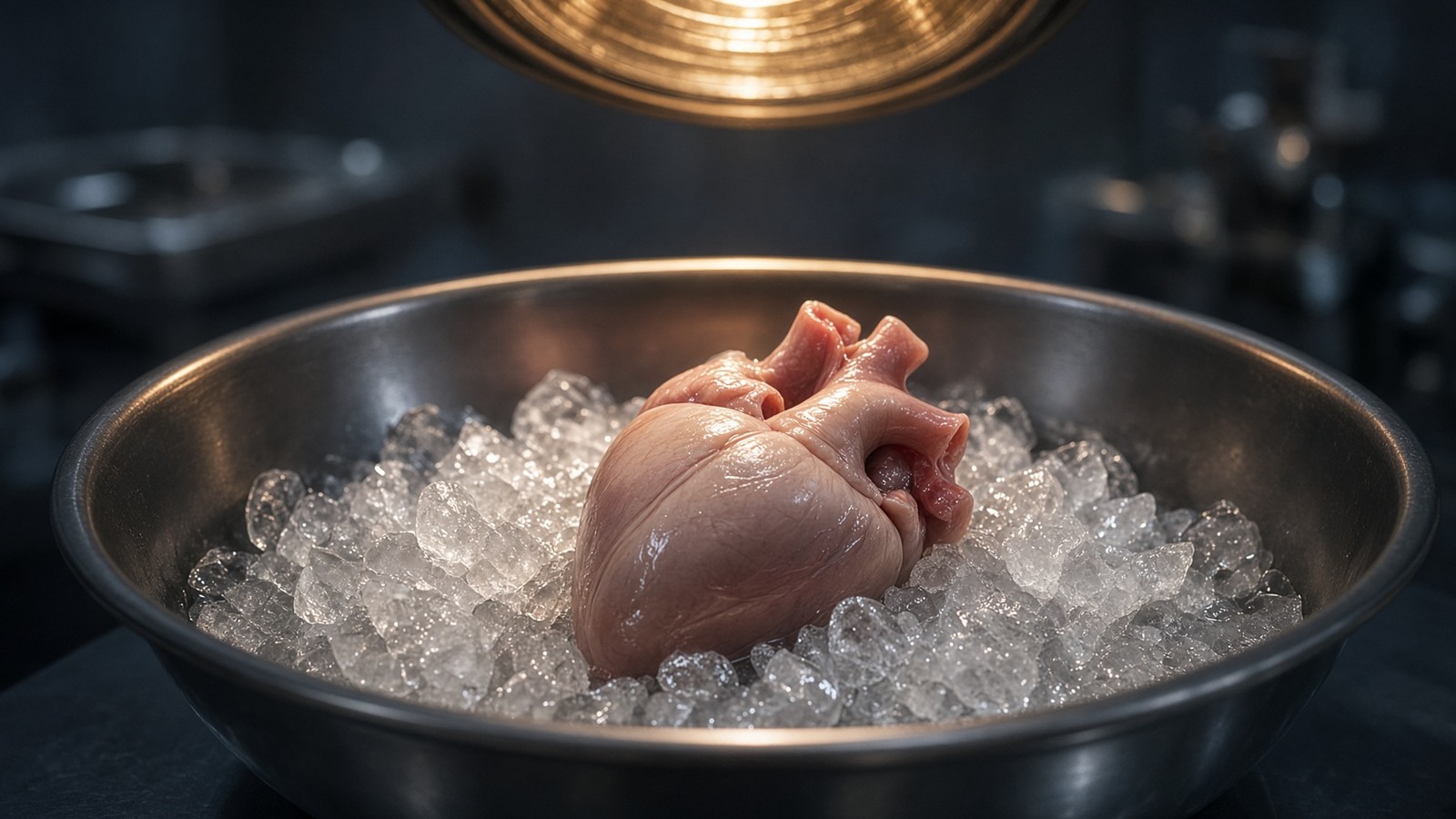
Frontier biology · 47 min · 10,437 words
CRISPR pigs, and the first gene-edited organs in people
Knock out the sugar that human antibodies attack, knock out porcine retroviruses, add human complement regulators — then sew a pig heart into a man. That sentence has already been true, more than once.
What this essay actually tells you
- Revivicor's GalSafe pigs and later 10-gene edits knock out xenoantigens (including α-Gal) and add human complement and coagulation regulators. Long gene list. One knockout was never going to be enough.
- University of Maryland implanted a gene-edited pig heart into David Bennett in 2022. He lived 60 days. A second patient lived 40 days in 2023. Named patients, counted days.
- Porcine endogenous retroviruses and immune incompatibility are why the gene list is long. The 10-gene animal exists because the 1-gene animal didn't.
What this actually means
There aren't enough human organs. Pigs are the right size, but a human immune system sees pig tissue as a sugar it was never supposed to meet, and pig genomes carry retroviruses. CRISPR let labs delete the sugar genes, inactivate the retroviruses, and add human proteins that calm complement. In 2022 David Bennett received a gene-edited pig heart at the University of Maryland and lived for two months. Others followed, including kidney xenografts that lasted longer. Nobody has a routine pig-organ clinic yet. The edits, though, are no longer a slide. They've been in people.
A man with a pig heart was a sentence from 2012 TED talks. It's also a discharge summary from the University of Maryland Medical Center, dated 2022, and then another in 2023. Bartley Griffith and Muhammad Mohiuddin sewed a heart from a Revivicor pig — ten genetic modifications, three carbohydrate knockouts, a growth-hormone-receptor knockout, six human transgenes — into David Bennett on 7 January 2022. He lived sixty days. Lawrence Faucette received a similar organ in September 2023 and lived forty. Those aren't rumours and they aren't renders. They're named patients, counted days, and papers in the New England Journal of Medicine. I want you to hold both clocks at once: the organs worked, and they did not last. Weeks to months, not yet years. What follows is the punch list that made the first sentence possible, the retroviruses that made the list long, and the reasons a waiting-list solution is still a clinical-trial programme rather than a clinic you can join. A pitch for a pig-organ pharmacy hasn't looked at the charts. A claim that it cannot be done hasn't looked at them either.
In short. Two named men in Maryland received gene-edited pig hearts, in 2022 and 2023. One lived sixty days, the other forty. The organs worked. They did not last.
The arithmetic that put those hearts on an operating list isn't a metaphor. In the United States more than a hundred thousand people sit on an organ waiting list at any moment, the large majority of them waiting for a kidney; a smaller, more desperate cohort waits for a heart. Historically on the order of seventeen people a day have died waiting, a number that moves with year and organ and is still the wrong size for a rich country. NHS Blood and Transplant runs a smaller list in the United Kingdom — thousands, not hundreds of thousands — and still loses hundreds of patients a year to death or to being too sick to transplant. Donation after brain death and donation after circulatory death have been squeezed for every honest extra organ they can give. Machine perfusion has bought hours. None of that closes the gap, because the gap is a breeding-and-immunology problem, not a logistics problem. A human donor is a tragedy that happens to yield a graft. A pig, if the immunology can be taught, is a scheduled animal. That's the only reason this field exists, and it's a colder sentence than the photographs.
In short. Far more people need organs than die in a way that lets their organs be used. Pigs could be bred on a timetable. The immune system is why that stayed a fantasy for so long.
Pigs are the right size. An adult heart from a young pig, from a line whose growth-hormone receptor has been knocked out, sits in the same mass band as a human heart: a few hundred grams, four chambers, a left ventricle that can generate a systemic pressure a person can live on. Kidneys match well enough that a single porcine kidney can clear urea and creatinine in a primate and, now, in a person. Breeding interval is months, not years; litter size is several; the husbandry is industrial already. Anatomy is close enough that a cardiac surgeon doesn't have to invent a new anastomosis. Physiology is close enough to be tempting and far enough to be a research programme: potassium handling, heart-rate set-point, endothelial display of sugars and of complement regulators, the coagulation conversation at the graft wall. Size plus fecundity plus a century of farm veterinary medicine is why the field picked Sus scrofa and not a goat. The genome is large, sequenced, and, since 2013, writable with Cas9. That last clause is the only new one. The rest of the argument is older than CRISPR and was stuck on immunology.
In short. Pigs are the right size, they breed quickly, and surgeons already know the plumbing. Until gene editing, the human immune system wouldn't let the organ stay.
Non-human primates were the other obvious donor and they lost, for reasons that are scientific and for reasons that are not. Chimpanzee kidneys were put into people in the 1960s; Keith Reemtsma had a patient who lived nine months, a number the field still quotes because it's the existence proof that a cross-species kidney can work at all. Baby Fae received a baboon heart in 1984 and died twenty days later. Old World primates share more antigens with us, which sounds helpful until you remember that they also share more viruses, breed slowly, and sit inside a set of ethical and regulatory walls that livestock do not. Phylogenetic proximity is a zoonosis argument as much as it's an immunology argument. A baboon is also the wrong size for an adult human chest. The field, after those decades, made a decision that still looks correct: use the primate as the recipient model, not as the donor, and do the donor work in a pig you can actually produce at scale. Mohiuddin's baboon series is how the ten-gene heart earned the right to meet a person. The baboon was the dress rehearsal. The pig is the intended factory.
In short. In short, apes and baboons are closer to us, which means shared viruses and slow breeding. They became the test recipients. The donor animal is a pig.
The three sugars humans were never supposed to meet
Hyperacute rejection of a pig organ is largely a sugar. Galactose-α-1,3-galactose, written α-Gal, is assembled on glycoproteins and glycolipids by α-1,3-galactosyltransferase, the product of GGTA1. Humans, apes and Old World monkeys carry an inactivated GGTA1; we don't make the epitope, and we're full of IgM and IgG against it, raised over a lifetime of exposure to gut bacteria that display the same sugar. Put an unmodified pig heart into a human and those antibodies bind endothelium within minutes, complement fires, the membrane-attack complex opens holes, the graft blackens on the table. That's hyperacute rejection, and it's why the first knockout on every honest punch list is GGTA1. Cooper, Good, Galili, the carbohydrate immunologists of the 1980s and 1990s, named the epitope before anyone had a nuclease that could delete the gene in a livestock zygote. The CRISPR era did not discover α-Gal. It made the knockout a breeding line. GalSafe, Revivicor's GGTA1-knockout pig, is that line with a regulatory stamp on it, and it's the foothold everything else was stacked on.
In short. Pigs decorate their cells with a sugar called α-Gal. Humans don't make it, so we carry antibodies against it. Knocking out one pig gene removes the sugar.
One knockout was never going to be enough, which is the sentence the later animals exist to illustrate. CMAH encodes cytidine monophosphate-N-acetylneuraminic acid hydroxylase, the enzyme that converts Neu5Ac to Neu5Gc, another sialic acid humans don't make. We've antibodies against Neu5Gc too, quieter than the α-Gal repertoire in most people, loud enough in some to finish a graft that has already had GGTA1 deleted. B4GALNT2 encodes β-1,4-N-acetylgalactosaminyltransferase 2, which builds the Sda blood-group glycan; that's the third carbohydrate xenoantigen the field converged on. Triple-knockout pigs — GGTA1, CMAH, B4GALNT2 — are now the chassis under both the Revivicor ten-gene heart and several of the kidney lines. Residual antibody binding after the triple knockout isn't zero. It's low enough that hyperacute rejection, the minutes-scale catastrophe, largely recedes, and the slower arguments — complement regulation, coagulation, cellular immunity, infection — step forward. A protocol that stops at α-Gal is a protocol from 2005. The three-sugar chassis is the current floor.
In short. Those two further sugars, with unfriendly names, also draw human antibodies. Modern donor pigs have all three sugar genes switched off. That stops the minutes-scale disaster, not every later one.
The Sda story is the one that still surprises people who only packed α-Gal. B4GALNT2 is a glycosyltransferase most of us met, if at all, in a blood-group lecture, not in a transplant lecture. On porcine endothelium it displays a glycan that a subset of human sera recognise, and that recognition survived GGTA1 knockout in binding assays that the xeno laboratories had the honesty to keep running. Adding the B4GALNT2 knockout to GGTA1 and CMAH dropped residual cross-match titres further. That's a titration, not a catchphrase. Different human recipients arrive with different anti-glycan repertoires; a pig that's clean against one serum isn't automatically clean against the next. Pre-transplant cross-match, glycan arrays, and a willingness to turn a recipient away, are how a ten-gene animal still needs a histocompatibility bench. The gene list made the organ discussable. It did not make immunology optional. If you write 'the sugars are gone, therefore the organ is human', you haven't looked at a flow-cytometry cross-match.
In short. Even then, after the three sugar genes are removed, some patients' antibodies still see the pig. Surgeons still have to test the match before they operate.
United Therapeutics' GalSafe pig, authorised by the United States Food and Drug Administration in December 2020 for food and for medical products, is the regulatory object underneath the later headlines. It's a GGTA1-knockout animal, not the ten-gene heart. The authorisation said, in the language regulators use, that the intentional genomic alteration was safe for the pig, that food from the pig was safe to eat, and that the line could be used to produce medical products — a heparin, a biologic, eventually an organ — without the α-Gal epitope that sends some people into anaphylaxis from red meat. David Ayares and the Revivicor group, descended from the PPL Therapeutics lineage that cloned Dolly, had been sitting on GGTA1 knockouts for years before CRISPR made multiplex editing ordinary. GalSafe is the one-gene animal the FDA was willing to stamp. The Maryland hearts used a later Revivicor line with ten modifications. The 10-gene animal exists because the 1-gene animal did not finish the job. That's not a slight on GalSafe. It's the reason the punch list grew.
In short. So the first approved gene-edited pig only had the main sugar gene removed. It was a legal foothold. The hearts used in people came from pigs with ten changes, not one.
Hyperacute rejection, named properly, is an antibody-and-complement machine running on endothelium. Preformed IgM and IgG bind the glycan. C1q docks. The classical pathway runs. C3 convertase mints C3b; C5 convertase mints C5a and C5b; C5b-9, the membrane-attack complex, punches the endothelial plasma membrane. Von Willebrand factor and tissue factor come out; platelets sit down; the microvasculature thromboses; the graft blackens. The clock is minutes to a few hours. That's why a GGTA1 knockout, by itself, was already a large paper, and why it was still not a transplant programme. Complement doesn't require a glycan to be α-Gal; any antibody that finds an epitope on the endothelium can start the same cascade. Knocking out the three sugars lowers the antibody load. It doesn't rewrite C3. The human transgenes on the later animals — CD46, CD55, and in some lines CD59 — are there because the cascade is still the cascade, and because pig complement-regulatory proteins speak pig, not human, to the convertases they are supposed to decay. You can delete the sugar and still lose a graft to complement if the regulators on the wall are the wrong species.
In short. If antibodies stick to the graft, a blood-protein cascade punches holes in its blood-vessel lining within minutes. Removing sugars helps; human protective proteins on the pig cells help more.
Complement and coagulation as a language the pig does not speak
Complement is a proteolytic cascade that tags, pokes and recruits. On a human endothelium the cascade is damped by a set of membrane proteins that we actually named for the job: CD46 (membrane cofactor protein) is a cofactor for factor I cleavage of C3b and C4b; CD55 (decay-accelerating factor) accelerates the decay of C3 and C5 convertases; CD59 (protectin) blocks assembly of the membrane-attack complex. Pig orthologues of those proteins exist and don't work well against human complement, which is a species-restriction the field measured rather than guessed. Adding the human genes, under promoters that fire in endothelium, dresses the graft in our complement language. Imutran's hDAF pigs in the 1990s were the first public version of this idea, CD55 alone, and they moved the primate experiments. They did not move the clinic, because α-Gal was still there and because one regulator isn't a cascade. The modern animal stacks CD46 and CD55, and some kidney lines add CD59, on top of the triple-glycan knockout. The punch list is additive because the biology is additive. Each gene is a clause. The sentence only works if you write all of them.
In short. Human cells carry three surface proteins that quiet the hole-punching cascade. Pig versions of those proteins don't calm human blood, so the donor pigs are given the human genes.
Coagulation is the other language, and it has killed at least as many xenografts as complement once the sugars were gone. Human thrombin doesn't activate porcine thrombomodulin the way it activates our own; the thrombomodulin–thrombin complex is what turns protein C on, and activated protein C is how an endothelium tells a clot to stop. Without that conversation the graft microvasculature makes thrombin and doesn't damp it, platelets sit, thrombotic microangiopathy follows, and the organ dies of its own plumbing. Human thrombomodulin (THBD, TBM in the older papers) and human endothelial protein C receptor (EPCR, PROCR) are the transgenes that put the conversation back. They aren't optional decorations. In the baboon cardiac series, thrombomodulin on the pig heart was one of the differences between a graft that lasted weeks and a graft that lasted months. A coagulation story and a transplant story are the same story at the endothelium. If you write the ten-gene pig as 'three sugars plus some human proteins' without naming thrombomodulin, you haven't looked at why the later animals stopped clotting in the recipient.
In short. Pig blood-vessel lining doesn't tell human blood to stop clotting. Adding human thrombomodulin and a related receptor is how the field stopped grafts from filling with clot.
CD47 is the 'don't eat me' ligand for SIRPα on macrophages, and the handshake is species-restricted in the direction that hurts a xenograft. Human macrophages see porcine CD47 as a missing or mismatched passport and phagocytose the cell; human CD47 on the pig endothelium, and on circulating pig cells that leak from the graft, is how you ask those macrophages to stand down. The gene is easy to write as a catchphrase and harder to dose as a transgene: too little and the innate cellular attack proceeds, too much in the wrong cell type and you have asked a macrophage not to do its job on a cell you might actually want cleared. The Revivicor ten-gene heart carries human CD47. So do several of the eGenesis kidney lines. Innate cellular immunity — macrophages, natural killer cells reading mismatched MHC class I, neutrophils — is the half of rejection that the glycan story never covered. T cells are the adaptive half, and they are why the recipients still take the kind of immunosuppression a human-to-human transplant would, plus extras (anti-CD40 in the baboon work, complement blockers in some protocols). The pig was edited. The recipient was still a transplant patient.
In short. Human immune cells eat pig cells in part because a 'leave me alone' signal doesn't cross species. The donor pigs are given the human version of that signal.
Two more clauses on the Revivicor heart, because the punch list is a list of genes and we'll name them. Heme oxygenase-1 (HMOX1, HO-1) catabolises heme to biliverdin, carbon monoxide and iron; on endothelium it's anti-apoptotic and anti-inflammatory, and it's one of the genes the xeno laboratories added because ischaemia-reperfusion and complement leave a lot of heme lying around. Growth-hormone-receptor knockout is the size clause. A pig, left to its own endocrine programme, will grow a heart that keeps growing in a human chest; several of the early primate grafts hypertrophied themselves into failure. Deleting GHR, or using a young donor and a tightly managed metabolic picture, is how you keep the organ in band. The ten genetic modifications on the Maryland heart, written as a list rather than as a feeling, are therefore: GGTA1, CMAH, B4GALNT2, GHR, and the human transgenes CD46, CD55, thrombomodulin, EPCR, CD47 and HO-1. Four knockouts, six additions. That's the animal Griffith sewed in. Ayares's group built it. Rothblatt's company paid for the building. The list is the interesting document.
In short. The Maryland pig hearts had ten genetic changes: four deletions, including a growth-hormone receptor so the organ wouldn't keep growing, and six added human genes.
A transgene isn't a sticker. Human CD46, sitting in a pig genome, has to be found by the pig's transcriptional machinery, licensed at a promoter, elongated by RNA polymerase II, spliced, exported and translated, then folded and trafficked to the endothelial surface in a quantity that actually damps human C3. Promoter choice is a methods argument: a constitutive promoter that fires in every cell is a different object from an endothelial-specific cassette that fires where the blood is. Copy number, insertion site, silencing by surrounding heterochromatin, and the fact that a pig cell has its own CMAH-null, GGTA1-null glycome underneath the human protein, are why 'we added CD46' is the start of a molecular biology paper and not the end of one. Multiplex CRISPR made the knockouts tractable. The knock-ins are still transgenic husbandry, often by targeted insertion or by random insertion followed by breeding, depending on the line and the year. Cloning by somatic-cell nuclear transfer then turns a correctly edited fibroblast into an animal. That pipeline — edit in culture, clone, breed, barrier-house, harvest — is the industrial fact underneath a two-hour operation. The operation is the photograph. The pipeline is the work.
In short. So: adding a human gene to a pig only works if the pig cell actually reads it and puts the protein on the blood-vessel wall. Editing, cloning and breeding are how you get that animal.
Diagram
Closed chromatin (H3K27me3, DNA methylation) hides the promoter. Pioneer factors and histone acetyltransferases open it.
PIC: TFIID, TFIIH, Mediator, Pol II. Ser5 phosphorylation of the CTD lets the polymerase leave the promoter.
Elongation ~20–40 nt/s. Capping, splicing, cleavage and polyadenylation happen on the still-growing RNA.
Human genes are islands in 3.1 billion base pairs of mostly noncoding sequence. Promoter, enhancers, chromatin state and the Mediator complex decide whether Pol II is allowed to fire. Epithalon’s literature sits on TERT and pineal clocks — two of the rare promoters anyone bothers to name in a peptide essay.
PERVs, already in the genome
Porcine endogenous retroviruses are the other reason the gene list is long, and they aren't a sugar. They are proviruses, retroviral genomes integrated into the pig germline over evolutionary time, inherited Mendelianly, present in every cell, including the cells of the heart you would like to sew in. PERV-A and PERV-B can infect human cells in culture; PERV-C generally cannot, but can recombine with A to produce a human-tropic recombinant. Copy number depends on the breed and the line — on the order of a few dozen, sometimes cited around twenty-five, sometimes higher. There is no serological test that clears them, because they aren't an infection the pig caught last winter; they are the pig. For two decades this was the zoonosis argument that sat on the field like a wet blanket: even a perfectly carbohydrate-edited, complement-dressed organ might, in a immunosuppressed human, release a retrovirus we've no vaccine for. Whether that risk is theoretical or practical is still argued. What isn't argued is that the copies are there, and that a nuclease that can hit dozens of sites in one genome is how you would retire them.
In short. Pigs carry old virus genes stitched into their DNA, in every cell. Some of those viruses can enter human cells in a dish. You can't vaccinate them away. You have to edit them.
George Church's group, with Luhan Yang, Dong Niu and colleagues, did the experiment the field had been circling. Science, 2015: CRISPR-Cas9 inactivation of PERVs in a porcine cell line, sixty-two copies, a multiplex strike that read like a dare. Science, 2017: the same logic in primary porcine fibroblasts, then somatic-cell nuclear transfer, live PERV-inactivated pigs. eGenesis, the company that came out of that work, still carries PERV knockout as part of its identity, stacked with the glycan knockouts and the human transgenes. Revivicor's Maryland hearts, to be precise about the punch list, weren't sold as PERV-free animals; the ten genes are the immunology and growth cassette, and PERV risk was managed as a monitoring and barrier-husbandry problem rather than as a sixty-copy knockout. Two strategies, one worry. The 2015 paper is the one we passed around the lab like gossip, because a genome-wide retroviral clean-up had not been a realistic sentence before Cas9. It's now a breeding line. Whether every clinical pig needs it's a regulatory question sitting on a still-empty zoonosis file. Whether someone can do it's no longer a question.
In short. In short, 2015 and 2017 scientists used CRISPR to smash dozens of pig virus copies at once and then cloned pigs from those cells. That clean-up is now a real animal line.
Immune incompatibility and PERVs together are why a one-gene pig was never going to be a programme, and why the ten-gene animal, or the sixty-nine-edit eGenesis animal depending on who is counting, looks baroque to anyone who wanted a single heroic knockout. Hyperacute rejection is α-Gal. Delayed xenograft rejection is the other sugars, the complement regulators, the coagulation mismatch, CD47, the T-cell repertoire against porcine MHC, natural killer cells, macrophages. Zoonosis is PERV and, as the first heart taught everyone, also the ordinary pig viruses that aren't endogenous — porcine cytomegalovirus in particular, a herpesvirus that sits in latent form and reactivates when you immunosuppress the recipient. The gene list is long because the rejection list is long and because the virus list is long. Compressing that into 'they CRISPR'd a pig' is how a protocol becomes a headline. Expanding it into a named punch list is how you design the next animal. The 10-gene animal exists because the 1-gene animal did not. GalSafe was necessary. It wasn't sufficient.
In short. So the gene list is long because rejection is many problems stacked, and because pig viruses come in more than one kind. One knockout was never going to be enough.
Porcine cytomegalovirus — more carefully, porcine roseolovirus, a herpesvirus related to human HHV-6 and HHV-7 — is the husbandry lesson written in David Bennett's chart. The graft harboured PCMV that had not been detected by the assays in use; in the immunosuppressed recipient the virus ran, and the heart failed in a picture that mixed rejection, infection and capillary leak. Griffith, Mohiuddin, Fishman, the papers and the later reviews, are blunt about this: a designated-pathogen-free facility isn't a catchphrase, it's a nested set of assays, hysterotomies, colostrum deprivation, barrier rooms, and a willingness to scrap an animal that tests late. Endogenous retroviruses you edit. Latent herpesviruses you exclude, because they aren't in every pig and because a knockout of a herpesvirus that's not in the germline is a category error. The 2022 case turned a theoretical zoonosis seminar into a specific, named, preventable failure. Subsequent donor pigs have been raised under tighter viral surveillance. That's how translational science looks when you're in it: the asterisk is the next methods paragraph, not a reason to pretend the first operation did not happen.
In short. So the first pig heart carried a pig herpesvirus that tests had missed. In a patient on strong immune-suppressing drugs the virus woke up. Later donor pigs are screened much harder.
Diagram
- 0.1 nmHydrogen atomA proton and an electron. Chemistry starts here.
- 0.3 nmWater molecule70% of a cell by mass. The solvent life is.
- 1 nmAmino acidTwenty kinds. Peptide bonds string them.
- 2–4 nmResearch peptideA named chain. BPC-157 is 1.4 kDa, 15 residues.
- 4–10 nmGlobular proteinHaemoglobin, a GPCR’s extracellular face.
- 25 nmRibosomeThe factory that reads mRNA into protein.
- 5 nmMembraneA lipid bilayer. Every compartment starts here.
- 0.5–1 µmMitochondrionA bacterium the cell swallowed and kept.
- 6–10 µmNucleusTwo metres of DNA folded into a sphere.
- 10–30 µmTypical cellA city. 10¹⁰ proteins. One genome.
- 1 mmTissue grainA thousand cells talking across ECM.
- 1.7 mYou~36 trillion human cells. Most of them are red blood cells.
Lengths are characteristic, not exact. A research peptide is closer in size to a water molecule than to the cell that assays it — which is why a 15-mer can occupy a receptor pocket a small-molecule drug also wants.
Two hearts, counted days
David Bennett was fifty-seven, ineligible for a human heart, and out of medical options that a transplant board would sign. On 7 January 2022, under an expanded-access ('compassionate use') authorisation from the FDA, Griffith's team at the University of Maryland Medical Center in Baltimore implanted the Revivicor ten-gene heart. The organ beat. Cardiac output was real. Bennett woke, spoke, was photographed, lived on a pig heart in a human chest for sixty days, and died on 8 March 2022. Griffith BP, Goerlich CE, Singh AK, Rothblatt M, Ayares D, Mohiuddin MM, New England Journal of Medicine, 2022; 387: 35–44, is the paper. Read it. The graft did not hyperacutely reject, which is the molecular sentence the ten genes were asked to underwrite, and which they did. The patient died of a picture that included diastolic failure, capillary leak, a rising antibody titre later in the course, and the porcine cytomegalovirus already named. He had also been given intravenous immunoglobulin, a product that can carry anti-pig antibodies. Firsts accumulate asterisks. The asterisks are the work. Sixty days is both a triumph and a short time, and we'll hold both without a drum roll.
In short. So: david Bennett received a ten-gene pig heart in January 2022 and lived sixty days. The organ did not fail in minutes.
What the autopsy and the follow-up papers actually said, stripped of the press conference, is the sentence a colleague from another lab would want. There was no hyperacute rejection. There was evidence of antibody-mediated injury later, with endothelial damage and a capillary-leak picture, against a background of PCMV in the graft. The heart had been too thick, or became too thick, for the diastolic filling a person needs; GHR knockout and donor age are the levers on that, and they weren't yet perfect. Immunosuppression was heavy, as it had been in the baboons: anti-CD40, rituximab, complement blockade in the protocol neighbourhood, steroids, mycophenolate, the usual transplant pharmacy plus extras. Bennett wasn't a well man on the afternoon of the operation; ineligible for a human organ is a phrase that already contains a physiology. Translational firsts are done in people who can't wait, which is ethically the point and scientifically a confound. A sixty-day graft in a dying man isn't a Kaplan–Meier curve. It's a existence proof with a named failure mode. Subsequent protocol changes — viral screening, immunoglobulin choice, tighter donor sizing — are how you treat a first as data rather than as a relic.
In short. So: later analysis said the sugar problem was solved and other problems were not: a missed pig virus, swelling of the heart muscle, and antibodies that arrived later.
Lawrence Faucette was fifty-eight, end-stage heart disease, also ineligible for a human transplant, and on 20 September 2023 he became the second living person to receive a gene-edited pig heart at the same centre. He lived forty days. He died on 30 October 2023. The public record is thinner than Bennett's NEJM paper; the case was presented, discussed, and is still being written up in the slower way a second case is. Rejection, this time, was described more frankly in the hospital's own language as a contributor. Forty days is shorter than sixty, which isn't the curve a field wants to show a regulator, and it's still forty days of a pig heart supporting a man who did not have another organ to take. Mohiuddin has been careful in interviews to keep the claim at the size of the n. A second death at forty days, after a first at sixty, is a signal that the remaining gates — antibody, infection, sizing, the recipient's starting physiology — aren't trivia. It's not a signal that the ten-gene cassette failed to prevent hyperacute rejection. That cassette, on present evidence, did its job both times.
In short. Here, a second Maryland patient, Lawrence Faucette, received a similar pig heart in 2023 and lived forty days. Two cases are a start, not a survival curve.
The primate prelude is why Maryland was willing to operate at all. Mohiuddin, at the National Institutes of Health and then at Maryland, ran pig-to-baboon heterotopic and orthotopic heart grafts through a decade of protocol revisions. GTKO (GGTA1-knockout) hearts, then GTKO plus human CD46, then the addition of thrombomodulin, then anti-CD40 antibody in place of anti-CD154, then the growth-hormone-receptor knockout. Nature Communications, 2016, chimeric 2C10R4 anti-CD40, GTKO.hCD46.hTBM grafts: long-term survival of a pig heart in a baboon, measured in months to years, with one animal past nine hundred days. That number — on the order of 945 days in the best animal — is the existence proof that a genetically modified porcine heart can support a primate circulation far beyond the sixty days Bennett got. Baboons aren't people. Immunosuppression that a baboon will tolerate isn't automatically a human regimen. Orthotopic, life-supporting grafts are harder than heterotopic ones. All of that's true and doesn't make the 945 days vanish. The human operations weren't a leap from a dish. They were a step from a primate survival curve the field had already earned.
In short. In short, baboons, gene-edited pig hearts have lasted many months, even a couple of years, with the right immune-suppressing drugs. That animal work is why surgeons tried it in people.
Kidneys in brain-dead human recipients were the other rehearsal, and they deserve the same numbered honesty. Robert Montgomery at NYU Langone attached a gene-edited pig kidney to a decedent in 2021 and showed urine, creatinine clearance, no hyperacute rejection, over fifty-four hours; a second decedent study ran longer. Jayme Locke at the University of Alabama at Birmingham did the same with a ten-gene Revivicor kidney in 2022, with a more complete physiologic work-up, published in the American Journal of Transplantation. These aren't patients. They are experiments on people who have already died, with family consent, under a legal and ethical frame that's still being argued about in bioethics journals. They are also, as data, cleaner than a compassionate-use heart in a dying man, because the confound of the recipient's pre-existing shock is smaller. The decedent kidneys said: the triple-knockout-plus-transgene cassette can sit in a human circulation, make urine, and not blacken. Living recipients followed. The order of operations — primate, decedent, compassionate-use living, then hopefully a proper trial — is how you would have drawn it on a grant. For once the field roughly followed the drawing.
In short. So before living patients, surgeons put pig kidneys into people who had already died, with family consent, and watched the kidneys make urine. Those tests opened the door to living recipients.
Editing the pig was the solvable bit. We knew that by 2017. The open question, the one sitting on an operating list, is how long an edited organ lasts once it is plumbed into a person.— The field's own summary, restated from the 2022–2023 Maryland experience
Kidneys, and the other operating lists
Kidneys are the organ the arithmetic actually needs. The waiting list is mostly kidneys. A person can be bridged on dialysis, which is both a mercy and a reason the field could, in principle, take a slightly slower, cleaner path than the heart teams were forced onto. Richard Slayman, fifty-six, received an eGenesis pig kidney at Massachusetts General Hospital on 16 March 2024, the first living-person porcine kidney of this generation at that centre, and lived with it for about two months; he died on 11 May 2024, and the hospital said the death wasn't attributed to rejection of the graft. Lisa Pisano, at NYU, received a pig kidney in a more complicated picture that included a mechanical heart pump; that graft failed and was removed. Towana Looney, also at NYU, received a Revivicor pig kidney later in 2024 and kept graft function for months — the longest living-recipient kidney xenograft of the current wave at the time of writing, still a case. Weeks to months, not yet years: the sentence has to be written again, because the kidney numbers are better than the heart numbers and are still not a programme you can enrol a quiet fifty-year-old onto.
In short. So pig kidneys have now been put into living people as well. Some have made urine for weeks to months. None, yet, is a routine alternative to a human kidney.
eGenesis and Revivicor aren't the same pig, and collapsing them is how a journal becomes a stack. Revivicor, a United Therapeutics subsidiary, is the GalSafe-to-ten-gene lineage: GGTA1, then the triple glycan, then GHR, then the six human transgenes of the Maryland heart, with PERV treated as a monitoring problem. eGenesis, Church and Yang's company, treats PERV knockout as a founding move and stacks a similar immunology cassette — three glycan knockouts, a set of human complement and coagulation regulators, CD47, often CD59 — on top, in some lines to a headline number of sixty-nine edits once every PERV copy is counted. EGEN-2784, the kidney pig at Mass General, is one of those animals. Different insertion maps, different barrier facilities, different FDA files. A recipient who got a Revivicor heart and a recipient who got an eGenesis kidney did not receive 'CRISPR pigs' as a commodity. They received named genotypes, with named assays behind them. The catalogue of xeno-pigs is already a catalogue. It will get more so if the field lives. Writing the companies as interchangeable is a failure of reading, not a synthesis.
In short. Two companies build these pigs, with different virus strategies and overlapping immune edits. A Maryland heart and a Boston kidney weren't the same animal.
Montgomery's NYU programme and Locke's UAB programme, plus the Mass General / eGenesis collaboration, are the kidney map as it stood through 2024 and 2025: decedent work, then expanded-access living recipients, with graft function measured in weeks to months and with explants when the organ or the patient failed. Immunosuppression has been a mix of what a human kidney would get and what the baboon work suggested — anti-CD40 or anti-CD40L in some protocols, complement inhibitors, B-cell depletion, tacrolimus or similar, mycophenolate, steroids. Infection has been the tax, as it always is when you add extra suppression to a patient who already can't fight well. Cellular rejection has appeared. Antibody-mediated rejection has appeared. Some grafts have looked, on biopsy, surprisingly quiet for surprisingly long. The honest summary is a scatter, not a line. A scatter is what an early clinical programme is supposed to look like. Drawing a straight line from Slayman to a waiting-list solution hasn't looked at the explant reports. Drawing a straight line the other way, from two deaths to 'pigs will never work', hasn't looked at the biopsies that were clean.
In short. Several hospitals are now running pig-kidney cases, each with slightly different drugs and pigs. Results are mixed. That's what an early medical programme looks like.
Livers and lungs are on the same factory floor and further from a person. A pig liver has been used, in a handful of extreme cases and in decedent models, as a bridge — a perfusion, a temporary graft — because a liver is a factory of complement proteins and of coagulation factors, and a xenogeneic liver dumps a porcine proteome into the human bloodstream that the heart and kidney never did. Lungs have a huge endothelial surface and a microbiome problem, and pig-to-primate lung grafts still fail fast by the standards of the cardiac series. Corneas, skin, pancreatic islets: quieter programmes, some of them older, some of them easier because the tissue is smaller or because it can sit behind encapsulation. What follows is the organ-scale CRISPR animal, the one whose punch list was written so a heart or a kidney could take human blood pressure. The rest of the pig isn't automatically licensed by a sixty-day heart. Each tissue is a different endothelial conversation, a different viral reservoir, a different surgical insult. Neighbourhood on a reading list isn't identity of graft.
In short. Pig livers and lungs are being studied too, and they fail in different ways. A heart result doesn't automatically buy you a lung.
What a kidney actually has to do, once the photograph is over, is a list of rates. Glomerular filtration. Tubular reabsorption of sodium, water, bicarbonate. Erythropoietin, to a point. Blood-pressure hormones. Acid–base. Potassium. A pig kidney can clear creatinine in a person; that has now been measured, not guessed. Whether it sets a human blood-pressure set-point, whether its renin talks correctly to human angiotensinogen, whether its phosphate handling matches a diet a patient will actually eat, whether it grows, whether its urothelium harbours a virus the heart never carried — those are the adult questions, and they are why a quiet creatinine at day fourteen is a beginning. Dialysis exists. That's a mercy the heart teams did not have, and it's a temptation to declare victory at a urine output. Victory is a year of dialysis-free life, in a randomised or at least a registered cohort, with a protocol a second centre can copy. We don't have that. We've cases. Cases are how you earn a cohort. They aren't a cohort.
In short. A kidney has to filter blood and run a chemistry set, not just make urine for a photograph. We've early human measurements. We don't yet have a year of routine function.
Diagram
Matrix
- TCA cycle · β-oxidation · mtDNA nucleoids
- NADH produced here. Complex I spends it.
- MOTS-c (MRWQEMGYIFYPRKLR) from 12S rRNA.
Inner membrane
- I → II → III → IV → V (ATP synthase)
- ~150 mV proton-motive force
- ~40–60 kg of ATP turned over per human day
mtDNA is 16,569 bp, 37 genes, 13 proteins of the respiratory chain. Nuclear DNA encodes the other ~1,200 mitochondrial proteins. NAD+ is the hydride carrier between dehydrogenases and Complex I. MOTS-c is a 16-mer translated from 12S rRNA — a peptide the mitochondrion wrote itself.
What still fails once the sugar is gone
Antibody-mediated rejection after the hyperacute window is the problem the three-sugar knockout was never going to finish. Recipients still make, or already have, antibodies against porcine MHC (SLA, swine leucocyte antigen), against residual glycans, against proteins the punch list did not touch. Those antibodies arrive over days to weeks, fix complement at a slower tempo, recruit Fc receptors, and produce the endothelial swelling and C4d staining a transplant pathologist already knows from human-to-human work. The Maryland hearts both left the hyperacute window; at least one of them, and probably both, met this slower antibody weather. Cross-match, desensitisation, B-cell depletion, complement blockade (eculizumab and its cousins), and a more honest conversation about which recipients have a repertoire you can't damp, are the tools. Editing SLA — knocking out classical class I, shuffling class II — is on some of the next punch lists, because the cellular and humoral adaptive response to pig MHC isn't a mystery, it's a named locus. Each added edit is a breeding and off-target bill. The field is paying it because the sixty-day ceiling looks, in part, like antibody.
In short. After the first dangerous hours, patients can still grow new antibodies against the pig. That slower attack is one reason the organs haven't lasted a year.
Thrombotic microangiopathy is the coagulation failure mode that thrombomodulin and EPCR were asked to prevent and have only partly prevented. On biopsy you see fibrin, platelet microthrombi, endothelial swelling, a graft that dies region by region rather than as a cartoon of cellular rejection. Complement and coagulation talk to each other — C5a activates platelets, thrombin can cleave complement components — so a clean story that blames only one cascade is usually a story that hasn't stained for the other. Human thrombomodulin on the pig helps. It doesn't make the endothelium human. Species differences in von Willebrand factor, in tissue factor pathway inhibitor, in the way porcine endothelium displays phosphatidylserine after a complement nick, are still in the literature as unfinished business. Anticoagulation in the recipient is a blunt tool with a bleeding price. The next animals will carry more of the human coagulation dictionary, or they won't last. That's a prediction at the size of a punch list, not a prophecy.
In short. Small clots in the graft's tiny blood vessels can kill it even when the big sugar problem is gone. Extra human clotting-control genes are the current answer, and they aren't yet a complete one.
Infection versus immunosuppression is the oldest transplant dilemma, restated with a porcine microbiome. The drugs that keep T cells off a pig heart are the drugs that let CMV, PCMV, bacteria, fungi, and whatever the recipient already carried, run. Bennett's PCMV is the named case. Human CMV, BK virus in kidneys, opportunistic pneumonias, are the unnamed ones waiting in any series that gets large enough. Extra suppression — anti-CD40, complement blockade, B-cell depletion on top of a standard calcineurin-inhibitor backbone — buys you graft survival in a baboon and buys you infection in a person who was already sick. Designated-pathogen-free pigs cut the donor side of the invoice. They don't cut the recipient side. A programme that can't taper suppression without losing the graft is a programme that will lose patients to infection instead. That trade isn't a reason to stop. It's the reason a sixty-day survivor isn't yet a one-year protocol. Infectious-disease colleagues belong on these papers as authors, not as consults after the fact.
In short. So the drugs that stop rejection also stop the patient fighting infection. Donor pigs can be cleaned up. The patient's own microbes, and the drugs, remain a hard trade.
Growth and physiology are the unglamorous half, and they will kill a graft that immunology spares. A pig heart that continues to grow in a human mediastinum fills the space, impairs filling, and fails as a diastolic object; GHR knockout is the current answer and may not be the last one. Resting heart rate, the force-frequency relationship, sensitivity to human catecholamines, potassium handling, the fact that a pig's setpoint for some electrolytes isn't ours: each of those has been a footnote in a primate paper and will be a chapter in a human series if the series lasts long enough to have chapters. Kidneys have the renin–angiotensin conversation already named. Livers would have a porcine complement proteome. None of this is CRISPR's job in the narrow sense — you can edit a receptor and still have an organ that was built, developmentally, as a pig. Developmental biology is the ceiling above the punch list. The field will either accept a slightly pig-like physiology in a human chest, or it will keep adding genes. Both are possible. Both should be said out loud before the next compassionate-use request.
In short. A pig organ can keep growing, or beat at the wrong rate, or handle salts differently. Some of that's being edited. Some of it's just what a pig is.
Ischaemia-reperfusion is the mitochondrial clause, and it's why a pink organ on the table isn't yet a working one. Clamp, cut, cold, carry, sew, reperfuse: the cardiomyocyte or the proximal tubule spends that interval leaking calcium into mitochondria, dropping membrane potential, opening the permeability transition pore if the insult is large, making superoxide at Complexes I and III. Pig organs, like human ones, take this insult; machine perfusion, University of Wisconsin solution, and shorter ischaemic times are the ordinary transplant tools, and they apply here with the extra twist that the endothelium is already a complement-and-coagulation argument waiting to happen. Reperfusion is when antibodies find the graft. It's when latent PCMV is asked whether it will run. It's when HO-1, if the transgene fired, is supposed to earn its place on the list. A xenotransplant that ignores the inner membrane will look like an immunology failure because dead endothelium is where antibodies and clots finish the job. Measure lactate, troponin, urine output, and, if you can, a biopsy that includes the organelles, not only C4d.
In short. So: every transplant includes a stretch of time without blood flow. Cells start to starve, then oxygen slams back.
Husbandry, consent, a regulator
The FDA has treated these operations as expanded-access uses of an investigational article, not as a licensed therapy, and that legal class is the whole of the present tense. GalSafe is authorised as a genetically engineered animal for food and medical-product manufacture. The ten-gene heart isn't a licensed organ. Compassionate use, in a person who has no other option and who can consent, is how Bennett and Faucette got on the table. Investigational New Drug files, centre-specific protocols, institutional review boards, and a willingness by a regulator to say yes to a first, then a second, then a pause to read the asterisks, are the actual machinery. A waiting-list solution would be a clinical-trial programme with inclusion criteria a second centre can copy, with a control arm or at least a registered cohort, with one-year graft survival as a number rather than as a hope. We'll update this when someone publishes years, not weeks. Until then the honest public sentence is the one on the callout below. Anyone advertising a pig-organ clinic is advertising a feeling.
In short. In short, regulators have allowed a handful of last-ditch operations, not a standard treatment. There is no pig-organ clinic to join. That would take trials measured in years.
Designated-pathogen-free husbandry is a building, not a certificate you print. Caesarean derivation, closed colonies, HEPA air, sentinel animals, a PCR panel that includes PCMV and a dozen other porcine viruses, feed that doesn't reintroduce the thing you just excluded, staff who don't walk from a conventional barn into the barrier: this is how you keep a latent herpesvirus out of a graft. It's expensive, it fails if one assay is wrong, and it's the unphotogenic half of xenotransplantation. Animal welfare sits on the same floor. These are cloned, multiplex-edited mammals, raised to have their organs removed. The ethical literature isn't empty; it's also not a veto the way primate donation became a veto. Livestock already die for less. That sentence doesn't finish the argument, and we'll not pretend it does. The specific claims worth answering are: sentience and housing, the cloning failure rate, off-target edits that hurt the animal, and whether a sixty-day human graft justifies the colony. Those are answerable in numbers. They should be answered in numbers, in the same papers as the troponin.
In short. Donor pigs have to be raised in extremely clean rooms so hidden viruses don't travel with the organ. They are also animals bred to be operated on. Both facts belong in the open.
Consent in a dying person is the ethical knot the first hearts actually tied. Bennett was ineligible for a human organ, out of options, and asking for the pig. That's a real request and it's not the same request as a randomised trial in a patient who could still wait for a human heart. Desperation makes yes easier and makes yes less informative; a person who will die on Friday isn't well placed to weigh a zoonosis seminar or a forty-day median. Independent advocates, cooling-off where physiology allows, a public protocol, and a refusal to pretend that compassionate use is just a small trial, are the minimum. Families of decedents in the kidney rehearsals faced a cleaner version of the same knot: the patient was already dead, the data might help someone else, the body would still be a body. Bioethics papers on xenotransplantation are, for once, not ornamental. They are operational. If the field skips them it will earn a ban it did not need. If it treats them as the whole story and ignores the waiting list, it will have decided that a photograph of a pig matters more than a person on dialysis.
In short. A dying person can say yes to a first-of-its-kind operation, but that yes isn't the same as a calm trial volunteer. The rules around that difference have to stay strict.
Zoonosis beyond PERV is the file that PCMV opened and that a larger series will fill. Influenza, other herpesviruses, circoviruses, bacteria with a porcine penicillin-resistance cassette, a prion you weren't looking for: barrier husbandry cuts the list, it doesn't empty biology. PERV remains the argument that's genetically interesting, because the copies are in the germline and because Church showed you can hit them. Whether a PERV will ever establish in a human is still, after decades of looking including in people who received older, less edited pig tissues, an empty file, which isn't the same as a closed one. Immunosuppression is how you would let it establish if it were going to. Surveillance of recipients — blood, graft, contacts — isn't optional, and it has to last years, not the length of a press cycle. A public-health colleague who wants a pause until PERV knockout is universal is making a defensible argument. A public-health colleague who wants a pause until risk is zero is asking biology to be a different science. The live compromise is: edit what is germline, exclude what is latent, monitor what you can't see yet, and write the failures down.
In short. Besides the viruses built into pig DNA, ordinary pig infections can jump if we're sloppy. Clean breeding, virus-gene editing, and long follow-up of patients are how you keep that risk small.
A livestock genome with a CRISPR punch list
Multiplex CRISPR in a porcine fibroblast, followed by somatic-cell nuclear transfer, is the manufacturing route most of these animals still take. You design guides against GGTA1, CMAH, B4GALNT2, GHR; you provide templates or use a nuclease-only knockout; you add the human cassettes by targeted insertion or by a separate transgenic step; you sequence, you karyotype, you clone. Dolly's method, applied to an edited nucleus. Off-target cuts, mosaicism if you edit a zygote instead, residual copies of PERV if that's on the list, and the usual cloning phenotypes — large offspring, placental failure, a fraction of animals that aren't right — are the manufacturing loss. Breeding the founders into a closed colony is how you stop cloning every donor. A homozygous triple-knockout line that stably carries the human transgenes is a farm, not an experiment, and that's the point at which xenotransplantation either becomes a supply chain or remains a case report. Cas9, base editors, prime editors: the enzyme is the cheap part. The barrier room is the expensive part. Church said this out loud years ago. The jobs haven't contradicted him.
In short. So: most of these pigs are made by editing cells in a dish and cloning an animal from those cells, the method used for Dolly. Turning that into a breeding herd is the industrial step.
Casgevy, the first licensed CRISPR medicine, sits on the neighbouring essay and is a different object. Exagamglogene autotemcel takes a patient's own haematopoietic stem cells, cuts an enhancer of BCL11A, and puts the cells back so foetal haemoglobin can compensate for a broken adult globin. The enzyme family is shared. The ethical payload is not. One is an autologous rewrite of a blood lineage under a marketing authorisation; the other is a multiplex livestock genome whose organ is sewn into a second species under expanded access. Writing them as the same story because both say CRISPR is how a platform technology eats a distinction the patients wouldn't forgive. Prime editing, on the other neighbouring essay, is a nickase fused to a reverse transcriptase that writes from an RNA template, a pencil where Cas9 was a scissors. You could, in principle, prime-edit a pig. The xeno programmes did not wait: they used nucleases and transgene cassettes, because a knockout plus a knock-in is the job, and because a breeding line is a slower, blunter object than a patient's CD34+ cells. Same desk. Different floors.
In short. The CRISPR medicine that rewrites a patient's blood cells is related to the pig work, but it's not the same job. One is licensed. The other is still an experiment.
Neighbourhood on this journal is a reading list, not a combination claim. Casgevy occupies a haematopoietic enhancer. Prime editors occupy a nick. The ten-gene pig occupies a set of glycosyltransferases, a growth-hormone receptor, and six human transcription units, plus, in other lines, a few dozen PERV loci. A research peptide on the same website occupies a GPCR or a cofactor pocket in a dish, labelled for in-vitro work, and has nothing to do with a Baltimore operating list except that a reader might care about both. The peptide-map diagram that follows is here so those floors stay named. Stacking a xenotransplant essay with a sirtuin vial because both are 'biotech' is how a serious punch list becomes a mood. We'll not do that. If you came here from the Casgevy page, the shared sentence is programmable nucleases, 2012 to now. The unshared sentences are the rest of this piece. If you came here from a waiting list, the shared sentence is that organs are scarce. The unshared sentence is that a pig isn't yet a standard donor. Hold the unshared ones. They are the ones that keep people honest.
In short. Gene-edited pigs, gene-edited human blood cells, and laboratory peptides may sit in the same magazine. They sit on different biology. Don't stir them into one story.
Diagram
| Node | Catalogue | Conversation |
|---|---|---|
| GPCR | Ipamorelin, MT2, PT-141, retatrutide, CJC | Second messengers, secretion, appetite, pigment |
| RTK / IGF1R | IGF-1 LR3 | IRS–PI3K–Akt–mTOR and Shc–ERK |
| Cytokine receptor | Somatropin (HGH) | GHR–JAK2–STAT5b, hepatic IGF-1 |
| Cofactor | NAD+ | Sirtuins, PARPs, CD38, redox |
| Actin buffer | TB-500 / Tβ4 motif | G-actin sequestration, motility |
| Growth-factor-like | BPC-157 | VEGFR2 / FAK / eNOS neighbourhood |
| Copper ligand | GHK-Cu | Transcriptome shift in fibroblasts |
| MC fragment | KPV | NF-κB, PepT1, no pigment |
| Nuclear / pineal | Epithalon (AEDG) | TERT and melatonin literatures |
| mtORF peptide | MOTS-c | AMPK, folate–methionine cycle |
Each row is a different kind of molecular conversation. The catalogue peptides bind at these nodes; they are not interchangeable, and stacking them because a forum did mixes unrelated literatures.
- GalSafe
- GGTA1 knockout
- Maryland heart
- 10 modifications
- David Bennett
- 60 days
- Lawrence Faucette
- 40 days
- Baboon cardiac graft
- ~945 days
- PERV copies
- ~25–62
- US waitlist
- >100,000
- Graft so far
- weeks–months
FDA, December 2020. Food and medical-product animal. One gene. The foothold.
GGTA1, CMAH, B4GALNT2, GHR; human CD46, CD55, TBM, EPCR, CD47, HO-1.
Implanted 7 January 2022, died 8 March 2022. UMD. NEJM 2022.
Implanted 20 September 2023, died 30 October 2023. Second UMD heart.
Mohiuddin series, GTKO.hCD46.hTBM, anti-CD40. Primate, not person.
Breed-dependent. Yang, Church, Science 2015; Niu, Science 2017, live PERV-inactivated pigs.
Mostly kidney. Hearts are fewer and more desperate. NHSBT runs a smaller UK list.
Not yet years in a living person. The remaining gate, written as a duration.
Close: finite function, a live programme
The punch list is the interesting document, and it's still open. Three carbohydrate genes out, so the preformed antibody doesn't blacken the graft on the table. Human complement regulators and human coagulation regulators in, so the endothelium can speak the recipient's two proteolytic languages. CD47 so macrophages pause. HO-1 so heme isn't a second insult. GHR out so the organ doesn't outgrow the chest. PERVs hit, in some lines, so a germline retrovirus isn't part of the dowry. PCMV excluded, by husbandry rather than by Cas9, because a latent herpesvirus isn't a germline problem. SLA, more complement genes, more coagulation genes, maybe a next sugar: the drafts of the eleven-gene and twenty-gene animals already exist on slides. A long list isn't a failure of elegance. It's a map of every way a pig cell isn't a human cell at the blood interface. The 10-gene animal exists because the 1-gene animal did not. Anyone asking for a single knockout hasn't counted the rejection modes.
In short. So each added gene on the pig is there because a named human problem killed earlier grafts. The list is long because the biology is stacked, not because someone lost discipline.
Weeks to months, not yet years, is the duration that decides whether this is a footnote or a supply chain. Bennett sixty. Faucette forty. Slayman on the order of two months. Looney, months, still finite. Baboons, in the best hands, years. The gap between the primate curve and the human cases is the remaining scientific object: infection, antibody, sizing, the recipient's starting illness, a protocol that can be copied. Closing that gap is a clinical-trial programme — registered, multi-centre if it lives, with a one-year graft-survival number a regulator can read without a publicist. United Therapeutics, eGenesis, the Maryland and Boston and New York teams, the FDA's expanded-access desk: those are the players, and they are actually playing. A waiting list of a hundred thousand is still a waiting list of a hundred thousand. It will stay that way until duration moves. Duration will move, if it does, the way this field has always moved: one named failure at a time, written down, edited into the next pig or the next protocol. That's slower than a headline. It's also why the headline was able to be true at all.
In short. So the organs have lasted weeks to months in people, and years in baboons Hold the distinction.
What you should leave with is a map, not a mood. Hyperacute rejection is α-Gal, mostly, and GGTA1 knockout plus the two sister sugars largely retire it. Complement and coagulation are species-restricted at the endothelium, and the human transgenes are the translation layer. Innate cellular immunity reads CD47 and MHC. Adaptive immunity still wants immunosuppression. PERVs are germline and editable; PCMV is latent and excludable; the first heart taught the difference the hard way. Two living cardiac recipients, counted days, a NEJM paper, a second case at forty days. Kidney cases now, mixed, some longer. No licensed organ. No clinic. A GalSafe stamp on a one-gene pig, and a ten-gene animal that has been in people. Cas9 made the list writable. Husbandry makes the list deliverable. The rest is duration. If your next sentence is 'so pigs will replace donors', you have left the papers. If your next sentence is 'so it was a stunt', you have left it the other way. The papers is the punch list and the day counts. Stay there.
In short. So take home a map: sugars, complement, clotting, viruses, two hearts with counted days, kidneys beginning, no clinic yet. Stay with those facts when the headlines run either direction.
Scoreboard, kept boring on purpose, because that's the only version that will still be readable in five years. GalSafe: authorised, one knockout, a foothold. Revivicor ten-gene heart: in two living people, sixty days and forty days, no hyperacute rejection, both died. Mohiuddin baboons: months to years, the curve the humans haven't yet matched. eGenesis and others: PERV-inactivated lines, kidney cases in living people, function real and finite. NYU, UAB, Mass General, Maryland: the centres. PCMV: named, preventable, now part of the donor specification. Waiting list: still the size it was, which is the only scoreboard that finally matters. CRISPR, in this story, is a livestock instrument. It's also, in the neighbouring story, a licensed haematopoietic medicine. Both can be true. Neither is a reason to write the other as a sequel. We'll keep this page at the size of the charts. When someone publishes a year, the duration line will move, and not before.
In short. One-gene pig: approved as a foundation. Ten-gene hearts: two patients, sixty and forty days. Kidneys: in people, still measured in months. Waiting lists: unchanged. That's the current scoreboard.
Research-use-only is the wrong legal class for an organ, and this page isn't a catalogue listing. The objects here are animals, operating lists, and papers. A neighbouring CRISPR medicine is licensed for two blood diseases; a neighbouring peptide vial, if you came from that shelf, is a characterised laboratory solid and isn't a xenograft. Confusing those classes is how a reader ends up with a protocol they shouldn't have. The physiology in the paragraphs above is public, cited, and already in people, with asterisks. Use it to read the next NEJM case without the press release doing the reading for you. Name the sugars. Name the ten genes. Name the sixty days and the forty. Name the herpesvirus. Name the fact that years haven't yet been published. Then, if you're a surgeon or a regulator or a person on a list, argue about duration and about consent, which are the adult arguments. We'll not sell you a pig. We'll not tell you the waiting list is solved. We'll tell you the punch list, and we'll update it when the day count changes.
In short. This isn't a product page. It's a map of a real, unfinished medical experiment. Read the next patient write-up against the gene list and the day counts, not against a catchphrase.
- Name the sugars: α-Gal (GGTA1), Neu5Gc (CMAH), Sda (B4GALNT2). Hyperacute rejection lives here.
- Name the human transgenes on the wall: CD46, CD55, thrombomodulin, EPCR, CD47, HO-1. Complement and coagulation are languages.
- Name the viruses: PERV is germline and editable; PCMV is latent and excludable. Bennett taught the second sentence.
- Name the n: two living hearts (60 days, 40 days), a small scatter of kidneys, baboons measured in years.
- Name the legal class: expanded access, not a licensed organ. GalSafe is the one-gene foothold, not the heart.
- Write the duration. Weeks to months, not yet years. Update only when someone publishes years.
Questions the essay actually answers
- Why edit pigs for organs?
- Hyperacute rejection is largely α-Gal, a sugar humans don't make and are full of antibodies against. Knock out GGTA1 (and CMAH, B4GALNT2), inactivate or exclude porcine viruses, add human complement and coagulation regulators. Pigs are the right size and breed on a timetable. One knockout was never going to be enough.
- Have pig organs been transplanted into people?
- Yes. David Bennett received a Revivicor ten-gene heart at the University of Maryland in January 2022 and lived 60 days. Lawrence Faucette received a similar heart in 2023 and lived 40 days. Gene-edited pig kidneys have followed under expanded-access protocols, with graft function measured in weeks to months. Function has been real and so far finite.
- What is GalSafe, and how is it different from the Maryland heart?
- GalSafe is Revivicor's GGTA1-knockout pig, FDA-authorised in December 2020 for food and medical use. One gene. The Maryland hearts used a later ten-modification animal: three carbohydrate knockouts, GHR knockout, and six human transgenes. The 10-gene animal exists because the 1-gene animal did not finish the job.
- What are the ten genetic modifications?
- Knockouts: GGTA1, CMAH, B4GALNT2, GHR. Human transgenes: CD46, CD55, thrombomodulin, EPCR, CD47, heme oxygenase-1. Four deletions, six additions. Complement and coagulation at the endothelium are why the additions are there; growth in the chest is why GHR is out.
- What are porcine endogenous retroviruses?
- PERVs are retroviral genomes stitched into the pig germline, present in every cell, a few dozen copies depending on the line. PERV-A and PERV-B can infect human cells in culture. Church, Yang and Niu inactivated them with CRISPR (Science 2015, 2017) and made live pigs. Immune incompatibility and PERVs together are why the gene list is long.
- Why did David Bennett die?
- The graft did not hyperacutely reject. He died at 60 days with a mixed picture that included graft dysfunction, later antibody injury, and porcine cytomegalovirus in the heart that screening had missed. He was already ineligible for a human organ. Firsts accumulate asterisks; the asterisks are now part of the donor specification.
- Is this a waiting-list solution today?
- No. It's a clinical-trial programme with asterisks, not a feeling and not a clinic. Duration in living people is weeks to months, not yet years. Baboon grafts have lasted much longer. We'll update this when someone publishes years.
- How is this related to Casgevy or prime editing?
- The enzyme family is shared. Casgevy is an autologous haematopoietic CRISPR medicine under a licence. Prime editing writes from an RNA template. The ten-gene pig is a multiplex livestock genome for xenotransplantation under expanded access. Neighbourhood on a reading list isn't identity of mechanism.
- Which companies and centres are involved?
- Revivicor (United Therapeutics) built GalSafe and the ten-gene heart used at Maryland (Griffith, Mohiuddin). eGenesis (Church, Yang) built PERV-inactivated lines and the kidney used at Massachusetts General. NYU (Montgomery) and UAB (Locke) ran decedent and living kidney work. Different genotypes, different FDA files.
- Are these organs licensed medicines?
- No. GalSafe is an authorised genetically engineered animal. The organs themselves have been used under expanded access, not as a licensed therapy. A research-peptide vial on a neighbouring page is a different legal class again, and isn't a xenograft.
Read next

48 min · long read · Frontier biology
CRISPR is no longer a paper. It is a medicine.
In 2023 the UK and then the US licensed exagamglogene autotemcel — Casgevy — the first CRISPR-based therapy. Sickle-cell and β-thalassaemia patients had their own stem cells rewritten at BCL11A. The sci-fi crossed the pharmacy counter.

50 min · long read · Frontier biology
We can rewrite a genome the way a word processor rewrites a sentence
CRISPR cut DNA. Base editors change one letter without a double-strand break. Prime editors write arbitrary edits from an RNA template. The machinery is no longer hypothetical.
More in this desk
51 min · long read · Frontier biology
Tardigrades taught a human protein how to ignore radiation
Dsup, a disordered DNA-binding protein from a water bear, protects cultured human cells from X-rays. The animal that dries to a tun and lives through vacuum brought a transferable shield.
50 min · long read · Frontier biology
Xenobots: frog cells that became a new kind of machine
No genome was rewritten. Skin and heart cells from Xenopus were sculpted — first by hand, then by an evolutionary algorithm — into millimetre-scale organisms that walk, heal, and assemble copies of themselves.

49 min · long read · Frontier biology
We have the Neanderthal genome. Some of it is still in you.
Svante Pääbo pulled a genome out of bone powder, won the 2022 Nobel, and found that most people outside Africa carry a percent or two of an extinct human. Palaeogenomics is not only mammoths.
49 min · long read · Frontier biology
The woolly mouse is the mammoth’s twenty-day dress rehearsal
Colossal edited seven coat-and-metabolism genes into laboratory mice and got golden, shaggy, cold-curious animals. Elephant gestation is 22 months. A mouse tells you in three weeks whether the edit was worth the wait.
Essays describe published research. They are not medical advice and they do not authorise human use of any catalogue item.